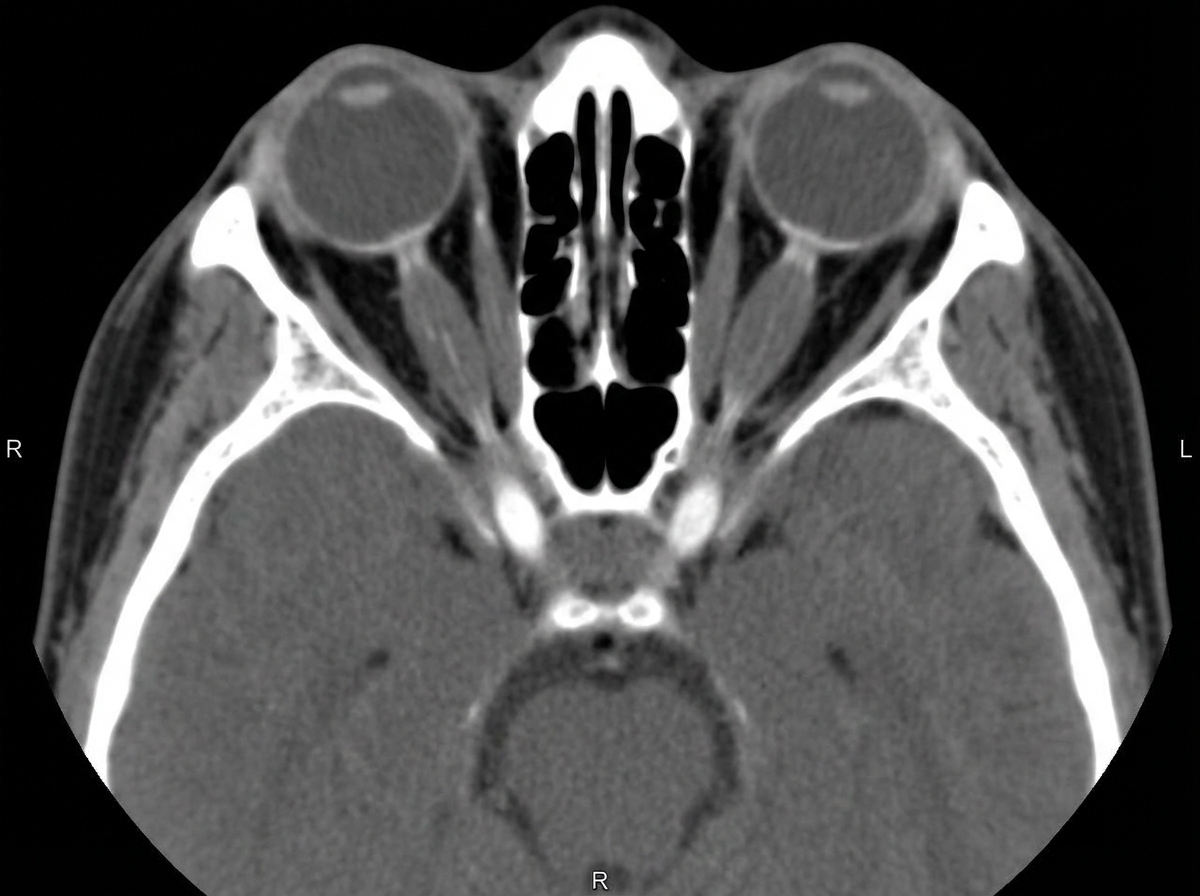
What is the most common cause of pulsating exophthalmos?
All of the following are features of orbital apex syndrome except?
Which of the following can cause pseudoproptosis?
What is the most common cause of metastatic tumors in the orbit in adult males?
Which part of the orbit commonly fractures in a blowout fracture?
What is the most common orbital tumor in children?
What is the most common metastatic orbital tumor in children?
All of the following statements are true about the given condition except?

Which cranial nerve is NOT involved in superior orbital fissure syndrome?
Which fungus is responsible for orbital cellulitis in a patient with diabetic ketoacidosis?
Explanation: **Explanation:** **Pulsating exophthalmos** is a clinical sign where the protrusion of the eyeball occurs in synchrony with the arterial pulse. **1. Why Caroticocavernous Fistula (CCF) is correct:** A CCF is an abnormal communication between the carotid artery and the cavernous sinus. Because the cavernous sinus is a venous structure directly connected to the ophthalmic veins, the high-pressure arterial blood is shunted into the low-pressure venous system of the orbit. This transmitted arterial pulsation causes the globe to pulsate. It is the **most common cause** of pulsating exophthalmos, often presenting with the classic triad of **pulsating proptosis, chemosis (conjunctival edema), and an audible orbital bruit.** **2. Analysis of Incorrect Options:** * **Orbital Varices:** These cause **intermittent proptosis** (triggered by Valsalva maneuvers or bending forward) rather than constant pulsations. * **Neurofibromatosis (Type 1):** While it can cause pulsating exophthalmos, it does so via a structural defect (sphenoid wing dysplasia) allowing brain pulsations to reach the orbit. It is a significant cause but less common than CCF. * **Cavernous Haemangioma:** This is the most common benign orbital tumor in adults, but it typically causes **slowly progressive, non-pulsatile axial proptosis.** **Clinical Pearls for NEET-PG:** * **Bruit:** In CCF, the patient often hears a "whooshing" sound, which disappears upon carotid artery compression. * **Dandy’s Sign:** Pulsations in CCF are better felt than seen. * **Trauma:** Head injury is the most common etiology for direct CCF. * **Investigation of Choice:** Digital Subtraction Angiography (DSA) is the gold standard for diagnosis.
Explanation: **Explanation:** **Orbital Apex Syndrome (OAS)** is a clinical constellation resulting from a lesion at the junction of the superior orbital fissure and the optic canal. To understand the features, one must recall the structures passing through this narrow "apex." **Why Enophthalmos is the Correct Answer:** Enophthalmos (posterior displacement of the eyeball) is **not** a feature of OAS. In fact, most space-occupying lesions at the orbital apex cause **Proptosis** (forward protrusion) due to the mass effect within the bony confines of the orbit. Enophthalmos is typically seen in orbital floor "blow-out" fractures or metastatic scirrhous carcinomas. **Analysis of Other Options:** * **Ophthalmoplegia (Option A):** Caused by involvement of the **III, IV, and VI cranial nerves** which pass through the superior orbital fissure. This results in paralysis of extraocular muscles. * **Ophthalmic nerve anaesthesia (Option C):** The **V1 (Ophthalmic) branch** of the Trigeminal nerve passes through the apex. Damage leads to loss of sensation over the forehead and a diminished corneal reflex. * **Amaurosis (Option D):** This refers to vision loss. The defining feature that distinguishes OAS from Superior Orbital Fissure Syndrome is the involvement of the **Optic Nerve (CN II)**, leading to decreased visual acuity or blindness. **High-Yield Clinical Pearls for NEET-PG:** * **Superior Orbital Fissure Syndrome (Rochon-Duvigneaud Syndrome):** Features are identical to OAS **except** the Optic Nerve is spared (Vision is normal). * **Cavernous Sinus Syndrome:** Similar to OAS but often involves the **V2 (Maxillary)** nerve and may present with Horner’s syndrome; it is often bilateral. * **Common Causes:** Fungal infections (Mucormycosis/Aspergillosis), Tolosa-Hunt Syndrome (idiopathic inflammation), and trauma.
Explanation: **Explanation:** **Pseudoproptosis** refers to a clinical condition where the eye appears prominent or protruding, mimicking true proptosis, but without an actual increase in orbital tissue volume or retrobulbar displacement. **Why Buphthalmos is correct:** In **Buphthalmos** (infantile glaucoma), the high intraocular pressure causes stretching of the immature, elastic sclera and cornea. This results in an **increased axial length** of the globe. Because the eyeball itself is physically larger, it occupies more space in the palpebral fissure, creating the illusion of proptosis despite the orbital contents being normal. Other common causes of pseudoproptosis include high axial myopia, contralateral enophthalmos, or lid retraction (as seen in early Graves' disease). **Why the other options are incorrect:** * **B. Meningioma of optic nerve:** This is a tumor that increases the volume of the orbital contents, causing **true axial proptosis**. * **C. Orbital cellulitis:** This involves inflammation and edema of the retrobulbar tissues, leading to **true proptosis** (often associated with painful restricted ocular movements). * **D. Dermoid cyst:** This is a space-occupying lesion (SOL) in the orbit that physically displaces the globe forward, resulting in **true proptosis**. **High-Yield Clinical Pearls for NEET-PG:** * **True Proptosis:** Caused by an increase in orbital volume (Tumors, Inflammation, Hemorrhage). * **Pseudoproptosis Checklist:** Always rule out **High Myopia**, **Buphthalmos**, **Lid Retraction**, and **Contralateral Ptosis/Enophthalmos**. * **Measurement:** Proptosis is measured using a **Hertel Exophthalmometer**. A reading >21mm or an asymmetry >2mm between eyes is significant.
Explanation: **Explanation:** Metastatic tumors to the orbit are relatively rare, accounting for approximately 1–13% of all orbital tumors. The primary site of origin varies significantly based on the patient's gender and age. **1. Why Lung Carcinoma is Correct:** In **adult males**, the most common primary site for orbital metastasis is **lung carcinoma**. This is followed by prostate cancer. Lung cancer is particularly aggressive and often presents with rapid-onset proptosis, pain, and ophthalmoplegia. Notably, in many cases of lung cancer, the orbital lesion is the first clinical sign of the systemic disease. **2. Analysis of Incorrect Options:** * **Breast Cancer (Option D):** This is the most common cause of orbital metastasis in **adult females** and the most common cause overall when both genders are combined. It often has a longer latency period between the primary diagnosis and orbital involvement. * **Neuroblastoma (Option C):** This is the most common cause of metastatic orbital tumors in **children**, typically presenting with characteristic "raccoon eyes" (periorbital ecchymosis). * **Hodgkin's Lymphoma (Option B):** While lymphoma can involve the orbit, it is usually considered a primary orbital lymphoproliferative disorder rather than a "metastatic" tumor from a distant solid organ site. **3. NEET-PG High-Yield Pearls:** * **Most common primary (Overall):** Breast cancer. * **Most common primary (Adult Males):** Lung cancer. * **Most common primary (Children):** Neuroblastoma. * **Commonest site of orbital metastasis:** The **orbital fat and extraocular muscles** (unlike intraocular metastases, which favor the highly vascular choroid). * **Enophthalmos:** While most tumors cause proptosis, **scirrhous breast carcinoma** can cause enophthalmos due to cicatrization (fibrosis) of orbital tissues.
Explanation: **Explanation:** A **blowout fracture** occurs when a blunt object (larger than the orbital rim, such as a tennis ball or fist) strikes the orbit. The impact increases intraorbital pressure, which is transmitted to the orbital walls. The fracture occurs at the weakest points to decompress the orbit. * **Why the Floor is Correct:** The **orbital floor** is the most common site of a blowout fracture. Specifically, the thin bone **medial to the infraorbital canal** (the maxillary bone) is the weakest area. When the floor fractures, orbital contents (fat and the inferior rectus muscle) can herniate into the maxillary sinus, leading to characteristic clinical signs like enophthalmos and diplopia on upward gaze. * **Medial Wall (Option D):** This is the **second most common** site of fracture (specifically the *lamina papyracea* of the ethmoid bone). While very thin, it is reinforced by the ethmoid air cell septa, making it slightly more resilient than the floor. * **Lateral Wall (Option A):** This is the **strongest** wall of the orbit, composed of the zygomatic bone and the greater wing of the sphenoid. It rarely fractures in isolation and usually requires high-velocity trauma (e.g., Malar fractures). * **Superior Wall/Roof (Option C):** This is generally strong and rarely involved, except in high-impact trauma or in children (where the frontal sinus is not yet fully pneumatized). **High-Yield Clinical Pearls for NEET-PG:** 1. **Clinical Triad:** Enophthalmos, Diplopia (due to entrapment of the Inferior Rectus), and Infraorbital nerve anesthesia. 2. **Radiology:** The **"Teardrop sign"** on a Caldwell or Waters view X-ray represents herniated orbital fat/muscle in the maxillary sinus. 3. **Investigation of Choice:** Non-contrast CT (NCCT) of the orbit with coronal cuts. 4. **Management:** Immediate surgery is indicated if there is a "White-eyed blowout fracture" (common in children) to prevent muscle necrosis.
Explanation: **Explanation:** **Rhabdomyosarcoma (Option A)** is the most common **primary** malignant orbital tumor in children. It is a mesenchymal tumor arising from undifferentiated pluripotent cells. Clinically, it presents as a characteristic "rapidly progressing proptosis" (often over days or weeks), which can mimic an inflammatory process like orbital cellulitis. The most common site is the superonasal quadrant, and the embryonal variant is the most frequent histological subtype. **Why other options are incorrect:** * **Retinoblastoma (Option B):** While it is the most common primary *intraocular* tumor in children, it is not primarily an orbital tumor. It only involves the orbit if there is extraocular extension (secondary involvement). * **Melanoma (Option C):** This is the most common primary intraocular malignancy in *adults*. It is extremely rare in the pediatric population and rarely presents as a primary orbital mass. * **Chloroma (Option D):** Also known as Granulocytic Sarcoma, this is an extramedullary manifestation of Acute Myeloid Leukemia (AML). While it is a significant cause of pediatric proptosis, it is considered a systemic/secondary involvement rather than the most common primary orbital tumor. **High-Yield Clinical Pearls for NEET-PG:** * **Most common benign orbital tumor in children:** Capillary Hemangioma (often presents with a "strawberry nevus"). * **Most common benign orbital tumor in adults:** Cavernous Hemangioma. * **Most common malignant orbital tumor in adults:** Secondary metastasis or Lymphoma. * **Rhabdomyosarcoma Management:** It is a medical emergency requiring urgent biopsy followed by radiotherapy and chemotherapy (VAC regimen). It is highly radiosensitive.
Explanation: **Explanation:** **Neuroblastoma** is the most common metastatic orbital tumor in the pediatric population. It typically originates from the adrenal medulla or the sympathetic chain. In children, orbital involvement occurs in approximately 10–20% of cases, often presenting with a characteristic "raccoon eyes" appearance (periorbital ecchymosis) due to the rapid growth of the tumor and subsequent necrosis/hemorrhage within the orbital tissues. **Analysis of Options:** * **Neuroblastoma (Correct):** It is the leading cause of orbital metastasis in children. It often presents with sudden onset proptosis and lid ecchymosis. * **Carcinoma of the lung:** This is the most common primary source for orbital metastasis in **adult males**, not children. * **Ewing’s sarcoma:** While it is the second most common metastatic orbital tumor in children, it is significantly less frequent than neuroblastoma. * **Ovarian sarcoma:** This is an extremely rare cause of orbital metastasis in any age group and is not a standard association for pediatric orbital disease. **Clinical Pearls for NEET-PG:** * **Most common primary orbital malignancy in children:** Rhabdomyosarcoma (presents with rapid proptosis). * **Most common benign orbital tumor in children:** Capillary Hemangioma. * **"Raccoon Eyes" Differential:** Neuroblastoma metastasis, Basal skull fracture (Panda sign), and Amyloidosis. * **Diagnostic Marker:** Urinary catecholamines (VMA/HVA) are often elevated in neuroblastoma. * **Radiology:** Look for "sunburst" periosteal reaction on CT scans of the orbit in metastatic neuroblastoma.
Explanation: ***It is associated with a good visual prognosis.*** - **Cryptophthalmos** has a **poor visual prognosis** due to severe underlying **ocular maldevelopment** and abnormal eyelid formation. - The absence of normal eyelid structures and potential **corneal opacity** significantly impair visual development and function. *It can be unilateral or bilateral.* - **Cryptophthalmos** can indeed present as either **unilateral** (affecting one eye) or **bilateral** (affecting both eyes). - The **bilateral form** is more commonly associated with **Fraser syndrome** and systemic abnormalities. *It is associated with systemic abnormalities.* - **Cryptophthalmos** is frequently part of **Fraser syndrome**, which includes **renal agenesis**, **syndactyly**, and **genital abnormalities**. - Other associated features may include **mental retardation**, **cleft lip/palate**, and **laryngeal stenosis**. *The underlying eye may show some reaction to light.* - Despite the **absence of eyelids** and **skin covering the eye**, the underlying **globe** may retain some **light perception**. - **Electroretinography** and **ultrasound** can help assess the functional status of the underlying ocular structures.
Explanation: ### Explanation **Superior Orbital Fissure Syndrome (SOFS)**, also known as Rochon-Duvigneaud syndrome, occurs due to lesions (trauma, tumors, or inflammation) involving the structures passing through the superior orbital fissure (SOF). **Why Option A is correct:** The **Olfactory nerve (CN I)** originates in the nasal mucosa and passes through the **cribriform plate** of the ethmoid bone to reach the anterior cranial fossa. It does not enter the orbit or pass through the superior orbital fissure. Therefore, it is never involved in SOFS. **Why the other options are incorrect:** The SOF is the gateway between the middle cranial fossa and the orbit. It transmits the following nerves, all of which would be affected in SOFS: * **3rd Nerve (Oculomotor):** Both superior and inferior divisions pass through the SOF. * **4th Nerve (Trochlear):** Passes through the SOF (outside the common tendinous ring). * **6th Nerve (Abducens):** Passes through the SOF (inside the common tendinous ring). * **5th Nerve (Trigeminal):** Specifically the **Ophthalmic division (V1)** via its branches: Lacrimal, Frontal, and Nasociliary nerves. **Clinical Pearls for NEET-PG:** 1. **Clinical Presentation:** Patients present with **ophthalmoplegia** (paralysis of CN III, IV, VI), ptosis, and anesthesia of the forehead/cornea (CN V1). 2. **SOFS vs. Orbital Apex Syndrome:** This is a frequent "trap" question. * **SOFS:** CN III, IV, V1, VI involved. **Vision is normal.** * **Orbital Apex Syndrome:** SOFS features **PLUS** involvement of the **Optic nerve (CN II)**. This leads to vision loss/RAPD. 3. **Cavernous Sinus Syndrome:** Presents similarly to SOFS but often includes the **Maxillary nerve (V2)** and sympathetic fibers (Horner's syndrome).
Explanation: **Explanation:** The correct answer is **Mucor**. **Why Mucor is correct:** Rhino-orbital-cerebral mucormycosis is a life-threatening opportunistic infection caused by fungi of the order Mucorales. It has a strong predilection for patients with **Diabetic Ketoacidosis (DKA)**. The underlying mechanism involves the fungus's affinity for acidic environments and high glucose levels. In DKA, the decreased pH causes the dissociation of iron from sequestering proteins (like transferrin); the resulting free iron acts as a potent growth factor for *Mucor*. These fungi are **angioinvasive**, leading to vascular thrombosis and tissue necrosis (black eschar). **Why the other options are incorrect:** * **Candida:** While common in immunocompromised states, it typically causes endophthalmitis (intraocular) rather than aggressive orbital cellulitis. * **Sporothrix:** Causes Sporotrichosis ("Rose gardener’s disease"), primarily a subcutaneous infection following traumatic inoculation; it does not typically present as acute orbital cellulitis in DKA. * **Penicillium:** Usually associated with pulmonary or systemic infections in HIV/AIDS patients (especially *Talaromyces marneffei*), not specifically linked to DKA-related orbital disease. **High-Yield Clinical Pearls for NEET-PG:** * **Hallmark Sign:** A black necrotic eschar on the turbinates or palate. * **Microscopy:** Look for **broad, ribbon-like, non-septate hyphae** with **right-angle (90°) branching**. (Contrast with Aspergillus: thin, septate, acute-angle branching). * **Treatment:** Medical emergency requiring aggressive surgical debridement and intravenous **Liposomal Amphotericin B**. * **Imaging:** Often shows "bone destruction" and orbital apex syndrome (involvement of CN III, IV, VI, and V1).
Orbital Anatomy
Practice Questions
Orbital Imaging Techniques
Practice Questions
Orbital Inflammations
Practice Questions
Orbital Infections
Practice Questions
Orbital Tumors: Primary
Practice Questions
Orbital Tumors: Secondary
Practice Questions
Vascular Lesions of Orbit
Practice Questions
Thyroid Orbitopathy
Practice Questions
Orbital Trauma
Practice Questions
Congenital Orbital Anomalies
Practice Questions
Orbital Surgery Techniques
Practice Questions
Enucleation and Exenteration
Practice Questions
Get full access to all questions, explanations, and performance tracking.
Start For Free