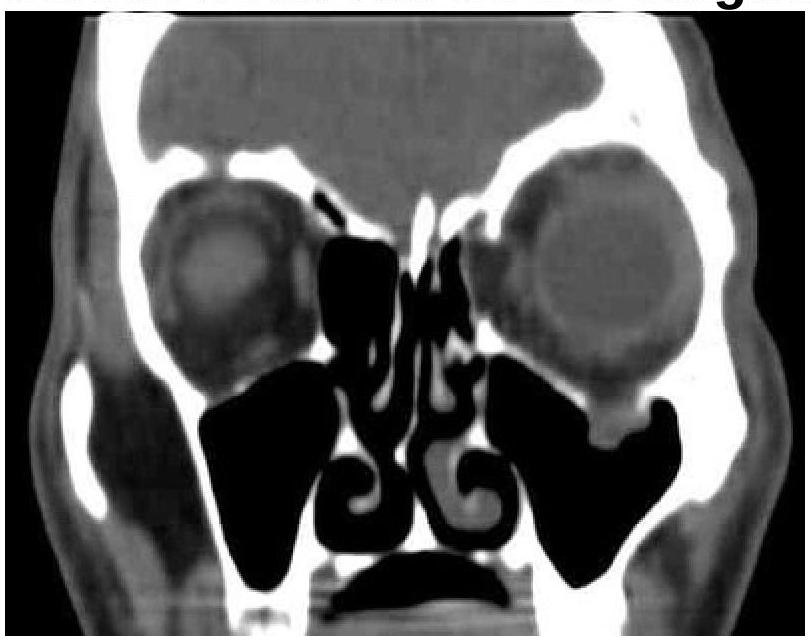
Blow out fracture of orbit commonly involves:-
Enophthalmos can be caused by all of the following EXCEPT:
A man presents 6 hrs after head injury complaining of mild proptosis and scleral hyperemia:
In blowout fractures, which of the following is seen?
The most common benign tumour of the orbit is
Which statement about inferior rectus is NOT true?
What is the diagnosis for a patient with unilateral proptosis with bilateral 6th nerve palsy with chemosis and euthyroid status?
The most common cause of proptosis in adults:-
All are causes of proptosis except:
A 30-year-old female presents with proptosis, pain, and vision loss in one eye. An MRI reveals an orbital mass. What is the most likely diagnosis?
Explanation: ***Floor is involved first*** - The **orbital floor** (composed mainly of the maxillary bone and portions of the palatine and zygomatic bones) is the most common site for a **blowout fracture** due to its relative weakness. - Trauma to the globe increases **intraorbital pressure**, causing the weakest part of the orbit, which is commonly the floor, to fracture and displace fragments into the maxillary sinus. *Medial wall is involved first as it is the thinnest* - While the **medial wall** (primarily the lacrimal bone and the lamina papyracea of the ethmoid bone) is indeed the **thinnest** portion of the orbit, it is structurally supported by the ethmoid air cells, making it less prone to fracture from direct globe impact compared to the floor. - Fractures of the medial wall can occur but are less common as the primary site of injury than the orbital floor. *The patient is not able to look up due to inferior rectus entrapment* - While **inferior rectus muscle** entrapment in orbital floor fractures does cause restricted upward gaze, this is a **complication** of the fracture, not what the fracture "commonly involves" anatomically. - The question asks which **anatomical structure** is commonly involved, not the clinical presentation. - Inferior rectus entrapment occurs in blowout fractures but doesn't answer which orbital wall is most commonly fractured. *Roof is involved first as it bears the maximum impact* - The **orbital roof** (formed by the frontal bone) is the strongest part of the orbit and rarely fractures from globe impact alone; it typically requires high-energy trauma to the forehead. - If the roof were involved, it would likely be due to direct impact to the supraorbital region, not from compression of the globe which usually affects the floor or medial wall.
Explanation: ***Horner's syndrome*** - **Horner's syndrome** is characterized by **ptosis**, **miosis**, and **anhidrosis** on the affected side. - While it can manifest with a mild degree of **apparent enophthalmos**, this is primarily due to the **ptosis creating an illusion** of globe retraction and **not true enophthalmos**. - It is caused by disruption of the **sympathetic nervous supply**, not by actual posterior displacement of the globe. *Cicatricial changes* - **Cicatricial changes** (scarring) within the orbit can cause **traction on the globe**, pulling it inward and resulting in **true enophthalmos**. - This scarring can occur following **trauma**, **inflammation**, or **surgery** affecting the orbital tissues. *Orbital floor fracture* - An **orbital floor fracture** typically leads to **enophthalmos** due to **herniation of orbital contents** (fat, muscle) into the maxillary sinus. - This involves a **structural defect** with increased orbital volume and loss of support for the globe. *Loss of orbital fat* - **Loss of orbital fat**, often seen in conditions like **Romberg's disease**, severe dehydration, or aging, causes the globe to sink backward. - This is due to a **reduction in volume supporting the globe**, resulting in **true enophthalmos**.
Explanation: ***Retro-orbital hematoma*** - The sudden onset of **proptosis** and **scleral hyperemia** within hours of a head injury is highly suggestive of bleeding behind the eye. - A **retro-orbital hematoma** causes increased orbital pressure, leading to the forward displacement of the eyeball (proptosis) and conjunctival injection (scleral hyperemia). *Caroticocavernous fistula* - This condition involves an abnormal communication between the carotid artery and the cavernous sinus, typically presenting with a **pulsatile proptosis** and a **bruit** over the eye. - While it can cause proptosis and hyperemia, its onset is usually not as acute as 6 hours post-trauma without being a direct major vessel injury in a recent trauma. *Pneumo-orbit* - A pneumo-orbit involves **air entering the orbit**, often following trauma that fractures an orbital wall communicating with a paranasal sinus. - Symptoms include **periorbital crepitus** and exophthalmos, but scleral hyperemia is not a primary or dominant feature. *Orbital cellulitis* - Orbital cellulitis is an **infection of the orbital tissues**, usually presenting with proptosis, ophthalmoplegia, pain, and fever. - This is an infectious process and would typically take longer than 6 hours to develop to such an extent after an acute trauma without an open wound or obvious contamination.
Explanation: ***Enophthalmos*** - A **blowout fracture** of the orbit typically involves the orbital floor or medial wall from direct trauma to the eye or periorbital region. - The fracture allows orbital contents (fat and muscle) to herniate into the maxillary sinus or ethmoid sinuses, **increasing orbital volume**. - This increased volume causes the eye to recede backward into the orbit, resulting in **enophthalmos** (sunken eye appearance). - **Key clinical features**: enophthalmos, diplopia (due to inferior rectus/medial rectus entrapment), restricted eye movements, infraorbital nerve hypoesthesia. *Exophthalmos* - **Exophthalmos** (proptosis) is forward protrusion of the eye, occurring when orbital volume is **decreased** or orbital contents are **increased** (e.g., thyroid eye disease, orbital tumors, orbital hemorrhage). - This is the **opposite** of enophthalmos and would not occur in a blowout fracture where orbital volume increases. *Bulbar hemorrhage* - **Subconjunctival hemorrhage** may occur as an associated finding from ocular trauma but is not a characteristic or defining feature of blowout fractures. - Many types of blunt ocular trauma can cause conjunctival hemorrhage without orbital fracture. *None of the options* - Incorrect because **enophthalmos** is the classic and characteristic finding of orbital blowout fractures.
Explanation: ***Haemangioma*** - **Cavernous haemangiomas** are the most frequently encountered benign tumors of the orbit in adults. - They are typically well-circumscribed, slow-growing vascular malformations that can cause **proptosis** and visual disturbances. *Optic nerve glioma* - While optic nerve gliomas are a benign tumor, they are less common than cavernous haemangiomas in the general orbital pathology. - These tumors specifically arise from the **optic nerve** and are more prevalent in children with **neurofibromatosis type 1 (NF1)**. *Meningioma* - **Orbital meningiomas** originate from the meninges surrounding the optic nerve or within the cranial cavity, extending into the orbit. - They are considered less common than haemangiomas and often present with a slower progression of symptoms like **proptosis** and **vision loss**. *Benign-mixed tumour* - This term usually refers to a **pleomorphic adenoma of the lacrimal gland**, which is the most common epithelial tumor of the lacrimal gland, but not the overall most common benign orbital tumor. - While benign, these tumors have a potential for malignant transformation and present with distinct symptoms related to the **lacrimal gland**.
Explanation: ***It is rarely involved in thyroid myopathy*** - This statement is **NOT true**. The **inferior rectus** muscle is, in fact, one of the **most commonly affected extraocular muscles** in **thyroid eye disease (Graves' ophthalmopathy)**. - Involvement of the inferior rectus leads to **restrictive myopathy**, causing **diplopia** (especially on upward gaze) and **hypotropia**. *It is connected to the lower lid by Lockwood's ligament* - The **inferior rectus** muscle sheath is indeed connected to the lower eyelid through expansions that contribute to **Lockwood's ligament**, providing support to the globe. - This connection ensures the **lower lid moves with the globe** during downward gaze. *Its yoke muscle is superior oblique* - The **yoke muscle** for the **inferior rectus** is the **superior oblique** of the contralateral eye, as they work together to produce downward and outward gaze. - Their combined action helps maintain **binocular vision** in specific gaze positions. *Actions are depression, adduction and extorsion* - The primary action of the **inferior rectus** muscle is **depression** (moving the eye downwards). - Its secondary actions are **adduction** (moving the eye inwards) and **extorsion** (rotating the top of the eye outwards).
Explanation: ***Cavernous sinus thrombosis*** - The combination of **unilateral proptosis**, **bilateral 6th nerve palsy**, and **chemosis** strongly suggests cavernous sinus thrombosis. - The cavernous sinus contains cranial nerves III, IV, V1, V2, and VI; thrombosis can lead to dysfunction of these nerves, particularly the **abducens nerve (VI)**, and venous congestion causing proptosis and chemosis. *Retinoblastoma* - Typically presents in **children** with **leukocoria**, strabismus, and sometimes proptosis. - It is a primary intraocular tumor and does not usually cause acute bilateral cranial nerve palsies and chemosis. *Thyroid ophthalmopathy* - Characterized by proptosis, lid retraction, and ophthalmoplegia, often with chemosis and conjunctival injection, but usually in the context of thyroid dysfunction (hyperthyroidism). - While it can cause proptosis, the presence of **bilateral 6th nerve palsy** and a **euthyroid** status makes cavernous sinus thrombosis more likely, as thyroid ophthalmopathy typically presents with restrictive ophthalmoplegia rather than isolated cranial nerve palsies. *Orbital pseudotumour* - Presents with painful proptosis, chemosis, and ophthalmoplegia, which can be unilateral or bilateral. - Differentiating features include a good response to **steroids** and usually **no associated cranial nerve palsies** in the pattern described.
Explanation: ***Thyroid eye disease*** - **Thyroid eye disease (TED)**, also known as Graves' ophthalmopathy, is the most common cause of **proptosis** in adults. - It results from an autoimmune process leading to inflammation and expansion of the **extraocular muscles** and orbital fat, which pushes the eyeball forward. *Preseptal cellulitis* - **Preseptal cellulitis** is an infection of the eyelid and periorbital tissue anterior to the orbital septum, typically presenting with **eyelid swelling** and redness. - While it causes periorbital swelling, it generally does not cause true **proptosis**, which is the anterior displacement of the eyeball itself. *Capillary hemangioma* - **Capillary hemangiomas** are benign vascular tumors and are the most common orbital tumor in **infancy and childhood**, not adults. - They typically cause proptosis in young children, often presenting as a **reddish-blue mass** that may increase in size with crying. *Orbital cellulitis* - **Orbital cellulitis** is a serious infection of the tissues within the orbit, posterior to the orbital septum, which can cause **proptosis**, pain, and ophthalmoplegia. - While it is a cause of proptosis, it is an **acute infectious process** and not the most common overall cause of proptosis in the adult population compared to thyroid eye disease.
Explanation: ***Retinal detachment*** - **Retinal detachment** is a condition where the retina separates from the underlying supportive tissue and does not cause proptosis. - Its primary symptoms include **flashes of light**, **floaters**, and a **curtain-like shadow** in the visual field. *Orbital cellulitis* - **Orbital cellulitis** is an infection of the fat and muscles around the eye, leading to inflammation and swelling. - This swelling can push the eye forward, causing **proptosis**. *Orbital tumor* - An **orbital tumor** is a mass growing within the orbit (eye socket), which occupies space and displaces the eyeball. - This displacement typically results in **proptosis**, often unilateral and progressive. *Graves' disease* - **Graves' disease** (or Graves' ophthalmopathy) involves inflammation and swelling of the extraocular muscles and orbital fat due to autoimmune processes. - This increased volume within the orbit directly causes **proptosis** and is often bilateral.
Explanation: ***Orbital pseudotumor*** - Orbital pseudotumor, also known as **idiopathic orbital inflammation**, often presents with **unilateral proptosis**, vision loss, and pain due to inflammatory masses in the orbit, as described. - Diagnosis often involves excluding other conditions like infection or malignancy, and an MRI can reveal a **diffuse or localized orbital mass**, mimicking other orbital lesions. *Orbital cellulitis* - This condition typically presents with signs of **acute infection**, such as erythema, warmth, severe pain, fever, and leukocytosis, which are not mentioned here. - While it can cause proptosis, the presence of an **"orbital mass"** on MRI, rather than diffuse inflammation or abscess, makes pseudotumor a more likely diagnosis. *Graves' ophthalmopathy* - Graves' ophthalmopathy usually involves **bilateral proptosis**, although it can be asymmetric, and is often associated with other signs of Graves' disease like hyperthyroidism, lid lag, and retraction. - The MRI in Graves' ophthalmopathy typically shows **enlargement of the extraocular muscles**, particularly the recti, rather than a distinct orbital mass. *Optic glioma* - Optic gliomas are **tumors of the optic nerve**, most commonly seen in children and associated with neurofibromatosis type 1. - While they can cause proptosis and vision loss, an MRI would specifically show a **fusiform enlargement of the optic nerve**, not a general "orbital mass," and it's less common in a 30-year-old without other predisposing factors.
Orbital Anatomy
Practice Questions
Orbital Imaging Techniques
Practice Questions
Orbital Inflammations
Practice Questions
Orbital Infections
Practice Questions
Orbital Tumors: Primary
Practice Questions
Orbital Tumors: Secondary
Practice Questions
Vascular Lesions of Orbit
Practice Questions
Thyroid Orbitopathy
Practice Questions
Orbital Trauma
Practice Questions
Congenital Orbital Anomalies
Practice Questions
Orbital Surgery Techniques
Practice Questions
Enucleation and Exenteration
Practice Questions
Get full access to all questions, explanations, and performance tracking.
Start For Free