A blow out fracture of the orbit commonly produces what?
A patient presents with proptosis that increases when bending down. What is the most likely diagnosis?
Which of the following is true about orbital cellulitis?
A 15-year-old female presents with a painless, gradually increasing mass located at the superotemporal orbital rim (upper outer quadrant of the orbit), present for the past 10 years. On examination, the mass is non-tender and slowly progressive. What is the most likely diagnosis?
A 25-year-old lady presents with development of proptosis on Valsalva maneuver. Diagnosis is:
A 30-year-old woman presents with painful eye swelling. Based on the clinical photograph shown, the most likely diagnosis is:

The sterilization method shown here is known as: (DNB Pattern 2018)

What is the most likely complication of the condition shown in the image below?

An orbital fracture caused by a ping pong ball is:
Blowout fracture of the orbit is characterized by all, except
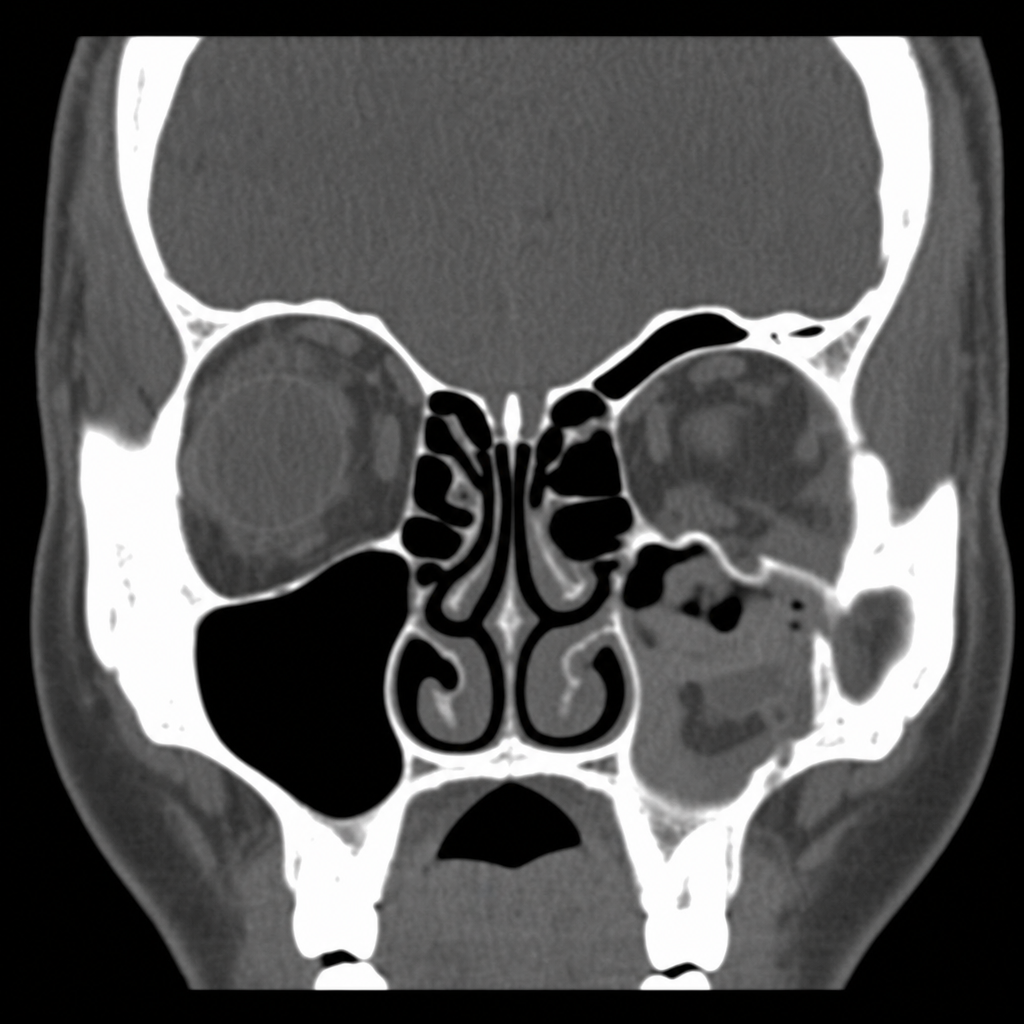
Explanation: **Explanation:** A **blow-out fracture** occurs when a blunt object (larger than the orbital rim, such as a tennis ball or fist) strikes the orbit. The impact causes a sudden increase in intraorbital pressure, which is transmitted to the orbital walls. The fracture occurs at the weakest points of the orbit to "decompress" the cavity. **1. Why the Correct Answer is Right:** The **orbital floor** is the most common site of a blow-out fracture because it is composed of the thin maxillary bone (specifically the posteromedial portion). The second most common site is the medial wall (lamina papyracea of the ethmoid bone). **2. Analysis of Incorrect Options:** * **A & C (Nasal Septum/Bones):** While nasal fractures can occur concurrently in midfacial trauma (Le Fort fractures), they are not the defining feature of an isolated orbital blow-out fracture, which specifically involves the internal walls while the orbital rim remains intact. * **B (Retinal Hemorrhage):** While blunt trauma can cause ocular injuries like commotio retinae or hyphema, a "blow-out fracture" refers specifically to the bony structural collapse of the orbit. **3. High-Yield Clinical Pearls for NEET-PG:** * **Clinical Triad:** Enophthalmos (sunken eye), Diplopia (double vision), and Infraorbital anesthesia (due to involvement of the infraorbital nerve). * **Muscle Entrapment:** The **Inferior Rectus** muscle is most commonly entrapped, leading to restricted upward gaze. * **Radiology:** The **"Teardrop Sign"** on a Water’s view X-ray or CT scan represents herniated orbital fat and muscle into the maxillary sinus. * **Management:** Immediate treatment includes ice packs and nasal decongestants (patients must be told **not to blow their nose** to prevent orbital emphysema). Surgical repair is indicated if diplopia persists or enophthalmos is >2mm.
Explanation: ***Orbital Varices***- This condition involves abnormal orbital veins that swell when orbital venous pressure increases, hence the classic finding of worsening proptosis or **intermittent proptosis** upon bending down or performing the **Valsalva maneuver**.- The proptosis is usually non-pulsatile and often unilateral, resulting from passive congestion of the venous malformation.*Thyroid Eye Disease*- Proptosis in **Thyroid Eye Disease** (**Graves' ophthalmopathy**) is typically caused by chronic inflammation and expansion of **extraocular muscles** and orbital fat, making the proptosis constant.- The severity of proptosis is usually stable and does not fluctuate rapidly or dramatically with maneuvers that increase venous pressure.*Cavernous Sinus Thrombosis*- This condition presents acutely with constant, painful, and progressive proptosis accompanied by **ophthalmoplegia** (due to multiple cranial nerve palsies) and systemic signs like high fever and severe headache.- The clinical picture is typically severe and life-threatening, involving signs of inflammation and infection, not positional congestion.*Orbital Cellulitis*- **Orbital cellulitis** is an acute infectious process characterized by constant, painful, and typically unilateral proptosis, along with severe eyelid swelling (*chemosis*) and **systemic symptoms** (fever).- Proptosis in this condition is fixed and progressive, driven by inflammation and pus formation, and not prone to intermittent worsening simply upon bending down.
Explanation: ***Ethmoid sinusitis is the most common etiology*** - Orbital cellulitis most frequently results from the spread of infection from adjacent structures, with the **ethmoid sinus** being the most common source due to the thin **lamina papyracea** separating it from the orbit. - It is almost always a serious complication of **acute bacterial sinusitis**, necessitating urgent aggressive management. *It is present anterior to the orbital septum* - Cellulitis **anterior to the orbital septum** is termed **preseptal** or **periorbital cellulitis**, which is a less severe condition. - Orbital cellulitis is characterized by infection and inflammation extending **posterior to the orbital septum**, affecting the deep orbital soft tissues. *Treated effectively with topical antibiotics* - Topical antibiotics are wholly inadequate for managing such a severe, deep-seated infection with risk of intracranial spread. - Treatment for orbital cellulitis requires immediate initiation of **systemic broad-spectrum intravenous antibiotics**. *Presents with proptosis, orbital swelling, normal pupil, and extraocular movements* - Orbital cellulitis typically causes severe pain, **proptosis**, **chemosis**, and crucially, **restricted and painful extraocular movements** (ophthalmoplegia). - The presence of restricted Extraocular Movements (EOM) and often an **Afferent Pupillary Defect (APD)** differentiates orbital cellulitis from preseptal cellulitis.
Explanation: ***Dermoid cyst*** - This diagnosis is strongly suggested by the classic presentation of a **painless**, **slowly progressive** mass in a young patient, located near the **superotemporal orbital rim** (lateral to the lateral canthus). - Dermoid cysts are **congenital choristomas** formed by sequestration of ectoderm along embryonic lines of closure, often presenting fixed to the periosteum. *Capillary hemangioma* - These tumors typically present in infancy and exhibit characteristic rapid growth followed by **spontaneous involution** (not slow progression over 10 years). - They are usually soft, compressible, and display color changes (red/blue), unlike the description of a firm, non-tender mass. *Lacrimal gland tumor* - Primary lacrimal gland epithelial tumors are rare in children and primarily occur in **adults** (40-60 years). - They typically cause axial proptosis and globe displacement (inferonasal) due to growth within the **lacrimal fossa**, usually presenting with symptoms related to pressure or pain if malignant. *Epidermoid cyst* - While also slow-growing and painless, epidermoid cysts are less likely than dermoid cysts to be found in the deep subcutaneous tissue fixed to the periosteum near the lateral canthus. - Epidermoid cysts contain only stratified squamous epithelium and keratin, while **dermoid cysts** also contain skin appendages (hair follicles, sebaceous glands).
Explanation: ***Orbital varix*** - An **orbital varix** is a congenital venous malformation that typically presents with **intermittent proptosis** that worsens with maneuvers that increase venous pressure, such as the **Valsalva maneuver**. - The patient's age and the clear history of proptosis on Valsalva are classic signs of this condition. *Pulsating proptosis* - **Pulsating proptosis** is usually caused by an **arteriovenous malformation** or a **carotid-cavernous fistula**, characterized by a vascular rumble and thrill. - While proptosis can worsen with Valsalva in some vascular lesions, the key differentiating feature here is the *absence of pulsation* in the description. *Optic nerve glioma* - **Optic nerve glioma** typically presents with **slowly progressive proptosis** and **vision loss**, often without significant fluctuation. - It does not characteristically manifest as proptosis dependent on the Valsalva maneuver. *Rhabdomyosarcoma* - **Rhabdomyosarcoma** is a **highly aggressive malignant tumor** of the orbit, most common in children, presenting with **rapidly progressive proptosis**. - It would not typically present with intermittent proptosis linked to the Valsalva maneuver.
Explanation: ***Acute dacryocystitis*** - The image shows a **painful, erythematous, and swollen area** at the medial canthus below the **medial palpebral ligament**, characteristic of acute inflammation of the lacrimal sac. - This condition results from **obstruction of the nasolacrimal duct**, leading to bacterial infection and abscess formation in the lacrimal sac. *Lacrimal gland carcinoma* - This condition typically presents as a **slow-growing mass** in the upper outer quadrant of the orbit, often causing **proptosis and displacement** of the globe, rather than acute inflammation at the medial canthus. - While it can be painful, the **acute inflammatory signs** and specific location seen in the image are not typical of lacrimal gland carcinoma. *Orbital cellulitis* - Orbital cellulitis involves inflammation and infection of the **orbital tissues posterior to the orbital septum**, causing generalized swelling of the eyelids, proptosis, pain with eye movements, and potentially vision loss. - The localized swelling near the medial canthus with obvious inflammatory signs is more consistent with a dacryocystitis, whereas orbital cellulitis would involve a broader area of swelling and often more systemic symptoms. *Hordeolum externum* - A hordeolum externum, or stye, is an acute **localized infection of a hair follicle or sebaceous gland** (gland of Zeis or Moll) along the eyelid margin. - The swelling seen in the image is much larger and more medially located, involving the lacrimal sac area, rather than being confined to the eyelid margin.
Explanation: ***Tubal occlusion by hysteroscopic sterilization*** - The image depicts a device inserted into the **fallopian tube** via a hysteroscopic approach to cause permanent **occlusion**. - This method involves placing small coils that induce a benign inflammatory reaction, leading to **fibrosis** and blockage of the tubes, preventing spermatozoa from reaching the ovum. *Tubal ligation* - This method involves **surgically cutting, tying, blocking, or sealing** the fallopian tubes, typically performed via laparoscopy or minilaparotomy. - The image does not show a surgical incision or a ligated/cut segment of the fallopian tube. *Vasectomy* - **Vasectomy** is a male sterilization procedure involving the cutting or sealing of the **vas deferens** to prevent sperm from entering the seminal fluid. - The image clearly shows a portion of the female reproductive system, specifically the uterus and fallopian tube. *Intrauterine device (IUD) insertion* - An **IUD** is a small, T-shaped device inserted into the **uterus** to prevent pregnancy, either by releasing copper or hormones. - The device in the image is placed inside the fallopian tube, not within the main uterine cavity, and its morphology does not resemble a typical IUD.
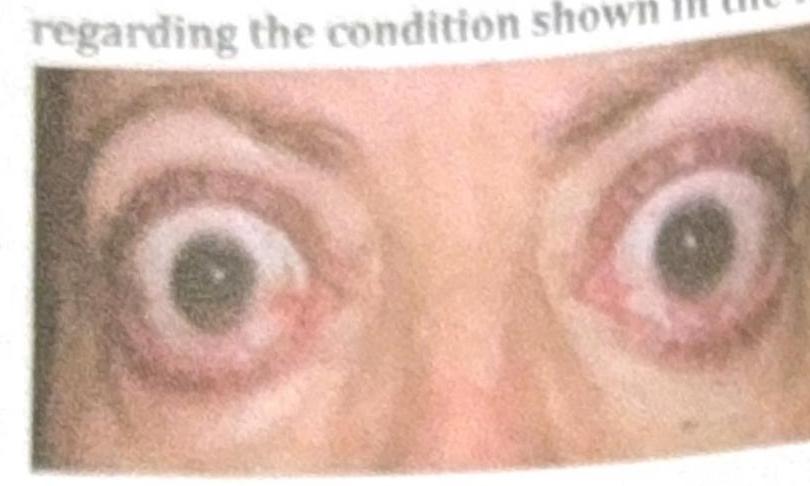
Explanation: ***Exposure Keratitis*** - The image shows **proptosis** (exophthalmos) of the right eye, where the eyeball protrudes forward. This condition often leads to incomplete eyelid closure (lagophthalmos). - **Exposure keratitis** occurs when the cornea is inadequately covered by the eyelids, leading to drying and damage due to constant exposure to air and environmental factors. *Difficulty in eye movement* - While **proptosis** can sometimes be associated with restricted eye movements (e.g., in severe Graves' ophthalmopathy due to muscle swelling), it is not the **most likely direct complication** of the exposure itself. - The image primarily depicts the physical displacement of the globe, which predisposes to corneal issues, not necessarily oculomotor dysfunction as the primary complication. *Cataract* - **Cataracts** are opacities of the lens and are typically associated with aging, trauma, or certain systemic conditions (e.g., diabetes, steroid use). - They are not a direct or common complication of **proptosis** or the resulting **exposure of the ocular surface**. *Glaucoma* - **Glaucoma** is a group of conditions characterized by damage to the optic nerve, often due to elevated intraocular pressure. - While severe **proptosis** leading to orbital congestion can theoretically increase intraocular pressure, it is not the most direct or prevalent complication compared to **exposure keratitis**, which is a direct consequence of inadequate globe protection.
Explanation: ***Blow out fracture*** - A **blow-out fracture** occurs when an object, like a ping pong ball, impacts the orbital rim and compresses the globe, causing a sudden increase in intraorbital pressure. - This pressure then fractures the weakest parts of the orbit, typically the **orbital floor** (into the maxillary sinus) or the **medial wall** (into the ethmoid sinus), while sparing the orbital rim. *Blow in fracture* - A **blow-in fracture** involves a direct impact to the orbital rim, causing the rim bones to be pushed inward. - This type of fracture often results from a **smaller, high-velocity object** directly hitting the bone and forcing the orbital contents inward. *Orbital fracture* - **Orbital fracture** is a general term that encompasses any break in the bones surrounding the eye socket. - While a blow-out fracture is a type of orbital fracture, this option is too broad and does not specifically describe the mechanism of injury by a ping pong ball. *Compound fracture* - A **compound fracture** (also known as an open fracture) is one where the broken bone penetrates the skin, creating an open wound. - This term describes the **integrity of the skin** around the fracture, not the mechanism of the orbital injury.
Explanation: ***Exophthalmos*** - **Exophthalmos** (protrusion of the eyeball) occurs when there is an increase in orbital contents, such as from a tumor or edema behind the globe. - In a **blowout fracture**, the orbital contents herniate into the adjacent sinus, leading to an increase in orbital volume, which typically causes **enophthalmos** (recession of the eyeball), not exophthalmos, as the globe sinks into the enlarged bony cavity. *Tear drop sign* - The **tear drop sign** is a classic radiological finding on sinus X-rays or CT scans in blowout fractures. - It represents the **herniated orbital tissue** (fat and/or muscle) projecting into the maxillary sinus, resembling a teardrop. *Diplopia* - **Diplopia** (double vision) is a common symptom of blowout fractures, especially on upward or downward gaze. - It results from the **entrapment** of an extraocular muscle (most commonly the inferior rectus) in the fractured bone, limiting its movement. *Forced duction test* - The **forced duction test** is a clinical maneuver used to assess the presence of mechanical restriction of eye movement. - A positive forced duction test, indicating mechanical restriction due to muscle entrapment, is a characteristic finding in blowout fractures and helps differentiate it from nerve palsies.
Orbital Anatomy
Practice Questions
Orbital Imaging Techniques
Practice Questions
Orbital Inflammations
Practice Questions
Orbital Infections
Practice Questions
Orbital Tumors: Primary
Practice Questions
Orbital Tumors: Secondary
Practice Questions
Vascular Lesions of Orbit
Practice Questions
Thyroid Orbitopathy
Practice Questions
Orbital Trauma
Practice Questions
Congenital Orbital Anomalies
Practice Questions
Orbital Surgery Techniques
Practice Questions
Enucleation and Exenteration
Practice Questions
Get full access to all questions, explanations, and performance tracking.
Start For Free