Axial myopia is defined as:
What is the treatment of choice for anisoeikonia?
Which of the following prescriptions is an example of simple myopic astigmatism?
Facultative hypermetropes manage to see because of:
Cylindrical glass is used for which refractive error?
The center of a biconvex lens is called what?
A child presents with difficulty in seeing the blackboard in school, and teachers report frequent eye squeezing. What is the most probable cause?
Excessive accommodation causes which of the following?
Objective assessment of the refractive state of the eye is termed?
What is the SI unit of the luminous intensity of a point light source?
Explanation: **Explanation:** Myopia (nearsightedness) occurs when the parallel rays of light coming from infinity are focused in front of the retina when accommodation is at rest. This refractive error can be classified based on the underlying anatomical cause: **1. Why Option A is Correct:** **Axial Myopia** is the most common clinical form. It occurs when the **anteroposterior (AP) length** of the eyeball is longer than normal, while the refractive power of the cornea and lens remains within normal limits. * **High-Yield Fact:** Every **1 mm increase** in axial length results in approximately **-3 Diopters** of myopia. **2. Why the Other Options are Incorrect:** * **Option B (Curvaturational Myopia):** This occurs when the curvature of the cornea or lens is increased (steeper). Examples include **Keratoconus** or Lenticonus. * **Option C (Positional Myopia):** This is caused by the **anterior displacement** of the crystalline lens (e.g., anterior subluxation), which increases the effective refractive power of the eye. * **Option D (Index Myopia):** This occurs due to an increase in the refractive index of the lens, typically seen in **nuclear sclerosis** (early stages of senile cataract). This often results in "second sight" in elderly patients. **Clinical Pearls for NEET-PG:** * **Normal Axial Length:** Approximately **24 mm** at birth. * **Pathological Myopia:** Also known as Degenerative Myopia, it is characterized by an axial length **>26.5 mm** and refractive error **>-6D**, often associated with posterior staphyloma and retinal lattice degeneration. * **Treatment of Choice:** Concave (minus) lenses, which diverge light rays to focus them precisely on the retina.
Explanation: **Explanation:** **Anisoeikonia** is a condition where there is a significant difference in the size and shape of the ocular images perceived by the two eyes. It most commonly occurs as a result of **anisometropia** (a difference in refractive power between the eyes). **Why Contact Lenses are the Treatment of Choice:** According to **Knapp’s Rule**, the magnification produced by a lens depends on its distance from the eye's nodal point. In refractive anisometropia, spectacles increase the image size disparity because they are placed at a distance from the cornea (vertex distance). **Contact lenses** are the treatment of choice because they are placed directly on the cornea, minimizing the vertex distance to near zero. This significantly reduces the magnification difference between the two eyes, allowing for better binocular single vision and fusion. **Analysis of Incorrect Options:** * **A. Orthoptic exercises:** These are used to treat binocular vision anomalies like convergence insufficiency but cannot correct the physical image size disparity inherent in anisoeikonia. * **B. Spectacles:** These often worsen anisoeikonia in refractive cases due to the magnification effect. Generally, a difference of >3 Diopters in spectacles is poorly tolerated by patients. * **C. Surgery:** While refractive surgery (like LASIK) can correct the underlying anisometropia, contact lenses remain the standard non-invasive "treatment of choice" for managing the optical disparity. **High-Yield Clinical Pearls for NEET-PG:** * **Tolerance Limit:** The human brain can typically tolerate up to a **3–5%** difference in image size. * **Knapp’s Rule:** States that for *axial* anisometropia, spectacles placed at the anterior focal point of the eye produce images of equal size. However, in clinical practice, most anisometropia is *refractive*, making **contact lenses** the superior choice. * **Anisophoria:** A subtype of anisometropia where the patient experiences different prismatic effects in different gazes when wearing spectacles.
Explanation: In **Simple Myopic Astigmatism**, one principal meridian is emmetropic (focuses light exactly on the retina), while the other is myopic (focuses light in front of the retina). ### Why "Rx will be plano" is correct To correct this condition, we use a **cylindrical lens**. A prescription for simple myopic astigmatism is written in the format: **Plano / -X.XX DC @ Axis**. * The **Plano** component indicates that one meridian requires no correction (it is emmetropic). * The **minus cylinder** corrects the specific myopic meridian. Therefore, among the options provided, the presence of a "Plano" sphere is the defining characteristic of a "Simple" astigmatism. ### Explanation of Incorrect Options * **Rx (+) sphere:** This would indicate **Hypermetropia**. If combined with a cylinder, it could be Simple Hypermetropic or Compound Hypermetropic Astigmatism. * **Rx (-) sphere:** This indicates **Myopia**. If a sphere and cylinder are both present and have the same sign (e.g., -2.00 DS / -1.00 DC), it is **Compound Myopic Astigmatism**. * **(-) (+) on axes:** This describes **Mixed Astigmatism**, where one meridian is myopic and the other is hypermetropic. ### High-Yield Clinical Pearls for NEET-PG 1. **Sturm’s Conoid:** The geometric configuration of light rays in astigmatism. In Simple Myopic Astigmatism, the **front focal line** is in front of the retina, and the **back focal line** is on the retina. 2. **Rule of Thumb:** * **Simple:** One focal line on the retina (requires Plano sphere). * **Compound:** Both focal lines in front or behind the retina (requires Sphere + Cylinder). * **Mixed:** Focal lines straddle the retina (one in front, one behind). 3. **Treatment:** Cylindrical lenses are the mainstay. Ensure you check if the astigmatism is "With-the-rule" (vertical meridian steepest) or "Against-the-rule" (horizontal meridian steepest).
Explanation: **Explanation:** Hypermetropia (farsightedness) is a refractive error where parallel rays of light come to a focus behind the retina. To bring this focus forward onto the retina, the eye must increase its refractive power. **Why Accommodation is Correct:** Hypermetropia is classified into **Latent** (corrected by physiological ciliary tone) and **Manifest**. Manifest hypermetropia is further divided into: 1. **Facultative Hypermetropia:** This is the portion of the refractive error that can be overcome by the patient’s own **active accommodation**. By contracting the ciliary muscle, the crystalline lens becomes more convex, increasing its dioptric power and shifting the focal point onto the retina. 2. **Absolute Hypermetropia:** This is the portion that cannot be overcome by accommodation (often due to high refractive error or age-related decline in accommodative amplitude). **Analysis of Incorrect Options:** * **B. Ciliary muscle contraction:** While accommodation *involves* ciliary contraction, "Accommodation" is the complete physiological process (including lens shape change) and is the standard clinical term for this mechanism. * **A. Wrinkling of the eye:** This is not a physiological mechanism for refractive correction. * **D. Use of cycloplegics:** Cycloplegics (like Atropine or Cyclopentolate) paralyze the ciliary muscle and **abolish** accommodation. Using them would actually unmask facultative hypermetropia, making the vision blurrier. **High-Yield Clinical Pearls for NEET-PG:** * **Total Hypermetropia** = Latent + Manifest (Facultative + Absolute). * **Cycloplegic Refraction:** Essential in children to uncover "Latent" hypermetropia which is otherwise hidden by strong ciliary tone. * **Clinical Presentation:** Facultative hypermetropes often present with **asthenopia** (eye strain) and headaches because they are constantly accommodating to maintain clear vision. * **Presbyopia connection:** As a patient ages, facultative hypermetropia gradually converts into absolute hypermetropia due to the loss of accommodative amplitude.
Explanation: ### Explanation **Correct Answer: D. Astigmatism** **1. Why Astigmatism is the Correct Answer:** Astigmatism is a refractive error where the eye does not focus light evenly on the retina due to an irregular curvature of the cornea or lens (different radii of curvature in different meridians). Instead of a single focal point, light forms two focal lines. **Cylindrical lenses** have power in only one meridian; they are used to correct this by focusing light along a specific axis to collapse these two focal lines into a single point on the retina. **2. Why Other Options are Incorrect:** * **A. Presbyopia:** This is an age-related loss of accommodation due to decreased elasticity of the crystalline lens. It is corrected using **simple convex (plus) lenses** for near work or bifocals. * **B. High Myopia:** Myopia (nearsightedness) occurs when the eyeball is too long or the refractive power is too high. It is corrected using **concave (minus) spherical lenses**. "High" myopia simply refers to a high dioptric power, not a change in lens type. * **C. Hypermetropia:** Farsightedness occurs when the eyeball is too short or refractive power is too low. It is corrected using **convex (plus) spherical lenses**. **3. High-Yield Clinical Pearls for NEET-PG:** * **Sturm’s Conoid:** The configuration of rays formed by an astigmatic surface. The distance between the two focal lines is the **Interval of Sturm**. * **Jackson’s Cross Cylinder (JCC):** A diagnostic tool used to refine the strength and axis of the cylinder during refraction. * **Toric Lenses:** These are used for correcting astigmatism in contact lenses or specialized Intraocular Lenses (IOLs). * **Simple Astigmatism:** One focal line on the retina, the other in front or behind. * **Compound Astigmatism:** Both focal lines are either in front of (myopic) or behind (hypermetropic) the retina.
Explanation: **Explanation:** The **Optical Center** is defined as a point on the principal axis of a lens through which a ray of light passes without undergoing any net deviation. In a thin biconvex lens, this point is located exactly at the geometric center of the lens. When light passes through the optical center, the incident ray and the emergent ray are parallel, making the lateral displacement negligible. **Analysis of Options:** * **Focal Point (A):** This is the specific point on the principal axis where parallel rays of light converge (in a convex lens) or appear to diverge from (in a concave lens) after passing through the lens. * **Epicenter (C):** This is a non-ophthalmic term, typically used in seismology to describe the point on the Earth's surface directly above an earthquake's focus. * **Focal Distance (D):** Also known as focal length, this is the linear distance between the optical center and the focal point. **High-Yield Clinical Pearls for NEET-PG:** * **Nodal Points:** In the human eye (a thick lens system), there are two nodal points ($N_1$ and $N_2$). For practical purposes, they are often treated as a single point located near the posterior surface of the crystalline lens. * **Prismatic Effect:** If a patient looks through a part of the lens other than the optical center (decentration), a "prismatic effect" occurs, leading to image displacement (Prentice’s Rule: $P = c \times F$). * **Optical Axis vs. Visual Axis:** The optical axis connects the centers of curvature of all refracting surfaces, while the visual axis connects the object of regard to the fovea, passing through the nodal points.
Explanation: **Explanation:** The clinical presentation of a child struggling to see the blackboard (distant vision) while maintaining normal near vision is the hallmark of **Myopia (Nearsightedness)**. In myopia, the anteroposterior diameter of the eyeball is relatively long or the refractive power of the eye is too strong, causing parallel rays of light to focus **in front of the retina**. The "eye squeezing" mentioned is a classic clinical sign known as the **stenopeic slit mechanism**. By squinting, the child reduces the palpebral fissure width, which acts like a pinhole, decreasing the size of the blur circle on the retina and temporarily improving distance clarity. **Analysis of Incorrect Options:** * **Hypermetropia:** These patients typically struggle more with near tasks (reading) than distance. Children often compensate using their strong accommodative reserve, which can lead to accommodative asthenopia or esotropia rather than simple distance blurring. * **Presbyopia:** This is an age-related loss of accommodation (usually occurring after age 40) affecting near vision. It is physiologically impossible in a school-aged child. * **Astigmatism:** While it can cause blurred vision at all distances and eye straining, the specific difficulty with the "blackboard" (distance) in a school setting most classically points toward simple myopia. **Clinical Pearls for NEET-PG:** * **School Myopia:** Typically appears between ages 5–15 years. * **Stenopeic Pinhole Test:** If visual acuity improves with a pinhole, the cause of blurring is a **refractive error**. * **Treatment:** Myopia is corrected using **concave (minus) lenses**, which diverge incoming light rays to focus them precisely on the retina. * **High-Yield Association:** Pathological myopia is associated with retinal lattice degeneration and increased risk of retinal detachment.
Explanation: **Explanation:** **1. Why Pseudomyopia is Correct:** Accommodation is the process by which the ciliary muscle contracts, relaxing the zonules and allowing the crystalline lens to become more convex (increasing its refractive power). **Excessive or sustained accommodation** (often due to prolonged near work or ciliary muscle spasm) results in the lens remaining in a high-power state even when viewing distant objects. This causes light rays to focus in front of the retina, mimicking the symptoms of myopia (blurred distance vision). Because this is a functional refractive error caused by ciliary spasm rather than a structural change in axial length, it is termed **Pseudomyopia**. **2. Why Other Options are Incorrect:** * **Hypermetropia:** This is a refractive error where the eyeball is too short or the lens too weak. Accommodation is actually the *compensatory mechanism* used to correct hypermetropia, not the result of excessive accommodation. * **Myopia:** True myopia is typically axial (eyeball too long) or index-based. While the symptoms are similar, true myopia persists even after the ciliary muscle is relaxed. * **Pseudohypermetropia:** This is not a standard clinical term related to excessive accommodation. **3. Clinical Pearls for NEET-PG:** * **Diagnosis:** Pseudomyopia is confirmed when the refractive error disappears after the administration of a potent **cycloplegic** (e.g., Atropine or Homatropine), which paralyzes the ciliary muscle. * **Drug of Choice:** For refraction in children (who have high accommodative reserves), **Atropine** is the gold standard cycloplegic to prevent over-diagnosis of myopia. * **Ciliary Spasm:** Also known as "Accommodation Spasm," it is frequently seen in students or individuals with excessive digital screen time. * **Rule of Thumb:** Always perform a cycloplegic refraction if you suspect a mismatch between a patient's symptoms and their static refractive state.
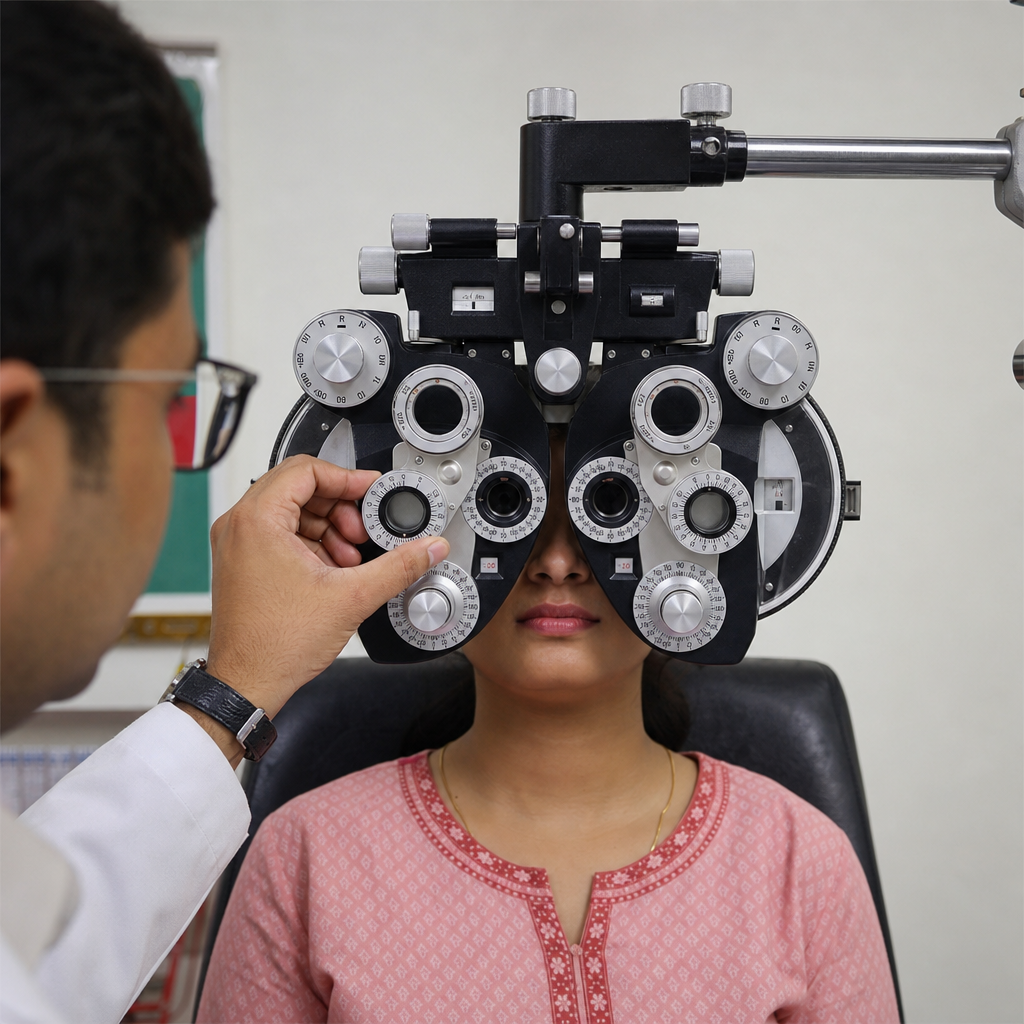
Explanation: **Explanation:** **Retinoscopy (Option A)** is the correct answer because it is the primary **objective** method used to measure the refractive power of the eye. Unlike subjective refraction, which relies on patient feedback ("Which is better, 1 or 2?"), retinoscopy utilizes a retinoscope to project light into the patient's eye. The clinician observes the speed, direction, and brightness of the **red reflex** as it moves across the pupil. By neutralizing this movement with lenses, the refractive error (Myopia, Hypermetropia, or Astigmatism) is calculated objectively. **Analysis of Incorrect Options:** * **Gonioscopy (Option B):** A clinical technique used to visualize the **iridocorneal angle** (anterior chamber angle) using a Gonio lens. It is essential for differentiating between open-angle and angle-closure glaucoma. * **Ophthalmoscopy (Option C):** A procedure used to examine the **posterior segment** (fundus) of the eye, including the retina, optic disc, and vitreous. While it can give a rough estimate of refraction, its primary purpose is structural evaluation. * **Keratoscopy (Option D):** Also known as Placido's disc examination, it evaluates the **curvature and integrity of the anterior surface of the cornea**. It is used to detect corneal irregularities like keratoconus, not the total refractive state. **High-Yield Clinical Pearls for NEET-PG:** * **Principle of Retinoscopy:** It is based on the principle of **Foucault’s test**. * **Static Retinoscopy:** Performed while the patient’s accommodation is relaxed (usually by fixing on a distant target or using cycloplegics). * **Dynamic Retinoscopy:** Used to objectively measure the **amplitude of accommodation**. * **Working Distance:** Usually performed at 66 cm (requires a deduction of 1.5D) or 1 meter (requires a deduction of 1D) from the patient.
Explanation: **Explanation:** The SI unit of **luminous intensity** is the **Candela (cd)**. It measures the power emitted by a light source in a particular direction per unit solid angle, weighted by the sensitivity of the human eye to different wavelengths (photopic vision). **Analysis of Options:** * **A. Candela (Correct):** It is one of the seven base SI units. In ophthalmology, it is fundamental for understanding how light sources are calibrated for diagnostic equipment. * **B. Lumen (lm):** This is the unit of **Luminous Flux**. It represents the total amount of visible light emitted by a source in all directions. (1 Candela = 1 Lumen per steradian). * **C. Lux (lx):** This is the unit of **Illuminance**. it measures the amount of luminous flux per unit area (1 Lux = 1 Lumen/m²). It is clinically relevant when assessing the required ambient lighting for vision testing or surgical theaters. * **D. Lambert:** This is a non-SI unit of **Luminance** (the brightness of a surface). In clinical practice, we more commonly use **Apostilbs (asb)** or **Candelas per square meter (cd/m²)** to describe the background intensity of automated perimetry (e.g., Humphrey Field Analyzer). **High-Yield Clinical Pearls for NEET-PG:** * **Standard Background Luminance:** In Humphrey Visual Field (HFA) testing, the background luminance is standardized at **31.5 apostilbs** (equivalent to 10 cd/m²). * **Inverse Square Law:** Illuminance (Lux) decreases with the square of the distance from the light source. * **Photopic vs. Scotopic:** The candela is defined based on the eye's peak sensitivity at **555 nm** (green light) under photopic conditions.
Physical Optics
Practice Questions
Geometric Optics
Practice Questions
Optical System of Eye
Practice Questions
Visual Acuity and Contrast Sensitivity
Practice Questions
Refractive Errors
Practice Questions
Accommodation and Presbyopia
Practice Questions
Optical Instruments
Practice Questions
Lenses and Prisms
Practice Questions
Retinoscopy
Practice Questions
Subjective Refraction
Practice Questions
Contact Lens Optics
Practice Questions
Wavefront Technology
Practice Questions
Get full access to all questions, explanations, and performance tracking.
Start For Free