Due to the circle of least diffusion, distant vision is comparatively good in which of the following conditions?
What does a Keratometer measure?
One meridian focused on the retina, and another meridian focused behind the retina, is seen in which refractive error?
What is the most common type of refractive error?
Which of the following tests can be used for assessing colour vision?
Posterior staphyloma is associated with?
For a near point of 20 cm, a hypermetropic patient with +4D refractive error has to exercise what amount of accommodation?
A pinhole can reduce refractive error up to which diopter amount?
In retinoscopy performed with a plane mirror at a distance of 1 meter, if the retinal glow moves in the opposite direction to the mirror's movement, what refractive error does the patient have?
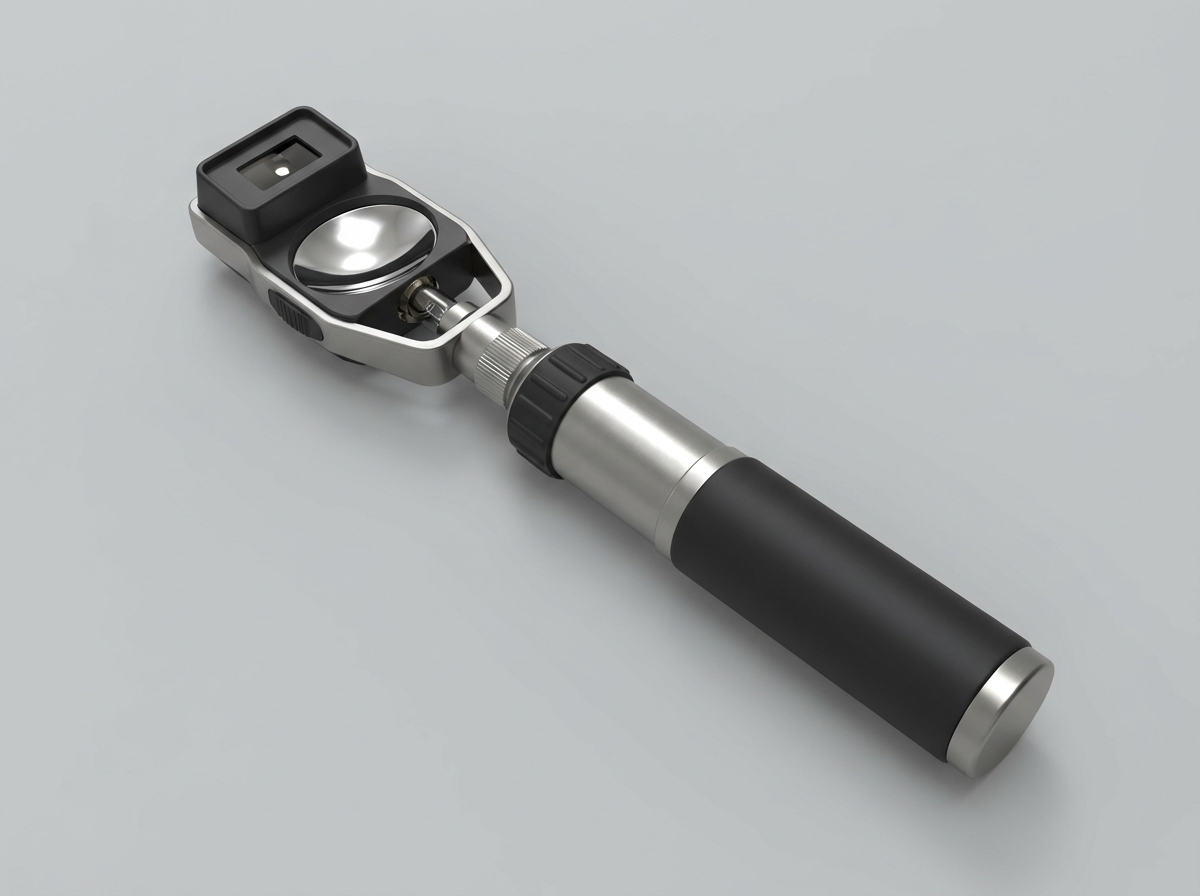
What is the area of the fundus that can be visualized using a direct ophthalmoscope?
Explanation: **Explanation:** The concept of the **Sturm’s Conoid** is central to understanding astigmatism. In astigmatism, light rays do not come to a single point focus but form two focal lines. Between these two lines lies the **Circle of Least Diffusion (CLD)**—the point where the blur is circular and the overall distortion is minimized, providing the best possible visual acuity for an uncorrected eye. **Why Mixed Astigmatism is the correct answer:** In **Mixed Astigmatism**, one focal line falls in front of the retina (myopic) and the other falls behind the retina (hypermetropic). Because the retina lies *between* the two focal lines, the Circle of Least Diffusion falls on or very near the retina. This allows the patient to achieve relatively good distant vision compared to other types of astigmatism where both focal lines (and the CLD) are located entirely in front of or behind the retina. **Analysis of Incorrect Options:** * **A. Simple Myopic Astigmatism:** One focal line is on the retina, but the other is in front. The CLD is located in front of the retina. * **B. Compound Myopic Astigmatism:** Both focal lines are in front of the retina. The CLD is significantly in front of the retina, causing marked blurring. * **D. Compound Hypermetropic Astigmatism:** Both focal lines are behind the retina. The CLD is behind the retina, requiring significant accommodation or correction for clarity. **High-Yield Pearls for NEET-PG:** * **Sturm’s Conoid:** The distance between the two focal lines is called the **Focal Interval of Sturm**. * **CLD Position:** The Circle of Least Diffusion is located at the dioptric midpoint between the two focal lines. * **Clinical Significance:** Patients with mixed astigmatism often squint (stenopeic slit effect) to further improve the clarity of the CLD on the retina. * **Treatment:** Mixed astigmatism is corrected using **spherocylindrical lenses** (transposition is often required in prescriptions).
Explanation: **Explanation:** The **Keratometer** (also known as an ophthalmometer) is a diagnostic instrument used to measure the **curvature of the anterior surface of the cornea**. It works on the principle that the anterior corneal surface acts as a convex mirror. By measuring the size of the reflected image (Purkinje image I) of an object of known size, the instrument calculates the radius of curvature ($r$) and converts it into dioptric power ($D$) using the formula: $D = (n-1)/r$. **Analysis of Options:** * **A. Thickness of the cornea:** This is measured using a **Pachymeter** (typically via ultrasound or optical coherence tomography). * **B. Radius of the cornea:** While a keratometer technically measures the radius of curvature first, its primary clinical purpose and the standard definition of its measurement is the **corneal curvature** (expressed in Diopters). * **D. Depth of the posterior chamber:** This is measured using **A-scan Ultrasonography** or specialized optical biometry (like IOL Master). **Clinical Pearls for NEET-PG:** * **Standard Keratometry:** Measures only the central 3 mm of the cornea (the "apical zone"). * **Clinical Uses:** Essential for **IOL power calculation**, fitting contact lenses, and diagnosing/monitoring **Keratoconus**. * **Astigmatism:** A keratometer can diagnose regular astigmatism by measuring the difference in curvature between the two principal meridians. * **Photokeratoscopy/Topography:** Unlike the keratometer which measures only a few points, corneal topography provides a color-coded map of the entire corneal surface.
Explanation: ### Explanation In **Astigmatism**, the refractive power of the eye is not uniform across all meridians, resulting in two different focal lines instead of a single focal point. This condition is classified based on where these focal lines fall relative to the retina. **1. Why Option D is Correct:** In **Simple Hypermetropic Astigmatism**, one principal meridian is emmetropic (focusing exactly **on the retina**), while the other meridian is hypermetropic (focusing **behind the retina**). This matches the scenario described in the question. **2. Analysis of Incorrect Options:** * **Simple Myopic Astigmatism (A):** One meridian focuses on the retina, while the other focuses **in front** of the retina. * **Simple Hypermetropia (B):** This is a spherical error, not astigmatism. All meridians focus at a single point **behind** the retina. * **Compound Myopic Astigmatism (C):** Both principal meridians focus **in front** of the retina, but at different distances. **3. Clinical Pearls & High-Yield Facts for NEET-PG:** * **Sturm’s Conoid:** The configuration of rays in astigmatism is known as Sturm’s Conoid. The distance between the two focal lines is the **Focal Interval of Sturm**. * **Circle of Least Confusion:** This is the point within Sturm’s conoid where the blur is minimal and the image is most circular. * **Mixed Astigmatism:** One meridian focuses in front of the retina (myopic) and the other focuses behind it (hypermetropic). * **Treatment:** Astigmatism is corrected using **Cylindrical lenses** or **Toric lenses**. * **Rule of Thumb:** "Simple" means one focus is on the retina; "Compound" means both are on the same side (but not on the retina); "Mixed" means they are on opposite sides.
Explanation: **Explanation:** **Why Astigmatism is the correct answer:** Astigmatism is statistically the most common refractive error. It occurs when the cornea or lens has an irregular curvature (different radii of curvature in different meridians), preventing light from focusing on a single point on the retina. Epidemiological studies and clinical data indicate that a minor degree of astigmatism (physiological astigmatism) is present in the vast majority of the population. Even when patients are primarily myopic or hypermetropic, they almost always possess a concurrent astigmatic component, making it the most prevalent refractive anomaly globally. **Analysis of Incorrect Options:** * **A. Hypermetropia:** While hypermetropia is the most common refractive error found in **newborns** (due to the short axial length of the eye), it is not the most common in the general adult population as the eye undergoes emmetropization during growth. * **B. Myopia:** Myopia is the most common refractive error **requiring clinical correction** or spectacles, particularly in school-going children and young adults. However, in total prevalence across all age groups and degrees of severity, it is surpassed by astigmatism. **High-Yield Clinical Pearls for NEET-PG:** * **Most common type of Astigmatism:** "With-the-rule" astigmatism (vertical meridian is steepest). * **Rule of Thumb:** If the question asks for the most common refractive error in **newborns**, the answer is **Hypermetropia**. * **Surgical Correction:** The most common surgery for correcting these errors is LASIK (Laser-Assisted In Situ Keratomileusis). * **Sturm’s Conoid:** This is the geometric configuration of light rays formed in a spherocylindrical (astigmatic) lens, a frequent topic in optics theory.
Explanation: **Explanation:** Assessment of color vision is a high-yield topic in Ophthalmology, focusing on the detection of congenital (usually X-linked recessive) or acquired color deficiencies. The correct answer is **All the above** because each option represents a distinct, validated method for evaluating color perception. * **Ishihara Plates (Option A):** This is the most common screening test for **Red-Green deficiency**. It consists of pseudo-isochromatic plates where numbers or paths are composed of colored dots against a background of differently colored dots. It cannot, however, detect Blue-Yellow (Tritan) defects. * **Holmgren’s Wool Test (Option B):** A historical but relevant test where the patient is asked to match skeins of colored wool. It is a qualitative test used to identify color blindness by observing how a patient groups different hues. * **City University Test (Option C):** Based on the Farnsworth D-15 principle, this test involves a central colored spot surrounded by four peripheral spots. The patient must choose which peripheral spot most closely matches the central one. It is effective for detecting both Red-Green and Blue-Yellow defects. **High-Yield Clinical Pearls for NEET-PG:** 1. **Gold Standard:** The **Nagel Anomaloscope** is the gold standard for diagnosing the exact type and severity of color vision defects (differentiating dichromats from anomalous trichromats). 2. **Farnsworth-Munsell 100 Hue Test:** The most sensitive clinical test for grading the severity of color vision loss. 3. **Kollner’s Rule:** Acquired outer retinal diseases usually result in Blue-Yellow defects, while optic nerve diseases (like optic neuritis) typically result in Red-Green defects (Exception: Glaucoma and Papilledema cause Blue-Yellow defects). 4. **Hardy-Rand-Rittler (HRR) Plates:** Unlike Ishihara, these can detect all three types of defects (Protan, Deutan, and Tritan).
Explanation: **Explanation:** **Posterior staphyloma** is a hallmark feature of **Pathological (Degenerative) Myopia**. It is defined as a localized bulging of the weakened sclera posteriorly, lined by thinned-out uveal tissue (choroid). 1. **Why Pathological Myopia is correct:** In high myopia (usually >-6.00D or axial length >26.5 mm), the eyeball undergoes progressive elongation. This stretching leads to thinning of the sclera, particularly at the posterior pole. As the sclera weakens, it ectasias (bulges) outward, creating a staphyloma. This is often associated with "Foster-Fuchs spots" and "Lacquer cracks." 2. **Why other options are incorrect:** * **Uveoscleritis:** While inflammation can weaken the sclera, it typically leads to generalized thinning rather than the classic posterior focal bulging seen in myopia. * **Pseudocornea:** This refers to a false cornea formed by organized exudates and fibrous tissue over a perforated corneal ulcer; it is an anterior segment pathology. * **Angle-closure glaucoma:** This is typically associated with **hypermetropia** (small eyeballs with shallow anterior chambers), not the elongated eyeballs found in posterior staphyloma. **Clinical Pearls for NEET-PG:** * **Types of Staphyloma:** Posterior is the most common. Others include Intercalary, Ciliary, and Equatorial (associated with scleritis or trauma). * **Diagnosis:** Posterior staphyloma is best visualized using **B-scan ultrasonography** or Optical Coherence Tomography (OCT). * **Key Sign:** On fundoscopy, it appears as a sudden "dip" or excavation in the macular area with associated chorioretinal atrophy.
Explanation: ### Explanation To solve this problem, we must calculate the total accommodative effort required by a hypermetropic eye to see a near object clearly. Accommodation is the process by which the eye increases its refractive power to focus on near objects. **1. The Calculation (Why B is correct):** The total accommodation required is the sum of two components: * **Correction of Refractive Error:** A hypermetrope has a "deficit" in refractive power. To see clearly at infinity (distance), they must first use accommodation to neutralize their refractive error. Here, the patient needs **+4.0 D** just to achieve distance vision. * **Near Effort:** To see an object at a specific distance, the eye needs additional power calculated by the formula: $P = 1/f$ (in meters). For a near point of 20 cm (0.2 m), the required power is $1 / 0.2 = \mathbf{+5.0 D}$. * **Total Accommodation** = Distance Correction + Near Effort = $+4.0 D + 5.0 D = \mathbf{+9.0 D}$. **2. Analysis of Incorrect Options:** * **Option A (+4.0 D):** This only accounts for the power needed to correct the distance vision; it ignores the effort required for the 20 cm near point. * **Option C (+10.0 D):** This is a calculation error, likely from miscalculating the near point power or adding an extra diopter. * **Option D (0 D):** This would only be true for an emmetropic eye looking at infinity. **3. Clinical Pearls for NEET-PG:** * **Hypermetropia & Esotropia:** Excessive accommodation in uncorrected hypermetropia leads to excessive convergence, often resulting in **Accommodative Convergent Squint**. * **Presbyopia:** This is the age-related physiological loss of the **amplitude of accommodation** due to decreased lens elasticity. * **Rule of Thumb:** An emmetrope requires +3.0 D of accommodation to read at the standard distance of 33 cm.
Explanation: **Explanation:** The **pinhole test** is a fundamental clinical tool used to differentiate between visual impairment caused by refractive errors and that caused by organic diseases of the eye (such as macular degeneration or cataracts). **1. Why 3 D is the correct answer:** A pinhole (typically 1.0 to 1.5 mm in diameter) works by allowing only a narrow, central bundle of parallel light rays to enter the eye. These rays pass through the center of the lens without being refracted, thereby bypassing the peripheral "blur circles" caused by a refractive error. This mechanism effectively increases the **depth of focus**. Clinically, a pinhole can compensate for and neutralize refractive errors up to approximately **3 Diopters**. If a patient’s vision improves with a pinhole, it indicates that the vision loss is primarily refractive. **2. Analysis of Incorrect Options:** * **Option A (1 D):** While a pinhole easily corrects 1 D, its maximum compensatory threshold is significantly higher. * **Options C & D (5 D and 10 D):** These errors are too high for a standard pinhole to neutralize. In high refractive errors, the blur circles are so large that the limited light entering through the pinhole is insufficient to create a sharp image on the retina. **3. Clinical Pearls for NEET-PG:** * **Pinhole Diameter:** The ideal size is **1.32 mm**. If the hole is too small (<1 mm), **diffraction** occurs, which degrades the image. If it is too large, the depth of focus is not sufficiently increased. * **Diagnostic Rule:** If vision improves with a pinhole, the cause is **Refractive Error**. If vision does not improve (or worsens), the cause is likely **Organic/Pathological** (e.g., corneal scarring, cataract, or retinal disease). * **Exception:** In cases of **central opacities** (like a central nuclear cataract), vision may actually worsen with a pinhole because it blocks the peripheral clear areas of the lens.
Explanation: ### Explanation **1. Understanding the Concept (The "Neutral Point")** Retinoscopy at 1 meter uses the concept of the **neutral point**. When performing retinoscopy at a distance of 1 meter, the observer’s eye is conjugate with a patient who has **-1.00 D of myopia**. * **With-movement:** Occurs when the far point is behind the observer (Hyperopia, Emmetropia, or Myopia < 1D). * **Neutrality:** Occurs when the far point is exactly at the observer's eye (Myopia of 1D). * **Against-movement:** Occurs when the far point lies between the patient and the observer (Myopia > 1D). In this case, the "opposite direction" (against-movement) indicates that the rays have already crossed before reaching the observer's eye, placing the far point closer than 1 meter. This signifies a refractive error **greater than 1 Diopter of myopia**. **2. Analysis of Incorrect Options** * **Option A (Less than 1 D):** This would result in "with-movement" because the far point is located behind the observer. * **Option B (1 Diopter):** This is the point of neutrality. The pupil would fill with light instantaneously without a distinct direction of movement. * **Option D (Greater than 2 Diopters):** While technically "against-movement" would occur here too, Option C is the more accurate clinical threshold. Any value above 1D (e.g., 1.25D) triggers against-movement at 1 meter. **3. High-Yield Clinical Pearls** * **Working Distance Formula:** The correction factor is $1/\text{distance (m)}$. At 1m, it is 1D; at 66cm, it is 1.5D; at 50cm, it is 2D. * **Mirror Type:** If a **concave mirror** is used instead of a plane mirror, the movements are reversed (Against-movement = Myopia < 1D). * **Net Prescription:** Net Power = Gross Retinoscopy Value – Working Distance – Cycloplegic allowance (if used).
Explanation: ### Explanation **1. Why Option B is Correct:** The direct ophthalmoscope provides a high-magnification, upright image of the fundus. However, this high magnification comes at the cost of a limited field of view. In an emmetropic eye, the field of view of a direct ophthalmoscope is approximately **10° to 15°**, which corresponds to an area of about **2 Disc Diameters (DD)**. This allows for a detailed examination of the optic disc and the macula but requires the examiner to move the device to visualize the periphery. **2. Why Other Options are Incorrect:** * **Option A (1 DD):** This is too small. While the magnification is high (~15x), the aperture allows for a view slightly wider than just the optic nerve head itself. * **Options C & D (3–4 DD):** These areas are too large for a direct ophthalmoscope. A field of 4–5 DD (approx. 30°–35°) is typically achieved using **Indirect Ophthalmoscopy**, which offers a wider field of view but lower magnification (~3x to 5x). **3. Clinical Pearls & High-Yield Facts for NEET-PG:** * **Magnification:** Direct Ophthalmoscopy offers **15x magnification** (highest among common methods). * **Image Characteristics:** The image is **virtual, erect, and real**. * **Field of View Comparison:** * **Direct Ophthalmoscope:** ~10°–15° (2 DD). * **Indirect Ophthalmoscope:** ~30°–45° (8 DD). * **Distance:** The direct ophthalmoscope is held as close to the patient's eye as possible (approx. 2 cm), whereas the indirect method is performed at arm's length. * **Prerequisite:** Direct ophthalmoscopy is difficult in patients with high refractive errors or hazy media (e.g., dense cataracts).
Physical Optics
Practice Questions
Geometric Optics
Practice Questions
Optical System of Eye
Practice Questions
Visual Acuity and Contrast Sensitivity
Practice Questions
Refractive Errors
Practice Questions
Accommodation and Presbyopia
Practice Questions
Optical Instruments
Practice Questions
Lenses and Prisms
Practice Questions
Retinoscopy
Practice Questions
Subjective Refraction
Practice Questions
Contact Lens Optics
Practice Questions
Wavefront Technology
Practice Questions
Get full access to all questions, explanations, and performance tracking.
Start For Free