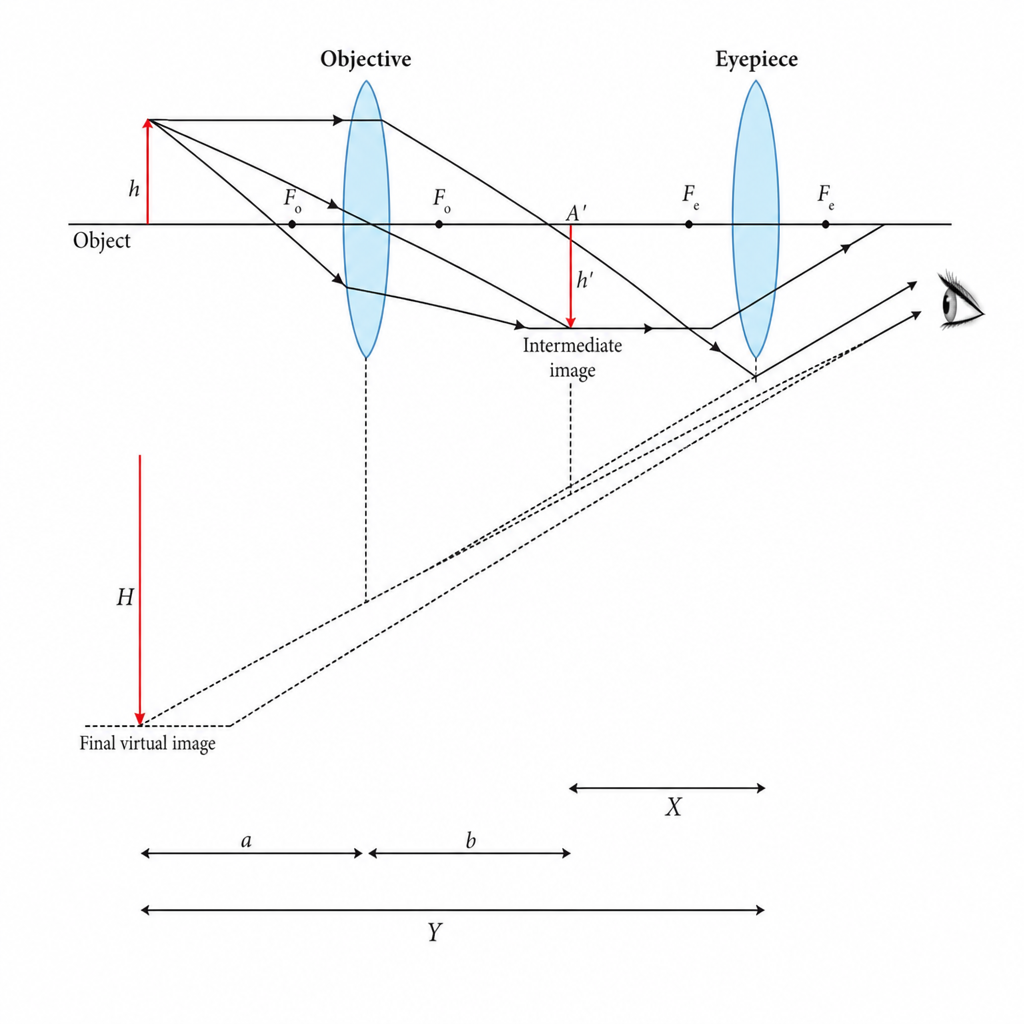
A girl presents with pain and blurring of vision while reading. What is the most likely diagnosis?
Which type of astigmatism is considered against the rule?
Which of the following is NOT a method to measure the error of refraction?
Which of the following types of astigmatism is associated with the best visual quality?
While performing a duochrome test, if the patient reports that he sees red letters more clearly than green, it indicates that he is slightly:
What is the normal refractive power of the human eye?
Accommodation is due to which of the following?
What is the total refractory power of the crystalline lens at rest with accommodation?
Which structure of the eye has the highest refractive index?
Which of the following is a prescription for simple myopic astigmatism?
Explanation: **Explanation:** The clinical presentation of pain (eye strain) and blurring of vision specifically associated with near-work (reading) is the hallmark of **Asthenopia**. **1. Why Asthenopia is correct:** Asthenopia, commonly known as "eye strain," is a subjective sensation of ocular fatigue. It occurs when the ciliary muscles or extraocular muscles are overworked. In the context of reading, it is often caused by uncorrected refractive errors (like hypermetropia or astigmatism) or muscle imbalances (like convergence insufficiency). The effort to maintain a clear image leads to symptoms of brow ache, headache, and intermittent blurring. **2. Why the other options are incorrect:** * **Esotropia & Exotropia:** These are forms of manifest strabismus (squint) where the eyes are visibly misaligned. While they can cause visual issues, the primary presentation is a deviation of the eye and potential diplopia, rather than just "pain while reading." * **Esophoria:** This is a latent inward deviation of the eyes. While esophoria *can cause* asthenopia, "Asthenopia" itself is the clinical diagnosis for the symptoms described. Esophoria is a specific underlying etiology, whereas the question asks for the diagnosis of the symptomatic presentation. **Clinical Pearls for NEET-PG:** * **Types of Asthenopia:** It can be **Accommodative** (due to ciliary muscle strain in hypermetropia) or **Muscular** (due to strain on medial recti in convergence insufficiency). * **Screen Time:** In the modern context, "Computer Vision Syndrome" is a common form of asthenopia. * **Treatment:** The first step in management is always the correction of refractive errors and ensuring proper lighting and ergonomics during near-work.
Explanation: ### Explanation In ophthalmology, astigmatism is classified based on the orientation of the steepest corneal meridian. **1. Understanding the Concept** * **With-the-rule (WTR) astigmatism:** The vertical meridian is steepest (more refractive power). To correct this, we use a **minus cylinder at 180°** or a **plus cylinder at 90°**. * **Against-the-rule (ATR) astigmatism:** The horizontal meridian is steepest. This is common in elderly patients due to eyelid pressure changes. To correct this, we use a **minus cylinder at 90°** or a **plus cylinder at 180°**. **Wait! Why is Option C (+2.00 x 90°) the correct answer?** There is a common point of confusion between the **axis of the correcting lens** and the **meridian of the error**. * In **Option C (+2.00 x 90°)**, the plus cylinder is placed at 90°. This adds power to the vertical meridian. This correction is used when the horizontal meridian is naturally steeper (ATR). Therefore, a plus cylinder at 90° corrects **Against-the-rule astigmatism**. **2. Analysis of Options** * **Option A (-2.00 x 90°):** A minus cylinder at 90° subtracts power from the horizontal meridian. This is used to correct **ATR** astigmatism. *(Note: In many standard classifications, both A and C could be argued as ATR depending on the transposition; however, in standard clinical notation for this specific question type, +90 is the classic ATR identifier).* * **Option B (-1.50 x 180°):** This is the classic correction for **WTR** astigmatism. * **Option D (+1.50 x 180°):** This adds power to the horizontal meridian, used to correct **WTR** astigmatism. **3. High-Yield Clinical Pearls for NEET-PG** * **WTR:** Vertical meridian is steepest; common in children/young adults; corrected by -cyl at 180° (± 30°). * **ATR:** Horizontal meridian is steepest; common in elderly; corrected by -cyl at 90° (± 30°). * **Oblique Astigmatism:** Principal meridians are not at 90/180 (e.g., 45° and 135°). * **Surgical Note:** Incisions made during cataract surgery (SICS/Phaco) can induce astigmatism; a superior incision usually induces ATR astigmatism.
Explanation: **Explanation:** The measurement of refractive error is broadly divided into two stages: **Objective methods** (where the clinician measures the error without patient input) and **Subjective methods** (where the patient’s feedback is used to fine-tune the prescription). **Why Binocular Balancing is the correct answer:** Binocular balancing is **not** a method to measure the initial error of refraction. Instead, it is a final step in the subjective refraction process. Its purpose is to ensure that the accommodation is equally relaxed in both eyes and that the patient is not over-corrected. It is performed *after* the refractive error has already been measured for each eye individually. **Analysis of Incorrect Options:** * **Retinoscopy (A):** This is the "gold standard" objective method for measuring refractive error. It uses a retinoscope to observe the movement of the red reflex to determine the eye's focal point. * **Refractometry (B):** This refers to the use of automated or manual refractometers to objectively determine the refractive power of the eye. * **Keratometry (C):** While primarily used to measure the curvature of the anterior corneal surface, it is a vital component in calculating astigmatism (corneal) and is used in the objective assessment of refractive status, especially for contact lens fitting and IOL power calculation. **Clinical Pearls for NEET-PG:** * **Static Retinoscopy:** Performed while the patient fixes at a distance to relax accommodation. * **Dynamic Retinoscopy:** Performed to measure the accommodative response at near. * **Duochrome Test:** A subjective test based on **chromatic aberration** used to fine-tune the spherical power (RAMPS: Red-Add-Minus, Green-Add-Plus). * **Jackson Cross Cylinder (JCC):** The preferred method for refining the axis and power of the cylinder during subjective refraction.
Explanation: **Explanation:** The visual quality in astigmatism is determined by the position of the **Circle of Least Confusion (COLC)** relative to the retina. The COLC represents the point of best focus where the image is equally blurred in all meridians, providing the sharpest possible image in an astigmatic eye. **1. Why Mixed Astigmatism is the Correct Answer:** In **Mixed Astigmatism**, one principal meridian is focalized in front of the retina (myopic) and the other behind the retina (hypermetropic). This configuration places the **Circle of Least Confusion directly on the retina**. Because the COLC is the "sweet spot" of the Sturm’s Conoid, its retinal placement results in better uncorrected visual acuity compared to other types where the COLC falls in front of or behind the retina. **2. Why the Other Options are Incorrect:** * **Simple Myopic Astigmatism:** One focal line is on the retina, but the other is in front. The COLC falls in front of the retina, leading to significant blur. * **Compound Myopic Astigmatism:** Both focal lines are in front of the retina. The COLC is far from the retina, resulting in poor distance vision. * **Oblique Astigmatism:** This refers to the orientation of the axes (not at 90/180°). It is generally associated with the **worst** visual quality and highest degree of distortion because the brain finds it harder to compensate for slanted images compared to vertical or horizontal ones. **Clinical Pearls for NEET-PG:** * **Sturm’s Conoid:** The geometric configuration of light rays in astigmatism. * **With-the-rule (WTR) Astigmatism:** Vertical meridian is steepest (corrected by minus cylinder at 180°). More common in children. * **Against-the-rule (ATR) Astigmatism:** Horizontal meridian is steepest (corrected by minus cylinder at 90°). More common in the elderly. * **Symptom:** "Tilting of objects" or "distorted vision" is more characteristic of oblique astigmatism.
Explanation: ### Explanation The **Duochrome Test** is a subjective refinement test used to verify the final spherical power during refraction. It is based on the principle of **chromatic aberration**: shorter wavelengths (green) are refracted more than longer wavelengths (red). **1. Why Myopia is the correct answer:** In a normal eye, the focal point for yellow light (mid-spectrum) falls on the retina. Consequently, the focal point for **green** (shorter wavelength) falls in front of the retina, and **red** (longer wavelength) falls behind it. * In **Myopia**, the eye is relatively too long. Both focal points shift forward. This brings the **red focus closer to the retina** and moves the green focus further away into the vitreous. Therefore, a myopic patient sees red letters more clearly. * **Rule of thumb:** "Red = Add Minus" (RAMP: Red Add Minus, Green Add Plus). **2. Why other options are incorrect:** * **B. Hypermetropic:** In hypermetropia, the eye is too short. The focal points shift backward, bringing the **green focus closer to the retina**. A hypermetrope sees green letters more clearly. * **C. Presbyopic:** Presbyopia is a loss of accommodative amplitude due to age, not a primary refractive error of the axial length. While it affects near vision, the duochrome test specifically refines the distance spherical correction. * **D. Emmetropic:** In an emmetropic (or perfectly corrected) eye, the red and green letters appear equally clear because they are equidistant from the retina. ### NEET-PG High-Yield Pearls: * **Principle:** Chromatic Aberration. * **Wavelengths:** Green (~535 nm) is refracted more than Red (~620 nm). * **Clinical Goal:** The test is complete when the patient reports both colors are equally clear (Neutralization). * **Mnemonic:** **RAMP** (Red Add Minus, Green Add Plus). If Red is clear, add minus power; if Green is clear, add plus power. * The test does not depend on color blindness because it relies on focus/clarity, not color identification.
Explanation: **Explanation:** The total refractive power of the human eye is approximately **+58 to +60 Diopters (D)**. This power is essential for focusing parallel rays of light onto the retina to form a clear image. The eye acts as a compound lens system where the two primary refractive components are: 1. **The Cornea:** Provides about **+43 D** (roughly 75% of the total power). It has the highest refractive power because of the significant difference in the refractive index between air (1.0) and the corneal epithelium (1.376). 2. **The Crystalline Lens:** Provides about **+15 to +19 D** in its resting state. **Analysis of Options:** * **Option A (20 D):** This is incorrect as it represents only the approximate power of the crystalline lens alone, not the entire eye. * **Option B (35 D):** This value does not correspond to any standard physiological measurement of the eye's refractive components. * **Option C (18 D):** This is the approximate power of the lens in an emmetropic eye. It is also the standard power of a posterior chamber Intraocular Lens (IOL) used during cataract surgery to replace the natural lens. * **Option D (58 D):** This is the **correct** total refractive power of the "Gullstrand’s Reduced Eye" model, a simplified schematic used in clinical optics. **Clinical Pearls for NEET-PG:** * **Reduced Eye Model:** A simplified model where the eye is treated as a single refracting surface with a focal length of **17 mm** and a total power of **+58.6 D**. * **Refractive Indices:** Air (1.0), Cornea (1.376), Aqueous/Vitreous (1.336), and Lens (1.386–1.406). * **Aphakia:** When the lens is removed, the eye loses ~18 D of power, becoming highly hypermetropic. * **Accommodation:** The lens can increase its power (up to +14 D in children) to focus on near objects, a process that declines with age (Presbyopia).
Explanation: ### Explanation The mechanism of accommodation is best explained by the **Helmholtz Theory**. Accommodation is the process by which the eye increases its refractive power to focus on near objects. **Why Option B is Correct:** When the eye focuses on a near object, the **ciliary muscle contracts**. This contraction moves the ciliary body forward and inward, narrowing the diameter of the ciliary ring. This action **relaxes the suspensory ligaments (zonules of Zinn)**. Once the tension on the zonules is released, the inherent elasticity of the lens capsule allows the lens to become more **globular (convex)**. This increase in curvature, particularly of the anterior surface, increases the dioptric power of the eye. **Why Other Options are Incorrect:** * **Option A:** Relaxation of the ciliary muscles occurs during distant vision. This increases tension on the zonules, flattening the lens and decreasing its refractive power. * **Option C:** The dilator pupillae is involved in mydriasis (pupillary dilation). In contrast, accommodation is part of the "Near Reflex" triad, which includes **miosis** (contraction of the sphincter pupillae), convergence, and accommodation. **High-Yield Clinical Pearls for NEET-PG:** * **The Near Reflex Triad:** 1. Accommodation, 2. Convergence (medial recti), 3. Miosis (sphincter pupillae). * **Presbyopia:** A physiological loss of accommodation due to age-related decrease in lens elasticity and ciliary muscle efficiency. * **Innervation:** The ciliary muscle is supplied by **parasympathetic fibers** via the **3rd Cranial Nerve (Oculomotor)**, originating from the Edinger-Westphal nucleus. * **Purkinje Images:** During accommodation, the 3rd Purkinje image (anterior lens surface) moves forward and becomes smaller, while the 4th remains stationary.
Explanation: **Explanation:** The total refractive power of the human eye is approximately **+58 to +60 Diopters (D)**. This power is primarily derived from two structures: the cornea and the crystalline lens. 1. **The Cornea:** Contributes about **+43D to +44D** (roughly two-thirds of the total power). 2. **The Crystalline Lens:** In its **resting state** (unaccommodated), the lens provides approximately **+15D to +16D** of refractive power. The question asks for the power "at rest," which refers to the state where the ciliary muscles are relaxed and the zonules are taut, keeping the lens in its least convex form. While some textbooks cite 15D, **16D** is the standard accepted value in most clinical ophthalmology references and competitive exams for the lens's resting refractive contribution. **Analysis of Options:** * **A (14D):** This is slightly below the average physiological range for a healthy adult lens. * **C & D (18D & 20D):** These values represent the lens power during **active accommodation**. During accommodation, the ciliary muscle contracts, zonules relax, and the lens becomes more spherical, increasing its power by approximately +10D to +14D in children (decreasing with age). **High-Yield Clinical Pearls for NEET-PG:** * **Refractive Index:** The crystalline lens has a gradient refractive index, but the average is **1.39**, while the cornea is **1.37**. * **Radius of Curvature:** At rest, the anterior surface radius is **10 mm**, and the posterior surface is **6 mm**. * **Aphakia:** If the lens is removed (aphakia), the eye loses its +16D power, requiring a high-plus spectacle correction (approx. +10D at the spectacle plane). * **Accommodation:** The maximum accommodative power is highest at birth and reaches zero around age 60 (Presbyopia).
Explanation: **Explanation:** The refractive index of a medium is a measure of how much it slows down and bends light. In the human eye, the **Lens** has the highest refractive index, ranging from approximately **1.386 at the cortex to 1.406 at the inner nucleus**. This gradient is due to the high concentration of crystallin proteins, particularly in the nucleus. **Analysis of Options:** * **Lens (Correct):** While the cornea provides the most refractive *power* (approx. 43D), the lens material itself is denser, giving it the highest refractive *index* (average 1.39–1.40). * **Cornea:** It has a refractive index of **1.376**. Although lower than the lens, it provides more refractive power because of the vast difference in refractive index between the air (1.0) and the corneal surface. * **Aqueous Humor:** It is a watery fluid with a refractive index of **1.336**, which is very similar to water. * **Vitreous Humor:** Like the aqueous, it consists mostly of water and has a refractive index of **1.336**. **High-Yield Clinical Pearls for NEET-PG:** 1. **Total Refractive Power of the Eye:** Approximately **+58 to +60 Diopters**. 2. **Corneal Power:** +43 to +44 D (Main contributor to static refraction). 3. **Lens Power:** +15 to +19 D (Responsible for dynamic refraction/accommodation). 4. **Reduced Eye:** A simplified model where the eye is treated as a single refracting surface with a total power of +60D and a nodal point 17mm in front of the retina. 5. **Index Myopia:** An increase in the refractive index of the lens (e.g., in nuclear cataracts) causes a myopic shift, often leading to "second sight" in elderly patients.
Explanation: ### Explanation To identify the correct prescription for **Simple Myopic Astigmatism (SMA)**, one must understand the refractive state of the eye in this condition. In SMA, one principal meridian is emmetropic (focuses on the retina), while the other is myopic (focuses in front of the retina). **1. Why Option A is Correct:** * **The Cylinder:** Astigmatism is corrected using a **cylindrical lens**, which has power in only one meridian. * **The Sign:** A **minus (-)** sign indicates myopia. * **The Prescription:** `-0.50 x 180°` means there is a myopic correction of 0.50 Diopters in the vertical meridian, while the horizontal meridian has zero power. This perfectly describes simple myopic astigmatism. **2. Analysis of Incorrect Options:** * **Option B (+0.50 x 180°):** This is a plus cylinder. It represents **Simple Hypermetropic Astigmatism**, where one meridian is emmetropic and the other is hypermetropic (focuses behind the retina). * **Option C (-3.00 D):** This is a spherical lens. It represents **Simple Myopia** (no astigmatism), where all meridians are equally myopic. * **Option D (+2.00 D):** This is a spherical lens representing **Simple Hypermetropia**. **3. High-Yield Clinical Pearls for NEET-PG:** * **Astigmatism Classification:** * **Simple:** One focal line on the retina; the other in front (myopic) or behind (hypermetropic). * **Compound:** Both focal lines are either in front of or behind the retina (e.g., -2.00 DS / -1.00 DC). * **Mixed:** One focal line is in front and the other is behind the retina (e.g., +2.00 DS / -3.00 DC). * **Rule of Thumb:** If the prescription contains *only* a minus cylinder (and no sphere), it is Simple Myopic Astigmatism. * **Sturm’s Conoid:** The geometric configuration of light rays in an astigmatic eye. The distance between the two focal lines is called the **Focal Interval of Sturm**.
Physical Optics
Practice Questions
Geometric Optics
Practice Questions
Optical System of Eye
Practice Questions
Visual Acuity and Contrast Sensitivity
Practice Questions
Refractive Errors
Practice Questions
Accommodation and Presbyopia
Practice Questions
Optical Instruments
Practice Questions
Lenses and Prisms
Practice Questions
Retinoscopy
Practice Questions
Subjective Refraction
Practice Questions
Contact Lens Optics
Practice Questions
Wavefront Technology
Practice Questions
Get full access to all questions, explanations, and performance tracking.
Start For Free