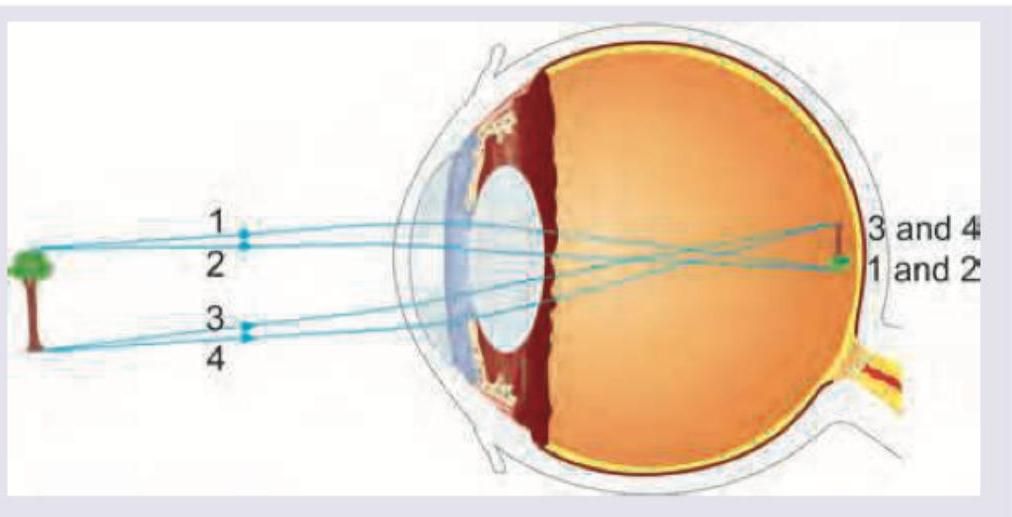
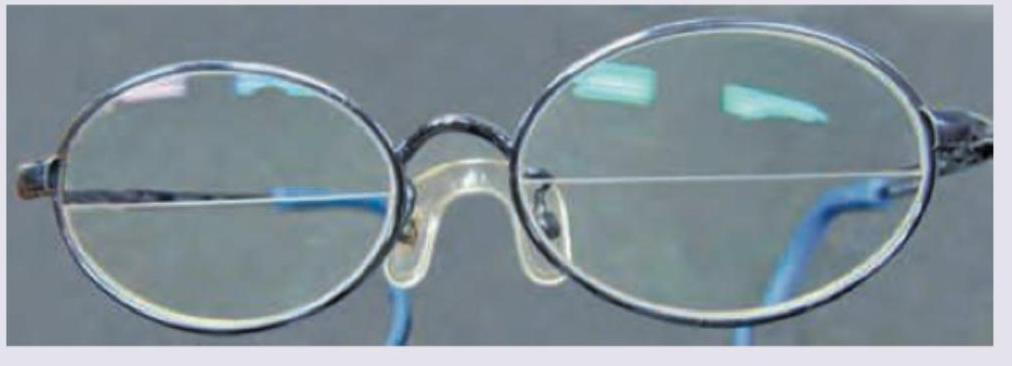
An aphakic patient wearing aphakic glasses will most commonly notice which of the following?
Magnification in indirect ophthalmoscopy depends on which of the following?
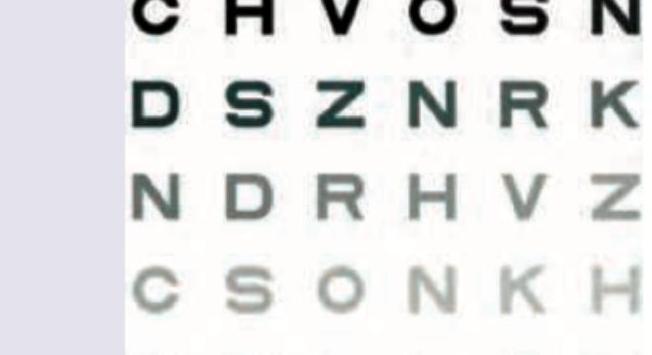
A 14-year-old boy complains of pain during reading. On examination, both his eyes are normal and vision with Snellen's reading is 6/5. He still complains of pain on occluding one eye. What is the most likely diagnosis?
What will be the refractive power of a lens with a focal length of 0.75 m?
Scarpa's Staphyloma is seen in?
What is the critical angle of the air-corneal interface?
What is the power of the reduced eye?
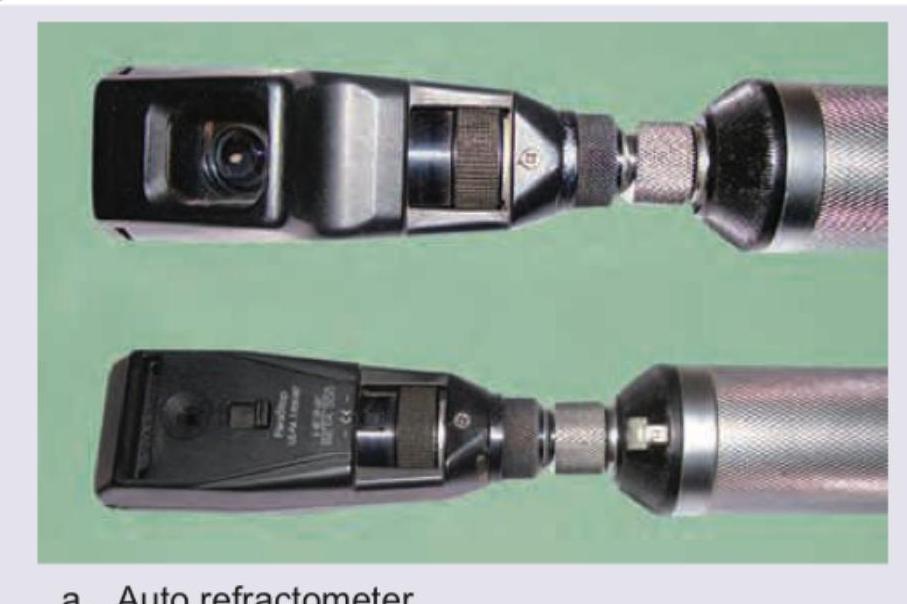
Which of the following is NOT true about an indirect ophthalmoscope?
In high myopia, which of the following complications is typically seen?
Which refractive surgery is most commonly performed for myopia?
Explanation: **Explanation:** In aphakia (absence of the crystalline lens), the eye loses approximately +15 to +18 diopters of refractive power. To compensate, high-plus convex lenses (usually >+10D) are prescribed. These thick lenses are associated with several optical aberrations, most notably **Pincushion Distortion**. 1. **Why Pincushion Distortion?** In high-plus lenses, the magnification increases significantly from the center toward the periphery. This causes the corners of a square object to be magnified more than the sides, making straight lines appear curved inward (like a pincushion). This is a classic "peripheral distortion" seen in aphakic spectacles. 2. **Analysis of Incorrect Options:** * **Barrel Distortion:** This occurs with high-minus (concave) lenses used for high myopia, where magnification decreases toward the periphery, making objects look like a barrel. * **Spherical Aberration:** This occurs when peripheral rays focus in front of central rays. While present in thick lenses, it primarily affects image sharpness/clarity rather than the characteristic shape distortion noticed by aphakic patients. * **Chromatic Aberration:** This is the failure of the lens to focus all colors (wavelengths) at the same point, causing "color fringes." While it occurs in aphakic glasses, it is less symptomatic than pincushion distortion. **High-Yield Clinical Pearls for NEET-PG:** * **Jack-in-the-box phenomenon:** A ring scotoma (roving ring scotoma) caused by the edge of high-plus lenses where objects disappear and suddenly reappear. * **Magnification:** Aphakic glasses cause ~25-30% image magnification (leading to "false orientation"), whereas contact lenses cause ~7% and IOLs cause ~0-2%. * **Anisometropia:** Spectacles cannot be used for unilateral aphakia due to the resulting **aniseikonia** (difference in image size), which prevents binocular vision. Secondary IOL or contact lenses are the preferred treatments.
Explanation: ### Explanation In indirect ophthalmoscopy, the magnification of the aerial image is determined by the relationship between the power of the eye and the power of the condensing lens. **1. Why the correct answer is right:** The magnification ($M$) in indirect ophthalmoscopy is calculated using the formula: $$M = \frac{\text{Power of the eye (Diopters)}}{\text{Power of the condensing lens (Diopters)}}$$ * **Power of the lens:** As the denominator, the power of the condensing lens inversely affects magnification. A **+20D lens** provides approximately **3x** magnification, while a **+13D lens** provides about **5x** magnification. * **Refractive error of the patient:** The "Power of the eye" (numerator) is not constant. In **myopia**, the eye has higher refractive power, leading to **greater magnification**. In **hypermetropia**, the eye has lower power, resulting in **lesser magnification**. Therefore, both factors dictate the final image size. **2. Why the other options are wrong:** * **Option A & B:** These are incomplete. While the condensing lens is the primary tool the clinician changes to alter magnification, the patient’s inherent refractive state (axial length and corneal curvature) mathematically scales that image. * **Option D:** This is factually incorrect as optics are governed by the vergence of light, which is directly dependent on these two variables. **3. High-Yield Clinical Pearls for NEET-PG:** * **Field of View vs. Magnification:** They are inversely related. A **+30D lens** gives a **larger field of view** but **lower magnification** (useful for peripheral retinal examination). * **Image Characteristics:** The image in indirect ophthalmoscopy is **real, inverted, and magnified.** * **Distance:** To maintain a clear image, the distance between the lens and the patient's eye should be equal to the **focal length** of the condensing lens.
Explanation: ### Explanation **1. Why Pseudomyopia is the Correct Answer:** The key to this diagnosis lies in the **excessive accommodation** occurring in a young patient. Pseudomyopia (also known as accommodative spasm) occurs when the ciliary muscle remains in a state of constant contraction. This increases the refractive power of the lens, mimicking myopia. In this clinical scenario: * **Age (14 years):** Young patients have high accommodative amplitudes. * **Pain during reading:** This indicates "accommodative asthenopia" due to the constant strain on the ciliary muscle. * **Vision 6/5:** The patient is technically emmetropic or slightly hyperopic at rest, but the spasm induces a temporary "minus" shift. * **Pain on monocular occlusion:** This is the **pathognomonic sign**. Unlike binocular vision anomalies (like convergence insufficiency), which are relieved by closing one eye, pseudomyopia is caused by an intrinsic ciliary muscle spasm. Therefore, the pain persists even when one eye is occluded because the spasm is independent of binocularity. **2. Why Other Options are Incorrect:** * **Myopia:** A true myope would typically have blurred distance vision (not 6/5) and would generally feel *less* strain during near work compared to a hyperope. * **Hyperopia:** While hyperopia causes accommodative strain, a 14-year-old with significant uncorrected hyperopia would likely not achieve 6/5 vision effortlessly without symptoms being relieved by rest or occlusion of the binocular demand. * **Emmetropia:** An emmetropic eye is "at rest" when viewing distant objects and should not experience significant pain during normal reading unless there is an underlying accommodative or convergence disorder. **3. Clinical Pearls for NEET-PG:** * **Diagnosis:** Confirmed by **Cycloplegic Refraction** (using Atropine or Cyclopentolate) to relax the ciliary muscle and reveal the true refractive error. * **Treatment:** Cycloplegics (to break the spasm) and plus-power lenses for near work. * **Differential:** Always differentiate from **Convergence Insufficiency**, where symptoms are typically **relieved** by occluding one eye (eliminating the need for convergence).
Explanation: ### Explanation **1. Why Option D is Correct** The refractive power ($P$) of a lens is defined as the reciprocal of its focal length ($f$) measured in **meters**. The unit of power is the **Diopter (D)**. The formula used is: $$P = \frac{1}{f \text{ (in meters)}}$$ Given the focal length ($f$) = 0.75 m: $$P = \frac{1}{0.75} = \frac{100}{75} = \mathbf{1.33 \text{ D}}$$ Since the focal length is positive, this represents a **convex (converging) lens**. **2. Why Other Options are Incorrect** * **Option A (0.75 D):** This incorrectly assumes the power is equal to the focal length. * **Option B (1.5 D):** This is a common calculation error, often resulting from misdividing $1/0.75$ or confusing it with $1/0.66$. * **Option C (1.25 D):** This would be the power of a lens with a focal length of 0.80 m ($1/0.80 = 1.25$). **3. Clinical Pearls & High-Yield Facts for NEET-PG** * **Sign Convention:** A **positive (+)** value denotes a convex lens (used for Hypermetropia, Aphakia, and Presbyopia). A **negative (-)** value denotes a concave lens (used for Myopia). * **Centimeters vs. Meters:** If the focal length is given in centimeters, use the formula: $P = 100 / f \text{ (cm)}$. * **Vergence:** Power is the ability of a lens to converge or diverge light. A shorter focal length results in a higher refractive power. * **Lens Combination:** When two thin lenses are placed in contact, their total power ($P_{total}$) is the algebraic sum of individual powers: $P_1 + P_2$. * **Nodal Point:** In the reduced eye model, the nodal point is situated 17 mm in front of the retina, and the total refractive power of the eye is approximately **+60 D** (Cornea $\approx$ 43-45 D, Lens $\approx$ 15-19 D).
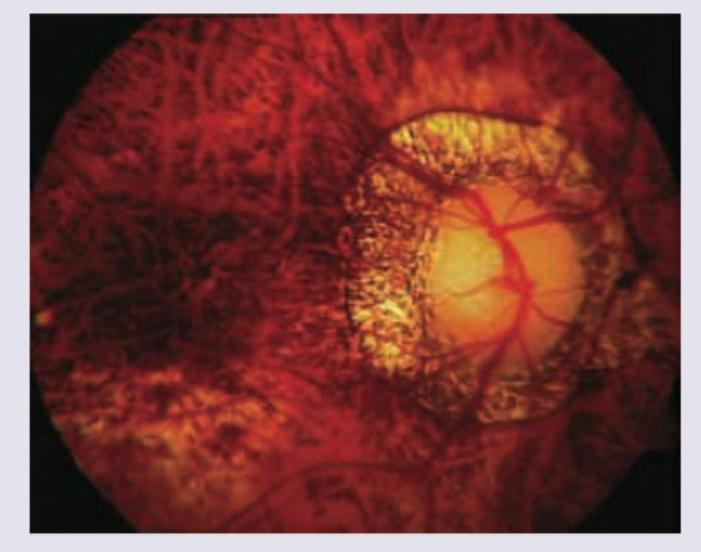
Explanation: **Explanation:** **Scarpa’s Staphyloma** (also known as Posterior Staphyloma) is a hallmark clinical feature of **Pathological (High) Myopia**. It refers to a localized bulging or ectasia of the posterior pole of the globe, where the sclera thins and the uveal tissue (choroid) shows through, giving it a bluish-grey appearance. **Why Myopia is Correct:** In high myopia (usually >-6.00D or axial length >26.5mm), the eyeball undergoes excessive axial elongation. This stretching leads to thinning of the sclera, particularly at the posterior pole. As the weakened sclera bulges outward, it creates the characteristic "staphyloma." This is often associated with "lacquer cracks" (breaks in Bruch’s membrane) and Forster-Fuchs spots. **Why Incorrect Options are Wrong:** * **Retinal Detachment:** While high myopia is a major risk factor for retinal detachment, the detachment itself is a separation of the neurosensory retina from the RPE, not a structural ectasia of the scleral wall. * **Glaucoma:** While "Buphthalmos" (enlarged globe) occurs in congenital glaucoma, and "Scleral Staphylomas" can occur in absolute glaucoma, Scarpa’s specifically refers to the posterior pole ectasia seen in myopia. * **Iridocyclitis:** This is an anterior segment inflammation. It does not cause structural thinning or bulging of the posterior sclera. **High-Yield Clinical Pearls for NEET-PG:** * **Definition of Staphyloma:** A localized bulge of the outer coat of the eye (sclera/cornea) lined by uveal tissue. * **Types of Staphyloma:** 1. **Anterior:** Ciliary or Intercalary (seen in scleritis/trauma). 2. **Equatorial:** At the exit of vortex veins. 3. **Posterior (Scarpa’s):** Pathognomonic for High Myopia. * **Diagnosis:** Best visualized via B-scan ultrasonography or fundus examination (showing a deep excavation at the macula).
Explanation: **Explanation:** The concept of the **critical angle** is fundamental to understanding why we cannot visualize the anterior chamber angle (gonioscopy) without a specialized lens. **1. Why 46 degrees is correct:** The critical angle is the angle of incidence above which **Total Internal Reflection (TIR)** occurs. When light travels from a medium with a higher refractive index (Cornea/Tears, $n \approx 1.376$) to a medium with a lower refractive index (Air, $n = 1.0$), it bends away from the normal. Using Snell’s Law ($\sin \theta_c = n_2 / n_1$), the calculation for the air-cornea interface ($\sin \theta_c = 1.0 / 1.376$) yields approximately **46 degrees**. Light rays from the iridocorneal angle typically strike the tear-air interface at an angle steeper than 46°, causing them to reflect back into the eye rather than exiting to the examiner’s eye. **2. Why other options are incorrect:** * **36 degrees:** This is too low; it would make visualization of the internal structures even more difficult than it already is. * **56 degrees:** This is the approximate **Brewster’s Angle** for glass, where light becomes perfectly polarized, but it is not the critical angle for the cornea. * **66 degrees:** This value does not correspond to any standard refractive constant in ocular optics. **High-Yield Clinical Pearls for NEET-PG:** * **Gonioscopy:** To overcome TIR, we use a goniolens (e.g., Goldmann or Zeiss). These lenses replace the air at the cornea with a material of a higher refractive index, eliminating the air-cornea interface and allowing light to exit. * **Refractive Indices to remember:** * Cornea: 1.376 * Aqueous/Vitreous: 1.336 * Lens: 1.39–1.41 * **Total Internal Reflection** is the reason why the angle of the anterior chamber is a "blind spot" during routine slit-lamp examination.
Explanation: **Explanation:** The **Reduced Eye (Gullstrand’s Schematic Eye)** is a simplified model used to study the optical properties of the human eye by treating it as a single refracting surface. 1. **Why 60 D is correct:** In the reduced eye model, the total refractive power is calculated as approximately **+60 Diopters** (specifically 58.64 D, rounded to 60 D for clinical simplicity). This power is the sum of the refractive contributions of the cornea (~43 D) and the crystalline lens (~17-19 D). In this model, the eye is simplified to have a single principal point (1.35 mm behind the cornea) and a single nodal point (7.08 mm behind the cornea), with a total axial length of **22.5 mm to 24 mm**. 2. **Analysis of Incorrect Options:** * **A (55 D):** This value is too low. While the lens power can decrease with age or in aphakia (where only the cornea provides ~43 D), the standard schematic eye power is higher. * **C & D (65 D & 70 D):** These values are too high for an emmetropic (normal) eye. Such high powers would result in high myopia (nearsightedness) unless the axial length was significantly shorter than average. **High-Yield Clinical Pearls for NEET-PG:** * **Refractive Indices:** The reduced eye is assumed to have a uniform refractive index of **1.33**. * **Nodal Point:** Located **7 mm** behind the anterior surface of the cornea (at the posterior pole of the lens). * **Principal Point:** Located **1.35 mm** behind the cornea. * **Anterior Focal Length:** 17.05 mm (in front of the cornea). * **Posterior Focal Length:** 22.6 mm (distance to the retina). * **Aphakia:** If the lens is removed, the power of the eye drops to approximately **+43 D**.
Explanation: ### Explanation The **Indirect Ophthalmoscope (IDO)** is a cornerstone of retinal examination, but it differs significantly from the Direct Ophthalmoscope in terms of image characteristics and clinical utility. **1. Why Option C is the Correct Answer (The "NOT True" Statement):** In Indirect Ophthalmoscopy, the magnification is **lower** (typically **3x to 5x** using a +20D lens) compared to Direct Ophthalmoscopy, which offers a high magnification of approximately **15x**. Therefore, the statement that IDO magnification is greater is incorrect. **2. Analysis of Other Options:** * **Option A (Real and Inverted):** This is true. The IDO uses a condensing lens to form a **real, inverted, and laterally reversed** aerial image between the lens and the examiner. * **Option B (Hazy Media):** This is true. Because the IDO uses a very bright light source and a binocular system, it can "pierce" through mild cataracts or vitreous haze better than a direct ophthalmoscope. * **Option C (Periphery Visualization):** This is true. When combined with **scleral indentation**, the IDO allows visualization up to the **ora serrata**, making it the gold standard for detecting peripheral retinal tears or detachments. **3. High-Yield Clinical Pearls for NEET-PG:** * **Field of View:** IDO has a much larger field of view (~37°) compared to Direct Ophthalmoscopy (~10°). * **Stereopsis:** IDO provides a **three-dimensional (binocular)** view, whereas Direct Ophthalmoscopy is monocular (2D). * **Lens Relation:** Magnification in IDO is inversely proportional to the power of the condensing lens (e.g., a +13D lens gives more magnification but a smaller field of view than a +20D lens). * **Working Distance:** IDO is performed at arm's length, while Direct Ophthalmoscopy requires being very close to the patient.
Explanation: **Explanation:** **High Myopia** (Pathological Myopia) is defined as a refractive error of > -6.00D or an axial length > 26.5 mm. The primary pathology is the progressive elongation of the globe, leading to mechanical stretching of the ocular coats. **Why Chorioretinal Degeneration is Correct:** As the eyeball elongates, the retina and choroid are stretched beyond their elastic limits. This results in characteristic degenerative changes, including **Chorioretinal atrophy**, **Fuchs' spots** (pigmented lesions at the macula), **Lacquer cracks** (ruptures in Bruch’s membrane), and **Posterior staphyloma** (bulging of the weakened sclera). These changes are hallmark features of pathological myopia. **Why Other Options are Incorrect:** * **Uveitis:** This is an inflammatory condition of the uveal tract (iris, ciliary body, choroid) and is not a direct mechanical complication of high myopia. * **Papillitis:** This refers to inflammation of the optic disc. While myopic eyes may show a "myopic crescent" or tilted disc due to stretching, they do not typically present with primary optic nerve inflammation. * **Retinal Hemorrhages:** While subretinal neovascularization (CNVM) can cause bleeding in myopia, "Retinal hemorrhages" is a non-specific term often associated with trauma, hypertension, or diabetes. Chorioretinal degeneration is the more definitive, overarching pathological process. **High-Yield Clinical Pearls for NEET-PG:** * **Most common cause of blindness in high myopia:** Chorioretinal degeneration/Macular degeneration. * **Vitreous changes:** Early vitreous liquefaction (syneresis) and Posterior Vitreous Detachment (PVD) are common. * **Retinal Detachment:** High myopes are at a significantly increased risk for rhegmatogenous RD due to peripheral degenerations like **Lattice degeneration**. * **Cataract:** Early onset of **Nuclear Sclerosis** and **Posterior Subcapsular Cataract** is frequently seen.
Explanation: **Explanation:** **LASIK (Laser-Assisted In Situ Keratomileusis)** is currently the most commonly performed refractive surgery for myopia worldwide. The procedure involves creating a thin corneal flap (using a microkeratome or femtosecond laser), followed by excimer laser ablation of the underlying stromal bed to flatten the central cornea. Its popularity stems from its **rapid visual recovery** (often within 24 hours), minimal postoperative pain, and high predictability for moderate to high myopia. **Analysis of Incorrect Options:** * **Radial Keratotomy (A):** An obsolete procedure where radial incisions were made to flatten the cornea. It is no longer preferred due to complications like diurnal vision fluctuation, progressive hyperopic shift, and weakened globe integrity. * **Photorefractive Keratectomy (PRK) (C):** A surface ablation technique where the epithelium is removed before laser treatment. While it is safer for patients with thin corneas, it is less common than LASIK due to slower visual recovery and significant postoperative pain during epithelial healing. * **Lensectomy (D):** Also known as Refractive Lens Exchange (RLE), this involves removing the natural lens. It is generally reserved for very high myopia or presbyopic patients where corneal procedures are contraindicated. **High-Yield Clinical Pearls for NEET-PG:** * **Prerequisites for LASIK:** Age >18 years, stable refraction for at least 1 year, and adequate corneal thickness (residual stromal bed must be >250–300 μm). * **Contraindications:** Keratoconus (absolute), active ocular infection, and severe dry eye. * **Complication:** The most common side effect is **Dry Eye**; the most dreaded complication is **Iatrogenic Corneal Ectasia**. * **SMILE (Small Incision Lenticule Extraction):** A newer, flapless alternative gaining popularity, which preserves better corneal biomechanical strength.
Physical Optics
Practice Questions
Geometric Optics
Practice Questions
Optical System of Eye
Practice Questions
Visual Acuity and Contrast Sensitivity
Practice Questions
Refractive Errors
Practice Questions
Accommodation and Presbyopia
Practice Questions
Optical Instruments
Practice Questions
Lenses and Prisms
Practice Questions
Retinoscopy
Practice Questions
Subjective Refraction
Practice Questions
Contact Lens Optics
Practice Questions
Wavefront Technology
Practice Questions
Get full access to all questions, explanations, and performance tracking.
Start For Free