The duochrome test is used for what purpose in ophthalmology?
Posterior staphyloma is a feature of?
In retinoscopy for refractive error, if a working distance of 1 meter requires an additional 1D lens, what additional lens power is needed for a working distance of 66 cm?
What is the power of a normal eye?
When the largest diameter and shortest diameter are perpendicular to each other, what type of astigmatism is present?
The shadow test is used in which of the following procedures?
What is the most important factor determining the convergence of light rays on the retina?
What is the kappa angle defined as?
Which of the following is used for contrast sensitivity testing?
What is the refractive power of the cornea in diopters?
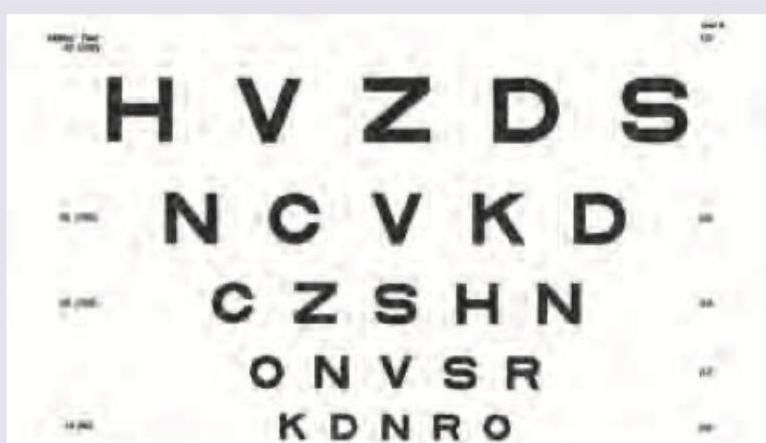
Explanation: The **Duochrome Test** is a standard clinical procedure used for the **subjective refinement** of the spherical component of a refraction. ### Why Option B is Correct: The test is based on the principle of **chromatic aberration**. White light entering the eye is dispersed into its component colors; shorter wavelengths (green) are refracted more and focus in front of longer wavelengths (red). * In an emmetropic eye, the yellow focus falls on the retina, leaving the red focus slightly behind and the green focus slightly in front of the retina at equal distances. * The test uses a chart with black letters on red and green backgrounds. The clinician adjusts the spherical power until the patient perceives the letters on both backgrounds to be equally sharp, indicating that the circle of least confusion is on the retina. ### Why Other Options are Incorrect: * **Option A (Verification):** Verification implies checking if a prescription is generally correct. Refinement (Option B) is the specific term for fine-tuning the final sphere after initial subjective testing. * **Option C (Binocular Balancing):** While some variations of the duochrome test can be used for balancing, the primary and most common use is monocular refinement. Standard binocular balancing typically uses techniques like the **Humphriss Immediate Contrast** or **Prism Dissociation**. ### High-Yield Clinical Pearls for NEET-PG: * **RAMGAP Mnemonic:** **R**ed **A**dd **M**inus, **G**reen **A**dd **P**lus. If the patient sees red more clearly, they are over-hyperopic or under-myopic (add minus). If green is clearer, they are over-myopic or under-hyperopic (add plus). * **Independent of Color Blindness:** The test relies on the **refractive** properties of the eye, not color perception; therefore, it can be performed on color-blind patients. * **Target:** It aims to achieve the "maximum plus for maximum visual acuity" in hyperopes and "minimum minus for maximum visual acuity" in myopes.
Explanation: **Explanation:** **Pathological (Degenerative) Myopia** is the correct answer because posterior staphyloma is its hallmark clinical feature. It is defined as an axial length typically >26.5 mm or a refractive error >-6.00D, accompanied by progressive degenerative changes in the posterior segment. A **posterior staphyloma** is a localized bulging of the weakened sclera lined by uveal tissue, occurring due to excessive axial elongation. This stretching leads to thinning of the sclera and atrophy of the choriocapillaris and retinal pigment epithelium (RPE). **Analysis of Options:** * **Simple Myopia:** This is a physiological variant where the eye is otherwise healthy. It usually stabilizes after puberty and does not involve degenerative changes like staphyloma or chorioretinal atrophy. * **Congenital Myopia:** Present at birth, it is often high in magnitude but usually remains stationary. While it can be associated with syndromes, it does not typically present with the progressive "staphylomatous" changes seen in pathological myopia. * **Hypermetropia:** This is characterized by a shorter axial length. The sclera is often thicker than normal, making a staphyloma (which requires thinning and bulging) anatomically impossible. **High-Yield Clinical Pearls for NEET-PG:** * **Fuchs' Spot:** A pigmented lesion at the macula due to subretinal neovascularization (CNVM) in pathological myopia. * **Lacquered Cracks:** Linear breaks in the Bruch’s membrane seen in high myopia. * **Commonest cause of blindness** in pathological myopia is **Chorioretinal degeneration**, but the most common cause of sudden vision loss is **Vitreous hemorrhage** or **Retinal Detachment**. * **B-Scan Ultrasonography** is the investigation of choice to confirm the presence of a posterior staphyloma.
Explanation: ### Explanation **1. Understanding the Concept** Retinoscopy is an objective method of measuring refractive error. The lens power found at the point of neutralization is the "gross" value. To find the "net" prescription (the patient's actual refractive error), we must subtract the **dioptric equivalent of the working distance**. The formula to calculate the required deduction (Working Distance Lens) is: **Power (D) = 1 / Distance (in meters)** * For a distance of 1 meter: $1 / 1 = 1.0\text{ D}$ * For a distance of 66 cm (0.66 m): $1 / 0.66 \approx 1.5\text{ D}$ Since we are neutralizing the divergence of light coming from a finite distance, we must **subtract** this power (or add a minus lens) to simulate light coming from infinity. Therefore, for 66 cm, an additional **-1.5 D** lens is required. **2. Analysis of Options** * **Option B (-1.5 D):** **Correct.** As calculated above, $1/0.66 = 1.5$. * **Option A (-2.0 D):** This would be the correction for a working distance of 50 cm ($1/0.5 = 2.0$). * **Option C (-0.5 D):** This would be the correction for a working distance of 2 meters ($1/2 = 0.5$). * **Option D (-5.0 D):** This corresponds to a very short, impractical working distance of 20 cm. **3. Clinical Pearls & High-Yield Facts** * **Standard Working Distance:** Most ophthalmologists use a distance of 66 cm (requiring a -1.5 D deduction) because it is roughly an arm's length. * **The "With" and "Against" Rule:** * **With movement:** Add plus lenses (Hyperopia). * **Against movement:** Add minus lenses (Myopia). * **Neutralization Point:** The point where the pupil is filled with light and no movement is seen. * **Static Retinoscopy:** Performed while the patient views a distant target to relax accommodation.
Explanation: **Explanation:** The total refractive power of a normal emmetropic human eye is approximately **+60 Diopters (D)**. This power is essential for focusing parallel rays of light directly onto the retina to form a clear image. The total power is derived from two primary refractive surfaces: 1. **The Cornea:** Contributes about **+43 D to +45 D** (roughly two-thirds of the total power). It has the highest refractive power because of the significant difference in the refractive index between air (1.0) and the corneal stroma (1.376). 2. **The Crystalline Lens:** Contributes about **+15 D to +19 D** (roughly one-third of the total power) in its resting state. **Analysis of Options:** * **Option A (+6 D) & B (+10 D):** These values are far too low to focus light on the retina. A +10 D lens is roughly the power used in spectacles for an **aphakic** patient (someone whose natural lens has been removed) to compensate for the lost refractive power. * **Option C (+16 D):** This represents the average power of the **crystalline lens alone** in an emmetropic eye, not the total power of the eye. * **Option D (+60 D):** This is the correct total refractive power (Cornea + Lens). **High-Yield Clinical Pearls for NEET-PG:** * **Reduced Eye (Listing’s Eye):** A simplified model where the eye is treated as a single refracting surface with a total power of +60 D and a focal length of **16.7 mm** (measured from the principal point to the retina). * **Refractive Indices:** Tear film/Cornea (1.376), Aqueous/Vitreous (1.336), Lens (1.39–1.42). * **Anterior Focal Length:** 15.7 mm; **Posterior Focal Length:** 24.4 mm. * The **cornea** has the maximum refractive power, but the **lens** provides the dynamic power (accommodation).
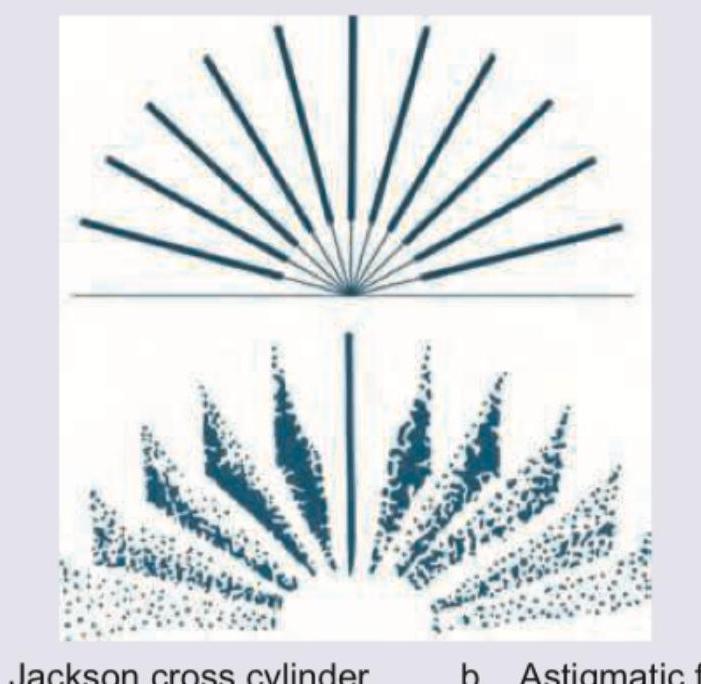
Explanation: ### Explanation **Correct Answer: D. Oblique** **Underlying Concept:** Astigmatism is a refractive error where the eye cannot focus light evenly onto the retina due to irregular curvature of the cornea or lens. In **Regular Astigmatism**, the two principal meridians (the maximum and minimum powers) are always at **right angles (90°)** to each other. Regular astigmatism is further sub-classified based on the orientation of these meridians: * **With-the-rule:** Vertical meridian is steepest (90° ± 20°). * **Against-the-rule:** Horizontal meridian is steepest (180° ± 20°). * **Oblique Astigmatism:** This occurs when the principal meridians are perpendicular to each other but are **not** in the vertical or horizontal planes (i.e., they lie between 20°–70° or 110°–160°). Since the question specifies they are perpendicular but implies a non-standard orientation, it refers to Oblique astigmatism. **Why Incorrect Options are Wrong:** * **A. Regular:** While Oblique astigmatism is technically a *subtype* of regular astigmatism, "Oblique" is the more specific and accurate descriptor for meridians that are perpendicular but tilted away from the 90/180 axes. * **B. Irregular:** In irregular astigmatism, the principal meridians are **not perpendicular** to each other. This is typically seen in corneal scarring or Keratoconus. * **C. Lenticular:** This refers to the *etiology* (astigmatism caused by the crystalline lens) rather than the geometric orientation of the meridians. **High-Yield Clinical Pearls for NEET-PG:** * **Sturm’s Conoid:** The configuration of rays formed by an astigmatic lens. * **Circle of Least Confusion:** The point in Sturm’s conoid where the image is equally blurred in all directions; this is where we aim to place the retina during correction. * **Jackon’s Cross Cylinder (JCC):** The clinical instrument used to determine the axis and power of the cylinder during refraction. * **Rule of Thumb:** With-the-rule astigmatism is common in children; Against-the-rule is more common in the elderly.
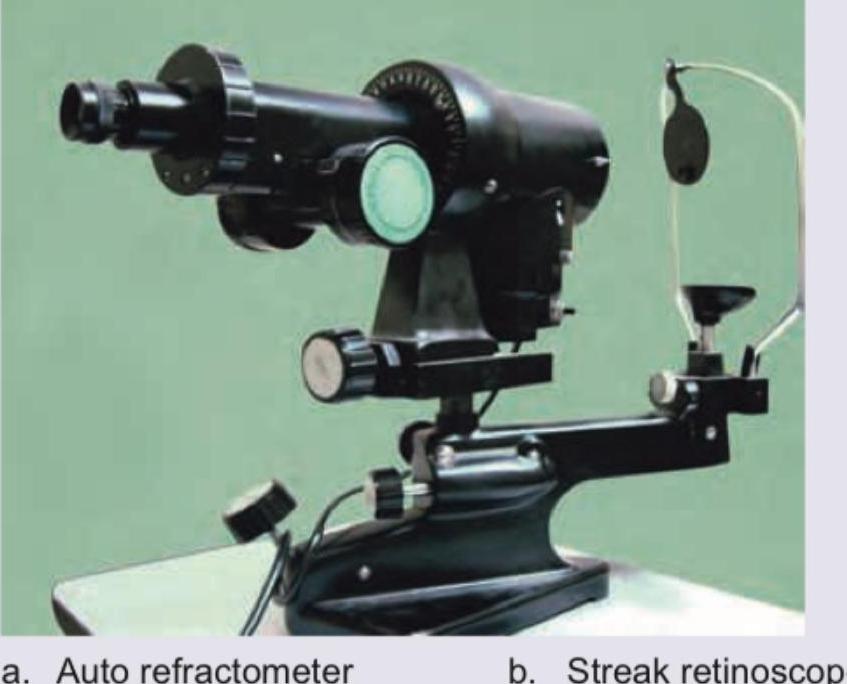
Explanation: **Explanation:** **Retinoscopy** (also known as Skiascopy) is an objective method used to determine the refractive error of an eye. The procedure is based on the principle of **Foucault’s test**. When light is projected into the patient's eye using a retinoscope, it reflects off the retina. The examiner observes the movement of the **red reflex (shadow)** in the pupillary area. By neutralizing this movement using trial lenses, the clinician determines the patient's refractive state. Because the test relies entirely on observing the movement and behavior of this light-shadow interface, it is traditionally called the **"Shadow Test."** **Why other options are incorrect:** * **Keratometry:** This procedure measures the curvature of the anterior surface of the cornea (used for IOL power calculation and astigmatism). It relies on the reflection of "mires" from the corneal surface, not shadow movement. * **Ophthalmoscopy:** This is used to visualize the fundus (posterior segment). While it uses light, it does not involve a "shadow test" to measure refractive error. * **Gonioscopy:** This involves using a Gonio lens to visualize the iridocorneal angle. It is used to differentiate between open-angle and angle-closure glaucoma. **High-Yield Clinical Pearls for NEET-PG:** * **Point of Reversal (Neutralization):** The stage where the pupil is filled with light and no shadow movement is seen. * **Movement Patterns:** * **With-movement:** Seen in Hypermetropia and Emmetropia. * **Against-movement:** Seen in Myopia (> -1.00 D). * **Working Distance:** Usually 66 cm (requires subtracting 1.5 D) or 50 cm (requires subtracting 2.0 D) from the final lens value. * **Static vs. Dynamic Retinoscopy:** Static is for distance refraction (accommodation relaxed); Dynamic is for studying accommodation.
Explanation: The total refractive power of the human eye is approximately **+58 to +60 Diopters**. The convergence of light rays onto the retina depends on both the refractive power of the ocular media and the axial length of the eye. **Why Curvature of the Cornea is the Correct Answer:** The cornea provides approximately **+43 Diopters** (nearly 70-75%) of the eye's total refractive power. This high refractive power is not just due to its curvature, but primarily due to the **significant difference in refractive indices** between air (1.00) and the corneal epithelium/tear film (1.376). According to Snell’s Law, the greatest deviation of light occurs at this first interface, making the corneal curvature the most critical factor in determining initial convergence. **Explanation of Incorrect Options:** * **Diopter power of the lens:** The crystalline lens contributes about **+15 to +20 Diopters**. While essential for accommodation (dynamic focus), its static refractive contribution is significantly less than that of the cornea. * **Axial length of the eyeball:** While axial length determines where the focal point falls relative to the retina (causing myopia or hypermetropia), it does not determine the *convergence power* of the light rays themselves. * **Physical state of the vitreous:** The vitreous has a refractive index (1.336) similar to the aqueous humor. Its physical state (gel vs. liquid) has negligible impact on the convergence of light. **High-Yield Clinical Pearls for NEET-PG:** * **Gullstrand’s Schematic Eye:** Total power = +58.64 D; Cornea = +43.05 D; Lens = +19.11 D. * **Radius of Curvature:** The anterior surface of the cornea (~7.8 mm) is the most important refractive surface. * **Astigmatism:** Most commonly results from irregularities in the curvature of the cornea rather than the lens. * **Keratometry:** The clinical procedure used to measure corneal curvature to calculate IOL power.
Explanation: ### Explanation **Angle Kappa** is a critical concept in physiological optics, representing the angular distance between the **pupillary axis** (a line passing through the center of the pupil perpendicular to the cornea) and the **visual axis** (the line connecting the object of regard to the fovea). #### Why Option A is Correct: In a perfectly symmetrical eye, these axes would coincide. However, because the fovea is usually situated slightly temporal to the posterior pole of the eye, the visual axis sits nasal to the pupillary axis. This creates Angle Kappa. * **Positive Angle Kappa:** Common in hypermetropes; it can cause a "pseudo-exotropia" (the eye appears to turn out even when aligned). * **Negative Angle Kappa:** Common in high myopes; it can cause a "pseudo-esotropia" (the eye appears to turn in). #### Why Other Options are Incorrect: * **Option B:** This describes **Angle Gamma**. It is the angle between the center of rotation of the eyeball and the line of fixation. It is primarily of theoretical interest in ocular motility. * **Option C:** This describes **Angle Alpha**. It is the angle between the visual axis and the optical axis (the line connecting the centers of curvature of all the refracting surfaces). #### NEET-PG High-Yield Pearls: 1. **Clinical Significance:** Angle Kappa must be accounted for during **refractive surgery (LASIK)** and **multifocal IOL implantation**. If the laser or lens is centered on the pupil instead of the visual axis, it can lead to decentration and poor visual quality (glare/halos). 2. **Hirschberg Test:** A positive angle kappa can give a false impression of squint. Always perform a cover-uncover test to differentiate pseudo-strabismus from true strabismus. 3. **Mnemonic:** * **K**appa = **P**upillary axis (**K-P**) * **A**lpha = **O**ptical axis (**A-O**)
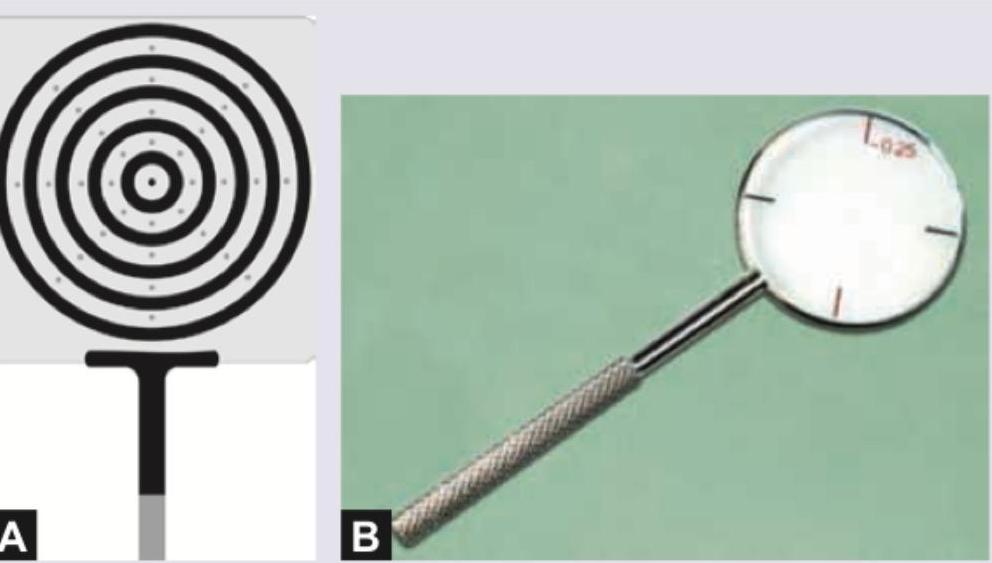
Explanation: **Explanation:** Contrast sensitivity measures the ability of the visual system to distinguish an object from its background, especially when the difference in luminance is subtle. While visual acuity (Snellen) measures the "quantity" of vision, contrast sensitivity measures the "quality" of vision. 1. **Pelli-Robson Chart:** This is the gold standard for clinical contrast sensitivity testing. It uses large letters of a uniform size (fixed spatial frequency) that gradually decrease in contrast (fading from black to light grey) as the patient reads down the chart. 2. **Regan Chart:** This uses letters of varying sizes (like a Snellen chart) but presented at several fixed, low-contrast levels (e.g., 96%, 25%, 11%, and 6%). It tests contrast sensitivity across different spatial frequencies. 3. **Snellen Chart:** While primarily used for visual acuity, the standard Snellen chart is technically a **100% (high) contrast test**. Because it represents one extreme end of the contrast spectrum, it is categorized as a tool that assesses contrast sensitivity at maximum levels. **Clinical Pearls for NEET-PG:** * **Early Diagnosis:** Contrast sensitivity is often affected earlier than visual acuity in conditions like **Glaucoma, Diabetic Retinopathy, Optic Neuritis, and Cataracts**. * **Other Tests:** Apart from the options mentioned, the **Vistech (VCTS)** and **FACT (Functional Acuity Contrast Test)** charts use sine-wave gratings to test contrast. * **Spatial Frequency:** High spatial frequency corresponds to small details (bottom of Snellen), while low spatial frequency corresponds to large objects. * **Arden Plates:** An older method using hand-held plates with gratings to test contrast.
Explanation: **Explanation:** The total refractive power of the human eye is approximately **+60 Diopters (D)**. This power is primarily derived from two structures: the cornea and the crystalline lens. 1. **Why 43 D is correct:** The cornea is the major refractive element of the eye, contributing approximately **+43 D to +44 D** (roughly two-thirds of the total power). This high refractive power is due to the significant difference in the refractive index between air (1.00) and the corneal epithelium (1.376). The anterior surface of the cornea provides about +48 D, while the posterior surface provides about -5 D, resulting in a net power of ~43 D. 2. **Why the other options are incorrect:** * **Option A (15 D):** This is too low for the cornea. However, 15 D is the approximate **accommodative amplitude** in a young child. * **Option B (30 D):** This does not correspond to a primary refractive component. The crystalline lens in its resting state has a power of approximately **+15 D to +20 D**. * **Option D (60 D):** This represents the **total refractive power** of the entire eye (Gullstrand’s reduced eye model), not the cornea alone. **High-Yield Clinical Pearls for NEET-PG:** * **Refractive Indices:** Air (1.00), Cornea (1.376), Aqueous/Vitreous (1.336), Lens (1.39–1.40). * **Radius of Curvature:** The anterior surface of the cornea is ~7.8 mm; the posterior surface is ~6.5 mm. * **Astigmatism:** Since the cornea provides most of the eye's power, minor irregularities in its curvature lead to significant refractive errors (astigmatism). * **Post-Cataract Surgery:** In aphakia (loss of lens), the eye loses ~18 D of power, which is why an Intraocular Lens (IOL) is required to restore vision.
Physical Optics
Practice Questions
Geometric Optics
Practice Questions
Optical System of Eye
Practice Questions
Visual Acuity and Contrast Sensitivity
Practice Questions
Refractive Errors
Practice Questions
Accommodation and Presbyopia
Practice Questions
Optical Instruments
Practice Questions
Lenses and Prisms
Practice Questions
Retinoscopy
Practice Questions
Subjective Refraction
Practice Questions
Contact Lens Optics
Practice Questions
Wavefront Technology
Practice Questions
Get full access to all questions, explanations, and performance tracking.
Start For Free