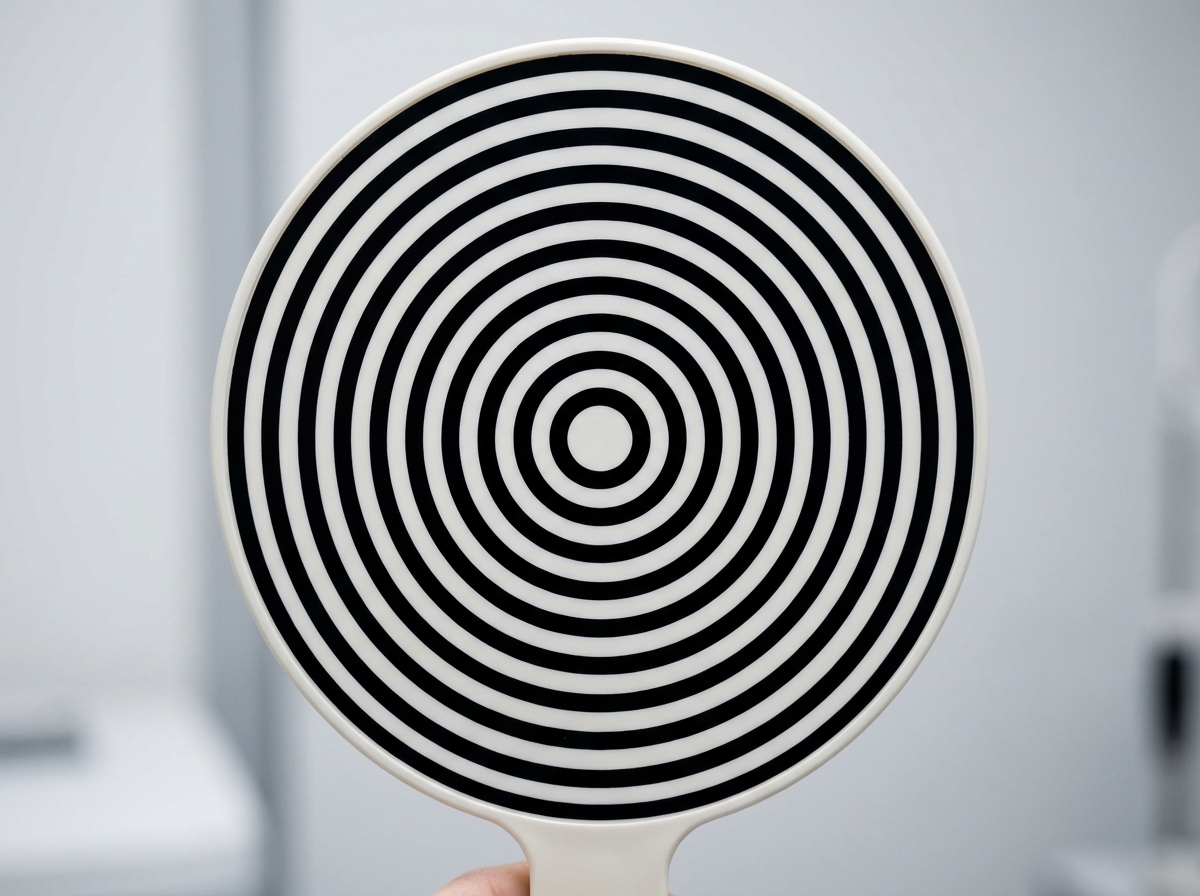
Use of a stenopaeic slit is indicated in all of the following except?
What is true about presbyopia?
What defines the visual axis?
In retinoscopy for refractive error at 1 meter, if -1 D is added, what will be the addition factor if the test is done at a distance of 66 cm?
What is the standard distance for a patient to be while reading a Snellen chart?
Anisometropia means:
Antimicrobial resistance in frequent contact lens users is primarily due to which of the following?
During retinoscopy with a plane mirror from a distance of 1 meter, no movement of the pupillary red reflex with the movement of the mirror indicates:
What is the power of the reduced eye?
One millimeter decrease in axial length of the eyeball leads to hypermetropia of:
Explanation: **Explanation:** The **stenopaeic slit** is a diagnostic tool consisting of a metal or plastic disc with a narrow rectangular opening (usually 1 mm wide). It works on the principle of the **pinhole**, allowing light to pass through only one meridian of the cornea at a time, thereby reducing the blur circle. **Why Corneal Tattooing is the Correct Answer:** Corneal tattooing (keratopigmentation) is a **therapeutic/cosmetic procedure** used to mask unsightly corneal scars or to treat symptomatic glare in patients with aniridia or iris coloboma. It is not a diagnostic test and does not utilize a stenopaeic slit. **Analysis of Other Options:** * **Fincham’s Test:** Used to differentiate between halos caused by glaucoma (corneal edema) and immature cataract. When a stenopaeic slit is moved across the pupil, **glaucomatous halos remain intact**, whereas **cataractous halos break into segments**. * **Optical Iridectomy:** Before performing this surgery (to create a new "pupil" in cases of central corneal scarring), a stenopaeic slit is used to scan the peripheral cornea to find the area with the best visual potential. * **Axis in Astigmatism:** The slit is rotated until the patient achieves the clearest vision. The orientation of the slit at this point corresponds to one of the principal meridians, helping determine the axis of astigmatism. **High-Yield Clinical Pearls for NEET-PG:** * **Pinhole Test:** If visual acuity improves with a pinhole, the cause is a **refractive error**; if it doesn't improve, the cause is likely **organic** (e.g., macular or optic nerve disease). * **Stenopaeic Slit vs. Pinhole:** While a pinhole reduces the blur circle in all directions, the slit only reduces it in the meridian perpendicular to the slit. * **Maddox Rod:** Another common tool, used to detect **latent squint (phoria)** by converting a point of light into a red line.
Explanation: **Explanation:** **Presbyopia** is a physiological aging process characterized by a progressive loss of the eye's ability to focus on near objects. **1. Why Option B is Correct:** Presbyopia is fundamentally a **defect in accommodation**, not a refractive error. It occurs due to a decrease in the amplitude of accommodation caused by: * **Loss of elasticity of the crystalline lens** (the lens becomes harder and less deformable). * **Age-related weakening of the ciliary muscles** (though lens hardening is the primary factor). As the near point of distinct vision recedes beyond the normal reading distance (usually >25 cm), near work becomes difficult. **2. Why Other Options are Incorrect:** * **Option A:** Presbyopia is **not a defect of refraction** (like myopia or hypermetropia). It is a physiological insufficiency of accommodation. A patient can have perfect distance vision (emmetropia) and still suffer from presbyopia. * **Option C:** It is corrected with a **convex (plus) lens**, not a concave lens. Convex lenses provide the additional refractive power needed to converge light rays from near objects onto the retina, compensating for the lost accommodative power. **High-Yield Clinical Pearls for NEET-PG:** * **Onset:** Usually becomes clinically significant around **40 years of age**. * **Symptoms:** Eye strain (asthenopia), the need to hold reading material at arm's length, and difficulty working in dim light. * **Premature Presbyopia:** Seen in uncorrected hypermetropes, premature sclerosis of the lens, or systemic diseases like diabetes. * **Surgical Management:** Options include Monovision (with CL or LASIK), PresbyLASIK, and Refractive Lens Exchange (RLE) with multifocal IOLs.
Explanation: ### Explanation The **Visual Axis** is a functional line that represents the path of light from an object of interest to the area of highest visual acuity. It is defined as the line connecting the **object of interest** to the **fovea centralis**, passing through the nodal points of the eye. Unlike the anatomical axis, the visual axis is slightly displaced because the fovea is located temporal to the posterior pole. #### Analysis of Options: * **Option B (Correct):** This is the precise definition. The visual axis ensures that the image of the object falls directly on the fovea for sharp central vision. * **Option A (Incorrect):** This describes the **Anatomical (Optical) Axis**, which is the line passing through the geometric centers of the cornea and the lens. It does not necessarily end at the fovea. * **Option C (Incorrect):** This is a partial description of the optical axis but lacks the retinal endpoint required to define a functional axis. #### Clinical Pearls for NEET-PG: 1. **Angle Kappa:** This is the angle formed between the **Visual Axis** and the **Anatomical Axis**. * A **positive angle kappa** (normal) can mimic a pseudo-exotropia. * A **negative angle kappa** (rare) can mimic a pseudo-esotropia. 2. **Fixation Axis:** The line joining the object of interest to the center of rotation of the eyeball. 3. **Pupillary Axis:** The line passing through the center of the pupil, perpendicular to the cornea. 4. **Nodal Points:** In the reduced eye model, the nodal point is situated approximately **17 mm** in front of the retina (near the posterior surface of the lens).
Explanation: ### Explanation **Concept of Working Distance in Retinoscopy** In retinoscopy, the light reflected from the patient's retina is neutralized using lenses. However, the point of reversal (neutralization) occurs at the examiner's eye, not at infinity. To find the patient's true refractive error (static refraction), we must subtract the **vergence of the working distance** from the gross retinoscopy value. The formula for the correction factor (dioptric power) is: **$P = 1 / d$ (in meters)** 1. **At 1 meter:** $P = 1 / 1 = 1.0\text{ D}$. This is why we subtract $1\text{ D}$ when performing the test at an arm's length of $100\text{ cm}$. 2. **At 66 cm (0.66 meters):** $P = 1 / 0.66 = 1.5\text{ D}$. Therefore, to neutralize the effect of the working distance at $66\text{ cm}$, an addition factor of **$-1.5\text{ D}$** is required. --- **Analysis of Incorrect Options** * **Option A (-2 D):** This would be the correction factor for a working distance of $50\text{ cm}$ ($1/0.5 = 2$). * **Option C (-0.5 D):** This corresponds to a working distance of $2\text{ meters}$ ($1/2 = 0.5$), which is clinically impractical for manual retinoscopy. * **Option D (-5 D):** This corresponds to a very short distance of $20\text{ cm}$, which would lead to significant errors due to the examiner's own accommodation and proximity. --- **High-Yield Clinical Pearls for NEET-PG** * **Standard Distance:** The most common working distance in clinical practice is $66\text{ cm}$ (roughly an arm's length), requiring a **$-1.5\text{ D}$** correction. * **The "Rule":** If the question mentions a "concave mirror" effect or "with movement" vs "against movement," remember that **With** movement is corrected with **Plus** lenses, and **Against** movement with **Minus** lenses. * **Static vs. Dynamic:** Retinoscopy measures static refraction when the patient's accommodation is relaxed (usually by fixing on a distant target or using cycloplegics).
Explanation: **Explanation:** The standard distance for visual acuity testing using a Snellen chart is **6 meters (20 feet)**. **Why 6 meters is the correct answer:** In optics, light rays originating from an object at 6 meters or beyond are considered to be practically **parallel** when they reach the eye. At this distance, the eye’s **accommodation is at rest**. This allows for the measurement of the static refractive state of the eye without the interference of the ciliary muscle contracting to focus. The Snellen chart is designed so that the letters at the 6/6 line subtend an angle of 5 minutes of arc at the nodal point of the eye from a distance of 6 meters. **Analysis of Incorrect Options:** * **6 feet (Option A):** This distance is too short; the rays would be divergent, triggering accommodation and leading to inaccurate results for distance vision. * **25 cm (Option B):** This is the standard **near point of distinct vision** (distinct from distance testing). It is the distance used for testing near vision (e.g., using a Jaeger chart). * **25 feet (Option D):** While some older charts used varying distances, 20 feet (6 meters) is the globally accepted clinical standard. **High-Yield Clinical Pearls for NEET-PG:** * **Visual Angle:** Each letter of the Snellen chart subtends an angle of **5 minutes of arc**, while each individual limb/gap of the letter subtends **1 minute of arc**. * **Pinhole Test:** If visual acuity improves with a pinhole, the cause of diminished vision is a **refractive error**. If it does not improve, it suggests organic pathology (e.g., macular or corneal disease). * **Malingering:** If a patient claims they cannot see the top letter (6/60) at 6 meters, move them closer (e.g., to 3 meters). If they still claim they cannot see it, suspect malingering or severe pathology. * **Landolt C & Tumbling E:** These are used for illiterate patients or children to eliminate "letter recognition" bias.
Explanation: **Explanation:** **Anisometropia** is defined as a condition where there is a significant difference in the refractive power between the two eyes. While a minor difference is common, clinically significant anisometropia is usually defined as a difference of **1 Diopter or more**. This difference can lead to **Aniseikonia** (difference in image size), which makes it difficult for the brain to fuse images, potentially leading to amblyopia (lazy eye), especially in children. **Analysis of Options:** * **Option A (Incorrect):** A difference in corneal curvature in both meridians within the *same eye* is the definition of **Astigmatism**, not anisometropia. * **Option C (Incorrect):** Subluxation of the lens (Ectopia lentis) can cause refractive errors (like high myopia or astigmatism), but it is a structural displacement and not the definition of anisometropia itself. * **Option D (Incorrect):** A difference in image size is called **Aniseikonia**. While anisometropia *causes* aniseikonia, the term anisometropia specifically refers to the refractive power difference, not the resulting image size. **High-Yield Clinical Pearls for NEET-PG:** * **Anisometropic Amblyopia:** This occurs because the brain suppresses the blurred image from the eye with the higher refractive error. It is more common in **Hypermetropic anisometropia** than in Myopic anisometropia. * **Treatment Limit:** The maximum difference in spectacle correction tolerated by a patient is generally **2 to 3 Diopters**. For differences greater than this, **Contact Lenses** or **Refractive Surgery (LASIK)** are preferred to minimize aniseikonia. * **Knapp’s Law:** Suggests that if anisometropia is axial, spectacles will produce images of the same size on the retina (though clinically, contact lenses are still often preferred).
Explanation: **Explanation:** The primary mechanism behind antimicrobial resistance in frequent contact lens users is **Biofilm formation**. A biofilm is a structured community of microorganisms (such as *Pseudomonas aeruginosa* or *Staphylococcus aureus*) embedded within a self-produced matrix of extracellular polymeric substances (EPS) that adheres to the surface of the contact lens or the lens case. This matrix acts as a physical and chemical barrier, preventing antibiotics and disinfectants from penetrating and reaching the bacteria. Furthermore, bacteria within biofilms exhibit an altered phenotype with a slower metabolic rate, making them significantly less susceptible to drugs that target active cell division. **Analysis of Incorrect Options:** * **Options B and C (Improper handling/Unsanitary care):** These are major **risk factors** for introducing pathogens (like *Acanthamoeba*) and causing keratitis, but they describe the *source* of infection rather than the biological *mechanism* of drug resistance. * **Option D (Low potency):** Resistance is generally due to the protective environment of the biofilm or genetic mutations in the bacteria, not the inherent potency of the prescribed antibiotic class itself. **Clinical Pearls for NEET-PG:** * **Most common organism** in contact lens-related bacterial keratitis: *Pseudomonas aeruginosa*. * **Acanthamoeba Keratitis:** Characterized by a "ring-shaped infiltrate" and severe pain out of proportion to clinical signs; often associated with using tap water for lens cleaning. * **Management:** Contact lens wear must be discontinued immediately in any case of suspected microbial keratitis. * **Biofilm location:** Biofilms often form more extensively in the **contact lens case** than on the lens itself, emphasizing the need for regular case replacement.
Explanation: **Explanation:** Retinoscopy is an objective method of measuring refractive error based on the principle of **foucault's test**. The direction of the pupillary reflex movement depends on the relationship between the patient’s far point and the retinoscope’s position. **Why Myopia of 1 D is Correct:** The point of reversal (neutralization) occurs when the patient’s far point coincides with the nodal point of the observer’s eye. In retinoscopy, "no movement" or a "neutral reflex" signifies that the far point of the eye is exactly at the distance of the retinoscope. * **Formula:** $P = 1/d$ (where $d$ is distance in meters). * At a distance of **1 meter**, the far point corresponds to a refractive error of **-1.00 D (Myopia of 1 D)**. At this specific point, the rays emerging from the patient's pupil are focused exactly on the observer's mirror, resulting in no visible movement. **Analysis of Incorrect Options:** * **Emmetropia:** At 1 meter, an emmetropic eye will show **"with-movement"** because its far point is at infinity (beyond the observer). * **Hypermetropia:** Any degree of hypermetropia will show **"with-movement"** because the far point is virtual and located behind the eye. * **Myopia > 1 D:** If myopia is greater than 1 D (e.g., -2 D), the far point is closer than 1 meter, resulting in **"against-movement."** **High-Yield Clinical Pearls for NEET-PG:** 1. **Plane Mirror Rules:** * *With-movement:* Hypermetropia, Emmetropia, and Myopia < 1 D. * *Against-movement:* Myopia > 1 D. * *No movement:* Myopia = 1 D (at 1 meter). 2. **Working Distance:** If the distance is 66 cm (standard), no movement indicates Myopia of **1.5 D**. 3. **Concave Mirror:** The rules for movement are exactly **reversed** compared to a plane mirror. 4. **Static Retinoscopy:** Requires the patient to fixate at a distance to relax accommodation.
Explanation: **Explanation:** The **Reduced Eye (Listing’s Eye)** is a simplified mathematical model used to study the optics of the human eye. It treats the eye as a single refracting surface separating air from a medium with a uniform refractive index. **1. Why 59 D is correct:** The total refractive power of the human eye is approximately **+58 to +60 Diopters (D)**. In the reduced eye model: * The **Cornea** contributes about **+43 D** (roughly 75% of the total power). * The **Crystalline Lens** contributes about **+15 to +17 D** (in a relaxed state). * Summing these gives the standard value of **59 D**. The model assumes a single principal point and a nodal point situated 17 mm in front of the retina, with a total axial length of 24 mm. **2. Why the other options are incorrect:** * **A (17 D):** This represents the refractive power of the **crystalline lens** alone in its resting state, not the entire eye. * **B (45 D):** This is close to the refractive power of the **cornea** (~43-45 D), which is the eye's most powerful refracting surface but not the total. * **D (66 D):** This value is too high for a standard emmetropic eye; such power would result in significant high myopia. **Clinical Pearls for NEET-PG:** * **Refractive Index:** The reduced eye has a simplified refractive index of **1.33**. * **Nodal Point:** Located **7 mm** behind the anterior surface of the cornea (or 17 mm in front of the retina). * **Principal Point:** Located **1.5 mm** behind the anterior surface of the cornea. * **Aphakia:** When the lens is removed, the eye loses ~15-17 D of power, requiring a high plus lens (approx. +10 D spectacle power) for correction.
Explanation: **Explanation:** The correct answer is **3 dioptres**. This question tests the relationship between the anatomical dimensions of the eye and its refractive power, specifically regarding **Axial Hypermetropia**. ### Why 3 Dioptres is Correct: In a schematic eye, the total refractive power is approximately +60 D, and the average axial length is 24 mm. There is a specific mathematical relationship between axial length and refractive error: * **1 mm change in axial length** results in approximately **3 dioptres** of refractive change. * Therefore, a **decrease** of 1 mm in axial length (shortening of the globe) causes the image to focus behind the retina, leading to **3 D of Hypermetropia**. * Conversely, an **increase** of 1 mm in axial length leads to **3 D of Myopia**. ### Why Other Options are Incorrect: * **Option A (6 D):** This is incorrect for axial length. However, 1 mm change in the **radius of curvature of the cornea** results in a much larger refractive change of approximately **6 dioptres**. * **Options B & D (2 D & 4 D):** These values do not correspond to the standard optical calculations for axial length changes in a human schematic eye. ### NEET-PG High-Yield Clinical Pearls: 1. **Rule of 1-2-3:** * 1 mm change in **Axial Length** = 3 D change. * 1 mm change in **Radius of Curvature** = 6 D change. * 1 mm change in **Anterior Chamber Depth** = ~1.5 D change. 2. **Aphakia:** In an aphakic eye (loss of lens), the total power of the eye drops to about +43 D. To correct this, a spectacle lens of approximately **+10 D** is typically required. 3. **Physiological Hypermetropia:** Most infants are born with approximately +2.5 to +3.0 D of hypermetropia, which gradually reduces as the eye grows (Emmetropization).
Physical Optics
Practice Questions
Geometric Optics
Practice Questions
Optical System of Eye
Practice Questions
Visual Acuity and Contrast Sensitivity
Practice Questions
Refractive Errors
Practice Questions
Accommodation and Presbyopia
Practice Questions
Optical Instruments
Practice Questions
Lenses and Prisms
Practice Questions
Retinoscopy
Practice Questions
Subjective Refraction
Practice Questions
Contact Lens Optics
Practice Questions
Wavefront Technology
Practice Questions
Get full access to all questions, explanations, and performance tracking.
Start For Free