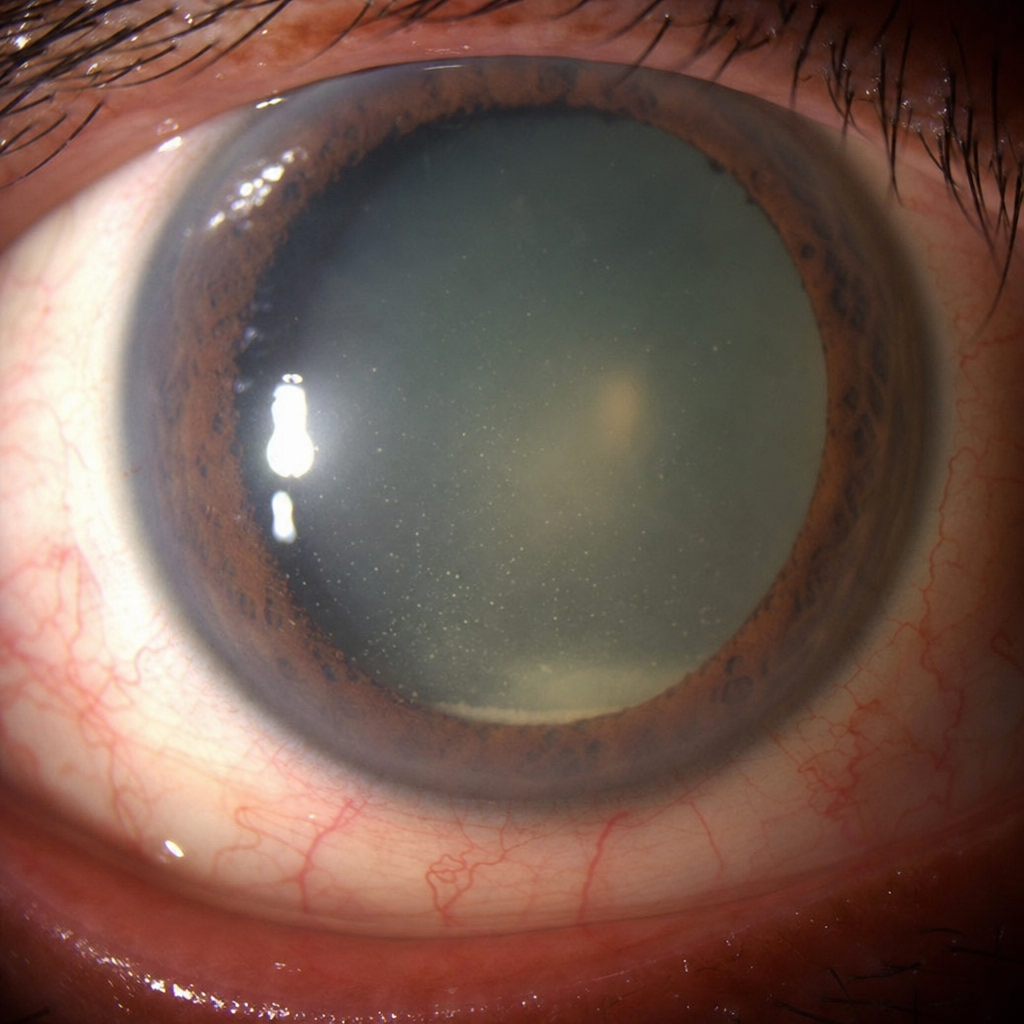
Which of the following is NOT a protocol for enucleation of the eye for transplant?
What is the primary treatment for dacrocystitis?
Sling surgery should be avoided in cases of ptosis with:
Capsulotomy after phacoemulsification is done using which one of the following methods?
Indirect ophthalmoscopy is used to detect which of the following?
What surgical procedure is preferred for severe ptosis with poor levator function?
An elderly female presented with recurrent swelling of the upper eyelid. Histopathological evaluation revealed it to be a chalazion. What is the characteristic histopathological finding in a chalazion?
Corneal transplantation requires which of the following procedures?
Oculocardiac reflex is seen in which surgery?
During Dacryocystorhinostomy (DCR) surgery, an osteotomy is performed in the anterior and superior region. Which anatomical space is accidentally opened during this step?
Explanation: **Explanation:** The question asks for the protocol that is **NOT** part of the standard procedure for eye donation/enucleation. **1. Why Option D is the correct answer:** The statement "Transplant within 6 hours" is incorrect. While the **enucleation** (removal of the eye) must ideally be performed within **6 hours** of death (up to 12-24 hours if the body is refrigerated), the actual **transplant** (keratoplasty) does not need to happen within that timeframe. Once harvested, the cornea can be preserved in storage media (like MK medium or Optisol) for **4 to 14 days**, depending on the solution used. **2. Analysis of Incorrect Options:** * **Option A (Ice packing):** This is a standard protocol. After enucleation, the eye is placed in a sterile container, and the socket is packed with ice/moist cotton to maintain tissue integrity and minimize post-mortem decomposition. * **Option B (No malignancy):** This is a mandatory screening criterion. Eyes from donors with systemic malignancies (like leukemia or lymphoma) or intraocular tumors (like retinoblastoma) are contraindicated for transplant to prevent disease transmission. * **Option C (Sterile procedure):** Enucleation must be performed under strict aseptic conditions to prevent donor-to-host transmission of infection (endophthalmitis). **High-Yield Clinical Pearls for NEET-PG:** * **Time Limit:** Enucleation should be done within **6 hours** of death. * **Preservation Media:** * **MK Medium:** 4°C for 3–4 days. * **Optisol/Dexsol:** 4°C for up to 14 days. * **Absolute Contraindications:** Death of unknown cause, HIV, Hepatitis B/C, Rabies, Creutzfeldt-Jakob Disease, and Septicemia. * **Age Limit:** There is no strict upper age limit for eye donation, though younger donor tissue is generally preferred for better endothelial cell count.
Explanation: **Explanation:** The question refers to the management of **Congenital Dacrocystitis** (Congenital Nasolacrimal Duct Obstruction), which is the most common cause of a watering eye in infants. **1. Why Massage is Correct:** The primary treatment for congenital dacrocystitis is **Crigler’s Lacrimal Sac Massage** (Hydrostatic massage). The underlying medical concept is to increase the hydrostatic pressure within the lacrimal sac to rupture the imperforate membrane (usually the **Valve of Hasner**) at the lower end of the nasolacrimal duct. Approximately 90% of cases resolve spontaneously with massage and topical antibiotics by the age of one. **2. Why other options are incorrect:** * **Probing (B):** This is the second line of treatment, typically reserved for cases that fail to resolve with massage after the age of **1 year**. * **Surgery (C):** Dacryocystorhinostomy (DCR) is the definitive surgery for chronic dacrocystitis but is generally avoided in infants until they are at least 3–4 years old. * **Antibiotic drops (D):** These are used as an adjunct to control secondary infection (mucopurulent discharge) but do not treat the underlying mechanical obstruction. **High-Yield Clinical Pearls for NEET-PG:** * **Most common site of obstruction:** Valve of Hasner. * **Massage Technique:** 10 strokes, 4 times a day (Rule of 10). * **Management Timeline:** * Up to 1 year: Crigler’s Massage + Antibiotics. * 1 to 1.5 years: Probing with Bowman’s probe. * 1.5 to 3 years: Intubation or Balloon Dacryoplasty. * After 3–4 years: Dacryocystorhinostomy (DCR). * **Acute Dacrocystitis:** In adults, the primary treatment is systemic antibiotics; surgery (DCR) is performed only after the acute inflammation subsides.
Explanation: **Explanation:** The primary goal of ptosis surgery is to elevate the eyelid; however, this creates a risk of corneal exposure during sleep or blinking. **Bell’s phenomenon** is a protective mechanism where the eyeball rolls upwards and outwards during eye closure. If a patient has a **poor Bell’s phenomenon**, the cornea remains exposed even when the lids are closed. Performing a sling surgery (which significantly elevates the lid and often results in lagophthalmos) in such patients leads to severe **exposure keratopathy**, corneal ulceration, and potential permanent vision loss. Therefore, a poor Bell’s phenomenon is a strong contraindication for most ptosis surgeries, especially sling procedures. **Analysis of Options:** * **Option A (Very poor levator action):** This is actually the **primary indication** for sling surgery (Frontalis suspension). When levator function is <4 mm, resection is ineffective, and the frontalis muscle must be used to lift the lid. * **Option C (Weak Muller’s muscle):** Muller’s muscle contributes only 2 mm of lift. Weakness here is managed by Fasanella-Servat or Muller’s muscle conjunctival resection (MMCR), not sling surgery. * **Option D (Multiple failed surgeries):** While challenging, failed surgeries are not a contraindication. If levator function is exhausted or scarred, a sling surgery is often the "rescue" procedure of choice. **Clinical Pearls for NEET-PG:** * **Frontalis Sling Materials:** Autologous **Fascia Lata** (harvested from the thigh) is the gold standard for children >3 years. Synthetic materials like Prolene or Silicone are used in younger children. * **Marcus Gunn Jaw Winking Phenomenon:** Sling surgery with bilateral levator excision is the treatment of choice to eliminate the synkinetic wink. * **Contraindications for Ptosis Surgery:** Poor Bell’s phenomenon, reduced corneal sensations, and dry eye (Schirmer’s test <10mm).
Explanation: **Explanation:** The correct answer is **Nd:YAG laser (Neodymium-doped Yttrium Aluminum Garnet)**. **1. Why Nd:YAG Laser is Correct:** After phacoemulsification, the most common late complication is **Posterior Capsular Opacification (PCO)**, also known as "After Cataract." This occurs due to the proliferation and migration of residual lens epithelial cells across the posterior capsule. The Nd:YAG laser is a **solid-state, photodisruptive laser** (wavelength 1064 nm). It works via **optical breakdown**, creating a plasma that generates a shockwave to mechanically cut the opacified tissue without requiring a surgical incision. This procedure is called **Nd:YAG Laser Capsulotomy**. **2. Why Other Options are Incorrect:** * **Argon Laser:** This is a gas laser used for **photocoagulation**. It is absorbed by pigment (melanin/hemoglobin) and is primarily used for retinal procedures (e.g., PRP for diabetic retinopathy) or trabeculoplasty. It cannot "cut" transparent tissue like the lens capsule. * **CO2 Laser:** This is a long-wavelength infrared laser used for **photovaporization**. It is used in oculoplastics (e.g., blepharoplasty) but is not used intraocularly due to high thermal damage. * **Krypton Laser:** Similar to Argon, it is used for retinal photocoagulation, particularly when treating through thin hemorrhages or in the macula. **3. High-Yield Clinical Pearls for NEET-PG:** * **Laser Type:** Nd:YAG is a **Q-switched** laser (delivers high energy in short bursts). * **Complications of YAG Capsulotomy:** Transient rise in Intraocular Pressure (IOP) – most common; Cystoid Macular Edema (CME); Retinal Detachment; and IOL pitting (damage to the lens). * **Timing:** Usually performed at least 3–6 months post-surgery to allow the eye to quieten. * **PCO Types:** Elschnig’s pearls (most common) and Fibrotic PCO.
Explanation: **Explanation:** Indirect Ophthalmoscopy (ID) is a fundamental clinical tool used for the visualization of the posterior segment. The correct answer is **D. Examination of fovea**, as the fovea is a central component of the retina and is routinely visualized during a comprehensive indirect ophthalmoscopic examination. **Why the correct answer is right:** Indirect ophthalmoscopy provides a wide-field, stereoscopic (3D) view of the entire retina, extending from the posterior pole to the ora serrata. While it is famously used for the periphery, it is equally essential for examining the **fovea** and macula, especially in cases of media opacities (like mild cataracts) where direct ophthalmoscopy fails. It provides a global view of the fundus, allowing the clinician to assess the fovea in relation to the rest of the retina. **Why the other options are incorrect:** * **A, B, and C (Ora serrata, Retinal periphery, Vitreous base):** While indirect ophthalmoscopy is indeed the *gold standard* for examining these peripheral structures, the question asks what it is used to detect/examine. In the context of standard MCQ patterns, if a single choice must be selected and the fovea is listed, it highlights that ID is not *limited* to the periphery. However, it is important to note that to see the **ora serrata** and **vitreous base** clearly, **scleral indentation** is usually required as an adjunct to indirect ophthalmoscopy. **High-Yield NEET-PG Pearls:** * **Image Characteristics:** The image in ID is **real, inverted, and magnified** (usually 3x to 5x depending on the lens used). * **Condensing Lenses:** The most common lens is **+20D** (offers a balance of magnification and field of view). A +13D lens gives higher magnification, while a +28D or +30D lens gives a wider field of view. * **Principle:** It works on the principle of making the eye highly myopic by placing a strong convex lens in front of it. * **Advantage:** Its greatest advantage over direct ophthalmoscopy is its **stereopsis** (depth perception) and the ability to visualize the retina despite hazy media.
Explanation: **Explanation:** The choice of ptosis surgery is primarily determined by the **Levator Palpebrae Superioris (LPS) muscle function**. **1. Why Frontalis Sling is correct:** In cases of **severe ptosis (>4mm)** with **poor levator function (<4mm)**, the LPS muscle is too weak to be effectively tightened. Therefore, the eyelid must be mechanically linked to the frontalis muscle of the forehead. The **Frontalis Sling (Brow Suspension)** procedure uses a sling material (e.g., Autologous Fascia Lata or synthetic materials like Prolene/Silicone) to allow the patient to lift their eyelid by raising their eyebrows. **2. Why the other options are incorrect:** * **Fasanella-Servat procedure:** This is a posterior approach (tarsoconjunctivo-müllerectomy) indicated only for **minimal ptosis (1.5–2mm)** with good LPS function, such as in Horner’s syndrome. * **Levator Resection (e.g., Everbusch’s operation):** This is the procedure of choice for **moderate ptosis** with **fair to good LPS function (>5mm)**. It involves shortening the LPS muscle to increase its effective pull. Everbusch’s is specifically the anterior approach to levator resection. **3. Clinical Pearls for NEET-PG:** * **LPS Function Grading:** Good (>8mm), Fair (5–8mm), Poor (<4mm). * **Marcus Gunn Jaw Winking Phenomenon:** The preferred treatment is bilateral excision of the LPS muscle followed by a bilateral Frontalis Sling. * **Fascia Lata:** The preferred material for slings; usually harvested from the thigh in children over 3 years of age. * **Contraindication:** Avoid ptosis surgery if the Bell’s phenomenon is absent or poor, as it leads to a high risk of exposure keratopathy.
Explanation: **Explanation:** A **chalazion** is a chronic, non-infectious, granulomatous inflammation of the Meibomian glands (modified sebaceous glands). It occurs due to the obstruction of the gland duct, leading to the leakage of sebum into the surrounding tarsal stroma. **1. Why Lipogranuloma is Correct:** The leaked lipid material (sebum) acts as an irritant, triggering a chronic inflammatory response. Histologically, this is characterized by a **Lipogranuloma**. This consists of clear spaces (where lipid was dissolved during processing) surrounded by a cellular infiltrate of neutrophils, plasma cells, lymphocytes, and **multinucleated giant cells** (specifically of the Touton or foreign-body type). **2. Why the other options are incorrect:** * **Suppurative granuloma:** This involves pus formation (neutrophil-rich), typically seen in acute infections like a *Hordeolum Externum* (Stye), rather than chronic granulomatous inflammation. * **Foreign body granuloma:** While giant cells are present in a chalazion, the term "foreign body granuloma" usually refers to a reaction against exogenous material (e.g., suture or silica). * **Xanthogranuloma:** This is a specific clinical entity (like Juvenile Xanthogranuloma) characterized by lipid-laden histiocytes (foam cells), but it is not the standard pathology for a chalazion. **Clinical Pearls for NEET-PG:** * **Recurrent Chalazion:** In an elderly patient, a recurrent chalazion at the same site must be biopsied to rule out **Sebaceous Gland Carcinoma** (the "masquerade syndrome"). * **Treatment:** Small ones may resolve spontaneously; larger ones require **Incision and Curettage (I&C)**. * **Incision Direction:** Vertical (on the conjunctival side) to avoid damaging adjacent Meibomian glands. * **Hordeolum Internum:** This is an *acute* staphylococcal infection of the Meibomian gland, which can later evolve into a chronic chalazion.
Explanation: **Explanation:** **Why Option C is Correct:** The success of a corneal transplant (Keratoplasty) depends primarily on the health of the **corneal endothelium**, which maintains corneal transparency through its "pump-leak" mechanism. Since endothelial cells do not regenerate, a high cell count in the donor cornea is vital. **Specular Microscopy** is the gold standard non-invasive procedure used to evaluate the donor cornea for endothelial cell density (ECD) and morphology (pleomorphism/polymegethism). For a successful transplant, a donor cell count of **>2000–2500 cells/mm²** is generally required. **Why Other Options are Incorrect:** * **Option A:** There is no absolute upper age limit for corneal donation. While younger tissue is preferred, donors older than 60 are frequently used if the endothelial cell count is healthy. * **Option B:** In modern practice, the whole eye is rarely preserved. Instead, the **corneo-scleral rim** is excised and stored in specialized media like **McCarey-Kaufman (MK) medium** (4°C for 4 days) or **Optisol-GS** (4°C for up to 14 days). * **Option D:** Unlike kidney or heart transplants, **HLA matching is NOT a routine requirement** for primary corneal transplants because the cornea is an "immunologically privileged" site (avascular). It is only considered in "high-risk" cases (e.g., vascularized corneas or repeat grafts). **High-Yield Clinical Pearls for NEET-PG:** * **Storage Media:** MK Medium (Short term: 4 days); Optisol/Dexsol (Intermediate: 2 weeks); Organ Culture (Long term: 4 weeks). * **Contraindications for Donor:** Death of unknown cause, slow virus infections (Rabies, Creutzfeldt-Jakob disease), HIV, Hepatitis B/C, and systemic malignancies (except localized basal cell carcinoma). * **Ideal Donor Time:** Cornea should ideally be harvested within **6 hours** of death.
Explanation: **Explanation:** The **Oculocardiac Reflex (OCR)**, also known as the **Aschner-Dagnini reflex**, is a trigemino-vagal reflex triggered by pressure on the eyeball or traction on the extraocular muscles. **Why Strabismus Surgery is the correct answer:** Strabismus surgery involves significant manipulation and traction of the extraocular muscles (most commonly the **medial rectus**). This traction stimulates the long and short ciliary nerves, sending afferent signals via the **Ophthalmic division of the Trigeminal nerve (CN V1)** to the ciliary ganglion and then to the sensory nucleus of the trigeminal nerve. The efferent limb is carried by the **Vagus nerve (CN X)**, leading to bradycardia, arrhythmias, or even cardiac arrest. **Analysis of Incorrect Options:** * **Cataract Surgery:** While OCR can theoretically occur during any orbital procedure (like peribulbar blocks), it is significantly less common than in strabismus surgery because there is no direct traction on the extraocular muscles. * **VSD and Valvular Surgery:** These are cardiac surgeries. While they involve the heart, they do not involve the trigeminal-vagal pathway initiated by ocular stimulation. **High-Yield Clinical Pearls for NEET-PG:** * **Reflex Pathway:** Afferent = Trigeminal Nerve (V1); Efferent = Vagus Nerve (X). (Mnemonic: **5 and 10 reflex**). * **Clinical Presentation:** Bradycardia (most common), junctional rhythm, or asystole. * **Management:** The first step is to **stop the surgical stimulus** (release the muscle). If bradycardia persists, administer **Intravenous Atropine**. * **Fatigability:** The reflex is known to "fatigue" or diminish with repeated stimulation. * **Risk Factor:** Hypercarbia and acidosis increase the incidence of OCR.
Explanation: **Explanation:** The correct answer is **Anterior ethmoidal sinus**. **Anatomical Basis:** Dacryocystorhinostomy (DCR) involves creating a permanent bypass between the lacrimal sac and the nasal cavity by removing the intervening bone (lacrimal bone and frontal process of the maxilla). The lacrimal fossa is anatomically related to the **anterior ethmoidal air cells** (specifically the *agger nasi* cells) in its superior and posterior aspects. During the osteotomy, if the bone removal extends too far superiorly or posteriorly, the surgeon inadvertently enters these air cells. **Analysis of Options:** * **A. Anterior ethmoidal sinus:** Correct. These cells are frequently encountered during the superior-posterior extension of the osteotomy. * **B. Maxillary antrum:** Incorrect. The maxillary sinus lies inferior and lateral to the lacrimal fossa. It is not typically involved in a standard DCR unless the osteotomy is misplaced significantly inferiorly. * **C. Superior meatus:** Incorrect. This is located much higher and more posterior in the nasal cavity, protected by the superior turbinate. * **D. Middle meatus:** Incorrect. While the goal of DCR is to create an opening into the **middle meatus** (specifically anterior to the middle turbinate), the middle meatus is a *nasal space*, not an anatomical sinus cavity that is "accidentally opened" through bone. **High-Yield Clinical Pearls for NEET-PG:** * **Success of DCR:** Depends on making a large enough osteotomy to prevent cicatricial closure. * **Landmark:** The **Middle Turbinate** is the most important intranasal landmark during DCR. The osteotomy should be anterior to its insertion. * **Complication:** Entry into the ethmoids can lead to postoperative orbital emphysema or ethmoiditis if not managed properly. * **Contraindication:** DCR is contraindicated in cases of suspected lacrimal sac malignancy or atrophic rhinitis.
Surgical Anatomy of Eye
Practice Questions
Asepsis and Sterilization in Eye Surgery
Practice Questions
Anesthesia in Ophthalmic Surgery
Practice Questions
Cataract Surgery Techniques
Practice Questions
Corneal Surgeries
Practice Questions
Glaucoma Surgeries
Practice Questions
Oculoplastic Surgeries
Practice Questions
Vitreoretinal Surgeries
Practice Questions
Strabismus Surgery
Practice Questions
Refractive Surgery
Practice Questions
Ocular Oncology Surgeries
Practice Questions
Management of Surgical Complications
Practice Questions
Get full access to all questions, explanations, and performance tracking.
Start For Free