A patient presents with eyelid crusting and a thready sensation between the cornea and lids. What is the most likely diagnosis?
A 3-year-old child presents with epiphora, and probing reveals a soft block at 7 mm. What is the best treatment option for this condition?
During the performance of the test shown below, fast regurgitation of clear distilled water is seen through both the upper and lower puncta. Diagnosis is:

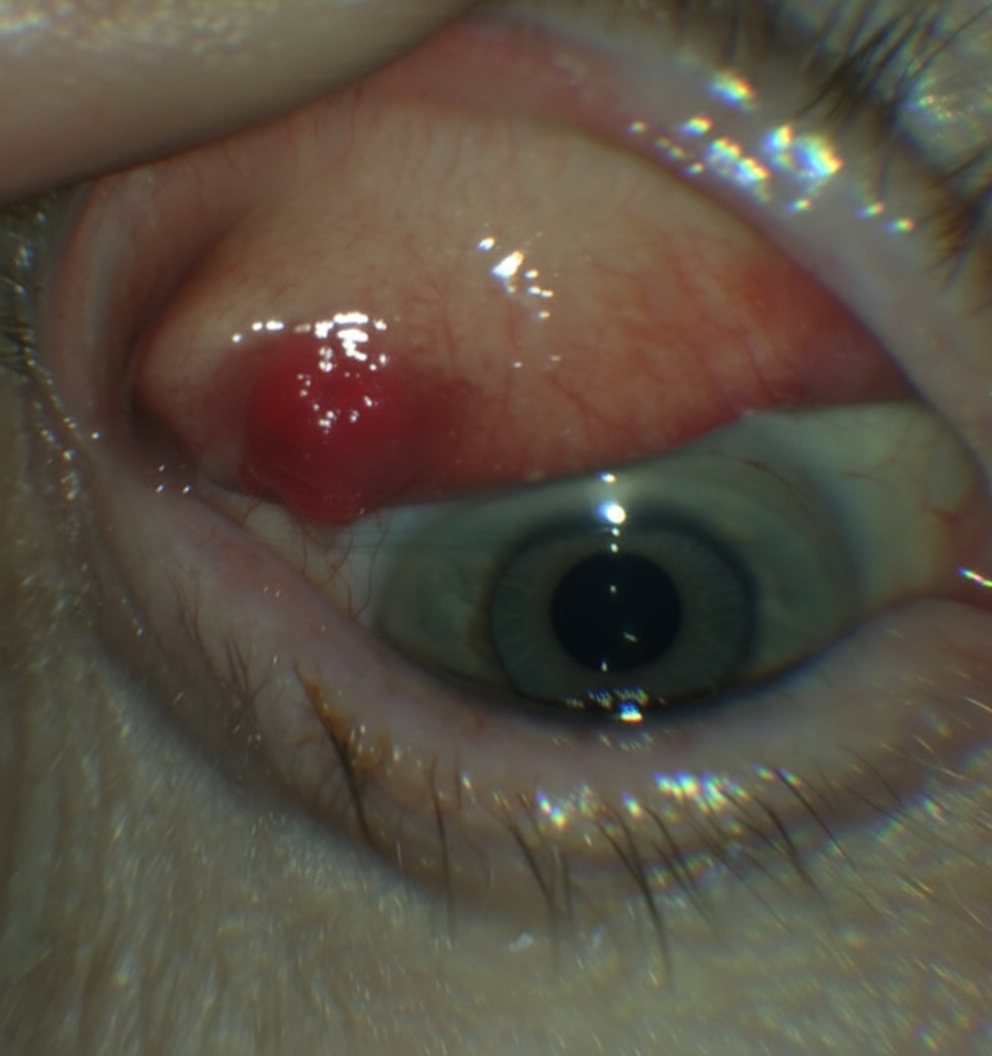
A diabetic patient presents with a painful, red swelling on the eyelid. Which is correct about the image shown below?

What is shown in the image given below?

A patient presents with itching in eyes with redness of eyelids. What is correct about the image shown below? (Recent NEET Pattern 2016-17)

What is shown in the image given below?

What does the following image show?

All are true about the lesion shown except:

All are used for the treatment of the condition shown below except:

Explanation: ***Chronic Blepharitis***- This condition is characterized by chronic inflammation of the eyelid margins, leading directly to the observed **eyelid crusting** and debris accumulation at the base of the eyelashes. - The **thready sensation** (often described as a foreign body sensation or stringy mucus) is classic, resulting from poor tear film stability and excessive friction between the chronically inflamed lid margin and the ocular surface.*Dry Eye Syndrome*- While it causes a foreign body sensation, primary uncomplicated dry eye syndrome is less typically associated with significant, persistent **eyelid margin crusting**.- Symptoms are primarily due to inadequate aqueous tear production or excessive evaporation, leading to ocular surface damage, often diagnosed using the **Schirmer test** or tear film breakup time.*Meibomian Gland Dysfunction*- MGD is specifically an obstruction or hypersecretion disorder of the meibomian glands, typically manifesting as poor **lipid layer quality** of the tear film.- Key clinical findings include inspissated gland orifices and telangiectasia on the lid margin, rather than the primary presenting complaint being generalized **eyelid crusting** and debris.*Conjunctivitis*- This typically involves generalized **conjunctival injection** (redness) and discharge (watery, purulent, or mucoid) affecting the entire ocular surface.- While it can cause morning crusting (matting), the chronic presentation focused on the lid margin with persistent **thready sensation** is more characteristic of blepharitis than acute or subacute conjunctival inflammation.
Explanation: ***Conjunctivodacryocystorhinostomy (CDCR) / Jones Tube*** - A **soft block** on probing indicates an obstruction within the **canalicular system**, as the probe meets a spongy resistance and cannot enter the lacrimal sac. - **Conjunctivodacryocystorhinostomy (CDCR)**, also known as conjunctival DCR or Jones tube placement, is the surgical procedure that bypasses the obstructed canaliculi by creating a new passage from the conjunctival sac to the nasal cavity with a Jones tube. - In this case, the soft block at 7 mm suggests canalicular obstruction, which cannot be addressed by standard DCR procedures that target nasolacrimal duct obstruction. *Endonasal Dacryocystorhinostomy (DCR)* - This procedure is the treatment of choice for **nasolacrimal duct (NLD) obstruction**, not canalicular obstruction. - NLD obstruction is identified by a **hard stop** during probing, where the probe passes through the canaliculi and contacts the bony lacrimal fossa wall. *External Dacryocystorhinostomy (DCR)* - Like the endonasal approach, external DCR is indicated for **NLD obstruction** (a **hard stop**), which is not the finding in this case. - It involves creating a fistula between the lacrimal sac and nasal mucosa through an external skin incision. *Dacryocystectomy* - This procedure involves the complete removal of the lacrimal sac and is reserved for conditions like **lacrimal sac tumors** or intractable chronic dacryocystitis. - It is a destructive procedure that eliminates the sac as a source of infection but does not resolve the **epiphora** (tearing).
Explanation: ***Common canalicular block*** - **Fast regurgitation** from both upper and lower puncta during syringing indicates that the obstruction is located proximal to the common canaliculus, preventing fluid from reaching the nasolacrimal duct. - This pattern specifically points to a block in the common canaliculus, where the upper and lower canaliculi join before entering the lacrimal sac. *Partial NLD block* - In a partial NLD block, fluid would still pass, albeit slowly or with difficulty, into the nasolacrimal duct; complete and fast regurgitation from both puncta would not occur. - Some fluid might reach the nose, or there would be delayed regurgitation, which is not the case here. *Complete NLD block* - A complete NLD block would result in regurgitation from the **punctum into which the fluid is injected**, but usually not from both puncta simultaneously unless there's an associated canalicular block. - If the block were solely in the NLD, fluid would collect in the lacrimal sac and regurgitate from the injected punctum, but it would not typically gush out of both puncta if the common canaliculus was clear. *Faulty technique being used* - While faulty technique can lead to incorrect interpretation, the described clinical finding of fast regurgitation from both puncta upon syringing from one punctum is a specific sign. - This specific symmetrical regurgitation pattern strongly points to an anatomical obstruction rather than just poor technique.
Explanation: ***Hordeolum internum*** - The image clearly shows a **tender, red, suppurative lesion** located on the inner surface of the eyelid, consistent with an infection of the **Meibomian gland**. - A **diabetic patient** is more prone to such infections due to impaired immune response and microvascular complications. *Hordeolum externum* - A **hordeolum externum** (stye) is an infection of the glands of Zeis or Moll, which are located at the **lid margin**. - The lesion in the image is clearly within the tarsal plate, not at the external lid margin. *Marginal chalazion* - A **chalazion** is a **painless, chronic, lipogranulomatous inflammation** of a Meibomian gland, typically presenting as a non-tender lump. - The lesion in the image appears acutely inflamed, red, and likely tender due to pus formation, which is not characteristic of a chalazion. *Basal cell carcinoma* - **Basal cell carcinoma** is a type of skin cancer that typically presents as a **pearly nodule** with telangiectasias, often on the lower eyelid or inner canthus. - It is usually slow-growing and does not typically present with acute inflammation and pus formation as seen here.
Explanation: ***Ectropion*** - The image clearly shows the **lower eyelid turning outwards**, exposing the inner conjunctiva. - This eversion often leads to symptoms like **dryness**, **irritation**, and **epiphora** (excessive tearing). *Entropion* - Entropion is characterized by the **inward turning of the eyelid margin**, causing the eyelashes to rub against the cornea. - This typically results in symptoms such as **corneal irritation**, foreign body sensation, and increased tearing. *Distichiasis* - Distichiasis is a rare condition where an **extra row of eyelashes** grows from the Meibomian glands on the inner eyelid margin. - The condition does not involve the eversion or inversion of the entire eyelid margin, unlike the image presented. *Angular conjunctivitis* - Angular conjunctivitis is an inflammation of the **conjunctiva**, specifically in the **outer or inner corners of the eye**. - It does not involve any structural malposition of the eyelid, such as the outward turning seen in the image.
Explanation: ***Blepharitis*** - The image shows **redness** and **inflammation of the eyelid margins**, often accompanied by scales or crusts at the base of the eyelashes. This is characteristic of blepharitis. - The history of **itching** and **redness of eyelids** further supports the diagnosis, as these are common symptoms of blepharitis, an immune-mediated inflammation. *Trichiasis* - This condition involves **misdirected eyelashes** that grow inwards and rub against the surface of the eye. - While it can cause irritation, the primary feature in the image is inflammation and crusting of the eyelid margin, not just misdirected lashes. *Blepharospasm* - **Blepharospasm** is an involuntary, repetitive, bilateral twitching or forceful closure of the eyelids. - This is a neurological condition affecting eyelid movement and is not depicted by the visible inflammation in the image. *Distichiasis* - **Distichiasis** is a rare condition where there is an extra row of eyelashes growing from the meibomian gland openings on the eyelid margin. - The image does not show an extra row of lashes; instead, it indicates inflammation and debris along the existing lash line.
Explanation: ***Ectropion*** - The image clearly displays the **sagging and outward turning of the lower eyelid**, exposing the conjunctiva. - This eversion of the eyelid margin is the hallmark clinical presentation of **ectropion**. *Chalazion* - A chalazion appears as a **firm, non-tender nodule** within the eyelid, usually due to a blocked meibomian gland. - It would not typically involve the entire eyelid margin turning outwards. *Stye* - A stye (hordeolum) is an **acute, painful, localized infection** of an eyelid gland, often appearing as a red, tender bump on the eyelid. - Unlike ectropion, it's an inflammatory lump, not an eversion of the lid margin. *Entropion* - Entropion is the **inward turning of the eyelid margin**, causing the lashes to rub against the cornea. - This is the opposite of what is seen in the image, where the eyelid is turned outwards.
Explanation: ***Xanthelasma*** - The image shows a **yellowish, raised plaque** on the inner part of the lower eyelid, which is characteristic of **xanthelasma**. - **Xanthelasma palpebrarum** is a common cutaneous manifestation of **lipid deposition**, often associated with **dyslipidemia**. *Stye* - A stye (hordeolum) is an **acute bacterial infection** of an eyelash follicle or a meibomian gland, presenting as a **red, painful, tender bump** on the eyelid margin. - Unlike the image, a stye is typically **inflamed and painful**, and appears as a localized pustule. *Chalazion* - A chalazion is a **painless, firm nodule** resulting from a clogged meibomian gland, often developing after a stye. - While it's a lump, it is typically **deeper within the eyelid tissue** and not yellowish or plaque-like on the surface. *Blepharitis* - Blepharitis is a **chronic inflammation of the eyelid margins**, often presenting with **redness, scaling, crusting**, and itching of the eyelashes. - It does not present as a distinct, raised, yellowish plaque like the one shown in the image.
Explanation: ***Contains cheesy sebaceous material*** - The image shows a **hordeolum (stye)**, which is an acute, purulent infection of the eyelid glands, typically presenting as a red, painful bump. - A hordeolum contains **pus** (neutrophils, bacteria, cellular debris), not cheesy sebaceous material. Cheesy sebaceous material is characteristic of a **chalazion**, which is a chronic lipogranulomatous inflammation of the Meibomian glands, often developing after a hordeolum resolves. *Suppurative inflammation of glands of Zeis* - An **external hordeolum** (stye) is caused by acute **suppurative inflammation** of the glands of Zeis or Moll (sebaceous and apocrine glands, respectively) located at the base of the eyelashes. - The image depicts an external hordeolum, consistent with this pathology. *Caused by Staphylococcus aureus* - The most common causative organism for both external and internal hordeola (as well as most acute bacterial infections of the eyelid) is **Staphylococcus aureus**. - This bacterium is a common inhabitant of the skin and can opportunistically infect blocked glands. *Can lead to cavernous sinus thrombosis* - Although rare, severe facial infections, including those around the eye such as a hordeolum, can potentially spread through the facial venous system (which lacks valves) to the **cavernous sinus**. - This can lead to serious complications like **cavernous sinus thrombosis**, although it is an infrequent outcome of uncomplicated hordeola.
Explanation: ***Canthoplasty*** - The image depicts **trichiasis**, a condition where eyelashes grow inwards and rub against the cornea. Canthoplasty is a surgical procedure that **modifies the outer or inner canthus of the eye** (the corners) and is not primarily used to address misdirected eyelashes. - Canthoplasty is typically performed for conditions like **ectropion** or **entropion** to correct eyelid position, or for cosmetic purposes, not for direct removal or redirection of individual eyelashes. *Electrolysis* - **Electrolysis** is a common and effective method for treating trichiasis by destroying the hair follicle with an electric current, preventing regrowth. - This procedure targets individual misdirected eyelashes, providing a long-term solution. *Electrodiathermy* - **Electrodiathermy** (also known as diathermy) uses high-frequency electrical currents to generate heat, which can be applied to destroy hair follicles, similar to electrolysis. - It is an effective treatment for permanent removal of eyelashes in cases of trichiasis. *Cryotherapy* - **Cryotherapy** involves freezing the eyelash follicles to destroy them, preventing further abnormal growth. - This technique is another viable option for the permanent removal of eyelashes in trichiasis and can be applied to a group of misdirected lashes.
Eyelid Anatomy and Physiology
Practice Questions
Ptosis
Practice Questions
Entropion and Ectropion
Practice Questions
Eyelid Tumors
Practice Questions
Facial Nerve Palsy
Practice Questions
Blepharospasm and Hemifacial Spasm
Practice Questions
Blepharitis and Meibomian Gland Dysfunction
Practice Questions
Lacrimal System Disorders
Practice Questions
Orbital Inflammations
Practice Questions
Orbital Tumors
Practice Questions
Thyroid Eye Disease
Practice Questions
Anophthalmic Socket Management
Practice Questions
Get full access to all questions, explanations, and performance tracking.
Start For Free