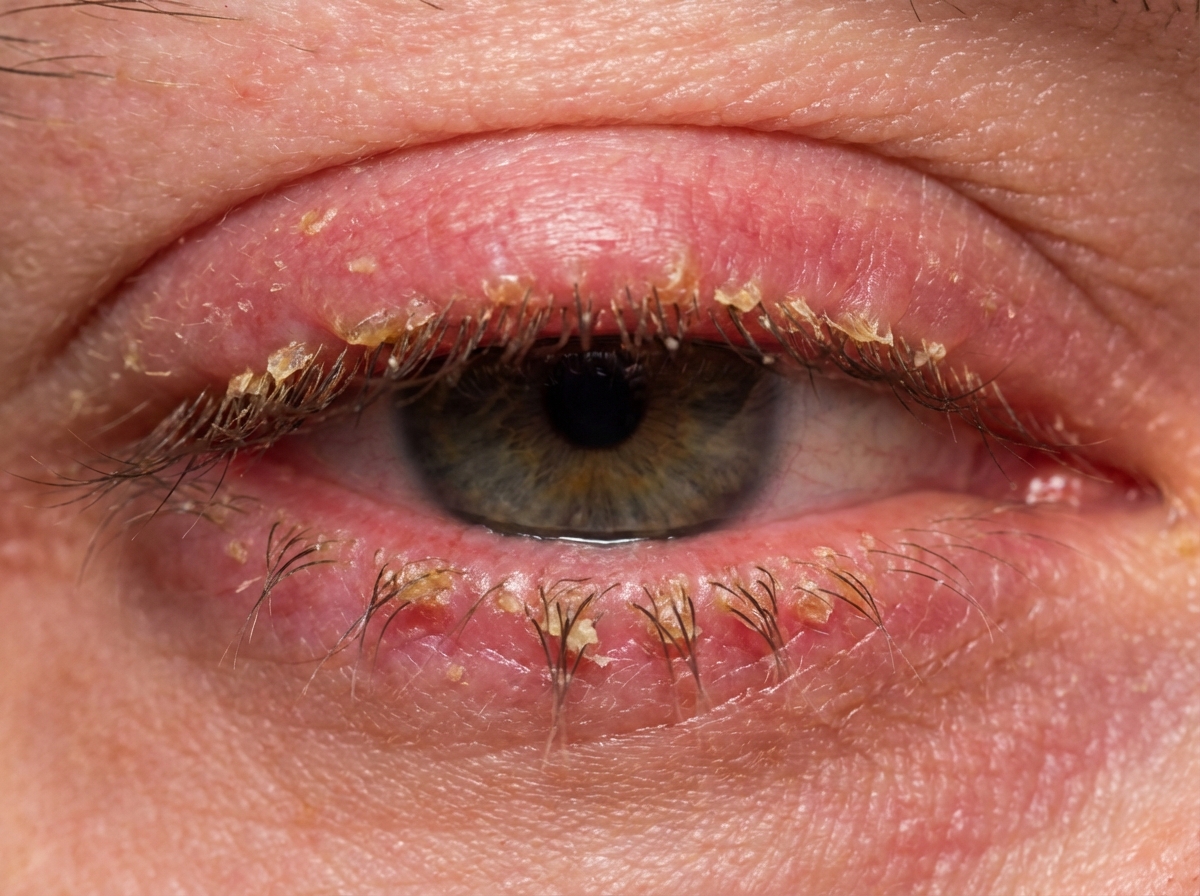
Which of the following is NOT true about epiblepharon?
In recurrent chalazion, histopathological examination is done to rule out which of the following conditions?
What is epiphora?
What is another name for a stye?
Epiphora in a patient with seventh nerve palsy is most likely due to:
In which type of ptosis does the amount of ptosis decrease with mouth opening?
A 60-year-old man presented with watering from his left eye for one year. Syringing revealed a patent drainage system. The rest of the ocular examination was normal. A provisional diagnosis of lacrimal pump failure was made. Confirmation of the diagnosis would be by:
Fasanella Servat operation is specifically indicated in which of the following conditions?
Probing and irrigation is not indicated in which of the following conditions?
Most common site of congenital blockage in the nasolacrimal duct is:
Explanation: **Explanation:** **Epiblepharon** is a congenital eyelid anomaly characterized by a horizontal fold of skin and underlying orbicularis muscle that pushes the eyelashes vertically or inwards against the globe. 1. **Why Option C is the correct answer (False statement):** Epiblepharon is a **congenital** condition, typically caused by the failure of the lower eyelid retractors to fuse with the skin and orbicularis muscle. It is **not caused by trauma**. Traumatic injuries to the eyelid are more likely to result in cicatricial entropion or ectropion, rather than the specific skin-fold mechanism seen in epiblepharon. 2. **Analysis of other options:** * **Option A:** It is frequently seen in children with **hyperopia** (long-sightedness) and those with chubby facial features or a flat nasal bridge. * **Option B:** It is commonly associated with other congenital eyelid folds, most notably **epicanthus** (epicanthus tarsalis or inversus). * **Option D:** The pathology involves an extra **fold of skin and muscle** (and indirectly affects the lid margin/conjunctiva) that causes the lashes to turn inwards. While the lid margin itself is usually in a normal position (unlike entropion), the fold forces the lashes and lid edge toward the globe. **High-Yield Clinical Pearls for NEET-PG:** * **Demographics:** Most common in Asian children. * **Differential Diagnosis:** Must be distinguished from **Congenital Entropion**. In epiblepharon, the eyelid margin remains in its normal anatomical position; only the skin fold and lashes are turned in. * **Management:** It often resolves spontaneously as the facial bones grow and the nasal bridge develops. Surgery (Hotz procedure) is only indicated if there is persistent corneal irritation or keratitis. * **Key Feature:** Pulling the skin fold downward usually results in the lashes turning outward, which is a diagnostic maneuver.
Explanation: ### Explanation **1. Why Sebaceous Gland Carcinoma (SGC) is the Correct Answer:** A chalazion is a chronic lipogranulomatous inflammation of the Meibomian glands (modified sebaceous glands). While usually benign, **Sebaceous Gland Carcinoma** is a highly malignant tumor that frequently mimics a chalazion in its early stages. This clinical similarity is known as **"Masquerade Syndrome."** In cases of recurrent chalazion at the same site or a chalazion with atypical features (e.g., loss of lashes, irregular consistency), a biopsy is mandatory to rule out SGC, as this cancer can lead to orbital invasion and systemic metastasis. **2. Why the Other Options are Incorrect:** * **B. Squamous Cell Carcinoma (SCC):** While SCC is a common eyelid malignancy, it typically presents as an ulcerated plaque or nodule on the lid margin (often the lower lid). It does not specifically mimic the deep-seated, focal glandular swelling characteristic of a chalazion. * **C. Adenocystic Carcinoma:** This is a rare, aggressive tumor primarily associated with the lacrimal gland, not the Meibomian glands of the eyelid. * **D. Basal Cell Carcinoma (BCC):** BCC is the **most common** eyelid malignancy (usually on the lower lid). It typically presents as a "pearly" nodule with telangiectasia or a "rodent ulcer." Unlike SGC, it rarely mimics a chalazion and does not arise from sebaceous glands. **Clinical Pearls for NEET-PG:** * **Most common site for SGC:** Upper eyelid (due to a higher concentration of Meibomian glands). * **Most common eyelid malignancy overall:** Basal Cell Carcinoma. * **Pagetoid spread:** A unique feature of SGC where tumor cells migrate into the conjunctival epithelium; this requires a "map biopsy." * **Staining:** SGC stains positive with **Oil Red O** or **Sudan IV** (requires fresh frozen tissue).
Explanation: **Explanation:** **Epiphora** is defined as the overflow of tears onto the cheek due to an **anatomical obstruction** in the lacrimal drainage system (outflow tract). This is distinct from "lacrimation," which refers to excessive tear production caused by reflex stimulation (e.g., corneal foreign body or inflammation). 1. **Why the correct answer is right:** In a healthy eye, tears are drained via the puncta into the lacrimal sac and through the nasolacrimal duct (NLD) into the inferior meatus of the nose. Any blockage along this pathway—such as punctal stenosis, canalicular obstruction, or NLD blockage—prevents drainage, causing tears to spill over the eyelid margin. 2. **Analysis of incorrect options:** * **Option A:** This describes **CSF Rhinorrhea**, typically seen in fractures of the cribriform plate. * **Option B:** This is a distractor; epiphora is a localized mechanical or functional issue of the lacrimal apparatus, not a classic epiphenomenon of cerebral tumors. * **Option C:** This describes **Ectropion**. While ectropion can *cause* epiphora (because the punctum is no longer in contact with the globe), the term "epiphora" refers to the symptom of tearing itself, not the eyelid malposition. **High-Yield Clinical Pearls for NEET-PG:** * **Jones Dye Test:** Used to differentiate between a functional and anatomical obstruction. * **Regurgitation Test (ROPLAS):** Positive in chronic dacryocystitis (mucoid discharge from punctum on pressure over the sac), indicating obstruction at the NLD level. * **Congenital NLD Obstruction:** Most common cause of watering in infants; usually due to a persistent **Valve of Hasner**. Management involves Crigler’s massage (lacrimal sac massage) until age 1, followed by probing if unresolved. * **Dacryocystorhinostomy (DCR):** The surgical treatment of choice for acquired NLD obstruction.
Explanation: **Explanation:** A **stye**, or **Hordeolum externum**, is an acute, focal, pyogenic inflammation of the eyelid margin. It is most commonly caused by a **Staphylococcal infection** of the **Glands of Zeis** (sebaceous) or **Glands of Moll** (sweat), and is often associated with the hair follicle of the eyelash. Clinically, it presents as a painful, red, and pointed swelling at the lid margin that may spontaneously rupture and drain pus. **Analysis of Options:** * **Hordeolum externum (Correct):** This is the medical term for a stye. It is "external" because the infection involves the superficial glands located on the anterior surface of the eyelid margin. * **Hordeolum internum (Incorrect):** This is a suppurative inflammation of the **Meibomian glands**. Unlike a stye, the inflammation is located within the tarsal plate, making the swelling more prominent on the inner (conjunctival) side of the lid. * **Chalazion (Incorrect):** This is a **chronic, non-infectious, granulomatous inflammation** of the Meibomian glands caused by the obstruction of a duct. Unlike a stye, it is typically **painless** and presents as a firm, "shotty" swelling away from the lid margin. **High-Yield Clinical Pearls for NEET-PG:** * **Primary Pathogen:** *Staphylococcus aureus* is the most common causative organism for both internal and external hordeola. * **Treatment:** Hot compresses are the mainstay of treatment to facilitate drainage. Antibiotic ointments are used to prevent recurrence. * **Recurrent Styes:** In cases of recurrent hordeola, always rule out **Diabetes Mellitus** or uncorrected **refractive errors** (due to frequent rubbing of eyes). * **Chalazion vs. Hordeolum:** Remember: Hordeolum = Acute/Painful/Infectious; Chalazion = Chronic/Painless/Granulomatous.
Explanation: ### Explanation **Correct Answer: C. Failure of the lacrimal pump system** The fundamental mechanism of tear drainage relies on the **lacrimal pump**, which is driven by the **orbicularis oculi muscle** (specifically the lacrimal part or Horner’s muscle). This muscle is innervated by the **Seventh Cranial Nerve (Facial Nerve)**. When the orbicularis oculi contracts during blinking, it creates a negative pressure in the lacrimal sac, sucking tears from the canaliculi into the sac. In **7th nerve palsy**, the orbicularis oculi is paralyzed. This leads to a total failure of the lacrimal pump mechanism, preventing tears from being actively transported into the drainage system, even if the anatomical pathway is patent. This is the **primary and most direct cause** of epiphora in these patients. **Analysis of Other Options:** * **A and B (Eversion of punctum and Ectropion):** While these are common clinical findings in facial nerve palsy due to loss of muscle tone in the lower lid, they are **secondary mechanical consequences**. While they contribute to epiphora by preventing tears from reaching the drainage openings, the physiological failure of the pump (Option C) occurs regardless of lid position and is the more comprehensive underlying pathophysiological explanation. * **D (All of the above):** While all factors contribute, the "most likely" or "most fundamental" cause in the context of nerve function is the pump failure. **Clinical Pearls for NEET-PG:** * **Lagophthalmos:** Inability to close the eye due to 7th nerve palsy, leading to exposure keratopathy. * **Bell’s Phenomenon:** The upward and outward movement of the globe during attempted lid closure; its presence is a protective sign in facial palsy. * **Schirmer’s Test:** Used to differentiate the level of 7th nerve lesion (proximal to the geniculate ganglion results in decreased tear production). * **Management:** Initial treatment involves lubricants and taping; surgical options include **tarsorrhaphy** or **gold weight implants** in the upper lid.
Explanation: **Explanation:** **Marcus Gunn Jaw-Winking Ptosis** is a form of **synkinetic congenital ptosis**. It occurs due to a "miswiring" of the cranial nerves during development. Specifically, the branch of the **Mandibular nerve (CN V3)** that supplies the lateral pterygoid muscle (responsible for jaw movement) is aberrantly connected to the **Levator Palpebrae Superioris (LPS)** muscle (supplied by CN III). When the patient opens their mouth or moves the jaw to the opposite side, the lateral pterygoid is stimulated, which simultaneously sends an impulse to the LPS. This causes the drooping eyelid to suddenly retract or "wink," thereby **decreasing the amount of ptosis** during mouth opening. **Analysis of Incorrect Options:** * **A. Blepharophimosis Syndrome:** A triad of ptosis, epicanthus inversus, and telecanthus. It is a permanent structural defect and does not change with jaw movement. * **C. Myogenic Ptosis:** Caused by primary muscle disorders (e.g., Myasthenia Gravis, CPEO). While Myasthenia shows variability (fatigability), it does not improve with jaw movement. * **D. Neurogenic Ptosis:** Caused by nerve palsy (e.g., 3rd Nerve Palsy or Horner’s Syndrome). These do not involve synkinetic jaw-eye movements. **High-Yield Clinical Pearls for NEET-PG:** * **Nerves involved:** CN V3 (Mandibular) and CN III (Oculomotor). * **Most common** type of congenital synkinetic ptosis (approx. 5% of cases). * **Inverse Marcus Gunn Phenomenon (Marin-Amat Syndrome):** The eyelid *closes* (ptosis increases) upon jaw opening; usually seen after facial nerve palsy recovery. * **Management:** If mild, observation; if severe, Levator excision with Frontalis sling is the treatment of choice to eliminate the synkinesis.
Explanation: ### Explanation **Concept: Lacrimal Pump Failure** Lacrimal pump failure occurs when the eyelids fail to effectively push tears into the lacrimal sac despite a physically open (patent) drainage system. This is often due to orbicularis oculi weakness (e.g., facial nerve palsy) or eyelid laxity in the elderly. **Why Dacryoscintigraphy is the Correct Answer:** * **Dacryoscintigraphy (Radioisotope Lacrimography)** is a **functional test**. It involves placing a drop of Technetium-99m into the conjunctival sac and using a gamma camera to track its movement. * Because it mimics physiological tear flow without external pressure, it is the **gold standard** for diagnosing functional nasolacrimal duct obstruction (where syringing is patent but tears don't flow) and lacrimal pump failure. **Why Other Options are Incorrect:** * **B. Dacryocystography (DCG):** This is an **anatomical test** involving the injection of radiopaque dye. It is excellent for identifying the site of a physical blockage (stricture/stone) but cannot assess functional pump failure because the dye is injected under pressure. * **C. Pressure Syringing:** This confirms anatomical patency. If the system is patent, fluid will reach the throat, but it bypasses the natural "pump" mechanism, thus failing to diagnose pump failure. * **D. Canaliculi Irrigation Test:** Similar to syringing, this checks for canalicular obstructions but does not evaluate the physiological dynamics of tear drainage. **High-Yield Clinical Pearls for NEET-PG:** * **Jones Dye Test I:** Differentiates hypersecretion from true obstruction (Positive = Patency). * **Jones Dye Test II:** Localizes the site of partial obstruction (Positive = Functional block/Pump failure; Negative = Total anatomical block). * **Primary diagnostic step for epiphora:** Fluorescein Disappearance Test (FDT). * **Management of Pump Failure:** Often involves horizontal eyelid shortening (e.g., Lateral Tarsal Strip procedure) to tighten the lid and restore pump efficiency.
Explanation: **Explanation:** The **Fasanella-Servat operation** is a posterior approach ptosis correction procedure involving the excision of the upper border of the tarsal plate, the lower border of the Müller’s muscle, and the overlying conjunctiva. **Why Horner’s Syndrome is correct:** The procedure is specifically indicated for **mild ptosis (1.5–2 mm)** with **good levator palpebrae superioris (LPS) function (≥10 mm)**. In Horner’s syndrome, the ptosis is mild because it results from paralysis of the **Müller’s muscle** (sympathetically innervated), while the LPS muscle remains functional. By shortening the posterior lamella (Müller’s and tarsus), the Fasanella-Servat operation effectively lifts the lid in these specific cases. **Analysis of Incorrect Options:** * **Congenital Ptosis:** Most cases are due to myogenic dysgenesis of the LPS with poor function, requiring a **Frontalis Sling** or **LPS Resection**. Fasanella-Servat is insufficient for moderate-to-severe congenital cases. * **Myasthenia Gravis:** This is a medical condition treated with anticholinesterases (Pyridostigmine). Surgery is generally avoided or deferred until the disease is stable, as the ptosis is variable and carries a risk of postoperative diplopia or exposure keratopathy. * **Steroid-induced Ptosis:** This typically results from aponeurotic dehiscence. The preferred treatment is **Levator Aponeurosis advancement/repair**. **High-Yield Clinical Pearls for NEET-PG:** 1. **Indication Criteria:** Mild ptosis (1.5–2 mm), Good LPS function (>10 mm), and a positive **Phenylephrine test** (lid elevates after sympathomimetic drops). 2. **Other Indications:** Minimal ptosis in cases of Synkinetic ptosis (Marcus Gunn Phenomenon) or mild acquired aponeurotic ptosis. 3. **Alternative:** The **Müller’s Muscle-Conjunctival Resection (MMCR)** is now more commonly performed than Fasanella-Servat as it spares the tarsal plate, preserving lid stability.
Explanation: **Explanation:** **Why Acute Dacryocystitis is the Correct Answer:** Probing and irrigation are strictly **contraindicated** in acute dacryocystitis. This is because the lacrimal sac is acutely inflamed, infected, and often contains an abscess. Attempting to pass a probe or force fluid through the system during this stage can: 1. Cause extreme pain to the patient. 2. Risk **disseminating the infection** into the surrounding orbital or facial tissues, potentially leading to orbital cellulitis or cavernous sinus thrombosis. 3. Create a **false passage** due to the friable, inflamed mucosa. The management of acute dacryocystitis involves systemic antibiotics and warm compresses; surgical intervention (DCR) is only performed once the acute infection has subsided. **Analysis of Incorrect Options:** * **Lacrimal Fistula:** Probing and irrigation are often used as diagnostic tools to confirm the patency of the lacrimal system and to identify the internal opening of the fistula. * **Congenital Dacryocystitis (Nasolacrimal Duct Obstruction):** Probing is the **treatment of choice** if the condition does not resolve with Crigler’s massage by the age of 1 year. * **Trauma to Eye:** In cases of canalicular lacerations or trauma involving the medial canthus, probing is essential to identify the severed ends of the canaliculi for surgical repair (stenting). **Clinical Pearls for NEET-PG:** * **Gold Standard for NLD Obstruction:** Dacryocystorhinostomy (DCR). * **Jones Dye Test I:** Differentiates between partial obstruction and hypersecretion (positive test = patent system). * **Regurgitation Test:** Positive in chronic dacryocystitis (mucocele) but should be avoided in acute cases. * **Congenital NLD Obstruction:** Most common site of blockage is the **Valve of Hasner**.
Explanation: **Explanation:** The nasolacrimal duct (NLD) develops from a solid cord of ectodermal cells that undergoes canalization. This process starts in the middle and progresses toward both ends. The **lower end** of the duct is the last part to canalize, typically occurring just before or shortly after birth. **Why Option C is correct:** The most common site of congenital blockage is at the lower end of the NLD, specifically at the **Valve of Hasner** (also known as the plica lacrimalis). This is due to the failure of the canalization process to complete, resulting in a persistent mucosal membrane that obstructs the opening into the inferior meatus of the nose. **Why other options are incorrect:** * **Option A & B:** Canalization begins in the middle and moves upwards and downwards; therefore, the upper and middle portions are rarely the site of primary congenital obstruction. * **Option D:** While "Dacryocystocele" can involve a large segment, a total blockage of the entire duct is rare compared to the localized membranous obstruction at the distal end. **Clinical Pearls for NEET-PG:** * **Presentation:** Persistent watering (epiphora) and matting of lashes, usually starting 1–2 weeks after birth. * **ROPLAS Test:** Regurgitation on Pressure over Lacrimal Sac is positive (mucoid/mucopurulent discharge). * **Management:** 1. **Crigler’s Massage (Lacrimal sac massage):** First-line treatment (90% success rate in the first year). It increases hydrostatic pressure to rupture the membrane at the Valve of Hasner. 2. **Probing:** Indicated if massage fails after age 1. 3. **Dacryocystorhinostomy (DCR):** Usually reserved for cases failing after age 3–4.
Eyelid Anatomy and Physiology
Practice Questions
Ptosis
Practice Questions
Entropion and Ectropion
Practice Questions
Eyelid Tumors
Practice Questions
Facial Nerve Palsy
Practice Questions
Blepharospasm and Hemifacial Spasm
Practice Questions
Blepharitis and Meibomian Gland Dysfunction
Practice Questions
Lacrimal System Disorders
Practice Questions
Orbital Inflammations
Practice Questions
Orbital Tumors
Practice Questions
Thyroid Eye Disease
Practice Questions
Anophthalmic Socket Management
Practice Questions
Get full access to all questions, explanations, and performance tracking.
Start For Free