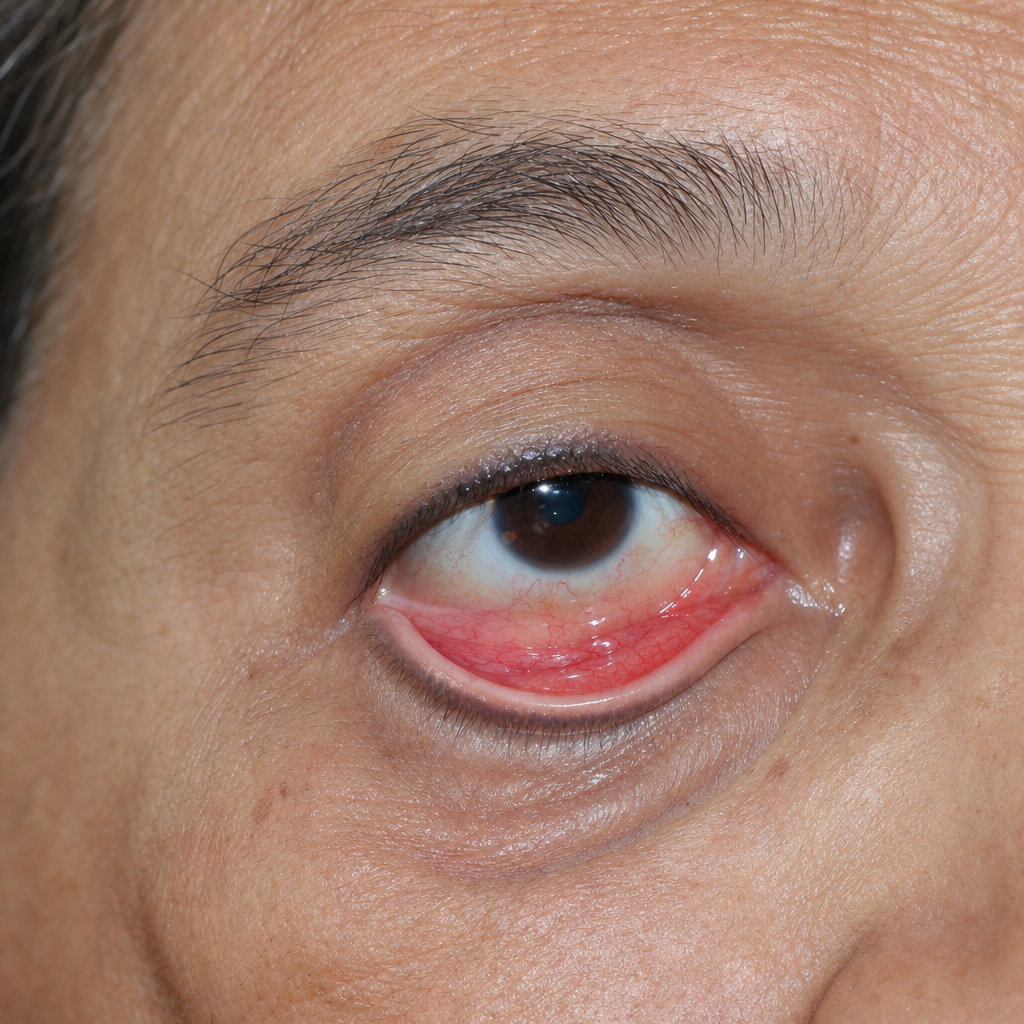
Senile ptosis is:
What is Euryblepharon?
Modified Wheeler's operation is done for which condition?
What is the treatment for congenital ptosis with poor elevation?
Meibomian gland carcinoma may be mistaken for which of the following?
All are true about congenital ptosis except?
The term ankyloblepharon means:
A 3-year-old child presents with drooping of the upper eyelid since birth. On examination, the palpebral aperture height is 6 mm and there is poor levator palpebrae superioris function. What is the recommended surgical procedure?
What is the most common site of obstruction in chronic dacryocystitis in adults?
What is the term for the adhesion of the margins of two eyelids?
Explanation: **Explanation:** **Senile ptosis** (also known as Involutional ptosis) is the most common form of acquired ptosis in the elderly. **Why Aponeurotic is correct:** The primary pathology in senile ptosis is the **disinsertion, dehiscence, or stretching of the Levator Palpebrae Superioris (LPS) aponeurosis** from its attachment to the tarsal plate. This occurs due to age-related degenerative changes. Characteristically, these patients present with a **high or absent upper eyelid crease** and good levator function, as the muscle itself is healthy, but its "tendon" (aponeurosis) has slipped. **Why other options are incorrect:** * **Neurogenic:** Caused by nerve defects, such as 3rd Nerve Palsy or Horner’s Syndrome. Senile ptosis does not involve nerve dysfunction. * **Myogenic:** Caused by primary muscle disorders (e.g., Myasthenia Gravis or Myotonic Dystrophy). In senile ptosis, the LPS muscle fibers are typically normal. * **Mechanical:** Caused by the weight of a mass (tumor, edema, or chalazion) pulling the lid down. Senile ptosis is due to structural laxity, not added weight. **High-Yield Clinical Pearls for NEET-PG:** * **Clinical Sign:** A "high skin crease" is the hallmark of aponeurotic ptosis. * **Thinning of the lid:** The eyelid may appear thin, sometimes allowing the iris to be visible through the skin (due to LPS dehiscence). * **Surgical Management:** The treatment of choice is **LPS Aponeurosis advancement or repair**. * **Differential:** If ptosis is associated with miosis, think Horner’s; if associated with ocular motility issues, think 3rd Nerve Palsy.
Explanation: **Explanation:** **Euryblepharon** is a rare congenital anomaly characterized by a **horizontal widening of the palpebral fissure**, typically associated with a vertical shortening of the eyelids. 1. **Why Option B is Correct:** The primary defect in euryblepharon is the lateral displacement of the lateral canthus and an enlargement of the eyelid opening. This results in a characteristic "drooping" of the outer half of the lower lid, leading to increased scleral show and potential lagophthalmos (inability to close the eyes completely). It can be unilateral but is more commonly bilateral and symmetrical. 2. **Why Other Options are Incorrect:** * **Option A (Coloboma):** A full-thickness triangular gap in the eyelid is known as an **Eyelid Coloboma**. It most commonly affects the medial third of the upper lid. * **Option C (Microblepharon):** Small eyelids are termed **Microblepharon**. This is a vertical deficiency where the lids are too short to cover the globe. * **Option D (Ablepharon):** The complete failure of the eyelid to develop is called **Ablepharon**. It is often seen in Ablepharon-Macrostomia Syndrome. **High-Yield Clinical Pearls for NEET-PG:** * **Clinical Presentation:** Patients often present with epiphora (tearing) and exposure keratopathy due to the malposition of the lids. * **Associations:** It is frequently associated with **lateral canthal dystopia** and **ectropion**. * **Management:** Mild cases require lubricants; severe cases require surgical correction via lateral canthoplasty or skin grafting to address the vertical skin deficiency.
Explanation: **Explanation:** **Modified Wheeler's Operation** is a surgical procedure specifically designed for the correction of **Spastic Senile Entropion**. 1. **Why Entropion is Correct:** In senile (involutional) entropion, the primary pathology involves horizontal lid laxity, disinsertion of the lower lid retractors, and **overriding of the preseptal orbicularis oculi** muscle over the pretarsal orbicularis. The Modified Wheeler’s operation involves a **double-breasting (imbrication) of the orbicularis oculi muscle**. By overlapping and suturing the muscle fibers, the surgeon creates a barrier that prevents the muscle from overriding the tarsal plate, thereby rotating the eyelid margin back to its normal outward position. 2. **Why Other Options are Incorrect:** * **Ectropion:** Common surgeries include the **Kuhnt-Szymanowski procedure** (for senile ectropion) or the **Lazy-T procedure** (for punctal ectropion). These focus on horizontal shortening rather than muscle imbrication. * **Symblepharon:** This refers to the adhesion of the palpebral conjunctiva to the bulbar conjunctiva. Treatment involves **symblepharectomy** with the use of amniotic membrane grafts or mucous membrane grafts. * **Ankyloblepharon:** This is the adhesion of the upper and lower eyelid margins. It requires **y-v plasty** or simple surgical division (separation) of the lids. **Clinical Pearls for NEET-PG:** * **Wheeler’s Operation (Original):** Originally described for entropion, but the "Modified" version is the standard reference in exams. * **Other Entropion Surgeries:** * **Bick’s Procedure:** For horizontal lid laxity. * **Jones Procedure:** For tightening lower lid retractors. * **Weis Procedure:** A transverse lid split with eversion sutures. * **High-Yield Tip:** If the question mentions "Double-breasting of orbicularis," always think of Wheeler’s and Entropion.
Explanation: In congenital ptosis, the choice of surgical procedure is primarily determined by the **Levator Palpebrae Superioris (LPS) function** (measured as the amount of upper lid excursion). ### Why "Frontalis Sling" is Correct The **Frontalis Sling (Suspension) operation** is the treatment of choice when LPS function is **poor (less than 4 mm)**. Since the levator muscle is dysplastic and cannot effectively lift the eyelid, the surgery involves "coupling" the eyelid to the frontalis muscle using a sling material (such as autologous fascia lata or synthetic materials like Prolene or Silicone). This allows the patient to elevate the eyelid by using their eyebrow muscles (frontalis). ### Why Other Options are Incorrect * **Levator Resection:** This is the preferred procedure when LPS function is **fair (5–8 mm) or good (>8 mm)**. If performed on a patient with poor elevation, the results are unsatisfactory because the muscle lacks the contractile strength to lift the lid even after shortening. * **Fasanella-Servat (FS) Operation:** This is a "posterior approach" ptosis surgery involving the resection of the superior tarsus, conjunctiva, and Müller’s muscle. It is indicated only for **minimal ptosis (1.5–2 mm)** with good LPS function, such as in Horner’s syndrome. ### High-Yield Clinical Pearls for NEET-PG * **LPS Function Grading:** Good (>8 mm), Fair (5–8 mm), Poor (<4 mm). * **Marcus Gunn Jaw Winking Phenomenon:** The most common surgery is a bilateral levator excision followed by a bilateral frontalis sling to achieve symmetry. * **Gold Standard Material:** Autologous **Fascia Lata** (harvested from the thigh) is the best material for a frontalis sling in children over 3 years of age. * **Complication:** The most common complication of ptosis surgery is under-correction; however, lagophthalmos and exposure keratitis must be monitored post-operatively.
Explanation: **Explanation:** **Meibomian Gland Carcinoma (Sebaceous Gland Carcinoma)** is a highly malignant, slow-growing tumor that arises from the meibomian glands (most commonly in the upper lid). It is notorious for being a **"masquerade syndrome"** because its clinical presentation closely mimics benign inflammatory conditions. **Why Option B is Correct:** The most common clinical presentation of Meibomian gland carcinoma is a firm, painless, non-tender nodule. Because it originates within the same glands involved in chalazion formation, it is frequently misdiagnosed as a **recurrent chalazion**. Any "chalazion" that recurs in the same location, especially in elderly patients, or feels unusually firm/fixed, must be biopsied to rule out malignancy. **Why Other Options are Incorrect:** * **A. Recurrent Stye (Hordeolum):** A stye is an acute, painful, staphylococcal infection. Carcinoma is typically chronic and painless, making it less likely to be mistaken for an acute infectious process. * **C. Recurrent Concretions:** Concretions are small, hard, yellow-white deposits found on the palpebral conjunctiva (usually due to chronic inflammation). They do not present as a distinct lid mass. * **D. Chronic Conjunctivitis:** While sebaceous carcinoma can present as "pagetoid spread" (mimicking chronic blepharoconjunctivitis), the question specifically asks about the nodular form, which is most classically mistaken for a chalazion. **High-Yield Clinical Pearls for NEET-PG:** 1. **Masquerade Syndrome:** It can also mimic chronic blepharitis or superior limbic keratoconjunctivitis (SLK). 2. **Location:** Unlike basal cell carcinoma (which favors the lower lid), Meibomian gland carcinoma is more common in the **upper lid** (due to a higher density of meibomian glands). 3. **Yellowish Hue:** The presence of lipid within the tumor often gives it a characteristic yellowish appearance. 4. **Management:** Wide surgical excision with Map biopsies. It is highly metastatic, spreading to preauricular and submandibular lymph nodes.
Explanation: In congenital ptosis, the primary pathology is **dysgenesis of the Levator Palpebrae Superioris (LPS) muscle**, where normal muscle fibers are replaced by fibrous or fatty tissue. This underlying pathophysiology explains the clinical features. ### Why "Prominence of lid crease" is the Correct Answer (The Exception) The lid crease is formed by the attachment of the LPS aponeurosis to the skin of the eyelid. In congenital ptosis, because the LPS muscle is malformed and weak, these attachments are either weak or absent. Consequently, the **lid crease is typically absent, faint, or poorly formed**, rather than prominent. A high or prominent lid crease is actually a hallmark of **aponeurotic (involutional) ptosis**, not congenital. ### Explanation of Other Options * **Stimulus deprivation amblyopia (A):** If the ptotic lid covers the visual axis (pupil) during the critical period of visual development, it prevents a clear image from reaching the retina, leading to amblyopia. This is the primary indication for early surgical intervention. * **Lid lag on downgaze (B):** This is a classic sign of congenital ptosis. Because the LPS muscle is fibrotic, it cannot relax or stretch normally when the patient looks down, causing the upper lid to remain higher than the normal side during downgaze. * **Loss of lid crease (D):** As explained above, the lack of a functional LPS aponeurosis leads to a loss or shallowing of the lid crease. ### High-Yield Clinical Pearls for NEET-PG * **Most common cause:** Isolated myogenic dysgenesis of the LPS. * **Marcus Gunn Jaw-Winking Phenomenon:** A common association where the lid elevates with jaw movement (synkinesis between the 5th and 3rd cranial nerves). * **Surgical Choice:** * If LPS action is **good (>8mm)**: LPS Resection. * If LPS action is **poor (<4mm)**: Frontalis Sling (Brow suspension) operation. * **Hering’s Law:** In cases of bilateral asymmetrical ptosis, lifting the more ptotic lid may cause the other lid to drop.
Explanation: ### Explanation **Ankyloblepharon** is a clinical condition characterized by the **partial or complete adhesion of the upper and lower eyelid margins** to each other. This results in a narrowing or shortening of the palpebral fissure. It can be congenital (often associated with other anomalies like cleft lip/palate) or acquired due to chemical burns, trauma, Stevens-Johnson syndrome, or ocular cicatricial pemphigoid. #### Analysis of Options: * **Option C (Correct):** The term is derived from the Greek words *ankylos* (fused/stiff) and *blepharon* (eyelid). It specifically refers to the fusion of the lid margins. * **Option A (Incorrect):** A smaller appearing palpebral fissure is generally termed **Blepharophimosis**. While ankyloblepharon results in a smaller fissure, the defining feature is the adhesion of the margins. * **Option B (Incorrect):** Incomplete closure of the palpebral aperture when the eyes are shut is termed **Lagophthalmos**. This is commonly seen in facial nerve palsy or severe proptosis. * **Option D (Incorrect):** Eversion of the lid margin (turning outward) is termed **Ectropion**. Conversely, inversion (turning inward) is called **Entropion**. #### High-Yield Clinical Pearls for NEET-PG: * **Symblepharon:** Adhesion between the palpebral conjunctiva (eyelid) and the bulbar conjunctiva (eyeball). Do not confuse this with ankyloblepharon (lid-to-lid adhesion). * **Cryptophthalmos:** A rare condition where the eyelids fail to form, and skin passes continuously from the forehead to the cheek, covering the eyeball. * **Blepharophimosis Syndrome (BPES):** A triad of Blepharophimosis, Ptosis, and Epicanthus inversus. * **Treatment:** The management of ankyloblepharon involves surgical separation of the fused margins (lid splitting).
Explanation: ### Explanation The clinical presentation describes a case of **Congenital Ptosis** with **poor Levator Palpebrae Superioris (LPS) function**. In pediatric ophthalmology, the choice of surgical procedure for ptosis is primarily dictated by the strength of the LPS muscle. **1. Why Frontalis Sling is correct:** The LPS function is categorized as Good (>8 mm), Fair (5–8 mm), or Poor (<4 mm). In this patient, the function is "poor." When the LPS muscle is too weak to lift the eyelid, the **Frontalis Sling (Brow Suspension)** procedure is indicated. This surgery connects the tarsal plate to the frontalis muscle using a sling material (e.g., Autologous Fascia Lata or synthetic materials like Prolene/Silicone), allowing the child to lift the eyelid by raising their eyebrows. **2. Why other options are incorrect:** * **Mullerectomy (Option B):** This is a posterior approach used only for **mild ptosis** (1–2 mm) where the LPS function is excellent and the eyelid responds well to the Phenylephrine test. * **Fasanella-Servat (Option C):** This involves excision of the superior tarsus, conjunctiva, and Muller’s muscle. It is indicated for **minimal ptosis** with good LPS function (e.g., Horner’s syndrome). * **Observation (Option D):** While mild ptosis can be observed, surgical intervention is mandatory in children if there is a risk of **deprivational amblyopia** (lazy eye) due to the eyelid covering the visual axis. **Clinical Pearls for NEET-PG:** * **Gold Standard Material:** Autologous **Fascia Lata** (taken from the thigh) is the best material for slings but is usually avoided in children under 3 years as the leg is not long enough. * **LPS Function Cut-offs:** * **>8 mm:** LPS Resection (preferred). * **5–8 mm:** LPS Resection (larger amount). * **<4 mm:** Frontalis Sling. * **Marcus Gunn Jaw Winking Phenomenon:** This is the most common type of synkinetic congenital ptosis; the treatment of choice is bilateral excision of LPS followed by a Frontalis Sling.
Explanation: **Explanation:** Chronic dacryocystitis is most commonly caused by **Primary Acquired Nasolacrimal Duct Obstruction (PANDO)**. The anatomical site most vulnerable to this obstruction is the **upper end of the nasolacrimal duct (NLD)**, specifically where the lacrimal sac narrows to enter the bony canal. This area is a physiological bottleneck where stasis of tears occurs, leading to chronic inflammation, mucosal edema, and eventual fibrosis. **Analysis of Options:** * **A. Upper end of the NLD (Correct):** This is the narrowest part of the drainage system. Chronic inflammation here leads to stricture formation, which is the hallmark of adult chronic dacryocystitis. * **B. Lower end of the NLD:** While this is the most common site of obstruction in **congenital** dacryocystitis (due to a persistent Hasner’s valve), it is less common in adults. * **C. The lacrimal sac:** The sac itself is usually the site of secondary infection and distension (mucocele) *resulting* from a distal obstruction, rather than being the primary site of the block. * **D. The common canaliculus:** Obstruction here (canalicular stenosis) prevents tears from reaching the sac, leading to epiphora without the typical discharge or swelling seen in dacryocystitis. **High-Yield Clinical Pearls for NEET-PG:** * **Most common organism:** *Staphylococcus aureus* (Acute); *Streptococcus pneumoniae* (Chronic). * **Gold Standard Investigation:** Dacryocystography (DCG) to localize the site of obstruction. * **Treatment of Choice:** Dacryocystorhinostomy (DCR) is the definitive surgery to create a new passage between the sac and the middle meatus. * **Key Sign:** A positive **Regurgitation Test** (pressure over the sac causes mucoid discharge from puncta) confirms NLD obstruction.
Explanation: **Explanation:** **Ankyloblepharon** (Correct Answer) refers to the partial or complete adhesion of the upper and lower eyelid margins. This condition results in a narrowed palpebral fissure. It can be **congenital** (often associated with other syndromes) or **acquired** due to chemical burns, trauma, Stevens-Johnson syndrome, or ocular cicatricial pemphigoid. **Analysis of Incorrect Options:** * **Symblepharon (A):** This is the adhesion of the **palpebral conjunctiva** (inner eyelid) to the **bulbar conjunctiva** (eyeball). While it also involves adhesions, it does not specifically refer to the fusion of the lid margins themselves. * **Lagophthalmos (B):** This is the **inability to close the eyelids completely**, leading to corneal exposure. It is commonly caused by facial nerve (CN VII) palsy or proptosis. * **Blepharophimosis (D):** This refers to a generalized **narrowing of the palpebral fissure** in both horizontal and vertical directions, but without the fusion of the lid margins. It is typically seen in the "Blepharophimosis, Ptosis, Epicanthus Inversus Syndrome" (BPES). **High-Yield Clinical Pearls for NEET-PG:** * **Ankyloblepharon Filiforme Adnatum:** A specific congenital form where the lids are joined by fine, vascularized connective tissue bands. * **Surgical Management:** The treatment for ankyloblepharon is **yawning/separation** of the lid margins, often followed by the application of lubricants or a conformer to prevent re-adhesion. * **Distinction:** Remember the "S" in **S**ymblepharon for **S**clera/Bulbar conjunctiva involvement, and "Ankylo" (meaning stiff/fused, as in Ankylosing Spondylitis) for lid margin fusion.
Explanation: **Explanation:** **Epiblepharon** is a congenital eyelid anomaly characterized by a horizontal fold of skin and underlying orbicularis muscle that pushes the eyelashes vertically or inwards against the globe. 1. **Why Option C is the correct answer (False statement):** Epiblepharon is a **congenital** condition, typically caused by the failure of the lower eyelid retractors to fuse with the skin and orbicularis muscle. It is **not caused by trauma**. Traumatic injuries to the eyelid are more likely to result in cicatricial entropion or ectropion, rather than the specific skin-fold mechanism seen in epiblepharon. 2. **Analysis of other options:** * **Option A:** It is frequently seen in children with **hyperopia** (long-sightedness) and those with chubby facial features or a flat nasal bridge. * **Option B:** It is commonly associated with other congenital eyelid folds, most notably **epicanthus** (epicanthus tarsalis or inversus). * **Option D:** The pathology involves an extra **fold of skin and muscle** (and indirectly affects the lid margin/conjunctiva) that causes the lashes to turn inwards. While the lid margin itself is usually in a normal position (unlike entropion), the fold forces the lashes and lid edge toward the globe. **High-Yield Clinical Pearls for NEET-PG:** * **Demographics:** Most common in Asian children. * **Differential Diagnosis:** Must be distinguished from **Congenital Entropion**. In epiblepharon, the eyelid margin remains in its normal anatomical position; only the skin fold and lashes are turned in. * **Management:** It often resolves spontaneously as the facial bones grow and the nasal bridge develops. Surgery (Hotz procedure) is only indicated if there is persistent corneal irritation or keratitis. * **Key Feature:** Pulling the skin fold downward usually results in the lashes turning outward, which is a diagnostic maneuver.
Explanation: **Explanation:** **Telecanthus** refers to an increased distance between the medial canthi of the eyes. The hallmark of this condition is that while the **intercanthal distance (ICD)** is increased, the **interpupillary distance (IPD)** and the distance between the bony orbits remain **normal**. This is usually due to abnormally long medial palpebral ligaments. **Analysis of Options:** * **Option D (Correct):** This accurately describes the anatomical definition. In telecanthus, the soft tissue distance is increased, but the underlying skeletal structure and the visual axes (pupils) are correctly aligned. * **Option A & C (Incorrect):** These describe variations of **Epicanthus** (a semilunar fold of skin over the medial canthus), which is a common cause of "pseudoesotropia" but is a skin deformity, not a measurement-based definition of telecanthus. * **Option B (Incorrect):** This describes **Hypertelorism**. In hypertelorism, there is a true lateralization of the entire bony orbit, leading to both an increased intercanthal distance AND an increased interpupillary distance. **High-Yield Clinical Pearls for NEET-PG:** * **Telecanthus vs. Hypertelorism:** Remember, Telecanthus = Soft tissue/Ligamentous issue (Normal IPD); Hypertelorism = Bony/Skeletal issue (Increased IPD). * **Waardenburg Syndrome:** A classic high-yield association featuring lateral displacement of the inner canthi (Telecanthus), white forelock, and sensorineural deafness. * **Trauma:** Traumatic telecanthus is a common sign of **Naso-ethmoidal-orbital (NOE) fractures** due to the disruption of the medial palpebral ligament. * **Normal Values:** Average ICD is ~30-34mm; average IPD is ~60-64mm. Telecanthus is generally diagnosed when the ICD is >34mm.
Explanation: ### Explanation **1. Why Sebaceous Gland Carcinoma (SGC) is the Correct Answer:** A chalazion is a chronic lipogranulomatous inflammation of the Meibomian glands (modified sebaceous glands). While usually benign, **Sebaceous Gland Carcinoma** is a highly malignant tumor that frequently mimics a chalazion in its early stages. This clinical similarity is known as **"Masquerade Syndrome."** In cases of recurrent chalazion at the same site or a chalazion with atypical features (e.g., loss of lashes, irregular consistency), a biopsy is mandatory to rule out SGC, as this cancer can lead to orbital invasion and systemic metastasis. **2. Why the Other Options are Incorrect:** * **B. Squamous Cell Carcinoma (SCC):** While SCC is a common eyelid malignancy, it typically presents as an ulcerated plaque or nodule on the lid margin (often the lower lid). It does not specifically mimic the deep-seated, focal glandular swelling characteristic of a chalazion. * **C. Adenocystic Carcinoma:** This is a rare, aggressive tumor primarily associated with the lacrimal gland, not the Meibomian glands of the eyelid. * **D. Basal Cell Carcinoma (BCC):** BCC is the **most common** eyelid malignancy (usually on the lower lid). It typically presents as a "pearly" nodule with telangiectasia or a "rodent ulcer." Unlike SGC, it rarely mimics a chalazion and does not arise from sebaceous glands. **Clinical Pearls for NEET-PG:** * **Most common site for SGC:** Upper eyelid (due to a higher concentration of Meibomian glands). * **Most common eyelid malignancy overall:** Basal Cell Carcinoma. * **Pagetoid spread:** A unique feature of SGC where tumor cells migrate into the conjunctival epithelium; this requires a "map biopsy." * **Staining:** SGC stains positive with **Oil Red O** or **Sudan IV** (requires fresh frozen tissue).
Explanation: ### Explanation **Concept Overview** Watering of the eyes is broadly classified into two categories: **Lacrimation** and **Epiphora**. * **Lacrimation** is the excessive production of tears due to reflex stimulation of the lacrimal gland (e.g., ocular surface irritation, inflammation, or emotional stress). * **Epiphora** is the overflow of tears onto the cheek specifically due to a **failure in the drainage system** (outflow obstruction), despite normal tear production. **Analysis of Options** * **Option C (Correct):** Epiphora occurs when there is a mechanical or functional blockage in the lacrimal drainage pathway (puncta, canaliculi, lacrimal sac, or nasolacrimal duct). This leads to an overflow because the tears cannot reach the inferior meatus of the nose. * **Option A:** This describes **CSF Rhinorrhea**, a serious condition involving a dural tear, not related to the lacrimal system. * **Option B:** While some cerebral tumors can cause neurological symptoms affecting the eye, "epiphenomenon" is a general term for a secondary symptom and is not a definition for epiphora. * **Option D:** This describes **Ectropion**. While ectropion often *causes* epiphora (because the punctum is no longer apposed to the globe), it is the anatomical deformity itself, not the definition of the tearing. **High-Yield Clinical Pearls for NEET-PG** 1. **Jones Dye Test:** Used to differentiate between partial obstruction and primary hypersecretion. 2. **Most Common Site of Obstruction:** The **Nasolacrimal Duct (NLD)** is the most frequent site for acquired obstruction (Primary Acquired Nasolacrimal Duct Obstruction - PANDO). 3. **Congenital Dacryostenosis:** Usually due to a persistent **Valve of Hasner** at the lower end of the NLD. 4. **Management:** The gold standard treatment for NLD obstruction is **Dacryocystorhinostomy (DCR)**.
Explanation: **Explanation:** **Epiphora** is defined as the overflow of tears onto the cheek due to an **anatomical obstruction** in the lacrimal drainage system (outflow tract). This is distinct from "lacrimation," which refers to excessive tear production caused by reflex stimulation (e.g., corneal foreign body or inflammation). 1. **Why the correct answer is right:** In a healthy eye, tears are drained via the puncta into the lacrimal sac and through the nasolacrimal duct (NLD) into the inferior meatus of the nose. Any blockage along this pathway—such as punctal stenosis, canalicular obstruction, or NLD blockage—prevents drainage, causing tears to spill over the eyelid margin. 2. **Analysis of incorrect options:** * **Option A:** This describes **CSF Rhinorrhea**, typically seen in fractures of the cribriform plate. * **Option B:** This is a distractor; epiphora is a localized mechanical or functional issue of the lacrimal apparatus, not a classic epiphenomenon of cerebral tumors. * **Option C:** This describes **Ectropion**. While ectropion can *cause* epiphora (because the punctum is no longer in contact with the globe), the term "epiphora" refers to the symptom of tearing itself, not the eyelid malposition. **High-Yield Clinical Pearls for NEET-PG:** * **Jones Dye Test:** Used to differentiate between a functional and anatomical obstruction. * **Regurgitation Test (ROPLAS):** Positive in chronic dacryocystitis (mucoid discharge from punctum on pressure over the sac), indicating obstruction at the NLD level. * **Congenital NLD Obstruction:** Most common cause of watering in infants; usually due to a persistent **Valve of Hasner**. Management involves Crigler’s massage (lacrimal sac massage) until age 1, followed by probing if unresolved. * **Dacryocystorhinostomy (DCR):** The surgical treatment of choice for acquired NLD obstruction.
Explanation: **Explanation:** A **stye**, or **Hordeolum externum**, is an acute, focal, pyogenic inflammation of the eyelid margin. It is most commonly caused by a **Staphylococcal infection** of the **Glands of Zeis** (sebaceous) or **Glands of Moll** (sweat), and is often associated with the hair follicle of the eyelash. Clinically, it presents as a painful, red, and pointed swelling at the lid margin that may spontaneously rupture and drain pus. **Analysis of Options:** * **Hordeolum externum (Correct):** This is the medical term for a stye. It is "external" because the infection involves the superficial glands located on the anterior surface of the eyelid margin. * **Hordeolum internum (Incorrect):** This is a suppurative inflammation of the **Meibomian glands**. Unlike a stye, the inflammation is located within the tarsal plate, making the swelling more prominent on the inner (conjunctival) side of the lid. * **Chalazion (Incorrect):** This is a **chronic, non-infectious, granulomatous inflammation** of the Meibomian glands caused by the obstruction of a duct. Unlike a stye, it is typically **painless** and presents as a firm, "shotty" swelling away from the lid margin. **High-Yield Clinical Pearls for NEET-PG:** * **Primary Pathogen:** *Staphylococcus aureus* is the most common causative organism for both internal and external hordeola. * **Treatment:** Hot compresses are the mainstay of treatment to facilitate drainage. Antibiotic ointments are used to prevent recurrence. * **Recurrent Styes:** In cases of recurrent hordeola, always rule out **Diabetes Mellitus** or uncorrected **refractive errors** (due to frequent rubbing of eyes). * **Chalazion vs. Hordeolum:** Remember: Hordeolum = Acute/Painful/Infectious; Chalazion = Chronic/Painless/Granulomatous.
Explanation: ### Explanation **Correct Answer: C. Failure of the lacrimal pump system** The fundamental mechanism of tear drainage relies on the **lacrimal pump**, which is driven by the **orbicularis oculi muscle** (specifically the lacrimal part or Horner’s muscle). This muscle is innervated by the **Seventh Cranial Nerve (Facial Nerve)**. When the orbicularis oculi contracts during blinking, it creates a negative pressure in the lacrimal sac, sucking tears from the canaliculi into the sac. In **7th nerve palsy**, the orbicularis oculi is paralyzed. This leads to a total failure of the lacrimal pump mechanism, preventing tears from being actively transported into the drainage system, even if the anatomical pathway is patent. This is the **primary and most direct cause** of epiphora in these patients. **Analysis of Other Options:** * **A and B (Eversion of punctum and Ectropion):** While these are common clinical findings in facial nerve palsy due to loss of muscle tone in the lower lid, they are **secondary mechanical consequences**. While they contribute to epiphora by preventing tears from reaching the drainage openings, the physiological failure of the pump (Option C) occurs regardless of lid position and is the more comprehensive underlying pathophysiological explanation. * **D (All of the above):** While all factors contribute, the "most likely" or "most fundamental" cause in the context of nerve function is the pump failure. **Clinical Pearls for NEET-PG:** * **Lagophthalmos:** Inability to close the eye due to 7th nerve palsy, leading to exposure keratopathy. * **Bell’s Phenomenon:** The upward and outward movement of the globe during attempted lid closure; its presence is a protective sign in facial palsy. * **Schirmer’s Test:** Used to differentiate the level of 7th nerve lesion (proximal to the geniculate ganglion results in decreased tear production). * **Management:** Initial treatment involves lubricants and taping; surgical options include **tarsorrhaphy** or **gold weight implants** in the upper lid.
Explanation: ### Explanation **1. Why Option A is Correct: The Lacrimal Pump Mechanism** The facial nerve (CN VII) supplies the **orbicularis oculi** muscle. This muscle is the primary driver of the "lacrimal pump." Under normal conditions, blinking creates a negative pressure within the lacrimal sac, sucking tears from the conjunctival cul-de-sac into the puncta and canaliculi. * In facial nerve palsy, the orbicularis oculi is paralyzed, leading to **lagophthalmos** (inability to close the eye). * Without the pumping action of the muscle, tears are not actively drained into the nasolacrimal system, leading to **epiphora** (overflow of tears), even in the absence of a physical obstruction. **2. Why Other Options are Incorrect** * **Option B (Increased lacrimal secretion):** While corneal exposure due to lagophthalmos can cause reflex tearing (lacrimation), the primary mechanism for the persistent overflow in nerve injury is the failure of drainage, not overproduction. * **Option C (Nasolacrimal duct obstruction):** This refers to a physical blockage (e.g., dacryocystitis or stones). In facial nerve palsy, the "plumbing" (ducts) is usually patent, but the "motor" (muscle pump) that drives the fluid is broken. **3. High-Yield Clinical Pearls for NEET-PG** * **Jones Test:** Used to differentiate between a functional and anatomical obstruction of the lacrimal passage. * **Bell’s Phenomenon:** An upward and outward rolling of the eyeball when attempting to close the eye; it is a protective mechanism often seen in facial nerve palsy. * **Ectropion:** Facial nerve palsy often causes paralytic ectropion (eversion of the lower lid), which further displaces the punctum away from the globe, worsening epiphora. * **Management:** In permanent facial palsy, a **tarsorrhaphy** or gold weight implant in the upper lid may be required to prevent exposure keratopathy.
Explanation: **Explanation:** **Marcus Gunn Jaw-Winking Ptosis** is a form of **synkinetic congenital ptosis**. It occurs due to a "miswiring" of the cranial nerves during development. Specifically, the branch of the **Mandibular nerve (CN V3)** that supplies the lateral pterygoid muscle (responsible for jaw movement) is aberrantly connected to the **Levator Palpebrae Superioris (LPS)** muscle (supplied by CN III). When the patient opens their mouth or moves the jaw to the opposite side, the lateral pterygoid is stimulated, which simultaneously sends an impulse to the LPS. This causes the drooping eyelid to suddenly retract or "wink," thereby **decreasing the amount of ptosis** during mouth opening. **Analysis of Incorrect Options:** * **A. Blepharophimosis Syndrome:** A triad of ptosis, epicanthus inversus, and telecanthus. It is a permanent structural defect and does not change with jaw movement. * **C. Myogenic Ptosis:** Caused by primary muscle disorders (e.g., Myasthenia Gravis, CPEO). While Myasthenia shows variability (fatigability), it does not improve with jaw movement. * **D. Neurogenic Ptosis:** Caused by nerve palsy (e.g., 3rd Nerve Palsy or Horner’s Syndrome). These do not involve synkinetic jaw-eye movements. **High-Yield Clinical Pearls for NEET-PG:** * **Nerves involved:** CN V3 (Mandibular) and CN III (Oculomotor). * **Most common** type of congenital synkinetic ptosis (approx. 5% of cases). * **Inverse Marcus Gunn Phenomenon (Marin-Amat Syndrome):** The eyelid *closes* (ptosis increases) upon jaw opening; usually seen after facial nerve palsy recovery. * **Management:** If mild, observation; if severe, Levator excision with Frontalis sling is the treatment of choice to eliminate the synkinesis.
Explanation: ### Explanation **Correct Option: C. Cicatricial ectropion** **Why it is correct:** Cicatricial ectropion occurs due to the **scarring and subsequent contraction** of the skin and underlying tissues of the eyelid. Burns (thermal or chemical) are a classic cause of this condition because the healing process involves the formation of fibrous tissue (cicatrix). As this scar tissue contracts, it shortens the anterior lamella (skin and orbicularis muscle) of the eyelid, pulling the lid margin away from the globe. Other causes include trauma, chronic dermatitis, or complications from eyelid surgery. **Why other options are incorrect:** * **A. Spastic ectropion:** This is caused by excessive contraction of the orbicularis oculi muscle, usually triggered by ocular irritation or inflammation. It is more common in the lower lid and is not primarily a result of tissue loss or scarring from burns. * **B. Mechanical ectropion:** This occurs when a heavy mass or tumor on the lower lid physically pulls the lid down due to gravity. While a burn might cause swelling initially, the definitive long-term deformity from a burn is cicatricial, not mechanical. **High-Yield Clinical Pearls for NEET-PG:** * **Involutional (Senile) Ectropion:** The most common type of ectropion, caused by horizontal lid laxity due to aging. * **Management of Cicatricial Ectropion:** Often requires surgical intervention such as a **skin graft** (to replace the shortened anterior lamella) or a "Z-plasty" to release the tension of the scar. * **Complication:** The most serious complication of any ectropion is **exposure keratopathy**, which can lead to corneal ulceration and perforation due to the inability to close the lids (lagophthalmos). * **Bell’s Palsy:** A common cause of **paralytic ectropion** due to weakness of the orbicularis oculi muscle (CN VII palsy).
Explanation: **Explanation:** **Epiphora** is defined as the overflow of tears onto the cheek due to an **anatomical obstruction** in the lacrimal drainage system (outflow pathway). This is distinct from "lacrimation," which refers to the excessive production of tears (hypersecretion) due to reflex stimulation of the lacrimal gland (e.g., corneal ulcer or foreign body). **Analysis of Options:** * **Option C (Correct):** Epiphora occurs when the nasolacrimal duct, canaliculi, or puncta are blocked, preventing the normal drainage of tears into the inferior meatus of the nose. * **Option A (Incorrect):** Eversion of the eyelid is termed **Ectropion**. While ectropion can lead to epiphora (because the punctum is no longer in contact with the globe), the term epiphora specifically refers to the symptom of tearing, not the eyelid malposition itself. * **Option B & D (Incorrect):** The leakage of cerebrospinal fluid (CSF) through the nose is called **CSF Rhinorrhea**, and through the ears is **CSF Otorrhea**. These are typically associated with fractures of the skull base (cribriform plate or petrous temporal bone). **High-Yield Clinical Pearls for NEET-PG:** 1. **Jones Dye Test:** Used to differentiate between a functional and anatomical obstruction in patients with epiphora. 2. **Regurgitation Test:** A positive test (pressure over the lacrimal sac causing reflux of mucoid/purulent material) indicates a blockage at the level of the **Nasolacrimal Duct (NLD)**. 3. **Congenital NLD Obstruction:** The most common cause of epiphora in infants, usually due to a persistent **Valve of Hasner**. Initial management is Crigler’s massage (lacrimal sac massage). 4. **Dacryocystorhinostomy (DCR):** The surgical procedure of choice to bypass an obstructed NLD by creating a permanent opening between the lacrimal sac and the middle meatus.
Explanation: ### Explanation **Concept: Lacrimal Pump Failure** Lacrimal pump failure occurs when the eyelids fail to effectively push tears into the lacrimal sac despite a physically open (patent) drainage system. This is often due to orbicularis oculi weakness (e.g., facial nerve palsy) or eyelid laxity in the elderly. **Why Dacryoscintigraphy is the Correct Answer:** * **Dacryoscintigraphy (Radioisotope Lacrimography)** is a **functional test**. It involves placing a drop of Technetium-99m into the conjunctival sac and using a gamma camera to track its movement. * Because it mimics physiological tear flow without external pressure, it is the **gold standard** for diagnosing functional nasolacrimal duct obstruction (where syringing is patent but tears don't flow) and lacrimal pump failure. **Why Other Options are Incorrect:** * **B. Dacryocystography (DCG):** This is an **anatomical test** involving the injection of radiopaque dye. It is excellent for identifying the site of a physical blockage (stricture/stone) but cannot assess functional pump failure because the dye is injected under pressure. * **C. Pressure Syringing:** This confirms anatomical patency. If the system is patent, fluid will reach the throat, but it bypasses the natural "pump" mechanism, thus failing to diagnose pump failure. * **D. Canaliculi Irrigation Test:** Similar to syringing, this checks for canalicular obstructions but does not evaluate the physiological dynamics of tear drainage. **High-Yield Clinical Pearls for NEET-PG:** * **Jones Dye Test I:** Differentiates hypersecretion from true obstruction (Positive = Patency). * **Jones Dye Test II:** Localizes the site of partial obstruction (Positive = Functional block/Pump failure; Negative = Total anatomical block). * **Primary diagnostic step for epiphora:** Fluorescein Disappearance Test (FDT). * **Management of Pump Failure:** Often involves horizontal eyelid shortening (e.g., Lateral Tarsal Strip procedure) to tighten the lid and restore pump efficiency.
Explanation: **Explanation:** The **Fasanella-Servat operation** is a posterior approach ptosis correction procedure involving the excision of the upper border of the tarsal plate, the lower border of the Müller’s muscle, and the overlying conjunctiva. **Why Horner’s Syndrome is correct:** The procedure is specifically indicated for **mild ptosis (1.5–2 mm)** with **good levator palpebrae superioris (LPS) function (≥10 mm)**. In Horner’s syndrome, the ptosis is mild because it results from paralysis of the **Müller’s muscle** (sympathetically innervated), while the LPS muscle remains functional. By shortening the posterior lamella (Müller’s and tarsus), the Fasanella-Servat operation effectively lifts the lid in these specific cases. **Analysis of Incorrect Options:** * **Congenital Ptosis:** Most cases are due to myogenic dysgenesis of the LPS with poor function, requiring a **Frontalis Sling** or **LPS Resection**. Fasanella-Servat is insufficient for moderate-to-severe congenital cases. * **Myasthenia Gravis:** This is a medical condition treated with anticholinesterases (Pyridostigmine). Surgery is generally avoided or deferred until the disease is stable, as the ptosis is variable and carries a risk of postoperative diplopia or exposure keratopathy. * **Steroid-induced Ptosis:** This typically results from aponeurotic dehiscence. The preferred treatment is **Levator Aponeurosis advancement/repair**. **High-Yield Clinical Pearls for NEET-PG:** 1. **Indication Criteria:** Mild ptosis (1.5–2 mm), Good LPS function (>10 mm), and a positive **Phenylephrine test** (lid elevates after sympathomimetic drops). 2. **Other Indications:** Minimal ptosis in cases of Synkinetic ptosis (Marcus Gunn Phenomenon) or mild acquired aponeurotic ptosis. 3. **Alternative:** The **Müller’s Muscle-Conjunctival Resection (MMCR)** is now more commonly performed than Fasanella-Servat as it spares the tarsal plate, preserving lid stability.
Explanation: **Explanation:** **Why Acute Dacryocystitis is the Correct Answer:** Probing and irrigation are strictly **contraindicated** in acute dacryocystitis. This is because the lacrimal sac is acutely inflamed, infected, and often contains an abscess. Attempting to pass a probe or force fluid through the system during this stage can: 1. Cause extreme pain to the patient. 2. Risk **disseminating the infection** into the surrounding orbital or facial tissues, potentially leading to orbital cellulitis or cavernous sinus thrombosis. 3. Create a **false passage** due to the friable, inflamed mucosa. The management of acute dacryocystitis involves systemic antibiotics and warm compresses; surgical intervention (DCR) is only performed once the acute infection has subsided. **Analysis of Incorrect Options:** * **Lacrimal Fistula:** Probing and irrigation are often used as diagnostic tools to confirm the patency of the lacrimal system and to identify the internal opening of the fistula. * **Congenital Dacryocystitis (Nasolacrimal Duct Obstruction):** Probing is the **treatment of choice** if the condition does not resolve with Crigler’s massage by the age of 1 year. * **Trauma to Eye:** In cases of canalicular lacerations or trauma involving the medial canthus, probing is essential to identify the severed ends of the canaliculi for surgical repair (stenting). **Clinical Pearls for NEET-PG:** * **Gold Standard for NLD Obstruction:** Dacryocystorhinostomy (DCR). * **Jones Dye Test I:** Differentiates between partial obstruction and hypersecretion (positive test = patent system). * **Regurgitation Test:** Positive in chronic dacryocystitis (mucocele) but should be avoided in acute cases. * **Congenital NLD Obstruction:** Most common site of blockage is the **Valve of Hasner**.
Explanation: **Explanation:** The nasolacrimal duct (NLD) develops from a solid cord of ectodermal cells that undergoes canalization. This process starts in the middle and progresses toward both ends. The **lower end** of the duct is the last part to canalize, typically occurring just before or shortly after birth. **Why Option C is correct:** The most common site of congenital blockage is at the lower end of the NLD, specifically at the **Valve of Hasner** (also known as the plica lacrimalis). This is due to the failure of the canalization process to complete, resulting in a persistent mucosal membrane that obstructs the opening into the inferior meatus of the nose. **Why other options are incorrect:** * **Option A & B:** Canalization begins in the middle and moves upwards and downwards; therefore, the upper and middle portions are rarely the site of primary congenital obstruction. * **Option D:** While "Dacryocystocele" can involve a large segment, a total blockage of the entire duct is rare compared to the localized membranous obstruction at the distal end. **Clinical Pearls for NEET-PG:** * **Presentation:** Persistent watering (epiphora) and matting of lashes, usually starting 1–2 weeks after birth. * **ROPLAS Test:** Regurgitation on Pressure over Lacrimal Sac is positive (mucoid/mucopurulent discharge). * **Management:** 1. **Crigler’s Massage (Lacrimal sac massage):** First-line treatment (90% success rate in the first year). It increases hydrostatic pressure to rupture the membrane at the Valve of Hasner. 2. **Probing:** Indicated if massage fails after age 1. 3. **Dacryocystorhinostomy (DCR):** Usually reserved for cases failing after age 3–4.
Explanation: **Explanation:** **Cicatricial ectropion** is the correct answer because it occurs due to the scarring and subsequent contraction of the eyelid skin (anterior lamella). In the context of **burns** (thermal or chemical), trauma, or chronic skin conditions like Stevens-Johnson syndrome, the formation of fibrous tissue leads to the shortening of the skin. This mechanical pulling force drags the eyelid margin away from the globe, resulting in ectropion. **Analysis of Incorrect Options:** * **Spastic ectropion:** This occurs due to excessive contraction of the orbicularis oculi muscle, typically triggered by ocular irritation or inflammation. It is more common in the lower lid and is not primarily a result of tissue loss or scarring. * **Mechanical ectropion:** This is caused by a physical mass or tumor on the lower eyelid that mechanically displaces the lid margin downwards due to gravity or bulk. While burns involve a mechanism, "mechanical" in ophthalmology specifically refers to weight-related displacement. **High-Yield Clinical Pearls for NEET-PG:** * **Involutional (Senile) Ectropion:** The most common type of ectropion, caused by horizontal lid laxity due to aging. * **Paralytic Ectropion:** Follows 7th cranial nerve (Facial nerve) palsy, leading to loss of orbicularis oculi tone. * **Management:** Cicatricial ectropion often requires surgical intervention, such as a **Z-plasty** or a **Skin Graft** (Full-thickness), to replace the deficient tissue and release the tension. * **Complication:** The most serious complication of any ectropion is **exposure keratopathy** due to the inability to close the eye properly (lagophthalmos).
Explanation: **Explanation:** **Basal Cell Carcinoma (BCC)** is the most common malignant tumor of the eyelid, accounting for approximately **90% of all eyelid malignancies**. It typically arises from the basal layer of the epidermis. The most common site is the **lower eyelid** (followed by the medial canthus), primarily due to chronic ultraviolet (UV) light exposure. It is characterized by slow growth, a "pearly" rolled border with telangiectasia, and central ulceration (Rodent ulcer). While locally invasive, it rarely metastasizes. **Analysis of Incorrect Options:** * **Squamous Cell Carcinoma (SCC):** This is the second most common eyelid malignancy (approx. 5%). It is more aggressive than BCC and has a higher potential for lymphatic metastasis. It often arises from pre-malignant lesions like actinic keratosis. * **Neurofibromatosis (NF-1):** This is a systemic genetic disorder, not a primary eyelid tumor. While it can present with an **S-shaped ptosis** due to a plexiform neurofibroma, it is far less common than BCC. * **Rhabdomyosarcoma:** This is the most common primary **orbital** malignancy in children, but it is not a common tumor of the eyelid surface itself. **High-Yield Clinical Pearls for NEET-PG:** * **Frequency Order:** BCC (90%) > Sebaceous Gland Carcinoma > SCC > Melanoma. * **Sebaceous Gland Carcinoma:** Often misdiagnosed as a recurrent chalazion (Masking syndrome); it is the most common eyelid tumor to show pagetoid spread. * **BCC Location:** Lower lid > Medial canthus > Upper lid > Lateral canthus. * **Management:** Gold standard is surgical excision with frozen section or **Mohs Micrographic Surgery** to ensure clear margins.
Explanation: ### Explanation **Correct Answer: C. Chronic lipogranulomatous inflammation** **Understanding the Concept:** A chalazion is a chronic, sterile, inflammatory lesion of the eyelid. It occurs due to the obstruction of a **Meibomian gland** (modified sebaceous gland). When the duct is blocked, the lipid-rich secretions (sebum) leak into the surrounding tarsal stroma. These lipids act as a foreign body, triggering a **Type IV hypersensitivity reaction** (delayed-type). Histologically, this results in a **lipogranulomatous inflammation**, characterized by the presence of epithelioid cells, multinucleated giant cells, and lymphocytes surrounding clear spaces (lipid vacuoles). **Analysis of Incorrect Options:** * **A. Caseous necrosis:** This is the hallmark of Tuberculosis. While chalazion is granulomatous, it is non-caseating. * **B. Chronic nonspecific inflammation:** Chalazion is a *specific* type of granulomatous reaction. Nonspecific inflammation lacks the organized collection of macrophages and giant cells seen here. * **D. Liposarcoma:** This is a malignant tumor of adipose tissue. While a recurrent chalazion can mimic **Sebaceous Gland Carcinoma**, it is not related to liposarcoma. **High-Yield Clinical Pearls for NEET-PG:** * **Gland involved:** Most commonly the Meibomian gland; if the Gland of Zeis is involved, it is called a "Marginal Chalazion." * **Clinical Feature:** A painless, firm, non-tender nodule away from the lid margin. * **Treatment:** Small ones may resolve spontaneously; larger ones require **Incision and Curettage (I&C)** using a vertical incision on the conjunctival side (to avoid damaging Meibomian ducts). * **Red Flag:** Recurrent chalazion in elderly patients must be biopsied to rule out **Sebaceous Gland Carcinoma**. * **Association:** Often associated with Acne Rosacea or Seborrheic Dermatitis.
Explanation: ### Explanation **Basal Cell Carcinoma (BCC)** is the most common malignant tumor of the eyelids, accounting for approximately 90% of cases. It most frequently involves the **lower eyelid**, followed by the medial canthus. **1. Why Noduloulcerative is Correct:** The **noduloulcerative (rodent ulcer)** type is the most common clinical presentation. It typically begins as a firm, pearly, translucent nodule with fine telangiectatic vessels on its surface. As it grows, the center undergoes necrosis, leading to a central ulceration with characteristic **"rolled edges."** This classic appearance is the hallmark of eyelid BCC in clinical practice and exams. **2. Analysis of Incorrect Options:** * **Nonulcerative nodular:** While this is an early stage of the lesion, most patients present once the central ulceration has developed. * **Sclerosing (Morpheaform) type:** This is a less common but more aggressive variant. It presents as a flat, indurated plaque with ill-defined borders. It is clinically significant because it often infiltrates much further than its visible margins suggest. * **Pigmented BCC:** This is a variant containing melanin, which can clinically mimic a malignant melanoma. It is not the most common form. **3. Clinical Pearls for NEET-PG:** * **Most common site:** Lower eyelid (due to maximum UV exposure). * **Risk Factors:** Chronic UV light exposure and fair skin (Type I/II). * **Metastasis:** BCC is locally invasive but **rarely metastasizes** to distant organs. * **Management:** Surgical excision with frozen section or **Mohs Micrographic Surgery** (gold standard) to ensure clear margins while preserving eyelid function. * **Medial Canthus Warning:** Tumors in the medial canthus are more prone to deep orbital invasion and are harder to manage.
Explanation: **Explanation:** **Senile (Involutional) Ectropion** is primarily caused by the aging process leading to horizontal lid laxity, medial/lateral canthal tendon laxity, and **disinsertion or attenuation of the inferior eyelid retractors** (the capsulopalpebral fascia). The inferior lid retractors are the lower limb equivalent of the Levator Palpebrae Superioris. When these retractors become weak or detached, the lower tarsal plate loses its stability and rotates outward. **Tucking or reattachment of the inferior lid retractors** (often via a Jones procedure or as part of a Kuhnt-Szymanowski procedure) restores the vertical tension and pulls the inferior border of the tarsus inward, correcting the ectropion. **Analysis of Incorrect Options:** * **Divergent Squint (Exotropia):** This is a neuromuscular or refractive misalignment of the visual axes. Management involves weakening the lateral rectus or strengthening the medial rectus muscles, not eyelid surgery. * **Ankyloblepharon:** This refers to the partial or complete adhesion of the upper and lower eyelid margins. Treatment involves surgical division of the adhesions (resection of the tissue bridge). * **Ptosis:** This is the drooping of the *upper* eyelid. It is treated by strengthening the **Levator Palpebrae Superioris (LPS)** muscle (e.g., LPS resection) or using a Frontalis sling, not by manipulating inferior lid retractors. **High-Yield Clinical Pearls for NEET-PG:** * **Involutional Entropion:** Also involves inferior retractor laxity, but is distinguished by the overriding of the preseptal orbicularis oculi over the pretarsal muscle. * **Jones Procedure:** Specifically refers to the plication/tucking of the inferior retractors. * **Horizontal Lid Laxity Test:** The "Pinch test" or "Snap-back test" is used clinically to assess the need for horizontal shortening in ectropion surgery.
Explanation: **Explanation:** **Senile (Involutional) Ectropion** occurs due to age-related changes in the lower eyelid. The primary pathophysiology involves four factors: horizontal lid laxity, medial/lateral canthal tendon laxity, orbicularis oculi weakness, and **disinsertion or attenuation of the inferior lid retractors** (the capsulopalpebral fascia). Tucking or reattachment of the inferior lid retractors restores the vertical stability of the eyelid and creates an inward pull, effectively rotating the everted lid margin back toward the globe. This is often combined with a horizontal shortening procedure (like the Lateral Tarsal Strip) for a definitive cure. **Analysis of Incorrect Options:** * **Divergent Squint (Exotropia):** This is a motility disorder managed by weakening the lateral rectus (recession) or strengthening the medial rectus (resection). It does not involve the eyelid retractors. * **Ankyloblepharon:** This refers to the partial or complete adhesion of the upper and lower eyelid margins. Treatment involves surgical separation (division) of the fused margins, not retractor surgery. * **Ptosis:** This involves the **upper** eyelid. While "tucking" or resection of the *Levator Palpebrae Superioris* (LPS) is a treatment for ptosis, the question specifically specifies **inferior** lid retractors, which are analogous to the LPS but located in the lower lid. **High-Yield Clinical Pearls for NEET-PG:** * **Inferior Lid Retractors:** Consist of the Capsulopalpebral fascia and the Inferior Tarsal Muscle (sympathetic). * **Jones Procedure:** A specific surgical technique involving the plication (tucking) of the inferior retractors for ectropion/entropion repair. * **Involutional Entropion:** Interestingly, laxity of the same inferior retractors also contributes to *entropion* (inward turning) by allowing the lower border of the tarsus to move forward. Tucking is used here to stabilize the tarsus.
Explanation: ### Explanation **Molluscum contagiosum** is the correct answer because the description—**pale, waxy, and umbilicated** (having a central pit or depression)—is the classic clinical presentation of this viral infection. It is caused by a **Poxvirus** and typically affects the eyelid margin in children or immunocompromised adults. The central umbilication contains a curd-like core consisting of viral particles (Henderson-Patterson bodies). **Why the other options are incorrect:** * **Chalazion:** This is a chronic, non-tender, granulomatous inflammation of the **Meibomian glands**. It presents as a firm, painless nodule within the tarsal plate, not a waxy, umbilicated lesion. * **External Hordeolum (Stye):** This is an acute staphylococcal infection of the **Glands of Zeis or Moll**. It presents as a painful, red, and pointing abscess at the lid margin. * **Internal Hordeolum:** This is an acute staphylococcal infection of the **Meibomian glands**. It is painful and localized within the tarsal plate, often appearing as a red swelling on the conjunctival surface of the lid. **High-Yield Clinical Pearls for NEET-PG:** * **Secondary Complication:** Molluscum contagiosum on the eyelid margin can shed viral proteins into the tear film, leading to a chronic **follicular conjunctivitis** or epithelial keratitis. * **Histopathology:** Look for **Henderson-Patterson bodies** (intracytoplasmic eosinophilic inclusion bodies). * **Management:** Treatment involves expression, cauterization, or cryotherapy of the lesion to resolve the associated conjunctivitis. * **Association:** In adults with multiple or giant molluscum lesions, always consider screening for **HIV/AIDS**.
Explanation: ### Explanation **1. Why Option A is Correct: The Lacrimal Pump Mechanism** The **7th Cranial Nerve (Facial Nerve)** innervates the **Orbicularis Oculi** muscle. This muscle is the primary driver of the "lacrimal pump." * **Physiology:** During blinking, the contraction of the pretarsal and preseptal fibers of the orbicularis oculi creates a negative pressure in the lacrimal sac, sucking tears from the conjunctival cul-de-sac into the canaliculi and sac. * **Pathophysiology:** In VII nerve palsy (e.g., Bell’s Palsy), the orbicularis oculi becomes paralyzed, leading to **lagophthalmos** (inability to close the eye). Because the muscle cannot contract to create the necessary pressure gradient, the lacrimal pump fails. Tears pool at the lid margin and overflow, causing **epiphora**, despite the drainage anatomy being patent. **2. Why Other Options are Incorrect:** * **Option B:** VII nerve injury actually leads to *decreased* lacrimal secretion (dry eye) if the lesion is proximal to the greater petrosal nerve. Epiphora here is due to poor drainage, not overproduction. * **Option C:** Nasolacrimal duct (NLD) obstruction is a mechanical blockage (e.g., dacryocystitis). In VII nerve palsy, the duct is anatomically open, but the physiological pump is broken. **3. High-Yield Clinical Pearls for NEET-PG:** * **Jones Dye Test:** Used to differentiate between anatomical obstruction and functional pump failure. * **Exposure Keratopathy:** The most serious complication of lagophthalmos due to the loss of the protective blink reflex and tear film distribution. * **Bell’s Phenomenon:** An upward and outward rolling of the eyeball when attempting to close the eyelid; its presence is a protective sign in VII nerve palsy. * **Management:** Initial treatment involves lubricants and taping; surgical options include **Tarsorrhaphy** or gold weight implants in the upper lid.
Explanation: **Explanation:** **Telecanthus** is a clinical condition characterized by an **increased intercanthal distance (ICD)** while the **interpupillary distance (IPD)** and inter-outer canthal distance remain within normal limits. It occurs due to the abnormally long medial palpebral ligaments, which displace the medial canthi laterally. * **Why Option D is Correct:** In telecanthus, the soft tissue deformity is isolated to the medial canthi. Because the bony orbits are positioned normally, the distance between the pupils (IPD) remains standard. * **Why Option B is Incorrect:** A "widely separated medial orbital wall" describes **Hypertelorism**. In hypertelorism, there is a true bony malformation leading to an increase in both ICD and IPD. * **Why Options A & C are Incorrect:** These describe localized eyelid or fold abnormalities (epicanthus) rather than a displacement of the canthal tendons themselves. **High-Yield Clinical Pearls for NEET-PG:** * **Normal Values:** In adults, the average ICD is ~30–34 mm, and the IPD is ~60–64 mm. Telecanthus is generally diagnosed when the ICD exceeds half of the IPD. * **Associated Syndromes:** Telecanthus is a hallmark feature of **Waardenburg Syndrome** (associated with sensorineural deafness and white forelock) and **Blepharophimosis, Ptosis, Epicanthus Inversus Syndrome (BPES)**. * **Traumatic Telecanthus:** Often follows **Naso-ethmoidal-orbital (NEO) fractures** due to the disruption of the medial palpebral ligament. * **Surgical Correction:** The procedure of choice is **Medial Canthoplasty** or transnasal wiring.
Explanation: **Explanation:** **Basal Cell Carcinoma (BCC)** is the most common malignant eyelid tumor, accounting for approximately 90% of all eyelid malignancies. It is a slow-growing, locally invasive tumor that rarely metastasizes but can cause significant local tissue destruction. **Why Lower Medial is Correct:** The distribution of BCC on the eyelids follows a specific frequency pattern. The **lower eyelid** is the most common site (50–60%), followed by the **medial canthus** (25–30%). Therefore, the **lower medial** aspect is the most frequent location. This predilection is attributed to chronic ultraviolet (UV) radiation exposure; the lower lid receives more direct sunlight, and the medial canthus acts as a "sun trap" due to its anatomical depression. **Analysis of Incorrect Options:** * **Upper Medial/Lateral (Options A & B):** The upper eyelid is involved in only about 10–15% of cases. Interestingly, if a malignancy is found on the upper eyelid, the clinical suspicion for **Sebaceous Gland Carcinoma** should be higher, as it is more common there than BCC. * **Lower Lateral (Option D):** While the lower lid is the primary site, the lateral aspect is less frequently involved than the medial aspect. The lateral canthus is the least common site for BCC (5%). **High-Yield Clinical Pearls for NEET-PG:** * **Classic Appearance:** A "pearly" nodule with telangiectasia and central ulceration (Rodent ulcer). * **Risk Factors:** Fair skin (Fitzpatrick type I/II), chronic sun exposure, and ionizing radiation. * **Prognosis:** Medial canthal tumors are more dangerous because they can deeply invade the lacrimal drainage system and the orbit. * **Management:** **Mohs Micrographic Surgery** is the gold standard treatment, offering the highest cure rate and maximal tissue preservation.
Explanation: ***Correct: Zeis gland*** - An acute pyogenic infection of the **Gland of Zeis** (a sebaceous gland associated with the eyelash follicle) is defined as an **external hordeolum** (stye). - The presence of a localized, painful swelling with a **pus point directed externally at the base of an eyelash** is the hallmark presentation of a stye. - External hordeolum classically involves the Zeis gland, though Moll glands may also be implicated. *Incorrect: Meibomian gland* - Infection of the Meibomian glands (located deep within the tarsal plate) leads to an **internal hordeolum**. - An internal hordeolum usually presents with swelling pointing *inward* toward the conjunctival surface, not externally at the lash base. *Incorrect: Lacrimal gland* - The lacrimal gland is located in the **superolateral aspect** of the orbit and is responsible for tear production. - Infection (**dacryoadenitis**) causes swelling in the upper, outer part of the eye, presenting as an **S-shaped curve** of the lid margin, distinct from a localized eyelid margin infection. *Incorrect: Moll gland* - Moll glands are modified **apocrine sweat glands** that also open near the lash follicle. - While their infection can contribute to external hordeolum, the **Zeis gland** (sebaceous) is classically cited as the primary source of acute, localized pus point at the base of the eyelash in standard teaching.
Explanation: ***Chronic Blepharitis***- This condition is characterized by chronic inflammation of the eyelid margins, leading directly to the observed **eyelid crusting** and debris accumulation at the base of the eyelashes. - The **thready sensation** (often described as a foreign body sensation or stringy mucus) is classic, resulting from poor tear film stability and excessive friction between the chronically inflamed lid margin and the ocular surface.*Dry Eye Syndrome*- While it causes a foreign body sensation, primary uncomplicated dry eye syndrome is less typically associated with significant, persistent **eyelid margin crusting**.- Symptoms are primarily due to inadequate aqueous tear production or excessive evaporation, leading to ocular surface damage, often diagnosed using the **Schirmer test** or tear film breakup time.*Meibomian Gland Dysfunction*- MGD is specifically an obstruction or hypersecretion disorder of the meibomian glands, typically manifesting as poor **lipid layer quality** of the tear film.- Key clinical findings include inspissated gland orifices and telangiectasia on the lid margin, rather than the primary presenting complaint being generalized **eyelid crusting** and debris.*Conjunctivitis*- This typically involves generalized **conjunctival injection** (redness) and discharge (watery, purulent, or mucoid) affecting the entire ocular surface.- While it can cause morning crusting (matting), the chronic presentation focused on the lid margin with persistent **thready sensation** is more characteristic of blepharitis than acute or subacute conjunctival inflammation.
Explanation: ***Conjunctivodacryocystorhinostomy (CDCR) / Jones Tube*** - A **soft block** on probing indicates an obstruction within the **canalicular system**, as the probe meets a spongy resistance and cannot enter the lacrimal sac. - **Conjunctivodacryocystorhinostomy (CDCR)**, also known as conjunctival DCR or Jones tube placement, is the surgical procedure that bypasses the obstructed canaliculi by creating a new passage from the conjunctival sac to the nasal cavity with a Jones tube. - In this case, the soft block at 7 mm suggests canalicular obstruction, which cannot be addressed by standard DCR procedures that target nasolacrimal duct obstruction. *Endonasal Dacryocystorhinostomy (DCR)* - This procedure is the treatment of choice for **nasolacrimal duct (NLD) obstruction**, not canalicular obstruction. - NLD obstruction is identified by a **hard stop** during probing, where the probe passes through the canaliculi and contacts the bony lacrimal fossa wall. *External Dacryocystorhinostomy (DCR)* - Like the endonasal approach, external DCR is indicated for **NLD obstruction** (a **hard stop**), which is not the finding in this case. - It involves creating a fistula between the lacrimal sac and nasal mucosa through an external skin incision. *Dacryocystectomy* - This procedure involves the complete removal of the lacrimal sac and is reserved for conditions like **lacrimal sac tumors** or intractable chronic dacryocystitis. - It is a destructive procedure that eliminates the sac as a source of infection but does not resolve the **epiphora** (tearing).
Explanation: ***Common canalicular block*** - **Fast regurgitation** from both upper and lower puncta during syringing indicates that the obstruction is located proximal to the common canaliculus, preventing fluid from reaching the nasolacrimal duct. - This pattern specifically points to a block in the common canaliculus, where the upper and lower canaliculi join before entering the lacrimal sac. *Partial NLD block* - In a partial NLD block, fluid would still pass, albeit slowly or with difficulty, into the nasolacrimal duct; complete and fast regurgitation from both puncta would not occur. - Some fluid might reach the nose, or there would be delayed regurgitation, which is not the case here. *Complete NLD block* - A complete NLD block would result in regurgitation from the **punctum into which the fluid is injected**, but usually not from both puncta simultaneously unless there's an associated canalicular block. - If the block were solely in the NLD, fluid would collect in the lacrimal sac and regurgitate from the injected punctum, but it would not typically gush out of both puncta if the common canaliculus was clear. *Faulty technique being used* - While faulty technique can lead to incorrect interpretation, the described clinical finding of fast regurgitation from both puncta upon syringing from one punctum is a specific sign. - This specific symmetrical regurgitation pattern strongly points to an anatomical obstruction rather than just poor technique.
Explanation: ***Hordeolum internum*** - The image clearly shows a **tender, red, suppurative lesion** located on the inner surface of the eyelid, consistent with an infection of the **Meibomian gland**. - A **diabetic patient** is more prone to such infections due to impaired immune response and microvascular complications. *Hordeolum externum* - A **hordeolum externum** (stye) is an infection of the glands of Zeis or Moll, which are located at the **lid margin**. - The lesion in the image is clearly within the tarsal plate, not at the external lid margin. *Marginal chalazion* - A **chalazion** is a **painless, chronic, lipogranulomatous inflammation** of a Meibomian gland, typically presenting as a non-tender lump. - The lesion in the image appears acutely inflamed, red, and likely tender due to pus formation, which is not characteristic of a chalazion. *Basal cell carcinoma* - **Basal cell carcinoma** is a type of skin cancer that typically presents as a **pearly nodule** with telangiectasias, often on the lower eyelid or inner canthus. - It is usually slow-growing and does not typically present with acute inflammation and pus formation as seen here.
Explanation: ***Ectropion*** - The image clearly shows the **lower eyelid turning outwards**, exposing the inner conjunctiva. - This eversion often leads to symptoms like **dryness**, **irritation**, and **epiphora** (excessive tearing). *Entropion* - Entropion is characterized by the **inward turning of the eyelid margin**, causing the eyelashes to rub against the cornea. - This typically results in symptoms such as **corneal irritation**, foreign body sensation, and increased tearing. *Distichiasis* - Distichiasis is a rare condition where an **extra row of eyelashes** grows from the Meibomian glands on the inner eyelid margin. - The condition does not involve the eversion or inversion of the entire eyelid margin, unlike the image presented. *Angular conjunctivitis* - Angular conjunctivitis is an inflammation of the **conjunctiva**, specifically in the **outer or inner corners of the eye**. - It does not involve any structural malposition of the eyelid, such as the outward turning seen in the image.
Explanation: ***Blepharitis*** - The image shows **redness** and **inflammation of the eyelid margins**, often accompanied by scales or crusts at the base of the eyelashes. This is characteristic of blepharitis. - The history of **itching** and **redness of eyelids** further supports the diagnosis, as these are common symptoms of blepharitis, an immune-mediated inflammation. *Trichiasis* - This condition involves **misdirected eyelashes** that grow inwards and rub against the surface of the eye. - While it can cause irritation, the primary feature in the image is inflammation and crusting of the eyelid margin, not just misdirected lashes. *Blepharospasm* - **Blepharospasm** is an involuntary, repetitive, bilateral twitching or forceful closure of the eyelids. - This is a neurological condition affecting eyelid movement and is not depicted by the visible inflammation in the image. *Distichiasis* - **Distichiasis** is a rare condition where there is an extra row of eyelashes growing from the meibomian gland openings on the eyelid margin. - The image does not show an extra row of lashes; instead, it indicates inflammation and debris along the existing lash line.
Explanation: ***Ectropion*** - The image clearly displays the **sagging and outward turning of the lower eyelid**, exposing the conjunctiva. - This eversion of the eyelid margin is the hallmark clinical presentation of **ectropion**. *Chalazion* - A chalazion appears as a **firm, non-tender nodule** within the eyelid, usually due to a blocked meibomian gland. - It would not typically involve the entire eyelid margin turning outwards. *Stye* - A stye (hordeolum) is an **acute, painful, localized infection** of an eyelid gland, often appearing as a red, tender bump on the eyelid. - Unlike ectropion, it's an inflammatory lump, not an eversion of the lid margin. *Entropion* - Entropion is the **inward turning of the eyelid margin**, causing the lashes to rub against the cornea. - This is the opposite of what is seen in the image, where the eyelid is turned outwards.
Explanation: ***Xanthelasma*** - The image shows a **yellowish, raised plaque** on the inner part of the lower eyelid, which is characteristic of **xanthelasma**. - **Xanthelasma palpebrarum** is a common cutaneous manifestation of **lipid deposition**, often associated with **dyslipidemia**. *Stye* - A stye (hordeolum) is an **acute bacterial infection** of an eyelash follicle or a meibomian gland, presenting as a **red, painful, tender bump** on the eyelid margin. - Unlike the image, a stye is typically **inflamed and painful**, and appears as a localized pustule. *Chalazion* - A chalazion is a **painless, firm nodule** resulting from a clogged meibomian gland, often developing after a stye. - While it's a lump, it is typically **deeper within the eyelid tissue** and not yellowish or plaque-like on the surface. *Blepharitis* - Blepharitis is a **chronic inflammation of the eyelid margins**, often presenting with **redness, scaling, crusting**, and itching of the eyelashes. - It does not present as a distinct, raised, yellowish plaque like the one shown in the image.
Explanation: ***Contains cheesy sebaceous material*** - The image shows a **hordeolum (stye)**, which is an acute, purulent infection of the eyelid glands, typically presenting as a red, painful bump. - A hordeolum contains **pus** (neutrophils, bacteria, cellular debris), not cheesy sebaceous material. Cheesy sebaceous material is characteristic of a **chalazion**, which is a chronic lipogranulomatous inflammation of the Meibomian glands, often developing after a hordeolum resolves. *Suppurative inflammation of glands of Zeis* - An **external hordeolum** (stye) is caused by acute **suppurative inflammation** of the glands of Zeis or Moll (sebaceous and apocrine glands, respectively) located at the base of the eyelashes. - The image depicts an external hordeolum, consistent with this pathology. *Caused by Staphylococcus aureus* - The most common causative organism for both external and internal hordeola (as well as most acute bacterial infections of the eyelid) is **Staphylococcus aureus**. - This bacterium is a common inhabitant of the skin and can opportunistically infect blocked glands. *Can lead to cavernous sinus thrombosis* - Although rare, severe facial infections, including those around the eye such as a hordeolum, can potentially spread through the facial venous system (which lacks valves) to the **cavernous sinus**. - This can lead to serious complications like **cavernous sinus thrombosis**, although it is an infrequent outcome of uncomplicated hordeola.
Explanation: ***Canthoplasty*** - The image depicts **trichiasis**, a condition where eyelashes grow inwards and rub against the cornea. Canthoplasty is a surgical procedure that **modifies the outer or inner canthus of the eye** (the corners) and is not primarily used to address misdirected eyelashes. - Canthoplasty is typically performed for conditions like **ectropion** or **entropion** to correct eyelid position, or for cosmetic purposes, not for direct removal or redirection of individual eyelashes. *Electrolysis* - **Electrolysis** is a common and effective method for treating trichiasis by destroying the hair follicle with an electric current, preventing regrowth. - This procedure targets individual misdirected eyelashes, providing a long-term solution. *Electrodiathermy* - **Electrodiathermy** (also known as diathermy) uses high-frequency electrical currents to generate heat, which can be applied to destroy hair follicles, similar to electrolysis. - It is an effective treatment for permanent removal of eyelashes in cases of trichiasis. *Cryotherapy* - **Cryotherapy** involves freezing the eyelash follicles to destroy them, preventing further abnormal growth. - This technique is another viable option for the permanent removal of eyelashes in trichiasis and can be applied to a group of misdirected lashes.
Explanation: ***Entropion*** - This image clearly depicts the **lower eyelid rolling inward towards the eye**, causing the eyelashes to rub against the cornea. - This inward turning is the defining characteristic of **entropion**, leading to irritation, pain, and potentially corneal damage. *Distichiasis* - **Distichiasis** is the presence of a double row of eyelashes, with the accessory row arising from the meibomian gland orifices. - The image shows a single, albeit inwardly directed, row of eyelashes, not an extra row. *Ectropion* - **Ectropion** is the opposite of entropion, where the eyelid turns **outward**, exposing the inner surface of the lid. - The image explicitly shows the eyelid turning *inward*, ruling out ectropion. *Normal eyelids* - **Normal eyelids** should properly cover and protect the eye, with the eyelashes directed outward, away from the corneal surface. - The depicted eyelid is clearly abnormal due to its inward rotation and irritation, indicating a pathological condition.
Explanation: ***Euryblepharon*** - The image shows an **enlarged palpebral fissure** and **vertical laxity of the eyelids**, consistent with euryblepharon. - This condition can lead to exposure keratopathy and tearing due to poor eyelid closure. *Coloboma* - A coloboma is a congenital defect where part of the eye structure (like the iris, retina, or eyelid) is **missing or malformed**. - It would typically appear as a **notch or gap** in the affected tissue, which is not depicted in this image. *Floppy eyelid syndrome* - Characterized by **loose, easily everted upper eyelids**, often occurring in obese males. - While there is eyelid laxity in the image, the primary feature here is the widened palpebral fissure and not easily everted eyelids. *Iridodialysis* - Iridodialysis is a **disinsertion of the iris root from the ciliary body**, often caused by trauma. - It would present as a **D-shaped pupil** with an area where the iris is detached, which is not seen here.
Explanation: ***Epicanthus*** - The image shows an **epicanthal fold**, which is a fold of skin that covers the inner corner (medial canthus) of the eye, giving the appearance of a wider set of eyes. - This is a normal anatomical variation, especially common in individuals of East Asian descent and infants, but can also be a feature in certain genetic conditions like **Down syndrome**. *Telecanthus* - **Telecanthus** refers to an abnormally increased distance between the inner corners (medial canthi) of the eyes, while the interpupillary distance (distance between pupils) remains normal. - The image does not clearly depict an increased distance between the medial canthi that falls outside normal variation. *Ablepharon* - **Ablepharon** is an extremely rare congenital anomaly characterized by the partial or complete absence of eyelids. - The image clearly shows the presence of eyelids, ruling out ablepharon. *Epiblepharon* - **Epiblepharon** is a congenital condition where a fold of skin and muscle overrides the margin of the eyelid, causing the eyelashes to turn vertically or inward towards the globe, often leading to corneal irritation. - While it involves an extra fold of skin, it specifically affects the eyelid margin and eyelashes, which is distinct from the more generalized epicanthal fold seen in the image.
Explanation: ***Basal cell cancer*** - **Basal cell carcinoma (BCC)** is by far the most common malignant tumor of the eyelid, accounting for approximately **90% of all eyelid malignancies**. - It typically appears as a **slow-growing nodule** with rolled borders, central ulceration, and telangiectasias, most commonly affecting the **lower eyelid and medial canthus**. - BCC is strongly associated with **chronic UV radiation exposure** and rarely metastasizes, but can cause significant local tissue destruction if untreated. *Sebaceous gland carcinoma* - **Sebaceous gland carcinoma** (also known as meibomian gland carcinoma) is a rare but aggressive malignant tumor arising from the sebaceous glands of the eyelid. - It accounts for approximately **1-5% of eyelid malignancies** and has a higher risk of metastasis compared to BCC. - More common in **Asian populations** and often masquerades as chronic blepharoconjunctivitis, leading to delayed diagnosis. *Squamous cell carcinoma* - **Squamous cell carcinoma (SCC)** is the **second most common** malignant eyelid tumor, accounting for approximately **5-10% of cases**. - It presents as a firm, erythematous nodule or plaque and has a higher metastatic potential than BCC. - Associated with **UV exposure, HPV infection**, and immunosuppression. *Melanoma* - **Melanoma** is a rare malignant tumor of the eyelid, accounting for less than **1% of eyelid malignancies**. - It arises from melanocytes and carries a significant risk of metastasis and mortality. - Presents as a pigmented lesion with irregular borders, but amelanotic variants can also occur.
Explanation: ***Meibomian glands (Correct)*** - An **internal hordeolum** results from acute **bacterial infection** (usually *Staphylococcus aureus*) and inflammation of a **Meibomian gland**, which are modified sebaceous glands located within the tarsal plate of the eyelid. - These glands produce the **lipid layer** of the tear film, and their blockage and infection lead to a painful, red lump on the **inner surface of the eyelid**. *Moll's gland (Incorrect)* - **Moll's glands** are modified apocrine sweat glands located near the base of the eyelashes. - Inflammation or infection of a Moll's gland would more commonly contribute to an **external hordeolum (stye)**, not an internal one. *Lacrimal gland (Incorrect)* - The **lacrimal gland** produces the watery component of tears and is located in the superotemporal orbit. - Inflammation of the lacrimal gland is called **dacryoadenitis**, which presents with swelling in the outer part of the upper eyelid and is distinct from a hordeolum. *Zeis gland (Incorrect)* - **Zeis glands** are sebaceous glands associated with the hair follicles of the eyelashes. - Similar to Moll's glands, infection of a Zeis gland is a common cause of an **external hordeolum (stye)**, which appears on the eyelid margin.
Explanation: ***LPS Resection*** - **LPS (levator palpebrae superioris) resection/advancement** is the most common surgical treatment for congenital ptosis, especially in mild to moderate cases. - This procedure strengthens the levator muscle, improving eyelid position and is appropriate when the **levator function is good** (typically greater than 4mm). *Frontalis sling procedure* - The **frontalis sling procedure** is generally reserved for severe congenital ptosis with poor levator function (<4mm) or in cases where the levator muscle is absent or highly dysfunctional. - It uses the frontalis muscle to lift the eyelid indirectly, which is less ideal for mild ptosis. *Antibiotics and hot compression* - **Antibiotics and hot compression** are treatments for infectious or inflammatory conditions of the eyelid, such as a **hordeolum** (stye) or **chalazion**. - They are not effective treatments for anatomical defects like congenital ptosis, which requires surgical intervention. *Wedge resection of conjunctiva* - **Wedge resection of the conjunctiva** might be used in some cases of conjunctival prolapse or for correction of specific conjunctival lesions or abnormalities. - It is not a standard or appropriate treatment for congenital ptosis.
Explanation: ***Middle meatus*** - In **dacryocystorhinostomy (DCR)**, a new connection is created between the lacrimal sac and the **nasal cavity**, specifically directing tears into the middle meatus. - This surgical procedure aims to bypass an obstruction in the **nasolacrimal duct**, allowing tears to drain directly into the nasal passage through this newly formed opening. *Supreme meatus* - The supreme meatus is a **rare anatomical variation**, located superior to the superior meatus, and is not the standard site for lacrimal drainage. - Surgical intervention in DCR does not target this region for tear evacuation. *Inferior meatus* - The **nasolacrimal duct** normally drains into the inferior meatus, but DCR is performed when this duct is **obstructed**. - Connecting the lacrimal sac directly to the inferior meatus is not the typical surgical approach for DCR. *Superior meatus* - The superior meatus receives drainage from the **posterior ethmoid cells** and the **sphenoid sinus**. - It is not the anatomical location for the lacrimal drainage system, nor is it the target for DCR.
Explanation: ***Chalazion*** - A chalazion is a **chronic**, sterile, **lipogranulomatous** inflammation of the **meibomian glands**. - It presents as a **painless**, firm, round swelling in the eyelid, often in the upper lid due to the larger meibomian glands. *Trachoma* - Trachoma is a **chronic keratoconjunctivitis** caused by *Chlamydia trachomatis*. - It primarily affects the conjunctiva and cornea, leading to scarring, entropion, and eventual blindness, not a painless eyelid swelling. *Internal Hordeolum* - An internal hordeolum is an **acute** bacterial infection of a **meibomian gland**, forming an abscess. - It is typically **painful**, red, and tender, contrasting with the painless nature of the given presentation. *External hordeolum* - An external hordeolum (stye) is an **acute** bacterial infection of the **glands of Zeis or Moll** at the lid margin. - It is usually **painful**, red, and tender, presenting as a small pustule or nodule on the eyelid margin, not a deep-seated painless swelling.
Explanation: ***Chronic granulomatous inflammation of Meibomian gland*** - A **hordeolum internum**, also known as an **internal chalazion** or simply **chalazion**, is a sterile, chronic **granulomatous inflammation** resulting from the obstruction and subsequent leakage of lipid secretions from a **Meibomian gland**. - It presents as a **painless, firm nodule** located deeper within the eyelid tissue (tarsal plate), differentiating it from an acute infection. - **Note:** While the acute phase may be called an "internal hordeolum," the chronic granulomatous stage is more commonly referred to as a **chalazion**. *Chronic infection of Zeis gland* - A chronic infection of the **gland of Zeis** would typically manifest as a persistent **external hordeolum (stye)** with chronic inflammation. - The **glands of Zeis** are sebaceous glands associated with eyelash follicles, located at the eyelid margin (more superficial than Meibomian glands). - This would present more superficially and is less common than Meibomian gland pathology. *Acute infection of Zeis gland* - An **acute infection** of the **gland of Zeis** is an **external hordeolum (stye)**, which is an acute, painful, localized infection at the eyelash follicle. - This typically presents as a **tender, red, swollen lump** at the eyelid margin, distinct from the painless, deeper lesion of hordeolum internum. *Acute infection of Moll gland* - An **acute infection** of the **gland of Moll** would also be a form of **external hordeolum (stye)**, as these are modified apocrine sweat glands located near the eyelash follicles. - Like Zeis gland infections, it would be characterized by **acute pain, redness, and swelling** at the eyelid margin, rather than the chronic granulomatous inflammation of a Meibomian gland.
Explanation: ***Basal cell carcinoma*** - **Basal cell carcinoma (BCC)** is the **most common cutaneous malignancy** and accounts for around **90% of all eyelid malignancies**. - The **lower eyelid** is the most frequent site of involvement due to its greater exposure to ultraviolet radiation. *Sebaceous carcinoma* - **Sebaceous carcinoma** is a rare but aggressive tumor that arises from the sebaceous glands of the eyelid, making it more common in the **upper eyelid** due to the higher density of Meibomian glands there. - While it can occur in the lower eyelid, it is significantly **less common** than BCC. *Squamous cell carcinoma* - **Squamous cell carcinoma (SCC)** is the second most common eyelid malignancy, but it is much **less frequent** than BCC. - It tends to be more aggressive than BCC, with a higher risk of **metastasis**. *Malignant melanoma* - **Malignant melanoma** is extremely rare in the eyelid region, accounting for only about **1% of all eyelid cancers**. - While highly aggressive, its incidence in the eyelid is far lower than that of BCC.
Explanation: ***Basal cell Carcinoma*** - **Basal cell carcinoma (BCC)** accounts for approximately 90% of all eyelid malignancies, making it the most common type. - It typically appears as a **pearly nodule** with telangiectasias, often in the lower eyelid. *Malignant Melanoma* - While highly malignant, **melanoma** is a relatively rare eyelid tumor, accounting for less than 1% of cases. - It is characterized by its **pigmented** appearance and potential for rapid growth and metastasis. *Squamous cell carcinoma* - **Squamous cell carcinoma (SCC)** is the second most common eyelid malignancy but is far less frequent than BCC, representing about 5-10% of cases. - It often presents as a **red, scaly patch** or nodule with a central ulceration. *Merkel Cell tumour* - **Merkel cell carcinoma** is a very rare and aggressive neuroendocrine tumor of the eyelid. - It presents as a **rapidly growing, painless nodule**, but its incidence is exceedingly low compared to BCC.
Explanation: ***Fasanella - servat*** - This procedure involves resecting the **tarsus**, **Müller's muscle**, and conjunctiva, effectively shortening the posterior lamella of the eyelid. - It is particularly useful for **mild ptosis** with good levator function, often seen in cases secondary to sympathetic denervation like **Horner's syndrome**. *Blaskovics operation* - This is a more complex external approach that involves the resection of the **levator aponeurosis** and Müller's muscle, which is generally reserved for more severe ptosis. - It is typically indicated for patients with **poor levator function** or significant ptosis that cannot be corrected by less invasive methods. *Frontalis sling* - This procedure is used for severe ptosis with **very poor or absent levator function**, often seen in congenital ptosis or oculomotor nerve palsy. - It involves using a sling material to connect the eyelid to the **frontalis muscle**, allowing the eyebrow to lift the eyelid. *Levator resection* - This operation is performed when there is moderate to severe ptosis with **some levator function** present. - It involves shortening the **levator palpebrae superioris muscle** to elevate the eyelid margin.
Explanation: ***Lagophthalmos*** - This term refers to the **inability to close the eyelids completely**, exposing the cornea. - It can lead to **corneal drying** and potential damage due to insufficient lubrication and protection. *Enophthalmos* - This condition is characterized by the **posterior displacement of the eyeball** within the orbit, making the eye appear sunken. - It does not directly relate to the inability to close the eyelids, but rather the eye's position. *Ptosis* - Ptosis is the medical term for **drooping of the upper eyelid**, which can partially or fully obstruct vision. - It is a problem with the eyelid's position, not its ability to close completely. *Entropion* - Entropion is a condition where the **eyelid (usually the lower lid) turns inward**, causing the eyelashes to rub against the cornea. - While uncomfortable and potentially damaging, it does not describe the inability to close the palpebral aperture.
Explanation: ***Cryoepilation*** - Cryoepilation is effective for **segmental trichiasis** because it destroys the **hair follicle** and the associated melanocytes, preventing regrowth. - It utilizes **freezing temperatures** to create a zone of necrosis, leading to permanent destruction of misdirected eyelashes. *Argon laser destruction* - Argon laser destruction is generally **less effective** for trichiasis because it primarily targets pigmented structures and may not reliably destroy the entire **hair follicle**. - It has a higher risk of **collateral damage** to surrounding tissues compared to cryotherapy, especially in non-pigmented lashes. *Electrolysis* - Electrolysis is useful for **solitary** or a few misplaced lashes but is **time-consuming** and less practical for segmental involvement. - The procedure involves inserting a **fine needle** into each follicle to deliver an electric current, which can be tedious and prone to recurrence if the follicle isn't fully destroyed. *Epilation* - Epilation, or **plucking**, offers only **temporary relief** as the lash will regrow in 3-6 weeks. - Repeated epilation can lead to **follicular distortion** and ultimately worsen trichiasis or cause secondary complications like infection.
Explanation: ***LPS resection*** - **Levator palpebrae superioris (LPS) resection** is the surgery of choice for congenital ptosis with **good levator action** (typically defined as >8-10 mm of levator function). - This procedure directly shortens and strengthens the **levator muscle**, improving eyelid elevation. *Fascia lata sling surgery* - This procedure is indicated for patients with **poor or absent levator function** (typically <4 mm). - It involves suspending the eyelid to the **frontalis muscle** using a sling material, often **fascia lata**, to allow eyebrow elevation to lift the eyelid. *Fasanella-Servat operation* - This is a minimally invasive procedure used for **mild ptosis** with **excellent levator action** (>10 mm). - It involves resecting a small amount of **Müller's muscle**, **conjunctiva**, and occasionally the **tarsal plate**, but is less effective for moderate-to-severe ptosis. *Müller's resection* - **Müller's muscle resection** is generally reserved for **mild ptosis** (1-2 mm) that responds positively to the **phenylephrine test**. - It primarily addresses ptosis due to sympathetic denervation or mild aponeurotic disinsertion, not significant congenital ptosis with good levator function.
Explanation: ***Lower eyelid*** - The **lower eyelid** is the most common site for basal cell carcinoma (BCC) of the eyelid, accounting for approximately **50-60%** of all eyelid BCCs. - This high frequency is due to increased exposure to **UV radiation**, which is the primary risk factor for BCC development. - BCC often presents as a **pearly nodule** with telangiectasias and central ulceration, frequently found on the lower lid margin. *Medial canthus* - The medial canthus is the **second most common site**, accounting for approximately **25-30%** of eyelid BCCs. - Tumors in this area can be **more aggressive** and challenging to treat due to proximity to the lacrimal system and orbital structures. - Medial canthal BCCs may require more extensive surgical reconstruction. *Upper eyelid* - The upper eyelid accounts for only **10-15%** of eyelid BCCs, making it significantly **less common** than the lower eyelid. - This is due to **less direct sun exposure** compared to the lower lid, as the upper lid is often shaded by the brow. *Outer canthus* - The outer (lateral) canthus is the **least common site**, accounting for only about **5%** of eyelid BCCs. - Tumors here may present with similar features but are much less frequently encountered than those on the lower lid or medial canthus.
Explanation: ***Pathological*** - This term is not a specific variety used to classify entropion; rather, **entropion itself is a pathological condition**. - Entropion is categorized by its underlying cause or mechanism, such as involutional, spastic, or cicatricial, not by general pathological descriptor. *Involutional* - This is a common type of entropion, typically seen in older individuals due to **age-related laxity of the eyelid tissues**. - It results from horizontal eyelid laxity, disinsertion of the lower eyelid retractors, and overriding of the preseptal orbicularis muscle. *Spastic* - This type of entropion is caused by **spasm of the orbicularis oculi muscle**, often triggered by ocular irritation or inflammation. - It is frequently seen after eye surgery or in the presence of an ocular foreign body. *Cicatrix* - Also known as cicatricial entropion, this variety is caused by **scarring or fibrous contraction of the conjunctiva and tarsus**. - It can result from conditions like **trachoma**, chemical burns, or chronic blepharitis, pulling the eyelid margin inward.
Explanation: ***Aponeurotic*** - **Aponeurotic ptosis** is the most common cause of adult-onset ptosis, resulting from a dehiscence, disinsertion, or stretching of the **levator aponeurosis**. - It typically presents as a gradual onset of ptosis and often occurs bilaterally, though one eye may be more affected. *Idiopathic* - While many cases may initially be labeled idiopathic, a specific cause, such as **aponeurotic changes**, is often identified upon closer examination. - This term is a general descriptor and not a specific pathophysiological mechanism. *Myasthenia gravis* - **Myasthenia gravis** can cause fluctuating ptosis that worsens with fatigue, but it is not the most common cause overall. - It is an **autoimmune neuromuscular junction disorder** characterized by weakness in various skeletal muscles. *Paralysis of 3rd nerve* - **Third nerve palsy** causes ptosis along with other signs like an **out-and-down eye deviation** and a **dilated pupil** (if parasympathetic fibers are involved). - While it causes significant ptosis, it is less common than aponeurotic ptosis and presents with a distinct constellation of symptoms.
Explanation: ***Hypertrophy and drooping of eyelid*** - **Tylosis** specifically refers to the **thickening and hypertrophy** of the eyelid margins, often accompanied by **ptosis** or drooping. - This condition can lead to cosmetic concerns and, in severe cases, obstruct vision. *Distortion of cilia* - **Distortion of cilia** (trichiasis) involves misdirected eyelashes that rub against the cornea, causing irritation. - While cilia are part of the eyelid, their distortion alone is not what tylosis signifies; tylosis involves the eyelid margin itself. *Senile eversion of eyelid* - **Senile eversion of the eyelid** is known as **ectropion**, where the eyelid turns outwards, commonly due to age-related tissue laxity. - This is distinct from tylosis, which is about thickening and drooping, not the eversion of the lid margin. *Inversion of eyelid* - **Inversion of the eyelid** is called **entropion**, where the eyelid turns inwards, causing eyelashes to rub against the globe. - Like ectropion, entropion is a positional abnormality of the eyelid, functionally different from the hypertrophy and drooping characteristic of tylosis.
Explanation: ***Lagophthalmos*** - This condition refers to the **inability to close the eyelids completely**, leading to exposure of the ocular surface. - It can result from **facial nerve palsy**, trauma, or an abnormally prominent globe, increasing the risk of dry eyes and corneal damage. *Entropion* - This is a condition where the **eyelid margin turns inward**, causing the eyelashes to rub against the cornea. - It typically causes irritation, foreign body sensation, and tearing, but not incomplete closure of the palpebral aperture itself. *Chalazion* - A chalazion is a **painless, firm nodule** in the eyelid caused by the obstruction and inflammation of a Meibomian gland. - It does not primarily affect the ability to close the eyelid, although a very large chalazion might mechanically interfere with full closure. *Ectropion* - This condition involves the **everting or turning outward of the eyelid margin**, leading to exposure of the conjunctiva. - While it primarily affects tear drainage and causes conjunctival irritation, it is a distinct entity from lagophthalmos, though the two conditions may occasionally coexist.
Explanation: ***Kuhnt surgery*** - **Kuhnt surgery** refers to procedures for **ectropion**, which is the outward turning of the eyelid margin, not entropion. - This procedure typically involves **resection of the tarsus and conjunctiva** to tighten the lower lid and correct its eversion. *Wheeler Procedure* - The **Wheeler procedure** is a surgical technique used to correct **entropion**, particularly to address chronic or spastic forms. - It involves a skin and muscle flap to evert the eyelid margin. *Lateral tarsal split procedure* - The **lateral tarsal split procedure** is a common surgical method for **entropion** repair. - It involves a horizontal incision through the eyelid, often combined with placement of sutures, to evert the eyelid margin. *Quicke Procedure* - The **Quickert procedure** (often spelled "Quickert") is a surgical technique for **entropion** that involves everting sutures and sometimes a horizontal shortening of the eyelid. - It aims to reposition the eyelid margin to prevent the inward turning of the lashes.
Explanation: ***Congenital ptosis*** - The **Fasanella-Servat operation** is indicated for **mild to moderate ptosis with good levator function** (levator function >10mm). - This includes cases of **mild congenital ptosis** where the levator muscle has adequate function. - The procedure involves resecting a portion of the **conjunctiva, Müller's muscle, and upper tarsus** to elevate the eyelid. - It provides approximately **2-3mm of lid elevation** and is particularly useful when levator function is preserved. *Horner syndrome* - Horner syndrome causes ptosis due to **denervation of Müller's muscle** (sympathetic dysfunction). - The Fasanella-Servat operation **resects Müller's muscle**, which would be counterproductive when this muscle is already dysfunctional. - Ptosis in Horner syndrome is typically managed with **levator resection** or observation, not Fasanella-Servat. *Myasthenia gravis* - Ocular manifestations of **myasthenia gravis** are treated with **acetylcholinesterase inhibitors** and immunomodulatory therapies. - The underlying **neuromuscular junction defect** causes variable ptosis that fluctuates throughout the day. - Surgical correction is not appropriate as the condition requires medical management of the autoimmune process. *Drug induced ptosis* - **Drug-induced ptosis** is a reversible condition that resolves with **discontinuation of the offending medication**. - Common culprits include topical prostaglandin analogs and certain systemic medications. - Surgical intervention like the Fasanella-Servat operation is not indicated as the cause is reversible.
Explanation: ***Wies marginal rotation*** - The Wies marginal rotation procedure is a surgical technique primarily used for the permanent correction of **involutional entropion**, involving horizontal eyelid shortening and rotation of the eyelid margin. - While it can address severe entropion, it is generally considered a definitive surgical correction rather than a temporary or non-surgical method for spastic entropion, which might resolve spontaneously or with less invasive interventions. *Quickert suture* - The Quickert suture technique is a minimally invasive surgical procedure that uses sutures to evert the eyelid, providing a temporary or semi-permanent solution for entropion, including **spastic entropion**. - It is commonly employed to stabilize the eyelid in cases of spastic entropion by tightening the lower eyelid retractors and reducing inward rotation. *Eyelid taping* - **Eyelid taping** is a non-invasive, temporary method used to manage spastic entropion by mechanically everting and holding the eyelid in the correct position. - This technique is often used as a first-line treatment, especially for new-onset cases or in situations where definitive surgical treatment is delayed, to protect the cornea from irritation. *Botox injection* - **Botox (botulinum toxin type A) injections** are used to treat spastic entropion by temporarily paralyzing the preseptal orbicularis oculi muscle, which is responsible for the spasm and inward turning of the eyelid. - This leads to relaxation of the muscle and eversion of the eyelid, effectively relieving the symptoms of spastic entropion for a limited period.
Explanation: **Horner's syndrome** * The **Fasanella-Servat procedure** is a useful surgical technique for correcting mild to moderate ptosis, particularly in cases where the **Müller's muscle** function is impaired, as seen in **Horner's syndrome**. * This operation involves resecting a small portion of the conjunctiva and **Müller's muscle**, effectively tightening the eyelid and elevating it. *Congenital ptosis* * Cases of **congenital ptosis** often involve poor function of the **levator palpebrae superioris muscle**, making procedures that rely on Müller's muscle such as Fasanella-Servat less effective. * More extensive surgical interventions, such as **levator resection** or **frontalis sling surgery**, are typically indicated for congenital ptosis depending on the degree of levator function. *Steroid induced ptosis* * **Steroid-induced ptosis** is generally reversible upon discontinuation or reduction of steroid use. * Surgical intervention is rarely the primary treatment for steroid-induced ptosis, as the underlying cause is often transient. *Myasthenia gravis* * **Myasthenia gravis** causes fluctuating ptosis due to an autoimmune attack on **acetylcholine receptors** at the neuromuscular junction. * Treatment primarily involves medical management with **cholinesterase inhibitors** or immunosuppressants; surgery is generally considered only in stable, well-controlled cases with significant residual ptosis, and often involves less invasive **Müllerectomy** procedures.
Explanation: ***Distichiasis*** - This condition involves an **extra row of eyelashes** (cilia) that emerge from the **Meibomian gland orifices** on the posterior aspect of the eyelid margin, behind the normal lash line (posterior to the grey line). - These accessory lashes can be directed towards the globe, causing **corneal irritation** and damage. *Trichiasis* - This refers to the **misdirection of normally positioned eyelashes** towards the globe, causing irritation and corneal damage. - There is **no additional row of lashes** present, unlike in distichiasis. *Tylosis* - **Tylosis** is a thickening or **hyperkeratosis of the skin**, often seen in the soles of the feet and palms of the hands. - It does not refer to a condition related to eyelashes or the eyelid margin. *Madarosis* - **Madarosis** is the general term for **loss of eyelashes** (cilia) or eyebrows. - This is the opposite of having an extra layer of eyelashes.
Explanation: ***Distichiasis*** - An **extra/accessory row of eyelashes** emerges from the **meibomian gland orifices** at the posterior border of the eyelid margin - These aberrant lashes grow posteriorly toward the eye, causing **irritation, foreign body sensation, and potential corneal abrasion** - Can be congenital or acquired (chronic blepharitis, chemical injury) *Trichiasis* - **Normal eyelashes** that are **misdirected inward** toward the globe - No additional row of lashes; the existing lashes are simply malpositioned - Common causes: chronic blepharitis, trachoma, cicatricial conditions *Madarosis* - **Loss or absence of eyelashes** or eyebrows - Represents a deficit, not excess lash growth - Causes include chronic blepharitis, alopecia, trauma, thyroid disease *Tylosis* - A form of **hyperkeratosis** causing thickened, scaly skin - Primarily affects palms and soles, not eyelid margins - Completely unrelated to eyelash abnormalities
Explanation: ***Adhesion of the eyelid margins to each other*** - **Ankyloblepharon** specifically refers to the condition where the **eyelid margins fuse together**, either partially or completely. - This can be congenital or acquired due to inflammation, trauma, or burns. *Adhesion of the lid to the eyeballs* - This condition is known as **symblepharon**, where the conjunctiva of the lid adheres to the bulbar conjunctiva or cornea. - It often results from severe conjunctival inflammation or injury, such as chemical burns. *Inturned eyelash* - An inturned eyelash is called **trichiasis**, where eyelashes grow inwards and rub against the cornea or conjunctiva. - This can cause irritation, corneal abrasions, and ultimately vision impairment. *Inflammation of the lid margin* - Inflammation of the lid margin is known as **blepharitis**, a common condition characterized by redness, swelling, and crusting along the eyelid edges. - It is typically caused by bacterial infection, meibomian gland dysfunction, or allergic reactions.
Explanation: ***Trachoma*** - **Cicatricial entropion** with **linear conjunctival scars** (specifically **Arlt's line**) along the upper tarsal conjunctiva are pathognomonic late-stage signs of chronic ocular *Chlamydia trachomatis* infection, known as trachoma. - This condition is a leading cause of preventable blindness worldwide, predominantly affecting developing countries due to poor hygiene. *Spring catarrh* - Also known as **vernal keratoconjunctivitis**, this is a chronic, bilateral allergic conjunctivitis, usually seen in children, characterized by large, flattened papillae on the upper tarsal conjunctiva ("cobblestone papillae") and often associated with shield ulcers on the cornea. - While it affects the upper eyelid and can cause scarring in severe, chronic cases, it typically does not lead to the specific linear scarring and cicatricial entropion seen in trachoma. *Ligneous conjunctivitis* - This rare form of chronic pseudomembranous conjunctivitis is characterized by the formation of **wood-like, firm, white-yellow fibrinous plaques** on the conjunctiva, often associated with a deficiency in plasminogen. - It does not present with the typical linear scarring or cicatricial entropion characteristic of trachoma. *Parinaud oculoglandular syndrome* - This syndrome is characterized by **unilateral granulomatous conjunctivitis** with prominent preauricular and/or submandibular **lymphadenopathy**, often caused by bacterial infections (e.g., Cat Scratch Disease due to *Bartonella henselae*) or viral infections. - It does not cause the diffuse cicatricial changes or entropion seen in trachoma and is typically an acute or subacute process rather than a chronic scarring one.
Explanation: ***Zeis*** - An **external stye (hordeolum externum)** is an acute, suppurative inflammation most commonly involving the **glands of Zeis**, which are sebaceous glands associated with eyelash follicles at the lid margin. - External styes can also involve the **glands of Moll** (apocrine sweat glands), though Zeis gland infection is more common and is the classical answer for medical examinations. - The inflammation is typically caused by a **bacterial infection**, commonly *Staphylococcus aureus*, leading to a painful, red, and swollen lump at the eyelid margin. *Meibomian* - Inflammation of the **Meibomian glands** (also known as tarsal glands) results in an **internal stye (hordeolum internum)**, which is deeper within the eyelid tissue and located within the tarsal plate. - A chronic, non-infectious inflammation of Meibomian glands results in a **chalazion**, which is a granulomatous lesion. - These are large sebaceous glands located within the tarsal plates of the eyelids, secreting the lipid layer of the tear film. *Wolfring* - The **glands of Wolfring** are accessory lacrimal glands located in the upper and lower conjunctival fornices. - They contribute to the **aqueous layer of the tear film** and are not involved in the formation of styes. *All of the options* - This option is incorrect because only the glands of Zeis (and Moll) are associated with external styes, while Meibomian glands are linked to internal styes. - Wolfring glands are accessory lacrimal glands with no role in stye formation. - Each gland type has a distinct anatomical location, function, and associated pathological conditions.
Explanation: ***Distichiasis*** - This condition involves the growth of an **accessory row of eyelashes** from the meibomian glands, typically located along the posterior border of the **grey line** of the tarsal plate. - These eyelashes are often **thinner** and **shorter** than normal lashes and can cause ocular irritation. *Tylosis* - This term refers to the **thickening** and hardening of the skin, often associated with a chronic inflammatory process, but it does not specifically describe an extra row of eyelashes. - It more commonly refers to skin conditions like **palmar-plantar keratoderma** or chronic inflammation leading to thickening. *Madarosis* - This condition is characterized by the **loss of eyelashes** (or eyebrows), which is the opposite of having an extra row. - It can be caused by various factors, including local skin conditions, systemic diseases, or trauma. *Trichiasis* - This condition involves the **misdirection of normally placed eyelashes** so that they rub against the cornea, leading to irritation and potential corneal damage. - Unlike distichiasis, there is no extra row of lashes; rather, existing lashes are misdirected.
Explanation: ***Frontalis suspension surgery*** - This procedure is indicated for **severe ptosis** with **poor levator function** (typically <4 mm), as the levator muscle is too weak to lift the eyelid effectively. - It uses the **frontalis muscle** (forehead muscle) to elevate the eyelid, connecting the eyelid to the eyebrow, which is a suitable approach when the primary elevator is compromised. *Mullerectomy* - This procedure excises the **Müller's muscle** and a small portion of conjunctiva for **mild ptosis** and should only be performed when **good levator function** is present. - It relies on an intact **sympathetic innervation** to the Müller's muscle and is ineffective in cases of poor levator function. *Fasanella Servat surgery* - This procedure involves resecting the **tarsus** and **conjunctiva** along with Müller's muscle and is indicated for **mild ptosis** with **good levator function**. - It is not suitable for cases where there is significant weakness of the levator palpebrae superioris muscle. *Levator muscle resection* - This involves shortening the **levator palpebrae superioris muscle** and is indicated for **moderate to severe ptosis** but only when there is **fair to good levator function** (generally >5 mm). - It relies on the presence of sufficient residual function in the levator muscle to achieve satisfactory lift, which is absent in this child's case.
Explanation: ***Retraction of the upper lid*** - **Dalrymple's sign** specifically refers to the **wide-eyed stare** seen in **Graves' ophthalmopathy** due to **retraction of the upper eyelid**. - This symptom is caused by sympathetic overactivity of the **levator palpebrae superioris muscle**. *Lid lag* - **Lid lag (Graefe's sign)** is a different ocular sign where the **upper eyelid lags behind the globe** on downward gaze. - While also seen in **Graves' disease**, it is distinct from constant upper lid retraction. *Proptosis* - **Proptosis**, or **exophthalmos**, is the **forward protrusion of the eyeball** from the orbit. - This is a common feature of **Graves' ophthalmopathy**, but it is not what Dalrymple's sign refers to. *Convergence insufficiency* - **Convergence insufficiency (Moebius sign)** refers to the **inability to maintain convergence** during near vision. - While this can occur in **thyroid eye disease**, it is not Dalrymple's sign.
Explanation: ***Dacryocystorhinostomy*** - This procedure creates a new connection between the **lacrimal sac** and the **nasal cavity**, bypassing the obstructed nasolacrimal duct. - It is the **surgery of choice** for chronic acquired dacryocystitis as it provides a permanent solution for tear drainage. *Dacryocystectomy* - This involves **excision of the lacrimal sac**, which can relieve symptoms of infection but eliminates the sac's function. - It is generally reserved for cases where dacryocystorhinostomy is contraindicated or has failed, and is **not the primary choice** for restoring tear flow. *Conjunctivo-cystorhinostomy* - This procedure creates a bypass from the **conjunctiva** directly to the **nasal cavity**, typically used when the canaliculi are also obstructed. - It is a more complex surgery indicated for **proximal lacrimal system obstruction** (e.g., canalicular block) rather than isolated nasolacrimal duct obstruction. *None of the options* - **Dacryocystorhinostomy** is the well-established and most effective surgical intervention for chronic acquired dacryocystitis. - Therefore, this option is incorrect as there is a suitable surgical choice available.
Explanation: ***Muscle suspension technique*** - For congenital ptosis with **poor levator function** (typically <4 mm excursion), suspending the eyelid from the **frontalis muscle** is the preferred surgical approach. - This technique utilizes the forehead muscle to elevate the eyelid, compensating for the weak levator muscle. *Muscle advancement procedure* - This technique, generally **levator advancement** or **resection**, is indicated for ptosis with **good to fair levator function** (typically >5 mm excursion). - It involves strengthening the existing levator muscle, which would be ineffective in cases of poor function. *Conservative management* - **Conservative management** is generally reserved for **mild ptosis** or when surgical intervention is not immediately necessary, often involving observation. - It is **not appropriate** for congenital ptosis with poor levator function that often leads to **amblyopia** if left untreated. *Direct muscle repair* - Direct muscle repair is not a standard term for ptosis surgery; surgical procedures like **levator resection** or **aponeurotic repair** modify the levator muscle. - In cases of **poor levator function**, directly repairing or strengthening a severely compromised muscle is **unlikely to yield effective eyelid elevation**.
Explanation: ***Moderate*** - A ptosis in which the upper eyelid covers **4 mm of the cornea** is classified as **moderate ptosis**. - Moderate ptosis often correlates with a **margin-reflex distance 1 (MRD1)** between 1 to 2 mm. *Mild* - **Mild ptosis** is defined by the upper eyelid covering **2 mm or less of the cornea**. - This corresponds to an **MRD1 measurement** of 3 mm or more. *Severe* - **Severe ptosis** typically involves the upper eyelid covering **5 mm or more of the cornea**. - This degree of ptosis is associated with an **MRD1 of 0 mm or less**. *Profound* - "Profound" is not a standard grading term for ptosis based on precise corneal coverage measurements. - Ptosis is generally categorized as mild, moderate, or severe based on the extent of **corneal obstruction** or **MRD1**.
Explanation: ***Nasolacrimal duct*** - **Congenital dacryocystitis** is primarily caused by an obstruction in the **nasolacrimal duct**, specifically at the **valve of Hasner** at its distal end near the inferior meatus. - This blockage prevents the proper drainage of tears into the nasal cavity, leading to tear overflow (epiphora), mucoid discharge, and potential secondary infection. - Present in approximately **5-6% of newborns**, with most cases resolving spontaneously by 12 months of age. *Punctum* - Congenital **punctal agenesis** is rare and not the typical site of obstruction in congenital dacryocystitis. - The puncta are usually patent in this condition. *Lacrimal canaliculi* - Obstruction of the **lacrimal canaliculi** is uncommon in congenital cases. - Canalicular obstruction is more often acquired (trauma, infection, medications). *Lacrimal sac* - The **lacrimal sac** itself is not the site of primary obstruction in congenital dacryocystitis. - The sac may become distended due to downstream obstruction at the nasolacrimal duct.
Explanation: ***Congenital ptosis*** - **Congenital ptosis** is the most frequent cause of a droopy eyelid in children, present from birth due to **dysgenesis (developmental abnormality) of the levator palpebrae superioris muscle**. - It accounts for the **majority of pediatric ptosis cases** and often presents as an isolated finding with varying degrees of severity. - Can impact vision development if the eyelid covers the pupil, potentially leading to **amblyopia** (lazy eye). *Myasthenia gravis* - While it can cause ptosis, **myasthenia gravis** is a rare autoimmune neuromuscular disorder in children, with ptosis that typically **fluctuates** throughout the day. - The ptosis classically **worsens with fatigue** and improves with rest, unlike congenital ptosis which is static and non-fatigable. - Usually associated with other signs of muscle weakness including extraocular muscle involvement. *Idiopathic* - The term "idiopathic" refers to ptosis of **unknown etiology**; however, in pediatric cases, most ptosis can be attributed to a **specific identifiable cause**, most commonly congenital levator muscle dysgenesis. - This makes "idiopathic" an imprecise diagnosis when **congenital ptosis** represents a specific, well-defined developmental abnormality. *Paralysis of 3rd nerve* - A **3rd nerve (oculomotor) palsy** causes ptosis due to paralysis of the levator muscle, but is **less common than congenital ptosis** in children. - Typically accompanied by other characteristic signs: **pupil dilation, impaired adduction, elevation, and depression** of the eye. - When present in children, usually results from trauma, tumors, congenital anomalies, or vascular causes, presenting with a broader clinical picture beyond isolated ptosis.
Explanation: ***Acute infection of Meibomian gland*** - A **hordeolum internum** is an acute, purulent infection of the **Meibomian glands**, which are sebaceous glands located within the tarsal plate of the eyelid. - The infection primarily manifests on the **inner surface of the eyelid** due to the gland's location, causing localized inflammation and pain. *Acute infection of Zeis gland* - An acute infection of a **Zeis gland** (a sebaceous gland connected to an eyelash follicle) is known as a **hordeolum externum**, or external stye. - Unlike a hordeolum internum, a **hordeolum externum** usually points externally at the lid margin. *Acute infection of Moll gland* - An acute infection of a **Moll gland** (apocrine sweat glands located near the lid margin) is also a type of **hordeolum externum**. - While it's an acute infection of an eyelid gland, it is not specifically referred to as a **hordeolum internum**. *Chronic infection of Zeis gland* - A chronic infection of a **Zeis gland** is not a typical designation for eyelid lesions; chronic inflammatory processes of sebaceous glands often lead to conditions like a **chalazion**, though chalazia are more commonly associated with Meibomian glands. - This option incorrectly identifies the gland for a hordeolum internum and specifies **chronic infection**, whereas a hordeolum is inherently **acute**.
Explanation: ***Hyperthyroidism (Graves' disease)*** - **Hyperthyroidism** causes eyelid retraction, leading to a **stare** or **lid lag**, rather than **ptosis**. - **Graves' ophthalmopathy** can cause proptosis (bulging eyes) and conjunctival injection, but does not typically manifest as ptosis. *Congenital* - **Congenital ptosis** is often present at birth due to improper development of the **levator palpebrae superioris muscle**. - It can be **bilateral** and is usually isolated, without other systemic symptoms. *Trauma* - **Traumatic ptosis** can occur if the **levator muscle**, **aponeurosis**, or **third cranial nerve** is damaged. - This can be **bilateral** depending on the nature and extent of the head trauma. *Myotonic dystrophy* - **Myotonic dystrophy** is a **hereditary muscle disorder** characterized by progressive muscle weakness. - **Bilateral ptosis** is a very common early sign of **myotonic dystrophy**, often accompanied by **facial weakness** and **myotonia**.
Explanation: ***Basal cell carcinoma*** - **Basal cell carcinoma (BCC)** accounts for approximately 85-95% of all eyelid malignancies, making it the most common type. - It often presents as a **pearly nodule** with telangiectatic vessels, frequently affecting the lower eyelid. *Squamous cell carcinoma* - **Squamous cell carcinoma (SCC)** is the second most common eyelid malignancy, but it is significantly less frequent (5-10%) than BCC. - SCC has a **higher metastatic potential** compared to BCC. *Malignant melanoma* - **Malignant melanoma** is a rare but highly aggressive eyelid tumor, accounting for less than 1% of all eyelid malignancies. - It is characterized by its **pigmented appearance** and rapid growth pattern. *Sebaceous gland carcinoma* - **Sebaceous gland carcinoma** is a relatively uncommon, but aggressive, tumor of the eyelid, comprising about 1-5% of cases. - It often mimics benign lesions like a **chalazion** or chronic blepharitis, leading to delayed diagnosis.
Explanation: ***Madarosis*** - **Madarosis** refers specifically to the loss of **eyelashes** (ciliary madarosis) or **eyebrows** (superciliary madarosis). - This condition can be caused by various factors, including thyroid disorders, systemic diseases like leprosy, local skin conditions, or medication side effects. *Tylosis* - **Tylosis** is a medical term for **hyperkeratosis**, or thickening, of the skin, most commonly observed on the palms and soles. - It does not refer to hair loss or abnormalities of the eyelashes. *Trichiasis* - **Trichiasis** describes a condition where the **eyelashes grow inwards** towards the eye, causing irritation and potential damage to the cornea. - It is a condition of eyelash misdirection, not eyelash loss. *Ectropion* - **Ectropion** is a condition where the **eyelid turns outward**, exposing the conjunctiva and inner surface of the eyelid. - This usually affects the lower eyelid and can lead to dryness, irritation, and excessive tearing, but it is not related to eyelash loss.
Explanation: ***None of the options*** - The **commonest fungal lesion of the eyelid** is **dermatophytosis (tinea)**, caused by dermatophyte fungi such as *Trichophyton*, *Microsporum*, or *Epidermophyton*. - **Tinea palpebrae** or **tinea faciei** affecting the eyelid presents with **erythematous, scaly patches** with a **raised border**, often with itching. - Since dermatophytes are not listed among the options, **"None of the options"** is the correct answer. *Sporothrix* - **Sporotrichosis** of the eyelid is a **rare** lymphocutaneous infection following trauma with contaminated plant material. - While it can cause nodular lesions that ulcerate and spread along lymphatic channels, it is **not the most common** fungal eyelid infection. *Candida* - **Candidiasis** of the eyelid can occur but is less common than dermatophyte infections. - It typically affects **immunocompromised patients** or occurs as part of **angular blepharitis** or **candidal blepharoconjunctivitis**. *Aspergillosis* - **Aspergillosis** of the eyelid is **extremely rare** and usually represents extension from **invasive orbital or sinus disease** in severely immunocompromised patients. - It is an aggressive deep tissue infection rather than a common superficial eyelid lesion.
Explanation: ***Quickert*** - The **Quickert procedure** involves horizontal shortening of the lower lid combined with plication of the **lower lid retractors**, aiming to correct involutional entropion by tightening both horizontal and vertical components of the eyelid. - This technique directly addresses the underlying pathologies of involutional entropion, re-establishing the proper anatomical relationship between the eyelid margin and the globe. *Weiss* - The **Weiss procedure** typically refers to a full-thickness lid resecting procedure that is used to repair an eyelid defect, often after tumor removal or trauma. - It does not specifically involve plication of the lower lid retractors as its primary mechanism of action for correcting entropion. *Modified Wheeler's* - The **modified Wheeler procedure** for entropion involves an **orbicularis oculi muscle flap** to evert the lid margin. - While it addresses lower lid malposition, its primary mechanism is not the plication of the lower lid retractors, but rather the repositioning of the orbicularis muscle. *Jones* - The **Jones procedure** is primarily a technique to correct **conjunctivochalasis**, which is the redundant conjunctiva and not directly related to lower lid retractor plication. - It involves excising excess conjunctiva and does not typically focus on tightening the lower lid retractors for entropion correction.
Explanation: ***Atropine*** - **Atropine** is an **anticholinergic drug** that primarily acts by blocking muscarinic acetylcholine receptors. It is not known to cause canalicular stenosis. - Its effects include pupillary dilation (mydriasis), reduction of secretions, and increased heart rate, with **no direct association with lacrimal drainage system damage**. *5-fluorouracil* - **5-fluorouracil** (5-FU) is a chemotherapeutic agent known to cause **canalicular stenosis** as a significant ocular side effect, particularly when administered systemically or periocularly. - The mechanism involves its cytotoxic effect on the **canalicular epithelium**, leading to inflammation and fibrosis. *Docetaxel* - **Docetaxel** is another chemotherapeutic agent that has been reported to cause **canalicular stenosis** and epiphora (excessive tearing). - Its mechanism of action involves microtubule stabilization, which can lead to damage and inflammation of the **lacrimal drainage system**. *Epinephrine* - Topical **epinephrine** eye drops, particularly when used long-term for conditions like glaucoma, are associated with the risk of **canalicular stenosis**. - Its metabolism can lead to the formation of **pigmentary deposits** (melanin-like) within the canaliculi, causing obstruction and inflammation.
Explanation: ***Response rate is over 95%*** - While botulinum toxin is highly effective for **essential blepharospasm**, the response rate typically ranges from **70-90%**, not over 95%. - A response rate this high is optimistic and not universally observed in clinical practice. *Need repeat injections* - **Botulinum toxin** effects are temporary, usually lasting for **3 to 4 months**, necessitating repeat injections for sustained relief. - The medication works by temporarily **paralyzing the orbicularis oculi muscle**, and as its effect wears off, symptoms recur. *Diplopia may occur* - **Diplopia** (double vision) can occur as a side effect if the toxin spreads to affect adjacent extraocular muscles, particularly the **superior rectus muscle**. - This is a known, though generally uncommon, complication of injections around the eye. *Botulinum toxin type A is the most effective treatment.* - **Botulinum toxin type A** (e.g., Botox, Xeomin, Dysport) is considered the **first-line and most effective treatment** for essential blepharospasm. - It works by blocking the release of **acetylcholine** at the neuromuscular junction, reducing involuntary muscle spasms.
Explanation: ***Zeis*** - A **stye (hordeolum externum)** is an acute suppurative inflammation of the **sebaceous glands of Zeis**, which are associated with the eyelash follicles at the eyelid margin. - This infection typically presents as a painful, red, swollen lump on the eyelid margin. - The **glands of Zeis are the most commonly affected** and are classically cited as the cause of external hordeolum. *Meibomian* - Inflammation of the **Meibomian glands** (which are modified sebaceous glands located within the tarsal plate) causes an **internal hordeolum** when acutely infected. - A **chalazion** is a chronic, non-tender, sterile granulomatous inflammation of the Meibomian gland, distinct from the acute infection of internal hordeolum. - Both conditions affect the deeper structures of the eyelid, not the eyelid margin like an external hordeolum. *Lacrimal* - The **lacrimal gland** produces tears and its inflammation is called **dacryoadenitis**. - Dacryoadenitis presents as swelling and pain in the **superotemporal aspect of the orbit**, not on the eyelid margin as with a stye. *Gland of Moll* - The **glands of Moll** are modified apocrine sweat glands located near the eyelash follicles at the eyelid margin. - While infections of Moll's glands can also present as external hordeolum clinically, the **classical definition of a stye specifically refers to infection of the sebaceous glands of Zeis**. - In practice, both Zeis and Moll gland infections present identically and are managed the same way.
Explanation: ***Modified Burrow's operation*** - The **Modified Burrow's operation** is primarily used in oculoplastic surgery for the correction of **entropion** or **ectropion**, and to resect redundant skin and muscle, not for ptosis correction. - It involves removing a strip of skin and orbicularis muscle, which does not address the underlying levator muscle weakness or disinsertion typical of congenital ptosis. *Blaskowics' operation* - This procedure involves an **anterior approach** to resect and advance the **levator aponeurosis** and Müller's muscle. - It is used for **mild to moderate congenital ptosis** with residual levator function (levator function >4-5 mm). *Everbusch's operation* - An **external approach** to resect the **levator muscle** or aponeurosis to elevate the eyelid. - It is used for **moderate congenital ptosis** where there is some residual levator function. *Frontalis sling operation* - This is a **suspension procedure** that connects the eyelid to the **frontalis muscle** using autogenous fascia lata, silicone rod, or other materials. - It is the procedure of choice for **severe congenital ptosis with poor levator function** (<4 mm), allowing the patient to use the frontalis muscle to elevate the eyelid.
Explanation: ***Abnormal extra row of cilia*** - **Distichiasis** is a congenital or acquired condition characterized by the presence of a double row of eyelashes, where the extra row emerges from the **Meibomian gland orifices**. - These accessory eyelashes can be the same length as normal lashes or appear finer and shorter, often causing **ocular irritation**, corneal abrasion, and epiphora due to their abnormal growth direction. *Abnormal inversion of eyelashes* - This description typically refers to **trichiasis**, where normally positioned eyelashes grow inwards towards the eye. - While both can cause irritation, **trichiasis** involves misdirection of existing lashes, whereas distichiasis involves an *extra* row. *Abnormal eversion of eyelashes* - Eversion of eyelashes is not a recognized abnormality in this context; rather, **ectropion** refers to the outward turning of the eyelid margin, which may expose the eyelashes but is not a primary cilial abnormality. - This condition is more about eyelid positioning than the eyelashes themselves. *Misdirected cilia* - While distichiasis does involve cilia growing in an abnormal direction, the key feature of distichiasis is the presence of an *additional* row of lashes, not just misdirection of the primary row. - **Trichiasis** is the more appropriate term for misdirected cilia from the normal lash line.
Explanation: ***Vertical incision is used to remove the contents*** - This is marked as the FALSE statement, but this requires clarification. - In the **transconjunctival approach** (most common), a **vertical incision** is made perpendicular to the lid margin through the palpebral conjunctiva. - In the **external/skin approach**, a **horizontal incision** following the skin creases may be used. - The question likely intends to test that horizontal incisions are more commonly described in traditional teaching, though vertical transconjunctival incisions are actually the preferred modern approach. *Incision and curettage are performed* - **TRUE statement** - Incision and curettage is the standard surgical procedure for chalazion removal when conservative treatment fails. - The chalazion is incised and the granulomatous material is scraped out using a **curette**. *It is a granulomatous condition* - **TRUE statement** - Chalazion is a **chronic sterile granulomatous inflammation** of the meibomian gland. - Results from obstruction of the meibomian gland duct, leading to lipogranulomatous inflammation with **foreign body giant cells** and **epithelioid cells**. *Horizontal incision is made to remove the contents* - **TRUE statement** - Horizontal incision parallel to the lid margin can be used in the external/skin approach. - Follows natural skin creases to minimize scarring. - However, the **transconjunctival approach with vertical incision** is more commonly preferred as it avoids external scarring.
Eyelid Anatomy and Physiology
Practice Questions
Ptosis
Practice Questions
Entropion and Ectropion
Practice Questions
Eyelid Tumors
Practice Questions
Facial Nerve Palsy
Practice Questions
Blepharospasm and Hemifacial Spasm
Practice Questions
Blepharitis and Meibomian Gland Dysfunction
Practice Questions
Lacrimal System Disorders
Practice Questions
Orbital Inflammations
Practice Questions
Orbital Tumors
Practice Questions
Thyroid Eye Disease
Practice Questions
Anophthalmic Socket Management
Practice Questions
Get full access to all questions, explanations, and performance tracking.
Start For Free