Rupture of the sclera in ocular contusion is most commonly seen in which quadrant?
A 20-year-old patient presents to the casualty department with a sustained eye injury from a cricket ball. Examination reveals no perforation but does show hyphaema. What is the most likely source of the blood?
Which wall is most often fractured in a blowout fracture of the orbit due to a fistcuff injury?
Dalen fuch nodules are seen in which of the following conditions?
Which of the following is an inert metal that can be left alone in the eye?
What is the investigation of choice for an intraocular foreign body?
Traumatic hyphaema (blood in the anterior chamber) occurs due to injury to the iris or ciliary body vessels. The circulus iridis major gives off branches to the ciliary processes. Which ocular muscle and nerve are primarily involved in controlling the medial rectus muscle?
Vossious ring occurs in:
Traumatic iridodialysis may cause:
All of the following intraocular foreign bodies produce a suppurative reaction except:
Explanation: **Explanation:** In cases of blunt ocular trauma (contusion), the sclera most commonly ruptures at its weakest points. The **superonasal quadrant** is the most frequent site for indirect scleral rupture. **Why is the Superonasal quadrant the correct answer?** 1. **Anatomical Weakness:** The sclera is naturally thinnest at the insertions of the extraocular muscles and at the limbus. 2. **The "Counter-blow" Mechanism:** Most blunt injuries occur from the inferior or temporal side (as the prominent brow and nose provide partial protection from the superior and nasal sides). When an impact occurs inferotemporally, the force is transmitted through the incompressible vitreous, causing the globe to expand and rupture at the opposite pole—the superonasal quadrant—near the limbus. 3. **Canal of Schlemm:** The presence of the Canal of Schlemm near the limbus further weakens this area, making it prone to rupture under sudden intraocular pressure spikes. **Analysis of Incorrect Options:** * **Superotemporal, Inferonasal, and Inferotemporal quadrants:** While ruptures can occur in these areas (especially direct ruptures at the site of impact), they are statistically less common than the superonasal site in indirect trauma due to the protective bony anatomy of the orbit and the direction of most incoming insults. **Clinical Pearls for NEET-PG:** * **Most common site of scleral rupture:** Parallel to the limbus, approximately 1–2 mm behind it, in the superonasal quadrant. * **Occult Rupture:** Always suspect a posterior scleral rupture if there is a "shallow" or "abnormally deep" anterior chamber and low intraocular pressure (hypotony) following trauma. * **Management:** Scleral ruptures are surgical emergencies requiring immediate exploration and primary repair to prevent endophthalmitis and sympathetic ophthalmitis.
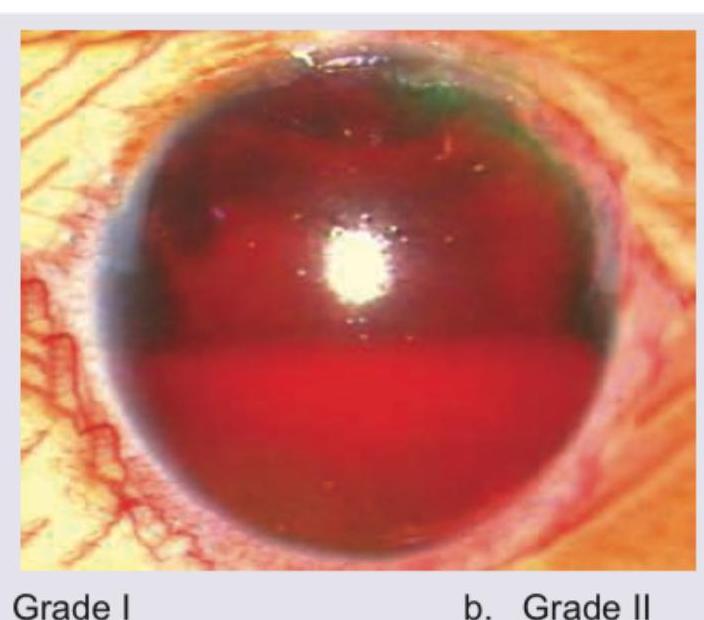
Explanation: **Explanation:** **1. Why "Circulus iridis major" is correct:** In blunt ocular trauma (like a cricket ball injury), the sudden compression and subsequent expansion of the globe cause a rapid increase in intraocular pressure and mechanical shearing forces. This leads to a tear at the **iris root** (iridodialysis) or the **ciliary body face** (recession). The **Circulus Iridis Major**, located in the ciliary stroma near the iris root, is the primary arterial supply to the iris and ciliary body. When these tissues are torn, this arterial circle is ruptured, leading to the accumulation of blood in the anterior chamber, known as **hyphaema**. **2. Why the other options are incorrect:** * **Short posterior ciliary vessels:** These supply the optic nerve head and the posterior choroid. Injury to these would result in subretinal or vitreous hemorrhage, not hyphaema. * **Circulus iridis minor:** This is an incomplete vascular plexus located near the pupillary margin. While it can bleed, it is rarely the primary source in blunt trauma compared to the major circle at the iris root. * **Ophthalmic artery:** This is the main trunk supplying the entire orbit. A rupture here would cause a massive retrobulbar hemorrhage and proptosis, rather than an isolated hyphaema. **3. NEET-PG High-Yield Pearls:** * **Definition:** Hyphaema is the presence of blood in the **anterior chamber**. * **Most common cause:** Blunt trauma (leading to a tear in the ciliary body face—the most common site). * **Management:** Bed rest with head elevation (30-45°) to allow blood to settle, cycloplegics (to prevent pupillary movement), and monitoring for **secondary glaucoma** (the most common complication). * **8-ball hyphaema:** A total hyphaema where the blood turns black/purplish due to lack of oxygenation; it carries a high risk of corneal blood staining.
Explanation: ### Explanation **1. Why the Inferior Wall is Correct:** A blowout fracture occurs when a blunt object (like a fist or a tennis ball) larger than the orbital rim strikes the eye. This increases intraorbital pressure (the **"Hydraulic Theory"**) or transmits kinetic energy directly to the orbital walls (the **"Buckling Theory"**). The **inferior wall (orbital floor)** is the most common site of fracture because it is structurally the weakest. Specifically, the bone is thinnest medial to the infraorbital groove. This fracture often leads to the herniation of orbital fat and the **inferior rectus muscle** into the maxillary sinus. **2. Why the Other Options are Incorrect:** * **Medial Wall (Option C):** This is the **second most common** site of fracture (specifically the *lamina papyracea*). While it is very thin, it is reinforced by the ethmoid sinus septa, making it slightly more resilient than the floor. * **Superior Wall (Option A):** The roof of the orbit is generally strong. Fractures here are rare and usually associated with high-energy frontal bone trauma, often seen in pediatric populations. * **Lateral Wall (Option D):** This is the **strongest** orbital wall, composed of the zygomatic bone and the greater wing of the sphenoid. It rarely fractures in isolation and is usually involved only in complex "Tripod" or Le Fort fractures. **3. High-Yield Clinical Pearls for NEET-PG:** * **Clinical Sign:** Diplopia on upward gaze due to entrapment of the **Inferior Rectus muscle**. * **Nerve Involved:** Anesthesia in the distribution of the **Infraorbital nerve** (cheek and upper lip). * **Radiology:** Look for the **"Teardrop Sign"** on a Water’s view X-ray (herniated contents in the maxillary sinus). * **Immediate Management:** Advise the patient **not to blow their nose** to prevent orbital emphysema. * **Surgical Indication:** Persistent diplopia, significant enophthalmos (>2mm), or a large floor defect (>50%).
Explanation: **Explanation:** **Dalen-Fuchs nodules** are pathognomonic histopathological features of **Sympathetic Ophthalmitis (SO)**. They are small, discrete, yellowish-white nodules located between the retinal pigment epithelium (RPE) and Bruch’s membrane. They consist of clusters of epithelioid cells, macrophages, and pigment-laden cells. **Why Sympathetic Ophthalmitis is correct:** SO is a rare, bilateral granulomatous panuveitis that occurs following a penetrating ocular injury or intraocular surgery in one eye (the "exciting eye"), which subsequently affects the fellow eye (the "sympathizing eye"). The underlying mechanism is a T-cell mediated autoimmune response against uveal antigens (melanocytes) that were previously sequestered from the immune system. **Analysis of Incorrect Options:** * **Tuberculosis:** Characterized by caseating granulomas and "mutton-fat" keratic precipitates, but Dalen-Fuchs nodules are not a classic feature. * **Sarcoidosis:** While it presents with granulomatous uveitis and "candle-wax drippings" (perivasculitis), Dalen-Fuchs nodules are specifically associated with SO and VKH. * **Vogt-Koyanagi-Harada (VKH) syndrome:** This is the most common distractor. While Dalen-Fuchs nodules *can* be seen in VKH (as it also involves an autoimmune attack on melanocytes), they are the **classic hallmark** described for Sympathetic Ophthalmitis in standard ophthalmic pathology. In the context of NEET-PG, SO is the primary association. **High-Yield Clinical Pearls for NEET-PG:** * **Histology of SO:** Characterized by non-caseating granulomatous inflammation with **sparing of the choriocapillaris**. * **Latent Period:** Usually occurs 2 weeks to 3 months after injury (65% within 2 weeks to 2 months). * **Prevention:** Evisceration/Enucleation of the injured eye within 10–14 days of trauma if there is no visual potential. * **Treatment:** Long-term systemic corticosteroids and immunosuppressants.
Explanation: ### Explanation Intraocular foreign bodies (IOFBs) are classified based on their chemical reactivity within the ocular tissues. The management of an IOFB depends largely on whether the material is **inert** or **reactive**. **1. Why Lead is the Correct Answer:** Lead is considered a **chemically inert** metal. When lodged in the eye, it does not undergo significant oxidation or trigger a toxic inflammatory response. If a lead pellet (e.g., from a shotgun) is located in a position where surgical removal might cause more trauma to the retina or vitreous than the object itself, it can be safely **left alone** and monitored. Other inert materials include gold, silver, platinum, glass, and high-grade plastic. **2. Why the Other Options are Incorrect:** * **Iron (A):** Highly reactive. It undergoes oxidation, leading to **Siderosis Bulbi**. Ferrous ions deposit in epithelial structures (lens, iris, retina), causing irreversible damage, including "rust-colored" cataracts and retinal degeneration. * **Copper (B):** Extremely toxic. Pure copper (>85%) causes massive suppurative endophthalmitis. Alloys with lower copper content cause **Chalcosis**, characterized by a **Sunflower cataract**, Kayser-Fleischer rings, and greenish discoloration of the vitreous. * **Nickel (D):** Considered a reactive metal that can trigger inflammatory responses and localized toxicity, necessitating removal. **Clinical Pearls for NEET-PG:** * **Siderosis Bulbi:** Earliest sign is increased pigment in the iris (heterochromia). The most characteristic finding is a **diminished b-wave** on ERG (Electroretinogram). * **Chalcosis:** Look for the "Sunflower Cataract" (copper deposition in the lens capsule). * **Vegetable Matter:** These are the most dangerous IOFBs as they carry a high risk of fulminant fungal endophthalmitis. * **Management Rule:** All reactive and organic foreign bodies must be removed; inert ones are removed only if they interfere with vision or cause mechanical irritation.
Explanation: **Explanation:** **CT Scan (Non-Contrast CT - NCCT)** is the investigation of choice for an intraocular foreign body (IOFB) because it provides high resolution, allows for precise localization, and can detect almost all types of foreign bodies (metallic, glass, or stone). It is particularly superior in identifying the size, shape, and exact position of the object relative to the ocular coats. Thin-cut axial and coronal sections (1–2 mm) are typically used. **Why other options are incorrect:** * **MRI:** It is strictly **contraindicated** if a metallic foreign body is suspected. The strong magnetic field can cause the metal to move or vibrate, leading to catastrophic intraocular damage or hemorrhage. * **USG (B-Scan):** While useful for detecting IOFBs in opaque media, it is operator-dependent and can be dangerous in cases of an open globe (perforating injury) as the pressure from the probe may cause extrusion of intraocular contents. * **X-ray:** Historically used (e.g., Mc Grigor’s or Comberg’s views), but it lacks the sensitivity to detect small or non-radiopaque objects and cannot provide precise 3D localization. **Clinical Pearls for NEET-PG:** * **Gold Standard:** NCCT Orbit (Axial and Coronal views). * **Most common IOFB:** Iron (Siderosis bulbi) followed by Copper (Chalcosis). * **Vegetative IOFB:** Wood is best detected by **MRI** (after ruling out metal) or CT, as it may appear isodense to air or soft tissue on standard scans. * **Siderosis Bulbi:** Characterized by "Rusty" deposits and a classic ERG finding of a diminished b-wave.
Explanation: **Explanation** The question tests the anatomical knowledge of extraocular muscle innervation. The **Medial Rectus (MR)** is the strongest adductor of the eye and is innervated by the **inferior division of the Oculomotor nerve (CN III)**. However, the question asks for the muscle and nerve primarily involved in *controlling* (opposing/balancing) the medial rectus. **Why Option A is Correct:** The **Lateral Rectus (LR)** is the direct **antagonist** to the Medial Rectus. In ocular motility, Hering’s Law and Sherrington’s Law dictate that for the MR to contract and move the eye medially, its antagonist (LR) must be inhibited. The LR is uniquely supplied by the **Abducent nerve (CN VI)**. Therefore, the LR and CN VI are the primary structures controlling the lateral-medial balance of the globe. **Analysis of Incorrect Options:** * **Option B:** The Superior Rectus is supplied by the superior division of CN III, and the Trochlear nerve (CN IV) supplies the Superior Oblique. Neither is the primary antagonist to the MR. * **Option C:** While the MR is the muscle in question, it is supplied by the **inferior division** of the Oculomotor nerve, not the superior division (which supplies the Superior Rectus and Levator Palpebrae Superioris). * **Option D:** The Inferior Oblique is indeed supplied by the inferior division of CN III, but it functions primarily in elevation and abduction, not as the primary controller of the MR. **High-Yield Clinical Pearls for NEET-PG:** * **Formula for Innervation:** **LR6(SO4)3** – Lateral Rectus (CN VI), Superior Oblique (CN IV), all others (CN III). * **Traumatic Hyphaema:** Most commonly results from a tear at the **ciliary body face (angle recession)**, involving the **major arterial circle of the iris**. * **CN III Divisions:** The **Superior division** supplies the SR and LPS; the **Inferior division** supplies the MR, IR, IO, and carries parasympathetic fibers to the ciliary ganglion (for miosis).
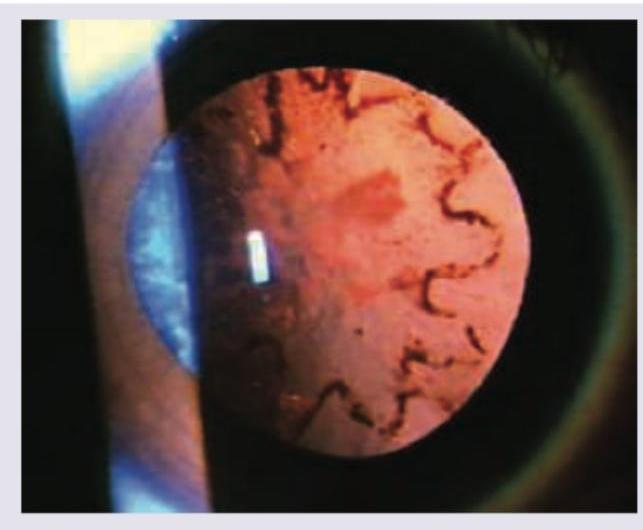
Explanation: **Explanation:** **Vossius ring** is a classic sign of **concussion (blunt) injury** to the eye. It is a circular ring of faint, brownish pigment granules deposited on the **anterior lens capsule**. **Mechanism:** When a blunt object strikes the globe, the force causes a sudden compression of the anterior chamber. This pushes the **pupillary margin of the iris** forcefully against the anterior surface of the lens. The pigment from the iris posterior epithelium is "stamped" onto the lens capsule in a ring shape that corresponds to the size of the pupil at the moment of impact. **Analysis of Options:** * **A. Penetrating injury:** These involve a full-thickness breach of the ocular coats (cornea/sclera). While they can cause cataracts, they do not typically produce the specific "stamping" mechanism required for a Vossius ring. * **C. Lens dislocation:** This occurs due to the rupture of zonules (often from blunt trauma), but the dislocation itself is a positional change, not the pigmented ring. * **D. Extracapsular extraction:** This is a surgical procedure. While pigment dispersion can occur during surgery, a Vossius ring is specifically a post-traumatic clinical sign. **Clinical Pearls for NEET-PG:** * **Appearance:** The ring is usually smaller than the current pupil size because the pupil often undergoes traumatic mydriasis (dilation) after the injury. * **Prognosis:** It is usually asymptomatic and does not interfere with vision unless accompanied by a traumatic cataract. * **Other Blunt Trauma Signs:** Look for **Rosette-shaped cataracts** (late sign), **Iridodialysis** (iris tearing from the ciliary body), and **Angle recession** (risk of glaucoma). * **Hyphaema:** Blood in the anterior chamber is the most common association with blunt trauma.
Explanation: **Explanation:** **Iridodialysis** refers to the traumatic separation of the iris root from its attachment to the ciliary body. This typically occurs following blunt ocular trauma, where a sudden increase in intraocular pressure causes the iris to tear at its thinnest point—the periphery (iris root). **Why Antiflexion is the Correct Answer:** When the iris root is torn, the detached segment of the iris tends to fold forward upon itself due to the mechanical force of the trauma and the loss of peripheral tension. This forward folding is termed **antiflexion**. It often results in a "D-shaped" pupil and may cause monocular diplopia if the gap is large enough to act as a second pupil. **Analysis of Incorrect Options:** * **Retroflexion of the iris:** This refers to the iris folding backward over the ciliary processes. While it can occur in severe trauma (often associated with ciliary body detachment or subluxation of the lens), it is not the characteristic feature of a simple iridodialysis. * **Iridoplegia:** This refers to paralysis of the iris sphincter muscle, leading to a fixed, dilated pupil (traumatic mydriasis). While it often co-exists with trauma, it is a functional nerve/muscle deficit, whereas iridodialysis is a structural anatomical tear. * **All of the above:** Since antiflexion is the specific mechanical consequence of the peripheral tear in iridodialysis, this option is incorrect. **Clinical Pearls for NEET-PG:** * **Vossius Ring:** A circular ring of pigment on the anterior lens capsule, often seen alongside iridodialysis, representing the "imprint" of the iris pupillary margin. * **Hyphema:** The most common immediate complication of iridodialysis due to the rupture of the **Major Arterial Circle of the Iris**. * **Management:** Small asymptomatic tears require no treatment; large tears causing diplopia or glare are managed via **Surgical Iridodesis**.
Explanation: **Explanation:** The nature of the intraocular inflammatory response to a foreign body (IOFB) depends on its chemical composition. Metals are broadly classified into those that cause a **suppurative (purulent) reaction**, those that cause **specific degenerative changes**, and those that are **inert**. **1. Why Copper alloys is the correct answer:** The reaction to copper depends on its concentration. * **Pure copper (>85%)** causes a violent **suppurative reaction** (sterile endophthalmitis). * **Copper alloys (e.g., Brass or Bronze)**, which contain lower concentrations of copper, typically do not cause suppuration. Instead, they lead to **Chalcosis**—a chronic, non-suppurative condition characterized by the deposition of copper in basement membranes (e.g., Sunflower cataract, Kayser-Fleischer ring). Therefore, copper alloys are the exception among the listed metals that typically cause acute suppuration. **2. Analysis of Incorrect Options:** * **Pure Zinc (A):** Highly reactive; it causes a severe suppurative reaction and significant intraocular inflammation. * **Mercury (B):** Extremely toxic to intraocular tissues; it leads to a violent, acute suppurative inflammatory response. * **Nickel (D):** Known to be highly irritant and chemically active, leading to a suppurative reaction upon entry into the vitreous or anterior chamber. **Clinical Pearls for NEET-PG:** * **Siderosis Bulbi:** Caused by **Iron** IOFBs; leads to heterochromia iridis (darker iris) and "Rusty" deposits. * **Chalcosis:** Caused by **Copper alloys**; classic sign is the **Sunflower Cataract** (copper deposition in the anterior lens capsule). * **Inert IOFBs:** Glass, plastic, gold, silver, and platinum generally do not cause a chemical reaction and are often left alone if they are not causing mechanical damage.
Classification of Ocular Trauma
Practice Questions
Blunt Trauma
Practice Questions
Penetrating and Perforating Injuries
Practice Questions
Intraocular Foreign Bodies
Practice Questions
Chemical Injuries
Practice Questions
Thermal and Radiation Injuries
Practice Questions
Orbital Trauma
Practice Questions
Traumatic Optic Neuropathy
Practice Questions
Ocular Manifestations of Child Abuse
Practice Questions
Sports-Related Eye Injuries
Practice Questions
Ocular Trauma Management Principles
Practice Questions
Rehabilitation After Ocular Trauma
Practice Questions
Get full access to all questions, explanations, and performance tracking.
Start For Free