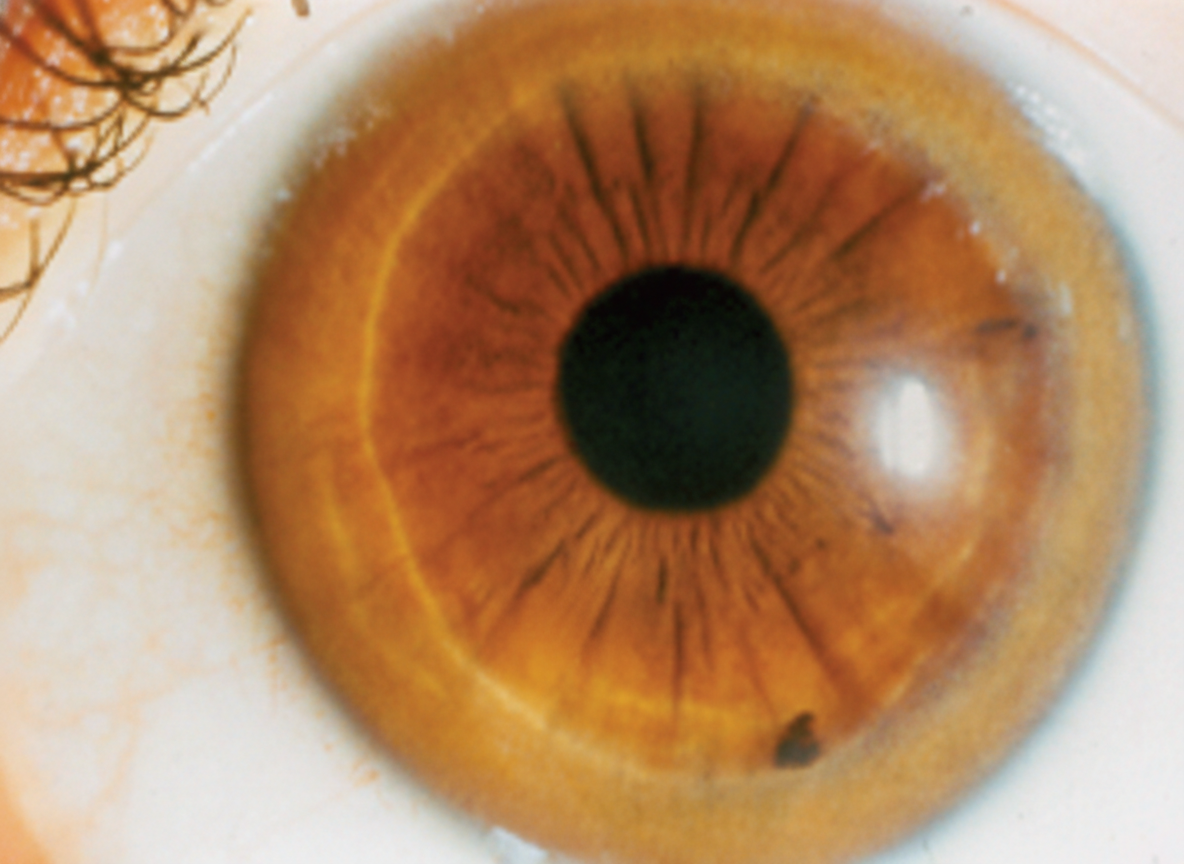
Ocular lesions of gout include all of the following except?
What are the proper investigations for a 10-year-old child presenting with bilateral uveitis?
Neovascularization in uveal tissue is most commonly caused by?
Which is the last ocular muscle to be involved in Grave's disease?
Sunflower cataract is associated with the inborn error of metabolism of which of the following?
Sarcoidosis is associated with which of the following conditions?
What is the most common site for basal cell carcinoma of the eyelids?
A young patient presents with gradual blurring of vision in the left eye. Slit lamp examination reveals fine stellate keratic precipitates and aqueous flare, along with a typical complicated posterior subcapsular cataract. No posterior synechiae were observed. What is the most likely diagnosis?
Night blindness may be associated with:
Which of the following is a specific ocular finding in albinism?
Explanation: **Explanation:** Gout is a systemic metabolic disorder characterized by hyperuricemia and the deposition of monosodium urate (MSU) crystals in various tissues. While gout primarily affects joints, it can involve ocular structures, particularly those rich in collagen and connective tissue. **Why Keratitis is the Correct Answer:** Keratitis (inflammation of the cornea) is **not** a recognized manifestation of gout. The cornea is an avascular structure, and while MSU crystals can rarely deposit in the corneal stroma (forming "urate keratopathy"), it does not typically present as an inflammatory keratitis. **Analysis of Other Options:** * **Episcleritis & Scleritis:** These are the most common ocular manifestations of gout. MSU crystals deposit in the vascularized episcleral and scleral tissues, triggering an inflammatory response. Gouty scleritis is often bilateral and can be the presenting sign of the disease. * **Uveitis:** Gout is a known cause of acute anterior uveitis (iridocyclitis). It is often associated with high serum uric acid levels and responds well to systemic treatment of the underlying gout. **High-Yield Clinical Pearls for NEET-PG:** * **Most common ocular finding:** Chronic conjunctival hyperemia (often described as a "muddy" or "brick-red" appearance). * **Tophi:** Can rarely be found on the eyelids or within the tarsal plate. * **Treatment:** Ocular symptoms usually resolve with systemic management of hyperuricemia (e.g., Allopurinol) and NSAIDs. * **Differential Diagnosis:** In a patient with recurrent episcleritis and joint pain, always screen for Serum Uric Acid levels.
Explanation: ### Explanation The correct answer is **X-ray of the sacroiliac joint (Option C)**. **Why it is correct:** In a 10-year-old child with bilateral uveitis, the most common systemic association to rule out is **Juvenile Idiopathic Arthritis (JIA)**. Specifically, **Enthesitis-Related Arthritis (ERA)**—a subtype of JIA—is strongly associated with HLA-B27 and presents as an acute, bilateral (often alternating) anterior uveitis. An X-ray of the sacroiliac joint is the gold-standard investigation to look for **sacroiliitis**, which confirms the diagnosis of spondyloarthropathy in these pediatric patients. **Why other options are incorrect:** * **CT Scan (Option A):** This is generally used for orbital trauma, tumors, or calcifications (like retinoblastoma). It has no routine role in the initial workup of non-traumatic uveitis. * **Tuberculin Test (Option B):** While Tuberculosis can cause uveitis, it typically presents as granulomatous uveitis with "mutton-fat" KPs or choroiditis. In a child, JIA is statistically a more common cause of bilateral anterior uveitis than TB. * **HIV Test (Option D):** While HIV can cause opportunistic ocular infections (like CMV retinitis), it is a rare cause of isolated bilateral uveitis in the pediatric age group compared to autoimmune etiologies. **High-Yield Clinical Pearls for NEET-PG:** * **JIA & Uveitis:** The **Oligoarticular** type of JIA is the most common cause of chronic non-granulomatous anterior uveitis in children. It is often **asymptomatic** (White Eye Uveitis), making screening essential. * **Risk Factor:** **ANA positivity** in a child with JIA is the strongest predictor for developing uveitis. * **Complications:** Band-shaped keratopathy, complicated cataract, and secondary glaucoma are common sequelae of pediatric uveitis. * **HLA-B27 Triad:** Acute anterior uveitis, sacroiliitis, and ankylosing spondylitis.
Explanation: **Explanation:** Neovascularization of the uveal tissue (specifically **Neovascularization of the Iris/NVI** or Rubeosis Iridis) is a pathological response to chronic retinal ischemia. When the retina is hypoxic, it releases **Vascular Endothelial Growth Factor (VEGF)**, which diffuses anteriorly to stimulate the formation of new, fragile vessels on the iris and in the iridocorneal angle. **1. Why Diabetic Retinopathy is Correct:** While several conditions cause retinal ischemia, **Diabetic Retinopathy (DR)**—specifically Proliferative Diabetic Retinopathy (PDR)—is the **most common cause** of NVI worldwide due to the sheer prevalence of the disease. Chronic hyperglycemia leads to widespread capillary non-perfusion, making DR the leading driver of VEGF-mediated anterior segment neovascularization. **2. Analysis of Incorrect Options:** * **Central Retinal Vein Occlusion (CRVO):** This is the *second* most common cause. Specifically, the "Ischemic" type of CRVO is notorious for causing "100-day glaucoma" (Neovascular Glaucoma), but it occurs less frequently in the general population than Diabetes. * **Central Retinal Artery Occlusion (CRAO):** While CRAO causes profound ischemia, NVI is relatively rare (approx. 15-20% of cases) because the inner retinal layers often become too atrophic to produce sustained high levels of VEGF. * **Choroidal Melanoma:** This can cause NVI via tumor-induced ischemia or inflammation, but it is a rare clinical entity compared to systemic vascular diseases. **High-Yield Clinical Pearls for NEET-PG:** * **Sequence of NVI:** New vessels usually appear first at the **pupillary margin**, then progress toward the angle. * **Complication:** NVI leads to **Neovascular Glaucoma (NVG)**, where a fibrovascular membrane contracts and zips the angle shut (Synechial angle closure). * **Management:** The gold standard treatment for the underlying ischemia is **Panretinal Photocoagulation (PRP)**, often supplemented by Intravitreal Anti-VEGF injections.
Explanation: **Explanation:** In **Graves’ Ophthalmopathy** (Thyroid Eye Disease), the extraocular muscles undergo pathological changes characterized by inflammatory cell infiltration, edema, and the deposition of glycosaminoglycans, eventually leading to fibrosis. The involvement of extraocular muscles follows a specific, predictable sequence. The mnemonic **"I’M SLOW"** is a high-yield tool to remember the order of involvement (from most common to least common): 1. **I:** **I**nferior Rectus (Most commonly involved) 2. **M:** **M**edial Rectus 3. **S:** **S**uperior Rectus 4. **L:** **L**ateral Rectus 5. **O/W:** **O**bliques (Inferior and Superior Obliques are the last to be affected) **Why Inferior Oblique is correct:** The recti muscles are significantly more susceptible to the autoimmune process in Graves' disease than the oblique muscles. Among all extraocular muscles, the **Inferior Oblique** is typically the last to show clinical or radiological signs of involvement. **Analysis of Incorrect Options:** * **A. Inferior Rectus:** This is the **first** and most frequently involved muscle, often leading to restrictive vertical diplopia and a characteristic "head tilt." * **B. Lateral Rectus:** While less common than the Inferior, Medial, or Superior recti, it is still involved far more frequently than the oblique muscles. * **C. Superior Rectus:** This is the third most common muscle involved in the sequence. **Clinical Pearls for NEET-PG:** * **Most common sign:** Eyelid retraction (Dalrymple’s sign). * **Most common cause of proptosis** (both unilateral and bilateral) in adults is Graves' disease. * **Muscle Sparing:** In Graves', the **tendons are spared** (only the muscle belly is enlarged), which helps differentiate it from Orbital Myositis on CT/MRI. * **Smoking** is the most significant modifiable risk factor for the progression of ophthalmopathy.
Explanation: **Explanation:** **Sunflower cataract** (Chalcosis lentis) is a pathognomonic ocular sign of **Wilson’s Disease** (Hepatolenticular degeneration). This condition is an autosomal recessive inborn error of **Copper** metabolism caused by a mutation in the *ATP7B* gene. This leads to impaired biliary excretion of copper and its subsequent deposition in various tissues. In the eye, copper deposits in the **anterior lens capsule**, forming a central disc with radiating petal-like spokes, resembling a sunflower. Unlike many other cataracts, it typically does not significantly impair vision and may resolve with chelation therapy (e.g., D-penicillamine). **Analysis of Incorrect Options:** * **A. Iron:** Excess iron deposition in the eye is known as **Siderosis bulbi**. It typically results from an intraocular foreign body and causes a "rusty" discoloration of the lens (Siderotic cataract), not a sunflower pattern. * **B. Nickel:** Nickel toxicity does not have specific, high-yield ocular manifestations associated with cataract formation in systemic metabolic disorders. * **D. Zinc:** While zinc is essential for ocular health, its metabolic errors are not associated with sunflower cataracts. **High-Yield Clinical Pearls for NEET-PG:** * **Kayser-Fleischer (KF) Ring:** The most common ocular sign of Wilson’s Disease. It represents copper deposition in the **Descemet’s membrane** of the cornea (starts superiorly). * **Location:** Sunflower cataract = Anterior lens capsule; KF Ring = Descemet’s membrane. * **Diagnosis:** Low serum ceruloplasmin, high urinary copper, and the presence of a KF ring on slit-lamp examination.
Explanation: **Explanation:** **Sarcoidosis** is a multisystem granulomatous disease characterized by non-caseating granulomas. The association with **Band Keratopathy** is a high-yield concept for NEET-PG. **Why Band Keratopathy is the correct answer:** Sarcoidosis frequently causes **hypercalcemia** and hypercalciuria due to the extra-renal synthesis of 1,25-dihydroxyvitamin D by macrophages within the granulomas. Chronic hypercalcemia leads to the deposition of calcium phosphate salts in the subepithelial space, anterior Bowman’s membrane, and anterior stroma of the cornea. This clinical finding is known as Band Keratopathy, typically presenting in the interpalpebral fissure. **Analysis of Incorrect Options:** * **B. Systemic amyloidosis:** While sarcoidosis and amyloidosis are both granulomatous/infiltrative diseases, they are distinct pathological entities. Sarcoidosis does not typically cause systemic amyloidosis. * **C. Angioid streaks:** These are associated with the mnemonic **PEPSI**: **P**seudoxanthoma elasticum (most common), **E**hlers-Danlos syndrome, **P**aget’s disease of bone, **S**ickle cell anemia, and **I**diopathic. * **D. Cataracta nigra:** This refers to an advanced stage of nuclear sclerosis where the lens becomes dark brown or black. It is a result of age-related senile changes, not systemic sarcoidosis. **Clinical Pearls for NEET-PG:** * **Ocular Sarcoidosis:** The most common manifestation is **Anterior Uveitis** (often granulomatous with "Mutton-fat" Keratic Precipitates). * **Lofgren Syndrome:** Erythema nodosum, bilateral hilar adenopathy, and arthralgia. * **Heerfordt Syndrome (Uveoparotid fever):** Uveitis, Parotid enlargement, and Facial nerve palsy. * **Candle-wax drippings:** Characteristic periphlebitis (vasculitis) seen on fundus examination in sarcoidosis.
Explanation: **Explanation:** Basal Cell Carcinoma (BCC) is the most common malignant eyelid tumor, accounting for approximately 90% of all cases. It is primarily associated with chronic exposure to ultraviolet (UV) radiation. **1. Why the Lower Lid is Correct:** The **lower eyelid** is the most common site (50–60% of cases) because it receives the highest amount of direct vertical sunlight and UV radiation exposure compared to other periocular structures. The anatomy of the brow ridge provides some shade to the upper lid, whereas the lower lid remains exposed. **2. Analysis of Incorrect Options:** * **Upper Lid:** This is the least common site for BCC (approx. 10–15%). Notably, if a malignancy is found on the upper lid, clinicians should have a higher suspicion for **Sebaceous Gland Carcinoma**, which has a predilection for the upper lid due to the higher density of Meibomian glands there. * **Medial Canthus:** This is the second most common site (25–30%). While less frequent than the lower lid, BCC in this location is clinically more dangerous as it tends to invade deeply into the lacrimal drainage system and the orbit. * **Lateral Canthus:** This is the rarest site for BCC (approx. 5%). **High-Yield Clinical Pearls for NEET-PG:** * **Classic Presentation:** A slow-growing, painless, "pearly" nodule with telangiectasia and central ulceration (**Rodent Ulcer**). * **Risk Factors:** Fair skin (Fitzpatrick types I & II), chronic sun exposure, and Gorlin-Goltz syndrome. * **Metastasis:** BCC is locally invasive but rarely metastasizes. * **Management:** Gold standard is **Mohs Micrographic Surgery**, which ensures the highest cure rate while preserving maximal healthy tissue.
Explanation: **Explanation:** The clinical presentation is classic for **Fuchs’ Heterochromic Iridocyclitis (FHI)**. The diagnosis is based on a triad of specific findings: 1. **Fine Stellate Keratic Precipitates (KPs):** Unlike the "mutton-fat" KPs of granulomatous uveitis, FHI presents with small, stellate (star-shaped) KPs distributed diffusely over the entire corneal endothelium. 2. **Absence of Posterior Synechiae:** This is a hallmark feature. Despite chronic low-grade inflammation (aqueous flare), the iris does not adhere to the lens. 3. **Complicated Cataract:** Posterior subcapsular cataract is a very common late complication. **Why other options are incorrect:** * **Intermediate Uveitis (Pars Planitis):** Characterized by "snowball" vitreous opacities and "snowbanking" on the pars plana. While it causes cataracts, it does not typically present with stellate KPs. * **Heerfordt’s Disease (Uveoparotid Fever):** A form of Sarcoidosis characterized by granulomatous uveitis (large mutton-fat KPs), parotid enlargement, and facial nerve palsy. Posterior synechiae are common here. * **Subacute Iridocyclitis:** Usually presents with circumcorneal congestion, pain, and a high tendency to form posterior synechiae. **High-Yield Clinical Pearls for NEET-PG:** * **Amsler Sign:** Filiform hemorrhage triggered by paracentesis or minor trauma (due to fragile iris vessels). * **Iris Heterochromia:** The affected eye is usually hypochromic (lighter) due to iris atrophy, though it may be hyperchromic in patients with light-colored irides. * **Glaucoma:** This is the most vision-threatening complication of FHI (more so than the cataract). * **Treatment:** Steroids are generally **ineffective** and not indicated for the chronic low-grade flare of FHI. Only the cataract and glaucoma require surgical/medical intervention.
Explanation: **Explanation:** Night blindness (Nyctalopia) is the inability to see clearly in low light or at night. It occurs due to the dysfunction of **rod photoreceptors** or a deficiency in **rhodopsin** (visual purple), the pigment required for vision in dim light. **1. Vitamin A Deficiency (Option A):** This is the most common cause of night blindness worldwide. Vitamin A (Retinol) is a precursor to 11-cis-retinal, which combines with opsin to form rhodopsin. Deficiency leads to a failure in the regeneration of this pigment, resulting in nyctalopia. **2. Cirrhosis of Liver (Option B):** The liver plays a critical role in Vitamin A metabolism. It is the primary site for the **storage** of Vitamin A (in hepatic stellate cells) and the **synthesis of Retinol Binding Protein (RBP)**, which transports the vitamin to the retina. In cirrhosis, impaired storage and transport lead to secondary Vitamin A deficiency, causing night blindness. **3. Malingering (Option C):** Night blindness is a subjective symptom. It is frequently feigned by malingerers (e.g., to avoid military night duty or for insurance claims). Since it is difficult to disprove without specialized tests like the **Electroretinogram (ERG)**, it remains a clinically recognized association. **High-Yield Clinical Pearls for NEET-PG:** * **Earliest Symptom of Vitamin A Deficiency:** Night blindness (Nyctalopia). * **Earliest Sign of Vitamin A Deficiency:** Conjunctival Xerosis. * **Other Causes of Nyctalopia:** Retinitis Pigmentosa (most common genetic cause), Pathological Myopia, Gyrate Atrophy, and Choroideremia. * **Objective Test:** The **Full-field ERG** (specifically the scotopic response) is the gold standard to objectively assess rod function and rule out malingering.
Explanation: **Explanation:** In albinism, the fundamental defect is a deficiency in melanin production. Melanin is essential in the eye for providing pigment to the iris and the Retinal Pigment Epithelium (RPE). **Why "Red Reflex" is the correct answer:** In a normal eye, the iris is opaque and blocks light. In albinism, the lack of iris pigment leads to **iris transillumination**. When light is directed into the eye, it passes through the translucent iris tissue and reflects off the vascular choroid, resulting in a prominent **red reflex** (often visible through the iris itself, not just the pupil). This is a hallmark clinical sign used to diagnose ocular albinism. **Analysis of Incorrect Options:** * **B, C, and D (Decreased visual acuity, Photophobia, Nystagmus):** While these are all commonly seen in albinism, they are **non-specific**. They occur in various other ocular conditions (e.g., congenital cataracts, aniridia, or achromatopsia). The question asks for a "specific" finding; the abnormal red reflex due to pigment deficiency is the most characteristic diagnostic feature of the albinotic eye. **High-Yield Clinical Pearls for NEET-PG:** * **Foveal Hypoplasia:** The most common cause of permanent decreased vision in albinos (melanin is required for normal foveal development). * **Misrouting of Optic Nerve Fibers:** There is an excessive decussation (crossing) of nerve fibers at the optic chiasm (more than the normal 53%). * **Tyrosinase:** The key enzyme often deficient in Oculocutaneous Albinism (OCA). * **Hermansky-Pudlak Syndrome:** Albinism associated with platelet dysfunction (bleeding diathesis).
Diabetes Mellitus
Practice Questions
Hypertension
Practice Questions
Autoimmune Disorders
Practice Questions
Thyroid Disease
Practice Questions
HIV and AIDS
Practice Questions
Hematological Disorders
Practice Questions
Neurological Disorders
Practice Questions
Dermatological Conditions
Practice Questions
Pregnancy-Related Eye Changes
Practice Questions
Metabolic Disorders
Practice Questions
Ocular Toxicity of Systemic Medications
Practice Questions
Infectious Systemic Diseases
Practice Questions
Get full access to all questions, explanations, and performance tracking.
Start For Free