A 30-year-old patient with a history of recurrent headache presents for fundus evaluation. Funduscopic examination reveals generalized arterial attenuation, multiple cotton wool spots, and flame-shaped hemorrhages in both eyes. What is the most likely cause?
What is the first symptom of vitamin A deficiency?
Which of the following statements regarding chalazion is true?
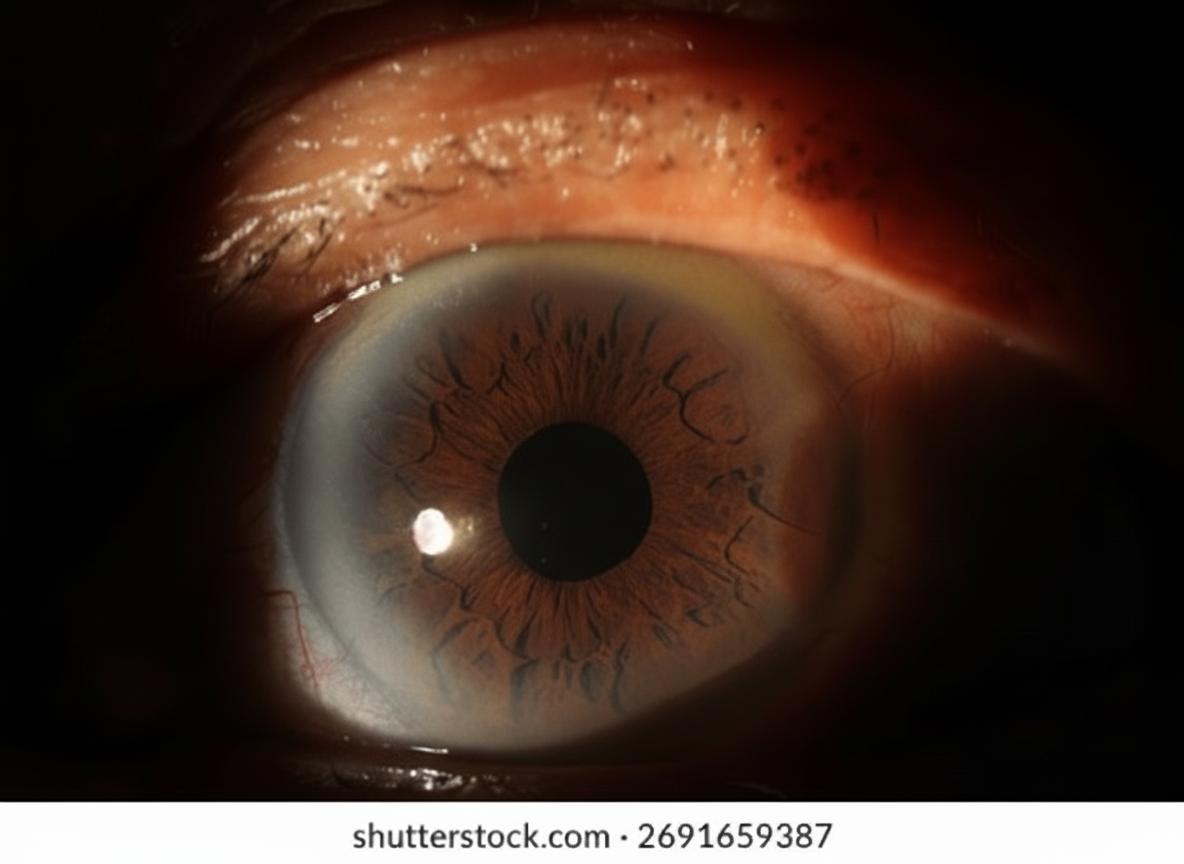
A 37-year-old woman presented with symptoms consistent with allergic conjunctivitis. What is the diagnosis for this incidental finding?
Heerfordt's syndrome is characterized by all of the following EXCEPT:
In Von Hippel-Lindau Syndrome, retinal vascular tumors are often associated with intracranial hemangioblastoma. Which one of the following regions is associated with such vascular abnormalities in this syndrome?
What is the causative agent for Oculoglandular syndrome of Parinaud?
What is a common ocular consequence of a sudden increase in blood sugar in a diabetic patient?
Chronic, sterile inflammation of the meibomian gland is seen in which of the following conditions?
What is true about cavernous sinus thrombosis?
Explanation: **Explanation:** The clinical presentation of **generalized arterial attenuation**, **cotton wool spots**, and **flame-shaped hemorrhages** in a young patient with recurrent headaches is classic for **Hypertensive Retinopathy**. 1. **Why it is correct:** Hypertension causes a breakdown of the blood-retinal barrier. * **Arterial attenuation** occurs due to vasospasm (vasotonic stage) and later sclerosis. * **Flame-shaped hemorrhages** occur in the superficial nerve fiber layer (NFL) due to high intravascular pressure. * **Cotton wool spots** (soft exudates) represent micro-infarctions of the NFL. The "recurrent headache" in a 30-year-old is a strong clinical clue pointing toward systemic hypertension. 2. **Why the other options are wrong:** * **Diabetic Retinopathy:** Characterized primarily by microaneurysms, dot-and-blot hemorrhages (deep retina), and hard exudates. While cotton wool spots occur, generalized arterial narrowing is not a hallmark. * **Central Retinal Artery Occlusion (CRAO):** Presents with sudden, painless loss of vision, a "cherry-red spot" at the macula, and a pale, edematous retina—not multiple hemorrhages and cotton wool spots. * **Temporal Arteritis:** Typically affects patients >50 years. It presents with scalp tenderness and jaw claudication. Ocular involvement usually manifests as Ischemic Optic Neuropathy (pale disc edema), not generalized retinopathy. **High-Yield Clinical Pearls for NEET-PG:** * **Keith-Wagener-Barker Classification:** * **Grade I:** Mild generalized arteriolar narrowing. * **Grade II:** Focal narrowing and AV nipping (Salus sign). * **Grade III:** Grade II + Hemorrhages, Cotton wool spots, and Hard exudates (Macular star). * **Grade IV:** Grade III + **Papilledema** (indicates malignant hypertension). * **Silver/Copper wiring:** Caused by increased light reflex from sclerotic vessel walls.
Explanation: **Explanation:** Vitamin A (Retinol) is essential for the synthesis of **rhodopsin** (visual purple), the photosensitive pigment located in the rods of the retina. Rods are responsible for vision in low-light conditions. When Vitamin A levels drop, the regeneration of rhodopsin is impaired, leading to **Night Blindness (Nyctalopia)**. This is clinically recognized as the **earliest functional symptom** of Vitamin A deficiency (WHO classification X1A). **Analysis of Options:** * **A. Conjunctival Xerosis (X1B):** This is the first **clinical sign** (objective finding) where the conjunctiva becomes dry, lusterless, and non-wettable. However, it occurs after the onset of night blindness. * **B. Bitot’s Spots (X2):** These are triangular, foamy, silvery-white patches on the bulbar conjunctiva caused by keratinization. They are a characteristic sign but appear later in the progression. * **C. Night Blindness (X1A):** Correct. It is the earliest subjective symptom reported by the patient. * **D. Corneal Ulcer (X3A/X3B):** This represents advanced deficiency (Keratomalacia). It involves liquefactive necrosis of the cornea and is an ocular emergency that can lead to permanent blindness. **High-Yield Clinical Pearls for NEET-PG:** * **WHO Classification Sequence:** X1A (Night blindness) → X1B (Conjunctival xerosis) → X2 (Bitot's spots) → X3A (Corneal xerosis) → X3B (Keratomalacia) → XS (Corneal scar) → XF (Xerophthalmic fundus). * **Earliest Sign:** Conjunctival Xerosis. * **Earliest Symptom:** Night Blindness. * **Most Specific Sign:** Bitot’s Spots. * **Treatment:** For children >1 year, the standard dose is 200,000 IU of Vitamin A orally on days 0, 1, and 14.
Explanation: **Explanation:** A **chalazion** is a chronic, non-infectious, granulomatous inflammation of the **Meibomian glands**. These glands are modified **sebaceous glands** located in the tarsal plate of the eyelids. * **Why Option B is Correct:** Since Meibomian glands secrete sebum (oil), a chalazion is pathologically classified as a **sebaceous cyst** (specifically, a retention cyst). It occurs when the gland duct becomes obstructed, leading to the accumulation of lipid secretions and a subsequent lipogranulomatous reaction. * **Why Option A is Incorrect:** A mucous cyst involves the accumulation of mucin, typically seen in the conjunctiva or oral cavity (mucocele), not the eyelid glands. * **Why Option C is Incorrect:** Chalazion is a **sterile** (non-infectious) inflammation. In contrast, a **Hordeolum (Stye)** is an acute, painful, suppurative infection usually caused by *Staphylococcus aureus*. * **Why Option D is Incorrect:** While persistent or recurrent chalazia *can* mimic **Sebaceous Gland Carcinoma**, the statement "recurrence may imply malignancy" is a clinical suspicion, not a definitive definition of the lesion itself. In the context of this question, Option B is the fundamental pathological definition. **High-Yield Clinical Pearls for NEET-PG:** * **Pathology:** Characterized by a **lipogranulomatous reaction** (giant cells and histiocytes). * **Clinical Feature:** Presents as a painless, firm, "painless pea" swelling away from the lid margin. * **Complication:** A large chalazion on the upper lid can cause **blurred vision due to induced astigmatism**. * **Management:** Conservative (warm compresses), intralesional steroids (Triamcinolone), or **Incision and Curettage (I&C)** using a vertical incision on the conjunctival surface to avoid damaging other Meibomian glands.
Explanation: ***Prominent iris collarette*** - The **iris collarette** is a normal anatomical structure representing the **thickest part of the iris** at the junction of the **pupillary and ciliary zones**. - This is a **benign incidental finding** with no clinical significance, commonly observed during routine eye examinations. *Aniridia* - A **congenital absence** or severe **underdevelopment of the iris**, resulting in a barely visible iris rim. - Associated with **photophobia**, **nystagmus**, and potential complications like **glaucoma** and **cataracts**. *Coloboma of the iris* - A **developmental defect** resulting in a **wedge-shaped gap** or **keyhole appearance** of the iris. - Often located **inferonasally** and may be associated with **visual field defects** or other ocular abnormalities. *Granulomatous iritis* - An **inflammatory condition** of the iris characterized by **mutton-fat keratic precipitates** and **posterior synechiae**. - Presents with **pain**, **photophobia**, **blurred vision**, and **ciliary injection**, not as an incidental finding.
Explanation: **Explanation:** Heerfordt’s syndrome, also known as **Uveoparotid fever**, is a rare clinical manifestation of **Sarcoidosis**. It is classically defined by a specific tetrad of clinical features. **Why Option C is the correct answer:** The neurological hallmark of Heerfordt’s syndrome is **7th Cranial Nerve (Facial nerve) palsy**, not 6th nerve palsy. Facial nerve involvement is the most common neurological manifestation of sarcoidosis (neurosarcoidosis) and is typically of the Lower Motor Neuron (LMN) type. It can be unilateral or bilateral. **Analysis of other options:** * **Option A (Fever):** A low-grade fever is a systemic component of the syndrome and is often the presenting constitutional symptom. * **Option B (Parotitis):** Bilateral, painless enlargement of the parotid glands is a classic feature. It may occasionally involve other salivary or lacrimal glands. * **Option D (Uveitis):** Ocular involvement is mandatory for the diagnosis. It typically presents as **chronic granulomatous anterior uveitis** (characterized by Mutton-fat Keratic Precipitates). **High-Yield Clinical Pearls for NEET-PG:** * **The Tetrad:** Fever + Parotitis + Anterior Uveitis + Facial Nerve Palsy. * **Diagnosis:** Often supported by elevated Serum ACE levels, bilateral hilar lymphadenopathy on Chest X-ray, and a positive Kveim test (though rarely used now). * **Histopathology:** Non-caseating granulomas are the pathognomonic finding. * **Mikulicz’s Syndrome:** Often confused with Heerfordt's; it involves symmetrical enlargement of lacrimal and salivary glands but lacks the fever and neurological involvement seen in Heerfordt’s.
Explanation: **Explanation:** **Von Hippel-Lindau (VHL) Syndrome** is an autosomal dominant multisystem disorder caused by a mutation in the VHL gene on chromosome 3p. It is characterized by the development of benign and malignant tumors, most notably **hemangioblastomas**. 1. **Why Cerebellum is Correct:** In VHL, the most common site for intracranial hemangioblastomas is the **cerebellum** (occurring in up to 60-70% of patients), followed by the spinal cord and brainstem. These are highly vascular, slow-growing tumors. The classic clinical triad of VHL includes retinal hemangioblastomas (Von Hippel tumors), cerebellar hemangioblastomas (Lindau tumors), and visceral cysts/carcinomas (e.g., Renal Cell Carcinoma). 2. **Why Other Options are Incorrect:** * **Optic Radiation, Optic Tract, and Pulvinar:** While VHL can involve the central nervous system, hemangioblastomas have a strong predilection for the **posterior fossa** (cerebellum) and spinal cord. They do not typically occur in the supratentorial visual pathways (optic tract/radiations) or the thalamus (pulvinar). **High-Yield Clinical Pearls for NEET-PG:** * **Retinal Manifestation:** Retinal capillary hemangioblastoma is often the first sign of VHL. It appears as a red, globular lesion with a **dilated, tortuous feeder artery** and a draining vein. * **Associated Visceral Lesions:** Renal Cell Carcinoma (clear cell type), Pheochromocytoma, and Pancreatic cysts/neuroendocrine tumors. * **Genetics:** Mutation in the **VHL tumor suppressor gene (3p25.3)**. * **Screening:** Patients require lifelong surveillance, including annual ophthalmoscopy and periodic MRI of the brain and abdomen.
Explanation: **Explanation:** **Parinaud Oculoglandular Syndrome (POGS)** is a clinical triad characterized by unilateral granulomatous conjunctivitis, a visible conjunctival nodule, and ipsilateral regional lymphadenopathy (typically preauricular or submandibular). 1. **Why Bartonella henselae is correct:** * *Bartonella henselae* is a gram-negative rod and the causative agent of **Cat-Scratch Disease (CSD)**. It is the most common cause of POGS (responsible for ~5-7% of CSD cases). * Transmission occurs via a scratch or bite from an infected cat (usually a kitten) or via flea feces inoculated into the conjunctiva. * The organism triggers a granulomatous immune response in the conjunctival stroma and draining lymph nodes. 2. **Why the other options are incorrect:** * **Arachnia propionica:** Now known as *Propionibacterium propionicum*, it is a common cause of **canaliculitis** (concretions in the lacrimal canaliculi), not POGS. * **Bifidobacterium dentium:** This is a commensal of the oral cavity associated with dental caries; it does not have a recognized role in oculoglandular syndromes. * **Mycobacterium leprae:** While Leprosy causes various ocular issues (madarosis, lagophthalmos, uveitis), it is not the primary agent for Parinaud Oculoglandular Syndrome. (Note: *Mycobacterium tuberculosis* and *Tularemia* are rarer causes of POGS). **High-Yield Clinical Pearls for NEET-PG:** * **Diagnosis:** Usually clinical + history of cat contact. Confirmed via **Warthin-Starry silver stain** (shows pleomorphic bacilli) or Serology (IFA/ELISA). * **Treatment:** Often self-limiting, but systemic **Azithromycin** is the drug of choice to reduce lymph node volume. * **Distinction:** Do not confuse *Parinaud Oculoglandular Syndrome* with *Parinaud (Dorsal Midbrain) Syndrome*, which involves vertical gaze palsy and is caused by pineal gland tumors.
Explanation: **Explanation:** The correct answer is **Myopia**. This phenomenon is a classic high-yield concept in ocular manifestations of diabetes mellitus. **1. Why Myopia is Correct:** When blood glucose levels rise suddenly (hyperglycemia), there is a corresponding increase in the glucose concentration within the aqueous humor. This glucose diffuses into the crystalline lens, where it is converted into **sorbitol** by the enzyme aldose reductase. Sorbitol is osmotically active and cannot easily exit the lens, leading to an influx of water. This causes **lenticular swelling (hydration)**, which increases the curvature of the lens and its refractive index. The increased refractive power shifts the light focus in front of the retina, resulting in **index myopia**. **2. Why Other Options are Incorrect:** * **Hypermetropia:** While sudden *decreases* in blood sugar (during treatment or stabilization) can lead to a hypermetropic shift due to lens dehydration, acute *increases* consistently cause myopia. * **Presbyopia:** This is an age-related loss of accommodation due to lens hardening. While diabetics may develop presbyopia earlier, it is not an acute consequence of a blood sugar spike. * **Anisometropia:** This refers to a significant difference in refractive power between the two eyes. Hyperglycemic changes are typically bilateral and symmetrical. **Clinical Pearls for NEET-PG:** * **Rule of Thumb:** "Sugar goes up, vision goes Myopic; Sugar goes down, vision goes Hypermetropic." * **Clinical Management:** Never prescribe new spectacles to a diabetic patient until their blood sugar has been stable for at least **4–6 weeks**, as the refractive error is reversible. * **Cataract Link:** This same osmotic mechanism (sorbitol accumulation) is responsible for the formation of **Snowflake Cataracts** in juvenile diabetics.
Explanation: ### Explanation **Correct Answer: C. Chalazion** **Medical Concept:** A **Chalazion** is defined as a **chronic, non-infectious (sterile), granulomatous inflammation** of the meibomian glands. It occurs due to the obstruction of the gland duct, leading to the leakage of sebaceous secretions (lipids) into the surrounding tarsal stroma. This lipid material acts as a foreign body, triggering a **Type IV hypersensitivity reaction** (lipogranulomatous inflammation). Histologically, it is characterized by a "snowball" appearance of multinucleated giant cells and epithelioid cells surrounding lipid vacuoles. **Why Incorrect Options are Wrong:** * **A & D. External Hordeolum (Stye):** This is an **acute, painful, bacterial infection** (usually *Staphylococcus aureus*) of the glands of Zeis or Moll. Unlike a chalazion, it is infectious and involves the lash follicle. * **B. Internal Hordeolum:** This is an **acute, painful, bacterial infection** of the meibomian glands. While it involves the same gland as a chalazion, it is characterized by suppuration (pus formation) and active infection rather than sterile, chronic inflammation. Note: An internal hordeolum can sometimes evolve into a chalazion if the infection resolves but the duct remains blocked. **NEET-PG High-Yield Pearls:** * **Clinical Presentation:** A painless, firm, slow-growing swelling away from the lid margin. * **Astigmatism:** Large chalazia on the upper lid can press on the cornea, causing **against-the-rule astigmatism** and blurred vision. * **Recurrence:** Recurrent chalazia in the same location in elderly patients must be biopsied to rule out **Sebaceous Gland Carcinoma**. * **Treatment:** Conservative (warm compresses), intralesional triamcinolone (steroid) injection, or **Incision and Curettage (I&C)** using a vertical incision on the conjunctival surface to avoid damaging adjacent meibomian glands.
Explanation: **Cavernous Sinus Thrombosis (CST)** is a life-threatening condition, typically resulting from the spread of infection from the "danger area" of the face, paranasal sinuses, or orbits. ### **Explanation of Options** * **A. Pupils are dilated (Correct):** The cavernous sinus contains the **Oculomotor nerve (CN III)** and the **sympathetic plexus** (wrapped around the internal carotid artery). In CST, compression or ischemia of these nerves occurs. While sympathetic damage causes miosis, the involvement of the parasympathetic fibers of CN III is more dominant, leading to a **dilated and fixed pupil**. * **B. Enophthalmos (Incorrect):** CST causes impaired venous drainage from the orbit via the superior and inferior ophthalmic veins. This leads to venous congestion, orbital edema, and **proptosis** (bulging of the eye), not enophthalmos (sunken eye). * **C. Unilateral (Incorrect):** Although CST may begin unilaterally, the two cavernous sinuses communicate via the **intercavernous sinuses**. Therefore, the hallmark of CST is the **rapid progression to bilateral involvement**, which helps differentiate it from orbital cellulitis. * **D. Slow onset (Incorrect):** CST is characterized by an **acute, fulminant onset** with high-grade fever, severe headache, and rapidly progressing ophthalmoplegia. ### **NEET-PG High-Yield Pearls** * **First Nerve Affected:** The **Abducens nerve (CN VI)** is usually the first to be involved because it travels centrally through the sinus (medial to the ICA), whereas CN III and IV are protected in the lateral wall. * **Clinical Triad:** Chemosis (conjunctival edema), Proptosis, and Ophthalmoplegia. * **Differential Diagnosis:** Unlike Orbital Cellulitis, CST presents with bilateral signs, more severe systemic toxicity, and involvement of the trigeminal nerve (loss of corneal reflex/facial anesthesia). * **Investigation of Choice:** Contrast-enhanced MRI (MRV - Magnetic Resonance Venography).
Diabetes Mellitus
Practice Questions
Hypertension
Practice Questions
Autoimmune Disorders
Practice Questions
Thyroid Disease
Practice Questions
HIV and AIDS
Practice Questions
Hematological Disorders
Practice Questions
Neurological Disorders
Practice Questions
Dermatological Conditions
Practice Questions
Pregnancy-Related Eye Changes
Practice Questions
Metabolic Disorders
Practice Questions
Ocular Toxicity of Systemic Medications
Practice Questions
Infectious Systemic Diseases
Practice Questions
Get full access to all questions, explanations, and performance tracking.
Start For Free