What is the most common ocular involvement in sarcoidosis?
In retinoblastoma, after enucleation, which tissue is sectioned to determine the extent of spread?
Which ocular structure is commonly involved in sympathetic ophthalmia?
What ocular structures are involved in Staphylococcal blepharitis?
Sympathetic ophthalmia is defined as:
Vitamin A deficiency is characterized by all EXCEPT:
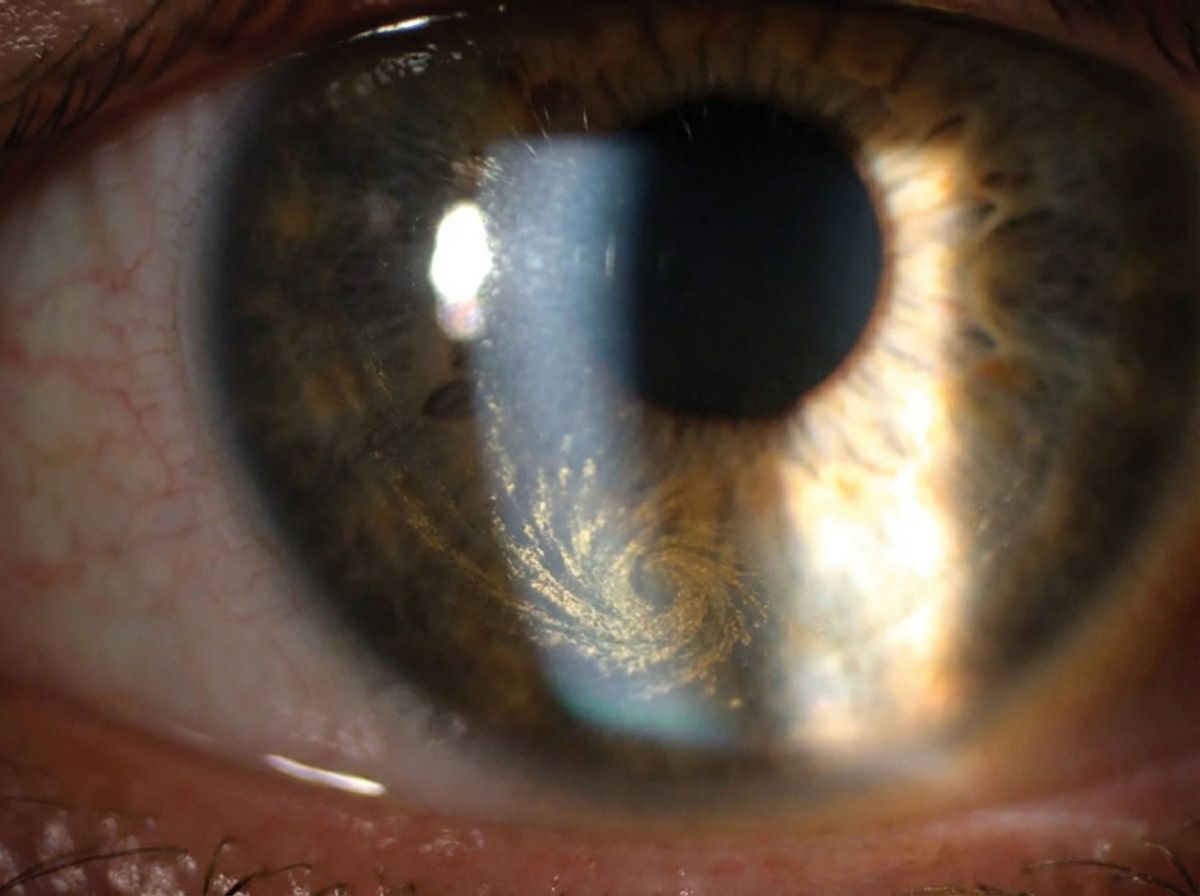
A 55-year-old cardiac patient on long-term treatment presents for a follow-up visit. The physician observes a specific finding on ophthalmological examination. Which drug prescribed by the physician is most likely responsible for this finding?
A patient presents to the eye outpatient department with recurrent chalazion. Which of the following types of cancer should be excluded in these patients?
What is the most common ophthalmological manifestation of the X-linked form of Alport syndrome?
Ocular manifestations of vitamin D deficiency include:
Explanation: **Explanation:** Sarcoidosis is a multisystem granulomatous disease characterized by non-caseating granulomas. Ocular involvement occurs in approximately 25–50% of patients, and **Anterior Uveitis (Iritis/Iridocyclitis)** is the most common manifestation. * **Why Iritis is Correct:** The hallmark of ocular sarcoidosis is a bilateral, chronic granulomatous anterior uveitis. Clinically, this presents with "mutton-fat" keratic precipitates (KPs) on the corneal endothelium and Iris nodules (Koeppe and Busacca nodules). While sarcoidosis can affect any part of the eye (panuveitis), the anterior segment is the most frequent site of inflammation. * **Why Incorrect Options are Wrong:** * **Keratitis:** While sarcoidosis can cause Keratoconjunctivitis Sicca (dry eye) due to lacrimal gland involvement, primary inflammation of the cornea (keratitis) is rare. * **Cataract:** This is typically a **secondary complication** of chronic intraocular inflammation or prolonged corticosteroid therapy used to treat sarcoidosis, rather than a primary manifestation. * **Glaucoma:** Similar to cataracts, glaucoma in sarcoidosis is usually secondary, resulting from trabeculitis, peripheral anterior synechiae (PAS), or steroid use. **High-Yield Clinical Pearls for NEET-PG:** * **Classic Triad:** Bilateral hilar lymphadenopathy (on CXR), elevated Serum ACE levels, and granulomatous uveitis. * **Fundus Findings:** "Candle-wax drippings" (perivascular sheathing/chorioretinitis). * **Lofgren Syndrome:** Erythema nodosum, bilateral hilar lymphadenopathy, and arthralgia (often associated with acute uveitis). * **Heerfordt Syndrome (Uveoparotid Fever):** Uveitis, Parotitis, Facial nerve palsy, and Fever.
Explanation: **Explanation:** In **Retinoblastoma**, the most common route of extraocular spread is via direct extension through the **optic nerve**. The tumor cells invade the lamina cribrosa and travel along the subarachnoid space of the optic nerve to reach the brain and cerebrospinal fluid (CSF). Therefore, during enucleation, it is mandatory to obtain a long stump of the optic nerve (usually 10–15 mm). Histopathological examination of the **resected end of the optic nerve** is the gold standard for determining the prognosis and the need for adjuvant chemotherapy. **Analysis of Options:** * **Optic Nerve (Correct):** It is the primary pathway for intracranial spread. Involvement of the surgical cut-end indicates a high risk of systemic and CNS metastasis. * **Central Retinal Artery:** While the tumor can involve retinal vessels, it does not typically spread systemically through the arterial wall; the optic nerve parenchyma and subarachnoid space are the significant prognostic markers. * **Sclera and Episclera:** Though Retinoblastoma can cause "massive uveal invasion" leading to scleral involvement, this usually occurs in advanced stages. It is not the primary tissue sectioned to determine the *extent* of spread compared to the optic nerve. * **Vortex Vein:** Hematogenous spread can occur via the choroidal vessels and vortex veins (leading to bone and liver metastasis), but the optic nerve remains the most critical surgical margin to assess post-enucleation. **High-Yield Clinical Pearls for NEET-PG:** * **Flexner-Wintersteiner Rosettes:** Pathognomonic for Retinoblastoma (indicates photoreceptor differentiation). * **Homer-Wright Rosettes:** Seen in Retinoblastoma, but also in Neuroblastoma and Medulloblastoma. * **Calcification:** Differentiates Retinoblastoma from other causes of Leukocoria (e.g., Coats' disease) on CT scan. * **Trilateral Retinoblastoma:** Bilateral RB associated with a Pinealoblastoma.
Explanation: **Explanation:** **Sympathetic Ophthalmia (SO)** is a rare, bilateral, non-necrotizing granulomatous panuveitis that occurs following a penetrating ocular injury or intraocular surgery in one eye (the "exciting eye"), subsequently affecting the other eye (the "sympathizing eye"). **Why Iris and Ciliary Body is Correct:** The hallmark of SO is a **diffuse granulomatous inflammation of the entire uveal tract**. The iris and ciliary body are the anterior components of the uvea. In the early stages or in milder presentations, the disease often manifests as an acute anterior uveitis involving the **iris and ciliary body**, leading to symptoms like photophobia, miosis, and ciliary congestion. Pathologically, there is a characteristic infiltration of the uveal tissue with lymphocytes and "Dalen-Fuchs" nodules (sub-RPE granulomas). **Why Other Options are Incorrect:** * **A. Cornea:** While "mutton-fat" Keratic Precipitates (KPs) may deposit on the corneal endothelium due to uveitis, the cornea itself is not the primary site of the inflammatory process. * **B. Lens:** The lens is an avascular structure and is not primarily involved in this immune-mediated process, though secondary cataracts may develop due to chronic inflammation. * **C. Optic Nerve:** While optic disc edema can occur as a secondary complication of posterior segment involvement, it is not the primary or most common structure involved compared to the uveal tract. **High-Yield Clinical Pearls for NEET-PG:** * **Trigger:** Penetrating trauma involving the **ciliary body** (the "danger zone") is the most common cause. * **Latent Period:** Usually occurs within 2 weeks to 3 months after injury (65% within 2 weeks; 90% within 1 year). * **Pathology:** Characterized by diffuse uveal thickening with **sparing of the choriocapillaris**. * **Prevention:** Evisceration or enucleation of the injured eye within **10–14 days** of trauma can prevent the development of SO in the sympathizing eye. * **Treatment:** Long-term systemic corticosteroids and immunosuppressants.
Explanation: **Explanation:** Staphylococcal blepharitis is a chronic inflammatory condition of the lid margins caused by *Staphylococcus aureus* or *Staphylococcus epidermidis*. While the primary site of infection is the eyelid, the condition frequently triggers secondary hypersensitivity reactions in the eye. **Why the correct answer is right:** The correct answer is **Iris with cornea**. This is due to the release of staphylococcal exotoxins which lead to two specific complications: 1. **Cornea:** Marginal keratitis (catarrhal ulcers) occurs due to a Type III hypersensitivity reaction to staphylococcal antigens, typically presenting as peripheral corneal infiltrates. 2. **Iris:** Chronic irritation and toxin exposure can lead to a mild secondary **anterior uveitis (iritis)**. The association of blepharitis with both corneal involvement and low-grade iritis makes this the most clinically accurate choice among the options provided. **Analysis of Incorrect Options:** * **Option A (Iris with conjunctiva):** While chronic conjunctivitis is common, the hallmark systemic/secondary involvement specifically emphasizes the corneal-uveal axis in advanced cases. * **Option B (Conjunctiva with cornea):** Though frequent, this option overlooks the internal ocular involvement (iritis) often tested in this specific context. * **Option C (Choroid with retina):** Staphylococcal blepharitis is an anterior segment disease. It does not involve the posterior segment (choroid or retina). **High-Yield Clinical Pearls for NEET-PG:** * **Collarettes:** Fibrinous scales that encircle the base of the lashes (pathognomonic for Staphylococcal blepharitis). * **Tylosis:** Thickening of the lid margin seen in chronic cases. * **Madoraosis & Poliosis:** Loss of lashes and whitening of lashes, respectively, are common sequelae. * **Treatment:** Lid hygiene (warm compresses/scrubs) and topical antibiotics (Erythromycin/Bacitracin).
Explanation: ### Explanation **Sympathetic Ophthalmia (SO)** is a rare, bilateral, granulomatous (non-suppurative) panuveitis that occurs following a penetrating ocular injury or intraocular surgery. **1. Why Option D is Correct:** The pathogenesis involves a cell-mediated autoimmune response against uveal antigens (retinal S-antigen) that were previously sequestered from the immune system. When one eye (the **exciting eye**) is injured, these antigens are released, leading to an immune sensitization that attacks both the injured eye and the healthy, uninjured eye (the **sympathizing eye**). Because this is an autoimmune inflammatory process and not a bacterial infection, it is classified as **non-suppurative**. Since it eventually affects both eyes, it is **bilateral**. **2. Why Other Options are Incorrect:** * **Options A & C (Unilateral):** By definition, SO is a bilateral condition. While it starts in the injured eye, the hallmark of the disease is the subsequent involvement of the fellow eye. * **Options A & B (Suppurative):** Suppurative uveitis (like endophthalmitis) involves pus formation, usually due to pyogenic bacterial infection. SO is a granulomatous, non-suppurative inflammation characterized by lymphocytic infiltration. **3. High-Yield Clinical Pearls for NEET-PG:** * **Incidence:** Most commonly occurs 2 weeks to 3 months after injury (rarely before 2 weeks). * **Histopathology:** Characterized by **Dalen-Fuchs nodules** (clusters of epithelioid cells between the RPE and Bruch’s membrane) and a "sparing of the choriocapillaris." * **Clinical Sign:** The earliest sign in the sympathizing eye is often **retrolental flare** or cells. * **Prevention:** If an injured eye has no chance of regaining vision (No PL), **enucleation** should ideally be performed within 10–14 days of injury to prevent SO. * **Treatment:** High-dose systemic corticosteroids and immunosuppressants.
Explanation: **Explanation:** The correct answer is **D. Tranta’s spot**. **Tranta’s spots** (also known as Horner-Tranta’s spots) are small, white, chalky elevated dots found at the limbus. They are a hallmark clinical feature of **Vernal Keratoconjunctivitis (VKC)**, a type of allergic conjunctivitis, and are composed of eosinophils and epithelial debris. They are not associated with Vitamin A deficiency. **Analysis of Incorrect Options:** * **Night Blindness (Nyctalopia):** This is the **earliest clinical symptom** of Vitamin A deficiency. It occurs due to the failure of rhodopsin regeneration in the retinal rods. * **Xerophthalmia:** This is a spectrum of ocular diseases caused by Vitamin A deficiency, ranging from night blindness to keratomalacia. It literally translates to "dry eye." * **Bitot’s Spot:** This is a **pathognomonic sign** of Vitamin A deficiency. These are triangular, foamy, silvery-white patches on the bulbar conjunctiva (usually temporal) caused by squamous metaplasia and keratinization of the conjunctival epithelium. **High-Yield Clinical Pearls for NEET-PG:** * **WHO Classification of Xerophthalmia:** * **X1A:** Conjunctival xerosis * **X1B:** Bitot’s spots * **X2:** Corneal xerosis * **X3A/X3B:** Corneal ulceration/Keratomalacia (<1/3 or >1/3 of corneal surface) * **XS:** Corneal scar * **XF:** Xerophthalmic fundus * **First Sign:** Conjunctival xerosis. * **First Symptom:** Night blindness. * **Treatment:** For children >1 year, the standard dose is 200,000 IU of Vitamin A orally on days 0, 1, and 14.
Explanation: ***Amiodarone*** - Long-term amiodarone therapy causes **corneal microdeposits** (vortex keratopathy/cornea verticillata) in nearly **90-100%** of patients, appearing as **whorl-like deposits** on slit-lamp examination. - These **bilateral corneal deposits** are typically **asymptomatic** and reversible upon discontinuation, making them a characteristic ophthalmological finding in cardiac patients. *Digoxin* - Digoxin toxicity primarily causes **visual disturbances** like **yellow-green halos** around lights and **blurred vision**, not corneal deposits. - Associated with **nausea**, **vomiting**, and **cardiac arrhythmias** rather than specific ophthalmological examination findings. *Verapamil* - Calcium channel blockers like verapamil do **not cause characteristic ophthalmological findings** on routine examination. - Side effects are primarily **cardiovascular** (hypotension, bradycardia) and **gastrointestinal** (constipation). *Propranolol* - Beta-blockers may cause **dry eyes** but do not produce **characteristic corneal deposits** or specific ophthalmological examination findings. - Primary side effects include **bronchospasm**, **fatigue**, and **cold extremities**, not ocular manifestations.
Explanation: **Explanation:** **Why Sebaceous Cell Carcinoma (SGC) is the correct answer:** Sebaceous cell carcinoma is a highly malignant tumor arising from the meibomian glands (most common), glands of Zeis, or the caruncle. It is notoriously known as a **"masquerading syndrome"** because its early clinical presentation mimics benign conditions. A **recurrent chalazion** at the same site or a chronic unilateral blepharoconjunctivitis in an elderly patient must be considered SGC until proven otherwise. The underlying medical concept is that the tumor cells infiltrate the eyelid, causing thickening and nodularity that clinically resembles the granulomatous inflammation of a chalazion. **Analysis of Incorrect Options:** * **A. Basal Cell Carcinoma (BCC):** This is the most common eyelid malignancy. It typically presents as a painless, pearly nodule with telangiectasia or a "rodent ulcer." While common, it does not typically mimic the internal focal inflammation of a chalazion. * **C. Malignant Melanoma:** This arises from melanocytes and presents as a pigmented (melanotic) or non-pigmented (amelanotic) mass. It does not present as a recurrent inflammatory lid nodule. * **D. Squamous Cell Carcinoma (SCC):** This is less common than BCC and often arises from pre-cancerous lesions like actinic keratosis. It typically presents as an ulcerated plaque or a cutaneous horn, rather than a deep-seated meibomian-like nodule. **High-Yield Clinical Pearls for NEET-PG:** * **Pagetoid Spread:** SGC is unique for its "pagetoid spread," where tumor cells migrate into the conjunctival and corneal epithelium. * **Biopsy Protocol:** If SGC is suspected, a **full-thickness wedge biopsy** is required. Map biopsies of the conjunctiva are often done to check for pagetoid spread. * **Yellowish Hue:** The presence of a yellowish tint within the nodule (due to lipid content) is a clinical clue favoring SGC over other malignancies. * **Most Common Site:** The **upper eyelid** is the most common site for SGC (due to a higher density of meibomian glands), whereas BCC is more common in the lower eyelid.
Explanation: **Explanation:** Alport syndrome is a genetic disorder caused by mutations in the genes encoding **Type IV collagen** (specifically the $\alpha$3, $\alpha$4, and $\alpha$5 chains), which is a vital structural component of basement membranes in the kidney, inner ear, and eye. **1. Why "Dot and flake retinopathy" is correct:** While anterior lenticonus is the most *pathognomonic* (specific) sign, **dot and flake retinopathy** is the **most common** ocular manifestation, occurring in approximately 85% of affected males with the X-linked form. It presents as bilateral, tiny, white or yellow-white punctate lesions in the perimacular or peripheral retina. These lesions are usually asymptomatic and do not affect visual acuity. **2. Analysis of Incorrect Options:** * **B. Anterior lenticonus:** This is a highly specific (pathognomonic) feature where the lens capsule thins and bulges forward. However, it occurs in only about 25% of cases, making it less common than retinopathy. * **C. Posterior polymorphous corneal dystrophy (PPCD):** While associated with Alport syndrome due to basement membrane abnormalities in the cornea, it is a rare finding compared to retinal changes. * **D. Posterior lenticonus:** This is typically associated with **Lowe syndrome** or is idiopathic/congenital; it is not a characteristic feature of Alport syndrome. **High-Yield Clinical Pearls for NEET-PG:** * **Classic Triad:** Hereditary nephritis (sensorineural deafness), sensorineural hearing loss, and ocular anomalies. * **Inheritance:** Most common is **X-linked dominant** (COL4A5 mutation). * **Vision Impact:** Retinopathy is asymptomatic; vision loss in Alport is usually due to progressive **high myopia** or oil-droplet configuration of the lens from anterior lenticonus. * **Management:** Anterior lenticonus is treated with clear lens extraction and IOL implantation if vision is significantly impaired.
Explanation: **Explanation:** Vitamin D plays a crucial role in calcium homeostasis. Deficiency leads to hypocalcemia, which manifests in the eye through several distinct mechanisms: 1. **Zonular (Lamellar) Cataract:** This is the most characteristic ocular finding. Hypocalcemia alters the permeability of the lens capsule and interferes with the electrolyte balance of the lens fibers. This results in opacification of specific layers (zones) of the lens, typically occurring during periods of active deficiency. 2. **Papilledema:** Severe Vitamin D deficiency and associated hypoparathyroidism can lead to increased intracranial pressure (pseudotumor cerebri). This manifests clinically as bilateral optic disc swelling (papilledema). 3. **Increased Lacrimation:** Hypocalcemia can cause neuromuscular irritability and autonomic dysfunction, leading to reflex tearing or hyperlacrimation. **Clinical Pearls for NEET-PG:** * **Zonular Cataract** is the most common type of congenital/infantile cataract. It is typically bilateral and symmetric, often described as "riders" (opacities extending from the equator). * **Hypocalcemic Tetany:** Always look for signs like Chvostek’s and Trousseau’s signs in a patient presenting with these ocular features. * **Differential Diagnosis:** While Vitamin A deficiency is famous for Bitot’s spots and Xerophthalmia, Vitamin D deficiency is high-yield for its association with **cataracts** and **raised ICP**. * **Other findings:** Photophobia and blepharospasm may also be seen due to ocular surface irritability. Since all three listed manifestations are documented consequences of Vitamin D deficiency/hypocalcemia, **Option D** is the correct answer.
Diabetes Mellitus
Practice Questions
Hypertension
Practice Questions
Autoimmune Disorders
Practice Questions
Thyroid Disease
Practice Questions
HIV and AIDS
Practice Questions
Hematological Disorders
Practice Questions
Neurological Disorders
Practice Questions
Dermatological Conditions
Practice Questions
Pregnancy-Related Eye Changes
Practice Questions
Metabolic Disorders
Practice Questions
Ocular Toxicity of Systemic Medications
Practice Questions
Infectious Systemic Diseases
Practice Questions
Get full access to all questions, explanations, and performance tracking.
Start For Free