Commonest complication of topical corticosteroids is -
A 25-year-old male presents with recurrent bilateral conjunctival hyperemia and a gritty sensation. Likely diagnosis?
Unilateral frontal blisters with upper lid edema and conjunctivitis is seen in?
A patient presents with a history of bullae involving more than 30% of the body surface area, along with rashes all over the body and erosions of the lips and other mucosa, for a few days. What could be the potential triggering factor for this condition?
A 30-year-old with recurrent ulcers on lips and genitalia, and positive pathergy test. Diagnosis?
A patient with acute history of blistering and denudation involving >30% BSA along with erosions of the lips with hemorrhagic crusting and other mucosa for few days. What is the most common triggering factor?
Distichiasis is a condition characterized by:
Primary objective of the use of atropine in anterior uveitis
Which of the following indicates activity of anterior uveitis?
In a child with juvenile idiopathic arthritis, the eye examination shows presence of:
Explanation: ***Glaucoma*** - **Topical corticosteroids** are well-known to increase **intraocular pressure** by reducing the outflow of aqueous humor, leading to **steroid-induced glaucoma**. - This complication can result in irreversible **optic nerve damage** and vision loss if not managed properly. *Ptosis* - **Ptosis** is a drooping of the upper eyelid and is not a common complication directly associated with topical corticosteroid use. - It is more often linked to issues like **muscle weakness**, nerve damage, or age-related changes. *Proptosis* - **Proptosis** refers to the bulging of the eye and is typically associated with conditions like **Graves' ophthalmopathy** or orbital tumors. - It is not a common or direct side effect of topical corticosteroid application. *Cataract* - While **steroid-induced cataracts** (specifically **posterior subcapsular cataracts**) are a known complication of chronic systemic corticosteroid use, they are less common with topical corticosteroids and usually require prolonged, high-dose therapy. - In contrast, a rise in intraocular pressure (leading to glaucoma) can occur more acutely and with lower doses of topical corticosteroids.
Explanation: ***Vernal keratoconjunctivitis*** * This is the correct diagnosis as it perfectly matches the clinical presentation: **young male patient** (VKC has male predominance, especially in adolescents/young adults), **recurrent course** (VKC is a chronic allergic condition with seasonal exacerbations), and **bilateral involvement** with gritty sensation. * VKC is a **severe form of allergic conjunctivitis** characterized by **bilateral conjunctival hyperemia**, intense itching, gritty sensation, photophobia, and mucoid discharge. The recurrent bilateral nature in a young male is pathognomonic. *Herpes keratitis* * Usually presents as **unilateral eye pain**, redness, and a characteristic **dendritic ulcer** on the cornea (seen with fluorescein staining), which is not described here. * Caused by herpes simplex virus and typically has an acute presentation rather than recurrent bilateral conjunctival symptoms. Can lead to significant vision loss if untreated. *Episcleritis* * Characterized by **localized sectorial redness** in one eye, often in a radial pattern, and is usually **mild and self-limiting**. * Typically causes minimal discomfort and does not commonly present with gritty sensation or recurrent bilateral involvement as the primary feature. *Bacterial conjunctivitis* * Typically presents with **purulent discharge** (thick yellow-green pus) and matting of eyelids, which is not mentioned in this patient's symptoms. * While it causes redness and grittiness, it's usually **acute and unilateral or sequential bilateral** (one eye then the other), and resolves with topical antibiotics within days, unlike the recurrent chronic nature described here.
Explanation: ***Herpes Zoster Ophthalmicus*** - This condition is characterized by a **unilateral vesicular rash** (blisters) in the **trigeminal dermatome (V1)**, which includes the forehead and upper eyelid, along with significant **lid edema** and **conjunctivitis**. - **Hutchinson's sign** (lesions on the tip, side, or root of the nose) indicates a high risk of ocular involvement due to the nasociliary nerve innervation. *Acanthamoeba Keratitis* - This is an **amoebic infection** of the cornea typically associated with **contact lens wear** and often presents with severe pain and a **ring infiltrate** in the cornea. - It does not typically present with unilateral frontal blisters or significant lid edema. *Herpes Simplex* - Herpes simplex typically causes **recurrent corneal ulcers** (dendritic or geographic) and sometimes blepharitis, but not the widespread **unilateral frontal blisters** seen in the trigeminal distribution. - While it can cause conjunctivitis and lid edema, the pattern of skin lesions is the key differentiator. *Neuroparalytic Keratitis* - This condition results from **trigeminal nerve damage**, leading to corneal anesthesia and subsequent **trophic corneal ulceration**. - It presents primarily with **corneal findings** (epithelial defects, ulcers) due to impaired sensation and tear film stability, not initial vesicular skin lesions or prominent lid edema.
Explanation: ***Correct: Drug induced*** - The severe presentation with widespread **bullae** covering over 30% of the body surface area, extensive rashes, and **mucosal erosions** (lips) is highly suggestive of **Toxic Epidermal Necrolysis (TEN)**. - TEN is most commonly **drug-induced**, often triggered by medications like **antibiotics** (sulfonamides, penicillins), **anticonvulsants** (carbamazepine, phenytoin, lamotrigine), **NSAIDs**, and **allopurinol**. - The combination of extensive skin detachment (>30% BSA), mucosal involvement, and acute onset strongly points to a drug-induced etiology. *Incorrect: Viral infection* - While some viral infections can cause rashes and mucocutaneous lesions, they typically do not lead to such widespread **epidermal detachment** and severe **mucosal erosions** affecting over 30% BSA, as seen in TEN. - Viral exanthems (e.g., measles, herpes) are generally milder and have different morphology compared to the full-thickness epidermal necrosis seen in this condition. *Incorrect: Bacterial infection* - Bacterial skin infections can cause **bullous impetigo** or **staphylococcal scalded skin syndrome (SSSS)**, but SSSS typically spares the mucous membranes and involves superficial epidermal splitting (not full-thickness necrosis). - The extent and severity of the lesions, including widespread **mucosal involvement**, are more consistent with a systemic hypersensitivity reaction rather than a localized or superficial bacterial infection. *Incorrect: Idiopathic* - Although the cause can sometimes be undetermined, the pattern of severe symptoms described—especially with extensive **skin sloughing** and **mucosal involvement**—points strongly to a known etiology. - TEN has a well-established association with drug triggers in **80-95% of cases**, making a truly idiopathic cause unlikely in the absence of thorough drug history evaluation.
Explanation: Behcet's disease - The combination of recurrent oral and genital ulcers along with a positive pathergy test is highly characteristic of Behcet's disease. - Behcet's is a systemic vasculitis that can affect multiple organ systems, with mucocutaneous lesions being a hallmark [3]. Herpes simplex - While herpes simplex causes recurrent oral (cold sores) and genital ulcers, it does not typically involve a positive pathergy test [1]. - Herpes lesions are typically vesicular before ulcerating, and diagnosis is often confirmed by viral culture or PCR [1]. Pemphigus vulgaris - Characterized by painful oral blisters and erosions, but genital ulcers are less common, and it does not typically involve a positive pathergy test. - Pemphigus vulgaris is an autoimmune blistering disease due to antibodies against desmoglein, diagnosed by biopsy and immunofluorescence [2]. Syphilis - Can cause oral and genital ulcers (chancres in primary syphilis) and sometimes mucocutaneous lesions in secondary syphilis (e.g., mucous patches). - However, syphilis does not present with a positive pathergy test, and its diagnosis is made through serological tests (e.g., RPR, VDRL, FTA-ABS).
Explanation: ***Drug induced*** - **Toxic epidermal necrolysis (TEN)**, characterized by blistering and denudation of >30% body surface area and mucosal involvement, is most commonly triggered by **drugs**, such as sulfonamides, antiepileptics, allopurinol, and NSAIDs. - The rapid onset and severe presentation are highly suggestive of an adverse drug reaction. *Viral infection* - While viruses can trigger some mucocutaneous reactions, severe widespread necrosis and denudation like in TEN are not typically **direct viral effects**. - **Herpes simplex virus (HSV)** can cause erythema multiforme, which is less severe and extensive than TEN. *Idiopathic* - While some cases of severe cutaneous adverse reactions can be idiopathic, the vast majority of **TEN cases have an identifiable trigger**, with drugs being the leading cause. - Attributing it to an unknown cause would be less precise given the common association with medications. *Bacterial infection* - Bacterial infections, such as **Staphylococcal scalded skin syndrome (SSSS)**, can cause blistering and desquamation, but it primarily affects children and involves a superficial epidermal split, rather than the full-thickness necrosis seen in TEN. - SSSS typically spares the **mucous membranes**, unlike the prominent mucosal involvement described in the patient.
Explanation: ***Abnormal extra row of cilia*** - **Distichiasis** is a congenital or acquired condition characterized by the presence of a double row of eyelashes, where the extra row emerges from the **Meibomian gland orifices**. - These accessory eyelashes can be the same length as normal lashes or appear finer and shorter, often causing **ocular irritation**, corneal abrasion, and epiphora due to their abnormal growth direction. *Abnormal inversion of eyelashes* - This description typically refers to **trichiasis**, where normally positioned eyelashes grow inwards towards the eye. - While both can cause irritation, **trichiasis** involves misdirection of existing lashes, whereas distichiasis involves an *extra* row. *Abnormal eversion of eyelashes* - Eversion of eyelashes is not a recognized abnormality in this context; rather, **ectropion** refers to the outward turning of the eyelid margin, which may expose the eyelashes but is not a primary cilial abnormality. - This condition is more about eyelid positioning than the eyelashes themselves. *Misdirected cilia* - While distichiasis does involve cilia growing in an abnormal direction, the key feature of distichiasis is the presence of an *additional* row of lashes, not just misdirection of the primary row. - **Trichiasis** is the more appropriate term for misdirected cilia from the normal lash line.
Explanation: ***Rest to the ciliary muscle*** - Atropine is a **cycloplegic** agent that paralyzes the **ciliary muscle**, thereby alleviating pain caused by spasms and inflammation in anterior uveitis. - This **cycloplegia** is the primary therapeutic goal, as it reduces **ciliary spasm** and the associated pain. *Helps in preventing posterior synechia formation (secondary effect)* - While atropine's **mydriatic** action (pupil dilation) helps prevent the formation of **posterior synechiae**, this is a beneficial secondary effect and not its primary objective in alleviating symptoms or pain. - The dilation breaks existing synechiae or prevents new ones from forming by moving the iris away from the lens capsule. *Increase blood flow* - Atropine's primary action is anticholinergic, leading to **cycloplegia** and **mydriasis**, not a direct increase in ocular blood flow. - Increased blood flow is not a targeted therapeutic effect of atropine in acute anterior uveitis. *Increase supply of antibody* - Atropine does not directly influence the immune system or increase the supply of antibodies to the inflamed eye. - Its mechanism of action is limited to blocking muscarinic acetylcholine receptors.
Explanation: ***Cells in anterior chamber*** - The presence of **inflammatory cells** (leukocytes) floating in the **aqueous humor** is a direct sign of active inflammation in the anterior uvea. - These cells cause the **Tyndall effect** (flare) when a slit lamp beam is passed through the anterior chamber, indicating active uveitis. *Circumcorneal congestion* - This is a symptom of **uveitis** but doesn't specifically indicate the *activity* of the inflammation. It's a general sign of inflammation in the anterior segment. - It results from dilation of the **perilimbal blood vessels**, which can persist even when the inflammation is subsiding. *Keratic precipitate* - These are **deposits of inflammatory cells** on the posterior corneal surface. While seen in uveitis, they represent the *sequelae* of inflammation rather than active, ongoing cellular activity in the aqueous. - They can be present even in quiescent phases of the disease, making them less indicative of current activity compared to live cells in the anterior chamber. *Corneal edema* - **Corneal edema** can occur in severe anterior uveitis but is not a primary indicator of active inflammation. It usually signifies compromise of the corneal endothelium due to prolonged or severe inflammation. - It is a less direct measure of the ongoing inflammatory process than the presence of cellular activity in the anterior chamber.
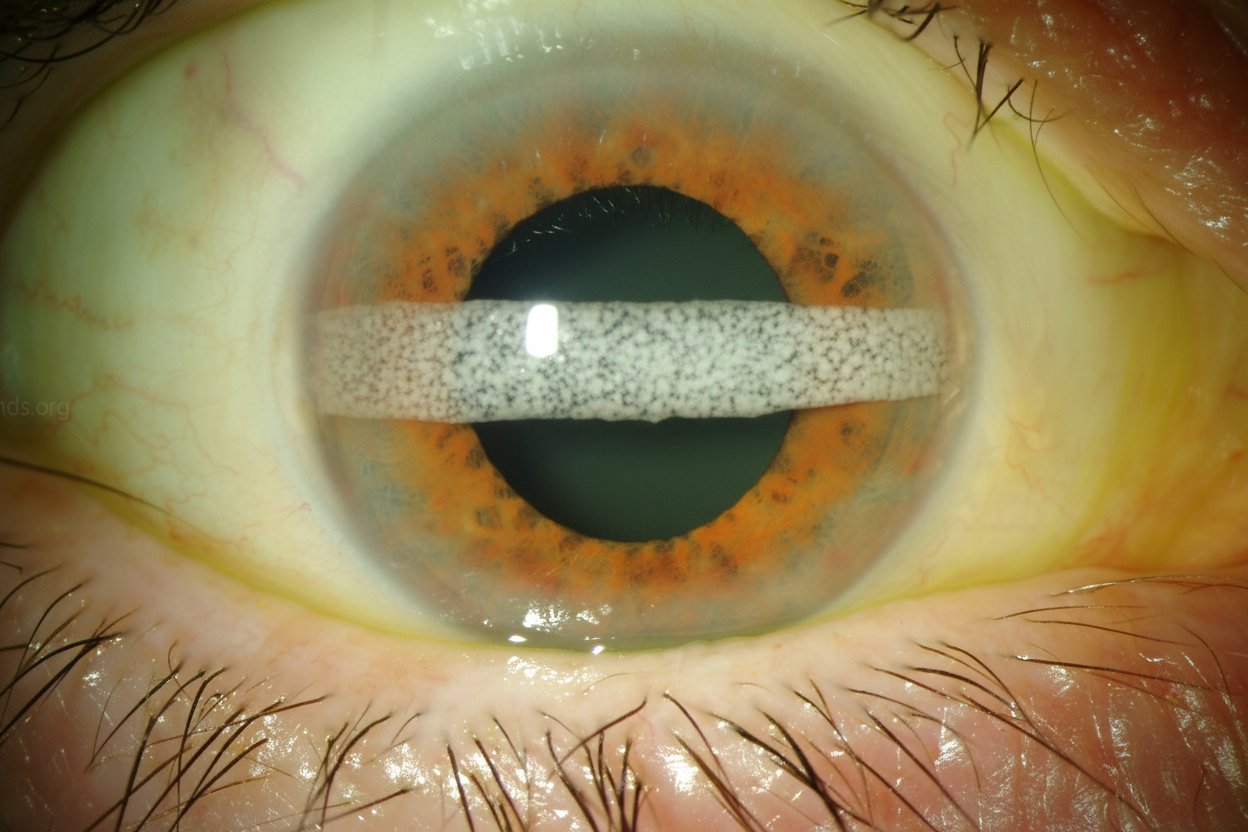
Explanation: ***Band keratopathy*** - **Band keratopathy** is a common ocular manifestation in children with chronic uveitis secondary to **juvenile idiopathic arthritis (JIA)**, characterized by a horizontal band-like deposition of calcium salts in the superficial cornea. - The image depicts a whitish or grayish band across the cornea, consistent with **calcium deposition**, which is a hallmark of band keratopathy. *Vortex keratopathy* - **Vortex keratopathy** (or **cornea verticillata**) is a swirling, whorl-like pattern of corneal deposits, typically caused by drug toxicity (e.g., amiodarone, chloroquine) or metabolic disorders (e.g., Fabry disease). - It does not present as a horizontal band or diffuse opacification like that seen in the image, and is unrelated to JIA. *Fuchs' endothelial dystrophy* - **Fuchs' endothelial dystrophy** is a unilateral or bilateral progressive condition primarily affecting the corneal endothelium, leading to stromal edema and **guttae** (small excrescences on Descemet's membrane). - It typically affects older adults and is not primarily linked to JIA or the appearance in the provided image. *Bitot's spots* - **Bitot's spots** are foamy, triangular patches of keratinized conjunctival epithelium, usually located on the temporal bulbar conjunctiva, and are pathognomonic for **vitamin A deficiency**. - They are a conjunctival finding, not a corneal one, and are not associated with JIA.
Get full access to all questions, explanations, and performance tracking.
Start For Free