Which of the following tests is not useful for the diagnosis of patients with Ocular Myasthenia Gravis?
What type of visual field defect is typically seen with a pituitary adenoma?
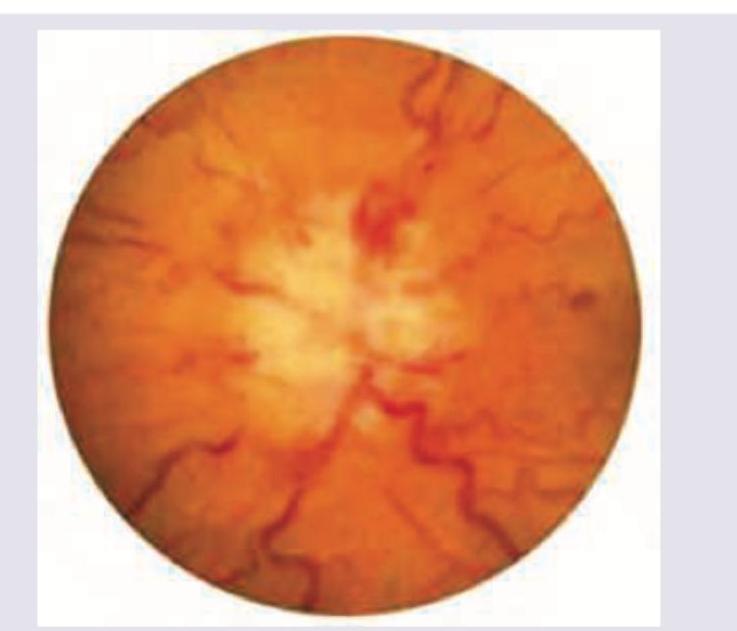
A 25-year-old man presents with acute, painless loss of vision in the right eye. The appearance of the optic nerve of the right eye is hyperemic. What is the most likely diagnosis among the given options?
A 44-year-old man presents with a noticed difference in pupil size between his right and left eye, which he believes has been present for several weeks. He reports no pain or restriction of eye movements. Examination in a dimly lit room shows both pupils to be 4mm in size. Upon light exposure, his right pupil dilates to 4mm, while his left pupil constricts to 2mm. His eye movements are normal, and the remainder of his neurological examination is unremarkable. He does not exhibit ptosis. This physical finding is indicative of which of the following pathological processes?
Which order neuron is the optic nerve?
A patient presents with right homonymous hemianopia. What is the most likely site of the lesion?
Which cell type constitutes the first-order neuron in the visual pathway?
Absence of Lamina cribrosa occurs in which condition?
Which one of the following would be true if only the left optic nerve was severed?
Charge syndrome includes all of the following except:
Explanation: **Explanation:** The diagnosis of **Ocular Myasthenia Gravis (OMG)** focuses on confirming neuromuscular junction dysfunction localized to the extraocular and levator muscles. **Why Spirometry is the correct answer:** Spirometry is used to assess pulmonary function (forced vital capacity) in patients with **Generalized Myasthenia Gravis** to monitor for respiratory muscle weakness or an impending myasthenic crisis. In purely **Ocular Myasthenia**, the pathology is restricted to the eyes (ptosis and diplopia); therefore, spirometry provides no diagnostic value for the ocular subtype. **Analysis of other options:** * **MRI Brain:** While not a test for Myasthenia itself, it is **essential for the differential diagnosis** of OMG. It helps rule out compressive lesions (like third nerve palsy or brainstem tumors) that mimic ocular symptoms. * **Anti-MuSK Antibody Titer:** This is a specific serological test. While more common in generalized MG, a subset of seronegative (AChR-negative) patients may test positive for MuSK antibodies. * **Ice Pack Test:** A highly sensitive bedside test for OMG. Cooling the eyelid inhibits acetylcholinesterase, increasing acetylcholine availability and temporarily improving ptosis. **Clinical Pearls for NEET-PG:** * **Gold Standard Diagnosis:** Single Fiber EMG (SFEMG) is the most sensitive test. * **Most Specific Serology:** Anti-AChR antibodies (though often negative in 50% of OMG cases). * **Simpson’s Test:** Sustained upward gaze leading to worsening ptosis (fatigability). * **Cogan’s Lid Twitch:** Brief overshoot of the upper lid when shifting from downgaze to primary position. * **Associated Condition:** Always screen for **Thymoma** using a CT Chest in newly diagnosed MG patients.
Explanation: **Explanation:** The visual field defect typically associated with a pituitary adenoma is **Bitemporal Hemianopia**. **1. Why Bitemporal Hemianopia is Correct:** The pituitary gland lies in the sella turcica, directly beneath the **optic chiasm**. As a pituitary adenoma grows superiorly, it compresses the decussating (crossing) fibers in the central part of the chiasm. These crossing fibers originate from the **nasal retina** of each eye. Since the nasal retina is responsible for perceiving the **temporal visual field**, damage to these fibers results in a loss of the outer half of the vision in both eyes. **2. Analysis of Incorrect Options:** * **Binasal Hemianopia:** This is rare and occurs due to lateral compression of the chiasm (non-crossing fibers), often seen in bilateral internal carotid artery atherosclerosis or glaucoma. * **Quadrantanopia:** This refers to the loss of one-fourth of the visual field. While a pituitary tumor can occasionally cause a superior quadrantanopia if it compresses only the inferior fibers, the classic and most common presentation is a full hemianopia. * **Pie in the Sky Defect:** This is a **Superior Homonymous Quadrantanopia**, typically caused by a lesion in the **temporal lobe** (Meyer’s loop). **High-Yield Clinical Pearls for NEET-PG:** * **Superior Quadrantanopia:** "Pie in the sky" (Temporal lobe lesion). * **Inferior Quadrantanopia:** "Pie on the floor" (Parietal lobe lesion). * **Homonymous Hemianopia with Macular Sparing:** Classic for Occipital lobe lesions (Posterior Cerebral Artery occlusion). * **Junctional Scotoma:** A lesion at the junction of the optic nerve and chiasm, causing a central scotoma in the ipsilateral eye and a temporal field defect in the contralateral eye (Wilbrand’s knee).
Explanation: ### Explanation **Correct Option: C. Leber Hereditary Optic Neuropathy (LHON)** **Why it is correct:** LHON is a mitochondrial DNA disorder (typically mutations at positions 11778, 3460, or 14484) that primarily affects young males. It presents as an **acute or subacute, painless, central vision loss**. The hallmark finding in the acute stage is a **hyperemic optic disc** with **pseudo-papilledema** (elevation without leakage on FFA) and peripapillary telangiectatic microangiopathy. While it starts unilaterally, the second eye is usually involved within weeks to months. **Why the other options are incorrect:** * **A. Vitamin B12 deficiency:** This causes nutritional optic neuropathy, which presents as **gradual, bilateral, and progressive** vision loss, not acute. The disc usually appears normal initially, progressing to temporal pallor. * **B. Ethambutol toxicity:** This is a dose-dependent toxic optic neuropathy. It presents with **bilateral, symmetrical, and gradual** reduction in vision and color perception (red-green). * **D. Dominant Optic Atrophy (Kjer’s type):** This is the most common hereditary optic atrophy but presents in **early childhood (4–6 years)** with very slow, insidious progression and characteristic **temporal wedge disc pallor**, not acute hyperemia. **High-Yield Clinical Pearls for NEET-PG:** * **Inheritance:** Mitochondrial (Maternal inheritance); however, it shows a strong male predilection (85%). * **Triad of Acute LHON:** 1. Circumpapillary telangiectatic microangiopathy, 2. Swelling of the nerve fiber layer (Pseudo-papilledema), 3. Absence of leakage on Fluorescein Angiography (distinguishes it from true papilledema). * **Visual Field:** Typically shows a **centrocecal scotoma**. * **Treatment:** Idebenone (a potent antioxidant) is often used to improve visual outcomes.
Explanation: **Explanation:** The clinical presentation describes **Anisocoria** that is more pronounced in light. In a dimly lit room, the pupils are equal (4mm), but upon light exposure, the right pupil fails to constrict (remains 4mm) while the left pupil constricts normally (2mm). This indicates a **Right-sided Third Cranial Nerve (Oculomotor) Palsy** involving the parasympathetic pupilloconstrictor fibers. **1. Why the Correct Answer is Right:** The most critical surgical cause of an isolated, pupil-involving Third Nerve Palsy is a **Posterior Communicating Artery (PComA) Aneurysm** (Option A). The pupilloconstrictor fibers are located superficially (peripherally) in the third nerve, making them highly susceptible to external compression by an enlarging aneurysm. This is a medical emergency as it may precede a subarachnoid hemorrhage. **2. Why Incorrect Options are Wrong:** * **Option B:** Superior sagittal sinus occlusion typically presents with signs of raised intracranial pressure (papilledema) and seizures, not isolated pupillary defects. * **Option C:** Transtentorial herniation causes a "blown pupil" due to uncal compression of the third nerve, but this occurs in comatose patients with severe head trauma or large masses, not in an otherwise unremarkable neurological exam. * **Option D:** Carotid artery dissection (rupture of the inner lumen) typically causes **Horner’s Syndrome** (miosis and ptosis) due to disruption of sympathetic fibers. Here, the affected pupil is dilated, not constricted. **Clinical Pearls for NEET-PG:** * **Rule of the Pupil:** In 3rd nerve palsy, if the pupil is involved, suspect **compression** (Aneurysm); if the pupil is spared, suspect **ischemia** (Diabetes/Hypertension). * **Mydriasis (Dilated pupil):** Parasympathetic lesion (3rd Nerve). * **Miosis (Constricted pupil):** Sympathetic lesion (Horner’s Syndrome). * **Light-Near Dissociation:** Seen in Adie’s Tonic Pupil and Argyll Robertson Pupil.
Explanation: To understand why the optic nerve is the **second-order neuron**, one must trace the visual pathway starting from the photoreceptors in the retina. Unlike most sensory nerves, the optic nerve is embryologically an extension of the central nervous system (CNS). ### **The Visual Pathway Hierarchy:** 1. **First-order neuron:** These are the **Bipolar cells** located within the retina. They receive impulses from the photoreceptors (rods and cones). 2. **Second-order neuron:** These are the **Retinal Ganglion Cells**. The axons of these ganglion cells converge at the optic disc to form the **Optic Nerve**. Therefore, the optic nerve itself consists of second-order neuronal axons. 3. **Third-order neuron:** These are located in the **Lateral Geniculate Body (LGB)** of the thalamus. Axons from the LGB form the optic radiations, which terminate in the primary visual cortex (Area 17). ### **Why other options are incorrect:** * **First-order neuron:** Incorrect because the bipolar cells precede the ganglion cells in the signal transduction chain. * **Third-order neuron:** Incorrect because these are located in the LGB, distal to the optic nerve and tract. * **Fourth-order neuron:** This term is sometimes used to describe neurons in the **Visual Cortex**, but they are not part of the optic nerve. ### **High-Yield NEET-PG Pearls:** * **Myelination:** Since the optic nerve is a CNS tract, it is myelinated by **oligodendrocytes**, not Schwann cells. This explains why it is affected in Multiple Sclerosis (Optic Neuritis). * **Meningeal Coverings:** It is surrounded by all three layers of meninges (dura, arachnoid, and pia mater). This is why increased intracranial pressure is transmitted to the optic disc, causing **papilledema**. * **Length:** The total length is approximately 50mm, with the intraorbital portion (25mm) being the longest.
Explanation: ### Explanation The visual pathway is organized such that the **left side of the brain processes the right visual field** of both eyes, and vice versa. This crossover occurs at the optic chiasm. **1. Why Option A is Correct:** A **homonymous hemianopia** refers to the loss of the same half of the visual field in both eyes. This occurs due to a lesion **posterior to the optic chiasm** (retrochiasmal). Because the fibers from the left temporal retina and right nasal retina (both representing the right visual field) travel together in the **left** optic tract, lateral geniculate body, and optic radiations, a lesion in the **Left Optic Radiation** results in a Right Homonymous Hemianopia. **2. Why the other options are incorrect:** * **B & D (Right-sided lesions):** Lesions in the right geniculate body or right optic radiation would result in a **Left** Homonymous Hemianopia. * **C (Right optic nerve):** A lesion here occurs anterior to the chiasm. It would result in ipsilateral (right-sided) monocular vision loss or a central scotoma, not a bilateral field defect. **3. High-Yield Clinical Pearls for NEET-PG:** * **Congruity:** The more posterior the lesion (closer to the occipital cortex), the more "congruous" (identical in shape) the field defects in both eyes become. * **Pie in the Sky:** A lesion in the **Temporal lobe** (Meyer’s loop) causes a Superior Homonymous Quadrantanopia. * **Pie on the Floor:** A lesion in the **Parietal lobe** (Baum’s loop) causes an Inferior Homonymous Quadrantanopia. * **Macular Sparing:** Often seen in occipital lobe lesions (e.g., PCA stroke) due to collateral blood supply from the Middle Cerebral Artery (MCA).
Explanation: ### Explanation The visual pathway is a complex sensory circuit that begins in the retina. Unlike many other sensory systems, the first three neurons of the visual pathway are located entirely within the layers of the retina. **1. Why Photoreceptors are the Correct Answer:** The **Photoreceptors (Rods and Cones)** are the primary sensory cells that perform phototransduction—converting light energy into electrical signals. In the anatomical hierarchy of the visual pathway, they are designated as the **First-order neurons**. They synapse with the dendrites of bipolar cells. **2. Analysis of Incorrect Options:** * **Bipolar Cells (Option A):** These act as the **Second-order neurons**. They receive input from the photoreceptors and transmit the signal to the ganglion cells. * **Ganglion Cells (Option B):** These are the **Third-order neurons**. Their axons converge at the optic disc to form the Optic Nerve (CN II), which then travels to the Lateral Geniculate Body (LGB). * **Horizontal Cells (Option C):** These are interneurons located in the inner nuclear layer. They provide lateral inhibition and help in modulating signals between photoreceptors and bipolar cells, but they are not part of the direct vertical conduction pathway. **3. Clinical Pearls & High-Yield Facts for NEET-PG:** * **Fourth-order neurons:** Located in the **Lateral Geniculate Body (LGB)** of the thalamus. Their axons form the optic radiations that end in the primary visual cortex (Area 17). * **The "Inverted" Retina:** Light must pass through the ganglion and bipolar layers before reaching the photoreceptors (except at the fovea). * **Rods vs. Cones:** Rods are responsible for scotopic (dim light) vision and peripheral vision; Cones are responsible for photopic (bright light) vision, color vision, and high visual acuity. * **Memory Aid:** 1st = Photoreceptor, 2nd = Bipolar, 3rd = Ganglion (Alphabetical order: **P**hotoreceptor → **B**ipolar → **G**anglion).
Explanation: **Explanation:** **Morning Glory Syndrome (MGS)** is a congenital optic disc anomaly characterized by a funnel-shaped excavation of the posterior pole that includes the optic nerve head. The hallmark of this condition is the **total absence of the lamina cribrosa**. Instead of the normal sieve-like connective tissue structure, the floor of the excavation is filled with a central plug of white glial tissue. This defect allows for the characteristic clinical appearance: a large, excavated disc with radial retinal vessels and peripapillary pigmentary changes. **Analysis of Options:** * **Optic Nerve Hypoplasia/Agenesis (Option A):** In hypoplasia, the optic nerve is small but the lamina cribrosa is typically present (though reduced in size). In complete agenesis, the entire nerve is absent, but MGS is the specific developmental "excavation" syndrome defined by the absence of the lamina. * **Drusen (Option C):** Optic disc drusen are hyaline calcific deposits located *pre-laminar* or within the substance of the optic nerve head. The lamina cribrosa is present and often appears crowded. * **Non-ophthalmia (Option D):** This is a non-specific term (likely a distractor for Anophthalmos). In Anophthalmos, the entire globe is absent, which is a much more global developmental failure than a specific laminar defect. **High-Yield Clinical Pearls for NEET-PG:** * **Associations:** MGS is frequently associated with **Basal Encephalocele** (transsphenoidal type) and **Moyamoya disease**. Always screen for midline craniofacial defects. * **Visual Field:** Typically shows a large blind spot. * **Complication:** Serous retinal detachment occurs in about 30% of cases. * **Key Sign:** "Flower-like" appearance of the disc with straight, radial vessels emerging from the periphery of the glial plug.
Explanation: To understand this question, one must grasp the anatomy of the **Pupillary Light Reflex (PLR)**, which consists of an **afferent limb** (CN II - Optic nerve) and an **efferent limb** (CN III - Oculomotor nerve). ### **Explanation of the Correct Answer** When the **left optic nerve** is severed, the afferent pathway from the left eye is completely lost. * **Shining light in the left eye:** No signal reaches the pretectal nuclei. Therefore, **neither** the direct reflex (left eye) nor the consensual reflex (right eye) will occur. * **Shining light in the right eye:** The afferent signal travels via the intact right optic nerve to the midbrain. Because the efferent pathways (bilateral CN III) are intact, both pupils will constrict. This results in a **Direct reflex in the right eye** and a **Consensual reflex in the left eye**. *Note: There appears to be a clerical error in the provided options/key. If the left optic nerve is severed, shining light in the left eye results in **no response in either eye**. The correct physiological statement is that shining light in the **right (intact) eye** elicits a response in both eyes.* ### **Analysis of Incorrect Options** * **Options A & C:** Incorrect because the left optic nerve is the "sensor." If the sensor is cut, the brain never receives the signal to initiate constriction in either eye. * **Options B & D:** Incorrect because the pupillary reflex is always bilateral (if the afferent signal reaches the brain) or absent (if it doesn't). It cannot be isolated to only the opposite eye when the ipsilateral nerve is severed. ### **NEET-PG High-Yield Pearls** 1. **Marcus Gunn Pupil (RAPD):** This is the clinical hallmark of an optic nerve lesion. In a "swinging flashlight test," the affected pupil appears to dilate when light is moved from the normal eye to the affected eye. 2. **The Pathway:** Retinal ganglion cells → Optic Nerve → Pretectal Nucleus (Midbrain) → **Bilateral** Edinger-Westphal Nuclei → Ciliary Ganglion → Short Ciliary Nerves → Sphincter Pupillae. 3. **Rule of Thumb:** * **Afferent defect (CN II):** Light in the bad eye = No response in either. Light in the good eye = Both respond. * **Efferent defect (CN III):** The affected eye is "fixed" and cannot constrict, regardless of which eye is stimulated.
Explanation: **Explanation:** **CHARGE syndrome** is a rare genetic disorder caused by mutations in the **CHD7 gene**. It is diagnosed based on a specific constellation of clinical features. The correct answer is **Esophageal atresia**, as it is not a primary component of the CHARGE mnemonic, although it can occasionally occur as a secondary complication. The mnemonic **CHARGE** stands for: * **C – Coloboma:** Typically bilateral chorioretinal colobomas, but can involve the iris or optic nerve. This is a hallmark ophthalmic finding. * **H – Heart defects:** Most commonly Tetralogy of Fallot, PDA, or VSD. * **A – Atresia choanae:** Narrowing or blockage of the nasal passages (membranous or bony). * **R – Retardation of growth and development:** Both physical growth and mental development are often delayed. * **G – Genitourinary anomalies:** Such as cryptorchidism, micropenis, or renal malformations. * **E – Ear abnormalities:** Characteristically includes "cup-shaped" ears and sensorineural hearing loss or semicircular canal hypoplasia. **Why other options are incorrect:** * **Coloboma (A), Heart defects (B), and Urogenital anomalies (C)** are all core diagnostic criteria represented by the letters C, H, and G in the mnemonic. **Clinical Pearls for NEET-PG:** * **Gene:** CHD7 (Chromodomain helicase DNA binding protein 7) on chromosome 8q12. * **Most common ocular finding:** Chorioretinal coloboma (present in ~80% of cases). * **Differential Diagnosis:** VACTERL association (which *does* include Esophageal atresia/Tracheoesophageal fistula). * **Key Diagnostic Sign:** Hypoplasia of the semicircular canals is highly specific for CHARGE syndrome.
Anatomy of Visual Pathways
Practice Questions
Pupillary Disorders
Practice Questions
Optic Neuritis
Practice Questions
Ischemic Optic Neuropathies
Practice Questions
Other Optic Neuropathies
Practice Questions
Papilledema
Practice Questions
Cranial Nerve Palsies
Practice Questions
Nystagmus
Practice Questions
Visual Field Defects
Practice Questions
Neuro-ophthalmic Manifestations of Intracranial Lesions
Practice Questions
Functional Visual Disorders
Practice Questions
Migraine and the Eye
Practice Questions
Get full access to all questions, explanations, and performance tracking.
Start For Free