Horner's syndrome consists of all of the following features except:
What is the best investigation for optic nerve damage among the following options?
A relative afferent pupillary defect is manifested by which of the following pupil appearances?
What is the most common cause of ptosis?
Amaurosis fugax is due to -
Marcus-Gunn pupil phenomenon is seen in which of the following conditions?
A patient presents with a right homonymous hemianopia, characterized by saccadic pursuit movements and defective optokinetic nystagmus. Where is the lesion most likely located?
Which of the following conditions typically spares the pupil?
Which of the following is the most probable cause of bilateral superior temporal quadrantopia and galactorrhea?
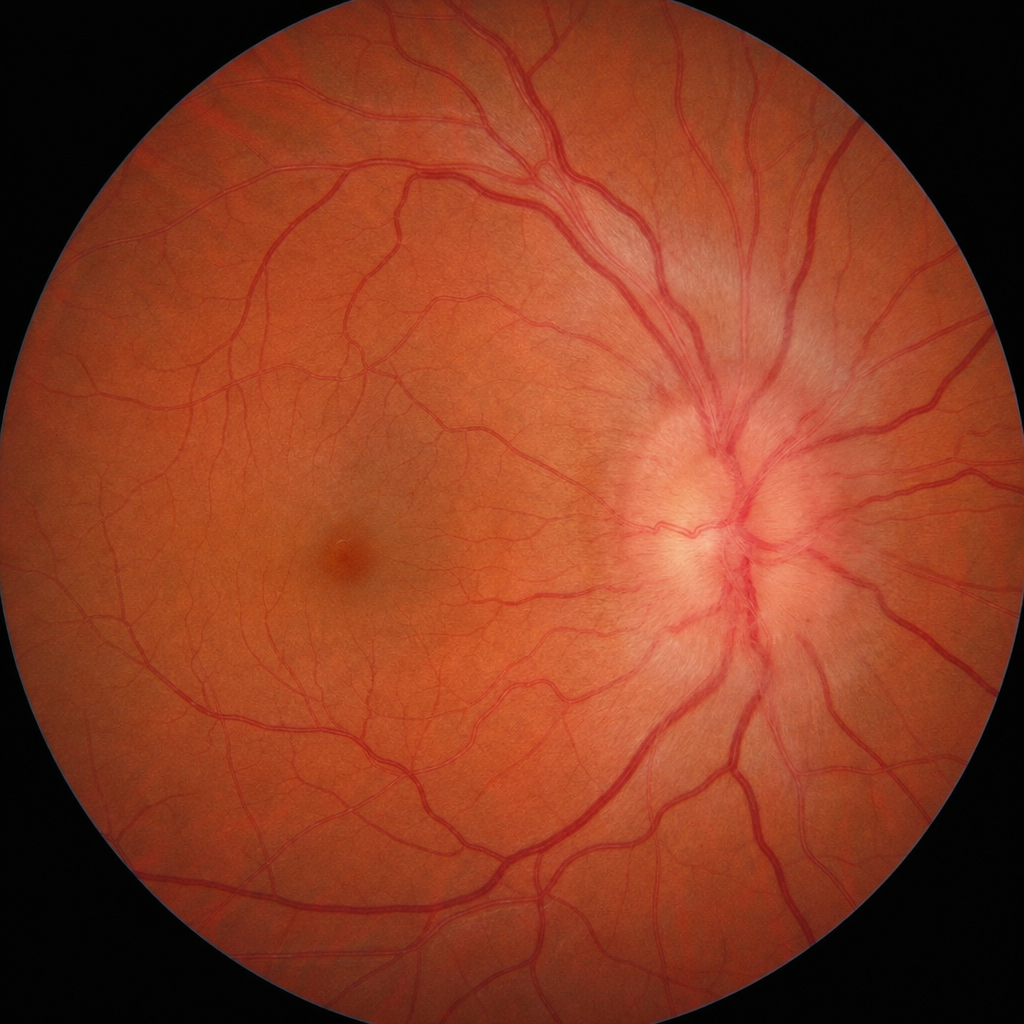
What is the 'angry sun' appearance in fundoscopy indicative of?
Explanation: **Explanation:** Horner’s syndrome is caused by a lesion in the **sympathetic pathway** supplying the eye and face. Since the sympathetic nervous system is responsible for pupillary dilation (via the dilator pupillae muscle), a lesion results in **miosis (constricted pupil)** due to the unopposed action of the parasympathetic-driven sphincter pupillae. Therefore, a **dilated pupil** is the correct answer as it is the opposite of what occurs in Horner’s syndrome. **Analysis of Options:** * **Ptosis:** Occurs due to paralysis of **Müller’s muscle** (superior tarsal muscle), which is sympathetically innervated. This results in a "partial ptosis" (1-2mm drop). * **Anhidrosis:** Loss of sweating occurs on the affected side of the face if the lesion is proximal to the carotid bifurcation (first or second-order neurons). * **Enophthalmos:** This is often an **apparent enophthalmos** caused by the narrowing of the palpebral fissure (due to upper lid ptosis and "upside-down ptosis" of the lower lid), making the eye look sunken. **High-Yield Clinical Pearls for NEET-PG:** 1. **The Triad:** Miosis, Partial Ptosis, and Anhidrosis. 2. **Cocaine Test:** In Horner’s, the pupil **fails to dilate** after cocaine drops (which block norepinephrine reuptake). 3. **Apraclonidine Test:** Causes **reversal of anisocoria** (dilation of the Horner’s pupil) due to denervation supersensitivity. 4. **Heterochromia Iridum:** If Horner’s is **congenital**, the affected eye may be lighter in color (hypochromia) because sympathetic stimulation is required for melanin production in melanocytes. 5. **Pancoast Tumor:** A common cause of preganglionic Horner’s syndrome involving the apex of the lung.
Explanation: **Explanation:** **Perimetry (Visual Field Testing)** is considered the best functional investigation for assessing optic nerve damage. The optic nerve is essentially a bundle of axons; when these fibers are damaged (due to glaucoma, optic neuritis, or compression), the primary clinical manifestation is a loss of sensitivity in specific areas of the visual field. Perimetry quantifies this functional loss, mapping out scotomas and field defects that correlate with the site of the lesion. **Analysis of Incorrect Options:** * **Ophthalmoscopy:** While it allows for structural visualization of the optic disc (e.g., cupping, pallor, or edema), it is subjective and cannot quantify the extent of functional vision loss. Early damage may exist even when the disc appears normal (e.g., retrobulbar neuritis). * **Fluorescence Angiography (FFA):** This is primarily used to evaluate retinal and choroidal vascularity. While it can show leakage in disc edema, it does not measure the health or conductive integrity of the optic nerve fibers. * **Ultrasound (B-Scan):** This is useful for detecting structural pathologies like optic nerve sheath thickening or tumors (especially when media is opaque), but it provides no information regarding the functional status of the nerve. **Clinical Pearls for NEET-PG:** * **Gold Standard for Structure:** While Perimetry is the best functional test, **OCT (Optical Coherence Tomography)** is the gold standard for structural quantification of the Retinal Nerve Fiber Layer (RNFL). * **Goldmann Perimetry** is preferred for neurological field defects, while **Humphrey Field Analyzer (HFA)** is the standard for glaucoma. * **VEP (Visual Evoked Potential):** If the question asks for the best investigation for *demyelinating* diseases (like Multiple Sclerosis), VEP is the answer as it measures conduction velocity (latency).
Explanation: **Explanation:** The **Marcus Gunn pupil** is the clinical hallmark of a **Relative Afferent Pupillary Defect (RAPD)**. It occurs due to a lesion in the afferent pathway (Optic nerve or extensive retinal disease), where the affected eye perceives less light than the normal eye. When light is shifted from the normal eye to the affected eye during the **Swinging Flashlight Test**, the brain perceives a decrease in light intensity. This results in reduced parasympathetic outflow, causing both pupils to appear to **dilate** instead of constrict when the light is shone into the diseased eye. **Analysis of Incorrect Options:** * **Argyll Robertson Pupil:** Characterized by "Light-Near Dissociation" (pupils constrict to accommodation but not to light). It is classically associated with neurosyphilis (lesion in the pretectal nucleus). * **Hutchinson’s Pupil:** A fixed, dilated pupil caused by compression of the third cranial nerve (oculomotor), typically due to uncal herniation or increased intracranial pressure. * **Adie’s Tonic Pupil:** A benign condition involving a post-ganglionic parasympathetic lesion (Ciliary ganglion). It presents as a unilaterally dilated pupil that reacts very slowly to light and near stimuli. **High-Yield Clinical Pearls for NEET-PG:** * **Most common cause of RAPD:** Optic neuritis (e.g., Multiple Sclerosis). * **Swinging Flashlight Test:** The gold standard clinical test to diagnose RAPD. * **Retinal causes:** RAPD only occurs in extensive retinal disease (e.g., Central Retinal Artery Occlusion or massive Retinal Detachment); small lesions do not cause RAPD. * **Important Note:** RAPD does **not** cause anisocoria (unequal pupil size) in a dark room; both pupils remain equal in size because the efferent pathway is intact.
Explanation: **Explanation:** **1. Why Congenital is Correct:** Ptosis (drooping of the upper eyelid) is most frequently encountered as a **congenital** condition. The underlying pathophysiology is typically **myogenic dysgenesis** of the Levator Palpebrae Superioris (LPS) muscle. In these cases, the muscle fibers are replaced by fibrous or fatty tissue, leading to poor contraction and inadequate relaxation (lid lag on downgaze). It is the most common cause overall in both pediatric populations and general clinical surveys. **2. Why Other Options are Incorrect:** * **Myasthenia Gravis:** This is a common cause of *acquired* myogenic ptosis characterized by fatigability and variability. While high-yield for exams, it is statistically less common than congenital cases. * **Paralysis of 3rd Nerve:** This causes neurogenic ptosis (often complete). While clinically dramatic and often associated with "Down and Out" eyeball deviation, it is an infrequent cause compared to developmental or age-related involutional ptosis. * **Idiopathic:** While some cases of ptosis lack a clear etiology, the majority can be classified into specific categories (Myogenic, Neurogenic, Aponeurotic, or Mechanical). "Congenital" is a more definitive and common classification. **Clinical Pearls for NEET-PG:** * **Most common cause of Acquired Ptosis:** Aponeurotic (Involutional/Senile) ptosis, caused by the disinsertion or stretching of the LPS aponeurosis. * **Marcus Gunn Jaw-Winking Phenomenon:** The most common type of congenital synkinetic ptosis (CN V3 misdirected to CN III). * **Surgical Management:** * If LPS action is **good (>8mm):** Fasanella-Servat procedure. * If LPS action is **fair (5-8mm):** Levator resection. * If LPS action is **poor (<4mm):** Frontalis Sling operation.
Explanation: ### Explanation **Amaurosis Fugax** (transient monocular blindness) is a sudden, temporary loss of vision in one eye, often described by patients as a "curtain falling" over their field of vision. **1. Why Option A is Correct:** Amaurosis fugax is most commonly caused by a **Transient Ischemic Attack (TIA)** involving the **carotid artery system**. The underlying mechanism is typically an **embolus** (often a Hollenhorst plaque consisting of cholesterol) originating from an atherosclerotic carotid artery. This embolus temporarily obstructs the **ophthalmic artery** or the **central retinal artery**, leading to transient retinal ischemia. Vision usually returns to normal within minutes once the embolus dissolves or moves distally. **2. Why the Other Options are Incorrect:** * **Tobacco and Alcohol (B & D):** While chronic use of these substances is associated with **Toxic Amblyopia** (nutritional optic neuropathy), they cause gradual, bilateral, and progressive vision loss rather than sudden, transient episodes. * **Optic Neuritis (C):** This presents with subacute, painful vision loss (associated with pain on eye movement) and is typically prolonged, not transient. It is a hallmark of Multiple Sclerosis. **3. Clinical Pearls for NEET-PG:** * **The "Curtain" Metaphor:** Always associate "painless, transient, curtain-like vision loss" with Amaurosis Fugax. * **Hollenhorst Plaques:** These are bright, refractile cholesterol crystals seen on fundoscopy at retinal artery bifurcations; they are a major diagnostic clue for carotid disease. * **Gold Standard Investigation:** Carotid Doppler/Duplex ultrasound is the initial investigation of choice to rule out carotid stenosis. * **Systemic Significance:** It is considered a "warning sign" for a future major stroke (CVA).
Explanation: **Explanation:** The **Marcus-Gunn pupil**, also known as a **Relative Afferent Pupillary Defect (RAPD)**, occurs when there is a significant lesion in the afferent pathway (Retina or Optic Nerve). In this condition, when light is swung from the normal eye to the affected eye (Swinging Flashlight Test), the affected pupil appears to **dilate** rather than constrict. This happens because the damaged eye perceives less light intensity than the healthy eye, leading to a reduction in the parasympathetic drive for constriction. **Why Retinal Detachment is Correct:** For a retinal lesion to cause an RAPD, it must be extensive. A **large/total Retinal Detachment (RD)** involves a massive loss of functioning photoreceptors, significantly impairing the afferent signal. This creates a "relative" defect compared to the healthy eye. **Why the other options are incorrect:** * **Retinitis Pigmentosa:** While it is a progressive retinal dystrophy, it is usually **bilateral and symmetrical**. RAPD is a "relative" test; if both eyes are equally affected, the pupillary response remains symmetrical. * **Diabetic & Hypertensive Retinopathy:** These are typically bilateral, chronic microvascular diseases. Unless there is a massive unilateral complication (like a major vitreous hemorrhage or secondary optic neuropathy), they do not typically produce a Marcus-Gunn pupil. **High-Yield Clinical Pearls for NEET-PG:** * **Most common cause of RAPD:** Optic nerve lesions (e.g., Optic Neuritis). * **Retinal causes:** Only extensive damage like Central Retinal Artery Occlusion (CRAO) or Total RD causes RAPD. * **Important:** Media opacities (Cataract, Corneal ulcer, Vitreous hemorrhage) **do not** cause RAPD because light still reaches the retina. * **The Test:** The "Swinging Flashlight Test" is the gold standard for diagnosis.
Explanation: ### Explanation The correct answer is **Parietal lobe**. This question tests the localization of visual pathway lesions based on associated neurological signs. #### 1. Why the Parietal Lobe is Correct A lesion in the parietal lobe involves the **optic radiations** (superior fibers), resulting in a **contralateral homonymous hemianopia** (classically denser inferiorly). * **Optokinetic Nystagmus (OKN):** The parietal lobe is the center for the "slow phase" of pursuit. A lesion here disrupts the smooth pursuit toward the side of the lesion, leading to a **defective OKN** (specifically, a decreased response when the drum is rotated toward the side of the lesion). * **Saccadic Pursuit:** Because smooth pursuit is impaired, the eyes use "catch-up" saccades to follow a moving object, resulting in jerky or **saccadic pursuit movements**. #### 2. Why Other Options are Incorrect * **Frontal Lobe:** This contains the Frontal Eye Fields (FEF), which control **saccades** to the opposite side. Lesions here cause a gaze deviation toward the side of the lesion but do not typically cause homonymous hemianopia. * **Occipital Lobe:** While this is the most common site for homonymous hemianopia (often macula-sparing), **OKN remains normal** because the parietal pursuit pathways are intact. * **Temporal Lobe:** Lesions here involve Meyer’s loop, causing a **"pie in the sky"** (superior quadrantanopia). OKN is typically normal in temporal lobe lesions. #### Clinical Pearls for NEET-PG * **Parietal Lesion:** "Pie on the floor" (Inferior quadrantanopia) + Abnormal OKN. * **Temporal Lesion:** "Pie in the sky" (Superior quadrantanopia) + Normal OKN. * **Cogan’s Rule:** An asymmetric OKN response in a patient with homonymous hemianopia strongly localizes the lesion to the **parietal lobe**. * **Macular Sparing:** Highly suggestive of a **vascular occipital lobe** lesion (due to dual blood supply from MCA and PCA).
Explanation: **Explanation:** The correct answer is **Myasthenia Gravis (MG)**. **1. Why Myasthenia Gravis is the correct answer:** Myasthenia Gravis is an autoimmune disorder caused by antibodies against the **nicotinic acetylcholine receptors (nAChR)** at the neuromuscular junction of **striated (skeletal) muscles**. The intraocular muscles (sphincter pupillae and ciliary muscle) are **smooth muscles** controlled by **muscarinic receptors**. Therefore, MG characteristically involves the levator palpebrae superioris (causing ptosis) and extraocular muscles (causing diplopia) but **never affects the pupil or accommodation.** **2. Analysis of Incorrect Options:** * **Riley-Day Syndrome (Familial Dysautonomia):** This is a multisystem autonomic neuropathy. It features a **parasympathetic denervation supersensitivity** of the pupil; patients typically show a constricted pupil that reacts excessively to dilute pilocarpine. * **Disseminated Sclerosis (Multiple Sclerosis):** MS frequently causes **Optic Neuritis**. This leads to an afferent pupillary conduction defect, clinically manifesting as a **Relative Afferent Pupillary Defect (RAPD)** or Marcus Gunn pupil. * **Horner’s Syndrome:** This is caused by a lesion in the sympathetic pathway. It directly involves the pupil, resulting in **miosis** (due to unopposed parasympathetic action) along with ptosis and anhidrosis. **Clinical Pearls for NEET-PG:** * **Rule of Thumb:** If a patient has ptosis and diplopia but the **pupil is normal**, think of **Myasthenia Gravis** or a **Pupil-sparing Third Nerve Palsy** (often diabetic/ischemic). * **Cogan’s Lid Twitch:** A classic sign of MG where the upper eyelid overshoots when the patient shifts gaze from down to primary position. * **Ice Pack Test:** A bedside test for MG; cold temperatures improve neuromuscular transmission, temporarily resolving ptosis.
Explanation: **Explanation:** The combination of **bilateral superior temporal quadrantopia** and **galactorrhea** points toward a lesion affecting the optic chiasm and the pituitary gland. 1. **Why Pituitary Macroadenoma is correct:** * **Visual Defect:** Pituitary tumors typically compress the optic chiasm from **below**. This initially affects the inferior nasal fibers (which subserve the superior temporal visual fields), leading to **Bitemporal Superior Quadrantopia**. As the tumor grows, it progresses to a full bitemporal hemianopia. * **Endocrine Sign:** A macroadenoma can cause galactorrhea either by being a **Prolactinoma** (secreting prolactin) or via the **"Stalk Effect"** (compressing the pituitary stalk, which prevents dopamine—the prolactin-inhibiting factor—from reaching the gland). 2. **Why other options are incorrect:** * **Craniopharyngioma:** These typically arise from Rathke’s pouch remnants *above* the chiasm. Therefore, they compress the chiasm from **above and behind**, leading to an **inferior** temporal quadrantopia. * **Sheehan’s Syndrome:** This is postpartum pituitary necrosis due to hemorrhage/hypotension. It leads to panhypopituitarism (failure of lactation), not galactorrhea, and does not typically cause chiasmal compression. * **Pituitary Hypophysitis:** An inflammation of the pituitary (often pregnancy-related). While it can cause mass effect, it is much less common than macroadenomas and usually presents with headache and systemic autoimmune features. **High-Yield Clinical Pearls for NEET-PG:** * **Superior Quadrantopia:** Think "Compression from Below" (Pituitary Macroadenoma). * **Inferior Quadrantopia:** Think "Compression from Above" (Craniopharyngioma). * **Bitemporal Hemianopia:** The hallmark of any central chiasmal lesion. * **Junctional Scotoma:** Indicates a lesion at the junction of the optic nerve and chiasm (involving Wilbrand’s knee).
Explanation: **Explanation:** The **'angry sun' appearance** is a classic descriptive term for the fundoscopic findings in **Papilledema** (specifically the established or acute stage). This appearance is caused by the combination of significant optic disc swelling, blurring of disc margins, and the radial arrangement of **peripapillary flame-shaped hemorrhages** and dilated capillaries. These features radiate outward from the disc, mimicking the rays of a "furious" or "angry" sun. **Analysis of Options:** * **Papilledema (Correct):** It refers to passive bilateral disc edema due to increased intracranial pressure (ICP). Key features include loss of venous pulsations, Paton’s folds, and the 'angry sun' appearance due to vascular congestion and hemorrhages. * **Primary Optic Atrophy:** Characterized by a **chalky white disc** with well-defined margins and reduced vascularity. It is the polar opposite of the hyperemic, blurred appearance of the 'angry sun.' * **Papillitis:** This is inflammatory disc edema (Optic Neuritis). While the disc is hyperemic, it is typically unilateral and associated with a profound **sudden loss of vision** and an afferent pupillary defect (RAPD), unlike early papilledema where vision is preserved. * **Drusen’s Rings:** These are hyaline bodies in the optic nerve head that cause "pseudopapilledema." They give the disc a scalloped, "lumpy-bumpy" appearance but lack the hemorrhages and vascular congestion seen in the 'angry sun' sign. **NEET-PG High-Yield Pearls:** * **Foster-Kennedy Syndrome:** Optic atrophy in one eye (due to direct compression) and papilledema in the other (due to raised ICP), typically seen in olfactory groove meningiomas. * **Paton’s Folds:** Retinal circumferential lines/folds seen in papilledema. * **Early Sign:** Loss of spontaneous venous pulsations (SVP) is one of the earliest signs of raised ICP.
Anatomy of Visual Pathways
Practice Questions
Pupillary Disorders
Practice Questions
Optic Neuritis
Practice Questions
Ischemic Optic Neuropathies
Practice Questions
Other Optic Neuropathies
Practice Questions
Papilledema
Practice Questions
Cranial Nerve Palsies
Practice Questions
Nystagmus
Practice Questions
Visual Field Defects
Practice Questions
Neuro-ophthalmic Manifestations of Intracranial Lesions
Practice Questions
Functional Visual Disorders
Practice Questions
Migraine and the Eye
Practice Questions
Get full access to all questions, explanations, and performance tracking.
Start For Free