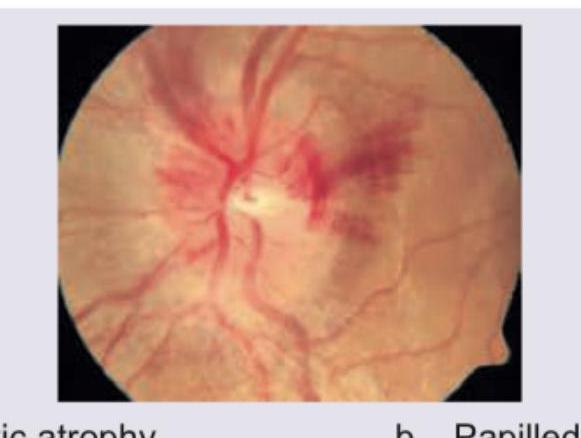
Typical field defect observed in anterior ischemic optic neuropathy is?
Which of the following is NOT a characteristic of diabetic third nerve palsy?
Incongruous homonymous hemianopia is caused by a lesion in which of the following?
Which of the following statements about Leber's hereditary optic neuropathy is FALSE?
Bergmeister papilla are present on which anatomical structure?
Foster Kennedy syndrome is associated with all of the following, except:
The shown procedure is helpful in diagnosing which condition?

Disc edema is not seen in which of the following conditions?
A patient presents with normal eyesight and absence of direct and consensual light reflexes. Which of the following cranial nerves is suspected to be lesioned?
What is the most common cause of optic neuritis?
Explanation: **Explanation:** **Anterior Ischemic Optic Neuropathy (AION)** occurs due to occlusion of the **short posterior ciliary arteries**, which supply the optic nerve head. The vascular supply of the optic disc is divided into superior and inferior halves. Because of this segmental distribution, ischemia typically affects one half of the disc, leading to the characteristic **Altitudinal Hemianopia** (a defect that respects the horizontal midline). Inferior altitudinal defects are more common than superior ones. **Analysis of Incorrect Options:** * **A. Homonymous hemianopia:** This occurs in lesions **posterior to the optic chiasm** (optic tract, lateral geniculate body, or optic radiations). It respects the vertical midline, not the horizontal. * **B. Baring of the blind spot:** This is a non-specific sign formerly associated with **early glaucoma**, where the physiological blind spot appears excluded from the central field. * **C. Paracentral scotoma:** These are small islands of vision loss near the point of fixation, commonly seen in **early glaucoma** or certain maculopathies. **High-Yield Clinical Pearls for NEET-PG:** * **Types of AION:** 1. **Non-Arteritic (NA-AION):** Most common; associated with hypertension, diabetes, and a "disc-at-risk" (small cup-to-disc ratio). 2. **Arteritic (A-AION):** Associated with **Giant Cell Arteritis (GCA)**. It is a medical emergency requiring high-dose steroids to prevent bilateral blindness. * **Classic Presentation:** Sudden, painless monocular vision loss with an **Afferent Pupillary Defect (RAPD)** and a swollen, pale optic disc ("chalky white" in arteritic cases). * **Key Distinction:** While AION causes altitudinal defects, **Optic Neuritis** typically presents with a **central or centrocecal scotoma**.
Explanation: In diabetic third nerve palsy, the underlying pathology is **microvascular ischemia** (vasa nervorum infarction). This leads to axonal damage but leaves the surrounding connective tissue sheath intact. **Why "Aberrant Regeneration" is the correct answer:** Aberrant regeneration (synkinesis) occurs when regenerating nerve fibers are misdirected into the wrong muscle sheaths (e.g., fibers meant for the superior rectus reaching the levator palpebrae). This phenomenon is **only seen in compressive or traumatic lesions** where the nerve sheath is disrupted. In diabetic (ischemic) palsy, the endoneurial sheath remains intact, acting as a guide for correct regrowth; therefore, aberrant regeneration does **not** occur. **Explanation of other options:** * **Presence of pain (A):** Contrary to popular belief, about 50-80% of diabetic 3rd nerve palsies are associated with periorbital pain, likely due to irritation of trigeminal pain fibers within the cavernous sinus. * **Normal pupillary function (B):** This is the hallmark of "Medical 3rd nerve palsy." Parasympathetic pupilloconstrictor fibers are located peripherally on the nerve. In ischemia, the central core is affected, sparing the superficial pupillary fibers. (In contrast, surgical compression by an Aneurysm usually involves the pupil). * **Spontaneous recovery (C):** Most ischemic palsies resolve completely within 3 to 6 months as the nerve remyelinates. **High-Yield Clinical Pearls for NEET-PG:** * **Rule of the Pupil:** If the pupil is spared, think Medical (Diabetes/HTN). If the pupil is involved (dilated/fixed), think Surgical (Post. Communicating Artery Aneurysm). * **Most common cause** of isolated 3rd nerve palsy in adults is Diabetes Mellitus. * **Nerve involved:** The oculomotor nerve (CN III) is most commonly affected in diabetic mononeuropathy.
Explanation: **Explanation:** The key to solving visual field defects lies in understanding the anatomical symmetry of the visual pathways. **1. Why Optic Tract is Correct:** A **homonymous hemianopia** occurs when there is a lesion posterior to the optic chiasm. The term **"incongruous"** refers to a visual field defect that is significantly different in shape, size, or intensity between the two eyes. * In the **optic tract**, the nerve fibers from the two eyes (ipsilateral temporal and contralateral nasal) are not yet closely "aligned" or packed together according to their corresponding retinal points. * Therefore, a lesion here affects these fibers unequally, resulting in a highly **incongruous** defect. As we move more posteriorly toward the occipital cortex, the fibers become more tightly organized, and the defects become increasingly **congruous** (symmetrical). **2. Why Other Options are Incorrect:** * **Optic Chiasma:** Lesions here typically cause **bitemporal hemianopia** (heteronymous) because they affect the decussating nasal fibers. * **Optic Nerve:** Lesions here result in **ipsilateral monocular vision loss** or a central scotoma, not a hemianopia. * **Optic Radiation:** Lesions in the radiations (or the occipital cortex) produce **congruous** homonymous hemianopia because the fibers from corresponding retinal points are anatomically closer together. **High-Yield Clinical Pearls for NEET-PG:** * **Wernicke’s Hemianopic Pupil:** Seen in optic tract lesions. Light shined on the non-functioning half of the retina produces no pupillary response. * **Bow-tie Atrophy:** Optic tract lesions lead to primary optic atrophy; specifically, "bow-tie" atrophy in the contralateral eye. * **Rule of Thumb:** The more posterior the lesion (e.g., Occipital Lobe), the more **congruous** the defect. Occipital lesions are also associated with **macular sparing**.
Explanation: **Explanation:** Leber’s Hereditary Optic Neuropathy (LHON) is a classic example of **Mitochondrial Inheritance** (maternal inheritance), not X-linked recessive inheritance. This is why Option B is the false statement. In mitochondrial disorders, the mutation is located in the mitochondrial DNA (mtDNA); therefore, it is transmitted only by females to all their children, but affected males cannot pass the trait to their offspring. **Analysis of other options:** * **Option A (Male predominance):** Despite being maternally inherited, LHON shows a striking male predilection (approx. 80-90% of clinically affected individuals are male). The exact reason is unclear but may involve hormonal factors or a nuclear modifier gene. * **Option C (Profound vision loss):** LHON typically presents as a painless, subacute, bilateral (sequential) central vision loss leading to dense central or centrocecal scotomas and optic atrophy. * **Option D (Cardiac preexcitation):** LHON is occasionally associated with minor neurological abnormalities and cardiac conduction defects, specifically **Wolff-Parkinson-White (WPW)** and Lown-Ganong-Levine syndromes. **High-Yield Clinical Pearls for NEET-PG:** * **Triad of Acute LHON:** Circumpapillary telangiectatic microangiopathy, swelling of the nerve fiber layer (pseudo-edema), and absence of leakage on Fluorescein Angiography (FFA). * **Common Mutations:** 11778 (most common, worst prognosis), 3460, and 14484 (best prognosis for recovery). * **Risk Factors:** Smoking and alcohol consumption can trigger or worsen vision loss in carriers.
Explanation: **Explanation:** **Bergmeister’s papilla** is a benign congenital remnant of the **hyaloid artery** system. During fetal development, the hyaloid artery provides nourishment to the developing lens. It is enclosed in a sheath of glial tissue called the fibrous sheath of the hyaloid artery. Normally, this system regresses completely by the seventh month of gestation. When the posterior portion of this glial sheath fails to regress fully, it persists as a small tuft of fibrous or glial tissue arising from the center of the **optic disc**. **Analysis of Options:** * **Option B (Correct):** Bergmeister’s papilla is specifically located at the optic disc (nerve head). It often appears as a small, white, elevated tuft of tissue, usually on the nasal side of the disc, and typically does not affect vision. * **Option A:** The anterior corneal surface is not involved in the hyaloid system. * **Option C & D:** While the hyaloid artery extends from the disc to the lens, a remnant on the **posterior lens surface** is known as a **Mittendorf dot**, not Bergmeister’s papilla. The anterior lens surface is unrelated to this vascular regression. **High-Yield Clinical Pearls for NEET-PG:** * **Mittendorf Dot:** A small, circular opacity on the posterior lens capsule (nasal to the center) representing the anterior attachment of the hyaloid artery. * **Persistent Fetal Vasculature (PFV):** A condition where the primary vitreous fails to regress, potentially leading to leukocoria, microphthalmos, and tractional retinal detachment. * **Cloquet’s Canal:** The empty space/channel in the vitreous where the hyaloid artery once resided.
Explanation: ### Explanation **Foster Kennedy Syndrome** is a classic neuro-ophthalmological triad caused by a space-occupying lesion (SOL), most commonly an **Olfactory groove meningioma**, frontal lobe tumor, or sphenoid wing meningioma. #### Why "Contralateral Optic Atrophy" is the Correct Answer: In Foster Kennedy Syndrome, the optic atrophy occurs **ipsilateral** (on the same side) to the lesion, not contralateral. The tumor exerts direct mechanical pressure on the optic nerve, leading to compressive atrophy. Therefore, "Contralateral Optic Atrophy" is the false statement. #### Analysis of Other Options: * **A. Ipsilateral Anosmia:** The tumor (e.g., olfactory groove meningioma) compresses the olfactory bulb/tract on the same side, leading to a loss of smell. * **C. Olfactory groove meningioma:** This is the most common cause of this syndrome. * **D. Contralateral Papilloedema:** As the tumor grows, it increases intracranial pressure (ICP). Since the ipsilateral optic nerve is already atrophied (dead fibers cannot swell), the increased ICP manifests as papilledema only in the healthy **contralateral** eye. #### Clinical Pearls for NEET-PG: 1. **The Triad:** 1) Ipsilateral optic atrophy, 2) Contralateral papilledema, 3) Ipsilateral anosmia. 2. **Pseudo-Foster Kennedy Syndrome:** This presents with similar fundus findings (atrophy in one eye, edema in the other) but is caused by sequential **Non-Arteritic Ischemic Optic Neuropathy (NAION)**, not a tumor. It lacks anosmia and features of raised ICP. 3. **Key Localization:** Frontal lobe/Anterior cranial fossa. 4. **Memory Aid:** The side with the **T**umor has the **T**otal loss of vision (Atrophy) and **T**otal loss of smell (Anosmia).
Explanation: ***Marcus Gunn pupil*** - The **swinging flashlight test** detects **relative afferent pupillary defect (RAPD)** by alternating light between eyes to identify asymmetric pupillary responses. - Marcus Gunn pupil shows **paradoxical dilation** when light swings to the affected eye due to **optic nerve dysfunction**. *Adie's pupil* - Characterized by a **dilated pupil** with **slow constriction** to light and **better response to accommodation** than light. - The swinging flashlight test does not assess **accommodation reflexes** or detect the **tonic pupillary responses** typical of Adie's pupil. *Horner's pupil* - Features **miosis**, **ptosis**, and **anhidrosis** due to **sympathetic nerve pathway disruption**. - The swinging flashlight test evaluates **parasympathetic pathways** and **optic nerve function**, not sympathetic denervation. *Pinpoint pupil* - Results from **opioid intoxication** or **pontine lesions** causing **bilateral miosis** with preserved light reflexes. - The swinging flashlight test cannot differentiate **bilateral symmetric** pupillary abnormalities or assess **drug-induced miosis**.
Explanation: **Explanation:** The presence or absence of disc edema in optic neuritis depends entirely on the **location** of the inflammation relative to the optic nerve head. **1. Why Retrobulbar Neuritis is the correct answer:** In retrobulbar neuritis, the inflammation occurs in the posterior part of the optic nerve, well behind the eyeball (the lamina cribrosa). Because the inflammation is distant from the optic disc, the fundus appears **completely normal** during the acute phase. This leads to the classic clinical adage: *"The patient sees nothing (due to vision loss), and the doctor sees nothing (due to a normal fundus)."* **2. Why the other options are incorrect:** * **Papillitis:** This is a form of optic neuritis where the inflammation involves the optic disc itself. Therefore, hyperaemia and edema of the disc are primary clinical findings. * **Papilledema:** By definition, this is passive bilateral disc edema resulting from increased intracranial pressure (ICP). * **Optic Nerve Glioma:** This tumor can cause disc edema either by direct compression/infiltration of the nerve head or by obstructing venous drainage (pre-septal location). **Clinical Pearls for NEET-PG:** * **Retrobulbar Neuritis** is most commonly associated with **Multiple Sclerosis (MS)** in adults. * **Marcus Gunn Pupil (RAPD)** is the most important objective sign in all forms of optic neuritis, including retrobulbar neuritis, even when the disc looks normal. * **Visual Field Defect:** The most common defect in optic neuritis is a **central or centrocecal scotoma**. * **Pulfrich Phenomenon:** A classic high-yield symptom where objects moving in a straight line appear to move in an elliptical orbit due to delayed conduction in the affected nerve.
Explanation: ### Explanation The light reflex pathway involves two main limbs: the **Afferent limb** (Optic nerve, CN II) and the **Efferent limb** (Oculomotor nerve, CN III). **Why Oculomotor Nerve is the Correct Answer:** The question states the patient has **normal eyesight**, which confirms that the afferent limb (Optic nerve) and the visual cortex are intact. However, both the **direct and consensual light reflexes are absent**. For this to occur despite a functional optic nerve, the lesion must lie in the efferent pathway. The Oculomotor nerve carries parasympathetic fibers from the Edinger-Westphal nucleus to the ciliary ganglion and then to the sphincter pupillae muscle. A lesion here prevents the pupil from constricting, regardless of which eye is stimulated by light. **Analysis of Incorrect Options:** * **Optic Nerve (CN II):** If the optic nerve were lesioned, the patient would have impaired vision (decreased visual acuity) and an **Afferent Pupillary Defect (RAPD)**. In a unilateral CN II lesion, the direct reflex is lost in the affected eye, but the *consensual* reflex remains intact when the normal eye is stimulated. * **Trochlear (CN IV) & Abducent (CN VI):** These are purely motor nerves supplying the Superior Oblique and Lateral Rectus muscles, respectively. They have no role in the pupillary light reflex pathway. **Clinical Pearls for NEET-PG:** * **Light-Near Dissociation:** Seen in Adie’s Tonic Pupil and Argyll Robertson Pupil (ARP). Remember the mnemonic for ARP: **A**ccommodation **R**eflex **P**resent, **P**upillary **R**eflex **A**bsent. * **Wernicke’s Hemianopic Pupil:** Light reflex is absent when light is shown on the blind side of the retina in cases of optic tract lesions. * **Edinger-Westphal Nucleus:** The subnucleus of CN III responsible for parasympathetic supply to the eye.
Explanation: **Explanation:** **Optic Neuritis (ON)** is an inflammatory, demyelinating condition of the optic nerve. **Multiple Sclerosis (MS)** is the most common cause of optic neuritis, particularly in young adults (20–40 years). In many cases, optic neuritis is the first clinical manifestation of MS. The underlying mechanism involves an autoimmune-mediated attack on the myelin sheath of the optic nerve, leading to sudden, unilateral vision loss and pain with eye movements. **Analysis of Incorrect Options:** * **A. Ethyl alcohol:** This is associated with **Toxic Optic Neuropathy** (specifically tobacco-alcohol amblyopia). It typically presents with bilateral, painless, progressive vision loss and centrocecal scotomas, rather than acute inflammatory neuritis. * **B. Anterior Ischemic Optic Neuropathy (AION):** This is caused by vascular insufficiency to the optic nerve head (e.g., giant cell arteritis or atherosclerosis). It presents with sudden painless vision loss in older patients, often with altitudinal field defects. * **C. Leber’s Hereditary Optic Neuropathy (LHON):** This is a mitochondrial genetic disorder. It causes sequential, painless, profound central vision loss, typically in young males, and is not an inflammatory "neuritis." **Clinical Pearls for NEET-PG:** * **Classic Triad:** Sudden unilateral vision loss, periocular pain (worse with movement), and a Relative Afferent Pupillary Defect (RAPD). * **Pulfrich Phenomenon:** Objects moving in a straight line appear to move in ellipses due to delayed conduction in the affected nerve. * **Uhthoff’s Phenomenon:** Temporary worsening of vision when body temperature rises (e.g., after exercise or a hot bath). * **MRI Brain:** The most important prognostic tool to determine the future risk of developing MS.
Anatomy of Visual Pathways
Practice Questions
Pupillary Disorders
Practice Questions
Optic Neuritis
Practice Questions
Ischemic Optic Neuropathies
Practice Questions
Other Optic Neuropathies
Practice Questions
Papilledema
Practice Questions
Cranial Nerve Palsies
Practice Questions
Nystagmus
Practice Questions
Visual Field Defects
Practice Questions
Neuro-ophthalmic Manifestations of Intracranial Lesions
Practice Questions
Functional Visual Disorders
Practice Questions
Migraine and the Eye
Practice Questions
Get full access to all questions, explanations, and performance tracking.
Start For Free