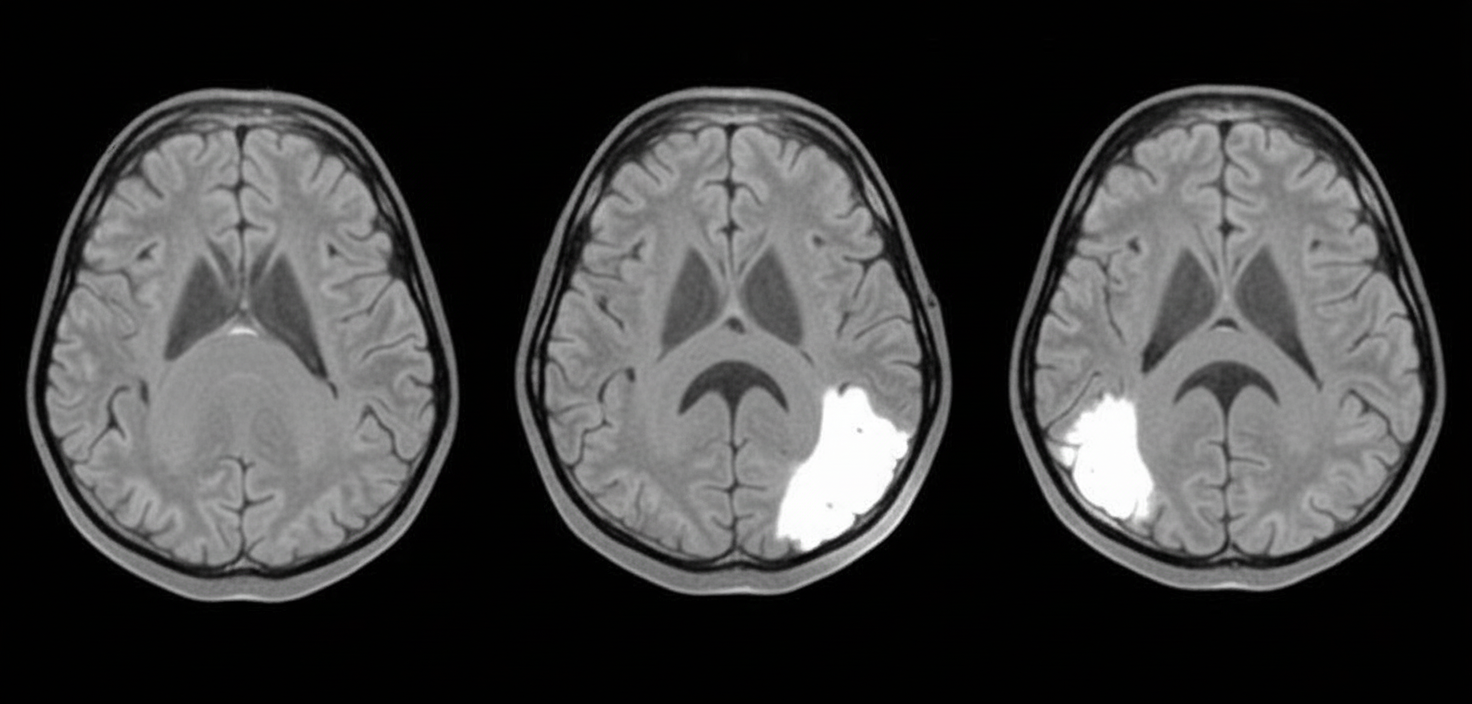
When a flashlight is moved from a normal eye to an abnormal eye, the affected pupil dilates. What is the MOST likely diagnosis?
Bitemporal hemianopia is characteristically produced by a lesion of which of the following structures?
Which of the following is the drug of choice for optic neuritis?
Headache with bitemporal hemianopia and 6/6 vision is seen in which of the following conditions?
Which cranial nerve is completely paralyzed in the case of ptosis?
What is the initial bedside investigation for papilledema?
Which of the following is NOT a feature of optic neuritis?
What is the normal value of the Arden index?
What is the commonest cause of vision loss in Neurofibromatosis type 1?
Crocodile tears are seen in which of the following conditions?
Explanation: ### Explanation The clinical scenario describes a positive **Swinging Flashlight Test**, which is the hallmark of a **Relative Afferent Pupillary Defect (RAPD)**, also known as a **Marcus Gunn pupil**. #### Why Option B is Correct In a Marcus Gunn pupil, there is a lesion in the afferent pathway (usually the optic nerve or extensive retinal disease). When light is shone into the normal eye, both pupils constrict (normal direct and consensual reflex). However, when the light is quickly moved to the affected eye, the brain perceives a weaker light stimulus compared to the normal eye. This results in a reduction of the efferent parasympathetic drive, causing both pupils to **paradoxically dilate** instead of constrict. #### Why Other Options are Incorrect * **A. Amaurotic Pupil:** This occurs in a completely blind eye (total optic nerve lesion). There is no direct light reflex in the affected eye and no consensual reflex in the normal eye. It does not "dilate" upon swinging the light; it simply fails to respond. * **C. Hutchinson’s Pupil:** This is seen in cases of increased intracranial pressure (e.g., uncal herniation). The pupil is fixed and widely dilated due to compression of the third cranial nerve (efferent pathway), not an afferent defect. * **D. Argyll Robertson Pupil:** Characterized by "Light-Near Dissociation" (pupils react to accommodation but not to light). It is typically bilateral, small, and irregular, often associated with neurosyphilis. #### NEET-PG High-Yield Pearls * **Most common cause of RAPD:** Optic neuritis (e.g., Multiple Sclerosis). * **Other causes:** Ischemic optic neuropathy, asymmetric glaucoma, or massive retinal detachment. * **Note:** Dense cataracts or vitreous hemorrhage do **not** cause an RAPD because enough light still reaches the retina to trigger the reflex. * **Pathway:** The afferent limb of the pupillary light reflex is the **Optic Nerve (CN II)**; the efferent limb is the **Oculomotor Nerve (CN III)**.
Explanation: ***Central chiasma*** - Lesions of the **central chiasma** damage the **crossing nasal fibers** from both eyes, resulting in loss of temporal visual fields bilaterally (bitemporal hemianopia). - Classic cause is **pituitary adenoma** compressing the chiasm from below, affecting the decussating fibers that carry information from the nasal retina. *Optic nerve* - Optic nerve lesions cause **monocular visual loss** or **monocular visual field defects** in the affected eye only. - Cannot produce bitemporal hemianopia as it affects only **one eye's visual pathway** before the chiasm. *Lateral chiasma* - Lateral chiasma lesions affect **non-crossing temporal fibers**, causing **nasal hemianopia** on the same side. - May also produce **junctional scotoma** affecting the ipsilateral eye and contralateral superior temporal quadrant. *Lateral geniculate body (LGB)* - LGB lesions cause **contralateral homonymous hemianopia** affecting the same visual field in both eyes. - Located **posterior to the chiasm**, so visual field defects are homonymous rather than heteronymous like bitemporal hemianopia.
Explanation: The management of optic neuritis is primarily guided by the landmark **Optic Neuritis Treatment Trial (ONTT)**. ### **Why Intravenous Steroids are the Correct Choice** The drug of choice is **Intravenous Methylprednisolone (IVMP)**, typically administered at a dose of 1g/day for 3 days, followed by an oral prednisolone taper (1mg/kg/day) for 11 days. * **Mechanism:** High-dose IV steroids reduce inflammation and stabilize the blood-brain barrier. * **Clinical Benefit:** While steroids do not change the ultimate long-term visual outcome (visual acuity at 1 year), they **accelerate the rate of visual recovery** and significantly **delay the progression to Multiple Sclerosis (MS)** for the first two years. ### **Why Other Options are Incorrect** * **A. Oral Steroids:** The ONTT study revealed that **oral steroids alone (low dose) are contraindicated** because they were found to double the rate of recurrence of optic neuritis compared to placebo or IV steroids. * **C. Topical Steroids:** These are ineffective as they cannot penetrate the posterior segment or the retrobulbar space to reach the optic nerve. * **D. Immunosuppressants:** These are not first-line for acute optic neuritis. They are reserved for steroid-resistant cases or specific etiologies like Neuromyelitis Optica (NMO). ### **High-Yield Clinical Pearls for NEET-PG** * **Classic Presentation:** Sudden unilateral vision loss, periocular pain (worsened by eye movement), and a **Relative Afferent Pupillary Defect (RAPD)**. * **Uhthoff’s Phenomenon:** Temporary worsening of vision with increased body temperature (e.g., exercise or hot showers). * **Pulfrich Phenomenon:** Perception of an object moving in a straight line as moving in an elliptical path. * **MRI Brain:** The most important predictor for the future risk of developing Multiple Sclerosis.
Explanation: **Explanation:** The clinical presentation of **bitemporal hemianopia** is the hallmark sign of a **chiasmal lesion**. 1. **Why Chiasmal Lesion is correct:** The optic chiasm is the site where nasal retinal fibers (responsible for the temporal visual fields) decussate. A compressive lesion at the center of the chiasm—most commonly a **Pituitary Adenoma**—interrupts these crossing fibers, resulting in a loss of both temporal fields (bitemporal hemianopia). Because the macula is often spared or the compression is extrinsic, central visual acuity can remain **6/6** until late stages. Headache is a common symptom due to stretching of the dura mater (diaphragma sellae). 2. **Why other options are incorrect:** * **Optic Neuritis:** Typically presents with sudden, painful, unilateral vision loss and a **central scotoma**, not hemianopia. * **Trauma:** While trauma can cause various field defects, it rarely presents as an isolated, clean bitemporal hemianopia with preserved 6/6 vision unless there is a specific sagittal fracture of the chiasm. * **Bilateral Cavernous Sinus Lesion:** This would primarily manifest as **multiple cranial nerve palsies** (III, IV, V1, V2, VI) leading to ophthalmoplegia and ptosis, rather than a specific chiasmal field defect. **High-Yield Clinical Pearls for NEET-PG:** * **Most common cause:** Pituitary Adenoma (compresses chiasm from below → superior bitemporal quadrantanopia). * **Craniopharyngioma:** Compresses chiasm from above → inferior bitemporal quadrantanopia. * **Foster Kennedy Syndrome:** Frontal lobe tumor causing ipsilateral optic atrophy and contralateral papilledema. * **Wernicke’s Hemianopic Pupil:** Seen in tract lesions, not chiasmal lesions.
Explanation: **Explanation:** **1. Why the 3rd Cranial Nerve (Oculomotor) is correct:** Ptosis (drooping of the upper eyelid) occurs due to the paralysis of the **Levator Palpebrae Superioris (LPS)** muscle. The LPS is the primary elevator of the eyelid and is exclusively innervated by the **3rd cranial nerve**. In a complete 3rd nerve palsy, the LPS is totally paralyzed, leading to severe or complete ptosis. Additionally, the 3rd nerve supplies the superior, inferior, and medial recti, and the inferior oblique; thus, a complete palsy typically presents with the eye positioned **"Down and Out."** **2. Why the other options are incorrect:** * **4th Cranial Nerve (Trochlear):** Supplies the Superior Oblique muscle. Palsy leads to vertical diplopia and head tilting, but it has no role in eyelid elevation. * **5th Cranial Nerve (Trigeminal):** This is a sensory nerve for the eye (Ophthalmic division - V1) and motor for muscles of mastication. It does not innervate any extraocular or eyelid muscles. * **6th Cranial Nerve (Abducens):** Supplies the Lateral Rectus muscle. Palsy leads to convergent squint (esotropia) and inability to abduct the eye, but does not cause ptosis. **3. Clinical Pearls for NEET-PG:** * **LPS vs. Mueller’s Muscle:** While the 3rd nerve supplies the LPS (major elevator), the sympathetic system supplies **Mueller’s muscle** (minor elevator). Paralysis of Mueller’s muscle (as seen in **Horner’s Syndrome**) causes only *mild* ptosis (1-2mm). * **Pupil Involvement:** In 3rd nerve palsy, a **dilated pupil** suggests external compression (e.g., PCom artery aneurysm), while **pupillary sparing** often suggests a medical cause like Diabetes Mellitus (microvascular ischemia). * **Pseudo-ptosis:** Can be seen in 6th nerve palsy due to the globe being slightly retracted or in cases of enophthalmos.
Explanation: **Explanation:** **Papilledema** is defined as bilateral swelling of the optic disc secondary to raised intracranial pressure (ICP). 1. **Why Fundoscopy is correct:** Fundoscopy is the **initial bedside investigation** because it allows for direct visualization of the optic disc. Early signs of papilledema detectable via fundoscopy include blurring of the disc margins (starting nasally), loss of spontaneous venous pulsations (SVP), and hyperemia of the disc. It is the quickest, non-invasive way to confirm the presence of disc edema before proceeding to neuroimaging. 2. **Why other options are incorrect:** * **CT Scan:** While a CT or MRI is the *next* step to rule out space-occupying lesions (SOL) once papilledema is confirmed, it is not the "initial bedside" tool for diagnosis. * **Retinoscopy:** This is a procedure used to determine the refractive error of the eye; it does not visualize the optic nerve head or disc morphology. * **Fluorescein Angiography (FA):** FA is a specialized investigation used to differentiate true papilledema from "pseudopapilledema" (e.g., optic disc drusen). It shows characteristic "leakage" of dye, but it is not a bedside test. **High-Yield Clinical Pearls for NEET-PG:** * **Earliest Sign:** Blurring of the nasal disc margins and loss of Spontaneous Venous Pulsations (SVP). Note: 20% of normal individuals lack SVP. * **Paton’s Lines:** Circumferential retinal folds seen in chronic papilledema. * **Foster Kennedy Syndrome:** Ipsilateral optic atrophy (due to direct tumor compression) and contralateral papilledema (due to raised ICP), typically seen in olfactory groove meningiomas. * **Contraindication:** Lumbar puncture should **never** be performed before neuroimaging in suspected papilledema to avoid brain herniation.
Explanation: **Explanation:** Optic neuritis is an inflammatory, demyelinating condition of the optic nerve, most commonly associated with Multiple Sclerosis. The correct answer is **D (Large cup of optic nerve head)** because a large cup-to-disc ratio is a hallmark of **Glaucoma**, not optic neuritis. In optic neuritis, the optic disc may appear normal (Retrobulbar neuritis) or swollen (Papillitis), but it does not typically show glaucomatous cupping. **Analysis of Options:** * **Marcus Gunn Pupil (Relative Afferent Pupillary Defect - RAPD):** This is the most important clinical sign of unilateral optic nerve disease. When light is swung from the normal to the affected eye, the pupil appears to dilate because the damaged nerve cannot conduct the light stimulus effectively. * **Reduced Color Vision (Dyschromatopsia):** Impairment of color vision (specifically red-green) is often the first sign of optic neuritis and is frequently more severe than the loss of visual acuity. * **Central Scotoma:** The most common visual field defect in optic neuritis is a central or centrocecal scotoma, reflecting damage to the highly metabolic papillomacular bundle. **High-Yield Clinical Pearls for NEET-PG:** * **Pulfrich Phenomenon:** Objects moving in a straight line appear to move in an elliptical path (due to delayed conduction). * **Uhtoff’s Phenomenon:** Temporary worsening of symptoms with increased body temperature (e.g., after a hot bath or exercise). * **Treatment:** The **ONTT (Optic Neuritis Treatment Trial)** recommends IV Methylprednisolone followed by oral steroids. Note: Oral steroids alone are contraindicated as they increase the rate of recurrence.
Explanation: ### Explanation The **Arden Index** (or Arden Ratio) is a quantitative measure derived from the **Electro-oculogram (EOG)**. The EOG measures the standing potential between the cornea (positive) and the retina (negative). This potential is primarily generated by the **Retinal Pigment Epithelium (RPE)** in response to light. **1. Why the Correct Answer is Right:** The Arden Index is calculated as the ratio of the **Light Peak** (maximum potential in light) to the **Dark Trough** (minimum potential in the dark). * **Formula:** (Light Peak / Dark Trough) × 100. * In a healthy eye, the potential should significantly increase when exposed to light. A **normal value is >185%** (or >1.85). Values between 165% and 185% are considered borderline, and values **below 165% are subnormal**. **2. Why the Other Options are Wrong:** * **Options A & B (1 and 1.5):** These values represent a significantly depressed RPE response. A ratio of 1.0 means there was no "light rise" at all, indicating severe RPE dysfunction. * **Option C (Less than 185%):** This range includes subnormal and pathological values. An Arden index below 165% is a hallmark of specific retinal dystrophies. **3. Clinical Pearls for NEET-PG:** * **Best Diagnostic Use:** The EOG is the gold standard for diagnosing **Best’s Vitelliform Macular Dystrophy**. In Best’s disease, the EOG is **abnormal (low Arden index)** even when the Electro-retinogram (ERG) is normal. * **RPE Integrity:** Since the EOG depends on the contact between photoreceptors and the RPE, it is also abnormal in conditions like extensive retinal detachment and Vitamin A deficiency. * **Mnemonic:** "Best's is the Best test for EOG" (though ironically, the EOG result is "bad" in this disease).
Explanation: **Explanation:** **Optic Nerve Glioma (Option D)** is the correct answer because it is the most common primary visual pathway tumor associated with Neurofibromatosis type 1 (NF1). Approximately 15–20% of children with NF1 develop these low-grade pilocytic astrocytomas. While many are asymptomatic, they are the leading cause of progressive vision loss, proptosis, and optic atrophy in this population. **Analysis of Incorrect Options:** * **Lisch Nodules (Option A):** These are melanocytic hamartomas of the iris. While they are the most common *ocular finding* in NF1 (present in >90% of adults), they are asymptomatic and **do not** cause vision loss. * **Acoustic Neuroma (Option B):** This is the hallmark of **Neurofibromatosis type 2 (NF2)**, not NF1. It causes hearing loss and tinnitus rather than primary vision loss. * **Cerebellopontine (CP) Angle Tumors (Option C):** These are typically vestibular schwannomas associated with NF2. While large tumors can cause papilledema due to increased intracranial pressure, they are not the primary cause of vision loss in NF1. **High-Yield Clinical Pearls for NEET-PG:** * **NF1 (von Recklinghausen Disease):** Chromosome **17** (Protein: Neurofibromin). * **NF2 (MISME Syndrome):** Chromosome **22** (Protein: Merlin). * **Optic Nerve Glioma:** In NF1, these are usually bilateral or involve the chiasm; they carry a better prognosis than sporadic gliomas. * **Diagnostic Triad for NF1:** Lisch nodules, Café-au-lait spots, and Neurofibromas. * **Sphenoid Wing Dysplasia:** A skeletal manifestation of NF1 that can cause pulsatile proptosis.
Explanation: **Explanation:** **Crocodile Tears Syndrome** (also known as Bogorad’s syndrome or Gustatolacrimal reflex) is a rare complication following **Facial Nerve (CN VII)** palsy, typically Bell’s palsy. **Why the correct answer is right:** The underlying mechanism is **abnormal/misdirected neuronal regeneration**. During recovery from a facial nerve injury proximal to the geniculate ganglion, the efferent parasympathetic fibers originally destined for the **submandibular and sublingual salivary glands** (via the chorda tympani) are misdirected. They mistakenly grow along the path of the **greater petrosal nerve**, which supplies the **lacrimal gland**. Consequently, a gustatory stimulus (smelling or tasting food) that should normally cause salivation instead triggers inappropriate tearing. **Why the incorrect options are wrong:** * **Frey’s Syndrome:** This involves misdirection of the **auriculotemporal nerve** (branch of CN V3) following parotid surgery. It results in "gustatory sweating" (sweating and flushing while eating) rather than tearing. * **Conjunctivitis & Ophthalmia Neonatorum:** These are inflammatory/infectious conditions of the conjunctiva. While they cause lacrimation (reflex tearing due to irritation), they do not involve the neurological misdirection characteristic of crocodile tears. **High-Yield Clinical Pearls for NEET-PG:** * **Site of Lesion:** The injury must occur at or proximal to the **Geniculate Ganglion**. * **Treatment:** The drug of choice for symptomatic relief is **Botulinum toxin (Botox)** injection into the lacrimal gland. * **Inverse Marcus Gunn Phenomenon:** Do not confuse this with Crocodile tears; it refers to ptosis that worsens with jaw movement.
Anatomy of Visual Pathways
Practice Questions
Pupillary Disorders
Practice Questions
Optic Neuritis
Practice Questions
Ischemic Optic Neuropathies
Practice Questions
Other Optic Neuropathies
Practice Questions
Papilledema
Practice Questions
Cranial Nerve Palsies
Practice Questions
Nystagmus
Practice Questions
Visual Field Defects
Practice Questions
Neuro-ophthalmic Manifestations of Intracranial Lesions
Practice Questions
Functional Visual Disorders
Practice Questions
Migraine and the Eye
Practice Questions
Get full access to all questions, explanations, and performance tracking.
Start For Free