Miners nystagmus is of which type?
Fundoscopic features of papilledema include all the following except?
Loss of convergence with slight light reflex is seen in which condition?
Anterior Ischemic Optic Neuropathy (AION) is seen in which of the following conditions?
All of the following drugs are used for the management of postherpetic neuralgia except?
Which of the following conditions is characterized by thyroid ophthalmopathy?
Which of the following is FALSE regarding optic atrophy?
Aberrant regeneration does not occur after injury to the oculomotor nerve with which one of the following conditions?
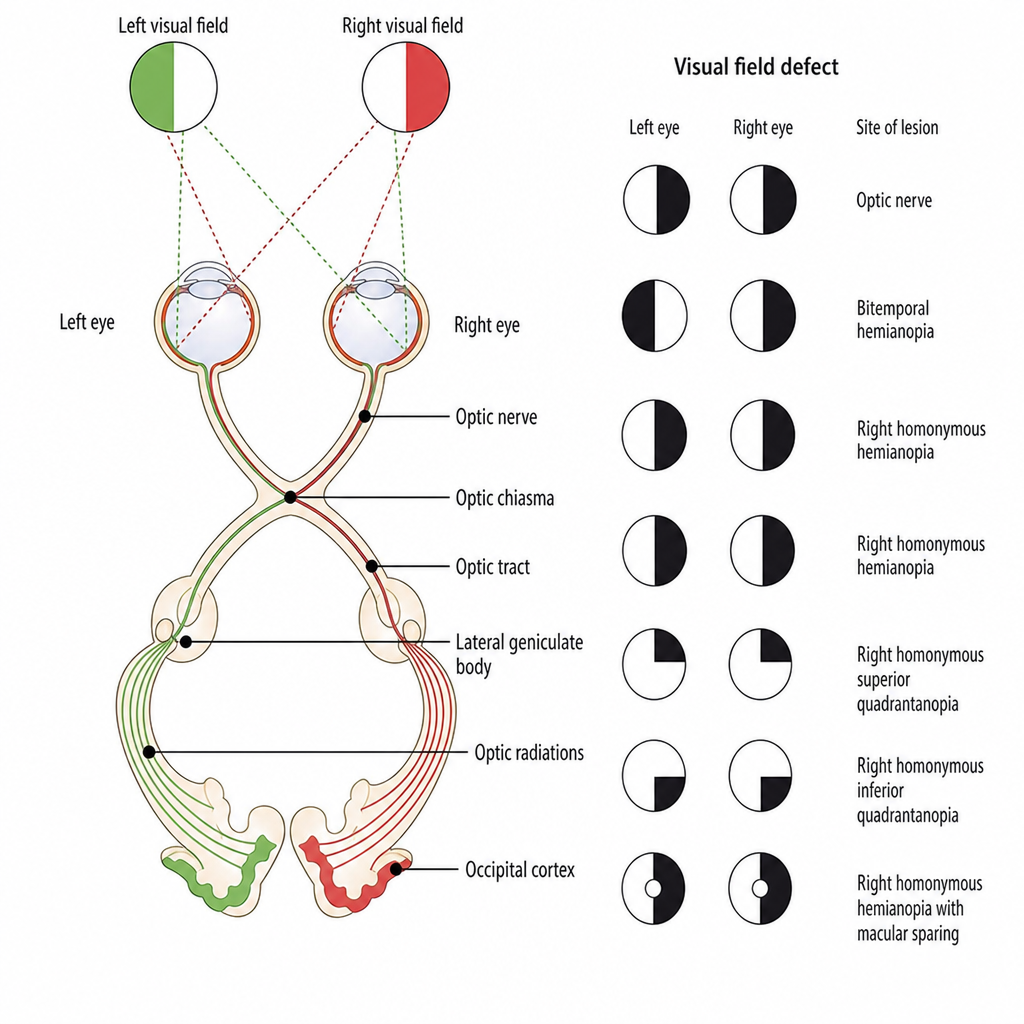
Homonymous hemianopia with macular sparing is seen in:
Homonymous hemianopia is seen in a lesion of which of the following?
Explanation: **Explanation:** **Miner’s Nystagmus** is a classic occupational disorder historically seen in coal miners who worked in extremely low-light conditions for prolonged periods. **1. Why Rotatory is Correct:** The underlying pathophysiology is related to **prolonged dark adaptation**. In the dim light of mines, the foveal (cone) vision is inactive, and the miner relies on peripheral (rod) vision. This leads to a failure of the fixation reflex. The resulting nystagmus is typically **pendular, rapid, and rotatory** (torsional) in nature. It is often exacerbated by looking upwards or by physical exhaustion and is frequently associated with compensatory head tremors and blepharospasm. **2. Why the Other Options are Incorrect:** * **Lateral (Horizontal):** While some components of movement may appear horizontal, the hallmark of Miner’s nystagmus is its rotatory/torsional component. Pure lateral nystagmus is more characteristic of vestibular or cerebellar lesions. * **Vertical:** Vertical nystagmus (up-beat or down-beat) usually signifies brainstem or craniocervical junction pathology (e.g., Arnold-Chiari malformation) rather than occupational light deprivation. * **All of the above:** This is incorrect because the specific clinical description of Miner’s nystagmus is consistently rotatory and pendular. **Clinical Pearls for NEET-PG:** * **Etiology:** It is considered a form of "disuse atrophy" of the fixation reflex due to chronic darkness. * **Current Status:** It is now largely a **historical condition** due to improved lighting (electric lamps) in modern mines. * **Key Triad:** Nystagmus (rotatory), Vertigo, and Head tremors. * **Differential:** Do not confuse this with *Spasmus Nutans*, which also presents with pendular nystagmus and head nodding but occurs in infants.
Explanation: **Explanation:** **Papilledema** refers specifically to optic disc swelling secondary to increased intracranial pressure (ICP). The fundamental pathophysiology involves the transmission of high CSF pressure through the subarachnoid space surrounding the optic nerve, which causes stasis of axoplasmic flow and vascular congestion. **Why "Deep physiological cup" is the correct answer:** In papilledema, the swelling of the optic nerve fibers and the accumulation of extracellular fluid cause the optic disc to protrude anteriorly into the vitreous. This process **obliterates (fills in)** the physiological cup. A "deep physiological cup" is actually a characteristic feature of **Glaucoma** (cupping), making it the opposite of what is seen in papilledema. **Analysis of incorrect options:** * **A. Ill-defined disc margin:** This is the earliest sign of papilledema. Edema starts at the nasal margin and spreads circumferentially, blurring the edges. * **C. Absent venous pulsation:** Spontaneous Venous Pulsation (SVP) is lost when ICP exceeds 200 mmH₂O. While 20% of the normal population lacks SVP, its *disappearance* in a patient who previously had it is a sensitive indicator of rising ICP. * **D. Bending of blood vessels:** As the disc becomes elevated (dome-shaped), the retinal vessels must climb over the swollen edges, causing them to "bend" or "curve" sharply at the disc margin. **High-Yield Clinical Pearls for NEET-PG:** * **Paton’s Lines:** Circumferential retinal folds seen on the temporal side of the swollen disc. * **Foster Kennedy Syndrome:** Anosmia, ipsilateral optic atrophy (due to direct tumor compression), and contralateral papilledema (due to raised ICP). * **Early vs. Late:** In early papilledema, visual acuity is usually **preserved**, whereas in optic neuritis (inflammatory swelling), vision loss is sudden and severe. * **Modified Frisén Scale:** Used for clinical grading of papilledema severity.
Explanation: ### Explanation The correct answer is **Holmes-Adie’s Pupil**. #### 1. Why Holmes-Adie’s Pupil is Correct Holmes-Adie’s pupil (or tonic pupil) is caused by post-ganglionic denervation of the **ciliary ganglion**. This leads to a "tonic" pupil that is typically unilateral and dilated. The hallmark of this condition is **Light-Near Dissociation (LND)**. In Adie’s pupil, the light reflex is absent or extremely sluggish (slight), but the near reflex (convergence/accommodation) is preserved and slow (tonic). This occurs because of **aberrant regeneration**, where nerve fibers originally intended for the ciliary body (accommodation) regrow to supply the iris sphincter, making the near response much stronger than the light response. #### 2. Why Other Options are Incorrect * **Argyll Robertson Pupil (ARP):** This is the classic "Prostitute's Pupil" seen in neurosyphilis. While it also shows LND, the key difference is that the pupils are **bilateral, small, and irregular**. In ARP, the light reflex is completely absent, while the near reflex is **brisk** (not lost or slight). * **Marcus Gunn Pupil:** This refers to a **Relative Afferent Pupillary Defect (RAPD)** caused by an optic nerve lesion. The pupil reacts sluggishly to direct light but constricts normally when the fellow eye is stimulated (consensual reflex). It does not involve a loss of convergence. * **Wernicke’s Pupil:** This is a hemi-achromatopsic pupillary reaction seen in lesions of the **optic tract**. Light shone on the blind half of the retina produces no response, while light on the seeing half produces a normal response. #### 3. Clinical Pearls for NEET-PG * **Adie’s Syndrome:** Adie’s pupil + diminished deep tendon reflexes (usually ankle jerks). * **Pharmacology Test:** Adie’s pupil is hypersensitive to weak cholinergic agents. It **constricts with 0.125% Pilocarpine**, whereas a normal pupil will not. * **Mnemonic for ARP:** **A**ccommodation **R**eflex **P**resent, **P**upillary **R**eflex **A**bsent (**ARP/PRA**).
Explanation: **Explanation:** **Anterior Ischemic Optic Neuropathy (AION)** is caused by the occlusion of the **short posterior ciliary arteries**, which supply the optic nerve head. It is broadly classified into two types: Arteritic (A-AION) and Non-Arteritic (NA-AION). 1. **Why Giant Cell Arteritis (GCA) is correct:** GCA is the primary cause of **Arteritic AION**. It is a systemic granulomatous vasculitis affecting medium and large-sized arteries. In the eye, it leads to rapid, profound vision loss due to inflammatory occlusion of the ciliary circulation. It is a medical emergency requiring high-dose systemic steroids to prevent bilateral blindness. 2. **Why the other options are incorrect:** * **Chronic Simple Glaucoma:** This is a progressive optic neuropathy characterized by increased intraocular pressure and "cupping" of the disc, not acute ischemic infarction. * **Chronic Iridocyclitis:** This is a form of anterior uveitis. While it can cause secondary complications like cataracts or macular edema, it does not typically manifest as AION. * **Sarcoidosis:** While sarcoidosis can cause optic neuropathy (usually via granulomatous infiltration or optic neuritis), it is not a classic cause of AION. **High-Yield Clinical Pearls for NEET-PG:** * **Clinical Presentation:** Sudden, painless, unilateral vision loss with an **Afferent Pupillary Defect (RAPD)** and "pale edema" of the optic disc. * **A-AION (GCA) Markers:** Elevated ESR (>50 mm/hr), elevated C-Reactive Protein (CRP), and thrombocytosis. * **Systemic Symptoms of GCA:** Jaw claudication (most specific), scalp tenderness, and headache. * **Gold Standard Diagnosis for GCA:** Temporal artery biopsy. * **NA-AION:** Associated with "crowded discs" (disc-at-risk), hypertension, and diabetes.
Explanation: **Explanation:** Postherpetic Neuralgia (PHN) is a chronic neuropathic pain syndrome persisting for more than 90 days after the onset of a Herpes Zoster rash. The management focuses on stabilizing overactive pain signaling in the peripheral and central nervous systems. **Why Cycloplegics are the Correct Answer:** Cycloplegics (e.g., Atropine, Homatropine) are used in the **acute phase** of Herpes Zoster Ophthalmicus (HZO) to treat associated anterior uveitis and ciliary spasm. They have no role in managing **Postherpetic Neuralgia**, which is a chronic neurological pain condition rather than an active inflammatory ocular condition. **Analysis of Incorrect Options:** * **Nortriptyline:** Tricyclic Antidepressants (TCAs) like Nortriptyline and Amitriptyline are first-line systemic agents for PHN. They work by inhibiting the reuptake of serotonin and norepinephrine, modulating pain pathways. * **Capsaicin Cream:** This is a topical alkaloid derived from chili peppers. It works by depleting **Substance P** from peripheral sensory neurons, thereby desensitizing the area to pain. * **Gabapentin:** An anticonvulsant that binds to the $\alpha_2\delta$ subunit of voltage-gated calcium channels. It is a mainstay of treatment for neuropathic pain. **High-Yield Clinical Pearls for NEET-PG:** * **Hutchinson’s Sign:** Vesicles on the tip of the nose (involvement of the nasociliary nerve) indicate a high risk of ocular involvement in HZO. * **First-line for PHN:** Gabapentin, Pregabalin, or TCAs (Nortriptyline is often preferred over Amitriptyline in elderly patients due to fewer anticholinergic side effects). * **Acute HZO Treatment:** Oral Acyclovir (800 mg 5 times daily for 7–10 days) started within 72 hours of rash onset reduces the risk of PHN.
Explanation: **Explanation:** **Thyroid Ophthalmopathy** (also known as Graves’ Orbitopathy) is an autoimmune inflammatory disorder associated with thyroid dysfunction, most commonly hyperthyroidism (Graves' disease). The underlying mechanism involves the activation of orbital fibroblasts by thyroid-stimulating hormone receptor (TSHR) antibodies. This leads to the accumulation of glycosaminoglycans (hyaluronic acid), resulting in extraocular muscle enlargement and increased orbital fat volume. **Analysis of Options:** * **Myasthenia Gravis (A):** This is a neuromuscular junction disorder characterized by fatiguable ptosis and diplopia. While it can coexist with thyroid disease, it does not cause the orbital tissue expansion seen in thyroid ophthalmopathy. * **Marfan Syndrome (B):** This is a connective tissue disorder (Fibrillin-1 mutation). Ocular hallmarks include **Ectopia Lentis** (typically superotemporal subluxation) and high myopia, not orbital inflammation. * **Pancoast Tumor (D):** An apical lung tumor that typically causes **Horner’s Syndrome** (ptosis, miosis, anhidrosis) due to compression of the sympathetic chain. It does not involve thyroid-related orbital changes. **High-Yield Clinical Pearls for NEET-PG:** 1. **Most common cause of both unilateral and bilateral proptosis** in adults is Thyroid Eye Disease. 2. **Dalrymple Sign:** Pathognomonic lid retraction in the primary position. 3. **Von Graefe’s Sign:** Lid lag on downward gaze. 4. **Muscle Involvement Sequence (Mnemonic: I’M SLOW):** Inferior Rectus (most common) > Medial Rectus > Superior Rectus > Lateral Rectus. 5. **Smoking** is the most significant modifiable risk factor for the progression of the disease.
Explanation: ### Explanation **1. Why Option C is the Correct Answer (The False Statement):** While optic atrophy involves the degeneration of nerve fibers, the **pallor** of the disc is not directly caused by the loss of fibers themselves. Instead, the white/pale appearance is primarily due to the **loss of the capillary network (vasculature)** within the optic disc and the associated **glial tissue proliferation** (astrogliosis). As the nourishing capillaries disappear, the underlying white lamina cribrosa becomes more visible, giving the disc its characteristic pale appearance. **2. Analysis of Other Options:** * **Option A (True):** In **Primary Optic Atrophy** (caused by lesions proximal to the disc like pituitary tumors or MS), the disc is classically described as **chalky white** with well-defined margins. The physiological cup is visible, and the lamina cribrosa is distinct. * **Option B (True):** There is often a **poor correlation** between the degree of disc pallor and the actual visual acuity or field loss. A disc may appear significantly pale while the patient retains decent vision, or conversely, a patient may have severe visual loss with only subtle temporal pallor (e.g., in early retrobulbar neuritis). **3. NEET-PG High-Yield Pearls:** * **Primary Optic Atrophy:** Disc is chalky white; margins are **sharp/clear**. * **Secondary Optic Atrophy:** Follows chronic papilledema or papillitis. Disc is dirty grey/white; margins are **blurred** due to gliosis. * **Consecutive Optic Atrophy:** Follows retinal diseases (e.g., Retinitis Pigmentosa, Central Retinal Artery Occlusion). Disc is **waxy yellow**. * **Glaucomatous Optic Atrophy:** Characterized by deep cupping and nasal shifting of vessels. * **Kestenbaum’s Index:** A clinical sign where the number of small vessels crossing the disc margin decreases (Normal: 10; Atrophy: <6).
Explanation: **Explanation:** The phenomenon of **aberrant regeneration** (synkinesis) occurs when damaged nerve fibers regrow and mistakenly enter the wrong end-organ sheaths. In the case of the 3rd cranial nerve (Oculomotor), this leads to unintended co-contractions, such as the **Pseudo-Graefe sign** (lid elevation on downgaze or adduction). **1. Why Ischemia (Diabetes) is the Correct Answer:** Aberrant regeneration requires a **disruption of the endoneurial sheath** (axotmesis or neurotmesis). In diabetic or hypertensive ischemic mononeuropathy, the injury is typically **microvascular and intraneural**. The connective tissue framework (endoneurium) remains intact, allowing the regenerating axons to follow their original paths accurately. Therefore, diabetic 3rd nerve palsies are characterized by a lack of aberrant regeneration and are usually "pupil-sparing." **2. Why Other Options are Incorrect:** * **Trauma (A):** Severe mechanical injury or transection physically disrupts the nerve sheaths, providing the perfect environment for misdirected axonal regrowth. * **Tumor Compression (C) & Aneurysm (D):** Chronic compression (e.g., by a PCom artery aneurysm or a meningioma) causes focal demyelination and axonal breakdown. As the nerve attempts to repair itself under constant pressure, fibers frequently cross-talk or enter incorrect tubes. This is often termed "primary aberrant regeneration" if it occurs without an acute preceding palsy. **Clinical Pearls for NEET-PG:** * **Pseudo-Graefe Sign:** The most common sign of aberrant 3rd nerve regeneration (upper lid retraction on downgaze). * **Pupil Involvement:** If a patient presents with a 3rd nerve palsy AND signs of aberrant regeneration but *no history of acute injury*, suspect a **slow-growing tumor** (e.g., cavernous sinus meningioma) or **aneurysm**. * **Rule of Thumb:** Ischemic (medical) palsies recover completely without synkinesis; compressive/traumatic (surgical) palsies often recover with synkinesis.
Explanation: **Explanation:** **1. Why Option A is Correct:** Homonymous hemianopia with macular sparing is the hallmark of a lesion in the **visual cortex (occipital lobe)**. The macula is spared due to two primary reasons: * **Dual Blood Supply:** The visual cortex receives blood from both the **Posterior Cerebral Artery (PCA)** and the **Middle Cerebral Artery (MCA)**. In a PCA stroke (the most common cause of cortical blindness), the MCA continues to supply the occipital pole where the macula is represented. * **Large Cortical Representation:** The macula occupies a disproportionately large area of the visual cortex (macular magnification), making it more resilient to small focal lesions. **2. Why Other Options are Incorrect:** * **Optic Radiations (Option B):** Lesions here typically cause a complete homonymous hemianopia **without** macular sparing. Depending on the fiber bundle involved, they may also cause quadrantanopias (e.g., "Pie in the sky" for temporal lobe/Meyer’s loop or "Pie on the floor" for parietal lobe/Baum’s loop). * **Lateral Geniculate Body (Option C):** Lesions here are rare and usually result in incongruous homonymous hemianopia or specific sectoral defects (like horizontal sectoranopia) depending on the blood supply involved (Anterior vs. Posterior Choroidal arteries). **3. NEET-PG High-Yield Pearls:** * **Congruity:** The more posterior the lesion (closer to the cortex), the more **congruous** (identical in both eyes) the visual field defect. * **Macular Sparing vs. Macular Splitting:** Macular **sparing** points to the Occipital Cortex; Macular **splitting** (the vertical line goes straight through the macula) points to the Optic Tract. * **Most common cause:** PCA occlusion is the most frequent cause of homonymous hemianopia with macular sparing.
Explanation: ### Explanation The key to understanding visual field defects lies in the anatomy of the visual pathway. A **homonymous hemianopia** (loss of the same half of the visual field in both eyes) occurs when there is a lesion **posterior to the optic chiasm**. **1. Why Option A is Correct:** Once the nasal fibers cross at the optic chiasm, the fibers from the left half of the visual field of both eyes travel together in the right-sided pathway, and vice versa. Therefore, a lesion in any of the following retrochiasmal structures results in a contralateral homonymous hemianopia: * **Optic Tract:** Causes incongruous (asymmetrical) homonymous hemianopia. * **Optic Radiation:** Causes congruous homonymous hemianopia (often presenting as "pie in the sky" or "pie on the floor" quadrantanopias). * **Occipital Cortex:** Causes highly congruous homonymous hemianopia, often with **macular sparing** due to dual blood supply (MCA and PCA). **2. Why Other Options are Incorrect:** * **Optic Nerve:** Lesions here cause **ipsilateral monocular vision loss** (central scotoma or total blindness in one eye), not hemianopia. * **Optic Chiasm:** Lesions here (e.g., Pituitary Adenoma) typically cause **bitemporal heteronymous hemianopia** by affecting the decussating nasal fibers. * Options B, C, and D are incorrect because they all include the optic nerve or optic chiasm, which do not produce homonymous defects. **3. High-Yield Clinical Pearls for NEET-PG:** * **Wernicke’s Hemianopic Pupil:** Seen in optic tract lesions; the pupil does not react when light is shone on the blind half of the retina. * **Macular Sparing:** Characteristic of occipital lobe lesions (PCA infarcts). * **Congruity:** The more posterior the lesion (closer to the cortex), the more identical (congruous) the field defects in both eyes appear. * **Temporal Lobe Lesion:** Superior homonymous quadrantanopia ("Pie in the sky"). * **Parietal Lobe Lesion:** Inferior homonymous quadrantanopia ("Pie on the floor").
Anatomy of Visual Pathways
Practice Questions
Pupillary Disorders
Practice Questions
Optic Neuritis
Practice Questions
Ischemic Optic Neuropathies
Practice Questions
Other Optic Neuropathies
Practice Questions
Papilledema
Practice Questions
Cranial Nerve Palsies
Practice Questions
Nystagmus
Practice Questions
Visual Field Defects
Practice Questions
Neuro-ophthalmic Manifestations of Intracranial Lesions
Practice Questions
Functional Visual Disorders
Practice Questions
Migraine and the Eye
Practice Questions
Get full access to all questions, explanations, and performance tracking.
Start For Free