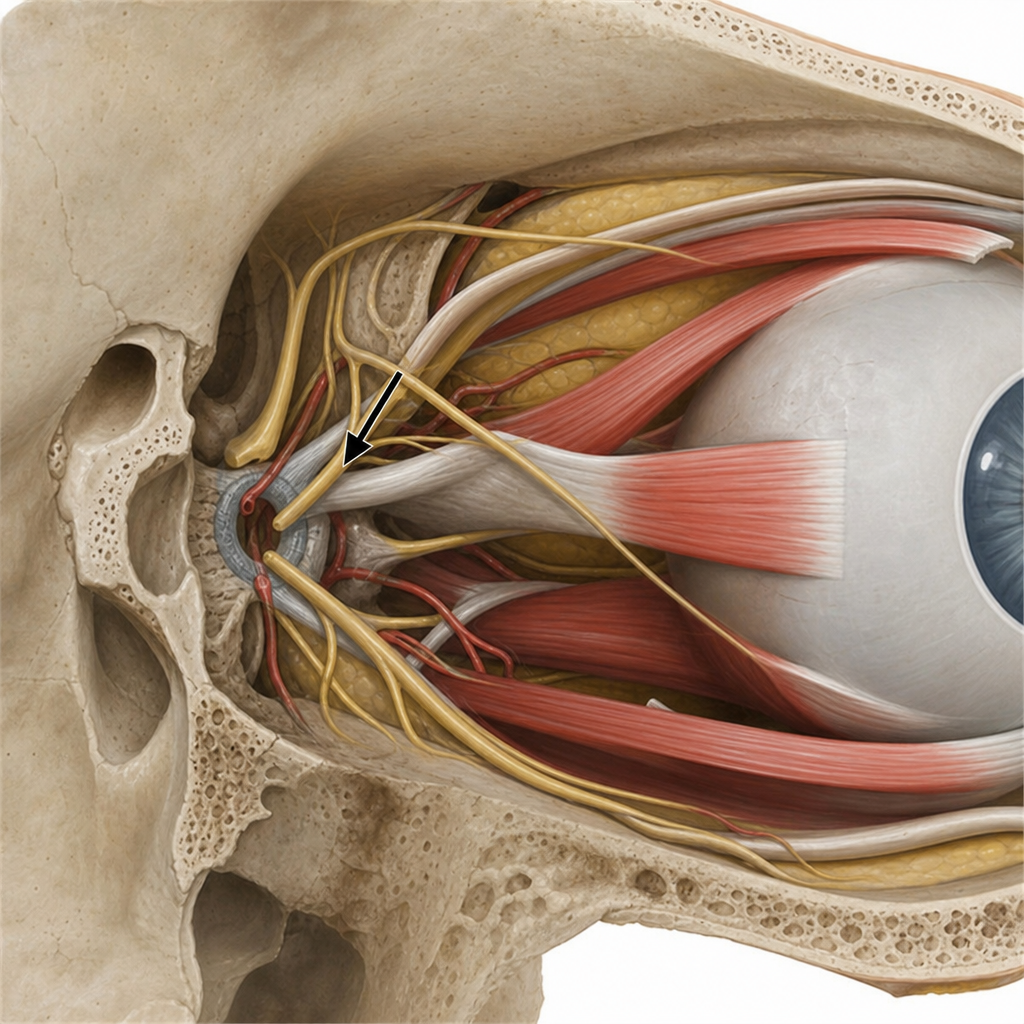
Ramkali bai, a 35-year-old female presented with a one-year history of menstrual irregularity and galactorrhoea. She also had off and on headache, her examination revealed bitemporal superior quadrantanopia. Her fundus examination showed primary optic atrophy. Which of the following is a most likely diagnosis in this case -
Keyhole-shaped visual field defect is seen in a lesion involving which of the following regions?
Which structure contains the second-order neurons in the optic pathway?
Identify the visual field defect shown in the image.

Visual processing center is located in -
The fibers from the contralateral nasal hemiretina project to the following layers of the lateral geniculate nucleus:
Macular sparing is associated with lesions in:
Statement 1 - A 59-year-old patient presents with flaccid bullae. Histopathology shows a suprabasal acantholytic split. Statement 2 - The row of tombstones appearance is diagnostic of Pemphigus vulgaris.
Wernicke's hemianopic pupillary response is seen in lesion of-
The parvocellular pathway from lateral geniculate body to visual cortex carries signals for detection of
Explanation: ***Pituitary macroadenoma*** - **Menstrual irregularity**, **galactorrhoea**, and **headaches** are classic symptoms of a pituitary macroadenoma, especially if it secretes **prolactin** [1]. - **Bitemporal superior quadrantanopia** and **primary optic atrophy** are consistent with compression of the inferior chiasm by a large pituitary tumor [1]. *Craniopharyngioma* - While craniopharyngiomas can cause visual field defects and endocrine dysfunction, galactorrhoea is less common, and they typically affect children and young adults or older adults, not commonly presenting in a 35-year-old with this specific constellation. - The visual field defect from craniopharyngioma would more typically be a bitemporal hemianopia due to compression of the mid-chiasm, not primarily a superior quadrantanopia. *Ophthalmic ICA Aneurysm* - An ophthalmic ICA aneurysm can compress the optic nerve, leading to visual loss, but it typically causes unilateral visual field defects and is not usually associated with galactorrhoea or menstrual irregularity. - Endocrine symptoms like galactorrhoea are not characteristic of an unruptured internal carotid artery aneurysm. *Chiasmal Glioma* - Chiasmal gliomas are more common in children and can cause visual field defects and endocrine abnormalities, but galactorrhoea is not a typical presentation. - The progression of symptoms and specific visual field defect (bitemporal superior quadrantanopia) are less classic for a chiasmal glioma compared to a pituitary macroadenoma.
Explanation: ***Lesion of the optic disk*** - A **keyhole-shaped visual field defect** is a **pathognomonic sign** of **optic disc lesions**, particularly in **glaucomatous optic neuropathy**. - This characteristic defect occurs due to damage to **retinal nerve fiber bundles** as they converge at the optic disc, respecting the **horizontal raphé**. - Arcuate scotomas (superior and inferior) can coalesce around the point of fixation, creating the distinctive **keyhole or dumbbell shape**. - The pattern reflects the anatomical organization of nerve fibers entering the optic nerve head. *Lesion of the lateral geniculate body* - Lesions of the **lateral geniculate body (LGB)** typically cause **incongruous homonymous hemianopias** or **quadrantanopias**, not keyhole defects. - The LGB has retinotopic organization with six layers, and partial lesions cause visual field defects affecting corresponding areas in both eyes. - Vascular lesions (from lateral choroidal artery branches) can cause sector-shaped or wedge-shaped defects, but not keyhole patterns. *Lesion of the optic chiasma* - A lesion of the optic chiasma typically leads to **bitemporal hemianopia**, where the temporal visual fields of both eyes are affected, usually due to compression from a **pituitary tumor**. - This is characterized by loss of vision in the outer halves of the visual field for both eyes, which is distinct from a keyhole defect. - The crossing nasal fibers are affected, resulting in bilateral temporal field loss. *Lesion of the occipital lobe* - Lesions in the occipital lobe, specifically the **primary visual cortex (V1)**, generally cause **homonymous hemianopia** or **quadrantanopia** respecting the vertical midline. - This means the same side of the visual field is affected in both eyes, and **macular sparing** may be present due to dual vascular supply. - Occipital lobe defects are typically congruous (identical in both eyes) and do not produce keyhole-shaped patterns.
Explanation: ***Layer of retina*** - The **second-order neurons** in the visual pathway are the **bipolar cells** of the retina [1] - Their **cell bodies are located in the inner nuclear layer** of the retina - These cells synapse with **photoreceptors** (first-order neurons) and transmit signals to **ganglion cells** (third-order neurons) [1], [2] - This makes the retina the correct answer as it contains the second-order neuronal cell bodies *Lateral geniculate body* - The **lateral geniculate body (LGB)** contains cell bodies of neurons that receive input from **retinal ganglion cells** [3] - These are **fourth-order neurons** in the visual pathway, not second-order - The LGB serves as a relay station in the thalamus before visual information reaches the primary visual cortex *Optic nerve* - The **optic nerve** consists of **axons of retinal ganglion cells** (third-order neurons) [3] - It does not contain cell bodies, only nerve fibers - It transmits visual information from the retina to the optic chiasm and then to the lateral geniculate body [3] *Medial geniculate body* - The **medial geniculate body (MGB)** is part of the **auditory pathway**, not the visual pathway - It is a thalamic nucleus that relays auditory information to the auditory cortex - It has no role in visual processing
Explanation: ***Bitemporal hemianopia*** - The image shows loss of vision in the **temporal (outer) halves of both visual fields**, which is characteristic of bitemporal hemianopia. - This defect typically results from a lesion at the **optic chiasm**, compressing the crossing nasal retinal fibers, often due to a **pituitary tumor**. *Binasal hemianopia* - This condition involves visual loss in the **nasal (inner) halves of both visual fields**, which is the opposite of what is depicted. - It is a rare defect that can be caused by lesions affecting the **uncrossed temporal retinal fibers** on both sides, such as from bilateral carotid artery aneurysms. *Homonymous hemianopia* - A homonymous hemianopia involves the **same half of the visual field in both eyes** (e.g., right visual field loss in both eyes), resulting from a lesion posterior to the optic chiasm. - The image clearly shows different halves affected in each eye (temporal fields), not the same half. *Altitudinal defect* - An altitudinal defect involves the **loss of vision in the upper or lower half of the visual field** in one or both eyes, respecting the horizontal midline. - The visual field loss shown in the image is vertical, affecting the temporal halves, not the upper or lower halves.
Explanation: ***Occipital lobe*** - The **occipital lobe** houses the **primary visual cortex**, which is responsible for processing and interpreting visual information received from the eyes [1]. - Damage to this lobe can lead to various visual deficits, including **cortical blindness** or **visual agnosia** [2], [3]. *Frontal lobe* - The **frontal lobe** is primarily involved in **executive functions**, such as decision-making, problem-solving, planning, and voluntary movement. - It also plays a key role in **personality** and social behavior. *Parietal lobe* - The **parietal lobe** integrates sensory information from various parts of the body, including touch, temperature, pain, and pressure. - It also plays a crucial role in **spatial awareness** and navigation. *Temporal lobe* - The **temporal lobe** is mainly associated with **auditory processing**, memory, and language comprehension. - It contains the **primary auditory cortex** and structures vital for forming memories, such as the hippocampus.
Explanation: ***Layers 1, 4 & 6.*** - The **contralateral nasal hemiretina** projects to layers 1, 4, and 6 of the lateral geniculate nucleus (LGN) [1]. - These layers receive input from the **magnocellular (layer 1)** and **parvocellular (layers 4 and 6)** pathways originating from the contralateral eye. *Layers 2, 3 & 5.* - This option incorrectly combines layers from both contralateral and ipsilateral projections. - Layers 2, 3, and 5 receive input from the **ipsilateral temporal hemiretina**, not the contralateral nasal hemiretina [1]. *Layers 1, 2 & 6.* - While layers 1 and 6 receive contralateral input, layer 2 specifically receives input from the **ipsilateral eye**. - This combination is not exclusively for contralateral nasal hemiretinal projection. *Layers 4, 5 & 6.* - This option includes layer 5, which receives input from the **ipsilateral temporal hemiretina**. - Layers 4 and 6 do receive contralateral input, but layer 5 makes this answer incorrect for an exclusive contralateral projection.
Explanation: ***Lesions in the occipital cortex*** - **Macular sparing** occurs when the central visual field (macula) is preserved despite damage to the occipital cortex, often due to its dual blood supply from the **middle cerebral artery** and the **posterior cerebral artery**. [2] - This phenomenon typically results from a **vascular lesion** in the occipital lobe, leading to a **homonymous hemianopia** with a distinct sparing of the foveal region. [2], [3] *Lesions in the optic nerve* - Lesions in the optic nerve cause **monocular vision loss** or central scotomas, rather than the homonymous visual field defects associated with macular sparing. [2] - Damage here affects the visual pathway **before** the optic chiasm, impacting the entire visual input from one eye. [2] *Lesions in the lateral geniculate body* - Lesions in the **lateral geniculate body (LGB)** produce **contralateral homonymous hemianopia** or quadrantanopia, but typically **do not exhibit macular sparing** as consistently as cortical lesions. - The LGB processes visual information from both eyes before relaying it to the visual cortex. [1] *Lesions in the optic chiasma* - Lesions in the **optic chiasma** classically cause **bitemporal hemianopia**, affecting the temporal visual fields of both eyes. [2] - This type of visual field defect is distinct from the homonymous defects seen with macular sparing, as it results from damage to the **crossing nasal fibers**. [2]
Explanation: ***Correct: Statements 1 & 2 are correct, 2 is not explaining 1*** **Analysis of Statement 1:** - A 59-year-old patient with **flaccid bullae** and **suprabasal acantholytic split** on histopathology is the classic presentation of **Pemphigus vulgaris** - The flaccid (easily ruptured) nature of bullae distinguishes it from tense bullae seen in bullous pemphigoid - The suprabasal location of the split (just above the basal layer) with acantholysis (loss of cell-to-cell adhesion) is pathognomonic - **Statement 1 is CORRECT** ✓ **Analysis of Statement 2:** - The **"row of tombstones" or "tombstone appearance"** is indeed a diagnostic histopathological feature of Pemphigus vulgaris - This appearance results from basal keratinocytes remaining attached to the basement membrane while suprabasal cells separate due to acantholysis - The intact basal cells standing upright resemble a row of tombstones - **Statement 2 is CORRECT** ✓ **Does Statement 2 explain Statement 1?** - Statement 2 describes a **histopathological appearance** (tombstone pattern) that is a **consequence** of the suprabasal split - However, it does NOT explain the **underlying cause** of the flaccid bullae or the suprabasal split - The true explanation involves **IgG autoantibodies against desmoglein 3 (and desmoglein 1)**, which attack intercellular adhesion structures (desmosomes), causing **acantholysis** - Therefore, **Statement 2 does NOT explain Statement 1** ✗ *Incorrect: Statement 2 is the correct explanation for Statement 1* - While both statements describe features of Pemphigus vulgaris, the tombstone appearance is a descriptive finding, not an explanatory mechanism *Incorrect: Statements 1 and 2 are incorrect* - Both statements are medically accurate descriptions of Pemphigus vulgaris features *Incorrect: Statement 1 is incorrect* - Statement 1 correctly describes the cardinal clinical and histopathological features of Pemphigus vulgaris
Explanation: ***Optic tract*** - Wernicke's hemianopic pupillary response describes the phenomenon where the pupil does not constrict when light is shone on the **blind (hemianopic) side of the retina** in patients with a lesion of the **optic tract**. - This response is due to the interruption of the afferent visual pathway from the affected retinal ganglion cells before they reach the **pretectal nucleus**, which mediates the pupillary light reflex. *Optic chiasm* - Lesions of the optic chiasm typically cause **bitemporal hemianopia**, affecting the temporal visual fields of both eyes. - While visual fields are affected, the pupillary light reflex pathways from the nasal retinas (which cross at the chiasm) are often spared sufficiently to maintain a light reflex. *Lateral geniculate body* - The lateral geniculate body (LGB) is a **relay station for visual information** on its way to the visual cortex. - Lesions here cause **contralateral homonymous hemianopia**, but the pupillary light reflex, which bypasses the LGB to reach the pretectal nucleus, remains intact. *Optic radiation* - The optic radiations carry visual information from the **LGB to the primary visual cortex**. - Lesions of the optic radiation result in **contralateral homonymous hemianopia or quadrantanopia**, but the pupillary reflex arc is preserved because the fibers mediating this reflex have already diverged from the visual pathway before the LGB.
Explanation: ***Colour contrast*** - The **parvocellular pathway** is specialized for processing **fine spatial details** and **color information**. - It receives input primarily from **cones** in the retina, which are responsible for color vision. *Luminance contrast* - **Luminance contrast** (light vs. dark) is primarily processed by the **magnocellular pathway**. - This pathway is involved in detecting **motion** and large-scale spatial patterns. *Saccadic eye movements* - **Saccadic eye movements** are rapid eye movements controlled by various brain regions, including the **frontal eye fields** and **superior colliculus**, not directly by the parvocellular pathway. - While visual input guides these movements, the parvocellular pathway's primary role isn't their generation. *Temporal frequency* - **Temporal frequency** (how quickly visual stimuli change over time) is predominantly handled by the **magnocellular pathway**. - This pathway is optimized for detecting **rapid changes and motion**.
Get full access to all questions, explanations, and performance tracking.
Start For Free