Which of the following prostaglandin analogues is used for the treatment of primary open-angle glaucoma?
Uveitis with raised intraocular tension is best managed by?
What is the earliest drug used in the management of acute angle closure glaucoma?
A 42-year-old hypertensive man is experiencing symptoms of increased intraocular pressure. Which of the following agents is NOT used in this patient?
What is the earliest functional change in glaucoma?
Uveoscleral outflow is increased by which of the following medications?
A middle-aged man presents with unilateral headache, right eye congestion and pain, accompanied by sudden vision loss. What is the most likely diagnosis?
What is a common symptom of open-angle glaucoma?
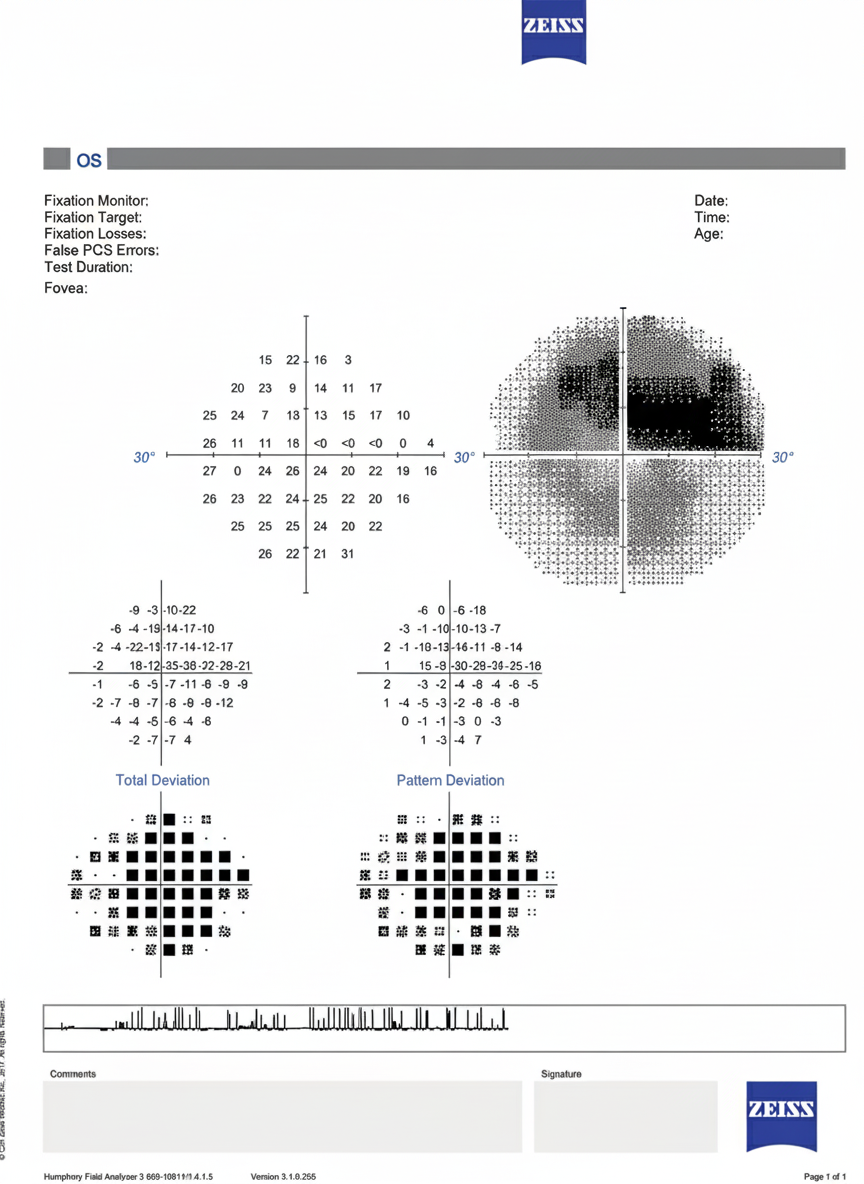
A 75-year-old patient presents with deterioration of vision. On examination, the pupillary reflex is observed to be sluggish, and the intraocular pressure is normal. Optic disc evaluation shows a large and deep cup, and the visual field primarily shows paracentral scotomas. What is the most likely diagnosis?
Which of the following is NOT a feature of infantile glaucoma?
Explanation: **Explanation:** Prostaglandin analogues (PGAs) are currently the first-line medical therapy for Primary Open-Angle Glaucoma (POAG) due to their superior efficacy in lowering intraocular pressure (IOP) and their once-daily dosing schedule. **Why PGF2α is Correct:** The prostaglandin analogues used in ophthalmology (such as **Latanoprost, Bimatoprost, and Travoprost**) are synthetic derivatives of **Prostaglandin F2alpha (PGF2α)**. These drugs act as selective agonists at the **FP receptors** located in the ciliary muscle. Their primary mechanism of action is increasing the **uveoscleral outflow** (the non-conventional pathway) of aqueous humor by remodeling the extracellular matrix in the ciliary body. **Why Other Options are Incorrect:** * **PGI2 (Prostacyclin):** Primarily functions as a potent vasodilator and inhibitor of platelet aggregation; it does not play a clinical role in lowering IOP. * **PGD2:** Involved in allergic responses and sleep regulation; it is not used in glaucoma management. * **PGE2 (Dinoprostone):** Primarily used in obstetrics for cervical ripening and induction of labor. While it can affect IOP, it is not used therapeutically for glaucoma due to its inflammatory potential. **High-Yield Clinical Pearls for NEET-PG:** * **Mechanism:** Increases uveoscleral outflow (NOT trabecular outflow). * **Side Effects:** Increased brown pigmentation of the iris, hypertrichosis (increased eyelash growth), darkening of periocular skin, and cystoid macular edema (CME). * **Contraindication:** Relative contraindication in patients with active uveitis or a history of herpetic keratitis. * **Latanoprostene bunod:** A newer agent that combines a PGF2α analogue with a nitric oxide (NO) donor to target both uveoscleral and trabecular pathways.
Explanation: **Explanation:** In cases of **Uveitic Glaucoma** (uveitis with raised intraocular pressure), the primary cause of the elevated tension is active inflammation. Inflammatory debris (cells and fibrin) clogs the trabecular meshwork, and inflammatory mediators cause trabeculitis. Therefore, the definitive management is to control the underlying inflammation using **Steroids**. Steroids reduce the production of inflammatory exudates, thereby restoring the drainage capacity of the trabecular meshwork. **Analysis of Options:** * **Steroids (Correct):** They address the root cause (inflammation). By suppressing the uveitis, they clear the drainage channels and lower IOP. * **Atropine:** While Atropine is used in uveitis to prevent synechiae and relieve ciliary spasm (cycloplegia), it is not the primary agent to lower IOP. In fact, it is a supportive treatment. * **Timolol:** This is a beta-blocker used to reduce aqueous production. While it can be used as an *adjunctive* therapy to lower IOP in uveitic glaucoma, it does not treat the underlying inflammatory cause. * **Pilocarpine (Contraindicated):** Pilocarpine is a miotic that should be **strictly avoided** in uveitis. It increases inflammation by breaking the blood-aqueous barrier and promotes the formation of posterior synechiae by constricting the pupil. **High-Yield Clinical Pearls for NEET-PG:** * **Posner-Schlossman Syndrome (Glaucomatocyclitic Crisis):** A specific type of uveitic glaucoma characterized by recurrent episodes of very high IOP with minimal signs of inflammation. Treatment is primarily steroids. * **Steroid-Induced Glaucoma:** Be cautious; while steroids treat uveitic glaucoma, prolonged use can cause a secondary "steroid-induced" rise in IOP in "steroid responders." * **Avoid Prostaglandin Analogues (PGAs):** Like Pilocarpine, PGAs (e.g., Latanoprost) are generally avoided in active uveitis as they are pro-inflammatory.
Explanation: In the management of **Acute Angle Closure Glaucoma (AACG)**, the primary goal is to rapidly lower the intraocular pressure (IOP) to prevent optic nerve damage and clear corneal edema. **Why Diamox (Acetazolamide) is the correct answer:** Diamox is a potent **Carbonic Anhydrase Inhibitor** that acts systemically to decrease the production of aqueous humor by the ciliary body. In an acute attack, the IOP is often so high (frequently >50-60 mmHg) that the iris sphincter becomes ischemic and unresponsive to topical miotics. Therefore, systemic medication like intravenous or oral Acetazolamide is the **earliest and most effective** first-line treatment to break the attack and lower the pressure enough for other treatments to work. **Analysis of Incorrect Options:** * **Pilocarpine:** While it is the definitive medical treatment to open the angle (miotic), it **cannot work initially** when IOP is very high because the iris sphincter is paralyzed by ischemia. It is usually administered only after the IOP has been lowered by systemic agents. * **Atropine:** This is a mydriatic (dilates the pupil). It is **strictly contraindicated** in AACG as it would further crowd the angle and worsen the condition. * **DFP (Diisopropyl Fluorophosphate):** This is a potent, irreversible cholinesterase inhibitor. It is not used in acute glaucoma because it can cause intense congestion and potentially worsen the pupillary block. **High-Yield Clinical Pearls for NEET-PG:** * **Sequence of Management:** 1. Systemic Hyperosmotics (Mannitol) or CAIs (Diamox) → 2. Topical Beta-blockers → 3. Topical Pilocarpine (once IOP <30 mmHg). * **Definitive Treatment:** The definitive treatment for AACG is **Laser Peripheral Iridotomy (LPI)**, performed on both the affected and the fellow (prophylactic) eye. * **Side Effects of Diamox:** Watch for paresthesia, hypokalemia, and metabolic acidosis. It is contraindicated in patients with sulfonamide allergies.
Explanation: **Explanation:** The core of this question lies in understanding the systemic contraindications of glaucoma medications, specifically in patients with **systemic hypertension**. **Why Alpha Agonists are the Correct Answer:** Alpha-adrenergic agonists (such as **Apraclonidine** and **Brimonidine**) work by decreasing aqueous humor production and increasing uveoscleral outflow. However, they can cause systemic sympathomimetic effects. Specifically, they can lead to peripheral vasoconstriction and potentially exacerbate hypertension or cause cardiac arrhythmias. In a patient already diagnosed with hypertension, these agents are generally avoided or used with extreme caution to prevent a hypertensive crisis or cardiovascular instability. **Analysis of Other Options:** * **Dipivefrin (Option A):** This is a prodrug of epinephrine. While it is a sympathomimetic, it is less commonly used today but is not strictly contraindicated in hypertension compared to the direct systemic risks posed by certain alpha-agonists in clinical scenarios. * **Beta-blockers (Option B):** These are first-line agents for glaucoma (e.g., Timolol). While they are contraindicated in asthma and heart block, they are actually beneficial or neutral in hypertensive patients as they do not raise blood pressure. * **Trabeculoplasty (Option D):** This is a laser procedure (SLT/ALT) to increase aqueous outflow. It is a non-pharmacological intervention and has no systemic contraindications related to hypertension. **High-Yield Clinical Pearls for NEET-PG:** * **Brimonidine** is known for causing "follicular conjunctivitis" (Type IV hypersensitivity) in 30% of patients. * **Beta-blockers** are the most common cause of "masked hypoglycemia" in diabetic patients and are contraindicated in Grade II/III heart block. * **Prostaglandin Analogues (Latanoprost)** are the current first-line treatment for Open Angle Glaucoma but can cause iris heterochromia and thickening of eyelashes.
Explanation: **Explanation:** In Glaucoma, visual field defects follow a specific chronological sequence. The question asks for the **earliest functional (visual field) change**, which is **Baring of the Blind Spot**. **1. Why Baring of the Blind Spot is correct:** Baring of the blind spot is considered the earliest sign of glaucomatous field loss. It occurs due to the exclusion of the blind spot from the central field (isopter) because of early generalized depression. Specifically, the superior or inferior poles of the blind spot become continuous with the peripheral field. While it is the earliest change, it is important to note that it is **non-specific** and can also be seen in normal individuals or other conditions. **2. Analysis of Incorrect Options:** * **Papilloedema (A):** This is a structural change (optic disc swelling) due to increased intracranial pressure, not a functional change of glaucoma. Glaucoma typically presents with "cupping," not edema. * **Hazy Cornea (B):** This is a clinical sign seen in acute congestive glaucoma or congenital glaucoma due to high IOP causing corneal edema. It is a physical finding, not a functional field defect. * **Sickle Scotoma (D):** Also known as a Seidel scotoma, this is a sickle-shaped extension of the blind spot. It occurs **after** baring of the blind spot and is a more definitive, but later, sign of early glaucoma. **High-Yield Clinical Pearls for NEET-PG:** * **Sequence of Field Defects:** Baring of blind spot → Small wing-shaped Paracentral scotoma → Seidel’s scotoma → Bjerrum’s (Arcuate) scotoma → Double Arcuate (Ring) scotoma → Roenne’s nasal step → Tubular vision → Temporal island of vision. * **Bjerrum’s Area:** The area between 10° and 20° from fixation where most early glaucomatous defects occur. * **Earliest Structural Change:** Thinning of the Retinal Nerve Fiber Layer (RNFL), often detected by OCT before field defects appear (Pre-perimetric glaucoma).
Explanation: **Explanation:** The intraocular pressure (IOP) is regulated by the balance between aqueous humor production and its drainage. Aqueous drainage occurs via two pathways: the **Trabecular (conventional) pathway** (~90%) and the **Uveoscleral (unconventional) pathway** (~10%). **Why Bimatoprost is correct:** Bimatoprost is a **Prostaglandin Analogue (PGA)**. PGAs are the most potent topical drugs for lowering IOP. They work primarily by remodeling the extracellular matrix in the ciliary muscle, thereby reducing resistance and **increasing uveoscleral outflow**. This makes them the first-line treatment for Primary Open Angle Glaucoma (POAG). **Analysis of Incorrect Options:** * **A. Timolol:** A non-selective Beta-blocker. It lowers IOP by **decreasing the production** of aqueous humor from the ciliary body epithelium, rather than affecting outflow. * **C. Mannitol:** An osmotic diuretic. It works by creating an osmotic gradient that **draws water out of the vitreous humor** into the bloodstream. It is used for emergency reduction of IOP in acute congestive glaucoma. * **D. Dorzolamide:** A topical Carbonic Anhydrase Inhibitor (CAI). Like beta-blockers, it reduces IOP by **inhibiting aqueous humor secretion**. **High-Yield Clinical Pearls for NEET-PG:** * **PGA Side Effects:** Increased iris pigmentation (heterochromia), lengthening of eyelashes (trichomegaly), and deepening of the upper eyelid sulcus. * **Drug of Choice:** PGAs are the DOC for POAG; Pilocarpine (a miotic) increases **trabecular** outflow and is the DOC for Angle Closure Glaucoma (pre-iridotomy). * **Contraindication:** Avoid PGAs in inflammatory glaucoma (uveitic glaucoma) as they are pro-inflammatory.
Explanation: ### Explanation The clinical presentation of a middle-aged patient with **unilateral headache, eye pain, congestion (ciliary flush), and sudden vision loss** is a classic description of an **Acute Attack of Angle Closure Glaucoma (AACG)**. **1. Why Option A is Correct:** In AACG, there is a sudden mechanical obstruction of the aqueous outflow at the iridocorneal angle, leading to a rapid and severe rise in Intraocular Pressure (IOP). This high IOP causes: * **Pain & Headache:** Due to trigeminal nerve stimulation. * **Congestion:** Ciliary injection resulting from vascular engorgement. * **Vision Loss:** Caused by corneal edema (due to endothelial pump failure at high IOP) and potential optic nerve ischemia. **2. Why Other Options are Incorrect:** * **Option B (Corneal Edema):** This is a *sign* of glaucoma, not a primary diagnosis. While it causes blurred vision and halos, it doesn't explain the systemic symptoms like severe headache. * **Option C (CRVO):** Presents as sudden, painless loss of vision. Fundus examination typically shows a "blood and thunder" appearance (disc edema and flame-shaped hemorrhages). * **Option D (CRAO):** Presents as sudden, painless, profound loss of vision. Key findings include a "cherry-red spot" at the macula and a milky-white retina. **3. NEET-PG High-Yield Pearls:** * **Classic Triad:** Fixed mid-dilated pupil, hazy cornea (steamy), and a "stony hard" eye on palpation. * **Precipitating Factors:** Mydriatics, dark rooms (cinema halls), or emotional stress. * **Immediate Management:** IV Mannitol (osmotic diuretic) and Acetazolamide to lower IOP, followed by topical Pilocarpine (miotic) once IOP drops. * **Definitive Treatment:** Peripheral Iridotomy (usually YAG laser) for both the affected and the fellow (prophylactic) eye.
Explanation: **Explanation:** **Primary Open-Angle Glaucoma (POAG)** is often called the "silent thief of sight" because it is typically asymptomatic in the early stages. However, as the disease progresses, patients frequently experience **difficulty in dark adaptation**. This occurs due to the progressive loss of peripheral rod photoreceptors and retinal ganglion cells, which are essential for vision in low-light conditions. As the visual field constricts (tunnel vision), the patient’s ability to navigate dimly lit environments significantly diminishes. **Analysis of Incorrect Options:** * **A. Sudden loss of vision:** This is characteristic of Acute Angle-Closure Glaucoma or vascular events like Central Retinal Artery Occlusion. POAG causes a slow, painless, and progressive loss of vision. * **C. Amaurosis fugax:** This refers to transient monocular blindness, usually caused by retinal emboli or carotid artery disease, not elevated intraocular pressure. * **D. Uniocular diplopia:** This is typically caused by refractive errors, cataracts (incipient stage), or iris abnormalities (polycoria), rather than glaucomatous nerve damage. **High-Yield Clinical Pearls for NEET-PG:** * **Earliest Visual Field Defect:** Paracentral scotoma (specifically in Bjerrum’s area). * **Earliest Sign:** Increase in cup-disc ratio or disc pallor. * **Gold Standard for Diagnosis:** Goldmann Applanation Tonometry (IOP) and Automated Perimetry (Visual Fields). * **Treatment of Choice:** Prostaglandin analogues (e.g., Latanoprost) are the first-line medical therapy.
Explanation: ### Explanation **Correct Option: B. Normal tension glaucoma (NTG)** The diagnosis is based on the classic triad of glaucoma: **optic disc cupping**, **visual field defects**, and **open angles**, but with a crucial caveat—the **Intraocular Pressure (IOP) remains within the statistically normal range** (≤21 mmHg). In this clinical scenario: * **Age:** NTG is more common in elderly patients. * **Optic Disc:** A "large and deep cup" indicates significant glaucomatous optic neuropathy. * **Visual Fields:** Paracentral scotomas are characteristic of NTG and often occur closer to the fixation point compared to Primary Open Angle Glaucoma (POAG). * **IOP:** The "normal intraocular pressure" specifically points toward NTG rather than high-tension glaucoma. --- ### Why the other options are incorrect: * **A. Primary narrow-angle glaucoma:** This typically presents with episodes of acutely high IOP, ocular pain, and a shallow anterior chamber. The IOP would not be "normal" during an evaluation of progressive vision loss. * **C. Neovascular glaucoma:** This is a secondary glaucoma characterized by rubeosis iridis (new vessels on the iris) and very high IOP. It is usually associated with ischemic conditions like Diabetic Retinopathy or CRVO. * **D. Absolute glaucoma:** This is the final stage of any uncontrolled glaucoma where the eye is blind (No Perception of Light), often painful, and the IOP is very high. --- ### NEET-PG High-Yield Pearls: * **NTG Associations:** Often associated with systemic vascular factors like **Raynaud’s phenomenon**, migraines, nocturnal hypotension, and obstructive sleep apnea. * **Disc Sign:** **Drance hemorrhages** (splinter hemorrhages at the disc margin) are more frequently seen in NTG than in POAG. * **Field Defects:** In NTG, field defects tend to be **deeper, steeper, and more localized** (closer to fixation) than in POAG. * **Treatment Goal:** Even though IOP is "normal," the primary treatment is still to lower the IOP by 30% from the baseline to prevent progression.
Explanation: ### Explanation **Primary Congenital (Infantile) Glaucoma** is caused by the maldevelopment of the trabecular meshwork (trabeculodysgenesis), leading to increased intraocular pressure (IOP) in an infant’s distensible eye. **Why Aniridia is the Correct Answer:** **Aniridia** (absence of the iris) is a distinct congenital anomaly often associated with the PAX6 gene. While Aniridia can *lead* to secondary glaucoma (due to angle closure by the rudimentary iris stump), it is **not a clinical feature** of infantile glaucoma itself. Infantile glaucoma is characterized by structural changes resulting from high IOP, not the absence of ocular structures. **Analysis of Other Options:** * **Haab’s Striae:** These are horizontal or curvilinear breaks in the **Descemet membrane** caused by the stretching of the cornea due to high IOP. They are a pathognomonic sign of resolved or ongoing congenital glaucoma. * **Hazy Cornea:** This is often the presenting sign. Elevated IOP causes **corneal edema**, leading to a loss of transparency and a "ground-glass" appearance. * **Blue Sclera:** In infants, the sclera is thin and collagen fibers are immature. Increased IOP causes the sclera to stretch and thin further, allowing the underlying uveal tissue to show through, giving it a bluish hue. **NEET-PG High-Yield Pearls:** * **Buphthalmos:** The "ox-eye" appearance occurs because the infant's globe enlarges (axial length increases) in response to pressure before age 3. * **Classic Triad:** Epiphora (tearing), Photophobia, and Blepharospasm. * **Barkan’s Membrane:** A controversial persistent embryonic tissue layer covering the trabecular meshwork. * **Treatment:** Primarily surgical. **Goniotomy** (if the cornea is clear) or **Trabeculotomy** (if the cornea is hazy) are the procedures of choice.
Aqueous Humor Dynamics
Practice Questions
Primary Open-Angle Glaucoma
Practice Questions
Primary Angle-Closure Glaucoma
Practice Questions
Secondary Open-Angle Glaucomas
Practice Questions
Secondary Angle-Closure Glaucomas
Practice Questions
Developmental and Congenital Glaucomas
Practice Questions
Medical Management of Glaucoma
Practice Questions
Laser Therapy in Glaucoma
Practice Questions
Glaucoma Filtration Surgery
Practice Questions
Glaucoma Drainage Devices
Practice Questions
Angle Assessment Techniques
Practice Questions
Visual Field Testing in Glaucoma
Practice Questions
Get full access to all questions, explanations, and performance tracking.
Start For Free