A male patient with insulin-dependent diabetes and macular edema develops glaucoma. Which medication should be used as a last resort for treatment?
Which of the following symptoms is characteristic of acute angle closure glaucoma?
Ring scotoma is seen in which condition?
In the investigation of open-angle glaucoma, which of the following is LEAST commonly performed?
What is the drug of choice for acute congestive glaucoma?
What is the term for trabeculae blocked by lens proteins?
A patient presents with a reddish eye and excessive watering of the left eye, accompanied by a shallow anterior chamber. What is the next best investigation?
A patient with glaucoma is being treated with systemic beta blockers. Which of the following medications should be avoided?
Trabeculectomy for glaucoma leads to the formation of a channel between which two spaces?
Krukenberg spindles are found in which of the following conditions?
Explanation: ### Explanation The correct answer is **Prostaglandin analogue (PGA)**. **Why Prostaglandin Analogues are the Last Resort:** In this clinical scenario, the patient has **Diabetes Mellitus** and existing **Macular Edema**. Prostaglandin analogues (e.g., Latanoprost) work by increasing the uveoscleral outflow. However, they are known to increase the levels of endogenous prostaglandins, which can lead to a breakdown of the blood-aqueous barrier. This can exacerbate or induce **Cystoid Macular Edema (CME)**. In a patient who already has diabetic macular edema, PGAs are generally avoided or used as a last resort to prevent worsening of the central vision. **Analysis of Other Options:** * **Alpha Agonists (e.g., Brimonidine):** These are generally safe in diabetics but should be used with caution in patients with cardiovascular disease. They do not have a direct contraindication related to macular edema. * **Pilocarpine:** This is a miotic (cholinergic). While it can cause side effects like brow ache or retinal detachment in predisposed individuals, it does not specifically worsen macular edema. * **Beta Blockers (e.g., Timolol):** These are often first-line agents. While they must be avoided in patients with asthma or heart block, they do not adversely affect macular edema. **High-Yield Clinical Pearls for NEET-PG:** * **PGA Side Effects:** Iris heterochromia (permanent), lengthening of eyelashes (hypertrichosis), and activation of Herpes Simplex Keratitis. * **Drug of Choice (DOC):** PGAs are the DOC for Primary Open Angle Glaucoma (POAG) due to high efficacy and once-daily dosing, *except* when inflammatory conditions or macular edema are present. * **Brimonidine:** Can cause "Granulomatous Anterior Uveitis" and is contraindicated in infants due to CNS depression (apnea).
Explanation: **Explanation:** **Acute Angle Closure Glaucoma (AACG)** is a sight-threatening emergency characterized by a sudden rise in intraocular pressure (IOP) due to the mechanical obstruction of the trabecular meshwork by the peripheral iris. **Why "Colored Haloes" is Correct:** In AACG, the sudden and severe elevation of IOP causes the corneal endothelium to fail, leading to **corneal edema**. The excess fluid in the corneal stroma and epithelium acts as a diffraction grating, splitting white light into its constituent spectral colors. This phenomenon is known as **Fincham’s Test** positive. Patients typically report seeing "rainbow-colored haloes" around bright lights. **Why Other Options are Incorrect:** * **B. Flashes of light (Photopsia):** This is a classic symptom of **vitreoretinal traction** or retinal detachment, not glaucoma. In AACG, patients experience severe pain and blurred vision, but not flashes. * **C. The anterior chamber is deep:** This is anatomically incorrect for AACG. A **shallow anterior chamber** is a primary predisposing factor for angle closure. A deep anterior chamber is more characteristic of conditions like high myopia or aphakia. **High-Yield Clinical Pearls for NEET-PG:** * **Triad of AACG:** Mid-dilated non-reactive pupil, hazy/steamy cornea, and a stony-hard globe on palpation. * **Systemic Symptoms:** AACG often presents with nausea, vomiting, and severe headache, which can be misdiagnosed as an acute abdominal or neurological emergency. * **Immediate Management:** IV Mannitol (to lower IOP), Acetazolamide, and topical Pilocarpine (once IOP drops below 40 mmHg). * **Definitive Treatment:** **Laser Peripheral Iridotomy (LPI)** is the gold standard for both the affected and the fellow (prophylactic) eye.
Explanation: **Explanation:** **Correct Answer: C. Severe Myopia** In severe (pathological) myopia, a **ring scotoma** occurs due to the coalescence of various degenerative changes. Specifically, it results from the extension and joining of a **peripapillary crescent** (atrophy around the optic nerve) with areas of **peripheral chorioretinal degeneration**. This creates a circular area of visual field loss in the mid-periphery, surrounding the central field. **Analysis of Incorrect Options:** * **A. Macular Edema:** Typically presents with a **central scotoma** or metamorphopsia (distorted vision) because it affects the fovea, the area responsible for central vision. * **B. Night Blindness (Nyctalopia):** While associated with Retinitis Pigmentosa (which causes a ring scotoma), night blindness itself is a *symptom*, not a specific visual field defect. * **D. Angle Closure Glaucoma:** Acute episodes present with generalized constriction or sudden vision loss. Chronic glaucoma typically shows arcuate (Bjerrum) scotomas or a "double arcuate" scotoma, which may eventually form a ring-like shape, but "Severe Myopia" is the classic textbook association for a true ring scotoma in this context. **High-Yield Clinical Pearls for NEET-PG:** * **Other causes of Ring Scotoma:** Retinitis Pigmentosa (most common cause), Glaucoma (double arcuate), Chloroquine toxicity (Bull’s eye maculopathy can present as a small pericentral ring), and Vitamin A deficiency. * **Aphakic Glasses:** High-plus "spectacle" lenses used for aphakia historically caused a "Jack-in-the-box" phenomenon due to a **roving ring scotoma** (peripheral prismatic effect). * **Myopic Crescent:** Usually located on the temporal side of the disc; if it surrounds the disc, it is called an annular crescent.
Explanation: In the management of Primary Open-Angle Glaucoma (POAG), the diagnostic focus is on intraocular pressure (IOP), optic nerve head (ONH) morphology, and visual field analysis. **Why Indirect Ophthalmoscopy is the Correct Answer:** Indirect ophthalmoscopy (IDO) is primarily used for peripheral retinal examination. While it provides a wide field of view, it offers **low magnification (3x–5x)**, which is insufficient for the detailed evaluation of the optic disc cup, neuroretinal rim, and peripapillary atrophy required in glaucoma. Therefore, it is the least common tool for routine glaucoma assessment compared to methods that offer higher magnification. **Analysis of Incorrect Options:** * **Tonometry (B):** This is a fundamental screening and monitoring tool used to measure IOP. Goldmann Applanation Tonometry (GAT) remains the gold standard. * **Direct Ophthalmoscopy (C):** Although being replaced by slit-lamp biomicroscopy (using 78D/90D lenses), direct ophthalmoscopy provides **high magnification (15x)**, allowing for the visualization of subtle disc changes like Drance hemorrhages or cup-to-disc ratio (CDR) changes. It is a standard bedside/clinic tool for ONH evaluation. * **Perimetry (D):** Automated Perimetry (e.g., Humphrey Visual Field) is the gold standard for detecting and monitoring functional visual field defects (e.g., Bjerrum’s scotoma) in glaucoma. **High-Yield Clinical Pearls for NEET-PG:** * **Gold Standard for ONH Evaluation:** Slit-lamp biomicroscopy with a 78D or 90D lens (provides stereoscopic view). * **Early Sign of Glaucoma:** Ischaemic changes at the poles (Notching) and Nerve Fiber Layer (NFL) defects (Hoyt’s changes). * **Key Triad of POAG:** 1. Raised IOP (>21 mmHg), 2. Optic disc cupping, 3. Characteristic visual field defects. * **Pachymetry:** Essential to measure Central Corneal Thickness (CCT), as thin corneas can underestimate true IOP.
Explanation: **Explanation:** **Acute Congestive Glaucoma** (Acute Angle-Closure Glaucoma) is a medical emergency characterized by a sudden rise in intraocular pressure (IOP) due to mechanical closure of the anterior chamber angle by the peripheral iris. **Why Pilocarpine is the Drug of Choice:** Pilocarpine is a direct-acting parasympathomimetic (miotic). In angle-closure glaucoma, the primary goal is to pull the iris away from the trabecular meshwork to open the drainage angle. Pilocarpine causes **miosis** (contraction of the sphincter pupillae), which stretches the iris tissue, thinning it and pulling it out of the angle, thereby restoring aqueous outflow. *Note:* In clinical practice, systemic hyperosmotics (like Mannitol) or Acetazolamide are often given first to lower IOP before pilocarpine can work effectively, as the sphincter muscle is often ischemic when IOP is >40-50 mmHg. **Analysis of Incorrect Options:** * **B & C (Timolol/Levobunanol):** These are topical Beta-blockers. While they help reduce aqueous production and are used as adjunctive therapy, they do not address the underlying mechanical obstruction (the closed angle). * **D (Atropine):** This is a potent **mydriatic** (dilator). It is strictly **contraindicated** in narrow-angle glaucoma as it causes iris crowding in the angle, potentially worsening or precipitating an acute attack. **High-Yield Clinical Pearls for NEET-PG:** * **Definitive Treatment:** The definitive treatment for acute angle-closure glaucoma is **Peripheral Iridotomy (Laser or Surgical)**. * **The "Mid-Dilated" Pupil:** A vertically oval, semi-dilated, non-reactive pupil is a classic sign of an acute attack. * **Prophylaxis:** Always perform a prophylactic laser iridotomy in the fellow (contralateral) eye, as it is anatomically predisposed to a similar attack.
Explanation: ### Explanation The correct answer is **Lens protein glaucoma**, also traditionally known as **Phacolytic glaucoma**. #### 1. Underlying Medical Concept In a hypermature or morgagnian cataract, high-molecular-weight lens proteins leak through the intact but microscopic pores of the lens capsule into the aqueous humor. These proteins, along with macrophages that have ingested them, physically obstruct the trabecular meshwork. This leads to a sudden rise in intraocular pressure (IOP), characterized by a deep anterior chamber and white "fluffs" or floating particles in the aqueous. #### 2. Analysis of Incorrect Options * **A. Lens particle glaucoma:** This occurs when the lens capsule is **ruptured** (due to trauma or surgery), allowing actual fragments of lens cortex to physically block the trabecular meshwork. * **C. Phacotopic glaucoma:** This refers to glaucoma secondary to **lens displacement** (ectopia lentis), such as subluxation or dislocation, which can cause pupillary block. * **D. Phacomorphic glaucoma:** This is a secondary **angle-closure** glaucoma caused by an intumescent (swollen) lens that pushes the iris forward, narrowing the iridocorneal angle. #### 3. NEET-PG High-Yield Pearls * **Phacolytic vs. Phacomorphic:** Phacolytic presents with a **deep** anterior chamber; Phacomorphic presents with a **shallow** anterior chamber. * **Key Histology:** The presence of **eosinophilic material** and **macrophages** in the aqueous is pathognomonic for phacolytic (lens protein) glaucoma. * **Management:** Immediate medical reduction of IOP followed by urgent cataract extraction (SICS/Phacoemulsification). * **Triad of Phacolytic Glaucoma:** Hypermature cataract + High IOP + Deep anterior chamber with cells/flare.
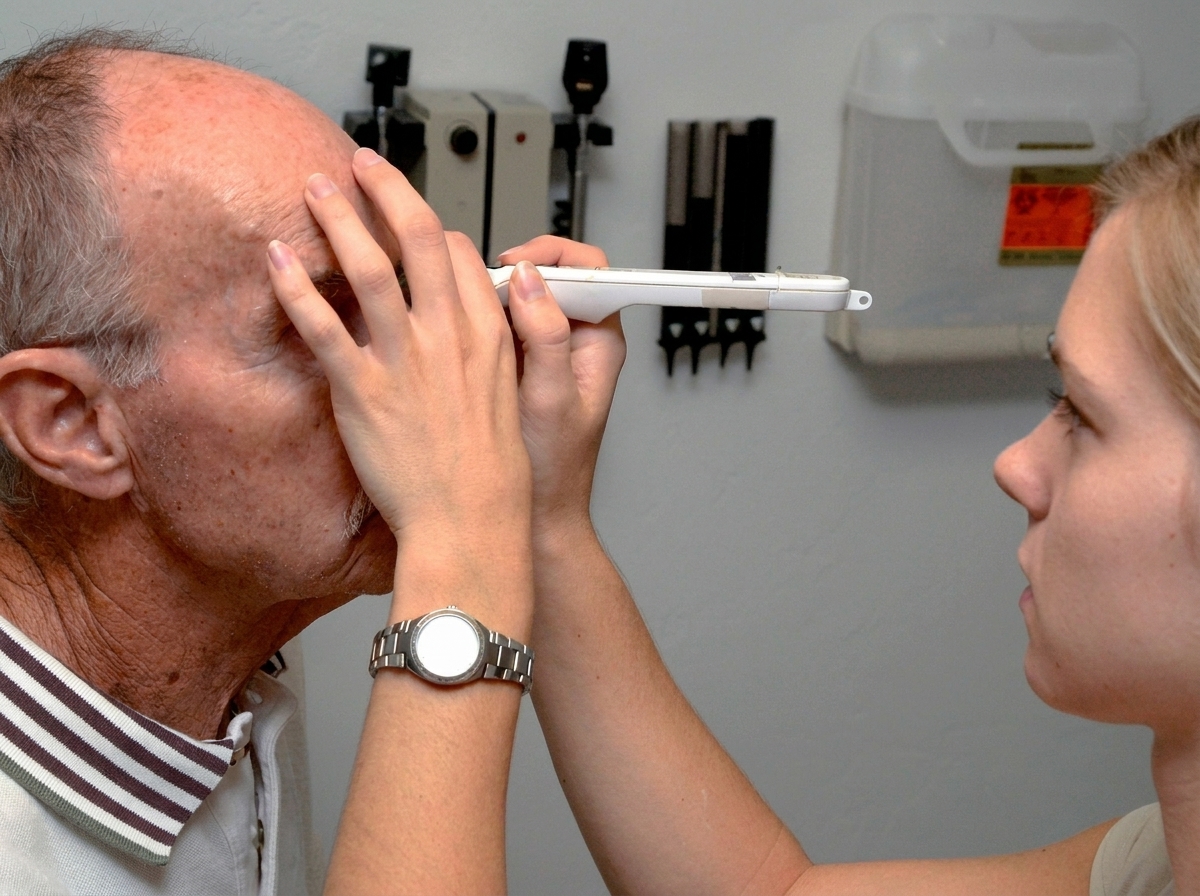
Explanation: ### Explanation The clinical presentation of a **red eye, excessive watering (epiphora), and a shallow anterior chamber** is highly suggestive of **Acute Angle-Closure Glaucoma (AACG)**. In any suspected case of glaucoma, the immediate priority is to confirm the diagnosis by measuring the **Intraocular Pressure (IOP)**. **1. Why Tonometry is the Correct Answer:** Tonometry is the gold standard for measuring IOP. In AACG, the IOP is typically severely elevated (often >40-60 mmHg). Establishing this elevation is the most critical "next step" to initiate emergency management (e.g., IV Mannitol, Acetazolamide) to prevent permanent optic nerve damage. **2. Why Other Options are Incorrect:** * **Gonioscopy:** While essential to visualize the angle and confirm "closure," it is technically difficult to perform during an acute attack due to corneal edema (haze). It is usually performed after the IOP is lowered and the cornea clears. * **Cup-to-disc (C:D) ratio & Ophthalmoscopy:** These assess the optic nerve head for chronic glaucomatous damage. In an acute attack, the priority is the pressure, not the morphology. Furthermore, corneal edema often obscures the view of the fundus during the initial presentation. **Clinical Pearls for NEET-PG:** * **Gold Standard Tonometry:** Goldmann Applanation Tonometry (GAT). * **Classic Triad of AACG:** Sudden ocular pain, "halos" around lights, and a mid-dilated non-reactive pupil. * **Definitive Treatment:** Peripheral Iridotomy (usually YAG laser) once the acute attack is controlled. * **Shallow Anterior Chamber:** Always predisposes a patient to angle closure; avoid mydriatics in such patients.
Explanation: **Explanation:** The core concept tested here is the **additive effect and systemic safety** of beta-blockers. **Why Levobunolol is the correct answer:** Levobunolol is a potent, non-selective **topical beta-blocker**. When a patient is already on systemic beta-blockers (e.g., for hypertension or ischemic heart disease), adding topical beta-blockers can lead to significant systemic absorption through the nasolacrimal duct. This results in an "additive effect," increasing the risk of severe adverse reactions such as **bradycardia, heart block, and bronchospasm**. Furthermore, the intraocular pressure (IOP) lowering effect of topical beta-blockers is significantly reduced in patients already taking systemic versions due to receptor saturation. **Analysis of Incorrect Options:** * **A. Brimonidine:** This is an alpha-2 agonist. It lowers IOP by decreasing aqueous production and increasing uveoscleral outflow. It does not share the same systemic contraindications as beta-blockers. * **B. Dorzolamide:** A topical carbonic anhydrase inhibitor. It reduces aqueous secretion and is a safe alternative for patients who cannot tolerate beta-blockers. * **D. Prostaglandin Analogues (e.g., Latanoprost):** These are the first-line treatment for primary open-angle glaucoma. They work by increasing uveoscleral outflow and have no significant systemic interaction with beta-blockers. **Clinical Pearls for NEET-PG:** * **Betaxolol** is a cardioselective ($\beta_1$) blocker and is relatively safer in patients with mild pulmonary issues, though still used with caution. * To minimize systemic absorption of any eye drop, advise patients to perform **punctal occlusion** (pressing the inner corner of the eye) for 2–3 minutes after instillation. * **Timolol** is the most commonly used topical beta-blocker but is contraindicated in patients with asthma or 2nd/3rd-degree heart block.
Explanation: **Explanation:** Trabeculectomy is the "gold standard" filtering surgery for glaucoma. The primary goal of the procedure is to create a new drainage pathway for aqueous humor to bypass the obstructed trabecular meshwork, thereby lowering intraocular pressure (IOP). **Why Option A is Correct:** During a trabeculectomy, a partial-thickness scleral flap is created, and a small piece of the limbal tissue (including the trabecular meshwork) is removed to create an opening into the **anterior chamber**. The aqueous humor flows through this opening, under the scleral flap, and into the **subconjunctival space**. This results in the formation of a **filtering bleb**, where the fluid is eventually absorbed by the conjunctival capillaries and lymphatics. **Why Other Options are Incorrect:** * **Option B:** A channel between the anterior and posterior chambers is created during a **Peripheral Iridectomy (PI)** or YAG laser iridotomy, used to treat angle-closure glaucoma by equalizing pressure between the two chambers. * **Option C:** This is anatomically incorrect for glaucoma filtration. The posterior chamber is located behind the iris; draining fluid directly from here to the subconjunctival space is not the standard surgical approach for trabeculectomy. **High-Yield Clinical Pearls for NEET-PG:** * **Antimetabolites:** Mitomycin-C (MMC) or 5-Fluorouracil (5-FU) are often applied during surgery to inhibit fibroblast proliferation and prevent bleb scarring (the most common cause of failure). * **Iridectomy:** A "peripheral iridectomy" is always performed during trabeculectomy to prevent the iris from plugging the internal ostium. * **Success Indicator:** The presence of a diffuse, shallow, and minimally vascularized **filtering bleb** indicates a functioning shunt.
Explanation: **Explanation:** **Krukenberg spindles** are vertical, spindle-shaped deposits of brown pigment on the **corneal endothelium**. They are a hallmark clinical sign of **Pigment Dispersion Syndrome (PDS)** and Pigmentary Glaucoma. 1. **Why Option A is Correct:** In PDS, there is an anatomical abnormality where the posterior surface of the iris rubs against the lens zonules (due to posterior bowing of the iris). This mechanical friction releases pigment granules into the aqueous humor. These granules follow the **convection currents** of the aqueous, rising near the warm iris and falling near the cooler cornea, eventually depositing vertically on the endothelium due to gravity and the eye's thermal gradient. 2. **Why Other Options are Incorrect:** * **Primary Angle Closure Glaucoma:** Characterized by a shallow anterior chamber and iris-corneal contact; pigment deposition is not a primary feature. * **Hypermature Morgagnian Cataract:** Associated with **Phacolytic glaucoma**, where leaked lens proteins (not pigment) are ingested by macrophages, blocking the trabecular meshwork. * **Anterior Uveitis:** May show Keratic Precipitates (KPs), which are inflammatory cell deposits, but these are typically white/mutton-fat and not organized in a vertical pigment spindle. **High-Yield Clinical Pearls for NEET-PG:** * **Triad of PDS:** Krukenberg spindle, mid-peripheral iris transillumination defects, and heavy trabecular meshwork pigmentation (Sampaolesi’s line). * **Patient Profile:** Typically young, myopic Caucasian males. * **Zentmayer’s Ring (Scheie’s Line):** Pigment deposition on the lens capsule/zonules, also seen in PDS. * **Management:** Laser Peripheral Iridotomy (LPI) can flatten the iris contour to reduce pigment release.
Aqueous Humor Dynamics
Practice Questions
Primary Open-Angle Glaucoma
Practice Questions
Primary Angle-Closure Glaucoma
Practice Questions
Secondary Open-Angle Glaucomas
Practice Questions
Secondary Angle-Closure Glaucomas
Practice Questions
Developmental and Congenital Glaucomas
Practice Questions
Medical Management of Glaucoma
Practice Questions
Laser Therapy in Glaucoma
Practice Questions
Glaucoma Filtration Surgery
Practice Questions
Glaucoma Drainage Devices
Practice Questions
Angle Assessment Techniques
Practice Questions
Visual Field Testing in Glaucoma
Practice Questions
Get full access to all questions, explanations, and performance tracking.
Start For Free