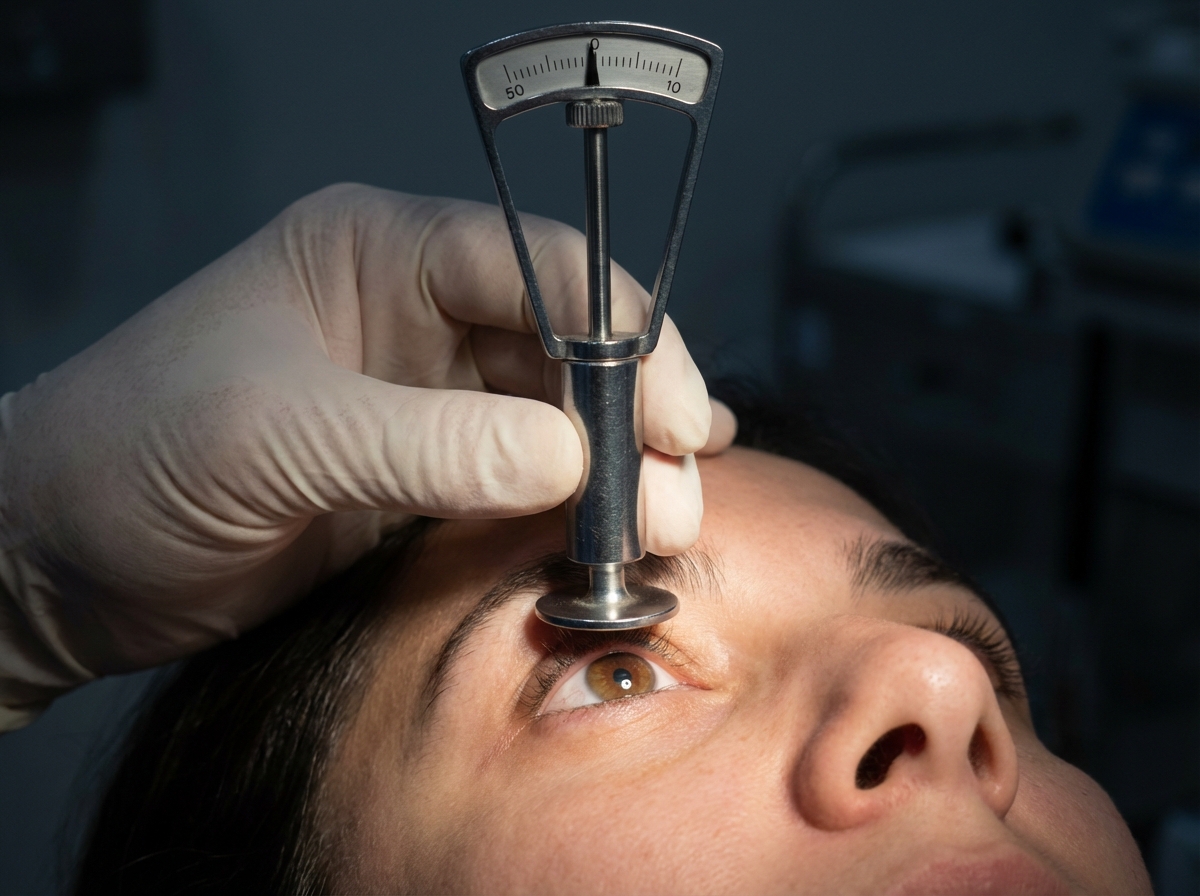
The Van Herick test is used for measuring which of the following?
A woman complains of colored haloes around lights in the evening, with nausea and vomiting. Intraocular pressure (IOP) is normal. What is the most likely diagnosis?
Shallow anterior chamber is seen in all of the following conditions EXCEPT:
Which of the following is not used in the management of glaucoma in hypertensive patients?
Pain in absolute glaucoma is best relieved by:
In Buphthalmos, all are seen except:
A patient has developed acute congestive glaucoma in their right eye. What prophylactic measure should be taken in the fellow eye?
How do hyperosmolar agents act in glaucoma?
Which test is used to differentiate halos due to angle closure glaucoma and immature cataract?
Intravenous (IV) Mannitol is used in which of the following conditions?
Explanation: **Explanation:** The **Van Herick technique** is a rapid, non-contact clinical method used to estimate the **peripheral anterior chamber depth (ACD)** using a slit lamp. **Why Option B is correct:** The test involves projecting a narrow slit beam onto the cornea at a 60° angle at the limbus. The examiner compares the thickness of the corneal section (the "optic section") to the width of the dark space (the peripheral anterior chamber) between the posterior cornea and the anterior iris. By grading this ratio (e.g., Grade 4 to Grade 1), clinicians can estimate the depth of the anterior chamber and identify eyes at risk for angle closure. **Why other options are incorrect:** * **Option A (Cells and flare):** These are markers of intraocular inflammation (uveitis) and are assessed using a small, bright rectangular beam in a dark room, not the Van Herick method. * **Option C (Anterior chamber angle):** While Van Herick *infers* the state of the angle, the definitive method to visualize and measure the AC angle is **Gonioscopy** (Gold Standard). * **Option D (Anterior chamber volume):** This is a quantitative measurement usually performed using advanced imaging like Pentacam or Anterior Segment OCT, not a bedside slit-lamp test. **High-Yield Clinical Pearls for NEET-PG:** * **Grading:** * Grade 4: AC depth > corneal thickness (Wide open). * Grade 1: AC depth < 1/4 corneal thickness (High risk of closure). * Grade 0: Slit-like or closed. * **Limitation:** It only assesses the temporal and nasal periphery; it cannot detect "creeping" angle closure or synechiae. * **Gold Standard for Angle Evaluation:** Gonioscopy (using a Goldmann or Zeiss lens).
Explanation: ### Explanation **Correct Option: B. Prodromal stage, closed-angle glaucoma** The clinical triad of **colored haloes**, **evening symptoms**, and **nausea/vomiting** is classic for the prodromal (intermittent) stage of Primary Angle-Closure Glaucoma (PACG). * **Mechanism:** In the evening (dim light), physiological mydriasis (pupil dilation) occurs. This leads to increased pupillary block and peripheral iris crowding, causing a transient rise in IOP. * **Colored Haloes:** The sudden IOP rise causes transient **corneal edema**. The edematous cornea acts as a diffraction grating, splitting white light into its spectral components (Fincham’s test). * **Normal IOP:** The hallmark of the prodromal stage is that symptoms are **self-limiting**. By the time the patient reaches the clinic, the pupil has constricted (e.g., due to bright light or sleep), the angle has reopened, and the IOP has returned to normal. **Why other options are incorrect:** * **A. Incipient stage open-angle glaucoma:** POAG is typically asymptomatic ("the silent thief of sight") and does not present with acute episodes of haloes or nausea. * **C & D. Migraine/Cluster Headache:** While these cause nausea and pain, they do not cause colored haloes. Haloes are a specific sign of corneal edema or lens changes. **High-Yield Clinical Pearls for NEET-PG:** 1. **Fincham’s Test:** Used to differentiate haloes of glaucoma (corneal edema) from cataract. Glaucomatous haloes disappear when a stenopeic slit is passed across the pupil; cataractous haloes do not. 2. **Precipitating Factors:** Dim light (cinema halls), emotional stress, or mydriatic drugs. 3. **Treatment of Choice:** Peripheral Iridotomy (usually YAG Laser) is the definitive treatment to prevent a full-blown acute attack. 4. **Differential Diagnosis:** Always rule out "Early Cataract" if a patient complains of haloes without pain/nausea.
Explanation: **Explanation:** The depth of the anterior chamber (AC) is a critical anatomical factor in differentiating types of glaucoma. **Why Steroid-induced Glaucoma is the correct answer:** Steroid-induced glaucoma is a form of **Secondary Open-Angle Glaucoma**. It occurs due to increased resistance to aqueous outflow at the level of the trabecular meshwork (caused by the accumulation of glycosaminoglycans). Because it is an open-angle pathology, the anterior chamber depth remains **normal or deep**. Therefore, it does not present with a shallow AC. **Analysis of Incorrect Options:** * **Old Age:** As age increases, the crystalline lens increases in anteroposterior thickness (phacomorphosis) and moves slightly forward, which naturally shallows the anterior chamber. * **Hypermetropia:** Hypermetropic eyes are anatomically smaller (short axial length). A relatively large lens in a small eye results in a shallow AC and a narrow drainage angle, predisposing them to angle closure. * **Angle Closure Glaucoma:** This is the classic condition associated with a shallow AC. The shallow depth facilitates iridocorneal contact, leading to pupillary block and subsequent angle closure. **High-Yield Clinical Pearls for NEET-PG:** * **Deep Anterior Chamber** is seen in: Myopia, Aphakia, Keratoconus, and Buphthalmos (Congenital Glaucoma). * **Shallow Anterior Chamber** is seen in: Hypermetropia, Malignant Glaucoma (Ciliary block), Intumescent cataract, and Spherophakia. * **Steroid Response:** Approximately 5-10% of the population are "high responders" who develop significant IOP elevation after 4-6 weeks of topical steroid use. * **Gold Standard** for measuring AC depth is Optical Pachymetry or A-scan ultrasonography; however, **Van Herick’s technique** is the common clinical screening method using a slit lamp.
Explanation: **Explanation:** The management of glaucoma in patients with systemic comorbidities like hypertension requires careful consideration of drug-drug interactions and systemic side effects. **Why Alpha Agonists (Option C) is the correct answer:** Alpha-2 agonists, particularly **Apraclonidine** and **Brimonidine**, are generally avoided or used with extreme caution in hypertensive patients. These agents can cause significant systemic cardiovascular effects. While they primarily act on alpha-2 receptors, they can cause a "rebound" hypertensive crisis or significant fluctuations in blood pressure. Furthermore, Brimonidine is contraindicated in patients taking **Monoamine Oxidase Inhibitors (MAOIs)**, which are sometimes used in refractory hypertension/depression, as they can precipitate a hypertensive crisis. **Analysis of Incorrect Options:** * **Dipivefrine (Option A):** This is a prodrug of epinephrine. While epinephrine itself can raise BP, Dipivefrine is designed to have better ocular penetration and fewer systemic side effects, making it less of a contraindication than alpha-agonists in this specific context. * **Beta-blockers (Option B):** Topical beta-blockers (e.g., Timolol) are actually often beneficial or neutral in hypertensive patients. However, they are strictly contraindicated in patients with **Asthma, COPD, or Heart Block**. * **Trabeculoplasty (Option D):** Laser Trabeculoplasty (ALT/SLT) is a non-pharmacological intervention. It has no systemic side effects and is a safe, preferred modality for managing glaucoma in patients with complex systemic vascular diseases. **High-Yield NEET-PG Pearls:** * **Brimonidine:** Can cause "Lethargy" in children (crosses Blood-Brain Barrier); contraindicated in children <2 years. * **Drug of Choice (DOC):** Prostaglandin analogues (Latanoprost) are the first-line treatment for most Glaucomas due to high efficacy and minimal systemic side effects. * **Beta-blocker of choice in respiratory patients:** Betaxolol (Cardioselective $B_1$ blocker).
Explanation: ### Explanation **Absolute Glaucoma** is the final stage of any uncontrolled glaucoma where the eye is completely blind (No Perception of Light), often stony hard, and associated with severe, agonizing pain due to high intraocular pressure (IOP). **Why Retrobulbar Alcohol is the Correct Choice:** In a blind, painful eye, the primary goal is **palliative care** (pain relief) rather than lowering IOP to save vision. A retrobulbar injection of **70-90% alcohol** (often preceded by Lidocaine) acts as a neurolytic agent. It destroys the ciliary ganglion and sensory nerve fibers (long and short ciliary nerves), effectively blocking the pain signals from the globe. This provides long-term relief without the need for invasive surgery like evisceration or enucleation. **Analysis of Incorrect Options:** * **B. Analgesics:** While they provide temporary relief, they are insufficient for the chronic, excruciating "stony hard" pain of absolute glaucoma. * **C. Trabeculectomy:** This is a filtering surgery intended to preserve vision. In absolute glaucoma, the eye is already blind and the internal structures are often too disorganized (atrophic) for this surgery to be successful or indicated. * **D. Miotics:** These are used to lower IOP in angle-closure glaucoma. In the absolute stage, the pupil is often fixed/dilated and the drainage angle is totally occluded by synechiae, making miotics ineffective. **High-Yield Clinical Pearls for NEET-PG:** * **Definition:** Absolute glaucoma = Blind eye (No PL) + High IOP + Pain. * **Sequence of Treatment:** 1. Medical management (Atropine 1% + Cycloplegics to relax ciliary body). 2. **Retrobulbar Alcohol** (Neurolysis). 3. **Cyclodestructive procedures** (e.g., Diode Laser Cyclophotocoagulation) to reduce aqueous production. 4. **Enucleation:** The final resort if pain persists or if an intraocular tumor is suspected. * **Appearance:** The eye may show a "ciliary staphyloma" and a "cupped-to-the-margin" optic disc.
Explanation: ### Explanation **Buphthalmos** (literally "ox-eye") is the clinical manifestation of **Primary Congenital Glaucoma**, occurring when intraocular pressure (IOP) is elevated before the age of 3 years. #### Why "Small Cornea" is the Correct Answer: In infants, the outer coats of the eye (sclera and cornea) are highly distensible and elastic. Persistent high IOP causes the entire globe to stretch and enlarge. Therefore, a **large cornea** (megalocornea) is a hallmark of the condition, making a "small cornea" (microcornea) clinically impossible in untreated Buphthalmos. #### Analysis of Other Options: * **Large Cornea (Megalocornea):** This is a cardinal sign. A corneal diameter >12 mm before age 1 or >13 mm at any age is diagnostic. Stretching also leads to **Haab’s striae** (horizontal breaks in Descemet’s membrane). * **Big Eyeball:** The entire globe enlarges due to the elasticity of the young sclera, leading to an increased axial length and progressive high myopia. * **Subluxated Lens:** As the eyeball and the ciliary ring enlarge, the zonules are stretched to their limit. This mechanical tension can lead to zonular dehiscence, resulting in lens subluxation. #### High-Yield Clinical Pearls for NEET-PG: 1. **Classic Triad:** Photophobia, Blepharospasm, and Lacrimation (Epiphora). 2. **Pathophysiology:** Caused by **Barkan’s Membrane**, an embryonic tissue remnant covering the trabecular meshwork due to incomplete development of the angle (Trabeculodysgenesis). 3. **Surgery of Choice:** * **Goniotomy** or **Trabeculotomy** (if the cornea is clear). * **Trabeculotomy + Trabeculectomy** (if the cornea is hazy). 4. **Genetics:** Often associated with the **CYP1B1** gene mutation.
Explanation: **Explanation:** **1. Why Laser Iridotomy is Correct:** Acute congestive glaucoma (Primary Angle Closure Glaucoma - PACG) is fundamentally an anatomical disease. If a patient experiences an attack in one eye, there is a **40-80% chance** of a similar attack occurring in the fellow eye within 5–10 years because the anatomical predisposition (shallow anterior chamber, narrow angles) is bilateral. Prophylactic **Laser Peripheral Iridotomy (LPI)** is the gold standard. It creates a small opening in the iris, bypassing pupillary block and allowing aqueous humor to flow freely from the posterior to the anterior chamber, thereby deepening the angle and preventing an acute attack. **2. Why Other Options are Incorrect:** * **Topical Steroids:** These are used to reduce inflammation *during* an acute attack but do not address the underlying anatomical narrow angle. In fact, long-term steroid use can cause secondary open-angle glaucoma. * **Peripheral Iridectomy:** While this achieves the same goal as LPI, it is a **surgical** procedure. In modern practice, non-invasive laser (LPI) is always preferred over surgical iridectomy unless the laser cannot be performed (e.g., due to a cloudy cornea). * **Antibiotics:** Glaucoma is a pressure-related mechanical/vascular issue, not an infectious one. Antibiotics have no role in its management. **3. High-Yield Clinical Pearls for NEET-PG:** * **Drug of Choice (Medical):** IV Mannitol or Acetazolamide to rapidly lower IOP. * **Definitive Treatment:** Laser Peripheral Iridotomy (LPI). * **The "Fellow Eye":** In PACG, the fellow eye is always considered an "eye at risk." * **Provocative Test:** The Dark Room Prone Position Test is used to diagnose inducible angle closure. * **Classic Presentation:** Mid-dilated, vertically oval, non-reactive pupil with "steamy" corneal edema and halos around lights.
Explanation: ### **Explanation** Hyperosmolar agents (such as **Mannitol** and **Glycerol**) act by creating an osmotic gradient between the blood and the intraocular fluids. **1. Why "Decreasing vitreous volume" is correct:** The primary mechanism of action for these agents is the **osmotic dehydration of the vitreous**. Because the blood-ocular barrier is relatively impermeable to these large molecules, they remain in the intravascular compartment, drawing water out of the vitreous body into the bloodstream. This reduction in vitreous volume causes the lens-iris diaphragm to shift backward, deepening the anterior chamber and rapidly lowering intraocular pressure (IOP). **2. Why the other options are incorrect:** * **A & D (Increasing aqueous/uveoscleral outflow):** These are the mechanisms of Prostaglandin analogues (uveoscleral) and Miotics/Trabeculoplasty (trabecular outflow). Hyperosmolar agents do not affect the drainage pathways. * **C (Decreasing aqueous production):** This is the mechanism of Carbonic Anhydrase Inhibitors (Acetazolamide) and Beta-blockers (Timolol). **3. NEET-PG High-Yield Pearls:** * **Mannitol (IV):** The most common agent used in acute emergencies (e.g., Acute Angle Closure Glaucoma). It is not metabolized and is excreted by the kidneys. * **Glycerol (Oral):** Effective but must be used cautiously in diabetics as it is metabolized into glucose, potentially causing hyperglycemia. * **Contraindications:** Congestive Heart Failure (CHF) and pulmonary edema, as these agents cause rapid expansion of extracellular fluid volume. * **Clinical Use:** Primarily used for rapid "de-bulking" of the eye before intraocular surgery or in acute hypertensive phases of glaucoma.
Explanation: The correct answer is **B. Differentiating halos due to angle closure glaucoma and immature cataract.** ### **Explanation** The test referred to in this question is **Emsley’s Fincham Test**. This test is used to distinguish between colored halos caused by corneal edema (as seen in acute angle-closure glaucoma) and those caused by lens opacities (as seen in immature cataracts). 1. **Glaucomatous Halos (Corneal Edema):** When a stenopeic slit is passed across the pupil, the halos **remain intact and stationary**. This is because the edema acts as a diffraction grating across the entire corneal surface. 2. **Cataractous Halos (Lenticular):** When the stenopeic slit is passed across the pupil, the halos **break up into segments** or disappear. This happens because the lens fibers (acting as the diffraction grating) are arranged radially, and the slit only allows light through specific sections of the lens at a time. ### **Why other options are incorrect:** * **Option A:** Differentiating open-angle from angle-closure glaucoma is primarily done via **Gonioscopy** (to visualize the drainage angle). * **Option C:** Classifying glaucomatous optic atrophy is done through **Fundoscopy** (cup-disc ratio) and **Perimetry** (visual field defects). * **Option D:** Differentiating uveitis types is done via slit-lamp examination looking for **Keratic Precipitates (KPs)**—large "mutton-fat" KPs indicate granulomatous inflammation. ### **High-Yield NEET-PG Pearls:** * **Halos in Glaucoma:** Caused by corneal edema (diffraction of light). The order of colors is **Blue inside, Red outside**. * **Emsley’s Fincham Test:** Uses a **stenopeic slit**. * **Differential Diagnosis of Halos:** Includes Acute Glaucoma, Cataract, and Mucopurulent Conjunctivitis (halos disappear after washing the eye/blinking).
Explanation: **Explanation:** **Angle Closure Glaucoma (Correct Answer):** IV Mannitol is a potent **hyperosmotic agent** used as a first-line emergency treatment for Acute Angle Closure Glaucoma (AACG). It works by increasing the plasma osmolarity relative to the vitreous humor. This creates an osmotic gradient that draws water out of the vitreous into the intravascular space, leading to a rapid reduction in vitreous volume and a subsequent drop in Intraocular Pressure (IOP). This "dehydration" of the vitreous helps deepen the anterior chamber and break the pupillary block. **Analysis of Incorrect Options:** * **Central Retinal Artery Occlusion (CRAO):** While reducing IOP is a goal in CRAO to improve perfusion, the primary emergency management involves ocular massage, anterior chamber paracentesis, or inhaled carbogen. Mannitol is not the standard of care here. * **Congestive Heart Failure (CHF) & Pulmonary Edema:** These are **absolute contraindications** for Mannitol. Mannitol initially causes a rapid expansion of extracellular fluid volume (drawing fluid from cells into the blood). In patients with CHF or pulmonary edema, this sudden increase in preload can lead to acute cardiac decompensation and worsen respiratory distress. **NEET-PG High-Yield Pearls:** * **Dose:** 1.5–2.0 g/kg body weight as a 20% solution, infused over 30–60 minutes. * **Mechanism:** Vitreous dehydration (Osmotic effect). * **Side Effects:** Headache (most common due to cerebral dehydration), nausea, and electrolyte imbalances. * **Contraindications:** Renal failure (anuria), severe dehydration, and active intracranial bleeding (except during craniotomy). * **Clinical Tip:** Always check the bottle for crystals; if present, warm the bottle to redissolve them before administration.
Aqueous Humor Dynamics
Practice Questions
Primary Open-Angle Glaucoma
Practice Questions
Primary Angle-Closure Glaucoma
Practice Questions
Secondary Open-Angle Glaucomas
Practice Questions
Secondary Angle-Closure Glaucomas
Practice Questions
Developmental and Congenital Glaucomas
Practice Questions
Medical Management of Glaucoma
Practice Questions
Laser Therapy in Glaucoma
Practice Questions
Glaucoma Filtration Surgery
Practice Questions
Glaucoma Drainage Devices
Practice Questions
Angle Assessment Techniques
Practice Questions
Visual Field Testing in Glaucoma
Practice Questions
Get full access to all questions, explanations, and performance tracking.
Start For Free