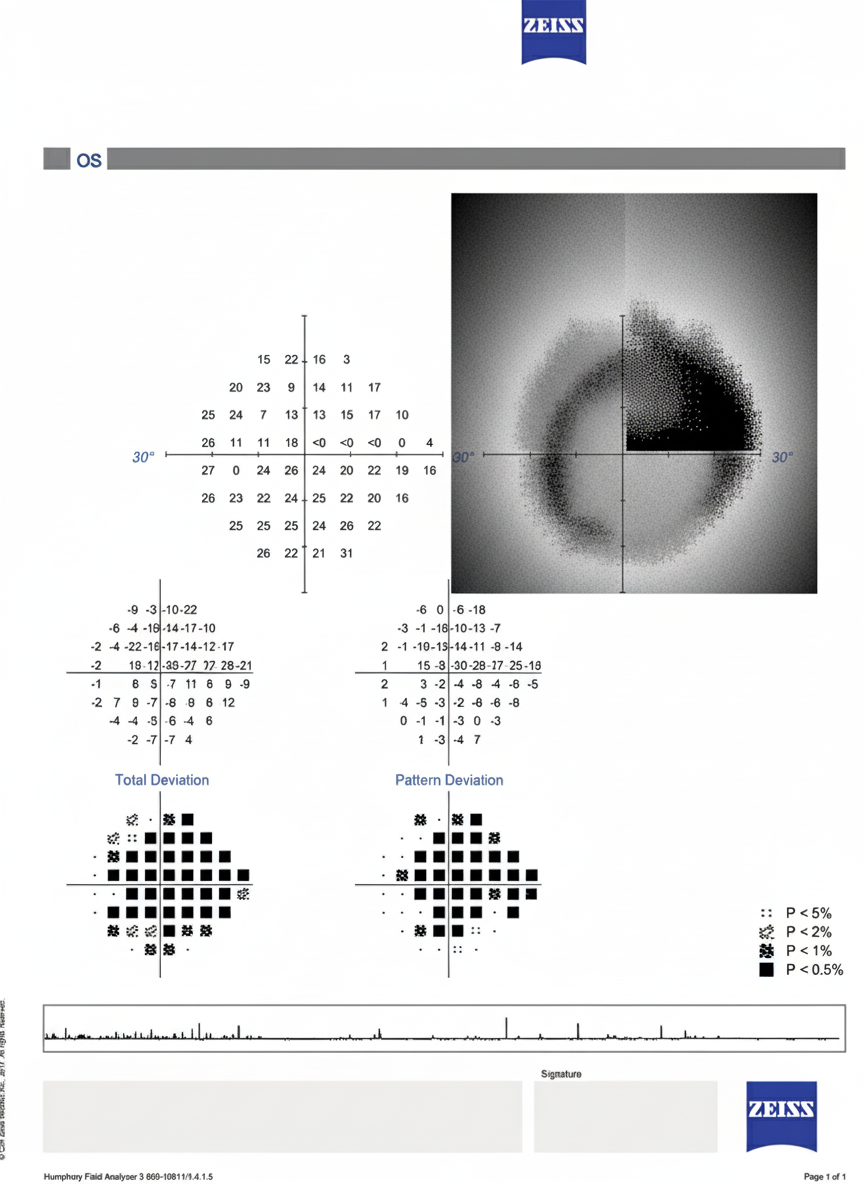
Uveitis with raised intraocular tension is best managed by?
100-day glaucoma is seen in which of the following conditions?
Ocular hypertension carries a high risk of progression to open-angle glaucoma. All of the statements given below are associated with the progression, except?
What is the approximate incidence of primary open-angle glaucoma in the population over 40 years of age?
Which of the following procedures involves the use of a glaucoma drainage device?
Which instrument best visualizes the recesses of the angle of the anterior chamber?
Angle recession glaucoma occurs in which of the following situations?
What is the normal cup-to-disc ratio?
Which of the following does NOT predispose to angle closure glaucoma?
Which of the following is the mechanism of action of the new drug Rhopressa for glaucoma treatment?
Explanation: In cases of **Uveitis with raised intraocular tension (Hypertensive Uveitis)**, the primary cause of the elevated pressure is the underlying inflammation. Inflammatory debris (cells and fibrin) clogs the trabecular meshwork, and inflammatory mediators cause trabeculitis, leading to reduced aqueous outflow. **Why Steroids are the Correct Answer:** Steroids are the definitive management because they address the **root cause**. By suppressing the intraocular inflammation, steroids clear the trabecular meshwork of debris and reduce trabeculitis, which subsequently lowers the intraocular pressure (IOP). While anti-glaucoma drugs are used as adjuncts, the IOP will not stabilize until the inflammation is controlled. **Analysis of Incorrect Options:** * **Pilocarpine (C):** This is **absolutely contraindicated** in uveitis. As a miotic, it breaks the blood-aqueous barrier, worsening inflammation. It also promotes the formation of posterior synechiae by keeping the pupil small and increases pain by causing ciliary muscle contraction. * **Atropine (B):** While atropine is used in uveitis to prevent synechiae and provide comfort (cycloplegia), it is not the primary agent to lower IOP. * **Timolol (A):** This is a beta-blocker used to reduce aqueous production. While it can be used as an adjunct to lower IOP in hypertensive uveitis, it does not treat the underlying inflammatory process. **High-Yield Clinical Pearls for NEET-PG:** * **Drug of Choice:** Topical Steroids (e.g., Prednisolone acetate 1%). * **Mydriatic of Choice:** Atropine is preferred in uveitis to put the ciliary body at rest and prevent "festooned pupils." * **Avoid:** Prostaglandin analogues (Latanoprost) in uveitis as they are pro-inflammatory and may cause cystoid macular edema (CME). * **Steroid-Induced Glaucoma:** Remember that long-term steroid use can itself cause a "steroid response" (raised IOP), but in the acute phase of hypertensive uveitis, they are life-saving for the eye.
Explanation: **Explanation:** **100-day glaucoma** is a classic clinical term for **Neovascular Glaucoma (NVG)** that occurs secondary to **Ischemic Central Retinal Vein Occlusion (CRVO)**. **Why CRVO is the correct answer:** In ischemic CRVO, widespread retinal hypoxia triggers the release of Vascular Endothelial Growth Factor (VEGF). This leads to **rubeosis iridis** (neovascularization of the iris) and the formation of a fibrovascular membrane over the trabecular meshwork. This membrane eventually contracts, causing synechial angle closure and a severe rise in intraocular pressure. The term "100-day" refers to the typical clinical latency period (approximately 3 months) between the initial vascular event and the onset of clinical glaucoma. **Why other options are incorrect:** * **Inflammatory Glaucoma:** This is usually caused by trabeculitis or inflammatory debris clogging the meshwork (open-angle) or posterior synechiae leading to iris bombé (closed-angle). It does not follow the specific 100-day timeline. * **CRAO:** While CRAO involves ischemia, it rarely causes NVG (occurring in <5% of cases) because the inner retinal layers are so infarcted that they often cannot produce sufficient VEGF. * **Steroid-induced Glaucoma:** This occurs due to increased resistance to aqueous outflow caused by structural changes in the trabecular meshwork (accumulation of GAGs). It is a secondary open-angle glaucoma and is not neovascular. **High-Yield Clinical Pearls for NEET-PG:** * **Most common cause of NVG:** Ischemic CRVO (followed by Diabetic Retinopathy). * **Ischemic vs. Non-ischemic CRVO:** Ischemic CRVO is defined by >10 disc areas of capillary non-perfusion on Fluorescein Angiography (FFA). * **Management:** Pan-retinal photocoagulation (PRP) is the gold standard to reduce the VEGF stimulus. Anti-VEGF injections are used as an adjunct.
Explanation: This question tests your knowledge of the **Ocular Hypertension Treatment Study (OHTS)**, a landmark trial that identified risk factors for the conversion of Ocular Hypertension (OHT) to Primary Open-Angle Glaucoma (POAG). ### **Why Option A is the Correct Answer (The False Statement)** Central Corneal Thickness (CCT) is one of the **most significant predictors** of progression. A **thin cornea** (typically <555 µm) is strongly associated with an increased risk of developing glaucoma. This is because: 1. **Measurement Error:** Goldmann Applanation Tonometry underestimates IOP in thin corneas, leading to a "false low" reading. 2. **Biological Factor:** Thin corneas may reflect a structurally weaker lamina cribrosa, making the optic nerve more susceptible to pressure damage. ### **Analysis of Other Options** * **Option B (Myopia):** High myopia is a well-established risk factor for POAG due to structural changes in the optic nerve head and an elongated axial length. * **Option C (IOP Control):** The OHTS trial proved that lowering IOP by 20% (using topical medications) reduced the risk of progression from 9.5% to 4.4% over five years. * **Option D (Race):** While glaucoma affects all races, the OHTS and other studies indicate that **African Americans** and **Caucasians** have a higher risk of progression compared to other groups, with African Americans often presenting with thinner corneas and earlier onset. ### **NEET-PG High-Yield Pearls** * **OHT Definition:** IOP >21 mmHg, normal optic disc, normal visual fields, and open angles. * **Key Risk Factors for Progression (OHTS):** 1. Higher IOP 2. Older Age 3. **Thin Central Corneal Thickness (CCT)** 4. Increased Vertical Cup-to-Disc Ratio (VCDR) 5. Higher Pattern Standard Deviation (PSD) on perimetry. * **Formula:** For every 40 µm decrease in CCT, there is a 70% increased risk of developing glaucoma.
Explanation: **Explanation:** Primary Open-Angle Glaucoma (POAG) is a chronic, progressive optic neuropathy characterized by a typical pattern of optic nerve head damage and visual field loss, occurring in the presence of an open anterior chamber angle. **Why Option A is Correct:** Epidemiological studies and standard ophthalmology textbooks (such as Khurana and Parsons) state that the prevalence of POAG increases significantly with age. In the population over **40 years of age**, the approximate incidence/prevalence is **1 in 100 (1%)**. This figure serves as a baseline for understanding the public health burden of the disease, as POAG is the most common type of glaucoma in many populations and a leading cause of irreversible blindness. **Why Other Options are Incorrect:** * **Option B (1 in 200):** This underestimates the prevalence in the 40+ age group. While it might reflect younger cohorts, it does not represent the standard statistical benchmark for the over-40 population. * **Options C and D (1 in 500 and 1 in 1000):** These figures are significantly lower than the actual prevalence. Such low frequencies are more characteristic of rarer conditions like Congenital Glaucoma or specific secondary glaucomas. **High-Yield Clinical Pearls for NEET-PG:** * **Risk Factors:** Increasing age, elevated Intraocular Pressure (IOP), African race, family history, and high myopia. * **Diagnosis:** Characterized by the "Triad" of (1) IOP >21 mmHg (though not always present), (2) Optic disc cupping, and (3) Visual field defects (e.g., Bjerrum’s scotoma). * **Screening:** Because POAG is often asymptomatic until advanced stages ("The Silent Thief of Sight"), routine screening after age 40 is clinically vital. * **Treatment:** Prostaglandin analogues (e.g., Latanoprost) are currently the first-line medical management.
Explanation: **Explanation:** **Correct Answer: D. Seton operation** The **Seton operation** refers to the surgical implantation of a **Glaucoma Drainage Device (GDD)** or aqueous shunt. These devices (e.g., Ahmed Glaucoma Valve, Baerveldt, or Molteno implants) consist of a tube inserted into the anterior chamber that drains aqueous humor to an external plate fixed to the sclera. This creates a permanent pathway for fluid to bypass the trabecular meshwork. It is typically indicated in "refractory" cases where traditional surgery has failed, such as neovascular glaucoma, uveitic glaucoma, or scarred conjunctiva. **Why the other options are incorrect:** * **A. Viscocanalostomy:** This is a **non-penetrating** glaucoma surgery where viscoelastic material is used to dilate Schlemm’s canal to improve outflow. No hardware or shunt is implanted. * **B. Trabeculectomy:** This is the "gold standard" filtering surgery. It involves creating a fistula to drain aqueous into a subconjunctival **bleb**. While it creates a new drainage pathway, it does not utilize a synthetic drainage device (tube). * **C. Deep sclerectomy:** Another **non-penetrating** procedure where a deep scleral flap is removed to allow aqueous to percolate through the thin trabeculo-descemet’s membrane. No device is used. **High-Yield Clinical Pearls for NEET-PG:** * **Ahmed Valve:** A popular "valved" Seton device that limits hypotony by closing if intraocular pressure (IOP) drops below 8 mmHg. * **Indication:** Setons are the procedure of choice for **Neovascular Glaucoma (NVG)** and **Glaucoma in Aphakia**. * **Complication:** The most common early complication of non-valved Setons is **postoperative hypotony**, while late complications include **tube erosion** or **corneal endothelial loss**.
Explanation: **Explanation:** The correct answer is **Gonioscope**. The angle of the anterior chamber cannot be visualized directly through a slit lamp because light rays originating from the angle undergo **total internal reflection** at the tear-air interface. This occurs because the angle of incidence exceeds the critical angle (approx. 46°). A **Gonioscope** (using a goniolens) overcomes this by replacing the cornea-air interface with a glass-tear interface, allowing light to exit and providing a clear view of structures like the trabecular meshwork, Schwalbe’s line, and the scleral spur. **Analysis of Incorrect Options:** * **Keratometer:** Used to measure the **curvature of the anterior surface of the cornea**, primarily for calculating IOL power or fitting contact lenses. * **Tonometer:** Used to measure **Intraocular Pressure (IOP)**. Examples include Goldmann Applanation Tonometer (Gold Standard) and Schiotz tonometer. * **Snellen’s Chart:** A tool used to assess **distance visual acuity**. **High-Yield Clinical Pearls for NEET-PG:** * **Gold Standard for Angle Evaluation:** Gonioscopy is essential for differentiating between **Open-Angle** and **Angle-Closure Glaucoma**. * **Types of Gonioscopy:** * *Direct (Koeppe lens):* Provides an upright image; used during surgery. * *Indirect (Goldmann/Zeiss lens):* Provides an inverted image; uses mirrors. * **Shaffer’s Grading:** The most common system used during gonioscopy to grade the width of the angle (Grade 0 to 4). * **Van Herick Technique:** A slit-lamp method to *estimate* angle depth, but it does not replace formal gonioscopy.
Explanation: **Explanation:** **Angle Recession Glaucoma** is a secondary open-angle glaucoma that occurs as a late complication of **blunt (concussion) trauma** to the eye. 1. **Why Option A is Correct:** When the globe undergoes a sudden concussion injury, the force causes a rapid anteroposterior compression and simultaneous equatorial expansion. This hydraulic pressure forces aqueous humor against the iris root and ciliary body. The result is a **tear between the longitudinal and circular muscles of the ciliary body**. While the angle initially appears "wider" (recessed) on gonioscopy, the subsequent scarring and degenerative changes in the trabecular meshwork lead to decreased aqueous outflow and elevated intraocular pressure (IOP), often years after the initial injury. 2. **Why Other Options are Incorrect:** * **Extraction of cataract:** This usually *lowers* IOP in primary angle-closure cases. If glaucoma occurs post-surgery, it is typically due to pupillary block, retained viscoelastic, or inflammation (uveitic glaucoma), not angle recession. * **Goniotomy:** This is a *surgical treatment* for congenital glaucoma where the Barkan’s membrane is incised to improve drainage; it does not cause angle recession. * **Intraocular tumors:** These cause secondary glaucoma via direct invasion of the angle, neovascularization, or anterior displacement of the iris-lens diaphragm. **High-Yield Clinical Pearls for NEET-PG:** * **Gonioscopy Finding:** A characteristic wide ciliary body band (deeper angle) compared to the fellow eye. * **Vossius Ring:** Often seen on the lens capsule, indicating previous blunt trauma. * **Risk:** Only about 5-10% of eyes with >180° of recession develop glaucoma; however, it is often a "bimodal" presentation (early spike or late-onset years later). * **Management:** It is often resistant to medical therapy; trabeculectomy with antimetabolites (Mitomycin-C) may be required.
Explanation: The **Cup-to-Disc Ratio (CDR)** is a critical clinical measurement used to assess the health of the optic nerve head. It compares the diameter of the "cup" (the central pale depression) to the total diameter of the "optic disc." ### **Explanation of the Correct Answer** * **Option A (0.3):** In a healthy individual, the normal CDR typically ranges from **0.1 to 0.3**. A ratio of 0.3 means the cup occupies 30% of the disc's diameter. While there is physiological variation based on disc size, 0.3 is considered the standard baseline for a healthy eye. ### **Explanation of Incorrect Options** * **Option B (0.6):** A CDR of 0.6 is generally considered **suspicious**. In clinical practice, a ratio >0.5 or an asymmetry between the two eyes of >0.2 is a red flag for Glaucoma (glaucomatous cupping). * **Option C & D (1.2 and 2.4):** These values are physiologically impossible. The cup is a part of the disc; therefore, the ratio cannot exceed **1.0**. A ratio of 1.0 (Total Cupping) represents the end-stage of glaucoma where all nerve fibers are lost. ### **High-Yield Clinical Pearls for NEET-PG** 1. **ISNT Rule:** In a normal disc, the thickness of the neuroretinal rim follows the ISNT rule (**Inferior > Superior > Nasal > Temporal**). Glaucoma often causes thinning of the inferior and superior rims first, breaking this rule. 2. **Large Discs vs. Glaucoma:** Large optic discs naturally have larger cups (physiological cupping). Always correlate CDR with the overall disc size. 3. **Vertical Cupping:** Glaucomatous damage often occurs at the poles, leading to **vertical elongation** of the cup (vertical CDR > horizontal CDR). 4. **Bayoneting Sign:** This occurs when retinal vessels make a sharp "Z" bend as they pass over the sharp edge of a deep cup, highly characteristic of advanced glaucoma.
Explanation: To understand the predisposition to **Primary Angle Closure Glaucoma (PACG)**, one must visualize a "crowded" anterior segment. PACG occurs when the iris physically obstructs the trabecular meshwork, a condition favored by specific anatomical dimensions. ### Why "Flat Cornea" is the Correct Answer A **flat cornea** (large radius of curvature) actually increases the volume of the anterior chamber and is generally associated with longer eyeballs (myopia). In contrast, a **steep cornea** (small radius of curvature) is a known risk factor for PACG because it is often associated with a shallower anterior chamber and a more crowded angle. Therefore, a flat cornea is protective rather than predisposing. ### Analysis of Incorrect Options * **Small Cornea (Microcornea):** A smaller corneal diameter (typically <11 mm) results in a smaller anterior segment, forcing the internal structures into a tighter space, which narrows the angle. * **Shallow Anterior Chamber:** This is the hallmark anatomical precursor for PACG. A decreased distance between the corneal endothelium and the iris/lens diaphragm makes pupillary block more likely. * **Short Axial Length:** This is characteristic of **hypermetropic (farsighted) eyes**. In short eyes, the lens is disproportionately large relative to the small globe, pushing the iris forward and narrowing the drainage angle. ### High-Yield Clinical Pearls for NEET-PG * **The "Crowded Eye":** PACG is most common in elderly, hypermetropic females. * **Lens Factor:** As age increases, the lens grows in thickness (phacomorphic component), further shallowing the anterior chamber. * **Trigger:** Mydriasis (pupillary dilation) can precipitate an acute attack by bunching the peripheral iris into the angle. * **Gold Standard Diagnosis:** Gonioscopy (to visualize the angle structures). * **Treatment of Choice:** Laser Peripheral Iridotomy (LPI).
Explanation: **Explanation:** **Rhopressa (Netarsudil)** is a first-in-class **Rho-kinase (ROCK) inhibitor** recently approved for the treatment of open-angle glaucoma and ocular hypertension. **1. Why Option B is Correct:** The primary mechanism of Netarsudil is the **increase of aqueous outflow through the trabecular meshwork (TM)**, which is the "conventional" outflow pathway. It works by inhibiting the Rho-kinase enzyme, leading to the relaxation of the actin-myosin cytoskeleton within the trabecular meshwork cells and the contraction of the inner wall of Schlemm’s canal. This reduces resistance and increases the ease with which fluid leaves the eye. Additionally, it lowers episcleral venous pressure. **2. Why the Other Options are Incorrect:** * **Option A:** Increased uveoscleral (unconventional) outflow is the primary mechanism of **Prostaglandin Analogues** (e.g., Latanoprost). * **Option C:** Increasing aqueous production would raise intraocular pressure (IOP) and is contraindicated in glaucoma management. * **Option D:** Decreased aqueous production is the mechanism of **Beta-blockers** (e.g., Timolol), **Alpha-2 agonists** (e.g., Brimonidine), and **Carbonic Anhydrase Inhibitors** (e.g., Dorzolamide). **Clinical Pearls for NEET-PG:** * **Triple Action:** Netarsudil is unique because it (1) increases TM outflow, (2) decreases episcleral venous pressure, and (3) slightly reduces aqueous production (minor effect). * **Side Effects:** The most common side effect is **conjunctival hyperemia** (redness) and **conjunctival hemorrhages** (petechiae). It can also cause **cornea verticillata** (vortex keratopathy). * **Dosing:** It is typically administered as a once-daily drop in the evening.
Aqueous Humor Dynamics
Practice Questions
Primary Open-Angle Glaucoma
Practice Questions
Primary Angle-Closure Glaucoma
Practice Questions
Secondary Open-Angle Glaucomas
Practice Questions
Secondary Angle-Closure Glaucomas
Practice Questions
Developmental and Congenital Glaucomas
Practice Questions
Medical Management of Glaucoma
Practice Questions
Laser Therapy in Glaucoma
Practice Questions
Glaucoma Filtration Surgery
Practice Questions
Glaucoma Drainage Devices
Practice Questions
Angle Assessment Techniques
Practice Questions
Visual Field Testing in Glaucoma
Practice Questions
Get full access to all questions, explanations, and performance tracking.
Start For Free