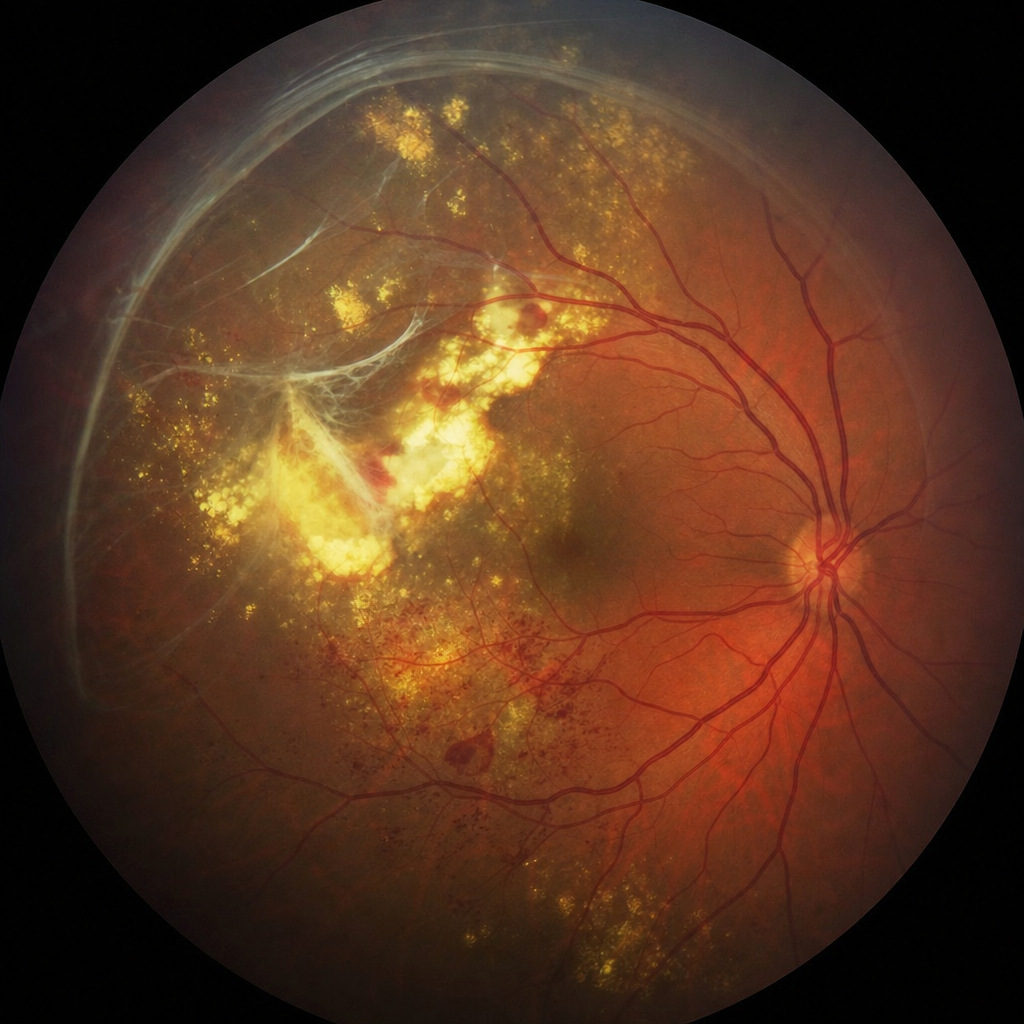
In retinal artery angiogram, where is the dye typically injected?
Which of the following is not a feature of pathological myopia?
The Amsler grid test is used to assess which of the following?
A hypertensive patient presented with sudden, painless loss of vision that occurred in the morning. This presentation is seen in all of the following conditions, EXCEPT:
Which of the following is most characteristic of exudative retinal detachments?
In which of the following diseases is the macula most commonly involved?
What is the most common eye pathology in toxoplasma infection?
The ocular features of retinitis pigmentosa include:
The type of degeneration most commonly associated with retinal breaks is:
What is the definition of retinal detachment?
Explanation: **Explanation:** The question refers to **Fluorescein Angiography (FFA)**, a fundamental diagnostic procedure in ophthalmology used to visualize the retinal and choroidal circulation. **Why Antecubital Vein is Correct:** In standard clinical practice, Sodium Fluorescein dye (usually 5ml of a 10% solution) is injected into a **peripheral vein**, most commonly the **antecubital vein**. Once injected, the dye travels through the systemic venous circulation to the heart, then via the arterial system (Aorta → Carotid Artery → Ophthalmic Artery → Central Retinal Artery) to reach the eye. This allows for a sequential study of the retinal blood flow (filling phases). **Why Other Options are Incorrect:** * **Retinal Artery:** Direct injection into the retinal artery is anatomically impossible and clinically dangerous; it would cause immediate trauma and vascular occlusion. * **Ophthalmic Artery:** While selective intra-arterial injections are used in specialized procedures (like intra-arterial chemotherapy for Retinoblastoma), they are not used for routine diagnostic angiography due to the high risk of stroke and orbital complications. * **Femoral Vein:** While technically possible for systemic access, it is unnecessarily invasive compared to the easily accessible antecubital vein. **High-Yield Clinical Pearls for NEET-PG:** * **Arm-to-Retina Time:** The time taken for the dye to reach the retinal arteries after injection into the antecubital vein is typically **8 to 14 seconds**. * **Dye Properties:** Sodium Fluorescein is excreted primarily by the **kidneys**; patients should be warned about yellowish discoloration of urine and skin for 24 hours. * **Contraindications:** History of severe allergic reactions or anaphylaxis to the dye. * **Phases of FFA:** Choroidal (Flush) → Arterial → Arteriovenous (Capillary) → Venous → Recirculation/Late phase.
Explanation: **Explanation:** Pathological (Degenerative) myopia is characterized by progressive axial elongation of the globe (usually >26 mm) leading to degenerative changes in the posterior segment. **Why "Anterior Staphyloma" is the correct answer:** A staphyloma is a localized bulge of the eyeball lined by uveal tissue. In pathological myopia, the elongation occurs primarily at the posterior pole, leading to **Posterior Staphyloma** (the hallmark of the disease). **Anterior staphyloma** is typically a sequel of corneal perforation or severe thinning (e.g., following a sloughing corneal ulcer) and is not a feature of myopia. **Analysis of Incorrect Options:** * **Lattice and Snail Track Degeneration:** These are peripheral retinal degenerations common in high myopes. They represent areas of retinal thinning and vitreoretinal adhesion, significantly increasing the risk of rhegmatogenous retinal detachment. * **Cystoid Degeneration:** This refers to the formation of tiny fluid-filled spaces in the peripheral retina (Blessig-Iwanoff cysts). It is frequently seen in myopic eyes due to chronic stretching and peripheral retinal ischemia. * **Tessellated Fundus:** This is one of the earliest signs of pathological myopia. It occurs because the retinal pigment epithelium (RPE) thins out, making the underlying large choroidal vessels visible, giving the fundus a "tiger-stripe" or tessellated appearance. **High-Yield Clinical Pearls for NEET-PG:** * **Hallmark:** Posterior Staphyloma (most common site is the posterior pole). * **Fuchs’ Spot:** A pigmented lesion at the macula caused by subretinal neovascularization (CNVM) followed by scarring. * **Lacquer Cracks:** Linear breaks in the Bruch’s membrane. * **Optic Disc:** Often shows a **Myopic Crescent** (usually temporal) and may appear tilted. * **Complications:** Retinal detachment, macular holes, and early-onset nuclear cataract.
Explanation: **Explanation:** The **Amsler grid** is a simple, non-invasive clinical tool used primarily to evaluate the central **10 degrees of the visual field**. It is specifically designed to assess **macular function**. The macula is responsible for central, high-resolution vision. When pathological changes occur in the macula—such as subretinal fluid, hemorrhages, or choroidal neovascularization (as seen in Wet ARMD)—the overlying retina becomes distorted. This leads to **metamorphopsia** (distortion of straight lines) or **scotomas** (blind spots), which the patient can easily identify while viewing the grid. **Analysis of Options:** * **Option A (Corneal thickness):** Measured via **Pachymetry**, which is essential for glaucoma screening and refractive surgery workups. * **Option C (Visual field changes):** While the Amsler grid does test a small part of the field, "visual field changes" usually refers to peripheral field defects (e.g., in glaucoma), which are assessed via **Perimetry** (e.g., Humphrey Field Analyzer). * **Option D (Squint angle):** Measured using tests like the **Krimsky test**, **Prism Cover Test**, or a **Synoptophore**. **High-Yield Clinical Pearls for NEET-PG:** * **Metamorphopsia** is the hallmark symptom detected by the Amsler grid. * It is the gold standard for **home monitoring** in patients with Age-Related Macular Degeneration (ARMD). * The grid consists of a 10x10 cm square containing 5mm squares; when held at 33 cm, each small square subtends an angle of **1 degree**. * Other tests for macular function include the **Photostress test**, Contrast Sensitivity, and the Watzke-Allen sign.
Explanation: **Explanation:** The clinical presentation of **sudden, painless loss of vision** is a classic high-yield topic in Ophthalmology. The key to this question lies in differentiating between conditions that cause acute vision loss versus those that cause transient or chronic changes. **Why Papilloedema is the Correct Answer:** Papilloedema refers to bilateral optic disc swelling due to increased intracranial pressure. It typically presents with **transient visual obscurations** (blurring lasting seconds) or chronic, progressive field loss. It does **not** cause sudden, permanent loss of vision in the early stages. Therefore, it is the exception in this list. **Analysis of Incorrect Options:** * **Amblyopia:** While traditionally a developmental condition, "Tobacco Amblyopia" (Toxic Optic Neuropathy) or sudden functional vision loss can be categorized here. However, in the context of NEET-PG, if "Amblyopia" refers to **Amaurosis Fugax** (often grouped in older texts), it presents as sudden painless loss. *Note: If the option refers to developmental lazy eye, it is usually gradual, but in competitive exams, Papilloedema is the most definitive "non-sudden" cause among these.* * **Vitreous Hemorrhage:** Common in hypertensive or diabetic patients. The blood blocks the visual axis, leading to an immediate, painless "curtain falling" or total loss of vision. * **Central Retinal Vein Occlusion (CRVO):** Classically occurs in elderly hypertensives. Patients often wake up in the morning with sudden painless vision loss due to venous stasis and macular edema (the "Blood and Thunder" fundus). **Clinical Pearls for NEET-PG:** * **Morning Vision Loss:** Highly suggestive of **CRVO** or **Non-Arteritic Ischemic Optic Neuropathy (NAION)** due to nocturnal hypotension. * **Sudden Painless Loss (Differential):** CRAO (Cherry red spot), CRVO (Tortuous veins), Vitreous Hemorrhage, and Retinal Detachment. * **Sudden Painful Loss:** Acute Congestive Glaucoma or Optic Neuritis (pain on eye movement).
Explanation: **Explanation:** Exudative (Serous) Retinal Detachment (RD) occurs when fluid accumulates in the subretinal space due to damage to the Blood-Retinal Barrier (BRB) or the Retinal Pigment Epithelium (RPE), without any break in the retina. **Why "Shifting Fluid" is correct:** The hallmark of exudative RD is **shifting fluid**. Since the subretinal fluid is not trapped by a break or traction, it is influenced by gravity. When the patient changes position, the fluid moves to the most dependent part of the eye, causing the detachment to shift accordingly. This is a pathognomonic clinical sign. **Analysis of Incorrect Options:** * **Demarcation lines:** These represent "tide marks" where the RPE has reacted to the presence of subretinal fluid. They are characteristic of **chronic Rhegmatogenous RD**, indicating that the detachment has been stationary for months. * **Tobacco dusting (Shafer’s sign):** This refers to the presence of RPE cells in the anterior vitreous. It is a classic sign of a **retinal tear** (Rhegmatogenous RD). * **Fixed folds:** These occur due to Proliferative Vitreoretinopathy (PVR), where membranes contract on the retinal surface. They are typically seen in **long-standing Rhegmatogenous or Tractional RD**, not exudative. **High-Yield Clinical Pearls for NEET-PG:** * **Causes of Exudative RD:** VKH syndrome, Sympathetic Ophthalmitis, Posterior Scleritis, and Choroidal tumors (e.g., Melanoma). * **Appearance:** The detached retina is smooth, convex, and lacks folds (unlike the corrugated appearance of Rhegmatogenous RD). * **Management:** Unlike other types, Exudative RD is primarily managed **medically** by treating the underlying cause (e.g., steroids for inflammation).
Explanation: **Explanation:** **Ocular Toxoplasmosis** is the most common cause of posterior uveitis worldwide. The causative organism, *Toxoplasma gondii*, has a unique predilection for the **macula** (the central retina). In congenital cases, it typically presents as a bilateral, "punched-out" pigmented chorioretinal scar in the macula, often referred to as a **Macular Coloboma** (a misnomer, as it is inflammatory, not developmental). In acquired cases, the classic presentation is a focal necrotizing retinitis adjacent to an old scar, described as a **"Headlight in the fog"** appearance due to overlying vitritis. **Analysis of Incorrect Options:** * **Sarcoidosis:** Primarily causes a granulomatous panuveitis. While it can cause macular edema, its hallmark posterior segment findings are **"Candle-wax drippings"** (periphlebitis) and "string of pearls" vitreous opacities. * **Brucellosis:** A rare cause of uveitis that typically presents as a non-specific chronic iridocyclitis or nummular keratitis; it does not specifically target the macula. * **Leprosy:** Ocular involvement in leprosy (Hansen’s disease) predominantly affects the **anterior segment**. Common findings include madarosis, lagophthalmos, episcleritis, and chronic iris atrophy with "pearls." Posterior segment involvement is extremely rare. **High-Yield Clinical Pearls for NEET-PG:** * **Most common site of Toxoplasmosis:** Macula. * **Treatment of choice:** Triple therapy (Pyrimethamine, Sulfadiazine, and Folinic acid) + Steroids (never give steroids without anti-parasitic coverage). * **Differential Diagnosis:** In infants, a macular scar must be differentiated from Cytomegalovirus (CMV) and Retinoblastoma. * **Key Sign:** Focal necrotizing retinitis is the hallmark.
Explanation: **Explanation:** **Toxoplasmosis**, caused by the protozoan *Toxoplasma gondii*, is the most common cause of posterior uveitis worldwide. The parasite has a specific predilection for neural tissue, particularly the **retina**. 1. **Why Retinochoroiditis is correct:** In toxoplasmosis, the primary site of infection is the retina (retinitis). Because the underlying choroid is almost always involved secondarily due to its proximity, the condition is accurately termed **retinochoroiditis**. The classic presentation is a "headlight in the fog" appearance, where an active white fluffy retinal lesion is seen adjacent to an old, pigmented chorioretinal scar. 2. **Why other options are incorrect:** * **Corneal Ulcer:** This is typically caused by bacteria, fungi, or viruses (like HSV) and is not a feature of systemic toxoplasmosis. * **Uveitis:** While toxoplasmosis *causes* uveitis, "Uveitis" is a broad term. Retinochoroiditis is the specific, definitive pathological manifestation. Anterior uveitis seen in these cases is usually a secondary "reactive" phenomenon. * **Cataract:** This is a secondary complication (complicated cataract) resulting from chronic inflammation or steroid use, not the primary pathology. **High-Yield Clinical Pearls for NEET-PG:** * **Congenital Toxoplasmosis Triad:** Chorioretinitis, Hydrocephalus, and Intracranial calcifications. * **Most common site:** Macula (leading to significant vision loss). * **Treatment of choice:** Triple therapy (Pyrimethamine, Sulfadiazine, and Folinic acid) + Steroids (only after 48 hours of antimicrobial cover). * **Key sign:** "Headlight in the fog" (active lesion viewed through vitritis).
Explanation: **Explanation:** Retinitis Pigmentosa (RP) is a hereditary, progressive dystrophy primarily affecting the rod photoreceptors and the retinal pigment epithelium (RPE). The diagnosis is clinically established by a classic **"Diagnostic Triad"** of fundus findings, which are represented in the options: 1. **Bony Corpuscular Appearance (Option A):** This refers to the characteristic pigmentary changes. As photoreceptors degenerate, pigment migrates from the RPE and accumulates in the perivascular spaces of the inner retina, forming shapes resembling the spicules of bone (bone spicules). These typically appear first in the mid-periphery. 2. **Waxy Pallor of the Optic Disc (Option B):** The optic disc develops a yellowish-white, "waxy" appearance. This is not true primary optic atrophy but is caused by the formation of a glial membrane over the disc surface (gliosis). 3. **Attenuation of Retinal Arterioles (Option C):** There is a marked narrowing (thread-like appearance) of the retinal blood vessels, likely a secondary response to reduced metabolic demand from the degenerating retina. **Why "All of the above" is correct:** Since all three features—bone spicule pigmentation, waxy disc pallor, and arteriolar attenuation—constitute the hallmark clinical triad of RP, Option D is the correct choice. **High-Yield Clinical Pearls for NEET-PG:** * **Symptoms:** The earliest symptom is **Nyctalopia** (night blindness), followed by "ring scotoma" leading to **tunnel vision**. * **Electroretinogram (ERG):** This is the most sensitive test; the ERG is typically **"extinguished"** (flat) even before fundus changes appear. * **Associations:** Look for **Cystoid Macular Edema (CME)** and **Posterior Subcapsular Cataract (PSC)** as common complications. * **Usher Syndrome:** The most common systemic association (RP + Sensorineural hearing loss).
Explanation: **Explanation:** **Lattice degeneration** is the correct answer because it is the most significant peripheral retinal degeneration predisposing to rhegmatogenous retinal detachment (RRD). It is characterized by thinning of the inner retinal layers, overlying vitreous liquefaction (lacunae), and, most importantly, **strong vitreoretinal adhesions** at the margins of the lesion. These adhesions create tractional forces that lead to "U-shaped" or "horseshoe" tears, which are the primary precursors to retinal breaks. It is found in approximately 8–10% of the general population but is present in about 30% of eyes with RRD. **Analysis of Incorrect Options:** * **Paving stone (Cobblestone) degeneration:** This involves atrophy of the outer retina and choriocapillaris. Since the overlying vitreous is not abnormally adherent, it **does not** lead to retinal breaks or detachment. * **Snowflake degeneration:** These are tiny, white-yellow spots (granular deposits) in the peripheral retina. While they indicate vitreoretinal changes, they are much less frequently associated with clinical breaks compared to lattice. * **Cystoid degeneration:** This is a common age-related change (Blessig-Iwanoff cysts) occurring near the ora serrata. While it can lead to typical degenerative retinoschisis, it rarely causes full-thickness retinal breaks. **High-Yield Clinical Pearls for NEET-PG:** * **Most common site:** Lattice degeneration is most frequently found in the **superior temporal** quadrant. * **Appearance:** Characterized by a "criss-cross" pattern of white lines (sclerosed vessels). * **Myopia Link:** It is significantly more common in myopic eyes. * **Management:** Asymptomatic lattice degeneration usually does not require treatment unless the fellow eye has had a retinal detachment or the patient is undergoing cataract surgery.
Explanation: ### Explanation **Correct Answer: C. Separation of the sensory retina from the pigment epithelium** **Understanding the Concept:** The retina consists of ten layers. Embryologically, the retina develops from the optic cup; the outer layer forms the **Retinal Pigment Epithelium (RPE)**, while the inner layer forms the **Neurosensory Retina** (the remaining nine layers). The space between these two layers is a "potential space." **Retinal Detachment (RD)** is defined as the separation of the neurosensory retina from the underlying RPE. When this occurs, subretinal fluid (SRF) accumulates in this potential space, leading to a loss of vision because the neurosensory retina is deprived of its primary source of nutrients (the choriocapillaris). **Analysis of Incorrect Options:** * **A. Effusion of fluid into the suprachoroidal space:** This describes a **Choroidal Detachment** (ciliochoroidal effusion), not a retinal detachment. This occurs between the choroid and the sclera. * **B. Retinoschisis:** This refers to the **splitting** of the neurosensory retina into two layers (usually at the outer plexiform layer). In RD, the entire neurosensory unit moves away from the RPE; in schisis, the retina itself splits. **NEET-PG High-Yield Pearls:** * **Most common type:** Rhegmatogenous RD (caused by a retinal break/hole). * **Classic Symptoms:** Photopsia (flashing lights), floaters (Muscae volitantes), and a "curtain-like" vision loss. * **Shafer’s Sign:** Presence of "tobacco dust" (pigment cells) in the anterior vitreous; highly suggestive of a retinal tear. * **Management:** Rhegmatogenous RD is a surgical emergency. Procedures include Scleral Buckling, Pneumatic Retinopexy, or Pars Plana Vitrectomy (PPV).
Retinal Anatomy and Physiology
Practice Questions
Age-Related Macular Degeneration
Practice Questions
Diabetic Retinopathy
Practice Questions
Retinal Vascular Diseases
Practice Questions
Retinal Detachment
Practice Questions
Hereditary Retinal Dystrophies
Practice Questions
Inflammatory Retinal Diseases
Practice Questions
Retinal Tumors
Practice Questions
Retinopathy of Prematurity
Practice Questions
Retinal Imaging Techniques
Practice Questions
Intravitreal Pharmacotherapy
Practice Questions
Vitreoretinal Surgery
Practice Questions
Get full access to all questions, explanations, and performance tracking.
Start For Free