The most typical clinical presentation of a retinoblastoma is
While working in a primary health centre, an elderly patient presents with a history of sudden loss of vision and curtain falling sensation in one eye. This symptom is highly suggestive that the patient has the following condition:
In diabetes mellitus the following findings are seen in ophthalmoscopy except:
A patient presents with sudden painful diminution of vision, difficulty looking in light (photophobia), and circumcorneal congestion with hypopyon. What is the most likely diagnosis?

A patient presented with gradual loss in night vision and peripheral vision. Based on the fundoscopic image provided, what is the most likely diagnosis?

An elderly woman presented with gradual painless diminution of vision. The fundus picture is shown below. What is the most likely diagnosis?

What is the most common route of the spread of retinoblastoma?
A 30-year-old female presents with redness and pain in the eye. Examination revealed 38 mm of Hg on IOP, aqueous flare, and corneal precipitates. Which of the following drugs must be avoided for her?
A 58-year-old woman is brought to the emergency room by her husband complaining, “I can’t see out of my right eye.” She was watching television last night when she covered her left eye due to an itch and discovered that she could not see. The patient denies any precipitating event, pain, swelling, flashes, floaters, or headaches. Her past medical history is significant for uncontrolled hypertension and angina. Her medications include hydrochlorothiazide, lisinopril, atorvastatin, and nitroglycerin as needed. Her physical examination is unremarkable. Fundus examination demonstrates generalized pallor and slight disc edema with no hemorrhages. What is the most likely explanation for this patient’s symptoms?
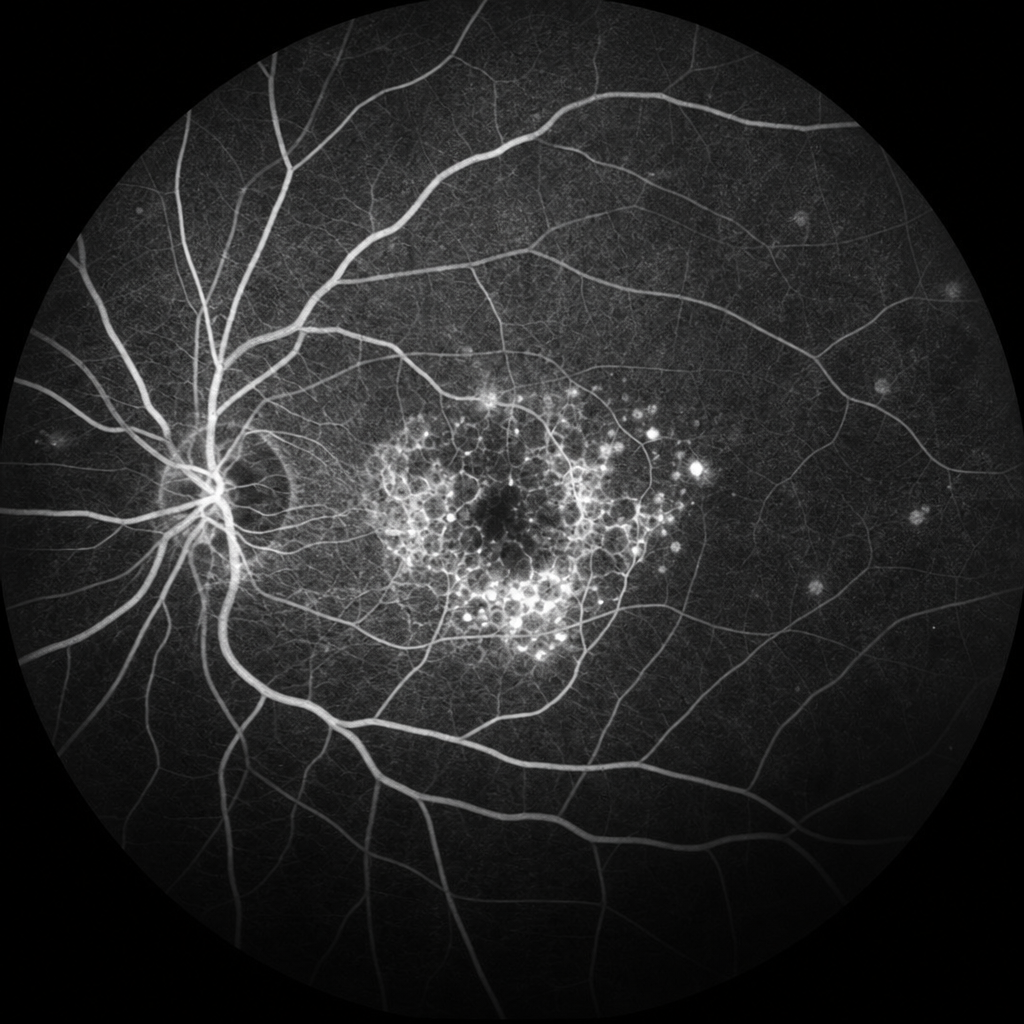
A fundus examination shows 'sunset glow' appearance. Which fluorescein angiography finding would best support Vogt-Koyanagi-Harada disease?
Explanation: ***White reflex in pupil*** - The most typical clinical presentation of retinoblastoma is **leukocoria**, or a **white reflex in the pupil**, which occurs when the tumor reflects light. - This symptom is often noticed by parents in photographs (the "cat's eye reflex") or during routine examinations. *Severe pain in the eye* - While retinoblastoma can cause pain in advanced stages, especially with increased **intraocular pressure** or inflammation, it is not the initial or most typical presenting symptom. - **Early retinoblastoma** is usually asymptomatic in terms of pain. *Loss of vision* - Vision loss can occur with retinoblastoma, particularly if the tumor affects the **macula** or becomes large, but it is often detected later than leukocoria. - Young children may not be able to articulate **vision changes**, making leukocoria a more apparent early sign. *Proptosis* - **Proptosis (bulging of the eye)** is an advanced sign of retinoblastoma, indicating significant tumor growth and extension beyond the globe. - It suggests **orbital involvement**, which is characteristic of more aggressive or late-stage disease rather than an initial presentation.
Explanation: ***Retinal detachment*** - The classic description of **sudden loss of vision** accompanied by a **"curtain falling" sensation** is highly characteristic of **rhegmatogenous retinal detachment**. - This occurs when the **neurosensory retina** separates from the **retinal pigment epithelium**, often leading to a **progressive visual field defect** as the detachment spreads. - This is an **ophthalmic emergency** requiring urgent referral for surgical intervention. *Vitreous haemorrhage* - A **vitreous haemorrhage** typically causes sudden, painless decrease in vision, often described as **floaters**, cobwebs, or a diffuse haze. - While it can impair vision significantly, it does not usually present with the specific "curtain falling" sensation that indicates a progressive visual field loss from the periphery. *Acute onset ptosis* - **Ptosis** refers to the drooping of the upper eyelid and directly affects the field of vision by physically obstructing the eye. - While it causes a reduction in the visual field, it is a physical obstruction and not typically described as a "curtain falling" sensation within the eye itself. *Intracranial haemorrhage* - An **intracranial haemorrhage** can cause various neurological deficits, including visual disturbances like **hemianopia** or **homonymous defects**, depending on the location of the bleed. - However, sudden unilateral vision loss with a "curtain falling" sensation localized to one eye is not a typical direct initial presentation, which would suggest an ocular rather than a neurological cause.
Explanation: ***Wet sponge haemorrhage*** - **Wet sponge haemorrhage** is not a term typically used in the description of diabetic retinopathy or other retinal conditions found during ophthalmoscopy. - The appearance it suggests (diffuse, sponge-like bleeding) does not correlate with the characteristic hemorrhage types seen in diabetic retinopathy. - This is **not a recognized ophthalmologic finding** in diabetes mellitus. *Flame shaped haemorrhage* - **Flame-shaped haemorrhages** are superficial retinal hemorrhages in the nerve fiber layer, commonly seen in diabetic retinopathy as well as hypertensive retinopathy. - Their characteristic shape reflects the arrangement of nerve fibers in the retina. - These are seen in both non-proliferative and proliferative diabetic retinopathy. *Dot haemorrhage* - **Dot haemorrhages** are small, round hemorrhages located deeper in the retina (inner nuclear and outer plexiform layers). - These are a common early finding in diabetic retinopathy, often representing microaneurysms that have ruptured or deep intraretinal hemorrhages. - They indicate damage to retinal capillaries. *Microaneurysm* - **Microaneurysms** are the earliest and most characteristic clinical sign of diabetic retinopathy, appearing as small, red dots on the retina. - They represent focal outpouchings of retinal capillaries due to weakened vessel walls and pericyte loss. - Best visualized with fluorescein angiography but visible on ophthalmoscopy.
Explanation: ***Acute anterior uveitis*** - The constellation of **sudden painful diminution of vision**, **photophobia**, **circumcorneal congestion**, and **hypopyon** (pus in the anterior chamber, visible as a whitish fluid level in the image) is highly characteristic of acute anterior uveitis. - This condition involves inflammation of the iris and ciliary body, leading to these severe symptoms and signs. *Acute conjunctivitis* - Characterized by **redness**, **itching**, and **discharge**, but typically lacks significant pain, photophobia, or vision loss. - Hypopyon is not a feature of acute conjunctivitis; the congestion is diffuse and not pericorneal. *Episcleritis* - Presents with **localized redness** and mild discomfort, but generally without pain, photophobia, or vision changes. - Episcleritis does not typically involve the anterior chamber with hypopyon. *Acute congestive glaucoma* - Involves severe eye pain, blurred vision, ciliary congestion, and often a **fixed, mid-dilated pupil** due to acutely elevated intraocular pressure. - While it shares some symptoms like pain, photophobia, and blurred vision, **hypopyon is not a typical finding** in acute congestive glaucoma, which differentiates it from uveitis.
Explanation: ***Retinitis pigmentosa*** - The fundoscopic image exhibits **bone spicule-like pigment deposits** in the periphery, **attenuation of retinal vessels**, and a **waxy pallor of the optic disc**, which are characteristic signs of retinitis pigmentosa. The clinical presentation of gradual loss in **night vision (nyctalopia)** and **peripheral vision** (tunnel vision) is classic for this inherited retinal dystrophy, as it primarily affects the **rod photoreceptors** first. *Retinal hemorrhage* - Retinal hemorrhages appear as **red blotches or streaks** on the fundus and are usually associated with conditions like **hypertension**, **diabetes**, or **retinal vein occlusion**. This image does not show acute red hemorrhages, but rather **dark, aggregated pigment**, and the symptoms do not align with sudden vision changes often seen in acute hemorrhages. *Fundus albipunctatus* - This condition is characterized by numerous **small, discrete, white or yellowish dots** scattered throughout the retina, usually sparing the macula. While it can cause night blindness, the fundoscopic image here shows **bone spicule pigmentation** and **vascular attenuation**, not the widespread white dots typical of fundus albipunctatus. *Fundus flavimaculatus* - This refers to Stargardt disease or fundus flavimaculatus, which presents with **yellowish flecks** (pisiform or fish-tail shaped) scattered in the posterior pole and mid-periphery, along with **macular degeneration**. The image does not show these distinct yellow flecks or evident macular changes, and the pigmentary changes are more consistent with retinitis pigmentosa.
Explanation: ***Central Retinal Vein Occlusion (CRVO)*** - The image displays characteristic findings of CRVO, including **widespread retinal hemorrhages**, **dilated and tortuous retinal veins**, and **cotton wool spots**. - The presence of **macular edema** (indicated by the bright, somewhat circular lesion near the center with surrounding exudates) also points to CRVO, which causes gradual, painless vision loss. *Central Retinal Artery Occlusion (CRAO)* - CRAO typically presents with sudden, profound, and painless vision loss, and the classic fundoscopic finding is a **cherry-red spot** in the macula with diffuse retinal whitening due to ischemia. - The image does not show these features; instead, it shows significant hemorrhages and dilated veins, which are inconsistent with CRAO. *Hypertensive Retinopathy* - Hypertensive retinopathy might show **arteriolar narrowing**, **AV nipping**, **cotton wool spots**, and sometimes hemorrhages, but the widespread, severe hemorrhages and marked venous dilation seen here are much more typical of CRVO. - While it can cause vision changes, the pattern of ocular findings is less severe and more chronic compared to the acute presentation of CRVO. *Diabetic Retinopathy* - Diabetic retinopathy can involve dot-blot hemorrhages, microaneurysms, hard exudates, and sometimes cotton wool spots, but the extensive, diffuse retinal hemorrhages in all four quadrants, along with the severely dilated and tortuous veins shown, are not the primary distinguishing features of typical diabetic retinopathy stages. - While **proliferative diabetic retinopathy (PDR)** can involve hemorrhages, the pattern in the image strongly suggests a vascular occlusion rather than the progressive microvascular damage of diabetes.
Explanation: ***Correct: Hematogenous*** - **Hematogenous spread** is the most common route of metastatic dissemination in retinoblastoma, occurring when tumor cells invade choroidal blood vessels. - This leads to distant metastases in **bone marrow, bones, liver, and brain** through bloodstream circulation. - Studies of metastatic retinoblastoma show hematogenous spread accounts for the majority of extraocular dissemination patterns. *Incorrect: Optic nerve invasion* - While optic nerve invasion is the **most clinically significant** prognostic factor and provides direct CNS access, it is not the most common route statistically. - Occurs in approximately 20-30% of enucleated eyes and is a critical indicator for adjuvant therapy. - When present, it dramatically worsens prognosis due to leptomeningeal spread potential. *Incorrect: Lymphatic spread* - The globe lacks true lymphatic drainage, making lymphatic spread extremely rare. - Lymphatic involvement only occurs if tumor extends beyond the eye into orbital tissues with lymphatic channels. - Not a primary route of retinoblastoma dissemination. *Incorrect: Direct invasion* - Direct orbital invasion occurs with advanced intraocular tumors breaking through the sclera. - This is a local extension rather than a route of distant metastatic spread. - While serious, it represents local progression rather than the most common dissemination pathway.
Explanation: ***Prostaglandin analogs*** - **Prostaglandin analogs** are **contraindicated in anterior uveitis** because they can significantly worsen inflammation. - They increase the risk of **cystoid macular edema (CME)** in patients with intraocular inflammation. - Can exacerbate existing **uveitis** and compromise treatment outcomes. - While they effectively lower IOP in non-inflammatory conditions, their pro-inflammatory effects make them unsuitable when aqueous flare and KPs are present. *Carbonic anhydrase inhibitors* - These drugs work by decreasing **aqueous humor production** and are safe and effective for reducing **IOP** in **uveitis**. - They do not exacerbate inflammation and are commonly used in the management of **uveitic glaucoma**. - Available in topical (dorzolamide, brinzolamide) and systemic (acetazolamide) formulations. *Mannitol* - **Mannitol** is an osmotic diuretic used for acute, severe elevations in **IOP**. - It rapidly reduces **IOP** by drawing fluid out of the vitreous and is safe to use in uveitis with elevated pressure. - Its use is typically for short-term, urgent IOP control. *Beta-blockers* - **Beta-blockers** (timolol, betaxolol) reduce **IOP** by decreasing **aqueous humor production**. - They are safe and commonly used to manage **elevated IOP** in uveitic patients. - They do not exacerbate inflammation and are first-line agents for IOP control.
Explanation: ***Occlusion of the ophthalmic artery by embolus*** - The sudden, painless monocular vision loss ("I can't see out of my right eye") in a patient with risk factors like **uncontrolled hypertension** and **angina** (suggesting atherosclerosis) is highly indicative of an **ophthalmic artery occlusion**, likely due to an **embolus**. - **Fundus examination** findings of **generalized pallor** and **slight disc edema with no hemorrhages** further support this, as it reflects ischemia without significant venous congestion. *Inflammation of the temporal artery* - This typically presents with **temporal headache**, **jaw claudication**, and elevated inflammatory markers like **ESR**, none of which are mentioned here. - While it can cause sudden vision loss (due to **anterior ischemic optic neuropathy**), the absence of other classic symptoms makes it less likely, and funduscopic findings often include a **pale, swollen optic disc**. *Optic neuritis* - Often causes **painful monocular vision loss** and is associated with **multiple sclerosis**. - Funduscopic examination may show a normal optic disc if retrobulbar, or **optic disc hyperemia** and swelling if papillitis, but not generalized retinal pallor. *Detachment of the retina* - Usually presents with symptoms like **flashes, floaters**, and a **"curtain-like" visual field defect**, which the patient specifically denies. - Fundus examination would reveal the detached retina, not generalized pallor of the fundus.
Explanation: ***Multiple pinpoint leaks*** - **Multiple pinpoint leaks** on fluorescein angiography during the acute inflammatory phase of Vogt-Koyanagi-Harada (VKH) disease reflect areas of **choroidal inflammation** and **serous retinal detachment**. - This finding is highly characteristic of the disease's active stage, signifying widespread inflammation of the **choroidal vasculature**. *Cherry red spot* - A **cherry red spot** is a classic finding in **central retinal artery occlusion** or **lysosomal storage disorders**, not in VKH disease. - It indicates an opaque retina with a fovea that is relatively spared, allowing visualization of the underlying choroidal circulation. *Bull's eye maculopathy* - **Bull's eye maculopathy** is typically associated with drug toxicities, such as **chloroquine** or **hydroxychloroquine**, or certain **inherited retinal dystrophies**. - It describes a ring of atrophy and pigmentary changes around the fovea, which is distinct from the diffuse inflammatory changes of VKH. *Cigarette smoke appearance* - The **cigarette smoke** or **smoke stack** appearance on fluorescein angiography refers to hyperfluorescence with leakage from the **optic disc**, typically seen in conditions like **papillitis** or **optic disc vasculitis**. - While this is a recognized angiographic finding, it is not characteristic of VKH disease, which primarily shows **multiple pinpoint leaks** from choroidal inflammation rather than disc-related leakage.
Retinal Anatomy and Physiology
Practice Questions
Age-Related Macular Degeneration
Practice Questions
Diabetic Retinopathy
Practice Questions
Retinal Vascular Diseases
Practice Questions
Retinal Detachment
Practice Questions
Hereditary Retinal Dystrophies
Practice Questions
Inflammatory Retinal Diseases
Practice Questions
Retinal Tumors
Practice Questions
Retinopathy of Prematurity
Practice Questions
Retinal Imaging Techniques
Practice Questions
Intravitreal Pharmacotherapy
Practice Questions
Vitreoretinal Surgery
Practice Questions
Get full access to all questions, explanations, and performance tracking.
Start For Free