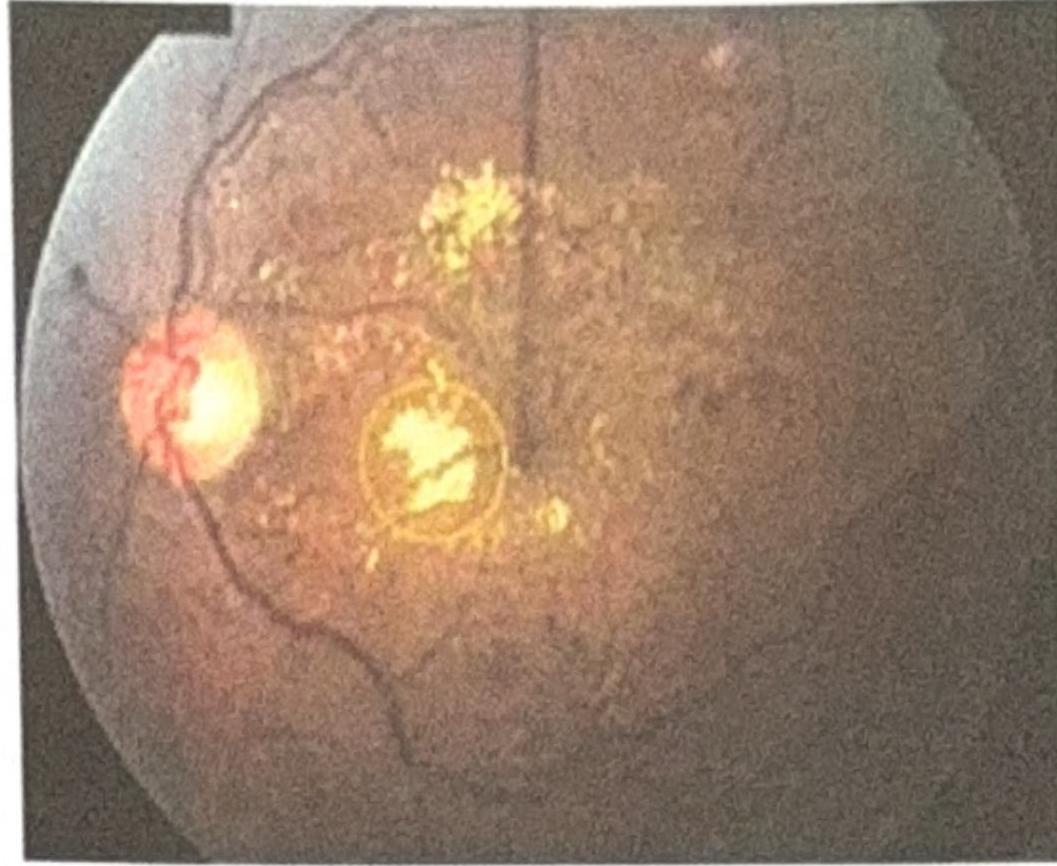
What pathology is shown in this fundus image?

A 25-year-old male patient came with history of progressive night blindness and decreased vision since childhood. Now he has tubular vision. Retinal examination as shown below revealed jet black, spidery spots similar to bone corpuscles. Which of the following statements is true?

This is the picture of the fundus of a female patient, who was on estrogen containing pills, and presents with sudden deterioration of vision. What is the likely diagnosis?

A 60-year-old patient during annual check-up had a report of HbA1C of $10 \%$. What does the given fundus examination show?

The test shown below is used for the evaluation of

A 75-year-old Englishman living in India presents to OPD with complaints of gradual onset painless, progressive blurring of central vision. He says he could earlier drive to the hospital by himself but is not able to do so now. Slit lamp examination is normal. Fundus examination is given below. What is the diagnosis?

The given FFA appearance occurs due to accumulation of dye in which of the following layers of retina?

A 20-year-old college student has visual complaints represented in the image given below. FFA of the patient shows presence of:

A 60-year-old polycythemia vera patient is having a marked reduction in visual acuity in both eyes. The fundus examination image is shown below. What is the most likely finding?

A 75-year-old patient with carotid artery bruit develops sudden onset, unilateral loss of vision. On examination direct pupillary light reflex is absent and perception of light is absent. What does the given fundus examination show?

Explanation: ***Toxoplasmosis*** - The image shows a **focal retinochoroidal scar** with surrounding retinal inflammation and pigmentary changes, characteristic of reactivated **ocular toxoplasmosis**. - This typically presents as a necrotizing retinitis lesion, often adjacent to a pre-existing scar, and can be associated with vitritis. *Rubella* - **Congenital rubella syndrome** can cause ocular manifestations like "salt-and-pepper" retinopathy, which is a diffuse pigmentary change, not the focal scar seen here. - Other ocular signs of rubella include cataracts and microphthalmia, which are not visible in a fundal image of this type. *CMV* - **Cytomegalovirus (CMV) retinitis** typically presents as large, confluent areas of yellow-white retinal opacification with associated hemorrhage ("cotton-wool spots" or "brushfire" appearance), primarily seen in immunocompromised patients. - The focal, well-demarcated scar with less hemorrhage seen in the image is not typical for CMV retinitis. *Babesiosis* - **Babesiosis** is a tick-borne parasitic disease that primarily affects red blood cells and can cause a malaria-like illness; it does not typically cause direct fundus lesions or retinochoroidal scars. - Ocular involvement in babesiosis is rare and usually manifests as non-specific findings related to systemic illness rather than specific infectious retinitis.
Explanation: ***The diagnosis is retinitis pigmentosa*** - The patient's history of **progressive night blindness**, **decreased vision since childhood**, and **tubular vision** are classic symptoms of retinitis pigmentosa. - The retinal examination finding of **jet black, spidery spots similar to bone corpuscles** in the image is pathognomonic for retinitis pigmentosa, representing retinal pigment epithelial migration and clumping. *Most commonly inherited as X-linked recessive* - While retinitis pigmentosa can be inherited in various patterns (autosomal dominant, autosomal recessive, X-linked), the **autosomal recessive** form is the most common, followed by autosomal dominant. - **X-linked recessive inheritance** is responsible for about 10-15% of cases and often leads to the most severe phenotype, but it is not the most common overall. *Papilledema occurs* - **Papilledema** is swelling of the optic disc due to increased intracranial pressure, which is not characteristic of retinitis pigmentosa. - In retinitis pigmentosa, the optic disc often appears **waxy pallor** and the retinal blood vessels are attenuated, not swollen. *The retinal changes typically start at the posterior pole and spread anteriorly* - The retinal changes in retinitis pigmentosa typically begin in the **mid-peripheral retina** and gradually spread both centrally towards the macula and peripherally. - This progressive loss of photoreceptors and RPE cells leads to the characteristic **ring scotoma** that eventually progresses to tubular vision by sparing central vision until later stages.
Explanation: ***Central retinal vein occlusion*** - The fundus image shows widespread **hemorrhages**, **dilated and tortuous veins**, and **optic disc swelling** which are classic signs of central retinal vein occlusion (CRVO). - Estrogen-containing pills increase the risk of **thrombosis**, making CRVO a plausible diagnosis in a patient presenting with sudden vision deterioration. *Diabetic background retinopathy* - While diabetic retinopathy can cause hemorrhages and exudates, the extensive, diffuse hemorrhages and significant venous engorgement seen here are more characteristic of a **venous occlusion**. - Diabetic retinopathy typically presents with microaneurysms, blot hemorrhages, hard exudates, and sometimes cotton wool spots, usually without the widespread venous changes seen in the image. *Hypertensive retinopathy* - Hypertensive retinopathy typically features **arteriolar narrowing**, **arteriovenous nicking**, flame-shaped hemorrhages, cotton wool spots, and sometimes optic disc edema if severe, but not the widespread pan-retinal hemorrhage and venous dilation depicted. - The patient's history does not mention hypertension, making this less likely compared to a thrombotic event linked to estrogen use. *Central retinal artery occlusion* - Central retinal artery occlusion (CRAO) presents with a **pale retina** and a **cherry-red spot** in the macula, due to acute ischemia. - The fundus image provided shows **widespread hemorrhages and dilated veins**, which are not characteristic features of CRAO.
Explanation: ***Proliferative retinopathy*** - The image shows **neovascularization**, which are new, abnormal blood vessels growing on the surface of the retina or optic disc. This is the hallmark of proliferative retinopathy. - There are also extensive **hard exudates**, retinal hemorrhages, and signs of significant retinal damage consistent with advanced diabetic retinopathy. *Nonproliferative retinopathy* - This stage is characterized by **microaneurysms**, **dot and blot hemorrhages**, hard exudates, and cotton wool spots, but crucially **lacks neovascularization**. - While many features of nonproliferative retinopathy are present (e.g., hemorrhages, exudates), the presence of visible new vessels confirms progression to the proliferative stage. *Neovascularization of the disc* - While **neovascularization of the disc** (NVD) is indeed a feature seen in the image, characterized by the growth of new abnormal vessels on or within one disc diameter of the optic disc, it is a *component* or *sign* of proliferative retinopathy, not the overarching diagnosis. - Proliferative retinopathy encompasses NVD and/or neovascularization elsewhere (NVE), along with other severe changes. *Subhyaloid hemorrhage* - A **subhyaloid hemorrhage** appears as a boat-shaped or D-shaped collection of blood lying beneath the posterior hyaloid face, often obscuring retinal details. - While hemorrhage is present in the image, there is no distinct subhyaloid collection of blood; instead, the picture shows widespread intraretinal and likely preretinal hemorrhages as part of the severe proliferative process.
Explanation: ***Macular degeneration*** - The image shown is an **Amsler grid**, a diagnostic tool used to detect **visual disturbances** caused by changes in the retina, especially the macula. - The straight lines appearing wavy or distorted, as seen in the right panel, are characteristic findings in **macular degeneration** or other macular pathologies. - The Amsler grid is the standard screening tool for **age-related macular degeneration (AMD)** and other macular disorders. *Glaucoma* - Glaucoma primarily affects the **optic nerve** and typically causes **peripheral vision loss**, which is not directly assessed by an Amsler grid. - Visual field tests (perimetry) are used for glaucoma diagnosis, not the Amsler grid. *Cataracts* - Cataracts involve **clouding of the lens** of the eye, leading to blurred vision, glare, and difficulty with night vision. - They do not typically cause the **distortion of straight lines** that an Amsler grid helps to detect. *Retinal detachment* - Retinal detachment usually presents with symptoms like flashes of light, **floaters**, or a curtain-like shadow in the vision. - While it can affect vision, the Amsler grid specifically detects **macular distortion**, which is the hallmark of macular pathology rather than peripheral retinal detachment.
Explanation: ***Age-related macular degeneration*** - The patient's age (75 years), gradual painless progressive blurring of **central vision**, and the presence of **drusen** (small yellow deposits) and a **macular hemorrhage** (red spot) on the fundus exam are all characteristic features of wet age-related macular degeneration. - The inability to drive due to vision loss further points to significant central vision impairment, which is a hallmark of AMD, especially the wet form due to **neovascularization** and hemorrhage. *Central serous retinopathy* - Typically affects younger to middle-aged individuals, often associated with stress or corticosteroid use, contrasting with the patient's age. - Characterized by **serous fluid detachment** of the neurosensory retina, not usually significant hemorrhage as seen in the image. *Cystoid macular edema* - Presents with **cyst-like fluid accumulation** within the retina, often leading to a flower petal-like appearance on imaging, which is not depicted in this fundus image. - Can be associated with various conditions like diabetes, retinal vein occlusion, or inflammation, and while it causes central vision loss, the funduscopic appearance here is more consistent with AMD. *Rhegmatogenous retinal detachment* - Usually presents with sudden vision loss, **floaters**, or **flashes of light**, and a "curtain" coming over the vision, which differs from the gradual onset described. - Fundus examination would typically show a detached, billowing retina, often with a retinal tear, not the macular changes with drusen and hemorrhage seen here.
Explanation: ***Inner plexiform layer*** - In **cystoid macular edema (CME)**, fluid accumulation occurs in multiple retinal layers, with the **inner plexiform layer** and **inner nuclear layer** being significantly involved. - The characteristic **petaloid (flower-petal) pattern** on fluorescein angiography results from fluid accumulation arranged around the foveal center in a radial pattern. - The **Müller cells**, which span the retina vertically, contribute to the formation of cystoid spaces when their supporting function is disrupted. **Note:** While the **outer plexiform layer (Henle's layer)** is classically described as the primary site of CME in many textbooks due to the radial arrangement of Henle fibers, fluid accumulation also prominently involves the **inner nuclear and inner plexiform layers**, and different imaging modalities and stages of CME may show variable involvement. *Outer plexiform layer* - The outer plexiform layer (also called **Henle's layer** at the macula) is frequently cited as a primary site of fluid accumulation in CME. - The radial arrangement of photoreceptor axons (Henle fibers) in this layer can contribute to the characteristic petaloid pattern. - Modern OCT imaging often shows cystoid spaces involving both outer plexiform and inner nuclear layers. *Ganglion cell layer* - The ganglion cell layer is the most superficial retinal layer containing neuronal cell bodies. - This layer is **not typically involved** in the cystoid fluid accumulation pattern of CME. - Edema here would present differently, potentially obscuring vessels or causing diffuse thickening. *Outer nuclear layer* - The outer nuclear layer contains photoreceptor cell bodies (nuclei of rods and cones). - This layer is **not characteristically involved** in CME's petaloid pattern. - Fluid in this layer is more associated with conditions like **outer retinal edema**, **retinoschisis**, or certain forms of retinal detachment.
Explanation: ***Central serous retinopathy*** - The FFA image shows a classic **inkblot or smokestack pattern of leakage** due to choroidal fluid seeping through a defective retinal pigment epithelium, characteristic of central serous retinopathy. - The Amsler grid on the left exhibits **metamorphopsia** (wavy lines) and a **central scotoma** (blurred dark area), indicating macular involvement, consistent with fluid accumulation under the retina in CSR. *Cystoid macular edema* - This condition typically presents with **petaloid leakage patterns** on FFA, due to fluid accumulation within the intraretinal layers, which is not seen here. - While it can cause metamorphopsia and reduced vision, the characteristic "inkblot" leakage on FFA points away from CME. *Age-related macular degeneration* - This condition is more common in older individuals, whereas the patient is a **20-year-old college student**. - Wet AMD typically shows **choroidal neovascularization (CNV)** with associated leakage or bleeding, which is distinct from the serous detachment and RPE leak seen. *Central retinal venous occlusion* - CRVO is characterized by widespread **retinal hemorrhages**, dilated and tortuous veins, and cotton wool spots due to impaired venous outflow. - FFA in CRVO would show delayed venous filling, capillary non-perfusion, and possible neovascularization, none of which are evident in the provided images.
Explanation: ***Central retinal venous occlusion*** - The fundus image shows widespread **retinal hemorrhages** (diffuse red areas), **dilated and tortuous retinal veins**, and **optic disc edema**, which are classic signs of a **central retinal venous occlusion (CRVO)**. - The patient's history of **polycythemia vera**, a myeloproliferative disorder causing increased blood viscosity and erythrocyte count, significantly increases the risk of thrombotic events like CRVO. *Cystoid macular edema* - This condition is characterized by fluid accumulation in the macula, forming cyst-like spaces, which would appear as a thickened and somewhat blurry macula, but typically without the widespread hemorrhages seen here. - While macular edema can accompany CRVO, it is not the primary finding describing the diffuse picture of hemorrhages and venous engorgement in the image. *Central retinal artery occlusion* - A **central retinal artery occlusion (CRAO)** typically presents with sudden, profound, painless vision loss and a characteristic **cherry-red spot** in the macula, often with retinal pallor, due to ischemia. - This image does not show retinal pallor or a cherry-red spot, and the widespread hemorrhages are inconsistent with arterial occlusion, which primarily causes ischemic necrosis. *Branched retinal vein occlusion* - A **branched retinal vein occlusion (BRVO)** would present with hemorrhages and venous engorgement limited to a specific quadrant or sector of the retina, corresponding to the distribution of the affected vein branch. - The image demonstrates widespread involvement with hemorrhages appearing throughout the retina, indicating an occlusion of the main central retinal vein rather than a branch.
Explanation: ***Central retinal artery occlusion*** - The image shows a **pale retina** with a distinct **cherry-red spot** in the fovea, which is characteristic of CRAO due to retinal ischemia and relative transparency of the foveola. - The patient's history of **sudden unilateral vision loss**, absent pupillary light reflex and perception of light, along with **carotid artery bruit** (indicating atherosclerosis and potential for emboli), are consistent with CRAO. *Central retinal venous occlusion (ischemic)* - Ischemic CRVO typically presents with a **"blood and thunder" fundus**, characterized by widespread retinal hemorrhages, dilated tortuous veins, cotton wool spots, and optic disc edema. - While it causes significant vision loss, the fundus appearance of a pale retina with a cherry-red spot is not typical for CRVO. *Central retinal venous occlusion (non-ischemic)* - Non-ischemic CRVO presents with similar signs to ischemic CRVO but generally less severe, including dilated tortuous veins, retinal hemorrhages, and macular edema, though less extensive than the ischemic form. - It does not present with the diffuse retinal pallor and cherry-red spot seen in the image and described in the clinical scenario. *Central serous retinopathy* - Central serous retinopathy typically presents with **serous detachment of the neurosensory retina** and/or retinal pigment epithelium, often associated with a blurry spot in vision or metamorphopsia. - The fundus features might include localized retinal elevation and sometimes pigment epithelial detachment, but not the widespread retinal pallor and cherry-red spot characteristic of acute arterial occlusion.
Retinal Anatomy and Physiology
Practice Questions
Age-Related Macular Degeneration
Practice Questions
Diabetic Retinopathy
Practice Questions
Retinal Vascular Diseases
Practice Questions
Retinal Detachment
Practice Questions
Hereditary Retinal Dystrophies
Practice Questions
Inflammatory Retinal Diseases
Practice Questions
Retinal Tumors
Practice Questions
Retinopathy of Prematurity
Practice Questions
Retinal Imaging Techniques
Practice Questions
Intravitreal Pharmacotherapy
Practice Questions
Vitreoretinal Surgery
Practice Questions
Get full access to all questions, explanations, and performance tracking.
Start For Free