Which of the following is not considered an ophthalmic emergency?
Which of the following is an ocular emergency?
A prematurely born baby at 29 weeks is examined at 42 weeks post-conceptional age and shows stage 2 zone 1 ROP with plus disease in both eyes. How will you manage this patient?
Which of the following statements is FALSE regarding Stargardt's disease?
What are the causes of exudative retinal detachment?
All are causes of white-dot syndrome except:
A myopic patient presents with complaints of flashes and floaters. On examination, a deep anterior chamber is seen. What is the likely diagnosis?
A patient presents with vision problems and has a history of cataract surgery. OCT finding is shown below. What is the syndrome most likely associated with these findings?
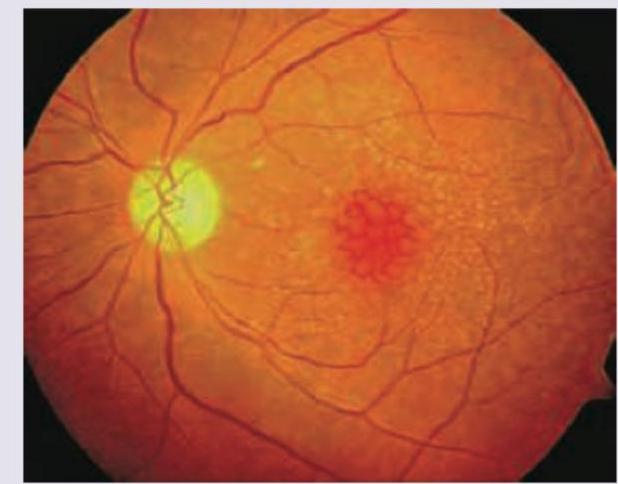
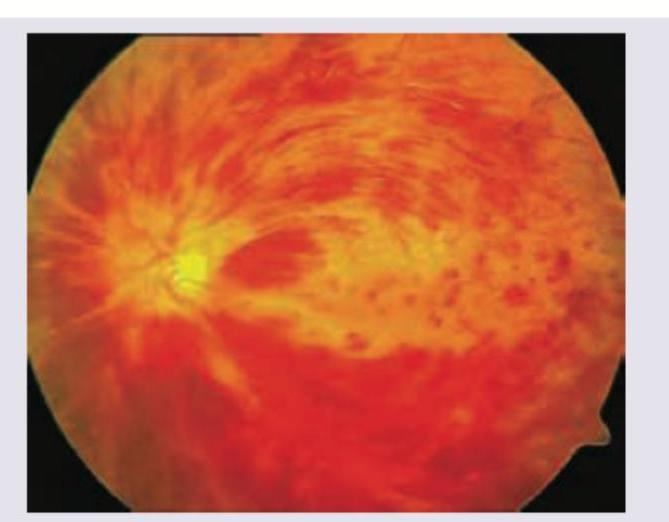
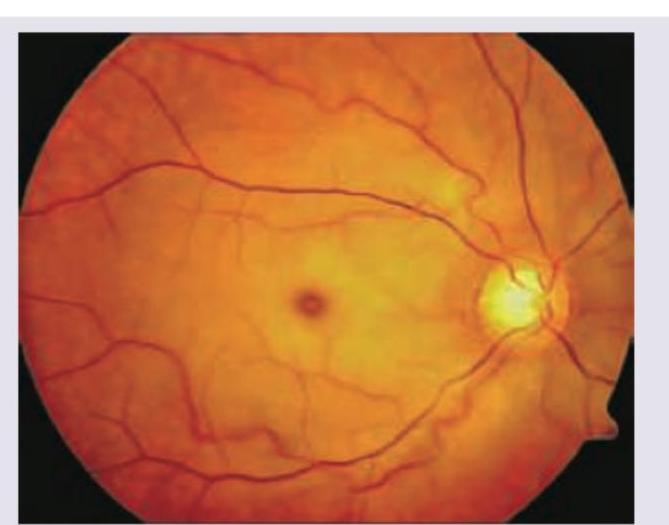
Fundoscopy findings are shown in the image below. What is the most likely diagnosis? 
A 62-year-old diabetic patient presents with sudden painless loss of vision in the right eye. Fundoscopy reveals a pale, edematous retina with a cherry-red spot at the macula. Retinal arterioles appear narrowed. Visual acuity is light perception only. What is the most likely diagnosis?
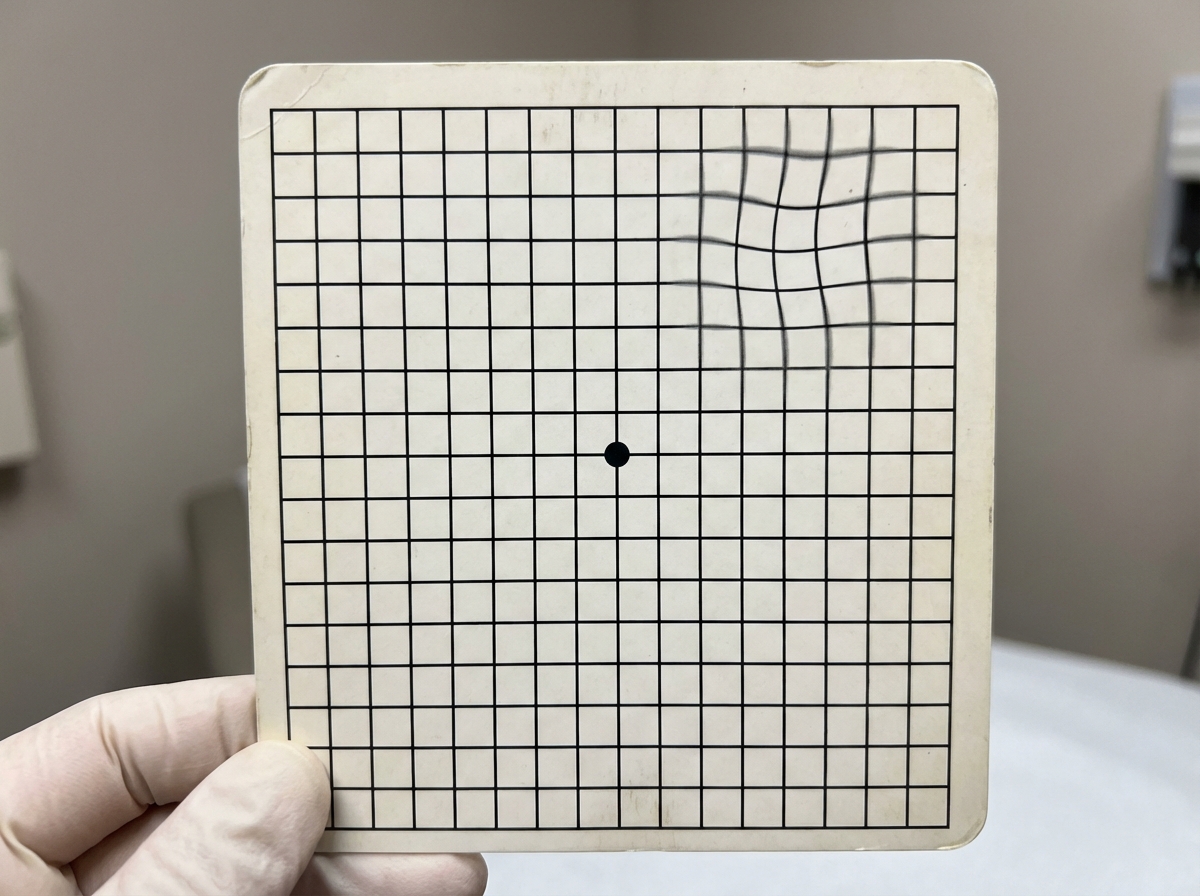
Explanation: **Explanation:** In ophthalmology, an **emergency** is defined as a condition requiring immediate intervention (within minutes to hours) to prevent permanent vision loss. **1. Why Macular Hole is the correct answer:** A macular hole is a full-thickness defect in the neurosensory retina at the fovea, usually caused by tangential vitreous traction. It is considered an **elective or urgent** condition, but not an emergency. Patients typically present with gradual blurring or metamorphopsia (distorted vision). Surgical repair (vitrectomy) is often successful even if performed weeks after diagnosis; therefore, it does not require immediate intervention to save the eye. **2. Why the other options are wrong (Emergencies):** * **Central Retinal Artery Occlusion (CRAO):** A true "eye stroke." Irreversible retinal damage occurs within 90–120 minutes. It requires immediate ocular massage and intraocular pressure reduction to dislodge the embolus. * **Retinal Detachment (RD):** Specifically "Macula-on" RD is a surgical emergency. Prompt surgery is required to prevent the detachment from involving the fovea, which would lead to permanent central vision loss. * **Acute Primary Angle Closure Glaucoma:** A sudden, severe rise in intraocular pressure that can cause permanent optic nerve damage and blindness within hours if not treated with immediate pressure-lowering agents and laser peripheral iridotomy. **High-Yield Clinical Pearls for NEET-PG:** * **CRAO Hallmark:** "Cherry-red spot" at the fovea and "cattle-trucking" of retinal vessels. * **Macular Hole Hallmark:** **Watzke-Allen sign** (patient perceives a break in a slit-lamp beam projected over the macula). * **Emergency vs. Urgent:** Chemical burns and CRAO are **true emergencies** (minutes count), while Macular holes and Diabetic Retinopathy are **elective/chronic** (weeks/months).
Explanation: In ophthalmology, an **ocular emergency** is defined as a condition that requires immediate intervention (within minutes to hours) to prevent permanent vision loss or irreversible structural damage. **Explanation of Options:** * **Central Retinal Artery Occlusion (CRAO):** This is often described as an "eye stroke." The retina has a very high metabolic rate; complete occlusion leads to irreversible ischemic damage within **90–100 minutes**. Clinical signs include sudden, painless loss of vision and a **"Cherry Red Spot"** on fundoscopy. Immediate management (e.g., ocular massage, paracentesis) is vital to lower intraocular pressure and dislodge the embolus. * **Acute Congestive Glaucoma (Angle-Closure):** This is a surgical emergency characterized by a sudden, severe rise in intraocular pressure (IOP). If not lowered immediately, the high pressure causes permanent damage to the optic nerve head and ischemic atrophy of the iris. Symptoms include severe pain, "halos" around lights, and a stony-hard eye. * **Optic Neuritis:** While sometimes considered "urgent," in the context of competitive exams, it is classified as an emergency because rapid initiation of intravenous steroids (as per the **ONTT trial**) is necessary to accelerate visual recovery and, in some cases, delay the onset of Multiple Sclerosis. **Clinical Pearls for NEET-PG:** * **CRAO:** Look for the "Cherry Red Spot" and "Cattle-tracking" appearance of retinal vessels. * **Acute Glaucoma:** The pupil is typically **mid-dilated and vertically oval**. * **Other Emergencies:** Chemical burns (alkali is worse than acid), Endophthalmitis, and Retinal Detachment (especially "Macula-on"). * **True Emergency:** Chemical burns are the only condition where treatment (irrigation) starts *before* visual acuity assessment.
Explanation: ### Explanation The management of Retinopathy of Prematurity (ROP) is guided by the **ETROP (Early Treatment for ROP) Study** criteria, which defines "Type 1 ROP" requiring urgent treatment. **1. Why Option B is Correct:** The patient has **Stage 2, Zone 1 with Plus disease**. According to the ETROP criteria, **Type 1 ROP** includes: * Zone I: Any stage with plus disease (This patient's case) * Zone I: Stage 3 without plus disease * Zone II: Stage 2 or 3 with plus disease The presence of **Plus disease** (dilatation and tortuosity of retinal vessels) in Zone 1 indicates high risk for progression to retinal detachment. The standard of care is urgent **Laser Photocoagulation** (usually peripheral ablation of the avascular retina) within 48–72 hours to induce regression of the disease. **2. Why Other Options are Incorrect:** * **Option A:** Waiting one week is dangerous. Type 1 ROP is "sight-threatening" and requires treatment within 72 hours. * **Option C:** ROP is a bilateral disease. If both eyes meet the criteria for Type 1 ROP, both must be treated simultaneously to prevent blindness. * **Option D:** Vitreoretinal surgery is reserved for **Stage 4** (partial retinal detachment) or **Stage 5** (total retinal detachment). **3. Clinical Pearls for NEET-PG:** * **Screening Criteria (India):** Birth weight <1750g or Gestational Age <34 weeks. * **First Screening:** Should be done at 4 weeks of life (or 3 weeks if born <28 weeks). * **Plus Disease:** Mandatory for treatment in Zone II, but in Zone I, Stage 3 alone warrants treatment. * **Anti-VEGF (Ranibizumab/Bevacizumab):** An alternative to laser, especially useful in Zone 1 or Aggressive Posterior ROP (AP-ROP), as it allows for continued vessel growth. * **Zone 1:** The most critical area (centered on the disc, twice the distance from the disc to the fovea).
Explanation: ### Explanation **1. Why Option A is the Correct (False) Statement:** Stargardt’s disease is the most common hereditary macular dystrophy. The underlying medical concept is a mutation in the **ABCA4 gene**, which is inherited in an **Autosomal Recessive (AR)** pattern, not autosomal dominant. This mutation leads to the accumulation of toxic lipofuscin (all-trans-retinal) in the Retinal Pigment Epithelium (RPE), resulting in progressive central vision loss. **2. Analysis of Other Options:** * **Option B (No family history):** Since it is an autosomal recessive condition, it often appears sporadically in a single generation without a prior family history, making this statement clinically plausible. * **Option C (Beaten bronze appearance):** This is the classic pathognomonic description of the macula in advanced Stargardt’s. It is often accompanied by "pisciform" (fish-shaped) yellowish-white flecks at the level of the RPE (Fundus Flavimaculatus). * **Option D (ERG and EOG abnormal):** In the early stages, electrophysiological tests may be normal. However, as the disease progresses and involves the diffuse RPE and photoreceptors, both the **Electroretinogram (ERG)** and **Electro-oculogram (EOG)** become subnormal/abnormal. **3. High-Yield Clinical Pearls for NEET-PG:** * **Silent Choroid:** On Fundus Fluorescein Angiography (FFA), the most characteristic sign is a "dark/silent choroid" due to the masking of background choroidal fluorescence by lipofuscin deposits. * **Presentation:** Typically occurs in the 1st or 2nd decade of life with bilateral, symmetrical decrease in central vision. * **Differential:** Distinguish from Best’s Disease, which is Autosomal Dominant and shows an abnormal EOG with a normal ERG.
Explanation: **Explanation:** Exudative (Serous) Retinal Detachment (ERD) occurs when fluid accumulates in the subretinal space between the neurosensory retina and the retinal pigment epithelium (RPE) due to damage to the blood-retinal barrier. Unlike rhegmatogenous detachment, there is **no retinal break**. **Why "All of the Above" is Correct:** 1. **Scleritis (Option A):** Posterior scleritis causes intense inflammation of the sclera that spreads to the choroid, leading to increased vascular permeability and fluid leakage into the subretinal space. 2. **Toxaemia of Pregnancy (Option B):** In severe pre-eclampsia or eclampsia, systemic hypertension leads to choroidal ischemia and dysfunction of the RPE, causing bilateral exudative detachment. 3. **Central Serous Retinopathy (CSR) (Option C):** This is characterized by a localized serous detachment of the macula due to idiopathic leakage from the choriocapillaris through a defect in the RPE. **Other Causes of ERD:** * **Inflammatory:** Vogt-Koyanagi-Harada (VKH) syndrome, Sympathetic ophthalmitis. * **Neoplastic:** Choroidal melanoma, Hemangioma, Metastatic tumors. * **Vascular:** Coats disease, Malignant hypertension. **NEET-PG High-Yield Pearls:** * **Clinical Sign:** The hallmark of ERD is **"Shifting Fluid"**—the subretinal fluid moves to the most dependent part of the retina with changes in head position. * **Fundus Appearance:** The detached retina is smooth, convex, and lacks folds (unlike rhegmatogenous RD which is corrugated). * **Management:** Unlike other types of RD, the primary treatment for ERD is **medical management** of the underlying systemic or inflammatory cause, rather than surgery.
Explanation: ### Explanation **White-dot syndromes (WDS)** are a group of idiopathic inflammatory conditions characterized by multiple, discrete, whitish-yellow lesions at the level of the outer retina, retinal pigment epithelium (RPE), and choroid. **Why Sympathetic Ophthalmitis is the Correct Answer:** While Sympathetic Ophthalmitis (SO) involves the choroid, it is classically characterized by **Dalen-Fuchs nodules** (small, granulomatous lesions). However, in the context of standard NEET-PG classification and clinical presentation, SO is categorized as a **bilateral granulomatous panuveitis** following trauma or surgery, rather than a primary "White-dot syndrome." The WDS group typically includes entities like MEWDS, APMPPE, Birdshot chorioretinopathy, and Multifocal Choroiditis. **Analysis of Other Options:** * **Fuch’s Heterochromic Uveitis (FHU):** Though primarily a chronic non-granulomatous uveitis, it can present with fine, stellate keratic precipitates (KPs) distributed across the endothelium, which can mimic "dots," and is often discussed in the differential of inflammatory spots. * **VKH Syndrome:** In the acute uveitic stage, Vogt-Koyanagi-Harada syndrome presents with multiple areas of exudative retinal detachment and subretinal yellowish-white spots (similar to Dalen-Fuchs nodules), often overlapping with the clinical appearance of WDS. * **HIV Retinopathy:** The most common finding in HIV retinopathy is **Cotton Wool Spots (CWS)**. These appear as fluffy white patches in the nerve fiber layer, which are frequently included in the clinical differential of "white dots" in the posterior pole. **High-Yield Clinical Pearls for NEET-PG:** * **MEWDS (Multiple Evanescent White Dot Syndrome):** The only WDS that is typically **unilateral** and has a "foveal granular appearance." * **APMPPE:** Associated with a viral prodrome; shows "cream-colored" lesions that **block fluorescence** early and **stain late** on FFA. * **Birdshot Chorioretinopathy:** Strongly associated with **HLA-A29** (highest HLA association in ophthalmology). * **Dalen-Fuchs Nodules:** Found in both Sympathetic Ophthalmitis and VKH; they are collections of epithelioid cells between Bruch’s membrane and the RPE.
Explanation: ***Rhegmatogenous retinal detachment***- The presence of **flashes (photopsia)** and **floaters** signifies acute **vitreoretinal traction** leading to a retinal break (*rhegma*), a classic presentation of RRD, especially in a **myopic** eye.- A **deep anterior chamber** can indicate **hypotony** (low intraocular pressure), which frequently occurs in RRD due to increased uveoscleral outflow from the fluid egress through the retinal break.*Exudative retinal detachment*- This type is caused by underlying processes like inflammation or tumors and is characterized by a lack of **retinal break** and, therefore, typically does **not** cause flashes or floaters associated with vitreous traction.- The subretinal fluid in this condition classically **shifts** upon changing head position, which is a key differentiating feature.*Tractional retinal detachment*- This form is caused by the contraction of **fibrovascular membranes** on the retinal surface, most commonly seen in advanced **proliferative diabetic retinopathy**.- It is usually slowly progressive and does **not** typically present acutely with the prominent **flashes** and **floaters** that suggest a fresh retinal tear.*Central serous retinopathy*- This condition involves fluid accumulation localized beneath the macula, leading to symptoms like **metamorphopsia** and central scotoma, without involving the peripheral retina.- It does **not** cause a generalized retinal detachment, significant **flashes** and **floaters**, or changes in the **anterior chamber depth**.
Explanation: ***Irvine-Gass Syndrome*** - This syndrome is defined as the development of **cystoid macular edema (CME)** after intraocular surgery, most commonly **cataract surgery**, which matches the patient's history. - The Optical Coherence Tomography (OCT) image clearly shows characteristic **intraretinal fluid-filled cysts** and thickening in the macular region, which are hallmark signs of CME. *Posner-Schlossman Syndrome* - This condition, also known as glaucomatocyclitic crisis, involves recurrent episodes of **acute unilateral uveitis** and **high intraocular pressure**. - While inflammation can cause CME, it is not the primary feature, and the diagnosis relies on signs of anterior chamber inflammation and pressure spikes, not postoperative macular changes. *Central Serous Retinopathy* - This condition is characterized by the accumulation of **subretinal fluid**, creating a serous detachment of the neurosensory retina, which appears as a large fluid-filled space under the retina on OCT. - The provided OCT shows **intraretinal cysts**, not subretinal fluid, which is the key differentiating feature from CSR. *Elschnig Pearls* - These are a type of **posterior capsule opacification (PCO)**, a common complication of cataract surgery where residual lens epithelial cells proliferate on the posterior capsule. - PCO causes blurry vision by obstructing the visual axis but is a condition of the lens capsule, not the retina, and would not produce the macular edema seen on this OCT.
Explanation: ***CRAO*** - The fundoscopy image shows a classic **cherry-red spot** at the macula, which is pathognomonic for Central Retinal Artery Occlusion (CRAO). This spot appears because the fovea receives its blood supply from the underlying choroid, which remains visible and red against the pale, ischemic retina. - CRAO presents as sudden, profound, and painless monocular vision loss. The diffuse retinal pallor is due to edema and ischemia of the inner retinal layers caused by the occlusion of the central retinal artery, often by an **embolus**. *CRVO* - Central Retinal Vein Occlusion (CRVO) is characterized by a "**blood and thunder**" fundus, featuring widespread **retinal hemorrhages**, dilated and tortuous veins, and cotton-wool spots, none of which are present in the image. - Unlike the arterial occlusion seen here, CRVO is a venous outflow obstruction, leading to venous stasis, ischemia, and hemorrhage rather than diffuse retinal pallor. *Diabetic retinopathy* - The fundoscopic findings of diabetic retinopathy include **microaneurysms**, **dot and blot hemorrhages**, **hard exudates**, and **cotton-wool spots** in its non-proliferative stage. - Proliferative diabetic retinopathy is marked by **neovascularization** (new, fragile blood vessel growth) at the disc or elsewhere, which is absent in this image. *Cystoid macular edema* - Cystoid macular edema involves fluid accumulation in the macula, which on fundoscopy may cause loss of the foveal reflex and macular thickening, but not the diffuse pallor or cherry-red spot seen here. - The characteristic finding is a **petaloid pattern** of leakage on fluorescein angiography or cystic spaces on **Optical Coherence Tomography (OCT)**.
Explanation: ***Central Retinal Artery Occlusion (CRAO)*** - The presentation of **sudden, painless, severe vision loss** (light perception only) combined with a **pale, edematous retina** and a **cherry-red spot at the macula** is pathognomonic for **CRAO**. - The cherry-red spot occurs because the **fovea** (which is supplied by the **choroid** and not the blocked retinal artery) appears red against the surrounding pale, ischemic retina. - The **narrowed retinal arterioles** further support arterial occlusion. *Central Retinal Vein Occlusion (CRVO)* - While also causing sudden painless vision loss, fundoscopy typically reveals a "**blood and thunder**" appearance with widespread retinal hemorrhages, dilated and tortuous veins, and cotton-wool spots. - Vision loss is usually **not as severe** as in CRAO, rarely limited to only light perception. - Arterioles would not be narrowed; instead, veins are dilated and tortuous. *Vitreous Hemorrhage* - Causes sudden vision loss, but the fundoscopic finding is an inability to clearly visualize the retina due to **blood filling the vitreous cavity**. - There would be **no pale retina** or **cherry-red spot** unless the underlying condition (like proliferative diabetic retinopathy) was the cause, but the hemorrhage itself obscures the view. *Retinal Detachment* - Presents with sudden painless vision loss, often preceded by **flashes** and **floaters**. - Fundoscopy shows a **gray, elevated retina** with a corrugated appearance, not a pale, edematous retina. - There is **no cherry-red spot** at the macula in retinal detachment.
Retinal Anatomy and Physiology
Practice Questions
Age-Related Macular Degeneration
Practice Questions
Diabetic Retinopathy
Practice Questions
Retinal Vascular Diseases
Practice Questions
Retinal Detachment
Practice Questions
Hereditary Retinal Dystrophies
Practice Questions
Inflammatory Retinal Diseases
Practice Questions
Retinal Tumors
Practice Questions
Retinopathy of Prematurity
Practice Questions
Retinal Imaging Techniques
Practice Questions
Intravitreal Pharmacotherapy
Practice Questions
Vitreoretinal Surgery
Practice Questions
Get full access to all questions, explanations, and performance tracking.
Start For Free