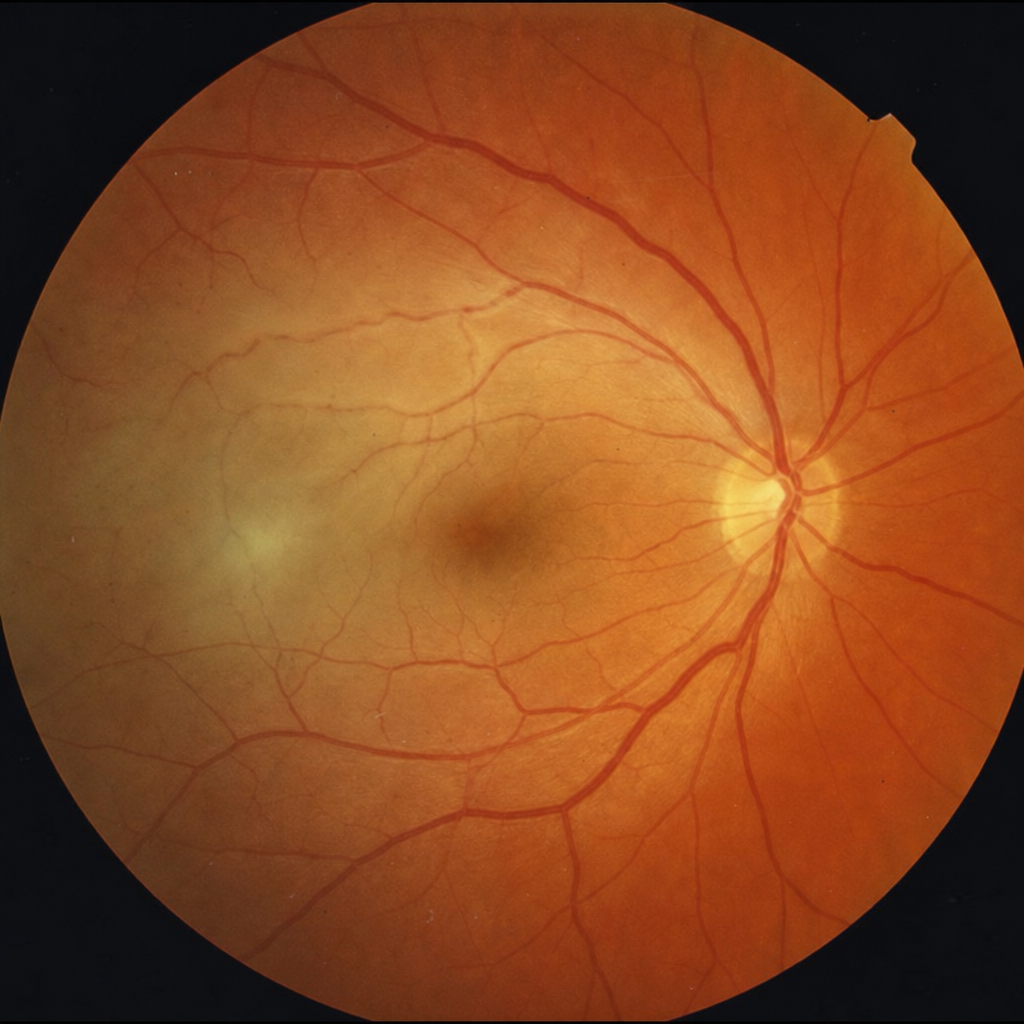
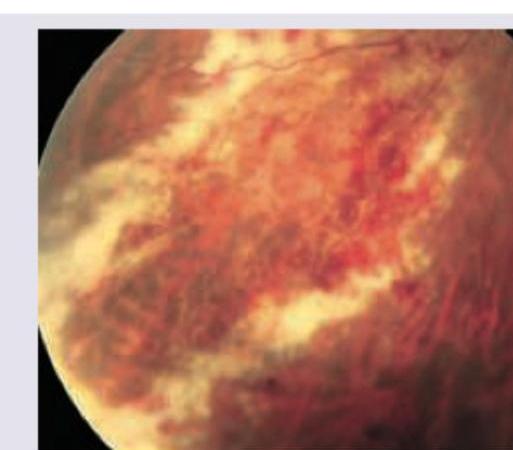
Posterior staphyloma is most commonly seen in:
Retinal detachment is diagnosed by:
In the diagnosis of retinitis pigmentosa, how does the Electroretinogram (ERG) compare in sensitivity to the Electrooculogram (EOG)?
Which of the following is NOT a characteristic finding in retinitis pigmentosa?
A young adult presented with diminished vision. On examination, the patient has anterior uveitis, vitritis, a focal necrotizing granuloma, and a macular spot. What is the most probable diagnosis?
Regarding intraocular retinoblastoma, which one of the following statements is false?
What is the primary treatment for neovascularization in diabetic retinopathy?
Ring scotoma is a characteristic visual field defect seen in which condition?
What is the thinnest part of the retina?
Which ophthalmological investigation is being performed on the patient?

Explanation: **Explanation:** **Posterior staphyloma** is defined as an outpouching of the posterior pole of the globe, involving the thinning of the sclera, choroid, and retinal pigment epithelium (RPE). **Why Degenerative Myopia is correct:** In **Degenerative (Pathological) Myopia**, there is progressive axial elongation of the eyeball. As the globe expands, the posterior sclera thins and bulges backward. This is the hallmark clinical feature of the disease. It is most commonly located at the posterior pole (peripapillary or macular region) and is often associated with "lacquer cracks" and Fuchs' spots. **Why other options are incorrect:** * **A & C (Perforating injuries/Sloughing corneal ulcer):** These conditions typically lead to **Anterior Staphyloma**. When the cornea perforates or sloughs, the iris prolapses and becomes incarcerated in the fibrous scar tissue (pseudocornea). The intraocular pressure causes this weakened anterior segment to bulge forward. * **B (Developmental glaucoma):** This leads to **Buphthalmos** (generalized enlargement of the globe) due to the distensibility of the young sclera under high intraocular pressure. While the whole eye expands, it does not typically present as a localized posterior staphyloma. **High-Yield Clinical Pearls for NEET-PG:** * **Types of Staphyloma:** 1. **Anterior:** Involves the cornea (post-ulcer/perforation). 2. **Intercalary:** At the limbus (up to the ciliary body). 3. **Ciliary:** Over the ciliary body (2–8 mm behind limbus). 4. **Equatorial:** At the exit of vortex veins. 5. **Posterior:** At the posterior pole (Pathological Myopia). * **B-Scan Ultrasonography** is the gold standard for diagnosing posterior staphyloma when the media is opaque. * **Curtin’s Classification** is used to categorize the different shapes of posterior staphyloma.
Explanation: **Explanation:** Retinal detachment (RD) is a clinical diagnosis made by visualizing the separation of the neurosensory retina from the underlying retinal pigment epithelium. To confirm this, a clinician must perform a detailed examination of the fundus using various biomicroscopic techniques. 1. **+90 D Lens:** This is a non-contact lens used with a slit lamp for **Indirect Ophthalmoscopy**. It provides a wide field of view and is excellent for screening the posterior pole and mid-periphery for fluid or tears. 2. **Hruby Lens:** This is a **-58.6 D plano-concave** non-contact lens. It neutralizes the refractive power of the eye to allow a direct, upright, and highly magnified view of the posterior retina and vitreous. 3. **Goldmann 3-Mirror Contact Lens:** This is the **gold standard** for evaluating the peripheral retina. While the central lens views the posterior pole, the three mirrors are angled (60°, 67°, and 73°) to visualize the ora serrata and the pars plana, where peripheral retinal breaks (the cause of rhegmatogenous RD) are most commonly located. Since all three instruments allow for the visualization of the retina required to identify detachment, **Option D** is correct. **High-Yield Clinical Pearls for NEET-PG:** * **Indirect Ophthalmoscopy:** Provides a real, inverted, and reversed image. It is the best method for a global view of RD. * **Scleral Depression:** Often used alongside indirect ophthalmoscopy to visualize the extreme periphery (ora serrata). * **B-Scan Ultrasonography:** The investigation of choice for diagnosing RD when ocular media are opaque (e.g., dense cataract or vitreous hemorrhage). It shows a high-amplitude "membrane" spike. * **Shafer’s Sign:** "Tobacco dusting" (pigment cells in the anterior vitreous) is a pathognomonic sign of a retinal tear.
Explanation: **Explanation:** **1. Why the correct answer is right:** Retinitis Pigmentosa (RP) is a progressive hereditary dystrophy primarily affecting the rod photoreceptors. In the early stages of the disease, the **Electrooculogram (EOG)** is more sensitive because it reflects the health of the **Retinal Pigment Epithelium (RPE)** and the photoreceptor-RPE interface. Since the RPE is affected very early in the pathogenesis of RP, the EOG (specifically the Arden Index) becomes abnormal **before** significant changes are visible on a standard full-field **Electroretinogram (ERG)**. Therefore, the ERG is considered **less sensitive** than the EOG for early detection. **2. Why the incorrect options are wrong:** * **Option A:** ERG is not more sensitive; while it is the "gold standard" for confirming the diagnosis (showing a characteristic "extinguished" or "flat" trace in advanced stages), it lacks the early-stage sensitivity of the EOG. * **Option C:** They are not equally sensitive because the EOG can detect subclinical RPE dysfunction while the ERG still shows near-normal amplitudes. **3. Clinical Pearls for NEET-PG:** * **Classic Triad of RP:** Bony spicule pigmentation, Arteriolar attenuation (narrowing), and Waxy pallor of the Optic Disc. * **ERG Findings:** The scotopic (rod-derived) response is affected first. In advanced RP, the ERG is typically **extinguished** (flat). * **EOG Arden Index:** A value of **<1.5** (or 150%) is considered abnormal (Normal is >1.85). * **Visual Field:** Characteristically shows a **Ring Scatoma** which progresses to "Tunnel Vision." * **Inheritance:** Most common is Autosomal Recessive; Most severe is X-linked.
Explanation: **Explanation:** Retinitis Pigmentosa (RP) is a hereditary, progressive dystrophy primarily affecting the rod photoreceptors, followed by the cones. The diagnosis is based on a classic clinical triad and characteristic functional tests. **Why Option D is the correct answer:** The **Electroretinogram (ERG)** is the most sensitive test for diagnosing RP. In this condition, the ERG is **never normal**; it typically shows markedly reduced (subnormal) or even "extinguished" (non-recordable) responses, even in early stages before significant fundus changes appear. A normal ERG effectively rules out a diagnosis of Retinitis Pigmentosa. **Analysis of Incorrect Options (Classic Triad):** * **Option A (Pigmentary deposits):** These are "bone-spicule" shaped pigment deposits, typically found in the mid-periphery. They are caused by the migration of melanin from the Retinal Pigment Epithelium (RPE) into the sensory retina. * **Option B (Pale, waxy optic disc):** This occurs due to consecutive optic atrophy resulting from the degeneration of retinal ganglion cells. * **Option C (Narrowing of retinal vessels):** Marked attenuation (thinning) of retinal arterioles is a hallmark sign, likely a secondary response to reduced retinal metabolic demand. **High-Yield Clinical Pearls for NEET-PG:** * **Earliest Symptom:** Nyctalopia (Night blindness) due to rod dysfunction. * **Visual Field:** Characteristically shows a **Ring Scotoma**, which progresses to "Tunnel Vision." * **Inheritance:** Most common is Autosomal Recessive; most severe is X-linked Recessive. * **Associated Syndromes:** **Usher Syndrome** (RP + Sensorineural hearing loss) and **Laurence-Moon-Biedl Syndrome** (RP + Obesity + Polydactyly + Hypogonadism + Intellectual disability). * **EOG (Electro-oculogram):** Also abnormal (shows absence of light peak).
Explanation: ### **Explanation** The clinical presentation of **anterior uveitis, vitritis, and a focal necrotizing granuloma** is classic for **Ocular Toxoplasmosis**, the most common cause of posterior uveitis worldwide. **1. Why Ocular Toxoplasmosis is Correct:** * **Focal Necrotizing Retinochoroiditis:** The hallmark lesion is a yellowish-white fluffy exudate (granuloma) with ill-defined margins. * **"Headlight in the Fog" Appearance:** Intense vitritis (inflammation in the vitreous) overlying the active retinal lesion creates this characteristic clinical sign. * **Macular Spot:** Toxoplasmosis has a predilection for the posterior pole, particularly the macula. In congenital cases, it often presents as a "punched-out" pigmented macular scar (Macular Coloboma-like lesion). * **Associated Findings:** It frequently causes a secondary "spill-over" anterior uveitis. **2. Why Other Options are Incorrect:** * **Proteus Syndrome:** A rare genetic disorder characterized by overgrowth of bones and skin; it does not typically present with necrotizing granulomatous uveitis. * **White Dot Syndromes:** These are a group of idiopathic inflammatory conditions (e.g., APMPPE, Birdshot) that present with multiple, small, discrete white lesions at the level of the outer retina/choroid, usually without intense vitritis or focal necrotizing granulomas. * **Multifocal Choroiditis (MFC):** While it involves vitritis, it presents with multiple small, punched-out chorioretinal lesions scattered throughout the fundus, rather than a single focal necrotizing granuloma. **Clinical Pearls for NEET-PG:** * **Etiology:** Caused by *Toxoplasma gondii* (obligate intracellular protozoan). * **Treatment of Choice:** Triple therapy (Sulfadiazine + Pyrimethamine + Folinic acid) + Steroids (started 24-48 hours after antibiotics). * **Recurrence:** New active lesions typically arise at the margins of old, pigmented scars (Satellite lesions).
Explanation: This question tests your understanding of the genetics and clinical management of Retinoblastoma (RB), the most common intraocular malignancy of childhood. ### **Explanation of the Correct Answer (Option B)** The statement in Option B is **false** because "sporadic" refers to the clinical presentation (no family history), not necessarily the genetic status. * **The Concept:** According to Knudson’s Two-Hit Hypothesis, RB occurs due to mutations in the **RB1 gene** (Chromosome 13q14). * While 94% of cases are sporadic (no family history), about **25-30% of these sporadic cases are actually germline mutations** (new mutations occurring in the gametes). * If a patient has a germline mutation, even if it was sporadic (de novo), they **can** pass the gene to their offspring (autosomal dominant inheritance with high penetrance). Only purely somatic (non-germline) mutations are not heritable. ### **Analysis of Other Options** * **Option A:** Correct. Approximately 94% of cases are sporadic, while only 6% are familial. * **Option C:** Correct. **Dystrophic calcification** is a hallmark of RB (occurring in 90% of cases). It appears as "chalky white" areas clinically and is highly echogenic on B-scan Ultrasound (showing "shadowing"). * **Option D:** Correct. The **Reese-Ellsworth classification** was specifically designed to predict the likelihood of **globe salvage and visual prognosis** following external beam radiotherapy (EBRT). Note: For chemotherapy/modern management, the International Classification of Intraocular Retinoblastoma (ICIR) is now more commonly used. ### **High-Yield Clinical Pearls for NEET-PG** * **Most common sign:** Leukocoria (white pupillary reflex). * **Second most common sign:** Strabismus. * **Pathology:** Flexner-Wintersteiner rosettes (highly specific) and Homer-Wright rosettes. * **Investigation of Choice:** CT scan is excellent for detecting calcification, but **MRI** is preferred to rule out optic nerve involvement and Trilateral Retinoblastoma (pineal gland involvement). * **Management:** Small tumors (<3mm) are treated with cryotherapy or laser; larger tumors may require chemotherapy (VEC protocol: Vincristine, Etoposide, Carboplatin) or enucleation.
Explanation: **Explanation:** The primary treatment for neovascularization in proliferative diabetic retinopathy (PDR) is **Pan-Retinal Photocoagulation (PRP)**, a type of retinal laser therapy. **Why Retinal Laser Photocoagulation is correct:** The underlying pathophysiology of PDR is retinal ischemia, which triggers the release of **Vascular Endothelial Growth Factor (VEGF)**. VEGF stimulates the growth of fragile new vessels (neovascularization). PRP works by laser-treating the peripheral "non-critical" ischemic retina. This reduces the overall oxygen demand of the retina and decreases VEGF production, leading to the regression of neovascularization and preventing complications like vitreous hemorrhage or tractional retinal detachment. **Why the other options are incorrect:** * **Pars plana vitrectomy (B):** This is a surgical intervention reserved for complications of PDR, such as non-clearing vitreous hemorrhage or tractional retinal detachment, rather than the primary treatment for neovascularization itself. * **Phacoemulsification (C):** This is the standard surgical technique for cataract extraction and has no role in treating retinal vascular disease. * **LASIK (D):** This is a refractive surgery used to correct myopia, hyperopia, and astigmatism by reshaping the cornea; it does not treat the retina. **Clinical Pearls for NEET-PG:** * **Gold Standard:** PRP remains the mainstay for PDR, though **Intravitreal Anti-VEGF injections** (e.g., Ranibizumab, Bevacizumab) are now frequently used as adjuncts or primary treatment for Diabetic Macular Edema (DME). * **NVE vs. NVD:** Neovascularization can occur at the Disc (NVD) or Elsewhere (NVE). * **Laser Type:** The Argon laser or Frequency-doubled Nd:YAG (532 nm) laser is typically used for PRP. * **Complication of PRP:** A common side effect is a reduction in peripheral vision and night vision (nyctalopia).
Explanation: **Explanation:** **Retinitis Pigmentosa (RP)** is a hereditary dystrophy primarily affecting the rod photoreceptors. The degeneration typically starts in the mid-peripheral retina, where rod density is highest. As these cells perish, a **ring scotoma** (annular defect) develops in the mid-periphery (usually between 30° and 50°). Over time, this scotoma expands both centrally and peripherally, eventually leaving only a small area of central vision, known as **"tunnel vision."** **Analysis of Incorrect Options:** * **A. Papilledema:** Characteristically presents with an **enlarged blind spot** due to the swelling of the optic nerve head pushing the peripapillary retina aside. * **B. Macular Edema:** Results in a **central scotoma** or metamorphopsia (distorted vision) because it involves the fovea, the area responsible for central high-acuity vision. * **C. Central Retinal Artery Occlusion (CRAO):** Typically causes sudden, profound, and **total loss of vision** (amaurosis). If a cilioretinal artery is present, a small island of central vision may be spared, but it does not produce a ring scotoma. **High-Yield Clinical Pearls for NEET-PG:** * **Classic Triad of RP:** 1. Bony spicule pigmentation (perivascular), 2. Arteriolar attenuation (narrowing), 3. Waxy pallor of the optic disc. * **Early Symptom:** Nyctalopia (night blindness) is the earliest clinical feature. * **ERG Findings:** The Electroretinogram (ERG) is subnormal or "extinguished" even in early stages. * **Other causes of Ring Scotoma:** Glaucoma (double arcuate scotoma), Vitamin A deficiency, and Chloroquine toxicity (Bull’s eye maculopathy can mimic it).
Explanation: **Explanation:** The retina varies significantly in thickness across its topography. The **foveola** is the thinnest part of the retina, measuring approximately **0.135 mm (135 μm)** in thickness. **1. Why Foveola is the correct answer:** The foveola is the central-most floor of the fovea centralis. To achieve maximum visual acuity, the inner layers of the retina (ganglion cell layer, inner plexiform, and inner nuclear layers) are displaced peripherally. Consequently, the foveola consists only of the photoreceptor layer (exclusively cones), the external limiting membrane, and the internal limiting membrane. This anatomical thinning minimizes light scattering, allowing for the highest resolution of central vision. **2. Why other options are incorrect:** * **Surrounding optic nerve head:** This is actually the **thickest** part of the retina (approx. 0.56 mm) due to the heavy accumulation of nerve fibers (axons) converging to form the optic nerve. * **Fovea:** The fovea is a larger depression (1.5 mm diameter) that contains the foveola. While thin, the fovea includes the "foveal slope" where retinal layers are still present, making it thicker than the foveola itself. * **Nasally to fovea:** The retina is generally thicker on the nasal side of the optic disc compared to the temporal side, but it is significantly thicker than the central foveolar depression. **High-Yield Clinical Pearls for NEET-PG:** * **Thickest part:** Nerve fiber layer near the optic disc. * **Thinnest part:** Foveola (0.135 mm) and the Ora Serrata (0.11 mm). Note: If both are options, Foveola is the standard clinical answer for "retina proper." * **Foveola composition:** Contains only **cones** (no rods). * **Henle’s layer:** The oblique arrangement of photoreceptor axons in the foveal region is called Henle’s layer (clinically significant in Macular Edema).
Explanation: ***Direct ophthalmoscopy*** - The **handheld device** held very close to the patient's eye without a **headband** or **condensing lens** is characteristic of direct ophthalmoscopy. - Provides a **magnified upright image** of the fundus with approximately **15x magnification** for detailed examination of the **optic disc** and **macula**. *Retinoscopy* - Uses a **streak or spot beam** projected from a distance to assess **refractive errors** by observing the **red reflex movement**. - The instrument is held at **arm's length** (approximately 66cm) from the patient, not close to the eye. *Indirect ophthalmoscopy* - Requires a **binocular headset** worn by the examiner and a **hand-held condensing lens** (typically **20D or 28D**). - Provides a **wider field of view** but an **inverted and reversed image** of the fundus. *Oblique illumination test* - Uses a **tangential light source** directed at the **anterior segment** to examine structures like the **cornea** and **iris**. - The light is positioned at an **oblique angle** to create shadows and highlights, not directed into the pupil for fundal examination.
Retinal Anatomy and Physiology
Practice Questions
Age-Related Macular Degeneration
Practice Questions
Diabetic Retinopathy
Practice Questions
Retinal Vascular Diseases
Practice Questions
Retinal Detachment
Practice Questions
Hereditary Retinal Dystrophies
Practice Questions
Inflammatory Retinal Diseases
Practice Questions
Retinal Tumors
Practice Questions
Retinopathy of Prematurity
Practice Questions
Retinal Imaging Techniques
Practice Questions
Intravitreal Pharmacotherapy
Practice Questions
Vitreoretinal Surgery
Practice Questions
Get full access to all questions, explanations, and performance tracking.
Start For Free