Retinitis pigmentosa is not associated with which of the following conditions?
Which of the following is NOT a feature of non-proliferative diabetic retinopathy?
Waxy pallor of the optic disc is seen in which disease?
What is the peak sensitivity of retinal rods and cones pigment in the most refractive eyes?
What is the diameter of the macula lutea?
Uveal effusion syndrome may be associated with all of the following, except:
A 25-year-old male presents with painless sudden loss of vision. Ocular and systemic examinations are not contributory. What is the probable diagnosis?
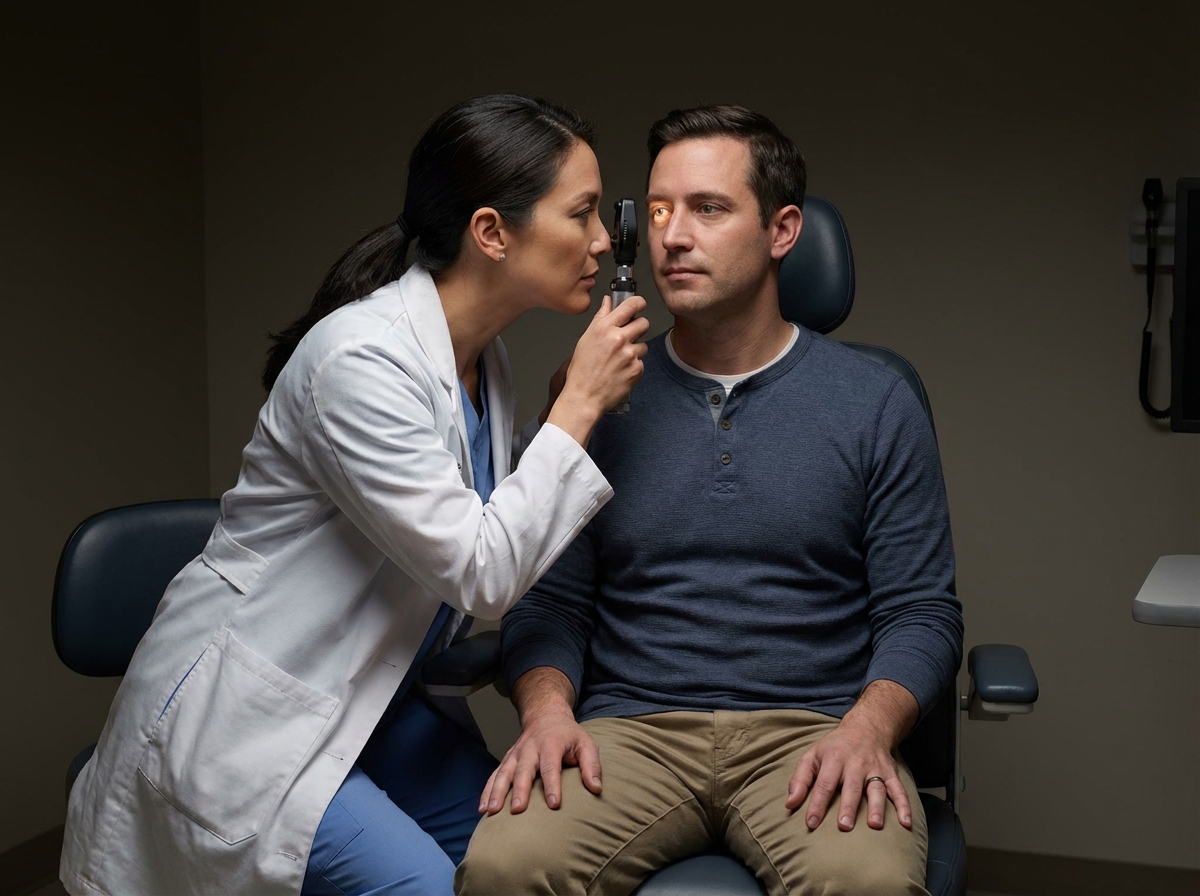
Select the incorrect statement about this condition?

Microaneurysms in diabetic retinopathy are typically found in which retinal layer?
What is the most common site for a retinal break?
Explanation: **Explanation:** Retinitis Pigmentosa (RP) is a group of inherited retinal dystrophies characterized by the progressive degeneration of photoreceptors (primarily rods). While most cases are isolated, approximately 25% are associated with systemic syndromes. **Why Marfan Syndrome is the Correct Answer:** Marfan syndrome is a connective tissue disorder caused by a mutation in the **FBN1 gene** (fibrillin-1). Its ocular hallmarks include **ectopia lentis** (typically superotemporal subluxation), high myopia, and retinal detachment. It is **not** associated with the retinal pigmentary changes or rod-cone dystrophy seen in Retinitis Pigmentosa. **Analysis of Other Options (Syndromes associated with RP):** * **Usher Syndrome:** The most common syndromic cause of RP. It involves sensorineural hearing loss and vestibular dysfunction. * **Refsum’s Syndrome:** A metabolic disorder (accumulation of phytanic acid) characterized by RP, peripheral neuropathy, and cerebellar ataxia. It is high-yield because it is potentially treatable via dietary restriction. * **Laurence-Moon-Biedl (Bardet-Biedl) Syndrome:** Characterized by RP, polydactyly, obesity, hypogonadism, and mental retardation. **NEET-PG Clinical Pearls:** * **Classic Triad of RP:** Bony spicule pigmentation (mid-periphery), arteriolar attenuation (narrowing), and waxy pallor of the optic disc. * **Earliest Symptom:** Nyctalopia (night blindness) due to rod dysfunction. * **Visual Field:** Characterized by a "ring scotoma" progressing to tubular vision. * **Other Associations:** Kearns-Sayre syndrome (external ophthalmoplegia, heart block), Bassen-Kornzweig syndrome (abetalipoproteinemia), and Cockayne syndrome.
Explanation: **Explanation:** The question asks for a feature that is **NOT** part of Non-Proliferative Diabetic Retinopathy (NPDR). However, there is a technical error in the provided options/key: **Hard exudates are a hallmark feature of NPDR.** The correct answer to "which is NOT a feature of NPDR" should be **Option A: Neovascularization.** **1. Why Neovascularization is the correct answer (The Concept):** Diabetic Retinopathy is classified into two main stages: * **NPDR (Non-Proliferative):** Characterized by changes *within* the retina due to increased vascular permeability and capillary occlusion. Key features include microaneurysms (earliest sign), dot-blot hemorrhages, **hard exudates** (lipid leaks), and **soft exudates** (cotton wool spots/nerve fiber layer infarcts). * **PDR (Proliferative):** Defined by the hallmark presence of **Neovascularization** (NVD/NVE) due to severe retinal ischemia and VEGF release. **2. Analysis of Options:** * **A. Neovascularization:** This is the defining feature of **PDR**, not NPDR. * **B. Soft Exudates:** Also known as Cotton Wool Spots; these occur in pre-proliferative/severe NPDR due to axoplasmic stasis in the nerve fiber layer. * **C. Hard Exudates:** These are yellow-waxy deposits of lipoproteins in the Outer Plexiform Layer, a classic sign of NPDR. * **D. Vitreous Detachment:** While more common in PDR due to fibrovascular traction, Posterior Vitreous Detachment (PVD) can occur independently in diabetic patients. **High-Yield Clinical Pearls for NEET-PG:** * **Earliest clinical sign of DR:** Microaneurysms (located in the Inner Nuclear Layer). * **First sign on Fluorescein Angiography (FFA):** Microaneurysms (appear as hyperfluorescent dots). * **Hard Exudates Location:** Outer Plexiform Layer. * **Classification:** The **ETDRS classification** is the gold standard for grading severity. * **Management:** Pan-retinal photocoagulation (PRP) is indicated for High-Risk PDR. Anti-VEGFs are first-line for Diabetic Macular Edema (DME).
Explanation: The correct answer is **Retinitis pigmentosa (RP)**. ### **Explanation** **Retinitis pigmentosa** is a hereditary dystrophy characterized by the progressive degeneration of photoreceptors (primarily rods). The classic clinical presentation is defined by a **diagnostic triad**: 1. **Waxy pallor of the optic disc:** This occurs due to consecutive optic atrophy resulting from retinal ganglion cell degeneration and glial proliferation (astrocytic gliosis) over the disc surface. 2. **Bony spicule pigmentation:** Pigment migration into the perivascular spaces of the retina, typically in the mid-periphery. 3. **Arteriolar attenuation:** Significant narrowing of the retinal blood vessels. ### **Analysis of Incorrect Options** * **B. Retinopathy of Prematurity (ROP):** Characterized by peripheral neovascularization, fibrovascular proliferation, and tractional retinal detachment. It does not typically cause waxy disc pallor. * **C. Hypertensive Retinopathy:** Features include arteriolar narrowing, AV nipping, flame-shaped hemorrhages, and cotton wool spots. Severe cases (Grade IV) show **papilledema** (swelling), not waxy pallor. * **D. Diabetic Retinopathy:** Characterized by microaneurysms, hard exudates, and neovascularization. While it can lead to optic neuropathy, waxy pallor is not a hallmark feature. ### **NEET-PG High-Yield Pearls** * **Symptoms of RP:** Nyctalopia (night blindness) is the earliest symptom, followed by "ring scotoma" leading to **tubular vision**. * **ERG Findings:** The Electroretinogram (ERG) is **subnormal or extinguished** even in early stages, making it the most sensitive test for diagnosis. * **Associations:** RP is associated with **Posterior Subcapsular Cataract (PSC)**, Cystoid Macular Edema (CME), and Keratoconus. * **Systemic Association:** **Usher syndrome** (RP + Sensorineural hearing loss) is the most common syndromic association.
Explanation: ### Explanation The human retina contains two types of photoreceptors—rods and cones—which contain photopigments sensitive to specific wavelengths of light. This question tests the fundamental physiological concept of **spectral sensitivity**. **1. Why Option D is Correct:** * **Rods:** These contain the pigment **Rhodopsin**, which is responsible for scotopic (night) vision. Its peak sensitivity is approximately **498 nm** (often rounded to 500 nm in some texts), which falls in the blue-green spectrum. * **Cones:** These are responsible for photopic (daylight) and color vision. While there are three types of cones (S, M, and L), the **overall peak sensitivity** of the combined cone system (photopic luminosity curve) is approximately **555 nm**, which corresponds to a yellowish-green hue. **2. Why Other Options are Incorrect:** * **Option A:** 260 nm is in the Ultraviolet (UV) range, which is largely absorbed by the cornea and lens to protect the retina. * **Option B:** 460 nm and 480 nm are in the blue spectrum. While S-cones (blue cones) peak near 420-440 nm, these values do not represent the peak for rods or the overall cone system. * **Option C:** 398 nm is near the violet/UV border, and 550 nm is close to the cone peak but the rod value is incorrect. **3. Clinical Pearls & High-Yield Facts for NEET-PG:** * **Purkinje Shift:** This is the shift in peak sensitivity from 555 nm (cones) to 505/498 nm (rods) as lighting conditions change from daylight to twilight. * **Vitamin A:** Retinal (the aldehyde form of Vitamin A) is the prosthetic group for all photopigments. Deficiency leads to **Nyctalopia** (night blindness) because rods are affected first. * **Tritanopia:** Rare blue-yellow color blindness (S-cone deficiency). * **Deuteranopia:** Most common form of color blindness (M-cone/green deficiency).
Explanation: **Explanation:** The **macula lutea** (often simply called the macula) is a yellowish, oval-shaped area located at the posterior pole of the retina, temporal to the optic disc. Its diameter is approximately **5.5 mm**, which corresponds to an visual angle of about 15–18 degrees. It is anatomically defined as the region containing two or more layers of ganglion cells. **Breakdown of Options:** * **5.5 mm (Correct):** This is the standard anatomical diameter of the macula. It is bounded by the superior and inferior temporal arterial arcades. * **1.5 mm (Incorrect):** This is the diameter of the **fovea centralis** (the central depression within the macula) and is also roughly the same size as the **optic disc**. * **3.5 mm (Incorrect):** This value does not correspond to a major retinal landmark but is sometimes confused with the distance from the center of the fovea to the edge of the optic disc (which is ~3.5–4 mm). * **4.5 mm (Incorrect):** This is an incorrect measurement for the macula. **High-Yield Clinical Pearls for NEET-PG:** * **Foveola:** The central-most part of the fovea (0.35 mm diameter). It is the thinnest part of the retina and contains **only cones** (highest visual acuity). * **Foveal Avascular Zone (FAZ):** Located within the fovea, it is roughly 0.4–0.6 mm in diameter. Its absence or enlargement is significant in diabetic retinopathy (seen on FFA). * **Xanthophyll Pigment:** The yellow color of the macula is due to carotenoid pigments (lutein and zeaxanthin), which protect the retina from UV damage. * **Henle’s Layer:** In the foveal region, the outer plexiform layer is oblique and is known as Henle’s fiber layer; this is where "macular stars" (exudates) form.
Explanation: **Explanation:** Uveal Effusion Syndrome (UES) is a rare condition characterized by spontaneous ciliochoroidal detachment and exudative retinal detachment. The core pathophysiology involves **impaired trans-scleral outflow** of intraocular fluid. **1. Why Myopia is the Correct Answer (The "Except"):** UES is classically associated with **Hyperopia**, not Myopia. In UES, the eye is typically small (nanophthalmos) or has an abnormally thick sclera. Myopia is associated with an elongated globe and a thin sclera, which would theoretically facilitate rather than hinder fluid outflow. Therefore, Myopia is the outlier. **2. Analysis of Other Options:** * **Nanophthalmos (Option D):** This is the most common association. A small globe (short axial length) often possesses an abnormally thick, congested sclera that obstructs the drainage of the vortex veins and protein transport. * **Structural defect in the sclera (Option C):** UES is fundamentally a disease of the sclera. Histopathology shows disorganized collagen bundles and deposition of glycosaminoglycans, which increases resistance to fluid movement. * **Ciliochoroidal detachment (Option B):** This is a hallmark clinical feature of the syndrome. The accumulation of fluid in the suprachoroidal space leads to "kissing choroidals" and secondary exudative retinal detachment. **Clinical Pearls for NEET-PG:** * **"Leopard Spot" Pigmentation:** After the resolution of the subretinal fluid, the RPE often shows a characteristic mottled appearance. * **Management:** Medical therapy (steroids) is usually ineffective. The definitive treatment is **Scleral Buckling or Quadrant Sclerectomies** (thick sclera excision) to allow fluid drainage. * **Differential Diagnosis:** Always rule out intraocular tumors or Vogt-Koyanagi-Harada (VKH) syndrome, though VKH presents with inflammation (cells/flare), which is absent in UES.
Explanation: ### Explanation The correct answer is **Eale’s disease**. **1. Why Eale’s Disease is Correct:** Eale’s disease is an idiopathic peripheral perivasculitis (primarily affecting venules) that typically affects **young adult males** (20–30 years). The "painless sudden loss of vision" in this demographic is most commonly due to a **vitreous hemorrhage** resulting from neovascularization. A key diagnostic feature for NEET-PG is that the systemic and ocular examinations (other than the retinal findings) are often **non-contributory**, though there is a strong historical association with tuberculoprotein hypersensitivity. **2. Why Other Options are Incorrect:** * **Retinal Detachment (RD):** While it causes painless vision loss, it is often preceded by "flashes and floaters" (photopsia). In a 25-year-old, RD is usually associated with high myopia or trauma, which would be noted in the examination. * **Glaucoma:** Chronic simple glaucoma causes a progressive, painless loss of *peripheral* vision (tunnel vision), not sudden total loss. Acute congestive glaucoma causes sudden loss but is associated with intense pain, redness, and vomiting. * **Cataract:** This causes a **gradual**, progressive painless blurring of vision, not a sudden event. **3. Clinical Pearls for NEET-PG:** * **Demographic:** Classic "Young Male" + "Sudden painless vision loss" = Eale’s Disease. * **Stages:** Perivasculitis (sheathing) → Peripheral non-perfusion → Neovascularization → Vitreous Hemorrhage → Tractional RD. * **Treatment:** Photocoagulation (LASER) for ischemia/neovascularization and steroids for active inflammation. * **Differential:** Always rule out Tuberculosis, as many cases show a positive Mantoux test.
Explanation: ***Associated with vitreous hemorrhage*** - **Valsalva retinopathy** causes **preretinal/subhyaloid hemorrhage** or **sub-internal limiting membrane (ILM) hemorrhage**, NOT vitreous hemorrhage. - The blood remains confined to the **retinal layers** and does not extend into the **vitreous cavity**. *Self-resolving* - **Valsalva retinopathy** is typically **self-limiting** and resolves spontaneously over weeks to months. - Most cases do not require intervention as the **preretinal hemorrhage** gradually clears without treatment. *Seen in Valsalva maneuver* - Results from **sudden increase in intrathoracic pressure** during activities like coughing, vomiting, or weight lifting. - The **venous pressure spike** causes rupture of **superficial retinal capillaries** leading to characteristic hemorrhage pattern. *Bleeding profile can be checked* - **Coagulation studies** may be performed to rule out underlying **bleeding disorders** in recurrent cases. - Workup helps exclude systemic causes like **thrombocytopenia** or **coagulopathy** that might predispose to retinal bleeding.
Explanation: **Explanation:** Microaneurysms are the **earliest clinically detectable sign** of Diabetic Retinopathy (DR). They represent focal saccular outpouchings of the retinal capillaries, occurring due to the loss of pericytes and basement membrane thickening. **Why the Inner Nuclear Layer (INL) is correct:** The retina has a dual blood supply. The inner layers are supplied by the central retinal artery, which forms two primary capillary networks: 1. **Superficial capillary plexus:** Located in the Nerve Fiber Layer (NFL) or Ganglion Cell Layer (GCL). 2. **Deep capillary plexus:** Located at the junction of the **Inner Nuclear Layer (INL)** and the Outer Plexiform Layer. Microaneurysms predominantly arise from the **venous end** of these deep capillaries located within the **Inner Nuclear Layer**. **Why the other options are incorrect:** * **Outer Nuclear Layer (ONL):** This layer contains the cell bodies of photoreceptors (rods and cones). It is part of the outer retina, which is avascular and relies on the choriocapillaris for nutrition via diffusion. * **Inner Plexiform Layer (IPL):** While the superficial plexus is nearby, the pathological hallmark of microaneurysms is specifically linked to the deeper capillary bed in the INL. * **Outer Plexiform Layer (OPL):** This is the site where **Hard Exudates** (lipid deposits) typically accumulate, but it is not the primary site of microaneurysm formation. **NEET-PG High-Yield Pearls:** * **Earliest Sign of DR:** Microaneurysms (clinically); Loss of pericytes (histologically). * **Dot-Blot Hemorrhages:** Also located in the **Inner Nuclear Layer** (deep retina). * **Flame-shaped Hemorrhages:** Located in the **Nerve Fiber Layer** (superficial retina). * **Investigation of Choice:** Fluorescein Angiography (FFA) shows microaneurysms as tiny "hyperfluorescent" dots.
Explanation: **Explanation:** The most common site for a retinal break (tear or hole) is the **upper temporal (superotemporal)** quadrant. **Why Upper Temporal?** The primary mechanism behind retinal breaks is **Vitreoretinal Traction**. The vitreous base is most firmly attached at the ora serrata. Due to the effects of gravity and the anatomical distribution of vitreous liquefaction (synchysis), the vitreous tends to collapse and pull away from the superior retina first. The temporal quadrant is more susceptible than the nasal quadrant because it is more extensive and often undergoes more significant peripheral degenerative changes, such as lattice degeneration. **Analysis of Options:** * **A. Upper temporal (Correct):** Approximately 60% of retinal breaks occur in the superior quadrants, with the superotemporal being the single most frequent site. * **B. Lower temporal:** While common for certain types of retinal dialysis (often traumatic), it is statistically less frequent than the upper temporal quadrant for spontaneous rhegmatogenous breaks. * **C & D. Nasal Quadrants:** These are less common sites because the nasal retina is anatomically shorter and generally experiences less mechanical traction compared to the temporal side. **NEET-PG High-Yield Pearls:** * **Most common type of Retinal Detachment (RD):** Rhegmatogenous RD (caused by a break). * **Most common precursor lesion:** Lattice degeneration (found in ~8% of the population; most common in the superotemporal quadrant). * **Lincoff’s Rules:** These are used to locate the primary retinal break based on the shape of the subretinal fluid. * **Symptom Triad:** Photopsia (flashes), sudden onset of floaters, and a "curtain-like" visual field loss.
Retinal Anatomy and Physiology
Practice Questions
Age-Related Macular Degeneration
Practice Questions
Diabetic Retinopathy
Practice Questions
Retinal Vascular Diseases
Practice Questions
Retinal Detachment
Practice Questions
Hereditary Retinal Dystrophies
Practice Questions
Inflammatory Retinal Diseases
Practice Questions
Retinal Tumors
Practice Questions
Retinopathy of Prematurity
Practice Questions
Retinal Imaging Techniques
Practice Questions
Intravitreal Pharmacotherapy
Practice Questions
Vitreoretinal Surgery
Practice Questions
Get full access to all questions, explanations, and performance tracking.
Start For Free