Amster grid is used in which type of examination?
Epiretinal membrane is seen in which of the following conditions?
The "shower of golden rain" appearance in synchisis scintillans is due to which of the following?
Screening of the retina in non-insulin-dependent diabetes mellitus should start after how many years of diagnosis?
What is the cause of acute vision loss in a patient with alcoholic pancreatitis?
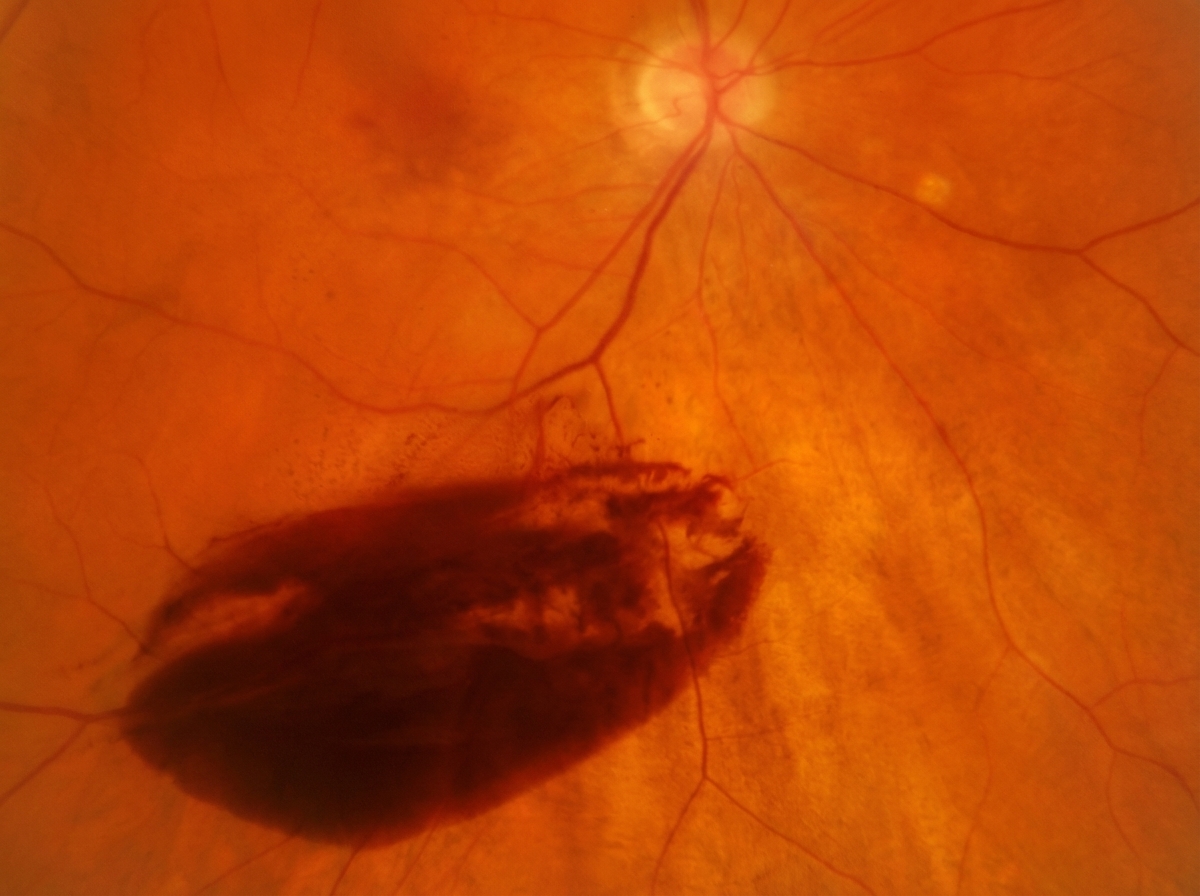
Black floaters in a diabetic patient indicate what condition?
Visual fields are diagnosed by which of the following methods?
Which of the following statements regarding retinal detachment is false?
Lattice degeneration is seen in which of the following conditions?
Which is the most resistant layer of the neurosensory retina?
Explanation: **Explanation:** The **Amsler Grid** is a simple, non-invasive clinical tool used primarily to monitor the central **10 degrees** of the visual field. It is the gold standard for the bedside screening and self-monitoring of **maculopathy**. **Why Option A is correct:** The macula is responsible for central, high-resolution vision. When there is fluid (edema), blood, or subretinal neovascularization (as seen in Wet ARMD), the retinal architecture is distorted. This leads to **metamorphopsia** (distortion of straight lines) or **scotomas** (blind spots), which the patient perceives while viewing the grid. It is most commonly used in Age-Related Macular Degeneration (ARMD) and Central Serous Chorioretinopathy (CSCR). **Why other options are incorrect:** * **Optic disc examination:** This is typically performed using direct/indirect ophthalmoscopy or slit-lamp biomicroscopy (90D lens). Functional assessment of the optic nerve involves visual acuity, pupillary reaction (RAPD), and perimetry (HVF). * **Squint assessment:** Evaluated using the Hirschberg corneal reflex test, Cover-Uncover tests, and Prism Bar Cover Test (PBCT). * **General retinal examination:** This requires a wider field of view, achieved via Indirect Ophthalmoscopy or peripheral retinal imaging. **High-Yield Clinical Pearls for NEET-PG:** * **Metamorphopsia:** The earliest symptom of maculopathy detectable by Amsler Grid. * **Testing Distance:** The grid is held at a normal reading distance (**30 cm**) with near-correction glasses on. * **The "Watzke-Allen" Sign:** Another clinical test for macular holes using a slit-lamp beam. * **Micropsia vs. Macropsia:** Edema (pushing photoreceptors apart) causes micropsia; retinal scarring (pulling them together) can cause macropsia.
Explanation: **Explanation:** **Epiretinal Membrane (ERM)**, also known as macular pucker or cellophane maculopathy, is a thin, semi-transparent fibrocellular layer that forms on the inner surface of the retina (the internal limiting membrane). **1. Why Posterior Vitreous Detachment (PVD) is the correct answer:** PVD is the most common cause of idiopathic ERM. When the vitreous separates from the retina, it can cause microscopic damage to the retinal surface or leave behind residual vitreous cells (hyalocytes). This triggers a wound-healing response where glial cells (Müller cells, astrocytes) and RPE cells migrate and proliferate on the retinal surface, forming a contractile membrane. **2. Why the other options are incorrect:** * **Optic Neuritis, Papilloedema, and Glaucomatous Optic Atrophy:** These are all pathologies primarily affecting the **Optic Nerve (Cranial Nerve II)**. While they may cause vision loss or changes in the optic disc appearance, they do not involve the fibrocellular proliferation on the retinal surface that characterizes an epiretinal membrane. ERM is a vitreoretinal interface disorder, not a primary optic nerve disorder. **Clinical Pearls for NEET-PG:** * **Symptoms:** Most patients are asymptomatic, but advanced cases present with **Metamorphopsia** (distorted vision) and decreased visual acuity. * **Diagnosis:** **Optical Coherence Tomography (OCT)** is the gold standard, showing a hyperreflective line on the retinal surface. * **Watzke-Bile Sign:** Used to differentiate ERM/Pseudohole from a true Macular Hole. * **Management:** Pars Plana Vitrectomy (PPV) with **Membrane Peeling** (using Brilliant Blue G dye) is the treatment of choice for symptomatic cases.
Explanation: **Explanation:** **Synchisis Scintillans** (also known as cholesterolosis bulbi) is a degenerative condition of the eye characterized by the accumulation of **cholesterol crystals** in the vitreous humor. These crystals are typically the result of chronic intraocular inflammation, long-standing vitreous hemorrhage, or trauma. * **Why Option B is correct:** The cholesterol crystals are flat, angular, and highly refractive. Because they are heavier than the vitreous, they settle at the bottom of the vitreous cavity. When the eye moves, these crystals are stirred up and then slowly settle back down due to gravity. This movement creates the classic **"shower of golden rain"** appearance on ophthalmoscopy. * **Why Option A is incorrect:** Calcium soaps (calcium phosphate) are the hallmark of **Asteroid Hyalosis**. Unlike synchisis scintillans, these bodies are suspended within the vitreous fibrils and do not settle when the eye is still. * **Why Options C & D are incorrect:** Iron deposition (Siderosis bulbi) and Copper deposition (Chalcosis) are related to retained intraocular foreign bodies. Iron typically causes a "rusty" appearance and retinal toxicity, while copper can lead to a "sunflower cataract." **High-Yield Clinical Pearls for NEET-PG:** | Feature | Synchisis Scintillans | Asteroid Hyalosis | | :--- | :--- | :--- | | **Composition** | Cholesterol crystals | Calcium-lipid complexes | | **Movement** | Settle at the bottom (Gravity-dependent) | Move with vitreous, do not settle | | **Association** | Damaged/Diseased eye (Hemorrhage, Uveitis) | Usually healthy eye; associated with Age/Diabetes | | **Bilateralism** | Often Unilateral | Usually Unilateral | | **Vitreous State** | Fluid (Synchytic) | Solid/Normal |
Explanation: **Explanation:** The timing of screening for Diabetic Retinopathy (DR) depends entirely on the type of Diabetes Mellitus (DM) and the likely duration of asymptomatic hyperglycemia. **Why "Immediately" is correct:** In **Type 2 DM (NIDDM)**, the exact onset of the disease is often unknown. Patients may have had asymptomatic hyperglycemia for years before a clinical diagnosis is made. Consequently, approximately 20% of Type 2 diabetics already have some degree of retinopathy at the time of diagnosis. Therefore, the American Academy of Ophthalmology (AAO) and national guidelines recommend an initial dilated fundus examination **immediately (at the time of diagnosis)**. **Why other options are incorrect:** * **5 Years (Option A):** This is the screening protocol for **Type 1 DM**. In Type 1, the onset is acute and clearly defined. Since retinopathy rarely develops within the first 5 years of prepubertal or adolescent onset, screening is deferred until 5 years after diagnosis. * **6 Years / 3 Months (Options B & D):** These do not align with any standard clinical guidelines for the initial screening of diabetic patients. **High-Yield Clinical Pearls for NEET-PG:** * **Follow-up:** After the initial screen, follow-up is typically **annually** if no retinopathy is found. * **Pregnancy:** Diabetic patients who become pregnant should be screened in the **first trimester** and monitored closely throughout pregnancy (risk of rapid progression), except in cases of gestational diabetes (where the risk of DR is negligible). * **First Sign:** The earliest clinical sign of DR is **Microaneurysms** (seen in the Inner Nuclear Layer). * **Earliest Change:** The earliest pathological change is the **loss of pericytes** and basement membrane thickening.
Explanation: **Explanation:** **Purtscher’s retinopathy** is a rare but classic microvascular occlusive disease associated with non-ocular trauma (like head injuries or chest compression) and certain systemic conditions, most notably **acute pancreatitis**. 1. **Why it is correct:** In the context of alcoholic pancreatitis, the underlying mechanism involves the activation of the complement cascade (specifically C5a). This leads to the formation of leukocyte aggregates and fibrin-platelet clumps that embolize to the retinal precapillary arterioles. This results in characteristic **Purtscher flecks** (areas of inner retinal whitening), cotton wool spots, and retinal hemorrhages, leading to sudden, painless vision loss. 2. **Why the other options are incorrect:** * **Acute Congestive Glaucoma:** Presents with sudden vision loss but is accompanied by severe pain, a stony-hard eye, and a mid-dilated non-reactive pupil, which are not typical of pancreatitis. * **Central Retinal Artery Occlusion (CRAO):** Causes sudden painless vision loss, but the classic finding is a "cherry-red spot" at the macula and generalized retinal pallor, usually due to carotid or cardiac emboli. * **Optic Neuritis:** Typically presents with painful eye movements and a relative afferent pupillary defect (RAPD), often associated with Multiple Sclerosis rather than systemic metabolic crises. **High-Yield Clinical Pearls for NEET-PG:** * **Classic Triad:** Sudden vision loss + Acute Pancreatitis/Trauma + Purtscher flecks on fundoscopy. * **Purtscher Flecks:** These are pathognomonic; they are white patches of retinal ischemia located between the retinal arterioles and venules (unlike cotton wool spots which are more superficial). * **Management:** Usually conservative/observation, as the retinopathy often resolves with the treatment of the underlying systemic condition.
Explanation: **Explanation:** **1. Why Vitreous Hemorrhage is Correct:** In a diabetic patient, the most common cause of sudden "black floaters" or a "cobweb" appearance is **Vitreous Hemorrhage (VH)**. This occurs due to **Proliferative Diabetic Retinopathy (PDR)**, where chronic ischemia triggers the release of VEGF, leading to **neovascularization** (NVD/NVE). These new vessels are fragile and lack a proper basement membrane; they easily rupture into the vitreous cavity. When blood enters the vitreous, it casts shadows on the retina, which the patient perceives as dark, moving spots or floaters. **2. Why Other Options are Incorrect:** * **Maculopathy:** Diabetic maculopathy (e.g., Macular Edema) typically presents with **painless, gradual blurring of central vision** or metamorphopsia (distortion), not floaters. * **Vitreous Infarction:** This is not a recognized clinical entity. The vitreous is an avascular structure and does not undergo "infarction." * **Posterior Vitreous Detachment (PVD):** While PVD also causes floaters (often with flashes/photopsia), in a **diabetic** context, the examiner is specifically testing for the most common sight-threatening complication of PDR, which is hemorrhage. **Clinical Pearls for NEET-PG:** * **Fresh VH:** Presents with a "red hue" or "black streaks." * **Old VH:** May appear as "ochre membrane" (yellowish-white) due to hemoglobin degradation. * **Management:** B-Scan Ultrasonography is mandatory if the fundus is not visible to rule out underlying **Tractional Retinal Detachment (TRD)**. * **Gold Standard Treatment:** Pars Plana Vitrectomy (PPV) if the hemorrhage fails to resolve or if TRD is present.
Explanation: **Explanation:** **Perimetry** is the systematic measurement of the visual field, which represents the entire area that an eye can see while fixed on a central point. It is the gold standard for mapping the peripheral and central visual fields, helping to detect "scotomas" (blind spots) and patterns of vision loss. In clinical practice, this is essential for diagnosing and monitoring conditions like **glaucoma** (arcuate scotomas), neurological lesions (hemianopias), and retinal toxicities. **Analysis of Incorrect Options:** * **Pachymetry:** This is the measurement of **corneal thickness**. It is clinically vital for preoperative screening in LASIK and for adjusting Intraocular Pressure (IOP) readings in glaucoma (as thin corneas can lead to underestimated IOP). * **Corneal Topography:** This provides a 3D map of the **surface curvature of the cornea**. It is primarily used to diagnose Keratoconus and to plan refractive surgeries. * **Optical Coherence Tomography (OCT):** This is a non-invasive imaging technique that provides high-resolution **cross-sectional views of the retinal layers**. While it assesses the *structure* of the retina and optic nerve, perimetry assesses the *function*. **High-Yield Clinical Pearls for NEET-PG:** * **Goldmann Perimetry:** A type of kinetic perimetry. * **Humphrey Field Analyzer (HFA):** The most common static automated perimetry used today. * **Amsler Grid:** A simple bedside perimetry tool used specifically to monitor the central 10° of the visual field for **Macular Degeneration** (metamorphopsia). * **Confrontation Test:** The simplest clinical (bedside) method to screen for gross visual field defects.
Explanation: **Explanation:** **Why Option C is the correct (false) statement:** In clinical practice, retinal detachment (RD) is frequently a bilateral condition. For **Rhegmatogenous Retinal Detachment (RRD)**, the most common type, the fellow eye is involved in approximately **10-15%** of cases. This is because the underlying predisposing factors—such as high myopia, lattice degeneration, and vitreous syneresis—are typically bilateral processes. Therefore, a thorough examination of the peripheral retina in the asymptomatic fellow eye is a mandatory clinical protocol to identify and prophylactically treat any "at-risk" lesions. **Analysis of other options:** * **Option A:** RRD, caused by a retinal break (hole or tear) allowing fluid to enter the subretinal space, is indeed the **most common** clinical type of RD. * **Option B:** Aphakia (absence of lens) and pseudophakia (IOL) are known risk factors. Post-cataract surgery, changes in vitreous dynamics and the potential for posterior vitreous detachment (PVD) increase the risk of retinal tears. * **Option D:** Modern vitreoretinal surgical techniques (Scleral buckling, Pneumatic retinopexy, and Pars Plana Vitrectomy) boast high anatomical success rates, often exceeding **90%**. **High-Yield Clinical Pearls for NEET-PG:** * **Most common site of a retinal tear:** Superotemporal quadrant. * **Classic Symptom Triad:** Photopsia (flashes), Floaters (Vitreous syneresis/hemorrhage), and a "curtain-like" visual field loss. * **Shafer’s Sign:** "Tobacco dust" (pigment cells) in the anterior vitreous is pathognomonic for a retinal tear. * **Marcus Gunn Pupil:** An Afferent Pupillary Defect (RAPD) is often present in extensive detachments.
Explanation: **Explanation:** **Lattice Degeneration** is a common peripheral retinal degeneration characterized by localized thinning of the inner retinal layers, overlying vitreous liquefaction, and increased vitreoretinal adhesion at the margins of the lesion. **Why Myopia is correct:** Lattice degeneration is strongly associated with **Myopia (nearsightedness)**, particularly in eyes with increased axial length. The stretching of the globe in myopic eyes leads to peripheral retinal thinning. It is found in approximately 8–10% of the general population but has a much higher prevalence in myopes. It is the most important precursor lesion for **rhegmatogenous retinal detachment (RRD)**, as the strong vitreoretinal traction at the edges can lead to "atrophic holes" or "horseshoe tears." **Why the other options are incorrect:** * **A. Hypermetropia:** These are "short" eyes. While they are predisposed to angle-closure glaucoma, they are not typically associated with peripheral retinal thinning or lattice degeneration. * **B. Anisocoria:** This refers to unequal pupil size, which is a neurological or local iris-related sign (e.g., Horner’s syndrome or Adie’s pupil) and has no structural relationship with retinal degeneration. * **C. Glaucoma:** While myopes are at a higher risk for open-angle glaucoma, glaucoma itself is a disease of the optic nerve head and ganglion cells, not a primary cause of peripheral retinal lattice formation. **High-Yield Clinical Pearls for NEET-PG:** * **Appearance:** Characterized by "criss-cross" white lines (sclerosed vessels) and pigmentary alterations. * **Location:** Most commonly found in the **superior temporal** quadrant, between the equator and the ora serrata. * **Association:** Roughly 30% of patients with Rhegmatogenous Retinal Detachment have underlying lattice degeneration. * **Snail Track Degeneration:** A similar peripheral thinning often considered a variant of lattice, also highly associated with myopia.
Explanation: ### Explanation The **Ganglion Cell Layer (GCL)** is considered the most resistant layer of the neurosensory retina, particularly against ischemia and metabolic stress. This resilience is attributed to the high concentration of antioxidants (like glutathione) and the robust metabolic machinery within these cells, which allows them to withstand transient periods of hypoxia better than the highly metabolically active photoreceptors. **Analysis of Options:** * **A. Ganglionic cell layer (Correct):** These cells are the final output neurons of the retina. While they are sensitive to chronic pressure (as seen in glaucoma), they demonstrate superior resistance to acute ischemic insults compared to other layers. * **B. Layer of rods and cones:** This is the **most metabolically active** and, consequently, the **most fragile** layer. Photoreceptors have the highest oxygen consumption rate in the body and are the first to suffer damage in retinal detachment or ischemia. * **C. Retinal pigment epithelium (RPE):** While technically a single layer of cells, the RPE is **not part of the neurosensory retina** (it is the outermost layer of the retina proper). It is highly resistant to many insults but is the primary site of pathology in Age-Related Macular Degeneration (ARMD). * **D. Nerve fibre layer (NFL):** This layer consists of the axons of the ganglion cells. It is highly susceptible to mechanical damage and ischemia (e.g., cotton wool spots). **Clinical Pearls for NEET-PG:** * **Most sensitive layer to ischemia:** Layer of rods and cones (Photoreceptors). * **First layer to show changes in Glaucoma:** Nerve Fibre Layer/Ganglion Cell Layer. * **Blood-Retinal Barrier (Inner):** Formed by tight junctions of retinal capillary endothelial cells. * **Blood-Retinal Barrier (Outer):** Formed by tight junctions (Zonula occludens) of the **RPE**. * **Retinal Detachment:** Occurs at the potential space between the RPE and the neurosensory retina (specifically the layer of rods and cones).
Retinal Anatomy and Physiology
Practice Questions
Age-Related Macular Degeneration
Practice Questions
Diabetic Retinopathy
Practice Questions
Retinal Vascular Diseases
Practice Questions
Retinal Detachment
Practice Questions
Hereditary Retinal Dystrophies
Practice Questions
Inflammatory Retinal Diseases
Practice Questions
Retinal Tumors
Practice Questions
Retinopathy of Prematurity
Practice Questions
Retinal Imaging Techniques
Practice Questions
Intravitreal Pharmacotherapy
Practice Questions
Vitreoretinal Surgery
Practice Questions
Get full access to all questions, explanations, and performance tracking.
Start For Free