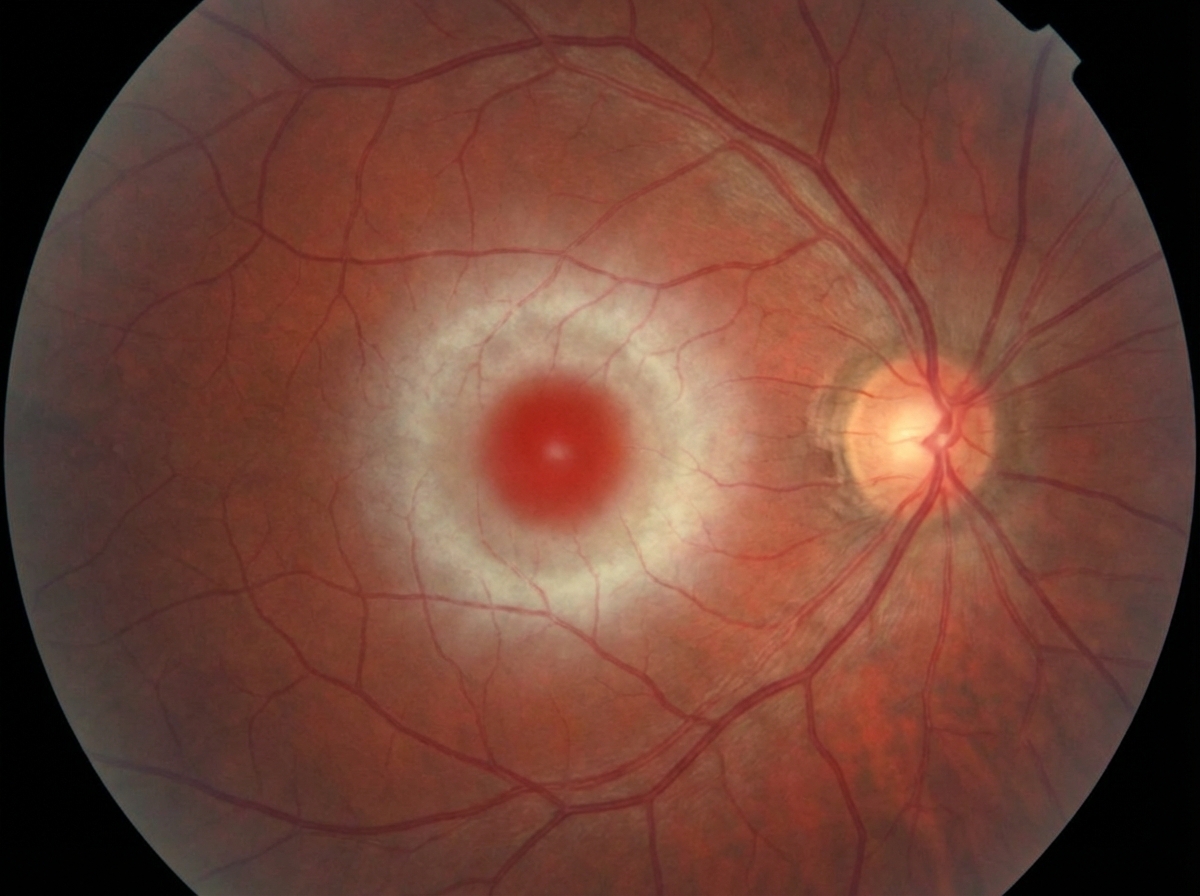
All of the following are features of central retinal artery occlusion except?
Proliferative diabetic retinopathy is treated by?
On retinal examination of a diabetic patient, cotton wool spots are noted. What is the cause of cotton wool spots seen in this case?
A patient with a known mutation in the 'Rb gene' is disease-free from Retinoblastoma. The patient is at the highest risk of developing which of the following malignancies?
Vascular invasion is commonly seen in:
Flower petal appearance in fundus fluorescein angiography is characteristic of which condition?
The blood retinal barrier is formed by which of the following structures?
Which of the following statements regarding Gyrate Atrophy is INCORRECT?
What are the three components of the triad seen in shaken baby syndrome?
What is the most common cause of rubeosis iridis?
Explanation: **Explanation:** Central Retinal Artery Occlusion (CRAO) is an ophthalmic emergency characterized by a sudden, painless loss of vision due to the blockage of the central retinal artery, leading to inner retinal ischemia. **Why Option D is the correct answer:** Multiple superficial hemorrhages are **not** a feature of CRAO. Hemorrhages (dot-blot or flame-shaped) are hallmark features of **Central Retinal Vein Occlusion (CRVO)**, often described as a "blood and thunder" fundus. In CRAO, the blood supply is cut off, leading to a "bloodless" appearance rather than a hemorrhagic one. **Analysis of Incorrect Options:** * **A. Marked narrowing of retinal arterioles:** Due to the lack of perfusion, the arterioles become thin and thread-like. One may also see "cattle-tracking" or segmentation of the blood column. * **B. Cherry red spot at macula:** This is the classic sign. The fovea remains red because it is thin and receives its blood supply from the underlying choroid (ciliary circulation), which stands out against the surrounding pale, ischemic retina. * **C. Retinal oedema:** Ischemia leads to intracellular edema and cloudy swelling of the retinal nerve fiber layer, giving the fundus a milky-white or ground-glass appearance. **High-Yield Clinical Pearls for NEET-PG:** * **Most common cause:** Embolism (from carotid arteries or heart). * **Cilioretinal Artery:** Present in ~20% of the population; if present, it may spare a small area of central vision despite CRAO. * **Treatment Window:** Irreversible retinal damage occurs within **90–100 minutes**. Emergency management includes ocular massage, anterior chamber paracentesis, and acetazolamide to lower IOP and dislodge the embolus. * **Amaurosis Fugax:** Often a precursor to CRAO, described as a "curtain falling" over the eye.
Explanation: **Explanation:** **1. Why Pan-retinal Photocoagulation (PRP) is the Correct Answer:** Proliferative Diabetic Retinopathy (PDR) is characterized by retinal ischemia, which triggers the release of **Vascular Endothelial Growth Factor (VEGF)**, leading to neovascularization (NVD/NVE). The goal of PRP is to ablate the peripheral "ischemic" retina, thereby reducing the overall oxygen demand and decreasing the production of VEGF. This causes the regression of abnormal new vessels and prevents complications like vitreous hemorrhage or tractional retinal detachment. It remains the **gold standard** treatment for PDR. **2. Why the Other Options are Incorrect:** * **Pars plana vitrectomy (PPV):** This is a surgical intervention reserved for **complications** of PDR, such as non-clearing vitreous hemorrhage, tractional retinal detachment involving the macula, or combined tractional-rheumatogenous detachment. It is not the primary treatment for PDR itself. * **Grid laser photocoagulation:** Historically used for **diffuse diabetic macular edema (DME)**, where laser burns are applied in a grid pattern to the macula. * **Focal retinal photocoagulation:** Used specifically for **focal diabetic macular edema** to treat leaking microaneurysms identified on FFA. **Clinical Pearls for NEET-PG:** * **Standard PRP Protocol:** Usually involves 1,500–3,000 burns, avoiding the macula and the area within the temporal vascular arches. * **Indication for PRP:** High-risk PDR (defined by NVD > 1/3rd disc area or any NVD/NVE with vitreous hemorrhage). * **Anti-VEGF Agents:** (e.g., Ranibizumab, Bevacizumab) are now frequently used as adjuncts to PRP or as primary treatment for DME. * **Side Effects of PRP:** Reduced peripheral vision, impaired night vision (nyctalopia), and sometimes transient macular edema.
Explanation: **Explanation:** **Cotton wool spots (CWS)**, also known as soft exudates, are a hallmark finding in Diabetic Retinopathy. The underlying pathophysiology is **focal retinal ischemia** caused by the occlusion of terminal retinal arterioles. This ischemia leads to the obstruction of axoplasmic flow within the nerve fiber layer (NFL). As a result, there is an accumulation of axoplasmic debris and organelles (mitochondria and lysosomes), leading to localized **retinal edema** and swelling of the nerve fibers. These swollen axons are histologically termed **Cytoid bodies**. **Analysis of Options:** * **A. Retinal edema (Correct):** CWS represent localized swelling/edema of the nerve fiber layer due to axoplasmic stasis. * **B. Retinal holes:** These are full-thickness breaks in the neurosensory retina, typically associated with retinal detachment, not microvascular ischemia. * **C. Retinal haemorrhage:** While common in diabetes (dot-blot or flame-shaped), hemorrhages represent blood leakage, whereas CWS represent nerve fiber infarcts. * **D. Macular degeneration:** This involves progressive degeneration of the RPE and photoreceptors (often age-related), distinct from the acute arteriolar occlusion seen in CWS. **High-Yield Clinical Pearls for NEET-PG:** * **Histology:** The characteristic pathological feature of a cotton wool spot is the **Cytoid Body**. * **Grading:** The presence of even a single CWS in a diabetic patient upgrades the diagnosis to **Pre-proliferative Diabetic Retinopathy (Moderate to Severe NPDR)**. * **Differential Diagnosis:** CWS are also seen in Hypertension (Grade III Keith-Wagener-Barker classification), HIV retinopathy, and Systemic Lupus Erythematosus (SLE). * **Hard Exudates vs. Soft Exudates:** Hard exudates are lipid deposits due to chronic leakage (found in OPL), whereas soft exudates (CWS) are infarcts (found in NFL).
Explanation: **Explanation:** The **Rb gene** is a tumor suppressor gene located on **chromosome 13q14**. According to Knudson’s "Two-Hit Hypothesis," individuals with a germline mutation (hereditary retinoblastoma) already possess one "hit" in every cell of their body. While the first clinical manifestation is usually Retinoblastoma, these patients remain predisposed to secondary non-ocular malignancies throughout their lives, especially if they received radiation therapy. **Why Osteosarcoma is the correct answer:** **Osteosarcoma** is the most common secondary primary tumor in survivors of hereditary retinoblastoma. The Rb protein (pRb) regulates the cell cycle at the G1-S checkpoint; its absence in bone cells leads to uncontrolled proliferation. It typically occurs in the second decade of life, often within the previous radiation field, but can also occur in bones outside the field of radiation. **Analysis of Incorrect Options:** * **A. Renal cell carcinoma:** This is associated with the VHL gene mutation (Von Hippel-Lindau syndrome), not the Rb gene. * **C. Pinealoblastoma:** While "Trilateral Retinoblastoma" refers to bilateral retinoblastoma associated with a pineal tumor, it is considered a synchronous primary intracranial tumor rather than a late-stage secondary malignancy. Osteosarcoma remains statistically more common as a secondary cancer. * **D. Chondrosarcoma:** Although mesenchymal tumors can occur, they are significantly less frequent than Osteosarcoma in Rb gene mutation carriers. **High-Yield Clinical Pearls for NEET-PG:** * **Trilateral Retinoblastoma:** Bilateral RB + Pinealoblastoma (poor prognosis). * **Most common secondary malignancy:** Osteosarcoma (followed by soft tissue sarcomas and melanoma). * **Flexner-Wintersteiner Rosettes:** Pathognomonic histological feature of Retinoblastoma. * **Calcification:** A hallmark sign of RB on CT scans (Dystrophic calcification).
Explanation: **Explanation:** The correct answer is **Malignant melanoma of the choroid**. This is the most common primary intraocular malignancy in adults. A hallmark of its growth is the invasion of blood vessels, particularly the large choroidal vessels. As the tumor grows, it breaks through the **Bruch’s membrane**, assuming a characteristic **mushroom or collar-stud shape**. This vascular invasion and the high density of microvessels (microvascular loops) are significant prognostic factors, as they facilitate hematogenous metastasis, most commonly to the liver. **Analysis of Incorrect Options:** * **Retinoblastoma:** While it is the most common intraocular tumor in children, it is characterized by "endophytic" or "exophytic" growth and extensive necrosis. It typically spreads via direct extension into the optic nerve or subarachnoid space rather than primary vascular invasion. * **Optic Nerve Glioma:** This is a benign, slow-growing tumor (usually pilocytic astrocytoma) associated with Neurofibromatosis type 1. It causes enlargement of the optic nerve but does not exhibit aggressive vascular invasion. * **Medulloepithelioma (Diktyoma):** This is a rare congenital tumor arising from the non-pigmented epithelium of the ciliary body. It grows locally and may invade the iris or lens but is not primarily known for systemic vascular invasion. **High-Yield Clinical Pearls for NEET-PG:** * **Mushroom Shape:** Pathognomonic for Choroidal Melanoma after it ruptures Bruch’s membrane. * **Investigation of Choice:** Ocular B-scan Ultrasonography (shows low internal reflectivity and excavation of the choroid). * **Most Common Site of Metastasis:** Liver (Hematogenous spread). * **Callender Classification:** Used for prognosis; **Spindle A** has the best prognosis, while **Epithelioid** has the worst.
Explanation: ### Explanation **Correct Answer: A. Cystoid Macular Edema (CME)** The "flower petal" or **petaloid pattern** is a classic angiographic hallmark of Cystoid Macular Edema. This occurs because fluid accumulates in the **Henle’s layer** (the outer plexiform layer) of the retina. In the foveal region, the fibers of Henle’s layer are arranged radially. When fluid leaks from the perifoveal capillaries (due to a breakdown of the blood-retinal barrier), it fills these radial spaces, creating a symmetrical, petal-like appearance during the late phases of Fundus Fluorescein Angiography (FFA). **Analysis of Incorrect Options:** * **B. Retinitis Pigmentosa:** FFA typically shows a "moth-eaten" appearance due to window defects (RPE atrophy) and bone-spicule pigmentation. While CME can occur as a complication of RP, the primary disease itself does not show a petaloid pattern. * **C. Central Serous Retinopathy (CSR):** Characterized by a **"smokestack"** or **"ink-blot"** appearance on FFA due to leakage of dye into the subretinal space from the choriocapillaris. * **D. Age-related Macular Degeneration (ARMD):** Dry ARMD shows "window defects" (drusen), while Wet ARMD is characterized by **choroidal neovascularization (CNVM)**, appearing as a lacy pattern of leakage or a classic "well-defined" membrane. **High-Yield Clinical Pearls for NEET-PG:** * **Irvine-Gass Syndrome:** This refers to CME occurring specifically after cataract surgery (most common cause of post-op vision loss). * **Drug-induced CME:** Epinephrine, Latanoprost, and Nicotinic acid are known triggers. * **Management:** First-line treatment usually involves topical NSAIDs and steroids. Carbonic anhydrase inhibitors (Acetazolamide) are also used to reduce edema.
Explanation: The Blood-Retinal Barrier (BRB) is a physiological barrier that regulates ion, water, and nutrient transport into the retina while protecting it from toxins. It consists of two components: 1. **Inner BRB:** Formed by the tight junctions (**Zonula occludens**) between the **endothelial cells** of the retinal capillaries. 2. **Outer BRB:** Formed by the tight junctions between the **Retinal Pigment Epithelium (RPE)** cells. **Explanation of the Correct Option:** The **Outer Plexiform Layer (OPL)** is the anatomical site where the processes of photoreceptors synapse with bipolar and horizontal cells. In the context of clinical ophthalmology and fluid dynamics (such as in Macular Edema), the OPL acts as a watershed zone. While the RPE forms the physiological barrier, the OPL is the layer where fluid accumulates and where the "barrier" effect is most clinically evident on imaging. In many standard PG entrance exams, the OPL is identified as the structural boundary associated with the outer barrier's functional limit. **Why other options are incorrect:** * **Muller Cells:** These are glial cells that provide structural support and maintain homeostasis but do not form the tight junctions of the BRB. * **Amacrine & Horizontal Cells:** These are interneurons involved in signal processing within the retina; they have no barrier or transport functions. **High-Yield Clinical Pearls for NEET-PG:** * **Breakdown of BRB:** Leads to the accumulation of fluid, resulting in **Cystoid Macular Edema (CME)**. * **CME Fluid Location:** In CME, fluid primarily accumulates in the **Outer Plexiform Layer** (Henle’s layer in the fovea), giving it a characteristic "petaloid" appearance on Fluorescein Angiography. * **Blood-Aqueous Barrier:** Unlike the BRB, this is formed by the non-pigmented ciliary epithelium and the iris capillaries.
Explanation: **Explanation:** **Gyrate Atrophy** is a rare metabolic vitreoretinal dystrophy. The correct answer is **D** because the treatment actually involves an **arginine-restricted diet**, not an arginine-rich one. 1. **Why Option D is Incorrect (The Concept):** Gyrate atrophy is caused by a deficiency of the mitochondrial enzyme **ornithine aminotransferase (OAT)**, which requires Vitamin B6 as a cofactor. This deficiency leads to a massive accumulation of **ornithine** in the blood and tissues (hyperornithinemia), which is toxic to the Retinal Pigment Epithelium (RPE) and choroid. Since arginine is the metabolic precursor to ornithine, patients must **restrict arginine intake** (low-protein diet) to lower ornithine levels and slow disease progression. 2. **Analysis of Other Options:** * **Option A:** Correct. The primary defect is in the *OAT* gene located on chromosome 10. * **Option B:** Correct. It follows an **Autosomal Recessive** inheritance pattern. * **Option C:** Correct. The hallmark clinical feature is multiple, well-defined, **"punched-out" circular areas** of chorioretinal atrophy in the mid-periphery. These eventually coalesce to form a scalloped border (gyrate appearance). **High-Yield Clinical Pearls for NEET-PG:** * **Triad of Symptoms:** Progressive night blindness (nyctalopia), constricted visual fields, and early-onset posterior subcapsular cataracts. * **Biochemical Marker:** Hyperornithinemia (10–20 fold increase). * **Treatment:** Arginine restriction and **Vitamin B6 (Pyridoxine)** supplementation (only a subset of patients are "B6-responsive"). * **Differential Diagnosis:** Choroideremia (X-linked) and Retinitis Pigmentosa.
Explanation: **Explanation:** **Shaken Baby Syndrome (SBS)**, now more broadly termed **Abusive Head Trauma (AHT)**, is a severe form of physical child abuse resulting from violent shaking. The mechanism involves repetitive acceleration-deceleration forces that cause the brain to move within the skull, leading to the classic clinical triad: 1. **Subdural Hemorrhage (SDH):** Tearing of the bridging veins between the brain and the dural sinuses. 2. **Retinal Hemorrhages:** These are typically bilateral, multilayered (subretinal, intraretinal, and preretinal), and extend to the periphery. They are considered highly pathognomonic of AHT. 3. **Encephalopathy:** Presenting as irritability, seizures, or coma due to diffuse axonal injury or cerebral edema. **Analysis of Incorrect Options:** * **Option B:** While vitreous hemorrhage (Terson-like syndrome) can occur, hyphema is not a standard component of the triad and usually suggests direct blunt ocular trauma. * **Option C & D:** These options list various types of intracranial bleeds. While subarachnoid or intracerebral hemorrhages can occur in AHT, they are not the specific defining components of the classic diagnostic triad, which must include the ocular finding (retinal hemorrhage). **Clinical Pearls for NEET-PG:** * **Pathognomonic Finding:** Large, thick, multilayered retinal hemorrhages extending to the ora serrata are the hallmark of SBS. * **Schisis Cavities:** Traumatic retinoschisis (circumferential macular folds) is a highly specific sign of shaking injury. * **Differential Diagnosis:** Always rule out accidental trauma, bleeding diathesis, or Glutaric Aciduria Type 1. * **Imaging:** Non-contrast CT head is the initial investigation of choice to detect acute SDH.
Explanation: **Explanation:** **Rubeosis iridis** (neovascularization of the iris) is a serious condition where new, fragile blood vessels develop on the anterior surface of the iris in response to severe, chronic retinal ischemia. **Why Diabetes Mellitus is the Correct Answer:** The underlying mechanism for rubeosis iridis is the release of **Vascular Endothelial Growth Factor (VEGF)** by hypoxic retinal tissue. While several conditions cause retinal ischemia, **Diabetes Mellitus (specifically Proliferative Diabetic Retinopathy)** is statistically the **most common cause** worldwide. In diabetic patients, widespread capillary non-perfusion triggers extensive VEGF production, leading to neovascularization of the iris and the iridocorneal angle. **Analysis of Incorrect Options:** * **Central Retinal Vein Occlusion (CRVO):** This is the **second most common cause**. Specifically, the "Ischemic" type of CRVO is notorious for causing rapid-onset rubeosis, often leading to "100-day glaucoma." * **Central Retinal Artery Occlusion (CRAO):** While CRAO involves ischemia, rubeosis is relatively uncommon (occurring in only about 15-20% of cases) because the inner retinal layers often become too atrophic to produce significant VEGF. * **Vitreous Hemorrhage:** This is a *complication* of neovascularization (usually from PDR or Eales disease) rather than a primary cause of rubeosis iridis itself. **Clinical Pearls for NEET-PG:** * **The "100-Day Glaucoma":** Refers to Neovascular Glaucoma (NVG) following Ischemic CRVO. * **Management:** The definitive treatment for rubeosis iridis is **Pan-retinal Photocoagulation (PRP)** to reduce the oxygen demand of the retina, supplemented by anti-VEGF injections. * **Sequence:** Neovascularization typically starts at the **pupillary margin** before involving the angle of the anterior chamber.
Retinal Anatomy and Physiology
Practice Questions
Age-Related Macular Degeneration
Practice Questions
Diabetic Retinopathy
Practice Questions
Retinal Vascular Diseases
Practice Questions
Retinal Detachment
Practice Questions
Hereditary Retinal Dystrophies
Practice Questions
Inflammatory Retinal Diseases
Practice Questions
Retinal Tumors
Practice Questions
Retinopathy of Prematurity
Practice Questions
Retinal Imaging Techniques
Practice Questions
Intravitreal Pharmacotherapy
Practice Questions
Vitreoretinal Surgery
Practice Questions
Get full access to all questions, explanations, and performance tracking.
Start For Free