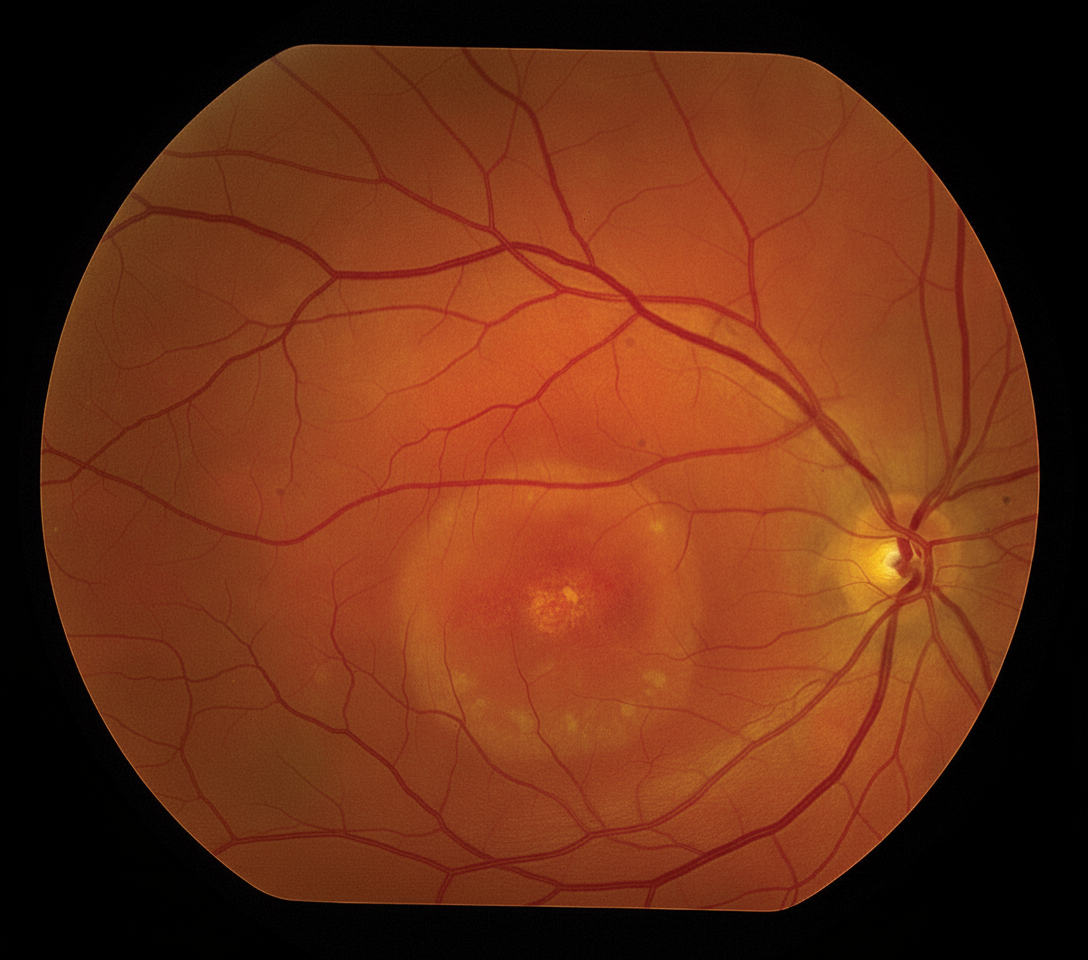
What condition presents with a 'cattle truck' appearance on fundus examination?
All of the following are causes of exudative retinal detachment, EXCEPT:
Which of the following is useful in the management of choroiditis?
Retinoblastoma spreads to the CNS through which route?
Asteroid hyalosis is composed of which of the following?
Which of the following conditions is characterized by a "cattle truck" appearance on fundoscopy?
Which of the following is true regarding intraocular retinoblastoma?
Which of the following types of macular dystrophy is associated with the typical egg yolk lesion located in the central macula?
Which of the following is true about inverse Retinitis pigmentosa?
Which of the following statements is not true regarding rhegmatogenous retinal detachment?
Explanation: ### Explanation The correct answer is **Incomplete Central Retinal Artery Occlusion (CRAO)**. **1. Why it is correct:** The "cattle truck" appearance (also known as **segmentation** or **box-carring**) of the retinal blood column is a classic sign of severely slowed blood flow. In CRAO, the arterial supply is obstructed, leading to the fragmentation of the blood column into segments of red cells separated by clear plasma. This phenomenon is most visible in the veins and arteries during an *incomplete* or *evolving* occlusion, where the flow is sluggish but not entirely absent. **2. Why the other options are incorrect:** * **Central Retinal Vein Occlusion (CRVO):** This presents with a "Blood and Thunder" fundus, characterized by massive retinal hemorrhages, dilated tortuous veins, and disc edema. * **Incomplete CRVO:** While flow is slowed, the primary clinical feature is venous engorgement and scattered hemorrhages, not the distinct segmentation of the blood column seen in arterial compromise. * **Hypertensive Retinopathy:** This is characterized by arteriolar narrowing, AV nipping, flame-shaped hemorrhages, and Cotton Wool spots (Grade III) or papilledema (Grade IV), but not segmentation of the blood flow. **3. NEET-PG High-Yield Clinical Pearls:** * **CRAO Classic Triad:** Sudden painless loss of vision, Cherry Red Spot (at the fovea), and Cattle-trucking/Box-carring. * **Cherry Red Spot:** Occurs because the thin fovea allows the underlying vascular choroid to show through, while the surrounding macula is pale due to retinal edema. * **Amaurosis Fugax:** A common precursor to CRAO, often described as a "curtain falling" over the eye. * **Management:** CRAO is an ophthalmic emergency. Immediate measures include digital ocular massage and paracentesis to lower Intraocular Pressure (IOP) in an attempt to dislodge the embolus.
Explanation: **Explanation:** The core concept in this question is distinguishing between the three types of retinal detachment (RD): **Rhegmatogenous** (due to a break/hole), **Tractional** (due to pulling by membranes), and **Exudative** (due to fluid accumulation under the retina without a break). **Why Retinopathy of Prematurity (ROP) is the correct answer:** ROP is a vasoproliferative disorder where abnormal fibrovascular membranes grow into the vitreous. These membranes contract, pulling the neurosensory retina away from the retinal pigment epithelium (RPE). Therefore, ROP causes a **Tractional Retinal Detachment**, not an exudative one. **Analysis of Incorrect Options (Causes of Exudative RD):** Exudative RD occurs when fluid leaks from the choroidal vessels or RPE due to inflammation, tumors, or vascular anomalies. * **Sympathetic Ophthalmitis:** A bilateral granulomatous panuveitis following trauma. The intense choroidal inflammation leads to fluid leakage (exudation) under the retina. * **Posterior Scleritis:** Inflammation of the posterior sclera causes thickening and secondary subretinal fluid accumulation. * **Orbital Cellulitis:** Severe orbital inflammation can spread to the posterior segment of the eye, leading to reactive choroidal effusion and exudative RD. **High-Yield Clinical Pearls for NEET-PG:** * **Most common cause of RD:** Rhegmatogenous (associated with Myopia and Lattice degeneration). * **Shifting Fluid Sign:** Pathognomonic for Exudative RD (fluid moves with gravity). * **Tobacco Dust (Shafer’s Sign):** Pigment cells in the vitreous, highly suggestive of a retinal tear (Rhegmatogenous RD). * **Concave vs. Convex:** Tractional RD typically has a **concave** configuration and is non-mobile, whereas Rhegmatogenous/Exudative RDs are usually **convex**.
Explanation: **Explanation:** **Choroiditis** is an inflammation of the choroid, often presenting as part of posterior uveitis. The primary goal of management is to suppress the inflammatory response and prevent permanent structural damage to the retina and vision loss. **Why Steroids are the Correct Answer:** Steroids are the **mainstay of treatment** for non-infectious choroiditis. They act by inhibiting the inflammatory cascade, reducing exudation, and preventing the formation of chorioretinal scars. Depending on the severity and laterality, they can be administered topically (less effective for posterior segments), via periocular injections (e.g., posterior sub-Tenon's triamcinolone), or systemically. If an underlying infection (like TB or Toxoplasmosis) is present, steroids are administered under the cover of specific anti-infective therapy. **Why Other Options are Incorrect:** * **Antibiotics:** These are only indicated if a specific bacterial etiology is confirmed. Most cases of choroiditis are autoimmune or idiopathic; hence, antibiotics are not the primary management. * **Miotics (e.g., Pilocarpine):** These are contraindicated. In uveitis, **mydriatics/cycloplegics** (like Atropine) are used instead to prevent synechiae formation and relieve ciliary muscle spasm pain. Miotics would worsen pain and promote posterior synechiae. * **Padding:** Padding is contraindicated in most inflammatory or infectious eye conditions as it increases the local temperature, promoting bacterial growth and preventing the drainage of secretions. **High-Yield Clinical Pearls for NEET-PG:** * **Fundus Appearance:** Active choroiditis appears as yellowish-white deep patches with hazy borders. Healed choroiditis shows well-defined "punched-out" scars with prominent underlying sclera and pigment clumps. * **Symptom:** Unlike anterior uveitis, isolated choroiditis is typically **painless** but presents with blurred vision and floaters. * **Key Association:** Always rule out systemic associations like Sarcoidosis, Syphilis, and Tuberculosis in cases of posterior uveitis.
Explanation: **Explanation:** Retinoblastoma is the most common intraocular malignancy of childhood. Understanding its routes of metastasis is crucial for NEET-PG. **Why "Direct Extension" is correct:** The most common route for Retinoblastoma to involve the Central Nervous System (CNS) is via **direct extension through the optic nerve**. The tumor cells invade the lamina cribrosa, travel along the optic nerve, and reach the subarachnoid space at the level of the optic chiasm. From there, they spread into the cerebrospinal fluid (CSF) and the brain. Direct extension can also occur through the sclera into the orbit. **Analysis of Incorrect Options:** * **Lymphatic spread:** The eye lacks a traditional lymphatic drainage system. Lymphatic spread only occurs if the tumor involves the conjunctiva or eyelids, draining to preauricular or submandibular nodes. It is not the route to the CNS. * **Arterial embolization:** While Retinoblastoma spreads hematogenously (most commonly to bone marrow, liver, and lungs), this occurs via **venous** channels, not arterial embolization. * **Vitreous seeding:** This refers to the internal shedding of tumor cells into the vitreous cavity. While this is a hallmark of endophytic growth and complicates local treatment, it is an intraocular event and not a mechanism for CNS metastasis. **High-Yield Clinical Pearls for NEET-PG:** * **Most common site of distant metastasis:** Bone marrow. * **Flexner-Wintersteiner Rosettes:** Pathognomonic histological feature (indicates photoreceptor differentiation). * **Homer-Wright Rosettes:** Seen in Retinoblastoma but also in Neuroblastoma and Medulloblastoma (less specific). * **Trilateral Retinoblastoma:** Bilateral retinoblastoma associated with a pineal gland tumor (Pineoblastoma). * **Calcification:** A key radiological sign on CT scans, helping differentiate it from Coats' disease.
Explanation: **Explanation:** **Asteroid Hyalosis** is a common, benign vitreous condition characterized by the accumulation of tiny, spherical, white or creamy-white opacities suspended within the vitreous gel. **Why Calcium is Correct:** The "asteroid bodies" are biochemically composed of **calcium-lipid complexes** (specifically calcium hydroxyapatite and phospholipids) associated with a collagenous matrix. These bodies are suspended in a structurally normal vitreous and move with the vitreous during eye movements, returning to their original position once the eye is still (unlike synchysis scintillans). **Why Other Options are Incorrect:** * **Iron (A):** Iron deposition in the eye is known as **Siderosis Bulbi**, typically resulting from a retained intraocular foreign body. It leads to retinal toxicity and heterochromia iridis. * **Copper (B):** Copper deposition is known as **Chalcosis**. It classically presents as a "Sunflower Cataract" or a Kayser-Fleischer ring (in Wilson’s disease), not vitreous opacities. * **Silica (D):** Silica is not a standard metabolic or degenerative deposit found in the vitreous. **High-Yield Clinical Pearls for NEET-PG:** * **Appearance:** Often described as "Stars in the night sky" on ophthalmoscopy. * **Vision:** Surprisingly, it rarely affects visual acuity significantly, though it can make the fundus examination difficult for the surgeon. * **Association:** It is usually unilateral (80% of cases) and is frequently associated with **Diabetes Mellitus**, hypertension, and hypercholesterolemia. * **Differential Diagnosis:** Must be distinguished from **Synchysis Scintillans**, which consists of **cholesterol crystals**, is usually bilateral, occurs in liquefied vitreous (synchysis), and the crystals settle at the bottom of the globe.
Explanation: **Explanation:** **Central Retinal Artery Occlusion (CRAO)** is a true ophthalmic emergency. The "cattle truck" appearance (also known as **segmentation** or **box-carring**) refers to the fragmentation of the blood column within the retinal arterioles. This occurs because the total cessation of arterial blood flow causes erythrocytes to clump together, separated by clear plasma, resembling a line of moving cattle cars. **Why the other options are incorrect:** * **Central Serous Retinopathy (CSR):** Characterized by a localized sensory retinal detachment at the macula, typically presenting with a "smokestack" or "ink-blot" appearance on Fundus Fluorescein Angiography (FFA), not the vessels. * **Coat’s Disease:** An idiopathic condition featuring telangiectatic and aneurysmal retinal vessels with massive subretinal exudation ("lightbulb" appearance on imaging), usually seen in young males. * **Retinopathy of Prematurity (ROP):** Characterized by peripheral retinal neovascularization, a "demarcation line," or a "ridge" in preterm infants, often leading to tractional retinal detachment. **Clinical Pearls for NEET-PG:** * **Classic Triad of CRAO:** Sudden painless loss of vision, **Cherry Red Spot** (due to the choroidal vasculature showing through the thin fovea amidst surrounding retinal edema), and **Cattle-trucking**. * **Afferent Pupillary Defect (Marcus Gunn Pupil):** Usually present in the affected eye. * **Management:** Immediate ocular massage, anterior chamber paracentesis, and inhalation of Carbogen (95% $O_2$, 5% $CO_2$) to induce vasodilation and dislodge the embolus. * **Time Window:** Irreversible retinal damage occurs within 90–100 minutes of complete occlusion.
Explanation: **Explanation:** **1. Why Option C is Correct:** The **International Classification of Retinoblastoma (ICRB)** (Groups A to E) is the current gold standard for staging intraocular tumors. It was specifically designed to predict the success of **chemoreduction** and globe salvage. Unlike older systems (like Reese-Ellsworth), the ICRB guides modern treatment modalities, such as systemic chemotherapy, intra-arterial chemotherapy (IAC), and focal therapies (laser/cryotherapy). **2. Why Other Options are Incorrect:** * **Option A:** The statistics are reversed. Approximately **60% of cases are sporadic** (unilateral, non-heritable), while **40% are familial/germline** (often bilateral). All bilateral cases are considered germline mutations. * **Option B:** **Leukocoria** (white pupillary reflex) is the **most common** (60%) presenting sign of retinoblastoma, not the second. **Strabismus** is the second most common presenting feature (20%). **3. High-Yield Clinical Pearls for NEET-PG:** * **Genetics:** Mutation in the **RB1 gene** on chromosome **13q14**. It follows Knudson’s "Two-hit hypothesis." * **Pathology:** Look for **Flexner-Wintersteiner rosettes** (highly specific) and Homer-Wright rosettes. * **Calcification:** Dystrophic calcification is a hallmark; it appears as "cottage cheese" on fundoscopy and is easily detected on **B-scan USG or CT scan**. * **Management:** The primary goal is saving life, followed by saving the globe, and then preserving vision. **Enucleation** is indicated for Group E (advanced) disease or when there is no potential for vision. * **Contraindication:** **Biopsy (FNA) is strictly contraindicated** due to the high risk of extraocular tumor seeding.
Explanation: **Explanation:** **Best Disease (Vitelliform Macular Dystrophy)** is the correct answer. It is an autosomal dominant condition caused by a mutation in the **BEST1 gene** on chromosome 11, which encodes the protein **bestrophin-1**. This protein acts as a chloride channel in the Retinal Pigment Epithelium (RPE). Dysfunction leads to an abnormal accumulation of **lipofuscin** between the RPE and Bruch’s membrane, resulting in the classic **"egg-yolk" (vitelliform) lesion** at the macula. A hallmark diagnostic feature is a **normal Electroretinogram (ERG)** but an **abnormal Electro-oculogram (EOG)** with an Arden index < 1.5. **Why other options are incorrect:** * **Stargardt Disease:** The most common macular dystrophy, characterized by a **"beaten bronze"** appearance and peripheral yellow-white **pisciform (fish-shaped) flecks**. It shows a "dark choroid" sign on Fundus Fluorescein Angiography (FFA). * **Cone-Rod Dystrophies:** These typically present with a **"bull’s eye maculopathy"** (similar to chloroquine toxicity) and result in early loss of color vision and central visual acuity. * **X-Linked Juvenile Retinoschisis:** Characterized by a **spoke-wheel pattern** of cystoid spaces in the macula and splitting of the retinal layers (usually the nerve fiber layer). **High-Yield Clinical Pearls for NEET-PG:** * **Stages of Best Disease:** Pre-vitelliform → Vitelliform (Egg-yolk) → Pseudohypopyon (partial absorption) → Vitelliruptive (Scrambled egg) → Atrophic/Cicatricial. * **EOG vs. ERG:** Best disease is the classic example where EOG is subnormal despite a normal ERG. * **Inheritance:** Best disease is Autosomal Dominant; Stargardt is usually Autosomal Recessive.
Explanation: **Explanation:** **Inverse Retinitis Pigmentosa (RP)**, also known as Central Retinitis Pigmentosa, is a rare variant of the RP spectrum where the pigmentary changes and photoreceptor degeneration begin centrally rather than in the periphery. 1. **Why Option A is Correct:** While Retinitis Pigmentosa as a whole most commonly follows an Autosomal Recessive pattern, **Inverse RP** is specifically associated with an **X-linked recessive inheritance** pattern (linked to the *RPGR* gene). This makes it more common and typically more severe in males. 2. **Why the other options are incorrect:** * **Options B & C:** In Inverse RP, the characteristic "bony spicule" pigmentary changes are notably **absent**. Instead, patients present with macular atrophy, "bull’s eye" maculopathy, or fine granular pigmentary changes in the foveal/parafoveal region. Bony spicules are the hallmark of *classic* (peripheral) RP. * **Option D:** Progressive choroidal degeneration is the hallmark of **Choroideremia** or **Gyrate Atrophy**, not Inverse RP. Inverse RP primarily affects the cone-rod system starting at the macula. **Clinical Pearls for NEET-PG:** * **Symptom Triad:** Unlike classic RP (which starts with night blindness), Inverse RP presents with **early loss of central vision**, **color vision defects**, and **photophobia**. * **Visual Fields:** Shows a **central scotoma** with preserved peripheral fields (the "inverse" of the ring scotoma seen in classic RP). * **ERG Findings:** Shows a marked decrease in **photopic** (cone) responses early in the disease, while scotopic (rod) responses may remain normal until later stages. * **Differential Diagnosis:** Must be distinguished from Stargardt’s disease and Cone-Rod Dystrophy.
Explanation: ### Explanation **1. Why Option A is the Correct Answer (The "Not True" Statement):** Rhegmatogenous Retinal Detachment (RRD) is defined by a **full-thickness break (rhegma)** in the neurosensory retina, which allows liquefied vitreous to enter the subretinal space. The mechanism described in Option A—vitreous traction or fibrous bands pulling the retina without a break—is the hallmark of **Tractional Retinal Detachment (TRD)**, commonly seen in proliferative diabetic retinopathy. While vitreous traction can *cause* a tear leading to RRD, the presence of "fibrous bands" specifically points toward TRD. **2. Analysis of Incorrect Options (True Statements):** * **Option B:** Floaters (due to vitreous hemorrhage or Weiss ring) and photopsia (flashes due to vitreomacular traction) are classic **prodromal symptoms** of RRD. * **Option C:** RRD is a surgical emergency. Unlike exudative detachment (which is managed medically), RRD requires mechanical closure of the break via **Scleral Buckling, Pneumatic Retinopexy, or Pars Plana Vitrectomy**. * **Option D:** Anatomically, the neurosensory retina is attached only at the **optic disc and the ora serrata**. Therefore, a total RRD can extend between these two boundaries. **3. High-Yield Clinical Pearls for NEET-PG:** * **Most common type** of retinal detachment: Rhegmatogenous. * **Risk Factors:** Myopia (most common), Aphakia, Trauma, and Lattice degeneration. * **Shafer’s Sign:** "Tobacco dust" (pigment cells in the anterior vitreous) is pathognomonic for a retinal tear. * **Configuration:** RRD usually has a **convex** surface and is undulant (moves with eye movements), whereas TRD is typically **concave** and non-mobile.
Retinal Anatomy and Physiology
Practice Questions
Age-Related Macular Degeneration
Practice Questions
Diabetic Retinopathy
Practice Questions
Retinal Vascular Diseases
Practice Questions
Retinal Detachment
Practice Questions
Hereditary Retinal Dystrophies
Practice Questions
Inflammatory Retinal Diseases
Practice Questions
Retinal Tumors
Practice Questions
Retinopathy of Prematurity
Practice Questions
Retinal Imaging Techniques
Practice Questions
Intravitreal Pharmacotherapy
Practice Questions
Vitreoretinal Surgery
Practice Questions
Get full access to all questions, explanations, and performance tracking.
Start For Free