Which fundoscopic finding is characterized by a retinal hemorrhage with a white center?
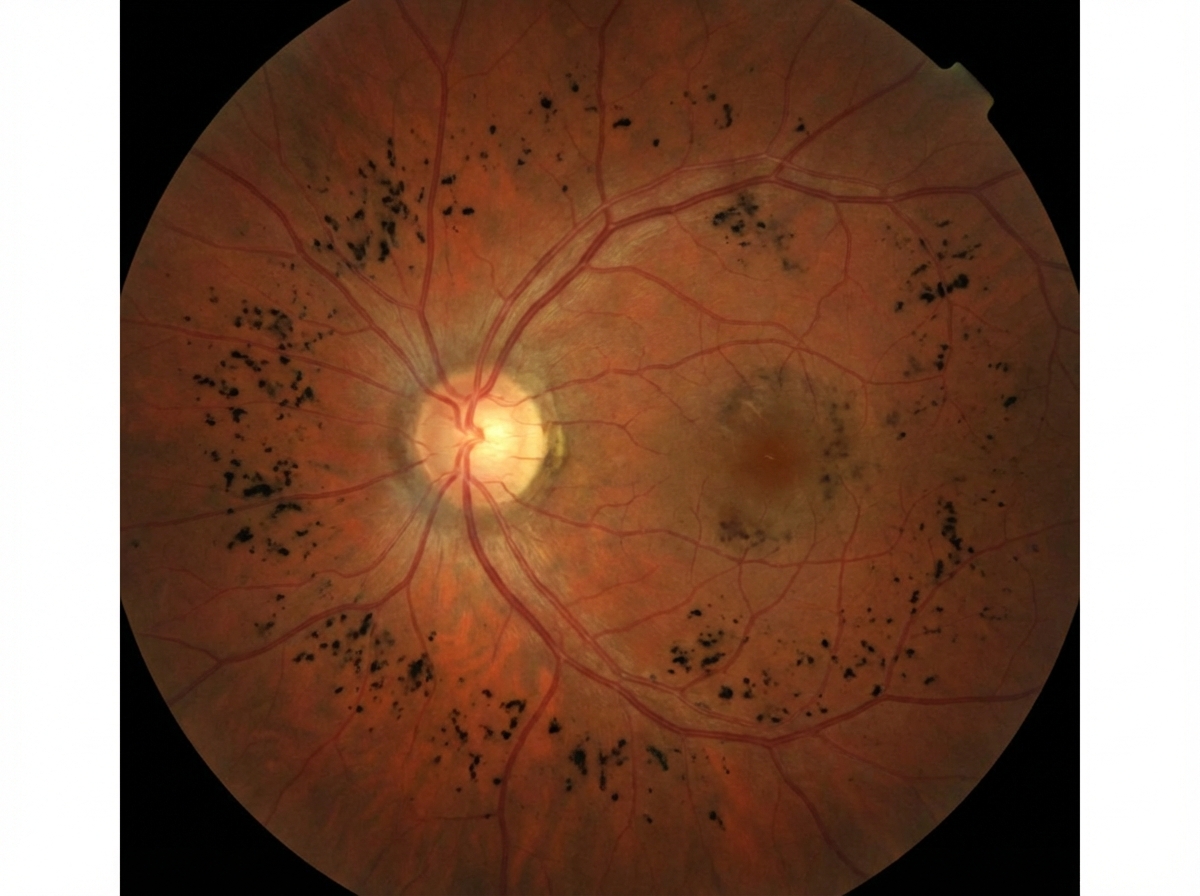
All are true regarding retinitis pigmentosa EXCEPT?
Spontaneous regression of proliferative retinopathy may occur in which of the following conditions?
A 45-year-old male presents with proliferative diabetic retinopathy and significant vitreomacular traction. What is the most appropriate treatment?
What causes a cherry red spot?
Synchysis refers to:
Which of the following conditions is inherited in an autosomal dominant pattern?
Acquired blue blindness is a feature of:
Retinal tear is associated with which degeneration?
All of the following are true about Retinitis punctata albescens except?
Explanation: **Explanation:** **Roth spots** are characterized by retinal hemorrhages with a central white or pale spot. Pathophysiologically, the white center represents a **fibrin-platelet thrombus** at the site of vessel rupture, surrounded by a flame-shaped hemorrhage in the nerve fiber layer. While classically associated with **Subacute Bacterial Endocarditis (SBE)**, they are not pathognomonic and can be seen in leukemia, severe anemia, diabetes, and hypertensive retinopathy. **Analysis of Incorrect Options:** * **A. Cotton wool spots:** These are yellowish-white, "fluffy" lesions caused by micro-infarctions of the retinal nerve fiber layer (axoplasmic stasis). They do not contain blood/hemorrhage. * **B. Flame-shaped hemorrhage:** These are linear, splinter-like hemorrhages located in the superficial nerve fiber layer. While they form the "red" part of a Roth spot, they lack the characteristic white center. * **C. Drusen:** These are small, yellow deposits of extracellular debris (lipofuscin) located between the retinal pigment epithelium (RPE) and Bruch’s membrane. They are hallmark features of Age-related Macular Degeneration (AMD) and are not hemorrhagic. **High-Yield Clinical Pearls for NEET-PG:** * **Roth Spot Mnemonic:** "Roth" = **R**ed **O**utside, **T**hrombus **H**ere (center). * **Most common cause:** Though SBE is the classic exam answer, **Leukemia** is a very frequent cause in clinical practice. * **Location:** Roth spots are typically found in the superficial retina (nerve fiber layer), which gives the hemorrhage its feathered or flame-shaped border.
Explanation: **Explanation:** Retinitis Pigmentosa (RP) is a hereditary, progressive dystrophy primarily affecting the rod photoreceptors. The diagnosis is based on a classic clinical triad and characteristic electrophysiological findings. **Why Option A is the "Except" (Correct Answer):** In the context of this specific question, there is a slight nuance. While the **Electroretinogram (ERG)** is indeed abnormal (it is often subnormal or "extinguished" even before fundus changes appear), it is technically a **true** statement. However, in standard NEET-PG patterns, if Option D (**Waxy pigments**) is listed, it is the most "incorrect" descriptor. The classic triad of RP includes **Bony-spicule pigmentation**, not "waxy" pigments. The term "waxy" is specifically used to describe the **Waxy pallor of the optic disc**. Therefore, if the question asks for the "Except," it highlights a misnomer in the description of the pigments. **Analysis of Other Options:** * **B. Pale Disc:** True. As the disease progresses, consecutive optic atrophy occurs, leading to a characteristic **waxy pallor** of the disc. * **C. Attenuation of Arteries:** True. Marked narrowing (thread-like appearance) of retinal arterioles is a hallmark sign due to reduced metabolic demand of the degenerating retina. * **D. Waxy Pigments:** False/Incorrect descriptor. The pigments in RP are **Bony-spicule** shaped (perivascular), resulting from the migration of RPE cells into the sensory retina. "Waxy" describes the disc, not the pigments. **High-Yield Clinical Pearls for NEET-PG:** * **Classic Triad:** 1. Arteriolar attenuation, 2. Bony-spicule pigmentation (starting in mid-periphery), 3. Waxy pallor of the disc. * **Earliest Symptom:** Nyctalopia (Night blindness). * **Earliest Sign:** Ring scotoma on visual field testing. * **Gold Standard Diagnosis:** ERG (shows reduced a-wave and b-wave amplitude; eventually becomes extinguished). * **Associations:** Usher Syndrome (deafness), Laurence-Moon-Biedl Syndrome (obesity, polydactyly, hypogonadism).
Explanation: **Explanation:** The hallmark of proliferative retinopathy is **neovascularization** (the growth of new, fragile blood vessels) in response to retinal ischemia and the release of vascular endothelial growth factor (VEGF). While these conditions often require treatment (like laser photocoagulation or anti-VEGF injections), spontaneous regression is a documented clinical phenomenon in specific scenarios. 1. **Diabetic Retinopathy (DR):** Although rare, spontaneous regression of neovascularization can occur, particularly if there is a significant improvement in systemic glycemic control or if the eye develops a complete posterior vitreous detachment (PVD), which removes the scaffold for vessel growth. 2. **Proliferative Sickle Retinopathy (PSR):** This condition is uniquely known for "autoinfarction" of the peripheral neovascular "sea-fan" lesions. The sickled erythrocytes can cause a localized blockage of the very vessels they helped create, leading to spontaneous regression. 3. **Retinopathy of Prematurity (ROP):** This is the most common condition among the three to undergo spontaneous regression. Approximately 85–90% of infants with early-stage ROP (Stage 1 or 2) experience spontaneous involution without any medical intervention as the peripheral retina vascularizes normally. **Clinical Pearls for NEET-PG:** * **PSR:** Most common in **HbSC** and **HbSThal** genotypes rather than HbSS (Sickle Cell Anemia). * **ROP:** The "vanguard" and "rear guard" are classic terms associated with the mesenchymal shunt in ROP. * **High-Yield Fact:** While regression occurs, it may leave behind "ghost vessels" or peripheral retinal thinning, which still requires long-term monitoring for retinal tears or detachment.
Explanation: ### Explanation The correct answer is **Vitrectomy with endophotocoagulation**. **1. Why it is correct:** The patient presents with two distinct pathologies: **Proliferative Diabetic Retinopathy (PDR)** and **Vitreomacular Traction (VMT)**. While Pan-retinal photocoagulation (PRP) is the gold standard for PDR, it cannot be performed effectively if there is significant traction or media opacity. Furthermore, VMT is a mechanical problem where the posterior hyaloid pulls on the macula; this requires surgical release. A **Pars Plana Vitrectomy (PPV)** addresses the traction by removing the vitreous and any fibrovascular membranes. During the same procedure, **endophotocoagulation** is performed to treat the underlying PDR, fulfilling the role of PRP internally. **2. Why the other options are incorrect:** * **Option A (PRP):** While PRP is the standard for PDR, it does not address the mechanical VMT. In cases of significant traction, PRP can sometimes worsen the tractional component (the "crunch" phenomenon). * **Option C (Ozurdex):** This is a steroid implant used primarily for diabetic macular edema (DME) or vein occlusions. It does not treat the neovascularization of PDR or the mechanical traction of VMT. * **Option D (Anti-VEGF):** Anti-VEGFs reduce neovascularization but can cause rapid contraction of fibrovascular membranes. In the presence of significant traction, this can lead to a **tractional retinal detachment (TRD)**. **3. Clinical Pearls for NEET-PG:** * **Indications for Vitrectomy in PDR:** Non-clearing vitreous hemorrhage (>1 month), Tractional Retinal Detachment (TRD) involving the macula, combined TRD/Rhegmatogenous detachment, and significant Vitreomacular Traction. * **The "Crunch" Phenomenon:** Rapid fibrosis and contraction of membranes following Anti-VEGF injection in PDR, potentially leading to retinal detachment. * **Standard of Care:** For stable PDR without traction, PRP remains the first-line treatment.
Explanation: **Explanation:** A **Cherry Red Spot** is a clinical sign where the fovea appears bright red against a pale, edematous background. This occurs because the foveola is the thinnest part of the retina, lacking the ganglion cell layer. When the surrounding retina becomes opaque due to edema or storage material, the underlying vascular choroid shines through the foveola, creating the "red spot" appearance. **Why Berlin’s Edema is correct:** Berlin’s Edema (Commotio Retinae) occurs following blunt trauma to the eye. The trauma causes extracellular edema and disruption of the outer retinal layers (photoreceptors and RPE). This opacification of the surrounding retina makes the normal choroidal vasculature at the fovea stand out as a cherry red spot. **Why the other options are incorrect:** * **Central Retinal Vein Occlusion (CRVO):** This is characterized by a "Blood and Thunder" appearance (extensive flame-shaped hemorrhages, dilated tortuous veins, and disc edema). It does **not** cause a cherry red spot. * **Eales Disease:** This is an idiopathic peripheral perivasculitis (inflammation of vessel walls) leading to peripheral non-perfusion and vitreous hemorrhage. It does not typically involve the macula in a way that produces a cherry red spot. **High-Yield Clinical Pearls for NEET-PG:** * **Most common cause:** Central Retinal Artery Occlusion (CRAO). * **Metabolic causes:** Tay-Sachs disease (most common lysosomal storage disorder), Niemann-Pick disease, and Gaucher’s disease. * **Traumatic cause:** Berlin’s Edema. * **Drug-induced:** Quinine toxicity. * **Mnemonic (OCHRE):** **O**clusion (CRAO), **C**herry red spot (Tay-Sachs), **H**urler’s, **R**etinal trauma (Berlin's), **E**dema.
Explanation: **Explanation:** **1. Why Option A is Correct:** **Synchysis** is the medical term for the **liquefaction of the vitreous humor**. The vitreous is normally a gel-like substance composed of 98% water, collagen fibrils, and hyaluronic acid. With age or certain pathological conditions (like high myopia), the hyaluronic acid molecules release their bound water, and the collagen network collapses. This process transforms the gel into a liquid state, creating fluid-filled pockets within the vitreous cavity. **2. Why the Other Options are Incorrect:** * **Option B (Black spots):** These are clinically known as **Muscae volitantes** (floaters). While liquefaction (synchysis) leads to floaters, the term synchysis specifically refers to the physical state of the vitreous, not the visual symptom. * **Option C (Collapse of the vitreous):** This is known as **Syneresis**. It refers to the shrinking or contraction of the vitreous gel as it separates from the liquid component. * **Option D (Detachment of the vitreous):** This is known as **Posterior Vitreous Detachment (PVD)**. It occurs when the posterior hyaloid membrane separates from the internal limiting membrane of the retina, often as a sequel to synchysis and syneresis. **3. NEET-PG High-Yield Clinical Pearls:** * **Synchysis Scintillans:** A condition where cholesterol crystals are found in a liquefied vitreous (usually post-trauma or inflammation). These crystals settle at the bottom due to gravity but shower upward like a "snow globe" when the eye moves. * **Asteroid Hyalosis:** Calcium-lipid complexes (asteroid bodies) suspended in a **solid/normal** vitreous. Unlike synchysis scintillans, these do not settle at the bottom. * **Most common cause of Synchysis:** Senile degeneration (aging) is the most common cause, followed by high myopia.
Explanation: **Explanation:** **Retinoblastoma (Option A)** is the correct answer. While most cases of Retinoblastoma are sporadic, the **hereditary form** (associated with the Knudson’s "Two-Hit" Hypothesis) is inherited in an **autosomal dominant** pattern with high penetrance (90%). It involves a germline mutation in the **RB1 gene** located on chromosome **13q14**. Clinically, hereditary cases are often bilateral and multifocal, predisposing patients to secondary non-ocular tumors like osteosarcoma. **Analysis of Incorrect Options:** * **Ataxia Telangiectasia (Option B):** This is an **autosomal recessive** multisystem disorder characterized by cerebellar ataxia, oculocutaneous telangiectasia, and immunodeficiency due to mutations in the ATM gene. * **Bloom’s Syndrome (Option C):** This is an **autosomal recessive** chromosomal instability disorder. It is characterized by short stature, sun-sensitive erythematous rash, and a high predisposition to various cancers. * **Xeroderma Pigmentosum (Option D):** This is an **autosomal recessive** condition caused by a defect in nucleotide excision repair (DNA repair). It leads to extreme photosensitivity and a high risk of skin malignancies (SCC, BCC, Melanoma). **High-Yield Clinical Pearls for NEET-PG:** * **Most common intraocular tumor of childhood:** Retinoblastoma. * **Most common presenting sign:** Leukocoria (White pupillary reflex), followed by strabismus. * **Pathognomonic Histology:** Flexner-Wintersteiner rosettes. * **Calcification:** A hallmark feature seen on B-scan USG or CT scan (helps differentiate from Coats' disease). * **Rule of Thumb:** Most DNA repair defect syndromes (Bloom, XP, Fanconi) and metabolic errors are Autosomal Recessive, whereas structural protein defects or "Two-Hit" tumor syndromes (RB, NF, VHL) are often Autosomal Dominant.
Explanation: **Explanation:** **1. Why Option A is Correct:** Acquired blue blindness (tritanopia) occurs in **increased sclerosis of the crystalline lens** (nuclear cataract). As the lens ages and becomes sclerotic, it undergoes "brunescence" (yellow-brown discoloration). This yellowing acts as a filter that selectively absorbs shorter wavelengths of light, specifically the **blue-violet spectrum**. Consequently, less blue light reaches the retina, leading to a deficiency in blue color perception. Following cataract surgery, patients often report "cyanopsia" (seeing everything in a blue tint) because the blue-blocking filter has been removed. **2. Why Other Options are Incorrect:** * **Option B (Optic Nerve Disease):** Most optic nerve diseases (like Optic Neuritis) typically cause **Red-Green color blindness**. A notable exception is glaucoma, which can sometimes cause blue-yellow defects, but it is not the classic association for "acquired blue blindness" in this context. * **Option C (Macular Disease):** While some macular pathologies (like Central Serous Chorioretinopathy) can cause blue-yellow defects (Köllner’s Rule), the most definitive and high-yield cause for acquired blue-light filtration is lens sclerosis. * **Option D:** Since the mechanisms and primary color deficits differ between lens, nerve, and macular pathologies, "All of the above" is incorrect. **3. NEET-PG High-Yield Pearls:** * **Köllner’s Rule:** States that outer retinal/macular diseases usually cause **Blue-Yellow** defects, while optic nerve diseases cause **Red-Green** defects. * **Exception to Köllner’s Rule:** Glaucoma (optic nerve) causes blue-yellow defects, and Stargardt’s disease (macula) can cause red-green defects. * **Ishihara Chart:** Used primarily for screening congenital Red-Green deficiency; it cannot detect Blue-Yellow (Tritan) defects. * **Hardy-Rand-Rittler (HRR) Plates:** Can detect all three types of color blindness (Protan, Deutan, and Tritan).
Explanation: **Explanation:** **Lattice Retinal Degeneration** is the most common peripheral retinal degeneration associated with **rhegmatogenous retinal detachment (RRD)**. It is characterized by thinning of the inner retinal layers and overlying vitreous liquefaction (synchysis), but most importantly, there is **strong vitreoretinal adhesion** at the margins of the lattice lesion. When the vitreous collapses (Posterior Vitreous Detachment), the traction at these adherent margins leads to **U-shaped (horseshoe) tears**, which allow fluid to enter the subretinal space, causing detachment. Approximately 30% of patients with RRD have underlying lattice degeneration. **Analysis of Incorrect Options:** * **Equatorial Drusen:** These are small, yellow-white deposits (extracellular material) located under the sensory retina. They are common age-related changes and do not predispose to retinal tears or detachment. * **Reticular Pigmentary Degeneration:** Also known as "senile pigmentary degeneration," it is a benign age-related change characterized by a honeycomb pattern of hyperpigmentation. It is not associated with an increased risk of retinal breaks. * **Paving Stone (Cobblestone) Degeneration:** This involves discrete areas of chorioretinal atrophy. While it looks significant on fundoscopy, the retina is actually firmly adherent to the underlying choroid in these areas, making it a "protective" factor against the spread of detachment; it does not cause tears. **High-Yield Clinical Pearls for NEET-PG:** * **Snail Track Degeneration:** Considered a variant of lattice; it also carries a risk of retinal holes. * **Most common site for Lattice:** Temporal quadrant (superior-temporal most frequent). * **Prophylaxis:** Laser photocoagulation or cryotherapy is indicated if lattice is associated with symptoms (flashes/floaters) or in the fellow eye of a patient who already had a retinal detachment.
Explanation: **Explanation:** **Retinitis punctata albescens (RPA)** is a rare, hereditary form of progressive tapetoretinal dystrophy. It is often considered a variant of Retinitis Pigmentosa (RP) and is characterized by the presence of numerous small, white, discrete dots scattered across the retina. **Why Option C is the correct answer (The "Except"):** Unlike other white-dot syndromes, the white dots in RPA are typically found in the **mid-periphery and periphery** of the retina, while the **macula and posterior pole are characteristically spared** in the early to mid-stages of the disease. Therefore, the statement that it "particularly involves the posterior pole" is incorrect. **Analysis of other options:** * **Option A (Autosomal Dominant):** While most cases of RPA are **Autosomal Recessive** (linked to the *RDH5* gene), rare **Autosomal Dominant** variants have been documented. In the context of multiple-choice questions, it is generally accepted as a possible inheritance pattern. * **Option B (Retinal pigment deposition):** As the disease progresses, it behaves like Retinitis Pigmentosa. Patients eventually develop retinal pigmentary changes, including "bone-spicule" pigmentation and retinal pigment epithelium (RPE) atrophy. * **Option D (White dots on fundus):** This is the hallmark clinical feature. The fundus shows multiple, uniform, deep-seated white dots that do not coalesce. **High-Yield Clinical Pearls for NEET-PG:** * **Gene Mutation:** Most commonly associated with the **RDH5 gene** (encoding 11-cis retinol dehydrogenase). * **Symptoms:** Presents with **Nyctalopia** (night blindness) in childhood and progressive visual field loss. * **Differential Diagnosis:** Must be distinguished from **Fundus albipunctatus**, which also shows white dots but is a *non-progressive* condition (Stationary Night Blindness) where the dots are more concentrated in the posterior pole. * **ERG:** Shows a progressive decline in both rod and cone responses, unlike Fundus albipunctatus where the ERG can normalize after prolonged dark adaptation.
Retinal Anatomy and Physiology
Practice Questions
Age-Related Macular Degeneration
Practice Questions
Diabetic Retinopathy
Practice Questions
Retinal Vascular Diseases
Practice Questions
Retinal Detachment
Practice Questions
Hereditary Retinal Dystrophies
Practice Questions
Inflammatory Retinal Diseases
Practice Questions
Retinal Tumors
Practice Questions
Retinopathy of Prematurity
Practice Questions
Retinal Imaging Techniques
Practice Questions
Intravitreal Pharmacotherapy
Practice Questions
Vitreoretinal Surgery
Practice Questions
Get full access to all questions, explanations, and performance tracking.
Start For Free