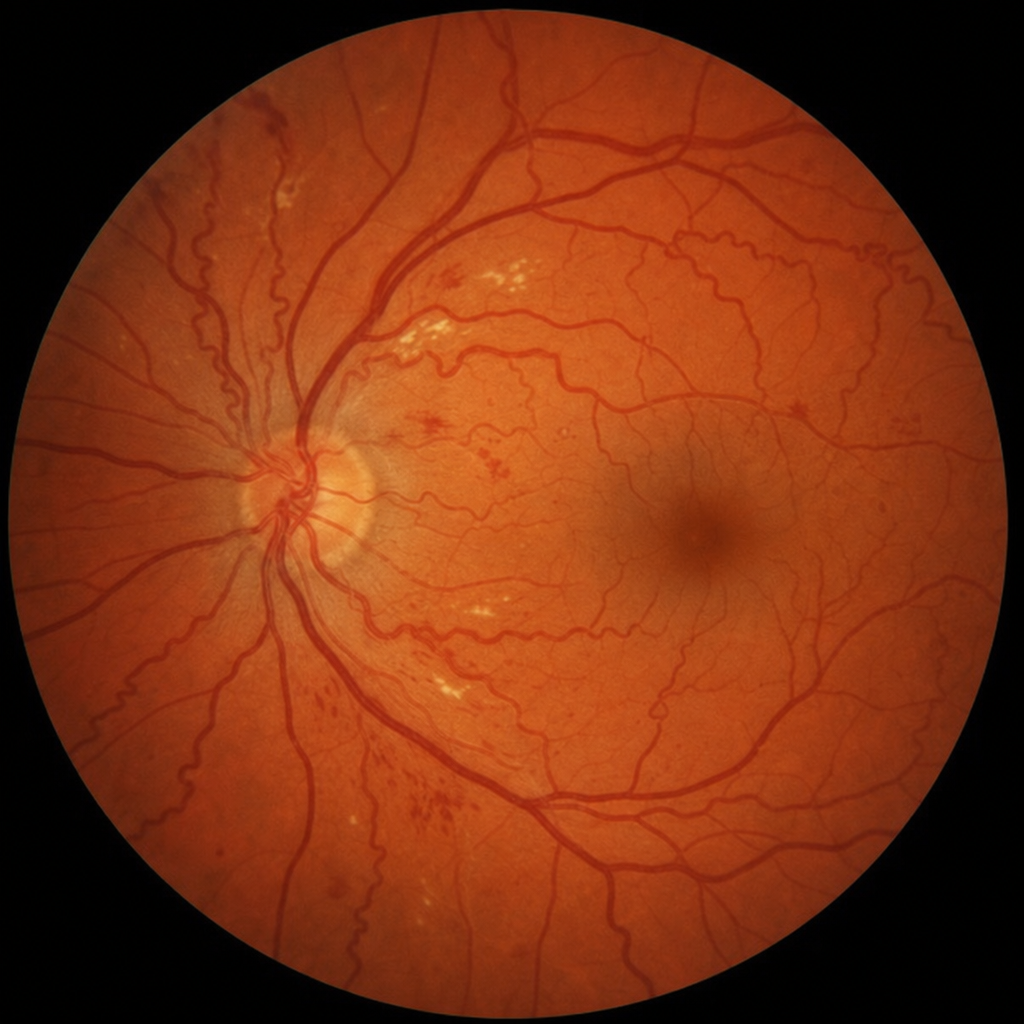
A 45-year-old female with a long history of progressive myopia develops sudden patchy loss of vision in her right eye. She is very alarmed and rushes to her family doctor. Funduscopic examination reveals a large retinal detachment in the right eye. The retina in the left eye is normal. When the pupillary light reflex is tested by shining a light in the right eye, what would the physician likely note?
A patient with Coats' disease presents with leukocoria. What condition needs to be differentiated from this?
A "white centered retinal haemorrhage" is seen in which of the following conditions?
Which of the following is NOT a layer of the retina?
A 33-year-old woman presents with a 3-day history of seeing "spots" floating around in her eye. Today, she notes streaks of light in the same eye accompanied by a "shadow" in her peripheral vision that moves when looking up and down. Her medical history is significant for migraine headaches; however, she has never had such visual symptoms with her headaches. What is the most likely diagnosis?
A female presented with progressive loss of vision during the night for the past few months. Fundoscopy shows 'bone-spicule formation'. Her two brothers and mother are also suffering from the same problem. What is the most likely diagnosis?
PASCAL is used for what procedure?
What is the most common cause of ptosis?
An HIV patient complains of visual disturbances. Fundal examination shows bilateral retinal exudates and perivascular haemorrhages. Which of the following viruses is most likely to be responsible for this retinitis?
Which findings are true in central retinal artery occlusion?
Explanation: ### Explanation The correct answer is **D. Dilatation of the right pupil and dilatation of the left pupil.** #### 1. The Underlying Concept: Relative Afferent Pupillary Defect (RAPD) The patient has a large retinal detachment (RD), which significantly reduces the amount of light perceived by the retina. This creates a **Relative Afferent Pupillary Defect (RAPD)**, also known as a **Marcus Gunn Pupil**. In a normal eye, light triggers the afferent pathway (CN II), leading to bilateral pupillary constriction via the Edinger-Westphal nuclei (CN III). In an eye with a large RD, the afferent signal is severely weakened. When light is shone into the affected (right) eye, the brain perceives less light than expected. Consequently, the pupillary reflex is not triggered effectively, and both pupils fail to constrict. Instead, they appear to **dilate** (or remain dilated) relative to the state they were in when the light was shone in the healthy eye. #### 2. Why the Other Options are Incorrect * **Option A:** This describes a normal pupillary reflex. In a large RD, the damaged afferent pathway prevents this response. * **Option B & C:** These are physiologically impossible in a standard light reflex test because the pupillary response is always **consensual** (bilateral). Both pupils always constrict or dilate together because the pretectal nuclei project to both Edinger-Westphal nuclei. #### 3. Clinical Pearls for NEET-PG * **RAPD Causes:** Most commonly caused by **Optic Nerve lesions** (e.g., Optic Neuritis, Ischemic Optic Neuropathy) or **extensive retinal disease** (e.g., Large RD, Central Retinal Artery Occlusion). * **Note:** Dense cataracts or vitreous hemorrhage usually **do not** cause RAPD because light still reaches the retina diffusely. * **The "Swinging Flashlight Test":** This is the clinical gold standard to diagnose RAPD. The hallmark is the "paradoxical dilatation" of the pupil when the light is moved from the normal eye to the affected eye. * **High-Yield Association:** High myopia is a major risk factor for rhegmatogenous retinal detachment due to peripheral retinal thinning (Lattice degeneration).
Explanation: **Explanation:** **Coats' Disease** is an idiopathic condition characterized by telangiectatic and aneurysmal retinal vessels leading to massive subretinal exudation. When this exudation becomes extensive, it results in an exudative retinal detachment that presents clinically as **leukocoria** (white pupillary reflex). **Why Retinoblastoma is the correct answer:** Retinoblastoma is the most common primary intraocular malignancy of childhood and is the most critical "life-before-sight" differential diagnosis for any child presenting with leukocoria. Both Coats' disease and Retinoblastoma typically present in young children (though Coats' is usually unilateral and affects males more frequently). Differentiating them is vital: Retinoblastoma often shows **calcification** on imaging (USG/CT), whereas Coats' disease is characterized by **lipid exudation** and lacks a solid soft-tissue mass. **Analysis of Incorrect Options:** * **Retinitis Pigmentosa:** Presents with night blindness (nyctalopia) and peripheral vision loss. It is characterized by "bone-spicule" pigmentation, not leukocoria. * **Retinal Detachment:** While a total detachment can cause a pale reflex, in the pediatric context, the primary concern is identifying the *cause* (like Coats' or RB) rather than the detachment itself. * **Congenital Cataract:** This is a common cause of leukocoria, but it is an opacity of the lens, not a retinal pathology. It is easily distinguished from Coats' via a slit-lamp examination. **High-Yield Clinical Pearls for NEET-PG:** * **Coats' Disease Hallmark:** "Light bulb" telangiectasia and massive hard exudates. * **Gender/Laterality:** Predominantly affects young males (85%) and is almost always **unilateral**. * **Imaging:** Ultrasound (B-scan) in Retinoblastoma shows high-reflectivity spikes due to **calcification** (present in 90% of cases), which is absent in Coats'. * **Other Leukocoria Differentials:** PHPV (Persistent Hyperplastic Primary Vitreous), Retinopathy of Prematurity (ROP), and Toxocariasis.
Explanation: The clinical finding described is a **Roth spot**. A Roth spot is a retinal hemorrhage with a central white or pale spot. Historically, the white center was thought to be an abscess, but it is now understood to be a **fibrin-platelet thrombus** at the site of capillary rupture. ### **Explanation of Options** * **Subacute Bacterial Endocarditis (SBE):** Classically associated with Roth spots due to septic emboli causing capillary damage and subsequent hemorrhage. * **Leukaemia:** A very common cause where the white center often represents a cluster of malignant white blood cells or localized anemia/thrombocytopenia leading to fragile vessels. * **Diabetes Mellitus:** While less common than microaneurysms, Roth spots can occur in diabetic retinopathy due to capillary fragility and localized ischemia. Since all three conditions (along with others like severe anemia and hypertension) can manifest with these lesions, **Option D (All of the above)** is the correct answer. ### **High-Yield Clinical Pearls for NEET-PG** * **Pathophysiology:** The white center represents **fibrin-platelet plug** formation following a rupture of the retinal capillary wall. * **Differential Diagnosis (Mnemonic: "LASH"):** * **L**eukaemia * **A**nemia (Severe) * **S**BE (Subacute Bacterial Endocarditis) * **H**ypertension / **H**IV * **Other Causes:** Carbon monoxide poisoning, Preeclampsia, and Scurvy. * **Key Distinction:** Roth spots are **not pathognomonic** for SBE; they are a non-specific sign of blood dyscrasias or vascular injury.
Explanation: The retina is a complex, ten-layered neurosensory structure. To answer this question, one must distinguish between the layers of the **cornea** and the layers of the **retina**. ### **Why Bowman’s Membrane is the Correct Answer** **Bowman’s membrane** is the second layer of the **cornea** (located between the epithelium and the stroma). It is an acellular, condensed layer of collagen fibers. It does not belong to the retina. A key clinical fact is that Bowman’s membrane does not regenerate; if damaged, it heals by scarring. ### **Analysis of Incorrect Options (Layers of the Retina)** The retina consists of 10 layers (from outside to inside): 1. **Retinal Pigment Epithelium (RPE):** The outermost layer (Option B). It supports photoreceptor health and absorbs stray light. 2. **Photoreceptor Layer:** Rods and cones. 3. **Outer Limiting Membrane (OLM):** A fenestrated membrane formed by the junctional complexes of Müller cells and photoreceptors (Option A). 4. **Outer Nuclear Layer:** Cell bodies of rods and cones. 5. **Outer Plexiform Layer:** Synapses between photoreceptors and bipolar/horizontal cells. 6. **Inner Nuclear Layer:** Cell bodies of bipolar, horizontal, and amacrine cells. 7. **Inner Plexiform Layer:** Synapses between bipolar and ganglion cells. 8. **Ganglion Cell Layer:** Contains the nuclei of ganglion cells (Option D). 9. **Nerve Fiber Layer:** Axons of ganglion cells that form the optic nerve. 10. **Inner Limiting Membrane:** The innermost boundary, formed by Müller cell basal laminae. ### **High-Yield Clinical Pearls for NEET-PG** * **Retinal Detachment:** Occurs at the potential space between the **RPE** (Layer 1) and the **Neurosensory retina** (Layers 2–10). * **Müller Cells:** These are the principal glial cells of the retina, extending from the OLM to the ILM. * **Macula:** At the foveola, the retina is thinnest because the inner layers are displaced peripherally to allow light to strike photoreceptors directly.
Explanation: **Explanation:** The clinical presentation of **floaters** ("spots"), **photopsia** (streaks of light), and a **peripheral "shadow"** or curtain-like defect is the classic triad of **Retinal Detachment (RD)**. 1. **Why Retinal Detachment is correct:** * **Floaters:** Caused by vitreous condensation or hemorrhage following a retinal tear. * **Photopsia:** Results from mechanical stimulation (traction) of the retina by the vitreous gel. * **Peripheral Shadow:** This represents the actual separation of the neurosensory retina from the retinal pigment epithelium (RPE). The fact that the shadow moves with eye movement suggests a fluid-filled space (subretinal fluid) shifting, which is characteristic of a rhegmatogenous RD. 2. **Why other options are incorrect:** * **Ophthalmic Migraine:** While the patient has a history of migraines, these typically present with transient, bilateral scintillating scotomas (zigzag lines) lasting 20–30 minutes, not persistent floaters or a moving shadow. * **Malingering:** The symptoms are highly specific and localized to one eye, pointing toward organic pathology rather than feigned illness. * **Amaurosis Fugax:** This is a "painless, transient monocular vision loss" (like a curtain coming down and then lifting) usually lasting seconds to minutes, caused by retinal emboli. It does not present with persistent floaters or photopsia. **Clinical Pearls for NEET-PG:** * **Shafer’s Sign:** The presence of "tobacco dust" (pigment cells) in the anterior vitreous on slit-lamp exam is pathognomonic for a retinal tear. * **Risk Factors:** High myopia, aphakia, and trauma are the most common predisposing factors for rhegmatogenous RD. * **Management:** RD is a surgical emergency. The goal is to seal the break (Cryotherapy/Laser) and appose the retina (Scleral buckling, Pneumatic retinopexy, or Vitrectomy).
Explanation: ### Explanation **Correct Answer: D. Retinitis Pigmentosa** **Why it is correct:** Retinitis Pigmentosa (RP) is a hereditary, progressive dystrophy primarily affecting the rod photoreceptors. The clinical presentation in this case is classic: 1. **Nyctalopia (Night Blindness):** This is the earliest symptom due to rod dysfunction. 2. **Bone-Spicule Formation:** This hallmark fundoscopic finding represents intraretinal pigment migration and accumulation around the retinal vessels. 3. **Inheritance Pattern:** The involvement of the mother and brothers suggests an **Autosomal Dominant** inheritance pattern (though RP can also be AR or X-linked). **Why the other options are incorrect:** * **A. Papilledema:** Presents with optic disc swelling due to increased intracranial pressure. It typically causes transient visual obscurations or headache, not night blindness or pigmentary changes. * **B. Macular Edema:** Causes central vision loss and metamorphopsia (distorted vision), not night blindness. Fundoscopy would show retinal thickening or cystoid spaces. * **C. Central Retinal Artery Occlusion (CRAO):** Presents as sudden, painless, profound loss of vision. Fundoscopy shows a "Cherry-red spot" and retinal whitening, not bone-spicules. **High-Yield Clinical Pearls for NEET-PG:** * **Classic Triad of RP:** 1. Bone-spicule pigmentation (mid-periphery), 2. Arteriolar attenuation (narrowing), 3. Waxy pallor of the optic disc. * **Visual Field:** Characteristically shows a **Ring Scotoma**. * **Electroretinogram (ERG):** The most sensitive test; it shows a **subnormal or extinguished** (flat) response even before fundus changes appear. * **Associated Conditions:** Usher syndrome (RP + Sensorineural hearing loss) and Laurence-Moon-Biedl syndrome (RP + Obesity + Polydactyly + Hypogonadism + Mental retardation).
Explanation: **Explanation:** **PASCAL** stands for **PAttern SCAn Laser**. It is a semi-automated system used for **Laser Photocoagulation**, primarily in the treatment of retinal vascular diseases like Diabetic Retinopathy. **Why Option B is Correct:** Traditional laser systems deliver a single spot at a time, which is time-consuming and painful for the patient. PASCAL uses a high-speed scanner to deliver a **predetermined pattern of multiple laser spots** (up to 56 spots) in a single rapid burst (short pulse duration of 10–20 ms). This reduces the total treatment time, minimizes heat dissipation to surrounding tissues (reducing pain), and ensures more uniform spacing of laser burns. **Why Other Options are Incorrect:** * **Option A (Angiography):** Retinal angiography (FFA or ICG) uses cameras and dyes (Fluorescein or Indocyanine Green) to visualize blood flow, not therapeutic lasers. * **Option C & D (RNFL/Ganglion cell layer):** These are structural layers of the retina measured using **Optical Coherence Tomography (OCT)**. OCT is a diagnostic imaging modality, whereas PASCAL is a therapeutic modality. **High-Yield Clinical Pearls for NEET-PG:** * **Primary Indication:** Pan-Retinal Photocoagulation (PRP) for Proliferative Diabetic Retinopathy (PDR). * **Advantage:** The shorter pulse duration of PASCAL results in **less collateral damage** to the choroid and nerve fiber layer compared to conventional lasers. * **Laser Type:** It typically utilizes a frequency-doubled Nd:YAG laser (532 nm green laser). * **Other Retinal Lasers:** Remember **Transpupillary Thermotherapy (TTT)** for small choroidal melanomas and **Photodynamic Therapy (PDT)** using Verteporfin for CNVM.
Explanation: **Explanation:** **1. Why Congenital is the Correct Answer:** Ptosis (blepharoptosis) refers to the drooping of the upper eyelid. Statistically, **Congenital Ptosis** is the most common cause overall. It is primarily due to **levator palpebrae superioris (LPS) maldevelopment** (dysgenesis), where the muscle tissue is replaced by fibrous or fatty tissue. It is usually present at birth and is most often unilateral, though it can be bilateral. **2. Analysis of Incorrect Options:** * **Myasthenia Gravis:** This is a common cause of *acquired* myogenic ptosis characterized by fatiguability and variability, but it is less frequent than congenital cases in the general population. * **Paralysis of 3rd Nerve:** This causes neurogenic ptosis (often complete) along with "down and out" eye deviation and pupillary involvement. While clinically significant, it is a specific neurological deficit rather than the most common cause. * **Idiopathic:** While some cases of senile (aponeurotic) ptosis are age-related, "Congenital" remains the most frequently cited primary etiology in standard ophthalmic textbooks. **3. NEET-PG High-Yield Pearls:** * **Most common cause of Acquired Ptosis:** Aponeurotic (Senile) ptosis, caused by the involutional stretching or dehiscence of the LPS aponeurosis. * **Marcus Gunn Jaw-Winking Phenomenon:** The most common type of congenital synkinetic ptosis (CN V3 misdirected to CN III). * **Surgical Management:** * If LPS action is **good (>8mm):** Fasanella-Servat operation. * If LPS action is **fair (5-8mm):** Levator resection. * If LPS action is **poor (<4mm):** Frontalis Brow Suspension (Sling operation). * **Critical Complication:** Severe congenital ptosis can lead to **deprivational amblyopia**, making early surgical intervention necessary if the pupillary axis is covered.
Explanation: ### Explanation **Correct Option: C. Cytomegalovirus (CMV)** CMV retinitis is the most common opportunistic ocular infection in HIV/AIDS patients, typically occurring when the **CD4+ T-cell count falls below 50 cells/µL**. The classic funduscopic appearance described—perivascular hemorrhages and fluffy yellow-white retinal exudates—is known as the **"Pizza-pie"** or **"Cottage cheese and ketchup"** appearance. The virus causes a full-thickness necrotizing retinitis that spreads along the retinal vessels (perivascular distribution). **Analysis of Incorrect Options:** * **A & B (HSV and VZV):** These viruses cause **Acute Retinal Necrosis (ARN)** or **Progressive Outer Retinal Necrosis (PORN)**. Unlike CMV, these conditions are characterized by rapid progression, minimal inflammation (in PORN), and a "scalloped" edge of necrosis. They do not typically present with the heavy "pizza-pie" exudative/hemorrhagic pattern. * **D (Epstein-Barr Virus):** EBV is associated with Burkitt lymphoma and nasopharyngeal carcinoma but is not a recognized cause of primary necrotizing retinitis in HIV patients. **High-Yield Clinical Pearls for NEET-PG:** * **Most common site of CMV retinitis:** The retina (it is the leading cause of blindness in AIDS). * **Pathognomonic sign:** "Brushfire" border (active yellow-white edge with a granular appearance). * **Treatment of Choice:** **Valganciclovir** (oral) or **Ganciclovir** (IV/Intravitreal). Foscarnet and Cidofovir are second-line. * **Immune Recovery Uveitis (IRU):** An inflammatory reaction that occurs when a patient starts HAART and their CD4 count rises, causing inflammation against pre-existing CMV antigens.
Explanation: ### Explanation **Central Retinal Artery Occlusion (CRAO)** is a true ophthalmic emergency characterized by sudden, painless, profound loss of vision. The underlying pathology is an obstruction of the central retinal artery, leading to ischemic death of the inner retinal layers. #### Why Option A is Correct: In CRAO, the retina suffers severe ischemia, resulting in a failure of the afferent visual pathway. 1. **Direct Pupillary Reflex Absent:** Since the retina cannot perceive light or transmit the signal through the optic nerve, the ipsilateral (direct) light reflex is lost in the affected eye. 2. **Relative Afferent Pupillary Defect (RAPD):** Also known as the **Marcus Gunn Pupil**, RAPD is a hallmark of significant unilateral retinal or optic nerve disease. When light is swung from the normal eye to the affected eye, the pupil appears to dilate because the brain perceives less light through the ischemic retina compared to the healthy one. #### Why Other Options are Incorrect: * **Option B:** The direct reflex cannot be present if there is a total afferent block (amaurotic pupil). * **Option C:** The indirect (consensual) reflex remains intact in the affected eye when light is shone into the healthy eye, so "both" are not absent. * **Option D:** **Scalloped pupils** are typically associated with traumatic iridodialysis or certain types of iris atrophy (e.g., in Fuch’s heterochromic iridocyclitis), not vascular occlusions. #### High-Yield Clinical Pearls for NEET-PG: * **Fundus Findings:** "Cherry-red spot" at the fovea (due to the thin foveola showing the underlying choroidal vasculature) and "cattle-trucking" (segmentation of blood columns). * **Ground Glass Appearance:** The surrounding retina appears milky white due to intracellular edema. * **Cilioretinal Artery:** In 15-20% of the population, this artery (derived from ciliary circulation) spares a small part of the macular vision. * **Management:** Immediate ocular massage, anterior chamber paracentesis, and inhalation of Carbogen (95% $O_2$, 5% $CO_2$) to induce vasodilation.
Retinal Anatomy and Physiology
Practice Questions
Age-Related Macular Degeneration
Practice Questions
Diabetic Retinopathy
Practice Questions
Retinal Vascular Diseases
Practice Questions
Retinal Detachment
Practice Questions
Hereditary Retinal Dystrophies
Practice Questions
Inflammatory Retinal Diseases
Practice Questions
Retinal Tumors
Practice Questions
Retinopathy of Prematurity
Practice Questions
Retinal Imaging Techniques
Practice Questions
Intravitreal Pharmacotherapy
Practice Questions
Vitreoretinal Surgery
Practice Questions
Get full access to all questions, explanations, and performance tracking.
Start For Free