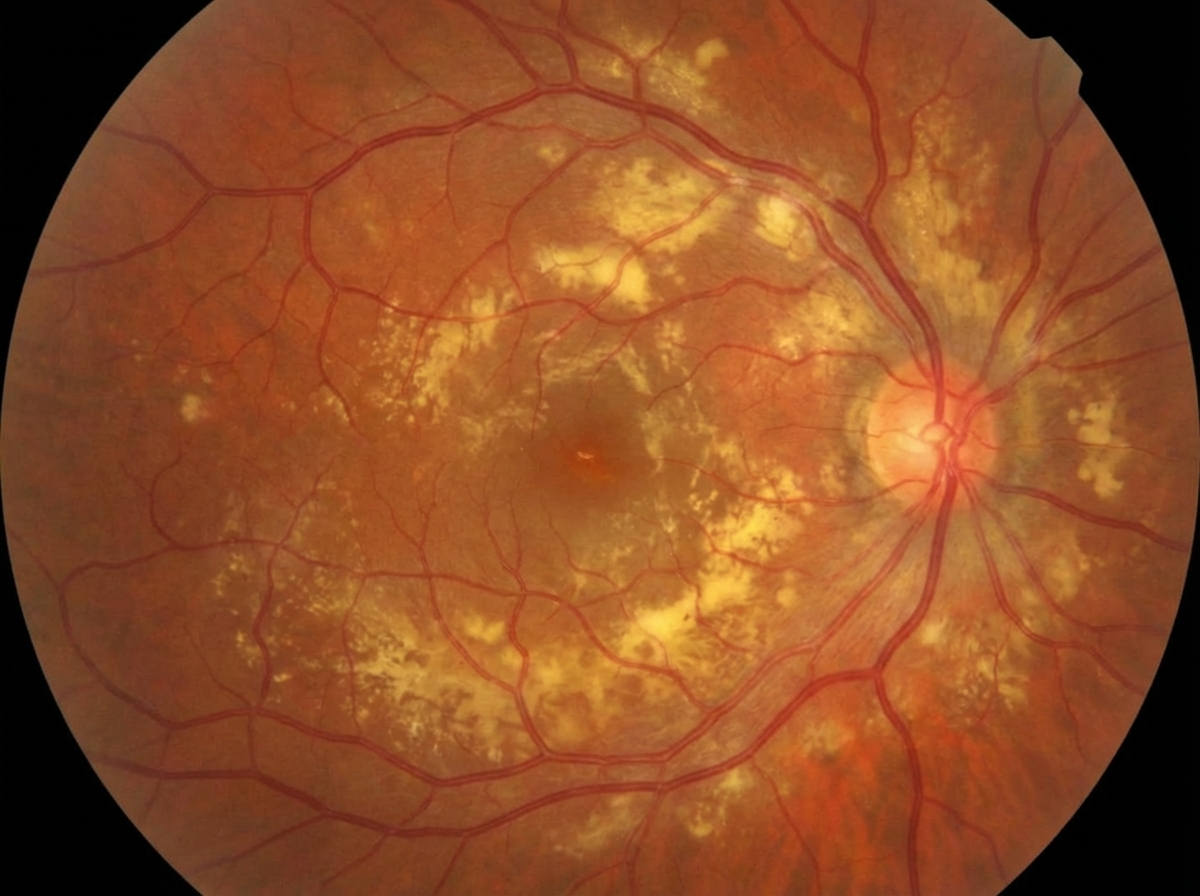
What happens to the number of pericytes in diabetic retinopathy?
A cherry red spot in the retina is a characteristic finding of which condition?
What is a common cause of floaters in Diabetes Mellitus?
In central serous retinopathy, which of the following is true?
A 6-year-old male presents with findings on a blood smear examination. Which of the following ocular conditions is most likely to be associated with this patient?

A 40-year-old male with diabetes mellitus presents with vitreous hemorrhage. What is the most important cause for it?
Soft exudates are found in all of the following conditions except?
Dot and blot hemorrhages and flame-shaped hemorrhages can be characteristically seen in which of the following conditions?
What condition is characterized by a 'salt and pepper' fundus appearance?
All of the following are true about central retinal artery occlusion (CRAO) except:
Explanation: **Explanation:** In Diabetic Retinopathy (DR), the **loss of pericytes** is the earliest histopathological hallmark of the disease. Pericytes are contractile cells wrapped around retinal capillaries that provide structural support and regulate blood flow. Chronic hyperglycemia leads to the accumulation of sorbitol (via the polyol pathway) and Advanced Glycation End-products (AGEs), which are toxic to pericytes. As pericytes undergo apoptosis, the capillary wall weakens, leading to the formation of **microaneurysms** (the first clinical sign of DR). This loss also disrupts the blood-retinal barrier, resulting in vascular leakage and exudation. **Analysis of Options:** * **Option A (Increases):** Incorrect. Hyperglycemia is cytotoxic to pericytes; they never increase in number during the progression of DR. * **Option B (Decreases):** **Correct.** Selective pericyte loss is the "signature" lesion of early diabetic microangiopathy. * **Option C (No change):** Incorrect. Significant structural changes occur at the cellular level long before clinical symptoms appear. * **Option D (Decreases followed by increases):** Incorrect. Once pericytes are lost, they do not regenerate; instead, the basement membrane thickens and acellular capillaries form. **High-Yield Clinical Pearls for NEET-PG:** 1. **Pericyte to Endothelial Cell Ratio:** In a normal retina, the ratio is **1:1**. In diabetic retinopathy, this ratio significantly decreases. 2. **Earliest Clinical Sign:** Microaneurysms (seen as tiny red dots on fundoscopy). 3. **Earliest Pathological Sign:** Loss of pericytes and basement membrane thickening. 4. **Aldose Reductase:** The enzyme responsible for converting glucose to sorbitol, leading to pericyte death.
Explanation: ### Explanation **Concept of the Cherry Red Spot:** The "cherry red spot" is a clinical sign where the fovea appears bright red against a pale, opalescent, or white surrounding retina. This occurs because the foveola is the thinnest part of the retina and lacks the ganglion cell layer. In certain storage disorders, lipids or complex carbohydrates accumulate in the surrounding ganglion cell layer, making the retina appear opaque/white. The foveola remains transparent, allowing the underlying vascular choroid to shine through, creating the red spot. **Analysis of Options:** * **Niemann-Pick Disease (Correct):** This is a lysosomal storage disorder (sphingomyelinase deficiency) where sphingomyelin accumulates in the retinal ganglion cells, leading to a classic cherry red spot in about 50% of Type A cases. * **Infantile Gaucher’s Disease:** While it is a storage disorder, a cherry red spot is **extremely rare** in Gaucher’s. It is more typically associated with "Gaucher cells" in systemic organs. * **Fabry’s Disease:** This condition is characterized by **vortex keratopathy** (cornea verticillata) and wedge-shaped posterior subcapsular cataracts, not a cherry red spot. * **Central Retinal Vein Occlusion (CRVO):** This presents with a "blood and thunder" appearance (diffuse flame-shaped hemorrhages). A cherry red spot is a hallmark of **Central Retinal Artery Occlusion (CRAO)**, not vein occlusion. **High-Yield Clinical Pearls for NEET-PG:** * **Mnemonic for Cherry Red Spot:** "**S**ome **M**en **A**re **C**herry **P**icked" (**S**andhoff disease, **M**achado-Joseph/Tay-Sachs, **A**rtery occlusion [CRAO], **C**herry red spot myoclonus syndrome, **P**ick’s [Niemann-Pick]). * **Tay-Sachs Disease:** The most common storage disorder associated with a cherry red spot (found in nearly 100% of cases). * **CRAO:** The most common **vascular** cause of a cherry red spot. * **Quinine Toxicity:** A rare toxic cause of a cherry red spot.
Explanation: **Explanation:** In the context of Diabetes Mellitus, the sudden appearance of floaters is most commonly attributed to **Vitreous Hemorrhage**. This occurs during the stage of **Proliferative Diabetic Retinopathy (PDR)**. Chronic hypoxia triggers the release of Vascular Endothelial Growth Factor (VEGF), leading to **neovascularization** (NVD/NVE). These new vessels are fragile and lack a proper basement membrane; they easily rupture due to vitreoretinal traction, leaking blood into the vitreous cavity. Patients typically describe "cobwebs," "dark streaks," or "spots" (floaters), which may progress to sudden painless loss of vision if the bleed is extensive. **Analysis of Incorrect Options:** * **Vitreous Detachment (PVD):** While a common cause of floaters in the elderly and myopes, it is not the specific pathological hallmark of diabetic eye disease compared to hemorrhage. * **Maculopathy:** Diabetic Macular Edema (DME) is the most common cause of *gradual* vision loss in diabetics. It presents with blurring or metamorphopsia (distortion), not floaters. * **Infarction:** Retinal infarction (e.g., Cotton Wool Spots) represents localized ischemia of the nerve fiber layer. It is usually asymptomatic unless it involves the fovea and does not cause floaters. **NEET-PG High-Yield Pearls:** * **Classification:** PDR is defined by the presence of neovascularization. * **Management:** The gold standard for PDR is **Pan-Retinal Photocoagulation (PRP)**. For non-clearing vitreous hemorrhage, **Pars Plana Vitrectomy (PPV)** is indicated. * **Investigation:** If the fundus is obscured by blood, an **Ocular B-Scan** must be performed to rule out tractional retinal detachment.
Explanation: **Central Serous Retiopathy (CSR)** is characterized by a localized serous detachment of the neurosensory retina at the macula, caused by leakage from the choriocapillaris through a defect in the Retinal Pigment Epithelium (RPE). ### Why Option A is Correct: Fluorescein Angiography (FFA) is the gold standard for diagnosing CSR. It typically reveals **focal leakage** points. The two classic patterns are: 1. **Ink-blot appearance (Most common):** A small spot of leakage that gradually enlarges. 2. **Smoke-stack appearance (Pathognomonic):** Fluorescein rises vertically and then spreads laterally, resembling a plume of smoke. ### Why Other Options are Incorrect: * **Option B:** Macular holes are not a common complication of CSR. The fluid usually resorbs spontaneously. Chronic CSR may lead to RPE atrophy or subretinal fibrosis, but not typically a hole. * **Option C:** Patients with CSR experience **micropsia** (objects appearing smaller), not macropsia. This occurs because the subretinal fluid pushes the photoreceptors apart; when light hits these spread-out cells, the brain interprets the image as smaller. * **Option D:** The typical presentation is a **relative central scotoma** (a "dull" or "gray" spot), not a dense (absolute) scotoma. Other symptoms include metamorphopsia (distorted vision) and a sudden onset of mild-to-moderate blurring. ### High-Yield Clinical Pearls for NEET-PG: * **Demographics:** Classically affects young to middle-aged males with **Type A personalities**. * **Risk Factors:** Stress, **systemic steroid use** (most important association), and pregnancy. * **OCT Finding:** Shows a "double hump" sign or neurosensory detachment with subretinal fluid. * **Management:** Most cases are self-limiting and resolve in 3–4 months. If persistent, options include Micropulse Laser or Photodynamic Therapy (PDT).
Explanation: ***Retinitis pigmentosa*** - **Abetalipoproteinemia** (Bassen-Kornzweig syndrome) indicated by **acanthocytes** on blood smear is associated with **pigmentary retinopathy** resembling retinitis pigmentosa. - This **autosomal recessive disorder** causes **fat-soluble vitamin deficiencies** (A, D, E, K), leading to progressive **retinal degeneration** and night blindness. *Hypertensive retinopathy* - Occurs due to **chronic hypertension** causing **arteriovenous nicking**, **flame-shaped hemorrhages**, and **cotton wool spots**. - Unlikely in a **6-year-old child** without systemic hypertension, and not associated with **acanthocytes** on blood smear. *Sickle cell retinopathy* - Associated with **sickle-shaped red blood cells** on blood smear, not **acanthocytes** (spiny red cells). - Presents with **proliferative retinopathy**, **sea fan neovascularization**, and **retinal detachment** due to vaso-occlusive episodes. *Purtscher retinopathy* - Typically occurs following **severe trauma**, **chest compression**, or **acute pancreatitis** causing **cotton wool spots** and **retinal hemorrhages**. - Not associated with **metabolic disorders** or **acanthocytes** on blood smear, and uncommon in pediatric patients without trauma history.
Explanation: ### **Explanation** The correct answer is **Neovascularization of the disc (NVD)**. **1. Why Neovascularization of the disc is correct:** In a patient with diabetes mellitus, chronic retinal ischemia leads to the release of **VEGF** (Vascular Endothelial Growth Factor). This triggers **Proliferative Diabetic Retinopathy (PDR)**, characterized by the formation of fragile, new blood vessels (neovascularization) at the optic disc (NVD) or elsewhere (NVE). These vessels lack a proper basement membrane and are prone to bleeding into the vitreous cavity, especially during vitreous contraction. **PDR is the most common cause of spontaneous vitreous hemorrhage** in adults. **2. Why other options are incorrect:** * **Posterior Vitreous Detachment (PVD):** While a common cause of vitreous hemorrhage in the general elderly population (due to retinal vessel tearing), in a **diabetic patient**, neovascularization is the primary pathological concern. * **Central Retinal Vein Occlusion (CRVO):** While CRVO can lead to neovascularization (Ischemic CRVO), it is a separate clinical entity. The question specifies a diabetic patient, making diabetic-induced NVD the more direct and likely cause. * **Trauma to the Central Retinal Artery:** Trauma is an external cause and does not relate to the underlying pathophysiology of diabetes. Furthermore, CRA trauma usually leads to ischemia/infarction rather than hemorrhage. **3. NEET-PG High-Yield Pearls:** * **Most common cause of Vitreous Hemorrhage (Overall):** Trauma. * **Most common cause of Spontaneous Vitreous Hemorrhage:** Proliferative Diabetic Retinopathy. * **Clinical Sign:** "Fresh" vitreous hemorrhage presents as a sudden, painless loss of vision with a "black rain" or "cobweb" appearance (floaters). * **Management:** B-Scan ultrasonography is mandatory if the fundus is not visible to rule out retinal detachment.
Explanation: **Explanation:** **Soft exudates**, also known as **Cotton Wool Spots (CWS)**, are not true exudates. They represent micro-infarctions of the retinal nerve fiber layer (RNFL) caused by the occlusion of terminal retinal arterioles. This leads to the cessation of axoplasmic flow and the accumulation of transported material (cytoid bodies) in the nerve fibers. **Why Retinopathy of Prematurity (ROP) is the correct answer:** ROP is characterized by peripheral retinal ischemia leading to **pathological neovascularization** at the junction of vascularized and non-vascularized retina. While ischemia is present, the hallmark lesions are the "line," "ridge," and "extraretinal fibrovascular proliferation." Soft exudates are typically absent in ROP because the immature retinal vasculature in neonates does not manifest the same focal arteriolar occlusive pattern seen in adult vascular diseases. **Analysis of Incorrect Options:** * **Diabetic Retinopathy:** CWS are a hallmark of Pre-proliferative Diabetic Retinopathy (PPDR), signifying significant retinal ischemia. * **Hypertensive Retinopathy:** CWS appear in Grade III (Modified Scheie Classification) or "Accelerated/Malignant" hypertension due to acute arteriolar damage. * **CMV Retinitis:** This viral infection causes full-thickness retinal necrosis. The borders of the necrotic areas often appear as white, fluffy opacities resembling soft exudates (the "pizza-pie" appearance). **High-Yield Clinical Pearls for NEET-PG:** * **Hard Exudates:** Composed of lipoproteins/lipids; located in the Outer Plexiform Layer (Henle’s layer in the macula); caused by chronic vascular leakage (e.g., NPDR). * **Soft Exudates (CWS):** Located in the Nerve Fiber Layer; caused by acute arteriolar occlusion. * **Other conditions with CWS:** HIV retinopathy (most common finding), Anemia, Leukemia, and Systemic Lupus Erythematosus (SLE).
Explanation: **Explanation:** The correct answer is **Diabetic Retinopathy (DR)**. **1. Why Diabetic Retinopathy is correct:** In DR, chronic hyperglycemia leads to capillary basement membrane thickening and pericyte loss, resulting in microvascular leakage. * **Dot and Blot Hemorrhages:** These occur in the deeper layers of the retina (Inner Nuclear and Outer Plexiform layers). Because the cells are packed vertically here, the blood is confined into small, round shapes. * **Flame-shaped Hemorrhages:** These occur in the superficial Nerve Fiber Layer (NFL). The blood follows the horizontal orientation of the nerve fibers, giving them a feathered or "flame" appearance. While more classic for hypertension, they are frequently seen in DR as well. **2. Why other options are incorrect:** * **Hypertensive Retinopathy:** Characteristically shows flame-shaped hemorrhages, cotton wool spots, and hard exudates. While dot-blots can occur, they are not the primary hallmark compared to DR. * **Retinitis Pigmentosa:** A degenerative disease characterized by the triad of **bony spicule pigmentation**, arteriolar attenuation, and waxy disc pallor. Hemorrhages are not a feature. * **Central Retinal Artery Occlusion (CRAO):** Presents with sudden painless loss of vision, a **"Cherry Red Spot"** at the macula, and a ground-glass (milky white) retina due to edema. Hemorrhages are typically absent (unlike CRVO, which shows "blood and thunder" fundus). **High-Yield Clinical Pearls for NEET-PG:** * **Earliest clinical sign of DR:** Microaneurysms (seen in the Inner Nuclear Layer). * **Dot/Blot Hemorrhages** = Deep retina; **Flame Hemorrhages** = Superficial retina (NFL). * **Pre-proliferative DR** is characterized by Intraretinal Microvascular Abnormalities (IRMA) and venous beading. * **Proliferative DR** is defined by the presence of **Neovascularization** (NVD/NVE).
Explanation: The **'salt and pepper' fundus** is a classic ophthalmological sign characterized by diffuse, mottled areas of retinal pigment epithelial (RPE) hyperplasia (black spots) and atrophy (white/yellow spots). ### 1. Why Congenital Syphilis is Correct In **Congenital Syphilis**, the Treponema pallidum spirochetes cause a chronic low-grade inflammation of the RPE and choroid. This results in a widespread, non-progressive pigmentary retinopathy. While it can mimic Retinitis Pigmentosa, it is distinguished by the lack of "bony spicule" formation and a relatively preserved electroretinogram (ERG) in early stages. ### 2. Analysis of Incorrect Options * **Central Retinal Vein Occlusion (CRVO):** Characterized by a **"Blood and Thunder"** appearance (diffuse flame-shaped hemorrhages, macular edema, and disc edema). * **Retinopathy of Prematurity (ROP):** Characterized by peripheral neovascularization, fibrovascular proliferation, and potentially a **"dragged disc"** or tractional retinal detachment. * **Ethambutol Intoxication:** Primarily causes **toxic optic neuropathy** (retrobulbar neuritis). The fundus often appears normal initially, later progressing to optic disc pallor; it does not cause peripheral pigmentary changes. ### 3. Clinical Pearls for NEET-PG * **Differential Diagnosis for Salt and Pepper Fundus:** 1. **Congenital Syphilis** (Most common association) 2. **Rubella Retinopathy** (Classic "Salt and Pepper" appearance; vision is usually normal) 3. **Cystinosis** 4. **Leber’s Congenital Amaurosis** (Early stages) 5. **Cockayne Syndrome** * **Hutchinson’s Triad (Syphilis):** Interstitial keratitis, Hutchinson’s teeth, and 8th nerve deafness. * **Key Distinction:** Unlike Retinitis Pigmentosa, the salt and pepper fundus of Rubella and Syphilis is usually **static** (non-progressive).
Explanation: **Explanation** Central Retinal Artery Occlusion (CRAO) is an ophthalmic emergency characterized by a sudden, profound, and painless loss of vision. **Why Option C is the "Except" (Correct Answer):** The question asks for the statement that is **NOT** true. Option C states "Sudden, painless loss of vision." This is a **true** clinical feature of CRAO. In the context of a "Multiple True-False" style NEET-PG question where one option must be the outlier, this question is likely flawed or miskeyed in traditional banks. However, if we analyze the pathology: the most common site of obstruction is actually the **lamina cribrosa** (Option D is true), the most common cause is **embolism/thromboembolism** (Option A is true), and **AC paracentesis** is a standard emergency treatment (Option B is true). Since all options are technically true, Option C is often highlighted in exams to emphasize the classic clinical presentation, though it is factually correct. **Analysis of Other Options:** * **Option A:** True. Most cases are caused by emboli (Hollenhorst plaques from the carotid or calcific emboli from heart valves). * **Option B:** True. AC paracentesis is performed to rapidly lower intraocular pressure, theoretically allowing the embolus to dislodge and move to a more peripheral branch. * **Option D:** True. The retinal artery is narrowest as it pierces the lamina cribrosa, making it the most common site for an impacted embolus. **Clinical Pearls for NEET-PG:** * **Fundus Findings:** "Cherry-red spot" at the fovea (due to the underlying choroid showing through the thin fovea) and "cattle-track" appearance of retinal vessels. * **Golden Hour:** Irreversible retinal damage occurs within 90–120 minutes. * **Management:** Digital massage, Carbogen inhalation (5% $CO_2$, 95% $O_2$), and IV Acetazolamide. * **Differential Diagnosis:** Cherry-red spot is also seen in Tay-Sachs disease, Niemann-Pick disease, and Berlin’s edema (commotio retinae).
Retinal Anatomy and Physiology
Practice Questions
Age-Related Macular Degeneration
Practice Questions
Diabetic Retinopathy
Practice Questions
Retinal Vascular Diseases
Practice Questions
Retinal Detachment
Practice Questions
Hereditary Retinal Dystrophies
Practice Questions
Inflammatory Retinal Diseases
Practice Questions
Retinal Tumors
Practice Questions
Retinopathy of Prematurity
Practice Questions
Retinal Imaging Techniques
Practice Questions
Intravitreal Pharmacotherapy
Practice Questions
Vitreoretinal Surgery
Practice Questions
Get full access to all questions, explanations, and performance tracking.
Start For Free