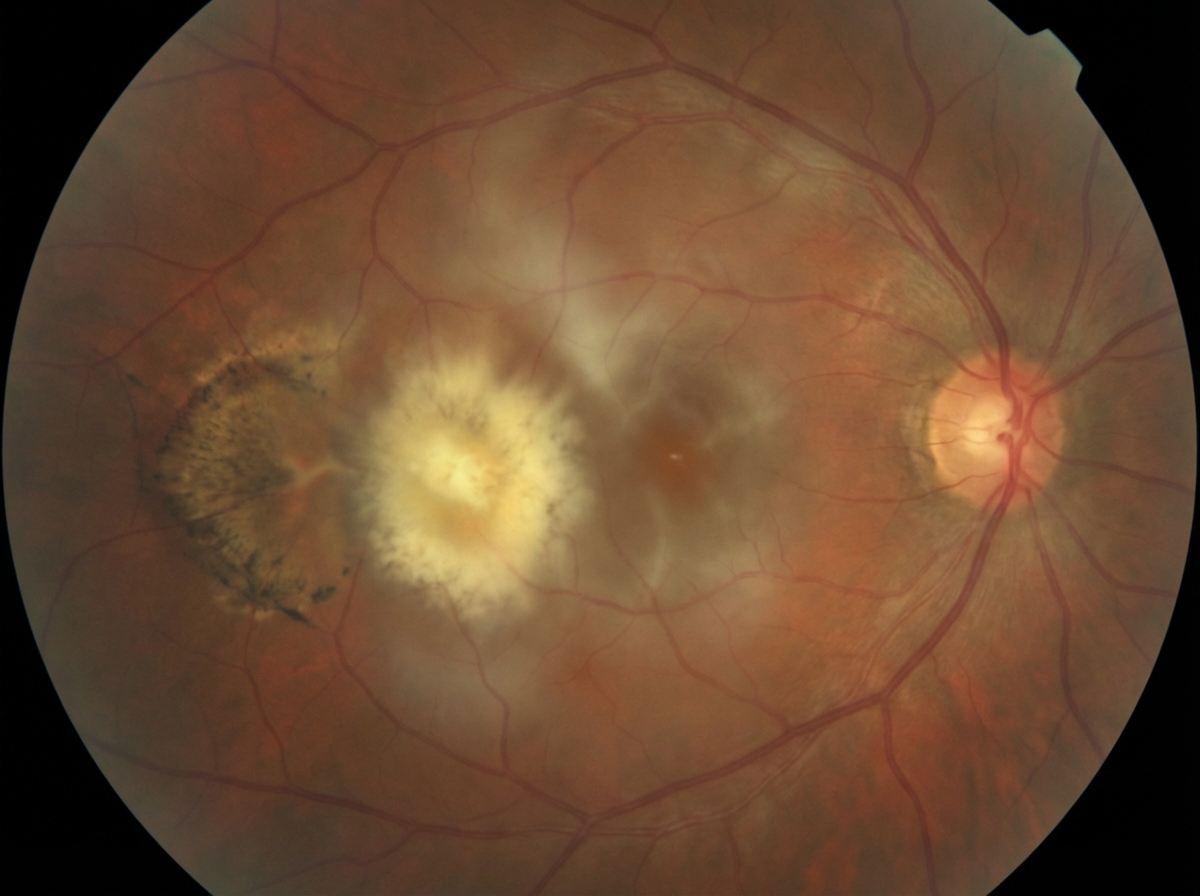
What is the strongest force of bonding between the retina and the retinal pigment epithelium (RPE)?
A diabetic patient is at greatest risk of developing which of the following types of retinal detachment?
Enlarging dot sign in fundus fluorescein angiography is seen in which of the following conditions?
Loss of vision may occur due to occlusion of which artery?
Which imaging modality is best for evaluating retinoblastoma?
A 75-year-old patient with a 25-year history of diabetes mellitus presented with sudden painless loss of vision. Fundus examination revealed flame-shaped hemorrhages in the retina. What is the probable diagnosis?
Dalen-Fuchs nodule is seen in which condition?
In cystoid macular edema, what is the basic defect?
What is the most constant and critical finding in retinitis pigmentosa?
Which disease, caused by a mutation in the BEST1 (VMD2) gene, is best diagnosed by a pathological test?
Explanation: ### Explanation The adhesion between the neurosensory retina (NSR) and the Retinal Pigment Epithelium (RPE) is a complex physiological process, as there are no anatomical intercellular junctions (like desmosomes) connecting these two layers. **Why Interphotoreceptor Matrix (IPM) is the Correct Answer:** The **Interphotoreceptor Matrix (IPM)** is considered the strongest and most critical factor for retinal adhesion. It is a viscous, glycosaminoglycan-rich "glue" that fills the subretinal space. It acts via two mechanisms: 1. **Chemical Bonding:** It creates a molecular bridge between the photoreceptor outer segments and the RPE microvilli. 2. **Mechanical Suction:** Its viscous nature creates a physical resistance to separation, similar to the surface tension between two wet glass slides. **Analysis of Incorrect Options:** * **A & B (Vitreous and Intraocular Pressure):** While IOP and the vitreous body exert a passive outward force that helps keep the retina apposed to the choroid, they are relatively weak forces. In cases of vitreous liquefaction or low IOP (hypotony), the retina does not automatically detach if the IPM and RPE pump are intact. * **C (RPE Water Transport):** The RPE actively pumps fluid from the subretinal space toward the choroid, creating a "relative vacuum." While this metabolic pump is vital for maintaining a dry subretinal space, it is secondary to the structural and chemical bonding provided by the IPM. **Clinical Pearls for NEET-PG:** * **The Potential Space:** The subretinal space (between NSR and RPE) is a remnant of the **optic vesicle cavity**; this is why it is a common site for fluid accumulation (Retinal Detachment). * **Metabolic Factors:** Retinal adhesion is oxygen and temperature-dependent. Factors that decrease RPE metabolism (like ischemia) weaken the bond. * **High-Yield Fact:** The strongest anatomical attachment of the retina is at the **Ora Serrata** and the **Optic Disc** (where the retina is continuous with the RPE/optic nerve). The IPM is the strongest *physiological* bond across the remaining posterior pole.
Explanation: **Explanation:** The hallmark of advanced diabetic eye disease is **Proliferative Diabetic Retinopathy (PDR)**. In PDR, chronic ischemia triggers the release of vascular endothelial growth factor (VEGF), leading to **neovascularization** (growth of new, fragile vessels). These new vessels grow along with a fibrous scaffold onto the posterior vitreous face. Over time, this fibrovascular tissue undergoes **contraction**, exerting mechanical pull on the sensory retina. This pulling force leads to **Tractional Retinal Detachment (TRD)**, which is characteristically concave and does not involve a retinal break. **Analysis of Incorrect Options:** * **Rhegmatogenous (D):** This is the most common type of RD overall, caused by a **retinal break/hole** allowing fluid to enter the subretinal space. While diabetics can develop this, TRD is the specific and most characteristic complication of PDR. * **Serous/Exudative (A):** Caused by fluid accumulation without a break (e.g., in VKH syndrome or tumors). While diabetic macular edema involves exudation, it rarely leads to a full serous detachment. * **Hemorrhagic (C):** This refers to blood in the subretinal space (often seen in ARMD). While PDR causes vitreous hemorrhage, "hemorrhagic RD" is not the primary mechanism of detachment in diabetes. **High-Yield Clinical Pearls for NEET-PG:** * **TRD Features:** Typically has a **"tent-like"** or concave configuration, is non-rhegmatogenous (no break), and is relatively immobile. * **Combined RD:** If a tractional band creates a tear, it is called a **Tractional-Rhegmatogenous RD**, which requires urgent surgical intervention. * **Management:** The definitive treatment for TRD involving the macula is **Pars Plana Vitrectomy (PPV)** to membrane peel and relieve traction.
Explanation: **Explanation:** **Central Serous Retinopathy (CSR)** is characterized by a localized serous detachment of the neurosensory retina at the macula, typically due to a leak at the level of the Retinal Pigment Epithelium (RPE). On **Fundus Fluorescein Angiography (FFA)**, CSR classically presents with two distinct leakage patterns: 1. **Ink-blot appearance (Enlarging dot sign):** This is the most common pattern. It begins as a small hyperfluorescent point (dot) that gradually increases in size and intensity as the dye spreads concentrically. 2. **Smoke-stack appearance:** Seen in about 10% of cases, where the dye rises vertically from the leak point and then spreads laterally, resembling a plume of smoke. **Analysis of Incorrect Options:** * **Cystoid Macular Edema (CME):** Characteristically shows a **"Flower-petal"** or **"Petaloid"** pattern of hyperfluorescence in the late phases of FFA due to dye accumulation in Henle’s layer. * **Significant Macular Edema (CSME):** Usually associated with Diabetic Retinopathy; it shows focal or diffuse leakage but does not exhibit the specific "enlarging dot" morphology. * **Coat’s Disease:** Characterized by telangiectatic "light bulb" vessels and massive subretinal exudation. FFA shows early leakage from these abnormal vessels and areas of capillary non-perfusion. **High-Yield Clinical Pearls for NEET-PG:** * **Demographics:** Typically affects young to middle-aged males with **Type-A personalities**. * **Risk Factors:** Stress, exogenous steroid use, and pregnancy. * **Metamorphopsia:** Patients often complain of distorted vision and a "central dark spot" (positive scotoma). * **OCT Finding:** Shows a "dome-shaped" elevation of the neurosensory retina with subretinal fluid. * **Management:** Most cases are self-limiting and resolve spontaneously within 3–4 months.
Explanation: **Explanation:** The **Central Retinal Artery (CRA)** is a branch of the ophthalmic artery and is a functional **"end artery."** It provides the sole blood supply to the inner layers of the retina, including the macula. Because there are no significant collateral anastomoses, an occlusion (CRAO) leads to immediate ischemia and infarction of the retinal tissue, resulting in sudden, painless, profound loss of vision. **Analysis of Options:** * **Optic artery (A):** This is not a standard anatomical term in human ocular vascularity. The primary supply to the optic nerve comes from the short posterior ciliary arteries and the pial plexus. * **Superior Ophthalmic artery (B):** While the Ophthalmic artery is the parent vessel, it has multiple branches (ciliary, muscular, lacrimal). Occlusion of the main trunk is rare; specific loss of vision is most characteristically linked to its branch, the CRA. * **External carotid artery (D):** The eye is primarily supplied by the **Internal Carotid Artery (ICA)** via the ophthalmic artery. The ECA supplies the face and scalp; while it has minor anastomoses with the ICA, its occlusion does not typically cause blindness. **High-Yield Clinical Pearls for NEET-PG:** * **Fundus Findings in CRAO:** "Cherry-red spot" at the fovea (due to the thin fovea showing the underlying vascular choroid) and "cattle-trucking" (segmentation) of retinal veins. * **Cilioretinal Artery:** Present in ~15-20% of the population; derived from posterior ciliary arteries. If present, it may spare central vision during a CRAO. * **Emergency Management:** Digital ocular massage, anterior chamber paracentesis, and inhaled carbogen to lower IOP and dislodge the embolus.
Explanation: **Explanation:** The evaluation of **Retinoblastoma (RB)**, the most common primary intraocular malignancy in children, requires a multi-modal imaging approach to confirm the diagnosis and assess for extraocular spread. **Why "CT scan and MRI" is the correct answer:** * **CT Scan:** This is the gold standard for detecting **intraocular calcification**, which is a hallmark feature of retinoblastoma (present in over 90% of cases). It helps differentiate RB from other "pseudogliomas" like Coats' disease. * **MRI:** This is the superior modality for evaluating **extraocular extension**. It is essential for assessing optic nerve involvement, subarachnoid spread, and intracranial tumors (e.g., Trilateral Retinoblastoma involving the pineal gland). Unlike CT, MRI does not involve ionizing radiation, which is a significant concern in children with the *RB1* mutation who are predisposed to secondary cancers. **Analysis of Incorrect Options:** * **A. Ultrasonography:** While useful for initial screening and detecting calcification (showing high-intensity echoes with acoustic shadowing), it lacks the resolution to evaluate intracranial extension. * **B & D. CT or MRI alone:** While both are vital, neither is sufficient on its own for a complete workup. CT is best for the "bone-like" density of calcification, while MRI is best for soft tissue and neural involvement. **Clinical Pearls for NEET-PG:** * **Most common presentation:** Leukocoria (white pupillary reflex), followed by strabismus. * **Pathology:** Look for **Flexner-Wintersteiner rosettes** (highly specific). * **Trilateral Retinoblastoma:** Bilateral RB associated with a pineal gland tumor (Pineoblastoma). * **Management:** Small tumors are treated with cryotherapy/laser; large tumors with chemoreduction; and advanced cases with enucleation.
Explanation: **Explanation:** The correct answer is **Retinal Detachment (RD)**, specifically **Tractional Retinal Detachment (TRD)**, which is a common complication of long-standing Diabetes Mellitus. **Why Retinal Detachment is correct:** In a patient with a 25-year history of diabetes, the most likely underlying pathology is **Proliferative Diabetic Retinopathy (PDR)**. Neovascularization leads to the formation of fibrovascular membranes. These membranes contract, causing mechanical traction on the retina, leading to a Tractional Retinal Detachment. While "sudden painless loss of vision" is the classic presentation, the presence of **flame-shaped hemorrhages** indicates acute vascular compromise or retinal tearing associated with the detachment process. **Why the other options are incorrect:** * **Central Retinal Artery Occlusion (CRAO):** Presents with sudden painless loss of vision, but the hallmark is a **"Cherry Red Spot"** and a pale, milky-white retina, not flame-shaped hemorrhages. * **Proliferative Retinopathy:** This is the *underlying stage* of the disease rather than the acute cause of sudden vision loss. While it leads to RD or Vitreous Hemorrhage, the clinical scenario of sudden loss in this context specifically points to the detachment as the end-stage event. * **Cystoid Macular Edema (CME):** Typically presents with **gradual** blurring or distortion of central vision (metamorphopsia), not sudden total loss of vision. **NEET-PG High-Yield Pearls:** * **Flame-shaped hemorrhages** are located in the **nerve fiber layer (NFL)** and are characteristic of hypertensive retinopathy or venous occlusions, but can occur in acute retinal traction. * **Dot-and-blot hemorrhages** are deeper (Inner Nuclear/Outer Plexiform layers) and are hallmark signs of Diabetic Retinopathy. * **Tractional RD** is typically "tent-shaped" and does not shift with head position, unlike Rhegmatogenous RD. * **Management:** Pars Plana Vitrectomy (PPV) is the treatment of choice for Tractional RD involving the macula.
Explanation: **Explanation:** **Sympathetic Ophthalmitis (SO)** is a rare, bilateral granulomatous panuveitis that occurs following a penetrating ocular injury or intraocular surgery in one eye (the "exciting" eye), subsequently affecting the other eye (the "sympathizing" eye). **Dalen-Fuchs nodules** are the pathognomonic histopathological hallmark of SO. They are small, yellowish-white elevated lesions located between the **retinal pigment epithelium (RPE) and Bruch’s membrane**. Microscopically, they consist of collections of epithelioid cells, macrophages, and pigment-laden cells. Their presence confirms the granulomatous nature of the inflammation. **Analysis of Incorrect Options:** * **B. Myopia:** High myopia is associated with **Fuchs’ Spots** (pigmented spots at the macula due to Forster-Fuchs retinal neovascularization), not Dalen-Fuchs nodules. * **C. Retinal Detachment:** This is a structural separation of the neurosensory retina from the RPE. While it can occur secondary to inflammation, Dalen-Fuchs nodules are not a feature. * **D. Phlyctenular Keratoconjunctivitis:** This is a type IV hypersensitivity reaction (often to Tuberculoprotein) presenting as a limbal nodule; it does not involve the posterior segment or RPE. **High-Yield Clinical Pearls for NEET-PG:** * **Latent Period:** SO usually occurs 2 weeks to 3 months after injury (65% within 2 weeks to 2 months). * **Histology:** Characterized by "sparing of the choriocapillaris" and diffuse non-necrotizing granulomatous inflammation of the uveal tract. * **Prevention:** Evisceration/Enucleation of the injured eye within **10–14 days** of injury can prevent the development of SO in the sympathizing eye. * **Differential Diagnosis:** Dalen-Fuchs nodules are also seen in **Vogt-Koyanagi-Harada (VKH) syndrome** and Sarcoidosis.
Explanation: **Explanation:** Cystoid Macular Edema (CME) is characterized by the accumulation of fluid in the outer plexiform (Henle’s layer) and inner nuclear layers of the retina, leading to the formation of cystic spaces. **1. Why Option A is Correct:** The fundamental defect in CME is the **breakdown of the inner blood-retinal barrier (BRB)**. The inner BRB is composed of **tight junctions between retinal vascular endothelial cells**. When these junctions are compromised (due to inflammation, traction, or ischemia), fluid leaks from the retinal capillaries into the extracellular space of the macula. **2. Why Other Options are Incorrect:** * **Option B:** The outer BRB consists of the **Retinal Pigment Epithelium (RPE)**. While its dysfunction can lead to subretinal fluid (as seen in Central Serous Chorioretinopathy), the classic "cystoid" pattern of intraretinal fluid is primarily a result of inner BRB failure. * **Option C:** Increased permeability of the choriocapillaris is associated with pachychoroid diseases and exudative age-related macular degeneration, but it is not the primary mechanism for the intraretinal cystic changes seen in CME. **Clinical Pearls for NEET-PG:** * **Pathognomonic Appearance:** On Fundus Fluorescein Angiography (FFA), CME shows a characteristic **"Flower-petal" appearance** (Petaloid pattern) due to the radial arrangement of Henle’s layer. * **Irvine-Gass Syndrome:** This refers to CME occurring specifically after cataract surgery (typically 4–6 weeks post-op). * **Common Causes:** Diabetes (DME), Retinal Vein Occlusion (RVO), Uveitis, and certain drugs (e.g., Prostaglandin analogues, Epinephrine). * **Gold Standard Diagnosis:** **Optical Coherence Tomography (OCT)** is now the preferred non-invasive method to visualize cystic spaces and measure retinal thickness.
Explanation: **Explanation:** Retinitis Pigmentosa (RP) is a hereditary dystrophy primarily affecting the rod photoreceptors. The diagnosis and monitoring of RP rely on identifying functional deficits of the retina. **Why Option B is Correct:** A **significantly reduced or extinguished Electroretinogram (ERG)** is the most constant, objective, and critical finding. In RP, the ERG (specifically the scotopic/rod response) becomes subnormal or non-recordable very early in the disease, often **before** visible fundus changes or subjective symptoms appear. It is considered the "gold standard" for diagnosis. **Analysis of Incorrect Options:** * **A. Bone spicule pigmentation:** While a classic hallmark, it is **not constant**. In "Retinitis Pigmentosa Sine Pigmento," patients exhibit all functional features of RP but lack visible pigmentary changes. * **C. Tubular visual fields:** This is a late-stage clinical manifestation. Early visual field defects typically present as an equatorial ring scotoma that gradually expands. * **D. Abnormality in the rhodopsin gene:** While the rhodopsin gene (RHO) is commonly mutated in autosomal dominant RP, it is not the only cause. RP is genetically heterogeneous, involving over 100 different genes (e.g., USH2A, RPGR). **High-Yield Clinical Pearls for NEET-PG:** * **Clinical Triad:** Arteriolar attenuation (earliest sign), Bone-spicule pigmentation, and Waxy pallor of the optic disc. * **Earliest Symptom:** Nyctalopia (Night blindness). * **Inheritance:** Most common is Autosomal Recessive; Most severe is X-linked. * **Associated Ocular Findings:** Posterior subcapsular cataract (PSC) and Cystoid Macular Edema (CME). * **EOG (Electro-oculogram):** Also abnormal (Arden index < 1.5), but ERG is more specific for early diagnosis.
Explanation: **Explanation:** The question refers to **Best Vitelliform Macular Dystrophy (Best Disease)**, an autosomal dominant condition caused by a mutation in the **BEST1 (VMD2) gene**. This gene encodes **bestrophin-1**, a protein located in the basolateral membrane of the Retinal Pigment Epithelium (RPE) that functions as a chloride channel. **Why EOG is the Correct Answer:** The hallmark of Best Disease is a generalized dysfunction of the RPE. The **Electro-oculogram (EOG)** measures the standing potential between the front and back of the eye, which is generated by the RPE. In Best Disease, the EOG is **markedly abnormal** (showing a decreased **Arden Index < 1.5**) even in the early stages or in asymptomatic carriers with a normal fundus. This makes it the definitive diagnostic test. **Why Other Options are Incorrect:** * **ERG (Electroretinogram):** This measures the electrical response of the outer retina (photoreceptors). In Best Disease, the **ERG remains normal** because the primary defect is in the RPE, not the neurosensory retina. * **Dark Adaptation:** This tests rod function over time in the dark. While it may be affected in diseases like Vitamin A deficiency or Retinitis Pigmentosa, it is not the diagnostic test for BEST1 mutations. * **Ophthalmoscope:** While an ophthalmoscope can visualize the classic "egg-yolk" (vitelliform) lesion, it cannot diagnose the condition in the pre-vitelliform stage or in carriers. The EOG is the "pathological" functional test required for confirmation. **High-Yield Clinical Pearls for NEET-PG:** * **Stages:** Pre-vitelliform → Vitelliform (Egg-yolk) → Pseudohypopyon → Vitelliruptive (Scrambled egg) → Atrophic/Choroidal Neovascularization (CNV). * **Arden Index:** Normal is >1.8; <1.5 is diagnostic for Best Disease. * **Inheritance:** Autosomal Dominant. * **Visual Prognosis:** Usually remains good until the later atrophic or cicatricial stages.
Retinal Anatomy and Physiology
Practice Questions
Age-Related Macular Degeneration
Practice Questions
Diabetic Retinopathy
Practice Questions
Retinal Vascular Diseases
Practice Questions
Retinal Detachment
Practice Questions
Hereditary Retinal Dystrophies
Practice Questions
Inflammatory Retinal Diseases
Practice Questions
Retinal Tumors
Practice Questions
Retinopathy of Prematurity
Practice Questions
Retinal Imaging Techniques
Practice Questions
Intravitreal Pharmacotherapy
Practice Questions
Vitreoretinal Surgery
Practice Questions
Get full access to all questions, explanations, and performance tracking.
Start For Free