The outer blood-retinal barrier is formed by which structure?
About retinitis pigmentosa, all are true EXCEPT?
In cystoid macular edema, fluid collects in the macular region at the level of which layer?
Which of the following is not a high-risk characteristic in proliferative diabetic retinopathy?
Angioid streaks are typically seen in which of the following conditions?
Which of the following malignancies is associated with invasion of the Vex Vein?
Snow banking is typically seen in which of the following conditions?
Which of the following is NOT a feature of traumatic optic neuropathy?
Which of the following is NOT a presentation of retinoblastoma?
All of the following are seen in retinitis pigmentosa except?
Explanation: ### Explanation The **Blood-Retinal Barrier (BRB)** is a physiological barrier that regulates the movement of fluids and nutrients into the retina, maintaining a dry environment essential for clear vision. It consists of two distinct components: 1. **Outer Blood-Retinal Barrier (Correct Option C):** This is formed by the **Retinal Pigment Epithelium (RPE)**. The RPE cells are joined by **tight junctions (Zonula occludens)**, which prevent the leakage of large molecules and fluid from the underlying fenestrated choriocapillaris into the subretinal space. 2. **Inner Blood-Retinal Barrier:** This is formed by the **non-fenestrated endothelial cells** of the retinal capillaries. These cells also utilize tight junctions to prevent leakage from the retinal circulation. #### Analysis of Incorrect Options: * **Option A (Internal Limiting Membrane):** This is the innermost layer of the retina, formed by the basement membrane of Müller cells. It separates the retina from the vitreous but does not function as a blood barrier. * **Option B (Endothelium):** While endothelial cells form the *Inner* BRB, they do not form the *Outer* BRB. * **Option D (Ganglion cells):** These are the second-order neurons of the visual pathway; they have no structural role in forming physiological barriers. #### High-Yield Clinical Pearls for NEET-PG: * **Breakdown of Outer BRB:** Leads to conditions like **Central Serous Chorioretinopathy (CSCR)** and **Exudative Age-related Macular Degeneration (AMD)**. * **Breakdown of Inner BRB:** Leads to **Macular Edema** (e.g., Diabetic Retinopathy, RVO). * **Fluorescein Angiography (FFA):** The "background glow" or choroidal flush seen in FFA is due to the fenestrated nature of the choriocapillaris, while the RPE acts as a filter (the "RPE screen effect").
Explanation: **Explanation:** Retinitis Pigmentosa (RP) is a hereditary, progressive dystrophy primarily affecting the **rod photoreceptors** (rod-cone dystrophy). Because rods are concentrated in the mid-periphery of the retina, the disease typically begins there and spares the central cone-rich macula until the very late stages. **Why "Central Scotoma" is the correct answer (the exception):** In RP, the initial visual field defect is an isolated scotoma in the mid-periphery. These scotomas eventually coalesce to form a **Ring Scotoma**. As the disease progresses, the field constricts further, leading to "tubular vision." **Central scotoma** is characteristic of macular diseases (like ARMD or Stargardt disease) or optic nerve pathologies, not typical RP, where central vision is usually preserved until the end-stage. **Analysis of other options:** * **Ring Scotoma (Option A):** This is the classic visual field defect in RP, resulting from the circumferential degeneration of rods in the mid-peripheral retina. * **Waxy Pallor of Disc (Option C):** Part of the "Classic Triad" of RP. It is caused by glial proliferation over the optic nerve head (gliosis), rather than true optic atrophy. * **Bone Spicule Pigmentation (Option D):** Part of the "Classic Triad." It occurs due to the migration of pigment from the Retinal Pigment Epithelium (RPE) into the sensory retina, typically following a perivascular distribution in the mid-periphery. **NEET-PG High-Yield Pearls:** 1. **Classic Triad:** (1) Bone spicule pigmentation, (2) Waxy pallor of the disc, (3) Arteriolar attenuation (narrowing). 2. **Earliest Symptom:** Nyctalopia (Night blindness). 3. **Earliest Sign:** Exhaustion of the a-wave on Electroretinogram (ERG). Note: ERG is subnormal or extinguished. 4. **Inheritance:** Most common is Autosomal Recessive; most severe is X-linked Recessive. 5. **Associated Systemic Syndrome:** Usher Syndrome (RP + Sensorineural deafness) is the most common.
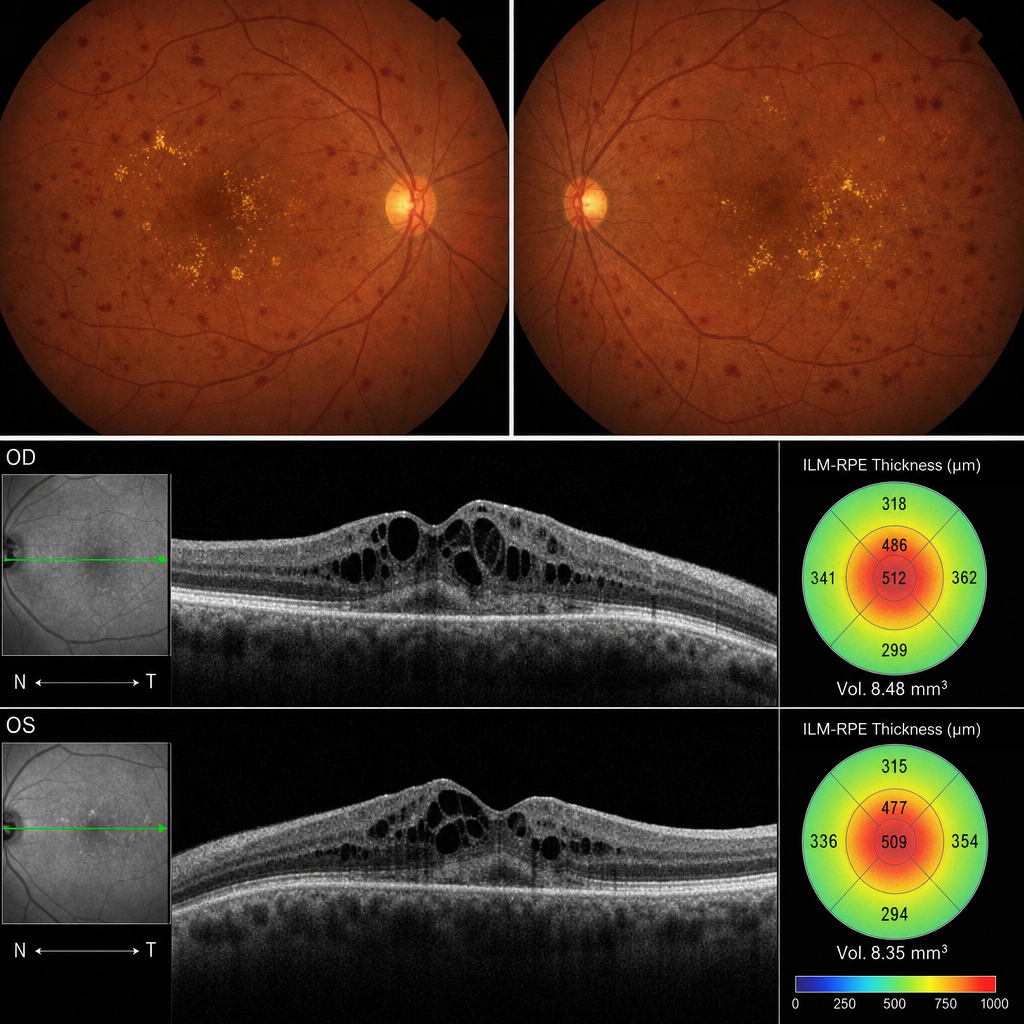
Explanation: ### Explanation **Cystoid Macular Edema (CME)** is characterized by the accumulation of fluid in the macula, leading to the formation of cyst-like spaces. **1. Why the Outer Plexiform Layer (OPL) is correct:** In the macular region, the fibers of the outer plexiform layer are oriented obliquely; these are known as **Henle’s layer**. Because of this loose, radial arrangement, the OPL has a high capacity to accumulate extracellular fluid. In CME, fluid primarily collects in these spaces, creating the characteristic **"petaloid" pattern** seen on Fluorescein Angiography (FA). **2. Analysis of Incorrect Options:** * **Outer Nuclear Layer (A):** While some fluid may involve the inner nuclear layer in chronic cases, the primary and initial site of collection is the plexiform layer. * **Inner Plexiform Layer (C):** This layer is more compact and is not the primary site for fluid accumulation in CME. * **Between RPE and Neurosensory Retina (D):** This describes a **Subretinal Detachment** (e.g., Central Serous Chorioretinopathy), not intraretinal edema. **3. High-Yield Clinical Pearls for NEET-PG:** * **Pathophysiology:** Breakdown of the blood-retinal barrier (usually the inner barrier/retinal capillaries). * **Gold Standard Diagnosis:** **Optical Coherence Tomography (OCT)**, which shows "honeycomb" cystic spaces. * **Fluorescein Angiography (FA):** Shows a classic **Flower-petal appearance** due to the radial arrangement of Henle’s layer. * **Irvine-Gass Syndrome:** CME occurring specifically after cataract surgery (typically 4–6 weeks post-op). * **Common Causes:** Diabetes (DME), Uveitis, Retinal Vein Occlusion (RVO), and Prostaglandin analogues (Latanoprost).
Explanation: The correct answer is **D. NVD + Clinically significant macular edema**. ### **Explanation** The concept of **High-Risk Characteristics (HRC)** was defined by the **Diabetic Retinal Study (DRS)** to identify patients at a high risk of severe visual loss who require urgent Pan-Retinal Photocoagulation (PRP). While Clinically Significant Macular Edema (CSME) is a major cause of vision loss in diabetic patients, it is **not** a criterion for "High-Risk Proliferative Diabetic Retinopathy (PDR)." CSME can occur at any stage of diabetic retinopathy (NPDR or PDR) and is treated with focal/grid lasers or anti-VEGF agents, whereas HRC-PDR specifically dictates the need for PRP. ### **Analysis of Options** According to the DRS, HRC is defined by the presence of **three or more** of the following four risk factors, or specifically the combinations listed below: * **Option A:** New vessels on the disc (NVD) $\geq$ 1/3 to 1/2 of the disc area (even without hemorrhage). * **Option B:** Any amount of NVD associated with vitreous or preretinal hemorrhage. * **Option C:** New vessels elsewhere (NVE) $\geq$ 1/2 disc area **AND** the presence of vitreous or preretinal hemorrhage. ### **Clinical Pearls for NEET-PG** * **Standard Treatment:** The presence of HRC is the absolute indication for **Pan-Retinal Photocoagulation (PRP)**. * **NVD vs. NVE:** NVD carries a much higher risk of vision loss than NVE; hence, smaller amounts of NVD qualify as high-risk compared to NVE. * **CSME Definition (ETDRS):** 1. Retinal thickening within 500 $\mu$m of the center of the macula. 2. Hard exudates within 500 $\mu$m of the center (with adjacent thickening). 3. Retinal thickening $\geq$ 1 disc area in size, any part of which is within 1 disc diameter of the center.
Explanation: **Explanation:** **Angioid streaks** are jagged, radiating, crack-like lines in the retina that represent dehiscence (breaks) in a thickened, calcified **Bruch’s membrane**. **1. Why Pseudoxanthoma Elasticum (PXE) is correct:** PXE (Grönblad-Strandberg syndrome) is the most common systemic association of angioid streaks. It is an autosomal recessive disorder characterized by progressive calcification of elastic fibers in the skin, eyes, and cardiovascular system. The calcification makes Bruch’s membrane brittle, leading to the characteristic linear ruptures. **2. Why the other options are incorrect:** * **Tuberous Sclerosis:** This phakomatosis is classically associated with **Astrocytic Hamartomas** (mulberry lesions) of the retina or optic nerve head, not angioid streaks. * **Sturge-Weber Syndrome:** This is associated with **diffuse choroidal hemangiomas** (tomato-catsup fundus) and ipsilateral glaucoma. * **Septo-optic Dysplasia (de Morsier Syndrome):** This involves optic nerve hypoplasia, midline brain defects (e.g., absent septum pellucidum), and pituitary deficiencies. **Clinical Pearls for NEET-PG:** * **Mnemonic for Angioid Streaks (PEPSI):** * **P** – **P**seudoxanthoma elasticum (Most common) * **E** – **E**hlers-Danlos syndrome * **P** – **P**aget’s disease of bone * **S** – **S**ickle cell anemia (and other hemoglobinopathies) * **I** – **I**diopathic * **Complication:** The most vision-threatening complication of angioid streaks is **Choroidal Neovascularization (CNV)**, which can lead to subretinal hemorrhage and scarring. * **Skin Finding in PXE:** Look for "plucked chicken skin" appearance (yellowish papules on the neck or axilla).
Explanation: **Explanation:** **Malignant Melanoma of the Choroid** is the most common primary intraocular malignancy in adults. Its primary mode of spread is **hematogenous**, and it specifically tends to invade the **Vortex Veins** (Vex Veins) to metastasize to distant organs, most commonly the liver. The tumor cells can also extend extraocularly through the scleral canals (emissaria) that house these veins. **Analysis of Options:** * **Retinoblastoma (Option A):** This is the most common intraocular tumor in children. Its primary mode of spread is via **direct extension** through the optic nerve into the subarachnoid space or via the lamina cribrosa. It does not typically prioritize vortex vein invasion. * **Optic Nerve Gliomas (Option C):** These are benign or low-grade malignant tumors of the optic nerve (often associated with Neurofibromatosis Type 1). They spread locally along the optic nerve sheath toward the chiasm, not through the venous system. * **Medulloepitheliomas (Option D):** These are rare tumors arising from the non-pigmented ciliary epithelium. They are usually locally invasive within the anterior segment and do not characteristically invade the vortex veins. **NEET-PG High-Yield Pearls:** * **Most common site of metastasis for Choroidal Melanoma:** Liver (90% of cases). * **Diagnostic Investigation of Choice:** B-Scan Ultrasonography (shows "Collar-stud" or mushroom-shaped appearance and acoustic shadowing). * **Fluorescein Angiography (FFA):** Shows a "Double Circulation" pattern (simultaneous visualization of retinal and intrinsic tumor vessels). * **Risk Factors for Metastasis:** Large tumor size, ciliary body involvement, and **monosomy 3** (the most important genetic prognostic factor).
Explanation: **Explanation:** **Pars planitis** is a specific subset of intermediate uveitis characterized by idiopathic inflammation of the *pars plana* (the posterior part of the ciliary body). The hallmark clinical sign of this condition is **"Snow banking,"** which refers to the accumulation of white, exudative inflammatory material (fibrovascular membranes) over the inferior pars plana and ora serrata. This is often accompanied by **"Snowballs,"** which are inflammatory cells clumped in the vitreous. **Analysis of Options:** * **Endophthalmitis:** This is a severe intraocular inflammation (usually bacterial or fungal) involving the vitreous and aqueous humors. It presents with a "hypopyon" (pus in the anterior chamber) and generalized vitreous haze, but not localized snow banking. * **Coat’s Disease:** An idiopathic condition characterized by telangiectatic retinal vessels and massive subretinal **hard exudates**. It is typically unilateral and seen in young males, but does not involve pars plana exudation. * **Eale’s Disease:** An idiopathic peripheral inflammatory venulitis (perivasculitis) that leads to peripheral non-perfusion, neovascularization, and recurrent **vitreous hemorrhage**. It does not present with snow banking. **High-Yield Clinical Pearls for NEET-PG:** * **Most common complication** of Pars planitis: Cystoid Macular Edema (CME), which is also the most common cause of vision loss in these patients. * **Demographics:** Typically affects children and young adults; often bilateral (80%). * **Management:** Steroids (Periocular/Systemic) are the first line; Cryotherapy or Laser photocoagulation is used for the snow bank area if complications like neovascularization occur.
Explanation: **Explanation:** **Traumatic Optic Neuropathy (TON)** refers to an acute injury to the optic nerve caused by direct or indirect trauma (e.g., blunt force to the brow). The core pathology involves damage to the **axons of the retinal ganglion cells** within the optic nerve, rather than the retina itself. **Why Macular Edema is the Correct Answer:** Macular edema is a retinal pathology involving fluid accumulation in the intraretinal layers. While trauma can cause both TON and retinal injuries (like Commotio Retinae) simultaneously, macular edema is **not a feature of the optic nerve injury itself**. TON is a clinical diagnosis based on evidence of optic nerve dysfunction with a relatively normal-appearing fundus in the acute stage. **Analysis of Incorrect Options:** * **Relative Afferent Pupillary Defect (RAPD):** This is the **most important clinical sign** of unilateral or asymmetric optic nerve damage. Even if the optic disc looks normal initially, a positive Marcus Gunn pupil confirms the conduction defect. * **Dilatation of the Pupil:** Due to the damage to the afferent limb of the light reflex, the affected pupil fails to constrict normally and appears relatively dilated when light is shone into it (as part of the RAPD phenomenon). * **Centrocecal Scotoma:** Optic nerve injuries typically manifest as central, centrocecal, or arcuate visual field defects due to the involvement of the papillomacular bundle. **High-Yield Clinical Pearls for NEET-PG:** * **Indirect TON:** The most common form; occurs due to shockwaves transmitted through the orbital bones to the optic canal. * **Fundus Appearance:** In the acute phase of TON, the optic disc usually appears **normal**. Optic atrophy (pallor) typically develops 4–6 weeks post-injury. * **Management:** Observation or high-dose intravenous corticosteroids (though the CRASH trial has made steroid use controversial). Surgical decompression is considered in specific cases of bony impingement.
Explanation: **Explanation:** Retinoblastoma is the most common primary intraocular malignancy of childhood. The correct answer is **Cataract**, as it is typically a "clear lens" malignancy. While advanced tumors can rarely cause secondary lens changes due to metabolic disturbances, cataract is not a recognized clinical presentation of the disease. **Why the other options are presentations:** * **Leucocoria (White Pupillary Reflex):** This is the **most common presentation (60%)**. The white reflex is caused by the light reflecting off the mass of the tumor behind the lens. * **Squint (Strabismus):** This is the **second most common presentation (20%)**. It occurs when the tumor involves the macula, leading to loss of central vision and subsequent sensory deviation of the eye. * **Glaucoma:** Secondary glaucoma is a common late-stage complication. It can occur via two mechanisms: **neovascular glaucoma** (due to VEGF production by the tumor) or **angle-closure glaucoma** (due to the tumor mass pushing the iris-lens diaphragm forward). **Clinical Pearls for NEET-PG:** 1. **Genetics:** Associated with the **RB1 gene** on chromosome **13q14**. It follows Knudson’s "two-hit" hypothesis. 2. **Calcification:** Pathognomonic feature seen on B-scan USG or CT scan (differentiates it from Coats' disease). 3. **Pathology:** Look for **Flexner-Wintersteiner rosettes** (highly specific) and Homer-Wright rosettes. 4. **Trilateral Retinoblastoma:** Bilateral retinoblastoma associated with a pineal gland tumor (Pineoblastoma). 5. **Most common site of metastasis:** Optic nerve invasion leading to CNS spread.
Explanation: **Explanation:** Retinitis Pigmentosa (RP) is a hereditary dystrophy primarily affecting the rod photoreceptors. The classic clinical presentation is characterized by a "triad" of signs, and understanding the pathophysiology of these signs is key to identifying the correct answer. **Why "Prominent retinal vessels" is the correct answer:** In RP, there is progressive atrophy of the retinal tissue and a decrease in metabolic demand. This leads to **marked attenuation (narrowing)** of the retinal arterioles, not prominence. The vessels often appear thread-like or "wiry" as the disease progresses. **Analysis of Incorrect Options:** * **Ring scotoma:** This is the characteristic visual field defect in RP. It begins as a series of isolated scotomas in the mid-periphery (corresponding to the maximum density of rods) which eventually coalesce to form a partial or complete ring. * **Pigmentation around the retinal veins:** As photoreceptors die, the Retinal Pigment Epithelium (RPE) migrates into the sensory retina. This pigment typically accumulates in the perivascular spaces (especially around the veins), forming the classic **"bone-spicule"** appearance. * **Pale disc:** Chronic retinal degeneration leads to consecutive optic atrophy. The disc takes on a characteristic **"waxy pallor"** appearance due to glial proliferation over the optic nerve head. **NEET-PG High-Yield Pearls:** * **Classic Triad:** 1. Bone-spicule pigmentation, 2. Attenuated retinal arterioles, 3. Waxy disc pallor. * **Earliest Symptom:** Nyctalopia (night blindness). * **ERG Findings:** The Electroretinogram (ERG) is the most sensitive test; it shows a reduced "a" and "b" wave amplitude even before fundus changes appear (eventually becoming "extinguished"). * **Inheritance:** Most common is Autosomal Recessive; most severe is X-linked Recessive.
Explanation: **Explanation:** **Retinitis Punctata Albescens (RPA)** is a rare, progressive form of hereditary retinal dystrophy that belongs to the **Retinitis Pigmentosa (RP) spectrum**. It is characterized by the presence of numerous small, white-to-yellowish dots scattered across the retina. 1. **Why Option C is the Correct Answer (The "Except"):** Unlike many other retinal conditions, the white dots in RPA typically **spare the macula (posterior pole)** in the early stages. The lesions are most prominent in the **mid-periphery** and extend toward the periphery. Therefore, the statement that it "particularly involves the posterior pole" is incorrect. 2. **Analysis of Other Options:** * **Option A (Autosomal Dominant):** While most cases of RPA are **Autosomal Recessive** (commonly associated with the *RLBP1* gene), rare **Autosomal Dominant** variants have been documented. In the context of NEET-PG, it is recognized as a hereditary condition with genetic heterogeneity. * **Option B (Retinal Pigment Epithelium):** The pathology primarily involves the **Retinal Pigment Epithelium (RPE)** and the photoreceptors. The white dots represent deposits/atrophy at the level of the RPE. * **Option D (White dots on fundus):** This is the hallmark clinical feature. These discrete, non-confluent white dots are seen on ophthalmoscopy, giving the condition its name. **Clinical Pearls for NEET-PG:** * **Symptom:** Patients typically present with **Nyctalopia** (night blindness) early in life. * **Differential Diagnosis:** Must be distinguished from **Fundus Albipunctatus**, which is *stationary* (non-progressive) and also shows white dots but has a normal or delayed dark adaptation curve. RPA is *progressive*. * **Electroretinogram (ERG):** Shows progressive diminution of both rod and cone responses (scotopic and photopic), eventually becoming extinguished. * **Key Gene:** *RLBP1* (encoding Cellular Retinaldehyde-Binding Protein) is the most high-yield association.
Explanation: **Explanation:** **Uveal Melanoma** is the most common primary intraocular malignancy in adults. The correct answer is **Option B** because approximately **80-90%** of uveal melanomas harbor mutually exclusive mutations in the **GNAQ** or **GNA11** genes. These genes encode alpha subunits of heterotrimeric G proteins. Mutations lead to the constitutive activation of the MAPK (mitogen-activated protein kinase) pathway, driving oncogenesis independently of UV radiation—a key distinction from cutaneous melanoma. **Analysis of Options:** * **Malignant Melanoma (Cutaneous):** While "malignant melanoma" often refers to the skin subtype, it is genetically distinct from uveal melanoma. Cutaneous melanomas typically involve **BRAF (V600E)**, NRAS, or KIT mutations and are strongly linked to UV exposure. GNAQ mutations are exceptionally rare here. * **Medulloepithelioma:** This is a rare intraocular tumor arising from the primitive medullary epithelium of the ciliary body (usually in children). It is associated with **DICER1** mutations, not GNAQ. * **All the above:** Incorrect, as the mutation is highly specific to the uveal subtype within this list. **High-Yield Clinical Pearls for NEET-PG:** * **Genetics:** GNAQ/GNA11 are early "driver" mutations. Late-stage progression and metastasis (especially to the **liver**) are associated with **BAP1** (BRCA1-associated protein 1) mutations on Chromosome 3 (Monosomy 3). * **Diagnosis:** Characterized by a "collar-stud" or **mushroom-shaped** appearance on B-scan ultrasonography. * **Associated Condition:** Patients with **Nevus of Ota** (Oculodermal Melanocytosis) have an increased risk of developing uveal melanoma and also frequently harbor GNAQ mutations.
Explanation: The **Electroretinogram (ERG)** is a clinical test that records the mass electrical response of the entire retina to a light stimulus. ### Why Option D is the Correct Answer (The "Except" Statement) **Flash ERG (Full-field ERG)** measures the summed electrical activity of the **entire retina**. Because the macula represents only a tiny fraction (approx. 2%) of the total retinal area, a localized macular lesion will not significantly alter the global response. Therefore, Flash ERG remains normal in early or localized macular diseases. To detect macular dysfunction, **Pattern ERG (pERG)** or **Multifocal ERG (mfERG)** must be used. ### Analysis of Other Options * **Option A:** ERG measures the action potential generated by the **neurosensory retina** in response to light, specifically the layers between the pigment epithelium and the ganglion cells. * **Option B:** The **a-wave** is the first negative deflection. It represents the hyperpolarization of the **photoreceptors** (rods and cones) in response to light. * **Option C:** The **b-wave** is the large positive deflection following the a-wave. It is generated by the **Muller cells and Bipolar cells**. It is the most clinically significant component of the ERG. ### High-Yield Clinical Pearls for NEET-PG * **c-wave:** Represents the Retinal Pigment Epithelium (RPE). * **Early Sign of Siderosis Bulbi:** An increase in the a-wave amplitude followed by a decrease in the b-wave. * **Negative ERG (Normal a-wave, absent/reduced b-wave):** Seen in Central Retinal Artery Occlusion (CRAO), Congenital Stationary Night Blindness, and Quinine toxicity. * **Extinguished ERG (Flat):** Seen in advanced Retinitis Pigmentosa, Total Retinal Detachment, and Pan-retinal Photocoagulation.
Explanation: **Explanation:** **Central Serous Retinal Detachment (CSR)** is the correct answer because it is a vascular/exudative condition characterized by a localized detachment of the neurosensory retina due to leakage from the Choriocapillaris through a defect in the Retinal Pigment Epithelium (RPE). **Fluorescein Angiography (FFA)** is the gold standard for diagnosing CSR, as it identifies the specific site of leakage. Classic patterns include the **"Smokestack appearance"** (due to convection currents) or the more common **"Ink-blot appearance."** **Why the other options are incorrect:** * **Posterior Vitreous Detachment (PVD):** This is a structural change where the vitreous gel separates from the retina. It is diagnosed clinically via slit-lamp biomicroscopy (looking for a **Weiss ring**) or B-scan ultrasonography. Angiography has no role as there is no vascular leakage. * **Rhegmatogenous Retinal Detachment (RRD):** This is caused by a physical break/hole in the retina. Diagnosis is made through indirect ophthalmoscopy and scleral depression to locate the break. Angiography is not indicated. * **Retinoschisis:** This involves a splitting of the retinal layers (usually at the outer plexiform layer). It is a structural anatomical defect best differentiated from retinal detachment using clinical examination or **Optical Coherence Tomography (OCT)**, not angiography. **NEET-PG High-Yield Pearls:** * **CSR Risk Factors:** Type A personality, steroid use, pregnancy, and stress. * **CSR Treatment:** Most cases are self-limiting (observe for 3–4 months). If persistent, consider laser photocoagulation or PDT. * **Investigation of Choice:** While FFA shows the leak, **OCT** is the best non-invasive tool to monitor subretinal fluid resolution.
Explanation: ### Explanation The visualization of the retinal periphery requires a wide field of view and the ability to bypass the optical limitations of the eye's extreme periphery. **1. Why Indirect Binocular Ophthalmoscopy (IDU) is Correct:** Indirect ophthalmoscopy is the gold standard for visualizing the peripheral retina up to the **ora serrata**. It provides a **wide field of view** (approx. 37°–60°) and excellent illumination. When combined with **scleral indentation**, it allows the examiner to bring the extreme periphery into view, making it indispensable for detecting peripheral retinal breaks or lattice degeneration. **2. Why the Other Options are Incorrect:** * **Direct Ophthalmoscopy:** This provides a high magnification (15x) but a very **narrow field of view** (about 10°). It can only visualize the posterior pole and cannot see beyond the mid-periphery. * **Anterior Segment Examination:** As the name suggests, this is used for structures anterior to the vitreous base (cornea, iris, lens) and cannot be used for retinal evaluation. * **Goldmann Three-Mirror Contact Lens:** While this *can* visualize the periphery, the question asks for the standard method. The three-mirror lens is a biomicroscopic technique used for a detailed, magnified view of specific peripheral lesions found during IDU. However, IDU remains the primary screening tool for the entire periphery. **Clinical Pearls for NEET-PG:** * **Image in IDU:** Real, inverted, and magnified (magnification depends on the lens power; a 20D lens provides ~3x magnification). * **Scleral Indentation:** This is the maneuver used during IDU to visualize the ora serrata and pars plana. * **Direct vs. Indirect:** Direct gives a virtual, erect image; Indirect gives a real, inverted image. * **Field of View:** IDU (8 disk diameters) > Direct Ophthalmoscopy (2 disk diameters).
Explanation: ### Explanation The question asks for the "Except" statement, implying that one of the options is technically incorrect or the others are more accurate descriptions of the disease. However, in the context of standard medical examinations, this question highlights a specific nuance regarding the **Rb1 gene**. **1. Why Option A is the "Correct" Answer (The Exception):** While the Rb1 gene is indeed located on **Chromosome 13q14**, in many competitive exams, this option is used as a distractor or is considered "true" but potentially mislabeled in the question key if the examiner is looking for a more specific clinical fact. However, looking at the options provided, all four statements are technically **factually correct**. * **Correction/Nuance:** In some contexts, if this is a "single best answer" and all are true, the question may be flawed. But strictly speaking, **Rb1 is on 13q14**, and it acts as a tumor suppressor gene. If this was the intended answer, it might be due to a typo in the chromosome number (e.g., 11 instead of 13) in the original source. **2. Analysis of Other Options:** * **Option B:** **True.** Retinoblastoma is the most common cause of intraocular calcification in children. On CT scan, this appears as "chalky white" deposits (pathognomonic). * **Option C:** **True.** Trilateral Retinoblastoma refers to bilateral RB associated with a midline intracranial tumor, most commonly a **Pinealoblastoma** (or parasellar tumor). * **Option D:** **True.** It is the most common primary intraocular malignancy in the pediatric age group. **3. High-Yield Clinical Pearls for NEET-PG:** * **Most common presentation:** Leukocoria (White pupillary reflex) > Strabismus. * **Knudson’s Two-Hit Hypothesis:** Explains the genetic basis (hereditary vs. sporadic). * **Pathology:** Look for **Flexner-Wintersteiner rosettes** (highly specific) and Homer-Wright rosettes. * **Classification:** The International Classification for Intraocular Retinoblastoma (ICIR) groups tumors from A to E based on size and seeding. * **Management:** Small tumors are treated with cryotherapy/laser; large tumors (Group E) usually require **enucleation**. Chemotherapy (Vincristine, Etoposide, Carboplatin) is used for chemoreduction.
Explanation: ### Explanation The correct answer is **D. Dilatation of the right pupil and dilatation of the left pupil.** #### 1. The Underlying Concept: Relative Afferent Pupillary Defect (RAPD) The patient has a large retinal detachment (RD), which significantly reduces the amount of light perceived by the retina. This creates a **Relative Afferent Pupillary Defect (RAPD)**, also known as a **Marcus Gunn Pupil**. In a normal eye, light triggers the afferent pathway (CN II), leading to bilateral pupillary constriction via the Edinger-Westphal nuclei (CN III). In an eye with a large RD, the afferent signal is severely weakened. When light is shone into the affected (right) eye, the brain perceives less light than expected. Consequently, the pupillary reflex is not triggered effectively, and both pupils fail to constrict. Instead, they appear to **dilate** (or remain dilated) relative to the state they were in when the light was shone in the healthy eye. #### 2. Why the Other Options are Incorrect * **Option A:** This describes a normal pupillary reflex. In a large RD, the damaged afferent pathway prevents this response. * **Option B & C:** These are physiologically impossible in a standard light reflex test because the pupillary response is always **consensual** (bilateral). Both pupils always constrict or dilate together because the pretectal nuclei project to both Edinger-Westphal nuclei. #### 3. Clinical Pearls for NEET-PG * **RAPD Causes:** Most commonly caused by **Optic Nerve lesions** (e.g., Optic Neuritis, Ischemic Optic Neuropathy) or **extensive retinal disease** (e.g., Large RD, Central Retinal Artery Occlusion). * **Note:** Dense cataracts or vitreous hemorrhage usually **do not** cause RAPD because light still reaches the retina diffusely. * **The "Swinging Flashlight Test":** This is the clinical gold standard to diagnose RAPD. The hallmark is the "paradoxical dilatation" of the pupil when the light is moved from the normal eye to the affected eye. * **High-Yield Association:** High myopia is a major risk factor for rhegmatogenous retinal detachment due to peripheral retinal thinning (Lattice degeneration).
Explanation: **Explanation:** **Coats' Disease** is an idiopathic condition characterized by telangiectatic and aneurysmal retinal vessels leading to massive subretinal exudation. When this exudation becomes extensive, it results in an exudative retinal detachment that presents clinically as **leukocoria** (white pupillary reflex). **Why Retinoblastoma is the correct answer:** Retinoblastoma is the most common primary intraocular malignancy of childhood and is the most critical "life-before-sight" differential diagnosis for any child presenting with leukocoria. Both Coats' disease and Retinoblastoma typically present in young children (though Coats' is usually unilateral and affects males more frequently). Differentiating them is vital: Retinoblastoma often shows **calcification** on imaging (USG/CT), whereas Coats' disease is characterized by **lipid exudation** and lacks a solid soft-tissue mass. **Analysis of Incorrect Options:** * **Retinitis Pigmentosa:** Presents with night blindness (nyctalopia) and peripheral vision loss. It is characterized by "bone-spicule" pigmentation, not leukocoria. * **Retinal Detachment:** While a total detachment can cause a pale reflex, in the pediatric context, the primary concern is identifying the *cause* (like Coats' or RB) rather than the detachment itself. * **Congenital Cataract:** This is a common cause of leukocoria, but it is an opacity of the lens, not a retinal pathology. It is easily distinguished from Coats' via a slit-lamp examination. **High-Yield Clinical Pearls for NEET-PG:** * **Coats' Disease Hallmark:** "Light bulb" telangiectasia and massive hard exudates. * **Gender/Laterality:** Predominantly affects young males (85%) and is almost always **unilateral**. * **Imaging:** Ultrasound (B-scan) in Retinoblastoma shows high-reflectivity spikes due to **calcification** (present in 90% of cases), which is absent in Coats'. * **Other Leukocoria Differentials:** PHPV (Persistent Hyperplastic Primary Vitreous), Retinopathy of Prematurity (ROP), and Toxocariasis.
Explanation: The clinical finding described is a **Roth spot**. A Roth spot is a retinal hemorrhage with a central white or pale spot. Historically, the white center was thought to be an abscess, but it is now understood to be a **fibrin-platelet thrombus** at the site of capillary rupture. ### **Explanation of Options** * **Subacute Bacterial Endocarditis (SBE):** Classically associated with Roth spots due to septic emboli causing capillary damage and subsequent hemorrhage. * **Leukaemia:** A very common cause where the white center often represents a cluster of malignant white blood cells or localized anemia/thrombocytopenia leading to fragile vessels. * **Diabetes Mellitus:** While less common than microaneurysms, Roth spots can occur in diabetic retinopathy due to capillary fragility and localized ischemia. Since all three conditions (along with others like severe anemia and hypertension) can manifest with these lesions, **Option D (All of the above)** is the correct answer. ### **High-Yield Clinical Pearls for NEET-PG** * **Pathophysiology:** The white center represents **fibrin-platelet plug** formation following a rupture of the retinal capillary wall. * **Differential Diagnosis (Mnemonic: "LASH"):** * **L**eukaemia * **A**nemia (Severe) * **S**BE (Subacute Bacterial Endocarditis) * **H**ypertension / **H**IV * **Other Causes:** Carbon monoxide poisoning, Preeclampsia, and Scurvy. * **Key Distinction:** Roth spots are **not pathognomonic** for SBE; they are a non-specific sign of blood dyscrasias or vascular injury.
Explanation: **Explanation:** **Indocyanine Green Angiography (ICGA)** is the gold standard for imaging the **choroidal circulation**. Unlike Fluorescein Angiography (FFA), which uses a water-soluble dye that leaks from choriocapillaris, ICG dye is 98% protein-bound. This prevents it from leaking through the fenestrations of the choriocapillaris, allowing for superior visualization of deeper choroidal vessels. Furthermore, ICG fluoresces in the **near-infrared spectrum**, which penetrates pigments like melanin, xanthophyll, and even thin layers of subretinal hemorrhage or exudates. * **Why Option A is correct:** In Age-Related Macular Degeneration (ARMD), **Occult Choroidal Neovascularization (CNV)** is often hidden on FFA by overlying blood or serous fluid. Because ICG dye stays within the vessels and its infrared light penetrates the RPE/hemorrhage, it can pinpoint the exact location and extent of the "hidden" (occult) neovascular membrane. * **Why Options B, C, and D are incorrect:** * **Conjunctivitis and Corneal Ulcers** are anterior segment pathologies diagnosed via slit-lamp examination and microbiology; angiography is not indicated. * **Vitreous Hemorrhage** obscures the view of the retina; while B-scan ultrasonography is used to check for retinal detachment behind the blood, ICGA cannot "see through" dense vitreous hemorrhage. **High-Yield Clinical Pearls for NEET-PG:** * **FFA vs. ICGA:** FFA is best for **Retinal** circulation; ICGA is best for **Choroidal** circulation. * **Specific Indications for ICGA:** Occult CNV, Polypoidal Choroidal Vasculopathy (PCV), and Central Serous Chorioretinopathy (CSCR). * **Contraindication:** ICG dye contains **iodine**; it is strictly contraindicated in patients with a **shellfish or iodine allergy**.
Explanation: The retina is a complex, ten-layered neurosensory structure. To answer this question, one must distinguish between the layers of the **cornea** and the layers of the **retina**. ### **Why Bowman’s Membrane is the Correct Answer** **Bowman’s membrane** is the second layer of the **cornea** (located between the epithelium and the stroma). It is an acellular, condensed layer of collagen fibers. It does not belong to the retina. A key clinical fact is that Bowman’s membrane does not regenerate; if damaged, it heals by scarring. ### **Analysis of Incorrect Options (Layers of the Retina)** The retina consists of 10 layers (from outside to inside): 1. **Retinal Pigment Epithelium (RPE):** The outermost layer (Option B). It supports photoreceptor health and absorbs stray light. 2. **Photoreceptor Layer:** Rods and cones. 3. **Outer Limiting Membrane (OLM):** A fenestrated membrane formed by the junctional complexes of Müller cells and photoreceptors (Option A). 4. **Outer Nuclear Layer:** Cell bodies of rods and cones. 5. **Outer Plexiform Layer:** Synapses between photoreceptors and bipolar/horizontal cells. 6. **Inner Nuclear Layer:** Cell bodies of bipolar, horizontal, and amacrine cells. 7. **Inner Plexiform Layer:** Synapses between bipolar and ganglion cells. 8. **Ganglion Cell Layer:** Contains the nuclei of ganglion cells (Option D). 9. **Nerve Fiber Layer:** Axons of ganglion cells that form the optic nerve. 10. **Inner Limiting Membrane:** The innermost boundary, formed by Müller cell basal laminae. ### **High-Yield Clinical Pearls for NEET-PG** * **Retinal Detachment:** Occurs at the potential space between the **RPE** (Layer 1) and the **Neurosensory retina** (Layers 2–10). * **Müller Cells:** These are the principal glial cells of the retina, extending from the OLM to the ILM. * **Macula:** At the foveola, the retina is thinnest because the inner layers are displaced peripherally to allow light to strike photoreceptors directly.
Explanation: **Explanation:** The clinical presentation of **floaters** ("spots"), **photopsia** (streaks of light), and a **peripheral "shadow"** or curtain-like defect is the classic triad of **Retinal Detachment (RD)**. 1. **Why Retinal Detachment is correct:** * **Floaters:** Caused by vitreous condensation or hemorrhage following a retinal tear. * **Photopsia:** Results from mechanical stimulation (traction) of the retina by the vitreous gel. * **Peripheral Shadow:** This represents the actual separation of the neurosensory retina from the retinal pigment epithelium (RPE). The fact that the shadow moves with eye movement suggests a fluid-filled space (subretinal fluid) shifting, which is characteristic of a rhegmatogenous RD. 2. **Why other options are incorrect:** * **Ophthalmic Migraine:** While the patient has a history of migraines, these typically present with transient, bilateral scintillating scotomas (zigzag lines) lasting 20–30 minutes, not persistent floaters or a moving shadow. * **Malingering:** The symptoms are highly specific and localized to one eye, pointing toward organic pathology rather than feigned illness. * **Amaurosis Fugax:** This is a "painless, transient monocular vision loss" (like a curtain coming down and then lifting) usually lasting seconds to minutes, caused by retinal emboli. It does not present with persistent floaters or photopsia. **Clinical Pearls for NEET-PG:** * **Shafer’s Sign:** The presence of "tobacco dust" (pigment cells) in the anterior vitreous on slit-lamp exam is pathognomonic for a retinal tear. * **Risk Factors:** High myopia, aphakia, and trauma are the most common predisposing factors for rhegmatogenous RD. * **Management:** RD is a surgical emergency. The goal is to seal the break (Cryotherapy/Laser) and appose the retina (Scleral buckling, Pneumatic retinopexy, or Vitrectomy).
Explanation: ### Explanation **Correct Answer: D. Retinitis Pigmentosa** **Why it is correct:** Retinitis Pigmentosa (RP) is a hereditary, progressive dystrophy primarily affecting the rod photoreceptors. The clinical presentation in this case is classic: 1. **Nyctalopia (Night Blindness):** This is the earliest symptom due to rod dysfunction. 2. **Bone-Spicule Formation:** This hallmark fundoscopic finding represents intraretinal pigment migration and accumulation around the retinal vessels. 3. **Inheritance Pattern:** The involvement of the mother and brothers suggests an **Autosomal Dominant** inheritance pattern (though RP can also be AR or X-linked). **Why the other options are incorrect:** * **A. Papilledema:** Presents with optic disc swelling due to increased intracranial pressure. It typically causes transient visual obscurations or headache, not night blindness or pigmentary changes. * **B. Macular Edema:** Causes central vision loss and metamorphopsia (distorted vision), not night blindness. Fundoscopy would show retinal thickening or cystoid spaces. * **C. Central Retinal Artery Occlusion (CRAO):** Presents as sudden, painless, profound loss of vision. Fundoscopy shows a "Cherry-red spot" and retinal whitening, not bone-spicules. **High-Yield Clinical Pearls for NEET-PG:** * **Classic Triad of RP:** 1. Bone-spicule pigmentation (mid-periphery), 2. Arteriolar attenuation (narrowing), 3. Waxy pallor of the optic disc. * **Visual Field:** Characteristically shows a **Ring Scotoma**. * **Electroretinogram (ERG):** The most sensitive test; it shows a **subnormal or extinguished** (flat) response even before fundus changes appear. * **Associated Conditions:** Usher syndrome (RP + Sensorineural hearing loss) and Laurence-Moon-Biedl syndrome (RP + Obesity + Polydactyly + Hypogonadism + Mental retardation).
Explanation: **Explanation:** In the context of Diabetes Mellitus, the development of floaters is most commonly associated with **Vitreous Hemorrhage**. This occurs during the stage of **Proliferative Diabetic Retinopathy (PDR)**. Hyperglycemia leads to retinal ischemia, which triggers the release of Vascular Endothelial Growth Factor (VEGF). This results in **neovascularization** (new, fragile blood vessels) at the disc (NVD) or elsewhere (NVE). These fragile vessels easily rupture into the vitreous cavity; small bleeds manifest as "floaters" or "cobwebs," while large bleeds cause sudden, painless loss of vision. **Analysis of Incorrect Options:** * **Vitreous Detachment:** While Posterior Vitreous Detachment (PVD) is a common cause of floaters in the general aging population or myopes, it is not the specific pathological hallmark of diabetic eye disease. * **Maculopathy:** Diabetic Macular Edema (DME) is the most common cause of vision loss in diabetics, but it typically presents with **metamorphopsia** (distorted vision) or central blurring, not floaters. * **Infarction:** Retinal infarctions (Cotton Wool Spots) occur due to microvascular occlusion in the nerve fiber layer. They are usually asymptomatic unless they involve the fovea and do not cause floaters. **NEET-PG High-Yield Pearls:** * **PDR Hallmark:** Presence of neovascularization (NVD/NVE). * **Management:** The gold standard for PDR with high-risk characteristics or vitreous hemorrhage is **Pan-Retinal Photocoagulation (PRP)**. * **Surgical Indication:** Non-clearing vitreous hemorrhage (usually >1–3 months) is an indication for **Pars Plana Vitrectomy (PPV)**. * **Fresh Bleed Advice:** Patients are advised to sleep with the head end elevated to allow the blood to settle inferiorly.
Explanation: **Explanation:** The pathogenesis of diabetic macular edema (DME) is primarily driven by the **breakdown of the blood-retinal barrier (BRB)**. In diabetic retinopathy, this breakdown occurs at the **Inner Blood-Retinal Barrier**, which consists of the tight junctions between retinal capillary endothelial cells. **1. Why RPE dysfunction is the correct answer:** The **Retinal Pigment Epithelium (RPE)** constitutes the *Outer Blood-Retinal Barrier*. While RPE dysfunction can lead to Cystoid Macular Edema (CME) in conditions like Retinitis Pigmentosa or Irvine-Gass Syndrome, it is **not** the primary driver in diabetic retinopathy. Diabetic macular edema is specifically a result of microvascular leakage from the retinal capillaries (Inner BRB). **2. Analysis of Incorrect Options:** * **VEGF (Vascular Endothelial Growth Factor):** This is the central mediator in DME. Hyperglycemia triggers VEGF production, which increases vascular permeability by phosphorylating tight junction proteins (like occludin). * **Oxidative Stress:** Chronic hyperglycemia leads to the formation of Advanced Glycation End-products (AGEs) and reactive oxygen species (ROS), which damage the capillary basement membrane and pericytes. * **Protein Kinase C (PKC):** Hyperglycemia activates the PKC pathway (specifically the PKC-β isoform), which contributes to basement membrane thickening, endothelial proliferation, and increased vascular permeability. **Clinical Pearls for NEET-PG:** * **Gold Standard Investigation for DME:** Optical Coherence Tomography (OCT) – shows "honeycomb" cystic spaces. * **Gold Standard for identifying leakage source:** Fundus Fluorescein Angiography (FFA) – shows a "Flower-petal" appearance in late phases. * **First-line Treatment:** Intravitreal Anti-VEGF agents (e.g., Ranibizumab, Aflibercept). * **Histopathology:** The fluid in CME accumulates primarily in the **Henle’s layer** (Outer Plexiform Layer) of the retina.
Explanation: **Explanation:** **PASCAL** stands for **PAttern SCAn Laser**. It is a semi-automated system used for **Laser Photocoagulation**, primarily in the treatment of retinal vascular diseases like Diabetic Retinopathy. **Why Option B is Correct:** Traditional laser systems deliver a single spot at a time, which is time-consuming and painful for the patient. PASCAL uses a high-speed scanner to deliver a **predetermined pattern of multiple laser spots** (up to 56 spots) in a single rapid burst (short pulse duration of 10–20 ms). This reduces the total treatment time, minimizes heat dissipation to surrounding tissues (reducing pain), and ensures more uniform spacing of laser burns. **Why Other Options are Incorrect:** * **Option A (Angiography):** Retinal angiography (FFA or ICG) uses cameras and dyes (Fluorescein or Indocyanine Green) to visualize blood flow, not therapeutic lasers. * **Option C & D (RNFL/Ganglion cell layer):** These are structural layers of the retina measured using **Optical Coherence Tomography (OCT)**. OCT is a diagnostic imaging modality, whereas PASCAL is a therapeutic modality. **High-Yield Clinical Pearls for NEET-PG:** * **Primary Indication:** Pan-Retinal Photocoagulation (PRP) for Proliferative Diabetic Retinopathy (PDR). * **Advantage:** The shorter pulse duration of PASCAL results in **less collateral damage** to the choroid and nerve fiber layer compared to conventional lasers. * **Laser Type:** It typically utilizes a frequency-doubled Nd:YAG laser (532 nm green laser). * **Other Retinal Lasers:** Remember **Transpupillary Thermotherapy (TTT)** for small choroidal melanomas and **Photodynamic Therapy (PDT)** using Verteporfin for CNVM.
Explanation: **Explanation:** **1. Why Congenital is the Correct Answer:** Ptosis (blepharoptosis) refers to the drooping of the upper eyelid. Statistically, **Congenital Ptosis** is the most common cause overall. It is primarily due to **levator palpebrae superioris (LPS) maldevelopment** (dysgenesis), where the muscle tissue is replaced by fibrous or fatty tissue. It is usually present at birth and is most often unilateral, though it can be bilateral. **2. Analysis of Incorrect Options:** * **Myasthenia Gravis:** This is a common cause of *acquired* myogenic ptosis characterized by fatiguability and variability, but it is less frequent than congenital cases in the general population. * **Paralysis of 3rd Nerve:** This causes neurogenic ptosis (often complete) along with "down and out" eye deviation and pupillary involvement. While clinically significant, it is a specific neurological deficit rather than the most common cause. * **Idiopathic:** While some cases of senile (aponeurotic) ptosis are age-related, "Congenital" remains the most frequently cited primary etiology in standard ophthalmic textbooks. **3. NEET-PG High-Yield Pearls:** * **Most common cause of Acquired Ptosis:** Aponeurotic (Senile) ptosis, caused by the involutional stretching or dehiscence of the LPS aponeurosis. * **Marcus Gunn Jaw-Winking Phenomenon:** The most common type of congenital synkinetic ptosis (CN V3 misdirected to CN III). * **Surgical Management:** * If LPS action is **good (>8mm):** Fasanella-Servat operation. * If LPS action is **fair (5-8mm):** Levator resection. * If LPS action is **poor (<4mm):** Frontalis Brow Suspension (Sling operation). * **Critical Complication:** Severe congenital ptosis can lead to **deprivational amblyopia**, making early surgical intervention necessary if the pupillary axis is covered.
Explanation: **Explanation:** Central Retinal Artery Occlusion (CRAO) is an ophthalmic emergency characterized by the sudden interruption of blood flow to the retina. **1. Why Option A is the correct answer (The "Not True" statement):** While embolism is the most common cause of CRAO (usually originating from carotid artery plaques or cardiac valves), **thrombosis** is less common. In medical exams, "thromboembolism" is often used loosely, but the primary mechanism is an **embolic plug** (Hollenhorst plaque). However, in the context of this specific question format, the most glaringly incorrect clinical feature is Option C, as CRAO is classically **painless**. *Note: If this question follows the standard clinical presentation pattern, Option C is the most "untrue" fact, as CRAO is a classic cause of sudden **painless** loss of vision.* **2. Analysis of other options:** * **Option B (True):** Anterior chamber paracentesis is a standard emergency treatment. It lowers intraocular pressure (IOP) rapidly, creating a pressure gradient that may dislodge the embolus to a more peripheral branch. * **Option C (False/The Key Feature):** CRAO presents as **sudden, profound, and painless** loss of vision. If pain is present, one must suspect conditions like Giant Cell Arteritis (GCA). * **Option D (True):** The anatomical site of obstruction is typically at the level of the **lamina cribrosa**, where the artery is narrowest as it enters the eye. **Clinical Pearls for NEET-PG:** * **Cherry Red Spot:** Seen at the fovea because the thin foveola allows the underlying vascular choroid to show through the edematous, opaque retina. * **Cattle-tracking:** Segmented blood flow in retinal veins (Box-carring). * **Cilioretinal Artery:** Present in ~20% of the population; if present, it may spare central vision. * **Golden Hour:** Treatment must be initiated within **90–120 minutes** to prevent permanent retinal damage.
Explanation: ### Explanation **Correct Option: C. Cytomegalovirus (CMV)** CMV retinitis is the most common opportunistic ocular infection in HIV/AIDS patients, typically occurring when the **CD4+ T-cell count falls below 50 cells/µL**. The classic funduscopic appearance described—perivascular hemorrhages and fluffy yellow-white retinal exudates—is known as the **"Pizza-pie"** or **"Cottage cheese and ketchup"** appearance. The virus causes a full-thickness necrotizing retinitis that spreads along the retinal vessels (perivascular distribution). **Analysis of Incorrect Options:** * **A & B (HSV and VZV):** These viruses cause **Acute Retinal Necrosis (ARN)** or **Progressive Outer Retinal Necrosis (PORN)**. Unlike CMV, these conditions are characterized by rapid progression, minimal inflammation (in PORN), and a "scalloped" edge of necrosis. They do not typically present with the heavy "pizza-pie" exudative/hemorrhagic pattern. * **D (Epstein-Barr Virus):** EBV is associated with Burkitt lymphoma and nasopharyngeal carcinoma but is not a recognized cause of primary necrotizing retinitis in HIV patients. **High-Yield Clinical Pearls for NEET-PG:** * **Most common site of CMV retinitis:** The retina (it is the leading cause of blindness in AIDS). * **Pathognomonic sign:** "Brushfire" border (active yellow-white edge with a granular appearance). * **Treatment of Choice:** **Valganciclovir** (oral) or **Ganciclovir** (IV/Intravitreal). Foscarnet and Cidofovir are second-line. * **Immune Recovery Uveitis (IRU):** An inflammatory reaction that occurs when a patient starts HAART and their CD4 count rises, causing inflammation against pre-existing CMV antigens.
Explanation: **Explanation:** **Understanding the Anatomy:** The retina consists of ten layers. Embryologically, the retina develops from the optic cup, where a potential space exists between the **neurosensory retina** (the inner nine layers) and the **retinal pigment epithelium (RPE)** (the outermost layer). **Why Option C is Correct:** Retinal detachment (RD) is defined as the separation of the neurosensory retina from the underlying RPE. When this occurs, fluid (subretinal fluid) accumulates in the potential space between these two layers. Because the neurosensory retina depends on the RPE for its metabolic support and vitamin A regeneration, this separation leads to ischemia and rapid degeneration of photoreceptors. **Why Other Options are Incorrect:** * **Option A:** Effusion into the suprachoroidal space refers to a **ciliochoroidal detachment**, where fluid accumulates between the choroid and the sclera, not within the retinal layers. * **Option B:** **Retinoschisis** is a condition where the neurosensory retina itself splits (usually at the outer plexiform layer). In RD, the entire neurosensory unit moves away from the RPE; in schisis, the retina is split internally. **NEET-PG High-Yield Pearls:** * **Most common type:** Rhegmatogenous RD (caused by a retinal break/hole). * **Most common site of a break:** Superotemporal quadrant. * **Classic Symptoms:** Photopsia (flashes), sudden onset of floaters, and a "curtain-like" visual field loss. * **Clinical Sign:** On ophthalmoscopy, the detached retina appears grey, opaque, and undulates with eye movements. * **Shafer’s Sign:** Presence of "tobacco dust" (pigment cells) in the anterior vitreous; highly suggestive of a retinal tear.
Explanation: **Central Serous Retinopathy (CSR)** is characterized by a localized serous detachment of the neurosensory retina at the macula, caused by leakage from the choriocapillaris through a defect in the Retinal Pigment Epithelium (RPE). ### **Explanation of Options** * **Option A (Correct):** Fluorescein Angiography (FFA) is diagnostic. It typically shows **focal "ink-blot" leakage** (most common) or a **"smoke-stack" appearance** (pathognomonic but less frequent) as dye enters the subretinal space through the RPE defect. * **Option B (Incorrect):** CSR is usually self-limiting with a good prognosis. A macular hole is not a complication; however, chronic CSR can lead to RPE atrophy or secondary choroidal neovascularization (CNV). * **Option C (Incorrect):** Patients experience **micropsia** (objects appearing smaller) and **metamorphopsia** (distorted vision). Micropsia occurs because the subretinal fluid increases the distance between photoreceptors; thus, an image covers fewer receptors than normal. * **Option D (Incorrect):** The most common presentation is a **relative central scotoma** (blurring or "gray spot"), not a dense (absolute) scotoma. ### **High-Yield Clinical Pearls for NEET-PG** * **Demographics:** Classically affects young to middle-aged males with **Type A personalities** or those on **steroid therapy** (the most important risk factor). * **Diagnosis:** **Optical Coherence Tomography (OCT)** is the gold standard for monitoring, showing a "dome-shaped" elevation of the neurosensory retina. * **Management:** Most cases resolve spontaneously within 3–4 months. If persistent, options include **Photodynamic Therapy (PDT)** or micropulse laser. * **Key Symptom:** Sudden onset of painless blurring of vision with a positive "Amsler Grid" test.
Explanation: **Explanation:** **Lattice Retinal Degeneration** is a peripheral vitreoretinal thinning characterized by localized areas of retinal thinning, overlying vitreous liquefaction, and exaggerated vitreoretinal adhesions at the margins. **Why Myopia is the Correct Answer:** Lattice degeneration is strongly associated with **Myopia (nearsightedness)**, particularly high myopia. In myopic eyes, the anteroposterior diameter of the globe is increased (axial myopia), leading to mechanical stretching and thinning of the peripheral retina. This thinning predisposes the eye to lattice formation. It is found in approximately 8–10% of the general population but has a significantly higher prevalence in myopic patients. **Analysis of Incorrect Options:** * **B. Hypermetropia:** In hypermetropia, the eyeball is shorter than normal. This does not cause the peripheral stretching or thinning associated with lattice degeneration. * **C. Presbyopia:** This is an age-related loss of lens accommodation (physiological change), not a structural retinal pathology. * **D. Anisocoria:** This refers to unequal pupil sizes, which is a neurological or pharmacological condition and has no direct correlation with retinal thinning or refractive errors. **High-Yield Clinical Pearls for NEET-PG:** * **Most Common Site:** Lattice degeneration is most frequently found in the **superior temporal quadrant**. * **Clinical Significance:** It is the most important peripheral retinal degeneration predisposing to **Rhegmatogenous Retinal Detachment (RRD)**. Approximately 30% of RRD cases are associated with lattice degeneration. * **Appearance:** Characterized by "criss-cross" white lines (sclerosed vessels), though these lines are absent in many cases. * **Management:** Asymptomatic lattice usually requires only periodic observation. Prophylactic laser photocoagulation is indicated if the patient has a history of RD in the fellow eye or is undergoing cataract surgery.
Explanation: **Explanation:** The pathogenesis of **Diabetic Macular Edema (DME)** is primarily driven by the breakdown of the **Blood-Retinal Barrier (BRB)**, specifically the **inner BRB** (tight junctions of retinal capillary endothelial cells). **Why Option A is the Correct Answer:** While the Retinal Pigment Epithelium (RPE) constitutes the *outer* blood-retinal barrier, its dysfunction is not the primary driver of macular edema in diabetes. In diabetic retinopathy, the pathology is essentially a **microangiopathy** affecting the retinal vasculature. The leakage occurs due to the loss of pericytes and breakdown of endothelial tight junctions, rather than a primary failure of the RPE pump or barrier. **Analysis of Incorrect Options:** * **B. Oxidative Stress:** Hyperglycemia leads to the accumulation of Reactive Oxygen Species (ROS) and Advanced Glycation End-products (AGEs). This oxidative stress damages the vascular endothelium, contributing to increased permeability. * **C. VEGF (Vascular Endothelial Growth Factor):** This is the most potent mediator in DME. Hyperglycemia-induced hypoxia triggers VEGF expression, which increases vascular permeability by phosphorylating tight junction proteins (like occludin and claudin). * **D. Increased Protein Kinase-C (PKC):** Hyperglycemia activates the PKC pathway (specifically the PKC-β isoform). This leads to basement membrane thickening, endothelial proliferation, and increased vascular permeability. **High-Yield Clinical Pearls for NEET-PG:** * **Primary site of leakage in DME:** Inner Blood-Retinal Barrier (Endothelial cells). * **Earliest clinical sign of Diabetic Retinopathy:** Microaneurysms (located in the inner nuclear layer). * **Earliest pathological sign:** Loss of pericytes (Pericyte:Endothelial cell ratio changes from 1:1 to 1:0). * **Gold Standard Investigation for DME:** Optical Coherence Tomography (OCT) to measure central macular thickness. * **First-line Treatment for DME:** Intravitreal Anti-VEGF agents (e.g., Ranibizumab, Aflibercept).
Explanation: ### Explanation **Central Retinal Artery Occlusion (CRAO)** is a true ophthalmic emergency characterized by sudden, painless, profound loss of vision. The underlying pathology is an obstruction of the central retinal artery, leading to ischemic death of the inner retinal layers. #### Why Option A is Correct: In CRAO, the retina suffers severe ischemia, resulting in a failure of the afferent visual pathway. 1. **Direct Pupillary Reflex Absent:** Since the retina cannot perceive light or transmit the signal through the optic nerve, the ipsilateral (direct) light reflex is lost in the affected eye. 2. **Relative Afferent Pupillary Defect (RAPD):** Also known as the **Marcus Gunn Pupil**, RAPD is a hallmark of significant unilateral retinal or optic nerve disease. When light is swung from the normal eye to the affected eye, the pupil appears to dilate because the brain perceives less light through the ischemic retina compared to the healthy one. #### Why Other Options are Incorrect: * **Option B:** The direct reflex cannot be present if there is a total afferent block (amaurotic pupil). * **Option C:** The indirect (consensual) reflex remains intact in the affected eye when light is shone into the healthy eye, so "both" are not absent. * **Option D:** **Scalloped pupils** are typically associated with traumatic iridodialysis or certain types of iris atrophy (e.g., in Fuch’s heterochromic iridocyclitis), not vascular occlusions. #### High-Yield Clinical Pearls for NEET-PG: * **Fundus Findings:** "Cherry-red spot" at the fovea (due to the thin foveola showing the underlying choroidal vasculature) and "cattle-trucking" (segmentation of blood columns). * **Ground Glass Appearance:** The surrounding retina appears milky white due to intracellular edema. * **Cilioretinal Artery:** In 15-20% of the population, this artery (derived from ciliary circulation) spares a small part of the macular vision. * **Management:** Immediate ocular massage, anterior chamber paracentesis, and inhalation of Carbogen (95% $O_2$, 5% $CO_2$) to induce vasodilation.
Explanation: **Explanation:** The correct answer is **C (Associated with vitreous hemorrhage)** because, while vitreous hemorrhage can occur alongside retinal detachment (especially in traumatic cases or proliferative diabetic retinopathy), it is **not a defining clinical feature** of the detachment itself. In fact, a dense vitreous hemorrhage often obscures the view, making it difficult to diagnose a retinal detachment via ophthalmoscopy. **Analysis of Options:** * **A. Field defect:** This is a classic symptom. Patients often describe a "curtain or veil" falling over their vision, corresponding to the area of detached retina. * **B. Retinal tears:** These are the primary cause of **Rhegmatogenous Retinal Detachment (RRD)**, the most common type. Liquefied vitreous passes through the tear into the subretinal space, separating the neurosensory retina from the RPE. * **D. Greyish-brown fundus:** On ophthalmoscopy, the detached retina loses its transparency and the underlying vascularity of the choroid is hidden. It appears as a **greyish-white or pearly-grey** undulating membrane with loss of the normal red reflex. **High-Yield Clinical Pearls for NEET-PG:** * **Shafer’s Sign:** The presence of "tobacco dust" (pigment cells) in the anterior vitreous is pathognomonic for a retinal tear. * **Types of RD:** 1. **Rhegmatogenous:** Most common; associated with myopia and lattice degeneration. 2. **Tractional:** Seen in Proliferative Diabetic Retinopathy (PDR). 3. **Exudative:** Seen in tumors (Choroidal melanoma) or inflammatory conditions (VKH syndrome). * **Management:** RRD is a surgical emergency. Procedures include Scleral buckling, Pneumatic retinopexy, or Pars Plana Vitrectomy (PPV).
Explanation: ### Explanation **Malignant Melanoma of the Choroid** is the most common primary intraocular malignancy in adults. The correct answer is **Exudative Retinal Detachment (ERD)**. #### Why Exudative Retinal Detachment is Correct: Choroidal melanoma is a solid subretinal tumor. As the tumor grows, it disrupts the overlying Retinal Pigment Epithelium (RPE) and the blood-retinal barrier. This leads to the leakage of fluid (exudate) from the tumor vessels and the damaged choriocapillaris into the subretinal space. Because this fluid accumulation occurs without a retinal break or mechanical pulling, it is classified as an **exudative (secondary) retinal detachment**. A classic clinical sign is "shifting fluid," where the detachment moves based on the patient's head position. #### Why Other Options are Incorrect: * **Retinal Dialysis:** This is a linear tear at the ora serrata, usually caused by blunt ocular trauma. It leads to rhegmatogenous detachment, not solid tumors. * **Traction Retinal Detachment (TRD):** This occurs when fibrovascular membranes in the vitreous pull the retina away (e.g., Proliferative Diabetic Retinopathy). Melanomas do not typically create these contractile forces. * **Rhegmatogenous Retinal Detachment (RRD):** This requires a full-thickness retinal break (hole or tear) allowing liquefied vitreous to enter the subretinal space. While a tumor can occasionally cause a secondary tear, the primary mechanism is always exudative. #### High-Yield Clinical Pearls for NEET-PG: * **Most common site:** Posterior pole (Choroid). * **Diagnosis:** **B-Scan Ultrasonography** is the gold standard, showing a "collar-stud" or **mushroom-shaped** appearance and **acoustic shadowing** (excavation of the choroid). * **Fluorescein Angiography (FFA):** Shows a "double circulation" pattern (simultaneous staining of retinal and tumor vessels). * **Treatment:** Small tumors are managed with plaque brachytherapy; large or painful tumors require enucleation. * **Metastasis:** Most commonly spreads to the **Liver** (hematogenous spread).
Explanation: **Explanation:** **Central Serous Retinopathy (CSR)** is characterized by the accumulation of transparent fluid in the subretinal space, leading to a **spontaneous, circumscribed detachment of the neurosensory retina** at the macula. 1. **Why Option A is Correct:** The primary pathology in CSR involves a defect in the pumping function of the Retinal Pigment Epithelium (RPE) or choroidal hyperpermeability. This leads to fluid leakage from the choriocapillaris through the RPE, pooling under the neurosensory retina and lifting it up. 2. **Why Options B, C, and D are Incorrect:** * **Macular Oedema (B):** This refers to intraretinal fluid (within the retinal layers), whereas CSR involves subretinal fluid (between the RPE and neurosensory retina). * **Detachment of Pigment Epithelium (C):** While a small Pigment Epithelial Detachment (PED) often co-exists and may be the "source" of the leak, the hallmark clinical feature and the cause of visual symptoms in CSR is the overlying neurosensory detachment. * **Detachment of Choroid (D):** CSR is a disease of the outer retina and RPE; the choroid remains attached to the sclera. **High-Yield Clinical Pearls for NEET-PG:** * **Demographics:** Typically affects young to middle-aged males with **"Type A" personalities** or those on **steroid therapy**. * **Clinical Features:** Sudden onset of painless blurred vision, **metamorphopsia** (distorted vision), and **micropsia** (objects appearing smaller). * **Diagnosis:** * **FFA (Fundus Fluorescein Angiography):** Shows characteristic **"Ink-blot"** or **"Smokestack"** appearance. * **OCT:** Gold standard for confirming subretinal fluid and monitoring resolution. * **Management:** Most cases are self-limiting and resolve spontaneously within 3–4 months. Conservative management is preferred initially.
Explanation: ### Explanation The clinical presentation described is the classic **triad of Retinitis Pigmentosa (RP)**, a hereditary dystrophy primarily affecting the rod photoreceptors. **1. Why Retinitis Pigmentosa is correct:** The diagnosis is based on three hallmark fundus findings: * **Bone-spicule pigmentation:** Melanin pigment migrates from the RPE into the retina, typically clustering around the retinal vessels in the mid-periphery. * **Arteriolar attenuation:** Narrowing of retinal vessels (often appearing thread-like). * **Waxy pallor of the optic disc:** Caused by consecutive optic atrophy. The "peripheral field loss" corresponds to the early involvement of rods, leading to **ring scotoma** and night blindness (nyctalopia). **2. Why the other options are incorrect:** * **Behcet’s Syndrome:** This is a multisystem inflammatory disorder. Ocular involvement typically presents as recurrent bilateral uveitis with **hypopyon** and retinal vasculitis, not bone-spicule pigmentation. * **Chorioretinitis:** While it can cause pigmentation, it usually presents as focal, irregular scars with white/yellow active lesions. It does not follow a symmetrical, peripheral distribution or cause waxy disc pallor. * **Open Angle Glaucoma:** While it causes peripheral field loss (arcuate/paracentral scotomas), the fundus shows **pathological cupping** of the disc, not waxy pallor or bone-spicule pigmentation. **High-Yield Clinical Pearls for NEET-PG:** * **Earliest Symptom:** Nyctalopia (Night blindness). * **Earliest Sign:** Minimal narrowing of retinal arterioles and fine dust-like pigmentation. * **ERG Findings:** The Electroretinogram (ERG) is **subnormal or extinguished** even in early stages (most sensitive test). * **Inheritance:** Most common is Autosomal Recessive; most severe is X-linked. * **Associated Syndromes:** Usher’s (deafness), Laurence-Moon-Biedl (polydactyly, obesity, hypogonadism).
Explanation: ### Explanation **Choroidal Neovascularization (CNV)** occurs when new, fragile blood vessels grow from the choroid through defects in **Bruch’s membrane** into the sub-retinal space. The key pathophysiological requirement for CNV is a mechanical or degenerative break in Bruch’s membrane. **Why Hypermetropia is the Correct Answer:** Hypermetropia (farsightedness) is characterized by a shorter axial length of the eyeball. Unlike high myopia, it does not involve stretching or thinning of the retinal layers or Bruch’s membrane. Therefore, it is **not** associated with the development of CNV. **Analysis of Incorrect Options:** * **Trauma:** Blunt trauma can cause **Choroidal Rupture** (typically concentric to the optic disc). These mechanical tears in Bruch’s membrane are a classic precursor to late-onset CNV. * **Angioid Streaks:** These are crack-like dehiscences in a calcified, brittle Bruch’s membrane. They are associated with the mnemonic **PEPSI** (Pseudoxanthoma elasticum, Ehlers-Danlos, Paget’s disease, Sickle cell anemia, Idiopathic). CNV is a frequent and vision-threatening complication. * **Myopia:** Pathological myopia (high myopia) leads to axial elongation, causing "lacquer cracks" (linear breaks in Bruch’s membrane). This is a leading cause of CNV in young adults (Myopic CNV). **High-Yield Clinical Pearls for NEET-PG:** * **Most common cause of CNV:** Age-related Macular Degeneration (Wet/Exudative AMD). * **Investigation of Choice:** **Optical Coherence Tomography (OCT)** is used for screening/monitoring, but **Fluorescein Angiography (FFA)** is the gold standard to confirm the type of CNV (Classic vs. Occult). * **Treatment:** Intravitreal **Anti-VEGF** agents (e.g., Ranibizumab, Bevacizumab, Aflibercept) are the first-line management. * **Metamorphopsia:** The earliest symptom of CNV, best monitored using an **Amsler Grid**.
Explanation: To approach this question, one must distinguish between **sudden** (seconds to days) and **gradual** (months to years) vision loss. ### Why Optic Atrophy is the Correct Answer **Optic Atrophy** is the end-stage result of various optic nerve pathologies. It represents the degeneration of retinal ganglion cell axons. This process is inherently **chronic and progressive**, leading to a **gradual, painless** loss of vision. It does not occur overnight; therefore, it does not fit the "sudden" criteria. ### Analysis of Incorrect Options (Causes of Sudden Painless Loss) * **Central Retinal Artery Occlusion (CRAO):** Characterized by "amaurosis fugax" or sudden, profound, painless loss of vision (seconds to minutes). Clinical hallmark: **Cherry-red spot** at the macula. * **Optic Neuritis:** Typically presents as sudden/subacute vision loss. While often associated with pain on ocular movement (90% of cases), it can occasionally be painless. However, compared to the chronic nature of optic atrophy, it is classified as a sudden cause. * **Retinal Detachment (RD):** Rhegmatogenous RD causes sudden, painless vision loss, often preceded by "flashes and floaters" (photopsia) and a "curtain-falling" sensation in the visual field. ### NEET-PG Clinical Pearls * **Sudden Painless Loss of Vision (Mnemonic: "CRV"):** **C**RAO, **R**etinal Detachment, **V**itreous Hemorrhage, and Central Retinal **V**ein Occlusion (CRVO). * **Sudden Painful Loss of Vision:** Acute Congestive Glaucoma, Endophthalmitis, and Uveitis. * **Gradual Painless Loss of Vision:** Cataract, Refractive errors, Glaucoma (POAG), and **Optic Atrophy**. * **High-Yield Fact:** The most common cause of a "Cherry-red spot" is CRAO, but in children, consider metabolic storage diseases like Tay-Sachs.
Explanation: **Explanation:** **Malignant Melanoma** of the choroid is the most common primary intraocular malignancy in adults. One of its hallmark pathological features is its mode of extraocular extension. The tumor cells frequently invade the **vortex veins** (often referred to as "vexin veins" in some older texts or exam transcripts) as they exit the sclera. This venous invasion is a critical prognostic factor, as it facilitates hematogenous spread, most commonly to the liver. **Why other options are incorrect:** * **Retinoblastoma:** This is the most common intraocular tumor in children. Its primary mode of spread is via direct extension through the **optic nerve** to the subarachnoid space or via the sclera into the orbit, rather than specific vortex vein invasion. * **Medulloepithelioma:** A rare tumor arising from the non-pigmented ciliary epithelium. It is typically locally invasive within the anterior segment and does not characteristically involve the vortex veins. * **Optic Nerve Glioma:** This is a benign (pilocytic astrocytoma) or low-grade tumor of the optic nerve associated with Neurofibromatosis Type 1. It spreads along the optic nerve sheath toward the chiasm, not through the uveal venous system. **High-Yield Clinical Pearls for NEET-PG:** * **Most common site of metastasis for Choroidal Melanoma:** Liver (95% of cases). * **Pathological Classification:** Callender’s classification (Spindle A, Spindle B, and Epithelioid cells). **Epithelioid cells** have the worst prognosis. * **Collar-stud (Mushroom) appearance:** A classic sign on B-scan USG when the tumor breaks through Bruch’s membrane. * **Investigation of choice:** Standardized A-scan (shows low internal reflectivity) and B-scan USG.
Explanation: **Explanation:** **Microaneurysms** are the **earliest clinically detectable sign** and the hallmark feature of Diabetic Retinopathy (DR). Pathologically, they occur due to the loss of intramural pericytes, leading to focal outpouchings of the retinal capillary walls. On fundoscopy, they appear as tiny, round, red dots, typically located in the inner nuclear layer. On Fluorescein Angiography (FFA), they appear as "pinpoint leaks" (hyperfluorescence). **Analysis of Incorrect Options:** * **A. Hard Exudates:** These are yellowish-waxy deposits of lipids and proteins in the outer plexiform layer. While common in Non-Proliferative Diabetic Retinopathy (NPDR), they are a result of chronic vascular leakage rather than the primary diagnostic hallmark. * **B. Soft Exudates (Cotton Wool Spots):** These represent focal areas of retinal ischemia (infarction of the nerve fiber layer). They are seen in pre-proliferative DR and other conditions like hypertensive retinopathy, but are not the pathognomonic feature. * **C. Amblyopia:** This is a functional reduction in vision due to abnormal visual development (e.g., strabismus or refractive errors), usually in childhood. It is not a feature of diabetic retinopathy, which causes vision loss through macular edema or vitreous hemorrhage. **High-Yield Clinical Pearls for NEET-PG:** * **Earliest Pathological Change:** Basement membrane thickening and pericyte loss (Pericyte:Endothelial cell ratio changes from 1:1 to 1:0). * **First Clinical Sign:** Microaneurysms. * **IRMA (Intraretinal Microvascular Abnormalities):** A hallmark of "Severe NPDR." * **Neovascularization (NVD/NVE):** The defining feature that differentiates Proliferative (PDR) from Non-Proliferative (NPDR) retinopathy. * **Most Common Cause of Vision Loss in DR:** Diabetic Macular Edema (DME).
Explanation: **Explanation:** **Primary Retinal Detachment**, also known as **Rhegmatogenous Retinal Detachment (RRD)**, is characterized by the presence of a break (tear or hole) in the neurosensory retina. The term "Rhegmatogenous" is derived from the Greek word *rhegma*, meaning a break. In this condition, liquefied vitreous passes through the retinal tear into the subretinal space, separating the neurosensory retina from the underlying retinal pigment epithelium (RPE). This is the most common type of clinical retinal detachment. **Why other options are incorrect:** * **Tractional Retinal Detachment:** Caused by the pulling of the retina by fibrovascular membranes (common in Proliferative Diabetic Retinopathy). While tears *can* occur secondary to traction, the primary mechanism is the physical pulling, not a pre-existing tear. * **Exudative (Serous) Retinal Detachment:** Occurs due to the accumulation of fluid under the retina without any retinal break. It is usually caused by inflammation (e.g., VKH syndrome) or tumors (e.g., Choroidal melanoma). * **Secondary Retinal Detachment:** This is a broad category referring to detachments caused by underlying pathologies like tumors or systemic diseases, rather than a primary retinal break. **High-Yield Clinical Pearls for NEET-PG:** * **Most common site for retinal tears:** Superotemporal quadrant. * **Most common precursor lesion:** Lattice degeneration (seen in ~8% of the general population). * **Classic Symptoms:** Photopsia (flashing lights), sudden onset of floaters (Muscae volitantes), and a "curtain-like" loss of vision. * **Shafer’s Sign:** Presence of "tobacco dust" (pigment cells) in the anterior vitreous is pathognomonic for a retinal tear.
Explanation: ### Explanation **Correct Answer: D. Any nucleated retinal layer** **Underlying Medical Concept:** Retinoblastoma is a primary intraocular malignancy of childhood that originates from **multipotent neuroepithelial cells** (primitive retinal cells). These precursor cells are found in all **nucleated layers** of the sensory retina. While historically there was debate regarding its exact cell of origin, it is now established that the tumor can arise from any layer containing nuclei, specifically the **Inner Nuclear Layer (INL)**, the **Outer Nuclear Layer (ONL)**, and the **Ganglion Cell Layer (GCL)**. The tumor is characterized by the proliferation of undifferentiated cells that may show differentiation toward photoreceptor elements (forming Flexner-Wintersteiner rosettes). **Why Incorrect Options are Wrong:** * **A, B, and C:** These options (Rods/Cones, Bipolar cells, and Ganglion cells) are specific components of the retinal layers. While retinoblastoma *can* arise from these layers, selecting any one of them is too restrictive. Since the primitive neuroectodermal cells are distributed across all cellular (nucleated) strata of the retina, "Any nucleated retinal layer" is the most accurate and comprehensive description. **High-Yield Clinical Pearls for NEET-PG:** * **Genetics:** Mutation in the **RB1 gene** on chromosome **13q14**. It follows Knudson’s "Two-hit hypothesis." * **Most Common Sign:** **Leukocoria** (White pupillary reflex), followed by strabismus. * **Pathognomonic Histology:** **Flexner-Wintersteiner rosettes** (highly specific); Homer-Wright rosettes (less specific, also seen in neuroblastoma). * **Calcification:** Intraocular calcification in a child under 3 years is retinoblastoma until proven otherwise (visible on CT/Ultrasound). * **Classification:** The **International Classification of Retinoblastoma (ICRB)** is currently used for grouping (Groups A-E) to predict the likelihood of eye salvage.
Explanation: ### Explanation **Correct Option: B. Neovascularization at disc** In a diabetic patient, the primary mechanism for vitreous hemorrhage is **Proliferative Diabetic Retinopathy (PDR)**. Chronic hyperglycemia leads to retinal ischemia, which triggers the release of **Vascular Endothelial Growth Factor (VEGF)**. This results in the formation of fragile, new blood vessels (neovascularization) at the optic disc (NVD) or elsewhere (NVE). These vessels lack a proper basement membrane and easily rupture due to vitreous traction, leading to a vitreous hemorrhage. **Analysis of Incorrect Options:** * **A. Posterior retinal detachment:** While PDR can lead to *tractional* retinal detachment, the detachment itself is usually a consequence of fibrovascular proliferation rather than the primary cause of the hemorrhage. * **C. Central retinal vein occlusion (CRVO):** While CRVO can cause vitreous hemorrhage (via neovascular glaucoma or NVD in ischemic types), the question specifies a diabetic patient, making PDR the most statistically likely and direct cause. * **D. Trauma to central retinal artery:** The central retinal artery is a high-pressure system; trauma usually leads to occlusion (cherry-red spot) rather than vitreous hemorrhage. Vitreous hemorrhage is typically venous or capillary in origin. **Clinical Pearls for NEET-PG:** * **Most common cause of Vitreous Hemorrhage:** Trauma (overall); Diabetic Retinopathy (spontaneous). * **Terson Syndrome:** Vitreous hemorrhage associated with subarachnoid hemorrhage. * **Management:** Bed rest with head elevation. If it doesn't resolve or if the retina cannot be visualized, **B-Scan Ultrasonography** is the investigation of choice to rule out retinal detachment. * **Treatment:** Pars Plana Vitrectomy (PPV) is indicated if the hemorrhage fails to clear or if tractional detachment occurs.
Explanation: **Explanation:** **Lacquer cracks** are a hallmark clinical feature of **pathological myopia** (high myopia). They represent spontaneous, linear, or stellate breaks in **Bruch’s membrane**. 1. **Why Bruch’s membrane is correct:** In pathological myopia, the progressive elongation of the globe (increased axial length) leads to mechanical stretching of the posterior pole. Bruch’s membrane is a relatively inelastic structure; when the stretching exceeds its tensile strength, it develops linear dehiscences or "cracks." These appear clinically as fine, irregular, yellowish-white horizontal lines deep to the retina. 2. **Why the other options are wrong:** * **Retinal Pigment Epithelium (RPE):** While the RPE may undergo secondary atrophy or thinning over a lacquer crack, the primary anatomical break occurs in Bruch's membrane. * **Outer and Inner Plexiform Layers:** These are neural layers of the retina. Breaks here would represent retinoschisis or retinal holes, not the characteristic linear lesions seen in lacquer cracks. **Clinical Pearls for NEET-PG:** * **Significance:** Lacquer cracks are a major risk factor for the development of **Myopic Choroidal Neovascularization (CNV)**, as they provide a pathway for vessels to grow from the choroid into the sub-retinal space. * **Forster-Fuchs Spot:** A pigmented, circular lesion at the macula caused by a healed CNV or subretinal hemorrhage associated with lacquer cracks. * **Other Pathological Myopia findings:** Posterior staphyloma (pathognomonic), tilted disc, and peripheral lattice degeneration.
Explanation: ### Explanation **Correct Answer: A. Eale’s disease** **Why it is correct:** Eale’s disease is an idiopathic inflammatory peripheral perivasculitis (primarily affecting the venules) that typically presents in **young adult males** (20–30 years). The disease progression follows a classic triad: **Perivasculitis (sheathing) → Peripheral non-perfusion → Neovascularization**. These new vessels are fragile and prone to bleeding, leading to **recurrent vitreous hemorrhage**, which is the hallmark clinical presentation. In India and Southeast Asia, it is frequently associated with hypersensitivity to *Mycobacterium tuberculosis* proteins. **Why the other options are incorrect:** * **B. Central Retinal Vein Occlusion (CRVO):** Typically occurs in older patients with systemic risk factors like hypertension or glaucoma. While it can cause vitreous hemorrhage via neovascularization, it presents with a "blood and thunder" fundus and sudden painless vision loss, not recurrent episodes in the young. * **C. Proliferative Retinopathy:** This is a broad category. While Diabetic Retinopathy is the most common cause of proliferative changes, it usually occurs in older patients or those with a long-standing history of diabetes, rather than as an idiopathic primary presentation in a healthy young patient. * **D. Coat’s Disease:** This is a non-inflammatory idiopathic condition characterized by **telangiectatic vessels and massive subretinal exudation** ("light bulb" appearance). It typically presents in young boys as leucocoria or strabismus, not recurrent vitreous hemorrhage. **NEET-PG High-Yield Pearls:** * **Demographics:** Young males (20-40 years) are the classic demographic. * **Staging:** It starts as peripheral periphlebitis (venous sheathing) and progresses to "sea-fan" neovascularization. * **Association:** Strongly linked to a positive Mantoux test (Tuberculoprotein hypersensitivity). * **Treatment:** Photocoagulation (LASER) for neovascularization and Vitrectomy for non-clearing vitreous hemorrhage.
Explanation: **Explanation:** The retina contains two primary types of photoreceptor cells: **Rods** and **Cones**. The appreciation of color is exclusively a function of the **Cones**. **1. Why Cones are correct:** Cones are concentrated in the fovea centralis and are responsible for **photopic vision** (vision in bright light), high visual acuity, and **color perception**. There are three types of cones, each containing a different photopigment (iodopsin) sensitive to specific wavelengths: * **L-cones:** Red (Long wavelength) * **M-cones:** Green (Medium wavelength) * **S-cones:** Blue (Short wavelength) The brain integrates signals from these three types to perceive the full visible spectrum (Trichromatic theory). **2. Why other options are incorrect:** * **Rods:** These are responsible for **scotopic vision** (vision in dim light) and peripheral vision. They contain a single pigment, **rhodopsin**, which cannot differentiate between wavelengths. Therefore, rods provide achromatic (black and white) vision. * **Both rods and cones:** While both are photoreceptors, their functions are distinct. Rods do not contribute to color discrimination. * **Neither:** Photoreceptors are the only cells in the retina capable of converting light into electrical signals for color processing. **Clinical Pearls for NEET-PG:** * **Nyctalopia (Night blindness):** Result of rod dysfunction (e.g., Vitamin A deficiency or Retinitis Pigmentosa). * **Color Blindness:** Most commonly an X-linked recessive disorder due to the absence of one or more cone pigments (Protanopia = Red, Deuteranopia = Green, Tritanopia = Blue). * **Ishihara Charts:** The most common screening tool for red-green color blindness. * **Purkinje Shift:** The shift in peak sensitivity from the yellow-red spectrum (cones) to the blue-green spectrum (rods) as light levels drop.
Explanation: **Explanation:** **Macular Edema** occurs due to the breakdown of the blood-retinal barrier, leading to the accumulation of fluid in the intraretinal layers of the macula. **Why Diabetes Mellitus is Correct:** Diabetic Macular Edema (DME) is the most common cause of vision loss in patients with Diabetic Retinopathy. Chronic hyperglycemia leads to pericyte loss and endothelial damage, causing capillary leakage. This results in fluid accumulation within the Henle’s layer (outer plexiform layer), often presenting as **Cystoid Macular Edema (CME)**. **Analysis of Incorrect Options:** * **A. Central Retinal Artery Occlusion (CRAO):** This presents with **cloudy swelling** (intracellular edema) of the entire retina due to ischemia, not localized macular edema. The classic finding is a "Cherry Red Spot" because the fovea is thin and reflects the underlying vascular choroid. * **B. Papilledema:** This refers specifically to bilateral swelling of the **optic disc** due to increased intracranial pressure. While severe cases (Grade IV/V) may show macular fan/star formation (exudates), the primary pathology is disc edema, not macular edema. * **D. Age-related Macular Degeneration (ARMD):** Dry ARMD is characterized by **Drusen** and geographic atrophy. While Wet (Neovascular) ARMD involves subretinal fluid/hemorrhage due to CNVM, "Macular Edema" as a standalone clinical entity is most classically associated with systemic vascular diseases like Diabetes. **High-Yield Clinical Pearls for NEET-PG:** * **Gold Standard Investigation:** Optical Coherence Tomography (OCT) is used to quantify macular thickness. * **First-line Treatment for DME:** Intravitreal Anti-VEGF injections (e.g., Ranibizumab, Aflibercept). * **Irvine-Gass Syndrome:** A specific type of CME occurring after cataract surgery. * **Histological Site:** Fluid in CME typically accumulates in the **Outer Plexiform Layer (Henle’s layer)**.
Explanation: **Explanation:** Retinitis Pigmentosa (RP) is a hereditary, progressive dystrophy primarily affecting the **rod photoreceptors** first, followed by the cones. **Why Option C is the correct (False) statement:** In RP, the degeneration starts in the mid-peripheral retina where rod density is highest. Consequently, the initial symptoms are **nyctalopia (night blindness)** and **peripheral field loss** (ring scotoma). Central vision is typically **preserved** until the late stages of the disease when cone involvement becomes significant or complications like Cystoid Macular Edema (CME) occur. Therefore, early loss of central vision is not a common initial symptom. **Analysis of other options:** * **Option A:** Night blindness is the hallmark initial symptom due to early rod dysfunction. * **Option B & D:** These describe the classic **"Diagnostic Triad"** of RP fundus findings: 1. **Bony spicule pigmentation** (perivascular pigment clumps in the mid-periphery). 2. **Arteriolar attenuation** (narrowing of retinal vessels). 3. **Waxy pallor of the optic disc** (due to consecutive optic atrophy). **NEET-PG High-Yield Pearls:** * **Inheritance:** Most common is Autosomal Recessive; most severe is X-linked. * **Visual Field:** Characteristically shows a **Ring Scotoma**. * **ERG Findings:** The Electroretinogram (ERG) is **subnormal or extinguished** even before fundus changes appear (earliest diagnostic tool). * **Associated Syndromes:** **Usher Syndrome** (RP + Sensorineural hearing loss) and **Laurence-Moon-Biedl Syndrome** (RP + Obesity + Polydactyly + Hypogonadism + Mental retardation). * **Ocular Associations:** Posterior subcapsular cataract, Myopia, and Open-angle glaucoma.
Explanation: ### Explanation **Correct Answer: D. Leber’s Hereditary Optic Neuropathy (LHON)** **Why it is correct:** Leber’s Hereditary Optic Neuropathy (LHON) is the most common cause of inherited blindness resulting from a **mitochondrial DNA (mtDNA) mutation**. It typically involves point mutations at positions 11778, 3460, or 14484. Because mitochondria are inherited exclusively from the oocyte, LHON follows a **maternal inheritance pattern** (all children of an affected mother are at risk, but affected fathers do not pass it on). It clinically presents as painless, subacute, bilateral central vision loss, primarily affecting young males. **Why the other options are incorrect:** * **A. Retinopathy of Prematurity (ROP):** This is an acquired proliferative retinopathy caused by oxygen toxicity and prematurity; it is not a genetic or mitochondrial disorder. * **B. Retinitis Pigmentosa (RP):** While RP is a common cause of inherited blindness, it is primarily caused by mutations in **nuclear DNA** (Autosomal Dominant, Recessive, or X-linked), not mitochondrial DNA. * **C. Retinal Detachment:** This is a structural/mechanical emergency often related to trauma, high myopia, or vitreous changes, rather than a chromosomal anomaly. **High-Yield Clinical Pearls for NEET-PG:** * **Inheritance:** Maternal inheritance (Mitochondrial). * **Demographics:** Strong male predilection (approx. 80-90%), though the mutation is carried by females. * **Fundus Findings:** Circumpapillary telangiectatic microangiopathy and swelling of the nerve fiber layer (pseudo-edema), which does not leak on Fluorescein Angiography (FFA). * **Key Association:** Often associated with "Leber’s plus" syndromes, which may include cardiac conduction defects (arrhythmias) and neurological abnormalities.
Explanation: **Explanation:** Central Retinal Vein Occlusion (CRVO) is a common retinal vascular disorder characterized by the "blood and thunder" fundus appearance. Blindness or severe visual loss in CRVO is multifactorial, resulting from both acute changes and long-term complications. **Why "All of the above" is correct:** 1. **Cystoid Macular Edema (CME):** This is the **most common cause** of decreased vision in both ischemic and non-ischemic CRVO. Increased intraluminal pressure leads to the leakage of fluid into the Henle’s layer of the macula, causing structural damage and loss of central acuity. 2. **Macular Hemorrhage:** In the acute phase, extensive deep and superficial (flame-shaped) hemorrhages can involve the fovea, directly blocking photoreceptors and leading to a sudden drop in vision. 3. **Vitreous Hemorrhage:** This is a late-stage complication primarily seen in **Ischemic CRVO**. Retinal ischemia triggers the release of Vascular Endothelial Growth Factor (VEGF), leading to Neovascularization of the Disc (NVD) or elsewhere (NVE). These fragile new vessels can rupture, causing vitreous hemorrhage and sudden vision loss. **Clinical Pearls for NEET-PG:** * **The "90-Day Glaucoma":** Ischemic CRVO is highly associated with Neovascular Glaucoma (NVG), which typically develops around 3 months after the occlusion. * **Investigation of Choice:** **Optical Coherence Tomography (OCT)** is used to monitor Macular Edema, while **Fundus Fluorescein Angiography (FFA)** is the gold standard to differentiate between Ischemic and Non-ischemic types (based on areas of capillary non-perfusion). * **Management:** Intravitreal Anti-VEGF injections (e.g., Ranibizumab, Aflibercept) are the mainstay of treatment for macular edema. Pan-retinal photocoagulation (PRP) is indicated if neovascularization develops.
Explanation: **Explanation:** **Retinitis Pigmentosa (RP)** is the correct answer because it is a progressive hereditary dystrophy primarily affecting the rod photoreceptors. The degeneration typically starts in the **mid-periphery** of the retina. As these mid-peripheral rods are lost, a circular area of visual field loss develops, known as a **Ring Scotoma**. As the disease progresses, this scotoma expands both inward and outward, eventually leaving only a small central area of vision (Tunnel Vision). **Analysis of Incorrect Options:** * **Glaucoma:** While glaucoma causes various field defects (like Arcuate or Bjerrum scotomas), it typically presents with a **Double Arcuate Scotoma** (forming a ring-like shape) only in advanced stages. However, the classic, textbook association for a "Ring Scotoma" is RP. * **Sympathetic Ophthalmia:** This is a bilateral granulomatous panuveitis following trauma. It typically presents with generalized field constriction or multiple small scotomas, but not a classic ring scotoma. * **Vitreous Hemorrhage:** This causes a generalized "floaters" sensation or a sudden, diffuse loss of vision depending on the severity, rather than a specific patterned field defect like a ring scotoma. **High-Yield Clinical Pearls for NEET-PG:** * **Classic Triad of RP:** 1. Bony spicule pigmentation (perivascular), 2. Arteriolar attenuation (narrowing), 3. Waxy pallor of the optic disc. * **Early Symptom:** Nyctalopia (Night blindness) is the earliest clinical feature. * **ERG Findings:** The Electroretinogram (ERG) is **subnormal or extinguished** even before fundus changes appear. * **Other causes of Ring Scotoma:** Vitamin A deficiency, Chloroquine toxicity (Bull’s eye maculopathy can present similarly), and Glaucoma (Double Arcuate).
Explanation: **Explanation:** The transformation of a benign choroidal nevus into a **malignant melanoma** is a critical clinical progression. To differentiate between a stable nevus and an early melanoma, clinicians use the **"TFSOM" mnemonic** (To Find Small Ocular Melanoma). * **Increased height and pigmentation (Option A):** A thickness of >2 mm is a major risk factor. Rapid growth or an increase in the density of pigmentation suggests active cellular proliferation characteristic of malignancy. * **Orange pigment (Option B):** This represents the accumulation of **lipofuscin** at the level of the Retinal Pigment Epithelium (RPE). It indicates metabolic distress and chronic RPE damage caused by an underlying growing tumor. This is one of the most predictive signs of malignancy. * **Serous detachment (Option C):** Malignant cells disrupt the overlying RPE and the blood-retinal barrier, leading to the leakage of subretinal fluid. The presence of subretinal fluid (serous detachment) is a hallmark of activity and transformation. Since all three features are established clinical indicators of malignant transformation, **Option D** is the correct answer. **High-Yield Clinical Pearls (TFSOM Mnemonic):** To remember the risk factors for malignant change, use: **"To Find Small Ocular Melanoma Using Helpful Hints Daily"** * **T** – **T**hickness >2 mm * **F** – Subretinal **F**luid * **S** – **S**ymptoms (flashes/floaters/blurred vision) * **O** – **O**range pigment (Lipofuscin) * **M** – **M**argin within 3 mm of the optic disc * **UH** – **U**ltrasonographic **H**ollow (low internal reflectivity) * **D** – Absence of **D**rusen (Drusen usually indicate a long-standing, stable, benign nevus).
Explanation: ### Explanation In Indirect Ophthalmoscopy, a strong light source and a convex condensing lens (usually +20D) are used to create a **real, inverted, and magnified image** of the fundus between the lens and the examiner. **Why Option C is the "Except" (Correct Answer):** The question contains a technical error in its framing or the provided key. In clinical practice, indirect ophthalmoscopy is **superior** to direct ophthalmoscopy for hazy media because of its high-intensity illumination. However, if we analyze the options based on standard textbook definitions: * **Option B (There is no stereopsis)** is actually a **False** statement. Indirect ophthalmoscopy provides excellent **stereopsis** (3D visualization) because it is a binocular procedure. * **Option D (The retinal periphery cannot be examined)** is also a **False** statement. Indirect ophthalmoscopy is the gold standard for examining the retinal periphery up to the **ora serrata** (especially with scleral indentation). *Note: In many competitive exams, if the question asks for the "False" statement and lists "No stereopsis" or "Periphery cannot be examined," those are the intended answers. If Option C is marked correct in your key, it implies a pedagogical error, as indirect ophthalmoscopy is specifically indicated for hazy media.* **Analysis of Other Options:** * **Option A:** True. It can be performed while the patient is sitting, reclining, or supine. * **Option B:** False. It provides a binocular view, hence **stereopsis is present**. * **Option D:** False. It is the preferred method for **peripheral retinal examination**. **NEET-PG High-Yield Pearls:** 1. **Image Characteristics:** Real, Inverted (both vertically and laterally), and formed between the lens and the examiner. 2. **Magnification:** Approximately 3x with a +20D lens (Magnification = 60 / Power of lens). 3. **Field of View:** Large (approx. 8 disc diameters), making it ideal for a general overview. 4. **Condensing Lenses:** +20D is standard; +13D gives more magnification; +28D/30D gives a wider field of view.
Explanation: **Explanation:** **Eales’ Disease** is an idiopathic, inflammatory peripheral perivasculitis (primarily affecting the venules) that typically affects young healthy males. The pathophysiology involves peripheral retinal ischemia, which leads to the release of Vasoproliferative factors (VEGF). **Why Optic Neuritis is the correct answer:** Optic neuritis is an inflammatory condition of the optic nerve, often associated with multiple sclerosis or infections. It is **not** a feature of Eales’ disease. While Eales’ disease involves inflammation, it is localized to the retinal vasculature (periphlebitis) and does not primarily involve the optic nerve fibers. **Why the other options are incorrect:** The complications of Eales’ disease follow a sequence driven by **retinal ischemia**: * **Retinal Detachment (B):** Recurrent vitreous hemorrhages lead to the formation of fibrovascular tractional bands. These bands can cause **Tractional Retinal Detachment**, a common late-stage complication. * **Rubeosis Iridis (A) & Neovascular Glaucoma (C):** Severe, chronic peripheral ischemia triggers neovascularization not just in the retina, but also on the iris (Rubeosis iridis). These vessels can block the aqueous outflow in the anterior chamber angle, resulting in **Neovascular Glaucoma (NVG)**. **Clinical Pearls for NEET-PG:** * **Demographics:** Most common in males aged 20–40 years. * **Stages:** Perivasculitis (sheathing) → Non-perfusion → Neovascularization → Complications (Vitreous hemorrhage/RD). * **Classic Sign:** "Sea-fan" neovascularization (similar to Sickle Cell Retinopathy). * **Association:** Historically linked to **Tuberculosis** sensitivity (positive Mantoux test), though the exact etiology remains idiopathic. * **Management:** Photocoagulation (LASER) for ischemia and Anti-VEGF for neovascularization.
Explanation: **Explanation:** **Ocriplasmin** is a recombinant truncated form of human **plasmin**. It is the first pharmacological agent approved for the treatment of symptomatic **Vitreomacular Traction (VMT)** and small macular holes. **Why Option B is Correct:** The underlying mechanism of VMT involves an incomplete posterior vitreous detachment (PVD) where the vitreous remains abnormally adherent to the macula, causing mechanical distortion. Ocriplasmin works through **enzymatic vitreolysis**. It targets and breaks down protein components (laminin, fibronectin, and collagen) at the vitreoretinal interface. By dissolving these "glue-like" proteins, it facilitates the release of traction and promotes a complete PVD without the need for surgical vitrectomy. **Why Other Options are Incorrect:** * **A. Retinal break:** These are treated with laser photocoagulation or cryopexy to create a chorioretinal scar. Ocriplasmin could theoretically worsen a break by inducing vitreous movement. * **C & D. Submacular/Diabetic macular bleed:** These conditions involve vascular pathology or neovascularization. Management typically involves Anti-VEGF agents (like Ranibizumab or Aflibercept) or surgical evacuation (for submacular hemorrhage), not enzymatic vitreolysis. **High-Yield Clinical Pearls for NEET-PG:** * **Route of Administration:** Intravitreal injection (0.125 mg). * **Indications:** Best results are seen in patients with focal VMT (adhesion ≤1500 µm) and those without an epiretinal membrane (ERM). * **Side Effects:** Patients may report "chromatopsia" (yellowish vision) or transient electroretinogram (ERG) changes post-injection. * **Alternative Treatment:** Pars Plana Vitrectomy (PPV) remains the gold standard for severe or non-responsive VMT.
Explanation: ### Explanation **Correct Answer: C. Retinoblastoma** **Why it is correct:** Retinoblastoma (RB) is the most common primary intraocular malignancy of childhood. **Calcification** is considered a pathognomonic hallmark of this tumor, occurring in approximately **90-95%** of cases. It results from DNA-calcium binding within areas of tumor necrosis (dystrophic calcification). On clinical examination, these appear as "chalky white" deposits. In NEET-PG, the presence of intraocular calcification in a child under 3 years old on a CT scan or B-scan ultrasound is virtually diagnostic of Retinoblastoma. **Why the other options are incorrect:** * **A. Malignant Melanoma of the Choroid:** This is the most common primary intraocular tumor in adults. Unlike RB, it rarely shows calcification. On imaging, it typically presents as a mushroom or collar-stud shaped mass with low internal reflectivity on USG. * **B. Retinocytoma:** This is a benign version (retinoma) of the same genetic mutation (RB1 gene). While it can show some calcification and "fish-flesh" appearance, it is a rare, non-progressive lesion and is not the classic answer for pathognomonic calcification in a malignant context. * **D. Angiomatosis Retinae (von Hippel-Lindau disease):** This is characterized by retinal hemangioblastomas (vascular tumors) with feeder vessels and exudation, but calcification is not a primary feature. **High-Yield Clinical Pearls for NEET-PG:** * **Most common sign:** Leukocoria (White pupillary reflex). * **Second most common sign:** Strabismus. * **Histology:** Look for **Flexner-Wintersteiner rosettes** (highly specific) and Homer-Wright rosettes. * **Imaging Choice:** **B-scan Ultrasonography** is the initial screening tool; **CT scan** is excellent for detecting calcification; **MRI** is preferred to evaluate optic nerve involvement and pinealoblastoma (Trilateral Retinoblastoma). * **Inheritance:** 40% are germline (bilateral/multifocal), 60% are somatic (unilateral).
Explanation: **Explanation:** Cystoid Macular Edema (CME) is characterized by the accumulation of fluid in the outer plexiform (Henle’s) and inner nuclear layers of the retina, leading to a "petaloid" appearance on fluorescein angiography. **1. Why Prostaglandin E2 (PGE2) analogues are correct:** Prostaglandins are potent inflammatory mediators. PGE2 analogues (and certain PGF2α analogues like Latanoprost) are known to increase vascular permeability and breakdown the blood-retinal barrier. This allows fluid leakage into the macula, particularly in aphakic or pseudophakic patients where the posterior capsule is not intact. **2. Analysis of Incorrect Options:** * **Prostaglandin F2α analogues:** While specific drugs in this class (e.g., Latanoprost) are notorious for causing CME, the question specifically highlights **PGE2** as the primary mediator of inflammation-induced edema in this context. In many standardized exams, PGE2 is considered the more potent inflammatory trigger for CME. * **Oral Corticosteroids:** These are actually used to **treat** CME by stabilizing the blood-retinal barrier and reducing inflammation. However, note that corticosteroids can cause other ocular side effects like cataracts and secondary glaucoma. * **Alpha Blockers:** Systemic alpha-blockers (e.g., Tamsulosin) are associated with **Intraoperative Floppy Iris Syndrome (IFIS)** during cataract surgery, not CME. **High-Yield Clinical Pearls for NEET-PG:** * **Drug-Induced CME Mnemonic (D-E-P-O-T):** **D**ipivefrin, **E**pinephrine, **P**rostaglandins (Latanoprost), **O**cular Nicotinic acid/Niacin, **T**axanes (Paclitaxel). * **Irvine-Gass Syndrome:** CME occurring specifically after cataract surgery (peaks at 6–10 weeks). * **Gold Standard Investigation:** Optical Coherence Tomography (OCT) shows cystic spaces; Fluorescein Angiography (FFA) shows a classic **"Flower-petal appearance."** * **Topical Carbonic Anhydrase Inhibitors (Dorzolamide):** Often used to treat CME by pumping fluid out of the subretinal space.
Explanation: ### Explanation **Core Concept:** Vitreous hemorrhage (VH) typically occurs due to the rupture of **newly formed fragile vessels (neovascularization)** or the mechanical tearing of normal retinal vessels. Neovascularization is a response to chronic retinal ischemia mediated by Vascular Endothelial Growth Factor (VEGF). **Why CRAO is the correct answer:** **Central Retinal Artery Occlusion (CRAO)** is an acute embolic or thrombotic event that leads to total infarction of the inner retinal layers. Because the blood supply is completely cut off, the retina becomes necrotic rapidly. Unlike chronic ischemic conditions, CRAO does not typically lead to neovascularization of the retina or disc; therefore, vitreous hemorrhage is **not** a feature of CRAO. (Note: Neovascularization of the iris/glaucoma can rarely occur, but VH is not characteristic). **Analysis of Incorrect Options:** * **Eales’ Disease:** An idiopathic peripheral perivasculitis (common in young males) that causes profound peripheral ischemia, leading to neovascularization and **recurrent vitreous hemorrhage** (the hallmark of the disease). * **CRVO:** Ischemic CRVO leads to widespread retinal hypoxia and high VEGF levels, resulting in neovascularization of the disc (NVD) or elsewhere (NVE), which frequently causes VH. * **Coat’s Disease:** Characterized by abnormal telangiectatic retinal vessels and massive exudation. In advanced stages, these abnormal vessels can bleed into the vitreous. **High-Yield Clinical Pearls for NEET-PG:** * **Most common cause of VH overall:** Diabetic Retinopathy. * **Most common cause of VH in young adults:** Eales’ disease or Trauma. * **Terson Syndrome:** Vitreous hemorrhage associated with Subarachnoid Hemorrhage (SAH). * **CRAO Classic Sign:** "Cherry Red Spot" at the fovea due to the visible choroid through the edematous macula.
Explanation: ### Explanation The correct answer is **Eale’s disease**. **1. Why Eale’s Disease is Correct:** Eale’s disease is an idiopathic peripheral perivasculitis (primarily affecting venules) that typically affects **young adult males** (20–30 years). It is characterized by three stages: perivasculitis, peripheral capillary non-perfusion, and neovascularization. The "painless sudden loss of vision" in these patients is most commonly due to a **vitreous hemorrhage** resulting from the rupture of fragile new vessels (neovascularization). Since the initial systemic and ocular examinations (excluding the fundus) are often non-contributory, this clinical profile is a classic presentation for Eale’s disease in the Indian subcontinent. **2. Why Other Options are Incorrect:** * **Retinal Detachment:** While it causes painless vision loss, it is often preceded by "flashes and floaters" (photopsia) and a field defect ("curtain falling"). It is less likely to have a completely "non-contributory" examination as signs like Shafer’s sign or tobacco dusting may be present. * **Glaucoma:** Chronic glaucoma causes gradual, progressive peripheral vision loss. Acute Angle Closure Glaucoma causes sudden loss of vision but is **extremely painful** and associated with a red eye and nausea. * **Cataract:** This causes a **gradual**, progressive, painless blurring of vision, not a sudden loss. **3. Clinical Pearls for NEET-PG:** * **Demographics:** Most common in healthy young males in South East Asia. * **Association:** Historically linked to **Tuberculosis** hypersensitivity (positive Mantoux test is common). * **Fundus Findings:** "Sea-fan" neovascularization and peripheral vascular sheathing (frosting). * **Management:** Laser photocoagulation for ischemia; Vitrectomy for non-resolving vitreous hemorrhage. * **Differential:** Always rule out Sickle Cell Retinopathy in cases of peripheral neovascularization.
Explanation: **Explanation:** The development and progression of Diabetic Retinopathy (DR) are multifactorial, influenced by the metabolic control, chronicity, and timing of the disease. 1. **Duration of the disease (Most Important Factor):** This is the single most significant predictor of DR. For Type 1 Diabetics, DR is rarely present at diagnosis but affects nearly 95% of patients after 20 years. In Type 2 Diabetics, about 60% show signs of DR after 20 years. 2. **Intensity of the disease (Metabolic Control):** Poor glycemic control (reflected by high HbA1c levels) accelerates microvascular damage. Chronic hyperglycemia leads to basement membrane thickening, pericyte loss, and microaneurysm formation. 3. **Age of onset:** While DR is rare before puberty, the age at which diabetes is diagnosed influences the cumulative lifetime risk. Patients diagnosed at a younger age have a longer duration of exposure to hyperglycemia, increasing the likelihood of developing proliferative changes. **Why "Any of the above" is correct:** All three factors—how long the patient has had the disease, how well it is controlled, and when it started—interact to determine the risk and severity of retinal damage. **High-Yield Clinical Pearls for NEET-PG:** * **First clinical sign:** Microaneurysms (located in the inner nuclear layer). * **First pathological sign:** Loss of pericytes and basement membrane thickening. * **Pregnancy:** Can lead to rapid progression of pre-existing DR (requires close monitoring). * **Hypertension & Nephropathy:** These are strong systemic co-factors that worsen the prognosis of DR. * **Classification:** Remember the ETDRS classification (NPDR vs. PDR) for management questions.
Explanation: **Explanation:** **Indocyanine Green Angiography (ICGA)** is a diagnostic imaging technique used to visualize the **choroidal circulation**. Unlike Fluorescein Angiography (FFA), which uses a water-soluble dye that leaks from choriocapillaris, ICG dye is 98% protein-bound. This property prevents it from leaking through the fenestrations of the choriocapillaris, allowing for superior visualization of deeper choroidal vessels. **Why Option A is correct:** In Age-Related Macular Degeneration (ARMD), **Occult Choroidal Neovascularization (CNV)** is often hidden by subretinal blood, exudates, or pigment epithelial detachments on a standard FFA. Because ICG dye emits fluorescence in the **near-infrared spectrum**, it can penetrate the retinal pigment epithelium (RPE), xanthophyll pigments, and thin layers of blood. This makes ICGA the gold standard for identifying occult CNV, Polypoidal Choroidal Vasculopathy (PCV), and retinal angiomatous proliferation (RAP). **Why other options are incorrect:** * **B & D (Conjunctivitis/Corneal Ulcer):** These are anterior segment pathologies diagnosed via slit-lamp examination and microbiological cultures. Angiography has no role here. * **C (Vitreous Hemorrhage):** Dense hemorrhage obscures the view of the fundus. The investigation of choice to rule out retinal detachment in such cases is **B-Scan Ultrasonography**. **High-Yield Clinical Pearls for NEET-PG:** * **Dye Properties:** ICG is iodine-based; it is **contraindicated** in patients with **shellfish or iodine allergy**. * **Excretion:** Unlike Fluorescein (renal excretion), ICG is taken up by the liver and excreted in **bile**. * **Wavelength:** ICG uses a longer wavelength (~800-840 nm) compared to FFA (~490-530 nm), allowing deeper tissue penetration.
Explanation: **Explanation:** **1. Why Central Serous Retinopathy (CSR) is correct:** CSR is characterized by a localized serous detachment of the neurosensory retina at the macula due to leakage from the choriocapillaris through a defect in the Retinal Pigment Epithelium (RPE). It typically affects **young to middle-aged males** (Type A personalities) and presents as **sudden, painless blurring of vision**, micropsia, or metamorphopsia. The hallmark of CSR is its **self-limiting nature**, with most cases resolving spontaneously within 3–4 months, matching the clinical timeline provided in the question. **2. Why the other options are incorrect:** * **Macular hole:** This leads to a permanent central scotoma and significant vision loss that does **not** resolve spontaneously; it usually requires surgical intervention (vitrectomy). * **Myopic crescent:** This is a degenerative change seen in pathological myopia. While it indicates high myopia, it does not cause sudden vision loss or spontaneous recovery. * **Vitreous hemorrhage:** While it causes sudden painless vision loss, the recovery depends on the underlying cause (e.g., trauma, proliferative retinopathy). It rarely resolves completely and spontaneously within a fixed 3-month window without leaving debris or requiring treatment. **High-Yield Clinical Pearls for NEET-PG:** * **Risk Factors:** Stress, steroid use (topical, systemic, or inhaled), and pregnancy. * **FFA Finding:** Classic **"Ink-blot"** appearance (most common) or **"Smoke-stack"** appearance (due to convection currents). * **OCT Finding:** Shows neurosensory detachment with subretinal fluid. * **Management:** Observation is the first line. If non-resolving, Micropulse Laser or Photodynamic Therapy (PDT) may be considered.
Explanation: **Explanation:** **Foster-Fuchs’ Spots** (or simply Fuchs’ spots) are a classic fundoscopic finding in **Pathological (High) Myopia**. **Why Myopia is correct:** In pathological myopia (typically > -6.00D or axial length >26.5 mm), the progressive elongation of the eyeball leads to mechanical stretching of the retina and choroid. This stress causes cracks in the Bruch’s membrane, known as **Lacquer cracks**. These cracks can lead to localized Subretinal Neovascularization (SRNV). When these fragile new vessels bleed and subsequently undergo organization and scarring, they leave behind a circular, pigmented (dark/blackish) lesion at the macula. This pigmented scar is the **Foster-Fuchs’ spot**, which results in a significant loss of central vision. **Why other options are incorrect:** * **Hypermetropia:** This involves a shorter axial length. While it is associated with conditions like "crowded discs" or predispositions to angle-closure glaucoma, it does not involve the degenerative stretching or Bruch’s membrane ruptures seen in myopia. * **Astigmatism:** This is a refractive error caused by an irregular curvature of the cornea or lens. It is an optical distortion and does not involve the structural/degenerative chorioretinal changes required to form Fuchs’ spots. **High-Yield Clinical Pearls for NEET-PG:** * **Pathognomonic triad of Pathological Myopia:** Posterior Staphyloma, Lacquer Cracks, and Foster-Fuchs’ spots. * **Lacquer Cracks:** These are the precursors to Fuchs’ spots and represent healed ruptures of the Bruch’s membrane. * **Other Myopic findings:** Myopic crescent (temporal), Weiss ring (due to PVD), and Lattice degeneration (predisposing to Retinal Detachment). * **Management:** If active CNVM is present, Anti-VEGF injections are the treatment of choice.
Explanation: **Explanation:** The clinical triad of **attenuated retinal vessels**, **bony spicule-like pigmentation**, and **waxy pallor of the optic disc** is the hallmark of **Retinitis Pigmentosa (RP)**. **Why Retinitis Pigmentosa is correct:** RP is a hereditary progressive rod-cone dystrophy. The "bony corpuscular" lesions are caused by the migration of retinal pigment epithelium (RPE) cells into the sensory retina, typically accumulating around the retinal veins in a characteristic branching pattern. The arteriolar attenuation occurs as a secondary response to reduced retinal metabolic demand as photoreceptors degenerate. **Why the other options are incorrect:** * **Diabetes Mellitus:** Characterized by microaneurysms, dot-and-blot hemorrhages, hard exudates, and neovascularization (PDR), but not bony spicules. * **Hypertension:** Features generalized arteriolar narrowing, AV nipping, flame-shaped hemorrhages, and cotton wool spots (Grade III/IV), but lacks pigmentary migration. * **Eales Disease:** An idiopathic peripheral perivasculitis (primarily affecting young males) characterized by peripheral non-perfusion, "sea-fan" neovascularization, and recurrent vitreous hemorrhages. **High-Yield Clinical Pearls for NEET-PG:** * **Earliest Symptom:** Nyctalopia (Night blindness) due to early rod involvement. * **Visual Field:** Ring scotoma progressing to "Tubular vision." * **ERG Findings:** The Electroretinogram (ERG) is **subnormal or extinguished** (flat) even in early stages, making it the most sensitive diagnostic test. * **Associations:** Often associated with Usher syndrome (deafness), Posterior Subcapsular Cataract (PSC), and Cystoid Macular Edema (CME).
Explanation: **Explanation:** The pathogenesis of **Diabetic Macular Edema (DME)** is primarily driven by the breakdown of the **Inner Blood-Retinal Barrier (iBRB)**, which consists of the tight junctions between retinal capillary endothelial cells. **Why Option A is the Correct Answer:** While the Retinal Pigment Epithelium (RPE) constitutes the *Outer* Blood-Retinal Barrier, its dysfunction is not the primary driver of macular edema in diabetes. In diabetic retinopathy, the pathology starts at the level of the microvasculature (pericyte loss and endothelial damage). Therefore, **RPE dysfunction** is the "except" as it is more characteristic of conditions like Age-Related Macular Degeneration (AMD) or Central Serous Chorioretinopathy (CSCR) rather than the initial pathogenesis of DME. **Analysis of Incorrect Options:** * **VEGF (Vascular Endothelial Growth Factor):** This is the most potent mediator. Hyperglycemia induces VEGF expression, which increases vascular permeability by phosphorylating tight junction proteins (occludin and zonula occludens). * **Increased Protein Kinase-C (PKC):** Hyperglycemia activates the PKC pathway (specifically the β isoform), leading to basement membrane thickening, endothelial proliferation, and increased vascular permeability. * **Oxidative Stress:** Chronic hyperglycemia leads to the accumulation of Reactive Oxygen Species (ROS) and Advanced Glycation End-products (AGEs), which cause direct oxidative damage to the capillary endothelium. **High-Yield Clinical Pearls for NEET-PG:** * **Gold Standard Investigation for DME:** Optical Coherence Tomography (OCT) – shows increased central retinal thickness and "sponge-like" swelling. * **First-line Treatment:** Intravitreal Anti-VEGF agents (e.g., Ranibizumab, Aflibercept). * **Earliest Clinical Sign of Diabetic Retinopathy:** Microaneurysms (located in the Inner Nuclear Layer). * **Earliest Histopathological Sign:** Loss of pericytes.
Explanation: **Explanation:** The correct answer is **Diabetic Retinopathy (DR)**. In a patient with a long-standing history of diabetes mellitus (10 years), the most common cause of sudden or subacute vision loss associated with a "central bleed" is proliferative diabetic retinopathy (PDR). The "central bleed" typically refers to a **vitreous hemorrhage** or a **pre-retinal (subhyaloid) hemorrhage** originating from fragile neovascularization at the disc (NVD) or elsewhere (NVE). While the patient also has hypertension, diabetes is a more potent risk factor for significant intraocular bleeding. **Why the other options are incorrect:** * **Retinal tear:** While it can cause vitreous hemorrhage, it is usually associated with symptoms like flashes (photopsia) and floaters, often in myopic eyes or following trauma, rather than a systemic metabolic history. * **Optic neuritis:** This typically presents with painful eye movements, a relative afferent pupillary defect (RAPD), and a pale or swollen disc, but **not** with a retinal or central hemorrhage. * **Hypertensive retinopathy:** While it causes flame-shaped hemorrhages and exudates, it rarely causes a massive "central bleed" unless associated with a secondary branch retinal vein occlusion (BRVO). **NEET-PG High-Yield Pearls:** * **Duration of Diabetes:** This is the single most important risk factor for the development of DR. * **Earliest Sign of DR:** Microaneurysms (located in the inner nuclear layer). * **First Clinically Detectable Sign:** Microaneurysms. * **PDR Hallmark:** Neovascularization (NVD/NVE) due to retinal ischemia (VEGF-mediated). * **Management:** Pan-retinal photocoagulation (PRP) is the gold standard for PDR to regress neovascularization.
Explanation: **Explanation:** **Why FNAC is Contraindicated:** Fine Needle Aspiration Cytology (FNAC) is strictly contraindicated in cases of suspected Retinoblastoma due to the high risk of **extraocular seeding**. Retinoblastoma is a highly malignant intraocular tumor; breaching the globe with a needle can track tumor cells along the needle path, leading to orbital dissemination and transforming a localized intraocular disease into a systemic, life-threatening one. Diagnosis is primarily clinical and radiological. **Analysis of Other Options:** * **CT Scan (A):** Highly useful for detecting **intraocular calcification** (pathognomonic "chalky white" appearance), though it carries a risk of radiation-induced secondary malignancies in patients with the *RB1* germline mutation. * **USG (B):** A non-invasive, first-line tool used to confirm the presence of a mass and detect calcification (seen as high-echo spikes with posterior shadowing). * **MRI (C):** The **investigation of choice** for evaluating optic nerve involvement, extraocular extension, and screening for "Trilateral Retinoblastoma" (associated pinealoblastoma). It avoids ionizing radiation. **Clinical Pearls for NEET-PG:** * **Most common** intraocular tumor of childhood. * **Most common presentation:** Leukocoria (white pupillary reflex), followed by strabismus. * **Pathology:** Flexner-Wintersteiner rosettes (highly specific) and Homer-Wright rosettes. * **Genetics:** Mutation in the *RB1* gene on chromosome **13q14**. * **Calcification:** Present in 90% of cases; its absence should make one reconsider the diagnosis.
Explanation: ### Explanation **Correct Answer: C. Papilloedema** **Mechanism:** The physiological blind spot (Mariotte's spot) corresponds to the **optic nerve head**, where there are no photoreceptors. In **papilloedema** (passive disc swelling due to increased intracranial pressure), the optic disc undergoes edema and expansion. This swelling causes the surrounding peripapillary retina to be pushed away and the sensory retina to be displaced or lifted (Paton’s folds). This physical enlargement of the non-receptive area results in a **centrifugal enlargement of the blind spot** on visual field testing (perimetry). **Why other options are incorrect:** * **Retinal Detachment (A):** Typically presents with a dense scotoma corresponding to the area of detachment or a "curtain-like" loss of vision, rather than isolated blind spot enlargement. * **Avulsion of Optic Nerve (B):** This is a traumatic event leading to immediate, profound vision loss and a total or massive field defect, not a localized enlargement of the blind spot. * **Papillitis (D):** This is primary inflammation of the optic disc (optic neuritis). Unlike papilloedema, the hallmark of papillitis is a **central or centrocecal scotoma** with a significant, early decrease in visual acuity and color vision. **High-Yield Clinical Pearls for NEET-PG:** * **Papilloedema vs. Papillitis:** In early papilloedema, visual acuity is usually **preserved**, whereas in papillitis, visual acuity is **severely diminished**. * **Foster Kennedy Syndrome:** Characterized by optic atrophy in one eye (due to direct compression by a tumor) and papilloedema in the other (due to increased ICP). * **Visual Field in Glaucoma:** Remember that glaucoma causes arcuate scotomas (Bjerrum’s scotoma) and nasal steps, not simple blind spot enlargement. * **Paton’s Lines:** Circumferential retinal folds seen in chronic papilloedema.
Explanation: **Explanation:** Retinal detachment (RD) is classified into three types: Rhegmatogenous, Tractional, and Exudative. **Diabetic Retinopathy (Option A)** is a major risk factor for **Tractional Retinal Detachment (TRD)**. In the proliferative stage (PDR), chronic ischemia leads to neovascularization. These new vessels are accompanied by fibrous tissue growth. Over time, this fibrovascular membrane contracts, pulling the neurosensory retina away from the underlying retinal pigment epithelium (RPE). This is a classic high-yield association for NEET-PG. **Analysis of Incorrect Options:** * **Myopia (Option B):** While **High Myopia** is a significant risk factor for *Rhegmatogenous* RD (due to peripheral retinal degenerations like Lattice degeneration), it is not the primary mechanism associated with the systemic pathology often tested alongside diabetic complications in this specific context. However, in many clinical scenarios, Myopia is a correct risk factor; here, the question emphasizes the systemic-to-ocular link. * **Hypermetropia (Option C):** This is generally considered "protective" against RD because the eyeball is shorter and the retina is less stretched compared to myopic eyes. * **CRVO (Option D):** While CRVO can lead to macular edema or neovascular glaucoma, it is not a direct primary risk factor for retinal detachment in the same way that the fibrovascular proliferation of Diabetes is. **Clinical Pearls for NEET-PG:** * **Most common type of RD:** Rhegmatogenous (associated with Myopia and trauma). * **Tractional RD:** Characterized by a "tent-like" configuration and lack of mobility; it does *not* show shifting fluid. * **Exudative RD:** Associated with "shifting fluid" and seen in conditions like Vogt-Koyanagi-Harada (VKH) syndrome or posterior scleritis.
Explanation: ### Explanation The patient is a long-standing diabetic presenting with sudden painless loss of vision and a progressive visual field defect. In the context of proliferative diabetic retinopathy (PDR), this presentation is highly suggestive of a **Tractional Retinal Detachment (TRD)** involving or threatening the macula. **Why Pars Plana Vitrectomy (PPV) is the Correct Choice:** In PDR, fibrovascular membranes form on the retinal surface. These membranes contract, pulling the neurosensory retina away from the retinal pigment epithelium. Unlike rhegmatogenous detachment, TRD requires surgical intervention to relieve the mechanical traction. **Pars Plana Vitrectomy** is the definitive management to remove the vitreous scaffold, membrane peeling, and endolaser to stabilize the retina. The history of vitrectomy in the fellow eye further suggests advanced bilateral diabetic eye disease. **Analysis of Incorrect Options:** * **Pan-retinal photocoagulation (PRP):** While PRP is the gold standard for treating active PDR to induce regression of neovascularization, it cannot fix a mechanical retinal detachment. In fact, aggressive PRP in the presence of significant traction can sometimes worsen a TRD (the "proximal buckle" effect). * **Scleral buckling:** This is primarily used for Rhegmatogenous Retinal Detachment (RRD) to close retinal breaks. It does not address the internal vitreous traction characteristic of diabetic TRD. * **Pneumatic retinopexy:** This involves injecting a gas bubble to tamponade a superior retinal break in RRD. It is contraindicated in TRD as it does not remove the tractional membranes. **Clinical Pearls for NEET-PG:** * **Indications for Vitrectomy in PDR:** Non-clearing vitreous hemorrhage (>1–3 months), Tractional Retinal Detachment involving the macula, combined Tractional-Rhegmatogenous detachment, and dense premacular hemorrhage. * **TRD Characteristics:** Typically has a concave configuration, is non-mobile, and does not extend to the ora serrata (unlike RRD). * **Sudden vision loss in Diabetes:** Always consider Vitreous Hemorrhage (VH) or TRD. The "progressive field defect" followed by sudden loss strongly points toward TRD involving the macula.
Explanation: **Explanation:** **Purtscher Retinopathy** is a rare, occlusive microangiopathy typically triggered by severe non-ocular trauma or systemic diseases. **1. Why Option B is the Correct Answer (The False Statement):** Purtscher retinopathy is characterized by **sudden, profound, and painless loss of vision** (usually 6/60 or worse) occurring within 24–48 hours of the inciting event. It is an acute vascular event, not a gradual process. The vision loss is typically bilateral but can be asymmetrical. **2. Analysis of Other Options:** * **Option A (Causes):** It is classically associated with **severe head injury**, compressive chest trauma (crush injuries), and **acute pancreatitis**. These conditions lead to the formation of microemboli (leukocyte aggregates, fat, or fibrin) that occlude retinal precapillary arterioles. * **Option C (Clinical Features):** The hallmark signs include **Purtscher flecks** (areas of inner retinal whitening), cotton wool spots, and **multiple retinal hemorrhages** (flame-shaped or dot-blot). * **Option D (Associations):** While trauma is the most common cause, "Purtscher-like retinopathy" is associated with systemic conditions such as **HELLP syndrome**, systemic lupus erythematosus (SLE), and chronic renal failure. **Clinical Pearls for NEET-PG:** * **Pathogenesis:** Embolization leading to precapillary arteriolar occlusion and subsequent retinal ischemia. * **Fundus Findings:** Look for the "Purtscher fleck"—pathognomonic white patches between the retinal arterioles and venules, usually sparing the area immediately adjacent to the vessels. * **Management:** No specific ocular treatment exists; management focuses on treating the underlying systemic cause (e.g., managing pancreatitis). Vision may partially recover over months, but permanent deficits are common.
Explanation: **Explanation:** **Vitreous hemorrhage (VH)** occurs when blood extravasates into the vitreous cavity, typically due to the rupture of normal vessels (trauma) or, more commonly, the rupture of fragile **neovascularization** (new blood vessels). **Why Retinal Vein Occlusion (RVO) is correct:** In Central Retinal Vein Occlusion (CRVO) or Branch Retinal Vein Occlusion (BRVO), especially the ischemic types, retinal hypoxia triggers the release of **VEGF** (Vascular Endothelial Growth Factor). This leads to neovascularization of the disc (NVD) or elsewhere (NVE). These new vessels lack a proper basement membrane and bleed easily into the vitreous. RVO is one of the most common causes of spontaneous VH, alongside Proliferative Diabetic Retinopathy (PDR) and Eales disease. **Why other options are incorrect:** * **Retinal Artery Occlusion:** This causes sudden ischemia and retinal whitening (Cherry Red Spot), but it does not typically lead to neovascularization or hemorrhage because the retina becomes atrophic rather than proliferative. * **Retinitis Pigmentosa:** This is a degenerative rod-cone dystrophy characterized by bone-spicule pigmentation and arteriolar attenuation. It does not involve neovascularization or vitreous hemorrhage. * **Retinoblastoma:** While it can cause vitreous "seeds" (tumor clumps), it rarely presents with vitreous hemorrhage. Its hallmark is leukocoria (white pupillary reflex). **High-Yield Clinical Pearls for NEET-PG:** * **Most common cause of VH in adults:** Proliferative Diabetic Retinopathy (PDR). * **Most common cause of VH in young males (India):** Eales disease. * **Most common cause of VH following trauma:** Rupture of normal retinal vessels. * **Clinical Sign:** Sudden painless loss of vision with "black streaks" or "floaters." On Ophthalmoscopy, the red glow is absent. * **Management Tip:** If the fundus is not visible due to VH, the investigation of choice to rule out retinal detachment is **B-Scan Ultrasonography**.
Explanation: **Explanation:** The correct diagnosis is **Retinal Detachment (RD)**, specifically Rhegmatogenous RD. **1. Why Retinal Detachment is correct:** Pseudophakia (post-cataract surgery status) is a major risk factor for retinal detachment. The surgical procedure, even if uncomplicated, leads to biochemical and structural changes in the vitreous (liquefaction), which increases the risk of **Posterior Vitreous Detachment (PVD)**. PVD can cause retinal tears, leading to RD. The classic presentation includes **floaters** (due to vitreous traction or hemorrhage) followed by a **"curtain-like" sudden loss of vision** as the retina separates from the underlying pigment epithelium. **2. Why other options are incorrect:** * **Vitreous Hemorrhage:** While it presents with floaters and sudden vision loss, it is more commonly associated with proliferative diabetic retinopathy or trauma. In a post-cataract patient with these symptoms, RD must be ruled out first as the primary cause of the hemorrhage. * **Central Retinal Artery Occlusion (CRAO):** This presents as a sudden, painless, profound loss of vision, but it is **not** associated with floaters. The classic finding is a "cherry-red spot" on the macula. * **Cystoid Macular Edema (CME):** Also known as Irvine-Gass syndrome post-cataract surgery, it typically presents with a **gradual** blurring of central vision (peaking at 6–8 weeks), not a sudden loss of vision or floaters. **Clinical Pearls for NEET-PG:** * **Irvine-Gass Syndrome:** CME occurring after cataract surgery; diagnosed via FFA (Flower-petal appearance). * **Shafer’s Sign:** "Tobacco dust" (pigment cells) in the anterior vitreous is pathognomonic for a retinal tear. * **Risk:** The risk of RD is higher if there was a posterior capsular rupture during the cataract surgery.
Explanation: **Explanation:** **Retinitis Pigmentosa (RP)** is a hereditary dystrophy primarily affecting the rod photoreceptors. The characteristic visual field defect in RP is a **Ring Scotoma**. This occurs because the degeneration typically begins in the mid-periphery of the retina (where rod density is highest). As the disease progresses, these mid-peripheral scotomas coalesce to form a circular (ring) area of vision loss. Eventually, this progresses to "tunnel vision," leaving only a small central island of vision before total blindness. **Analysis of Incorrect Options:** * **Night Blindness (Nyctalopia):** This is a *symptom*, not a disease entity itself. While it is the earliest clinical feature of RP, it describes the inability to see in low light rather than a specific pattern of visual field loss. * **Severe Myopia:** Pathological myopia is associated with peripheral retinal degenerations (like lattice degeneration) and central scotomas (due to Forster-Fuchs spots), but not a characteristic ring scotoma. * **Angle Closure Glaucoma:** This typically presents with sudden, severe pain and vision loss. Chronic glaucoma (POAG) causes arcuate or Bjerrum scotomas, which may eventually lead to tunnel vision, but the classic "ring" progression is specific to RP. **NEET-PG High-Yield Pearls:** * **Classic Triad of RP:** Bony spicule pigmentation, Arteriolar attenuation (narrowing), and Waxy pallor of the optic disc. * **Electroretinogram (ERG):** The most sensitive test for early diagnosis; it shows a reduced or abolished "a" and "b" waves even before fundus changes appear. * **Inheritance:** Most common is Autosomal Recessive; most severe is X-linked. * **Other causes of Ring Scotoma:** Chloroquine toxicity (Bull’s eye maculopathy), Vitamin A deficiency, and Glaucoma (double arcuate scotoma).
Explanation: ### Explanation The **Electroretinogram (ERG)** is a diagnostic test that measures the electrical response of the retina to a light stimulus. The waveform consists of several distinct components, each corresponding to specific retinal layers. **1. Why Retinal Pigment Epithelium (RPE) is Correct:** The **C-wave** is a long-latency, positive deflection that follows the b-wave. It is generated by the **Retinal Pigment Epithelium (RPE)** in response to the decrease in potassium concentration in the subretinal space following photoreceptor activation. It reflects the metabolic health of the RPE-photoreceptor complex. **2. Analysis of Incorrect Options:** * **Rods and Cones (Option A):** These generate the **a-wave**, which is the first negative deflection of the ERG. It represents the hyperpolarization of the photoreceptor outer segments. * **Muller Cells and Bipolar Cells (Options B & C):** These are primarily responsible for the **b-wave**, the largest positive deflection. While the b-wave is the result of several interactions, the trans-retinal current generated by Muller cells (secondary to bipolar cell activity) is the major contributor. **3. High-Yield Clinical Pearls for NEET-PG:** * **A-wave:** Negative wave (Photoreceptors). * **B-wave:** Positive wave (Muller/Bipolar cells). It is the most clinically used component. * **C-wave:** Positive wave (RPE). * **D-wave:** Represents the "off-response" of the retina. * **Oscillatory Potentials:** Seen on the rising limb of the b-wave; they represent activity in the **Amacrine cells** and are sensitive indicators of retinal ischemia (e.g., Early Diabetic Retinopathy). * **Arden Index:** Used in **EOG (Electro-oculogram)** to assess RPE function. A value <1.5 is considered abnormal (Normal >1.85).
Explanation: **Explanation:** **1. Why Option B is Correct:** Retinitis Pigmentosa (RP) is a hereditary dystrophy characterized by the progressive degeneration of photoreceptors. The primary pathology begins in the **rods**, which are concentrated in the mid-periphery of the retina and are responsible for scotopic (low-light) vision. Because rods are affected first and more severely than cones, the earliest clinical symptom is **nyctalopia (night blindness)**. Cones, which handle photopic (daylight) and central vision, are relatively preserved in the early stages, allowing patients to maintain good visual acuity until the disease progresses to the macula. **2. Why Other Options are Incorrect:** * **Options A & C:** Ganglion cells are the third-order neurons in the visual pathway. While they may eventually undergo secondary degeneration in advanced RP, they are not the primary site of pathology. The hallmark of RP is a "photoreceptor-first" degeneration. * **Option D:** While it is true that ganglion cells are relatively preserved compared to rods, this does not explain the specific symptom of *night blindness*. Night blindness is specifically a result of the functional disparity between the two types of photoreceptors (rods vs. cones). **3. High-Yield Clinical Pearls for NEET-PG:** * **Inheritance:** Most common is Autosomal Recessive; most severe is X-linked. * **Classic Triad (Fundus):** 1. Arteriolar attenuation (narrowing). 2. Bony spicule pigmentation (mid-periphery). 3. Waxy pallor of the optic disc. * **Visual Field:** Characteristically shows a **ring scotoma**, which progresses to "tunnel vision." * **Electroretinogram (ERG):** The most sensitive test for early diagnosis; shows a **reduced or extinguished 'a' and 'b' wave** (scotopic response affected first). * **Associations:** Usher syndrome (deafness), Laurence-Moon-Biedl syndrome (obesity, polydactyly, hypogonadism).
Explanation: **Explanation:** In **Retinal Detachment (RD)**, the separation occurs at the **potential space** between the **Neurosensory Retina (NSR)** and the **Retinal Pigment Epithelium (RPE)**. **Why the correct answer is right:** Embryologically, the retina develops from the optic cup. The outer layer of the cup forms the RPE, while the inner layer forms the neurosensory retina. These two layers never fuse firmly; they are held together by the pump action of the RPE and the interdigitation of photoreceptors. When fluid (subretinal fluid) accumulates in this potential space, it separates the sensory retina from its underlying pigmentary layer, leading to RD. **Why the incorrect options are wrong:** * **Options A, B, and D:** These describe separations between the internal layers of the neurosensory retina itself. Separation within these layers is characteristic of **Retinoschisis** (splitting of the retinal layers), not retinal detachment. Specifically, the most common site for degenerative retinoschisis is the outer plexiform layer. **High-Yield Clinical Pearls for NEET-PG:** * **Most common type:** Rhegmatogenous RD (caused by a break/hole in the retina). * **Most common site of a retinal break:** Superotemporal quadrant. * **Classic Symptoms:** Photopsia (flashes of light), sudden onset of floaters, and a "curtain-like" loss of vision. * **Shafer’s Sign:** Presence of "tobacco dust" (pigment cells) in the anterior vitreous; it is pathognomonic for a retinal tear. * **Treatment:** The goal is to close the break. Modalities include Scleral buckling, Pneumatic retinopexy, or Pars Plana Vitrectomy (PPV).
Explanation: **Explanation:** The clinical presentation of a **focal necrotic retinochoroiditis** associated with inflammatory signs like **iritis** and **vitritis** (often described as a "headlight in the fog" appearance) is a classic hallmark of **Ocular Toxoplasmosis**. 1. **Why Ocular Toxoplasmosis is correct:** It is the most common cause of posterior uveitis worldwide. In young adults, it typically presents as a unilateral, focal, yellowish-white necrotic lesion. The intense vitreous inflammatory reaction (vitritis) overlying the lesion is a key diagnostic feature. While often a reactivation of a congenital infection (near an old pigmented scar), primary acquired cases also present with active necrotizing retinitis. 2. **Why other options are incorrect:** * **Multiple Evanescent White Dot Syndrome (MEWDS):** Typically presents with multiple, very small, fine white dots at the level of the RPE/deep retina. It lacks the intense vitritis and large focal necrotic lesions seen here. * **Multifocal Choroiditis (MFC):** Characterized by multiple, small, punched-out chorioretinal lesions (similar to Histoplasmosis) but with associated vitritis. It does not typically present as a single large focal necrotic macular lesion. * **Ocular Sarcoidosis:** Usually presents with bilateral granulomatous uveitis, "mutton-fat" keratic precipitates, and "string of pearls" vitreous opacities or retinal periphlebitis (candle-wax drippings), rather than a focal necrotic retinal lesion. **High-Yield Clinical Pearls for NEET-PG:** * **Classic Sign:** "Headlight in the fog" (Active retinitis seen through dense vitritis). * **Treatment of Choice:** Triple therapy (Pyrimethamine, Sulfadiazine, and Folinic acid) + Steroids (Steroids are *never* given without anti-parasitic cover). * **Macula involvement:** Toxoplasmosis has a predilection for the posterior pole, making it a common cause of permanent central vision loss.
Explanation: **Explanation:** Choroidal Neovascularization (CNV) occurs when new, fragile blood vessels grow from the choroid through breaks in **Bruch’s membrane** into the sub-retinal space. This process is typically triggered by conditions that cause mechanical stress, inflammation, or degenerative changes at the retinal pigment epithelium (RPE)-Bruch’s membrane complex. **Why Hypermetropia is the Correct Answer:** Hypermetropia (farsightedness) is characterized by a shorter axial length of the eye. Unlike high myopia, it does not involve stretching or thinning of the choroid and retina. Therefore, there is no mechanical disruption of Bruch’s membrane to stimulate neovascularization. **Analysis of Incorrect Options:** * **Choroidal Rupture:** Blunt trauma causes mechanical breaks in Bruch’s membrane. These cracks serve as conduits for CNV growth during the healing phase. * **Angioid Streaks:** These are crack-like dehiscences in a calcified, brittle Bruch’s membrane (often associated with *Pseudoxanthoma elasticum*). CNV is a common and vision-threatening complication of these streaks. * **High Myopia:** Excessive axial elongation leads to thinning of the uvea and "lacquer cracks" (linear breaks in Bruch’s membrane), which are a classic precursor to Myopic CNV. **NEET-PG High-Yield Pearls:** * **Mnemonic for CNV Causes (CHESS):** **C**horoidal rupture, **H**istoplasmosis, **E**xudative ARMD (most common cause), **S**treaks (Angioid), **S**lanted discs/Myopia. * **Investigation of Choice:** **Optical Coherence Tomography (OCT)** is used for screening/monitoring, but **Fluorescein Angiography (FFA)** is the gold standard to confirm the type of CNV (Classic vs. Occult). * **Treatment:** Intravitreal **Anti-VEGF** (e.g., Ranibizumab, Bevacizumab, Aflibercept) is the current mainstay of management.
Explanation: **Explanation:** The **'Sea-fan' appearance** refers to characteristic neovascularization (new vessel growth) seen in **Sickle Cell Retinopathy**, specifically in the proliferative stage. **1. Why Sickle Cell Disease is correct:** In Sickle Cell Disease (most commonly the SC and S-Thal genotypes), sickled erythrocytes cause microvascular occlusion in the peripheral retinal arterioles. This leads to peripheral ischemia, which triggers the release of Vascular Endothelial Growth Factor (VEGF). This results in **Proliferative Sickle Retinopathy (PSR)**, where new vessels grow in a fan-shaped pattern resembling the marine invertebrate *Gorgonia flabellum* (Sea-fan). These vessels usually arise from arteriovenous anastomoses at the junction of the vascular and avascular retina. **2. Why other options are incorrect:** * **CRAO:** Characterized by a **'Cherry-red spot'** at the macula due to retinal edema and opacification, with the underlying choroid shining through the thin fovea. * **SLE:** Typically presents with **Cotton wool spots** (cytoid bodies) and retinal vasculitis, but does not classically produce sea-fan neovascularization. * **Gaucher’s Disease:** May show small, white, well-defined spots (preretinal glia) or cherry-red spots in rare types, but not peripheral neovascularization. **High-Yield Clinical Pearls for NEET-PG:** * **Goldberg’s Classification:** Used to stage Sickle Cell Retinopathy (Stage III is the Sea-fan stage). * **Salmon-patch hemorrhage:** A pre-proliferative sign (intraretinal hemorrhage). * **Black sunburst:** Areas of RPE hypertrophy/pigmentation following the resorption of a hemorrhage. * **Differential for Sea-fan:** Eales disease, ROP, and Branch Retinal Vein Occlusion (BRVO) can also occasionally show similar patterns, but it is most classic for Sickle Cell.
Explanation: **Explanation:** The presence or absence of intraocular calcification is a high-yield diagnostic feature in pediatric ophthalmology, particularly when differentiating a "white eye reflex" (leukocoria). **1. Why PHPV is the correct answer:** **Persistent Hyperplastic Primary Vitreous (PHPV)**, now more commonly termed Persistent Fetal Vasculature (PFV), is a congenital anomaly where the embryonic hyaloid vascular system fails to regress. It typically presents in a **microphthalmic** (small) eye. Crucially, PHPV **does not typically show calcification** on imaging (CT/Ultrasound). This is the primary radiological feature used to distinguish it from Retinoblastoma. **2. Analysis of incorrect options:** * **Retinoblastoma:** This is the most common intraocular tumor of childhood. Calcification is a hallmark feature, occurring in over **90% of cases** due to DNA release from necrotic tumor cells (calcified DNA). * **Optic Nerve Drusen:** These are mucoproteinaceous deposits that undergo progressive calcification with age. They appear as highly echogenic, autofluorescent spots at the optic nerve head. * **Choroid Osteoma:** This is a benign ossifying tumor of the choroid. By definition, it consists of mature bone and shows **intense calcification** on CT scans, mimicking the density of the orbital wall. **Clinical Pearls for NEET-PG:** * **The "Rule of Thumb":** In a child with leukocoria, **Calcification + Normal/Large Eye = Retinoblastoma**, whereas **No Calcification + Microphthalmos = PHPV.** * **Other causes of intraocular calcification:** Phthisis bulbi (end-stage eye), Astrocytic hamartoma (associated with Tuberous Sclerosis), and Retrolental Fibroplasia (ROP - late stages). * **Imaging Modality:** B-scan Ultrasonography and CT are the preferred modalities to detect calcification; MRI is less sensitive for calcium but superior for optic nerve extension.
Explanation: **Explanation:** **Eales’ Disease** is an idiopathic inflammatory peripheral perivasculitis (primarily affecting the venules) that leads to peripheral retinal ischemia and neovascularization. **Why Tractional RD is the correct answer:** The hallmark of Eales’ disease is peripheral retinal neovascularization (sea-fan neovascularization). These new vessels are accompanied by fibrous proliferation. As this fibrovascular membrane contracts, it exerts mechanical pull on the retina, leading to a **Tractional Retinal Detachment (TRD)**. This is the most common type of RD seen in the proliferative stage of the disease, similar to the mechanism in Proliferative Diabetic Retinopathy (PDR). **Why other options are incorrect:** * **Exudative RD:** While Eales’ disease involves inflammation and vascular leakage, the primary sight-threatening complication in advanced stages is due to fibrosis and traction, not massive subretinal fluid accumulation. * **Rhegmatogenous RD:** This is caused by a retinal break or tear. While a tractional detachment can occasionally lead to a secondary tear (Tractional-Rhegmatogenous), it is not the primary or typical mechanism in Eales’ disease. **Clinical Pearls for NEET-PG:** * **Demographics:** Typically affects young adult males (20–40 years). * **Association:** Strongly associated with hypersensitivity to **Tuberculoprotein** (Mantoux test is often positive). * **Presentation:** Sudden painless loss of vision most commonly due to **Vitreous Hemorrhage** (the most common complication). * **Stages:** Perivasculitis (sheathing) → Peripheral Ischemia → Neovascularization → Vitreous Hemorrhage/Tractional RD. * **Treatment:** Laser photocoagulation for ischemia; Vitrectomy for non-resolving vitreous hemorrhage or TRD.
Explanation: **Explanation:** The correct answer is **Tractional Retinal Detachment (TRD)**. **1. Why Tractional is Correct:** In Proliferative Diabetic Retinopathy (PDR), chronic ischemia triggers the release of Vascular Endothelial Growth Factor (VEGF), leading to **neovascularization**. These fragile new vessels grow along with a fibrous scaffold (fibrovascular proliferation) into the vitreous. Over time, this fibrous tissue contracts, creating mechanical "traction" that pulls the sensory retina away from the underlying Retinal Pigment Epithelium (RPE). Unlike other types, TRD occurs without a retinal break and typically presents with a concave, immobile surface. **2. Why Other Options are Incorrect:** * **Rhegmatogenous (A):** This is the most common type of RD overall, caused by a **retinal break/hole** allowing fluid to enter the subretinal space. While a "combined" tractional-rhegmatogenous RD can occur in late-stage PDR, pure TRD is the hallmark. * **Exudative (C):** Also known as serous RD, this occurs due to fluid leakage (e.g., inflammation or tumors) without traction or breaks. While PDR involves leakage (macular edema), it does not typically cause extensive exudative RD. * **Retinoschisis (D):** This is a splitting of the retinal layers (usually at the outer plexiform layer), not a true detachment of the retina from the RPE. **Clinical Pearls for NEET-PG:** * **Management:** The gold standard treatment for Tractional RD involving the macula is **Pars Plana Vitrectomy (PPV)** to relieve the traction. * **Configuration:** TRD is typically **concave** and limited in mobility, whereas Rhegmatogenous RD is **convex** and ripples with eye movement. * **High-Yield Fact:** The most common cause of vitreous hemorrhage in adults is PDR; if the fundus is obscured by blood, **B-Scan Ultrasonography** is mandatory to rule out an underlying TRD.
Explanation: **Explanation:** **Tubular vision** (also known as tunnel vision) refers to the loss of peripheral vision with the retention of only a small central field. **Why Retinitis Pigmentosa (RP) is the correct answer:** Retinitis Pigmentosa is a hereditary dystrophy primarily affecting the **rod photoreceptors**. Since rods are concentrated in the mid-periphery of the retina, their degeneration leads to **ring scotomas**. As the disease progresses, these scotomas expand peripherally and centrally, leaving only a small island of central vision (macular sparing). This clinical phenomenon is termed "tubular vision." **Analysis of Incorrect Options:** * **Narrow-angle glaucoma:** While advanced chronic glaucoma causes tunnel vision, acute narrow-angle glaucoma typically presents with sudden vision loss, halos, and ocular pain rather than progressive tubular field loss. * **Nuclear cataract:** This causes a gradual decrease in visual acuity and a "second sight" phenomenon (myopic shift), but it does not cause peripheral field constriction. * **Papilledema:** Early papilledema typically presents with an **enlarged blind spot** (negative scotoma). Tubular vision only occurs in the terminal stages of secondary optic atrophy following chronic papilledema, making RP the more definitive primary cause. **NEET-PG High-Yield Pearls:** * **Classic Triad of RP:** Bony spicule pigmentation, Arteriolar attenuation (narrowing), and Waxy pallor of the optic disc. * **Earliest Symptom:** Nyctalopia (night blindness) due to rod dysfunction. * **ERG Findings:** The Electroretinogram (ERG) is subnormal or extinguished even before fundus changes appear. * **Associated Syndrome:** Usher’s Syndrome (RP + Sensorineural hearing loss) is a common exam favorite.
Explanation: **Explanation:** The core pathology in **Wet (Neovascular) Age-Related Macular Degeneration (ARMD)** is the development of **Choroidal Neovascularization (CNV)**. These abnormal vessels leak fluid and blood under the macula, leading to rapid vision loss. **Why Panretinal Photocoagulation (PRP) is the correct answer:** PRP involves applying laser burns to the peripheral retina to reduce the overall oxygen demand, thereby regressing neovascularization. It is the gold standard treatment for **Proliferative Diabetic Retinopathy (PDR)** and **Ischemic Central Retinal Vein Occlusion (CRVO)**. It is **not** used for ARMD because the pathology in ARMD is localized to the macula, and applying PRP would not address the subfoveal CNV. **Analysis of other options:** * **Anti-VEGF therapy (e.g., Ranibizumab, Bevacizumab, Aflibercept):** This is the **first-line treatment** for wet ARMD. It inhibits Vascular Endothelial Growth Factor, reducing vascular permeability and clinical edema. * **Photodynamic Therapy (PDT):** Uses a photosensitizer (Verteporfin) and a cold laser to selectively destroy CNV membranes while sparing the overlying retina. It is used in specific cases like Polypoidal Choroidal Vasculopathy (PCV). * **Macular Grid Photocoagulation:** While largely replaced by Anti-VEGF, focal or grid laser was historically used for well-defined extrafoveal CNV in ARMD. **High-Yield Clinical Pearls for NEET-PG:** * **Earliest symptom of ARMD:** Metamorphopsia (distortion of vision), tested using the **Amsler Grid**. * **Hallmark of Dry ARMD:** Drusen (sub-retinal yellow deposits) and geographic atrophy. * **Investigation of choice:** **Optical Coherence Tomography (OCT)** is used for monitoring; **Fundus Fluorescein Angiography (FFA)** is used to confirm and type the CNV. * **Dietary Supplement:** AREDS-2 formulation (Antioxidants, Zinc, Lutein, Zeaxanthin) is used to slow progression in *Dry* ARMD.
Explanation: ### **Explanation** The clinical presentation of a **white pupillary reflex (leukocoria)** in a child under the age of two, combined with **intraocular calcification** on imaging, is pathognomonic for **Retinoblastoma** until proven otherwise. **1. Why Retinoblastoma is Correct:** Retinoblastoma is the most common primary intraocular malignancy of childhood. It typically presents before age 3. The "chalky white" calcification seen on CT scans (present in >90% of cases) represents DNA-calcium complexes (the **Fujiwara effect**) resulting from tumor necrosis. This is a hallmark diagnostic feature that distinguishes it from other causes of leukocoria. **2. Why Other Options are Incorrect:** * **Congenital Cataract:** While it is the most common cause of leukocoria, it presents as an opacification of the lens. It does not show intraocular mass-like calcification on CT. * **Endophthalmitis:** This is an intraocular inflammation (often post-traumatic or metastatic). While it can cause a yellow-white reflex (pseudoglioma), it is usually associated with pain, redness, and a history of infection, lacking the specific calcification pattern of a tumor. * **Coats Disease:** An idiopathic exudative retinopathy typically seen in slightly older boys (6–8 years). While it causes leukocoria due to retinal detachment, calcification is extremely rare, and imaging usually shows subretinal exudates. **3. NEET-PG High-Yield Pearls:** * **Most common presentation:** Leukocoria (60%), followed by Strabismus (20%). * **Genetics:** Mutation in the **RB1 gene** on chromosome **13q14**. It follows Knudson’s "Two-hit hypothesis." * **Histopathology:** Look for **Flexner-Wintersteiner rosettes** (highly specific) and Homer-Wright rosettes. * **Investigation of Choice:** **MRI** is preferred over CT to evaluate optic nerve involvement and to avoid radiation, though CT is superior for detecting calcification. * **Trilateral Retinoblastoma:** Bilateral retinoblastoma associated with a Pinealoblastoma.
Explanation: **Explanation:** Central Retinal Artery Occlusion (CRAO) is a true ophthalmic emergency, often referred to as an "ocular stroke." **Why "Gradual loss of vision" is the correct answer:** CRAO is characterized by an **abrupt, painless, and profound loss of vision** (typically counting fingers or worse). Because the central retinal artery is an end-artery, its occlusion leads to immediate ischemic necrosis of the inner retinal layers. **Gradual** loss of vision is characteristic of chronic conditions like cataract, open-angle glaucoma, or diabetic retinopathy, not an acute vascular event like CRAO. **Analysis of other options:** * **Sudden loss of vision:** This is the hallmark clinical presentation of CRAO. It occurs within seconds. * **Headache:** While not a primary symptom of the occlusion itself, CRAO can be associated with Giant Cell Arteritis (Temporal Arteritis) in elderly patients, where headache and scalp tenderness are key systemic features. * **Retained central vision:** This occurs in approximately 15–25% of the population who possess a **Cilioretinal artery** (a branch of the posterior ciliary artery). If this artery is present, the fovea remains perfused despite CRAO, sparing central visual acuity. **NEET-PG High-Yield Pearls:** 1. **Fundus Findings:** "Cherry-red spot" at the macula (due to the thin fovea showing the underlying vascular choroid) and "milky white" edematous retina. 2. **Cattle-tracking:** Fragmentation of the blood column in retinal veins (Box-carring). 3. **Afferent Pupillary Defect (RAPD):** Usually present and marked. 4. **Management:** Immediate ocular massage, anterior chamber paracentesis, and IV Mannitol to lower IOP and dislodge the embolus. The "golden window" for treatment is within 90–120 minutes.
Explanation: **Explanation:** Vitreous hemorrhage (VH) typically occurs due to the rupture of newly formed, fragile blood vessels (**neovascularization**) or the mechanical tearing of normal retinal vessels. **Why CRAO is the correct answer:** In **Central Retinal Artery Occlusion (CRAO)**, there is an acute blockage of blood flow to the inner retina, leading to immediate ischemic necrosis. Because the retina is infarcted and "dead," it generally does not produce the chronic angiogenic stimulus (like VEGF) required for neovascularization of the disc or retina. Therefore, VH is **not** a feature of CRAO. (Note: Neovascular glaucoma can rarely occur, but VH remains clinically atypical for CRAO). **Why the other options are incorrect:** * **Central Retinal Vein Occlusion (CRVO):** Ischemic CRVO leads to significant retinal hypoxia and high VEGF levels, resulting in neovascularization of the disc (NVD) or elsewhere (NVE), which can bleed into the vitreous. * **Coat’s Disease:** This is characterized by telangiectatic retinal vessels and aneurysms. While exudation is more common, these abnormal vessels can leak or rupture, leading to VH. * **Eales’ Disease:** An idiopathic peripheral perivasculitis (common in young males) that causes extensive peripheral ischemia, leading to neovascularization and recurrent vitreous hemorrhages (one of its hallmark presentations). **High-Yield Clinical Pearls for NEET-PG:** 1. **Most common cause of VH:** Proliferative Diabetic Retinopathy (PDR). 2. **Most common cause of VH in young adults:** Trauma or Eales' disease. 3. **Terson Syndrome:** Vitreous hemorrhage associated with subarachnoid hemorrhage (SAH). 4. **B-Scan Ultrasound:** The investigation of choice to rule out retinal detachment when the fundus is obscured by VH.
Explanation: **Explanation:** **Central Serous Retinopathy (CSR)** is characterized by a localized serous detachment of the neurosensory retina at the macula, typically affecting young to middle-aged males with "Type A" personalities. 1. **Why Option A is Correct:** Fluorescein Angiography (FFA) is the gold standard for diagnosing CSR. It typically reveals **focal leakage** from the Choriocapillaris through a defect in the Retinal Pigment Epithelium (RPE). Classic patterns include the **"Ink-blot" appearance** (most common) and the **"Smokestack" appearance** (pathognomonic, seen in 10-15% of cases). 2. **Why Other Options are Incorrect:** * **Option B:** Macular holes are not a common complication of CSR. CSR is usually self-limiting with a good prognosis. Chronic cases may lead to RPE atrophy or subretinal fibrosis, but not typically a hole. * **Option C:** This is a **trick option**. In CSR, patients experience **Micropsia** (objects appearing smaller) due to the separation of photoreceptors by subretinal fluid. While the option describes micropsia, it is technically a clinical feature, but **Option A** is the more definitive "textbook" true statement regarding the disease's diagnostic hallmark. *(Note: In some exam contexts, both A and C are true, but A is the primary diagnostic feature).* * **Option D:** Patients typically present with a **relative central scotoma** (blurring or dimness), not a "dense" (absolute) scotoma. Other symptoms include metamorphopsia (distorted vision) and a positive shift in refractive error (acquired hyperopia). **High-Yield Clinical Pearls for NEET-PG:** * **Risk Factors:** Steroid use (most important), pregnancy, stress, and Cushing’s syndrome. * **OCT Finding:** Shows a "double-layer sign" or neurosensory detachment with subretinal fluid. * **Management:** Most cases resolve spontaneously within 3–4 months. Persistent cases are treated with **Photodynamic Therapy (PDT)** or Micropulse Laser. Avoid steroids as they worsen the condition.
Explanation: **Explanation:** The **"Salt and Pepper Fundus"** refers to a characteristic pigmentary retinopathy consisting of diffuse, fine, mottled areas of retinal pigment epithelium (RPE) atrophy (the "salt") interspersed with clumps of pigment hypertrophy (the "pepper"). **1. Why Congenital Syphilis is Correct:** In **Congenital Syphilis**, this finding is a classic late manifestation. It results from a chronic, low-grade inflammatory process (chorioretinitis) caused by *Treponema pallidum*. Unlike Retinitis Pigmentosa, it is usually non-progressive, and the retinal vessels and optic disc typically remain normal. It is often asymptomatic but can be associated with interstitial keratitis and Hutchinson’s teeth (Hutchinson’s Triad). **2. Analysis of Incorrect Options:** * **Multiple Sclerosis:** Primarily associated with **Optic Neuritis** (sudden vision loss, RAPD) and Internuclear Ophthalmoplegia (INO), not pigmentary retinal changes. * **Cystinosis:** Characterized by the deposition of shimmering, needle-shaped **cystine crystals** in the cornea and conjunctiva, leading to photophobia. * **Weill-Marchesani Syndrome:** A connective tissue disorder characterized by **microspherophakia** (small, spherical lens), high myopia, and ectopia lentis, but not a salt and pepper fundus. **3. NEET-PG High-Yield Clinical Pearls:** * **Differential Diagnosis of Salt and Pepper Fundus:** 1. **Congenital Syphilis** (Most common association). 2. **Congenital Rubella** (Most common ocular finding in Rubella). 3. **Leber’s Congenital Amaurosis** (Early stage). 4. **Cystinosis** (Can occasionally show peripheral mottling, but crystals are the hallmark). 5. **Cockayne Syndrome.** * **Key Distinction:** In syphilis, the "salt and pepper" appearance is usually peripheral and does not significantly affect the Electroretinogram (ERG), whereas in hereditary dystrophies, the ERG is typically extinguished.
Explanation: ### Explanation **Correct Answer: D. Central Retinal Artery Occlusion (CRAO)** The clinical presentation is a classic textbook case of **Central Retinal Artery Occlusion**. The underlying pathophysiology involves a sudden blockage of the central retinal artery (usually by an embolus), leading to ischemia of the inner retinal layers. * **Sudden, painless loss of vision:** CRAO presents as a dramatic drop in visual acuity (often to Light Perception or Hand Movements) within seconds or minutes. * **Relative Afferent Pupillary Defect (RAPD):** This indicates significant optic nerve or extensive retinal ischemia. * **Cherry-red spot:** The hallmark sign. The fovea remains red because it is the thinnest part of the retina, allowing the underlying vascular choroid to show through. In contrast, the surrounding infarcted retina becomes opaque and milky-white (pale) due to intracellular edema. **Why the other options are incorrect:** * **A. Central Retinal Vein Occlusion (CRVO):** Characterized by a "blood and thunder" fundus with extensive flame-shaped hemorrhages, dilated tortuous veins, and disc edema, rather than a pale retina. * **B & C. Diabetic Retinopathy (Proliferative/Background):** These are chronic, progressive conditions. While they can cause vision loss (via vitreous hemorrhage or macular edema), they do not present with a sudden cherry-red spot and acute retinal pallor. **NEET-PG High-Yield Pearls:** * **"Time is Tissue":** CRAO is an ocular emergency. Irreversible retinal damage occurs within **90–100 minutes**. * **Management:** Immediate ocular massage, anterior chamber paracentesis, and IV acetazolamide to lower IOP and dislodge the embolus. * **Differential for Cherry-Red Spot:** CRAO, Tay-Sachs disease, Niemann-Pick disease, and Gaucher’s disease. * **Cilioretinal Artery:** In 15–20% of the population, this artery (spared in CRAO) may preserve a small island of central vision.
Explanation: **Explanation:** In patients with **Anterior Uveitis** (Iridocyclitis), the primary cause of significant vision loss due to posterior segment involvement is **Cystoid Macular Edema (CME)**. **1. Why Cystoid Macular Edema (CME) is correct:** Chronic or severe inflammation in the anterior chamber triggers the release of inflammatory mediators (prostaglandins, cytokines). These mediators diffuse posteriorly through the vitreous to the macula, causing a breakdown of the **blood-retinal barrier**. This leads to fluid accumulation in the outer plexiform (Henle’s) and inner nuclear layers, forming cystic spaces. On Fundus Fluorescein Angiography (FFA), this classically appears as a **"Flower-petal appearance."** **2. Why other options are incorrect:** * **Visual Floaters:** These are caused by inflammatory cells or debris in the vitreous (vitritis). While common in intermediate or posterior uveitis, they cause "spots" in vision rather than a primary decrease in central visual acuity. * **Inflammatory Disc Edema:** This can occur in severe uveitis (Papillitis), but it is less common than CME and usually secondary to the diffusion of inflammatory products. * **Exudative Retinal Detachment:** This is typically a feature of **Vogt-Koyanagi-Harada (VKH) syndrome** or posterior uveitis, not standard anterior uveitis. **Clinical Pearls for NEET-PG:** * **Irvine-Gass Syndrome:** CME occurring specifically after cataract surgery. * **Drug-induced CME:** Associated with Topical Epinephrine and Latanoprost. * **Treatment:** The mainstay for uveitic CME includes topical or systemic NSAIDs, corticosteroids, and occasionally Carbonic Anhydrase Inhibitors (Acetazolamide). * **Gold Standard Investigation:** Optical Coherence Tomography (OCT) is now the preferred non-invasive method to diagnose and monitor CME.
Explanation: **Explanation:** The question asks for the "Except" statement regarding **Recurrent Toxoplasmic Retinochoroiditis**. **1. Why Option B is the Correct Answer (The False Statement):** While *Toxoplasma gondii* can indeed be acquired by eating undercooked meat (containing bradyzoites) or through oocyst ingestion from cat feces, **recurrent** ocular toxoplasmosis is almost always a reactivation of a **congenital infection**. In these cases, the parasite was acquired transplacentally during pregnancy and remained dormant in the retina as tissue cysts. Therefore, the recurrence itself is not due to a new "infestation" via meat, but the breakdown of old cysts from a pre-existing congenital infection. **2. Analysis of Other Options:** * **Option A:** Recurrent episodes typically manifest in the second or third decade of life, with a mean age of approximately 25 years, as the dormant cysts reactivate. * **Option C:** This describes the classic **"Satellite Lesion."** The hallmark of recurrence is a new area of fluffy, white focal necrotizing retinitis located immediately adjacent to an old, pigmented chorioretinal scar. * **Option D:** Recurrent posterior segment inflammation often triggers a "spill-over" anterior uveitis, manifesting as iritis with granulomatous or non-granulomatous keratic precipitates. **Clinical Pearls for NEET-PG:** * **Classic Appearance:** "Headlight in the fog" (active white retinitis seen through vitritis). * **Most Common Cause:** Toxoplasmosis is the most common cause of posterior uveitis worldwide. * **Treatment:** The "Triple Therapy" includes Pyrimethamine, Sulfadiazine, and Folinic acid (to prevent bone marrow toxicity). Steroids are added only *after* starting anti-parasitics. * **Macula:** It has a predilection for the macula, often leading to permanent central vision loss.
Explanation: ### Explanation **Correct Option: A. Central Serous Retinopathy (CSR)** Central Serous Retinopathy (also known as CSCR) typically affects **young to middle-aged males** (20–45 years). It is characterized by a localized accumulation of subretinal fluid at the macula due to a leak in the retinal pigment epithelium (RPE). * **Clinical Presentation:** Patients experience sudden, painless blurring of vision, micropsia (objects appearing smaller), metamorphopsia (distorted vision), and a central scotoma. * **Natural History:** The hallmark of CSR is its **spontaneous resolution** in the majority of cases (80–90%) within 3 to 4 months, leading to the recovery of vision, which matches the clinical scenario provided. **Why the other options are incorrect:** * **B. Macular Hole:** This results in a permanent central scotoma and significant vision loss. It does not resolve spontaneously and usually requires surgical intervention (vitrectomy). * **C. Myopic Crescent:** This is a degenerative change seen in high myopia where the choroid and RPE atrophy at the temporal edge of the optic disc. It is a structural finding and does not cause "sudden" loss of vision or spontaneous recovery. * **D. Vitreous Haemorrhage:** While it causes sudden painless loss of vision, it rarely resolves completely or spontaneously within a fixed 3-month window without underlying treatment, and it is often associated with floaters rather than the focal macular symptoms of CSR. **High-Yield Clinical Pearls for NEET-PG:** * **Risk Factors:** Type A personality, emotional stress, and **systemic steroid use** (most common trigger). * **Investigation of Choice:** **Optical Coherence Tomography (OCT)** shows a "serous detachment of the neurosensory retina." * **Gold Standard for Leak Site:** **Fluorescein Angiography (FFA)** shows a classic **"Smoke-stack appearance"** or "Ink-blot appearance." * **Management:** Observation is the first line. If persistent, Micropulse Laser or Photodynamic Therapy (PDT) may be used.
Explanation: **Explanation:** **Exudative Retinal Detachment (ERD)** occurs when fluid accumulates in the subretinal space due to damage to the Blood-Retinal Barrier (BRB) or the Retinal Pigment Epithelium (RPE), without any retinal breaks or traction. **Why Harada’s Syndrome is Correct:** Harada’s syndrome (part of Vogt-Koyanagi-Harada or VKH disease) is a multisystem autoimmune disorder characterized by granulomatous uveitis. The primary pathology involves intense inflammation of the choroid, leading to increased vascular permeability. This fluid leaks through the RPE into the subretinal space, causing a classic **multifocal exudative retinal detachment**. **Analysis of Incorrect Options:** * **Central Retinal Artery Occlusion (CRAO):** This is a vascular emergency causing inner retinal ischemia and edema (cloudy swelling). It typically presents with a "cherry-red spot" but does not cause fluid accumulation in the subretinal space or detachment. * **Hypertensive Retinopathy:** While severe (Grade IV) hypertension can cause exudates and disc edema, it is not a primary cause of ERD in the same way inflammatory or neoplastic conditions are. (Note: While *Toxemia of Pregnancy* can cause ERD, standard hypertensive retinopathy does not). **High-Yield Clinical Pearls for NEET-PG:** * **Shifting Fluid Sign:** This is the pathognomonic clinical feature of Exudative RD; the subretinal fluid moves to the most dependent part of the retina with changes in head position. * **Common Causes of ERD:** * **Inflammatory:** VKH syndrome, Posterior Scleritis. * **Neoplastic:** Choroidal Melanoma (most common intraocular tumor causing ERD), Metastasis. * **Vascular/Systemic:** Eclampsia, Chronic Renal Failure. * **Management:** Unlike Rhegmatogenous RD (which requires surgery), ERD is primarily managed by treating the **underlying systemic cause** (e.g., systemic steroids for VKH).
Explanation: **Explanation:** **Amaurosis Fugax** is defined as sudden, painless, transient monocular vision loss (often described as a "curtain falling" over the eye) that typically lasts seconds to minutes, followed by complete recovery. **Why the correct answer is right:** The most common cause of amaurosis fugax is an **embolus** (Hollenhorst plaque) originating from an atherosclerotic carotid artery. This embolus travels through the internal carotid and ophthalmic arteries to lodge temporarily in the **retinal arterial system**. While it can affect the Central Retinal Artery (CRA), it frequently involves a **Branch Retinal Artery (BRA)**. The transient occlusion leads to ischemia of the inner retinal layers, causing temporary vision loss until the embolus dissolves or moves distally. **Why the incorrect options are wrong:** * **Middle Cerebral Artery (MCA):** Occlusion of the MCA typically results in contralateral hemiparesis and hemianesthesia. While it can cause visual field defects (homonymous hemianopia), it does not cause monocular transient vision loss. * **Branch Retinal Vein (BRV):** Venous occlusions present with sudden, *persistent* (not transient) blurring of vision and characteristic "blood and thunder" fundus findings (hemorrhages). * **Choroidal Artery:** Occlusion here would affect the outer retina and RPE, but it is not the classic pathological mechanism associated with the clinical syndrome of amaurosis fugax. **High-Yield Clinical Pearls for NEET-PG:** * **Hollenhorst Plaques:** Cholesterol emboli seen at retinal artery bifurcations; a hallmark sign of carotid artery disease. * **Investigation of Choice:** Carotid Doppler (to rule out carotid stenosis). * **Differential Diagnosis:** Must be distinguished from Giant Cell Arteritis (GCA) in elderly patients. * **Significance:** Amaurosis fugax is considered a "TIA of the eye" and is a strong predictor of a future stroke.
Explanation: **Explanation:** The question refers to **Fluorescein Angiography (FFA)**, a fundamental diagnostic procedure in ophthalmology used to visualize the retinal and choroidal circulation. **Why Antecubital Vein is Correct:** In standard clinical practice, Sodium Fluorescein dye (usually 5ml of a 10% solution) is injected into a **peripheral vein**, most commonly the **antecubital vein**. Once injected, the dye travels through the systemic venous circulation to the heart, then via the arterial system (Aorta → Carotid Artery → Ophthalmic Artery → Central Retinal Artery) to reach the eye. This allows for a sequential study of the retinal blood flow (filling phases). **Why Other Options are Incorrect:** * **Retinal Artery:** Direct injection into the retinal artery is anatomically impossible and clinically dangerous; it would cause immediate trauma and vascular occlusion. * **Ophthalmic Artery:** While selective intra-arterial injections are used in specialized procedures (like intra-arterial chemotherapy for Retinoblastoma), they are not used for routine diagnostic angiography due to the high risk of stroke and orbital complications. * **Femoral Vein:** While technically possible for systemic access, it is unnecessarily invasive compared to the easily accessible antecubital vein. **High-Yield Clinical Pearls for NEET-PG:** * **Arm-to-Retina Time:** The time taken for the dye to reach the retinal arteries after injection into the antecubital vein is typically **8 to 14 seconds**. * **Dye Properties:** Sodium Fluorescein is excreted primarily by the **kidneys**; patients should be warned about yellowish discoloration of urine and skin for 24 hours. * **Contraindications:** History of severe allergic reactions or anaphylaxis to the dye. * **Phases of FFA:** Choroidal (Flush) → Arterial → Arteriovenous (Capillary) → Venous → Recirculation/Late phase.
Explanation: **Coats' Disease** is a rare, idiopathic condition characterized by **telangiectatic and aneurysmal retinal vessels** with massive subretinal exudation (rich in cholesterol crystals), often leading to exudative retinal detachment. ### **Explanation of Options** * **Correct Answer (D):** The primary goal of treatment is to ablate the abnormal telangiectatic vessels to stop leakage. **Laser photocoagulation** is the treatment of choice for early stages. For more advanced cases with significant exudation, cryotherapy or anti-VEGF injections may be used. * **Option A:** It does **not** have equal sex incidence. It shows a strong male predilection (approximately 85% of cases are male). * **Option B:** It is caused by **telangiectasia** (dilation of existing vessels) of the primary retinal capillaries, not neovascularization (growth of new vessels). It typically affects the temporal quadrant. * **Option C:** It is **non-hereditary** and sporadic. There is no genetic inheritance pattern (unlike Retinoblastoma or VHL). ### **High-Yield Clinical Pearls for NEET-PG** * **Demographics:** Typically presents in young males (usually <10 years old) and is almost always **unilateral** (90%). * **Clinical Presentation:** The most common presenting sign is **Leukocoria** (white pupillary reflex), making it a critical differential diagnosis for Retinoblastoma. * **Pathognomonic Feature:** "Light bulb" appearance of telangiectatic vessels on fluorescein angiography. * **Complications:** If untreated, it progresses to total retinal detachment, neovascular glaucoma, and phthisis bulbi. * **Key Differentiator:** Unlike Retinoblastoma, Coats' disease does **not** show calcification on CT/Ultrasound.
Explanation: **Explanation:** Pathological (Degenerative) myopia is characterized by progressive axial elongation of the globe (usually >26 mm) leading to degenerative changes in the posterior segment. **Why "Anterior Staphyloma" is the correct answer:** A staphyloma is a localized bulge of the eyeball lined by uveal tissue. In pathological myopia, the elongation occurs primarily at the posterior pole, leading to **Posterior Staphyloma** (the hallmark of the disease). **Anterior staphyloma** is typically a sequel of corneal perforation or severe thinning (e.g., following a sloughing corneal ulcer) and is not a feature of myopia. **Analysis of Incorrect Options:** * **Lattice and Snail Track Degeneration:** These are peripheral retinal degenerations common in high myopes. They represent areas of retinal thinning and vitreoretinal adhesion, significantly increasing the risk of rhegmatogenous retinal detachment. * **Cystoid Degeneration:** This refers to the formation of tiny fluid-filled spaces in the peripheral retina (Blessig-Iwanoff cysts). It is frequently seen in myopic eyes due to chronic stretching and peripheral retinal ischemia. * **Tessellated Fundus:** This is one of the earliest signs of pathological myopia. It occurs because the retinal pigment epithelium (RPE) thins out, making the underlying large choroidal vessels visible, giving the fundus a "tiger-stripe" or tessellated appearance. **High-Yield Clinical Pearls for NEET-PG:** * **Hallmark:** Posterior Staphyloma (most common site is the posterior pole). * **Fuchs’ Spot:** A pigmented lesion at the macula caused by subretinal neovascularization (CNVM) followed by scarring. * **Lacquer Cracks:** Linear breaks in the Bruch’s membrane. * **Optic Disc:** Often shows a **Myopic Crescent** (usually temporal) and may appear tilted. * **Complications:** Retinal detachment, macular holes, and early-onset nuclear cataract.
Explanation: **Explanation:** **Eales disease** is an idiopathic, inflammatory peripheral retinal perivasculitis (primarily affecting the venules) that typically affects healthy young adults. **Why Optic Neuritis is the correct answer:** Optic neuritis is an inflammatory condition of the optic nerve, whereas Eales disease is primarily a **peripheral retinal vascular disease**. While Eales disease involves the retina and vitreous, it does not typically involve the optic nerve. Therefore, optic neuritis is not a feature of this condition. **Analysis of other options:** * **A. Occurs in the young:** This is a classic feature. It typically affects males in their 2nd to 3rd decades of life (20–30 years). * **B. Vitreous hemorrhage:** This is a hallmark complication. The disease progresses through stages: perivasculitis → peripheral non-perfusion → neovascularization. These fragile new vessels (neovascularization elsewhere/NVE) bleed easily into the vitreous, causing sudden painless vision loss. * **C. Retinal detachment:** Advanced Eales disease leads to proliferative vitreoretinopathy. The contraction of fibrovascular membranes can result in **Tractional Retinal Detachment**, a common cause of permanent visual impairment in these patients. **NEET-PG High-Yield Pearls:** * **Association:** Strongly associated with hypersensitivity to **Tuberculoprotein** (Mantoux test is often strongly positive), though the exact etiology remains idiopathic. * **Stages:** 1. Perivasculitis (sheathing), 2. Capillary non-perfusion, 3. Neovascularization, 4. Vitreous hemorrhage/Tractional RD. * **Management:** Laser photocoagulation (for non-perfusion areas) and anti-VEGF injections are mainstay treatments. Steroids are used for the active inflammatory stage.
Explanation: **Explanation:** The **Amsler grid** is a simple, non-invasive clinical tool used primarily to evaluate the central **10 degrees of the visual field**. It is specifically designed to assess **macular function**. The macula is responsible for central, high-resolution vision. When pathological changes occur in the macula—such as subretinal fluid, hemorrhages, or choroidal neovascularization (as seen in Wet ARMD)—the overlying retina becomes distorted. This leads to **metamorphopsia** (distortion of straight lines) or **scotomas** (blind spots), which the patient can easily identify while viewing the grid. **Analysis of Options:** * **Option A (Corneal thickness):** Measured via **Pachymetry**, which is essential for glaucoma screening and refractive surgery workups. * **Option C (Visual field changes):** While the Amsler grid does test a small part of the field, "visual field changes" usually refers to peripheral field defects (e.g., in glaucoma), which are assessed via **Perimetry** (e.g., Humphrey Field Analyzer). * **Option D (Squint angle):** Measured using tests like the **Krimsky test**, **Prism Cover Test**, or a **Synoptophore**. **High-Yield Clinical Pearls for NEET-PG:** * **Metamorphopsia** is the hallmark symptom detected by the Amsler grid. * It is the gold standard for **home monitoring** in patients with Age-Related Macular Degeneration (ARMD). * The grid consists of a 10x10 cm square containing 5mm squares; when held at 33 cm, each small square subtends an angle of **1 degree**. * Other tests for macular function include the **Photostress test**, Contrast Sensitivity, and the Watzke-Allen sign.
Explanation: **Explanation:** The clinical presentation of **sudden, painless loss of vision** is a classic high-yield topic in Ophthalmology. The key to this question lies in differentiating between conditions that cause acute vision loss versus those that cause transient or chronic changes. **Why Papilloedema is the Correct Answer:** Papilloedema refers to bilateral optic disc swelling due to increased intracranial pressure. It typically presents with **transient visual obscurations** (blurring lasting seconds) or chronic, progressive field loss. It does **not** cause sudden, permanent loss of vision in the early stages. Therefore, it is the exception in this list. **Analysis of Incorrect Options:** * **Amblyopia:** While traditionally a developmental condition, "Tobacco Amblyopia" (Toxic Optic Neuropathy) or sudden functional vision loss can be categorized here. However, in the context of NEET-PG, if "Amblyopia" refers to **Amaurosis Fugax** (often grouped in older texts), it presents as sudden painless loss. *Note: If the option refers to developmental lazy eye, it is usually gradual, but in competitive exams, Papilloedema is the most definitive "non-sudden" cause among these.* * **Vitreous Hemorrhage:** Common in hypertensive or diabetic patients. The blood blocks the visual axis, leading to an immediate, painless "curtain falling" or total loss of vision. * **Central Retinal Vein Occlusion (CRVO):** Classically occurs in elderly hypertensives. Patients often wake up in the morning with sudden painless vision loss due to venous stasis and macular edema (the "Blood and Thunder" fundus). **Clinical Pearls for NEET-PG:** * **Morning Vision Loss:** Highly suggestive of **CRVO** or **Non-Arteritic Ischemic Optic Neuropathy (NAION)** due to nocturnal hypotension. * **Sudden Painless Loss (Differential):** CRAO (Cherry red spot), CRVO (Tortuous veins), Vitreous Hemorrhage, and Retinal Detachment. * **Sudden Painful Loss:** Acute Congestive Glaucoma or Optic Neuritis (pain on eye movement).
Explanation: **Explanation:** Exudative (Serous) Retinal Detachment (RD) occurs when fluid accumulates in the subretinal space due to damage to the Blood-Retinal Barrier (BRB) or the Retinal Pigment Epithelium (RPE), without any break in the retina. **Why "Shifting Fluid" is correct:** The hallmark of exudative RD is **shifting fluid**. Since the subretinal fluid is not trapped by a break or traction, it is influenced by gravity. When the patient changes position, the fluid moves to the most dependent part of the eye, causing the detachment to shift accordingly. This is a pathognomonic clinical sign. **Analysis of Incorrect Options:** * **Demarcation lines:** These represent "tide marks" where the RPE has reacted to the presence of subretinal fluid. They are characteristic of **chronic Rhegmatogenous RD**, indicating that the detachment has been stationary for months. * **Tobacco dusting (Shafer’s sign):** This refers to the presence of RPE cells in the anterior vitreous. It is a classic sign of a **retinal tear** (Rhegmatogenous RD). * **Fixed folds:** These occur due to Proliferative Vitreoretinopathy (PVR), where membranes contract on the retinal surface. They are typically seen in **long-standing Rhegmatogenous or Tractional RD**, not exudative. **High-Yield Clinical Pearls for NEET-PG:** * **Causes of Exudative RD:** VKH syndrome, Sympathetic Ophthalmitis, Posterior Scleritis, and Choroidal tumors (e.g., Melanoma). * **Appearance:** The detached retina is smooth, convex, and lacks folds (unlike the corrugated appearance of Rhegmatogenous RD). * **Management:** Unlike other types, Exudative RD is primarily managed **medically** by treating the underlying cause (e.g., steroids for inflammation).
Explanation: **Explanation:** **Ocular Toxoplasmosis** is the most common cause of posterior uveitis worldwide. The causative organism, *Toxoplasma gondii*, has a unique predilection for the **macula** (the central retina). In congenital cases, it typically presents as a bilateral, "punched-out" pigmented chorioretinal scar in the macula, often referred to as a **Macular Coloboma** (a misnomer, as it is inflammatory, not developmental). In acquired cases, the classic presentation is a focal necrotizing retinitis adjacent to an old scar, described as a **"Headlight in the fog"** appearance due to overlying vitritis. **Analysis of Incorrect Options:** * **Sarcoidosis:** Primarily causes a granulomatous panuveitis. While it can cause macular edema, its hallmark posterior segment findings are **"Candle-wax drippings"** (periphlebitis) and "string of pearls" vitreous opacities. * **Brucellosis:** A rare cause of uveitis that typically presents as a non-specific chronic iridocyclitis or nummular keratitis; it does not specifically target the macula. * **Leprosy:** Ocular involvement in leprosy (Hansen’s disease) predominantly affects the **anterior segment**. Common findings include madarosis, lagophthalmos, episcleritis, and chronic iris atrophy with "pearls." Posterior segment involvement is extremely rare. **High-Yield Clinical Pearls for NEET-PG:** * **Most common site of Toxoplasmosis:** Macula. * **Treatment of choice:** Triple therapy (Pyrimethamine, Sulfadiazine, and Folinic acid) + Steroids (never give steroids without anti-parasitic coverage). * **Differential Diagnosis:** In infants, a macular scar must be differentiated from Cytomegalovirus (CMV) and Retinoblastoma. * **Key Sign:** Focal necrotizing retinitis is the hallmark.
Explanation: **Explanation:** The adhesion between the neurosensory retina and the Retinal Pigment Epithelium (RPE) is a complex physiological process, as there are no specialized intercellular junctions (like desmosomes) between these two layers. **Why Option D is Correct:** The **Interphotoreceptor Matrix (IPM)** is considered the strongest and most critical factor in retinal adhesion. It is a viscous, glycosaminoglycan-rich substance that fills the subretinal space. It acts like a "biological glue" or "honey," creating a physical bond through chemical bridging and mechanical interlocking between the photoreceptor outer segments and the RPE microvilli. **Analysis of Incorrect Options:** * **Options A & B (Vitreous and Intraocular Pressure):** While hydrostatic pressure and the tamponade effect of the vitreous gel do push the retina against the RPE, they are relatively weak forces. Clinical evidence shows that the retina remains attached even in aphakic eyes or eyes with low intraocular pressure (hypotony). * **Option C (RPE Water Transport):** The RPE contains active metabolic pumps (Na+/K+ ATPase) that transport fluid from the subretinal space toward the choroid. This creates a "suction" effect that helps maintain dryness and adhesion, but it is secondary to the structural bonding provided by the IPM. **High-Yield Clinical Pearls for NEET-PG:** * **The Potential Space:** The space between the neurosensory retina and RPE is a remnant of the **Optic Vesicle cavity**. This is why retinal detachment occurs specifically at this interface. * **Metabolic Factors:** Retinal adhesion is oxygen and temperature-dependent; it weakens significantly in ischemic conditions. * **Other Factors:** Mechanical interdigitation of RPE microvilli and the oncotic pressure gradient between the choroid and subretinal space also contribute to adhesion.
Explanation: **Explanation:** **Toxoplasmosis**, caused by the protozoan *Toxoplasma gondii*, is the most common cause of posterior uveitis worldwide. The parasite has a specific predilection for neural tissue, particularly the **retina**. 1. **Why Retinochoroiditis is correct:** In toxoplasmosis, the primary site of infection is the retina (retinitis). Because the underlying choroid is almost always involved secondarily due to its proximity, the condition is accurately termed **retinochoroiditis**. The classic presentation is a "headlight in the fog" appearance, where an active white fluffy retinal lesion is seen adjacent to an old, pigmented chorioretinal scar. 2. **Why other options are incorrect:** * **Corneal Ulcer:** This is typically caused by bacteria, fungi, or viruses (like HSV) and is not a feature of systemic toxoplasmosis. * **Uveitis:** While toxoplasmosis *causes* uveitis, "Uveitis" is a broad term. Retinochoroiditis is the specific, definitive pathological manifestation. Anterior uveitis seen in these cases is usually a secondary "reactive" phenomenon. * **Cataract:** This is a secondary complication (complicated cataract) resulting from chronic inflammation or steroid use, not the primary pathology. **High-Yield Clinical Pearls for NEET-PG:** * **Congenital Toxoplasmosis Triad:** Chorioretinitis, Hydrocephalus, and Intracranial calcifications. * **Most common site:** Macula (leading to significant vision loss). * **Treatment of choice:** Triple therapy (Pyrimethamine, Sulfadiazine, and Folinic acid) + Steroids (only after 48 hours of antimicrobial cover). * **Key sign:** "Headlight in the fog" (active lesion viewed through vitritis).
Explanation: **Explanation:** The correct answer is **Hypermetropia**. Retinal detachment (RD) is primarily associated with conditions that increase axial length or cause vitreoretinal traction. In hypermetropia, the eyeball is shorter than normal, which is generally a protective factor against the development of rhegmatogenous retinal detachment. **Why the other options are associated with RD:** * **High Myopia:** This is the most common predisposing factor for Rhegmatogenous RD. The increased axial length leads to thinning of the retina and peripheral degenerations (like Lattice degeneration), making it prone to holes and tears. * **Aphakia:** Surgical removal of the lens (without IOL replacement) leads to increased vitreous mobility (endophthalmodonesis). This creates dynamic traction on the retina, significantly increasing the risk of RD, especially if there was vitreous loss during surgery. * **Choroiditis:** Inflammatory conditions of the choroid can lead to **Exudative (Serous) Retinal Detachment**. Fluid leaks from the damaged choroidal vasculature and accumulates in the subretinal space, pushing the retina forward without the presence of a hole or tear. **Clinical Pearls for NEET-PG:** 1. **Most common type of RD:** Rhegmatogenous RD (caused by a retinal break). 2. **Most common site of a retinal break:** Superotemporal quadrant. 3. **Shafer’s Sign:** "Tobacco dust" (pigment cells) in the anterior vitreous is pathognomonic for a retinal tear. 4. **Treatment of choice:** For Rhegmatogenous RD, the goal is to seal the break (Scleral buckling, Pneumatic retinopexy, or Pars Plana Vitrectomy). For Exudative RD, the treatment is medical management of the underlying cause (e.g., steroids for choroiditis).
Explanation: **Explanation:** **Synchysis** refers to the **liquefaction of the vitreous humor**. The vitreous is a clear, gel-like substance composed primarily of water (99%), collagen fibrils, and hyaluronic acid. As the eye ages or undergoes pathological changes, the collagen framework collapses, and the hyaluronic acid releases its bound water, resulting in the formation of liquid pockets (lacunae) within the gel. * **Why Option C is correct:** Synchysis is the direct pathological term for this liquefaction process. It is often followed by **synchysis scintillans**, a condition where cholesterol crystals form in a liquefied vitreous, typically following trauma or chronic inflammation. * **Why Option A is incorrect:** A pale, bony-looking disc is characteristic of **Optic Atrophy**, specifically secondary to conditions like Retinitis Pigmentosa (where the triad includes waxy disc pallor, bony spicule pigmentation, and arteriolar attenuation). * **Why Option B is incorrect:** Detachment of the vitreous from the retina is termed **Syncheresis** (shrinkage) leading to **Posterior Vitreous Detachment (PVD)**. While synchysis often precedes PVD, they are distinct processes. * **Why Option D is incorrect:** Black spots in front of the eyes are clinically known as **Muscae volitantes (floaters)**. These are caused by opacities casting shadows on the retina, often due to vitreous degeneration. **High-Yield Clinical Pearls for NEET-PG:** 1. **Synchysis Scintillans:** Characterized by golden-brown cholesterol crystals that settle at the bottom of the vitreous due to gravity (unlike Asteroid Hyalosis). 2. **Asteroid Hyalosis:** Calcium-lipid complexes (Benson’s bodies) in a *solid* vitreous; these do not settle and are usually unilateral and asymptomatic. 3. **Shafer’s Sign:** The presence of "tobacco dust" (RPE cells) in the anterior vitreous, a pathognomonic sign of a retinal tear.
Explanation: **Explanation:** Microaneurysms are the **earliest clinically detectable sign** of Diabetic Retinopathy (DR). They represent focal dilatations of the retinal capillaries, specifically occurring due to the loss of **pericytes** (which provide structural support) and basement membrane thickening. **Why the Inner Nuclear Layer (INL) is correct:** The retinal blood supply is organized into two capillary networks: the superficial and the deep plexus. The **deep capillary plexus** is primarily located within the **Inner Nuclear Layer**. Since microaneurysms arise from these capillary loops, the Inner Nuclear Layer is the anatomical site of their development. **Analysis of Incorrect Options:** * **Outer Plexiform Layer (OPL):** This is the site where **Hard Exudates** (lipoprotein deposits) typically accumulate. While related to DR, it is not the site of microaneurysm formation. * **Layer of Rods and Cones:** This layer is avascular and receives its nutrition via diffusion from the choriocapillaris. It does not contain retinal capillaries. * **Retinal Pigment Epithelium (RPE):** This is the outermost layer of the retina. While DR can eventually lead to RPE dysfunction due to chronic edema, it is not the site of vascular microaneurysms. **High-Yield Clinical Pearls for NEET-PG:** * **First Sign of DR:** Microaneurysms (seen as tiny red dots on ophthalmoscopy). * **First Histological Sign:** Loss of pericytes (Pericyte:Endothelial cell ratio changes from 1:1 to 1:0). * **Investigation of Choice:** **Fluorescein Angiography (FFA)** is the most sensitive method to detect microaneurysms, appearing as "pinpoint leaks" (hyperfluorescence). * **Dot-Blot Hemorrhages:** These also occur in the Inner Nuclear Layer/Outer Plexiform Layer, whereas Flame-shaped hemorrhages occur in the Nerve Fiber Layer (NFL).
Explanation: **Explanation:** Retinitis Pigmentosa (RP) is a hereditary, progressive dystrophy primarily affecting the rod photoreceptors and the retinal pigment epithelium (RPE). The diagnosis is clinically established by a classic **"Diagnostic Triad"** of fundus findings, which are represented in the options: 1. **Bony Corpuscular Appearance (Option A):** This refers to the characteristic pigmentary changes. As photoreceptors degenerate, pigment migrates from the RPE and accumulates in the perivascular spaces of the inner retina, forming shapes resembling the spicules of bone (bone spicules). These typically appear first in the mid-periphery. 2. **Waxy Pallor of the Optic Disc (Option B):** The optic disc develops a yellowish-white, "waxy" appearance. This is not true primary optic atrophy but is caused by the formation of a glial membrane over the disc surface (gliosis). 3. **Attenuation of Retinal Arterioles (Option C):** There is a marked narrowing (thread-like appearance) of the retinal blood vessels, likely a secondary response to reduced metabolic demand from the degenerating retina. **Why "All of the above" is correct:** Since all three features—bone spicule pigmentation, waxy disc pallor, and arteriolar attenuation—constitute the hallmark clinical triad of RP, Option D is the correct choice. **High-Yield Clinical Pearls for NEET-PG:** * **Symptoms:** The earliest symptom is **Nyctalopia** (night blindness), followed by "ring scotoma" leading to **tunnel vision**. * **Electroretinogram (ERG):** This is the most sensitive test; the ERG is typically **"extinguished"** (flat) even before fundus changes appear. * **Associations:** Look for **Cystoid Macular Edema (CME)** and **Posterior Subcapsular Cataract (PSC)** as common complications. * **Usher Syndrome:** The most common systemic association (RP + Sensorineural hearing loss).
Explanation: **Explanation:** **Lattice degeneration** is the correct answer because it is the most significant peripheral retinal degeneration predisposing to rhegmatogenous retinal detachment (RRD). It is characterized by thinning of the inner retinal layers, overlying vitreous liquefaction (lacunae), and, most importantly, **strong vitreoretinal adhesions** at the margins of the lesion. These adhesions create tractional forces that lead to "U-shaped" or "horseshoe" tears, which are the primary precursors to retinal breaks. It is found in approximately 8–10% of the general population but is present in about 30% of eyes with RRD. **Analysis of Incorrect Options:** * **Paving stone (Cobblestone) degeneration:** This involves atrophy of the outer retina and choriocapillaris. Since the overlying vitreous is not abnormally adherent, it **does not** lead to retinal breaks or detachment. * **Snowflake degeneration:** These are tiny, white-yellow spots (granular deposits) in the peripheral retina. While they indicate vitreoretinal changes, they are much less frequently associated with clinical breaks compared to lattice. * **Cystoid degeneration:** This is a common age-related change (Blessig-Iwanoff cysts) occurring near the ora serrata. While it can lead to typical degenerative retinoschisis, it rarely causes full-thickness retinal breaks. **High-Yield Clinical Pearls for NEET-PG:** * **Most common site:** Lattice degeneration is most frequently found in the **superior temporal** quadrant. * **Appearance:** Characterized by a "criss-cross" pattern of white lines (sclerosed vessels). * **Myopia Link:** It is significantly more common in myopic eyes. * **Management:** Asymptomatic lattice degeneration usually does not require treatment unless the fellow eye has had a retinal detachment or the patient is undergoing cataract surgery.
Explanation: ### Explanation **Correct Answer: C. Separation of the sensory retina from the pigment epithelium** **Understanding the Concept:** The retina consists of ten layers. Embryologically, the retina develops from the optic cup; the outer layer forms the **Retinal Pigment Epithelium (RPE)**, while the inner layer forms the **Neurosensory Retina** (the remaining nine layers). The space between these two layers is a "potential space." **Retinal Detachment (RD)** is defined as the separation of the neurosensory retina from the underlying RPE. When this occurs, subretinal fluid (SRF) accumulates in this potential space, leading to a loss of vision because the neurosensory retina is deprived of its primary source of nutrients (the choriocapillaris). **Analysis of Incorrect Options:** * **A. Effusion of fluid into the suprachoroidal space:** This describes a **Choroidal Detachment** (ciliochoroidal effusion), not a retinal detachment. This occurs between the choroid and the sclera. * **B. Retinoschisis:** This refers to the **splitting** of the neurosensory retina into two layers (usually at the outer plexiform layer). In RD, the entire neurosensory unit moves away from the RPE; in schisis, the retina itself splits. **NEET-PG High-Yield Pearls:** * **Most common type:** Rhegmatogenous RD (caused by a retinal break/hole). * **Classic Symptoms:** Photopsia (flashing lights), floaters (Muscae volitantes), and a "curtain-like" vision loss. * **Shafer’s Sign:** Presence of "tobacco dust" (pigment cells) in the anterior vitreous; highly suggestive of a retinal tear. * **Management:** Rhegmatogenous RD is a surgical emergency. Procedures include Scleral Buckling, Pneumatic Retinopexy, or Pars Plana Vitrectomy (PPV).
Explanation: **Explanation:** **Color blindness** (Color Vision Deficiency) is a common high-yield topic in NEET-PG. 1. **Why Option A is Correct:** Most cases of color blindness are **congenital**, resulting from X-linked recessive mutations affecting the photopigments in retinal cones. This explains why it is significantly more common in males (8%) than females (0.5%). While acquired causes exist (e.g., optic neuritis, toxic amblyopia), the vast majority of clinical cases are hereditary. 2. **Analysis of Other Options:** * **Option B:** While the **Farnsworth-Munsell 100 Hue Test** is indeed used to assess color vision, the question asks for the "most true" or primary characteristic. In many MCQ formats, if a general characteristic (congenital nature) is pitted against a specific test, the etiology is prioritized. However, note that B and C are technically accurate statements; in a "Multiple True" format, they would be correct. * **Option C:** The **Ishihara Chart** is the most common screening tool specifically designed to detect **Red-Green** color blindness. It cannot detect Blue-Yellow defects (Tritanopia). * **Option D:** This is a distractor. There is no "Jerlin-Merlin cotton wool test" for color vision. Cotton wool spots are clinical findings in diabetic or hypertensive retinopathy, not a color vision test. **High-Yield Clinical Pearls for NEET-PG:** * **Kollner’s Rule:** Outer retinal diseases (e.g., ARMD) usually cause Blue-Yellow defects, while optic nerve diseases (e.g., Glaucoma, Optic Neuritis) cause Red-Green defects. *Exception: Glaucoma and Papilledema often cause Blue-Yellow defects initially.* * **Nagel’s Anomaloscope:** The gold standard for definitive diagnosis and qualitative assessment of color blindness. * **Protanopia:** Red deficiency; **Deuteranopia:** Green deficiency (most common); **Tritanopia:** Blue deficiency.
Explanation: ### Explanation **Correct Answer: B. Neovascularization at the optic disc (NVD)** In a diabetic patient, the most common cause of spontaneous vitreous hemorrhage is **Proliferative Diabetic Retinopathy (PDR)**. Chronic retinal ischemia leads to the release of Vascular Endothelial Growth Factor (VEGF), which stimulates the formation of fragile, abnormal new vessels (neovascularization) at the optic disc (NVD) or elsewhere in the retina (NVE). These vessels lack a proper basement membrane and are prone to bleeding into the vitreous cavity, especially following vitreous contraction. **Analysis of Incorrect Options:** * **A. Posterior retinal detachment:** While PDR can lead to *tractional* retinal detachment, the detachment itself is usually a consequence of the fibrovascular proliferation rather than the primary cause of the hemorrhage. * **C. Central retinal vein occlusion (CRVO):** Although CRVO can cause vitreous hemorrhage via neovascularization (90-day glaucoma), it is less common than PDR in a 40-year-old diabetic male. * **D. Trauma to the central retinal artery:** The central retinal artery is an internal structure; trauma typically results in occlusion (ischemia) rather than vitreous hemorrhage. **NEET-PG High-Yield Pearls:** * **Most common cause of Vitreous Hemorrhage:** Trauma (overall); PDR (spontaneous/medical). * **Clinical Sign:** "Fresh" vitreous hemorrhage presents as a sudden, painless loss of vision with a "black rain" or "cobweb" sensation (floaters). * **Investigation of Choice:** If the fundus is obscured by blood, perform a **B-Scan Ultrasound** to rule out retinal detachment. * **Management:** Conservative (head elevation) or Pars Plana Vitrectomy (PPV) if the hemorrhage fails to resolve or if tractional detachment occurs.
Explanation: ### Explanation **Correct Answer: B. Pars Planitis** **Pars planitis** is a specific subset of intermediate uveitis characterized by idiopathic inflammation of the *pars plana* (the posterior part of the ciliary body). The hallmark clinical features are: 1. **Snowball opacities:** These are whitish, inflammatory aggregates of cells and exudates found in the vitreous, typically concentrated in the inferior periphery near the **ora serrata**. 2. **Snowbanking:** This refers to the accumulation of fibrovascular exudates over the pars plana, most commonly seen in the inferior quadrant. **Why other options are incorrect:** * **A. Iridocyclitis:** This is anterior uveitis. It presents with aqueous flare, cells, and Keratic Precipitates (KPs) on the corneal endothelium, rather than peripheral vitreous opacities. * **C. Chorioretinitis:** This is posterior uveitis involving the retina and choroid. It typically presents with focal yellow-white lesions on the fundus and vitreous haze, but not the specific "snowball" configuration at the ora serrata. * **D. Fungal Endophthalmitis:** While this can cause "string of pearls" vitreous opacities, it is an acute/subacute sight-threatening infection usually following surgery or systemic fungemia, accompanied by severe pain and hypopyon. **High-Yield Clinical Pearls for NEET-PG:** * **Demographics:** Pars planitis typically affects children and young adults; it is often bilateral (80%). * **Most Common Complication:** **Cystoid Macular Edema (CME)** is the leading cause of vision loss in these patients. * **Other Complications:** Complicated cataract (posterior subcapsular) and vitreous hemorrhage. * **Treatment:** Steroids (topical/periocular) are the first line. For recalcitrant cases, cryotherapy or laser photocoagulation of the snowbank area is performed.
Explanation: **Explanation:** The term **"Salt and Pepper Fundus"** refers to a characteristic clinical appearance of the retina where there are diffuse, mottled areas of pigmentary hypertrophy (black "pepper") and atrophy (white "salt"). 1. **Congenital Rubella (Correct Answer):** This is the most common ocular manifestation of the Rubella virus. It occurs due to damage to the **Retinal Pigment Epithelium (RPE)**. Despite the dramatic appearance of the fundus, the visual acuity is usually preserved, and the condition is non-progressive. It is part of the "Gregg Triad" (Cataract, Heart defects, and Deafness). 2. **Toxoplasma (Incorrect):** Typically presents as a "headlight in the fog" appearance due to active focal necrotizing retinochoroiditis with overlying vitritis. Healed lesions appear as punched-out chorioretinal scars with pigmented borders. 3. **Toxocara (Incorrect):** Usually presents as a unilateral posterior pole granuloma or peripheral tractional bands leading to leukocoria (white pupillary reflex). 4. **Ehlers-Danlos Syndrome (Incorrect):** This connective tissue disorder is classically associated with **Angioid Streaks** (breaks in Bruch’s membrane) and high myopia, not salt and pepper retinopathy. **High-Yield Clinical Pearls for NEET-PG:** * **Differential Diagnosis of Salt and Pepper Fundus:** * Congenital Rubella (Most common) * Congenital Syphilis * Leber’s Congenital Amaurosis (LCA) * Cystinosis * Phenothiazine toxicity (Thioridazine) * **Key Distinction:** Unlike Retinitis Pigmentosa, Salt and Pepper fundus in Rubella does **not** typically show "bony spicule" pigmentation or significant arteriolar narrowing.
Explanation: **Explanation:** **Retinitis Pigmentosa (RP)** is a hereditary, progressive dystrophy primarily affecting the rod photoreceptors, followed by the cones. **Why Option B is the Correct Answer (The False Statement):** Currently, there is **no definitive cure or effective treatment** to stop the progression of Retinitis Pigmentosa. While early diagnosis is possible through electroretinography (ERG), it does not lead to curative treatment. Management is largely supportive, involving low-vision aids, vitamin A supplementation (controversial), and genetic counseling. **Analysis of Other Options:** * **Option A (Genetic inheritance):** RP is genetically heterogeneous. It can be inherited as Autosomal Dominant (best prognosis), Autosomal Recessive (most common), or **X-linked recessive** (most severe). * **Option C (Visual acuity):** Central visual acuity is typically preserved until the late stages because RP first affects the mid-peripheral retina (rods). Patients initially present with nyctalopia (night blindness) and "tunnel vision" before losing central vision. * **Option D (Systemic abnormalities):** Approximately 25% of cases are associated with syndromes. The most common is **Usher syndrome** (RP + sensorineural hearing loss). Others include Bassen-Kornzweig and Bardet-Biedl syndrome. **NEET-PG High-Yield Pearls:** * **Classic Triad:** Bony spicule pigmentation (perivascular), Arteriolar attenuation (narrowing), and Waxy pallor of the optic disc. * **Earliest Sign:** Nyctalopia (Night blindness). * **Earliest Diagnostic Test:** Electroretinogram (ERG) shows a reduced "a" and "b" wave amplitude even before fundus changes appear. * **Visual Field:** Characteristically shows a **ring scotoma**. * **Common Complication:** Posterior Subcapsular Cataract (PSC) and Cystoid Macular Edema (CME).
Explanation: **Explanation:** The core concept distinguishing these two imaging modalities lies in the **physical properties of the dyes** and their ability to penetrate the Retinal Pigment Epithelium (RPE). **Why Option C is the correct answer (The "NOT" difference):** In reality, **ICG is more sensitive for Occult Choroidal Neovascular Membranes (CNVM)**, while FA is superior for Classic CNVM. Occult CNVM is located beneath the RPE; because ICG uses near-infrared light, it penetrates the RPE and blood better than the visible light used in FA. Therefore, the statement that "FA is more sensitive for occult CNVM" is clinically incorrect, making it the right choice for this "NOT" question. **Analysis of Incorrect Options:** * **A. Dyes used:** This is a valid difference. FA uses **Sodium Fluorescein**, while ICG uses **Indocyanine Green**. * **B. Choroidal capillaries:** This is a valid difference. ICG is 98% protein-bound (to albumin), keeping it within the fenestrated choriocapillaris, whereas Fluorescein leaks out rapidly. Combined with infrared penetration, ICG provides far superior visualization of the choroidal circulation. * **D. Wavelength:** This is a valid difference. FA uses visible light (Excitation: 490nm; Emission: 530nm), whereas ICG uses near-infrared light (Excitation: 805nm; Emission: 835nm). **High-Yield Clinical Pearls for NEET-PG:** * **FA** is the gold standard for **Retinal vascular diseases** (e.g., Diabetic Retinopathy, BRVO). * **ICG** is the gold standard for **Choroidal diseases** (e.g., PCV - Polypoidal Choroidal Vasculopathy, and Occult CNVM). * **Contraindication:** Avoid ICG in patients with **Iodine allergy** (as the dye contains iodine) or liver disease. * **Side Effects:** Nausea is common in FA; anaphylaxis is rare but more common in FA than ICG.
Explanation: The retinal microvasculature has a unique anatomical arrangement essential for maintaining the blood-retinal barrier and metabolic supply. **Explanation of the Correct Option:** **Option B (Capillary-free zone around the veins)** is the correct answer because it is a false statement. In the retina, a distinct **peri-arterial capillary-free zone** exists (approximately 50–120 μm wide), where capillaries are absent immediately adjacent to the arterioles. This is likely due to the high oxygen tension surrounding the arterioles. There is **no such capillary-free zone around the veins**; capillaries frequently drain directly into or lie in close proximity to the venules. **Analysis of Other Options:** * **Option A (Widening of calibre):** Retinal capillaries are narrowest at the posterior pole (approx. 7 μm) and undergo a **widening of calibre** as they move toward the periphery (up to 50–100 μm), forming a simpler, wider-meshed network near the ora serrata. * **Option C & D (Superficial and Deep networks):** The retinal vasculature is organized into two primary layers: * **Superficial network:** Located in the nerve fiber layer (NFL) or ganglion cell layer. * **Deep network:** A denser, more complex network located in the inner nuclear layer. **High-Yield Clinical Pearls for NEET-PG:** * **Foveal Avascular Zone (FAZ):** A 0.5 mm diameter area at the center of the fovea that is completely devoid of capillaries. Enlargement of the FAZ on Fluorescein Angiography (FFA) is a key sign of **macular ischemia** (e.g., in Diabetic Retinopathy). * **Blood-Retinal Barrier (BRB):** The inner BRB is formed by the **non-fenestrated endothelial cells** of the retinal capillaries (tight junctions/Zonula occludens). * **Pericyte Loss:** The earliest histopathological change in Diabetic Retinopathy is the selective loss of pericytes, leading to microaneurysm formation.
Explanation: **Explanation:** **1. Why Myopia is the Correct Answer:** Peripheral retinal degenerations, particularly **Lattice degeneration**, are most strongly associated with **Myopia** (nearsightedness). In myopic eyes, especially high myopia, the anteroposterior diameter of the eyeball is increased (**axial myopia**). This elongation causes the retina and choroid to stretch and thin out, particularly at the periphery (the ora serrata and equator). This mechanical stretching leads to various degenerative changes, such as lattice degeneration, snail-track degeneration, and peripheral cystoid degeneration. These areas of thinning are clinically significant as they predispose the patient to retinal tears and subsequent **Rhegmatogenous Retinal Detachment (RRD)**. **2. Why Other Options are Incorrect:** * **Presbyopia:** This is an age-related loss of accommodation due to the hardening of the crystalline lens. It is a physiological change of the lens, not a refractive error involving eyeball elongation or retinal thinning. * **Hypermetropia:** In hypermetropia (farsightedness), the eyeball is typically shorter than normal. The retina is not under stretching tension; therefore, peripheral thinning and degenerations are rare compared to myopia. * **Astigmatism:** This is caused by an irregular curvature of the cornea or lens. It does not involve the axial length of the globe or the structural integrity of the peripheral retina. **3. Clinical Pearls for NEET-PG:** * **Lattice Degeneration:** The most important peripheral degeneration; present in ~8% of the general population but found in ~30% of eyes with RRD. * **High Myopia Definition:** Refractive error > -6.00D or axial length > 26.5 mm. * **Other Myopic Changes:** Look for Foster-Fuchs spots (macular hemorrhage), Lacquer cracks (ruptures in Bruch’s membrane), and Posterior Staphyloma. * **Prophylaxis:** Not all peripheral degenerations require laser; however, symptomatic "horseshoe tears" in myopes are high-risk and require urgent laser photocoagulation.
Explanation: **Explanation:** **Retinitis Pigmentosa (RP)** is a hereditary dystrophy primarily affecting the rod photoreceptors. The characteristic "jet-black spots" are known as **bone-spicule pigmentary changes**. These occur because the degeneration of photoreceptors leads to the migration of retinal pigment epithelium (RPE) cells into the inner retinal layers, where they aggregate around retinal capillaries in a branching pattern resembling bone corpuscles. This typically begins in the mid-periphery and is associated with the clinical triad of night blindness (nyctalopia), tubular vision, and a waxy pallor of the optic disc. **Why other options are incorrect:** * **Retinoblastoma:** Presents typically as a "leukocoria" (white pupillary reflex). While calcification may be seen on imaging, jet-black pigmentary migration is not a feature. * **Diabetic Retinopathy:** Characterized by microaneurysms, dot-and-blot hemorrhages, hard exudates, and neovascularization, but not bone-spicule pigmentation. * **Hypertensive Retinopathy:** Features include arteriolar narrowing, AV nipping, flame-shaped hemorrhages, and Cotton Wool spots. In severe cases (Grade IV), Macular Star and papilledema are seen. **High-Yield Clinical Pearls for NEET-PG:** * **Classic Triad of RP:** 1. Bone-spicule pigmentation, 2. Arteriolar attenuation (narrowing), 3. Waxy pallor of the optic disc. * **Electroretinogram (ERG):** The most sensitive test for early diagnosis; it shows a reduced or "extinguished" a- and b-wave. * **Visual Field:** Characteristically shows a **ring scotoma**, which eventually progresses to tunnel vision. * **Associations:** Often associated with Usher syndrome (deafness) and Bassen-Kornzweig syndrome (acanthocytosis).
Explanation: **Explanation:** The clinical presentation of a young male with a sudden central scotoma and focal foveal detachment is classic for **Central Serous Chorioretinopathy (CSCR)**. CSCR is characterized by an idiopathic serous detachment of the neurosensory retina at the macula due to leakage from the choriocapillaris through a defect in the Retinal Pigment Epithelium (RPE). **Why Option B is correct:** The most significant and well-documented risk factor for the development or exacerbation of CSCR is the use of **exogenous steroids** (systemic, inhaled, topical, or even nasal). Steroids increase capillary fragility and alter the permeability of the choriocapillaris. Therefore, the immediate next step in management is to identify and discontinue any steroid use, as most cases of CSCR resolve spontaneously once the trigger is removed. **Why other options are incorrect:** * **Option A:** Retrolental cells (cells in the anterior vitreous) are markers of posterior uveitis. While uveitis can cause macular edema, the focal foveal detachment in a young male is more indicative of CSCR than inflammation. * **Option C:** History of trauma in the *other* eye is relevant for Sympathetic Ophthalmitis, which presents with bilateral granulomatous panuveitis, not isolated focal detachment. * **Option D:** While a slit-lamp exam is necessary for diagnosis, the question asks for the "next step" in the context of identifying the etiology. Inquiring about steroids is a high-yield clinical priority. **High-Yield Pearls for NEET-PG:** * **Demographics:** Typically affects young to middle-aged males with "Type A" personalities. * **FFA Finding:** Classic "Ink-blot" or "Smoke-stack" appearance. * **OCT Finding:** Neurosensory detachment with or without a Pedunculated Pigment Epithelial Detachment (PED). * **Management:** Observation (most resolve in 3–4 months). If persistent, consider Photodynamic Therapy (PDT) or Micropulse Laser.
Explanation: **Explanation:** **Hard exudates** are yellow-waxy deposits of lipoproteins and lipid-laden macrophages located in the **Outer Plexiform Layer (OPL)** of the retina. They result from chronic leakage of plasma through a compromised blood-retinal barrier (microvascular leakage). **Why Retinitis Pigmentosa (RP) is the correct answer:** RP is a primary **photoreceptor dystrophy** (specifically rods) characterized by the classic triad of bony spicule pigmentation, arteriolar narrowing, and waxy disc pallor. It is a degenerative condition, not a primary exudative or microvascular leakage disease. Therefore, hard exudates are typically absent. Note: While RP can be associated with Cystoid Macular Edema (CME), it does not typically manifest with hard exudates. **Analysis of incorrect options:** * **Diabetic Retinopathy:** The hallmark of NPDR. Increased capillary permeability leads to the leakage of lipids, often forming a circinate pattern around microaneurysms. * **Eale’s Disease:** An idiopathic peripheral perivasculitis. The inflammatory damage to vessel walls leads to exudation and peripheral non-perfusion. * **Retinal Artery Macroaneurysm (RAM):** A localized dilation of a retinal artery. High pressure within the aneurysm causes significant leakage of blood and lipids, often resulting in a ring of hard exudates. **Clinical Pearls for NEET-PG:** 1. **Location:** Hard exudates are always in the **Outer Plexiform Layer (Henle’s layer in the fovea)**. 2. **Composition:** Lipids and lipoproteins (unlike soft exudates/Cotton Wool Spots, which are areas of axoplasmic stasis in the Nerve Fiber Layer). 3. **Differential Diagnosis:** Other conditions with hard exudates include **Coats' disease** (massive exudation), Hypertensive retinopathy, and Von Hippel-Lindau disease (Angiomatosis retinae).
Explanation: **Explanation:** The correct answer is **Macular Edema**. In patients with **Non-Proliferative Diabetic Retinopathy (NPDR)**, the most common cause of vision loss is **Diabetic Macular Edema (DME)**. It occurs due to increased capillary permeability and the breakdown of the blood-retinal barrier, leading to the leakage of fluid and plasma constituents into the macula. While NPDR typically causes gradual blurring, it can present as a relatively "sudden" or noticeable drop in central vision once the fovea is involved. **Why the other options are incorrect:** * **Vitreous Hemorrhage:** This is a hallmark of **Proliferative Diabetic Retinopathy (PDR)**, caused by the rupture of fragile new vessels (neovascularization). Since the question specifies the patient has **NPDR**, vitreous hemorrhage is unlikely. * **Retinal Traction:** Tractional Retinal Detachment (TRD) is a late-stage complication of **PDR**, where fibrovascular membranes contract and pull the retina. It does not occur in the NPDR stage. * **Subretinal Hemorrhage:** This is more commonly associated with Choroidal Neovascular Membranes (CNVM), seen in conditions like Wet Age-Related Macular Degeneration (ARMD), rather than standard diabetic retinopathy. **High-Yield Clinical Pearls for NEET-PG:** * **Most common cause of legal blindness in diabetics:** Diabetic Macular Edema (DME). * **Most common cause of total blindness in diabetics:** Vitreous hemorrhage/PDR. * **Earliest clinical sign of NPDR:** Microaneurysms (located in the inner nuclear layer). * **Investigation of choice for DME:** Optical Coherence Tomography (OCT) to measure central macular thickness. * **First-line treatment for DME:** Intravitreal Anti-VEGF injections (e.g., Ranibizumab, Aflibercept).
Explanation: **Explanation:** **Best Disease (Vitelliform Macular Dystrophy)** is the correct answer. It is an **autosomal dominant (AD)** condition caused by a mutation in the **BEST1 gene** (chromosome 11q13), which encodes the protein bestrophin-1. This protein acts as a chloride channel in the Retinal Pigment Epithelium (RPE). Dysfunction leads to the characteristic accumulation of lipofuscin (egg-yolk appearance) in the macula. **Analysis of Incorrect Options:** * **Gyrate Atrophy:** This is an **autosomal recessive (AR)** chorioretinal degeneration caused by a deficiency of the enzyme ornithine aminotransferase. It is characterized by "punched-out" peripheral chorioretinal atrophy and high plasma ornithine levels. * **Laurence-Moon-Biedl Syndrome:** This is an **autosomal recessive (AR)** ciliopathy. It presents with a pentad of features: Retinitis Pigmentosa, obesity, polydactyly, hypogonadism, and mental retardation. * **Bassen-Kornzweig Disease (Abetalipoproteinemia):** This is an **autosomal recessive (AR)** metabolic disorder. It involves a deficiency of microsomal triglyceride transfer protein (MTP), leading to malabsorption of fat-soluble vitamins (A, E, K), acanthocytosis, and atypical Retinitis Pigmentosa. **High-Yield Clinical Pearls for NEET-PG:** * **EOG is the Key:** In Best Disease, the **Electro-oculogram (EOG) is abnormal** (Arden ratio < 1.5) even in asymptomatic carriers, while the **ERG remains normal** until late stages. * **Stages:** It progresses from Pre-vitelliform → Vitelliform (Egg-yolk) → Pseudohypopyon → Vitelliruptive (Scrambled egg) → Atrophic/Choroidal Neovascularization (CNV). * **Inheritance Rule:** Most retinal dystrophies are AR; however, Best Disease and the majority of cases of Sorsby’s Fundus Dystrophy are notable AD exceptions.
Explanation: **Explanation:** The correct answer is **Hypermetropia**. Retinal detachment (RD) occurs when the neurosensory retina separates from the underlying retinal pigment epithelium (RPE). Understanding the risk factors depends on the type of RD (Rhegmatogenous, Tractional, or Exudative). **Why Hypermetropia is NOT a risk factor:** Hypermetropia (farsightedness) is associated with a **shorter axial length** of the eyeball. This results in a thicker sclera and less stretching of the peripheral retina. In contrast, **Myopia** (Option B) is a major risk factor because the elongated eyeball leads to thinning of the retina and peripheral degenerations (like Lattice degeneration), which predispose to retinal tears and Rhegmatogenous RD. **Analysis of other options:** * **Diabetic Retinalpathy (Option A):** This is a classic cause of **Tractional RD**. Proliferative changes lead to the formation of fibrovascular membranes that contract and pull the retina away from its base. * **Central Retinal Vein Occlusion (Option D):** CRVO can lead to **Exudative (Serous) RD** due to increased vascular permeability and the breakdown of the blood-retinal barrier, or Tractional RD if neovascularization develops. **High-Yield Clinical Pearls for NEET-PG:** * **Most common type of RD:** Rhegmatogenous RD (associated with Myopia, trauma, and aphakia). * **Most common peripheral degeneration leading to RD:** Lattice degeneration. * **Classic Symptoms:** Sudden onset of flashes (photopsia), floaters, and a "curtain-like" loss of vision. * **Shafer’s Sign:** "Tobacco dust" (pigment cells) in the anterior vitreous is pathognomonic for a retinal tear. * **Management:** Rhegmatogenous RD requires surgery (Scleral buckling or Pars Plana Vitrectomy); Tractional RD requires Vitrectomy; Exudative RD is managed by treating the underlying medical cause.
Explanation: **Explanation:** Pneumatic retinopexy (PR) is a minimally invasive procedure used to treat rhegmatogenous retinal detachment (RRD). It involves injecting an expansile gas bubble (like $SF_6$ or $C_3F_8$) into the vitreous cavity to tamponade the retinal break. **Why Option B is the Correct Answer:** The fundamental principle of PR is **buoyancy**. The gas bubble rises to the highest point in the eye. Therefore, PR is indicated for breaks located in the **superior 8 clock hours** (between 8 o’clock and 4 o’clock). It is **not suitable for inferior retinal breaks** because the gas bubble cannot effectively tamponade a break at the bottom of the eye unless the patient is placed in a physically impossible head-down position. **Analysis of Incorrect Options:** * **A. Fresh retinal detachment:** PR is most successful in acute RRDs where the subretinal fluid is mobile and there is no significant proliferative vitreoretinopathy (PVR Grade C or D). * **C. No air travel:** This is a critical safety prerequisite. Atmospheric pressure changes during flight cause the intraocular gas bubble to expand rapidly, leading to a dangerous spike in intraocular pressure (IOP) and central retinal artery occlusion. * **D. Patient positioning:** Success depends entirely on the patient’s ability to maintain a specific head posture (e.g., "nose-to-shoulder") for several days to ensure the bubble stays against the break. **Clinical Pearls for NEET-PG:** * **Ideal Candidate:** Single break or a group of breaks within 1 clock hour in the superior retina. * **Common Gases:** Sulfur hexafluoride ($SF_6$) and Perfluoropropane ($C_3F_8$). * **The "Steamroller" Maneuver:** A technique used during PR to push subretinal fluid away from the macula. * **Contraindications:** Glaucoma (uncontrolled), cloudy media, and inferior breaks.
Explanation: **Explanation:** **Retinitis Pigmentosa (RP)** is a hereditary dystrophy primarily affecting the rod photoreceptors. The characteristic visual field defect in RP is an **annular (ring) scotoma**. This occurs because the degeneration typically begins in the mid-peripheral retina (where rod density is highest). As the disease progresses, these mid-peripheral field defects coalesce to form a circular ring of vision loss, eventually leaving only a small central area of "tunnel vision" before total blindness occurs. **Analysis of Incorrect Options:** * **Night Blindness (Nyctalopia):** This is a *symptom*, not a specific disease entity. While it is the earliest symptom of RP, it describes the inability to see in low light rather than a specific pattern of visual field loss. * **Severe Myopia:** High myopia is typically associated with peripheral field contraction, temporal crescents, or central scotomas (if Forster-Fuchs spots develop), but not a classic annular scotoma. * **Angle Closure Glaucoma:** Acute episodes present with sudden vision loss and halos. Chronic glaucoma (Open Angle) typically presents with arcuate (Bjerrum) scotomas or paracentral scotomas, which may eventually lead to tunnel vision, but the classic "annular" description is specific to RP. **High-Yield Clinical Pearls for NEET-PG:** * **Classic Triad of RP:** 1. Bony spicule pigmentation (perivascular), 2. Arteriolar attenuation (narrowing), 3. Waxy pallor of the optic disc. * **ERG Findings:** The Electroretinogram (ERG) is the most sensitive test for early diagnosis and shows a **subnormal or extinguished** (flat) response even before fundus changes appear. * **Inheritance:** Most common is Autosomal Recessive; most severe is X-linked Recessive. * **Differential for Ring Scotoma:** Apart from RP, it can be seen in Vitamin A deficiency, Chloroquine toxicity, and Glaucoma (double arcuate scotoma).
Explanation: ### **Explanation** **1. Why Rhegmatogenous Retinal Detachment (RRD) is correct:** Rhegmatogenous RD is the most common type of retinal detachment, caused by a **break (rhegma)** in the sensory retina. This allows liquefied vitreous to enter the subretinal space, separating the neurosensory retina from the retinal pigment epithelium (RPE). The classic clinical triad for RRD includes: * **Photopsia (Flashing lights):** Caused by vitreoretinal traction stimulating the retina. * **Floaters:** Resulting from vitreous condensation or a **Shafer’s sign** (tobacco dust/RPE cells in the anterior vitreous). * **Field Defect:** Described as a "curtain falling" over the vision. **2. Why the other options are incorrect:** * **Vitreous Hemorrhage:** While it presents with sudden floaters, it does not typically cause retinal detachment unless associated with underlying proliferative retinopathy. * **Exudative RD:** Caused by fluid accumulation (e.g., inflammation or tumors) without a retinal break. It is characterized by **shifting fluid** and usually lacks photopsia or floaters because there is no vitreous traction. * **Tractional RD:** Caused by fibrovascular membranes pulling the retina (common in Diabetic Retinopathy). It is typically slow-progressing, lacks photopsia (as traction is static), and the detachment is concave in shape. **3. NEET-PG High-Yield Pearls:** * **Shafer’s Sign:** Pathognomonic for a retinal tear/RRD (pigment cells in the vitreous). * **Configuration:** RRD is **convex** and extends to the ora serrata; Tractional RD is **concave** and does not reach the ora serrata. * **Management:** RRD is a surgical emergency. The goal is to seal the break using **Cryopexy or Laser photocoagulation**, followed by Scleral buckling or Pars Plana Vitrectomy.
Explanation: **Explanation:** Rhegmatogenous Retinal Detachment (RRD) is characterized by a full-thickness break (hole or tear) in the neurosensory retina, allowing liquefied vitreous to enter the subretinal space. **Why Diabetes is the Correct Answer:** Diabetes Mellitus is primarily associated with **Tractional Retinal Detachment (TRD)**, not rhegmatogenous. In proliferative diabetic retinopathy (PDR), neovascularization leads to the formation of fibrovascular membranes. These membranes contract, pulling the neurosensory retina away from the retinal pigment epithelium (RPE) without necessarily causing a retinal break. **Analysis of Incorrect Options (Risk Factors for RRD):** * **High Myopia (Option B):** This is the most common predisposing factor. Myopic eyes have longer axial lengths, thinner peripheral retinas, and are prone to lattice degeneration and early vitreous liquefaction, increasing the risk of tears. * **Aphakia (Option A) and Pseudophakia (Option D):** Intraocular surgeries, especially cataract extraction, significantly increase RRD risk. This is due to forward movement of the vitreous (internal tamponade loss) and vitreoretinal traction during or after surgery (e.g., YAG capsulotomy). **High-Yield Clinical Pearls for NEET-PG:** * **Most common type of RD:** Rhegmatogenous. * **Most common precursor to RRD:** Lattice degeneration (found in ~8% of the general population). * **Classic Symptoms:** Photopsia (flashes), sudden onset of floaters, and a "curtain-like" visual field loss. * **Shafer’s Sign:** Presence of "tobacco dust" (RPE cells) in the anterior vitreous; pathognomonic for a retinal tear. * **Management:** RRD requires surgical intervention (Scleral buckling, Pneumatic retinopexy, or Pars Plana Vitrectomy) to close the break.
Explanation: **Explanation:** **Central Retinal Artery Occlusion (CRAO)** is the correct answer. The term **"trucking"** (also known as **cattle-trucking** or **segmentation**) refers to the fragmentation of the blood column within the retinal arterioles. This occurs due to a complete or near-complete cessation of blood flow, causing the red blood cells to clump together and move in segments, separated by clear plasma. This is a hallmark sign of a profound, acute ischemic event in the retina. **Why the other options are incorrect:** * **Central Retinal Vein Occlusion (CRVO):** Characterized by "blood and thunder" fundus (extensive flame-shaped hemorrhages), dilated tortuous veins, and disc edema, but not segmentation of the arterial column. * **Hypertensive Retinopathy:** Features include arteriolar narrowing, AV nicking, copper/silver wiring, and cotton wool spots. While vessels change caliber, they do not exhibit the "trucking" phenomenon. * **Sickle Cell Retinopathy:** Known for "sea-fan" neovascularization, salmon-patch hemorrhages, and black sunburst lesions. While it involves vaso-occlusion, "trucking" is not its defining clinical sign. **High-Yield Clinical Pearls for NEET-PG:** 1. **Cherry Red Spot:** The most famous sign of CRAO, caused by the contrast between the opaque, edematous ischemic retina and the thin fovea showing the underlying choroidal vasculature. 2. **Cilioretinal Artery:** In ~15-20% of the population, this artery (derived from ciliary circulation) spares the macula, preserving central vision despite CRAO. 3. **Management:** CRAO is an ocular emergency. Immediate measures include digital ocular massage, anterior chamber paracentesis, and IV acetazolamide to lower IOP and dislodge the embolus.
Explanation: **Explanation:** The **Ophthalmoscope** (Direct or Indirect) is the primary instrument used for **Fundus Examination**. The "fundus" refers to the interior surface of the eye opposite the lens, including the retina, optic disc, macula, and posterior pole. * **Why Option B is Correct:** Funduscopy (Ophthalmoscopy) allows the clinician to visualize the posterior segment of the eye. It is essential for diagnosing retinal detachments, diabetic retinopathy, and hypertensive changes. * **Why Option A is Incorrect:** While the optic disc is *part* of the fundus, "Fundus Examination" is the more comprehensive and clinically accurate term for the procedure. * **Why Option C is Incorrect:** Corneal examination is primarily performed using a **Slit-lamp biomicroscope** or a **Placido disc** (for curvature). * **Why Option D is Incorrect:** Examination of the angle of the anterior chamber requires a specialized lens called a **Goniolens** (Gonioscopy), as the angle cannot be seen directly due to total internal reflection. **High-Yield Clinical Pearls for NEET-PG:** 1. **Direct Ophthalmoscope:** Provides a virtual, erect image with high magnification (15x) but a small field of view (approx. 10°). 2. **Indirect Ophthalmoscope:** Provides a real, inverted image with lower magnification (approx. 3x-5x) but a wider field of view (approx. 37°). It allows for **stereopsis** (3D view) and examination of the peripheral retina up to the ora serrata. 3. **Gold Standard:** For detailed macular evaluation, a **90D or 78D non-contact lens** used with a slit lamp is preferred.
Explanation: **Explanation:** **Correct Answer: D. Orbital mucormycosis** **Medical Concept:** Orbital mucormycosis is a fulminant fungal infection, typically seen in immunocompromised patients (e.g., uncontrolled diabetes or post-COVID-19). The fungus (*Mucorales*) is **angioinvasive**, meaning it directly invades the walls of blood vessels. This leads to vasculitis, thrombosis, and subsequent tissue infarction. When the infection spreads to the orbit, it can cause thrombosis of the **Central Retinal Artery (CRAO)** or the ophthalmic artery, leading to sudden, painless loss of vision. **Analysis of Incorrect Options:** * **A. Panophthalmitis:** This is an intense inflammation of all coats of the eye, including the Tenon’s capsule. While it causes severe vision loss, it is characterized by global ocular destruction and suppuration rather than a specific vascular occlusion like CRAO. * **B. Diabetic Retinopathy:** This is a microangiopathy characterized by capillary basement membrane thickening and pericyte loss. It leads to chronic ischemia and neovascularization, but it does not typically present as an acute CRAO. * **C. CMV Retinitis:** This is an opportunistic viral infection (common in AIDS) that causes "pizza-pie" fundus (retinal necrosis and hemorrhage). It destroys the retinal tissue directly rather than causing a primary arterial occlusion. **High-Yield Clinical Pearls for NEET-PG:** * **CRAO Fundus Findings:** Look for a "Cherry Red Spot" at the fovea (due to the visible choroidal vasculature through the thin fovea) and "cattle-trucking" (segmentation) of blood in the retinal veins. * **Mucormycosis Triad:** Sinusitis, orbital cellulitis (proptosis/ophthalmoplegia), and black eschar on the palate or nasal mucosa. * **Emergency Management:** CRAO is an ocular emergency. Immediate measures include digital ocular massage, anterior chamber paracentesis, and inhaled carbogen to induce vasodilation.
Explanation: **Explanation:** The "headlight in fog" appearance is a classic clinical sign of **Ocular Toxoplasmosis**. This phenomenon occurs when an active, creamy-white focus of necrotizing retinochoroiditis is viewed through a dense, overlying vitreous inflammatory haze (vitritis). The bright white lesion represents the "headlight," while the intense vitreous reaction represents the "fog." **Analysis of Options:** * **Toxoplasmosis (Correct):** Caused by *Toxoplasma gondii*, it is the most common cause of posterior uveitis. It typically presents as a focal retinitis adjacent to an old, pigmented chorioretinal scar (satellite lesion). * **Anterior Uveitis:** This involves inflammation of the iris and ciliary body. While it may cause a "hypopyon" or "keratic precipitates," it does not involve the retina or produce a "headlight in fog" sign. * **Cytomegalovirus (CMV) Retinitis:** Characteristically seen in HIV/AIDS patients (CD4 < 50), it presents as a **"Pizza-pie"** or **"Cottage cheese and ketchup"** appearance (hemorrhage with necrosis). Notably, there is minimal vitritis ("cold" retina), so no "fog" is present. * **Candida Retinitis:** Typically presents as multiple, small, white, fluffy **"string of pearls"** or **"snowball"** opacities in the vitreous, usually in patients on long-term IV antibiotics or parenteral nutrition. **NEET-PG High-Yield Pearls:** * **Most common cause of posterior uveitis:** Toxoplasmosis. * **Treatment of choice:** Triple therapy (Pyrimethamine, Sulfadiazine, and Folinic acid) + Steroids. * **Congenital Toxoplasmosis Triad:** Chorioretinitis, Hydrocephalus, and Intracranial calcifications. * **Kyrieleis’ Arteritis:** Accumulation of periarterial exudates seen in Ocular Toxoplasmosis.
Explanation: **Explanation:** **CMV Retinitis (Correct Answer):** Cytomegalovirus (CMV) retinitis is the most common opportunistic ocular infection in patients with late-stage AIDS (CD4 count <50 cells/µL). The classic **'Pizza Pie' appearance** (also known as the 'Cottage cheese and ketchup' appearance) refers to the funduscopic finding of dense, white fluffy retinal necrosis (cheese) interspersed with prominent intraretinal hemorrhages (ketchup) and vasculitis. It typically spreads along the retinal vessels in a brushfire-like pattern. **Incorrect Options:** * **Toxoplasmosis:** Characterized by a **'Headlight in the fog'** appearance. This is due to an active, creamy-white focal retinochoroiditis lesion seen through a hazy vitreous caused by intense vitritis. * **Congenital Rubella:** Classically presents with a **'Salt and pepper' retinopathy**. This involves diffuse, fine pigmentary changes (mottling) of the retinal pigment epithelium (RPE) without affecting vision significantly. * **Drug Toxicity:** Various drugs cause specific patterns, such as **Chloroquine/Hydroxychloroquine**, which leads to a **'Bull’s eye maculopathy'** due to concentric rings of RPE depigmentation. **High-Yield Clinical Pearls for NEET-PG:** * **Treatment of choice:** Intravenous **Ganciclovir** (or Valganciclovir). Foscarnet and Cidofovir are alternatives. * **Frosted Branch Angiitis:** A severe form of CMV retinitis characterized by extensive perivascular white sheathing. * **Risk of Retinal Detachment:** CMV retinitis is a leading cause of rhegmatogenous retinal detachment in HIV patients due to multiple necrotic retinal breaks. * **Immune Recovery Uveitis (IRU):** Occurs in HIV patients when the CD4 count rises after starting HAART, leading to an inflammatory response against residual CMV antigens.
Explanation: **Explanation:** The **Amsler Grid** is a simple, non-invasive clinical tool used to monitor the central **10 degrees** of the visual field. It is primarily used to detect and monitor diseases affecting the **macula**. **Why B is Correct:** In **Age-related Macular Degeneration (ARMD)**, particularly the "wet" (exudative) type, subretinal neovascularization or macular edema causes the retinal layers to become distorted. When a patient looks at the straight lines of the Amsler grid, this distortion results in **metamorphopsia** (wavy lines) or **scotomas** (missing areas/blind spots). It is the gold standard for home monitoring in ARMD patients to detect early progression. **Why the other options are incorrect:** * **A. Retinitis Pigmentosa:** This condition primarily affects the peripheral retina (rods), leading to "tunnel vision" and night blindness. The Amsler grid, which tests the central field, is not the primary diagnostic tool. * **C. Optic Atrophy:** This involves damage to the optic nerve. While it can cause central scotomas, it is typically diagnosed via fundoscopy (pale disc) and formal automated perimetry (e.g., Humphrey Visual Field). * **D. Choroiditis:** While posterior uveitis can affect the macula, the Amsler grid is not the specific diagnostic test for inflammation of the choroid. **NEET-PG High-Yield Pearls:** * **Testing Distance:** The grid is held at a normal reading distance (**30 cm**) with near-correction (reading glasses) on. * **Metamorphopsia:** This is the hallmark symptom detected by the Amsler grid. * **Micropsia vs. Macropsia:** Edema pushing photoreceptors apart causes *micropsia*; crowding of receptors causes *macropsia*. * **Other uses:** It can also be used to monitor **Central Serous Chorioretinopathy (CSCR)** and **Cystoid Macular Edema (CME)**.
Explanation: **Explanation:** The clinical presentation of **sudden, painless loss of vision** in a young, otherwise healthy male is a classic "textbook" description of **Eales' disease**. **1. Why Eales' Disease is Correct:** Eales' disease is an idiopathic peripheral periphlebitis (inflammation of retinal veins) that primarily affects healthy young males (20–30 years). The disease progresses through stages: perivasculitis, peripheral capillary non-perfusion, and finally **neovascularization**. The sudden loss of vision is typically due to a **vitreous hemorrhage** resulting from the rupture of these fragile new vessels. Since the vitreous lacks sensory innervation, the vision loss is entirely painless. **2. Why Other Options are Incorrect:** * **Retinal Detachment (RD):** While RD causes painless vision loss, it is usually preceded by "flashes and floaters" (photopsia) and a "curtain-falling" sensation. It is less common in a young patient with an "unremarkable" history (no high myopia or trauma). * **Glaucoma:** Chronic glaucoma causes slow, progressive peripheral field loss (painless), while Acute Angle Closure Glaucoma causes sudden vision loss but is **exceedingly painful** and associated with a red eye. * **Cataract:** This causes a **gradual, progressive** painless blurring of vision, not a sudden loss. **Clinical Pearls for NEET-PG:** * **Demographics:** Most common in Asian (Indian) males aged 20–40. * **Association:** Historically linked to **Tuberculosis** hypersensitivity (Mantoux test is often positive). * **Stages:** Periphlebitis → Ischemia → Neovascularization → Vitreous Hemorrhage. * **Management:** Steroids (for inflammation), Laser Photocoagulation (for ischemia), and Vitrectomy (for non-resolving hemorrhage).
Explanation: **Explanation:** Hypertensive retinopathy is primarily a disease of **arteriolar narrowing and vascular leakage** due to acute or chronic elevations in blood pressure. The hallmark of the condition is vasoconstriction, arteriosclerosis, and increased vascular permeability. **Why Neovascularization is the correct answer:** Neovascularization (the growth of new, fragile blood vessels) is a feature of **ischemic retinopathies**, most notably **Diabetic Retinopathy (PDR)**, Central Retinal Vein Occlusion (CRVO), or Eales disease. In hypertension, while ischemia can occur (leading to cotton wool spots), the primary response is not typically proliferative. Neovascularization is **not** a feature of the Keith-Wagener-Barker or Scheie classifications of hypertensive retinopathy. **Analysis of Incorrect Options:** * **Silver wiring (Option A):** A feature of Grade 3/4 arteriosclerosis. As the vessel wall thickens and hyalinizes, the light reflex occupies the entire width of the blood vessel, making it appear like a silver wire. * **Bonnet sign (Option B):** This is a classic **A-V crossing phenomenon** where there is banking of the vein distal to the arteriovenous crossing. Other signs include Salus sign (deflection of the vein) and Gunn sign (tapering of the vein). * **Disc edema (Option C):** This defines **Grade 4 (Malignant) Hypertensive Retinopathy**. It indicates severe, life-threatening systemic hypertension (hypertensive emergency). **High-Yield Clinical Pearls for NEET-PG:** 1. **Keith-Wagener-Barker Classification:** * Grade 1: Mild generalized arteriolar narrowing. * Grade 2: Focal narrowing and A-V nicking. * Grade 3: Retinal hemorrhages, exudates (Macular star), and cotton wool spots. * Grade 4: Grade 3 + **Papilledema (Disc edema)**. 2. **Copper wiring** occurs before silver wiring (Grade 2/3 arteriosclerosis). 3. The earliest sign of hypertensive retinopathy is **generalized arteriolar vasoconstriction**.
Explanation: **Explanation:** **Juxtafoveal Retinal Telangiectasias (Macular Telangiectasia or MacTel)** refers to a group of rare conditions characterized by ectatic, incompetent, and structurally abnormal retinal capillaries specifically localized in the **macular area**. **Why Option D is the Correct Answer (The Exception):** Macular Telangiectasias are, by definition, confined to the **juxtafoveal region** (the area immediately surrounding the fovea). Unlike conditions like Coat’s disease, which frequently involves the peripheral retina, MacTel **does not involve peripheral telangiectasias**. Therefore, statement D is false and the correct choice for this "Except" question. **Analysis of Other Options:** * **Option A:** Historically, MacTel (specifically Type 1) is considered a **localized variant of Coat’s disease**. It is typically unilateral and involves aneurysmal dilations of the capillary network. * **Option B:** The hallmark of the disease is the presence of **telangiectasias** (dilated, leaky capillaries) within the macula, leading to macular edema or neurodegeneration. * **Option C:** Histopathology confirms that these vessels are **structurally abnormal**, showing endothelial cell degeneration and thickened basement membranes, which leads to a breakdown of the blood-retinal barrier. **High-Yield Clinical Pearls for NEET-PG:** * **Gass and Blodi Classification:** * **Type 1:** Unilateral, congenital, aneurysmal (Variant of Coat's). * **Type 2:** Bilateral, acquired, neurodegenerative (Most common; associated with "right-angled vessels" and crystalline deposits). * **Type 3:** Bilateral, occlusive (Very rare). * **Key Diagnostic Tool:** **Optical Coherence Tomography (OCT)** shows characteristic hyporeflective "cavities" in the inner or outer retina (not always due to edema). * **Fluorescein Angiography (FFA):** Shows early telangiectatic vessels with late leakage in the temporal juxtafoveal area.
Explanation: **Explanation:** The correct answer is **Butterfly macular dystrophy**, which is an **Autosomal Dominant (AD)** disorder. It belongs to a group of conditions known as **Pattern Dystrophies**, most commonly caused by mutations in the **PRPH2 gene** (Peripherin-2). Clinically, it is characterized by pigment deposition in the macula resembling the wings of a butterfly, usually presenting with a mild, late-onset reduction in vision. **Analysis of other options:** * **Gyrate Atrophy:** This is an **Autosomal Recessive (AR)** metabolic disorder caused by a deficiency of the enzyme ornithine aminotransferase (OAT). It leads to high plasma ornithine levels and characteristic "punched-out" chorioretinal atrophy. * **Goldmann-Favre Syndrome:** This is an **AR** condition characterized by early-onset night blindness, retinoschisis (foveal and peripheral), and pigmentary degeneration. It is associated with mutations in the **NR2E3 gene**. * **Bardet-Biedl Syndrome:** This is a classic **AR** ciliopathy. It presents with a pentad of features: pigmentary retinopathy, polydactyly, obesity, hypogonadism, and renal anomalies. **High-Yield Clinical Pearls for NEET-PG:** 1. **PRPH2 Gene:** Remember this gene for multiple pattern dystrophies (Butterfly, Reticular, Adult-onset vitelliform). 2. **Gyrate Atrophy Treatment:** Managed with a **Vitamin B6 (Pyridoxine)** supplement and a low-protein (low-arginine) diet. 3. **Inheritance Patterns:** Most metabolic retinal disorders are AR, while many structural/pattern dystrophies are AD. 4. **Stargardt Disease:** The most common AR macular dystrophy (ABCA4 mutation).
Explanation: **Explanation:** The correct answer is **Best disease** (Best Vitelliform Macular Dystrophy). This condition is characterized by an **Autosomal Dominant (AD)** inheritance pattern, caused by a mutation in the **BEST1 gene** on chromosome 11q13, which encodes the protein bestrophin-1. This leads to an accumulation of lipofuscin within the retinal pigment epithelium (RPE), resulting in the classic "egg-yolk" appearance on fundoscopy. **Analysis of Incorrect Options:** * **Gyrate Atrophy:** This is an **Autosomal Recessive (AR)** metabolic disorder caused by a deficiency of the enzyme ornithine aminotransferase, leading to hyperornithinemia and progressive chorioretinal atrophy. * **Laurence-Moon-Biedl (Bardet-Biedl) Syndrome:** This is an **AR** ciliopathy characterized by retinitis pigmentosa, obesity, polydactyly, hypogonadism, and intellectual disability. * **Bassen-Kornzweig Disease (Abetalipoproteinemia):** This is an **AR** condition involving a deficiency of microsomal triglyceride transfer protein (MTP), leading to malabsorption of fat-soluble vitamins (A, E, K) and atypical retinitis pigmentosa. **High-Yield Clinical Pearls for NEET-PG:** 1. **EOG vs. ERG:** In Best disease, the **Electro-oculogram (EOG) is abnormal** (Arden ratio < 1.5) even in the carrier state, while the **Electro-retinogram (ERG) remains normal**. 2. **Stages:** It progresses from Pre-vitelliform → Vitelliform (egg-yolk) → Pseudohypopyon → Vitelliruptive (scrambled egg) → Atrophic/Cicatricial. 3. **Memory Aid:** Most retinal dystrophies are AR, but **Best disease** and **Doyne Honeycomb dystrophy** are notable AD exceptions.
Explanation: ### Explanation **Correct Answer: D. Neovascularization of the disc** In a diabetic patient, the most common cause of vitreous hemorrhage is **Proliferative Diabetic Retinopathy (PDR)**. Chronic hyperglycemia leads to retinal ischemia, which triggers the release of Vascular Endothelial Growth Factor (VEGF). This results in **neovascularization** (formation of fragile new vessels) at the optic disc (NVD) or elsewhere (NVE). These new vessels lack a proper basement membrane and are prone to bleeding into the vitreous cavity, especially when the vitreous undergoes contraction. **Analysis of Incorrect Options:** * **A. Posterior Vitreous Detachment (PVD):** While PVD is a common cause of vitreous hemorrhage in the general elderly population (due to traction on retinal vessels), in a **diabetic** patient, neovascularization is the statistically more significant and specific cause. * **B. Central Retinal Vein Occlusion (CRVO):** CRVO can lead to vitreous hemorrhage via neovascularization, but it typically presents with a "blood and thunder" fundus. In the context of a known diabetic, PDR is the primary suspicion. * **C. Corneal Trauma:** Trauma to the cornea affects the anterior segment. While severe globe trauma can cause vitreous hemorrhage, it is not a systemic or "most important" cause in a diabetic clinical scenario. **Clinical Pearls for NEET-PG:** * **Most common cause of vitreous hemorrhage overall:** Trauma. * **Most common spontaneous cause of vitreous hemorrhage:** Proliferative Diabetic Retinopathy (PDR). * **Management:** If the fundus is not visible due to hemorrhage, **B-Scan Ultrasonography** is the investigation of choice to rule out retinal detachment. * **Treatment:** Pan-retinal photocoagulation (PRP) is used to regress neovascularization; Pars Plana Vitrectomy (PPV) is indicated if the hemorrhage fails to resolve.
Explanation: **Explanation:** The macula is responsible for central vision, high-resolution visual acuity, and color perception. Macular function tests are clinical investigations used to assess the functional integrity of the macula, especially when the media (cornea or lens) is opaque. **Why Scanning Laser Polarimetry (SLP) is the correct answer:** Scanning Laser Polarimetry (e.g., GDx) is not a functional test but a **structural imaging modality**. It uses polarized light to measure the thickness of the **Retinal Nerve Fiber Layer (RNFL)** based on the principle of birefringence. It is primarily used for the early diagnosis and monitoring of **Glaucoma**, not for assessing macular function. **Analysis of Incorrect Options:** * **Visual Acuity:** This is the most basic test of macular function, assessing the fovea's ability to resolve fine detail. * **Colour Vision:** The cones are densely packed in the fovea centralis. Testing color vision (e.g., Ishihara charts) is a sensitive indicator of macular health. * **Entoptic Phenomenon:** These are visual perceptions caused by the eye's own internal structures. Examples include **Blue Field Entoptoscopy** (to visualize macular capillary circulation) and the **Maxwell spot**, both used to assess macular viability behind cataracts. **Clinical Pearls for NEET-PG:** * **Other Macular Function Tests:** Amsler Grid (detects metamorphopsia), Photostress test (recovery time >50-60s is abnormal), Contrast sensitivity, and Potential Acuity Meter (PAM). * **Electrophysiology:** The **mfERG (Multifocal Electroretinogram)** is the specific electrophysiological test for macular function, whereas the standard ERG reflects global retinal activity. * **Watzke-Allen Test:** A clinical test using a slit lamp beam to confirm a Full-Thickness Macular Hole (FTMH).
Explanation: **Explanation:** **Birdshot Retinochoroidopathy (BSRC)** is the correct answer because it has the strongest known association between a disease and an HLA haplotype in all of medicine. Approximately **95–97% of patients** with BSRC are positive for **HLA-A29**. It is a chronic, bilateral posterior uveitis characterized by multiple cream-colored, oval spots (resembling birdshot from a shotgun) scattered throughout the fundus, primarily in the post-equatorial region. **Analysis of Incorrect Options:** * **A. Serpiginous geographical choroidopathy:** This is a chronic, progressive inflammatory disease of the choriocapillaris and RPE. While it has some associations with HLA-B7, it is not linked to HLA-A29. * **C. Sympathetic ophthalmitis:** This is a bilateral granulomatous panuveitis following penetrating trauma or surgery to one eye. It is most commonly associated with **HLA-DR4** and HLA-DQw3, not HLA-A29. * **D. Acute posterior multifocal placoid pigment epitheliopathy (APMPPE):** This is a self-limiting condition characterized by multiple cream-colored placoid lesions. It is associated with **HLA-B7 and HLA-DR2**, often following a viral prodrome. **NEET-PG High-Yield Pearls:** * **The "A29" Rule:** If you see HLA-A29 in a question, the answer is almost always Birdshot Retinochoroidopathy. * **Clinical Presentation:** Patients typically present with floaters and blurred vision; the hallmark is the "birdshot" pattern of lesions that spare the macula initially. * **Investigation:** Indocyanine Green (ICG) angiography is superior to Fluorescein Angiography (FA) for visualizing the deep choroidal lesions. * **Treatment:** Requires long-term systemic immunosuppression (e.g., Cyclosporine) to prevent vision loss from cystoid macular edema (CME).
Explanation: **Explanation:** The **Cherry Red Spot** is a classic ophthalmic finding where the fovea appears bright red against a pale, opacified background of the surrounding retina. This occurs because the fovea is the thinnest part of the retina and lacks the ganglion cell layer; therefore, the underlying vascular choroid shines through, while the surrounding retina becomes opaque due to ischemia or the accumulation of metabolic storage material in the ganglion cells. **Why Sarcoidosis is the correct answer:** Sarcoidosis is a multisystem granulomatous disease. In the eye, it typically presents with **uveitis** (granulomatous), "mutton-fat" keratic precipitates, and "candle-wax drippings" (periphlebitis). It does **not** cause storage of metabolites in the ganglion cell layer or acute retinal artery occlusion, and thus does not produce a cherry red spot. **Analysis of Incorrect Options:** * **Tay-Sachs Disease:** A GM2 gangliosidosis (hexosaminidase A deficiency) where lipids accumulate in retinal ganglion cells, causing the characteristic pale halo around the fovea. * **Niemann-Pick Disease:** A sphingomyelinase deficiency leading to sphingomyelin accumulation. It is a classic cause of a cherry red spot (seen in 50% of Type A cases). * **Gaucher’s Disease:** While less common than the others, the **infantile form (Type 2)** can present with a cherry red spot due to glucosylceramide accumulation. **NEET-PG High-Yield Pearls:** * **Most common cause:** Central Retinal Artery Occlusion (CRAO). * **Mnemonic for Cherry Red Spot (CHERRY):** **C**RAO, **H**allervorden-Spatz syndrome, **E**nzymatic deficiency (Tay-Sachs, Farber’s), **R**etinal trauma (Berlin’s edema), **R**etinal toxicity (Quinine), **Y**oung (Sialidosis/Gaucher's/Niemann-Pick). * **Differential:** In **Tay-Sachs**, the spot is always present; in **CRAO**, the spot disappears after a few weeks as retinal atrophy sets in.
Explanation: **Explanation:** **Retinopathy of Prematurity (ROP)** is a vasoproliferative disorder affecting the immature retina of preterm infants. 1. **Why Option B is Correct:** The majority of infants with ROP (approximately 80–90%) develop only mild stages (Stage 1 or 2) that undergo **spontaneous regression** without requiring any medical or surgical intervention. Only a small percentage progress to "Threshold Disease" or retinal detachment requiring treatment. 2. **Why Other Options are Incorrect:** * **Option A:** ROP is classified into **5 stages** based on severity (Stage 1: Demarcation line to Stage 5: Total retinal detachment), not 4. * **Option C:** Based on anatomical location, **Zone 1** is centered on the disc, **Zone 2** extends to the nasal ora serrata, and **Zone 3** is the remaining **temporal crescent** of the retina. Zone 3 does *not* include the nasal retina. * **Option D:** The primary risk factors are **low birth weight (<1500g)**, **low gestational age (<32 weeks)**, and **unmonitored oxygen therapy**. Polyhydramnios is not a recognized risk factor for ROP. **High-Yield Clinical Pearls for NEET-PG:** * **Plus Disease:** Characterized by venous dilation and arterial tortuosity in the posterior pole; it indicates active, aggressive disease. * **Screening Timing:** The first screening should be done at **4 weeks post-natal age** or **31 weeks post-conceptional age** (whichever is later). * **Treatment of Choice:** Laser photocoagulation (diode laser) of the peripheral avascular retina is the gold standard. Anti-VEGF agents (e.g., Ranibizumab) are increasingly used for Zone 1 disease.
Explanation: **Explanation:** In Diabetic Retinopathy (DR), visual impairment occurs through two primary mechanisms: **gradual** loss and **sudden** loss. **1. Why Macular Edema is Correct:** Diabetic Macular Edema (DME) is the **most common cause of gradual, painless vision loss** in patients with both Non-Proliferative (NPDR) and Proliferative Diabetic Retinopathy (PDR). Chronic hyperglycemia leads to a breakdown of the blood-retinal barrier, causing fluid leakage and lipid exudation (Hard Exudates) into the macula. This thickening of the central retina distorts the foveal architecture, leading to a progressive decline in visual acuity. **2. Analysis of Incorrect Options:** * **Cataract (A):** While diabetics are prone to developing cataracts earlier (snowflake cataracts), it is a secondary complication and not the primary retinal cause of vision loss in DR. * **Glaucoma (C):** Neovascular Glaucoma (NVG) can occur in advanced PDR due to rubeosis iridis, but this typically presents with pain and acute vision loss rather than the classic gradual decline seen with DME. * **Keratoconus (D):** This is a corneal ectasia unrelated to the pathophysiology of Diabetic Retinopathy. **3. NEET-PG High-Yield Pearls:** * **Most common cause of sudden vision loss in DR:** Vitreous Hemorrhage. * **First clinical sign of DR:** Microaneurysms (seen in the Inner Nuclear Layer). * **Earliest pathological change:** Loss of Pericytes and basement membrane thickening. * **Investigation of choice for DME:** Optical Coherence Tomography (OCT) is used to quantify macular thickness; Fundus Fluorescein Angiography (FFA) identifies the source of leakage. * **Treatment Gold Standard for DME:** Intravitreal Anti-VEGF injections (e.g., Ranibizumab, Bevacizumab).
Explanation: **Explanation:** Central Retinal Artery Occlusion (CRAO) is a vascular emergency characterized by a sudden, painless, and profound loss of vision. It is essentially an "ischemic stroke" of the retina. **Why "Multiple superficial haemorrhages" is the correct answer:** CRAO is an **arterial** obstructive disease. In arterial occlusion, blood flow into the eye is blocked, leading to an "ischemic, bloodless" appearance. Retinal hemorrhages are characteristic of **Central Retinal Vein Occlusion (CRVO)**, where the outflow is blocked, causing back-pressure and vessel rupture (the "blood and thunder" fundus). In CRAO, hemorrhages are typically absent. **Analysis of incorrect options:** * **Cherry red spot at macula:** This is the hallmark of CRAO. The fovea is thin and lacks the opaque, edematous inner retinal layers; therefore, the underlying red choroid shines through, contrasting against the surrounding pale retina. * **Marked narrowing of retinal arterioles:** Due to the lack of perfusion, arterioles appear thin, thread-like, and may show "cattle-trucking" or segmentation of the blood column. * **Retinal oedema:** Ischemia leads to intracellular edema (cloudy swelling) of the ganglion cell layer, giving the retina a milky-white or ground-glass appearance. **Clinical Pearls for NEET-PG:** * **Most common cause:** Embolism (from carotid arteries or heart). * **Cilioretinal artery:** In 15-20% of people, this artery (derived from ciliary circulation) spares a part of the macula, preserving central vision despite CRAO. * **Management:** Ocular massage, anterior chamber paracentesis, and inhaled Carbogen to induce vasodilation and dislodge the embolus. * **Differential Diagnosis:** Cherry red spot is also seen in Tay-Sachs disease, Niemann-Pick disease, and Gaucher’s disease.
Explanation: **Explanation:** **Cotton wool spots (CWS)**, also known as soft exudates, are not true exudates. They represent **focal areas of retinal ischemia** in the nerve fiber layer (NFL). The underlying mechanism involves the obstruction of precapillary arterioles, leading to the cessation of axoplasmic flow in the ganglion cell axons. This causes "axoplasmic stasis" and the accumulation of organelles, which appear clinically as fluffy, white, cloud-like lesions with indistinct margins. **Why Option A is Correct:** CWS are a hallmark of retinal microvascular compromise. They are classically seen in: * **Diabetic Retinopathy:** Indicative of the pre-proliferative stage (NPDR). * **Hypertensive Retinopathy:** Specifically Grade III (Modified Scheie Classification). * **AIDS:** The most common clinical sign of HIV retinopathy (non-infectious). * **Toxemia of Pregnancy (Preeclampsia/Eclampsia):** Resulting from severe arteriolar vasospasm. * Other causes include retinal vein occlusion, systemic lupus erythematosus (SLE), and severe anemia. **Why Other Options are Incorrect:** Options B, C, and D include **Retinoblastoma**. Retinoblastoma is a primary intraocular malignancy of childhood characterized by a "chalky white" mass due to dystrophic calcification, not CWS. While both appear white on fundoscopy, their pathophysiology is entirely different; CWS are ischemic markers, whereas Retinoblastoma is a neoplastic growth. **High-Yield Clinical Pearls for NEET-PG:** * **Histology:** CWS correspond to **Cytoid bodies** (swollen ends of ruptured axons) in the nerve fiber layer. * **Location:** They are always found in the **posterior pole** because the NFL is thickest there. * **Rule of Thumb:** The presence of >8 CWS in a diabetic patient is a strong predictor of progression to Proliferative Diabetic Retinopathy (PDR). * **HIV Retinopathy:** CWS are the most common finding and must be differentiated from CMV retinitis (which shows "pizza-pie" hemorrhages and necrosis).
Explanation: **Explanation:** The **cherry-red spot** is a clinical sign where the fovea appears bright red against a pale, edematous background. This occurs because the fovea is the thinnest part of the retina, lacking the ganglion cell layer. When the surrounding retina becomes opaque (due to ischemia or metabolic storage), the underlying vascular choroid shines through at the fovea, creating the "red spot" appearance. **Why Central Retinal Vein Occlusion (CRVO) is the correct answer:** In CRVO, there is a backup of blood due to venous obstruction, leading to widespread retinal hemorrhages, tortuous veins, and disc edema (the **"Blood and Thunder"** fundus). It does **not** cause a cherry-red spot. A cherry-red spot is characteristic of Central Retinal *Artery* Occlusion (CRAO), where sudden ischemia causes retinal whitening. **Analysis of incorrect options:** * **Tay-Sachs & Niemann-Pick Disease:** These are Lysosomal Storage Disorders (Sphingolipidoses). Accumulation of lipids (Gangliosides and Sphingomyelin, respectively) in the retinal ganglion cells causes the surrounding retina to appear white, highlighting the red fovea. * **Gaucher’s Disease:** While rare, a cherry-red spot can be seen in the perinatal/infantile forms of Gaucher’s due to glucosylceramide accumulation. **NEET-PG High-Yield Pearls:** * **Mnemonic for Cherry-Red Spot:** "**S**andhoff's, **T**ay-Sachs, **R**etinal Artery Occlusion, **I**nfantile Gaucher's, **N**iemann-Pick, **G**angliosidosis (GM1)." (**STRING**) * **CRAO:** The most common cause of a cherry-red spot in adults. * **Tay-Sachs:** The most common cause in children. * **Quinine Poisoning:** An important toxicological cause of a cherry-red spot.
Explanation: **Explanation:** The retina is a neurosensory tissue devoid of pain fibers. Therefore, a Rhegmatogenous Retinal Detachment (RRD) is characteristically a **painless** condition. **Retro-orbital pain** (Option A) is not a feature of RD and instead suggests inflammatory conditions (like optic neuritis), orbital cellulitis, or acute angle-closure glaucoma. **Analysis of other options:** * **Photopsia (Option B):** These are subjective flashes of light caused by mechanical vitreoretinal traction on the retina. It is often the earliest symptom of a retinal tear or impending detachment. * **Floaters (Option C):** Patients often report "cobwebs" or spots. These are caused by vitreous opacities, such as condensed vitreous fibers or a **Shafer’s sign** (tobacco dusting), which represents RPE cells released into the vitreous following a retinal tear. * **Darkened peripheral field (Option D):** As the retina detaches, it loses its blood supply from the choroid, leading to a loss of function. This manifests as a "curtain-like" or "shadow" falling over the field of vision, typically starting peripherally and progressing centrally. **High-Yield Clinical Pearls for NEET-PG:** * **Shafer’s Sign:** Presence of pigment granules in the anterior vitreous; it is pathognomonic for a retinal break. * **Marcus-Gunn Pupil (RAPD):** May be present if the retinal detachment is extensive or involves the macula. * **Configuration:** On ophthalmoscopy, a fresh RD appears as a greyish-white, elevated area with loss of choroidal pattern and undulations. * **Treatment of choice:** For RRD, the goal is to seal the break (Cryotherapy/Laser) and appose the retina (Scleral buckling, Pneumatic retinopexy, or Pars Plana Vitrectomy).
Explanation: **Explanation:** **Central Retinal Artery Occlusion (CRAO)** is a true ophthalmic emergency, often referred to as an "ocular stroke." **Why "Gradual loss of vision" is the correct answer:** CRAO is characterized by an **abrupt, painless, and profound loss of vision** (typically counting fingers to light perception). Because the central retinal artery is an end-artery, its occlusion leads to immediate ischemic necrosis of the inner retinal layers. **Gradual** vision loss is characteristic of conditions like cataracts, open-angle glaucoma, or age-related macular degeneration, not acute vascular occlusions. **Analysis of Incorrect Options:** * **Sudden loss of vision:** This is the hallmark clinical presentation of CRAO. * **Headache:** While not a primary symptom of the occlusion itself, CRAO is frequently associated with **Giant Cell Arteritis (GCA)** in elderly patients. In such cases, patients often present with a new-onset headache, jaw claudication, and scalp tenderness. * **Retained central vision:** This occurs in approximately 15–25% of the population who possess a **Cilioretinal artery** (a branch of the posterior ciliary artery). If this artery is present, the macular area remains perfused despite CRAO, sparing central visual acuity. **High-Yield Clinical Pearls for NEET-PG:** * **Fundus Findings:** "Cherry-red spot" at the fovea (due to the thin fovea showing the underlying choroid) and "cattle-track" appearance of retinal vessels. * **Ground Glass Appearance:** The retina appears milky-white due to intracellular edema. * **Management:** Immediate ocular massage, anterior chamber paracentesis, and inhalation of Carbogen (95% $O_2$, 5% $CO_2$) to induce vasodilation. * **Most common cause:** Embolism (usually from the carotid artery or heart).
Explanation: **Explanation:** In Diabetic Retinopathy (DR), the primary mechanism of vision loss depends on the stage of the disease. **Why Macular Edema is Correct:** In **Non-Proliferative Diabetic Retinopathy (NPDR)**, the hallmark is increased capillary permeability and microaneurysms. This leads to the leakage of fluid and plasma constituents into the retinal layers. When this occurs at the macula—the area responsible for central, high-acuity vision—it results in **Diabetic Macular Edema (DME)**. DME is the single most common cause of legal blindness in diabetic patients overall and specifically the leading cause of vision loss in the NPDR stage. **Why the other options are incorrect:** * **Vitreous Hemorrhage (A):** This is a complication of **Proliferative Diabetic Retinopathy (PDR)**, where fragile new vessels (neovascularization) bleed into the vitreous cavity. * **Detachment of Retina (C):** Tractional Retinal Detachment (TRD) occurs in advanced PDR due to the contraction of fibrovascular membranes. It is not a feature of NPDR. * **Subretinal Hemorrhage (D):** While it can occur in various retinal pathologies (like Wet AMD), it is not a characteristic or common cause of vision loss in NPDR. **High-Yield Clinical Pearls for NEET-PG:** * **Most common cause of vision loss in NPDR:** Macular Edema. * **Most common cause of vision loss in PDR:** Vitreous Hemorrhage. * **CSME (Clinically Significant Macular Edema):** A clinical diagnosis made via slit-lamp biomicroscopy (not fluorescein angiography). * **Investigation of Choice for DME:** Optical Coherence Tomography (OCT) is used to quantify retinal thickness and monitor treatment response. * **Treatment:** Intravitreal Anti-VEGF agents are now the first-line treatment for center-involving DME.
Explanation: **Explanation:** Asteroid hyalosis is a common, benign vitreoretinal condition characterized by the presence of numerous tiny, white, spherical bodies (asteroid bodies) suspended in the vitreous humor. **Why Option C is the correct answer (False statement):** Asteroid hyalosis is **typically unilateral** (occurring in one eye) in approximately **75% to 90%** of cases. The statement "Is typically bilateral" (implied as the false statement in this context) or the choice provided as the "false" one indicates that its unilateral nature is its hallmark clinical feature. In the context of this question, if the option "Is typically unilateral" is marked as the correct answer to "which is false," it suggests a common examiner trap where students confuse it with Synchysis Scintillans (which is often bilateral and associated with trauma). *Note: In clinical practice, asteroid hyalosis is indeed mostly unilateral; if the question asks for the false statement, it implies the condition is usually bilateral, which is incorrect.* **Analysis of other options:** * **Option A (True):** Asteroid bodies are composed of **calcium-lipid complexes** (hydroxyapatite) suspended within the vitreous fibrils. * **Option B (True):** It is considered a **degenerative condition**, usually associated with aging (typically seen in patients over 60). It is generally asymptomatic and does not significantly affect vision. **NEET-PG High-Yield Pearls:** * **Appearance:** "Stars in a night sky" or "Snowstorm" appearance on ophthalmoscopy. * **Mobility:** Unlike Synchysis Scintillans, asteroid bodies move with vitreous displacement but **return to their original position** because they are attached to the vitreous framework. * **Associations:** Often linked with Diabetes Mellitus, Hypertension, and Hypercholesterolemia (though evidence is debated). * **Diagnosis:** If the fundus is obscured, **B-scan ultrasonography** shows bright, mobile echoes with a clear vitreous space behind them.
Explanation: ### Explanation The hallmark of diabetic retinopathy (DR) is microangiopathy, characterized by structural and cellular changes in the retinal capillaries. **Why the Correct Answer is Right:** In diabetic retinopathy, the chronic hyperglycemic state leads to the **proliferation of endothelial cells**. This occurs as a compensatory response to capillary non-perfusion and hypoxia. The proliferation, along with basement membrane thickening, leads to narrowing of the capillary lumen, further exacerbating retinal ischemia. This process eventually triggers the release of VEGF (Vascular Endothelial Growth Factor), leading to neovascularization (Proliferative Diabetic Retinopathy). **Analysis of Incorrect Options:** * **A. Increase in pericytes:** This is incorrect. One of the earliest pathognomonic changes in DR is the **loss of pericytes** (pericyte ghost cells). Pericytes normally provide structural support and regulate endothelial cell growth; their loss leads to out-pouching of the capillary wall (microaneurysms). * **B. Thinned out capillary basement membrane:** This is incorrect. In diabetes, there is actually **thickening of the capillary basement membrane** due to the accumulation of type IV collagen and glycation end-products. * **C. Lipohyaline deposits:** While hyaline degeneration occurs in systemic hypertension and diabetes (arteriolosclerosis), it is not the primary characteristic sign used to describe the microvascular cellular dynamics of diabetic retinopathy in this context. **High-Yield Clinical Pearls for NEET-PG:** * **Earliest Clinical Sign:** Microaneurysms (seen as red dots in the inner nuclear layer). * **Earliest Pathological Change:** Basement membrane thickening and pericyte loss (Pericyte:Endothelial ratio changes from 1:1 to 1:0). * **Cotton Wool Spots:** Represent nerve fiber layer infarcts (pre-proliferative stage). * **Hard Exudates:** Composed of lipoproteins/lipid-laden macrophages in the Outer Plexiform Layer (Henle’s layer in the macula).
Explanation: **Explanation:** **Papilloedema** is defined specifically as **passive, non-inflammatory swelling of the optic disc** resulting from **increased intracranial pressure (ICP)**. The mechanism involves the transmission of elevated ICP through the subarachnoid space surrounding the optic nerve, which leads to the stasis of axoplasmic flow at the lamina cribrosa. This results in axonal swelling and subsequent venous congestion. Crucially, papilloedema is almost always **bilateral**, though it may be asymmetrical. **Why other options are incorrect:** * **Glaucomatous optic atrophy:** This is characterized by progressive "cupping" of the optic disc due to elevated intraocular pressure (IOP), leading to the death of retinal ganglion cells, not disc edema. * **Optic neuritis:** This is an **inflammatory** condition of the optic nerve (often associated with Multiple Sclerosis). Unlike papilloedema, it typically presents with **sudden painful vision loss** and a Relative Afferent Pupillary Defect (RAPD). * **Birdshot retinopathy:** This is a rare form of bilateral posterior uveitis (HLA-A29 associated) characterized by multiple cream-colored spots on the fundus, not isolated disc edema. **High-Yield Clinical Pearls for NEET-PG:** * **Early Sign:** Loss of spontaneous venous pulsations (SVP) is one of the earliest signs of papilloedema. * **Visual Acuity:** In early/established papilloedema, visual acuity usually remains **normal**, which helps differentiate it from optic neuritis. * **Foster Kennedy Syndrome:** Characterized by optic atrophy in one eye (due to direct tumor compression) and papilloedema in the other (due to raised ICP), typically seen in frontal lobe tumors. * **Paton’s Lines:** Circumferential retinal folds seen at the temporal aspect of the swollen disc.
Explanation: **Explanation:** The correct answer is **Purkinje shift**. This phenomenon describes the shift in peak spectral sensitivity of the eye toward shorter wavelengths as illumination levels drop. **1. Why Purkinje Shift is Correct:** During the transition from daylight (**photopic vision**) to twilight (**mesopic/scotopic vision**), the eye’s sensitivity shifts from the cones (peak sensitivity ~555 nm, yellow-green) to the rods (peak sensitivity ~507 nm, blue-green). As light intensity decreases, the cones become less sensitive, and the rods take over. Since rods cannot perceive color, objects lose their hue and appear in shades of grey. This explains why red flowers appear black or grey in the evening while blue objects appear relatively brighter. **2. Why the other options are incorrect:** * **Stiles-Crawford Effect:** This refers to the phenomenon where light entering the eye through the center of the pupil is perceived as brighter than light entering through the periphery. it is related to the directional sensitivity of **cones**. * **Dark Adaptation:** This is the physiological process by which the eye increases its sensitivity to light after entering a dark environment. It involves the regeneration of rhodopsin. While related, it describes the *process* of adjustment rather than the *spectral shift* in color perception. * **Color Blindness:** This is a structural or genetic deficiency in one or more cone pigments (e.g., protanopia, deuteranopia), leading to an inability to distinguish specific colors, regardless of light intensity. **High-Yield Clinical Pearls for NEET-PG:** * **Photopic vision:** Mediated by cones; maximum sensitivity at **555 nm**. * **Scotopic vision:** Mediated by rods; maximum sensitivity at **507 nm**. * **Mesopic vision:** The intermediate zone where both rods and cones function (where the Purkinje shift occurs). * **Vitamin A deficiency:** First affects scotopic vision, leading to Nyctalopia (night blindness).
Explanation: **Explanation:** **Eales’ Disease** is an idiopathic, inflammatory peripheral retinal perivasculitis. It primarily affects healthy young adult males (20–40 years). The hallmark of the disease is a triad of **retinal perivasculitis (usually phlebitis), peripheral retinal ischemia, and neovascularization.** 1. **Why Option A is Correct:** The primary pathology involves peripheral retinal capillary non-perfusion, which leads to the formation of **neovascularization elsewhere (NVE)**. These fragile new vessels are prone to bleeding into the vitreous cavity. Because the underlying ischemia persists without treatment, these episodes of **recurrent vitreous hemorrhage** are the classic clinical presentation, often described as "sudden painless floaters or vision loss." 2. **Why the other options are incorrect:** * **Option B:** While Eales’ can occasionally show mild anterior chamber reaction, it is primarily a **posterior segment** vascular disease, not a classic recurrent anterior uveitis. * **Option C:** Subconjunctival hemorrhage is a benign condition involving surface vessels; it has no pathological link to the retinal vasculitis seen in Eales’. * **Option D:** Choroidal hemorrhages occur deep to the retina (e.g., in ARMD or trauma). Eales’ disease specifically targets the **retinal vasculature**. **High-Yield Clinical Pearls for NEET-PG:** * **Demographics:** Most common in Asian (Indian) males in their 2nd–3rd decade. * **Association:** Strongly associated with hypersensitivity to **Tuberculoprotein** (Mantoux test is often positive), though the exact etiology remains idiopathic. * **Stages:** Perivasculitis (sheathing) → Non-perfusion → Neovascularization → Vitreous Hemorrhage. * **Management:** Scatter laser photocoagulation (PRP) for ischemia/neovascularization and anti-VEGF injections. Vitrectomy is indicated for non-clearing vitreous hemorrhage.
Explanation: ### Explanation The correct diagnosis is **Age-related Macular Degeneration (ARMD)**. **1. Why Option C is Correct:** The clinical presentation is classic for ARMD. The patient’s age (72 years), ethnicity (more common in Caucasians), and symptoms (difficulty reading fine print/fatigue) point toward macular dysfunction. The pathognomonic finding here is **soft drusen**. Drusen are yellowish deposits of extracellular material (lipofuscin) located between the retinal pigment epithelium (RPE) and Bruch’s membrane. While "hard" drusen can be a normal sign of aging, **large, confluent, soft drusen** are a major risk factor for progression to advanced ARMD (both dry and wet types). **2. Why Other Options are Incorrect:** * **A. Cystoid Macular Edema (CME):** Characterized by fluid-filled cysts in the Henle’s layer. On fundoscopy, it shows a "flower petal" appearance on FFA, not drusen. * **B. Central Serous Retinopathy (CSR):** Typically affects younger males (20–50 years) and is associated with stress or steroid use. It presents with a localized sensory retinal detachment ("ink-blot" or "smoke-stack" leak on FFA). * **C. Macular Hole:** Presents with a sudden drop in central vision and a distinct "punched-out" red circular lesion at the fovea (Watzke-Allen sign positive). **3. NEET-PG High-Yield Pearls:** * **Risk Factors:** Smoking (most significant modifiable risk), age, female gender, and family history. * **Amsler Grid:** Used for home monitoring to detect **metamorphopsia** (distortion of lines). * **Dry ARMD (Geographic Atrophy):** Most common type (90%); managed with AREDS-2 formula antioxidants. * **Wet ARMD (Exudative):** Characterized by **Choroidal Neovascularization (CNVM)**; treated with Intravitreal Anti-VEGF (e.g., Ranibizumab, Bevacizumab).
Explanation: ### Explanation **Correct Answer: A. Macular Edema** In patients with **Non-Proliferative Diabetic Retinopathy (NPDR)**, the most common cause of vision loss is **Diabetic Macular Edema (DME)**. The underlying pathophysiology involves the breakdown of the blood-retinal barrier, leading to the leakage of fluid and plasma constituents (like hard exudates) into the macula. While NPDR itself is often asymptomatic in the periphery, involvement of the fovea results in a painless, gradual, or sudden decrease in central visual acuity. In this clinical scenario, since the patient is specifically noted to have NPDR, macular edema is the only complication listed that occurs without the presence of neovascularization. **Why the other options are incorrect:** * **B. Vitreous Hemorrhage:** This is a hallmark of **Proliferative Diabetic Retinopathy (PDR)**. It occurs when fragile new vessels (neovascularization) rupture. Since the question specifies the patient has NPDR, this is less likely. * **C. Subretinal Hemorrhage:** This is more commonly associated with Choroidal Neovascular Membranes (CNVM), seen in conditions like Wet Age-Related Macular Degeneration, rather than standard diabetic retinopathy. * **D. Retinal Traction:** Tractional Retinal Detachment (TRD) is a late-stage complication of **PDR**, where fibrovascular membranes contract and pull the retina away from the RPE. **NEET-PG High-Yield Pearls:** * **Most common cause of legal blindness in diabetics:** Diabetic Macular Edema (DME). * **Most common cause of sudden, total vision loss in PDR:** Vitreous Hemorrhage. * **Investigation of choice for DME:** Optical Coherence Tomography (OCT) – used to measure central macular thickness. * **Gold Standard for diagnosing leakage:** Fundus Fluorescein Angiography (FFA). * **Treatment:** Intravitreal Anti-VEGF agents (e.g., Ranibizumab, Bevacizumab) are now the first-line treatment for clinically significant macular edema.
Explanation: **Explanation:** Age-Related Macular Degeneration (ARMD) is a leading cause of irreversible visual loss in the elderly. Its pathogenesis involves oxidative stress, chronic inflammation, and cumulative damage to the Retinal Pigment Epithelium (RPE) and Bruch’s membrane. **Why Smoking is Correct:** Smoking is the most significant **modifiable risk factor** for ARMD. It increases the risk by 2 to 4 times. The underlying mechanism involves: * **Oxidative Stress:** Cigarette smoke contains free radicals that damage the RPE. * **Vascular Effects:** It causes vasoconstriction and reduces choroidal blood flow. * **Inflammation:** It lowers plasma levels of protective antioxidants (like Vitamin C and Lutein) and activates the complement pathway, accelerating drusen formation. **Analysis of Incorrect Options:** * **A. Chronic Alcoholism:** While heavy alcohol consumption is a general health risk, it is not a primary or proven independent risk factor for macular degeneration. * **C. Diabetes Mellitus:** Diabetes is the primary cause of **Diabetic Retinopathy** (microangiopathy). While it affects the retina, it is a distinct pathological entity from ARMD. * **D. Eales Disease:** This is an idiopathic inflammatory peripheral retinal perivasculitis (primarily affecting young males). It leads to peripheral non-perfusion and neovascularization, not primary macular degeneration. **High-Yield Clinical Pearls for NEET-PG:** * **Non-Modifiable Risk Factors:** Age (strongest), Female gender, and Family history (CFH gene mutation). * **Hallmark Lesion:** **Drusen** (yellowish deposits between the RPE and Bruch’s membrane). * **Wet ARMD:** Characterized by Choroidal Neovascularization (CNVM). The drug of choice is **Anti-VEGF** (e.g., Ranibizumab, Bevacizumab). * **Prevention:** The **AREDS-2 formula** (Vitamin C, E, Zinc, Copper, Lutein, and Zeaxanthin) is used to slow progression in intermediate stages. Note: Beta-carotene is avoided in smokers due to increased lung cancer risk.
Explanation: **Explanation:** The location and appearance of retinal hemorrhages are determined by the anatomical arrangement of the specific retinal layer in which they occur. **Why the Nerve Fibre Layer (NFL) is correct:** Superficial retinal hemorrhages occur in the **Nerve Fibre Layer**. Because the axons in this layer are arranged horizontally and parallel to the retinal surface, blood tracks along these fibers. This results in the characteristic **"Flame-shaped"** or linear appearance with feathered margins. These are commonly seen in conditions like Hypertension, Central Retinal Vein Occlusion (CRVO), and Papilledema. **Analysis of Incorrect Options:** * **Inner Nuclear Layer (INL) & Outer Nuclear Layer (ONL):** Hemorrhages in these deeper layers are constrained by the vertically oriented Müller cells. This pressure forces the blood into a circular shape, leading to **"Dot and Blot" hemorrhages**, typically seen in Diabetic Retinopathy. * **Inner Plexiform Layer (IPL):** While this layer contains synaptic connections, it is not the primary site for the classic superficial flame-shaped hemorrhages described in clinical practice. **Clinical Pearls for NEET-PG:** 1. **Flame-shaped Hemorrhage:** Superficial (Nerve Fibre Layer). 2. **Dot and Blot Hemorrhage:** Deep (Inner Nuclear Layer). 3. **Boat-shaped Hemorrhage:** Preretinal/Sub-hyaloid space (between the retina and vitreous). 4. **Roth Spots:** Flame-shaped hemorrhages with a central white spot (leukemic cells or fibrin), classically seen in Subacute Bacterial Endocarditis (SABE), Leukemia, and Severe Anemia. 5. **Microaneurysms:** The earliest clinical sign of Diabetic Retinopathy, occurring in the Inner Nuclear Layer.
Explanation: **Explanation:** In the context of **Malignant Hypertension** (Grade IV Hypertensive Retinopathy according to the Modified Scheie Classification), the hallmark finding is **Cotton Wool Spots**. **Why Cotton Wool Spots is the correct answer:** Malignant hypertension is characterized by severe, acute elevations in blood pressure that lead to **arteriolar fibrinoid necrosis**. This causes acute focal ischemia of the retinal nerve fiber layer (RNFL). The resulting interruption of axoplasmic flow leads to the accumulation of "cytoid bodies," which appear clinically as fluffy, white **Cotton Wool Spots**. While other findings occur, Cotton Wool Spots are the classic indicator of acute retinal ischemia in hypertensive emergencies. **Analysis of Incorrect Options:** * **A. Exudates:** Hard exudates (lipid deposits) are common in chronic hypertension (Grade III) and form a "macular star," but they are less specific for the acute ischemic crisis of malignant hypertension than cotton wool spots. * **C. Retinal Hemorrhage:** Flame-shaped hemorrhages occur in Grade III and IV, but they are non-specific and seen in various conditions like RVO or severe anemia. * **D. Narrowing of Arterioles:** This is a feature of **Grade I** (generalized narrowing) and **Grade II** (focal narrowing) retinopathy. It represents a compensatory response rather than the end-organ damage seen in the malignant phase. **High-Yield Clinical Pearls for NEET-PG:** * **Keith-Wagener-Barker Classification:** Grade IV is defined by the presence of **Papilledema** (optic disc edema), which is the definitive sign of malignant hypertension. * **Cotton Wool Spots** are also known as "soft exudates," though they are not true exudates but micro-infarcts. * **Differential Diagnosis:** Cotton wool spots are also a key feature of Diabetic Retinopathy, HIV retinopathy, and Systemic Lupus Erythematosus (SLE).
Explanation: ### Explanation The **Cherry Red Spot** is a classic ophthalmological sign characterized by a bright red fovea surrounded by a pale, opaque, or grayish-white retina. This appearance occurs because the fovea lacks the ganglion cell layer; therefore, the underlying vascular choroid remains visible, while the surrounding retina becomes opaque due to the accumulation of lipids or metabolic byproducts within the ganglion cells. **Why Krabbe’s Disease is the Correct Answer:** Krabbe’s disease (Globoid cell leukodystrophy) is a lysosomal storage disorder caused by a deficiency of the enzyme galactocerebrosidase. Unlike other sphingolipidoses, it primarily affects the **myelin sheath** (white matter) of the nervous system rather than the retinal ganglion cells. Therefore, it does not present with a cherry red spot. Instead, it typically presents with **optic atrophy**. **Analysis of Incorrect Options:** * **Niemann-Pick Disease:** Caused by sphingomyelinase deficiency. Type A is a classic cause of a cherry red spot (seen in ~50% of cases). * **GM1 Gangliosidosis:** A lysosomal storage disorder where GM1 ganglioside accumulates in the retina. It presents with a cherry red spot in approximately 50% of patients (Type I). * **Multiple Sulfatase Deficiency:** This rare condition combines features of metachromatic leukodystrophy and mucopolysaccharidosis. It is a recognized cause of a cherry red spot. **High-Yield Clinical Pearls for NEET-PG:** * **Mnemonic for Cherry Red Spot:** "**S**ome **M**en **A**re **C**razy **K**illers" (**S**andhoff/Tay-Sachs, **M**etachromatic Leukodystrophy, **A**rtery Occlusion [CRAO], **C**herry Red Spot Myoclonus Syndrome/Sialidosis, **K**rabbe's is the **EXCEPT**). * **Most Common Cause:** Central Retinal Artery Occlusion (CRAO). * **Most Common Metabolic Cause:** Tay-Sachs Disease (GM2 Gangliosidosis). * **Gaucher’s Disease:** Usually does *not* have a cherry red spot (except for the rare Type 3).
Explanation: ### Explanation **Rubeosis iridis** (neovascularization of the iris) is a serious condition where new, fragile blood vessels form on the iris surface in response to severe, chronic retinal ischemia. **1. Why Diabetes Mellitus is the Correct Answer:** While several conditions cause retinal ischemia, **Diabetes Mellitus (specifically Proliferative Diabetic Retinopathy - PDR)** is the **most common cause** of rubeosis iridis overall. In PDR, widespread capillary non-perfusion leads to the release of Vascular Endothelial Growth Factor (VEGF). This cytokine diffuses into the anterior segment, stimulating angiogenesis on the iris and in the iridocorneal angle. **2. Analysis of Incorrect Options:** * **Central Retinal Vein Occlusion (CRVO):** This is the **second most common** cause. Specifically, the "ischemic" type of CRVO is highly associated with rubeosis (often called "100-day glaucoma"), but its overall prevalence is lower than diabetic retinopathy. * **Central Retinal Artery Occlusion (CRAO):** While CRAO causes profound ischemia, rubeosis is relatively uncommon (occurring in only about 1–5% of cases) because the inner retinal layers often become too atrophic to produce sustained high levels of VEGF. * **Carotid Stenosis (Ocular Ischemic Syndrome):** This causes chronic hypoperfusion and can lead to rubeosis, but it is a much rarer clinical entity compared to the epidemic levels of Diabetes. **3. High-Yield Clinical Pearls for NEET-PG:** * **The "100-Day Glaucoma":** Refers to Neovascular Glaucoma (NVG) following ischemic CRVO, typically appearing 3 months after the event. * **Sequence of Growth:** Neovascularization usually appears first at the **pupillary margin** before spreading to the angle. * **Management:** The gold standard treatment for rubeosis iridis is **Pan-Retinal Photocoagulation (PRP)** to reduce the ischemic drive, often supplemented by Intravitreal Anti-VEGF injections. * **Complication:** If left untreated, rubeosis leads to **Neovascular Glaucoma** due to the contraction of fibrovascular membranes closing the angle (synechial angle closure).
Explanation: **Explanation:** Retinitis Pigmentosa (RP) is a hereditary, progressive dystrophy primarily affecting the **photoreceptors** and the retinal pigment epithelium (RPE). 1. **Why Option B is the Correct Answer (The False Statement):** In RP, the **rods are affected first** and more severely than the cones. Since rods are concentrated in the mid-periphery of the retina, the disease begins with night blindness (nyctalopia) and peripheral field loss. The **macula (central vision)**, which is rich in cones, is typically spared until the very late stages of the disease. Therefore, saying central vision is lost early is clinically incorrect. 2. **Analysis of Other Options:** * **Option A:** True. Because the fovea is preserved for a long time, patients often maintain 6/6 or 20/20 visual acuity despite having a severely constricted field. * **Option C:** True. Although it starts as a rod-led dystrophy, it eventually involves the cones, leading to total blindness in advanced stages. * **Option D:** True. As the peripheral field progressively constricts, the patient is left with only a small island of central vision, a clinical phenomenon known as **"Tunnel Vision."** **High-Yield Clinical Pearls for NEET-PG:** * **Classic Triad:** 1. Bony-spicule pigmentation (perivascular), 2. Arteriolar attenuation (narrowing), 3. Waxy pallor of the optic disc. * **ERG Findings:** The Electroretinogram (ERG) is the most sensitive test; it shows a **subnormal or extinguished** (flat) response even before fundus changes appear. * **Inheritance:** Most common is Autosomal Recessive; most severe is X-linked. * **Associated Conditions:** Usher Syndrome (deafness), Laurence-Moon-Biedl Syndrome (obesity, polydactyly, hypogonadism).
Explanation: **Explanation:** Soft exudates, commonly known as **Cotton Wool Spots (CWS)**, are not true exudates. They represent micro-infarctions of the retinal nerve fiber layer (RNFL). **Why Option D is the correct answer (False statement):** Soft exudates and hard exudates have entirely different pathophysiologies. Soft exudates are caused by axoplasmic stasis in the RNFL, whereas hard exudates are lipid deposits resulting from chronic vascular leakage (e.g., in Diabetic Retinopathy). **Soft exudates never convert into hard exudates.** Instead, they typically fade and disappear within 4 to 6 weeks as the debris is cleared by macrophages, leaving behind a localized area of thinned retina. **Analysis of other options:** * **Option A:** They are a hallmark sign of **retinal hypoxia** and ischemia. They occur due to the occlusion of terminal retinal arterioles. * **Option B:** When ischemia occurs, axoplasmic transport is interrupted. This leads to the accumulation of organelles (mitochondria and debris) at the edge of the infarct, causing **swelling of the nerve fiber layer**. * **Option C:** Because they represent an active process of ischemia and subsequent resolution, their appearance, size, and **shape change frequently** over a few weeks. **NEET-PG High-Yield Pearls:** * **Histology:** The characteristic finding in soft exudates is the **Cytoid Body** (swollen axonal ends containing eosinophilic material). * **Common Causes:** Diabetic Retinopathy (Pre-proliferative stage), Hypertension (Grade III Keith-Wagener-Barker), HIV retinopathy, and Retinal Vein Occlusions. * **Differential:** Hard exudates are found in the Outer Plexiform Layer (Henle’s layer in the macula), while Soft exudates are in the Nerve Fiber Layer.
Explanation: **Explanation:** The **macula lutea** is a specialized area of the retina responsible for central, high-acuity vision. Anatomically, it is located **temporal** to the optic disc. The center of the macula (the fovea) lies approximately **2 disc diameters (3–4 mm)** temporal to the edge of the optic disc and slightly below its horizontal meridian. In standard ophthalmic textbooks (like Khurana), the distance from the center of the optic disc to the fovea is cited as approximately **4 mm**. **Analysis of Options:** * **Option A (1 mm) & B (2 mm):** These distances are too short. The optic disc itself has a diameter of approximately 1.5 mm; therefore, these distances would place the macula inside or immediately adjacent to the disc margin. * **Option C (2.5 mm):** While closer, this still underestimates the anatomical gap. The standard measurement used in clinical anatomy and competitive exams is 3–4 mm. * **Option D (4 mm):** This is the **correct** anatomical measurement. It corresponds to the clinical observation that the fovea is located roughly 2–2.5 disc diameters away from the disc. **High-Yield Clinical Pearls for NEET-PG:** * **Dimensions:** The macula is approximately **5.5 mm** in diameter. * **Fovea Centralis:** The central depressed area of the macula (1.5 mm diameter) is the most sensitive part of the retina. * **Foveola:** The central 0.35 mm of the fovea; it contains **only cones** and is the thinnest part of the retina. * **Landmark:** The macula is characterized by the presence of yellow pigment (**xanthophyll**), which helps protect the photoreceptors from UV light. * **Vascularity:** The fovea contains the **Foveal Avascular Zone (FAZ)**, which is crucial for high-resolution vision and is a key landmark in Fundus Fluorescein Angiography (FFA).
Explanation: **Explanation:** The **Retina** is the most metabolically active tissue in the human body, characterized by the highest oxygen consumption rate per unit weight—even exceeding that of the brain or heart. This intense metabolic demand is primarily driven by the **photoreceptors** (rods and cones), which require vast amounts of ATP for the continuous regeneration of visual pigments, maintenance of dark current (ion pumps), and rapid signal transduction. Within the retina, the outer layers (photoreceptors) consume oxygen at a significantly higher rate than the inner layers. **Analysis of Incorrect Options:** * **Choroid:** While the choroid has the **highest blood flow** (highest rate of perfusion) in the entire body to dissipate heat and provide nutrients, its actual oxygen extraction rate is relatively low. Most of the oxygen delivered by the choroid passes through to the outer retina. * **Lens:** The lens is an avascular structure with a very low metabolic rate. It relies primarily on **anaerobic glycolysis** for energy to maintain transparency and prevent oxidative damage. * **Ciliary Epithelium:** Although metabolically active for the production of aqueous humor (via active transport), its oxygen consumption does not reach the extraordinary levels seen in the neural retina. **High-Yield Clinical Pearls for NEET-PG:** * **Dual Blood Supply:** The inner 2/3 of the retina is supplied by the Central Retinal Artery (CRA), while the outer 1/3 (photoreceptors) is nourished by the choriocapillaris via diffusion. * **Vulnerability:** Because of its high oxygen demand, the retina is extremely sensitive to ischemia (e.g., Central Retinal Artery Occlusion). * **Warburg Effect:** Uniquely, the retina also exhibits high rates of aerobic glycolysis (converting glucose to lactate even in the presence of oxygen) to support its rapid metabolic needs.
Explanation: **Explanation:** **Circinate retinopathy** refers to the clinical appearance of yellowish-white waxy exudates arranged in a ring or "crown" shape around a central cluster of leaking microaneurysms. These are **Hard Exudates**, which are composed of lipoproteins and lipid-laden macrophages deposited in the Outer Plexiform Layer (Henle’s layer) of the retina. 1. **Why Diabetic Retinopathy (DR) is correct:** In DR, chronic hyperglycemia leads to a breakdown of the blood-retinal barrier. This results in the leakage of plasma lipids and proteins from microaneurysms. As the fluid is reabsorbed by the surrounding capillaries, the heavier lipid residues remain, forming the characteristic circinate pattern, typically seen in **Non-Proliferative Diabetic Retinopathy (NPDR)**. 2. **Why other options are incorrect:** * **Hypertensive Retinopathy:** Characterized by arteriolar narrowing, AV nipping, and flame-shaped hemorrhages. While hard exudates can occur (forming a "Macular Star"), a classic circinate ring is not the hallmark. * **Best Disease:** A macular dystrophy characterized by an "egg-yolk" (vitelliform) lesion due to lipofuscin accumulation in the RPE, not lipid exudation from vessels. * **Stargardt’s Disease:** Presents with "beaten bronze" macula and "pisciform" (fish-shaped) flecks at the level of the RPE. **High-Yield Clinical Pearls for NEET-PG:** * **Location:** Hard exudates are located in the **Outer Plexiform Layer**. * **Differential Diagnosis:** Besides DR, circinate rings can also be seen in **Coats’ Disease** (massive exudation) and **Retinal Branch Vein Occlusion (BRVO)**. * **Soft Exudates (Cotton Wool Spots):** These are not true exudates but micro-infarcts of the **Nerve Fiber Layer (NFL)**.
Explanation: **Explanation:** Diabetic Retinopathy is broadly classified into Non-Proliferative (NPDR) and Proliferative (PDR). The hallmark of NPDR is pathology confined within the retinal layers due to increased vascular permeability and capillary occlusion. **Why Soft Exudates is the correct answer:** Soft exudates, also known as **Cotton Wool Spots**, are a key feature of NPDR (specifically moderate to severe stages). They represent localized areas of retinal ischemia in the nerve fiber layer caused by the occlusion of terminal retinal arterioles. This leads to the cessation of axoplasmic flow and the accumulation of "cytoid bodies." **Analysis of Incorrect Options:** * **A & C (Hard Exudates and Microaneurysms):** While these are classic features of NPDR, they are typically the *earliest* signs. Microaneurysms are the first clinically detectable sign. However, in the context of multiple-choice questions where "Soft Exudates" is marked as the specific answer, it often refers to the progression toward the "Pre-proliferative" stage of NPDR. *(Note: In many clinical contexts, A, B, and C are all features of NPDR; however, Soft Exudates specifically signify significant ischemia).* * **D (Retinal Detachment):** This is a hallmark of **Proliferative Diabetic Retinopathy (PDR)**. In PDR, neovascularization leads to fibrovascular proliferation, which can cause **Tractional Retinal Detachment**, a major cause of vision loss. **NEET-PG High-Yield Pearls:** * **Earliest Sign:** Microaneurysms (found in the Inner Nuclear Layer). * **First Clinical Sign:** Microaneurysms. * **Dot and Blot Hemorrhages:** Located in the Inner Nuclear/Outer Plexiform layers. * **Hard Exudates:** Located in the Outer Plexiform Layer (Henle’s layer in the macula). * **IRMA (Intraretinal Microvascular Abnormalities):** A definitive sign of Severe NPDR (4-2-1 rule). * **PDR Definition:** Presence of Neovascularization (NVD/NVE).
Explanation: **Explanation:** **Cytomegalovirus (CMV)** is the most common cause of opportunistic ocular infection and blindness in patients with AIDS, typically occurring when the **CD4+ T-cell count falls below 50 cells/mm³**. 1. **Why CMV is Correct:** CMV retinitis presents as a progressive necrotizing retinitis. The virus spreads hematogenously to the retina, causing characteristic "brushfire" or **"Pizza-pie" appearance** (confluent areas of yellow-white retinal necrosis with associated intraretinal hemorrhages). It follows the retinal vessels and can lead to retinal detachment or optic atrophy if untreated. 2. **Why Other Options are Incorrect:** * **Toxoplasma gondii:** While it causes retinochoroiditis, it is usually a reactivation of a congenital infection. In AIDS, it presents with thick, fluffy white lesions ("headlight in the fog"), but it is less common than CMV. * **Cryptococcus neoformans:** This primarily causes meningitis. Ocular involvement is usually secondary to increased intracranial pressure (papilledema) or direct optic nerve involvement, rather than primary chorioretinitis. * **Histoplasma capsulatum:** Causes "Presumed Ocular Histoplasmosis Syndrome" (POHS), characterized by punched-out chorioretinal scars and peripapillary atrophy. It is not specifically an AIDS-defining opportunistic infection in the same frequency as CMV. **High-Yield Clinical Pearls for NEET-PG:** * **Drug of Choice:** Intravenous **Ganciclovir** (Valganciclovir is the oral prodrug). Foscarnet is used for resistant cases. * **Classic Sign:** "Frosted branch angiitis" (severe perivascular whitening). * **Differential:** HIV Microangiopathy (Cotton wool spots) is the most common *finding* in AIDS, but CMV is the most common *infection*. * **Immune Recovery Uveitis (IRU):** An inflammatory reaction occurring when CD4 counts rise after starting HAART.
Explanation: ### Explanation The susceptibility of retinal layers to ionizing radiation is determined by the metabolic activity and the level of differentiation of the cells. **Correct Option: B. Retinal Pigment Epithelium (RPE)** The RPE is considered the **most radioresistant** layer of the retina. This is because RPE cells are highly differentiated, post-mitotic cells with a robust repair mechanism and high concentrations of melanin, which acts as a protective antioxidant. While they can be damaged by extremely high doses of radiation (leading to pigmentary changes), they withstand therapeutic radiation levels much better than the neural retina. **Incorrect Options:** * **A. Layer of Rods and Cones (Photoreceptors):** These are highly metabolically active and are among the **most radiosensitive** components of the neural retina. Radiation often leads to the loss of outer segments and eventual cell death. * **C. Outer Plexiform Layer:** This layer consists of synapses between photoreceptors and bipolar/horizontal cells. While not the primary target, it undergoes secondary degeneration following photoreceptor damage. * **D. Ganglion Cell Layer:** These cells are sensitive to radiation-induced ischemia. Radiation retinopathy primarily affects the retinal vasculature (endothelial damage), leading to microaneurysms and cotton wool spots, which indirectly causes ganglion cell death. **Clinical Pearls for NEET-PG:** * **Most Radiosensitive Part of the Eye:** The **Lens** (leads to radiation cataract; threshold dose is as low as 0.5–2 Gy). * **Radiation Retinopathy:** A delayed complication (usually 6 months to 3 years post-exposure) characterized by capillary non-perfusion, similar in appearance to Diabetic Retinopathy. * **Hierarchy of Sensitivity:** Lens > Retina > Cornea > Sclera (Sclera is the most radioresistant tissue of the eye overall).
Explanation: **Explanation:** **Cotton wool spots (CWS)**, also known as soft exudates, represent localized areas of retinal ischemia. They occur due to the obstruction of precapillary arterioles, leading to the cessation of axoplasmic flow in the nerve fiber layer and the subsequent accumulation of "cytoid bodies." **Why Option D is Correct:** In the context of **Cytomegalovirus (CMV) Retinitis**, cotton wool spots are a hallmark early finding. CMV retinitis typically presents in immunocompromised patients (CD4 <50) as a necrotizing retinitis. The classic appearance is described as **"Pizza-pie" or "Cottage cheese and ketchup" retinopathy**, characterized by granular white opacification (representing necrosis and CWS) associated with prominent retinal hemorrhages. **Analysis of Other Options:** * **Option A (HIV):** While HIV microangiopathy is the most common cause of CWS in HIV patients, it is a non-infectious, transient finding. In the context of this specific question/pattern, CMV is the more definitive pathological association for necrotizing lesions. * **Option B (Diabetes Mellitus):** CWS are a feature of **Pre-Proliferative Diabetic Retinopathy (PPDR)**. While common, they indicate advancing ischemia rather than the primary diagnostic hallmark of the disease itself. * **Option C (Hypertension):** CWS appear in **Grade III Modified Scheie’s/Keith-Wagener-Barker classification** of Hypertensive Retinopathy. **NEET-PG High-Yield Pearls:** 1. **Pathology:** CWS are not true exudates; they are **micro-infarcts** of the retinal nerve fiber layer (RNFL). 2. **Differential Diagnosis:** The presence of CWS in a non-diabetic, non-hypertensive young patient should always prompt an investigation for **HIV/AIDS**. 3. **CMV Treatment:** The drug of choice for CMV retinitis is **Ganciclovir** (Intravitreal or Systemic) or Valganciclovir. 4. **Purtscher’s Retinopathy:** Characterized by multiple CWS and hemorrhages following severe head trauma or acute pancreatitis.
Explanation: **Explanation:** The correct answer is **Tamoxifen**. In fact, Tamoxifen is not a treatment for diabetic retinopathy; rather, it is a known cause of **toxic retinopathy**. 1. **Why Tamoxifen is the correct answer:** Tamoxifen is a Selective Estrogen Receptor Modulator (SERM) used in breast cancer. It can cause **Tamoxifen-induced maculopathy**, characterized by bilateral, fine, yellow, crystalline deposits in the inner retinal layers (macula) and foveal cavitation. It is contraindicated/avoided in patients with pre-existing retinal disease and is never used to treat diabetic macular edema (DME). 2. **Why the other options are incorrect (Mechanisms in Diabetic Retinopathy):** * **Ruboxistaurin:** This is a selective **Protein Kinase C (PKC-β) inhibitor**. PKC activation is a key pathway in hyperglycemia-induced vascular damage; inhibiting it helps reduce vascular permeability and neovascularization. * **Pyridazinones:** These act as **Aldose Reductase Inhibitors (ARIs)**. They block the polyol pathway (glucose → sorbitol), which reduces osmotic stress and oxidative damage in retinal pericytes. * **Benfotiamine:** A fat-soluble derivative of Vitamin B1 (Thiamine). It inhibits the formation of **Advanced Glycation End-products (AGEs)** and activates transketolase, diverting excess glucose metabolites into safer pathways, thereby protecting the retinal microvasculature. **High-Yield Clinical Pearls for NEET-PG:** * **Tamoxifen Toxicity:** Look for "crystalline maculopathy" and "pseudocystic foveal spaces" on OCT. * **First-line for DME:** Intravitreal Anti-VEGF (e.g., Ranibizumab, Aflibercept) is currently the gold standard. * **Key Pathogenesis:** The four main biochemical pathways in DR are: Polyol pathway, PKC activation, AGE formation, and the Hexosamine pathway. Options A, B, and C target these specific pathways.
Explanation: **Explanation:** **CMV Retinitis (Correct Answer):** Cytomegalovirus (CMV) retinitis is the most common opportunistic ocular infection in patients with AIDS (typically when CD4 counts fall below 50 cells/mm³). The characteristic **"Brush fire"** or **"Pizza-pie"** appearance refers to the funduscopic finding of full-thickness retinal necrosis (white granular opacification) associated with prominent intraretinal hemorrhages and vasculitis. The "fire" represents the advancing edge of the infection as it spreads along the retinal vessels. **Why the other options are incorrect:** * **Toxoplasmosis:** Characteristically presents as a **"Headlight in the fog"** appearance, which describes a focal area of active yellow-white chorioretinitis seen through a hazy, vitreous inflammatory reaction (vitritis). * **Chloroquine Toxicity:** Classically presents with a **"Bull’s eye maculopathy,"** characterized by a central pigment spot surrounded by a depigmented zone of RPE atrophy, further encircled by a ring of hyperpigmentation. * **Bacterial Endocarditis:** Associated with **Roth spots**, which are retinal hemorrhages with central white spots (representing fibrin-platelet plugs). **High-Yield Clinical Pearls for NEET-PG:** * **Treatment of Choice:** Valganciclovir (oral) or Ganciclovir (IV/Intravitreal). Foscarnet is used in resistant cases. * **Frosted Branch Angiitis:** Another presentation of CMV retinitis characterized by severe perivascular sheathing. * **Key differentiator:** Unlike Toxoplasmosis, CMV retinitis typically presents with **minimal vitritis** ("cold" endophthalmitis) because the patient is severely immunocompromised.
Explanation: **Explanation:** The correct answer is **Indirect Ophthalmoscopy (D)**. **Why Indirect Ophthalmoscopy is the Correct Choice:** Indirect ophthalmoscopy is the gold standard for examining the peripheral retina. Its superiority for this purpose stems from two main factors: 1. **Wide Field of View:** It provides a wide-angled, panoramic view (approx. 37°–60° depending on the lens used), allowing for better orientation and visualization of the periphery. 2. **Scleral Indentation:** It is the only method that can be combined with scleral indentation (depressing the sclera from the outside), which brings the extreme periphery (ora serrata and pars plana) into view. This is crucial for detecting peripheral retinal breaks or lattice degeneration. **Analysis of Incorrect Options:** * **A. Retinoscopy:** This is an objective method used to determine the **refractive error** of an eye. It does not provide a visualization of the retinal tissue. * **B. Ultrasound (USG):** B-scan USG is used to visualize the posterior segment when the ocular media (cornea, lens, or vitreous) is **opaque** (e.g., dense cataract or vitreous hemorrhage). While it can detect retinal detachment, it lacks the resolution and color detail of direct visualization. * **C. Direct Ophthalmoscopy:** This provides a high magnification (15x) but a very **narrow field of view** (about 10°). It is excellent for examining the optic disc and macula but cannot visualize the retina beyond the mid-periphery. **High-Yield Clinical Pearls for NEET-PG:** * **Image Characteristics:** The image in indirect ophthalmoscopy is **real, inverted, and magnified** (approx. 2x to 5x). * **Condensing Lenses:** The most commonly used lens is **+20D**. Remember: As the power of the lens increases, magnification decreases, but the field of view increases. * **Direct vs. Indirect:** Direct ophthalmoscopy provides a virtual, erect image with high magnification but lacks stereopsis (3D depth perception), whereas indirect ophthalmoscopy provides excellent stereopsis.
Explanation: **Explanation:** **1. Why Retinal Detachment (RD) is the Correct Answer:** The patient presents with the classic triad of **post-cataract surgery status**, **floaters**, and **sudden loss of vision**. Pseudophakia (status post-cataract surgery) is a major risk factor for Rhegmatogenous Retinal Detachment (RRD) due to changes in vitreous dynamics (e.g., posterior vitreous detachment) following lens removal. The "floaters" represent vitreous traction or the presence of pigment/blood (Shafer’s sign), while the sudden loss of vision indicates the detachment has progressed to involve the macula. **2. Analysis of Incorrect Options:** * **Vitreous Hemorrhage:** While it presents with floaters and sudden vision loss, it is more commonly associated with proliferative diabetic retinopathy or trauma. In a post-cataract patient, RD is a more specific and frequent complication leading to these symptoms. * **Central Retinal Artery Occlusion (CRAO):** This presents as sudden, painless, profound loss of vision, but **without floaters**. The classic finding is a "cherry-red spot" on the macula, usually due to embolism, not surgical history. * **Cystoid Macular Edema (CME):** Also known as Irvine-Gass Syndrome when post-cataract, it typically causes a **gradual** blurring of central vision (metamorphopsia) rather than a sudden loss, and it does not present with floaters. **3. NEET-PG High-Yield Pearls:** * **Shafer’s Sign:** "Tobacco dust" (pigment granules) in the anterior vitreous is pathognomonic for a retinal tear. * **Irvine-Gass Syndrome:** Peak incidence of CME is 6–10 weeks post-cataract surgery. * **Risk Factor:** The risk of RD is significantly higher if there was a posterior capsular rupture during the cataract surgery. * **Clinical Presentation:** RD vision loss is often described as a "curtain falling" over the eyes.
Explanation: **Explanation:** **Retinitis Pigmentosa (RP)** is a hereditary retinal dystrophy characterized by the progressive degeneration of photoreceptors (primarily rods). The association between RP and specific lens changes is a classic high-yield topic in ophthalmology. **Why Posterior Subcapsular Cataract (PSC) is correct:** PSC is the most common type of cataract associated with Retinitis Pigmentosa, occurring in approximately **40-50% of patients**. The exact pathogenesis is not fully understood, but it is believed to be caused by the migration of inflammatory mediators or metabolic byproducts from the degenerating retina through the vitreous to the posterior pole of the lens. This leads to the migration of lens epithelial cells posteriorly, forming a plaque-like opacity. **Why other options are incorrect:** * **Anterior polar cataract:** These are usually congenital or related to trauma/keratitis and are not associated with retinal dystrophies. * **Cortical cataract:** These are typically age-related (senile) changes involving the hydration of lens fibers. While they can occur in older RP patients, they are not the characteristic or most frequent type. * **Mixed cataract:** While patients may eventually develop multiple types of opacities, the specific association emphasized in medical literature and exams for RP is the PSC. **Clinical Pearls for NEET-PG:** * **Classic Triad of RP:** 1. Bony spicule pigmentation (mid-periphery), 2. Arteriolar attenuation (narrowing), 3. Waxy pallor of the optic disc. * **Symptoms:** Nyctalopia (night blindness) is the earliest symptom, followed by tunnel vision (ring scotoma). * **Other Ocular Associations:** Cystoid Macular Edema (CME), Myopia, and Keratoconus. * **ERG Finding:** The Electroretinogram (ERG) is "extinguished" or markedly subnormal even in early stages.
Explanation: **Explanation:** Retinoblastoma is the most common primary intraocular malignancy of childhood. Understanding its clinical presentation is crucial for NEET-PG, as early diagnosis is life-saving. **1. Why "Leukocoria with Strabismus" is correct:** * **Leukocoria (White Pupillary Reflex):** This is the **most common** sign of retinoblastoma (occurring in ~60% of cases). It is caused by the light reflecting off the white mass of the tumor behind the lens. * **Strabismus (Squint):** This is the **second most common** presentation (occurring in ~20% of cases). It occurs because the tumor involves the macula, leading to a loss of central vision. When the eye cannot fixate properly, it deviates, resulting in sensory strabismus. * The combination of these two represents the classic clinical profile of the disease. **2. Analysis of Incorrect Options:** * **Heterochromia iridis (Option A):** While iris color changes can occur due to rubeosis iridis or tumor infiltration, it is a much rarer finding compared to strabismus. * **Pseudohypopyon (Option B):** This occurs when tumor cells settle in the anterior chamber, mimicking an infection. It is a sign of **advanced** disease or endophytic growth but is not as common as the primary presentation. * **Hyphema (Option C):** Spontaneous hemorrhage in the anterior chamber is rare in retinoblastoma and usually indicates advanced neovascularization or trauma. **Clinical Pearls for NEET-PG:** * **Inheritance:** Most cases are sporadic, but 40% are germline (bilateral/multifocal) involving the **RB1 gene on Chromosome 13q14**. * **Calcification:** Pathognomonic feature seen on B-scan USG or CT scan (Dystrophic calcification). * **Histology:** Look for **Flexner-Wintersteiner rosettes** (highly specific). * **Trilateral Retinoblastoma:** Bilateral retinoblastoma associated with a pinealoblastoma.
Explanation: **Explanation:** Night blindness (**Nyctalopia**) occurs when there is a dysfunction of the **rod photoreceptors** or a deficiency in **rhodopsin** (visual purple), which is essential for vision in low-light conditions. **Why Eales Disease is the correct answer:** Eales disease is an idiopathic, inflammatory peripheral retinal perivasculitis. It primarily affects the retinal vasculature, leading to peripheral non-perfusion, neovascularization, and recurrent vitreous hemorrhages. Since it is a **vascular/proliferative disease** rather than a primary degeneration of the rod photoreceptors or the retinal pigment epithelium (RPE), it does not typically present with night blindness. **Analysis of other options:** * **Vitamin A Deficiency:** Vitamin A is a precursor to 11-cis-retinal, which combines with opsin to form rhodopsin. Deficiency directly impairs the regeneration of visual purple, making it the most common cause of night blindness worldwide. * **High Myopia:** Pathological or high myopia is associated with **chorioretinal degeneration**. The thinning of the retina and RPE, particularly in the periphery, leads to significant rod dysfunction and subsequent nyctalopia. **High-Yield Clinical Pearls for NEET-PG:** * **Inherited causes of Nyctalopia:** Retinitis Pigmentosa (most common genetic cause), Choroideremia, and Gyrate atrophy. * **Congenital Stationary Night Blindness (CSNB):** A non-progressive condition where night blindness is present from birth. * **Vitamin A Deficiency Sequence:** The earliest symptom is night blindness, while the earliest clinical sign is **Conjunctival Xerosis**. **Bitot’s spots** are characteristic triangular foamy patches on the bulbar conjunctiva. * **Dark Adaptation Test:** Used to clinically assess the threshold of rod function in patients complaining of nyctalopia.
Explanation: **Explanation:** **Retinitis Pigmentosa (RP)** is a hereditary, progressive dystrophy primarily affecting the rod photoreceptors. The hallmark of the disease is the degeneration of rods, which are most densely concentrated in the **mid-periphery** of the retina. 1. **Why Ring Scotoma is correct:** As the rods in the mid-peripheral zone (equatorial region) degenerate first, a circular area of vision loss develops. This is known as a **ring scotoma**. It typically begins as isolated scotomas in the mid-periphery that coalesce to form a "ring," leaving the central vision and extreme peripheral vision temporarily intact. 2. **Why other options are incorrect:** * **Peripheral field defect:** While RP eventually leads to "tunnel vision" (loss of peripheral vision), the *most characteristic* early-to-mid stage visual field finding is the specific ring-shaped pattern. * **Central scotoma:** This is characteristic of macular diseases (e.g., ARMD or Stargardt disease). In RP, central vision is usually preserved until the end stages. * **Diplopia:** This refers to double vision, usually caused by extraocular muscle imbalance or cranial nerve palsies, and is not a feature of retinal dystrophies. **High-Yield Clinical Pearls for NEET-PG:** * **Classic Triad:** 1. Bony spicule pigmentation (perivascular), 2. Arteriolar attenuation (narrowing), 3. Waxy pallor of the optic disc. * **Earliest Symptom:** Nyctalopia (night blindness). * **Earliest Sign:** Exhaustion of the 'a' wave on Electroretinogram (ERG). * **ERG Finding:** A "scotopic" ERG (rod-driven) is affected first; eventually, the ERG becomes **extinguished (flat)**. * **Associated Conditions:** Usher syndrome (deafness), Laurence-Moon-Biedl syndrome (obesity, polydactyly, hypogonadism).
Explanation: **Explanation:** **Eales’ disease** is an idiopathic, inflammatory peripheral retinal perivasculitis (primarily affecting the venules) that typically affects young healthy males. The pathogenesis is characterized by three stages: inflammation (perivasculitis), ischemia (peripheral non-perfusion), and neovascularization (leading to vitreous hemorrhage). 1. **Why Steroids are Correct:** Since the primary underlying mechanism in the active phase of the disease is **inflammation** (vasculitis), **systemic or periocular corticosteroids** are the mainstay of treatment to control the inflammatory response and prevent further vascular damage. 2. **Why other options are incorrect:** * **Anti-tuberculosis drugs (ATT) & Streptomycin:** While Eales’ disease has a historical association with hypersensitivity to *Mycobacterium tuberculosis* (positive Mantoux test), it is **not** an active tubercular infection. ATT is only indicated if there is evidence of active systemic tuberculosis; it does not treat the retinal vasculitis itself. * **Bevacizumab:** This is an anti-VEGF agent. While it may be used as an adjunct to treat complications like neovascularization or macular edema, it is not the primary treatment for the underlying disease process. **High-Yield Clinical Pearls for NEET-PG:** * **Demographics:** Classically seen in males aged 20–30 years. * **Clinical Hallmark:** Peripheral "sea-fan" neovascularization and recurrent vitreous hemorrhage. * **Staging:** 1. Perivasculitis (sheathing) 2. Capillary non-perfusion 3. Neovascularization 4. Vitreous hemorrhage/Tractional Retinal Detachment. * **Management:** Steroids for inflammation; **Photocoagulation (Laser)** for ischemia/neovascularization; Vitrectomy for non-clearing vitreous hemorrhage.
Explanation: **Explanation:** The development and progression of diabetic retinopathy (DR) are influenced by several systemic factors, but the **duration of diabetes** is universally recognized as the most significant independent risk factor. 1. **Why Option A is correct:** The longer a patient lives with hyperglycemia, the greater the cumulative damage to the retinal microvasculature. In Type II DM, approximately 20% of patients already have some degree of retinopathy at the time of diagnosis (due to undiagnosed asymptomatic hyperglycemia), and nearly 60% will show signs of DR after 20 years. In Type I DM, almost 100% of patients develop DR after 20 years of disease. 2. **Why Options B, C, and D are incorrect:** * **Type of DM:** While Type I patients have a higher overall prevalence and severity of DR over time compared to Type II, the *duration* remains the primary predictor in both groups. * **Severity of disease:** This is a vague term. If it refers to the degree of hyperglycemia (HbA1c), it is the most important factor for the *progression* of DR, but duration remains the most important factor for its *development*. * **Duration of treatment:** While poor compliance affects outcomes, the biological clock of microvascular damage starts from the onset of the disease, not the start of treatment. **High-Yield Clinical Pearls for NEET-PG:** * **Most important risk factor for development:** Duration of diabetes. * **Most important risk factor for progression:** Poor glycemic control (High HbA1c). * **Other major risk factors:** Hypertension, Nephropathy (strongly correlated with DR), Pregnancy, and Anemia. * **Screening Guidelines:** * **Type I DM:** First screen 5 years after diagnosis. * **Type II DM:** First screen at the time of diagnosis.
Explanation: **Explanation:** **Soft exudates**, also known as **Cotton Wool Spots (CWS)**, are not true exudates. They represent micro-infarctions of the retinal nerve fiber layer (RNFL) caused by terminal arteriolar occlusion. This leads to the obstruction of axoplasmic flow and the accumulation of "cytoid bodies." 1. **Why Hypertensive Retinopathy is Correct:** While soft exudates occur in many conditions, they are a hallmark of **Grade III Hypertensive Retinopathy** (Keith-Wagener-Barker classification). In acute, severe hypertension, intense arteriolar vasoconstriction leads to focal ischemia and the rapid appearance of multiple cotton wool spots. 2. **Analysis of Incorrect Options:** * **Background Diabetic Retinopathy (BDR):** This stage is characterized primarily by microaneurysms, dot-blot hemorrhages, and **hard exudates** (lipid deposits). Soft exudates appear in the *Pre-proliferative* stage (NPDR), signaling increasing ischemia, but are not the defining feature of BDR. * **Coat’s Disease:** This is an idiopathic condition characterized by telangiectatic vessels and massive subretinal **hard exudates** (lipids), often leading to exudative retinal detachment. * **Eales’ Disease (Bale's is a likely typo for Eales):** This is an idiopathic peripheral perivasculitis. It is characterized by peripheral neovascularization and vitreous hemorrhage, not primarily by soft exudates. **High-Yield Clinical Pearls for NEET-PG:** * **Hard Exudates:** Located in the Outer Plexiform Layer (Henle’s layer in the macula); composed of lipoproteins. * **Soft Exudates:** Located in the Nerve Fiber Layer; composed of axoplasmic debris. * **Mnemonic for Grade III HTN Retinopathy:** "Hose" (Hemorrhages), "Oil" (Hard exudates), "S" (Soft exudates/CWS), "E" (Edema). * **Grade IV HTN Retinopathy:** Grade III + Papilledema (Optic disc swelling).
Explanation: **Explanation:** **Pars planitis** is a specific subset of intermediate uveitis characterized by idiopathic inflammation of the *pars plana* (the posterior part of the ciliary body). The hallmark clinical feature is **"Snow banking,"** which refers to the accumulation of white, exudative inflammatory material (fibroglial masses) over the inferior pars plana and ora serrata. This is often accompanied by **"Snowballs,"** which are inflammatory cells clumped in the vitreous. **Analysis of Options:** * **Endophthalmitis:** This is a severe intraocular inflammation (usually bacterial or fungal) involving the vitreous and aqueous humors. It presents with hypopyon, severe pain, and vision loss, but not localized snow banking. * **Coat's Disease:** An idiopathic condition characterized by telangiectatic retinal vessels and massive subretinal exudation ("light bulb" appearance on angiography). It does not involve pars plana exudates. * **Eale's Disease:** An idiopathic peripheral perivasculitis (primarily affecting young males) characterized by peripheral retinal neovascularization and recurrent vitreous hemorrhages. **High-Yield Clinical Pearls for NEET-PG:** * **Most common complication:** Cystoid Macular Edema (CME) is the leading cause of vision loss in pars planitis. * **Demographics:** Typically affects children and young adults; often bilateral (80%). * **Associated Conditions:** While pars planitis is idiopathic, intermediate uveitis can be associated with Multiple Sclerosis and Sarcoidosis. * **Treatment:** Steroids (topical/periocular) are the first line; cryotherapy or laser photocoagulation is used for the snow bank area if complications arise.
Explanation: **Explanation:** **Rubeosis iridis** (neovascularization of the iris) is a serious complication resulting from chronic retinal ischemia. The underlying mechanism involves the release of **Vascular Endothelial Growth Factor (VEGF)** by hypoxic retinal tissue, which diffuses anteriorly to stimulate the formation of new vessels on the iris and in the iridocorneal angle. **Why Central Retinal Artery Occlusion (CRAO) is the correct answer:** In CRAO, there is a sudden, complete cessation of blood flow to the inner layers of the retina. Because the tissue becomes rapidly necrotic and "dead" rather than chronically ischemic, it typically does not produce the sustained levels of VEGF required to induce rubeosis iridis. While it can occur in rare cases (usually associated with concomitant carotid artery disease), it is classically the **least likely** cause among the options provided. **Analysis of Incorrect Options:** * **Central Retinal Vein Occlusion (CRVO):** Specifically the ischemic type, CRVO is a leading cause of rubeosis iridis (often called "100-day glaucoma" due to the timing of secondary neovascular glaucoma). * **Diabetic Retinopathy:** Proliferative Diabetic Retinopathy (PDR) is the most common cause of rubeosis iridis worldwide due to widespread, chronic retinal capillary non-perfusion. * **Neovascularization:** This is a general term for the process that *defines* rubeosis iridis. Rubeosis iridis is, by definition, neovascularization of the iris. **Clinical Pearls for NEET-PG:** * **Most common cause of Rubeosis Iridis:** Diabetic Retinopathy. * **Most common cause of Unilateral Rubeosis Iridis:** Ischemic CRVO. * **The "100-day Glaucoma":** Refers to Neovascular Glaucoma following an ischemic CRVO. * **Management:** Pan-retinal photocoagulation (PRP) is the gold standard to reduce the VEGF drive by ablating ischemic retina.
Explanation: **Explanation:** Eales disease is an idiopathic, inflammatory peripheral periphlebitis that typically affects healthy young adult males (20–40 years). While it involves stages of ischemia and neovascularization, the question hinges on the specific terminology used in clinical classification. **Why "Proliferative Retinopathy" is the correct answer:** In the context of Eales disease, the condition progresses through stages: perivascular inflammation (periphlebitis), peripheral capillary non-perfusion (ischemia), and finally **neovascularization**. While neovascularization can lead to a "proliferative" state, the term "Proliferative Retinopathy" is a specific clinical descriptor usually reserved for conditions like Diabetes (PDR) or Sickle Cell. In Eales disease, the hallmark is **peripheral neovascularization** and its complications, rather than a generalized proliferative retinopathy. *Note: Some classifications do mention a proliferative stage, but in standardized NEET-PG patterns, Eales is defined by its triad of periphlebitis, peripheral ischemia, and recurrent hemorrhages.* **Analysis of Incorrect Options:** * **A & B: Recurrent retinal and vitreous hemorrhage:** These are hallmark features. Ischemia leads to fragile new vessels (neovascularization) which rupture easily, causing sudden, painless vision loss. * **C. Neovascularization:** This is a core feature of Stage 3 Eales disease. New vessels typically form at the junction of perfused and non-perfused retina (NVE) or at the disc (NVD). **Clinical Pearls for NEET-PG:** * **Demographics:** Most common in young males; strong association with **tuberculosis** (hypersensitivity to tuberculoprotein) and **smoking**. * **Staging:** * Stage 1: Periphlebitis (sheathing of vessels). * Stage 2: Capillary non-perfusion. * Stage 3: Neovascularization. * Stage 4: Vitreous hemorrhage/Tractional Retinal Detachment. * **Classic Sign:** "Sea-fan" neovascularization (similar to Sickle Cell Retinopathy). * **Treatment:** Photocoagulation (LASER) for ischemia and steroids for active inflammation.
Explanation: The retina is a complex neurosensory tissue composed of ten distinct layers. Understanding its functional anatomy is crucial for NEET-PG. ### **Explanation of the Correct Answer** **Option A (Rods and Cones)** is the correct answer because these are the **photoreceptors** of the eye. They are the primary sensory cells responsible for **phototransduction**—the process of converting light energy into electrical signals. Rods mediate vision in dim light (scotopic vision), while cones are responsible for daylight vision, color perception, and high visual acuity (photopic vision). ### **Analysis of Incorrect Options** * **Option B (Ganglion layer):** This layer contains the cell bodies of ganglion cells. Their axons form the optic nerve. While they transmit signals to the brain, they are secondary neurons, not the primary sensory receptors. * **Option C (Amacrine cell layer):** Amacrine cells are located in the Inner Nuclear Layer. They are interneurons that modulate and integrate signals between bipolar and ganglion cells; they do not sense light directly. * **Option D (Retinal pigment epithelium - RPE):** The RPE is the outermost layer of the retina. While it supports the photoreceptors by absorbing stray light and recycling Vitamin A, it is **not** part of the neurosensory retina. In clinical conditions like **Retinal Detachment**, the separation occurs between the RPE and the sensory retina (photoreceptor layer). ### **High-Yield Clinical Pearls for NEET-PG** * **The First Order Neuron** of the visual pathway is the **Bipolar cell**. * **The Second Order Neuron** is the **Ganglion cell**. * **The Third Order Neuron** is located in the **Lateral Geniculate Body (LGB)**. * **Macula Lutea:** The central area of the retina where the concentration of cones is highest, specifically in the **fovea centralis**, which lacks rods and consists entirely of cones for maximum acuity.
Explanation: ### Explanation **Correct Option: B. Best Disease** Best Disease, also known as **Vitelliform Macular Dystrophy**, is an **Autosomal Dominant (AD)** condition. It is caused by a mutation in the **BEST1 gene** (located on chromosome 11q13), which encodes the protein **bestrophin-1**. This protein acts as a chloride channel in the Retinal Pigment Epithelium (RPE). A hallmark of this disease is a **normal Electroretinogram (ERG)** but an **abnormal Electro-oculogram (EOG)** (Arden ratio < 1.5), indicating RPE dysfunction despite normal photoreceptor activity. **Analysis of Incorrect Options:** * **A. Gyrate Atrophy:** This is an **Autosomal Recessive (AR)** metabolic disorder caused by a deficiency of the enzyme ornithine aminotransferase. It leads to circular "punched-out" chorioretinal atrophy and high levels of plasma ornithine. * **C. Laurence-Moon-Biedl Syndrome:** This is an **Autosomal Recessive (AR)** ciliopathy characterized by retinitis pigmentosa, obesity, polydactyly, hypogonadism, and mental retardation. * **D. Bassen-Kornzweig Disease:** Also known as Abetalipoproteinemia, this is an **Autosomal Recessive (AR)** condition. It involves a deficiency of microsomal triglyceride transfer protein (MTP), leading to malabsorption of fat-soluble vitamins (A, E, K), acanthocytosis, and atypical retinitis pigmentosa. **High-Yield Clinical Pearls for NEET-PG:** * **Best Disease Stages:** It progresses from Pre-vitelliform → **Vitelliform ("Egg-yolk" appearance)** → Pseudohypopyon → Vitelliruptive ("Scrambled egg") → Atrophic/Choroidal Neovascularization. * **EOG vs. ERG:** Best disease is the classic exam example where the EOG is abnormal while the ERG remains normal. * **Inheritance Rule of Thumb:** Most metabolic retinal dystrophies (like Gyrate atrophy or Bassen-Kornzweig) are AR, while structural/dystrophic conditions like Best disease are often AD.
Explanation: **Explanation:** **Pseudoglioma** refers to a group of non-malignant conditions that present with a white pupillary reflex (leukocoria), mimicking Retinoblastoma (RB). Differentiating the two is critical for management. **1. Why Option A is correct:** **Decreased intraocular pressure (Hypotony)** is a hallmark of many pseudogliomas, particularly those involving chronic inflammation (Endophthalmitis) or structural collapse (Phthisis bulbi). In contrast, Retinoblastoma is frequently associated with **increased intraocular pressure (Secondary Glaucoma)** due to the tumor mass pushing the iris-lens diaphragm forward or tumor cells clogging the trabecular meshwork. **2. Why other options are incorrect:** * **Option B (Blurring of vision):** This is a non-specific symptom found in both Retinoblastoma and Pseudoglioma. It does not serve as a differentiating factor. * **Option C (Enlargement of the optic foramen):** This is a feature of **Retinoblastoma**, not pseudoglioma. Optic foramen enlargement occurs when RB spreads extraocularly via the optic nerve. In pseudoglioma, the optic nerve and foramen typically remain normal in size. **Clinical Pearls for NEET-PG:** * **Age of Presentation:** RB usually presents before age 3; many pseudogliomas (like Coats' disease) may present slightly later. * **Calcification:** On CT scan, **calcification** is seen in 90% of Retinoblastoma cases. Its absence should raise suspicion of pseudoglioma. * **Common causes of Pseudoglioma:** 1. **Persistent Hyperplastic Primary Vitreous (PHPV):** Usually unilateral, associated with microphthalmos. 2. **Coats' Disease:** Unilateral, telangiectatic vessels with subretinal exudates. 3. **Retinopathy of Prematurity (ROP):** Bilateral, history of oxygen therapy/prematurity. 4. **Toxocariasis:** Inflammatory granuloma.
Explanation: **Explanation:** Retinoblastoma is the most common primary intraocular malignancy of childhood. Understanding its presentation is crucial for NEET-PG, as early diagnosis is life-saving. **1. Why Leucocoria is Correct:** Leucocoria, or a **"white pupillary reflex,"** is the most common presenting sign, occurring in approximately **60% of cases**. It is caused by the light reflecting off the surface of the white, vascularized tumor mass located behind the lens. Parents often first notice this in flash photography (the "cat’s eye reflex"). **2. Analysis of Incorrect Options:** * **Strabismus (Option A):** This is the **second most common** presentation (approx. 20%). It occurs when the tumor involves the macula, leading to loss of central fixation and subsequent deviation of the eye. * **Decreased Vision (Option B):** While vision is often impaired, it is rarely the *presenting* complaint because the patients are usually infants or toddlers who cannot verbalize visual loss. * **Yellowish-white retinal mass (Option D):** This is the **pathognomonic clinical finding** on fundoscopy (Ophthalmoscopy), but it is not the "presentation" (the sign/symptom that brings the patient to the doctor). **Clinical Pearls for NEET-PG:** * **Genetics:** Associated with the **RB1 gene** on chromosome **13q14**. * **Calcification:** Intraocular calcification in a child under 3 years is Retinoblastoma until proven otherwise (Best seen on **CT scan**). * **Pathology:** Look for **Flexner-Wintersteiner rosettes** (highly specific). * **Classification:** The International Classification for Intraocular Retinoblastoma (ICIR) is used for management. * **Trilateral Retinoblastoma:** Bilateral retinoblastoma associated with a pinealoblastoma.
Explanation: **Explanation:** Retinitis Pigmentosa (RP) is a hereditary dystrophy primarily affecting the rod photoreceptors, leading to progressive vision loss. **Why Diplopia is the "Correct" Answer (Contextual Note):** In the context of standard Ophthalmology, **Diplopia is NOT a characteristic finding of Retinitis Pigmentosa.** RP typically presents with nyctalopia (night blindness) and visual field loss. However, in the specific context of certain medical examinations where this question appears, "Diplopia" is sometimes marked as the key due to its association with **Kearns-Sayre Syndrome**. This syndrome is a mitochondrial myopathy characterized by the triad of: 1. Progressive External Ophthalmoplegia (leading to **Diplopia** and ptosis) 2. Pigmentary retinopathy (atypical RP) 3. Cardiac conduction defects **Analysis of Other Options:** * **A & B. Ring Scotoma / Peripheral Field Defect:** These are actually the **most classic** clinical findings of RP. Degeneration starts in the mid-periphery (equatorial region), leading to a ring scotoma that eventually expands to "tunnel vision." * **C. Central Scotoma:** This is rare in early RP as cones (central vision) are spared until the end stages. It is more characteristic of Macular Degeneration. **NEET-PG High-Yield Pearls for Retinitis Pigmentosa:** * **Classic Triad:** Bony spicule pigmentation (perivascular), Arteriolar attenuation (narrowing), and Waxy pallor of the optic disc. * **Earliest Sign:** Nyctalopia (Night blindness). * **Earliest ERG Change:** Reduced scotopic b-wave amplitude (Electroretinogram is the most sensitive test). * **Associations:** Usher Syndrome (Deafness), Laurence-Moon-Biedl Syndrome (Obesity, Polydactyly, Hypogonadism). * **Inheritance:** Most common is Autosomal Recessive; most severe is X-linked.
Explanation: **Explanation:** The question asks to identify which condition is **NOT** an inherited retinal disorder. However, there is a technical nuance in clinical classification: while all four options have a genetic basis, **Butterfly Macular Dystrophy** is often classified specifically as a **Pattern Dystrophy** of the Retinal Pigment Epithelium (RPE) rather than a primary "retinal" (photoreceptor) disorder. *Note: In many standard textbooks, all four are considered inherited. However, for the purpose of competitive exams, Butterfly Dystrophy is distinguished by its localized RPE involvement compared to the systemic or generalized retinal degenerations listed.* **Analysis of Options:** * **Butterfly Macular Dystrophy (Correct Answer):** It is a type of **Pattern Dystrophy** caused by mutations in the **RDS/peripherin gene**. It is characterized by pigment deposition in a butterfly shape at the level of the RPE. It usually has a benign course with minimal vision loss until late stages. * **Gyrate Atrophy (Incorrect):** An autosomal recessive (AR) dystrophy caused by a deficiency of the mitochondrial enzyme **ornithine aminotransferase (OAT)**. It leads to "punched-out" chorioretinal atrophy. * **Goldmann-Favre Syndrome (Incorrect):** An AR vitreoretinal dystrophy characterized by night blindness, retinoschisis, and pigmentary changes. It is associated with the **NR2E3 gene**. * **Bardet-Biedl Syndrome (Incorrect):** A well-known AR ciliopathy. Clinical features include **Rod-Cone dystrophy**, polydactyly, obesity, hypogonadism, and renal anomalies. **High-Yield Clinical Pearls for NEET-PG:** 1. **Gyrate Atrophy Treatment:** High doses of **Vitamin B6 (Pyridoxine)** and an **Arginine-restricted diet** can slow progression. 2. **Pattern Dystrophies:** Often misdiagnosed as AMD; they show characteristic **autofluorescence** patterns. 3. **Bardet-Biedl:** Remember the mnemonic "Retina, Renal, Reproductive, Round (obesity), and Roots (polydactyly)."
Explanation: **Explanation:** Dark adaptation is the process by which the retina increases its sensitivity to light under low-illumination conditions. This process primarily depends on the regeneration of **rhodopsin** in the **rod photoreceptors**, which are concentrated in the peripheral retina. **Why Heredomacular Degeneration is the correct answer:** Heredomacular degenerations (such as Stargardt disease) primarily affect the **macula**, which is densely packed with **cones** rather than rods. Since dark adaptation is a function of the peripheral rod system, macular diseases typically result in a loss of central visual acuity and color vision, but **do not significantly delay dark adaptation**. **Analysis of Incorrect Options:** * **Pigmentary Retinal Dystrophy (Retinitis Pigmentosa):** This condition primarily affects the rod system first. Nyctalopia (night blindness) and delayed dark adaptation are the earliest clinical hallmarks due to the degeneration of peripheral photoreceptors. * **Vitamin A Deficiency:** Vitamin A is a precursor to 11-cis-retinal, the chromophore of rhodopsin. Deficiency leads to a failure in rhodopsin regeneration, directly causing delayed dark adaptation and night blindness. * **Primary Open-Angle Glaucoma (POAG):** In advanced glaucoma, there is significant damage to the peripheral retinal nerve fiber layer and reduced retinal sensitivity. Studies show that the dark adaptation threshold is significantly elevated and delayed in these patients. **NEET-PG High-Yield Pearls:** * **Photopic vision** is mediated by cones (daylight); **Scotopic vision** is mediated by rods (night). * The **Purkinje shift** refers to the shift in peak spectral sensitivity from 555 nm (cones) to 507 nm (rods) during dark adaptation. * **Vitamin A deficiency** is the most common cause of treatable night blindness worldwide. * **Kohlrausch Bend:** The point on a dark adaptation curve where the rods take over from the cones (usually after 5–10 minutes).
Explanation: ### Explanation The adhesion between the neurosensory retina (NSR) and the Retinal Pigment Epithelium (RPE) is a complex physiological process, as there are no anatomical intercellular junctions (like desmosomes) connecting these two layers. **Why Interphotoreceptor Matrix (IPM) is the Correct Answer:** The **Interphotoreceptor Matrix (IPM)** is considered the strongest and most critical factor for retinal adhesion. It is a viscous, glycosaminoglycan-rich "glue" that fills the subretinal space. It acts via two mechanisms: 1. **Chemical Bonding:** It creates a molecular bridge between the photoreceptor outer segments and the RPE microvilli. 2. **Mechanical Suction:** Its viscous nature creates a physical resistance to separation, similar to the surface tension between two wet glass slides. **Analysis of Incorrect Options:** * **A & B (Vitreous and Intraocular Pressure):** While IOP and the vitreous body exert a passive outward force that helps keep the retina apposed to the choroid, they are relatively weak forces. In cases of vitreous liquefaction or low IOP (hypotony), the retina does not automatically detach if the IPM and RPE pump are intact. * **C (RPE Water Transport):** The RPE actively pumps fluid from the subretinal space toward the choroid, creating a "relative vacuum." While this metabolic pump is vital for maintaining a dry subretinal space, it is secondary to the structural and chemical bonding provided by the IPM. **Clinical Pearls for NEET-PG:** * **The Potential Space:** The subretinal space (between NSR and RPE) is a remnant of the **optic vesicle cavity**; this is why it is a common site for fluid accumulation (Retinal Detachment). * **Metabolic Factors:** Retinal adhesion is oxygen and temperature-dependent. Factors that decrease RPE metabolism (like ischemia) weaken the bond. * **High-Yield Fact:** The strongest anatomical attachment of the retina is at the **Ora Serrata** and the **Optic Disc** (where the retina is continuous with the RPE/optic nerve). The IPM is the strongest *physiological* bond across the remaining posterior pole.
Explanation: **Explanation:** The hallmark of advanced diabetic eye disease is **Proliferative Diabetic Retinopathy (PDR)**. In PDR, chronic ischemia triggers the release of vascular endothelial growth factor (VEGF), leading to **neovascularization** (growth of new, fragile vessels). These new vessels grow along with a fibrous scaffold onto the posterior vitreous face. Over time, this fibrovascular tissue undergoes **contraction**, exerting mechanical pull on the sensory retina. This pulling force leads to **Tractional Retinal Detachment (TRD)**, which is characteristically concave and does not involve a retinal break. **Analysis of Incorrect Options:** * **Rhegmatogenous (D):** This is the most common type of RD overall, caused by a **retinal break/hole** allowing fluid to enter the subretinal space. While diabetics can develop this, TRD is the specific and most characteristic complication of PDR. * **Serous/Exudative (A):** Caused by fluid accumulation without a break (e.g., in VKH syndrome or tumors). While diabetic macular edema involves exudation, it rarely leads to a full serous detachment. * **Hemorrhagic (C):** This refers to blood in the subretinal space (often seen in ARMD). While PDR causes vitreous hemorrhage, "hemorrhagic RD" is not the primary mechanism of detachment in diabetes. **High-Yield Clinical Pearls for NEET-PG:** * **TRD Features:** Typically has a **"tent-like"** or concave configuration, is non-rhegmatogenous (no break), and is relatively immobile. * **Combined RD:** If a tractional band creates a tear, it is called a **Tractional-Rhegmatogenous RD**, which requires urgent surgical intervention. * **Management:** The definitive treatment for TRD involving the macula is **Pars Plana Vitrectomy (PPV)** to membrane peel and relieve traction.
Explanation: **Explanation:** **Central Serous Retinopathy (CSR)** is characterized by a localized serous detachment of the neurosensory retina at the macula, typically due to a leak at the level of the Retinal Pigment Epithelium (RPE). On **Fundus Fluorescein Angiography (FFA)**, CSR classically presents with two distinct leakage patterns: 1. **Ink-blot appearance (Enlarging dot sign):** This is the most common pattern. It begins as a small hyperfluorescent point (dot) that gradually increases in size and intensity as the dye spreads concentrically. 2. **Smoke-stack appearance:** Seen in about 10% of cases, where the dye rises vertically from the leak point and then spreads laterally, resembling a plume of smoke. **Analysis of Incorrect Options:** * **Cystoid Macular Edema (CME):** Characteristically shows a **"Flower-petal"** or **"Petaloid"** pattern of hyperfluorescence in the late phases of FFA due to dye accumulation in Henle’s layer. * **Significant Macular Edema (CSME):** Usually associated with Diabetic Retinopathy; it shows focal or diffuse leakage but does not exhibit the specific "enlarging dot" morphology. * **Coat’s Disease:** Characterized by telangiectatic "light bulb" vessels and massive subretinal exudation. FFA shows early leakage from these abnormal vessels and areas of capillary non-perfusion. **High-Yield Clinical Pearls for NEET-PG:** * **Demographics:** Typically affects young to middle-aged males with **Type-A personalities**. * **Risk Factors:** Stress, exogenous steroid use, and pregnancy. * **Metamorphopsia:** Patients often complain of distorted vision and a "central dark spot" (positive scotoma). * **OCT Finding:** Shows a "dome-shaped" elevation of the neurosensory retina with subretinal fluid. * **Management:** Most cases are self-limiting and resolve spontaneously within 3–4 months.
Explanation: **Explanation:** The **Central Retinal Artery (CRA)** is a branch of the ophthalmic artery and is a functional **"end artery."** It provides the sole blood supply to the inner layers of the retina, including the macula. Because there are no significant collateral anastomoses, an occlusion (CRAO) leads to immediate ischemia and infarction of the retinal tissue, resulting in sudden, painless, profound loss of vision. **Analysis of Options:** * **Optic artery (A):** This is not a standard anatomical term in human ocular vascularity. The primary supply to the optic nerve comes from the short posterior ciliary arteries and the pial plexus. * **Superior Ophthalmic artery (B):** While the Ophthalmic artery is the parent vessel, it has multiple branches (ciliary, muscular, lacrimal). Occlusion of the main trunk is rare; specific loss of vision is most characteristically linked to its branch, the CRA. * **External carotid artery (D):** The eye is primarily supplied by the **Internal Carotid Artery (ICA)** via the ophthalmic artery. The ECA supplies the face and scalp; while it has minor anastomoses with the ICA, its occlusion does not typically cause blindness. **High-Yield Clinical Pearls for NEET-PG:** * **Fundus Findings in CRAO:** "Cherry-red spot" at the fovea (due to the thin fovea showing the underlying vascular choroid) and "cattle-trucking" (segmentation) of retinal veins. * **Cilioretinal Artery:** Present in ~15-20% of the population; derived from posterior ciliary arteries. If present, it may spare central vision during a CRAO. * **Emergency Management:** Digital ocular massage, anterior chamber paracentesis, and inhaled carbogen to lower IOP and dislodge the embolus.
Explanation: **Explanation:** The evaluation of **Retinoblastoma (RB)**, the most common primary intraocular malignancy in children, requires a multi-modal imaging approach to confirm the diagnosis and assess for extraocular spread. **Why "CT scan and MRI" is the correct answer:** * **CT Scan:** This is the gold standard for detecting **intraocular calcification**, which is a hallmark feature of retinoblastoma (present in over 90% of cases). It helps differentiate RB from other "pseudogliomas" like Coats' disease. * **MRI:** This is the superior modality for evaluating **extraocular extension**. It is essential for assessing optic nerve involvement, subarachnoid spread, and intracranial tumors (e.g., Trilateral Retinoblastoma involving the pineal gland). Unlike CT, MRI does not involve ionizing radiation, which is a significant concern in children with the *RB1* mutation who are predisposed to secondary cancers. **Analysis of Incorrect Options:** * **A. Ultrasonography:** While useful for initial screening and detecting calcification (showing high-intensity echoes with acoustic shadowing), it lacks the resolution to evaluate intracranial extension. * **B & D. CT or MRI alone:** While both are vital, neither is sufficient on its own for a complete workup. CT is best for the "bone-like" density of calcification, while MRI is best for soft tissue and neural involvement. **Clinical Pearls for NEET-PG:** * **Most common presentation:** Leukocoria (white pupillary reflex), followed by strabismus. * **Pathology:** Look for **Flexner-Wintersteiner rosettes** (highly specific). * **Trilateral Retinoblastoma:** Bilateral RB associated with a pineal gland tumor (Pineoblastoma). * **Management:** Small tumors are treated with cryotherapy/laser; large tumors with chemoreduction; and advanced cases with enucleation.
Explanation: **Explanation:** The correct answer is **Retinal Detachment (RD)**, specifically **Tractional Retinal Detachment (TRD)**, which is a common complication of long-standing Diabetes Mellitus. **Why Retinal Detachment is correct:** In a patient with a 25-year history of diabetes, the most likely underlying pathology is **Proliferative Diabetic Retinopathy (PDR)**. Neovascularization leads to the formation of fibrovascular membranes. These membranes contract, causing mechanical traction on the retina, leading to a Tractional Retinal Detachment. While "sudden painless loss of vision" is the classic presentation, the presence of **flame-shaped hemorrhages** indicates acute vascular compromise or retinal tearing associated with the detachment process. **Why the other options are incorrect:** * **Central Retinal Artery Occlusion (CRAO):** Presents with sudden painless loss of vision, but the hallmark is a **"Cherry Red Spot"** and a pale, milky-white retina, not flame-shaped hemorrhages. * **Proliferative Retinopathy:** This is the *underlying stage* of the disease rather than the acute cause of sudden vision loss. While it leads to RD or Vitreous Hemorrhage, the clinical scenario of sudden loss in this context specifically points to the detachment as the end-stage event. * **Cystoid Macular Edema (CME):** Typically presents with **gradual** blurring or distortion of central vision (metamorphopsia), not sudden total loss of vision. **NEET-PG High-Yield Pearls:** * **Flame-shaped hemorrhages** are located in the **nerve fiber layer (NFL)** and are characteristic of hypertensive retinopathy or venous occlusions, but can occur in acute retinal traction. * **Dot-and-blot hemorrhages** are deeper (Inner Nuclear/Outer Plexiform layers) and are hallmark signs of Diabetic Retinopathy. * **Tractional RD** is typically "tent-shaped" and does not shift with head position, unlike Rhegmatogenous RD. * **Management:** Pars Plana Vitrectomy (PPV) is the treatment of choice for Tractional RD involving the macula.
Explanation: **Explanation:** **Sympathetic Ophthalmitis (SO)** is a rare, bilateral granulomatous panuveitis that occurs following a penetrating ocular injury or intraocular surgery in one eye (the "exciting" eye), subsequently affecting the other eye (the "sympathizing" eye). **Dalen-Fuchs nodules** are the pathognomonic histopathological hallmark of SO. They are small, yellowish-white elevated lesions located between the **retinal pigment epithelium (RPE) and Bruch’s membrane**. Microscopically, they consist of collections of epithelioid cells, macrophages, and pigment-laden cells. Their presence confirms the granulomatous nature of the inflammation. **Analysis of Incorrect Options:** * **B. Myopia:** High myopia is associated with **Fuchs’ Spots** (pigmented spots at the macula due to Forster-Fuchs retinal neovascularization), not Dalen-Fuchs nodules. * **C. Retinal Detachment:** This is a structural separation of the neurosensory retina from the RPE. While it can occur secondary to inflammation, Dalen-Fuchs nodules are not a feature. * **D. Phlyctenular Keratoconjunctivitis:** This is a type IV hypersensitivity reaction (often to Tuberculoprotein) presenting as a limbal nodule; it does not involve the posterior segment or RPE. **High-Yield Clinical Pearls for NEET-PG:** * **Latent Period:** SO usually occurs 2 weeks to 3 months after injury (65% within 2 weeks to 2 months). * **Histology:** Characterized by "sparing of the choriocapillaris" and diffuse non-necrotizing granulomatous inflammation of the uveal tract. * **Prevention:** Evisceration/Enucleation of the injured eye within **10–14 days** of injury can prevent the development of SO in the sympathizing eye. * **Differential Diagnosis:** Dalen-Fuchs nodules are also seen in **Vogt-Koyanagi-Harada (VKH) syndrome** and Sarcoidosis.
Explanation: **Explanation:** Cystoid Macular Edema (CME) is characterized by the accumulation of fluid in the outer plexiform (Henle’s layer) and inner nuclear layers of the retina, leading to the formation of cystic spaces. **1. Why Option A is Correct:** The fundamental defect in CME is the **breakdown of the inner blood-retinal barrier (BRB)**. The inner BRB is composed of **tight junctions between retinal vascular endothelial cells**. When these junctions are compromised (due to inflammation, traction, or ischemia), fluid leaks from the retinal capillaries into the extracellular space of the macula. **2. Why Other Options are Incorrect:** * **Option B:** The outer BRB consists of the **Retinal Pigment Epithelium (RPE)**. While its dysfunction can lead to subretinal fluid (as seen in Central Serous Chorioretinopathy), the classic "cystoid" pattern of intraretinal fluid is primarily a result of inner BRB failure. * **Option C:** Increased permeability of the choriocapillaris is associated with pachychoroid diseases and exudative age-related macular degeneration, but it is not the primary mechanism for the intraretinal cystic changes seen in CME. **Clinical Pearls for NEET-PG:** * **Pathognomonic Appearance:** On Fundus Fluorescein Angiography (FFA), CME shows a characteristic **"Flower-petal" appearance** (Petaloid pattern) due to the radial arrangement of Henle’s layer. * **Irvine-Gass Syndrome:** This refers to CME occurring specifically after cataract surgery (typically 4–6 weeks post-op). * **Common Causes:** Diabetes (DME), Retinal Vein Occlusion (RVO), Uveitis, and certain drugs (e.g., Prostaglandin analogues, Epinephrine). * **Gold Standard Diagnosis:** **Optical Coherence Tomography (OCT)** is now the preferred non-invasive method to visualize cystic spaces and measure retinal thickness.
Explanation: **Explanation:** Retinitis Pigmentosa (RP) is a hereditary dystrophy primarily affecting the rod photoreceptors. The diagnosis and monitoring of RP rely on identifying functional deficits of the retina. **Why Option B is Correct:** A **significantly reduced or extinguished Electroretinogram (ERG)** is the most constant, objective, and critical finding. In RP, the ERG (specifically the scotopic/rod response) becomes subnormal or non-recordable very early in the disease, often **before** visible fundus changes or subjective symptoms appear. It is considered the "gold standard" for diagnosis. **Analysis of Incorrect Options:** * **A. Bone spicule pigmentation:** While a classic hallmark, it is **not constant**. In "Retinitis Pigmentosa Sine Pigmento," patients exhibit all functional features of RP but lack visible pigmentary changes. * **C. Tubular visual fields:** This is a late-stage clinical manifestation. Early visual field defects typically present as an equatorial ring scotoma that gradually expands. * **D. Abnormality in the rhodopsin gene:** While the rhodopsin gene (RHO) is commonly mutated in autosomal dominant RP, it is not the only cause. RP is genetically heterogeneous, involving over 100 different genes (e.g., USH2A, RPGR). **High-Yield Clinical Pearls for NEET-PG:** * **Clinical Triad:** Arteriolar attenuation (earliest sign), Bone-spicule pigmentation, and Waxy pallor of the optic disc. * **Earliest Symptom:** Nyctalopia (Night blindness). * **Inheritance:** Most common is Autosomal Recessive; Most severe is X-linked. * **Associated Ocular Findings:** Posterior subcapsular cataract (PSC) and Cystoid Macular Edema (CME). * **EOG (Electro-oculogram):** Also abnormal (Arden index < 1.5), but ERG is more specific for early diagnosis.
Explanation: **Explanation:** The primary treatment for neovascularization in diabetic retinopathy (Proliferative Diabetic Retinal Disease - PDR) is **Pan-retinal Photocoagulation (PRP)**. **1. Why Retinal Laser Photocoagulation is correct:** The underlying pathophysiology of PDR is chronic retinal ischemia, which leads to the release of **Vascular Endothelial Growth Factor (VEGF)**. VEGF stimulates the growth of fragile new vessels (neovascularization). PRP works by ablating the peripheral "starving" ischemic retina. This reduces the overall oxygen demand and suppresses the production of VEGF, leading to the regression of neovascularization and preventing complications like vitreous hemorrhage or tractional retinal detachment. **2. Why the other options are incorrect:** * **B. Pars plana vitrectomy:** This is a surgical intervention reserved for *complications* of PDR, such as non-clearing vitreous hemorrhage or tractional retinal detachment, rather than the primary treatment for neovascularization itself. * **C. Phacoemulsification:** This is the standard surgical procedure for cataract removal and has no role in treating retinal vascular disease. * **D. LASIK:** This is a refractive surgery used to correct myopia, hyperopia, and astigmatism by reshaping the cornea; it does not treat the retina. **Clinical Pearls for NEET-PG:** * **Gold Standard:** PRP remains the mainstay for PDR, though **Anti-VEGF agents** (e.g., Ranibizumab, Bevacizumab) are increasingly used as adjuncts or primary therapy for Diabetic Macular Edema (DME). * **PRP Landmark:** The laser burns are applied to the peripheral retina, sparing the macula and the papillomacular bundle. * **High-Yield Sign:** The presence of **Neovascularization at the Disc (NVD)** or **Neovascularization Elsewhere (NVE)** defines the proliferative stage. * **Nerve Fiber Layer:** Cotton wool spots (soft exudates) represent micro-infarctions of the nerve fiber layer and are a hallmark of Pre-proliferative Diabetic Retinal Disease (NPDR).
Explanation: **Explanation:** The question refers to **Best Vitelliform Macular Dystrophy (Best Disease)**, an autosomal dominant condition caused by a mutation in the **BEST1 (VMD2) gene**. This gene encodes **bestrophin-1**, a protein located in the basolateral membrane of the Retinal Pigment Epithelium (RPE) that functions as a chloride channel. **Why EOG is the Correct Answer:** The hallmark of Best Disease is a generalized dysfunction of the RPE. The **Electro-oculogram (EOG)** measures the standing potential between the front and back of the eye, which is generated by the RPE. In Best Disease, the EOG is **markedly abnormal** (showing a decreased **Arden Index < 1.5**) even in the early stages or in asymptomatic carriers with a normal fundus. This makes it the definitive diagnostic test. **Why Other Options are Incorrect:** * **ERG (Electroretinogram):** This measures the electrical response of the outer retina (photoreceptors). In Best Disease, the **ERG remains normal** because the primary defect is in the RPE, not the neurosensory retina. * **Dark Adaptation:** This tests rod function over time in the dark. While it may be affected in diseases like Vitamin A deficiency or Retinitis Pigmentosa, it is not the diagnostic test for BEST1 mutations. * **Ophthalmoscope:** While an ophthalmoscope can visualize the classic "egg-yolk" (vitelliform) lesion, it cannot diagnose the condition in the pre-vitelliform stage or in carriers. The EOG is the "pathological" functional test required for confirmation. **High-Yield Clinical Pearls for NEET-PG:** * **Stages:** Pre-vitelliform → Vitelliform (Egg-yolk) → Pseudohypopyon → Vitelliruptive (Scrambled egg) → Atrophic/Choroidal Neovascularization (CNV). * **Arden Index:** Normal is >1.8; <1.5 is diagnostic for Best Disease. * **Inheritance:** Autosomal Dominant. * **Visual Prognosis:** Usually remains good until the later atrophic or cicatricial stages.
Explanation: **Explanation:** Night blindness (Nyctalopia) occurs due to the dysfunction of **rod photoreceptors** or structural damage to the peripheral retina and choroid. **Why Retinitis Proliferans is the correct answer:** Retinitis proliferans is a late-stage complication of proliferative vitreoretinopathy or diabetic retinopathy, characterized by the formation of fibrovascular membranes on the retinal surface. It primarily leads to **tractional retinal detachment** and severe vision loss, but it is not a primary cause of night blindness. It affects the retinal architecture globally rather than specifically targeting the rod-mediated scotopic system. **Analysis of other options:** * **Retinitis Pigmentosa:** The classic cause of night blindness. It is a pigmentary retinal dystrophy that primarily destroys rods in the mid-periphery, leading to "ring scotoma" and tunnel vision. * **Retinitis Punctata Albescens:** A variant of RP (stationary or progressive) characterized by multiple white dots scattered across the fundus. It presents with early-onset night blindness. * **Pathological Myopia:** High myopia leads to chorioretinal degeneration and thinning of the peripheral retina. This structural damage impairs rod function, frequently causing night blindness. **High-Yield Clinical Pearls for NEET-PG:** * **Vitamin A Deficiency:** The most common cause of reversible night blindness worldwide. * **Oguchi’s Disease:** A rare autosomal recessive condition causing congenital stationary night blindness, characterized by the **Mizuo-Nakamura phenomenon** (golden-yellow fundus reflex that disappears after dark adaptation). * **Gyrate Atrophy:** An inborn error of ornithine metabolism causing "garland-shaped" chorioretinal atrophy and night blindness. * **Fundus Albipunctatus:** Another "white dot syndrome" causing stationary night blindness, often confused with Retinitis punctata albescens.
Explanation: **Explanation:** A **cherry red spot** is a clinical sign where the fovea appears bright red against a pale, edematous, or opaque surrounding retina. This occurs because the fovea is the thinnest part of the retina (lacking the ganglion cell layer), allowing the underlying vascular choroid to shine through, while the surrounding macula becomes opaque due to intracellular accumulation of lipids or ischemia. **Why Metachromatic Leukodystrophy (MLD) is correct:** MLD is a lysosomal storage disorder caused by a deficiency of the enzyme **Arylsulfatase A**. This leads to the accumulation of sulfatides in the ganglion cell layer of the retina, causing the surrounding macula to appear white/opaque, thereby creating the classic "cherry red spot" appearance. **Analysis of Incorrect Options:** * **Retinitis Pigmentosa:** Characterized by the classic triad of bony spicule pigmentation, arteriolar attenuation, and waxy disc pallor. It does not feature a cherry red spot. * **Retinopathy of Prematurity (ROP):** Involves abnormal peripheral neovascularization due to oxygen toxicity in premature infants. It leads to fibrous scarring and tractional retinal detachment, not a cherry red spot. * **Central Retinal Vein Occlusion (CRVO):** Classically presents with a **"blood and thunder" fundus** (diffuse flame-shaped hemorrhages, tortuous veins, and disc edema). A cherry red spot is characteristic of Central Retinal *Artery* Occlusion (CRAO), not vein occlusion. **High-Yield Clinical Pearls for NEET-PG:** * **Mnemonic for Cherry Red Spot:** "Check My Apple Sauce" (**C**RAO, **M**etachromatic Leukodystrophy, **A**maurotic Familial Idiocy [Tay-Sachs], **S**andhoff disease/Sialidosis). * **Tay-Sachs Disease:** The most common metabolic cause of a cherry red spot. * **Niemann-Pick Disease:** Cherry red spot is seen in 50% of cases (Type A). * **Quinine Poisoning:** A rare toxicological cause of a cherry red spot.
Explanation: **Explanation:** The correct answer is **Tamoxifen**. In fact, Tamoxifen is not a treatment for Diabetic Retinopathy (DR); rather, it is a known cause of **toxic retinopathy**. Tamoxifen, a selective estrogen receptor modulator (SERM) used in breast cancer, can cause "Tamoxifen Retinopathy," characterized by bilateral, fine, yellow, crystalline deposits in the macula, which may lead to macular edema and decreased vision. **Analysis of Options:** * **Ruboxistaurin (Option A):** This is a specific inhibitor of **Protein Kinase C (PKC-beta)**. PKC activation is a key pathway in the pathogenesis of diabetic microvascular complications. Ruboxistaurin has been studied to reduce the progression of DR and visual loss. * **Pyridazinones (Option B):** These act as **Aldose Reductase Inhibitors (ARIs)**. The polyol pathway (glucose to sorbitol via aldose reductase) is a major contributor to osmotic stress in diabetic retinal cells. * **Benfotiamine (Option C):** A lipid-soluble derivative of Vitamin B1 (Thiamine). It inhibits the formation of **Advanced Glycation End-products (AGEs)** and reduces oxidative stress, thereby protecting the retinal capillaries from hyperglycemic damage. **High-Yield Clinical Pearls for NEET-PG:** 1. **Gold Standard Treatment:** Intravitreal Anti-VEGF (Ranibizumab, Aflibercept) is currently the first-line treatment for clinically significant macular edema (CSME). 2. **Crystalline Retinopathy D/D:** Tamoxifen, Canthaxanthin, Talc (in IV drug users), and Bietti’s Crystalline Dystrophy. 3. **Pathogenesis of DR:** Remember the mnemonic **"PAGE"**—**P**KC activation, **A**GE accumulation, **G**lucose (Polyol) pathway, and **E**xcessive oxidative stress. All options A, B, and C target these specific pathways.
Explanation: **Explanation:** The clinical presentation described is the classic **triad of Retinitis Pigmentosa (RP)**, a hereditary dystrophy primarily affecting the rod photoreceptors. 1. **Why Retinitis Pigmentosa is correct:** The diagnosis is based on three hallmark funduscopic findings: * **Bony Spicule Pigmentation:** Melanin pigment migrates from the RPE and deposits in a perivascular pattern, typically starting in the mid-periphery. * **Arteriolar Attenuation:** Retinal vessels become thin and thread-like. * **Waxy Pallor of the Disc:** Resulting from consecutive optic atrophy. The **peripheral field loss** (ring scotoma progressing to tubular vision) occurs because rods, which are concentrated in the periphery, are affected first. 2. **Why other options are incorrect:** * **Behcet’s Syndrome:** Characterized by recurrent uveitis, hypopyon, and occlusive vasculitis (peri-phlebitis), not bone-spicule pigmentation. * **Chorioretinitis:** Presents with focal white/yellow inflammatory patches and vitreous haze (vitritis). While it can leave scars, it does not follow the symmetrical, generalized perivascular pattern of RP. * **Open-angle Glaucoma:** Causes peripheral field loss and optic disc changes, but the disc shows **pathological cupping**, not waxy pallor, and there is no retinal pigmentation. **High-Yield Clinical Pearls for NEET-PG:** * **Earliest Symptom:** Nyctalopia (Night blindness). * **Earliest Sign:** Increase in dark adaptation threshold. * **Gold Standard Investigation:** **Electroretinogram (ERG)**, which shows a "subnormal" or "extinguished" (flat) wave even before fundus changes appear. * **Associated Conditions:** Usher’s syndrome (deafness), Laurence-Moon-Biedl syndrome (obesity, polydactyly, hypogonadism). * **Common Complication:** Posterior Subcapsular Cataract (PSC) and Cystoid Macular Edema (CME).
Explanation: **Explanation:** **Foster-Fuchs Fleck** (or Fuchs’ spot) is a circular, pigmented lesion at the macula caused by subretinal neovascularization (SRNV) in patients with **pathological (high) myopia**. The process begins with a rupture in the Bruch’s membrane, leading to a small subretinal hemorrhage. As the hemorrhage organizes, it results in a raised, pigmented scar. This is a classic high-yield finding for myopia-related vision loss. **Analysis of Incorrect Options:** * **A. Lacquer’s lines:** These are fine, irregular, yellowish-white linear streaks representing healed mechanical cracks in the Bruch’s membrane. While they are a hallmark of high myopia and often precede a Fuchs’ spot, they are not hemorrhages themselves. * **C. Dalen-Fuchs nodules:** These are small, yellow-white inflammatory nodules located between the RPE and Bruch’s membrane. They are characteristic of **Sympathetic Ophthalmitis** and Vogt-Koyanagi-Harada (VKH) syndrome, not myopia. * **D. Berlin’s edema:** Also known as *Commotio Retinae*, this is a milky-white opacification of the retina caused by blunt trauma, typically involving the macula. **High-Yield Clinical Pearls for NEET-PG:** * **Pathological Myopia** is defined as refractive error > -6.00D or axial length > 26.5 mm. * **Staphyloma:** Posterior bulging of the weakened sclera is the most characteristic sign of pathological myopia. * **Other Myopic findings:** Temporal crescent (at the optic disc), "Paving stone" degeneration, and increased risk of Rhegmatogenous Retinal Detachment.
Explanation: **Explanation:** **Fundus Fluorescein Angiography (FFA)** is a vital diagnostic procedure used to visualize the retinal and choroidal circulation. **Why Peripheral Veins are Correct:** In clinical practice, the dye (typically 5ml of 10% sodium fluorescein) is injected into a **peripheral vein**, most commonly the **antecubital vein** in the arm. Once injected, the dye travels through the systemic venous circulation to the right heart, through the lungs, into the left heart, and finally enters the ophthalmic artery via the internal carotid artery. It reaches the retinal circulation in approximately 8 to 12 seconds (the arm-to-retina time). This method is preferred because it is minimally invasive and safe for outpatient settings. **Why Other Options are Incorrect:** * **Aorta:** Injecting into the aorta would require an invasive arterial catheterization (similar to a cardiac cath), which is unnecessarily risky and complex for retinal imaging. * **Retinal Artery/Vein:** These vessels are microscopic and located inside the eye. Direct cannulation of these vessels is anatomically impossible and would cause permanent blinding ocular trauma. **High-Yield Clinical Pearls for NEET-PG:** * **Dye used:** Sodium Fluorescein (exhibits luminescence; stimulated by blue light at 490nm, emits yellow-green light at 530nm). * **Contraindications:** History of severe allergic reaction/anaphylaxis to the dye. It is relatively contraindicated in pregnancy and severe renal failure. * **Common Side Effects:** Nausea (most common), transient yellowish discoloration of skin/urine, and rarely, anaphylaxis. * **Indocyanine Green (ICG) Angiography:** Used specifically to study the **choroidal circulation**, as ICG dye leaks less from fenestrated choriocapillaris compared to fluorescein.
Explanation: **Explanation:** The retina receives a dual blood supply: the outer layers (photoreceptors to the outer plexiform layer) are nourished by the choriocapillaris via diffusion, while the inner layers are supplied by the **Central Retinal Artery (CRA)**. **Why the Nerve Fibre Layer (NFL) is correct:** Upon entering the eye through the optic disc, the Central Retinal Artery divides into superior and inferior branches. These **major retinal vessels** (arterioles and venules) are anatomically located within the **Nerve Fibre Layer (NFL)**, just deep to the Internal Limiting Membrane (ILM). From this superficial location, they give rise to two capillary networks: the superficial capillary plexus (in the NFL/Ganglion cell layer) and the deep capillary plexus (in the Inner Nuclear Layer). **Analysis of Incorrect Options:** * **Option A:** The space between the vitreous and ILM is a potential space. Vessels located here are considered "pre-retinal" (e.g., neovascularization in proliferative diabetic retinopathy) and are pathological. * **Option C:** The Inner Plexiform Layer contains synaptic connections and smaller capillary branches, but not the major trunk vessels. * **Option D:** The Inner Nuclear Layer contains the deep capillary plexus, which consists of fine capillaries, not the major retinal vessels. **Clinical Pearls for NEET-PG:** * **Blood-Retinal Barrier (BRB):** The inner BRB is formed by the non-fenestrated endothelial cells of these retinal capillaries. * **Cherry Red Spot:** In CRAO, the NFL becomes edematous and opaque, but the foveola remains red because it lacks the NFL and is supplied by the underlying choroid. * **Flame-shaped Hemorrhages:** These occur in the NFL (e.g., in HTN retinopathy) because the blood tracks along the horizontally oriented nerve fibers.
Explanation: **Explanation:** **Indirect Ophthalmoscopy (IDOP)** is the gold standard for examining the **periphery of the retina** (Option B). Unlike direct ophthalmoscopy, which provides high magnification but a very narrow field of view (approx. 10°), IDOP offers a wide field of view (approx. 30°–60°). When combined with **scleral depression**, it allows the clinician to visualize the retina as far as the **ora serrata**, making it indispensable for detecting peripheral lesions like retinal tears, holes, or lattice degeneration. **Analysis of Incorrect Options:** * **A. Central Retina:** While the central retina (macula and disc) can be seen with IDOP, it is better evaluated using **Direct Ophthalmoscopy** or **Slit-lamp Biomicroscopy (90D/78D lenses)** due to the higher magnification required to see fine details. * **C. Sclera:** The sclera is the outer white coat of the eye, usually examined via simple inspection or slit-lamp examination, not ophthalmoscopy. * **D. Angle of Anterior Chamber:** This is visualized using **Gonioscopy** (e.g., Goldmann 3-mirror lens), as the angle is hidden by the limbus and cannot be seen directly due to total internal reflection. **High-Yield Clinical Pearls for NEET-PG:** * **Image Characteristics:** The image formed in IDOP is **Real, Inverted, and Magnified**. * **Magnification:** It is inversely proportional to the power of the condensing lens. A **20D lens** (most common) gives ~3x magnification, while a 13D lens gives higher magnification (~5x). * **Principle:** It works on the principle of **Convex-lens Ophthalmoscopy**, making the eye highly myopic by placing a strong condensing lens in front of it. * **Advantage:** It provides **stereopsis** (3D view), which is crucial for diagnosing retinal detachment or elevated tumors.
Explanation: **Explanation:** **Retinoblastoma** is the correct answer because it is the classic clinical model used by Alfred Knudson in 1971 to formulate the **"Two-Hit Hypothesis"** of tumorigenesis. 1. **The Underlying Concept:** Retinoblastoma is caused by a mutation in the **RB1 gene** (a tumor suppressor gene) on chromosome **13q14**. * **In Hereditary cases:** The "first hit" is a germline mutation inherited from a parent (present in all cells). The "second hit" is a somatic mutation occurring in the retinal cell. This explains why hereditary cases are often bilateral and occur earlier. * **In Sporadic cases:** Both "hits" must occur somatically in the same retinal cell. This is rarer, explaining why sporadic cases are usually unilateral and occur later. **Why other options are incorrect:** * **Glaucoma:** This is a group of ocular diseases characterized by progressive optic neuropathy; while some forms have genetic links (e.g., MYOC gene in JOAG), they do not follow the two-hit tumor suppressor model. * **Optic Glioma:** Associated with Neurofibromatosis Type 1 (NF1), which involves the NF1 tumor suppressor gene, but the two-hit hypothesis was specifically pioneered and is most classically associated with Retinoblastoma. * **Meningioma:** While often associated with the NF2 gene (chromosome 22), it is not the primary condition used to define Knudson’s hypothesis in medical literature. **High-Yield Clinical Pearls for NEET-PG:** * **Most common** intraocular malignancy in childhood. * **Most common presenting sign:** Leukocoria (White pupillary reflex). * **Pathology:** Flexner-Wintersteiner rosettes (highly specific). * **Calcification:** A hallmark feature seen on CT scans (helps differentiate from Coats' disease). * **Trilateral Retinoblastoma:** Bilateral RB associated with a pinealoblastoma.
Explanation: **Explanation:** Pregnancy-Induced Hypertension (PIH), specifically pre-eclampsia, manifests in the eye as a form of hypertensive retinopathy. The primary underlying pathophysiology is **generalized arteriolar vasospasm** caused by increased sensitivity to circulating pressor substances like Angiotensin II. **Why the correct answer is right:** The earliest clinical sign of PIH in the retina is **segmental or generalized narrowing of the arterioles**. This constriction typically begins in the **nasal periphery** before progressing to the posterior pole. Therefore, the constriction of nasal blood vessels is the first detectable change, often preceding systemic symptoms or significant proteinuric changes. **Analysis of incorrect options:** * **A & B (Soft Exudates and Flame-shaped hemorrhages):** These represent more advanced stages of retinopathy. They occur due to focal ischemia and breakdown of the blood-retinal barrier as the hypertension worsens. They are signs of severity, not the initial manifestation. * **D (Papilledema):** This is a late and ominous sign indicating severe pre-eclampsia or eclampsia. It suggests increased intracranial pressure or severe hypertensive encephalopathy and carries a poor prognosis for both the mother and the fetus. **High-Yield Clinical Pearls for NEET-PG:** * **Most common ocular finding in PIH:** Generalized narrowing of retinal arterioles. * **Most common cause of sudden vision loss in PIH:** Serous (Exudative) Retinal Detachment. This is usually bilateral and typically resolves spontaneously after delivery. * **Elschnig spots:** Small, black spots surrounded by a yellow halo; they represent focal infarcts of the choroid and are a sign of hypertensive choroidopathy in severe PIH. * **Management:** The definitive treatment for PIH-related retinal changes is the termination of pregnancy (delivery). Retinal changes usually regress rapidly postpartum.
Explanation: **Explanation:** **Eales’ Disease** is an idiopathic, inflammatory peripheral retinal perivasculitis (primarily affecting the venules) that typically leads to peripheral non-perfusion, neovascularization, and recurrent vitreous hemorrhages. **Why Optic Neuritis is the Correct Answer:** Optic neuritis is an inflammation of the optic nerve, which is **not** a characteristic feature of Eales’ disease. Eales’ disease is primarily a **retinal vascular disease**. While the inflammation can rarely involve the optic disc (papillitis) in severe cases, "Optic Neuritis" is a distinct clinical entity associated with demyelinating diseases like Multiple Sclerosis, not the peripheral vasculitis seen here. **Analysis of Other Options:** * **A. Occurs in the young:** This is true. It characteristically affects healthy young adult males (typically 20–40 years of age). * **B. Vitreous hemorrhage:** This is a hallmark feature. Peripheral retinal ischemia leads to Neovascularization Elsewhere (NVE). These fragile new vessels rupture easily, causing sudden, painless vision loss due to vitreous hemorrhage. * **C. Retinal Detachment:** This is a known complication. Chronic neovascularization leads to fibrovascular proliferation. The contraction of these membranes can cause **Tractional Retinal Detachment (TRD)**, which is a major cause of permanent visual loss in these patients. **High-Yield Clinical Pearls for NEET-PG:** * **Etiology:** Strongly associated with hypersensitivity to **Tuberculoprotein** (Mantoux test is often strongly positive). * **Stages:** Perivasculitis (sheathing) → Peripheral non-perfusion → Neovascularization → Vitreous Hemorrhage/TRD. * **Classic Sign:** "Sea-fan" neovascularization (similar to Sickle Cell Retinopathy). * **Treatment:** Peripheral laser photocoagulation (PRP) for ischemia and Anti-VEGF injections; Vitrectomy for non-clearing hemorrhage or TRD.
Explanation: ### Explanation **Correct Answer: B. Retina laser photocoagulation** **Mechanism and Rationale:** Diabetic Retinopathy (DR) is characterized by retinal ischemia, which triggers the release of **Vascular Endothelial Growth Factor (VEGF)**. This leads to neovascularization (Proliferative DR) and increased capillary permeability (Macular Edema). * **Pan-retinal Photocoagulation (PRP):** This is the gold standard for Proliferative Diabetic Retinopathy (PDR). By destroying the peripheral hypoxic retina, it reduces the overall oxygen demand and decreases VEGF production, leading to the regression of new vessels. * **Focal/Grid Laser:** Historically used for Clinically Significant Macular Edema (CSME) to seal leaking microaneurysms. **Analysis of Incorrect Options:** * **A. Phacoemulsification:** This is the modern surgical technique for **cataract extraction**. While diabetics are prone to early-onset cataracts, this procedure does not treat the underlying retinal pathology. * **C. LASIK:** This is a refractive surgery used to reshape the cornea to correct **myopia, hyperopia, and astigmatism**. It has no role in managing retinal vascular diseases. **High-Yield Clinical Pearls for NEET-PG:** * **First Sign of DR:** Microaneurysms (found in the Inner Nuclear Layer). * **Classification:** Based on the **ETDRS study**. The "4-2-1 rule" is used to diagnose Severe Non-Proliferative DR (NPDR). * **Current Trends:** While laser is the "standard" for PDR, **Intravitreal Anti-VEGF agents** (e.g., Ranibizumab, Bevacizumab) are now the first-line treatment for Diabetic Macular Edema (DME). * **Dot-Blot Hemorrhages:** Located in the Inner Nuclear/Outer Plexiform layers.
Explanation: ### Explanation **Correct Option: C. Central retinal artery occlusion (CRAO)** The hallmark of CRAO is the **"Cherry-Red Spot."** In CRAO, the sudden blockage of the central retinal artery leads to ischemia and intracellular edema of the inner retinal layers, causing the retina to appear milky-white and opaque. However, the fovea is the thinnest part of the retina and lacks these inner layers; thus, the underlying highly vascular **choroid** shines through the thin foveal tissue, creating the characteristic cherry-red appearance against the pale, edematous background. **Incorrect Options:** * **A. Retinitis pigmentosa:** Characterized by the triad of bony-spicule pigmentation, arteriolar attenuation, and waxy disc pallor. It does not present with a cherry-red spot. * **B. Retinoblastoma:** Typically presents with **leukocoria** (white pupillary reflex) and strabismus. While it involves the retina, it does not cause acute arterial occlusion or a cherry-red spot. * **C. Central retinal vein occlusion (CRVO):** Classically described as a **"Blood and Thunder"** fundus, showing extensive flame-shaped hemorrhages, tortuous veins, and disc edema due to venous congestion. **High-Yield Clinical Pearls for NEET-PG:** * **Differential Diagnosis of Cherry-Red Spot:** Remember the mnemonic **"Sands"** or **"T-C-M-S-G"**: **T**ay-Sachs disease, **C**RAO, **M**ultiple Sclerosis (rarely), **S**andhoff disease, and **G**aucher’s/Niemann-Pick disease. * **Cilioretinal Artery:** In 15–20% of the population, this artery (derived from ciliary circulation) supplies the macula. If present during CRAO, central vision may be preserved. * **Management:** CRAO is an ocular emergency. Immediate measures include digital ocular massage, anterior chamber paracentesis, and inhaled carbogen to lower IOP and dislodge the embolus.
Explanation: **Explanation:** Diabetic Retinopathy (DR) is a microangiopathy affecting the retinal precapillary arterioles, capillaries, and venules. **Why Microaneurysms are the correct answer:** Microaneurysms are the **earliest clinically detectable sign** of diabetic retinopathy. Pathologically, the process begins with the loss of **pericytes** (cells that support the capillary wall), leading to focal out-pouchings of the capillary wall. On fundoscopy, they appear as tiny, round, red dots, usually located in the inner nuclear layer of the retina. Fluorescein Angiography (FFA) is the most sensitive method to detect them, appearing as "pinpoint leaks." **Analysis of Incorrect Options:** * **B. Hard Exudates:** These are yellowish deposits of lipids and lipoproteins in the outer plexiform layer. They occur due to chronic vascular leakage but appear *after* the formation of microaneurysms. * **C. Cotton Wool Exudates:** Also known as soft exudates, these represent focal areas of retinal ischemia (nerve fiber layer infarction). They are a sign of Pre-proliferative Diabetic Retinopathy (PPDR) and occur later in the disease progression. * **D. Neovascularization:** This is the hallmark of **Proliferative Diabetic Retinopathy (PDR)**. It occurs due to widespread ischemia triggering VEGF release and is a late-stage complication. **High-Yield Clinical Pearls for NEET-PG:** * **Earliest Histological Change:** Basement membrane thickening and pericyte loss. * **Earliest Clinical Sign:** Microaneurysms. * **Earliest Functional Change:** Alteration in Contrast Sensitivity / Blue-yellow color vision defects. * **Most Common Cause of Vision Loss in DR:** Diabetic Macular Edema (DME). * **Dot-Blot Hemorrhages:** These occur when microaneurysms rupture into the deeper retinal layers.
Explanation: **Explanation:** **Cotton wool spots (Soft exudates)** are not true exudates but rather micro-infarcts of the **Nerve Fiber Layer (NFL)**. They occur due to the occlusion of terminal retinal arterioles, leading to axoplasmic stasis (the buildup of axoplasmic material) within the ganglion cell axons. This accumulation appears clinically as fluffy, white, cloud-like lesions with indistinct margins. * **Why Option C is correct:** The nerve fiber layer contains the axons of ganglion cells. When ischemia occurs, orthograde and retrograde axonal transport is interrupted, causing "axonal debris" to accumulate, which manifests as a cotton wool spot. * **Why Option A is incorrect:** The **Outer Plexiform Layer (OPL)** is the site where **Hard Exudates** (lipid deposits from chronic vascular leakage) typically accumulate. This is a high-yield distinction for exams. * **Why Option B & D are incorrect:** The Inner Nuclear Layer and the Rods and Cones layer are involved in different pathologies (like deep hemorrhages or retinal dystrophies) but do not host the localized axonal swelling characteristic of soft exudates. **High-Yield Clinical Pearls for NEET-PG:** * **Histology:** On microscopic examination, cotton wool spots show characteristic **Cytoid bodies** (swollen ends of ruptured axons). * **Common Causes:** Diabetic Retinopathy (pre-proliferative stage), Hypertension, HIV retinopathy, and Retinal Vein Occlusions. * **Key Distinction:** * **Soft Exudates:** Nerve Fiber Layer (Ischemia/Infarction). * **Hard Exudates:** Outer Plexiform Layer (Lipid leakage/Henle's layer in the macula).
Explanation: **Explanation:** Night blindness (**Nyctalopia**) occurs due to the dysfunction of **rod photoreceptors**, which are responsible for vision in low-light conditions. **Why Lattice Degeneration is the correct answer:** Lattice degeneration is a peripheral retinal thinning characterized by an arborizing network of white lines. While it is a significant risk factor for **rhegmatogenous retinal detachment** due to vitreoretinal traction and holes, it typically does not affect rod function globally. It is usually asymptomatic and does not cause night blindness. **Analysis of Incorrect Options:** * **Vitamin A Deficiency:** Vitamin A is a precursor to **rhodopsin** (visual purple) in rods. Deficiency leads to impaired dark adaptation and is the most common cause of treatable night blindness worldwide. * **Retinitis Pigmentosa (RP):** A hereditary dystrophy primarily affecting the rods. Nyctalopia is the **earliest clinical symptom**, followed by ring scotoma and "bone-spicule" pigmentation. * **Syphilis:** Chronic syphilitic chorioretinitis can mimic the clinical appearance of Retinitis Pigmentosa (often called **Pseudo-RP**), leading to extensive rod damage and subsequent night blindness. **NEET-PG High-Yield Pearls:** * **Other causes of Nyctalopia:** Pathological myopia, Gyrate atrophy, Choroideremia, and Oguchi disease (stationary night blindness). * **Lattice Degeneration:** Most common in myopic eyes; found in roughly 8-10% of the general population. * **Vitamin A:** The first clinical sign of deficiency is impaired dark adaptation, while the first physical sign is **conjunctival xerosis**. * **RP Triad:** Arteriolar attenuation, bone-spicule pigmentation, and waxy disc pallor.
Explanation: **Favre-Goldmann Syndrome** is a rare, autosomal recessive vitreoretinal dystrophy caused by mutations in the **NR2E3 gene**. It is characterized by a progressive degeneration of the retina and vitreous. ### Why Ectopia Lentis is the Correct Answer **Ectopia lentis** (displacement of the lens) is **not** a feature of Favre-Goldmann syndrome. It is typically associated with conditions involving systemic connective tissue disorders or zonular weakness, such as Marfan syndrome, Homocystinuria, or Weill-Marchesani syndrome. ### Explanation of Incorrect Options * **Retinoschisis (Option B):** This is a hallmark feature. Patients develop **foveal and peripheral retinoschisis** (splitting of the retinal layers), often leading to early vision loss. * **Nyctalopia (Option C):** Night blindness is a primary symptom. It occurs due to the progressive dysfunction of the photoreceptors, specifically the rods. * **Pigmentary changes (Option D):** The fundus often shows "bone-spicule" pigmentary changes, attenuated vessels, and optic disc pallor, mimicking the clinical appearance of **Retinitis Pigmentosa**. ### High-Yield Clinical Pearls for NEET-PG * **Genetics:** Autosomal Recessive; **NR2E3 gene** (Enhanced S-cone syndrome spectrum). * **Vitreous Findings:** Characterized by **optically empty vitreous** with fibrillar liquefaction (similar to Wagner’s or Stickler’s syndrome). * **Electroretinogram (ERG):** Shows a pathognomonic "Enhanced S-cone" response—increased sensitivity to blue light but severely reduced rod and long/medium-wavelength cone function. * **Differential Diagnosis:** Must be distinguished from X-linked Retinoschisis (which lacks the RP-like pigmentary changes) and Stickler Syndrome (which features high myopia and systemic skeletal issues).
Explanation: **Explanation:** **Retinitis Pigmentosa (RP)** is a hereditary dystrophy primarily affecting the rod photoreceptors. The degeneration typically begins in the **mid-peripheral retina**. As the rods in this zone perish, a circular area of vision loss develops, known as a **Ring Scotoma**. Initially, this starts as a series of isolated scotomas in the mid-periphery (equatorial region) which eventually coalesce to form a complete ring. As the disease progresses, the ring expands both inward and outward, eventually leaving only a small area of central vision, commonly referred to as **"Tunnel Vision."** **Analysis of Incorrect Options:** * **Blue dot cataract (Punctate cataract):** These are common, stationary congenital opacities that appear as small bluish dots. They are usually asymptomatic and do not cause specific field defects like ring scotomas. * **Nuclear cataract:** This involves progressive sclerosis of the lens nucleus. It typically causes a gradual blurring of vision and a "second sight" (myopic shift) rather than localized visual field defects. * **Diabetic retinopathy:** This condition is characterized by microvascular damage leading to hemorrhages, exudates, and macular edema. While it can cause patchy scotomas or generalized vision loss, it does not characteristically present with a ring scotoma. **Clinical Pearls for NEET-PG:** * **Classic Triad of RP:** 1. Bony spicule pigmentation (perivascular), 2. Arteriolar attenuation (narrowing), 3. Waxy pallor of the optic disc. * **Earliest Symptom:** Nyctalopia (Night blindness). * **Electroretinogram (ERG):** Shows a reduced or "extinguished" (flat) a- and b-wave even before fundus changes appear. * **Other causes of Ring Scotoma:** Glaucoma (Double Arcuate/Stephens scotoma), Vitamin A deficiency, and Chloroquine toxicity (Bull’s eye maculopathy can mimic it).
Explanation: **Explanation:** **CMV Retinitis (Correct Answer):** Cytomegalovirus (CMV) retinitis is the most common opportunistic ocular infection in patients with AIDS (typically when CD4 counts fall below 50 cells/µL). The classic ophthalmoscopic appearance is described as a **"Brush-fire"** or **"Pizza-pie"** pattern. This is characterized by areas of fulminant yellow-white retinal necrosis and edema that spread centrifugally, bordered by prominent intraretinal hemorrhages. The "brush-fire" analogy refers to the advancing edge of the necrotic lesion as it moves toward the periphery. **Analysis of Incorrect Options:** * **Toxoplasmosis:** Characterized by a "Headlight in the fog" appearance due to active focal chorioretinitis with overlying intense vitreous inflammation (vitritis). * **Congenital Rubella:** Typically presents with a "Salt and pepper" fundus, which refers to diffuse, mottled pigmentary changes in the retinal pigment epithelium (RPE). * **Syphilis:** Known as the "Great Mimicker," it can cause various patterns, but the most characteristic is "Acute Syphilitic Posterior Placoid Chorioretinitis" (ASPPC), appearing as large, yellowish-gray placoid lesions. **High-Yield Clinical Pearls for NEET-PG:** * **CD4 Count:** CMV retinitis is highly suggestive of a CD4 count **<50 cells/µL**. * **Treatment:** Intravenous or intravitreal **Ganciclovir** is the drug of choice; Valganciclovir is used for maintenance. * **Frosted Branch Angiitis:** Another presentation of CMV retinitis characterized by severe perivascular sheathing. * **Complication:** Rhegmatogenous retinal detachment is a common vision-threatening complication of CMV retinitis.
Explanation: **Explanation:** **Leber Congenital Amaurosis (LCA)** is a severe group of inherited retinal dystrophies characterized by profound visual loss at birth or within the first year of life. **Why Option C is the correct answer:** LCA is primarily an **Autosomal Recessive (AR)** disorder. It is genetically heterogeneous, with mutations in genes such as *RPE65*, *GUCY2D*, and *CRB1*. Because the question asks for the feature that is **NOT** associated with LCA, Autosomal Dominant inheritance is the correct choice (though rare AD variants exist, the classic and exam-standard inheritance is AR). **Analysis of other options:** * **Option A (Pupillary reflexes are impaired):** Due to the severe, early-onset degeneration of photoreceptors, there is a lack of sensory input to the afferent limb of the light reflex, leading to sluggish or absent pupillary responses. * **Option B (Enophthalmos):** This is part of the **"Oculo-digital sign of Franceschetti."** Infants frequently poke or rub their eyes to stimulate the retina (phosphenes), which leads to the loss of orbital fat, resulting in enophthalmos and keratoconus. * **Option D (Most common retinal dystrophy in infants):** LCA is indeed the most common cause of inherited blindness in children, accounting for roughly 5% of all retinal dystrophies. **Clinical Pearls for NEET-PG:** * **Fundus Appearance:** Initially may appear normal (disproportionate to the severe vision loss), later developing "bone-spicule" pigmentation or a "salt and pepper" fundus. * **ERG Findings:** The Electroretinogram (ERG) is **non-recordable (extinguished)** even in early stages, which is a key diagnostic feature. * **Gene Therapy:** *Voretigene neparvovec* (Luxturna) is an FDA-approved gene therapy for LCA patients with the *RPE65* mutation, making it a high-yield topic for recent updates.
Explanation: **Explanation:** **Floaters** (muscae volitantes) are subjective perceptions of shadows cast on the retina by opacities within the vitreous humor. For a patient to experience floaters, the pathology must involve the vitreous chamber or the vitreous-retinal interface. **Why Acute Congestive Glaucoma is the correct answer:** In **Acute Congestive Glaucoma** (Angle-closure glaucoma), the primary pathology is a sudden, severe rise in intraocular pressure (IOP) due to mechanical obstruction of the aqueous outflow. The hallmark symptoms are intense ocular pain, headache, nausea, and **halos around lights** (due to corneal edema). Since the pathology is anterior to the vitreous and does not typically involve vitreous opacification, floaters are not a clinical feature of this condition. **Analysis of Incorrect Options:** * **Vitreous Hemorrhage:** Bleeding into the vitreous (e.g., from proliferative diabetic retinopathy or trauma) creates red blood cell aggregates that cast shadows, presenting as sudden-onset floaters. * **Retinal Detachment (RD):** Rhegmatogenous RD is often preceded by Posterior Vitreous Detachment (PVD). Patients report floaters (due to condensed vitreous or the **Weiss ring**) and flashes of light (photopsia). * **Uveitis:** Specifically intermediate and posterior uveitis. Inflammatory cells, debris, and "snowballs" in the vitreous (vitritis) are perceived by the patient as floaters. **High-Yield Clinical Pearls for NEET-PG:** * **Weiss Ring:** A ring-shaped floater pathognomonic for Posterior Vitreous Detachment (PVD), representing the vitreous attachment around the optic disc. * **Shafer’s Sign:** "Tobacco dust" appearance (pigment cells in the anterior vitreous) seen on slit-lamp exam; it is a highly specific sign for a retinal tear. * **Halos vs. Floaters:** Always differentiate "Halos" (Corneal edema/Glaucoma/Cataract) from "Floaters" (Vitreous opacities).
Explanation: **Explanation:** **Retinitis Pigmentosa (RP)** is a hereditary, progressive dystrophy primarily affecting the rod photoreceptors, followed by the cones. **Why Electroretinogram (ERG) is the Correct Answer:** The ERG is the **gold standard and confirmatory investigation** for RP. It measures the electrical response of the retina to light stimulation. In RP, the ERG shows a characteristic **reduction in amplitude** (subnormal) or becomes **extinguished (flat)** even in the early stages of the disease, often before visible fundus changes (RP sine pigmento) or significant visual field loss occur. Specifically, the scotopic (rod-driven) ERG is affected first and more severely than the photopic (cone-driven) ERG. **Why Other Options are Incorrect:** * **Optical Coherence Tomography (OCT):** While OCT is useful to detect complications like Cystoid Macular Edema (CME) or to see thinning of the outer nuclear layer, it is not used for the primary diagnosis of RP. * **Pachymetry:** This measures corneal thickness and is used in glaucoma management or refractive surgery; it has no role in retinal dystrophies. * **Visual Acuity Testing:** This is a subjective test of central vision. In RP, central vision is often preserved until late stages, making it an unreliable diagnostic tool for the disease itself. **High-Yield Clinical Pearls for NEET-PG:** * **Classic Triad:** Arteriolar attenuation (narrowing), bony spicule pigmentation (perivascular), and waxy pallor of the optic disc. * **Earliest Symptom:** Nyctalopia (night blindness). * **Visual Field:** Characteristically shows a **ring scotoma**, which progresses to "tubular vision." * **Inheritance:** Most common is Autosomal Recessive; most severe is X-linked Recessive. * **Associated Syndromes:** Usher Syndrome (deafness) and Laurence-Moon-Biedl Syndrome (obesity, polydactyly, hypogonadism, mental retardation).
Explanation: **Explanation:** The correct answer is **Diabetic Retinopathy** because it is primarily associated with **Tractional Retinal Detachment (TRD)**. In proliferative diabetic retinopathy, neovascularization leads to the formation of fibrovascular membranes. These membranes contract, pulling the neurosensory retina away from the underlying retinal pigment epithelium (RPE). While advanced cases may show a "combined" mechanism, the hallmark is traction, not exudation. **Analysis of Options:** * **Toxemia of Pregnancy (Eclampsia/Pre-eclampsia):** Severe systemic hypertension and vascular damage lead to choroidal ischemia and leakage of fluid into the subretinal space, causing exudative RD. * **Malignant Hypertension:** Similar to toxemia, extreme blood pressure elevations cause fibrinoid necrosis of choroidal arterioles, leading to RPE dysfunction and protein-rich fluid accumulation (exudative RD). * **Posterior Scleritis:** This inflammatory condition involves the sclera and choroid. The inflammation causes significant fluid leakage into the subretinal space, making it a classic cause of exudative RD. **High-Yield Clinical Pearls for NEET-PG:** 1. **Exudative RD (Solid/Serous):** Occurs due to fluid accumulation without a retinal break or traction. Key causes include **Vogt-Koyanagi-Harada (VKH) syndrome**, **Choroidal Melanoma**, and **Sympathetic Ophthalmitis**. 2. **Rhegmatogenous RD:** The most common type; caused by a **retinal break/hole** (e.g., in high myopes or post-trauma). 3. **Shifting Fluid Sign:** This is the pathognomonic clinical feature of Exudative RD, where subretinal fluid moves according to gravity when the patient changes position. 4. **Diabetic Retinopathy** is the most common cause of **Tractional RD** in the clinical setting.
Explanation: **Explanation:** The **Anomaloscope** (specifically the Nagel anomaloscope) is the **gold standard** for diagnosing and classifying congenital red-green color vision deficiencies. It operates on the principle of **metameric matching**. The subject is asked to match a "test field" (monochromatic yellow light) by mixing two "primary fields" (red and green light) in a split-screen view. By analyzing the proportions of red and green used to achieve a match, clinicians can differentiate between protanopia (red deficiency), deuteranopia (green deficiency), and their respective anomalous trichromacies. **Why other options are incorrect:** * **A. Squint:** Evaluated using tests like the Cover-Uncover test, Hirschberg corneal reflex test, and Synoptophore (which measures binocular single vision and angle of deviation). * **B. Retinopathy:** Diagnosed via Fundoscopy (Direct/Indirect Ophthalmoscopy), Optical Coherence Tomography (OCT), and Fluorescein Angiography (FFA) to visualize retinal vascular changes. * **C. Congenital Glaucoma:** Detected by measuring intraocular pressure (Tonometry), assessing corneal diameter (megalocornea), and observing optic disc cupping. **High-Yield Clinical Pearls for NEET-PG:** * **Ishihara Charts:** The most common screening tool for color blindness; however, it cannot detect blue-yellow (tritan) defects. * **Hardy-Rand-Rittler (HRR) Plates:** Can detect all three types of defects (Protan, Deutan, and Tritan). * **Farnsworth-Munsell 100 Hue Test:** Used for detailed assessment of the severity of color vision loss. * **Inheritance:** Most congenital color blindness is **X-linked recessive**, making it significantly more common in males.
Explanation: **Explanation:** In Diabetic Retinopathy (DR), the **loss of pericytes** is the earliest histopathological hallmark of the disease. Pericytes are contractile cells wrapped around retinal capillaries that provide structural support and regulate blood flow. Chronic hyperglycemia leads to the accumulation of sorbitol (via the polyol pathway) and Advanced Glycation End-products (AGEs), which are toxic to pericytes. As pericytes undergo apoptosis, the capillary wall weakens, leading to the formation of **microaneurysms** (the first clinical sign of DR). This loss also disrupts the blood-retinal barrier, resulting in vascular leakage and exudation. **Analysis of Options:** * **Option A (Increases):** Incorrect. Hyperglycemia is cytotoxic to pericytes; they never increase in number during the progression of DR. * **Option B (Decreases):** **Correct.** Selective pericyte loss is the "signature" lesion of early diabetic microangiopathy. * **Option C (No change):** Incorrect. Significant structural changes occur at the cellular level long before clinical symptoms appear. * **Option D (Decreases followed by increases):** Incorrect. Once pericytes are lost, they do not regenerate; instead, the basement membrane thickens and acellular capillaries form. **High-Yield Clinical Pearls for NEET-PG:** 1. **Pericyte to Endothelial Cell Ratio:** In a normal retina, the ratio is **1:1**. In diabetic retinopathy, this ratio significantly decreases. 2. **Earliest Clinical Sign:** Microaneurysms (seen as tiny red dots on fundoscopy). 3. **Earliest Pathological Sign:** Loss of pericytes and basement membrane thickening. 4. **Aldose Reductase:** The enzyme responsible for converting glucose to sorbitol, leading to pericyte death.
Explanation: **Explanation:** The clinical presentation of **sudden, painless loss of vision** in a **young adult male** that resolves **spontaneously** is a classic description of **Central Serous Retinopathy (CSR)**. **1. Why CSR is the correct answer:** CSR is characterized by the accumulation of subretinal fluid at the posterior pole, leading to a circumscribed serous detachment of the neurosensory retina. It typically affects young to middle-aged males (20–45 years) often associated with "Type A" personalities or steroid use. The hallmark of CSR is its **self-limiting nature**, with most cases resolving spontaneously within 3 to 4 months, matching the timeline in the question. **2. Why the other options are incorrect:** * **Macular hole:** This typically presents with gradual or subacute distortion (metamorphopsia) and a central scotoma. It does not resolve spontaneously and usually requires surgical intervention (vitrectomy). * **Myopic crescent:** This is a structural degenerative change seen in high myopia. While it indicates a risk for other pathologies, the crescent itself does not cause sudden vision loss followed by spontaneous recovery. * **Vitreous haemorrhage:** While it causes sudden painless vision loss, it rarely resolves completely or spontaneously within 3 months without leaving underlying debris or requiring treatment, especially if the underlying cause (like trauma or vasculitis) is not addressed. **NEET-PG High-Yield Pearls for CSR:** * **Risk Factors:** Stress (Type A personality), exogenous steroids, pregnancy, and Cushing’s syndrome. * **Symptoms:** Micropsia (objects appearing smaller), metamorphopsia, and a localized central scotoma. * **Investigation of Choice:** **Optical Coherence Tomography (OCT)** shows subretinal fluid. * **Gold Standard Imaging:** **Fundus Fluorescein Angiography (FFA)** shows a characteristic **"Ink-blot"** or **"Smoke-stack"** appearance. * **Management:** Observation is the first line due to high spontaneous recovery rates.
Explanation: ### Explanation **Concept of the Cherry Red Spot:** The "cherry red spot" is a clinical sign where the fovea appears bright red against a pale, opalescent, or white surrounding retina. This occurs because the foveola is the thinnest part of the retina and lacks the ganglion cell layer. In certain storage disorders, lipids or complex carbohydrates accumulate in the surrounding ganglion cell layer, making the retina appear opaque/white. The foveola remains transparent, allowing the underlying vascular choroid to shine through, creating the red spot. **Analysis of Options:** * **Niemann-Pick Disease (Correct):** This is a lysosomal storage disorder (sphingomyelinase deficiency) where sphingomyelin accumulates in the retinal ganglion cells, leading to a classic cherry red spot in about 50% of Type A cases. * **Infantile Gaucher’s Disease:** While it is a storage disorder, a cherry red spot is **extremely rare** in Gaucher’s. It is more typically associated with "Gaucher cells" in systemic organs. * **Fabry’s Disease:** This condition is characterized by **vortex keratopathy** (cornea verticillata) and wedge-shaped posterior subcapsular cataracts, not a cherry red spot. * **Central Retinal Vein Occlusion (CRVO):** This presents with a "blood and thunder" appearance (diffuse flame-shaped hemorrhages). A cherry red spot is a hallmark of **Central Retinal Artery Occlusion (CRAO)**, not vein occlusion. **High-Yield Clinical Pearls for NEET-PG:** * **Mnemonic for Cherry Red Spot:** "**S**ome **M**en **A**re **C**herry **P**icked" (**S**andhoff disease, **M**achado-Joseph/Tay-Sachs, **A**rtery occlusion [CRAO], **C**herry red spot myoclonus syndrome, **P**ick’s [Niemann-Pick]). * **Tay-Sachs Disease:** The most common storage disorder associated with a cherry red spot (found in nearly 100% of cases). * **CRAO:** The most common **vascular** cause of a cherry red spot. * **Quinine Toxicity:** A rare toxic cause of a cherry red spot.
Explanation: **Explanation:** In the context of Diabetes Mellitus, the sudden appearance of floaters is most commonly attributed to **Vitreous Hemorrhage**. This occurs during the stage of **Proliferative Diabetic Retinopathy (PDR)**. Chronic hypoxia triggers the release of Vascular Endothelial Growth Factor (VEGF), leading to **neovascularization** (NVD/NVE). These new vessels are fragile and lack a proper basement membrane; they easily rupture due to vitreoretinal traction, leaking blood into the vitreous cavity. Patients typically describe "cobwebs," "dark streaks," or "spots" (floaters), which may progress to sudden painless loss of vision if the bleed is extensive. **Analysis of Incorrect Options:** * **Vitreous Detachment (PVD):** While a common cause of floaters in the elderly and myopes, it is not the specific pathological hallmark of diabetic eye disease compared to hemorrhage. * **Maculopathy:** Diabetic Macular Edema (DME) is the most common cause of *gradual* vision loss in diabetics. It presents with blurring or metamorphopsia (distortion), not floaters. * **Infarction:** Retinal infarction (e.g., Cotton Wool Spots) represents localized ischemia of the nerve fiber layer. It is usually asymptomatic unless it involves the fovea and does not cause floaters. **NEET-PG High-Yield Pearls:** * **Classification:** PDR is defined by the presence of neovascularization. * **Management:** The gold standard for PDR is **Pan-Retinal Photocoagulation (PRP)**. For non-clearing vitreous hemorrhage, **Pars Plana Vitrectomy (PPV)** is indicated. * **Investigation:** If the fundus is obscured by blood, an **Ocular B-Scan** must be performed to rule out tractional retinal detachment.
Explanation: **Explanation:** Indocyanine Green (ICG) angiography is a diagnostic imaging technique that uses a dye with near-infrared fluorescence. Unlike Fluorescein Angiography (FFA), which is better for retinal circulation, ICG can penetrate the retinal pigment epithelium (RPE), melanin, and subretinal fluid/hemorrhage to visualize the **choroidal circulation**. * **Why Occult CNV is correct:** In **Occult Choroidal Neovascularization (CNV)**, the leakage on FFA is ill-defined or "hidden" behind the RPE. Because ICG dye is highly protein-bound (98%), it remains within the vessels longer and its infrared wavelength penetrates the RPE, allowing for the identification of "hot spots" or plaques of neovascularization that are invisible on FFA. * **Why other options are incorrect:** * **Minimal Classical CNV:** Classical CNV is well-defined on FFA; therefore, FFA remains the gold standard for its diagnosis. * **Angioid Streaks:** While ICG can show streaks, the primary indication for managing associated CNV is usually FFA or OCT. * **Polypoidal Choroidal Vasculopathy (PCV):** This is a tricky distractor. While ICG is the **gold standard** for diagnosing PCV, the question asks for the primary indication among standard CNV classifications. In many standardized NEET-PG contexts, ICG's role in "unmasking" Occult CNV is the classic academic teaching point. **High-Yield Clinical Pearls for NEET-PG:** * **FFA Dye:** Sodium Fluorescein (Excitation: 490nm; Emission: 530nm). * **ICG Dye:** Indocyanine Green (Excitation: 805nm; Emission: 835nm). * **Contraindication:** Avoid ICG in patients with **Iodine/Shellfish allergy** (ICG contains 5% iodine). * **Key Indication:** ICG is superior for viewing the choroid, especially in the presence of overlying lipid, blood, or pigment.
Explanation: **Explanation:** **Central Retinal Vein Occlusion (CRVO)** is the correct answer. The "Tomato Ketchup" or "Blood and Thunder" appearance is the classic funduscopic hallmark of non-ischemic or ischemic CRVO. This occurs due to an obstruction in the central retinal vein (often at the level of the lamina cribrosa), leading to a sudden backup of blood. This results in massive, widespread superficial flame-shaped hemorrhages, cotton wool spots, optic disc edema, and tortuous, dilated retinal veins across all four quadrants. **Analysis of Incorrect Options:** * **Central Retinal Artery Occlusion (CRAO):** Characterized by a **"Cherry Red Spot"** at the fovea against a pale, milky-white edematous retina. It represents an ischemic emergency, not a hemorrhagic one. * **Coats Disease:** Typically presents with massive **hard exudates** (subretinal lipid deposition) and telangiectatic "light bulb" vessels, leading to exudative retinal detachment. It does not show diffuse hemorrhages. * **Sickle Cell Retinopathy:** Characterized by peripheral neovascularization known as **"Sea-fan retinopathy"** and "Salmon patch" hemorrhages, rather than a global "ketchup" appearance. **High-Yield Clinical Pearls for NEET-PG:** * **CRVO Risk Factors:** Hypertension (most common), Diabetes Mellitus, and raised Intraocular Pressure (Glaucoma). * **Ischemic vs. Non-ischemic:** Ischemic CRVO is defined by >10 disc areas of capillary non-perfusion on Fluorescein Angiography (FFA) and carries a high risk of **Neovascular Glaucoma (100-day glaucoma)**. * **Treatment:** Intravitreal Anti-VEGF agents or steroids are the mainstay for associated macular edema. Pan-retinal photocoagulation (PRP) is indicated if neovascularization develops.
Explanation: **Explanation:** **Correct Option: A (Retinal nerve infarcts)** Cotton wool spots (CWS), also known as soft exudates, are a hallmark of retinal ischemia. They occur due to the occlusion of terminal retinal arterioles, which leads to localized **infarction of the nerve fiber layer (NFL)**. This ischemia causes a disruption in axoplasmic flow within the ganglion cell axons. As a result, cellular debris and organelles (like mitochondria) accumulate at the site of the block, creating the characteristic fluffy, white, "cotton-like" appearance on fundoscopy. **Why other options are incorrect:** * **B. Retinal holes:** These are full-thickness defects in the neurosensory retina, usually caused by vitreoretinal traction or lattice degeneration, and are not related to microvascular ischemia. * **C. Retinal hemorrhage:** While common in diabetic retinopathy (dot-blot or flame-shaped), hemorrhages represent the leakage of blood from weakened capillaries, not the accumulation of axoplasmic material. * **D. Macular degeneration:** This involves chronic changes to the retinal pigment epithelium (RPE) and Bruch’s membrane (e.g., Drusen), typically associated with aging rather than acute nerve fiber layer infarction. **High-Yield Clinical Pearls for NEET-PG:** * **Histology:** On light microscopy, CWS appear as **Cytoid bodies** (swollen axonal ends containing eosinophilic material). * **Grading:** In Diabetic Retinopathy, the presence of CWS is a sign of **Pre-proliferative Diabetic Retinopathy (PPDR)**, indicating significant retinal hypoxia. * **Differential Diagnosis:** CWS are not pathognomonic for diabetes; they are also seen in Hypertension, HIV retinopathy, SLE, and Retinal Vein Occlusions. * **Hard vs. Soft Exudates:** Hard exudates are lipid deposits from chronic leakage (found in the Outer Plexiform Layer), whereas Soft exudates (CWS) are infarcts (found in the Nerve Fiber Layer).
Explanation: **Explanation:** **Pars planitis** is a subset of intermediate uveitis characterized by idiopathic inflammation of the *pars plana* (the posterior part of the ciliary body). 1. **Why Pars planitis is correct:** The hallmark clinical feature of this condition is the formation of **'Snow-banking.'** This refers to the accumulation of white, exudative inflammatory material (fibrovascular membranes) over the inferior pars plana and ora serrata. Additionally, inflammatory aggregates in the vitreous are termed **'Snowballs.'** These findings are best visualized using indirect ophthalmoscopy with scleral indentation. 2. **Why the other options are incorrect:** * **Endophthalmitis:** This is a severe intraocular inflammation (usually bacterial or fungal) involving the vitreous and aqueous humors. It presents with a "hypopyon" and "yellow reflex," but not organized snow-banking. * **Eale's Disease:** An idiopathic peripheral perivasculitis (usually affecting young males). It is characterized by peripheral neovascularization, vitreous hemorrhage, and "sea-fan" angiogenesis, not pars plana exudates. * **Coat's Disease:** An idiopathic condition characterized by telangiectatic retinal vessels and massive subretinal exudation (hard exudates), leading to exudative retinal detachment. **High-Yield Clinical Pearls for NEET-PG:** * **Intermediate Uveitis:** The primary site of inflammation is the vitreous. * **Commonest Symptom:** Floaters (due to vitritis) and blurred vision (due to Cystoid Macular Edema). * **Most Common Complication:** Cystoid Macular Edema (CME) is the leading cause of vision loss in Pars planitis. * **Associations:** Often associated with Multiple Sclerosis and Sarcoidosis. * **Treatment:** Corticosteroids (Periocular/Systemic) are the first-line treatment if vision is threatened.
Explanation: **Explanation:** The **Electroretinogram (ERG)** is the correct answer because it measures the generalized electrical response of the entire retina to a light stimulus. It primarily reflects the health of the outer retinal layers (photoreceptors and bipolar cells) across the **whole retina**. Since the macula represents only about 2% of the total retinal area, a standard ERG will remain normal even if there is significant macular degeneration, provided the rest of the retina is healthy. To specifically test macular function via electrophysiology, a **Multifocal ERG (mfERG)** or **Pattern ERG (pERG)** is required. **Analysis of other options (Macular Function Tests):** * **Laser Interferometry:** This is a test of **potential visual acuity**. It bypasses media opacities (like cataracts) to project interference patterns directly onto the macula to determine its functional integrity. * **Two-point Discrimination:** This assesses the resolving power of the fovea. The ability to distinguish two distinct points as separate is a hallmark of high-density cone function in the macula. * **Maddox Rod Test:** While often used for squint, in the context of macular function (specifically before cataract surgery), it is used to check for **foveal fixation**. If a patient sees a straight, unbroken red line, it indicates gross macular functional integrity. **NEET-PG High-Yield Pearls:** * **Amsler Grid:** The most common bedside test for monitoring metamorphopsia in macular diseases (e.g., ARMD). * **Photostress Recovery Test:** A sensitive clinical test for maculopathy; recovery time >50–60 seconds is considered abnormal. * **EOG (Electro-oculogram):** Specifically measures the health of the **Retinal Pigment Epithelium (RPE)**. It is the gold standard for diagnosing **Best’s Disease** (Arden Index <1.5).
Explanation: **Central Serous Retiopathy (CSR)** is characterized by a localized serous detachment of the neurosensory retina at the macula, caused by leakage from the choriocapillaris through a defect in the Retinal Pigment Epithelium (RPE). ### Why Option A is Correct: Fluorescein Angiography (FFA) is the gold standard for diagnosing CSR. It typically reveals **focal leakage** points. The two classic patterns are: 1. **Ink-blot appearance (Most common):** A small spot of leakage that gradually enlarges. 2. **Smoke-stack appearance (Pathognomonic):** Fluorescein rises vertically and then spreads laterally, resembling a plume of smoke. ### Why Other Options are Incorrect: * **Option B:** Macular holes are not a common complication of CSR. The fluid usually resorbs spontaneously. Chronic CSR may lead to RPE atrophy or subretinal fibrosis, but not typically a hole. * **Option C:** Patients with CSR experience **micropsia** (objects appearing smaller), not macropsia. This occurs because the subretinal fluid pushes the photoreceptors apart; when light hits these spread-out cells, the brain interprets the image as smaller. * **Option D:** The typical presentation is a **relative central scotoma** (a "dull" or "gray" spot), not a dense (absolute) scotoma. Other symptoms include metamorphopsia (distorted vision) and a sudden onset of mild-to-moderate blurring. ### High-Yield Clinical Pearls for NEET-PG: * **Demographics:** Classically affects young to middle-aged males with **Type A personalities**. * **Risk Factors:** Stress, **systemic steroid use** (most important association), and pregnancy. * **OCT Finding:** Shows a "double hump" sign or neurosensory detachment with subretinal fluid. * **Management:** Most cases are self-limiting and resolve in 3–4 months. If persistent, options include Micropulse Laser or Photodynamic Therapy (PDT).
Explanation: ### Explanation **Correct Answer: D. Orbital mucormycosis** **Mechanism of Association:** Orbital mucormycosis is an aggressive, angioinvasive fungal infection typically seen in immunocompromised individuals or those with uncontrolled diabetes. The fungus has a predilection for invading vessel walls, leading to **thrombosis and infarction**. When the infection spreads from the sinuses into the orbit, it can cause direct compression or vasculitis of the **Central Retinal Artery (CRA)**, resulting in **Central Retinal Artery Occlusion (CRAO)**. This is a vision-threatening emergency characterized by sudden, painless loss of vision and a "cherry-red spot" on fundoscopy. **Analysis of Incorrect Options:** * **A. Panophthalmitis:** This is an intense inflammation of all coats of the eye, including the Tenon’s capsule. While it causes severe vision loss, it is primarily an inflammatory/suppurative process rather than a primary cause of retinal arterial occlusion. * **B. Diabetic Retinopathy:** This is a microangiopathy characterized by capillary basement membrane thickening and pericyte loss. While diabetes is a risk factor for atherosclerosis (which can lead to CRAO), the retinopathy itself presents with hemorrhages, exudates, and neovascularization, not acute CRAO. * **C. CMV Retinitis:** This is a viral infection (common in HIV/AIDS) that causes full-thickness retinal necrosis. It typically presents with a "pizza-pie" or "crushed tomato" appearance due to granular opacification and hemorrhage, rather than an embolic or thrombotic arterial occlusion. **High-Yield Clinical Pearls for NEET-PG:** * **CRAO Fundus Findings:** "Cherry-red spot" (due to the fovea being thinned and showing the underlying choroid) and "cattle-trucking" (segmentation of blood flow). * **Most Common Cause of CRAO:** Embolism (usually from the carotid artery or heart). * **Orbital Mucormycosis Triad:** Ophthalmoplegia, proptosis, and vision loss in a diabetic patient. * **Management:** CRAO is an ocular emergency. Immediate measures include ocular massage, anterior chamber paracentesis, and inhaled carbogen to lower IOP and induce vasodilation.
Explanation: ### **Explanation** The correct answer is **Neovascularization of the disc (NVD)**. **1. Why Neovascularization of the disc is correct:** In a patient with diabetes mellitus, chronic retinal ischemia leads to the release of **VEGF** (Vascular Endothelial Growth Factor). This triggers **Proliferative Diabetic Retinopathy (PDR)**, characterized by the formation of fragile, new blood vessels (neovascularization) at the optic disc (NVD) or elsewhere (NVE). These vessels lack a proper basement membrane and are prone to bleeding into the vitreous cavity, especially during vitreous contraction. **PDR is the most common cause of spontaneous vitreous hemorrhage** in adults. **2. Why other options are incorrect:** * **Posterior Vitreous Detachment (PVD):** While a common cause of vitreous hemorrhage in the general elderly population (due to retinal vessel tearing), in a **diabetic patient**, neovascularization is the primary pathological concern. * **Central Retinal Vein Occlusion (CRVO):** While CRVO can lead to neovascularization (Ischemic CRVO), it is a separate clinical entity. The question specifies a diabetic patient, making diabetic-induced NVD the more direct and likely cause. * **Trauma to the Central Retinal Artery:** Trauma is an external cause and does not relate to the underlying pathophysiology of diabetes. Furthermore, CRA trauma usually leads to ischemia/infarction rather than hemorrhage. **3. NEET-PG High-Yield Pearls:** * **Most common cause of Vitreous Hemorrhage (Overall):** Trauma. * **Most common cause of Spontaneous Vitreous Hemorrhage:** Proliferative Diabetic Retinopathy. * **Clinical Sign:** "Fresh" vitreous hemorrhage presents as a sudden, painless loss of vision with a "black rain" or "cobweb" appearance (floaters). * **Management:** B-Scan ultrasonography is mandatory if the fundus is not visible to rule out retinal detachment.
Explanation: **Explanation:** **Soft exudates**, also known as **Cotton Wool Spots (CWS)**, are not true exudates. They represent micro-infarctions of the retinal nerve fiber layer (RNFL) caused by the occlusion of terminal retinal arterioles. This leads to the cessation of axoplasmic flow and the accumulation of transported material (cytoid bodies) in the nerve fibers. **Why Retinopathy of Prematurity (ROP) is the correct answer:** ROP is characterized by peripheral retinal ischemia leading to **pathological neovascularization** at the junction of vascularized and non-vascularized retina. While ischemia is present, the hallmark lesions are the "line," "ridge," and "extraretinal fibrovascular proliferation." Soft exudates are typically absent in ROP because the immature retinal vasculature in neonates does not manifest the same focal arteriolar occlusive pattern seen in adult vascular diseases. **Analysis of Incorrect Options:** * **Diabetic Retinopathy:** CWS are a hallmark of Pre-proliferative Diabetic Retinopathy (PPDR), signifying significant retinal ischemia. * **Hypertensive Retinopathy:** CWS appear in Grade III (Modified Scheie Classification) or "Accelerated/Malignant" hypertension due to acute arteriolar damage. * **CMV Retinitis:** This viral infection causes full-thickness retinal necrosis. The borders of the necrotic areas often appear as white, fluffy opacities resembling soft exudates (the "pizza-pie" appearance). **High-Yield Clinical Pearls for NEET-PG:** * **Hard Exudates:** Composed of lipoproteins/lipids; located in the Outer Plexiform Layer (Henle’s layer in the macula); caused by chronic vascular leakage (e.g., NPDR). * **Soft Exudates (CWS):** Located in the Nerve Fiber Layer; caused by acute arteriolar occlusion. * **Other conditions with CWS:** HIV retinopathy (most common finding), Anemia, Leukemia, and Systemic Lupus Erythematosus (SLE).
Explanation: **Explanation:** The correct answer is **Diabetic Retinopathy (DR)**. **1. Why Diabetic Retinopathy is correct:** In DR, chronic hyperglycemia leads to capillary basement membrane thickening and pericyte loss, resulting in microvascular leakage. * **Dot and Blot Hemorrhages:** These occur in the deeper layers of the retina (Inner Nuclear and Outer Plexiform layers). Because the cells are packed vertically here, the blood is confined into small, round shapes. * **Flame-shaped Hemorrhages:** These occur in the superficial Nerve Fiber Layer (NFL). The blood follows the horizontal orientation of the nerve fibers, giving them a feathered or "flame" appearance. While more classic for hypertension, they are frequently seen in DR as well. **2. Why other options are incorrect:** * **Hypertensive Retinopathy:** Characteristically shows flame-shaped hemorrhages, cotton wool spots, and hard exudates. While dot-blots can occur, they are not the primary hallmark compared to DR. * **Retinitis Pigmentosa:** A degenerative disease characterized by the triad of **bony spicule pigmentation**, arteriolar attenuation, and waxy disc pallor. Hemorrhages are not a feature. * **Central Retinal Artery Occlusion (CRAO):** Presents with sudden painless loss of vision, a **"Cherry Red Spot"** at the macula, and a ground-glass (milky white) retina due to edema. Hemorrhages are typically absent (unlike CRVO, which shows "blood and thunder" fundus). **High-Yield Clinical Pearls for NEET-PG:** * **Earliest clinical sign of DR:** Microaneurysms (seen in the Inner Nuclear Layer). * **Dot/Blot Hemorrhages** = Deep retina; **Flame Hemorrhages** = Superficial retina (NFL). * **Pre-proliferative DR** is characterized by Intraretinal Microvascular Abnormalities (IRMA) and venous beading. * **Proliferative DR** is defined by the presence of **Neovascularization** (NVD/NVE).
Explanation: The **'salt and pepper' fundus** is a classic ophthalmological sign characterized by diffuse, mottled areas of retinal pigment epithelial (RPE) hyperplasia (black spots) and atrophy (white/yellow spots). ### 1. Why Congenital Syphilis is Correct In **Congenital Syphilis**, the Treponema pallidum spirochetes cause a chronic low-grade inflammation of the RPE and choroid. This results in a widespread, non-progressive pigmentary retinopathy. While it can mimic Retinitis Pigmentosa, it is distinguished by the lack of "bony spicule" formation and a relatively preserved electroretinogram (ERG) in early stages. ### 2. Analysis of Incorrect Options * **Central Retinal Vein Occlusion (CRVO):** Characterized by a **"Blood and Thunder"** appearance (diffuse flame-shaped hemorrhages, macular edema, and disc edema). * **Retinopathy of Prematurity (ROP):** Characterized by peripheral neovascularization, fibrovascular proliferation, and potentially a **"dragged disc"** or tractional retinal detachment. * **Ethambutol Intoxication:** Primarily causes **toxic optic neuropathy** (retrobulbar neuritis). The fundus often appears normal initially, later progressing to optic disc pallor; it does not cause peripheral pigmentary changes. ### 3. Clinical Pearls for NEET-PG * **Differential Diagnosis for Salt and Pepper Fundus:** 1. **Congenital Syphilis** (Most common association) 2. **Rubella Retinopathy** (Classic "Salt and Pepper" appearance; vision is usually normal) 3. **Cystinosis** 4. **Leber’s Congenital Amaurosis** (Early stages) 5. **Cockayne Syndrome** * **Hutchinson’s Triad (Syphilis):** Interstitial keratitis, Hutchinson’s teeth, and 8th nerve deafness. * **Key Distinction:** Unlike Retinitis Pigmentosa, the salt and pepper fundus of Rubella and Syphilis is usually **static** (non-progressive).
Explanation: **Explanation** Central Retinal Artery Occlusion (CRAO) is an ophthalmic emergency characterized by a sudden, profound, and painless loss of vision. **Why Option C is the "Except" (Correct Answer):** The question asks for the statement that is **NOT** true. Option C states "Sudden, painless loss of vision." This is a **true** clinical feature of CRAO. In the context of a "Multiple True-False" style NEET-PG question where one option must be the outlier, this question is likely flawed or miskeyed in traditional banks. However, if we analyze the pathology: the most common site of obstruction is actually the **lamina cribrosa** (Option D is true), the most common cause is **embolism/thromboembolism** (Option A is true), and **AC paracentesis** is a standard emergency treatment (Option B is true). Since all options are technically true, Option C is often highlighted in exams to emphasize the classic clinical presentation, though it is factually correct. **Analysis of Other Options:** * **Option A:** True. Most cases are caused by emboli (Hollenhorst plaques from the carotid or calcific emboli from heart valves). * **Option B:** True. AC paracentesis is performed to rapidly lower intraocular pressure, theoretically allowing the embolus to dislodge and move to a more peripheral branch. * **Option D:** True. The retinal artery is narrowest as it pierces the lamina cribrosa, making it the most common site for an impacted embolus. **Clinical Pearls for NEET-PG:** * **Fundus Findings:** "Cherry-red spot" at the fovea (due to the underlying choroid showing through the thin fovea) and "cattle-track" appearance of retinal vessels. * **Golden Hour:** Irreversible retinal damage occurs within 90–120 minutes. * **Management:** Digital massage, Carbogen inhalation (5% $CO_2$, 95% $O_2$), and IV Acetazolamide. * **Differential Diagnosis:** Cherry-red spot is also seen in Tay-Sachs disease, Niemann-Pick disease, and Berlin’s edema (commotio retinae).
Explanation: **Explanation:** **Schaffer’s Sign** (also known as the "Tobacco Dust" sign) refers to the presence of fine, pigment granules in the anterior vitreous. It is a pathognomonic clinical finding for a **Rhegmatogenous Retinal Detachment (RRD)** or a full-thickness retinal tear. **Why it occurs:** When a retinal tear occurs, the Retinal Pigment Epithelium (RPE) cells are released from the subretinal space into the vitreous cavity. On slit-lamp biomicroscopy, these cells appear as brownish-red dust-like particles suspended in the vitreous. Its presence is a high-yield clinical marker, as it strongly suggests a retinal break even if the break is not immediately visible. **Analysis of Incorrect Options:** * **Retinitis Pigmentosa:** Characterized by "bone-spicule" pigmentation in the mid-peripheral retina and arteriolar attenuation, not free-floating vitreous pigment. * **CRVO:** Presents with a "blood and thunder" fundus (diffuse hemorrhages, dilated tortuous veins, and disc edema). * **CRAO:** Characterized by a "cherry-red spot" at the fovea and a pale, edematous retina due to ischemia. **Clinical Pearls for NEET-PG:** * **Tobacco Dust Sign:** Always associated with RPE cell release (Retinal tear/detachment). * **Weiss Ring:** A ring-shaped opacity indicating a Posterior Vitreous Detachment (PVD), which often precedes Schaffer's sign. * **Management:** A patient with new-onset flashes (photopsia), floaters, and a positive Schaffer’s sign requires urgent surgical intervention (e.g., Scleral buckling or Vitrectomy) to prevent permanent vision loss.
Explanation: ### Explanation **Correct Answer: A. Retrolental fibroplasia** **Medical Concept:** Retrolental fibroplasia, now more commonly known as **Retinopathy of Prematurity (ROP)**, is caused by the administration of high concentrations of supplemental oxygen to premature neonates. In a premature infant, the retinal vasculature is incompletely developed. Excessive oxygen causes **vasoconstriction** and damage to the immature endothelial cells. When the infant is later returned to room air, the relative hypoxia triggers a surge in **VEGF (Vascular Endothelial Growth Factor)**, leading to pathological neovascularization. These fragile new vessels can bleed and cause fibrous scarring, which pulls on the retina, leading to tractional retinal detachment (the "fibroplasia" behind the lens). **Analysis of Incorrect Options:** * **B & C. Respiratory Distress Syndrome (RDS) / Hyaline Membrane Disease:** These are synonymous terms for a pulmonary condition caused by a deficiency of surfactant in preterm infants. While RDS is the *reason* why neonates are given supplemental oxygen, it is not the ocular condition caused by the oxygen itself. * **D. Anaemic Retinopathy:** This occurs in adults or children with severe anemia (usually Hb < 8g/dL). It is characterized by retinal hemorrhages (often Roth spots), exudates, and venous tortuosity, but it is unrelated to oxygen therapy in neonates. **High-Yield Clinical Pearls for NEET-PG:** * **Screening Criteria:** Infants born at **≤32 weeks** gestation or with a birth weight **≤1500g** must be screened for ROP. * **Zone of Involvement:** The retina is divided into three zones centered on the optic disc. **Zone I** involvement is the most severe. * **Plus Disease:** Indicates significant shunting and is characterized by dilatation and tortuosity of posterior pole retinal vessels. * **Treatment:** The gold standard for "Type 1 ROP" is **Laser photocoagulation** of the avascular peripheral retina. Anti-VEGF injections (e.g., Ranibizumab) are also increasingly used.
Explanation: **Explanation:** **Microaneurysms** are the hallmark and the **earliest clinically detectable sign** of Diabetic Retinopathy (DR). Pathologically, they represent focal saccular outpouchings of the retinal capillaries. This occurs due to the loss of **pericytes** (which provide structural support to capillary walls) and the weakening of the basement membrane. On fundoscopy, they appear as tiny, round, red dots, typically located in the inner nuclear layer of the retina. On Fluorescein Angiography (FFA), they appear as "pinpoint leaks." **Analysis of Incorrect Options:** * **Cotton wool spots:** These represent focal areas of retinal ischemia in the nerve fiber layer (axoplasmic stasis). They are a feature of Pre-Proliferative Diabetic Retinopathy (PPDR), appearing much later than microaneurysms. * **Dot-and-blot hemorrhages:** These occur when microaneurysms or capillaries rupture within the deeper layers of the retina. While common in Non-Proliferative DR (NPDR), they typically follow the formation of microaneurysms. * **Hard exudates:** These are yellowish deposits of lipids and lipoproteins in the outer plexiform layer, resulting from chronic vascular leakage. They indicate "leakage" rather than the initial vascular structural change. **High-Yield Clinical Pearls for NEET-PG:** * **Earliest Pathological Change:** Loss of pericytes (Pericyte:Endothelial cell ratio drops from 1:1 to 1:0). * **Earliest Clinical Sign:** Microaneurysms. * **First Sign on FFA:** Microaneurysms (seen as hyperfluorescent spots). * **IRMA (Intraretinal Microvascular Abnormalities):** A key feature of Severe NPDR (4-2-1 rule), acting as a precursor to neovascularization. * **Most common cause of vision loss in DR:** Macular Edema.
Explanation: **Explanation:** The correct answer is **D. Choroidal neovascularization (CNV)**. Diabetic Retinopathy (DR) is primarily a **microangiopathy** affecting the retinal precapillary arterioles, capillaries, and venules. The hallmark of DR is retinal ischemia and increased vascular permeability. **Choroidal Neovascularization (CNV)**, however, involves the growth of new vessels from the choroid through Bruch’s membrane into the subretinal space. This is the classic feature of **"Wet" Age-Related Macular Degeneration (ARMD)**, not diabetic retinopathy. **Analysis of Incorrect Options:** * **A. Microaneurysms:** These are the **earliest clinical sign** of DR. They represent focal out-pouchings of retinal capillaries due to pericyte loss. * **B. Cotton wool spots:** Also known as soft exudates, these represent focal areas of retinal ischemia (infarction of the nerve fiber layer) and are a key feature of Pre-proliferative Diabetic Retinopathy (PPDR). * **C. Hard exudates:** These are yellowish deposits of lipids and lipoproteins in the outer plexiform layer, resulting from chronic vascular leakage (increased permeability). **High-Yield Clinical Pearls for NEET-PG:** * **Earliest Pathological Change:** Loss of pericytes and basement membrane thickening. * **Earliest Clinical Sign:** Microaneurysms (seen as tiny red dots). * **Proliferative DR (PDR):** Characterized by **Neovascularization elsewhere (NVE)** or **at the Disc (NVD)**. Note that these are *retinal* new vessels, unlike the *choroidal* vessels in CNV. * **Investigation of Choice:** Optical Coherence Tomography (OCT) for macular edema; Fundus Fluorescein Angiography (FFA) to detect ischemia or neovascularization.
Explanation: **Explanation:** Retinitis Pigmentosa (RP) is a genetically heterogeneous group of rod-cone dystrophies. While it exhibits multiple patterns of inheritance, **Autosomal Dominant (AD)** is the correct answer in the context of most standard examinations when asked for a single mode, as it represents the most common inheritance pattern in many clinical cohorts and generally carries the best visual prognosis. * **Why Autosomal Dominant is correct:** It is the most frequent mode of inheritance. The most common gene mutation associated with AD-RP is the **Rhodopsin (RHO) gene**. Patients with AD-RP typically have a later onset and a slower rate of progression compared to other forms. * **Why others are incorrect:** * **Autosomal Recessive (AR):** This is also very common (especially in consanguineous populations) and often presents with intermediate severity. * **X-linked Recessive (XLR):** This is the **most severe form**, characterized by early-onset legal blindness (by age 30-40). It is caused primarily by mutations in the *RPGR* gene. * **Digenic Inheritance:** This is a rare form involving mutations in two different genes (e.g., *ROM1* and *Peripherin/RDS*) simultaneously. **High-Yield Clinical Pearls for NEET-PG:** * **Classic Triad:** Bony spicule pigmentation (perivascular), Arteriolar attenuation (narrowing), and Waxy pallor of the optic disc. * **Earliest Symptom:** Nyctalopia (Night blindness) due to rod dysfunction. * **Earliest Sign:** Scanty pigmentary changes in the mid-periphery. * **Gold Standard Investigation:** Electroretinogram (ERG) – shows a "subnormal" or "extinguished" (flat) scotopic response early in the disease. * **Associated Conditions:** Usher Syndrome (RP + Sensorineural hearing loss) and Laurence-Moon-Biedl Syndrome (RP + Obesity + Polydactyly + Hypogonadism + Intellectual disability).
Explanation: **Explanation:** Macular edema is the accumulation of fluid in the intraretinal layers of the macula, primarily due to a breakdown of the **Blood-Retinal Barrier (BRB)**. This breakdown allows fluid and plasma constituents to leak into the extracellular space of the retina. **Why "None of the above" is correct:** All the listed options (A, B, and C) are established pathological mechanisms that lead to the development of macular edema. Since all three contribute to the condition, none of them can be excluded. * **Microaneurysms (Option A):** These are the earliest clinical signs of Diabetic Retinopathy. They represent focal outpouchings of capillary walls where the basement membrane is weakened. Their thin walls are highly permeable, leading to the leakage of fluid and lipids into the macula. * **Capillary Dilatation (Option B):** Chronic ischemia or inflammation leads to the dilation of retinal capillaries. This increases the surface area for filtration and often coincides with increased vascular permeability, contributing significantly to edema. * **Neovascularization (Option C):** New vessels (as seen in Wet AMD or Proliferative Diabetic Retinopathy) lack mature tight junctions (zonula occludens). These "leaky" vessels allow for the rapid exudation of serum and blood, causing significant macular swelling. **High-Yield Clinical Pearls for NEET-PG:** * **Gold Standard Investigation:** **Optical Coherence Tomography (OCT)** is the most sensitive tool to quantify macular thickness and monitor treatment response. * **Classic Appearance:** On Fundus Fluorescein Angiography (FFA), Cystoid Macular Edema (CME) typically shows a **"Flower-petal" appearance** due to fluid accumulation in the Henle’s layer (outer plexiform layer). * **Irvine-Gass Syndrome:** This refers to macular edema occurring specifically after cataract surgery. * **Treatment:** Intravitreal **Anti-VEGF** agents (e.g., Ranibizumab, Aflibercept) are currently the first-line management for most causes of macular edema.
Explanation: **Explanation:** **Retinopathy of Prematurity (ROP)** is a vasoproliferative disorder affecting preterm infants, characterized by abnormal retinal vascularization due to exposure to high oxygen levels followed by relative hypoxia. **Why Option A is Correct:** The goal of treating **Threshold ROP** is to ablate the peripheral avascular retina, which is the source of Vascular Endothelial Growth Factor (VEGF). **Laser photocoagulation** (specifically Diode laser) is the current gold standard. It destroys the ischemic peripheral retina, thereby reducing VEGF production, preventing further neovascularization, and reducing the risk of retinal detachment. Cryotherapy was used previously but has been largely replaced by laser due to better outcomes and fewer complications. **Why Other Options are Incorrect:** * **Option B:** While high oxygen is a risk factor, once threshold ROP has developed, simply reducing oxygen is insufficient to reverse the pathological neovascularization already in progress. * **Option C:** Retinal reattachment (Vitrectomy/Scleral buckling) is indicated for **Stage 4 or 5 ROP** (total or partial detachment). Threshold ROP occurs at Stage 3, where the goal is to prevent detachment from occurring. * **Option D:** Antioxidants (like Vitamin E) have been studied for prevention, but they are not a definitive treatment for established threshold ROP. **High-Yield Clinical Pearls for NEET-PG:** * **Threshold ROP Definition:** Stage 3 ROP in Zone I or II, involving 5 contiguous or 8 cumulative clock hours, associated with **Plus disease**. * **Plus Disease:** Characterized by dilatation and tortuosity of posterior pole retinal vessels. * **Screening Criteria (India):** All infants <1750g birth weight OR <34 weeks gestational age should be screened. * **Timing:** The first screening should be done at **4 weeks** of postnatal age or **31 weeks** of post-conceptional age (whichever is later). * **Recent Trend:** Intravitreal Anti-VEGF (e.g., Ranibizumab) is increasingly used, especially for Zone I disease.
Explanation: **Explanation:** **Retinitis Pigmentosa (RP)** is a group of inherited rod-cone dystrophies characterized by progressive vision loss, night blindness (nyctalopia), and "bone-spicule" pigmentation. While often isolated, it is associated with several systemic syndromes. **1. Why Lowe’s Syndrome is the Correct Answer:** **Lowe’s Syndrome (Oculocerebrorenal syndrome)** is an X-linked recessive disorder characterized by the triad of **congenital cataracts**, mental retardation, and renal tubular dysfunction (Fanconi syndrome). It is notably associated with **glaucoma**, but it does **not** feature Retinitis Pigmentosa. **2. Analysis of Incorrect Options (Syndromes associated with RP):** * **Usher’s Syndrome:** The most common syndromic cause of RP. It involves sensorineural hearing loss and RP. * **Refsum’s Syndrome:** A metabolic disorder (phytanic acid storage disease) presenting with RP, peripheral neuropathy, and cerebellar ataxia. It is high-yield because it is one of the few treatable causes of RP (via diet). * **Hallgren’s Syndrome:** A rare autosomal recessive condition characterized by RP, vestibulocerebellar ataxia, and congenital deafness (similar to Usher’s Type I). **Clinical Pearls for NEET-PG:** * **Classic Triad of RP:** Bone-spicule pigmentation, arteriolar attenuation (narrowing), and waxy pallor of the optic disc. * **Other RP-associated syndromes:** Bassen-Kornzweig (Abetalipoproteinemia), Bardet-Biedl (polydactyly, obesity, hypogonadism), and Kearns-Sayre (CPEO + heart block). * **Lowe’s Syndrome Mnemonic:** Remember the "3 Cs" of Lowe’s: **C**ataract (congenital), **C**ognitive impairment, and **C**ystinosis-like renal issues (Fanconi).
Explanation: Exudative (Serous) Retinal Detachment (ERD) occurs when fluid accumulates in the subretinal space due to damage to the Blood-Retinal Barrier (BRB) or the Retinal Pigment Epithelium (RPE), without the presence of a retinal break or vitreoretinal traction. **Why Dysthyroid Eye Disease (Graves' Ophthalmopathy) is the correct answer:** Dysthyroid eye disease primarily affects the extraocular muscles and orbital fat through autoimmune inflammation and deposition of glycosaminoglycans [1]. While it can cause proptosis, exposure keratopathy, and compressive optic neuropathy, it **does not** typically involve the subretinal space or cause exudative retinal detachment. **Analysis of Incorrect Options:** * **Scleritis:** Posterior scleritis is a classic cause of ERD. Intense inflammation of the sclera spreads to the choroid, leading to increased vascular permeability and fluid leakage into the subretinal space. * **Toxemia of Pregnancy (Preeclampsia/Eclampsia):** Severe systemic hypertension and vasospasm lead to choroidal ischemia and dysfunction of the RPE, causing bilateral serous retinal detachments in approximately 1% of patients with severe preeclampsia. * **Central Serous Retinopathy (CSR):** CSR is characterized by a localized serous detachment of the neurosensory retina at the macula, caused by idiopathic leakage from the choriocapillaris through a defect in the RPE. **NEET-PG High-Yield Pearls:** * **Most common cause of ERD:** Systemic hypertension/Toxemia. * **Most common intraocular tumor causing ERD:** Malignant Melanoma of the choroid. * **Vogt-Koyanagi-Harada (VKH) Syndrome:** A multisystem autoimmune disease and a frequent "favorite" exam topic for causing bilateral exudative RD. * **Shifting Fluid Sign:** The hallmark clinical sign of exudative RD, where subretinal fluid moves to the most dependent part of the retina with changes in head position.
Explanation: ### Explanation **Correct Option: A. Retinal Detachment (RD)** The clinical triad of **photopsia** (flashing lights), **floaters** (due to vitreous condensation or RPE release), and a **"curtain-like" visual field defect** (scotoma) is the classic presentation of Rhegmatogenous Retinal Detachment. The "curtain" represents the detached retina physically blocking the light from reaching the photoreceptors. As the subretinal fluid increases, the detachment spreads, leading to a sudden, painless loss of vision. **Analysis of Incorrect Options:** * **B. Eales Disease:** This is an idiopathic peripheral perivasculitis typically affecting young males. While it can lead to RD, its hallmark presentation is recurrent, painless **vitreous hemorrhage**. * **C. Vitreous Hemorrhage:** While this also presents with sudden floaters, it typically causes a "black rain" or a generalized haze/blurring of vision rather than a localized, progressive curtain-like shadow. * **D. Glaucoma:** Acute Congestive Glaucoma presents with sudden vision loss, but it is associated with **severe pain**, halos around lights, and a stony-hard eye, which contradicts the painless nature of this case. Chronic glaucoma causes gradual, peripheral field loss (tunnel vision), not a sudden "curtain." **High-Yield Clinical Pearls for NEET-PG:** * **Shafer’s Sign:** The presence of "tobacco dust" (RPE cells) in the anterior vitreous is pathognomonic for a retinal tear. * **Scleral Buckling/Pars Plana Vitrectomy:** These are the definitive surgical treatments for RD. * **Myopia:** High myopes are at a significantly increased risk for rhegmatogenous RD due to lattice degeneration and thinning of the retina. * **Painless sudden loss of vision (Differential):** Includes CRAO, CRVO, RD, and Vitreous Hemorrhage. Always look for the "curtain" or "flashes" to identify RD.
Explanation: **Explanation:** In the context of Diabetic Retinopathy (DR), the keyword **"sudden"** is the clinical differentiator. **1. Why Vitreous Hemorrhage is correct:** Proliferative Diabetic Retinopathy (PDR) is characterized by **neovascularization** (growth of fragile new blood vessels) due to retinal ischemia. These vessels lack structural integrity and easily rupture, bleeding into the vitreous cavity. This results in a sudden, painless loss of vision or the appearance of "floaters" and "cobwebs." It is the most common cause of acute vision loss in diabetic patients. **2. Why the other options are incorrect:** * **Cataract:** While diabetics are prone to "Snowflake cataracts" or early-onset senile cataracts, the vision loss is **gradual and progressive**, not sudden. * **Glaucoma:** Neovascular glaucoma can occur in PDR, but it usually presents with a painful red eye and gradual visual field loss rather than sudden total loss of vision. * **Papilledema:** This refers to optic disc swelling due to increased intracranial pressure. While it can occur in malignant hypertension (sometimes seen in diabetic renal patients), it is not a primary complication of diabetic retinopathy itself. **Clinical Pearls for NEET-PG:** * **Most common cause of gradual vision loss in DR:** Diabetic Macular Edema (DME). * **Most common cause of sudden vision loss in DR:** Vitreous Hemorrhage. * **Other causes of sudden vision loss in DR:** Tractional Retinal Detachment (TRD) and Central Retinal Vein Occlusion (CRVO). * **Investigation of choice for Vitreous Hemorrhage (when the fundus is not visible):** B-Scan Ultrasonography (to rule out underlying retinal detachment).
Explanation: ### Explanation **Retinal Detachment (RD)** is defined as the separation of the **neurosensory retina (NSR)** from the underlying **retinal pigment epithelium (RPE)**. #### 1. Why Option C is Correct Embryologically, the retina develops from the optic cup. The outer layer forms the RPE, while the inner layer forms the NSR. The space between these two layers is the **subretinal space**. In a healthy eye, these layers are held together by physiological forces (pumping action of RPE, osmotic pressure) rather than strong anatomical junctions. When fluid accumulates in the subretinal space or tractional forces pull the NSR away, a "detachment" occurs at this potential space. #### 2. Why Other Options are Incorrect * **Option A:** The RPE is firmly attached to the **choroid** via Bruch’s membrane. Separation of the retina from the choroid would imply the RPE is also detached, which is not the standard definition of RD. * **Option B:** Bruch’s membrane is the innermost layer of the choroid. Separation here would be a **pigment epithelial detachment (PED)**, commonly seen in wet ARMD, not a true retinal detachment. * **Option C:** The **Internal Limiting Membrane (ILM)** is the innermost layer of the NSR (adjacent to the vitreous). Separating it from the RPE would mean the entire thickness of the neurosensory retina is detached, but the definition specifically focuses on the cleavage plane between NSR and RPE. #### 3. NEET-PG High-Yield Pearls * **Most common type:** Rhegmatogenous RD (caused by a retinal break/hole). * **Most common site of a break:** Superotemporal quadrant. * **Clinical Triad:** Photopsia (flashing lights), Floaters (Vitreous syneresis/Shafer's sign), and a "curtain-like" visual field loss. * **Shafer’s Sign:** "Tobacco dust" (RPE cells) in the anterior vitreous; highly suggestive of a retinal tear. * **Surgery of choice:** Scleral buckling or Pars Plana Vitrectomy (PPV).
Explanation: **Explanation:** Cytomegalovirus (CMV) is a member of the Herpesvirus family. In the context of ophthalmology, it is the most common opportunistic ocular infection in patients with AIDS (typically when CD4 counts fall below 50 cells/µL). **Why Option B is the Correct Answer (The False Statement):** The question asks about **acquired** cytomegalic inclusion disease. While CMV can be transmitted sexually or via birth canal contact, the statement "acquired from the infected cervix of the mother during sexual intercourse" is a factual mismatch. Transmission from the mother's cervix to a neonate during birth results in **neonatal/congenital** infection, not the "acquired" form seen in adults. Acquired CMV in adults is typically transmitted through respiratory droplets, blood transfusions, organ transplants, or sexual contact (semen/vaginal secretions), but the specific phrasing in Option B describes a vertical/perinatal transmission route. **Analysis of Other Options:** * **Option A:** Acquired CMV retinitis is almost exclusively seen in **immunosuppressed patients** (AIDS, post-transplant, or those on systemic chemotherapy). It rarely affects immunocompetent hosts. * **Option C:** The hallmark of CMV retinitis is **acute necrotizing retinitis**. It presents as "pizza-pie" or "crushed tomato and cheese" fundus, characterized by areas of white retinal necrosis with associated hemorrhage. * **Option D:** As the virus causes full-thickness retinal necrosis, it can lead to both **exudative retinal detachment** (due to inflammation) and, more commonly, rhegmatogenous retinal detachment (due to multiple necrotic retinal breaks). **Clinical Pearls for NEET-PG:** * **Classic Appearance:** "Pizza-pie fundus" or "Bush-fire" appearance. * **Drug of Choice:** Intravenous **Ganciclovir** (or Valganciclovir). Foscarnet and Cidofovir are alternatives. * **CD4 Threshold:** High risk when **CD4 < 50 cells/mm³**. * **Histology:** "Owl’s eye" intranuclear inclusion bodies.
Explanation: **Explanation:** The most likely diagnosis in this patient is **Cataract**. In a long-standing diabetic patient (10 years of IDDM), the most common cause of **gradually progressive, painless loss of vision** is a cataract (specifically senile-type or "snowflake" metabolic cataract). While diabetic retinopathy is a major concern, the clinical presentation of slow, painless progression is the classic hallmark of lens opacification. **Analysis of Options:** * **A. Cataract (Correct):** Diabetes accelerates the formation of cataracts due to the accumulation of sorbitol in the lens via the polyol pathway, leading to osmotic swelling. It is the most frequent cause of gradual vision loss in this demographic. * **B. Vitreous Hemorrhage:** This typically presents as **sudden**, painless loss of vision or the appearance of "floaters" and "cobwebs," rather than a gradual decline. * **C. Total Rhegmatogenous Retinal Detachment:** This usually presents with a sudden onset of flashes (photopsia), floaters, and a "curtain-like" loss of the visual field, leading to rapid vision loss. * **D. Tractional Retinal Detachment (TRD):** While TRD is a complication of Proliferative Diabetic Retinopathy (PDR), the option specifies it does **not involve the macula**. If the macula is spared, the patient would likely maintain good central vision and would not complain of significant progressive loss of vision. **Clinical Pearls for NEET-PG:** * **Snowflake Cataract:** A specific type of bilateral subcapsular cataract seen in young patients with uncontrolled IDDM. * **Most common cause of legal blindness in diabetics:** Macular Edema (CSME). * **Most common cause of sudden painless vision loss in diabetics:** Vitreous Hemorrhage. * **Refractive changes:** Hyperglycemia often causes a **myopic shift** due to lens swelling, while sudden lowering of blood sugar can cause a hyperopic shift.
Explanation: **Explanation:** Indocyanine Green Angiography (ICGA) is superior to Fluorescein Angiography (FFA) for imaging the **choroidal circulation**. This is due to two primary properties of ICG dye: it is 98% protein-bound (remaining within the choroidal vessels) and it emits near-infrared fluorescence, which penetrates the retinal pigment epithelium (RPE), exudates, and thin hemorrhages more effectively than the visible light used in FFA. **1. Why Occult CNV is the correct answer:** In **Occult Choroidal Neovascularization**, the neovascular membrane is located beneath the RPE or is obscured by blood/exudate. On FFA, these lesions appear as "stippled hyperfluorescence" or "leakage of undetermined source," making the boundaries poorly defined. Because ICG dye penetrates the RPE and stays intravascular, it can pinpoint the exact location and extent of these "hidden" membranes, appearing as a "hot spot" or a "plaque." **2. Analysis of other options:** * **Classic CNV:** These membranes are above the RPE. They are well-delineated and easily identified on **FFA** (showing early lacy hyperfluorescence). While ICG can see them, FFA remains the gold standard for classic lesions. * **Angioid Streaks with CNV:** While ICG can be used, the primary diagnosis of angioid streaks is clinical/FFA. The question asks where ICG is *most* useful/indicated; occult CNV is the classic indication. * **Polypoidal Choroidal Vasculopathy (PCV):** While ICG is indeed the gold standard for PCV, in the context of standard NEET-PG questions regarding "Occult CNV vs. Classic CNV," ICG’s primary historical and clinical utility is defined by its ability to unmask occult membranes. **Clinical Pearls for NEET-PG:** * **FFA Dye:** Sodium Fluorescein (80% protein-bound); best for **retinal** vessels. * **ICG Dye:** Indocyanine Green (98% protein-bound); best for **choroidal** vessels. * **Contraindication:** Avoid ICG in patients with **iodine or shellfish allergy**, as the dye contains iodine. * **High-Yield:** ICG is the investigation of choice for **PCV** and **Occult CNV**.
Explanation: **Explanation:** Retinitis Pigmentosa (RP) is a hereditary dystrophy primarily affecting the rod photoreceptors. The characteristic fundus appearance is defined by a classic **clinical triad**, which explains why Option B is correct: 1. **Bony Spicule Pigmentation:** These are "jet-black" pigment deposits caused by the migration of melanin from the Retinal Pigment Epithelium (RPE) into the sensory retina. They typically aggregate around the mid-peripheral retinal veins. 2. **Arteriolar Attenuation:** The retinal vessels (especially arterioles) become markedly thin and thread-like. 3. **Waxy Disc Pallor:** The optic disc develops a pale, yellowish-waxy appearance due to consecutive optic atrophy and glial proliferation. **Analysis of Incorrect Options:** * **Option A:** "White spots with a red disc" is not characteristic of any major retinal dystrophy. A "cherry-red spot" is seen in Central Retinal Artery Occlusion (CRAO) or storage diseases (e.g., Tay-Sachs). * **Option C:** While "Retinitis Pigmentosa sine pigmento" exists as a rare variant where pigmentation is absent, it is not the *characteristic* presentation. * **Option D:** In RP, arterioles undergo **constriction/attenuation**, not dilatation. Dilatation is more common in inflammatory conditions or venous occlusions. **High-Yield Clinical Pearls for NEET-PG:** * **Earliest Symptom:** Nyctalopia (Night blindness). * **Earliest Sign:** Minimal change in the ERG (specifically, reduced scotopic response). * **Visual Field:** Characteristically shows a **Ring Scotoma**, which progresses to "Tunnel Vision." * **Associations:** Often associated with **Cystoid Macular Edema (CME)** and **Posterior Subcapsular Cataract (PSC)**. * **Inheritance:** Most common is Autosomal Recessive; most severe is X-linked Recessive.
Explanation: **Explanation:** **Correct Answer: D. Orbital mucormycosis** **Why it is correct:** Orbital mucormycosis is a fulminant fungal infection, typically seen in immunocompromised individuals or those with uncontrolled diabetes mellitus. The hallmark of *Mucorales* fungi is their **angioinvasive nature**. The hyphae invade the walls of the blood vessels, leading to vasculitis, intravascular thrombosis, and subsequent tissue infarction. When the infection spreads to the orbit, it can cause thrombosis of the **ophthalmic artery** or the **central retinal artery (CRAO)**, leading to sudden, painless loss of vision. **Analysis of Incorrect Options:** * **A. Panophthalmitis:** This is an intense inflammation of all coats of the eye, including the intraocular structures and Tenon’s capsule. While it causes severe vision loss, it is characterized by suppuration and global ocular involvement rather than isolated arterial occlusion. * **B. Diabetic retinopathy:** This is a microangiopathy characterized by capillary basement membrane thickening, pericyte loss, and microaneurysms. While diabetes is a risk factor for CRAO (due to atherosclerosis), the disease itself is a chronic progressive condition, not an acute cause of arterial occlusion. * **C. CMV retinitis:** This is an opportunistic viral infection (common in AIDS) that causes a "pizza-pie" or "cheese and ketchup" appearance due to retinal necrosis and hemorrhage. It involves the retinal tissue directly rather than causing a primary occlusion of the central retinal artery. **Clinical Pearls for NEET-PG:** * **CRAO Presentation:** Sudden, painless, profound loss of vision with a **"Cherry Red Spot"** at the fovea and "cattle-trucking" (segmentation) of blood in retinal veins. * **Mucormycosis Triad:** Uncontrolled diabetes (ketoacidosis), proptosis, and internal/external ophthalmoplegia. * **Management:** CRAO is an ocular emergency. Immediate measures include ocular massage, anterior chamber paracentesis, and acetazolamide to lower IOP and dislodge the embolus. For Mucormycosis, the treatment of choice is **Amphotericin B** and surgical debridement.
Explanation: **Explanation:** **Cytomegalovirus (CMV) Retinitis** is the most common opportunistic ocular infection in patients with AIDS (typically when CD4 counts fall below 50 cells/µL). The characteristic ophthalmoscopic appearance is described as **"Sauce and Cheese"** or **"Pizza Pie" retinopathy**. This appearance is caused by a combination of extensive white, granular retinal necrosis (the "cheese") and prominent flame-shaped intraretinal hemorrhages (the "sauce"). It typically follows a perivascular distribution and spreads centrifugally. **Analysis of Incorrect Options:** * **Rubella infection:** Characterized by a **"Salt and Pepper" fundus**, which consists of mottled, fine pigmentary changes (pigment epithelial stippling) rather than necrosis and hemorrhage. * **Toxoplasmosis:** Typically presents as a focal necrotizing retinochoroiditis. The classic description is a **"Headlight in the fog"** appearance, where a creamy-white active lesion is seen through a hazy vitreous (vitritis). * **Congenital syphilis:** Also associated with a **"Salt and Pepper" fundus** (similar to Rubella), though it can sometimes present with a "pseudoretinitis pigmentosa" appearance in later stages. **High-Yield Clinical Pearls for NEET-PG:** 1. **Treatment of choice:** Intravenous Ganciclovir or Valganciclovir. Foscarnet is used in resistant cases. 2. **Frosted Branch Angiitis:** Another clinical variant of CMV retinitis characterized by severe perivascular sheathing. 3. **Brushfire Border:** Refers to the active, yellow-white advancing edge of a CMV lesion. 4. **Immune Recovery Uveitis (IRU):** An inflammatory response seen in CMV patients after starting HAART as their CD4 count improves.
Explanation: **Explanation** Medullated (myelinated) nerve fibers are a benign congenital anomaly where the myelination of the optic nerve, which normally stops at the lamina cribrosa, extends onto the retinal nerve fiber layer. **Why Option B is the Correct Answer (The False Statement):** Myelination of the optic nerve proceeds from the chiasm toward the eye and typically reaches the lamina cribrosa at birth. Therefore, medullated nerve fibers are **rarely present at birth**; they usually develop postnatally during the first few weeks of life. They are not specifically associated with prematurity. **Analysis of Other Options:** * **Option A:** They appear as **striated, feather-edged white patches** (due to the arrangement of the nerve fiber layer) and are most commonly found adjacent to the optic disc. * **Option C:** Since myelin is maintained by the presence of intact axons, any condition causing **optic atrophy** (death of the axons) will lead to the disappearance of the medullated appearance. * **Option D:** Because the thick layer of myelin is opaque, it can block light from reaching the underlying photoreceptors, leading to a scotoma or **enlargement of the blind spot** on perimetry. **High-Yield Clinical Pearls for NEET-PG:** * **Appearance:** "Feathery" or "Flame-shaped" white patches with blurred margins that obscure underlying retinal vessels. * **Association:** Most cases are isolated, but they can be associated with **Gorlin-Goltz syndrome**. * **Straatsma Syndrome:** A triad of unilateral medullated nerve fibers, high myopia, and amblyopia. * **Differential Diagnosis:** Must be distinguished from cotton wool spots (which are smaller and transient) and retinoblastoma.
Explanation: **Explanation:** **Night blindness (Nyctalopia)** occurs due to the dysfunction of **rod photoreceptors** or a deficiency in the regeneration of visual purple (rhodopsin). **Why Devic’s Disease is the correct answer:** **Devic’s disease (Neuromyelitis Optica)** is an autoimmune inflammatory disorder characterized by synchronous or successive episodes of **optic neuritis** and transverse myelitis. While it causes significant vision loss (central scotomas or blindness) due to optic nerve involvement, it does **not** specifically target the rod system or cause night blindness. It is a disease of the central nervous system/optic nerve, not the peripheral retina. **Analysis of incorrect options:** * **Oguchi’s Disease:** A rare autosomal recessive form of **Stationary Night Blindness**. It is characterized by the *Mizuo-Nakamura phenomenon* (the fundus turns a golden-yellow color in light and reverts to normal after prolonged dark adaptation). * **Vitamin A Deficiency:** The most common cause of acquired night blindness. Vitamin A is a precursor to **11-cis-retinal**, which combines with opsin to form rhodopsin in the rods. * **High Myopia:** Pathological myopia leads to degenerative changes in the peripheral retina and choriocapillaris (chorioretinal degeneration), which can impair rod function and lead to night blindness. **High-Yield Clinical Pearls for NEET-PG:** * **Retinitis Pigmentosa** is the most common hereditary cause of night blindness. * **Other causes:** Gyrate atrophy, Choroideremia, Vitamin A deficiency (X1A stage), and Zinc deficiency. * **Mizuo-Nakamura Phenomenon:** Pathognomonic for Oguchi's disease. * **Devic’s Disease Marker:** Highly specific **NMO-IgG (Aquaporin-4 antibody)**.
Explanation: ### Explanation **Correct Answer: B. Retinal veins and Central Retinal Artery occlusion** #### 1. Understanding the Clinical Presentation The patient presents with **sudden, painless loss of vision**, which is the classic hallmark of **Central Retinal Artery Occlusion (CRAO)**. In CRAO, the cessation of arterial blood flow leads to severe retinal ischemia. The "orange reflex" mentioned refers to the **Cherry Red Spot**. This occurs because the fovea is thin and lacks the inner retinal layers that become opaque and milky-white due to edema; thus, the underlying vascular choroid (orange-red) shines through. The **segmentation of the blood column** (also known as "cattle-tracking" or "box-carring") is a critical diagnostic sign. It occurs due to the stasis of blood flow. Interestingly, while the primary pathology is arterial, this segmentation is most prominently visible in the **retinal veins**, as the sluggish flow leads to the separation of RBC clumps and serum within the venous system. #### 2. Why Other Options are Incorrect * **Option A:** While CRAO is the correct diagnosis, the segmentation (cattle-tracking) is a classic description associated with the venous column in late-stage or complete arterial obstruction. * **Options C & D:** **Central Retinal Vein Occlusion (CRVO)** typically presents with a "Blood and Thunder" fundus (extensive flame-shaped hemorrhages, dilated tortuous veins, and disc edema). It does not present with a cherry red spot or cattle-tracking. #### 3. NEET-PG High-Yield Pearls * **Cherry Red Spot Differential:** CRAO, Tay-Sachs disease, Niemann-Pick disease, Gaucher’s disease, and Berlin’s edema (commotio retinae). * **Cattle-tracking:** Indicates a very poor prognosis and signifies nearly total cessation of retinal blood flow. * **Immediate Management:** CRAO is an ocular emergency. Treatment includes digital ocular massage, anterior chamber paracentesis, and inhalation of Carbogen (95% $O_2$, 5% $CO_2$) to induce vasodilation and dislodge the embolus. * **Cilioretinal Artery:** In 15-20% of the population, this artery (derived from ciliary circulation) spares the macula, preserving central vision despite CRAO.
Explanation: ### Explanation **Correct Option: C. Vitreous hemorrhage** **Medical Concept:** Sudden, painless loss of vision is a classic ophthalmic emergency. In the context of retinal detachment (RD), specifically **Rhegmatogenous RD**, the mechanical tear in the retina often involves a retinal vessel, leading to an associated **vitreous hemorrhage**. The presence of blood in the vitreous cavity prevents light from reaching the retina, resulting in an immediate and profound drop in visual acuity. While the detachment itself causes a field defect (often described as a "curtain falling"), the sudden "blackout" or "floaters followed by vision loss" is typically due to the hemorrhage. **Analysis of Incorrect Options:** * **A. Iridocyclitis:** This is an anterior uveitis. It typically presents with **pain**, photophobia, and redness (ciliary congestion), rather than sudden painless vision loss. * **B. Chorioretinitis:** This is a form of posterior uveitis. While it can cause vision loss, it is usually **gradual or subacute** and associated with "floaters" or blurred vision rather than a sudden, total loss. * **D. Diabetic Retinopathy:** While advanced Proliferative Diabetic Retinopathy (PDR) is a leading cause of vitreous hemorrhage and tractional RD, the disease itself is a **chronic, progressive condition**. The sudden loss of vision in a diabetic patient is usually a *complication* (like vitreous hemorrhage), not the retinopathy itself. **NEET-PG High-Yield Pearls:** * **Differential Diagnosis for Sudden Painless Loss of Vision:** 1. Central Retinal Artery Occlusion (CRAO) – "Cherry red spot." 2. Central Retinal Vein Occlusion (CRVO) – "Blood and thunder fundus." 3. Vitreous Hemorrhage – "Absent red reflex." 4. Retinal Detachment – "Fresh-looking greyish reflex/folds." * **Clinical Sign:** In vitreous hemorrhage, the red reflex is often absent or dull, and the fundus details are obscured during ophthalmoscopy. B-Scan ultrasonography is the investigation of choice to rule out underlying RD when the media is opaque.
Explanation: **Explanation:** **Retinitis Pigmentosa (RP)** is a hereditary, progressive dystrophy primarily affecting the photoreceptors and the retinal pigment epithelium (RPE). **Why Nyctalopia is the correct answer:** The hallmark of RP is the **predominant involvement of rods** before cones. Rods are responsible for vision in dim light (scotopic vision) and are concentrated in the mid-periphery of the retina. Since rods are the first to degenerate, the **earliest clinical symptom** reported by patients is **Nyctalopia (night blindness)**, often occurring years before visible changes appear on fundoscopy. **Analysis of Incorrect Options:** * **Ring Scotoma (Option A):** This is the earliest **visual field defect (sign)**, not the earliest symptom. It corresponds to the degeneration of rods in the mid-peripheral "equatorial" zone (30–50 degrees from the fixation point). * **Tubular Vision (Option B):** This is a **late-stage manifestation**. As the disease progresses centripetally, the ring scotoma expands, leaving only a small central island of vision (tunnel vision). * **None (Option D):** Incorrect, as Nyctalopia is the classic presenting symptom. **High-Yield Clinical Pearls for NEET-PG:** * **Inheritance:** Most common is Autosomal Recessive; most severe is X-linked. * **Classic Triad (Fundus):** 1. Bony spicule pigmentation (perivascular), 2. Arteriolar attenuation (narrowing), 3. Waxy pallor of the optic disc. * **Electroretinogram (ERG):** The most sensitive test for early diagnosis. The **scotopic ERG** is reduced or abolished early in the disease. * **Associated Syndromes:** **Usher Syndrome** (RP + Sensorineural hearing loss) and **Refsum Disease** (RP + Peripheral neuropathy + Ataxia; treatable by restricting phytanic acid).
Explanation: ### Explanation **Correct Answer: C. Microaneurysms and pinpoint hemorrhages** **Pathophysiology:** The earliest clinical sign of diabetic retinopathy is the formation of **microaneurysms**. The fundamental pathological process begins with the **loss of pericytes** (cells that support the capillary walls) and thickening of the capillary basement membrane. This weakens the capillary wall, leading to focal saccular outpouchings known as microaneurysms. These appear as tiny, round, red dots on fundoscopy. Pinpoint hemorrhages often occur simultaneously due to the rupture of these weakened capillaries or microaneurysms. **Analysis of Incorrect Options:** * **A. Hyaloid changes:** These are late-stage changes associated with Proliferative Diabetic Retinopathy (PDR). They involve the posterior hyaloid membrane and are related to vitreous detachment or traction, occurring long after microvascular damage. * **B. Hard exudates:** These are composed of lipoprotein and lipid-filled macrophages. They occur due to chronic leakage from weakened vessels but typically appear *after* the initial formation of microaneurysms. * **D. Vitreous hemorrhage:** This is a severe, late-stage complication of PDR. It occurs when new, fragile vessels (neovascularization) bleed into the vitreous cavity, leading to sudden vision loss. **NEET-PG High-Yield Pearls:** * **Earliest Clinical Sign:** Microaneurysms (found in the inner nuclear layer). * **Earliest Pathological Change:** Loss of pericytes (Pericyte:Endothelial cell ratio changes from 1:1 to 1:0). * **First Sign on FFA:** Microaneurysms appear as "hyperfluorescent dots." * **Classification:** Microaneurysms are the hallmark of **Very Mild Non-Proliferative Diabetic Retinopathy (NPDR)**. * **Cotton Wool Spots:** Represent focal ischemia in the nerve fiber layer (not an early sign).
Explanation: **Explanation:** The question refers to **Fundus Fluorescein Angiography (FFA)**, a gold-standard diagnostic procedure used to visualize the retinal and choroidal circulation. **Why Peripheral Veins is Correct:** In FFA, a water-soluble dye called **Sodium Fluorescein (5ml of 10% or 3ml of 25%)** is injected into a **peripheral vein**, typically the **antecubital vein** in the arm. The dye follows the systemic circulation: it travels from the peripheral vein to the right heart, through the lungs, to the left heart, and then via the aorta and carotid arteries to reach the ophthalmic artery and finally the retinal/choroidal vessels. This route is preferred because it is minimally invasive, safe, and allows for the study of the "arm-to-retina" circulation time (normally 10–15 seconds). **Why Other Options are Incorrect:** * **Aorta:** Injecting into the aorta would require an invasive arterial catheterization (similar to cardiac angiography), which is unnecessary and carries high risks for a diagnostic eye procedure. * **Retinal Artery:** Direct injection into the retinal artery is anatomically impossible without highly invasive intra-arterial surgery and would likely cause permanent vascular damage or blindness. * **Retinal Vein:** The retinal veins are the "exit" vessels of the eye. Injecting here would not allow for the visualization of the arterial filling phases, which are crucial for diagnosis. **High-Yield Clinical Pearls for NEET-PG:** * **Dye used:** Sodium Fluorescein (excitation peak: 490 nm; emission peak: 530 nm). * **Side Effects:** Nausea (most common), yellowish skin/urine discoloration (transient), and rarely, anaphylaxis. * **Contraindications:** History of severe allergic reaction to the dye; use with caution in patients with severe renal failure. * **Phases of FFA:** Pre-arterial (Choroidal flush) → Arterial → Arteriovenous (Capillary) → Venous → Recirculation/Late phase.
Explanation: **Explanation:** **1. Why CMV Retinitis is the Correct Answer:** Cytomegalovirus (CMV) is the most common opportunistic ocular infection in patients with HIV/AIDS, typically occurring when the **CD4+ T-cell count falls below 50 cells/µL**. It is a necrotizing retinitis that spreads through the retina, leading to irreversible vision loss if untreated. It classically presents in two forms: the **"Pizza-pie" or "Cottage cheese and ketchup" appearance** (hemorrhagic necrosis) and the **"Brushfire" border** (granular white opacification). **2. Why the Other Options are Incorrect:** * **Toxoplasma chorioretinitis:** While *Toxoplasma gondii* is a common cause of posterior uveitis in the general population and can occur in HIV patients, it is less frequent than CMV. In HIV, it often presents as multifocal lesions and is usually associated with CNS toxoplasmosis. * **Syphilitic retinitis:** Known as "The Great Imitator," syphilis can cause various forms of uveitis in HIV patients. While its incidence is rising, it remains less common than CMV as a primary opportunistic retinal infection. * **Pneumocystis jirovecii:** While PCP is a leading cause of pneumonia in AIDS, its ocular manifestation (choroiditis) is relatively rare and typically occurs in patients receiving aerosolized pentamidine without systemic prophylaxis. **3. NEET-PG High-Yield Clinical Pearls:** * **CD4 Threshold:** Always look for a CD4 count **<50 cells/µL** in the clinical stem for CMV. * **Drug of Choice:** **Ganciclovir** (Intravenous or intravitreal) or Valganciclovir (Oral). * **Complication:** The most common cause of vision loss in CMV retinitis is **Rhegmatogenous Retinal Detachment**. * **Differential:** Unlike CMV, **Progressive Outer Retinal Necrosis (PORN)** caused by VZV presents with rapid progression and minimal inflammation/hemorrhage.
Explanation: **Explanation:** Angioid streaks are jagged, radiating lines that represent **linear dehiscences (cracks) in a thickened, calcified Bruch’s membrane**. **Why Option C is the correct answer (The False Statement):** Angioid streaks are located deep in the retina. Specifically, they occur at the level of the **Bruch’s membrane**, which lies between the retinal pigment epithelium (RPE) and the choriocapillaris. Therefore, they are situated **deep** to the retinal blood vessels. On ophthalmoscopy, the retinal vessels can be seen crossing over these streaks, confirming their deeper anatomical position. **Analysis of Incorrect Options:** * **Option A:** They often resemble blood vessels due to their reddish-brown or gray color and radiating pattern, which can lead to diagnostic confusion for a beginner. * **Option B:** They typically radiate outward from the **peripapillary area** (around the optic disc) in a circumferential or linear fashion, mimicking the appearance of a cracked windshield. * **Option D:** The primary pathology is indeed a defect or crack in the Bruch’s membrane, often associated with systemic conditions that cause elastic tissue degeneration. **High-Yield Clinical Pearls for NEET-PG:** * **Mnemonic for Associations (PEPSI):** **P**seudoxanthoma elasticum (most common), **E**hlers-Danlos syndrome, **P**aget’s disease of bone, **S**ickle cell anemia (and other hemoglobinopathies), **I**diopathic. * **Complication:** The most vision-threatening complication is **Choroidal Neovascularization (CNV)**, which can lead to subretinal hemorrhage and scarring. * **Appearance:** They are often described as "crack-like" or "spider-web" lesions.
Explanation: ### Explanation **1. Why Option A is Correct:** According to the **ETDRS (Early Treatment Diabetic Retinopathy Study)** classification, the risk of progression to Proliferative Diabetic Retinopathy (PDR) is determined by the "4-2-1 rule." **Very Severe NPDR** is defined when two or more criteria of the 4-2-1 rule are met. Such patients have a **45% to 50% risk** of progressing to high-risk PDR within one year, making close follow-up or early panretinal photocoagulation (PRP) crucial. **2. Why the Other Options are Incorrect:** * **Option B:** In **Ischemic Maculopathy**, laser photocoagulation is generally **ineffective or contraindicated** because the vision loss is due to capillary non-perfusion, not edema. However, the threshold for the Foveal Avascular Zone (FAZ) enlargement indicating ischemia is typically >500–600 microns, not 1000. More importantly, laser cannot restore blood flow to an ischemic zone. * **Option C:** PRP is typically performed in **multiple sittings** (usually 2–3). Doing it in a single sitting is avoided because it can cause sudden choroidal effusions, exudative retinal detachment, or acute angle-closure glaucoma. * **Option D:** The ETDRS study conclusively showed that **Aspirin (650mg/day) does not slow the progression** of retinopathy, nor does it increase the risk of retinal hemorrhage. It is neutral for retinopathy but beneficial for cardiovascular health. **High-Yield Clinical Pearls for NEET-PG:** * **4-2-1 Rule for Severe NPDR:** 4 quadrants of microaneurysms/hemorrhages, 2 quadrants of venous beading, or 1 quadrant of IRMA (Intraretinal Microvascular Abnormalities). * **First Clinical Sign:** Microaneurysms (in the inner nuclear layer). * **Earliest Pathological Change:** Loss of pericytes and basement membrane thickening. * **Treatment of Choice for CSME:** Intravitreal Anti-VEGF (e.g., Ranibizumab, Aflibercept) is now the first-line treatment, surpassing focal/grid laser.
Explanation: **Explanation:** Indocyanine Green (ICG) angiography is superior to Fluorescein Angiography (FFA) for visualizing the choroidal circulation because ICG dye is 98% protein-bound (staying within the fenestrated choriocapillaris) and emits infrared light, which penetrates the retinal pigment epithelium (RPE), exudates, and thin hemorrhages more effectively. **Why Option B is Correct:** In **Occult Choroidal Neovascularization (CNV)**, the neovascular membrane is located beneath the RPE. On FFA, this often appears as "ill-defined" leakage or "late leakage of undetermined source" because the RPE masks the fluorescence. ICG angiography, with its infrared properties, can "see through" the RPE to clearly delineate the extent and location of the occult membrane, making it the primary indication for management. **Analysis of Incorrect Options:** * **A. Minimal Classical CNV:** Classical CNV is located above the RPE (sub-retinal). It shows well-defined, early lacy patterns on **FFA**, which remains the gold standard for its diagnosis. * **C. Angioid Streaks:** While ICG can show "crack-like" hyperfluorescence, the diagnosis is primarily clinical. If CNV develops, FFA is usually sufficient unless it is occult. * **D. Polypoidal Choroidal Vasculopathy (PCV):** While ICG is the **gold standard** for diagnosing PCV (showing characteristic "polyps"), the question asks for the primary indication among standard CNV types. In the context of classic vs. occult CNV, the classic teaching emphasizes ICG for occult lesions. **High-Yield Clinical Pearls for NEET-PG:** * **FFA Dye:** Sodium Fluorescein (80% protein-bound); best for **retinal** vessels. * **ICG Dye:** Indocyanine Green (98% protein-bound); best for **choroidal** vessels. * **Contraindication:** Avoid ICG in patients with **iodine or shellfish allergy**. * **PCV Diagnosis:** If "Polypoidal Choroidal Vasculopathy" and "Occult CNV" are both options, ICG is the definitive investigation for both, but historically, its role in identifying occult membranes in ARMD is a frequent exam focus.
Explanation: **Explanation:** **Retinal Detachment (RD)**, specifically long-standing or chronic rhegmatogenous retinal detachment, is a well-known **masquerade syndrome**. In these cases, degenerating photoreceptor outer segments migrate into the vitreous and anterior chamber. These cells, along with associated pigment (Schwartz-Matsuo syndrome), can be mistaken for inflammatory "cells" and "flare," leading to a misdiagnosis of chronic uveitis. Furthermore, chronic RD can cause hypotony and mild ciliary congestion, further mimicking the clinical picture of iridocyclitis. **Analysis of Incorrect Options:** * **Choroidal detachment:** While it presents with low intraocular pressure (hypotony), it typically follows trauma or surgery and presents with characteristic "kissing choroidals" on imaging, rather than mimicking intraocular inflammation. * **Age-related macular degeneration (AMD):** This is a degenerative condition of the macula. While exudative AMD involves subretinal fluid/hemorrhage, it does not typically present with anterior or vitreous chamber cells that mimic uveitis. * **Central retinal artery occlusion (CRAO):** This is a vascular emergency presenting with sudden, painless loss of vision and a "cherry-red spot." It does not involve inflammatory-like cellular debris. **High-Yield Clinical Pearls for NEET-PG:** 1. **Schwartz-Matsuo Syndrome:** A specific masquerade where chronic RD leads to secondary glaucoma because photoreceptor outer segments block the trabecular meshwork. 2. **Other Masquerades:** Retinoblastoma (most common in children), Intraocular Lymphoma (most common in elderly), and Malignant Melanoma. 3. **Key Differentiator:** If a patient with suspected "uveitis" has low IOP (hypotony) and does not respond to steroids, always perform a dilated fundus exam to rule out Retinal Detachment.
Explanation: **Explanation:** **Retinitis Pigmentosa (RP)** is a hereditary dystrophy primarily affecting the rod photoreceptors. The characteristic visual field defect in RP is a **ring scotoma**. This occurs because the degeneration typically begins in the mid-peripheral retina (where rod density is high). As the disease progresses, these mid-peripheral scotomas coalesce to form a ring, eventually leaving only a small area of central vision, known as **"tunnel vision."** **Analysis of Incorrect Options:** * **Papilloedema:** Typically presents with an **enlarged blind spot** due to the physical swelling of the optic nerve head displacing the peripapillary retina. * **Macular Edema:** Results in **metamorphopsia** (distorted vision) and **central/centrocensal scotomas**, as it affects the fovea responsible for central high-acuity vision. * **Central Retinal Artery Occlusion (CRAO):** Usually leads to sudden, painless, total loss of vision (amaurosis). If a cilioretinal artery is present, a small island of temporal vision may be spared, but it does not produce a ring scotoma. **High-Yield Clinical Pearls for NEET-PG:** * **Classic Triad of RP:** Bony spicule pigmentation (perivascular), arteriolar attenuation (narrowing), and waxy pallor of the optic disc. * **Earliest Symptom:** Nyctalopia (night blindness). * **Electroretinogram (ERG):** The most sensitive test for early diagnosis; it shows a reduced or "extinguished" a- and b-wave. * **Other causes of Ring Scotoma:** Glaucoma (double arcuate scotoma), Vitamin A deficiency, and Chloroquine toxicity (Bull’s eye maculopathy).
Explanation: **Explanation:** **Angioid streaks** are irregular, jagged, radiating lines deep to the retina that resemble blood vessels. They represent **linear dehiscences (cracks) in a thickened, calcified, and brittle Bruch’s membrane**. 1. **Why Pseudoxanthoma Elasticum (PXE) is correct:** PXE (Grönblad-Strandberg syndrome) is the most common systemic association of angioid streaks, occurring in approximately 80% of patients. In this condition, progressive calcification of elastic fibers makes Bruch’s membrane fragile, leading to the characteristic cracks. 2. **Why the other options are incorrect:** * **Tuberous Sclerosis:** Characterized by **astrocytic hamartomas** (mulberry lesions) of the retina or optic nerve head, not Bruch’s membrane pathology. * **Sturge-Weber Syndrome:** Classically associated with **diffuse choroidal hemangiomas** ("tomato catsup" fundus) and glaucoma, but not angioid streaks. * **Septo-optic Dysplasia (de Morsier Syndrome):** A congenital anomaly involving **optic nerve hypoplasia**, midline brain defects, and pituitary deficiencies. **High-Yield Clinical Pearls for NEET-PG:** * **Mnemonic for Angioid Streaks (PEPSI):** * **P** – **P**seudoxanthoma elasticum (Most common) * **E** – **E**hlers-Danlos syndrome * **P** – **P**aget’s disease of bone * **S** – **S**ickle cell anemia (and other hemoglobinopathies) * **I** – **I**diopathic * **Clinical Significance:** The primary vision-threatening complication of angioid streaks is the development of **Choroidal Neovascularization (CNVM)**. * **PXE Skin Finding:** Look for "plucked chicken skin" appearance (yellowish papules on the neck/axilla).
Explanation: **Explanation:** **Amaurosis Fugax** (Latin for "fleeting darkness") refers to a sudden, painless, and temporary loss of vision in one eye. It is essentially a **Transient Ischemic Attack (TIA) of the retina**, typically caused by an embolus (most commonly Hollenhorst plaques from the carotid artery) that temporarily occludes the retinal circulation. * **Why Option A is correct:** The underlying mechanism is transient hypoperfusion. When an embolus lodges in the retinal artery, it causes ischemia; once the embolus dissolves or moves distally, perfusion is restored, and vision returns—usually within seconds to minutes. It is a critical warning sign of an impending stroke or Central Retinal Artery Occlusion (CRAO). **Why the other options are incorrect:** * **Option B:** Demyelinating disease (e.g., Multiple Sclerosis) causes **Optic Neuritis**, which presents with subacute, painful vision loss and a Marcus Gunn pupil, not transient episodes. * **Option C:** Retinal detachment in diabetes is usually **Tractional RD**, which causes progressive, permanent vision loss or "floaters," not transient episodes. * **Option D:** **Coat’s disease** is an idiopathic condition characterized by telangiectatic retinal vessels and exudation, typically seen in young males; it does not present as transient vision loss. **High-Yield Clinical Pearls for NEET-PG:** 1. **Classic Presentation:** Patients describe a "curtain coming down" over one eye that lifts after a few minutes. 2. **Most Common Source:** Carotid artery stenosis (Atherosclerosis). 3. **Hollenhorst Plaques:** These are bright, refractive cholesterol emboli seen at retinal vessel bifurcations during fundoscopy. 4. **Management:** Immediate carotid Doppler ultrasound and cardiovascular workup are mandatory to prevent a major stroke.
Explanation: **Explanation:** **Central Serous Retinopathy (CSR)** is characterized by a localized serous detachment of the neurosensory retina at the macula, typically caused by a leak at the level of the Retinal Pigment Epithelium (RPE). In **Fundus Fluorescein Angiography (FFA)**, CSR presents with two classic leakage patterns: 1. **Ink-blot appearance (Enlarging dot sign):** This is the most common pattern. It begins as a small, hyperfluorescent point (dot) that gradually increases in size and intensity as the dye spreads laterally under the subretinal space. 2. **Smoke-stack appearance:** Seen in about 10% of cases, where the dye rises vertically and then spreads laterally, resembling a plume of smoke. **Analysis of Incorrect Options:** * **Cystoid Macular Edema (CME):** Characteristically shows a **"Flower-petal"** or **"Petaloid"** pattern of leakage in the late phases of FFA due to dye accumulation in Henle’s layer. * **Significant Macular Edema:** Usually refers to Diabetic Macular Edema, which shows focal or diffuse leakage (often from microaneurysms) but does not follow the specific "enlarging dot" progression. * **Coat’s Disease:** FFA typically shows telangiectatic "light bulb" vessels, areas of capillary non-perfusion, and massive exudation, rather than a discrete enlarging dot. **High-Yield Clinical Pearls for NEET-PG:** * **Demographics:** Typically affects young to middle-aged males with **Type A personalities**. * **Risk Factors:** Stress, endogenous or exogenous **steroid use**, and pregnancy. * **Clinical Feature:** Patients often complain of metamorphopsia, micropsia, and a central scotoma. * **Management:** Most cases are self-limiting and resolve spontaneously within 3–4 months. If persistent, focal laser photocoagulation or PDT may be used.
Explanation: **Explanation:** The clinical presentation of **painless sudden loss of vision** in a young male (20–30 years) with an otherwise unremarkable systemic examination is a classic "textbook" description of **Eales’ disease**. **1. Why Eales’ Disease is correct:** Eales’ disease is an idiopathic peripheral perivasculitis (primarily affecting retinal veins). It typically affects healthy young males. The sudden loss of vision is usually due to a **Vitreous Hemorrhage** resulting from neovascularization. Since the question mentions a non-contributory systemic examination (ruling out Diabetes or Hypertension), Eales’ disease becomes the most probable diagnosis in this demographic. **2. Why other options are incorrect:** * **Retinal Detachment:** While it causes painless vision loss, it is often preceded by "flashes and floaters" (photopsia) and a "curtain-falling" sensation. It is less common as a primary spontaneous event in a healthy 25-year-old without high myopia or trauma. * **Glaucoma:** Chronic glaucoma causes gradual, progressive peripheral vision loss. Acute Angle Closure Glaucoma causes *painful* sudden loss of vision associated with halos and vomiting. * **Cataract:** This causes a **gradual, painless** progressive blurring of vision, not a sudden loss. **Clinical Pearls for NEET-PG:** * **Demographic:** Predominantly affects males in the 2nd–3rd decade of life. * **Stages:** Perivasculitis (sheathing) → Peripheral Non-perfusion → Neovascularization → Vitreous Hemorrhage (cause of sudden vision loss). * **Association:** Historically linked to **Tuberculosis** hypersensitivity (positive Mantoux test is common). * **Management:** Photocoagulation (LASER) for ischemia/neovascularization and steroids for active inflammation.
Explanation: ### Explanation **Retinopathy of Prematurity (ROP)** is a vasoproliferative disorder affecting preterm infants. Management is determined by the **International Classification of ROP (ICROP)**, which categorizes the disease based on Zone (location), Stage (severity), and the presence of "Plus disease" (shunting/venous dilation). **Why Option C is Correct:** **Stage 1, Zone 3 ROP** represents the mildest form of the disease in the most peripheral part of the retina. * **Zone 3** is the temporal crescent of the retina, furthest from the optic nerve. * **Stage 1** indicates a simple demarcation line between vascular and avascular retina. Disease in Zone 3 rarely progresses to vision-threatening stages and almost always undergoes spontaneous regression. Therefore, it requires **observation (serial monitoring)** rather than active intervention. **Why Other Options are Incorrect:** * **A. Aggressive posterior ROP (AP-ROP):** A rapidly progressing, severe form characterized by prominent plus disease in the posterior pole. It requires urgent treatment (Laser or Anti-VEGF) to prevent total retinal detachment. * **B. Stage 4 ROP:** This indicates **partial retinal detachment** (4a: extrafoveal; 4b: foveal). It requires surgical intervention (Scleral buckling or Vitrectomy). * **D. Stage 2, Zone 1 with Plus disease:** This meets the criteria for **Type 1 ROP** (High-risk ROP). According to the ETROP study, any stage in Zone 1 with Plus disease requires immediate treatment. **High-Yield Clinical Pearls for NEET-PG:** * **Screening Criteria (India):** Birth weight **<1750g** or Gestational Age **<34 weeks**. * **First Screening:** Should be done at **4 weeks** of birth or **31 weeks** of post-conceptional age (whichever is later). * **Plus Disease:** Defined by tortuosity of arterioles and dilation of venules in at least 2 quadrants of the posterior pole. * **Treatment of Choice:** Diode Laser Photocoagulation (standard) or Intravitreal Anti-VEGF (Ranibizumab/Bevacizumab).
Explanation: ### Explanation The "Cherry Red Spot" is a classic ophthalmoscopic finding characterized by a bright red circular area at the center of the macula, surrounded by a pale, opaque, or milky-white retina. **The Underlying Mechanism:** The foveola is the thinnest part of the retina, lacking the ganglion cell layer. In certain pathological states, the surrounding retina becomes opaque due to either **intracellular storage of lipids** (in metabolic disorders) or **axonal swelling and edema** (in vascular occlusion). Because the foveola remains thin and transparent, the underlying vascular choroid shines through, creating a stark red contrast against the pale background. **Analysis of Options:** * **Central Retinal Artery Occlusion (CRAO):** This is the most common vascular cause. Ischemia leads to cloudy swelling (edema) of the retinal nerve fiber and ganglion cell layers. The foveola, supplied by the choroid, remains red. * **Tay-Sachs Disease (GM2 Gangliosidosis):** A lysosomal storage disorder where gangliosides accumulate in the retinal ganglion cells, making the macula appear white, except for the foveola. * **Niemann-Pick Disease (Type A):** Sphingomyelin accumulates in the ganglion cells, resulting in the same clinical appearance. **Clinical Pearls for NEET-PG:** * **Mnemonic for Cherry Red Spot:** *"**S**ome **P**eople **C**an **M**ake **G**ood **T**asty **C**herry **H**alwa"* * **S**ialidosis * **P**aralytic Ileus (Farber’s disease) * **C**RAO (Most common vascular cause) * **M**etachromatic Leukodystrophy * **G**aucher’s Disease (Type 2) * **T**ay-Sachs Disease (Most common metabolic cause) * **C**herubism * **H**urler’s Syndrome * **Differential Diagnosis:** In **Berlin’s Edema (Commotio Retinae)**, a "pseudo-cherry red spot" may appear due to retinal concussive injury. * **Key Distinction:** In CRAO, the spot appears acutely; in storage diseases, it develops progressively.
Explanation: **Purtscher Retinopathy** is a chorioretinopathy characterized by sudden vision loss following severe trauma or certain systemic conditions. ### **Explanation of the Correct Answer** **C. Head trauma:** The classic presentation of Purtscher retinopathy occurs following severe **non-ocular trauma**, most commonly **crushing chest injuries** or **head/long-bone injuries**. The underlying pathophysiology involves the formation of **microemboli** (leukocyte aggregates, fibrin, or fat) that lead to the occlusion of precapillary retinal arterioles. This results in the pathognomonic clinical finding of **Purtscher flecks** (areas of inner retinal whitening) and superficial hemorrhages around the optic nerve. ### **Explanation of Incorrect Options** * **A. Complication of chronic pancreatitis:** While **acute pancreatitis** is a well-known cause of "Purtscher-like retinopathy" (due to complement activation), chronic pancreatitis is not typically associated with this acute vascular event. * **B. Occlusion of anterior retinal artery:** Purtscher retinopathy involves multiple precapillary arterioles, not a single major artery. Central or Branch Retinal Artery Occlusions (CRAO/BRAO) present with different clinical features, such as a cherry-red spot. * **D. Diabetes mellitus:** Diabetic retinopathy is a chronic microvascular disease characterized by microaneurysms, hard exudates, and neovascularization, which differs significantly from the acute embolic nature of Purtscher retinopathy. ### **High-Yield Clinical Pearls for NEET-PG** * **Pathognomonic Sign:** **Purtscher Flecks** (multiple areas of retinal whitening between the retinal arterioles and venules). * **Common Associations:** "The 3 Ps" — **P**ancreatitis (Acute), **P**olytrauma (Chest compression/Head injury), and **P**arturition (Amniotic fluid embolism). * **Diagnosis:** Primarily clinical; Fundus Fluorescein Angiography (FFA) shows areas of capillary non-perfusion. * **Prognosis:** Usually self-limiting; vision may recover partially as the retinal edema and flecks resolve over weeks.
Explanation: **Explanation:** **Von Hippel-Lindau (VHL) Syndrome** is an autosomal dominant multisystem disorder caused by a mutation in the VHL gene on **Chromosome 3p**. It is characterized by the development of numerous benign and malignant tumors, most notably **hemangioblastomas**. 1. **Why the Cerebellum is Correct:** The hallmark of VHL syndrome is the association of **Retinal Angiomatosis** (Von Hippel disease) with **Capillary Hemangioblastomas of the Central Nervous System**. The **cerebellum** is the most common site for these intracranial tumors (occurring in up to 60-70% of patients), followed by the spinal cord and brainstem. These are highly vascular, slow-growing tumors that often present with symptoms of increased intracranial pressure or cerebellar ataxia. 2. **Why Other Options are Incorrect:** * **Optic Radiation, Optic Tract, and Pulvinar:** While VHL can involve various parts of the CNS, hemangioblastomas do not typically involve the visual pathway structures (tracts or radiations) or the thalamic nuclei (pulvinar). These regions are more commonly associated with infarcts or specific neurodegenerative processes rather than the vascular hamartomas seen in VHL. **High-Yield Clinical Pearls for NEET-PG:** * **VHL Gene:** Located on **Chromosome 3p25**. * **Retinal Lesion:** Presents as a "sea-fan" appearance or a reddish globular tumor with a dilated, tortuous feeder artery and a draining vein. * **Systemic Associations:** * **Renal Cell Carcinoma (RCC):** Clear cell type (major cause of mortality). * **Pheochromocytoma:** Often bilateral. * **Pancreatic cysts** and Endolymphatic sac tumors. * **Screening:** Annual ophthalmoscopy and periodic MRI of the brain/abdomen are essential for early detection.
Explanation: **Explanation:** **Microaneurysms** are the hallmark and the **earliest clinically detectable sign** of diabetic retinopathy. They appear as small, round, red dots, typically located in the inner nuclear layer of the retina. Pathologically, they result from the loss of **pericytes** (which support capillary walls), leading to focal outpouchings of the capillary basement membrane. **Why the other options are incorrect:** * **Hard Exudates:** These are yellowish deposits of lipids and proteins in the outer plexiform layer. They occur due to chronic leakage from microaneurysms or damaged capillaries, making them a secondary feature that follows the formation of microaneurysms. * **Soft Exudates (Cotton Wool Spots):** These represent focal areas of retinal ischemia (infarction of the nerve fiber layer). They appear later in the disease process as non-proliferative diabetic retinopathy (NPDR) progresses toward the pre-proliferative stage. * **Dot and Blot Hemorrhages:** These occur when microaneurysms rupture or deep capillaries leak into the inner nuclear and outer plexiform layers. While common in early NPDR, they typically appear after or alongside microaneurysms. **High-Yield Clinical Pearls for NEET-PG:** * **Earliest Pathological Change:** Loss of intramural pericytes (Pericyte:Endothelial cell ratio drops from 1:1 to 1:20). * **Earliest Clinical Sign:** Microaneurysms. * **First change on Fluorescein Angiography (FFA):** Microaneurysms appear as tiny "pinpoint" hyperfluorescent spots. * **Classification:** The presence of even a single microaneurysm classifies the patient as having **Mild NPDR**. * **Most common cause of vision loss** in diabetic retinopathy is **Macular Edema**.
Explanation: **Explanation:** Diabetic Macular Edema (DME) is primarily a result of the breakdown of the **inner blood-retinal barrier (BRB)**, which consists of the tight junctions between retinal capillary endothelial cells. **Why Option A is the Correct Answer:** While the Retinal Pigment Epithelium (RPE) constitutes the *outer* blood-retinal barrier, its dysfunction is **not** the primary driver of macular edema in diabetic retinopathy. In diabetes, the pathology is fundamentally **microangiopathic**. The leakage occurs due to damage to the retinal capillaries (inner BRB), not the RPE. Therefore, RPE dysfunction is the "except" in this list. **Analysis of Other Options:** * **VEGF (Vascular Endothelial Growth Factor):** This is the most potent mediator in DME. Hyperglycemia triggers VEGF production, which increases vascular permeability by phosphorylating tight junction proteins (like occludin and zonula occludens). * **Increased Protein Kinase-C (PKC):** Hyperglycemia activates the PKC pathway (specifically the PKC-β isoform). This leads to basement membrane thickening, endothelial proliferation, and increased vascular permeability. * **Oxidative Stress:** Chronic hyperglycemia leads to the formation of Advanced Glycation End-products (AGEs) and reactive oxygen species (ROS). These induce inflammation and leukostasis, further damaging the capillary endothelium. **Clinical Pearls for NEET-PG:** * **Earliest sign of Diabetic Retinopathy:** Microaneurysms (located in the inner nuclear layer). * **Earliest clinical sign of Macular Edema:** Loss of foveal reflex on fundoscopy. * **Gold Standard for Diagnosis:** Optical Coherence Tomography (OCT) is used to quantify thickness; Fundus Fluorescein Angiography (FFA) identifies the type of leak (focal vs. diffuse). * **First-line Treatment:** Intravitreal Anti-VEGF agents (e.g., Ranibizumab, Aflibercept).
Explanation: The **MARINA trial** (Minimally Classic/Occult Trial of the Anti-VEGF Antibody Ranibizumab in the Treatment of Neovascular Age-Related Macular Degeneration) is a landmark study in ophthalmology that established **Ranibizumab (Lucentis)** as a gold standard for treating "wet" ARMD. ### **Explanation of the Correct Option** * **Option D:** The trial evaluated the efficacy of monthly intravitreal injections of Ranibizumab in patients with **minimally classic or occult choroidal neovascularization (CNV)** due to ARMD. It was revolutionary because it showed, for the first time, that Anti-VEGF therapy could not only prevent vision loss but actually **improve mean visual acuity** in nearly 95% of patients, compared to the natural decline seen in the sham group. ### **Why Other Options are Incorrect** * **Option A:** Fungal ulcers are managed with antifungals (e.g., Natamycin); the MARINA trial is strictly related to retinal vascular disease. * **Option B:** While Anti-VEGFs are used in diabetic retinopathy, the **DRCR.net** protocols (e.g., Protocol T) are the primary trials for that condition. * **Option C:** Aflibercept was primarily evaluated in the **VIEW 1 and VIEW 2** trials, which compared its efficacy to Ranibizumab. ### **High-Yield Clinical Pearls for NEET-PG** * **MARINA vs. ANCHOR:** While MARINA focused on *minimally classic/occult* CNV, the **ANCHOR trial** compared Ranibizumab to Photodynamic Therapy (PDT) in *predominantly classic* CNV. * **CATT Trial:** This trial compared **Ranibizumab vs. Bevacizumab** (Avastin) and found them to be equally effective for wet ARMD. * **Mechanism:** Ranibizumab is a recombinant humanized monoclonal antibody fragment (Fab) that binds to all isoforms of **VEGF-A**. * **Key Finding:** MARINA proved that Anti-VEGF therapy is superior to sham/placebo in maintaining and improving vision.
Explanation: **Explanation:** The correct answer is **Hypermetropia**. Retinal detachment (RD) is primarily associated with conditions that lead to structural weakening of the retina or changes in the vitreous volume and axial length of the eye. **1. Why Hypermetropia is the correct answer:** In Hypermetropia (farsightedness), the eyeball is typically **shorter** than normal (short axial length). This results in a relatively "crowded" posterior segment where the retina is firmly supported. Unlike myopia, there is no stretching of the retinal layers or thinning of the peripheral retina, making the risk of spontaneous or rhegmatogenous retinal detachment extremely low. **2. Why the other options are incorrect:** * **High Myopia:** This is a major risk factor for RD. The eyeball is elongated (increased axial length), leading to thinning of the retina and peripheral degenerations (like **Lattice degeneration**). This predisposes the eye to retinal breaks and subsequent detachment. * **Aphakia:** The absence of a lens (usually post-cataract surgery) leads to increased mobility of the vitreous humor (**vitreous syneresis**). This mechanical instability can exert traction on the retina, significantly increasing the risk of RD. * **Choroiditis:** Inflammatory conditions of the choroid can lead to **Exudative Retinal Detachment**. Fluid leaks from the inflamed choroidal vessels and accumulates in the subretinal space, pushing the retina away from the pigment epithelium. **Clinical Pearls for NEET-PG:** * **Most common type of RD:** Rhegmatogenous (due to a retinal hole/tear). * **Most common precursor:** Lattice degeneration (seen in 8-10% of the general population but highly associated with myopia). * **Tobacco Dust (Shafer’s Sign):** Presence of pigment cells in the anterior vitreous; a pathognomonic sign of a retinal tear. * **Treatment of choice:** Scleral buckling or Pars Plana Vitrectomy (PPV). For exudative RD, the primary treatment is managing the underlying medical cause (e.g., steroids for choroiditis).
Explanation: **Explanation:** **Cystoid Macular Edema (CME)**, specifically known as **Irvine-Gass Syndrome** when occurring post-cataract surgery, is characterized by the accumulation of fluid in the outer plexiform (Henle’s) and inner nuclear layers of the retina. **Why Intracapsular Lens Extraction (ICCE) is the correct answer:** While CME can occur after any intraocular surgery, it is significantly more common after **ICCE** compared to modern techniques. In ICCE, the entire lens capsule is removed, leading to the loss of the anatomical barrier between the anterior and posterior segments. This results in: 1. **Vitreous Wick Syndrome:** Vitreous incarceration in the wound. 2. **Increased Prostaglandin Release:** Without the posterior capsule, inflammatory mediators diffuse more easily to the macula, increasing capillary permeability. **Analysis of Incorrect Options:** * **Extracapsular Lens Extraction (ECCE/Phacoemulsification):** While CME still occurs, the incidence is much lower (approx. 1–2% clinically significant) because the posterior capsule remains intact, acting as a barrier to inflammatory mediators and preventing vitreous loss. * **Proliferative Diabetic Retinopathy (PDR):** While diabetes causes macular edema, it is typically due to chronic microvascular leakage (Diabetic Macular Edema) rather than the classic "cystoid" pattern seen post-surgically. * **Uveitis:** Inflammatory conditions (like Pars Planitis) are a major cause of CME, but statistically, the historical incidence following ICCE was higher and more characteristic in a surgical context. **High-Yield Clinical Pearls for NEET-PG:** * **Diagnosis:** Gold standard is **Fluorescein Angiography (FFA)**, showing a characteristic **"Flower-petal appearance"** due to leakage in Henle’s layer. * **OCT Findings:** Shows intraretinal cystic spaces and increased macular thickness. * **Treatment:** First-line treatment involves topical **NSAIDs** (e.g., Nepafenac or Ketorolac) and steroids. * **Spontaneous Resolution:** Most cases of Irvine-Gass syndrome resolve spontaneously within 6 months.
Explanation: **Explanation:** **Choroidal Neovascularization (CNV)** is a hallmark complication of **Pathological Myopia** (typically defined as refractive error > -6.00D or axial length > 26.5 mm). 1. **Why Myopia is correct:** In high myopia, the progressive elongation of the eyeball leads to mechanical stretching and thinning of the retina, choroid, and sclera. This stress causes linear breaks in the **Bruch’s membrane**, known as **Lacquer cracks**. These cracks act as conduits, allowing new, fragile blood vessels from the choroid to grow into the subretinal space (CNV). A classic clinical sign associated with this is the **Fuchs’ Spot**—a pigmented lesion at the macula representing a scarred CNV. 2. **Why other options are incorrect:** * **Hypermetropia:** The eyeball is shorter than normal. While it is associated with conditions like angle-closure glaucoma, it does not involve the mechanical stretching of the posterior pole required for CNV. * **Presbyopia:** This is an age-related physiological loss of accommodation due to decreased elasticity of the crystalline lens; it does not involve structural changes to the retina or choroid. * **Astigmatism:** This is a refractive error caused by an irregular curvature of the cornea or lens and does not predispose the patient to choroidal vascular pathology. **High-Yield Clinical Pearls for NEET-PG:** * **Fuchs’ Spot:** A pigmented, circular lesion at the macula following a subretinal hemorrhage in high myopia. * **Lacquer Cracks:** Mechanical breaks in Bruch’s membrane; they are the strongest precursor to myopic CNV. * **Treatment of choice:** Intravitreal **Anti-VEGF** (e.g., Ranibizumab, Bevacizumab) is the gold standard for managing myopic CNV. * **Other associations of High Myopia:** Posterior staphyloma, Rhegmatogenous Retinal Detachment (RRD), and Lattice degeneration.
Explanation: **Explanation:** **Cotton Wool Spots (CWS)**, also known as soft exudates, represent localized areas of retinal ischemia. They occur due to the obstruction of precapillary arterioles, leading to the failure of axoplasmic transport within the nerve fiber layer (NFL) and subsequent accumulation of "cytoid bodies." **Why Eales' Disease is the correct answer:** Eales' disease is an idiopathic peripheral inflammatory veno-occlusive disease (perivasculitis). Its hallmark features are peripheral retinal neovascularization, recurrent vitreous hemorrhage, and tractional retinal detachment. While it involves ischemia, it primarily affects the peripheral venous system rather than the precapillary arterioles of the posterior pole where CWS are typically observed. Therefore, CWS are not a characteristic feature of Eales' disease. **Analysis of incorrect options:** * **AIDS:** CWS are the most common clinical finding in HIV retinopathy, caused by microvascular injury or direct viral infection of the endothelium. * **Diabetic Retinopathy:** CWS are a classic feature of Pre-proliferative Diabetic Retinopathy (PPDR), signifying significant retinal ischemia. * **Hypertension:** CWS are a hallmark of Grade III Modified Scheie/Keith-Wagener-Barker classification of hypertensive retinopathy. **High-Yield Clinical Pearls for NEET-PG:** * **Mnemonic for CWS (PANIC):** **P**apilledema, **A**IDS, **N**ormal tension glaucoma, **I**schemia (Diabetes/HTN), **C**ollagen vascular diseases (SLE). * **Cytoid Bodies:** These are the histological equivalent of cotton wool spots. * **Purtscher’s Retinopathy:** Characterized by multiple CWS and hemorrhages following severe head or chest trauma. * **Eales' Disease:** Most commonly affects young adult males; strongly associated with hypersensitivity to tuberculoprotein (Mantoux positive).
Explanation: **Explanation:** **Bull’s eye maculopathy** is a classic clinical finding characterized by a central ring of retinal pigment epithelium (RPE) atrophy surrounding a spared central foveal area, giving it a target-like appearance on fundoscopy and fluorescein angiography (FA). **Why Phenothiazines are correct:** Phenothiazines, particularly **Thioridazine** and **Chlorpromazine**, are antipsychotic medications known to cause pigmentary retinopathy. Thioridazine, in high doses (typically >800mg/day), binds to the melanin in the RPE, leading to toxic accumulation and subsequent atrophy of the RPE and photoreceptors, resulting in the characteristic Bull’s eye appearance. **Why other options are incorrect:** * **Infrared light:** Exposure to infrared light is associated with "Glassblower’s cataract" (thermal injury to the lens), not specific macular pigmentary changes. * **UV-light:** Chronic UV exposure is linked to photokeratitis, pterygium, and potentially age-related macular degeneration (AMD), but it does not produce a Bull’s eye lesion. * **NSAIDs:** While some NSAIDs (like Indomethacin) can rarely cause corneal deposits or retinal pigment changes, they are not the classic or primary cause of Bull’s eye retinopathy. **High-Yield Clinical Pearls for NEET-PG:** * **Most Common Cause:** The most frequently tested cause of Bull's eye maculopathy is **Chloroquine** and **Hydroxychloroquine** (used in SLE/RA). * **Differential Diagnosis (Mnemonic: "CHLORPS"):** * **C:** Chloroquine/Hydroxychloroquine * **H:** Hereditary (Stargardt disease, Cone dystrophy) * **L:** Lipofuscinosis * **O:** Other (Fenretinide) * **R:** Rod-Cone dystrophy * **P:** Phenothiazines * **S:** Spielmeyer-Vogt disease * **FA Finding:** On Fluorescein Angiography, the lesion shows a **"Window Defect"** due to RPE atrophy allowing underlying choroidal fluorescence to show through.
Explanation: **Explanation:** Retinoblastoma is the most common primary intraocular malignancy of childhood. Understanding its genetic basis is crucial for NEET-PG. **Why Option C is the Correct Answer (The False Statement):** Retinoblastoma is a rare tumor, but it accounts for approximately **3% of all childhood cancers**, not 25%. The "25%" figure is a common distractor; however, it is important to note that it is the most common intraocular tumor in children, occurring in roughly 1 in 15,000 to 18,000 live births. **Analysis of Other Options:** * **Option A (True):** The RB1 gene is located on the long arm of **chromosome 13 (13q14)**. Deletion or mutation of this tumor suppressor gene is the primary cause of the disease. * **Option B (True):** While the mutation at the cellular level is recessive (Knudson’s Two-Hit Hypothesis), the **inheritance pattern** of the familial form is **Autosomal Dominant** with high penetrance (approx. 90%). * **Option D (True):** Approximately **40% of cases are heritable** (germline mutation), which are typically bilateral and multifocal. The remaining 60% are sporadic (somatic mutation) and usually unilateral. **High-Yield Clinical Pearls for NEET-PG:** * **Most common presenting sign:** Leukocoria (White pupillary reflex). * **Second most common sign:** Strabismus. * **Pathology:** Flexner-Wintersteiner rosettes (highly specific) and Homer-Wright rosettes. * **Calcification:** Dystrophic calcification is a hallmark feature (seen on CT scan/Ultrasound). * **Trilateral Retinoblastoma:** Bilateral RB associated with a pinealoblastoma. * **Treatment:** Chemoreduction is currently the preferred primary treatment to "shrink" the tumor before focal therapy (cryotherapy/laser). Enucleation is reserved for advanced stages (Group E).
Explanation: **Explanation:** Retinitis Pigmentosa (RP) is a hereditary dystrophy primarily affecting the rod photoreceptors. The characteristic fundus appearance is defined by a classic **clinical triad**: 1. **Bony Spicule Pigmentation:** These are "jet-black" spots caused by the migration of pigment from the Retinal Pigment Epithelium (RPE) into the sensory retina, typically following the course of the retinal veins in the mid-periphery. 2. **Arteriolar Attenuation:** Significant narrowing of the retinal blood vessels. 3. **Waxy Disc Pallor:** The optic disc appears pale and yellowish (waxy) due to consecutive optic atrophy and glial proliferation. **Analysis of Options:** * **Option A:** White spots with a red disc are not characteristic of RP. White spots are seen in conditions like *Retinitis Punctata Albescens* or *Fundus Albipunctatus*. * **Option C:** While a variant called *Retinitis Pigmentosa sine pigmento* exists where pigmentation is absent, it is not the "characteristic" presentation described in standard textbooks. * **Option D:** In RP, arterioles undergo **constriction/attenuation**, not dilatation. **High-Yield Clinical Pearls for NEET-PG:** * **Symptom sequence:** Nyctalopia (night blindness) is the earliest symptom, followed by "tunnel vision" (ring scotoma). * **Inheritance:** Most common is Autosomal Recessive; most severe is X-linked. * **ERG Findings:** The Electroretinogram (ERG) is the most sensitive test; it shows a **subnormal or extinguished (flat)** response even before fundus changes appear. * **Associations:** Usher Syndrome (RP + Sensorineural hearing loss) and Laurence-Moon-Biedl Syndrome (RP + Polydactyly + Obesity + Hypogonadism + Intellectual disability).
Explanation: ### Explanation The key to differentiating these two vascular emergencies lies in the **anatomy of the choroidal circulation**. **1. Why "Absence of cherry-red spot" is correct:** In **Central Retinal Artery Occlusion (CRAO)**, the retinal layers become edematous and opaque (white). However, the foveola is the thinnest part of the retina and lacks inner retinal layers; it receives its nutrition from the underlying **choriocapillaris**. Because the choroidal circulation remains intact in CRAO, the red color of the choroid shines through the thin foveola, creating the classic "cherry-red spot." In **Ophthalmic Artery Occlusion (OAO)**, the blockage is more proximal. Since the ophthalmic artery gives rise to both the central retinal artery and the **ciliary arteries** (which supply the choroid), both retinal and choroidal circulations are compromised. Without choroidal perfusion, the foveola remains pale/white, and the **cherry-red spot is absent**. **2. Why other options are incorrect:** * **A. Sudden painless loss of vision:** This is a hallmark feature of *both* CRAO and OAO. However, OAO typically presents with more profound vision loss (often No Light Perception) compared to CRAO. * **B. Box-carring of vessels:** This refers to the segmentation of the blood column in retinal vessels due to stasis. It is a sign of severe ischemia seen in both conditions. * **C. Area of retinal whitening:** Both conditions involve generalized retinal edema and opacification due to infarction of the inner retinal layers. **High-Yield Clinical Pearls for NEET-PG:** * **CRAO + Cilioretinal Artery:** In 15–20% of people, a cilioretinal artery (from the choroidal system) supplies the macula. In these patients, a CRAO will show a "preserved island of vision" and a patch of healthy red retina amidst the whitening. * **Amaurosis Fugax:** Often a precursor to CRAO, caused by embolic transient ischemia. * **Management:** CRAO is an emergency. Immediate measures include ocular massage, anterior chamber paracentesis, and acetazolamide to lower IOP and dislodge the embolus.
Explanation: **Explanation:** **Choroidal Neovascularization (CNVM)** occurs when new, fragile blood vessels grow from the choroid through a defect in **Bruch’s membrane** into the sub-retinal space. The fundamental requirement for CNVM is a pathological break or degeneration of Bruch’s membrane. **Why Hypermetropia is the correct answer:** Hypermetropia (farsightedness) is generally associated with a shorter axial length and a thicker sclera/choroid complex. Unlike myopia, it does not involve mechanical stretching or thinning of the retinal layers. Therefore, there is no inherent pathology that causes breaks in Bruch’s membrane, making CNVM an extremely rare or non-existent finding in simple hypermetropia. **Why the other options are incorrect:** * **Trauma:** Blunt ocular trauma can cause **Choroidal Ruptures** (typically concentric to the optic disc). These mechanical tears in Bruch’s membrane are a classic precursor to late-onset CNVM. * **Angioid Streaks:** These represent crack-like dehiscences in a calcified, brittle Bruch’s membrane. They are seen in conditions like **Pseudoxanthoma Elasticum (PXE)** and are highly predisposed to developing CNVM. * **Myopia:** Specifically **Pathological Myopia** (axial length >26.5 mm), involves excessive stretching of the posterior pole. This leads to "Lacquer cracks" (linear breaks in Bruch’s membrane), which frequently lead to CNVM (often called **Fuchs’ Spot** when scarred). **High-Yield Clinical Pearls for NEET-PG:** * **Mnemonic for Angioid Streaks:** **PEPSI** (Pseudoxanthoma elasticum, Ehlers-Danlos syndrome, Paget’s disease of bone, Sickle cell anemia/Thalassemia, Idiopathic). * **Most common cause of CNVM:** Age-related Macular Degeneration (Wet/Exudative AMD). * **Gold Standard Investigation:** Fluorescein Angiography (FFA) or Optical Coherence Tomography (OCT). * **Treatment of Choice:** Intravitreal Anti-VEGF (e.g., Ranibizumab, Bevacizumab, Aflibercept).
Explanation: **Explanation:** The clinical presentation and classic imaging findings point directly to **Cystoid Macular Edema (CME)**, specifically **Irvine-Gass Syndrome**, which occurs following cataract surgery. **1. Why Cystoid Macular Edema is correct:** CME involves the accumulation of fluid in the outer plexiform (Henle’s) and inner nuclear layers of the retina. * **Clinical Timing:** It typically presents 3–12 weeks post-cataract surgery. * **Honeycomb Maculopathy:** On slit-lamp biomicroscopy, the intraretinal cysts create a characteristic "honeycomb" appearance. * **Flower Petal Appearance:** On Fluorescein Angiography (FFA), leakage from perifoveal capillaries accumulates in the radial arrangement of Henle’s layer, creating a pathognomonic **"flower petal" or "stellate" pattern** of hyperfluorescence. **2. Why other options are incorrect:** * **Age-related Macular Degeneration (ARMD):** Presents with drusen (Dry) or choroidal neovascularization (Wet). FFA would show a "smoke-stack" or "lacy" pattern, not flower-petal leakage. * **Central Serous Retinopathy (CSR):** Typically affects younger males (20–50 years) and is associated with stress/steroids. FFA shows a "smoke-stack" or "ink-blot" appearance. * **Macular Dystrophy:** These are usually bilateral, genetic conditions (e.g., Stargardt’s) presenting at a much younger age with specific patterns like "beaten bronze" macula or "dark choroid" on FFA. **High-Yield Clinical Pearls for NEET-PG:** * **Irvine-Gass Syndrome:** CME occurring specifically after cataract surgery. * **Gold Standard Investigation:** Optical Coherence Tomography (OCT) is now the investigation of choice (shows cystic spaces), but **FFA** remains the classic exam favorite for its "flower petal" description. * **Treatment:** First-line treatment involves topical NSAIDs (e.g., Nepafenac or Ketorolac) and topical steroids. * **Risk Factors:** History of diabetes, uveitis, or posterior capsular rupture during surgery.
Explanation: Diabetic Retinopathy (DR) is a microangiopathic complication of diabetes mellitus. The development and progression of DR are influenced by several systemic and genetic factors. **Explanation of the Correct Answer:** * **Duration of Diabetes (Option A):** This is the **most important** risk factor. The longer a patient has diabetes, the higher the risk of developing retinopathy. Approximately 75-90% of patients with Type 1 and 60% of patients with Type 2 diabetes will show signs of DR after 20 years. * **Heredity (Option B):** Genetic predisposition plays a significant role. Specific genetic markers and family history can influence the severity and speed of retinal damage, explaining why some patients develop proliferative disease despite good glycemic control. * **Pregnancy (Option C):** Pregnancy is a known risk factor for the rapid progression of pre-existing DR. This is attributed to hormonal changes, increased retinal blood flow, and relative ischemia. Diabetic women planning pregnancy should have a baseline eye exam and frequent monitoring. Since all three factors contribute significantly to the pathogenesis, **Option D (All of the above)** is the correct choice. **High-Yield Clinical Pearls for NEET-PG:** * **Modifiable Risk Factors:** Poor glycemic control (HbA1c levels), Hypertension, Anemia, and Nephropathy (the "Renal-Retinal" relationship). * **Protective Factors:** High myopia and Carotid artery stenosis (due to reduced perfusion pressure protecting the retinal microvasculature). * **Screening:** Type 1 diabetics should be screened 5 years after diagnosis; Type 2 diabetics should be screened **at the time of diagnosis**. * **First Clinical Sign:** Microaneurysms (located in the inner nuclear layer).
Explanation: **Explanation:** The correct answer is **Renal artery stenosis**. **Underlying Medical Concept:** Exudative retinopathy (specifically **Hypertensive Retinopathy Grade IV**) is characterized by severe vascular leakage, macular edema, and the presence of a "Macular Star" (hard exudates). In the context of hypertension, this typically occurs during **Malignant or Accelerated Hypertension**. Renal artery stenosis is a classic cause of **Secondary Hypertension** mediated by the Renin-Angiotensin-Aldosterone System (RAAS). The resulting severe, refractory high blood pressure leads to a breakdown of the blood-retinal barrier, causing the leakage of plasma constituents and lipids into the retina, manifesting as exudative retinopathy. **Analysis of Incorrect Options:** * **Coarctation of the aorta:** While it causes upper limb hypertension, it rarely leads to the acute, malignant levels of diastolic pressure required to produce florid exudative retinopathy. * **Type I Takayasu's arteritis:** This primarily involves the arches of the aorta and its branches. It often leads to "pulseless disease" and **hypotensive retinopathy** (Takayasu’s Retinopathy) due to ocular ischemia, rather than hypertensive exudative changes. * **Diabetic atherosclerosis:** This contributes to chronic macrovascular disease but is not a direct mechanism for the acute exudative changes seen in hypertensive retinopathy. **High-Yield Clinical Pearls for NEET-PG:** * **Keith-Wagener-Barker Classification:** Grade IV is defined by the presence of **Papilledema**. * **Macular Star:** Formed by hard exudates (lipids) deposited in the **Henle’s layer** of the retina. * **Elschnig Spots:** Small black spots surrounded by yellow halos, representing focal choroidal infarcts (a sign of hypertensive choroidopathy). * **Siegrist Streaks:** Linear hyperpigmented streaks along choroidal vessels, also seen in malignant hypertension.
Explanation: ### Explanation: Electroretinogram (ERG) The Electroretinogram (ERG) is a diagnostic test that measures the electrical response of various layers of the retina to a light stimulus. **1. Why Option D is Correct:** The **'c' wave** is a slow, **positive** deflection that follows the 'b' wave. It represents the metabolic activity and electrical response of the **Retinal Pigment Epithelium (RPE)** in conjunction with the photoreceptors. **2. Analysis of Incorrect Options:** * **Option A:** The **'a' wave** is the first component of the ERG and is a **negative** wave (downward deflection). * **Option B:** The 'a' wave arises from the **photoreceptors** (rods and cones), not the RPE. It reflects the initial hyperpolarization of these cells. * **Option C:** The **'b' wave** is a large positive wave that arises from the **inner retinal layers**, specifically the **Müller cells and Bipolar cells**. It does not arise directly from the rods and cones. **3. High-Yield Clinical Pearls for NEET-PG:** * **Components Summary:** * **'a' wave:** Negative; Photoreceptors. * **'b' wave:** Positive; Bipolar/Müller cells (Largest component). * **'c' wave:** Positive; Retinal Pigment Epithelium (RPE). * **'d' wave:** Reflects the "off-response" of the retina. * **Clinical Utility:** ERG is most useful in diagnosing **Retinitis Pigmentosa** (where the ERG is typically "extinguished" or subnormal even before visual field loss occurs). * **Negative ERG:** A condition where the 'a' wave is preserved but the 'b' wave is lost (seen in Central Retinal Artery Occlusion and Congenital Stationary Night Blindness). * **EOG (Electro-oculogram):** Specifically tests RPE function (Arden Index < 1.5 is abnormal); it is the gold standard for **Best’s Disease**.
Explanation: ### Explanation **Correct Answer: D. Early treatment for diabetic retinopathy study** The **Early Treatment Diabetic Retinopathy Study (ETDRS)** was a landmark multicenter clinical trial that established the gold standard for classifying diabetic retinopathy and managing macular edema. **Why it is correct:** The ETDRS study introduced the **ETDRS logMAR chart**, which is now the global standard for measuring visual acuity in clinical research. Unlike the Snellen chart, the ETDRS chart uses a geometric progression of letter sizes, equal spacing between letters and rows (Sloan letters), and five letters per line. This design ensures that the difficulty remains constant across all levels of vision, providing a more accurate and reproducible measurement. **Why the other options are incorrect:** * **Option A & B:** While "Treatment" and "Diabetic Retinopathy" are part of the acronym, the study specifically focused on "Early" intervention (evaluating aspirin and laser photocoagulation) rather than "Extended" or "Emergency" therapy. * **Option C:** This is a distractor. While rotatory drums (like the Landolt C drum) are used in vision testing, they are unrelated to the ETDRS study protocols. **High-Yield Clinical Pearls for NEET-PG:** * **Standard Distance:** The ETDRS chart is typically used at **4 meters** (unlike Snellen’s 6 meters). * **Clinically Significant Macular Edema (CSME):** The definition of CSME was established by the ETDRS study. * **Panretinal Photocoagulation (PRP):** ETDRS defined the timing for PRP, specifically recommending it for **High-Risk Proliferative Diabetic Retinopathy (PDR)**. * **LogMAR Scale:** Each line on the ETDRS chart represents a change of **0.1 log units**, and each letter carries a value of **0.02 log units**.
Explanation: **Explanation:** **Retinitis Pigmentosa (RP)** is a hereditary, progressive dystrophy primarily affecting the photoreceptors and the retinal pigment epithelium (RPE). **Why Nyctalopia is the Correct Answer:** The hallmark of RP is the **predominant involvement of rods** before cones. Rods are responsible for vision in low-light conditions (scotopic vision). Since rod degeneration occurs earliest in the disease process, **Nyctalopia (night blindness)** is the earliest and most characteristic symptom. Patients often notice difficulty navigating in the dark or transitioning from bright to dim light. **Analysis of Incorrect Options:** * **A. Ring Scotoma:** This is a characteristic **visual field defect**, not a symptom. It occurs due to the degeneration of the mid-peripheral retina (where rod density is highest). While it develops early, it follows the onset of night blindness. * **C. Tubular Vision:** This is a **late-stage manifestation**. As the disease progresses centripetally, the peripheral field is lost, leaving only a small island of central vision (tunnel vision). * **D. None of the above:** Incorrect, as Nyctalopia is the established earliest symptom. **High-Yield Clinical Pearls for NEET-PG:** * **Inheritance:** Most common is Autosomal Recessive; most severe is X-linked Recessive. * **Classic Triad (Fundus):** 1. Bony spicule-shaped pigmentation (perivascular). 2. Arteriolar attenuation (narrowing). 3. Waxy pallor of the optic disc. * **Electroretinogram (ERG):** The most sensitive test for early diagnosis; it shows a **diminished or "extinguished" a- and b-waves** even before fundus changes appear. * **Associated Syndromes:** Usher Syndrome (RP + Sensorineural hearing loss) and Laurence-Moon-Biedl Syndrome (RP + Obesity + Polydactyly + Hypogonadism + Mental retardation).
Explanation: **Explanation:** Direct ophthalmoscopy is a fundamental clinical skill in ophthalmology. The procedure is typically performed in two distinct stages, which often leads to confusion regarding the "correct" distance. 1. **The Correct Answer (25 cm):** This is the distance used for **Distant Direct Ophthalmoscopy**. At approximately 25 cm (or arm's length), the examiner evaluates the **red reflex**. This distance is critical for identifying opacities in the ocular media (cornea, aqueous, lens, or vitreous). If an opacity is present, it appears as a black shadow against the red glow. 2. **Why Option C is misleading:** While the examiner eventually moves "as close as possible" (approx. 2–3 cm) to visualize the fundus details (optic disc and retina) with high magnification (15x), the standard textbook definition for the *initial* performance and screening of media opacities is 25 cm. 3. **Why Options A and D are wrong:** 100 cm (1 meter) is the standard distance for **Retinoscopy**, not direct ophthalmoscopy. At 1 meter, the magnification and field of view for direct ophthalmoscopy would be insufficient for clinical utility. **High-Yield Clinical Pearls for NEET-PG:** * **Image Characteristics:** The image in direct ophthalmoscopy is **virtual, erect, and magnified (15x)**. * **Media Opacities:** If an opacity moves in the *same* direction as the eye, it is in front of the iris; if it moves in the *opposite* direction, it is in the lens or vitreous. * **Field of View:** It is approximately **10–12 degrees**. * **Comparison:** Unlike indirect ophthalmoscopy (which provides a 3D, inverted image), direct ophthalmoscopy provides a 2D, upright image but lacks stereopsis.
Explanation: **Explanation:** **CMV Retinitis (Correct Answer):** Cytomegalovirus (CMV) retinitis is the most common opportunistic ocular infection in patients with AIDS (typically when CD4 counts are <50 cells/µL). The "brush fire" appearance refers to the characteristic fundus finding of **fulminant necrosis** spreading peripherally, featuring a leading edge of white opacified retina (necrosis) associated with prominent intraretinal hemorrhages. This is also famously described as the **"Pizza-pie"** or **"Tomato-catsup"** appearance. **Analysis of Incorrect Options:** * **Toxoplasmosis:** Characterized by a "Headlight in the fog" appearance, which represents an active focus of yellow-white chorioretinitis seen through a hazy, vitreous inflammatory reaction (vitritis). * **Chloroquine Toxicity:** Classically presents with a **"Bull’s eye maculopathy"** due to a ring of retinal pigment epithelium (RPE) atrophy surrounding a central spared foveal area. * **Bacterial Endocarditis:** Associated with **Roth spots**, which are retinal hemorrhages with a central white/pale spot (representing fibrin-platelet plugs). **NEET-PG High-Yield Pearls:** * **Drug of Choice:** Ganciclovir (Intravenous or Intravitreal) is the first-line treatment for CMV retinitis. Foscarnet and Cidofovir are alternatives. * **Frosted Branch Angiitis:** Another presentation of CMV retinitis characterized by severe perivascular sheathing. * **Immune Recovery Uveitis (IRU):** A paradoxical inflammatory response seen in CMV patients after starting HAART as their CD4 count improves. * **Differentiating Feature:** Unlike Toxoplasmosis, CMV retinitis typically presents with **minimal vitritis** ("cold" inflammation) because the patient is severely immunocompromised.
Explanation: **Explanation:** The primary goal of this question is to distinguish between the stages of diabetic retinopathy (DR) that cause significant visual impairment versus those that are typically asymptomatic. **Why "Background Diabetic Retinopathy" is the correct answer:** Background Diabetic Retinopathy (BDR) is the earliest clinical stage of DR. It is characterized by microaneurysms, dot-and-blot hemorrhages, and hard exudates. In this stage, the lesions are confined to the retina and do not involve the fovea. Therefore, BDR is generally **asymptomatic** and does not cause vision loss unless it progresses to Diabetic Macular Edema (DME). **Analysis of Incorrect Options (Causes of Vision Loss):** * **Cataract formation:** Diabetes accelerates metabolic changes in the lens (e.g., sorbitol accumulation), leading to "Snowflake cataracts" or early-onset senile cataracts, both of which cause painless, progressive vision loss. * **Ischaemic maculopathy:** This occurs due to the closure of retinal capillaries at the fovea (foveal avascular zone enlargement). It is a major cause of irreversible central vision loss in diabetics and carries a poor prognosis. * **Vitreous hemorrhage:** A hallmark of Proliferative Diabetic Retinopathy (PDR). New vessels (neovascularization) are fragile and bleed into the vitreous cavity, causing sudden, painless floaters or total vision loss. **High-Yield Clinical Pearls for NEET-PG:** * **Most common cause of legal blindness** in DR: Diabetic Macular Edema (DME). * **Most common cause of sudden vision loss** in DR: Vitreous hemorrhage. * **Earliest clinical sign** of DR: Microaneurysms. * **Earliest functional change** in DR: Loss of blue-yellow color vision and altered Contrast Sensitivity. * **Investigation of choice** for Macular Edema: Optical Coherence Tomography (OCT). * **Investigation of choice** for Macular Ischemia: Fundus Fluorescein Angiography (FFA).
Explanation: **Explanation:** **Toxoplasma gondii** is the most common cause of infectious posterior uveitis worldwide. It typically presents as a **focal necrotizing retinochoroiditis**. The infection can be congenital or acquired. In most cases, it occurs due to the reactivation of a latent cyst in a previous scar, leading to the classic **"Headlight in the fog"** appearance (an active creamy-white lesion adjacent to an old pigmented chorioretinal scar, seen through a hazy vitreous). **Analysis of Incorrect Options:** * **Toxocara (Option A):** While *Toxocara canis* causes ocular larva migrans, it typically presents as a unilateral solitary posterior pole granuloma or endophthalmitis in children, rather than being the most common cause of posterior uveitis. * **Taenia solium (Option B):** This causes **Cysticercosis**. In the eye, the cyst is most commonly found in the subretinal space or vitreous, but it is a parasitic infestation rather than a primary cause of diffuse infectious uveitis. * **Plasmodium falciparum (Option D):** Malaria primarily affects the systemic vasculature. Ocular involvement (Malarial retinopathy) involves hemorrhages and vessel whitening but is not a standard cause of posterior uveitis. **High-Yield Clinical Pearls for NEET-PG:** * **Primary site of infection:** In Toxoplasmosis, the primary site is the **retina** (Retinitis), and the choroid is involved secondarily. * **Treatment of choice:** Triple therapy (Sulfadiazine + Pyrimethamine + Folinic acid) or Clindamycin. * **Steroids:** Always used in conjunction with anti-parasitic drugs, never alone, to prevent rapid multiplication of the organism. * **Differential Diagnosis:** CMV Retinitis (commonest in HIV/AIDS patients, characterized by "Pizza-pie" or "Cheese and Ketchup" fundus).
Explanation: ### Explanation **Core Concept:** Retinal detachment (RD) is a misnomer; it is not a separation of the entire retina from the choroid, but rather a separation of the **neurosensory retina** from the **Retinal Pigment Epithelium (RPE)**. Embryologically, the retina develops from the two layers of the optic cup. The outer layer forms the RPE, while the inner layer forms the neurosensory retina (which includes the photoreceptors). The space between these two layers, known as the **subretinal space**, is a "potential space." In a healthy eye, these layers are held together by the RPE pump and physiological forces. In RD, fluid accumulates in this potential space, separating the layer of rods and cones from the underlying RPE. **Analysis of Options:** * **Option D (Correct):** This describes the anatomical junction between the neurosensory retina and the RPE. This is the weakest point of attachment and the site where clinical detachment occurs. * **Options A, B, and C (Incorrect):** These describe separations *within* the layers of the neurosensory retina. Splitting within the retinal layers is termed **retinoschisis**, not retinal detachment. Specifically, degenerative retinoschisis usually occurs at the outer plexiform layer. **NEET-PG High-Yield Pearls:** * **Most common type of RD:** Rhegmatogenous (due to a retinal break/hole). * **Most common site of a retinal break:** Superotemporal quadrant. * **Clinical Triad:** Photopsia (flashes), floaters (Muscae volitantes), and a "curtain-like" visual field loss. * **Shafer’s Sign:** "Tobacco dust" (pigment cells) in the anterior vitreous; highly suggestive of a retinal tear. * **Macula-on vs. Macula-off:** This is the most important prognostic factor for visual recovery after surgery.
Explanation: **Explanation:** The retina consists of ten distinct layers, which can be broadly divided into two main components: the **Retinal Pigment Epithelium (RPE)** and the **Neurosensory Retina** (the remaining nine layers). **Why Option A is Correct:** The correct answer is based on embryology. The retina develops from the **optic cup**, which has two layers. The outer layer becomes the RPE, while the inner layer becomes the neurosensory retina. The space between these two layers is the **intraretinal space** (remnant of the optic vesicle). In a healthy eye, these layers are apposed but not structurally fused. **Retinal detachment (RD)** is defined as the separation of the neurosensory retina from the underlying RPE, allowing subretinal fluid to accumulate in this potential space. **Why Other Options are Incorrect:** * **Options B, C, and D:** These describe separations *within* the layers of the neurosensory retina itself. Separation within these layers is characteristic of **Retinoschisis** (splitting of the retinal layers), not retinal detachment. Specifically, degenerative retinoschisis usually occurs at the level of the outer plexiform layer. **High-Yield Clinical Pearls for NEET-PG:** * **Most common type:** Rhegmatogenous RD (caused by a retinal break/hole). * **Most common site of a break:** Superotemporal quadrant. * **Clinical Triad:** Photopsia (flashing lights), sudden onset of floaters, and a "curtain-like" visual field loss. * **Shafer’s Sign:** Presence of "tobacco dust" (pigment cells) in the anterior vitreous; highly suggestive of a retinal tear. * **Treatment of choice for Rhegmatogenous RD:** Scleral buckling, pneumatic retinopexy, or pars plana vitrectomy.
Explanation: ### Explanation **Correct Answer: C. Separation of the sensory retina from the pigment epithelium** **Understanding the Concept:** The retina consists of ten layers. Embryologically, the retina develops from the two layers of the optic cup. The outer layer becomes the **Retinal Pigment Epithelium (RPE)**, while the inner layer develops into the **Neurosensory Retina** (containing photoreceptors and other neural elements). In a healthy eye, these two layers are in contact but are not physically fused; they are held together by the pump mechanism of the RPE and the interdigitation of photoreceptor outer segments. **Retinal Detachment (RD)** is defined as the separation of the neurosensory retina from the underlying RPE, leading to the accumulation of subretinal fluid (SRF) in the potential space between them. **Analysis of Incorrect Options:** * **A. Effusion of fluid into the suprachoroidal space:** This describes a **Ciliochoroidal Detachment**. The suprachoroidal space is located between the choroid and the sclera, not within the retinal layers. * **B. Retinoschisis:** This refers to the **splitting** of the neurosensory retina into two layers (usually at the outer plexiform layer). Unlike RD, where the whole sensory retina lifts off the RPE, retinoschisis occurs *within* the retinal thickness itself. **High-Yield Clinical Pearls for NEET-PG:** * **Types of RD:** 1. **Rhegmatogenous (Most Common):** Caused by a retinal break/hole (e.g., in high myopes or lattice degeneration). 2. **Exudative:** Caused by fluid leakage (e.g., VKH syndrome, posterior scleritis). 3. **Tractional:** Caused by membranes pulling the retina (e.g., Proliferative Diabetic Retinopathy). * **Classic Symptoms:** Photopsia (flashes), floaters, and a "curtain-like" loss of vision. * **Shafer’s Sign:** "Tobacco dust" (pigment cells) in the anterior vitreous is pathognomonic for a retinal tear.
Explanation: ### Explanation **1. Why Central Retinal Artery Occlusion (CRAO) is Correct:** The "Cherry Red Spot" is a classic ophthalmoscopic finding in CRAO. When the central retinal artery is obstructed, the inner layers of the retina become ischemic and edematous, appearing **milky white and opaque**. However, the fovea is the thinnest part of the retina and lacks these inner layers; instead, it receives its blood supply from the underlying **choriocapillaris** (via the ciliary arteries). Consequently, the reddish color of the vascular choroid shines through the thin fovea, creating a sharp contrast against the surrounding pale, edematous retina. **2. Why the Other Options are Incorrect:** * **Central Retinal Vein Occlusion (CRVO):** Characterized by a **"Blood and Thunder"** appearance with extensive superficial hemorrhages, tortuous veins, and disc edema. There is no localized foveal sparing causing a red spot. * **Eales' Disease:** An idiopathic peripheral perivasculitis. It typically presents with peripheral neovascularization and recurrent **vitreous hemorrhages**, not a cherry red spot. * **Retinitis Pigmentosa:** A degenerative condition characterized by the triad of **bony spicule pigmentation**, arteriolar attenuation, and waxy pallor of the optic disc. **3. NEET-PG High-Yield Pearls:** * **Differential Diagnosis of Cherry Red Spot:** Remember the mnemonic **"OCHRE"**: **O**-CRAO, **C**-Congenital (Storage diseases like Tay-Sachs, Niemann-Pick, Gaucher’s), **H**-Hallervorden-Spatz syndrome, **R**-Retinal trauma (Berlin’s edema/Commotio Retinae), **E**-Emetine toxicity. * **CRAO Presentation:** Sudden, painless, profound loss of vision with an **Afferent Pupillary Defect (APD)**. * **Cilioretinal Artery:** In 15-20% of the population, this artery (a branch of the ciliary system) spares a portion of the macula, preserving central vision despite CRAO.
Explanation: **Explanation:** **Best’s Disease (Vitelliform Macular Dystrophy)** is the correct answer. It is an **autosomal dominant (AD)** condition caused by a mutation in the **BEST1 gene** on chromosome 11q13, which encodes the protein bestrophin-1. This protein acts as a chloride channel in the Retinal Pigment Epithelium (RPE). A hallmark of this disease is a **normal Electroretinogram (ERG)** but a **severely abnormal Electro-oculogram (EOG)** (Arden ratio < 1.5), even in asymptomatic carriers. **Analysis of Incorrect Options:** * **Gyrate Atrophy:** This is an **autosomal recessive (AR)** metabolic disorder caused by a deficiency of the enzyme ornithine aminotransferase, leading to hyperornithinemia and characteristic "scalloped" chorioretinal atrophy. * **Wilson’s Disease:** This is an **autosomal recessive (AR)** disorder of copper metabolism (ATP7B gene). While it has significant ophthalmic findings (Kayser-Fleischer rings and Sunflower cataracts), its inheritance is not dominant. * **Laurence-Moon-Biedl Syndrome:** This is an **autosomal recessive (AR)** ciliopathy characterized by retinitis pigmentosa, polydactyly, obesity, hypogonadism, and mental retardation. **High-Yield Clinical Pearls for NEET-PG:** * **Best’s Disease Stages:** It progresses from Pre-vitelliform → **Vitelliform (Egg-yolk appearance)** → Pseudohypopyon → Vitelliruptive (Scrambled egg) → Atrophic/Choroidal Neovascularization. * **EOG vs. ERG:** Best’s disease is the classic "must-know" example where the EOG is abnormal despite a normal ERG. * **Stargardt’s Disease:** Often confused with Best’s, but Stargardt’s is typically **Autosomal Recessive** and shows a "dark choroid" on FFA.
Explanation: **Explanation:** The presence of **Retinal Neovascularization (NV)** is a hallmark of ischemic retinal diseases where hypoxia triggers the release of Vascular Endothelial Growth Factor (VEGF). **Why Retinitis Pigmentosa is the Correct Answer (in the context of this specific question):** While Diabetic Retinopathy, Eale’s disease, and ROP are classic causes of neovascularization, this question likely focuses on identifying the condition where NV is **NOT** a primary or defining feature. In **Retinitis Pigmentosa (RP)**, the primary pathology is the progressive degeneration of photoreceptors and the retinal pigment epithelium (RPE). While rare complications like Coats-like exudative response can occur, **neovascularization is not a standard clinical feature of RP**. *Note: In many standard exams, this question is framed as "Retinal neovascularization is seen in all EXCEPT," where RP would be the outlier. If the question asks where it is seen, and RP is marked correct, it may be a "recall error" in the question stem or refers to the rare vasoproliferative tumors associated with RP.* **Analysis of Other Options:** * **Diabetic Retinopathy:** Proliferative Diabetic Retinopathy (PDR) is defined by the presence of NVD (at the disc) or NVE (elsewhere). * **Eale’s Disease:** An idiopathic peripheral perivasculitis (common in young males) that leads to peripheral non-perfusion and subsequent neovascularization and vitreous hemorrhage. * **Retinopathy of Prematurity (ROP):** Characterized by abnormal vascular growth at the junction of vascularized and non-vascularized retina due to oxygen-induced metabolic changes. **NEET-PG High-Yield Pearls:** * **Common causes of NV:** "DR VOS" – Diabetes, ROP, Vein occlusions (CRVO/BRVO), Ocular Ischemic Syndrome, Sickle cell retinopathy. * **RP Triad:** Bony spicules, Arteriolar attenuation, and Waxy pallor of the disc. * **Eale's Disease:** Often associated with Mantoux positivity (TB hypersensitivity).
Explanation: **Explanation:** **Why Myopia is Correct:** Peripheral retinal degenerations, particularly **Lattice Degeneration**, are most strongly associated with **Myopia (Nearsightedness)**, especially high myopia. The underlying mechanism is the increased **axial length** of the eyeball. As the globe elongates, the retina and choroid are stretched and thinned, particularly at the periphery (the ora serrata and equator). This mechanical stretching leads to vitreoretinal thinning, ischemia, and subsequent degenerative changes. Lattice degeneration is found in approximately 8–10% of the general population but is significantly more prevalent in myopes, serving as a major precursor to rhegmatogenous retinal detachment. **Why Other Options are Incorrect:** * **Presbyopia:** This is an age-related loss of lens elasticity affecting accommodation, not the anatomical length of the globe or retinal integrity. * **Hypermetropia:** In hypermetropia, the eyeball is shorter than normal. The retina is not under stretching tension; instead, these patients are more predisposed to conditions like angle-closure glaucoma due to a crowded anterior segment. * **Astigmatism:** This relates to irregularities in the curvature of the cornea or lens. It does not involve the elongation of the posterior segment or thinning of the peripheral retina. **High-Yield Clinical Pearls for NEET-PG:** * **Lattice Degeneration:** The most common peripheral degeneration predisposing to retinal holes and detachment. * **Snail Track Degeneration:** Another high-myopia associated degeneration characterized by glistening white specks. * **Pathologic Myopia:** Defined as myopia > -6.00D or axial length > 26.5 mm; associated with **Foster-Fuchs spots** (pigmented macula), **Lacquer cracks** (breaks in Bruch’s membrane), and posterior staphyloma. * **Prophylaxis:** Asymptomatic lattice degeneration in high myopes often requires monitoring, but laser photocoagulation is indicated if there are symptomatic tears or a history of detachment in the fellow eye.
Explanation: ### Explanation The clinical presentation of a young male with unilateral vision loss, **telangiectatic retinal vessels**, and **massive subretinal yellowish exudates** is a classic description of **Coats' disease**. **1. Why Coats' Disease is Correct:** Coats' disease is an idiopathic condition characterized by abnormal retinal vascular development (telangiectasia and aneurysms). These "leaky" vessels lead to the accumulation of proteinaceous subretinal exudates (rich in cholesterol crystals), often resulting in **exudative retinal detachment**. It is typically **unilateral** (90% of cases) and predominantly affects **young males** (85%) in their first decade of life. **2. Why the Other Options are Incorrect:** * **Sympathetic Ophthalmitis:** This is a bilateral granulomatous panuveitis following penetrating trauma or surgery to one eye (the "exciting" eye). The history of trauma and signs of inflammation (Mutton-fat KPs) are absent here. * **Familial Exudative Vitreoretinopathy (FEVR):** While it involves peripheral vascular abnormalities, FEVR is typically **bilateral**, often autosomal dominant (genetic history), and characterized by a failure of peripheral retinal vascularization rather than massive exudation. * **Retinopathy of Prematurity (ROP):** ROP is almost always **bilateral** and occurs in infants with a history of **preterm birth** and low birth weight/oxygen therapy. It is characterized by fibrovascular proliferation at the ridge between vascular and avascular retina. **Clinical Pearls for NEET-PG:** * **Key Triad:** Unilateral + Young Male + Telangiectasia/Exudation. * **Differential Diagnosis:** It is a major cause of **Leukocoria** (white pupillary reflex) and must be differentiated from Retinoblastoma. Unlike Retinoblastoma, Coats' disease lacks calcification on USG/CT. * **Treatment:** Laser photocoagulation or cryotherapy to the telangiectatic vessels; surgery for extensive detachment.
Explanation: **Explanation:** **Subretinal demarcation lines** (also known as "high-water marks") are a hallmark clinical sign of a **chronic or old rhegmatogenous retinal detachment (RRD)**. When a retinal detachment remains stationary for several weeks (usually 3 months or more), a reactive proliferation of the Retinal Pigment Epithelium (RPE) occurs at the junction of the detached and attached retina. This leads to the formation of a pigmented or white line on the subretinal surface. These lines indicate that the detachment has been present long enough for the eye to attempt to "wall off" the fluid. **Analysis of Options:** * **A. Fresh RRD:** In acute cases, the retina appears mobile, translucent, and convex with loss of underlying choroidal detail. There has not been sufficient time for RPE proliferation or demarcation line formation. * **C. Retinopathy of Prematurity (ROP):** This is characterized by peripheral vascular non-perfusion and a "demarcation line" or "ridge" at the **junction of vascular and avascular retina**, but it is an intraretinal/surface fibrovascular change, not a subretinal RPE response. * **D. Retinitis Pigmentosa:** This presents with "bone-spicule" pigmentation, arteriolar attenuation, and waxy disc pallor. It does not typically feature linear subretinal demarcation lines. **High-Yield Clinical Pearls for NEET-PG:** * **Timeframe:** It takes approximately **3 to 6 months** for a demarcation line to form. * **Significance:** Their presence suggests a relatively stable, long-standing detachment and carries a slightly better prognosis for surgical reattachment, though visual recovery depends on macular involvement. * **Other signs of Old RRD:** Secondary intraretinal cysts, retinal thinning (atrophy), and subretinal fibrosis. * **Convexity:** Remember that RRD is typically **convex** toward the vitreous, whereas tractional RD is often concave.
Explanation: **Explanation:** **Best Disease (Vitelliform Macular Dystrophy)** is an autosomal dominant condition caused by a mutation in the **BEST1 gene**, which codes for the protein bestrophin-1. This protein is located in the basolateral membrane of the **Retinal Pigment Epithelium (RPE)** and functions as a chloride channel. 1. **Why EOG is the Correct Answer:** The **Electrooculography (EOG)** measures the standing potential between the front and back of the eye, which is primarily generated by the RPE. In Best disease, there is a generalized dysfunction of the RPE. The hallmark of this condition is a **markedly abnormal EOG** (specifically a low **Arden Index < 1.5**) in the presence of a **normal Electroretinogram (ERG)**. This dissociation is pathognomonic for Best disease. 2. **Why Other Options are Incorrect:** * **Dark Adaptation:** This tests rod function and is typically used in conditions like Vitamin A deficiency or Retinitis Pigmentosa, not Best disease. * **Electroretinography (ERG):** The ERG measures the electrical response of the outer retinal layers (photoreceptors). In Best disease, the ERG remains **normal** because the primary defect is in the RPE, not the neurosensory retina. * **Gonioscopy:** This is used to visualize the anterior chamber angle to diagnose types of glaucoma and has no role in retinal dystrophies. **High-Yield Clinical Pearls for NEET-PG:** * **Classic Appearance:** "Egg-yolk" (vitelliform) lesion at the macula due to lipofuscin accumulation. * **Stages:** Progresses from Pre-vitelliform → Vitelliform → Pseudohypopyon → Vitelliruptive (Scrambled egg) → Atrophic/Choroidal Neovascularization. * **Inheritance:** Autosomal Dominant. * **Key Diagnostic Feature:** Normal ERG + Abnormal EOG (Arden Index < 1.5).
Explanation: **Explanation:** The development of the uveal tract and the retina is a high-yield topic in ocular embryology. The correct answer is **D (Non-pigmented epithelium of the ciliary body)**. *Note: There appears to be a minor typographical error in the option provided ("choroid" instead of "ciliary body"), but in the context of anatomical continuity, the neurosensory retina transitions into the ciliary body layers.* **1. Why the Correct Answer is Right:** The retina and the ciliary body epithelium both derive from the **optic cup**. The optic cup has two layers: * The **Outer Layer** becomes the **Retinal Pigment Epithelium (RPE)**. This layer continues anteriorly to become the **Pigmented Epithelium** of the ciliary body and the iris. * The **Inner Layer** becomes the **Neurosensory Retina**. This layer continues anteriorly past the ora serrata to become the **Non-pigmented Epithelium** of the ciliary body and the **Posterior Pigmented Epithelium** of the iris. **2. Why Incorrect Options are Wrong:** * **A. Pigmentary retinal epithelium:** This is the outer layer of the retina itself, not a structure it "continues" from in an anterior-posterior anatomical transition. * **B. Bruch's membrane:** This is a thin, acellular layer separating the RPE from the choriocapillaris; it is not epithelial tissue. * **C. Ora serrata:** This is the anatomical junction/boundary where the multi-layered neurosensory retina ends and the bilayered ciliary epithelium begins; it is a landmark, not the structure of origin. **Clinical Pearls for NEET-PG:** * **Blood-Aqueous Barrier:** Formed by the tight junctions of the **non-pigmented ciliary epithelium**. * **Retinal Detachment:** Occurs at the potential space between the RPE (outer layer) and the neurosensory retina (inner layer). * **Aqueous Secretion:** The non-pigmented epithelium of the ciliary body is actively involved in the production of aqueous humor.
Explanation: **Explanation:** **Retinitis Pigmentosa (RP)** is a hereditary, progressive dystrophy primarily affecting the rod photoreceptors, followed by the cones. **Why Electroretinogram (ERG) is the Correct Answer:** The ERG is the **gold standard and confirmatory investigation** for RP. It measures the electrical response of the retina to light stimulation. In RP, the ERG typically shows a **marked reduction in amplitude (subnormal)** or is **non-recordable (extinguished)** even in the early stages of the disease, often before visible fundus changes (RP sine pigmento) or visual field loss occur. Specifically, the scotopic ERG (rod-driven) is affected first and more severely than the photopic ERG (cone-driven). **Why Other Options are Incorrect:** * **A. Optical Coherence Tomography (OCT):** While OCT is useful to detect complications like Cystoid Macular Edema (CME) or to see thinning of the outer nuclear layer, it is not used for the primary diagnosis of RP. * **B. Pachymetry:** This measures corneal thickness (used in glaucoma or refractive surgery) and has no role in retinal dystrophy diagnosis. * **C. Visual Acuity Testing:** This measures central vision, which often remains preserved until the late stages of RP. It is a functional assessment, not a confirmatory diagnostic tool. **High-Yield Clinical Pearls for NEET-PG:** * **Classic Triad:** Arteriolar attenuation (narrowing), Bony spicule pigmentation (perivascular), and Waxy pallor of the optic disc. * **Earliest Symptom:** Nyctalopia (Night blindness). * **Visual Field:** Characterized by a **Ring scotoma**, which progresses to "Tunnel vision." * **Inheritance:** Most common is Autosomal Recessive; most severe is X-linked Recessive. * **Associated Syndromes:** Usher Syndrome (deafness) and Refsum Disease (phytanic acid accumulation).
Explanation: **Explanation:** The correct answer is **Eale’s disease**. This diagnosis is reached through a process of elimination based on the patient's age and the clinical presentation of "painless sudden loss of vision" with a non-contributory systemic examination. **Why Eale’s Disease is correct:** Eale’s disease is an idiopathic peripheral periphlebitis that typically affects **young adult males** (20–30 years). It is characterized by three stages: perivascular inflammation (sheathing), peripheral non-perfusion, and neovascularization. The "sudden loss of vision" in these patients is most commonly due to a **vitreous hemorrhage** resulting from the rupture of fragile new vessels. Crucially, systemic examinations (like blood sugar or BP) are often normal, though there is a strong historical association with hypersensitivity to tuberculoprotein. **Why other options are incorrect:** * **Retinal Detachment:** While it causes painless vision loss, it is often preceded by "flashes and floaters" (photopsia) or a curtain-like field defect. It is less likely to present with a completely "non-contributory" ocular exam if the detachment is significant enough to cause sudden total loss. * **Glaucoma:** Acute Angle Closure Glaucoma causes sudden loss of vision, but it is **exceedingly painful** and associated with a red eye and systemic symptoms like vomiting. Open-angle glaucoma causes chronic, progressive peripheral field loss, not sudden loss. * **Cataract:** This causes a **gradual**, progressive, and painless blurring of vision, never a sudden loss. **NEET-PG High-Yield Pearls:** * **Demographic:** Classic "Young Male" + Vitreous Hemorrhage = Eale’s Disease. * **Etiology:** Idiopathic, but often associated with **Tuberculosis** (Type IV hypersensitivity). * **Management:** Photocoagulation (LASER) for ischemia/neovascularization; Vitrectomy for non-resolving vitreous hemorrhage. * **Differential:** Always rule out Sickle Cell Retinopathy and Sarcoidosis in similar presentations.
Explanation: **Explanation:** The development and progression of diabetic retinopathy (DR) are multifactorial, but the **duration of diabetes** is universally recognized as the single most important risk factor. 1. **Why "Duration of Diabetes" is correct:** Microvascular damage in the retina is a cumulative process. Chronic hyperglycemia leads to the thickening of the capillary basement membrane, pericyte loss, and microaneurysm formation over time. Statistics show that after 20 years of diabetes, nearly 99% of patients with Type 1 and approximately 60% of patients with Type 2 diabetes will show some signs of retinopathy. 2. **Why other options are incorrect:** * **Level of diabetes (Glycemic Control):** While poor control (high HbA1c) significantly accelerates the *progression* and severity of DR, it is secondary to duration. Even well-controlled patients can develop DR if they have lived with the disease long enough. * **Type of diabetes:** Both Type 1 and Type 2 patients are at risk. While Type 1 patients often have a higher prevalence and severity of DR over time, the underlying mechanism remains duration-dependent. * **Comorbid conditions:** Hypertension, hyperlipidemia, and nephropathy are significant *modifiable* risk factors that can worsen the prognosis, but they do not initiate DR independently of the diabetic state. **High-Yield Clinical Pearls for NEET-PG:** * **Earliest Clinical Sign:** Microaneurysms (found in the Inner Nuclear Layer). * **Earliest Pathological Sign:** Loss of pericytes and basement membrane thickening. * **First Change on Fluorescein Angiography (FFA):** Microaneurysms appearing as "pinpoint leaks." * **Pregnancy:** A known risk factor for the rapid progression of pre-existing DR. * **Screening:** Type 1 patients should be screened 5 years after diagnosis; Type 2 patients should be screened *at the time of diagnosis*.
Explanation: **Explanation:** **Choroidal Effusion Syndrome (Uveal Effusion Syndrome)** is a rare condition characterized by the accumulation of fluid in the suprachoroidal space, leading to ciliochoroidal detachment and exudative retinal detachment. **Why Myopia is the Correct Answer:** Choroidal effusion syndrome is classically associated with **Hyperopia**, not Myopia. In this syndrome, the eye is typically small (short axial length), which is the anatomical hallmark of hyperopia. Myopia is generally associated with a long axial length and thinning of the sclera, which does not predispose an individual to the specific pathophysiology of fluid entrapment seen in this syndrome. **Analysis of Other Options:** * **Nanophthalmos (Option B):** This is a primary risk factor. It refers to a small, functional eye with a short axial length. The thickened sclera in nanophthalmos obstructs normal venous outflow through the vortex veins, leading to fluid accumulation. * **Structural defects in the sclera (Option C):** The core pathophysiology involves abnormalities in the scleral proteins and glycosaminoglycans, leading to a **thickened, rigid, and less permeable sclera**. This impairs the trans-scleral protein transport and venous drainage. * **Ciliochoroidal detachment (Option D):** This is a cardinal clinical feature of the syndrome. The fluid accumulation begins in the potential space between the choroid and the sclera, extending anteriorly to involve the ciliary body. **High-Yield Clinical Pearls for NEET-PG:** * **Pathogenesis:** Reduced scleral permeability + Impaired vortex vein drainage. * **Clinical Sign:** "Leopard-spot" retinal pigment epithelium changes are often seen after the resolution of chronic detachment. * **Management:** Often resistant to medical therapy; surgical management involves **scleral thinning (vortex vein decompression)** or partial thickness sclerectomies to allow fluid drainage. * **Differential:** Always rule out intraocular tumors or inflammatory conditions (like VKH syndrome) which can mimic effusion.
Explanation: ### Explanation **Correct Option: D. Cytomegalovirus (CMV)** Cytomegalovirus is the **most common opportunistic ocular infection** in patients with AIDS, typically occurring when the CD4+ T-lymphocyte count falls below **50 cells/mm³**. CMV retinitis is characterized by a full-thickness retinal necrosis and vasculitis. Clinically, it presents in two patterns: 1. **"Pizza-pie" or "Cottage cheese and ketchup" appearance:** Characterized by dense white retinal opacification (necrosis) with associated retinal hemorrhages. 2. **Granular pattern:** Indolent, peripheral lesions with minimal hemorrhage. **Analysis of Incorrect Options:** * **A. Candida albicans:** While it can cause endophthalmitis, it is typically seen in intravenous drug users or patients with long-term indwelling catheters, presenting as "string of pearls" vitreous opacities. * **B. Herpes simplex:** HSV (and VZV) causes **Acute Retinal Necrosis (ARN)**. While it occurs in immunocompromised states, it is less common than CMV in AIDS and progresses much more rapidly with prominent vitritis. * **C. Toxoplasma:** *Toxoplasma gondii* is the most common cause of posterior uveitis in the general population. In AIDS, it causes necrotizing retinitis, but it typically presents as a "headlight in the fog" appearance (due to intense vitritis), which is less common than CMV in this specific demographic. **High-Yield Clinical Pearls for NEET-PG:** * **Drug of Choice:** Intravenous **Ganciclovir** (or Valganciclovir). Foscarnet and Cidofovir are alternatives. * **Immune Recovery Uveitis (IRU):** A paradoxical inflammatory response seen in CMV patients after starting HAART as the CD4 count rises. * **Frosted Branch Angiitis:** A rare clinical sign of CMV retinitis characterized by severe perivascular sheathing. * **Most common cause of blindness in AIDS:** CMV Retinitis.
Explanation: **Explanation:** **Central Retinal Artery Occlusion (CRAO)** is the correct answer. The "cattle track" or "box-carring" appearance is a pathognomonic sign of CRAO. It occurs due to the fragmentation of the blood column within the retinal arterioles. When the arterial blood flow is severely obstructed, the red blood cells aggregate into segments separated by clear plasma, resembling a line of cattle cars or tracks moving through the vessels. **Analysis of Options:** * **Central Retinal Vein Occlusion (CRVO):** Characterized by a "blood and thunder" fundus, featuring extensive flame-shaped hemorrhages, dilated tortuous veins, and disc edema, rather than arterial segmentation. * **Retinitis Pigmentosa:** Presents with the classic triad of "bony spicule" pigmentation, arteriolar attenuation, and waxy pallor of the optic disc. * **Diabetic Retinopathy:** Features microaneurysms, hard exudates, dot-and-blot hemorrhages, and neovascularization, but does not involve acute segmentation of the blood column. **Clinical Pearls for NEET-PG:** * **Cherry Red Spot:** The most famous sign of CRAO, caused by the contrast between the opaque, edematous perifoveal retina and the underlying red choroid visible through the thin foveola. * **Ocular Emergency:** CRAO is the "stroke of the eye." Irreversible retinal damage occurs within 90–100 minutes. * **Management:** Immediate digital ocular massage, anterior chamber paracentesis, and inhalation of Carbogen (95% $O_2$, 5% $CO_2$) to induce vasodilation and dislodge the embolus. * **Differential for Cherry Red Spot:** Includes Tay-Sachs disease, Niemann-Pick disease, Gaucher disease, and Berlin’s edema (commotio retinae).
Explanation: ### Explanation: Central Retinal Artery Occlusion (CRAO) **Correct Option: C. "Trucking" of the vessel is a characteristic sign.** In CRAO, the sudden cessation of blood flow leads to the fragmentation of the blood column within the retinal arterioles. This phenomenon, where segments of RBCs are separated by clear plasma, is known as **"cattle-trucking"** or **segmentation**. It is a hallmark sign of sluggish or absent blood flow in the retinal circulation. **Analysis of Incorrect Options:** * **A. Embolism is the main cause:** While embolism (from the carotid artery or heart) is a common cause, the **most common cause** of CRAO is actually **atherosclerosis-related thrombosis** occurring at the level of the lamina cribrosa. * **B. It causes painful loss of vision:** CRAO is classic for causing **sudden, painless, unilateral** loss of vision. Painful vision loss is more characteristic of conditions like acute congestive glaucoma or optic neuritis. * **D. It involves the ophthalmic artery:** CRAO specifically involves the **Central Retinal Artery**, which is a branch of the ophthalmic artery. If the ophthalmic artery itself were occluded, the clinical picture would be more severe (e.g., loss of choroidal circulation and absence of a cherry-red spot). **High-Yield Clinical Pearls for NEET-PG:** * **Cherry-Red Spot:** The most famous sign. The fovea appears red because it is thin, allowing the underlying vascular choroid to show through the surrounding pale, edematous retina. * **Cilioretinal Artery:** Present in ~20% of the population; if present, it may spare central vision despite CRAO. * **Management:** It is an ocular emergency. Immediate measures include **ocular massage**, anterior chamber paracentesis, and inhaled carbogen to lower IOP and dislodge the embolus. * **Afferent Pupillary Defect (RAPD):** Always present in the affected eye.
Explanation: ### Explanation **1. Why Negative Scotoma is Correct:** A **scotoma** is a localized area of depressed or absent vision within the visual field. A **negative scotoma** is a blind spot that the patient is unaware of; it is only detected during visual field testing (perimetry). In a **healed patch of chorioretinitis**, the active inflammation has subsided, leaving behind a permanent scar. This scar results in the destruction of the overlying photoreceptors and retinal pigment epithelium (RPE). Because the lesion is static and non-active, the brain "fills in" the gap or simply ignores the lack of input from that specific area. Therefore, the patient does not "see" a black spot; rather, they are simply "blind" in that area without subjective awareness. **2. Why the Other Options are Incorrect:** * **Positive Scotoma:** This is a blind spot that the patient **perceives** as a black spot or shadow in their field of vision. It is typically caused by **active** lesions or opacities in front of the retina (e.g., vitreous hemorrhage, active inflammatory exudates, or central serous chorioretinopathy). In active chorioretinitis, the patient may experience a positive scotoma, but once it **heals** into a scar, it becomes a negative scotoma. * **Both/None:** These are incorrect because the clinical distinction between active (positive) and healed (negative) lesions is a fundamental principle in perimetry. **3. High-Yield Clinical Pearls for NEET-PG:** * **Physiological Scotoma:** The "Blind Spot" (Optic Disc) is a classic example of a physiological negative scotoma. * **Chorioretinitis Etiology:** In India, the most common causes are **Tuberculosis** and **Toxoplasmosis**. * **Fundus Appearance:** A healed patch typically appears as a well-defined white area (exposed sclera) with clumps of black pigment (RPE hyperplasia) at the margins. * **Key Distinction:** * **Active lesion** = Positive scotoma (Patient sees a "blur" or "spot"). * **Healed lesion** = Negative scotoma (Patient is unaware until tested).
Explanation: **Explanation:** The clinical presentation of a young adult with metamorphopsia, a shallow macular detachment, and the classic **"smoke stack" appearance** on Fluorescein Angiography (FA) is pathognomonic for **Central Serous Chorioretinopathy (CSCR)**. **Why "Observe for spontaneous recovery" is correct:** CSCR is typically a self-limiting condition. Approximately 80–90% of cases resolve spontaneously within 3 to 4 months without any medical intervention. Therefore, the standard initial management is observation and lifestyle modification (stress reduction, discontinuing steroids). **Why the other options are incorrect:** * **Options B & C (Systemic/Pulse Corticosteroids):** These are **contraindicated**. Exogenous or endogenous corticosteroids are a major risk factor for the development and exacerbation of CSCR. Administering steroids can worsen the detachment or lead to chronicity. * **Option A (Topical Antibiotic-Corticosteroid):** There is no infectious etiology in CSCR, and the steroid component would be detrimental. **High-Yield Clinical Pearls for NEET-PG:** * **Demographics:** Classically affects young to middle-aged males with "Type A" personalities. * **FA Patterns:** 1. **Ink-blot appearance:** Most common (diffuse enlarging dot). 2. **Smoke-stack appearance:** Less common but highly characteristic (dye rises vertically due to convection currents). * **Optical Coherence Tomography (OCT):** Shows a characteristic "subretinal fluid" (SRF) pocket under the neurosensory retina. * **Treatment of Persistent Cases:** If the detachment persists beyond 3–4 months or in cases of occupational necessity, **Micropulse Laser** or **Photodynamic Therapy (PDT)** may be considered.
Explanation: **Explanation:** **Synchysis Scintillans** (also known as Cholesterolosis Bulbi) is a degenerative condition characterized by the accumulation of cholesterol crystals in the vitreous. **Why Option B is the Correct Answer (The "Except"):** The crystals in synchysis scintillans are **flat, angular, and needle-like or rhombic-shaped** plates of cholesterol, not spherical. Spherical bodies (calcium-lipid complexes) are the hallmark of **Asteroid Hyalosis**, which is the primary differential diagnosis. **Analysis of Other Options:** * **A. Fluid vitreous:** Synchysis scintillans always occurs in a **liquefied vitreous** (synchysis). This allows the crystals to settle at the bottom of the vitreous cavity due to gravity when the eye is at rest. * **C. Shower of gold rain:** This is the classic clinical description. When the patient moves their eye, the settled crystals are stirred up and shimmer like a "shower of gold," then rapidly sink back to the bottom. * **D. Secondary to trauma/inflammation:** Unlike Asteroid Hyalosis (which occurs in healthy eyes), synchysis scintillans is typically a **sequela of chronic ocular disease**, such as trauma, vitreous hemorrhage, or chronic uveitis. **High-Yield Clinical Pearls for NEET-PG:** | Feature | Synchysis Scintillans | Asteroid Hyalosis | | :--- | :--- | :--- | | **Composition** | Cholesterol crystals | Calcium-lipid complexes | | **Vitreous State** | Liquefied (Synchysis) | Solid/Normal | | **Movement** | Settle inferiorly (Gravity-dependent) | Move with vitreous, return to original position | | **Shape** | Flat, rhombic plates | **Spherical** (Snowball appearance) | | **Association** | Post-traumatic/Inflammatory | Ageing, Diabetes (weakly) |
Explanation: **Explanation:** **Juxtafoveal Retinal Telangiectasias (Macular Telangiectasia or MacTel)** refers to a group of rare retinal disorders characterized by ectatic, incompetent, and structurally abnormal retinal capillaries specifically localized to the **macular region**. 1. **Why Option D is the correct answer:** By definition, Juxtafoveal Retinal Telangiectasias are confined to the **paramacular or juxtafoveal area**. They do **not** involve the peripheral retina. If peripheral telangiectasias are present, the diagnosis shifts toward other conditions like Coat’s disease or Eales disease. 2. **Analysis of other options:** * **Option A (Variant of Coat’s disease):** Historically, Type 1 MacTel (Unilateral Congenital) is considered a localized, mild variant of Coat's disease, as both involve idiopathic retinal telangiectasias and aneurysms with lipid exudation. * **Option B (Associated with telangiectasias in the macula):** This is the hallmark of the disease. The vessels are dilated and "telangiectatic" within the juxtafoveal zone. * **Option C (Structurally abnormal retinal vessels):** Histopathology confirms that these vessels have thickened basement membranes, loss of pericytes, and endothelial cell abnormalities, leading to chronic leakage. **High-Yield Clinical Pearls for NEET-PG:** * **Classification (Gass and Blodi):** * **Type 1:** Unilateral, congenital, visible telangiectasia, exudative (resembles Coat's). * **Type 2:** Bilateral, acquired, most common, neurodegenerative, minimal exudation, associated with **diabetes/glucose intolerance**. * **Type 3:** Bilateral, occlusive (very rare). * **Key Sign:** Right-angled venules and crystalline deposits are classic for Type 2 MacTel. * **Imaging:** OCT shows characteristic **hyporeflective cavitation** (inner/outer retinal holes) without significant edema in Type 2.
Explanation: The management of Age-Related Macular Degeneration (ARMD) is a high-yield topic for NEET-PG, specifically regarding the **AREDS (Age-Related Eye Disease Study)** protocols. ### **Explanation** The correct answer is **Vitamin A**. While Vitamin A is essential for general retinal health, it is specifically excluded from the modern prophylaxis of ARMD. This is based on the findings of the **AREDS-2 trial**. In the original AREDS-1 study, **Beta-carotene** (a precursor of Vitamin A) was used. However, it was discovered that Beta-carotene supplementation significantly increases the risk of **lung cancer in smokers and former smokers**. Consequently, in the AREDS-2 formulation, Beta-carotene was replaced by Lutein and Zeaxanthin, which are safer and equally effective. ### **Analysis of Options** * **Vitamin C & Vitamin E (Options B & C):** These are potent antioxidants included in both AREDS-1 and AREDS-2 formulations. They help neutralize free radicals that cause oxidative stress in the retinal pigment epithelium (RPE). * **Lutein (Option D):** Along with Zeaxanthin, Lutein is a carotenoid that forms the macular pigment. It was added to the AREDS-2 formula as a safer alternative to Beta-carotene to provide photoprotection and antioxidant effects without the risk of lung malignancy. ### **High-Yield Clinical Pearls for NEET-PG** * **AREDS-2 Formulation:** Includes Vitamin C (500mg), Vitamin E (400 IU), Zinc (80mg), Copper (2mg), Lutein (10mg), and Zeaxanthin (2mg). * **Zinc:** Added to the formula because it is found in high concentrations in the retina/choroid; Copper is added to prevent **Zinc-induced copper deficiency anemia**. * **Indication:** Prophylaxis is indicated for patients with **Intermediate ARMD** or **Advanced ARMD in one eye** to prevent progression. It is *not* indicated for early-stage ARMD. * **Amsler Grid:** Used for home monitoring to detect the transition from Dry to Wet ARMD (metamorphopsia).
Explanation: **Explanation:** The **Central Retinal Artery (CRA)** is a branch of the ophthalmic artery. It enters the optic nerve approximately 10–15 mm behind the globe and travels centrally within the nerve. **Why Option B is correct:** The **lamina cribrosa** is a sieve-like meshwork of collagen and elastic fibers in the sclera through which the optic nerve fibers and the CRA pass. This is the **narrowest point** of the artery’s lumen. Due to this anatomical constriction, it is the most common site for an embolus (usually derived from the carotid arteries or heart) to become lodged, leading to **Central Retinal Artery Occlusion (CRAO)**. **Analysis of Incorrect Options:** * **Option A (In front of the lamina cribrosa):** Once the artery passes the lamina, it enters the eye and divides into superior and inferior branches. While branch retinal artery occlusions (BRAO) occur here, the primary trunk obstruction typically occurs at the point of maximum constriction (the lamina). * **Option C (Behind the lamina cribrosa):** While the artery is within the optic nerve, the lumen is relatively wider compared to the exit point at the lamina. * **Option D (Point of entry into the optic nerve):** This is a common site for inflammatory or compressive pathologies, but not the most common site for embolic obstruction. **High-Yield Clinical Pearls for NEET-PG:** * **Classic Presentation:** Sudden, painless, profound loss of vision. * **Fundus Findings:** "Cherry-red spot" at the fovea (due to the choroidal vasculature showing through the thin fovea) and "cattle-trucking" (segmentation) of blood in the retinal veins. * **Cilioretinal Artery:** Present in ~15-20% of the population; if present, it may spare central vision in CRAO as it is derived from the posterior ciliary circulation. * **Management:** Ocular emergency! Digital massage, paracentesis, and acetazolamide are used to lower IOP and dislodge the embolus.
Explanation: **Explanation:** The thickness of the neuroretinal rim in a healthy optic disc follows a specific anatomical pattern known as the **ISNT Rule**. This rule dictates that the rim width is not uniform but follows a decreasing order of thickness: **I**nferior > **S**uperior > **N**asal > **T**emporal. 1. **Inferior Pole (Correct):** Anatomically, the inferior neuroretinal rim is the broadest part of the disc. This is due to the high density of retinal nerve fibers entering the disc from the inferior arcuate bundle. 2. **Superior Pole:** This is the second thickest part of the rim. While broad, it is typically narrower than the inferior pole. 3. **Nasal Pole:** This represents the third thickest area. 4. **Temporal Pole:** This is the thinnest part of the neuroretinal rim. It contains the papillomacular bundle, which consists of fine fibers, resulting in a narrower rim appearance compared to the poles. **Clinical Pearls for NEET-PG:** * **ISNT Rule:** Essential for diagnosing Glaucoma. In early primary open-angle glaucoma (POAG), the ISNT rule is often "broken." * **Glaucomatous Changes:** The inferior and superior poles are the first areas to undergo thinning (notching). Therefore, a rim that is thinner superiorly or inferiorly than temporally is highly suggestive of glaucomatous optic neuropathy. * **Vertical Cup-Disc Ratio:** Because the superior and inferior rims are naturally the thickest, their thinning leads to vertical enlargement of the cup, a hallmark sign of glaucoma.
Explanation: **Explanation:** The presence of intraocular calcification is a critical diagnostic marker in pediatric and adult ophthalmology. This question tests the ability to differentiate between common calcified intraocular lesions and those that typically lack calcification. **1. Why Persistent Hyperplastic Primary Vitreous (PHPV) is the correct answer:** PHPV (now commonly termed Persistent Fetal Vasculature or PFV) is a congenital anomaly where the primary vitreous fails to regress. While it presents with **leukocoria** (white pupillary reflex) and a small eye (microphthalmos), it is **characteristically non-calcified** on imaging (CT/Ultrasound). This is the key radiological feature used to differentiate it from Retinoblastoma. **2. Analysis of Incorrect Options:** * **Retinoblastoma:** This is the most common intraocular tumor of childhood. Calcification is a hallmark feature, seen in over **90% of cases** (dystrophic calcification). On CT scan, it appears as a high-density mass. * **Choroidal Osteoma:** This is a benign ossifying tumor of the choroid. It consists of mature bone; therefore, it shows **intense calcification** on CT and high reflectivity with acoustic shadowing on B-scan ultrasonography. * **Optic Nerve Head Drusen:** These are hyaline-like deposits located within the optic nerve head. They often undergo **calcification** over time and are easily detected as "autofluorescent" or highly echogenic spots on ultrasound. **Clinical Pearls for NEET-PG:** * **Differential Diagnosis of Leukocoria:** Always remember the mnemonic **"R-C-P"** (Retinoblastoma, Coats disease, PHPV). Among these, Retinoblastoma is calcified, while PHPV is not. * **Imaging Gold Standard:** While Ultrasound (B-scan) is excellent for detecting calcification, **CT scan** is the most sensitive modality for confirming intraocular calcium. * **Phthisis Bulbi:** End-stage shrunken eyes (Phthisis bulbi) also frequently show dystrophic calcification of the lens or choroid.
Explanation: **Explanation:** The correct answer is **Onchocerciasis (B)**. In ophthalmology, **Chorioretinitis** refers to inflammation of the choroid and retina, typically caused by hematogenous spread of infections. While **Onchocerciasis** (River Blindness) is a major cause of blindness, it primarily causes **Sclerosing Keratitis** (anterior segment) and **Chorioretinal Degeneration/Atrophy** (posterior segment) rather than active chorioretinitis. The ocular damage in Onchocerciasis is due to a chronic inflammatory response to microfilariae, leading to "punched-out" lesions and optic atrophy, but it is not classified as a classic cause of infectious chorioretinitis. **Analysis of Incorrect Options:** * **Toxoplasmosis (D):** This is the **most common cause** of posterior uveitis/chorioretinitis worldwide. It typically presents as a "headlight in the fog" appearance (active white lesion next to an old pigmented scar). * **Cytomegalovirus (C):** CMV retinitis is the most common opportunistic ocular infection in AIDS patients (CD4 <50). It presents with a characteristic "pizza-pie" or "cheese and ketchup" fundus appearance. * **Cryptococcosis (A):** Fungal infections like Cryptococcus often cause multifocal chorioretinitis, especially in immunocompromised individuals, spreading via the CSF or bloodstream. **High-Yield Clinical Pearls for NEET-PG:** * **Most common cause of Chorioretinitis:** Toxoplasmosis. * **Candida Albicans:** Causes "string of pearls" vitreous opacities. * **Onchocerciasis:** Caused by *Onchocerca volvulus* (Vector: Blackfly/Simulium). It is the second leading infectious cause of blindness worldwide. * **Syphilis:** Known as the "Great Mimicker," it can cause any form of uveitis, including salt-and-pepper fundus.
Explanation: **Explanation:** **Central Retinal Artery Occlusion (CRAO)** occurs when the primary blood supply to the inner layers of the retina is obstructed. While systemic causes like atherosclerosis and emboli are common, **Orbital Mucormycosis** is a critical, life-threatening local cause. **Why Orbital Mucormycosis is correct:** Mucormycosis is an aggressive, angioinvasive fungal infection typically seen in immunocompromised or diabetic patients. The fungi (Rhizopus/Mucor) have a predilection for invading vessel walls, leading to vasculitis and thrombosis. When the infection spreads from the sinuses into the orbit, it can cause direct compression or inflammatory thrombosis of the **Central Retinal Artery**, resulting in sudden, painless vision loss characteristic of CRAO. **Why the other options are incorrect:** * **Panophthalmitis:** This is an intense inflammation of all coats of the eye, including the Tenon’s capsule. While it causes severe vision loss, it is primarily an inflammatory/infectious destruction of ocular tissues rather than a primary vascular occlusion of the CRA. * **Diabetic Retinopathy:** This is a chronic microvascular disease characterized by capillary basement membrane thickening and pericyte loss. It leads to vitreous hemorrhage or tractional retinal detachment, not acute CRAO. * **CMV Retinitis:** This is a necrotizing viral infection common in HIV/AIDS patients. It presents with a "pizza-pie" appearance (hemorrhage and exudates) due to retinal necrosis, not primary arterial occlusion. **High-Yield Clinical Pearls for NEET-PG:** * **Classic Sign:** "Cherry-red spot" at the fovea (due to the choroidal vasculature showing through the thin fovea amidst pale, edematous retina). * **Cattle-Trucking:** Segmentation of blood flow in retinal veins is a pathognomonic sign of CRAO. * **Emergency Management:** Ocular massage, anterior chamber paracentesis, and inhaled Carbogen (95% $O_2$, 5% $CO_2$) to induce vasodilation. * **Mucormycosis Triad:** Uncontrolled diabetes, orbital cellulitis/proptosis, and black necrotic eschar on the palate or nasal mucosa.
Explanation: **Explanation:** The pathogenesis of **Diabetic Macular Edema (DME)** is primarily driven by the breakdown of the **Inner Blood-Retinal Barrier (BRB)**, which consists of the tight junctions between retinal capillary endothelial cells. **Why A is the correct answer:** While the Outer Blood-Retinal Barrier (formed by the **Retinal Pigment Epithelium - RPE**) can be affected in late-stage degenerations, it is **not** the primary driver of macular edema in diabetic retinopathy. DME is essentially a microvascular complication where the insult starts at the level of the retinal capillaries (Inner BRB), not the RPE. **Why the other options are involved:** * **VEGF (Vascular Endothelial Growth Factor):** This is the most potent mediator. It increases vascular permeability by phosphorylating tight junction proteins (like occludin and claudin), leading to fluid leakage. * **Increased Protein Kinase-C (PKC):** Hyperglycemia activates the PKC pathway (specifically the β isoform), which induces basement membrane thickening, endothelial proliferation, and increased vascular permeability. * **Oxidative Stress:** Chronic hyperglycemia leads to the formation of Advanced Glycation End-products (AGEs) and reactive oxygen species (ROS). These trigger inflammatory cytokines and leukostasis, further damaging the capillary endothelium. **High-Yield Clinical Pearls for NEET-PG:** * **Earliest Pathological Change:** Loss of **pericytes** (pericyte-to-endothelial cell ratio decreases from 1:1 to 1:0). * **Earliest Clinical Sign:** Microaneurysms (found in the Inner Nuclear Layer). * **Gold Standard Investigation for DME:** Optical Coherence Tomography (OCT) – measures central macular thickness. * **First-line Treatment for DME:** Intravitreal Anti-VEGF agents (e.g., Ranibizumab, Aflibercept).
Explanation: **Explanation:** **Cotton wool spots (CWS)**, also known as soft exudates, are not actually exudates. They represent areas of **focal retinal ischemia** in the nerve fiber layer (NFL). When precapillary arterioles are occluded, axoplasmic flow within the ganglion cell axons is interrupted, leading to the accumulation of organelles and debris. This manifests clinically as fuzzy, white, "fluffy" patches on the retina. **Why "All of the Above" is Correct:** Cotton wool spots are a non-specific sign of retinal hypoxia and can be seen in various systemic and local conditions: * **Diabetic Retinopathy (DR):** CWS are a hallmark of Pre-Proliferative Diabetic Retinopathy (PPDR). Their presence indicates significant retinal ischemia. * **Hypertensive Retinopathy:** They occur in Grade III (Modified Scheie Classification) or "Accelerated/Malignant" hypertension due to acute arteriolar constriction and subsequent ischemia. * **AIDS:** HIV microangiopathy is the most common clinical finding in the fundus of AIDS patients, and CWS are its most frequent manifestation (even in the absence of opportunistic infections like CMV retinitis). **High-Yield Clinical Pearls for NEET-PG:** 1. **Histology:** On microscopic examination, CWS correspond to **Cytoid bodies** (swollen axonal ends) in the nerve fiber layer. 2. **Differential Diagnosis (Mnemonic: "D-H-A-N-I"):** **D**iabetes, **H**ypertension, **A**IDS/Anemia, **N**eoplasia (Leukemia), **I**schemia (Retinal vein occlusions). 3. **Purtscher’s Retinopathy:** Characterized by multiple CWS and hemorrhages following severe head or chest trauma. 4. **Key Distinction:** Unlike hard exudates (which are lipid deposits from chronic leakage), CWS have blurred margins and usually resolve within 4–6 weeks as the debris is cleared.
Explanation: In ophthalmology, an **emergency** is defined as a condition requiring immediate intervention (within minutes to hours) to prevent permanent vision loss. ### **Why Macular Hole is the Correct Answer** A **Macular Hole** is a full-thickness defect in the neurosensory retina at the fovea, usually caused by vitreoretinal traction. While it causes significant central vision loss and metamorphopsia (distorted vision), it is a **chronic, progressive condition**. Surgical repair (Vitrectomy with ILM peeling) is elective and can be scheduled within weeks without significantly altering the visual prognosis. It does not pose an immediate threat of irreversible blindness within hours. ### **Why the Other Options are Emergencies** * **Central Retinal Artery Occlusion (CRAO):** This is the "Ocular Stroke." The retina has a very low tolerance for ischemia; irreversible damage occurs within **90–120 minutes**. It presents as sudden, painless, profound loss of vision with a "Cherry Red Spot." * **Retinal Detachment (RD):** Specifically "Macula-on" RD is a surgical emergency. Immediate intervention is required to prevent the detachment from involving the fovea, which would permanently degrade visual acuity. * **Acute Primary Angle Closure Glaucoma:** A sudden rise in Intraocular Pressure (IOP) can cause permanent optic nerve damage and corneal edema within hours. It is a medical emergency requiring immediate pressure-lowering agents and laser peripheral iridotomy. ### **High-Yield Clinical Pearls for NEET-PG** * **True Ocular Emergencies:** Chemical burns (alkali is worse than acid), CRAO, Acute Angle Closure Glaucoma, and Endophthalmitis. * **Watzke-Akel Sign:** Used to diagnose Macular Hole (patient perceives a break in a thin slit-beam of light). * **Gass Classification:** Used for staging Macular Holes (Stage 1 is an impending hole; Stage 4 is a full-thickness hole with complete PVD).
Explanation: ### Explanation The management of Retinoblastoma (RB) is tailored to the stage of the disease in each eye, aiming primarily to save life, then the globe, and finally vision. **1. Why Option C is Correct:** * **Right Eye (RE):** The patient has diffuse involvement of the entire globe (Group E). In advanced unilateral or bilateral cases where there is no hope for vision and a high risk of extraocular spread, **Enucleation** is the gold standard. * **Left Eye (LE):** The tumor is small (2-3 mm) and peripheral. Small tumors (typically <3 mm in diameter and <2 mm in thickness) located away from the fovea and disc are ideal candidates for **Focal Therapy** (such as cryotherapy, laser photocoagulation, or Transpupillary Thermotherapy/TTT). This approach preserves vision and avoids the systemic side effects of chemotherapy. **2. Why Other Options are Wrong:** * **Option A:** Enucleation of both eyes is avoided whenever possible to prevent total blindness. If one eye has a treatable lesion, conservative management is preferred. * **Option B:** Observation is never an option for active retinoblastoma; it is a malignant tumor that will progress and metastasize if left untreated. * **Option D:** While Chemoreduction (VEC protocol) is used to shrink large tumors to make them amenable to focal therapy, it is not the primary choice for a globe already destroyed by diffuse disease (RE) or for a very small lesion that can be cured with focal therapy alone (LE). **Clinical Pearls for NEET-PG:** * **Most common intraocular malignancy** in children. * **Leucocoria** (white pupillary reflex) is the most common presentation. * **Flexner-Wintersteiner rosettes** are pathognomonic histological features. * **Calcification** on CT scan is a hallmark diagnostic sign. * **Genetic Basis:** Mutation in the *RB1* gene on chromosome **13q14**. Bilateral cases are always germline mutations.
Explanation: **Exudative Retinal Detachment (ERD)** occurs when fluid accumulates in the subretinal space due to damage to the Blood-Retinal Barrier (BRB) or the Retinal Pigment Epithelium (RPE), without the presence of a retinal break (rhegma) or vitreoretinal traction. ### **Explanation of the Correct Answer** The correct option is **B**. The underlying mechanism in ERD is the leakage of fluid from the choroid into the subretinal space. * **Scleritis (Posterior):** Causes intense inflammation that spreads to the choroid, leading to massive exudation. * **Toxaemia of Pregnancy (Preeclampsia/Eclampsia):** Severe hypertension and vasospasm lead to choroidal ischemia and subsequent leakage. * **Dysthyroid Eye Disease (Graves' Orbitopathy):** Severe orbital congestion and impaired venous outflow can lead to hydrostatic pressure changes and secondary fluid accumulation. ### **Analysis of Incorrect Options** * **Options A & C:** While **Central Serous Retinopathy (CSR)** involves localized serous detachment, it is traditionally categorized as a specific chorioretinopathy rather than a systemic cause of generalized exudative RD. In the context of standard NEET-PG patterns, the triad in Option B represents the classic systemic/inflammatory causes frequently tested together. * **Option D:** This is incomplete as it omits Dysthyroid eye disease, which is a recognized cause of secondary exudative changes. ### **High-Yield Clinical Pearls for NEET-PG** * **Key Feature:** Unlike rhegmatogenous RD, ERD is characterized by **"Shifting Fluid"** (fluid moves with gravity when the patient changes position). * **Fundus Appearance:** The detached retina is smooth, convex, and lacks folds or holes. * **Other Causes to Remember:** Vogt-Koyanagi-Harada (VKH) syndrome, Sympathetic Ophthalmitis, and Choroidal tumors (e.g., Melanoma). * **Management:** Unlike other types of RD, the primary treatment for ERD is **medical management** of the underlying systemic or inflammatory condition, rather than surgery.
Explanation: **Explanation:** **Gyrate Atrophy** is a rare, autosomal recessive chorioretinal degeneration caused by a deficiency of the mitochondrial enzyme **Ornithine Aminotransferase (OAT)**. This deficiency leads to a massive accumulation of ornithine in the blood and tissues (hyperornithinemia), which is toxic to the retinal pigment epithelium (RPE) and choroid. 1. **Why Option B is Correct:** Ornithine is a metabolic byproduct of the amino acid **Arginine**. Since the body cannot properly metabolize ornithine due to the enzyme defect, the primary treatment strategy is to reduce its production. An **Arginine-restricted diet** is the mainstay of management to lower systemic ornithine levels and slow the progression of chorioretinal atrophy. 2. **Why other options are wrong:** * **Option A:** While the goal is to lower ornithine, the diet must be **Arginine-free**, as arginine is the precursor. * **Option C:** While **Pyridoxine (Vitamin B6)** is a cofactor for the OAT enzyme and is beneficial in a small subset of "B6-responsive" patients, Folic acid has no established role in treating this specific condition. * **Option D:** **Angioid streaks** are associated with conditions like Pseudoxanthoma elasticum (PXE), Paget’s disease, and Sickle cell anemia (Mnemonic: **PEPSI**), but not with Gyrate atrophy. **High-Yield Clinical Pearls for NEET-PG:** * **Classic Triad:** Night blindness (Nyctalopia), constricted visual fields, and characteristic **scalloped (garland-shaped) chorioretinal atrophy** starting in the mid-periphery. * **Biochemical Hallmark:** Hyperornithinemia. * **Associated Findings:** High myopia, posterior subcapsular cataract, and cystoid macular edema (CME). * **Inheritance:** Autosomal Recessive.
Explanation: **Explanation:** **Amsler’s Grid** is a high-yield clinical tool used primarily to monitor and detect disorders of the **macula** (the central retina). It consists of a grid of horizontal and vertical lines with a central fixation point. **Why Maculopathy is correct:** The macula is responsible for central, high-resolution vision. In conditions like **Age-related Macular Degeneration (ARMD)** or **Central Serous Chorioretinopathy (CSCR)**, fluid or abnormal deposits (drusen) distort the retinal architecture. When a patient with maculopathy views the grid, they experience **metamorphopsia** (straight lines appearing wavy) or **scotomas** (missing areas/blind spots). It is the gold standard for home monitoring of "wet" ARMD. **Why other options are incorrect:** * **A. Colour vision:** Tested using **Ishihara plates**, Hardy-Rand-Rittler (HRR) charts, or the Farnsworth-Munsell 100-hue test. * **B. Retinal function test:** While Amsler’s grid tests a *part* of retinal function, this is too broad. Specific retinal function tests include **ERG** (Electroretinogram) for global retinal response or **EOG** (Electro-oculogram) for RPE function. * **D. Refractive errors:** Diagnosed via **Retinoscopy** or automated refractometers and corrected with lenses. **Clinical Pearls for NEET-PG:** * **Testing Distance:** The grid is held at a normal reading distance (**30 cm**) with near-vision correction on. * **Monocular Testing:** It must be performed **one eye at a time** to prevent the healthy eye from compensating for the diseased one. * **Metamorphopsia:** This is the earliest clinical sign of macular dysfunction detectable by the patient. * **Field Coverage:** Amsler’s grid evaluates the central **10° to 20°** of the visual field.
Explanation: **Explanation:** Retinoblastoma (RB) is the most common primary intraocular malignancy of childhood. The correct answer is **Cataract**, as it is typically **not** a primary presentation of retinoblastoma. In fact, the presence of a clear lens is a classic clinical feature used to differentiate RB from other causes of "white eye" (leucocoria), such as Congenital Cataract or Persistent Hyperplastic Primary Vitreous (PHPV). **Analysis of Options:** * **Leucocoria (A):** This is the **most common** presentation (60%). It is a "white pupillary reflex" caused by the light reflecting off the creamy-white tumor mass in the vitreous. * **Squint/Strabismus (B):** This is the **second most common** presentation (20%). It occurs when the tumor involves the macula, leading to loss of central vision and subsequent sensory deviation of the eye. While usually non-accommodative, any squint in a child warrants a fundus exam to rule out RB. * **Glaucoma (D):** Secondary glaucoma is a known late-stage presentation. It can occur due to anterior displacement of the iris-lens diaphragm by a large endophytic tumor or via neovascularization of the iris (Rubeosis Iridis). **Clinical Pearls for NEET-PG:** * **Genetics:** Mutation in the **RB1 gene** on chromosome **13q14**. * **Pathology:** Look for **Flexner-Wintersteiner rosettes** (highly specific) and Homer-Wright rosettes. * **Calcification:** Dystrophic calcification is a hallmark of RB; it is easily detected on **B-scan USG** or **CT scan** (appearing as "high-density" spots). * **Management:** The primary goal is life-saving, followed by globe and vision preservation. Intra-arterial chemotherapy (IAC) is a modern gold-standard for advanced cases.
Explanation: **Explanation:** The clinical presentation of **sudden, painless, profound loss of vision** in an elderly patient with systemic risk factors (heart disease) and the classic finding of a **"Cherry Red Spot"** is pathognomonic for **Central Retinal Artery Occlusion (CRAO)**. **Why CRAO is the correct answer:** In CRAO, the blood supply to the inner layers of the retina is cut off. The retina becomes pale and edematous (milky white) due to ischemia. However, the **fovea** is the thinnest part of the retina and lacks the inner layers; it receives its blood supply from the underlying **choriocapillaris**. Therefore, the reddish color of the vascular choroid shines through the thin fovea, contrasting against the surrounding pale, edematous retina to create the "Cherry Red Spot." **Why other options are incorrect:** * **Central Retinal Vein Occlusion (CRVO):** Characterized by a "Blood and Thunder" fundus (extensive retinal hemorrhages, dilated tortuous veins, and disc edema), not a cherry red spot. * **Amaurosis Fugax:** This refers to *transient* (temporary) monocular vision loss, often described as a "curtain falling," which resolves within minutes. * **Acute Ischemic Optic Neuropathy (AION):** Presents with sudden vision loss and disc swelling (pale edema), but the retina itself remains normal in color without a cherry red spot. **High-Yield NEET-PG Pearls:** * **Most common cause:** Embolism (often from carotid plaques or the heart). * **Management:** CRAO is an ophthalmic emergency. Treatment (within 90–120 mins) includes **digital ocular massage**, anterior chamber paracentesis, and IV Mannitol/Acetazolamide to lower IOP and dislodge the embolus. * **Cilioretinal Artery:** In 15–20% of people, this artery (derived from ciliary circulation) spares a part of the macula, preserving central vision despite CRAO. * **Other causes of Cherry Red Spot:** Tay-Sachs disease, Niemann-Pick disease, Gaucher disease, and Quinine toxicity.
Explanation: **Explanation:** **Best Disease (Vitelliform Macular Dystrophy)** is an autosomal dominant condition caused by a mutation in the **BEST1 gene**, which encodes the protein bestrophin-1. This protein is located in the **Retinal Pigment Epithelium (RPE)** and functions as a chloride channel. **Why Electrooculogram (EOG) is the correct answer:** The EOG measures the standing potential between the front and back of the eye, which reflects the metabolic health of the **RPE**. In Best disease, the RPE is diffusely dysfunctional. The hallmark diagnostic finding is an **abnormal EOG** with a **decreased Arden Index (<1.5)**. Crucially, the EOG is abnormal even in the pre-vitelliform stage and in asymptomatic carriers with a normal fundus, making it the "gold standard" for diagnosis. **Why other options are incorrect:** * **EEG (Electroencephalogram):** Measures electrical activity in the brain; used for epilepsy or sleep disorders, not ocular pathology. * **Electroneurogram:** Measures the conduction velocity of peripheral nerves; irrelevant to retinal diseases. * **Electroretinogram (ERG):** Measures the electrical response of the photoreceptors and inner retinal layers. In Best disease, the **ERG is typically normal** because the primary defect is in the RPE, not the neurosensory retina. **High-Yield Clinical Pearls for NEET-PG:** * **Fundus Appearance:** Classically described as an **"egg-yolk"** (vitelliform) lesion at the macula. * **Stages:** Pre-vitelliform → Vitelliform → Scrambled egg (vitelliruptive) → Atrophic. * **Arden Index:** Calculated as (Light peak / Dark trough). Normal is >2.0; **<1.5 is diagnostic for Best disease.** * **Inheritance:** Autosomal Dominant (Chromosome 11). * **Vision:** Surprisingly remains good for many years despite the dramatic appearance of the macular lesion.
Explanation: **Explanation:** The vitreous body is a transparent, gel-like substance that fills the posterior segment of the eye. It is not uniformly attached to the retina; rather, it has specific sites of firm adherence. **1. Why Ora-serrata is correct:** The **vitreous base** is the strongest and most permanent attachment of the vitreous. It is a 3–4 mm wide zone that straddles the **ora serrata** (extending approximately 2 mm anterior and 2 mm posterior to it). In a vitreous base detachment, the vitreous body pulls away from this specific anatomical landmark. Because this attachment is so strong, a true detachment here is rare and usually associated with severe blunt trauma, often resulting in a retinal dialysis. **2. Analysis of Incorrect Options:** * **A. Optic disc:** The attachment here is known as the **Weiss ring** (or Martegiani’s ring). While this is a site of firm attachment, its separation is characteristic of a standard Posterior Vitreous Detachment (PVD), not a vitreous base detachment. * **C. Posterior surface of the lens:** The vitreous is attached here via the **hyaloideo-capsular ligament (of Wieger)**. This is a circular attachment but is not the "vitreous base." * **D. Fovea centralis:** There is a firm attachment around the fovea, which is clinically significant in the pathogenesis of macular holes and vitreomacular traction syndrome, but it does not constitute the vitreous base. **Clinical Pearls for NEET-PG:** * **Hierarchy of Vitreous Attachment Strength:** Vitreous base (Strongest) > Optic Disc > Fovea > Along retinal vessels (Weakest). * **Retinal Dialysis:** This is a linear tear at the ora serrata, frequently caused by traumatic vitreous base avulsion. * **Shafer’s Sign:** The presence of "tobacco dust" (RPE cells) in the anterior vitreous following a tear/detachment; a high-yield clinical sign for retinal breaks.
Explanation: **Explanation:** **Stargardt’s Disease** is the most common hereditary macular dystrophy. It typically presents in the first or second decade of life with progressive, bilateral, symmetrical loss of central vision. 1. **Why it is correct:** The hallmark of Stargardt’s is the **discrepancy between the significant loss of central vision and a normal Electroretinogram (ERG)** in the early stages. This occurs because the ERG measures the global response of the retina; since Stargardt’s primarily affects the macula (a small area), the overall retinal function remains preserved initially. An **Electro-oculogram (EOG)** is also typically normal. 2. **Why the others are wrong:** * **Best’s Disease:** While it affects central vision, it is characterized by a **normal ERG but a highly abnormal EOG** (Arden index <1.5). It also typically shows a "fried-egg" vitelliform lesion. * **Retinitis Pigmentosa:** This primarily affects peripheral vision (tunnel vision) and night blindness. The **ERG is characteristically extinguished** or markedly reduced early on. * **Cone-Rod Dystrophy:** This involves early loss of central vision, but unlike Stargardt’s, the **Photopic ERG is significantly abnormal** from the start as it reflects generalized cone dysfunction. **High-Yield Clinical Pearls for NEET-PG:** * **Genetics:** Most commonly Autosomal Recessive (ABCA4 gene mutation). * **Fundus Appearance:** "Pisciform" (fish-flesh) flecks and a "beaten bronze" macula. * **FFA Finding:** **"Dark Choroid"** (Silent Choroid) due to the accumulation of lipofuscin which masks underlying choroidal fluorescence—a classic exam favorite. * **OCT:** Shows atrophy of the outer retinal layers and RPE in the foveal region.
Explanation: The **Early Treatment Diabetic Retinopathy Study (ETDRS)** is a landmark clinical trial in ophthalmology that established the current standards for managing diabetic retinopathy (DR). ### **Why Option A is Correct** One of the primary objectives of the ETDRS was to determine whether **650 mg of aspirin** daily could retard the progression of diabetic retinopathy or reduce the risk of vitreous hemorrhage. The study concluded that **aspirin does not affect the progression of DR**, nor does it increase the risk of retinal or vitreous hemorrhage. This is a high-yield fact because it confirms that diabetic patients can safely take aspirin for cardiovascular protection without ocular contraindications. ### **Analysis of Incorrect Options** * **Option B:** While the ETDRS did follow patients with various stages of DR, its primary focus was on the **timing of intervention** (early vs. deferred photocoagulation) rather than just observing visual outcomes over a fixed 2-year period. * **Option C:** This objective was primarily addressed by the **DRS (Diabetic Retinopathy Study)**, which proved that pan-retinal photocoagulation (PRP) reduces severe visual loss in Proliferative Diabetic Retinopathy (PDR). The ETDRS focused more on the timing of PRP and the benefit of focal laser for Macular Edema. ### **High-Yield Clinical Pearls for NEET-PG** * **Definition of CSME:** The ETDRS defined **Clinically Significant Macular Edema (CSME)** and established that focal/grid laser photocoagulation reduces the risk of moderate visual loss by 50%. * **Timing of PRP:** ETDRS recommended that PRP should be considered as eyes approach **High-Risk PDR** but is generally not indicated for mild to moderate Non-Proliferative Diabetic Retinopathy (NPDR). * **Classification:** The ETDRS classification of DR (based on the "Rule of 4-2-1") remains the gold standard for grading severity.
Explanation: **Explanation:** **Pars planitis** is a subset of intermediate uveitis characterized by idiopathic inflammation of the pars plana. The hallmark clinical feature is **"snow banking,"** which refers to the accumulation of white, exudative inflammatory material (fibrovascular membranes) over the inferior pars plana and ora serrata. This is often accompanied by **"snowballs,"** which are inflammatory cells clumped in the vitreous. **Analysis of Options:** * **Pars planitis (Correct):** It is the classic condition associated with snow banking and snowballs. It typically presents in young adults with floaters and blurred vision. * **Endophthalmitis:** This is a severe intraocular inflammation (usually bacterial or fungal) involving the vitreous and aqueous. While it shows vitreous exudates, it presents acutely with pain, redness, and hypopyon, rather than the localized "snow banking" of the pars plana. * **Coat’s Disease:** An idiopathic condition characterized by telangiectatic retinal vessels and massive **subretinal exudation** (hard exudates), not vitreous snow banking. * **Eale’s Disease:** An idiopathic peripheral inflammatory venulitis. It is characterized by peripheral neovascularization and recurrent **vitreous hemorrhage**, not snow banking. **High-Yield Clinical Pearls for NEET-PG:** * **Most common complication of Pars planitis:** Cystoid Macular Edema (CME) – this is the primary cause of vision loss. * **Location:** Snow banking is most commonly found **inferiorly**. * **Treatment:** Usually involves periocular steroid injections (Sub-tenon) or systemic steroids if bilateral. * **Differential:** If an underlying systemic cause (like Sarcoidosis or Multiple Sclerosis) is found, the condition is termed "Intermediate Uveitis" rather than Pars planitis.
Explanation: ### Explanation The clinical presentation of a young adult male (executive/stressed professional) with **metamorphopsia** (distorted vision), a **shallow macular detachment**, and the classic **'smoke stack' appearance** on Fluorescein Angiography (FA) is diagnostic of **Central Serous Chorioretinopathy (CSCR)**. **1. Why Observation is the Correct Management:** CSCR is typically a self-limiting condition. Approximately **80–90% of cases undergo spontaneous resolution** within 3 to 4 months without any active intervention. Therefore, the standard initial management is observation and lifestyle modification (stress reduction, discontinuing steroids). **2. Why Other Options are Incorrect:** * **Options B & C (Systemic/Pulse Corticosteroids):** These are **contraindicated**. Steroids (topical, systemic, or inhaled) are a known major risk factor for the development and exacerbation of CSCR. Administering steroids can worsen the detachment or lead to chronicity. * **Option A (Topical Antibiotic-Steroid):** There is no infectious component in CSCR, and the steroid component would be detrimental. **3. Clinical Pearls for NEET-PG:** * **Demographics:** Most common in young to middle-aged males with **Type A personalities**. * **FA Findings:** * **Ink-blot appearance** (most common). * **Smoke-stack appearance** (due to convection currents in the subretinal fluid). * **Optical Coherence Tomography (OCT):** Shows a characteristic "double-layer sign" or neurosensory detachment with increased choroidal thickness (**Pachychoroid**). * **Indications for Laser/PDT:** If the condition persists beyond 4 months, recurs frequently, or is required for occupational reasons (e.g., pilots), **Argon Laser Photocoagulation** (to the leak) or **Photodynamic Therapy (PDT)** is considered.
Explanation: **Explanation:** The Argon laser (Blue-Green, 488–514 nm) works on the principle of **photocoagulation**. It is absorbed primarily by the pigment epithelium and hemoglobin, converting light energy into heat to create localized tissue destruction or "welding." **Why Retinitis Pigmentosa (RP) is the correct answer:** Retinitis Pigmentosa is a **hereditary rod-cone dystrophy** characterized by progressive degeneration of the photoreceptors. Since the pathology is a genetic cellular decay rather than a vascular or structural defect amenable to "burning," laser treatment has no therapeutic role. In fact, unnecessary photocoagulation could further damage the already compromised visual field. **Analysis of other options:** * **Retinal Detachment:** Argon laser is used for **prophylactic photocoagulation** to create chorioretinal adhesions around retinal breaks or holes, preventing fluid from entering the subretinal space. * **Retinal Vein Occlusion (RVO):** In ischemic CRVO or BRVO, laser is used to treat macular edema (Grid/Focal) or to perform **Pan-Retinal Photocoagulation (PRP)** to regress neovascularization. * **Eales' Disease:** This is an idiopathic peripheral perivasculitis. Laser is the mainstay of treatment to ablate peripheral areas of non-perfusion (ischemia) to prevent vitreous hemorrhage and tractional detachment. **High-Yield Clinical Pearls for NEET-PG:** * **Wavelength:** Argon Green (514 nm) is preferred over Blue to avoid absorption by xanthophyll in the macula. * **Primary Use:** PRP is the gold standard for **Proliferative Diabetic Retinopathy (PDR)**. * **RP Triad:** Bone-spicule pigmentation, arteriolar attenuation, and waxy disc pallor. * **Laser of choice for After-Cataract:** Nd:YAG laser (Photodisruption). * **Laser of choice for Glaucoma (PI):** Nd:YAG laser.
Explanation: **Explanation:** Pathological myopia (Degenerative Myopia) is characterized by an axial length >26.5 mm and progressive degenerative changes in the posterior segment. **Why Tractional Retinal Detachment (TRD) is the correct answer:** TRD is typically caused by proliferative membranes that pull the retina away from the RPE, most commonly seen in **Proliferative Diabetic Retinopathy (PDR)** or Eales disease. In pathological myopia, the characteristic type of detachment is **Rhegmatogenous Retinal Detachment (RRD)**, caused by peripheral retinal degenerations like lattice degeneration and subsequent retinal holes/tears. **Analysis of Incorrect Options:** * **Complicated Cataract:** High myopia is strongly associated with early-onset **posterior subcapsular cataracts** and nuclear sclerosis. * **Vitreous Hemorrhage:** This occurs due to mechanical stretching and rupture of retinal vessels or as a result of bleeding from a **Fuchs’ Spot** (Choroidal Neovascularization). * **Lacquer Cracks:** These are pathognomonic linear breaks in the **Bruch’s membrane**. They appear as yellowish-white horizontal streaks and are a major risk factor for developing subretinal neovascular membranes. **High-Yield Clinical Pearls for NEET-PG:** * **Posterior Staphyloma:** The hallmark sign of pathological myopia (bulging of the weakened sclera). * **Fuchs’ Spot:** A pigmented circular lesion at the macula caused by healed CNVM. * **Foster-Kennedy Syndrome vs. Pseudo-Foster Kennedy:** High myopia can cause "tilted discs," which may mimic optic nerve pathology. * **Management:** Prophylactic barrier laser photocoagulation is indicated for symptomatic retinal breaks to prevent RRD.
Explanation: ### Explanation The hallmark distinction between **Non-Proliferative Diabetic Retinopathy (NPDR)** and **Proliferative Diabetic Retinopathy (PDR)** is the presence of **Neovascularization** (new vessel formation). **1. Why Neovascularization is the Correct Answer:** Neovascularization (at the disc - NVD, or elsewhere - NVE) is the defining feature of **PDR**. It occurs due to severe retinal ischemia, which triggers the release of Vascular Endothelial Growth Factor (VEGF). In NPDR, the pathology is confined within the retinal layers (intraretinal); once vessels breach the internal limiting membrane, the disease is classified as Proliferative. **2. Analysis of Incorrect Options (Features of NPDR):** * **Hard Exudates:** These are yellowish deposits of lipids and proteins in the outer plexiform layer, resulting from chronic vascular leakage through weakened capillaries. * **Cotton-wool Spots (Soft Exudates):** These represent focal areas of retinal ischemia in the nerve fiber layer. They are caused by the obstruction of terminal arterioles, leading to axoplasmic stasis. * **Note:** "Soft exudates" and "Cotton-wool spots" are synonymous terms in clinical practice. **3. High-Yield Clinical Pearls for NEET-PG:** * **Earliest Clinical Sign of NPDR:** Microaneurysms (found in the inner nuclear layer). * **Classification Tip:** The presence of **IRMA** (Intraretinal Microvascular Abnormalities), venous beading, and multiple cotton-wool spots indicates **Severe NPDR** (4-2-1 Rule). * **Most Common Cause of Vision Loss:** Macular Edema (can occur at any stage of NPDR or PDR). * **Management:** Pan-retinal photocoagulation (PRP) is indicated for PDR, while NPDR is primarily managed by strict glycemic control unless it reaches the "Very Severe" stage.
Explanation: **Explanation:** Rhegmatogenous Retinal Detachment (RRD) occurs when a break (hole or tear) in the neurosensory retina allows liquefied vitreous to enter the subretinal space. The risk is primarily increased by conditions that cause vitreoretinal traction or thinning of the peripheral retina. **Why Hyperopia is the correct answer:** **Hyperopia (Option C)** is associated with a shorter axial length of the eyeball. In contrast, **Myopia** (especially high myopia) is a major risk factor for RRD because the elongated globe leads to thinning of the retina and early vitreous liquefaction. Hyperopic eyes are generally "sturdier" regarding retinal breaks and are actually associated with a *decreased* risk of RRD compared to the general population. **Why the other options are incorrect:** * **Pseudophakia (Option A):** Post-cataract surgery (especially if the posterior capsule is ruptured) leads to biochemical changes in the vitreous and increased mobility (endophthalmodonesis), significantly raising the risk of RRD. * **Trauma (Option B):** Direct ocular trauma can cause immediate retinal tears (dialysis) or late-onset detachment due to vitreous base traction. * **Lattice Degeneration (Option C):** This is the most important peripheral retinal degeneration predisposing to RRD. It involves thinning of the inner retinal layers and strong vitreoretinal adhesions at the margins of the lesion. **High-Yield Clinical Pearls for NEET-PG:** * **Most common site of a retinal break:** Superotemporal quadrant. * **Most common type of RD:** Rhegmatogenous. * **Shafer’s Sign:** Presence of "tobacco dust" (RPE cells) in the anterior vitreous; pathognomonic for a retinal tear. * **Horseshoe tear:** The most common type of tear leading to RRD, caused by posterior vitreous detachment (PVD).
Explanation: **Explanation:** The clinical presentation of **sudden onset floaters** followed by a **"falling curtain" or "veil"** in the visual field is the classic hallmark of **Rhegmatogenous Retinal Detachment (RRD)**. 1. **Why Retinal Detachment is correct:** * **Floaters:** These occur due to vitreous condensation or a posterior vitreous detachment (PVD) which often precedes a retinal tear. * **Falling Curtain (Photopsia/Field Loss):** As the neurosensory retina separates from the retinal pigment epithelium (RPE) by subretinal fluid, the patient perceives a dark shadow or "curtain" progressing from the periphery toward the center. If the macula is involved, central vision drops significantly. 2. **Why other options are incorrect:** * **Eales Disease:** This is an idiopathic peripheral perivasculitis. While it can lead to vitreous hemorrhage, its primary presentation is painless vision loss in young males, not typically described as a "falling curtain." * **Vitreous Hemorrhage:** Patients usually complain of a sudden "shower of red spots" or "cobwebs" and generalized hazy vision. While it can cause floaters, the specific "curtain" effect is more characteristic of the physical separation of the retina. * **Glaucoma:** Acute Angle Closure Glaucoma presents with sudden pain, halos around lights, and a hazy cornea, while Chronic Glaucoma involves gradual, painless peripheral field loss (tunnel vision), not a sudden "curtain." **High-Yield Clinical Pearls for NEET-PG:** * **Shafer’s Sign:** Presence of "tobacco dust" (RPE pigment cells) in the anterior vitreous is pathognomonic for a retinal tear. * **Most common site** for a retinal tear is the **superior temporal quadrant**. * **Management:** RRD is a surgical emergency. Procedures include pneumatic retinopexy, scleral buckling, or pars plana vitrectomy.
Explanation: ### Explanation **Indocyanine Green Angiography (ICG)** is a diagnostic imaging technique that uses a tricarbocyanine dye. Its primary advantage over Fluorescein Angiography (FFA) lies in its **high protein-binding capacity** (98% to albumin) and its **near-infrared peak emission** (835 nm). These properties allow the dye to remain within the fenestrated choriocapillaris and penetrate the Retinal Pigment Epithelium (RPE) and xanthophyll pigment, providing a superior view of the **choroidal circulation**. **Why Option A is Correct:** In **Occult CNV**, the neovascular membrane is located beneath the RPE or is obscured by blood/exudates, making it appear "fuzzy" or poorly defined on FFA. Because ICG fluoresces in the infrared spectrum, it can "see through" the RPE, lipid exudates, and thin subretinal hemorrhages to clearly delineate the extent of the occult membrane, which is crucial for planning treatment. **Analysis of Incorrect Options:** * **Option B (Classic CNV):** These membranes are located above the RPE (sub-retinal space) and are well-defined. **FFA is the gold standard** for Classic CNV as it shows early lacy hyperfluorescence and late leakage. * **Option C (Angioid Streaks):** While ICG can show CNV associated with angioid streaks, it is not the *most* specific use compared to occult CNV. * **Option D (Polypoidal Choroidal Vasculopathy - PCV):** While ICG is indeed the **gold standard** for diagnosing PCV (showing characteristic "polyps"), in the context of standard NEET-PG questions comparing CNV types, **Occult CNV** is the classic textbook indication for ICG to differentiate it from Classic CNV. **High-Yield Clinical Pearls for NEET-PG:** * **FFA Dye:** Sodium Fluorescein (Excitation: 490nm; Emission: 530nm). Best for **Retinal** vessels. * **ICG Dye:** Indocyanine Green. Best for **Choroidal** vessels. * **Contraindication:** ICG contains **iodine**; avoid in patients with shellfish or iodine allergies. * **ICG in PCV:** Look for "hot spots" or polyp-like dilatations of the choroidal vasculature.
Explanation: **Explanation:** Drusen (colloid bodies) are extracellular deposits of metabolic waste products that accumulate between the retinal pigment epithelium (RPE) and the inner collagenous layer of Bruch’s membrane. **Why Option C is the correct answer (The "Except"):** In most cases, drusen are asymptomatic and do not cause significant visual impairment. They are often incidental findings during a fundus examination in elderly patients. Marked loss of vision only occurs if drusen progress to advanced stages of Age-Related Macular Degeneration (ARMD), such as geographic atrophy or choroidal neovascularization (CNV). Therefore, saying they are "usually" associated with marked loss of vision is clinically incorrect. **Analysis of Incorrect Options:** * **Option A:** Drusen are histologically described as hyaline excrescences (nodular thickenings) of Bruch’s membrane. * **Option B:** They are formed by the accumulation of lipids and proteins secreted by the RPE cells as a result of failing metabolic clearance. * **Option D:** Large, soft, confluent drusen are a major risk factor and precursor for "wet" (exudative) ARMD, also known as disciform macular degeneration. **NEET-PG High-Yield Pearls:** * **Hard Drusen:** Small, discrete, and carry a lower risk of progression. * **Soft Drusen:** Large, fuzzy borders, and carry a high risk for ARMD. * **Fundus Appearance:** They appear as small, yellow-white spots at the posterior pole. * **Fluorescein Angiography (FFA):** Drusen show **"Point Hyperfluorescence"** due to a window defect (RPE atrophy) or staining.
Explanation: ### Explanation The presence of both soft and hard exudates is a hallmark of retinal vascular diseases characterized by both **increased vascular permeability** and **retinal ischemia**. **1. Understanding the Concepts:** * **Hard Exudates:** These are yellowish, waxy-looking deposits with distinct margins. They are composed of lipid and proteinaceous material that leaks from damaged, hyperpermeable capillaries (e.g., microaneurysms). They are typically found in the Outer Plexiform Layer (Henle’s layer in the macula). * **Soft Exudates (Cotton Wool Spots):** These are not true exudates but rather **micro-infarcts** of the Retinal Nerve Fiber Layer (RNFL). They occur due to the occlusion of terminal retinal arterioles, leading to axoplasmic stasis. **2. Why "All of the Above" is Correct:** * **Diabetes Mellitus:** Hard exudates are a classic feature of Diabetic Macular Edema (DME). Soft exudates appear as the disease progresses to the Pre-proliferative (PPDR) stage, signaling significant ischemia. * **Hypertension:** In Grade 3 and 4 Hypertensive Retinopathy (Keith-Wagener-Barker classification), both are seen. Hard exudates often form a "macular star," while soft exudates indicate acute arteriolar narrowing and ischemia. * **Eale’s Disease:** This is an idiopathic peripheral perivasculitis. It involves peripheral non-perfusion (leading to soft exudates/ischemia) and vascular leakage (leading to hard exudates and vitreous hemorrhage). **Clinical Pearls for NEET-PG:** * **Hard Exudates Location:** Outer Plexiform Layer (OPL). * **Soft Exudates Location:** Nerve Fiber Layer (NFL). * **Differential for Macular Star:** Hypertension, Neuroretinitis, Papilledema, and Cat-scratch disease. * **Roth Spots:** Hemorrhages with a white center (fibrin), seen in Subacute Bacterial Endocarditis (SBE) and Leukemia.
Explanation: **Explanation:** The management of Retinoblastoma (RB) is determined by the extent of the disease, categorized by the Reese-Ellsworth or International Classification. **Why Exenteration is correct:** **Stage III Retinoblastoma** refers to **extraocular extension** where the tumor has breached the sclera and involves the orbital tissues, but remains confined to the orbit. In such cases, **Exenteration** (removal of the eyeball along with all orbital contents including muscles, fat, and connective tissue) is the surgical treatment of choice to ensure complete removal of the extraocular tumor mass. This is typically followed by adjuvant chemotherapy and radiotherapy to prevent systemic spread. **Why other options are incorrect:** * **A. Enucleation:** This is the treatment of choice for **Stage II** (intraocular tumor where the eye cannot be saved, e.g., Group E) or when there is involvement of the optic nerve. It is insufficient for Stage III because it leaves behind the extraocular orbital tumor. * **C. Radiotherapy:** While used as an adjuvant therapy in Stage III or as a primary treatment for small, bilateral tumors (to preserve vision), it is not the definitive surgical management for orbital extension (Stage III). **High-Yield Clinical Pearls for NEET-PG:** * **Most common intraocular tumor in children:** Retinoblastoma. * **Most common presentation:** Leukocoria (White pupillary reflex), followed by strabismus. * **Pathognomonic Histology:** Flexner-Wintersteiner rosettes. * **Calcification:** Present in 90% of cases (visible on CT scan; "fine, gritty" appearance). * **Genetics:** Mutation in the **RB1 gene** on chromosome **13q14**. * **Trilateral Retinoblastoma:** Bilateral RB associated with Pinealoblastoma.
Explanation: **Explanation:** The clinical presentation of a young patient with a history of a recent viral illness, paracentral scotomas, and characteristic **wedge-shaped (petaloid) parafoveal lesions** is classic for **Acute Macular Neuroretinopathy (AMN)**. **1. Why Acute Macular Neuroretinopathy (AMN) is correct:** AMN is a rare condition characterized by the sudden onset of paracentral scotomas. It typically affects young adults and is often preceded by a **flu-like illness** or associated with oral contraceptive use. The hallmark fundus finding is one or more reddish-brown, wedge-shaped lesions pointing toward the fovea. On **Optical Coherence Tomography (OCT)**, it shows hyperreflectivity at the level of the Outer Plexiform Layer (OPL) and Outer Nuclear Layer (ONL), representing a microvascular insult to the deep retinal capillary plexus. **2. Why other options are incorrect:** * **Serpiginous Choroidopathy:** Presents with chronic, progressive, "snake-like" gray-white lesions starting from the peripapillary area and spreading centrifugally. It involves the choriocapillaris and RPE, not just the neurosensory retina. * **Birdshot Retinochoroidopathy:** Typically affects older patients (5th-6th decade) and is strongly associated with **HLA-A29**. It presents with multiple creamy-yellow "birdshot" spots scattered in the mid-periphery, not wedge-shaped parafoveal lesions. * **Acute Zonal Occult Outer Retinopathy (AZOOR):** Characterized by rapid loss of large zones of outer retinal function. While it presents with scotomas and photopsia, the fundus often appears **normal** initially (hence "occult"), later showing RPE atrophy. **Clinical Pearls for NEET-PG:** * **AMN Diagnosis:** Best visualized using **Near-Infrared Reflectance (NIR)** imaging, which highlights the wedge-shaped lesions better than standard fundoscopy. * **Demographics:** Most common in young females (often associated with OCPs, caffeine, or sympathomimetics). * **Prognosis:** Visual acuity usually remains relatively good, but scotomas may persist long-term.
Explanation: **Explanation:** The clinical presentation and classic imaging findings point directly to **Cystoid Macular Edema (CME)**, specifically **Irvine-Gass Syndrome**, which occurs following cataract surgery. **1. Why the Correct Answer is Right:** CME involves the accumulation of fluid in the outer plexiform (Henle’s) and inner nuclear layers of the retina. * **Honeycomb Maculopathy:** On slit-lamp biomicroscopy, the fluid-filled cysts create a characteristic honeycomb appearance. * **Flower Petal Appearance:** On Fluorescein Angiography (FFA), dye leaks into the star-shaped Henle’s layer around the fovea, creating a "petalloid" or "flower petal" pattern of hyperfluorescence. * **Timing:** Post-cataract CME typically peaks 4–6 weeks after surgery, matching this patient's 3-week timeline. **2. Why Other Options are Incorrect:** * **ARMD:** Presents with drusen (Dry) or choroidal neovascularization/hemorrhage (Wet). FFA would show "stippled" fluorescence or a classic "smoke-stack/pedal" leak, not a petalloid pattern. * **CSR:** Typically affects younger males (20–50 years) and is associated with stress/steroids. FFA shows a "smoke-stack" or "ink-blot" appearance. * **Macular Dystrophy:** These are usually bilateral, genetic conditions (e.g., Stargardt’s) presenting at a younger age with specific patterns like "beaten bronze" macula or "dark choroid" on FFA. **High-Yield Clinical Pearls for NEET-PG:** * **Irvine-Gass Syndrome:** CME occurring specifically after cataract surgery. * **Gold Standard Investigation:** Optical Coherence Tomography (OCT) is now the investigation of choice (shows intraretinal cystic spaces), though FFA remains a classic exam favorite for its "flower petal" description. * **Treatment:** First-line management includes topical NSAIDs (e.g., Nepafenac or Ketorolac) and topical steroids.
Explanation: **Explanation:** The investigation of choice for vitreous hemorrhage is **B-Scan (Brightness Scan) ultrasonography**. **Why B-Scan is the Correct Answer:** In cases of vitreous hemorrhage, the blood creates media opacity, making it impossible for the clinician to visualize the posterior segment (retina) using an ophthalmoscope. B-Scan is a two-dimensional, cross-sectional gray-scale ultrasound that can "see through" opaque media. It is essential to rule out underlying sight-threatening conditions such as **Retinal Detachment (RD)** or intraocular tumors, which may be the cause of the hemorrhage. On B-Scan, fresh vitreous hemorrhage appears as low-amplitude, mobile dots or echoes. **Why Other Options are Incorrect:** * **A. Ultrasound Biomicroscopy (UBM):** This uses high-frequency ultrasound to visualize the **anterior segment** (ciliary body, iris, angle) in high resolution. It cannot penetrate deep enough to evaluate the posterior vitreous or retina. * **B. A-Scan:** This is a one-dimensional linear scan used primarily for **biometry** (measuring axial length) to calculate IOL power. It does not provide a structural image of the retina. * **D. Optical Coherence Tomography (OCT):** OCT uses light waves (interferometry). Like ophthalmoscopy, light cannot penetrate dense blood; therefore, OCT is ineffective when a significant vitreous hemorrhage is present. **High-Yield Clinical Pearls for NEET-PG:** * **Most common cause** of vitreous hemorrhage: Diabetic Retinopathy (Proliferative). * **Most common cause in trauma:** Mechanical globe injury. * **B-Scan "Membrane" Differentiation:** On B-Scan, a **Retinal Detachment** appears as a high-amplitude, thick, bright membrane that is attached to the optic disc, whereas a **Posterior Vitreous Detachment (PVD)** is a thin, low-amplitude membrane that moves freely and is not attached to the disc.
Explanation: **Explanation:** The presence of anterior vitreous cells (vitritis) is a hallmark of inflammatory processes involving the retina, choroid, or ciliary body. **Why Retinitis Pigmentosa (RP) is the correct answer:** Retinitis Pigmentosa is a **non-inflammatory, hereditary rod-cone dystrophy**. It is characterized by the progressive degeneration of photoreceptors and the migration of pigment into the retina (bone-spicule formation). Because the primary pathology is degenerative rather than immunological or infectious, it typically does not present with inflammatory cells in the vitreous. While "dust-like" pigment particles may occasionally be seen in the vitreous in RP, true inflammatory cells (white blood cells) are characteristic of the other options. **Analysis of Incorrect Options:** * **CMV Retinitis:** This is a necrotizing viral infection common in immunocompromised patients. Although it is known for having "minimal" vitritis compared to other herpetic retinitis (like ARN), some degree of anterior vitreous cells is still expected. * **Serpiginous Choroidopathy:** This is an idiopathic inflammatory condition involving the choriocapillaris and RPE. As an inflammatory "white dot syndrome," it frequently presents with mild to moderate vitritis. * **Chronic Cyclitis (Pars Planitis):** This is a form of intermediate uveitis. By definition, it involves significant inflammation of the vitreous, often presenting with "snowballs" or "snowbanking" in the vitreous base. **High-Yield Clinical Pearls for NEET-PG:** * **Classic Triad of RP:** Arteriolar attenuation, Bone-spicule pigmentation, and Waxy pallor of the optic disc. * **CMV Retinitis Appearance:** Often described as "Pizza-pie" or "Cottage cheese and ketchup" fundus. * **Vitritis Rule:** If a question asks for "minimal" or "absent" vitritis in a posterior segment infection, think **CMV Retinitis** (in the context of AIDS) or **Retinitis Pigmentosa** (in the context of dystrophy).
Explanation: **Explanation:** Intravitreal gas tamponade is a critical component of vitreoretinal surgery (such as for retinal detachment or macular holes). The primary goal is to provide surface tension that closes retinal breaks and holds the retina in place against the retinal pigment epithelium (RPE) while a permanent adhesion (chorioretinal scar) forms. **Why SF6 is Correct:** **Sulfur hexafluoride (SF6)** is a colorless, odorless, non-toxic, and chemically inert gas. When injected into the eye, it acts as a tamponade due to its high surface tension and buoyancy. It is a "medium-acting" gas that expands to roughly **double its volume** within 24–48 hours and remains in the eye for about **10–14 days**, providing sufficient time for laser or cryotherapy scars to strengthen. **Analysis of Incorrect Options:** * **B. S3F8:** This is a distractor. The correct long-acting gas is **C3F8 (Perfluoropropane)**. C3F8 expands to four times its volume and lasts much longer (6–8 weeks). * **C. S2F6 & D. S4F10:** These are chemically incorrect formulas and are not used in clinical ophthalmology. **High-Yield Clinical Pearls for NEET-PG:** * **Expansion Ratios:** SF6 expands **2x** (doubles); C3F8 expands **4x** (quadruples). * **Duration:** Air (1–2 days) < SF6 (1–2 weeks) < C3F8 (6–8 weeks). * **Patient Positioning:** Patients must maintain a specific "face-down" (prone) position post-operatively to ensure the gas bubble floats against the retinal break. * **Anesthesia Contraindication:** Patients with intraocular gas must avoid **Nitrous Oxide (N2O)** during general anesthesia, as it can rapidly diffuse into the gas bubble, causing a dangerous spike in intraocular pressure (IOP). * **Travel Warning:** Patients must not fly or travel to high altitudes until the gas bubble has resorbed due to the risk of atmospheric pressure-induced expansion.
Explanation: **Explanation:** Biomicroscopic examination of the fundus (Slit-lamp biomicroscopy) allows for a stereoscopic, magnified view of the retina and vitreous. This is achieved using two primary types of lenses: 1. **Hruby Lens (-58.6 D):** This is a **planoconcave** lens that acts as a neutralizing lens. When placed close to the eye, it diverges light to neutralize the eye's refractive power, forming a **virtual, erect, and magnified image**. Because it is a "non-contact" lens that provides a direct view, it is highly effective for examining the posterior pole. 2. **High-plus Non-contact Lenses (+78 D / +90 D):** These are **convex** aspheric lenses. They act as condensing lenses that form a **real, inverted, and reversed image** in front of the lens. The +78 D lens offers a good balance between magnification and field of view, making it a standard tool for detailed optic disc and macular evaluation. **Why Option C is correct:** Both the Hruby lens and the +78 D lens are standard instruments used in slit-lamp biomicroscopy to visualize the fundus, albeit through different optical principles (concave vs. convex). **Clinical Pearls for NEET-PG:** * **Goldmann 3-Mirror Lens:** A contact lens used for biomicroscopy. The central part views the posterior pole, while the three mirrors view the peripheral retina and the anterior chamber angle (gonioscopy). * **Image Characteristics:** Remember that **Direct Ophthalmoscopy** and **Hruby Lens** produce **Erect** images, while **Indirect Ophthalmoscopy** and **+78D/+90D lenses** produce **Inverted** images. * **Field of View vs. Magnification:** As the dioptric power of a convex lens increases (e.g., from +60D to +90D), the magnification decreases, but the field of view increases.
Explanation: ### Explanation The clinical presentation of **sudden, painless loss of vision** is a classic "must-know" for NEET-PG. **Why Vitreous Haemorrhage is correct:** Vitreous haemorrhage (VH) occurs when blood extravasates into the vitreous cavity, often due to proliferative diabetic retinopathy (most common cause), retinal tears, or trauma. Because the vitreous is normally transparent, the sudden presence of blood blocks light from reaching the retina, leading to an immediate drop in vision. Since the retina and vitreous lack pain fibers, the process is entirely painless. Patients often describe "floaters" or "cobwebs" before total vision loss occurs. **Why the other options are incorrect:** * **Glaucoma:** Acute Angle Closure Glaucoma presents with sudden vision loss, but it is **exceedingly painful** and associated with a "stony hard" eye, nausea, and vomiting. Chronic glaucoma is painless but causes gradual, not sudden, vision loss. * **Cataract:** This causes a **gradual, progressive**, and painless blurring of vision (not sudden blindness). * **Age-related Macular Degeneration (ARMD):** While the "wet" type can cause relatively rapid vision loss due to subretinal hemorrhage, it typically results in **metamorphopsia** (distorted vision) or a central scotoma rather than total sudden blindness. **Clinical Pearls for NEET-PG:** * **Differential Diagnosis for Sudden Painless Vision Loss:** 1. Central Retinal Artery Occlusion (CRAO) – Look for "Cherry Red Spot." 2. Central Retinal Vein Occlusion (CRVO) – Look for "Blood and Thunder" fundus. 3. Vitreous Haemorrhage – Look for "Absent Red Reflex." 4. Retinal Detachment – Look for "Flashers and Floaters" followed by a "curtain falling." * **Gold Standard Investigation for VH:** If the fundus is not visible due to hemorrhage, perform a **B-Scan Ultrasound** to rule out underlying retinal detachment.
Explanation: **Explanation:** The correct answer is **Eale’s disease**. This condition is an idiopathic, inflammatory peripheral perivasculitis (primarily affecting the venules) that typically presents in **young, healthy males** (20–40 years). **Why Eale’s Disease is correct:** The pathogenesis involves three stages: perivascular inflammation (sheathing), peripheral capillary non-perfusion (ischemia), and subsequent **neovascularization**. These fragile new vessels (usually at the junction of perfused and non-perfused retina) easily rupture, leading to **recurrent vitreous hemorrhage**. In the Indian subcontinent, it is frequently associated with hypersensitivity to *Mycobacterium tuberculosis* protein. **Why the other options are incorrect:** * **Central Retinal Vein Occlusion (CRVO):** Typically occurs in older patients with systemic risk factors like hypertension. While it can lead to neovascular glaucoma, it is not the classic cause of recurrent vitreous hemorrhage in the young. * **Proliferative Retinopathy:** While Proliferative Diabetic Retinopathy (PDR) is a major cause of vitreous hemorrhage, it is usually bilateral and associated with a long-standing history of diabetes, rather than being the primary diagnosis for an otherwise healthy young patient. * **Coat’s Disease:** This is a non-inflammatory idiopathic condition characterized by telangiectatic retinal vessels and **massive subretinal exudation** ("lightbulb" appearance). It typically presents as leucocoria in young children, not recurrent vitreous hemorrhage. **High-Yield Clinical Pearls for NEET-PG:** * **Demographic:** Young adult males (20-30s). * **Classic Sign:** Retinal perivascular "sheathing" (candle-wax dripping appearance). * **Association:** Positive Mantoux test is common. * **Management:** Photocoagulation for ischemia/neovascularization; Vitrectomy for non-clearing vitreous hemorrhage.
Explanation: **Explanation:** **Retinitis Pigmentosa (RP)** is a hereditary, progressive dystrophy primarily affecting the photoreceptors and the retinal pigment epithelium (RPE). **Why Night Blindness is the correct answer:** The hallmark of RP is the **predominant involvement of rods** before cones. Rods are responsible for vision in low-light conditions (scotopic vision). Since rods are the first to degenerate, the earliest clinical symptom is **Nyctalopia (Night Blindness)**, often manifesting in the first or second decade of life. **Analysis of Incorrect Options:** * **A. Ring scotoma:** This is the earliest **visual field defect** (sign), not the earliest symptom. It occurs due to the degeneration of the mid-peripheral retina where rod density is highest. * **C. Tubular vision:** This is a **late-stage feature**. As the disease progresses, the ring scotoma expands centripetally and centrifugally, eventually leaving only a small central island of vision (tunnel or tubular vision). * **D. None:** Incorrect, as night blindness is the classic presenting symptom. **High-Yield Clinical Pearls for NEET-PG:** * **Classic Triad (Fundus):** 1. Bony-spicule pigmentation (perivascular), 2. Arteriolar attenuation (narrowing), 3. Waxy pallor of the optic disc. * **Electroretinogram (ERG):** The most sensitive test for early diagnosis. It shows a **reduced "a" and "b" wave amplitude** (scotopic ERG is affected first). * **Inheritance:** Most common is Autosomal Recessive; most severe is X-linked Recessive. * **Associated Syndrome:** **Usher Syndrome** (RP + Sensorineural hearing loss) is the most common systemic association.
Explanation: **Explanation:** **Cystoid Macular Edema (CME)** is the most common cause of significant and permanent visual loss in patients with chronic or recurrent anterior uveitis. The underlying mechanism involves the release of inflammatory mediators (such as prostaglandins, cytokines, and leukotrienes) from the anterior segment. These mediators diffuse posteriorly through the vitreous to the macula, leading to a breakdown of the blood-retinal barrier. This results in fluid accumulation in the outer plexiform (Henle’s) and inner nuclear layers, forming characteristic cystic spaces that distort central vision. **Analysis of Incorrect Options:** * **A. Visual floaters:** While common in uveitis due to inflammatory cells or debris in the vitreous (vitritis), floaters cause a subjective nuisance rather than a primary decrease in visual acuity. * **B. Inflammatory disc edema:** This can occur in severe cases (Papillitis), but it is a less frequent cause of vision loss compared to the high prevalence of CME in uveitis patients. * **C. Exudative retinal detachment:** This is typically a feature of specific posterior uveitis syndromes (like Vogt-Koyanagi-Harada syndrome) or sympathetic ophthalmitis, rather than a standard complication of anterior uveitis. **High-Yield Pearls for NEET-PG:** * **Gold Standard Diagnosis:** While CME can be seen on Fundus Fluorescein Angiography (FFA) as a **"Flower-petal appearance,"** Optical Coherence Tomography (OCT) is now the investigation of choice for diagnosis and monitoring. * **Irvine-Gass Syndrome:** This refers specifically to CME occurring after cataract surgery. * **Treatment:** The primary management involves controlling the underlying inflammation with topical or systemic corticosteroids and NSAIDs. Carbonic anhydrase inhibitors (Acetazolamide) are often used to help reduce macular thickness.
Explanation: **Explanation:** **Coats’ Disease** is an idiopathic condition characterized by **telangiectatic and aneurysmal retinal vessels** leading to massive subretinal exudation (rich in cholesterol crystals), often resulting in exudative retinal detachment. 1. **Why Option D is Correct:** The primary goal of treatment is to ablate the abnormal, leaking telangiectatic vessels. **Laser photocoagulation** (for posterior lesions) or **cryotherapy** (for peripheral lesions) are the mainstays of treatment to stop the leakage and promote the resorption of subretinal fluid. In advanced cases with total detachment, surgical intervention may be required. 2. **Why Other Options are Incorrect:** * **Option A:** It is **not** equal in sex incidence; it shows a strong **male predilection** (approx. 85% of cases). * **Option B:** The hallmark is **telangiectasia and exudation**, not peripheral neovascularization (which is more characteristic of Eales’ disease or ROP). * **Option C:** It is a **non-hereditary, sporadic** condition. There is no genetic inheritance pattern (unlike Retinoblastoma). **High-Yield Clinical Pearls for NEET-PG:** * **Demographics:** Typically affects **young males** (first decade of life) and is **unilateral** in 90% of cases. * **Clinical Presentation:** Patients often present with **Leukocoria** (white pupillary reflex), making it a crucial differential diagnosis for Retinoblastoma. * **Pathognomonic Feature:** "Lightbulb" aneurysms and massive **hard exudates** (subretinal). * **Imaging:** On CT/MRI, Coats' disease shows high density/signal due to proteinaceous exudate but **lacks the calcification** typically seen in Retinoblastoma.
Explanation: ### Explanation The **Cherry Red Spot** is a classic ophthalmological sign where the fovea appears bright red against a pale, edematous surrounding retina. This occurs because the fovea is the thinnest part of the retina; it lacks the inner ganglionic layers that become opaque during edema, allowing the underlying vascular choroid to shine through. **Why CRVO is the correct answer:** In **Central Retinal Vein Occlusion (CRVO)**, the pathology is venous congestion and stasis. This leads to widespread retinal hemorrhages (the "Blood and Thunder" appearance), cotton wool spots, and disc edema. Because the entire retina is covered in hemorrhages, the specific contrast required for a cherry red spot does not develop. **Analysis of Incorrect Options:** * **CRAO:** The most common cause. Ischemia causes the inner retinal layers to become milky white/edematous, making the normal choroid at the fovea appear "cherry red" by contrast. * **Tay-Sachs Disease:** A sphingolipidosis where GM2 gangliosides accumulate in the retinal ganglion cells. Since there are no ganglion cells at the fovea, the surrounding retina turns white while the fovea remains clear/red. * **Trauma:** Specifically **Berlin’s Edema (Commotio Retinae)**. Blunt trauma causes extracellular edema of the outer retinal layers, creating a transient cherry red spot. **NEET-PG High-Yield Pearls:** * **Mnemonic for Cherry Red Spot:** "**S**ome **M**en **A**re **T**all **C**hicks **L**ove **G**uys" * **S**: **S**andhoff disease / **S**ialidosis * **M**: **M**aroteaux-Lamy syndrome / **M**etachromatic leukodystrophy * **A**: **A**maurotic familial idiocy (Tay-Sachs) * **T**: **T**rauma (Berlin’s edema) * **C**: **C**RAO * **L**: **L**ipid storage diseases (Niemann-Pick) * **G**: **G**aucher’s disease * **Differential Diagnosis:** If you see a "Cherry Red Spot" with **splenomegaly**, think **Niemann-Pick**; if there is **no splenomegaly**, think **Tay-Sachs**.
Explanation: **Explanation:** **Eales’ Disease** is an idiopathic, inflammatory peripheral retinal perivasculitis (primarily affecting the venules). It is a diagnosis of exclusion and is classically associated with hypersensitivity to **Mycobacterium tuberculosis** protein. **Why Optic Neuritis is the Correct Answer:** Optic neuritis is an inflammation of the optic nerve, whereas Eales’ disease is a primary **retinal vascular disease**. While Eales’ disease can lead to complications like macular edema or optic disc neovascularization, it does not typically cause primary optic neuritis. Therefore, it is the "except" option. **Analysis of Other Options:** * **A. Occurs in the young:** This is true. It typically affects healthy young males (20–40 years of age). * **B. Vitreous hemorrhage:** This is a hallmark feature. The disease progresses through three stages: perivasculitis (sheathing), capillary non-perfusion (ischemia), and neovascularization. These fragile new vessels bleed easily, leading to recurrent vitreous hemorrhage. * **C. Retinal detachment:** This is a known late-stage complication. Chronic neovascularization leads to fibrovascular proliferation, which can cause **tractional retinal detachment**. **High-Yield Clinical Pearls for NEET-PG:** * **Stages:** Perivasculitis → Ischemia → Neovascularization → Complications (VH/TRD). * **Classic Presentation:** Sudden, painless blurring of vision due to vitreous hemorrhage ("floaters"). * **Association:** Often associated with a positive Mantoux test (TB hypersensitivity). * **Management:** Peripheral scatter laser photocoagulation (to ischemic areas) and anti-VEGF injections. Vitrectomy is indicated for non-resolving vitreous hemorrhage or tractional RD.
Explanation: **Explanation:** **Indocyanine Green Angiography (ICGA)** is superior to Fluorescein Angiography (FA) for visualizing the choroidal circulation. This is due to two primary properties of ICG dye: it is 98% protein-bound (remaining within the vessels) and it emits fluorescence in the near-infrared spectrum, which penetrates the retinal pigment epithelium (RPE), xanthophyll, and subretinal blood/exudates more effectively. **Why Option A is Correct:** In **Occult CNV**, the neovascular membrane is located beneath the RPE or is obscured by blood/exudate. On a standard FA, this appears as "leakage of undetermined source." Because ICG penetrates the RPE and blood better than fluorescein, it can "see through" these barriers to clearly delineate the underlying membrane, making it the gold standard for identifying occult lesions. **Why Other Options are Incorrect:** * **Classic CNV (B):** This is well-defined on standard Fluorescein Angiography (FA) with early lacy patterns and late leakage. FA is usually sufficient; ICGA adds little diagnostic value here. * **Angioid Streaks (C):** While CNV can occur in angioid streaks, the primary diagnosis of the streaks themselves is clinical or via FA. * **Polypoidal Choroidal Vasculopathy (D):** While ICGA is indeed the gold standard for diagnosing PCV (showing characteristic "polyps"), in the context of standard NEET-PG questions comparing CNV types, **Occult CNV** is the classic textbook indication for ICGA utility. *Note: If "All of the above" were an option, PCV and Occult CNV would both be correct.* **High-Yield Clinical Pearls for NEET-PG:** * **Fluorescein Angiography (FA):** Best for Retinal vascular diseases (e.g., DR, BRVO). Uses Blue-light excitation (490 nm). * **ICG Angiography:** Best for Choroidal diseases (e.g., Occult CNV, PCV, Central Serous Chorioretinopathy). Uses Near-infrared light (800 nm). * **Contraindication:** Avoid ICG in patients with **Iodine/Shellfish allergy**, as the dye contains iodine.
Explanation: **Explanation:** The attachment between the neurosensory retina and the Retinal Pigment Epithelium (RPE) is unique because there are no intercellular junctions (like desmosomes) connecting them. Instead, they are held together by a combination of physiological and mechanical forces. **Why Option D is Correct:** The **Interphotoreceptor Matrix (IPM)** is the "glue" of the retina. It is a complex mixture of glycosaminoglycans (GAGs) and proteins located in the subretinal space. The IPM provides the **strongest adhesive force** through chemical bonding and physical interlocking between the RPE microvilli and the photoreceptor outer segments. This matrix acts as a viscous bridge that resists mechanical separation. **Why Other Options are Incorrect:** * **A & B (Vitreous and Intraocular Pressure):** While hydrostatic and oncotic pressures (including the "push" from the vitreous) help keep the retina apposed to the RPE, these are relatively weak passive forces compared to the biochemical bond of the IPM. * **C (RPE Water Transport):** The RPE contains active metabolic pumps (Na+/K+ ATPase) that transport fluid from the subretinal space toward the choroid. This creates a "suction" effect that maintains dehydration of the subretinal space, but it is considered a secondary physiological mechanism rather than the primary bonding force. **Clinical Pearls for NEET-PG:** * **Potential Space:** The space between the RPE and neurosensory retina is a remnant of the **optic vesicle cavity**; this is why retinal detachment occurs here. * **Strongest Attachment Sites:** The retina is most firmly attached at the **Ora Serrata** (anteriorly) and the **Optic Disc** (posteriorly). * **Pathophysiology:** In Rhegmatogenous Retinal Detachment, liquefied vitreous enters the subretinal space, overcoming the IPM adhesion and RPE pumps.
Explanation: **Explanation:** Retinitis Pigmentosa (RP) is a group of hereditary progressive retinal dystrophies primarily affecting the rod photoreceptors. **Why Option B is the Correct Answer (The False Statement):** Currently, there is **no definitive cure or treatment** to prevent the progression of Retinitis Pigmentosa. While certain interventions like Vitamin A palmitate, lutein, or gene therapy (e.g., Luxturna for RPE65 mutation) may slow the decline or treat specific subtypes, the disease remains inherently progressive, leading to significant visual impairment over time. **Analysis of Other Options:** * **Option A (Genetic inheritance):** RP is highly heterogeneous. It can be inherited as Autosomal Dominant (best prognosis), Autosomal Recessive (most common), or **X-linked (most severe)**. * **Option C (Visual acuity):** RP primarily affects the peripheral retina (rods) first, causing **nyctalopia** (night blindness) and "tunnel vision." Central visual acuity is typically preserved until the late stages, unless complicated by Cystoid Macular Edema (CME) or posterior subcapsular cataracts. * **Option D (Systemic abnormalities):** Approximately 20-30% of cases are syndromic. The most common is **Usher syndrome** (RP + sensorineural hearing loss). Others include **Bassen-Kornzweig syndrome** (fat malabsorption) and **Refsum disease** (phytanic acid storage). **NEET-PG High-Yield Pearls:** * **Classic Triad:** 1. Bony-spicule pigmentation (perivascular), 2. Arteriolar attenuation (narrowing), 3. Waxy pallor of the optic disc. * **Electroretinogram (ERG):** The most sensitive test for early diagnosis; shows a reduced "a" and "b" wave amplitude (scotopic ERG is affected first). * **Refsum Disease:** Important because it is one of the few treatable causes of RP (via dietary restriction of phytanic acid).
Explanation: **Explanation:** **Retinoscopy** (also known as skiascopy or the shadow test) is an objective method used to determine the **error of refraction** of the eye. It is based on the principle of **Foucault’s test**, which involves observing the movement of the light reflex from the retina (the red reflex) when a light source is moved across the pupil. By neutralizing this movement using trial lenses, the clinician can calculate the patient's refractive state (myopia, hypermetropia, or astigmatism) without requiring subjective feedback from the patient. **Analysis of Options:** * **Option A (Field of vision):** This is assessed using **Perimetry** (e.g., Humphrey Field Analyzer or Goldman Perimetry), which maps the peripheral and central visual field. * **Option C (Curvature of the retina):** There is no standard clinical test specifically for "retinal curvature." However, the curvature of the **cornea** is measured using **Keratometry**, and the shape of the posterior pole can be visualized via B-scan ultrasonography or OCT. * **Option D:** Incorrect, as Option B is the standard clinical application. **Clinical Pearls for NEET-PG:** * **Working Distance:** Retinoscopy is usually performed at 66 cm (requiring a +1.5D deduction) or 50 cm (requiring a +2.0D deduction) to account for the vergence of light. * **Reflex Movements:** * **"With" movement:** Indicates hypermetropia, emmetropia, or myopia less than the working distance (corrected with convex/plus lenses). * **"Against" movement:** Indicates myopia greater than the working distance (corrected with concave/minus lenses). * **Static vs. Dynamic:** Static retinoscopy measures distance refraction (accommodation relaxed), while dynamic retinoscopy (e.g., Tait’s or Sheard’s) assesses the accommodative response.
Explanation: **Explanation:** The **Direct Ophthalmoscope** is a high-magnification, low-field-of-view instrument used for detailed examination of the posterior pole. **1. Why Option B is Correct:** The field of view of a direct ophthalmoscope is approximately **10° to 15°**. In clinical terms, this corresponds to an area of about **2 disc diameters** (the optic disc itself is roughly 1.5 mm or 5°). This narrow field is the trade-off for its high magnification (approximately **15x** in an emmetropic eye), allowing for the visualization of fine details of the optic nerve head and macula. **2. Why Other Options are Incorrect:** * **Option A (1 disc diameter):** This is too small; while the focus is narrow, the actual visible area extends beyond the borders of a single disc. * **Options C & D (3-4 disc diameters):** These represent a wider field of view than a direct ophthalmoscope can provide. Such areas (and much larger) are typically visualized using **Indirect Ophthalmoscopy**, which offers a wider field (about 30°–45° or ~8 disc diameters) at the cost of lower magnification (approx. 3x). **3. High-Yield Clinical Pearls for NEET-PG:** * **Image Characteristics:** The image in direct ophthalmoscopy is **virtual, erect, and magnified**. (Contrast this with Indirect Ophthalmoscopy: Real, inverted, and magnified). * **Magnification Factor:** 15x (Direct) vs. 3x (Indirect). * **Illumination:** Direct ophthalmoscopy provides a brighter image but lacks **stereopsis** (depth perception) because it is a monocular examination. * **Refractive Errors:** Magnification is higher in **myopes** and lower in **hypermetropes**. * **Distance:** The instrument is held as close to the patient's eye as possible (usually 1-2 cm).
Explanation: **Explanation:** **1. Why Retinal Detachment (RD) is the Correct Answer:** The clinical triad of **photopsia** (flashes of light), **floaters** (due to vitreous condensation or RPE release), and a **painless "curtain-like" loss of vision** is the classic presentation of Rhegmatogenous Retinal Detachment. The "curtain falling" sensation occurs as the subretinal fluid accumulates, causing the sensory retina to separate from the retinal pigment epithelium (RPE), leading to a progressive visual field defect corresponding to the area of detachment. **2. Why the Other Options are Incorrect:** * **Eales Disease:** This is an idiopathic peripheral perivasculitis. While it can lead to RD or vitreous hemorrhage, its primary presentation is usually recurrent, painless vitreous hemorrhage in young males. * **Vitreous Hemorrhage:** While this presents with sudden floaters and blurred vision, it is typically described as "black streaks" or a "red haze" rather than a distinct curtain-like field defect. * **Glaucoma:** Acute Congestive Glaucoma presents with sudden vision loss, but it is associated with **severe pain**, halos around lights, and a cloudy cornea, not a "curtain" effect. Chronic glaucoma causes peripheral field loss so gradual that patients are often asymptomatic until late stages. **3. High-Yield Clinical Pearls for NEET-PG:** * **Shafer’s Sign:** The presence of "tobacco dust" (pigment cells) in the anterior vitreous is pathognomonic for a retinal tear. * **Most Common Site:** The **Superior-Temporal** quadrant is the most common site for retinal breaks. * **Surgical Management:** For Rhegmatogenous RD, the gold standard is **Scleral Buckling** or **Pars Plana Vitrectomy (PPV)** with internal tamponade (gas or silicone oil). * **Differential:** If the curtain "comes and goes" (transient), think **Amaurosis Fugax** (carotid artery disease); if it is "persistent," think **Retinal Detachment**.
Explanation: **Explanation:** **Fungal Endophthalmitis** (Correct Answer) is characterized by the presence of discrete, fluffy, white, round opacities in the vitreous humor. These are classically described as **"Puff-balls"** or **"Cotton-balls."** When these opacities are linked together by inflammatory strands, they create the **"String of pearls"** appearance. These findings represent focal collections of fungi (most commonly *Candida albicans*) and inflammatory cells. This is a high-yield clinical sign used to differentiate fungal etiology from bacterial endophthalmitis, which typically presents with a more diffuse, hazy vitritis. **Analysis of Incorrect Options:** * **Pars planitis:** This is a form of intermediate uveitis characterized by **"Snowballs"** (white inflammatory aggregates in the inferior vitreous) and **"Snowbanking"** (exudates over the pars plana). While similar in name, "Puff-balls" is the specific terminology reserved for fungal infections. * **Exudative retinopathy of Coats:** This is a non-inflammatory vascular disease characterized by telangiectatic vessels and massive subretinal yellow exudates. It does not typically present with vitreous opacities. * **Sympathetic ophthalmitis:** This is a bilateral granulomatous panuveitis following trauma. Its hallmark pathological finding is **Dalen-Fuchs nodules** (sub-RPE nodules), not vitreous puff-balls. **High-Yield Clinical Pearls for NEET-PG:** * **"String of pearls":** Pathognomonic for Fungal Endophthalmitis (Candida). * **"Snowbanking/Snowballs":** Pathognomonic for Pars Planitis. * **Treatment of choice for Fungal Endophthalmitis:** Intravitreal Amphotericin B or Voriconazole. * **Commonest cause of Endogenous Fungal Endophthalmitis:** *Candida albicans* (often associated with IV drug use or long-term indwelling catheters).
Explanation: **Explanation:** **Retinoblastoma** is the correct answer because it is the classic clinical model used by Alfred Knudson in 1971 to formulate the **"Two-Hit Hypothesis"** of oncogenesis. The hypothesis explains the development of cancer due to mutations in tumor suppressor genes (specifically the **RB1 gene** on chromosome **13q14**): * **First Hit:** In familial cases, the first mutation is inherited (germline) and present in all cells. In sporadic cases, it occurs spontaneously in a single retinal cell. * **Second Hit:** A second, somatic mutation occurs in the same cell, leading to the loss of both alleles. This "loss of heterozygosity" results in the absence of the pRb protein, leading to uncontrolled cell proliferation. **Analysis of Incorrect Options:** * **A. Glaucoma:** This is a group of ocular diseases characterized by progressive optic neuropathy; while some forms (like Juvenile Open Angle Glaucoma) have genetic links (e.g., MYOC gene), they do not follow the two-hit tumor suppressor model. * **C. Optic Glioma:** Associated with Neurofibromatosis Type 1 (NF1 gene), but it was not the primary model for Knudson’s hypothesis. * **D. Meningioma:** While these can involve the loss of the NF2 gene (merlin), they are not the classic condition associated with the origin of the two-hit theory. **High-Yield Clinical Pearls for NEET-PG:** * **Most common** intraocular malignancy of childhood. * **Most common sign:** Leukocoria (White pupillary reflex). Second most common: Strabismus. * **Pathology:** Flexner-Wintersteiner rosettes (highly specific) and Homer-Wright rosettes. * **Calcification:** A hallmark feature seen on B-scan USG or CT scan. * **Trilateral Retinoblastoma:** Bilateral retinoblastoma associated with a pinealoblastoma.
Explanation: **Explanation:** **Cataract surgery** is the most common cause of macular edema, specifically a subtype known as **Irvine-Gass Syndrome**. This typically occurs 4–12 weeks postoperatively due to the release of inflammatory mediators (prostaglandins) that increase the permeability of the perifoveal capillaries, leading to fluid accumulation in the Henle’s layer of the retina. On Fundus Fluorescein Angiography (FFA), it classically presents with a **"Petaloid pattern"** of leakage. **Analysis of Incorrect Options:** * **Secondary glaucoma:** While chronic glaucoma can lead to retinal nerve fiber layer thinning, it is not a primary cause of macular edema. However, certain glaucoma medications (like Latanoprost) can trigger macular edema in aphakic or pseudophakic eyes. * **Retinitis pigmentosa (RP):** Cystoid macular edema (CME) occurs in about 10–20% of RP patients, but it is a secondary complication rather than the most common cause overall. * **Uveitis:** Inflammatory conditions (especially intermediate uveitis/pars planitis) are significant causes of CME, but statistically, the sheer volume of cataract surgeries performed makes postoperative edema the more frequent clinical occurrence. **High-Yield Pearls for NEET-PG:** * **Gold Standard Diagnosis:** Optical Coherence Tomography (OCT) is the investigation of choice (shows cystic spaces). * **FFA Finding:** "Flower-petal" appearance at the macula. * **Management:** Prophylactic and therapeutic use of topical NSAIDs (e.g., Nepafenac or Ketorolac) and steroids. * **Other common causes:** Diabetic Retinopathy (most common cause of vision loss in DM) and Retinal Vein Occlusions (RVO).
Explanation: **Explanation:** **CMV Retinitis (Correct Answer):** Cytomegalovirus (CMV) retinitis is the most common opportunistic ocular infection in patients with AIDS (typically when CD4 counts fall below 50 cells/µL). The characteristic fundus appearance is described as **"Pizza-pie"** or **"Sauce and cheese" retinopathy**. This appearance is caused by the combination of extensive **creamy-white retinal necrosis** (the cheese) and multifocal **retinal hemorrhages** (the sauce). It typically follows a perivascular distribution and spreads centrifugally (the "brushfire" pattern). **Why other options are incorrect:** * **Toxoplasmosis:** Characteristically presents as a **"Headlight in the fog"** appearance, which refers to a focal area of active yellow-white necrotizing retinitis seen through a hazy vitreous (vitritis). * **Congenital Rubella:** Classically presents with a **"Salt and pepper" fundus**, characterized by diffuse, mottled pigmentary changes in the retinal pigment epithelium (RPE), usually without affecting vision significantly. * **Measles:** Can cause a subacute sclerosing panencephalitis (SSPE) related retinopathy or acute maculopathy, but it does not produce the hemorrhagic necrotic pattern seen in CMV. **High-Yield Clinical Pearls for NEET-PG:** 1. **Drug of Choice for CMV Retinitis:** Intravenous **Ganciclovir** (Valganciclovir is the oral prodrug). 2. **Frosted Branch Angiitis:** Another presentation of CMV retinitis characterized by severe perivascular whitening. 3. **Differential Diagnosis:** In HIV patients, if there is minimal inflammation/hemorrhage but rapid progression, consider **ARN (Acute Retinal Necrosis)** or **PORN (Progressive Outer Retinal Necrosis)** caused by the Varicella-Zoster Virus.
Explanation: ### Explanation The **"Cherry Red Spot"** is a classic ophthalmological finding where the fovea appears bright red against a pale, edematous, or opaque surrounding retina. This occurs because the fovea is the thinnest part of the retina (lacking the ganglion cell layer); thus, the underlying vascular choroid shines through, while the surrounding layers lose transparency. **Why Central Retinal Vein Occlusion (CRVO) is the Correct Answer:** In CRVO, the pathology is venous congestion and stasis. The fundus typically shows a **"Blood and Thunder"** appearance characterized by extensive flame-shaped hemorrhages, dilated tortuous veins, and disc edema. It does not cause the widespread retinal whitening required to produce a cherry red spot. **Why the other options are incorrect:** * **Central Retinal Artery Occlusion (CRAO):** This is the most common cause. Ischemia leads to acute edema and opacification of the inner retinal layers (whitening). Since the fovea is supplied by the underlying choriocapillaris, it remains clear and red, creating the contrast. * **Tay-Sachs & Niemann-Pick Disease:** These are Lysosomal Storage Disorders (Sphingolipidoses). Accumulation of gangliosides or sphingomyelin in the retinal ganglion cells causes the surrounding retina to appear white/cloudy, while the ganglion-cell-free fovea remains red. **High-Yield Clinical Pearls for NEET-PG:** * **Mnemonic for Cherry Red Spot:** *"Check My Apple, Night Is Very Tasty"* * **C:** **C**RAO * **M:** **M**etachromatic Leukodystrophy * **A:** **A**maurotic Familial Idiocy (Tay-Sachs) * **N:** **N**iemann-Pick Disease * **I:** **I**nfarction of Retina * **S:** **S**ialidosis / **S**andhoff Disease * **T:** **T**rauma (Berlin’s Edema/Commotio Retinae) * **Differential:** If a patient has a cherry red spot but also has **hepatosplenomegaly**, think **Niemann-Pick**. If there is **no** organomegaly, think **Tay-Sachs**. * **Quinine Poisoning** can also cause a cherry red spot.
Explanation: **Explanation:** Uveal Effusion Syndrome (UES) is a rare condition characterized by spontaneous serous detachment of the choroid, ciliary body, and retina. The pathophysiology is primarily linked to **abnormal scleral thickness and composition**, which leads to impaired trans-scleral protein transport and venous congestion. **Why Myopia is the Correct Answer:** UES is classically associated with **Hyperopia**, not Myopia. In hyperopic eyes, especially those with **Nanophthalmos** (small eyes), the sclera is abnormally thick and rigid. This thickness acts as a barrier to the normal outward drainage of intraocular fluid, leading to fluid accumulation in the suprachoroidal space. Myopia, conversely, is associated with a thin, stretched sclera, which does not predispose a patient to UES. **Analysis of Other Options:** * **Nanophthalmos (D):** This is the strongest risk factor for UES. These eyes have a short axial length and a very thick sclera, which obstructs the vortex veins. * **Structural defect in Sclera (C):** Histopathological studies in UES patients often show disorganized collagen bundles and an accumulation of glycosaminoglycans (GAGs) within the sclera, confirming a structural abnormality. * **Ciliochoroidal detachment (B):** This is a hallmark clinical feature of the syndrome. The fluid accumulation begins in the suprachoroidal space, leading to detachment of the ciliary body and choroid. **High-Yield Clinical Pearls for NEET-PG:** * **"Leopard Spot" Pigmentation:** After the resolution of the subretinal fluid, the RPE often shows a characteristic mottled appearance. * **Management:** Medical therapy is usually ineffective. The definitive treatment is **Scleral Buckling or Quadrant Sclerectomies** (Yamane technique) to facilitate fluid drainage. * **Differential Diagnosis:** Must be distinguished from Vogt-Koyanagi-Harada (VKH) syndrome and posterior scleritis.
Explanation: **Explanation:** The clinical presentation of bilateral retinal exudates and perivascular hemorrhages in an HIV-positive patient is classic for **Cytomegalovirus (CMV) Retinitis**. This is the most common opportunistic ocular infection in AIDS patients, typically occurring when the **CD4+ T-cell count drops below 50 cells/µL**. The characteristic fundoscopic appearance is often described as a **"Pizza-pie"** or **"Cottage cheese and ketchup"** retinopathy. This represents areas of white, granular retinal necrosis (exudates) associated with prominent intraretinal hemorrhages following the distribution of retinal vessels (perivasculitis). **Analysis of Incorrect Options:** * **Herpes Simplex Virus (HSV) & Varicella Zoster Virus (VZV):** These typically cause **Acute Retinal Necrosis (ARN)** or **Progressive Outer Retinal Necrosis (PORN)**. Unlike CMV, these conditions are characterized by rapid progression, minimal inflammation/hemorrhage (in PORN), and well-defined peripheral necrotic patches rather than the perivascular "pizza-pie" appearance. * **Epstein-Barr Virus (EBV):** While EBV is associated with Burkitt lymphoma and Oropharyngeal carcinoma in HIV patients, it is not a recognized cause of primary viral retinitis. **High-Yield Clinical Pearls for NEET-PG:** 1. **CMV Retinitis** is the leading cause of blindness in AIDS patients. 2. **Treatment of Choice:** Intravenous **Ganciclovir**. Alternatives include Valganciclovir, Foscarnet, and Cidofovir. 3. **Frosted Branch Angiitis:** A severe form of perivascular sheathing seen in CMV retinitis. 4. **Rhegmatogenous Retinal Detachment** is a common late complication due to retinal thinning and holes in necrotic areas.
Explanation: ### Explanation **Degenerative (Pathological) Myopia** is defined by a high refractive error (usually > -6.00D) and an axial length >26.5 mm, leading to progressive stretching of the ocular coats. **Why Retinal Detachment is the correct answer:** As the eyeball elongates, the retina and choroid undergo extreme thinning. This stretching leads to peripheral retinal degenerations, most notably **Lattice degeneration**, which predisposes the eye to retinal holes and tears. Coupled with premature vitreous liquefaction, these tears allow fluid to enter the subretinal space, leading to **Rhegmatogenous Retinal Detachment (RRD)**. This is considered a "serious" complication because it is sight-threatening and requires urgent surgical intervention. **Analysis of Incorrect Options:** * **B. Vitreous liquefaction:** While common in myopia (syneresis), it is a degenerative change rather than a "serious" clinical complication on its own. It is, however, a precursor to detachment. * **C. Myopic crescent:** This is a characteristic **sign** of myopia caused by the stretching of the choroid away from the disc margin. it is not a complication. * **D. Posterior staphyloma:** This is a **hallmark feature** of pathological myopia (ectasia of the posterior pole). While it signifies advanced disease, it is a structural change rather than an acute, serious complication like detachment. **NEET-PG High-Yield Pearls:** * **Fuchs’ Spot:** A pigmented lesion at the macula due to subretinal neovascularization (CNVM) and hemorrhage; a common cause of central vision loss in high myopes. * **Lacquer Cracks:** Linear breaks in the Bruch’s membrane, a precursor to CNVM. * **Most common cause of blindness in high myopia:** Degenerative changes at the macula (Myopic Maculopathy). * **Safest surgery for cataract in high myopes:** Phacoemulsification (but carries a higher risk of post-op RD).
Explanation: **Explanation:** The **cherry red spot** is a classic clinical finding where the central fovea appears bright red against a pale, edematous, or opaque macula. This occurs because the fovea lacks the ganglion cell layer; while the surrounding retina becomes opaque due to the accumulation of lipids (in storage diseases) or ischemia (in CRAO), the underlying vascular choroid remains visible through the thin fovea. **Why Option D is Correct:** **Multiple aromatase deficiency** (or Aromatase deficiency) is an endocrine disorder involving the inability to convert androgens to estrogens. It presents with virilization and bone age issues but has **no association** with retinal pathology or the accumulation of metabolic products in ganglion cells. Therefore, it does not cause a cherry red spot. **Why the other options are incorrect:** * **Hunter Syndrome (MPS II):** While most Mucopolysaccharidoses (MPS) primarily cause corneal clouding, Hunter syndrome is a lysosomal storage disorder where glycosaminoglycans can accumulate in the retina, occasionally presenting with a cherry red spot. * **Hallervorden-Spatz Disease (NBIA):** This is a neurodegenerative condition involving iron accumulation in the brain. It is a recognized, though rare, cause of a cherry red spot. * **Goldberg’s Disease (Sialidosis Type II):** This is a lysosomal storage disease (combined deficiency of sialidase and beta-galactosidase) where a cherry red spot is a hallmark finding alongside skeletal abnormalities. **High-Yield Clinical Pearls for NEET-PG:** * **Mnemonic for Cherry Red Spot:** "Check My Apple Sauce, High Ground Is Very Far" * **C:** Central Retinal Artery Occlusion (CRAO) - *Most common cause* * **M:** Metabolic (Tay-Sachs, Sandhoff disease) * **A:** Agnosidosis * **S:** Sialidosis (Goldberg's) * **H:** Hurler syndrome / Hallervorden-Spatz * **G:** Gaucher’s disease (Type I) * **I:** Infantile Niemann-Pick * **V:** Farber’s disease * **Tay-Sachs disease** is the most common storage disorder associated with this finding. * In **CRAO**, the spot disappears after a few weeks as retinal atrophy sets in.
Explanation: The field of vision is the entire area that can be seen when the eye is fixed in one position. In a normal human eye, the extent of the visual field is asymmetrical due to the anatomical positioning of the eye within the orbit and the interference of facial structures. **Why Temporal is correct:** The **temporal field** is the largest, extending approximately **90° to 100°** from the point of fixation. This is because there are no anatomical obstructions (like the nose or brow) on the lateral side of the head, allowing the peripheral retina to receive light from a wider angle. **Why other options are incorrect:** * **Nasal:** This field is restricted to approximately **60°** because the bridge of the **nose** physically blocks the medial line of sight. * **Superior:** This field is restricted to approximately **50° to 60°** due to the overhanging **superior orbital rim** and the upper eyelid. * **Inferior:** This field extends to approximately **70°**, limited primarily by the **cheekbones (maxilla)**. **Clinical Pearls for NEET-PG:** 1. **Total Horizontal Field:** The binocular horizontal field of vision is approximately 180°-200°, while the monocular field is roughly 150°. 2. **The Blind Spot (Mariotte's Spot):** Located in the **temporal field** (15° lateral to fixation), it corresponds to the optic disc where there are no photoreceptors. 3. **Isopters:** On a perimeter chart, lines connecting points of equal visual sensitivity are called isopters. 4. **Hill of Vision:** The visual field is often conceptualized as a "hill" where sensitivity is highest at the fovea (peak) and lowest at the periphery.
Explanation: **Explanation:** **Angioid streaks** are irregular, jagged, radiating lines emanating from the peripapillary region, resembling blood vessels. Pathophysiologically, they represent **linear crack-like dehiscences (breaks) in a thickened, calcified Bruch’s membrane**. 1. **Why Pseudoxanthoma Elasticum (PXE) is correct:** PXE (Grönblad-Strandberg syndrome) is the most common systemic association. In this condition, progressive calcification of elastic fibers leads to brittleness of the Bruch’s membrane, making it prone to cracking. It is the "classic" association tested in exams. 2. **Why the other options are incorrect:** * **Paget’s Disease:** While Paget’s disease *is* a known association of angioid streaks due to bone mineralization abnormalities affecting the Bruch’s membrane, it is less common than PXE. * **Acromegaly:** This is **not** typically associated with angioid streaks. * **Note on Option D:** While Paget's is an association, in the context of standard NEET-PG questions, if a single best answer is required and the list includes PXE, it remains the primary choice. However, if "All of the above" were to be correct, Acromegaly would need to be replaced by a condition like Sickle Cell Anemia. **High-Yield Clinical Pearls (Mnemonic: PEPSI)** To remember the systemic associations of Angioid Streaks, use the mnemonic **PEPSI**: * **P** – **P**seudoxanthoma elasticum (Most common) * **E** – **E**hlers-Danlos syndrome * **P** – **P**aget’s disease of bone * **S** – **S**ickle cell anemia (and other hemoglobinopathies like Thalassemia) * **I** – **I**diopathic **Key Exam Fact:** The most vision-threatening complication of angioid streaks is the development of **Choroidal Neovascularization (CNV)**, which can lead to subretinal hemorrhage and macular scarring.
Explanation: **Explanation:** The **Argus II Retinal Prosthesis System**, often referred to as the "bionic eye," is an electronic retinal implant designed to provide electrical stimulation of the retina to induce visual perception. **Why Retinitis Pigmentosa (RP) is correct:** In RP, there is progressive degeneration of photoreceptors (rods and cones), but the inner retinal layers (bipolar and ganglion cells) and the optic nerve often remain functionally intact for a long period. The Argus II bypasses the dead photoreceptors by using an external camera to capture images, which are converted into electrical pulses. These pulses are sent to an epiretinal electrode array that stimulates the surviving inner retinal neurons, allowing the patient to perceive patterns of light. **Why other options are incorrect:** * **Advanced Glaucoma & Optic Atrophy:** These conditions involve damage to the **ganglion cells and the optic nerve**. Since the Argus II relies on a functional optic nerve to transmit signals from the retina to the brain, it cannot restore vision if the nerve itself is atrophied. * **Failed Penetrating Keratoplasty:** This is a corneal pathology. Vision loss due to corneal opacity is treated with repeat keratoplasty or a **Keratoprosthesis (e.g., Boston K-pro)**, not a retinal implant. **High-Yield Facts for NEET-PG:** * **FDA Approval:** Argus II was the first "bionic eye" approved for patients with severe to profound RP. * **Implant Location:** It is an **epiretinal** implant (placed on the surface of the retina). * **Patient Selection:** It is indicated only for patients with bare light perception or worse, who have a functional optic nerve. * **Other Retinal Prostheses:** Alpha-IMS (subretinal) and Orion (cortical visual prosthesis—used if the optic nerve is damaged).
Explanation: **Explanation:** Hard exudates are yellow-waxy deposits of **lipoproteins and lipid-laden macrophages** located in the **Outer Plexiform Layer (OPL)** of the retina. They occur due to chronic leakage from incompetent retinal capillaries (breakdown of the blood-retinal barrier). **Why Retinitis Pigmentosa (RP) is the correct answer:** RP is a primary **pigmentary retinal dystrophy** characterized by the degeneration of photoreceptors (rods followed by cones). The hallmark findings are "bone-spicule" pigmentation, arteriolar attenuation, and waxy disc pallor. It is a degenerative condition, not a primary exudative or vascular leakage disease; therefore, hard exudates are typically absent. **Analysis of incorrect options:** * **Diabetic Retinopathy:** This is the most common cause of hard exudates. Microaneurysms and damaged capillaries leak lipids, often forming a "circinate" pattern around the site of leakage. * **Eale’s Disease:** An idiopathic peripheral perivasculitis. The inflammation leads to vascular leakage and exudation in the peripheral retina. * **Retinal Artery Macroaneurysm (RAM):** These are focal dilatations of retinal arteries. High pressure within the aneurysm leads to significant leakage of plasma and lipids, often resulting in a ring of hard exudates. **NEET-PG Clinical Pearls:** 1. **Location:** Hard exudates are always in the **Outer Plexiform Layer (Henle’s layer** in the fovea). 2. **Soft Exudates (Cotton Wool Spots):** These are not true exudates but micro-infarcts of the **Nerve Fiber Layer (NFL)**. 3. **Macular Star:** A specific star-shaped arrangement of hard exudates in the fovea, seen in Neuroretinitis, Hypertensive retinopathy, and RAM. 4. **Differential Diagnosis for Hard Exudates:** Remember the mnemonic **"DR. VHE"** (Diabetic Retinopathy, Retinal Vein Occlusion, Hypertension, Eale's/Coats disease).
Explanation: **Explanation:** Vitreous hemorrhage (VH) occurs when blood extravasates into the spaces in and around the vitreous body. The etiology varies significantly based on the patient's age group. **1. Why Trauma is Correct:** In **young individuals**, the most common cause of vitreous hemorrhage is **trauma** (both blunt and penetrating). Blunt trauma causes sudden compression and expansion of the globe, leading to the rupture of normal retinal vessels or ciliary body vessels. In children and young adults, the vitreous is typically firm and non-detached, making it more susceptible to mechanical traction during injury. **2. Analysis of Incorrect Options:** * **Diabetes (Proliferative Diabetic Retinopathy):** This is the **most common cause of VH in adults overall**. It occurs due to the rupture of fragile neovascularization (NVD/NVE). However, it is less common in the "young" demographic compared to accidental trauma. * **Eale’s Disease:** This is an idiopathic peripheral perivasculitis (vasculitis) that leads to peripheral non-perfusion and neovascularization. While it characteristically affects young adult males (20–30 years), it is statistically **less frequent** than trauma. * **Hypertension:** While systemic hypertension can lead to retinal vein occlusions (BRVO/CRVO) which cause VH, it is primarily a disease of the elderly and is rarely the primary cause in young patients. **High-Yield Clinical Pearls for NEET-PG:** * **Overall most common cause of VH:** Proliferative Diabetic Retinopathy (PDR). * **Most common cause of VH in young patients:** Trauma. * **Clinical Sign:** Patients complain of sudden onset of "floaters," "cobwebs," or a "red haze" with a painless drop in vision. * **Management:** If the fundus is not visible, **B-Scan Ultrasonography** is the gold standard investigation to rule out retinal detachment or intraocular foreign bodies. * **Fresh VH Appearance:** On ophthalmoscopy, it appears as a bright red streak; old blood looks yellowish-white or ochre.
Explanation: **Explanation:** **1. Why Option A is Correct:** Retinal detachment (RD) is defined as the separation of the **neurosensory retina** (the inner 9 layers) from the underlying **retinal pigment epithelium (RPE)**. Embryologically, the retina develops from the optic cup; the outer layer forms the RPE, while the inner layer forms the neurosensory retina. The space between these two layers is a "potential space" (the subretinal space). Because there is no strong anatomical attachment between them (except at the optic disc and the ora serrata), fluid can accumulate here, leading to their separation. **2. Why Other Options are Incorrect:** * **Option B:** Separation of the RPE from the choroid is known as **RPE detachment (PED)**. This is commonly seen in conditions like Age-Related Macular Degeneration (ARMD) or Central Serous Chorioretinopathy (CSCR), but it is not "retinal detachment." * **Option C:** Separation within the retinal layers (e.g., between the nuclear and plexiform layers) is termed **Retinoschisis**. In this condition, the retina splits internally rather than detaching from the RPE. **3. NEET-PG High-Yield Pearls:** * **Most common type:** Rhegmatogenous RD (caused by a retinal break/hole). * **Most common site of a retinal break:** Superotemporal quadrant. * **Clinical Triad:** Photopsia (flashing lights), Floaters (vitreous traction/hemorrhage), and a "curtain-like" visual field loss. * **Shafer’s Sign:** Presence of "tobacco dust" (pigment cells) in the anterior vitreous; it is pathognomonic for a retinal tear. * **Surgery of choice:** For Rhegmatogenous RD, the goal is to close the break (Scleral buckling, Pneumatic retinopexy, or Pars Plana Vitrectomy).
Explanation: **Explanation:** The clinical hallmark of **Retinoblastoma (RB)** is **leukocoria** (a white pupillary reflex). The differential diagnosis for RB includes conditions that present with a white reflex, collectively known as **"Pseudogliomas."** **Why Retinal Detachment (RD) is the correct answer:** While advanced retinoblastoma can *cause* an exudative retinal detachment, a simple, isolated retinal detachment is typically not considered a primary differential for RB. In children, RD usually presents with a greyish or opaque reflex rather than the classic chalky-white calcified mass seen in RB. More importantly, the other options are classic, textbook examples of pseudogliomas that mimic RB much more closely. **Analysis of Incorrect Options (Pseudogliomas):** * **Persistent Hyperplastic Primary Vitreous (PHPV):** A congenital anomaly (usually unilateral) where the fetal hyaloid vasculature fails to regress. It presents with leukocoria and a microphthalmic eye (unlike RB, where the eye size is usually normal). * **Coats’ Disease:** An idiopathic condition involving retinal telangiectasia and massive subretinal exudation. It is the most common condition mistaken for RB in clinical practice. * **Retinal Astrocytoma:** A benign retinal tumor (often associated with Tuberous Sclerosis) that appears as a white, mulberry-like retinal mass, closely mimicking the endophytic growth pattern of RB. **High-Yield Clinical Pearls for NEET-PG:** * **Most common mimic of RB:** Coats’ Disease. * **Calcification:** Pathognomonic for RB (seen in 90% of cases on CT/Ultrasound). * **Flexner-Wintersteiner Rosettes:** Specific histological marker for RB. * **PHPV vs. RB:** PHPV is associated with a **small eye (microphthalmos)**, whereas RB occurs in a **normal-sized eye**.
Explanation: **Explanation:** **Syneresis** is a degenerative process of the vitreous humor, most commonly associated with aging (senile degeneration) or high myopia. 1. **Why Option C is Correct:** The vitreous body is a gel-like structure composed of a collagen network and hyaluronic acid. With age, the hyaluronic acid molecules undergo depolymerization, releasing bound water. This leads to the formation of fluid-filled pockets (lacunae) within the gel. As these pockets enlarge and the collagen framework shrinks, the vitreous body loses its structural integrity and **collapses**. This specific process of shrinkage and collapse is termed **Syneresis**. 2. **Why Other Options are Incorrect:** * **Option A (Liquefaction):** This is technically known as **Synchisis**. While synchisis often precedes syneresis, the term "syneresis" specifically refers to the resulting collapse and contraction of the gel framework. * **Option B (Black spots):** These are clinical symptoms known as **Muscae volitantes** (floaters). They are caused by opacities or condensed collagen fibers casting shadows on the retina, often as a result of syneresis, but they are not the definition of the process itself. * **Option C (Detachment):** This refers to **Posterior Vitreous Detachment (PVD)**. Syneresis is the *mechanism* that leads to PVD, but they are distinct stages. PVD occurs when the collapsed vitreous separates from the internal limiting membrane of the retina. **High-Yield Clinical Pearls for NEET-PG:** * **Synchisis Senilis:** The most common cause of vitreous liquefaction. * **Weiss Ring:** A pathognomonic sign of PVD, representing the vitreous attachment site at the optic disc being pulled away. * **Shafer’s Sign:** "Tobacco dust" (RPE cells) in the anterior vitreous, highly suggestive of a retinal tear.
Explanation: **Explanation:** The correct answer is **Central Serous Retinopathy (CSR)**. **Why CSR is the correct diagnosis:** CSR typically affects young to middle-aged adults (more common in males) and is characterized by the accumulation of subretinal fluid at the posterior pole, leading to a circumscribed serous detachment of the neurosensory retina. The hallmark clinical presentation is **sudden, painless blurring of vision**, often accompanied by micropsia (objects appearing smaller), metamorphopsia (distorted vision), and a central scotoma. Crucially, CSR is a **self-limiting condition** in the majority of cases, with spontaneous resolution and recovery of vision occurring within **3 to 4 months**, matching the clinical scenario provided. **Why the other options are incorrect:** * **Macular hole:** Presents with painless vision loss and a central scotoma, but it is a structural defect that **does not resolve spontaneously**; it usually requires surgical intervention (vitrectomy). * **Angle-closure glaucoma:** Presents with **sudden, painful** loss of vision associated with halos, nausea, and vomiting. It is an ocular emergency and does not recover without treatment. * **Retinal detachment (Rhegmatogenous):** Presents with flashes (photopsia), floaters, and a "curtain-like" vision loss. It is progressive and **requires surgery**; spontaneous recovery is not the natural history. **High-Yield Clinical Pearls for NEET-PG:** * **Risk Factors:** Type A personality (stress), exogenous steroid use, and pregnancy. * **Fundus Finding:** A "Dumbbell" or "Smokestack" appearance on **Fluorescein Angiography (FFA)** due to dye leakage. * **Optical Coherence Tomography (OCT):** Shows a characteristic "double layer sign" or subretinal fluid elevation. * **Management:** Observation is the first line. If persistent, Micropulse Laser or Photodynamic Therapy (PDT) may be considered.
Explanation: ### Explanation The **"Cherry Red Spot"** is a classic ophthalmological finding where the fovea appears bright red against a pale, opaque, or edematous surrounding retina. This occurs because the fovea is the thinnest part of the retina and lacks the ganglion cell layer; while the surrounding retina becomes cloudy (due to storage material or edema), the underlying vascular choroid remains visible through the fovea. **Why Letterer-Siwe Disease is the Correct Answer:** Letterer-Siwe disease is a multisystem form of **Langerhans Cell Histiocytosis (LCH)**. It typically presents with skin rashes, hepatosplenomegaly, and bone lesions. It does **not** involve the accumulation of metabolic storage material in the retinal ganglion cells, nor does it cause acute retinal ischemia or edema. Therefore, it does not produce a cherry red spot. **Analysis of Other Options:** * **Tay-Sachs Disease:** A sphingolipidosis (GM2 gangliosidosis) where gangliosides accumulate in the retinal ganglion cells, causing the surrounding retina to appear white, accentuating the red fovea. * **Niemann-Pick Disease:** A lysosomal storage disorder (Sphingomyelinase deficiency) that similarly leads to lipid accumulation in the ganglion cell layer, resulting in a cherry red spot (seen in 50% of Type A cases). * **Commotio Retinae (Berlin’s Edema):** Following blunt trauma, extracellular edema and disruption of the outer retinal layers occur. The opaque, edematous retina surrounds the normal fovea, creating a "pseudo" cherry red spot. **High-Yield Clinical Pearls for NEET-PG:** * **Mnemonic for Cherry Red Spot:** *"**S**ome **M**en **A**re **C**onfused **T**onight"* (**S**andhoff’s, **M**achado-Joseph/Metachromatic Leukodystrophy, **A**maurotic idiocy/CRAO, **C**herubism/Commotio Retinae, **T**ay-Sachs). * **Most common cause:** Central Retinal Artery Occlusion (CRAO). * **Metabolic causes:** Tay-Sachs is the most common lysosomal storage cause. * **Gaucher’s Disease:** Usually **does not** have a cherry red spot (important "except" question).
Explanation: **Explanation:** Retinitis Pigmentosa (RP) is a hereditary dystrophy primarily affecting the rod photoreceptors and the retinal pigment epithelium (RPE). The characteristic fundus appearance is defined by a classic **clinical triad**: 1. **Bony Spicule Pigmentation:** These are "jet-black" spots caused by the migration of pigment from the RPE into the sensory retina. They typically cluster around the mid-peripheral retinal vessels. 2. **Arteriolar Attenuation:** The retinal blood vessels become markedly thin and thread-like. 3. **Waxy Pallor of the Disc:** This is due to consecutive optic atrophy resulting from the degeneration of retinal ganglion cells and glial proliferation. **Analysis of Options:** * **Option A (White spots with a red disc):** This is not seen in RP. White spots are more characteristic of conditions like *Retinitis Punctata Albescens* or *Fundus Albipunctatus*. * **Option C (No pigmentation):** While a variant called *RP sine pigmento* exists where pigmentation is absent, it is not the "characteristic" textbook appearance. * **Option D (Dilatation of arterioles):** Incorrect; RP is characterized by severe **narrowing** (attenuation) of arterioles, not dilatation. **High-Yield Clinical Pearls for NEET-PG:** * **Earliest Symptom:** Nyctalopia (Night blindness) due to rod dysfunction. * **Visual Field:** Characteristically shows a **Ring Scotoma**, which may progress to "Tubular Vision." * **ERG Findings:** The Electroretinogram (ERG) is **subnormal or extinguished** (flat) even in early stages. * **Inheritance:** Most common is Autosomal Recessive; most severe is X-linked Recessive. * **Associated Syndrome:** **Usher Syndrome** (RP + Sensorineural hearing loss) is a frequent exam topic.
Explanation: **Explanation:** **Angioid streaks** are irregular, jagged, radiating lines deep to the retina that resemble blood vessels. They represent **linear crack-like dehiscences (breaks) in a thickened, calcified, and brittle Bruch’s membrane.** **Why "All of the above" is correct:** The underlying pathophysiology involves any condition that causes mineralization or structural weakness of the elastic lamina of Bruch’s membrane. * **Pseudoxanthoma elasticum (PXE):** This is the most common systemic association (Grönblad-Strandberg syndrome). It involves a mutation in the ABCC6 gene leading to fragmentation of elastic fibers. * **Paget’s disease of bone:** Chronic bone remodeling leads to hypercalcemia and subsequent metastatic calcification of Bruch’s membrane, making it prone to cracks. * **Old age (Senile Elastosis):** Age-related degenerative changes and calcification of the elastic tissue in the eye can lead to the formation of these streaks, even in the absence of systemic disease. **Clinical Pearls & High-Yield Facts for NEET-PG:** To remember the systemic associations, use the mnemonic **"PEPSI"**: * **P** – **P**seudoxanthoma elasticum (Most common) * **E** – **E**hlers-Danlos syndrome * **P** – **P**aget’s disease of bone * **S** – **S**ickle cell anemia (and other hemoglobinopathies like Thalassemia) * **I** – **I**diopathic **Key Diagnostic Features:** * **Appearance:** Reddish-brown or grey streaks radiating from the peripapillary area (around the optic disc). * **Complication:** The most vision-threatening complication is **Choroidal Neovascularization (CNVM)**, which can lead to subretinal hemorrhage and scarring. * **Peau d'orange:** A speckled "orange peel" appearance of the retinal pigment epithelium is often seen temporal to the macula, frequently preceding the appearance of the streaks.
Explanation: **Explanation:** The **Cherry Red Spot** is a classic ophthalmic sign where the foveola appears bright red against a pale, opalescent background. This occurs because the foveola is the thinnest part of the retina (lacking ganglion cells), allowing the underlying vascular choroid to shine through, while the surrounding macula becomes opaque due to intracellular accumulation of lipids or intracellular edema. **Why Metachromatic Leukodystrophy (MLD) is correct:** MLD is a lysosomal storage disorder caused by a deficiency of **Arylsulfatase A**. This leads to the accumulation of sulfatides in the ganglion cell layer of the retina, causing the surrounding macula to appear white/pale, thereby creating the "cherry red spot" appearance. **Analysis of Incorrect Options:** * **Retinitis Pigmentosa:** Characterized by the classic triad of **bony spicule pigmentation**, arteriolar attenuation, and waxy disc pallor. It does not involve macular opacification. * **Retinopathy of Prematurity (ROP):** Primarily a disease of peripheral retinal neovascularization in preterm infants; it leads to fibrous scarring and tractional retinal detachment, not a cherry red spot. * **Central Retinal Vein Occlusion (CRVO):** Characterized by a **"blood and thunder" fundus** with extensive flame-shaped hemorrhages, dilated tortuous veins, and disc edema. (Note: A cherry red spot is seen in Central Retinal *Artery* Occlusion, not Vein Occlusion). **High-Yield Clinical Pearls for NEET-PG:** * **Mnemonic for Cherry Red Spot:** *"**S**ome **M**en **C**an't **G**et **C**herry **F**lavored **N**ice **S**weets"* * **S**ialidosis * **M**etachromatic Leukodystrophy * **C**RAO (Most common cause in adults) * **G**aucher’s disease / **G**angliosidosis (GM1) * **C**Herry red spot at fovea * **F**arber’s disease * **N**iemann-Pick disease * **S**andhoff / **S**ay-Tachs disease (GM2) * **Important Distinction:** In Tay-Sachs, the cherry red spot is present, but there is **no** hepatosplenomegaly (unlike Niemann-Pick).
Explanation: **Explanation:** **CMV Retinitis** is the most common opportunistic ocular infection in patients with AIDS, typically occurring when the CD4+ T-cell count falls below **50 cells/mm³**. It is characterized by a "pizza-pie" or "cheese and ketchup" fundus appearance due to retinal necrosis and hemorrhage. **Why Valganciclovir is correct:** The mainstay of treatment for CMV retinitis is anti-CMV agents that inhibit viral DNA polymerase. **Valganciclovir** (an oral prodrug of Ganciclovir) is the preferred treatment because it offers high oral bioavailability, achieving plasma levels comparable to intravenous Ganciclovir. It is used for both induction and maintenance therapy, significantly reducing the pill burden and the need for indwelling catheters. **Why the other options are incorrect:** * **Amantadine:** An antiviral used primarily for Influenza A and Parkinson’s disease; it has no activity against CMV. * **Fludarabine:** A purine analog chemotherapy agent used in the treatment of chronic lymphocytic leukemia (CLL), not an antiviral. * **Oseltamivir:** A neuraminidase inhibitor used specifically for the treatment and prophylaxis of Influenza A and B. **High-Yield Clinical Pearls for NEET-PG:** * **Drug of Choice:** Oral Valganciclovir is the first-line treatment. For sight-threatening lesions (near the macula or optic nerve), **Intravitreal Ganciclovir or Foscarnet** may be added. * **Alternative Agents:** Foscarnet and Cidofovir (used if there is resistance or systemic toxicity). * **Side Effects:** Ganciclovir/Valganciclovir can cause **bone marrow suppression** (neutropenia), while Foscarnet is notably **nephrotoxic**. * **HAART:** Initiation of Highly Active Antiretroviral Therapy is crucial for long-term management to restore immune function.
Explanation: **Explanation:** The visualization of the retinal periphery is a critical component of a fundus examination, especially for detecting peripheral degenerations or retinal detachments. **1. Why Indirect Binocular Ophthalmoscopy (IBO) is Correct:** IBO is the gold standard for visualizing the **peripheral retina up to the Ora Serrata**. It offers a **wide field of view** (about 37°–60°) and, most importantly, allows for **scleral indentation**. By indenting the sclera, the peripheral retina is brought into the examiner's line of sight, enabling visualization of the extreme periphery. Additionally, it provides a stereoscopic (3D) view, which is essential for identifying retinal elevation. **2. Why the Other Options are Incorrect:** * **Direct Ophthalmoscopy:** This provides a highly magnified (15x) but very narrow field of view (about 10°). It cannot visualize the retina beyond the equator and lacks stereopsis. * **Anterior Segment Lens:** As the name suggests, these lenses (like the Hruby lens or 78D/90D lenses used with a slit lamp) are primarily used for the posterior pole and macula. While 90D lenses can see the mid-periphery, they cannot reach the extreme periphery as effectively as IBO. * **Goldmann’s Three-Mirror Contact Lens:** While this *can* visualize the periphery, the question asks for the standard "method" or primary tool. The three-mirror lens is a contact procedure used for detailed evaluation of specific lesions (like a retinal tear) rather than a general screening of the periphery. **High-Yield Clinical Pearls for NEET-PG:** * **Image in IBO:** Real, inverted, and magnified (magnification depends on the lens power; a 20D lens provides ~3x magnification). * **Lens Power vs. Field:** Higher power lenses (e.g., 30D) provide a wider field of view but lower magnification compared to 20D lenses. * **Scleral Indentation:** This is the maneuver that specifically allows visualization of the **Ora Serrata**, the most anterior part of the retina.
Explanation: **Explanation:** The standard of care for chemoreduction in Retinoblastoma is the **CEV regimen**, which consists of **Carboplatin, Etoposide, and Vincristine**. **Why Option B is Correct:** Chemoreduction is primarily used to shrink the tumor size to allow for focal consolidation therapies (like cryotherapy or laser photocoagulation) and to avoid enucleation or external beam radiotherapy (EBRT). * **Carboplatin:** An alkylating agent that is the backbone of the treatment; it has better ocular penetration and lower nephrotoxicity compared to Cisplatin. * **Etoposide:** A topoisomerase II inhibitor. * **Vincristine:** A microtubule inhibitor. This combination is highly effective in treating intraocular retinoblastoma while minimizing long-term systemic side effects. **Why Other Options are Incorrect:** * **Option A:** Cisplatin is generally avoided in pediatric ocular cases due to high risk of ototoxicity and nephrotoxicity. Vinblastine is typically used in lymphomas/histiocytosis, not retinoblastoma. * **Option C & D:** Cyclophosphamide was historically used but has been largely replaced in standard protocols due to the high risk of inducing secondary malignancies (like bladder cancer or leukemia) and its potential for causing infertility. Doxorubicin is cardiotoxic and not part of the primary intraocular management. **High-Yield Clinical Pearls for NEET-PG:** * **Most common intraocular malignancy** in children. * **RB1 Gene:** Located on Chromosome **13q14**. * **Knudson’s Two-Hit Hypothesis:** Explains the genetic basis (hereditary vs. sporadic). * **Clinical Sign:** Leukocoria (white pupillary reflex) is the most common presentation. * **Histopathology:** Look for **Flexner-Wintersteiner rosettes** (pathognomonic) and Homer-Wright rosettes. * **Calcification:** Presence of intraocular calcification on CT scan is a hallmark diagnostic feature.
Explanation: **Explanation:** The **Retinal Electroretinogram (ERG)** is the correct answer because it is a measure of the **generalized** electrical activity of the entire retina, primarily the photoreceptors and inner retinal layers. In cases of isolated macular disease, the standard ERG remains **normal** because the macula represents only a tiny fraction (approx. 2%) of the total retinal area. To specifically test macular function via electrophysiology, a *Multifocal ERG (mfERG)* or *Pattern ERG (pERG)* is required. **Analysis of other options (Macular Function Tests):** * **Laser Interferometry:** A subjective test used to assess **potential visual acuity** (retinal acuity) behind a cataract. It bypasses optical opacities to project interference fringes directly onto the macula. * **Two-point Discrimination:** This is the physiological basis of **visual acuity**. The macula (specifically the fovea) has the highest cone density, allowing the eye to distinguish two close points as separate entities. * **Maddox Rod Test:** While primarily used for squint (phorias/tropias), in the context of macular function, it is used to assess **macular projection**. If a patient can accurately perceive the orientation and position of the red line, it indicates functioning macular receptors. **NEET-PG High-Yield Pearls:** * **Clinical Macular Tests:** Amsler Grid (metamorphopsia), Photostress test (recovery time >50-60s indicates macular disease), and Color vision (Ishihara). * **EOG (Electro-oculogram):** Measures the standing potential between the cornea and retina; it is the gold standard for **Best Disease**. * **ERG Components:** 'a' wave (photoreceptors), 'b' wave (Müller & Bipolar cells). ERG is extinguished in **Retinitis Pigmentosa**.
Explanation: ### Explanation **Correct Answer: B. Foveola centralis** The **foveola centralis** is the area of highest visual resolution (visual acuity) because it contains the highest density of cone photoreceptors in the entire retina. Anatomically, it is a 0.35 mm diameter depression located at the center of the fovea. To maximize resolution, all internal layers of the retina (including the ganglion cell layer and plexiform layers) are displaced laterally, allowing light to fall directly onto the cones without scattering. Furthermore, in this region, each cone synapses with a single bipolar cell and a single ganglion cell (a 1:1 ratio), ensuring minimal convergence and maximal spatial resolution. **Why other options are incorrect:** * **A. Macula lutea:** This is a larger area (approx. 5.5 mm) responsible for central vision. While it contains the fovea and foveola, the macula as a whole does not have the same peak density of cones or the specialized "one-to-one" neural circuitry found specifically in the foveola. * **C. Blind spot:** This corresponds to the **Optic Disc**, where the optic nerve exits the eye. It contains no photoreceptors (rods or cones) and therefore has zero visual resolution. **High-Yield Clinical Pearls for NEET-PG:** * **Foveola Anatomy:** It is the thinnest part of the retina and contains **only cones** (no rods). * **Blood Supply:** The foveola is avascular (Foveal Avascular Zone - FAZ) and relies on the underlying choriocapillaris for nutrition. * **Henle’s Layer:** The axons of the photoreceptors in the foveal region are oriented obliquely and are known as Henle’s fiber layer; this is where yellow exudates accumulate in a "star" pattern (e.g., in hypertensive retinopathy). * **Macular Pigments:** The yellow color of the macula is due to carotenoid pigments (**Lutein and Zeaxanthin**), which protect the retina from UV damage.
Explanation: **Explanation:** The correct answer is **None of the above** because all the listed mechanisms (microaneurysms, capillary dilatation, and neovascularization) are classic pathological causes of macular edema. **Underlying Medical Concept:** Macular edema occurs due to the breakdown of the **Blood-Retinal Barrier (BRB)**. When the tight junctions of the retinal vascular endothelium are compromised, fluid, proteins, and lipids leak into the extracellular space of the neurosensory retina, particularly within the outer plexiform and inner nuclear layers. * **Microaneurysms (Option A):** These are the earliest clinical signs of diabetic retinopathy. They are thin-walled focal outpouchings of capillaries that are highly permeable. Leakage from these microaneurysms is a primary cause of focal macular edema. * **Capillary Dilatation (Option B):** Chronic hypoxia leads to the release of vasoproliferative factors (like VEGF), causing telangiectatic changes and dilatation of existing capillaries. These dilated vessels are "leaky," contributing to diffuse macular edema. * **Neovascularization (Option C):** New vessels formed in response to ischemia (as seen in Proliferative Diabetic Retinopathy or Wet AMD) lack a mature endothelial structure and tight junctions. They are inherently fragile and prone to significant leakage and exudation. **Clinical Pearls for NEET-PG:** * **Cystoid Macular Edema (CME):** Characterized by a "Flower-petal" appearance on Fundus Fluorescein Angiography (FFA) due to fluid accumulation in Henle’s layer (outer plexiform layer). * **Irvine-Gass Syndrome:** A specific type of CME occurring after cataract surgery. * **Gold Standard Investigation:** Optical Coherence Tomography (OCT) is the most sensitive tool to quantify macular thickness, while FFA is used to identify the source of leakage. * **Drug-induced CME:** Can be caused by Latanoprost, Epinephrine, and Nicotinic acid.
Explanation: **Explanation:** **Roth spots** are characterized by retinal hemorrhages with a central white or pale spot. Pathophysiologically, the white center represents a **fibrin-platelet thrombus** at the site of vessel rupture, surrounded by a flame-shaped hemorrhage in the nerve fiber layer. While classically associated with **Subacute Bacterial Endocarditis (SBE)**, they are not pathognomonic and can be seen in leukemia, severe anemia, diabetes, and hypertensive retinopathy. **Analysis of Incorrect Options:** * **A. Cotton wool spots:** These are yellowish-white, "fluffy" lesions caused by micro-infarctions of the retinal nerve fiber layer (axoplasmic stasis). They do not contain blood/hemorrhage. * **B. Flame-shaped hemorrhage:** These are linear, splinter-like hemorrhages located in the superficial nerve fiber layer. While they form the "red" part of a Roth spot, they lack the characteristic white center. * **C. Drusen:** These are small, yellow deposits of extracellular debris (lipofuscin) located between the retinal pigment epithelium (RPE) and Bruch’s membrane. They are hallmark features of Age-related Macular Degeneration (AMD) and are not hemorrhagic. **High-Yield Clinical Pearls for NEET-PG:** * **Roth Spot Mnemonic:** "Roth" = **R**ed **O**utside, **T**hrombus **H**ere (center). * **Most common cause:** Though SBE is the classic exam answer, **Leukemia** is a very frequent cause in clinical practice. * **Location:** Roth spots are typically found in the superficial retina (nerve fiber layer), which gives the hemorrhage its feathered or flame-shaped border.
Explanation: **Explanation:** Retinitis Pigmentosa (RP) is a hereditary, progressive dystrophy primarily affecting the rod photoreceptors. The diagnosis is based on a classic clinical triad and characteristic electrophysiological findings. **Why Option A is the "Except" (Correct Answer):** In the context of this specific question, there is a slight nuance. While the **Electroretinogram (ERG)** is indeed abnormal (it is often subnormal or "extinguished" even before fundus changes appear), it is technically a **true** statement. However, in standard NEET-PG patterns, if Option D (**Waxy pigments**) is listed, it is the most "incorrect" descriptor. The classic triad of RP includes **Bony-spicule pigmentation**, not "waxy" pigments. The term "waxy" is specifically used to describe the **Waxy pallor of the optic disc**. Therefore, if the question asks for the "Except," it highlights a misnomer in the description of the pigments. **Analysis of Other Options:** * **B. Pale Disc:** True. As the disease progresses, consecutive optic atrophy occurs, leading to a characteristic **waxy pallor** of the disc. * **C. Attenuation of Arteries:** True. Marked narrowing (thread-like appearance) of retinal arterioles is a hallmark sign due to reduced metabolic demand of the degenerating retina. * **D. Waxy Pigments:** False/Incorrect descriptor. The pigments in RP are **Bony-spicule** shaped (perivascular), resulting from the migration of RPE cells into the sensory retina. "Waxy" describes the disc, not the pigments. **High-Yield Clinical Pearls for NEET-PG:** * **Classic Triad:** 1. Arteriolar attenuation, 2. Bony-spicule pigmentation (starting in mid-periphery), 3. Waxy pallor of the disc. * **Earliest Symptom:** Nyctalopia (Night blindness). * **Earliest Sign:** Ring scotoma on visual field testing. * **Gold Standard Diagnosis:** ERG (shows reduced a-wave and b-wave amplitude; eventually becomes extinguished). * **Associations:** Usher Syndrome (deafness), Laurence-Moon-Biedl Syndrome (obesity, polydactyly, hypogonadism).
Explanation: **Explanation:** The hallmark of proliferative retinopathy is **neovascularization** (the growth of new, fragile blood vessels) in response to retinal ischemia and the release of vascular endothelial growth factor (VEGF). While these conditions often require treatment (like laser photocoagulation or anti-VEGF injections), spontaneous regression is a documented clinical phenomenon in specific scenarios. 1. **Diabetic Retinopathy (DR):** Although rare, spontaneous regression of neovascularization can occur, particularly if there is a significant improvement in systemic glycemic control or if the eye develops a complete posterior vitreous detachment (PVD), which removes the scaffold for vessel growth. 2. **Proliferative Sickle Retinopathy (PSR):** This condition is uniquely known for "autoinfarction" of the peripheral neovascular "sea-fan" lesions. The sickled erythrocytes can cause a localized blockage of the very vessels they helped create, leading to spontaneous regression. 3. **Retinopathy of Prematurity (ROP):** This is the most common condition among the three to undergo spontaneous regression. Approximately 85–90% of infants with early-stage ROP (Stage 1 or 2) experience spontaneous involution without any medical intervention as the peripheral retina vascularizes normally. **Clinical Pearls for NEET-PG:** * **PSR:** Most common in **HbSC** and **HbSThal** genotypes rather than HbSS (Sickle Cell Anemia). * **ROP:** The "vanguard" and "rear guard" are classic terms associated with the mesenchymal shunt in ROP. * **High-Yield Fact:** While regression occurs, it may leave behind "ghost vessels" or peripheral retinal thinning, which still requires long-term monitoring for retinal tears or detachment.
Explanation: **Explanation:** **Lattice Retinal Degeneration** is a peripheral vitreoretinal degeneration characterized by localized thinning of the inner retinal layers, associated with overlying vitreous liquefaction and strong vitreoretinal adhesions at the margins of the lesion. 1. **Why Myopia is Correct:** Lattice degeneration is strongly associated with **Axial Myopia**. In myopic eyes, the anteroposterior diameter of the eyeball is increased, leading to mechanical stretching and thinning of the peripheral retina. It is found in approximately 8–10% of the general population but has a significantly higher prevalence in myopes. It is the most important peripheral retinal precursor to **Rhegmatogenous Retinal Detachment (RRD)**, as the strong vitreous traction at the edges can lead to "atrophic holes" or "tractional tears." 2. **Why Other Options are Incorrect:** * **Hypermetropia:** These are "short" eyes. While they are prone to angle-closure glaucoma due to a shallow anterior chamber, they do not typically exhibit the peripheral retinal stretching seen in lattice degeneration. * **Presbyopia:** This is an age-related physiological loss of accommodation due to hardening of the lens; it is not a structural retinal disease. * **Anisocoria:** This refers to unequal pupil size, which is a neuro-ophthalmological sign (e.g., Horner’s syndrome or Third nerve palsy) and has no direct anatomical link to retinal thinning. **High-Yield Clinical Pearls for NEET-PG:** * **Appearance:** Characterized by a "criss-cross" pattern of white lines (sclerosed vessels) and "snail-track" appearance. * **Location:** Most commonly found in the **superior temporal quadrant**. * **Association:** Roughly 30% of patients with RRD have underlying lattice degeneration. * **Management:** Asymptomatic lattice usually requires observation; prophylactic laser photocoagulation is considered if the patient has a history of RD in the fellow eye or high myopia.
Explanation: ### Explanation The correct answer is **Vitrectomy with endophotocoagulation**. **1. Why it is correct:** The patient presents with two distinct pathologies: **Proliferative Diabetic Retinopathy (PDR)** and **Vitreomacular Traction (VMT)**. While Pan-retinal photocoagulation (PRP) is the gold standard for PDR, it cannot be performed effectively if there is significant traction or media opacity. Furthermore, VMT is a mechanical problem where the posterior hyaloid pulls on the macula; this requires surgical release. A **Pars Plana Vitrectomy (PPV)** addresses the traction by removing the vitreous and any fibrovascular membranes. During the same procedure, **endophotocoagulation** is performed to treat the underlying PDR, fulfilling the role of PRP internally. **2. Why the other options are incorrect:** * **Option A (PRP):** While PRP is the standard for PDR, it does not address the mechanical VMT. In cases of significant traction, PRP can sometimes worsen the tractional component (the "crunch" phenomenon). * **Option C (Ozurdex):** This is a steroid implant used primarily for diabetic macular edema (DME) or vein occlusions. It does not treat the neovascularization of PDR or the mechanical traction of VMT. * **Option D (Anti-VEGF):** Anti-VEGFs reduce neovascularization but can cause rapid contraction of fibrovascular membranes. In the presence of significant traction, this can lead to a **tractional retinal detachment (TRD)**. **3. Clinical Pearls for NEET-PG:** * **Indications for Vitrectomy in PDR:** Non-clearing vitreous hemorrhage (>1 month), Tractional Retinal Detachment (TRD) involving the macula, combined TRD/Rhegmatogenous detachment, and significant Vitreomacular Traction. * **The "Crunch" Phenomenon:** Rapid fibrosis and contraction of membranes following Anti-VEGF injection in PDR, potentially leading to retinal detachment. * **Standard of Care:** For stable PDR without traction, PRP remains the first-line treatment.
Explanation: **Explanation:** A **Cherry Red Spot** is a clinical sign where the fovea appears bright red against a pale, edematous background. This occurs because the foveola is the thinnest part of the retina, lacking the ganglion cell layer. When the surrounding retina becomes opaque due to edema or storage material, the underlying vascular choroid shines through the foveola, creating the "red spot" appearance. **Why Berlin’s Edema is correct:** Berlin’s Edema (Commotio Retinae) occurs following blunt trauma to the eye. The trauma causes extracellular edema and disruption of the outer retinal layers (photoreceptors and RPE). This opacification of the surrounding retina makes the normal choroidal vasculature at the fovea stand out as a cherry red spot. **Why the other options are incorrect:** * **Central Retinal Vein Occlusion (CRVO):** This is characterized by a "Blood and Thunder" appearance (extensive flame-shaped hemorrhages, dilated tortuous veins, and disc edema). It does **not** cause a cherry red spot. * **Eales Disease:** This is an idiopathic peripheral perivasculitis (inflammation of vessel walls) leading to peripheral non-perfusion and vitreous hemorrhage. It does not typically involve the macula in a way that produces a cherry red spot. **High-Yield Clinical Pearls for NEET-PG:** * **Most common cause:** Central Retinal Artery Occlusion (CRAO). * **Metabolic causes:** Tay-Sachs disease (most common lysosomal storage disorder), Niemann-Pick disease, and Gaucher’s disease. * **Traumatic cause:** Berlin’s Edema. * **Drug-induced:** Quinine toxicity. * **Mnemonic (OCHRE):** **O**clusion (CRAO), **C**herry red spot (Tay-Sachs), **H**urler’s, **R**etinal trauma (Berlin's), **E**dema.
Explanation: **Explanation:** **1. Why Option A is Correct:** **Synchysis** is the medical term for the **liquefaction of the vitreous humor**. The vitreous is normally a gel-like substance composed of 98% water, collagen fibrils, and hyaluronic acid. With age or certain pathological conditions (like high myopia), the hyaluronic acid molecules release their bound water, and the collagen network collapses. This process transforms the gel into a liquid state, creating fluid-filled pockets within the vitreous cavity. **2. Why the Other Options are Incorrect:** * **Option B (Black spots):** These are clinically known as **Muscae volitantes** (floaters). While liquefaction (synchysis) leads to floaters, the term synchysis specifically refers to the physical state of the vitreous, not the visual symptom. * **Option C (Collapse of the vitreous):** This is known as **Syneresis**. It refers to the shrinking or contraction of the vitreous gel as it separates from the liquid component. * **Option D (Detachment of the vitreous):** This is known as **Posterior Vitreous Detachment (PVD)**. It occurs when the posterior hyaloid membrane separates from the internal limiting membrane of the retina, often as a sequel to synchysis and syneresis. **3. NEET-PG High-Yield Clinical Pearls:** * **Synchysis Scintillans:** A condition where cholesterol crystals are found in a liquefied vitreous (usually post-trauma or inflammation). These crystals settle at the bottom due to gravity but shower upward like a "snow globe" when the eye moves. * **Asteroid Hyalosis:** Calcium-lipid complexes (asteroid bodies) suspended in a **solid/normal** vitreous. Unlike synchysis scintillans, these do not settle at the bottom. * **Most common cause of Synchysis:** Senile degeneration (aging) is the most common cause, followed by high myopia.
Explanation: **Explanation:** The correct answer is **Indirect Ophthalmoscopy**. **Why Indirect Ophthalmoscopy is correct:** Indirect ophthalmoscopy is the gold standard for examining the retinal periphery up to the **ora serrata**. It offers a **wide field of view** (approx. 37°–60°) and utilizes a condensing lens (typically +20D) to create a real, inverted, and reversed image. Its primary advantage for peripheral examination is its high illumination and the ability to perform **scleral depression**, which brings the extreme periphery into view. It also provides stereopsis (3D view), allowing for the detection of peripheral retinal elevations like tears or detachments. **Why other options are incorrect:** * **Direct Ophthalmoscopy:** While it provides high magnification (15x), it has a very narrow field of view (approx. 10°) and lacks stereopsis. It cannot visualize the retina beyond the mid-periphery and is primarily used for examining the optic disc and macula. * **Retinoscopy:** This is an objective method used to determine the **refractive error** of an eye by observing the movement of the red reflex. It is not a fundus examination technique. **High-Yield Clinical Pearls for NEET-PG:** * **Image Characteristics:** In indirect ophthalmoscopy, the image is **real, inverted, and magnified** (approx. 3x with a +20D lens). * **Scleral Depression:** This is the essential maneuver used during indirect ophthalmoscopy to visualize the ora serrata and pars plana. * **Goldmann 3-Mirror Lens:** Another high-yield method for peripheral examination; the **peripheral mirror** (largest, square-shaped) is used to see the area from the mid-periphery to the ora serrata. * **Principle:** Indirect ophthalmoscopy works on the principle of **Convex lens optics**, making the eye highly myopic.
Explanation: **Explanation:** **Retinoblastoma (Option A)** is the correct answer. While most cases of Retinoblastoma are sporadic, the **hereditary form** (associated with the Knudson’s "Two-Hit" Hypothesis) is inherited in an **autosomal dominant** pattern with high penetrance (90%). It involves a germline mutation in the **RB1 gene** located on chromosome **13q14**. Clinically, hereditary cases are often bilateral and multifocal, predisposing patients to secondary non-ocular tumors like osteosarcoma. **Analysis of Incorrect Options:** * **Ataxia Telangiectasia (Option B):** This is an **autosomal recessive** multisystem disorder characterized by cerebellar ataxia, oculocutaneous telangiectasia, and immunodeficiency due to mutations in the ATM gene. * **Bloom’s Syndrome (Option C):** This is an **autosomal recessive** chromosomal instability disorder. It is characterized by short stature, sun-sensitive erythematous rash, and a high predisposition to various cancers. * **Xeroderma Pigmentosum (Option D):** This is an **autosomal recessive** condition caused by a defect in nucleotide excision repair (DNA repair). It leads to extreme photosensitivity and a high risk of skin malignancies (SCC, BCC, Melanoma). **High-Yield Clinical Pearls for NEET-PG:** * **Most common intraocular tumor of childhood:** Retinoblastoma. * **Most common presenting sign:** Leukocoria (White pupillary reflex), followed by strabismus. * **Pathognomonic Histology:** Flexner-Wintersteiner rosettes. * **Calcification:** A hallmark feature seen on B-scan USG or CT scan (helps differentiate from Coats' disease). * **Rule of Thumb:** Most DNA repair defect syndromes (Bloom, XP, Fanconi) and metabolic errors are Autosomal Recessive, whereas structural protein defects or "Two-Hit" tumor syndromes (RB, NF, VHL) are often Autosomal Dominant.
Explanation: **Explanation:** **1. Why Option A is Correct:** Acquired blue blindness (tritanopia) occurs in **increased sclerosis of the crystalline lens** (nuclear cataract). As the lens ages and becomes sclerotic, it undergoes "brunescence" (yellow-brown discoloration). This yellowing acts as a filter that selectively absorbs shorter wavelengths of light, specifically the **blue-violet spectrum**. Consequently, less blue light reaches the retina, leading to a deficiency in blue color perception. Following cataract surgery, patients often report "cyanopsia" (seeing everything in a blue tint) because the blue-blocking filter has been removed. **2. Why Other Options are Incorrect:** * **Option B (Optic Nerve Disease):** Most optic nerve diseases (like Optic Neuritis) typically cause **Red-Green color blindness**. A notable exception is glaucoma, which can sometimes cause blue-yellow defects, but it is not the classic association for "acquired blue blindness" in this context. * **Option C (Macular Disease):** While some macular pathologies (like Central Serous Chorioretinopathy) can cause blue-yellow defects (Köllner’s Rule), the most definitive and high-yield cause for acquired blue-light filtration is lens sclerosis. * **Option D:** Since the mechanisms and primary color deficits differ between lens, nerve, and macular pathologies, "All of the above" is incorrect. **3. NEET-PG High-Yield Pearls:** * **Köllner’s Rule:** States that outer retinal/macular diseases usually cause **Blue-Yellow** defects, while optic nerve diseases cause **Red-Green** defects. * **Exception to Köllner’s Rule:** Glaucoma (optic nerve) causes blue-yellow defects, and Stargardt’s disease (macula) can cause red-green defects. * **Ishihara Chart:** Used primarily for screening congenital Red-Green deficiency; it cannot detect Blue-Yellow (Tritan) defects. * **Hardy-Rand-Rittler (HRR) Plates:** Can detect all three types of color blindness (Protan, Deutan, and Tritan).
Explanation: **Explanation:** **Lattice Retinal Degeneration** is the most common peripheral retinal degeneration associated with **rhegmatogenous retinal detachment (RRD)**. It is characterized by thinning of the inner retinal layers and overlying vitreous liquefaction (synchysis), but most importantly, there is **strong vitreoretinal adhesion** at the margins of the lattice lesion. When the vitreous collapses (Posterior Vitreous Detachment), the traction at these adherent margins leads to **U-shaped (horseshoe) tears**, which allow fluid to enter the subretinal space, causing detachment. Approximately 30% of patients with RRD have underlying lattice degeneration. **Analysis of Incorrect Options:** * **Equatorial Drusen:** These are small, yellow-white deposits (extracellular material) located under the sensory retina. They are common age-related changes and do not predispose to retinal tears or detachment. * **Reticular Pigmentary Degeneration:** Also known as "senile pigmentary degeneration," it is a benign age-related change characterized by a honeycomb pattern of hyperpigmentation. It is not associated with an increased risk of retinal breaks. * **Paving Stone (Cobblestone) Degeneration:** This involves discrete areas of chorioretinal atrophy. While it looks significant on fundoscopy, the retina is actually firmly adherent to the underlying choroid in these areas, making it a "protective" factor against the spread of detachment; it does not cause tears. **High-Yield Clinical Pearls for NEET-PG:** * **Snail Track Degeneration:** Considered a variant of lattice; it also carries a risk of retinal holes. * **Most common site for Lattice:** Temporal quadrant (superior-temporal most frequent). * **Prophylaxis:** Laser photocoagulation or cryotherapy is indicated if lattice is associated with symptoms (flashes/floaters) or in the fellow eye of a patient who already had a retinal detachment.
Explanation: **Explanation:** **Retinitis punctata albescens (RPA)** is a rare, hereditary form of progressive tapetoretinal dystrophy. It is often considered a variant of Retinitis Pigmentosa (RP) and is characterized by the presence of numerous small, white, discrete dots scattered across the retina. **Why Option C is the correct answer (The "Except"):** Unlike other white-dot syndromes, the white dots in RPA are typically found in the **mid-periphery and periphery** of the retina, while the **macula and posterior pole are characteristically spared** in the early to mid-stages of the disease. Therefore, the statement that it "particularly involves the posterior pole" is incorrect. **Analysis of other options:** * **Option A (Autosomal Dominant):** While most cases of RPA are **Autosomal Recessive** (linked to the *RDH5* gene), rare **Autosomal Dominant** variants have been documented. In the context of multiple-choice questions, it is generally accepted as a possible inheritance pattern. * **Option B (Retinal pigment deposition):** As the disease progresses, it behaves like Retinitis Pigmentosa. Patients eventually develop retinal pigmentary changes, including "bone-spicule" pigmentation and retinal pigment epithelium (RPE) atrophy. * **Option D (White dots on fundus):** This is the hallmark clinical feature. The fundus shows multiple, uniform, deep-seated white dots that do not coalesce. **High-Yield Clinical Pearls for NEET-PG:** * **Gene Mutation:** Most commonly associated with the **RDH5 gene** (encoding 11-cis retinol dehydrogenase). * **Symptoms:** Presents with **Nyctalopia** (night blindness) in childhood and progressive visual field loss. * **Differential Diagnosis:** Must be distinguished from **Fundus albipunctatus**, which also shows white dots but is a *non-progressive* condition (Stationary Night Blindness) where the dots are more concentrated in the posterior pole. * **ERG:** Shows a progressive decline in both rod and cone responses, unlike Fundus albipunctatus where the ERG can normalize after prolonged dark adaptation.
Explanation: ### Explanation The correct answer is **Incomplete Central Retinal Artery Occlusion (CRAO)**. **1. Why it is correct:** The "cattle truck" appearance (also known as **segmentation** or **box-carring**) of the retinal blood column is a classic sign of severely slowed blood flow. In CRAO, the arterial supply is obstructed, leading to the fragmentation of the blood column into segments of red cells separated by clear plasma. This phenomenon is most visible in the veins and arteries during an *incomplete* or *evolving* occlusion, where the flow is sluggish but not entirely absent. **2. Why the other options are incorrect:** * **Central Retinal Vein Occlusion (CRVO):** This presents with a "Blood and Thunder" fundus, characterized by massive retinal hemorrhages, dilated tortuous veins, and disc edema. * **Incomplete CRVO:** While flow is slowed, the primary clinical feature is venous engorgement and scattered hemorrhages, not the distinct segmentation of the blood column seen in arterial compromise. * **Hypertensive Retinopathy:** This is characterized by arteriolar narrowing, AV nipping, flame-shaped hemorrhages, and Cotton Wool spots (Grade III) or papilledema (Grade IV), but not segmentation of the blood flow. **3. NEET-PG High-Yield Clinical Pearls:** * **CRAO Classic Triad:** Sudden painless loss of vision, Cherry Red Spot (at the fovea), and Cattle-trucking/Box-carring. * **Cherry Red Spot:** Occurs because the thin fovea allows the underlying vascular choroid to show through, while the surrounding macula is pale due to retinal edema. * **Amaurosis Fugax:** A common precursor to CRAO, often described as a "curtain falling" over the eye. * **Management:** CRAO is an ophthalmic emergency. Immediate measures include digital ocular massage and paracentesis to lower Intraocular Pressure (IOP) in an attempt to dislodge the embolus.
Explanation: **Explanation:** The core concept in this question is distinguishing between the three types of retinal detachment (RD): **Rhegmatogenous** (due to a break/hole), **Tractional** (due to pulling by membranes), and **Exudative** (due to fluid accumulation under the retina without a break). **Why Retinopathy of Prematurity (ROP) is the correct answer:** ROP is a vasoproliferative disorder where abnormal fibrovascular membranes grow into the vitreous. These membranes contract, pulling the neurosensory retina away from the retinal pigment epithelium (RPE). Therefore, ROP causes a **Tractional Retinal Detachment**, not an exudative one. **Analysis of Incorrect Options (Causes of Exudative RD):** Exudative RD occurs when fluid leaks from the choroidal vessels or RPE due to inflammation, tumors, or vascular anomalies. * **Sympathetic Ophthalmitis:** A bilateral granulomatous panuveitis following trauma. The intense choroidal inflammation leads to fluid leakage (exudation) under the retina. * **Posterior Scleritis:** Inflammation of the posterior sclera causes thickening and secondary subretinal fluid accumulation. * **Orbital Cellulitis:** Severe orbital inflammation can spread to the posterior segment of the eye, leading to reactive choroidal effusion and exudative RD. **High-Yield Clinical Pearls for NEET-PG:** * **Most common cause of RD:** Rhegmatogenous (associated with Myopia and Lattice degeneration). * **Shifting Fluid Sign:** Pathognomonic for Exudative RD (fluid moves with gravity). * **Tobacco Dust (Shafer’s Sign):** Pigment cells in the vitreous, highly suggestive of a retinal tear (Rhegmatogenous RD). * **Concave vs. Convex:** Tractional RD typically has a **concave** configuration and is non-mobile, whereas Rhegmatogenous/Exudative RDs are usually **convex**.
Explanation: **Explanation:** **Choroiditis** is an inflammation of the choroid, often presenting as part of posterior uveitis. The primary goal of management is to suppress the inflammatory response and prevent permanent structural damage to the retina and vision loss. **Why Steroids are the Correct Answer:** Steroids are the **mainstay of treatment** for non-infectious choroiditis. They act by inhibiting the inflammatory cascade, reducing exudation, and preventing the formation of chorioretinal scars. Depending on the severity and laterality, they can be administered topically (less effective for posterior segments), via periocular injections (e.g., posterior sub-Tenon's triamcinolone), or systemically. If an underlying infection (like TB or Toxoplasmosis) is present, steroids are administered under the cover of specific anti-infective therapy. **Why Other Options are Incorrect:** * **Antibiotics:** These are only indicated if a specific bacterial etiology is confirmed. Most cases of choroiditis are autoimmune or idiopathic; hence, antibiotics are not the primary management. * **Miotics (e.g., Pilocarpine):** These are contraindicated. In uveitis, **mydriatics/cycloplegics** (like Atropine) are used instead to prevent synechiae formation and relieve ciliary muscle spasm pain. Miotics would worsen pain and promote posterior synechiae. * **Padding:** Padding is contraindicated in most inflammatory or infectious eye conditions as it increases the local temperature, promoting bacterial growth and preventing the drainage of secretions. **High-Yield Clinical Pearls for NEET-PG:** * **Fundus Appearance:** Active choroiditis appears as yellowish-white deep patches with hazy borders. Healed choroiditis shows well-defined "punched-out" scars with prominent underlying sclera and pigment clumps. * **Symptom:** Unlike anterior uveitis, isolated choroiditis is typically **painless** but presents with blurred vision and floaters. * **Key Association:** Always rule out systemic associations like Sarcoidosis, Syphilis, and Tuberculosis in cases of posterior uveitis.
Explanation: **Explanation:** Retinoblastoma is the most common intraocular malignancy of childhood. Understanding its routes of metastasis is crucial for NEET-PG. **Why "Direct Extension" is correct:** The most common route for Retinoblastoma to involve the Central Nervous System (CNS) is via **direct extension through the optic nerve**. The tumor cells invade the lamina cribrosa, travel along the optic nerve, and reach the subarachnoid space at the level of the optic chiasm. From there, they spread into the cerebrospinal fluid (CSF) and the brain. Direct extension can also occur through the sclera into the orbit. **Analysis of Incorrect Options:** * **Lymphatic spread:** The eye lacks a traditional lymphatic drainage system. Lymphatic spread only occurs if the tumor involves the conjunctiva or eyelids, draining to preauricular or submandibular nodes. It is not the route to the CNS. * **Arterial embolization:** While Retinoblastoma spreads hematogenously (most commonly to bone marrow, liver, and lungs), this occurs via **venous** channels, not arterial embolization. * **Vitreous seeding:** This refers to the internal shedding of tumor cells into the vitreous cavity. While this is a hallmark of endophytic growth and complicates local treatment, it is an intraocular event and not a mechanism for CNS metastasis. **High-Yield Clinical Pearls for NEET-PG:** * **Most common site of distant metastasis:** Bone marrow. * **Flexner-Wintersteiner Rosettes:** Pathognomonic histological feature (indicates photoreceptor differentiation). * **Homer-Wright Rosettes:** Seen in Retinoblastoma but also in Neuroblastoma and Medulloblastoma (less specific). * **Trilateral Retinoblastoma:** Bilateral retinoblastoma associated with a pineal gland tumor (Pineoblastoma). * **Calcification:** A key radiological sign on CT scans, helping differentiate it from Coats' disease.
Explanation: **Explanation:** The **Amsler Grid** is a simple yet highly sensitive clinical tool used primarily for the functional evaluation of the **macula** (the central 10-20 degrees of the visual field). **1. Why "Detecting Maculopathy" is correct:** The grid consists of a 10x10 cm square containing a grid of lines with a central fixation point. When a patient with maculopathy (such as Age-related Macular Degeneration or Central Serous Chorioretinopathy) views the grid, they experience **metamorphopsia** (distortion of straight lines) or **scotomas** (blind spots). This occurs because fluid, exudates, or neovascularization under the retina displace the photoreceptors, causing the brain to perceive straight lines as wavy or curved. **2. Why other options are incorrect:** * **Optic disc examination:** This is typically performed using direct/indirect ophthalmoscopy or slit-lamp biomicroscopy (Volk lenses). While optic nerve disease can cause field defects, the Amsler grid is specifically designed for macular distortion. * **Squint evaluation:** Squint (strabismus) is assessed using tests like the Hirschberg corneal reflex test, Cover-Uncover test, or Prism bar cover test. * **General retinal examination:** This requires a wider field of view provided by Indirect Ophthalmoscopy or Fundus Fluorescein Angiography (FFA) to visualize the periphery. **High-Yield Clinical Pearls for NEET-PG:** * **Testing Distance:** The grid is held at a normal reading distance (**30 cm**) with near-correction glasses on. * **Monocular Testing:** It must be performed **one eye at a time** to prevent the healthy eye from compensating for the diseased one. * **Metamorphopsia:** This is the hallmark symptom detected by the Amsler grid. * **Home Monitoring:** It is the gold standard for self-monitoring in patients with **Dry AMD** to detect early conversion to **Wet AMD**.
Explanation: **Explanation:** **Asteroid Hyalosis** is a common, benign vitreous condition characterized by the accumulation of tiny, spherical, white or creamy-white opacities suspended within the vitreous gel. **Why Calcium is Correct:** The "asteroid bodies" are biochemically composed of **calcium-lipid complexes** (specifically calcium hydroxyapatite and phospholipids) associated with a collagenous matrix. These bodies are suspended in a structurally normal vitreous and move with the vitreous during eye movements, returning to their original position once the eye is still (unlike synchysis scintillans). **Why Other Options are Incorrect:** * **Iron (A):** Iron deposition in the eye is known as **Siderosis Bulbi**, typically resulting from a retained intraocular foreign body. It leads to retinal toxicity and heterochromia iridis. * **Copper (B):** Copper deposition is known as **Chalcosis**. It classically presents as a "Sunflower Cataract" or a Kayser-Fleischer ring (in Wilson’s disease), not vitreous opacities. * **Silica (D):** Silica is not a standard metabolic or degenerative deposit found in the vitreous. **High-Yield Clinical Pearls for NEET-PG:** * **Appearance:** Often described as "Stars in the night sky" on ophthalmoscopy. * **Vision:** Surprisingly, it rarely affects visual acuity significantly, though it can make the fundus examination difficult for the surgeon. * **Association:** It is usually unilateral (80% of cases) and is frequently associated with **Diabetes Mellitus**, hypertension, and hypercholesterolemia. * **Differential Diagnosis:** Must be distinguished from **Synchysis Scintillans**, which consists of **cholesterol crystals**, is usually bilateral, occurs in liquefied vitreous (synchysis), and the crystals settle at the bottom of the globe.
Explanation: **Explanation:** **Central Retinal Artery Occlusion (CRAO)** is a true ophthalmic emergency. The "cattle truck" appearance (also known as **segmentation** or **box-carring**) refers to the fragmentation of the blood column within the retinal arterioles. This occurs because the total cessation of arterial blood flow causes erythrocytes to clump together, separated by clear plasma, resembling a line of moving cattle cars. **Why the other options are incorrect:** * **Central Serous Retinopathy (CSR):** Characterized by a localized sensory retinal detachment at the macula, typically presenting with a "smokestack" or "ink-blot" appearance on Fundus Fluorescein Angiography (FFA), not the vessels. * **Coat’s Disease:** An idiopathic condition featuring telangiectatic and aneurysmal retinal vessels with massive subretinal exudation ("lightbulb" appearance on imaging), usually seen in young males. * **Retinopathy of Prematurity (ROP):** Characterized by peripheral retinal neovascularization, a "demarcation line," or a "ridge" in preterm infants, often leading to tractional retinal detachment. **Clinical Pearls for NEET-PG:** * **Classic Triad of CRAO:** Sudden painless loss of vision, **Cherry Red Spot** (due to the choroidal vasculature showing through the thin fovea amidst surrounding retinal edema), and **Cattle-trucking**. * **Afferent Pupillary Defect (Marcus Gunn Pupil):** Usually present in the affected eye. * **Management:** Immediate ocular massage, anterior chamber paracentesis, and inhalation of Carbogen (95% $O_2$, 5% $CO_2$) to induce vasodilation and dislodge the embolus. * **Time Window:** Irreversible retinal damage occurs within 90–100 minutes of complete occlusion.
Explanation: **Explanation:** **1. Why Option C is Correct:** The **International Classification of Retinoblastoma (ICRB)** (Groups A to E) is the current gold standard for staging intraocular tumors. It was specifically designed to predict the success of **chemoreduction** and globe salvage. Unlike older systems (like Reese-Ellsworth), the ICRB guides modern treatment modalities, such as systemic chemotherapy, intra-arterial chemotherapy (IAC), and focal therapies (laser/cryotherapy). **2. Why Other Options are Incorrect:** * **Option A:** The statistics are reversed. Approximately **60% of cases are sporadic** (unilateral, non-heritable), while **40% are familial/germline** (often bilateral). All bilateral cases are considered germline mutations. * **Option B:** **Leukocoria** (white pupillary reflex) is the **most common** (60%) presenting sign of retinoblastoma, not the second. **Strabismus** is the second most common presenting feature (20%). **3. High-Yield Clinical Pearls for NEET-PG:** * **Genetics:** Mutation in the **RB1 gene** on chromosome **13q14**. It follows Knudson’s "Two-hit hypothesis." * **Pathology:** Look for **Flexner-Wintersteiner rosettes** (highly specific) and Homer-Wright rosettes. * **Calcification:** Dystrophic calcification is a hallmark; it appears as "cottage cheese" on fundoscopy and is easily detected on **B-scan USG or CT scan**. * **Management:** The primary goal is saving life, followed by saving the globe, and then preserving vision. **Enucleation** is indicated for Group E (advanced) disease or when there is no potential for vision. * **Contraindication:** **Biopsy (FNA) is strictly contraindicated** due to the high risk of extraocular tumor seeding.
Explanation: **Explanation:** **Lattice Degeneration** is a peripheral retinal degeneration characterized by localized thinning of the inner retinal layers, vitreous liquefaction overlying the lesion, and strong vitreoretinal adhesions at the margins. **Why Myopia is Correct:** Lattice degeneration is strongly associated with **Myopia (especially high myopia)**. In myopic eyes, the increased axial length leads to stretching and thinning of the peripheral retina. It is found in approximately 8–10% of the general population but has a significantly higher prevalence in myopic patients. It is the most important peripheral retinal precursor to **rhegmatogenous retinal detachment (RRD)**, as the strong marginal adhesions can lead to "U-shaped" tears during posterior vitreous detachment. **Why Other Options are Incorrect:** * **Hypermetropia:** These eyes are axially shorter. While they are prone to angle-closure glaucoma, they do not typically exhibit the peripheral retinal thinning seen in lattice degeneration. * **Anisocoria:** This refers to unequal pupil size, which is a clinical sign related to autonomic nerve supply or iris pathology, not a structural retinal disease. * **Glaucoma:** This is a progressive optic neuropathy. While myopes are at higher risk for both glaucoma and lattice degeneration, there is no direct causal link between the two conditions. **High-Yield Clinical Pearls for NEET-PG:** * **Appearance:** Characterized by "criss-cross" white lines (fibrosed vessels), pigmentary alterations, and "snail-track" appearance. * **Location:** Most commonly found in the **superior temporal quadrant**. * **Association:** It is the most common peripheral retinal degeneration associated with retinal detachment (seen in ~30% of RRD cases). * **Management:** Asymptomatic lattice degeneration usually requires observation; however, prophylactic laser photocoagulation is considered if the patient has a history of RD in the fellow eye or is undergoing cataract surgery.
Explanation: **Explanation:** **Best Disease (Vitelliform Macular Dystrophy)** is the correct answer. It is an autosomal dominant condition caused by a mutation in the **BEST1 gene** on chromosome 11, which encodes the protein **bestrophin-1**. This protein acts as a chloride channel in the Retinal Pigment Epithelium (RPE). Dysfunction leads to an abnormal accumulation of **lipofuscin** between the RPE and Bruch’s membrane, resulting in the classic **"egg-yolk" (vitelliform) lesion** at the macula. A hallmark diagnostic feature is a **normal Electroretinogram (ERG)** but an **abnormal Electro-oculogram (EOG)** with an Arden index < 1.5. **Why other options are incorrect:** * **Stargardt Disease:** The most common macular dystrophy, characterized by a **"beaten bronze"** appearance and peripheral yellow-white **pisciform (fish-shaped) flecks**. It shows a "dark choroid" sign on Fundus Fluorescein Angiography (FFA). * **Cone-Rod Dystrophies:** These typically present with a **"bull’s eye maculopathy"** (similar to chloroquine toxicity) and result in early loss of color vision and central visual acuity. * **X-Linked Juvenile Retinoschisis:** Characterized by a **spoke-wheel pattern** of cystoid spaces in the macula and splitting of the retinal layers (usually the nerve fiber layer). **High-Yield Clinical Pearls for NEET-PG:** * **Stages of Best Disease:** Pre-vitelliform → Vitelliform (Egg-yolk) → Pseudohypopyon (partial absorption) → Vitelliruptive (Scrambled egg) → Atrophic/Cicatricial. * **EOG vs. ERG:** Best disease is the classic example where EOG is subnormal despite a normal ERG. * **Inheritance:** Best disease is Autosomal Dominant; Stargardt is usually Autosomal Recessive.
Explanation: **Explanation:** **Inverse Retinitis Pigmentosa (RP)**, also known as Central Retinitis Pigmentosa, is a rare variant of the RP spectrum where the pigmentary changes and photoreceptor degeneration begin centrally rather than in the periphery. 1. **Why Option A is Correct:** While Retinitis Pigmentosa as a whole most commonly follows an Autosomal Recessive pattern, **Inverse RP** is specifically associated with an **X-linked recessive inheritance** pattern (linked to the *RPGR* gene). This makes it more common and typically more severe in males. 2. **Why the other options are incorrect:** * **Options B & C:** In Inverse RP, the characteristic "bony spicule" pigmentary changes are notably **absent**. Instead, patients present with macular atrophy, "bull’s eye" maculopathy, or fine granular pigmentary changes in the foveal/parafoveal region. Bony spicules are the hallmark of *classic* (peripheral) RP. * **Option D:** Progressive choroidal degeneration is the hallmark of **Choroideremia** or **Gyrate Atrophy**, not Inverse RP. Inverse RP primarily affects the cone-rod system starting at the macula. **Clinical Pearls for NEET-PG:** * **Symptom Triad:** Unlike classic RP (which starts with night blindness), Inverse RP presents with **early loss of central vision**, **color vision defects**, and **photophobia**. * **Visual Fields:** Shows a **central scotoma** with preserved peripheral fields (the "inverse" of the ring scotoma seen in classic RP). * **ERG Findings:** Shows a marked decrease in **photopic** (cone) responses early in the disease, while scotopic (rod) responses may remain normal until later stages. * **Differential Diagnosis:** Must be distinguished from Stargardt’s disease and Cone-Rod Dystrophy.
Explanation: ### Explanation **1. Why Option A is the Correct Answer (The "Not True" Statement):** Rhegmatogenous Retinal Detachment (RRD) is defined by a **full-thickness break (rhegma)** in the neurosensory retina, which allows liquefied vitreous to enter the subretinal space. The mechanism described in Option A—vitreous traction or fibrous bands pulling the retina without a break—is the hallmark of **Tractional Retinal Detachment (TRD)**, commonly seen in proliferative diabetic retinopathy. While vitreous traction can *cause* a tear leading to RRD, the presence of "fibrous bands" specifically points toward TRD. **2. Analysis of Incorrect Options (True Statements):** * **Option B:** Floaters (due to vitreous hemorrhage or Weiss ring) and photopsia (flashes due to vitreomacular traction) are classic **prodromal symptoms** of RRD. * **Option C:** RRD is a surgical emergency. Unlike exudative detachment (which is managed medically), RRD requires mechanical closure of the break via **Scleral Buckling, Pneumatic Retinopexy, or Pars Plana Vitrectomy**. * **Option D:** Anatomically, the neurosensory retina is attached only at the **optic disc and the ora serrata**. Therefore, a total RRD can extend between these two boundaries. **3. High-Yield Clinical Pearls for NEET-PG:** * **Most common type** of retinal detachment: Rhegmatogenous. * **Risk Factors:** Myopia (most common), Aphakia, Trauma, and Lattice degeneration. * **Shafer’s Sign:** "Tobacco dust" (pigment cells in the anterior vitreous) is pathognomonic for a retinal tear. * **Configuration:** RRD usually has a **convex** surface and is undulant (moves with eye movements), whereas TRD is typically **concave** and non-mobile.
Explanation: **Explanation:** **Pars planitis** is a specific subset of intermediate uveitis characterized by idiopathic inflammation of the *pars plana* (the posterior part of the ciliary body). The hallmark clinical feature is the presence of **"snowball" opacities**—whitish, inflammatory aggregates of cells and exudates found in the vitreous, typically concentrated near the **ora serrata** and inferior vitreous base. When these exudates organize into a continuous plaque over the pars plana, they are termed **"snowbanks."** **Analysis of Incorrect Options:** * **Diabetic Retinopathy:** Characterized by microaneurysms, dot-blot hemorrhages, and neovascularization. It does not typically present with peripheral vitreous opacities. * **Anterior Choroiditis:** Primarily involves the choroid and overlying retina. While it can cause vitreous haze, it does not classically present with the localized "snowball" pattern at the ora serrata. * **Fungal Endophthalmitis:** While this can cause "string of pearls" or "fluffy" vitreous opacities, these are usually associated with severe pain, vision loss, and a history of trauma or systemic candidemia, rather than the chronic, localized presentation of pars planitis. **High-Yield Clinical Pearls for NEET-PG:** * **Demographics:** Typically affects children and young adults; often bilateral (80%). * **Symptoms:** Most common presenting symptom is **floaters** and blurred vision due to **Cystoid Macular Edema (CME)**, which is the most common cause of vision loss in these patients. * **Snowball vs. Snowbank:** "Snowballs" are floating clumps; "Snowbanks" are fixed exudates on the pars plana (usually inferiorly). * **Treatment:** Steroids (periocular or systemic) are the first line if vision is threatened by CME.
Explanation: **Explanation:** The **'headlight in fog'** appearance is a classic clinical sign of **Ocular Toxoplasmosis**. This phenomenon occurs due to an active, focal necrotizing retinochoroiditis (the "headlight") being viewed through a dense overlying vitreous inflammatory reaction or vitritis (the "fog"). Toxoplasmosis, caused by *Toxoplasma gondii*, is the most common cause of posterior uveitis worldwide. It typically presents as a creamy-white lesion adjacent to an old, pigmented chorioretinal scar. **Analysis of Incorrect Options:** * **B. CMV Retinitis:** Characterized by a **'pizza-pie'** or **'crumbled cheese and ketchup'** appearance. It features extensive retinal necrosis with prominent hemorrhages, typically seen in immunocompromised patients (e.g., HIV/AIDS with CD4 <50). * **C. Candida Retinitis:** Presents as multiple, fluffy, white **'cotton ball'** or **'string of pearls'** opacities in the vitreous. It is usually seen in patients on long-term IV antibiotics or parenteral nutrition. * **D. Toxocariasis:** Typically presents in children as a **posterior pole granuloma** or a peripheral granuloma with tractional bands leading to "dragged disc" appearance, rather than diffuse vitritis. **NEET-PG High-Yield Pearls:** * **Ocular Toxoplasmosis:** Most common cause of posterior uveitis; treated with the "Triple Therapy" (Pyrimethamine, Sulfadiazine, and Prednisolone). * **Kyrieleis Arteritis:** Accumulation of periarterial exudates seen specifically in Toxoplasmosis. * **Congenital Toxoplasmosis Triad:** Chorioretinitis, Hydrocephalus, and Intracranial calcifications.
Explanation: **Explanation** The presence of a **Cherry Red Spot** is a classic clinical finding in ophthalmology. It occurs when the underlying choroidal vasculature (which is red) becomes visible through the thin foveola, contrasted against a surrounding pale, edematous, or opaque retina. **Why the provided answer (B) is technically incorrect in standard clinical practice:** There appears to be a discrepancy in the provided key. In standard medical literature, **Central Retinal Artery Occlusion (CRAO)** is the classic vascular cause of a cherry red spot. In **Central Retinal Vein Occlusion (CRVO)**, the fundus typically shows a "blood and thunder" appearance (extensive hemorrhages and tortuous veins), **not** a cherry red spot. **Analysis of Options:** * **A. CRAO:** The most common vascular cause. Ischemia leads to retinal whitening/edema, making the fovea appear as a cherry red spot. * **C & D. Niemann-Pick & Tay-Sachs:** These are Lysosomal Storage Disorders (Sphingolipidoses). Ganglion cells in the retina (absent at the foveola) accumulate lipids, causing the surrounding retina to turn white, highlighting the red fovea. **Clinical Pearls for NEET-PG:** To remember the causes of a Cherry Red Spot, use the mnemonic **"OCHRE"** or **"Sandwich"**: 1. **S** - Sialidosis 2. **A** - **A**rtery Occlusion (CRAO) 3. **N** - **N**iemann-Pick Disease 4. **D** - **D**aiichi (Farber’s disease) 5. **W** - **W**olman’s disease 6. **I** - **I**nfantile Gaucher’s 7. **C** - **C**herry red spot (The finding itself) 8. **H** - **H**allervorden-Spatz / **H**urler’s / **H**exosaminidase deficiency (**Tay-Sachs**) **High-Yield Fact:** In CRAO, if a **cilioretinal artery** is present (a branch of the ciliary circulation), a small area of the retina may remain healthy and pink despite the surrounding ischemia.
Explanation: **Explanation:** **Floaters** (muscae volitantes) are subjective perceptions of moving spots or shadows in the visual field. They are caused by opacities within the vitreous cavity that cast shadows on the retina. **Why Acute Congestive Glaucoma is the correct answer:** In **Acute Congestive Glaucoma** (Acute Angle Closure Glaucoma), the primary pathology is a sudden, severe rise in intraocular pressure (IOP). This leads to corneal edema, causing the patient to see **colored halos** around lights (due to the prismatic effect of the edematous cornea) and blurred vision. However, it does not typically involve the formation of vitreous opacities; therefore, floaters are not a clinical feature of this condition. **Analysis of Incorrect Options:** * **Vitreous Hemorrhage:** Bleeding into the vitreous (e.g., from proliferative diabetic retinopathy or trauma) introduces red blood cells that act as opacities, causing sudden-onset floaters. * **Retinal Detachment:** As the retina tears or detaches, pigment cells (Schaffer’s sign) or blood may be released into the vitreous. Patients often report a "shower of floaters" accompanied by photopsia (flashes of light). * **Uveitis:** In posterior uveitis or intermediate uveitis (pars planitis), inflammatory cells and debris (exudates) accumulate in the vitreous, leading to the perception of floaters. **High-Yield Clinical Pearls for NEET-PG:** * **Schaffer’s Sign:** The presence of "tobacco dust" (pigment cells) in the anterior vitreous is highly suggestive of a retinal tear. * **Weiss Ring:** A circular floater indicating a Posterior Vitreous Detachment (PVD) where the vitreous has detached from the optic disc. * **Differential Diagnosis:** Always distinguish between **Halos** (Glaucoma, Cataract) and **Floaters** (Vitreous pathology).
Explanation: **Explanation:** **Central Retinal Artery Occlusion (CRAO)** is the correct answer. The "cattle track" appearance (also known as segmentation or box-carring) refers to the fragmentation of the blood column within the retinal arterioles. This occurs due to the cessation of arterial blood flow, causing red blood cells to clump together and move sluggishly, separated by clear plasma. This is a sign of severe, acute ischemia and is often accompanied by a **"Cherry Red Spot"** at the fovea and generalized retinal whitening (milky-white retina) due to edema of the nerve fiber layer. **Why the other options are incorrect:** * **Branch Retinal Vein Occlusion (BRVO):** Characterized by "flame-shaped" hemorrhages and macular edema localized to a specific quadrant, typically at an arteriovenous crossing. * **Central Serous Retinopathy (CSR):** Presents as a localized sensory retinal detachment at the macula. On fluorescein angiography, it classically shows a "smokestack" or "ink-blot" appearance, not vascular segmentation. * **Cystoid Macular Edema (CME):** Involves fluid accumulation in Henle’s layer, showing a "flower petal" or "petaloid" pattern on angiography. **High-Yield Clinical Pearls for NEET-PG:** * **Cherry Red Spot:** Seen in CRAO because the fovea is thin and lacks the opaque nerve fiber layer, allowing the vascular choroid to shine through. * **Differential for Cherry Red Spot:** CRAO, Tay-Sachs disease, Niemann-Pick disease, Gaucher’s disease, and Sialidosis. * **Management:** CRAO is an ocular emergency. Immediate measures include digital ocular massage, anterior chamber paracentesis, and inhaled carbogen to lower IOP and induce vasodilation. * **Amaurosis Fugax:** Often the precursor to CRAO, described as a "curtain falling" over the eye.
Explanation: **Explanation:** The **fovea centralis** is the most sensitive part of the retina because it is the site of maximum visual acuity and color perception. Located at the center of the macula, it contains the highest concentration of **cones** (photoreceptors responsible for sharp, detailed vision) and is completely devoid of rods. Anatomically, the inner retinal layers are displaced laterally at the fovea, allowing light to pass directly to the photoreceptors with minimal scattering, further enhancing sensitivity and resolution. **Analysis of Options:** * **Macula (Option A):** While the macula is the general area responsible for central vision, it is a larger region (approx. 5.5 mm). The fovea is a specialized pit *within* the macula that represents the absolute peak of sensitivity. * **Optic Disc (Option B):** This is the "blind spot." It contains no photoreceptors (rods or cones) as it is the exit point for ganglion cell axons forming the optic nerve. It has zero visual sensitivity. * **Peripheral Retina (Option D):** This area is dominated by rods. While it is superior for motion detection and vision in dim light (scotopic vision), it lacks the high resolution and color sensitivity of the central retina. **High-Yield Clinical Pearls for NEET-PG:** * **Foveola:** The very center of the fovea (0.35 mm), containing only cones; it is the thinnest part of the retina. * **Henle’s Layer:** The oblique orientation of photoreceptor axons in the foveal region. * **Blood Supply:** The fovea is avascular (Foveal Avascular Zone - FAZ) to maintain optical clarity, receiving nourishment from the underlying choriocapillaris. * **Cherry Red Spot:** In Central Retinal Artery Occlusion (CRAO), the fovea appears red because it is thin enough to show the underlying choroid, while the surrounding macula becomes pale due to edema.
Explanation: **Explanation:** **Pars planitis** is a specific subset of intermediate uveitis characterized by idiopathic inflammation of the *pars plana* (the posterior part of the ciliary body). The hallmark clinical features are: 1. **Snowball opacities:** These are whitish, fluffy inflammatory aggregates (clumps of cells and exudates) found in the inferior vitreous, typically near the ora serrata. 2. **Snowbanking:** This refers to the accumulation of white exudates over the pars plana, most commonly seen in the inferior quadrant. **Analysis of Options:** * **Fungal Endophthalmitis:** While it can present with "string of pearls" or "fluffy balls" in the vitreous, these are typically associated with severe pain, vision loss, and a history of trauma or systemic candidemia, rather than being localized specifically to the ora serrata. * **Diabetic Retinopathy:** This is a microvascular disease characterized by hemorrhages, exudates, and neovascularization. It does not typically present with inflammatory vitreous opacities. * **Anterior Choroiditis:** This involves inflammation of the choroid. While it may cause vitreous haze, it does not classically produce the localized "snowball" pattern seen in intermediate uveitis. **High-Yield Clinical Pearls for NEET-PG:** * **Most common symptom:** Blurred vision and floaters (painless). * **Most common complication:** Cystoid Macular Edema (CME), which is the leading cause of vision loss in these patients. * **Associated conditions:** Often idiopathic but can be associated with Multiple Sclerosis (MS) or Sarcoidosis. * **Treatment:** Topical or periocular corticosteroids are the first line of management.
Explanation: ### Explanation The key to answering this question lies in differentiating between **Benign (Chronic) Hypertension** and **Malignant (Accelerated) Hypertension** in the context of the Keith-Wagener-Barker (KWB) classification of hypertensive retinopathy. **Why "Cotton wool spots" is the correct answer:** Cotton wool spots (CWS) represent focal areas of retinal ischemia due to the occlusion of precapillary arterioles, leading to the stasis of axoplasmic flow. These are hallmark signs of **Grade III Hypertensive Retinopathy**, which is associated with **Malignant Hypertension**. In Benign Hypertension, the changes are primarily compensatory and vascular-remodeling based, rather than acutely ischemic. **Analysis of Incorrect Options:** * **A. Narrowing of arterioles:** This is the earliest sign of hypertensive retinopathy (Grade I). It occurs due to vasospasm and subsequent hyaline thickening of the vessel walls in response to chronically elevated blood pressure. * **B. Exudates:** Hard exudates (lipid deposits) occur in Grade II/III retinopathy due to chronic leakage from damaged vessels. While more common in advanced stages, they can be seen in long-standing benign hypertension. * **D. Retinal hemorrhage:** Flame-shaped hemorrhages occur in the nerve fiber layer when chronically stressed capillaries rupture. These are characteristic of Grade III retinopathy but can occur as benign hypertension progresses. **NEET-PG High-Yield Pearls:** 1. **KWB Classification:** * **Grade I:** Mild generalized arteriolar narrowing ("Silver/Copper wiring"). * **Grade II:** Focal narrowing and AV nipping (Salus sign). * **Grade III:** Hemorrhages, Hard exudates, and **Cotton wool spots**. * **Grade IV:** All of the above + **Papilledema** (defines Malignant Hypertension). 2. **Gunn’s Sign:** Tapering of the vein on either side of the AV crossing. 3. **Macular Star:** Formed by hard exudates arranged radially in Henle’s layer (seen in Grade III/IV).
Explanation: **Explanation:** The **Amsler Grid** is a simple, high-yield clinical tool used primarily to monitor the central 10–20 degrees of the visual field. It is specifically designed to detect and monitor **Macular dysfunction**. **1. Why Macular Dysfunction is Correct:** The macula is responsible for central, high-resolution vision. When there is fluid (edema), blood, or scar tissue in the subretinal space (as seen in Wet Age-Related Macular Degeneration or Central Serous Chorioretinopathy), the overlying photoreceptors are displaced. This physical distortion causes straight lines to appear wavy or bent (**Metamorphopsia**) or results in missing areas of vision (**Scotomata**). The Amsler grid allows patients to visualize these distortions easily. **2. Why Other Options are Incorrect:** * **Optic disc evaluation:** This is typically performed using Fundoscopy (Direct/Indirect) or Slit-lamp biomicroscopy. While optic nerve diseases cause field defects, the Amsler grid is not the standard for disc assessment. * **Strabismus:** This refers to ocular misalignment, which is evaluated using the Cover-Uncover test, Hirschberg corneal reflex test, or Prism bar tests. * **Retinal integrity:** While the macula is part of the retina, "retinal integrity" usually refers to the peripheral retina (checked via Indirect Ophthalmoscopy) to rule out tears or detachments. The Amsler grid is specific to the **central** retina (macula). **Clinical Pearls for NEET-PG:** * **Metamorphopsia** is the hallmark symptom detected by the Amsler Grid. * **Testing Protocol:** The grid is held at 33 cm (reading distance) with near-vision correction, testing **one eye at a time**. * **High-Yield Associations:** It is the gold standard for home monitoring in **Age-Related Macular Degeneration (ARMD)** and **Cystoid Macular Edema (CME)**. * **Photostress Recovery Test:** Another specific test for macular function; a prolonged recovery time (>50-60 seconds) indicates macular disease rather than optic nerve disease.
Explanation: **Explanation:** Diabetic Retinopathy (DR) is broadly classified into Non-Proliferative (NPDR) and Proliferative (PDR). The hallmark of **Proliferative Diabetic Retinopathy (PDR)** is **neovascularization** (the formation of new, fragile blood vessels). The underlying pathophysiology involves chronic retinal ischemia due to capillary non-perfusion. This triggers the release of **VEGF (Vascular Endothelial Growth Factor)**, which stimulates the growth of new vessels on the retina (NVE) or the optic disc (NVD). These vessels are prone to bleeding, leading to vitreous hemorrhage or tractional retinal detachment. **Analysis of Incorrect Options:** * **Soft Exudates (Cotton Wool Spots):** These represent micro-infarctions of the nerve fiber layer. While they indicate worsening ischemia, they are a feature of **Pre-proliferative NPDR**, not the defining feature of PDR. * **Hard Exudates:** These are yellowish deposits of lipids and proteins resulting from chronic vascular leakage. They are characteristic of **NPDR** and are often associated with Macular Edema. * **Papilloedema:** This refers to optic disc swelling due to increased intracranial pressure. It is not a standard feature of diabetic retinopathy, though "Diabetic Papillopathy" (a rare, benign disc swelling) can occur. **High-Yield Clinical Pearls for NEET-PG:** * **Earliest Clinical Sign of DR:** Microaneurysms (seen in the inner nuclear layer). * **First Sign on Fluorescein Angiography (FFA):** Microaneurysms (appear as hyperfluorescent dots). * **IRMA (Intraretinal Microvascular Abnormalities):** A key feature of Severe NPDR (4-2-1 rule). * **Treatment of Choice for PDR:** Pan-Retinal Photocoagulation (PRP) and Anti-VEGF injections (e.g., Ranibizumab).
Explanation: **Explanation:** The development and progression of Diabetic Retinopathy (DR) are multifactorial, but the **duration of diabetes** is the single most important risk factor. **1. Why "Duration of Diabetes" is correct:** The pathophysiology of DR involves chronic metabolic stress leading to microvascular damage (basement membrane thickening and pericyte loss). Large-scale studies like the WESDR (Wisconsin Epidemiological Study of Diabetic Retinopathy) have shown that the prevalence of DR increases significantly over time. For instance, after 20 years of diabetes, nearly 99% of Type 1 and 60% of Type 2 patients will show some signs of retinopathy. **2. Why other options are incorrect:** * **Type of diabetes:** While the prevalence and severity patterns differ (Type 1 patients are more prone to Proliferative DR), both types eventually develop retinopathy. The type determines the *onset* of screening, but the *degree* is dictated by time. * **Severity of hyperglycemia:** While poor glycemic control (HbA1c levels) accelerates the progression, it is a modifiable risk factor. Even patients with "tight" control can develop DR if they have had the disease long enough. * **Extent of retinal involvement:** This is a *description* of the stage of the disease (e.g., NPDR vs. PDR) rather than a factor upon which the degree of retinopathy depends. **High-Yield Clinical Pearls for NEET-PG:** * **Most important risk factor:** Duration of diabetes. * **Most important modifiable risk factor:** Glycemic control (HbA1c). * **Pregnancy:** Can cause rapid progression of pre-existing DR. * **Screening Guidelines:** * **Type 1:** Start screening 5 years after diagnosis. * **Type 2:** Start screening at the time of diagnosis (as the actual duration of disease is often unknown). * **First clinical sign:** Microaneurysms (located in the inner nuclear layer). * **First pathological sign:** Loss of pericytes and basement membrane thickening.
Explanation: **Explanation:** **Tubular vision** (also known as tunnel vision) refers to the loss of peripheral vision with the retention of only a small central field. 1. **Retinitis Pigmentosa (Correct):** This is a hereditary dystrophy primarily affecting the **rod photoreceptors** first. Since rods are concentrated in the mid-periphery of the retina, their degeneration leads to **ring scotomas**. As the disease progresses, these scotomas expand peripherally and centrally, leaving only a tiny island of central vision (macular sparing), resulting in the classic "tubular vision." 2. **Bread Crumb Cataract (Incorrect):** This refers to the characteristic appearance of a **complicated cataract** (secondary to intraocular inflammation like uveitis). While it causes blurred vision, it does not specifically cause tubular field loss. 3. **Balint Syndrome (Incorrect):** This is a triad of neuropsychological impairments (simultanagnosia, optic ataxia, and ocular apraxia) due to bilateral parieto-occipital lesions. While patients have difficulty perceiving the visual field as a whole, it is a cortical processing issue, not a retinal "tunnel" defect. 4. **Central Serous Retinopathy (CSR) (Incorrect):** CSR involves localized sensory retinal detachment at the macula. It typically causes **central scotoma**, micropsia, and metamorphopsia, rather than peripheral loss. **High-Yield Clinical Pearls for NEET-PG:** * **Classic Triad of RP:** Bony spicule pigmentation, Arteriolar attenuation, and Waxy pallor of the optic disc. * **First Symptom of RP:** Nyctalopia (Night blindness). * **Other causes of Tubular Vision:** Advanced Glaucoma (end-stage), Chronic Papilledema, and Pan-retinal photocoagulation (PRP). * **ERG in RP:** Characteristically shows a "subnormal" or "extinguished" (flat) response even in early stages.
Explanation: **Explanation:** **Metamorphopsia** is a type of visual distortion where straight lines appear wavy, bent, or crooked. 1. **Why Option B is Correct:** The underlying mechanism involves the physical displacement or distortion of the **photoreceptors** (rods and cones) within the **macula**. When the macular architecture is altered—due to fluid (edema), subretinal neovascular membranes, or traction—the brain receives a spatially distorted image. Since the macula is responsible for central, high-resolution vision, any pathology here (e.g., Central Serous Chorioretinopathy, Age-related Macular Degeneration, or Macular Hole) typically manifests as metamorphopsia. 2. **Why Other Options are Incorrect:** * **Option A:** While it can occur in age-related conditions (like ARMD), it is a **pathological sign**, not a normal physiological age-related change (like presbyopia). * **Option C:** Excessive light causes "dazzle" or photophobia, not spatial distortion. * **Option D:** "Flashes" of light are known as **photopsia**, which usually indicates vitreoretinal traction (common in retinal detachment or posterior vitreous detachment), not macular distortion. **High-Yield Clinical Pearls for NEET-PG:** * **Amsler Grid:** The gold standard bedside clinical test used to detect and monitor metamorphopsia. * **Micropsia vs. Macropsia:** If photoreceptors are pushed apart (e.g., by edema), the image appears smaller (**Micropsia**). If they are crowded together (e.g., by a healing scar), the image appears larger (**Macropsia**). * **Watzke-Allen Sign:** A specific clinical test using a slit-lamp beam to confirm a full-thickness macular hole (the patient sees a break in the beam).
Explanation: **Explanation:** **Eales disease** is the most common cause of recurrent vitreous hemorrhage in young adults (typically males aged 20–40) in the Indian subcontinent. It is an idiopathic, inflammatory peripheral retinal perivasculitis (primarily affecting venules). The disease progresses through three stages: perivascular sheathing, peripheral retinal ischemia/non-perfusion, and finally, **neovascularization**. These fragile new vessels (usually at the junction of perfused and non-perfused retina) bleed easily into the vitreous, leading to sudden, painless vision loss. Its association with hypersensitivity to tuberculoprotein is a frequently tested high-yield point. **Why other options are incorrect:** * **Trauma:** While a common cause of a *single* episode of vitreous hemorrhage, it is less likely to cause spontaneous *recurrent* episodes unless associated with a specific structural complication like a retinal tear. * **Peripheral detachment of retina:** Retinal detachment (RD) usually presents with flashes (photopsia) and floaters. While a retinal tear can cause hemorrhage, the RD itself is a consequence or a co-finding, not the primary etiology for recurrent bleeding in this demographic. * **Central Retinal Artery Occlusion (CRAO):** This presents with sudden, profound, painless loss of vision and a "cherry-red spot." It is an ischemic event, not a hemorrhagic one, and is rare in young patients. **High-Yield Clinical Pearls for NEET-PG:** * **Classic Triad of Eales:** Perivasculitis (sheathing), peripheral non-perfusion, and neovascularization/vitreous hemorrhage. * **Treatment:** Peripheral scatter laser photocoagulation (to ablate ischemic areas) and occasionally anti-VEGF injections or vitrectomy. * **Differential:** Always rule out Tuberculosis and Sarcoidosis in suspected Eales cases. * **Most common cause of VH in elderly:** Proliferative Diabetic Retinopathy (PDR).
Explanation: **Explanation:** A **'Bull's eye' maculopathy** is a classic clinical sign characterized by a central island of pigmented foveal epithelium surrounded by a concentric ring of hypopigmentation (due to RPE atrophy), which is further encircled by a ring of normal pigmentation. **Why Option C is Correct:** The lesion is not pathognomonic for a single disease but is a shared feature of several retinal conditions: 1. **Chloroquine/Hydroxychloroquine Maculopathy:** This is the most common toxic cause. The drug binds to melanin in the RPE, leading to localized atrophy in a circular pattern around the fovea. 2. **Progressive Cone Dystrophy:** This is the most common inherited cause. It presents with a gradual loss of color vision and central acuity, often manifesting the Bull's eye pattern during the atrophic stage. **Analysis of Other Options:** * **Options A & B:** While both conditions individually cause a Bull's eye lesion, selecting only one would be incomplete. In NEET-PG, when two valid causes are presented alongside a "Both" option, the combined option is the most accurate choice. **Clinical Pearls for NEET-PG:** * **Differential Diagnosis (Mnemonic: C-S-A-G-E):** * **C:** **C**hloroquine/Hydroxychloroquine toxicity. * **S:** **S**targardt’s disease (occasionally). * **A:** **A**ge-related macular degeneration (atrophic). * **G:** **G**lycosidosis (certain metabolic storage diseases). * **E:** **E**pinal (Cone) dystrophy. * **Screening:** For patients on Hydroxychloroquine, the **10-2 Visual Field test** and **SD-OCT** (showing the "Flying Saucer" sign) are the current gold standards for early detection before the Bull's eye becomes visible on fundoscopy. * **Prognosis:** Once the Bull's eye lesion is visible clinically, the damage is usually irreversible, even if the offending drug is discontinued.
Explanation: **Explanation:** Exudative (serous) retinal detachment occurs when fluid accumulates in the subretinal space due to damage to the blood-retinal barrier (RPE or retinal capillaries), without any retinal break or traction. **Why Harada’s Syndrome is Correct:** Harada’s disease (part of **Vogt-Koyanagi-Harada/VKH syndrome**) is a systemic autoimmune granulomatous panuveitis. The primary pathology involves inflammation of the choroid (choroiditis), which leads to an increase in vascular permeability. This causes massive leakage of fluid across the RPE into the subretinal space, typically resulting in **bilateral multifocal exudative retinal detachments**. **Analysis of Incorrect Options:** * **A. Central Retinal Artery Occlusion (CRAO):** This is a vascular emergency causing inner retinal ischemia and edema (cherry-red spot), but it does not lead to fluid accumulation in the subretinal space. * **B. Hypertensive Retinopathy:** While severe (Grade IV) hypertension can cause exudates and disk edema, it rarely causes a full exudative detachment unless it progresses to **Toxemia of Pregnancy** or hypertensive choroidopathy. * **D. Coat’s Disease:** This is a classic cause of exudative detachment; however, in the context of this specific question format (often seen in AIIMS/NEET-PG recalls), **Harada’s** is the most "textbook" inflammatory cause. *Note: If this were a multiple-choice question where more than one could be right, Coat's would also be a valid cause.* **High-Yield Clinical Pearls for NEET-PG:** * **Types of RD:** Rhegmatogenous (most common, due to holes/tears), Tractional (Diabetes), and Exudative (Inflammation/Tumors). * **Shifting Fluid Sign:** Pathognomonic for Exudative RD; the subretinal fluid moves with gravity when the patient changes position. * **VKH Syndrome Triad:** Bilateral uveitis, neurological signs (meningismus), and cutaneous signs (poliosis, vitiligo, alopecia). * **Other causes of Exudative RD:** Posterior scleritis, Sympathetic ophthalmitis, and Choroidal melanoma.
Explanation: **Explanation:** **Exudative (Serous) Retinal Detachment (RD)** occurs when fluid accumulates in the subretinal space between the neurosensory retina and the retinal pigment epithelium (RPE) without any retinal break or traction. **Why Pregnancy-Induced Hypertension (PIH) is correct:** In severe PIH or Eclampsia, the primary pathology is **systemic vasospasm**. This leads to intense vasoconstriction of the choroidal arterioles, causing choroidal ischemia and subsequent damage to the RPE. When the RPE (the blood-retinal barrier) is compromised, fluid leaks from the choriocapillaris into the subretinal space, resulting in an exudative RD. This is typically bilateral and usually resolves spontaneously once blood pressure is controlled postpartum. **Why the other options are incorrect:** * **Myopia:** High myopia is strongly associated with **Rhegmatogenous RD**, caused by peripheral retinal degenerations (like lattice degeneration) leading to retinal holes or tears. * **Diabetes Mellitus:** Proliferative Diabetic Retinopathy (PDR) leads to fibrovascular proliferation. The contraction of these membranes causes **Tractional RD**. * **Trauma:** Ocular trauma most commonly causes **Rhegmatogenous RD** (via retinal dialyses or tears) or occasionally tractional RD due to vitreous hemorrhage and scarring. **High-Yield Clinical Pearls for NEET-PG:** * **Rhegmatogenous RD:** Most common type; characterized by a "break" (hole/tear) and "Shifting Fluid" is **absent**. * **Exudative RD:** Key feature is **Shifting Fluid** (fluid moves with gravity). Other causes include Vogt-Koyanagi-Harada (VKH) syndrome, posterior scleritis, and choroidal tumors. * **Tractional RD:** Characterized by a "concave" configuration and restricted mobility; "Shifting Fluid" is **absent**.
Explanation: **Explanation:** The eye is a complex organ derived from three primary sources: surface ectoderm, neural ectoderm, and mesoderm (including neural crest cells). **Why Neural Ectoderm is Correct:** The retina develops from the **optic vesicle**, which is an outgrowth of the **forebrain (diencephalon)**. As the optic vesicle invaginates to form the double-layered **optic cup**, the outer layer becomes the **Retinal Pigment Epithelium (RPE)** and the inner layer becomes the **Neurosensory Retina**. Since the forebrain is a derivative of the neural tube, the retina is strictly a **neural ectoderm** derivative. Other structures from this layer include the optic nerve, the posterior epithelium of the iris, and the ciliary body muscles (sphincter and dilator pupillae). **Analysis of Incorrect Options:** * **A. Surface Ectoderm:** This layer gives rise to the **lens**, the corneal epithelium, the lacrimal apparatus, and the eyelid skin. * **C. Mesoderm:** This contributes to the extraocular muscles, vascular endothelium, and the temporal side of the sclera. (Note: Most of the stroma of the eye, like the choroid and iris stroma, is derived from **Neural Crest Cells**). * **D. Endoderm:** The endoderm does not contribute to the development of the eye. **High-Yield Clinical Pearls for NEET-PG:** * **The "Two-Layer" Rule:** The potential space between the RPE and neurosensory retina (the intraretinal space) is where **Retinal Detachment** occurs. * **Optic Nerve:** It is technically a tract of the CNS, not a peripheral nerve, which is why it is myelinated by **oligodendrocytes** rather than Schwann cells. * **Muscle Exception:** The sphincter and dilator pupillae are the only muscles in the body derived from **neural ectoderm** (most muscles are mesodermal).
Explanation: **Explanation:** **Central Retinal Artery Occlusion (CRAO)** is the correct answer. The "cattle track" appearance (also known as segmentation or box-carring of the blood column) is a pathognomonic sign of CRAO. It occurs due to the cessation of arterial blood flow, causing the column of red blood cells to separate into segments or "plugs" within the retinal arterioles and venules. This indicates a severe, near-total lack of perfusion. **Why the other options are incorrect:** * **Central Retinal Vein Occlusion (CRVO):** Characterized by a "Blood and Thunder" fundus, featuring massive retinal hemorrhages, dilated tortuous veins, and disc edema, rather than segmented blood columns. * **Diabetes Mellitus:** Typically presents with microaneurysms, dot-and-blot hemorrhages, hard exudates, and neovascularization (PDR). * **Syphilis:** Usually manifests as uveitis (salt and pepper fundus) or optic neuritis, not acute arterial segmentation. **Clinical Pearls for NEET-PG:** * **Cherry Red Spot:** The most famous sign of CRAO, caused by the contrast between the pale, edematous ganglion cell layer and the underlying red choroid visible at the foveola (where the ganglion layer is absent). * **Ocular Emergency:** CRAO is the "stroke of the eye." Irreversible retinal damage occurs within 90–100 minutes. * **Management:** Immediate measures include digital ocular massage (to dislodge the embolus), anterior chamber paracentesis, and inhaled Carbogen (95% $O_2$, 5% $CO_2$) to induce vasodilation. * **Differential for Cherry Red Spot:** CRAO, Tay-Sachs disease, Niemann-Pick disease, Gaucher’s disease, and Berlin’s edema (Commotio Retinae).
Explanation: ### Explanation The management of Retinopathy of Prematurity (ROP) is guided by the **ETROP (Early Treatment for ROP) study** criteria, which defines "Type 1 ROP" as disease requiring urgent treatment. **Why Option B is Correct:** This patient has **Stage 2, Zone I with Plus disease**. According to ETROP guidelines, **Type 1 ROP** includes: 1. Zone I, any stage with Plus disease (This patient's case). 2. Zone I, Stage 3 without Plus disease. 3. Zone II, Stage 2 or 3 with Plus disease. The presence of **Plus disease** (dilatation and tortuosity of posterior retinal vessels) in Zone I is a high-risk indicator for rapid progression to retinal detachment. The standard of care is **Laser Photocoagulation** (usually Diode laser) of the peripheral avascular retina within 48–72 hours to induce regression of the neovascular stimulus. **Why Other Options are Wrong:** * **Option A:** Delaying treatment by one week is dangerous. Type 1 ROP requires intervention within 72 hours to prevent blindness. * **Option C:** ROP is a bilateral disease. If both eyes meet Type 1 criteria, both must be treated simultaneously to prevent asymmetrical vision loss. * **Option D:** Vitreoretinal surgery is reserved for **Stage 4** (partial retinal detachment) or **Stage 5** (total retinal detachment). **Clinical Pearls for NEET-PG:** * **Screening Rule:** All infants born **≤30 weeks** gestation or **≤1500g** birth weight should be screened. * **First Screening:** Should be done at **4 weeks** of postnatal age or **31 weeks** of post-conceptional age (whichever is later). * **Plus Disease:** The hallmark of "active" ROP; signifies shunting and severe ischemia. * **Aggressive Posterior ROP (AP-ROP):** A rapidly progressing form (Rush disease) characterized by plus disease in Zone I or II without progressing through the classic stages.
Explanation: **Explanation:** The **cherry-red spot** is a classic clinical sign where the fovea appears bright red against a pale, edematous background. This occurs because the fovea is the thinnest part of the retina, lacking the ganglion cell layer. When the surrounding retina becomes opaque or edematous, the underlying vascular choroid shines through at the fovea, creating the "cherry-red" appearance. **Why Central Retinal Vein Occlusion (CRVO) is the correct answer:** In CRVO, the pathology is venous congestion and stasis. This leads to extensive retinal hemorrhages (the "blood and thunder" appearance), tortuous veins, and disc edema. The fovea is typically obscured by blood or diffuse edema rather than appearing as a distinct red spot against a pale background. **Why the other options are incorrect:** * **Central Retinal Artery Occlusion (CRAO):** This is the most common cause. Ischemia leads to sudden death of the inner retinal layers, causing them to turn milky white (cloudy swelling). The fovea remains thin, allowing the choroidal color to show through. * **Tay-Sachs & Niemann-Pick Disease:** These are **Sphingolipidoses** (Lysosomal storage disorders). Ganglion cells in the retina become laden with lipids (GM2 gangliosides or Sphingomyelin), turning the retina white. Since there are no ganglion cells at the fovea, it remains transparent, revealing the red choroid. **High-Yield Clinical Pearls for NEET-PG:** * **Mnemonic for Cherry-Red Spot:** "**S**ome **M**en **A**re **C**onfused **T**onight" (**S**andhoff disease, **M**ucholipidosis, **A**MAurotic familial idiocy/Tay-Sachs, **C**RAO, **T**rauma/Berlin’s edema). * **Berlin’s Edema (Commotio Retinae):** A traumatic cause of a cherry-red spot due to extracellular edema. * **Quinine Poisoning:** A rare toxic cause of a cherry-red spot. * **Gaucher’s Disease:** Notably does **NOT** typically feature a cherry-red spot, making it a common "distractor" in exams.
Explanation: ### Explanation **Correct Answer: B. Age-related macular degeneration (ARMD)** The clinical presentation is classic for **Age-Related Macular Degeneration**. The key diagnostic features in this case are: 1. **Age:** ARMD typically affects patients over 50–60 years. 2. **Metamorphopsia:** This distortion of vision (straight lines appearing wavy) is a hallmark symptom of macular pathology. 3. **Drusen:** The "yellow subretinal deposits" described are **Drusen**, which are accumulations of extracellular material between the retinal pigment epithelium (RPE) and Bruch’s membrane. Their presence near the macula is the earliest clinical sign of ARMD. --- ### Why the other options are incorrect: * **A. Hypertensive Retinopathy:** Characterized by generalized arteriolar narrowing, AV nipping, flame-shaped hemorrhages, and **Cotton Wool spots**. While "Hard Exudates" (yellowish) can occur, they usually form a macular star and are associated with vascular changes not mentioned here. * **C. Eales Disease:** An idiopathic peripheral perivasculitis (usually affecting young males). It presents with peripheral neovascularization and recurrent **vitreous hemorrhage**, not subretinal yellow deposits at the macula. * **D. Diabetic Retinopathy:** Features include microaneurysms, dot-and-blot hemorrhages, and hard exudates. However, these are typically accompanied by vascular abnormalities and occur in the setting of diabetes, whereas Drusen are specific to the aging RPE. --- ### High-Yield Clinical Pearls for NEET-PG: * **Amsler Grid:** The bedside test used to monitor metamorphopsia in ARMD patients. * **Dry vs. Wet ARMD:** Dry ARMD (90%) is characterized by Drusen and geographic atrophy. Wet ARMD (10%) involves **Choroidal Neovascularization (CNVM)** and is treated with **Anti-VEGF** injections (e.g., Ranibizumab, Bevacizumab). * **AREDS 2 Formula:** A specific combination of antioxidants (Vitamin C, E, Lutein, Zeaxanthin, Zinc) used to slow the progression of intermediate/advanced dry ARMD. * **Fundus Fluorescein Angiography (FFA):** The gold standard for identifying the "classic" or "occult" leakage in wet ARMD.
Explanation: **Explanation:** In vitreoretinal surgery, **intraocular gases** are used as a "tamponade" to provide surface tension that holds the retina in place against the retinal pigment epithelium (RPE), allowing for the closure of retinal breaks and the reabsorption of subretinal fluid. **1. Why Sulfur hexafluoride (SF6) is correct:** SF6 is a colorless, odorless, non-toxic, and inert gas. When injected into the eye, it acts as an **expansile gas**. It is insoluble in water, allowing it to remain in the eye for approximately **10–14 days**. This duration is sufficient for a permanent chorioretinal adhesion (scar) to form following laser or cryotherapy. Other commonly used gases include Perfluoropropane (C3F8), which lasts longer (55–65 days). **2. Why the other options are incorrect:** * **Ethylene oxide:** This is a potent chemical used for the **sterilization** of medical equipment. It is highly toxic and cannot be used inside the human body. * **Nitrous oxide (N2O):** Used as an **inhalation anesthetic**. It is highly soluble in blood and would be absorbed from the eye within minutes, making it useless as a tamponade. (Note: N2O should be discontinued during surgery before gas injection to prevent rapid expansion of the intraocular bubble). * **Carbon dioxide (CO2):** This gas is rapidly absorbed by the tissues and blood; it lacks the surface tension and longevity required for retinal stabilization. **High-Yield Clinical Pearls for NEET-PG:** * **Expansion:** SF6 expands to **2x** its volume; C3F8 expands to **4x** its volume. * **Positioning:** Patients must maintain a specific **prone (face-down) position** post-operatively so the buoyant gas bubble rises to press against the retinal break. * **Contraindication:** Patients with intraocular gas must **avoid air travel** and nitrous oxide anesthesia, as the change in atmospheric pressure can cause the gas to expand, leading to a dangerous rise in intraocular pressure (secondary glaucoma).
Explanation: **Explanation:** The clinical presentation of a young child with unilateral vision loss (presenting as exotropia), **telangiectatic retinal vessels**, and massive **subretinal yellow exudates** (due to lipid deposition) is the classic hallmark of **Coats Disease**. **Why Coats Disease is correct:** Coats disease is an idiopathic, non-hereditary condition characterized by abnormal telangiectatic and aneurysmal retinal vessels ("light bulb" appearance). These leaky vessels lead to extensive subretinal exudation, which can progress to an exudative retinal detachment. It typically affects young males (85%) and is almost always **unilateral**, distinguishing it from other pediatric retinal pathologies. **Why other options are incorrect:** * **Sympathetic Ophthalmia:** This is a bilateral granulomatous panuveitis following a penetrating injury or surgery to one eye (the "exciting" eye). There is no history of trauma or signs of uveitis here. * **Retinopathy of Prematurity (ROP):** ROP is typically bilateral and occurs in premature infants with a history of oxygen therapy. It is characterized by fibrovascular proliferation at the ridge between vascular and avascular retina, not massive subretinal lipid exudation. * **Familial Exudative Vitreous Retinopathy (FEVR):** While it shares features of peripheral non-perfusion, FEVR is usually **bilateral**, hereditary (autosomal dominant), and characterized by vitreoretinal traction rather than primary massive exudation. **High-Yield Clinical Pearls for NEET-PG:** * **Gender:** Predominantly affects males (85%). * **Laterality:** 90-95% of cases are **unilateral**. * **Leukocoria:** Coats disease is a major differential diagnosis for Retinoblastoma (pseudoglioma). * **Pathognomonic sign:** "Light bulb" telangiectasia and cholesterol crystals in the subretinal fluid. * **Treatment:** Laser photocoagulation or cryotherapy to the leaking vessels.
Explanation: **Explanation:** The correct answer is **Malaria**. While many systemic infections can affect the retina, **Malarial Retinopathy** is a hallmark of severe/cerebral malaria (caused by *Plasmodium falciparum*) and is characterized by a high predilection for the **macula**. **Why Malaria is Correct:** The pathophysiology involves the sequestration of parasitized red blood cells in the retinal microvasculature, leading to cytoadherence and capillary occlusion. This results in: 1. **Retinal Whitening:** Ischemic whitening that is most prominent in the **macular and paramacular areas**, often sparing the foveola. 2. **Vessel Changes:** "Orange" or "white" vessels due to dehemoglobinization. 3. **Malarial Retinal Hemorrhages:** Often have white centers (resembling Roth spots). The presence of macular whitening is a strong prognostic indicator of neurological involvement and mortality in children. **Why other options are incorrect:** * **Toxoplasma:** Typically presents as a focal "headlight in the fog" chorioretinitis. While it can occur at the macula, it is not defined by generalized macular involvement in the same systemic context as malarial retinopathy. * **CMV:** Characteristically presents as "pizza-pie" or "crushed tomato" retinopathy with extensive necrosis and hemorrhage, usually following the vascular arcades rather than being specifically localized to the macula. * **Syphilis:** Known as the "Great Imitator," it most commonly presents as posterior placoid chorioretinitis or generalized uveitis, but is not the primary association for specific macular involvement among these choices. **Clinical Pearls for NEET-PG:** * **Malarial Retinopathy Triad:** Retinal whitening (macular), vessel changes, and retinal hemorrhages. * **Prognostic Value:** Retinopathy is the most specific indicator of **Cerebral Malaria**. * **Differential:** Always differentiate Malarial whitening from **Cherry Red Spot** (seen in CRAO, Tay-Sachs, etc.), where the macula is pale but the fovea remains red.
Explanation: **Explanation:** **Epidemic Dropsy** is a clinical condition caused by the ingestion of mustard oil adulterated with **Argemone mexicana** oil. The toxic alkaloid involved is **Sanguinarine**, which inhibits the Na⁺-K⁺ ATPase pump, leading to increased capillary permeability and widespread vasodilation. **Why "Hard Exudates" is the correct answer:** Hard exudates are composed of lipoprotein deposits resulting from chronic vascular leakage (commonly seen in Diabetic Retinopathy). In Epidemic Dropsy, the ocular involvement is characterized by **acute vascular congestion** and hyperpermeability rather than chronic lipid deposition. Therefore, hard exudates are not a feature of this condition. **Analysis of other options:** * **Disc Edema (A):** Increased capillary permeability and venous congestion often lead to bilateral optic disc edema (papilledema). * **Peri-retinal Hemorrhage (C):** The toxic effect of Sanguinarine on the vessel walls causes them to leak or rupture, leading to superficial and deep retinal hemorrhages. * **Tortuous Retinal Vessels (D):** Marked dilatation and tortuosity of retinal veins occur due to the generalized vasodilatory effect of the toxin. **Clinical Pearls for NEET-PG:** 1. **Glaucoma:** The most characteristic ocular feature is **bilateral, secondary Open Angle Glaucoma** (due to increased production of aqueous humor and accumulation of prostaglandins). 2. **Key Symptom:** Unlike primary glaucoma, the intraocular pressure (IOP) is often very high, but the eye remains relatively quiet (no congestion). 3. **Systemic Features:** Bilateral pitting edema of the lower limbs, cardiac failure, and "Sanguinarine spots" (telangiectasia on the skin). 4. **Treatment:** Immediate withdrawal of the adulterated oil; medical management of glaucoma (though it is often refractory to conventional treatment).
Explanation: **Explanation:** Central Retinal Artery Occlusion (CRAO) is an ophthalmic emergency characterized by a sudden, painless loss of vision due to the blockage of the central retinal artery, leading to inner retinal ischemia. **Why Option D is the correct answer:** Multiple superficial hemorrhages are **not** a feature of CRAO. Hemorrhages (dot-blot or flame-shaped) are hallmark features of **Central Retinal Vein Occlusion (CRVO)**, often described as a "blood and thunder" fundus. In CRAO, the blood supply is cut off, leading to a "bloodless" appearance rather than a hemorrhagic one. **Analysis of Incorrect Options:** * **A. Marked narrowing of retinal arterioles:** Due to the lack of perfusion, the arterioles become thin and thread-like. One may also see "cattle-tracking" or segmentation of the blood column. * **B. Cherry red spot at macula:** This is the classic sign. The fovea remains red because it is thin and receives its blood supply from the underlying choroid (ciliary circulation), which stands out against the surrounding pale, ischemic retina. * **C. Retinal oedema:** Ischemia leads to intracellular edema and cloudy swelling of the retinal nerve fiber layer, giving the fundus a milky-white or ground-glass appearance. **High-Yield Clinical Pearls for NEET-PG:** * **Most common cause:** Embolism (from carotid arteries or heart). * **Cilioretinal Artery:** Present in ~20% of the population; if present, it may spare a small area of central vision despite CRAO. * **Treatment Window:** Irreversible retinal damage occurs within **90–100 minutes**. Emergency management includes ocular massage, anterior chamber paracentesis, and acetazolamide to lower IOP and dislodge the embolus. * **Amaurosis Fugax:** Often a precursor to CRAO, described as a "curtain falling" over the eye.
Explanation: **Explanation:** **1. Why Pan-retinal Photocoagulation (PRP) is the Correct Answer:** Proliferative Diabetic Retinopathy (PDR) is characterized by retinal ischemia, which triggers the release of **Vascular Endothelial Growth Factor (VEGF)**, leading to neovascularization (NVD/NVE). The goal of PRP is to ablate the peripheral "ischemic" retina, thereby reducing the overall oxygen demand and decreasing the production of VEGF. This causes the regression of abnormal new vessels and prevents complications like vitreous hemorrhage or tractional retinal detachment. It remains the **gold standard** treatment for PDR. **2. Why the Other Options are Incorrect:** * **Pars plana vitrectomy (PPV):** This is a surgical intervention reserved for **complications** of PDR, such as non-clearing vitreous hemorrhage, tractional retinal detachment involving the macula, or combined tractional-rheumatogenous detachment. It is not the primary treatment for PDR itself. * **Grid laser photocoagulation:** Historically used for **diffuse diabetic macular edema (DME)**, where laser burns are applied in a grid pattern to the macula. * **Focal retinal photocoagulation:** Used specifically for **focal diabetic macular edema** to treat leaking microaneurysms identified on FFA. **Clinical Pearls for NEET-PG:** * **Standard PRP Protocol:** Usually involves 1,500–3,000 burns, avoiding the macula and the area within the temporal vascular arches. * **Indication for PRP:** High-risk PDR (defined by NVD > 1/3rd disc area or any NVD/NVE with vitreous hemorrhage). * **Anti-VEGF Agents:** (e.g., Ranibizumab, Bevacizumab) are now frequently used as adjuncts to PRP or as primary treatment for DME. * **Side Effects of PRP:** Reduced peripheral vision, impaired night vision (nyctalopia), and sometimes transient macular edema.
Explanation: **Explanation:** **Cotton wool spots (CWS)**, also known as soft exudates, are a hallmark finding in Diabetic Retinopathy. The underlying pathophysiology is **focal retinal ischemia** caused by the occlusion of terminal retinal arterioles. This ischemia leads to the obstruction of axoplasmic flow within the nerve fiber layer (NFL). As a result, there is an accumulation of axoplasmic debris and organelles (mitochondria and lysosomes), leading to localized **retinal edema** and swelling of the nerve fibers. These swollen axons are histologically termed **Cytoid bodies**. **Analysis of Options:** * **A. Retinal edema (Correct):** CWS represent localized swelling/edema of the nerve fiber layer due to axoplasmic stasis. * **B. Retinal holes:** These are full-thickness breaks in the neurosensory retina, typically associated with retinal detachment, not microvascular ischemia. * **C. Retinal haemorrhage:** While common in diabetes (dot-blot or flame-shaped), hemorrhages represent blood leakage, whereas CWS represent nerve fiber infarcts. * **D. Macular degeneration:** This involves progressive degeneration of the RPE and photoreceptors (often age-related), distinct from the acute arteriolar occlusion seen in CWS. **High-Yield Clinical Pearls for NEET-PG:** * **Histology:** The characteristic pathological feature of a cotton wool spot is the **Cytoid Body**. * **Grading:** The presence of even a single CWS in a diabetic patient upgrades the diagnosis to **Pre-proliferative Diabetic Retinopathy (Moderate to Severe NPDR)**. * **Differential Diagnosis:** CWS are also seen in Hypertension (Grade III Keith-Wagener-Barker classification), HIV retinopathy, and Systemic Lupus Erythematosus (SLE). * **Hard Exudates vs. Soft Exudates:** Hard exudates are lipid deposits due to chronic leakage (found in OPL), whereas soft exudates (CWS) are infarcts (found in NFL).
Explanation: **Explanation:** The prognosis of **Choroidal Melanoma**, the most common primary intraocular malignancy in adults, is determined by factors that correlate with metastatic potential and local invasiveness. **Why Retinal Detachment is the correct answer:** While an exudative retinal detachment is a very common clinical finding in patients with choroidal melanoma (caused by fluid leakage from the tumor vessels), it has **no prognostic significance** regarding the patient’s survival or the risk of metastasis. It is a secondary complication rather than a marker of tumor biological aggression. **Analysis of Incorrect Options:** * **Size of the tumor (Option B):** This is one of the most critical prognostic factors. The **Callender classification** and the COMS (Collaborative Ocular Melanoma Study) emphasize that larger basal diameters and greater tumor height significantly increase the risk of metastasis. * **Cytology of tumor cells (Option C):** Histopathology is a major predictor. **Epithelioid cells** have the worst prognosis, whereas **Spindle A** cells have the best. A "Mixed cell" type carries an intermediate prognosis. * **Extraocular extension (Option D):** Extension of the tumor through the sclera (often via vortex veins or ciliary nerves) into the orbit significantly worsens the prognosis and increases the likelihood of systemic spread. **High-Yield Clinical Pearls for NEET-PG:** * **Most common site of metastasis:** Liver (90% of cases). * **Genetic markers:** Monosomy 3 is the most significant chromosomal indicator of poor prognosis (high metastatic risk). * **Most common histological type:** Mixed cell type. * **Treatment:** Plaque brachytherapy (for medium tumors) or Enucleation (for large/advanced tumors).
Explanation: **Explanation:** The pathogenesis of Diabetic Macular Edema (DME) is primarily driven by the breakdown of the **Blood-Retinal Barrier (BRB)**. While the Retinal Pigment Epithelium (RPE) constitutes the outer BRB, its primary dysfunction is not the initiating or hallmark mechanism of DME. Instead, DME is characterized by damage to the **inner BRB** (capillary endothelial cells and pericytes). * **Why Option A is the Correct Answer:** In diabetic retinopathy, the initial insult occurs at the level of the retinal capillaries (microangiopathy). While RPE changes can occur in late-stage chronic disease, **RPE dysfunction** is not a primary implicated factor in the development of macular edema compared to the biochemical pathways listed in the other options. * **Why other options are incorrect:** * **VEGF (Option C):** This is the most potent mediator. Hyperglycemia triggers VEGF production, which increases vascular permeability by phosphorylating tight junction proteins (occludin and claudin). * **Protein Kinase-C (PKC) (Option D):** Hyperglycemia activates the PKC pathway (especially the β isoform), leading to basement membrane thickening, endothelial proliferation, and increased vascular permeability. * **Oxidative Stress (Option B):** Increased production of Reactive Oxygen Species (ROS) due to the polyol pathway and AGE (Advanced Glycation End-products) accumulation causes direct damage to the capillary endothelium. **High-Yield Clinical Pearls for NEET-PG:** * **Earliest Clinical Sign of DR:** Microaneurysms (located in the inner nuclear layer). * **Earliest Pathological Sign:** Loss of pericytes (pericyte ghost). * **Classification of DME:** Clinically Significant Macular Edema (CSME) is a clinical diagnosis based on ETDRS criteria, whereas DME is now often assessed using **Optical Coherence Tomography (OCT)**. * **First-line Treatment for DME:** Intravitreal Anti-VEGF agents (e.g., Ranibizumab, Aflibercept).
Explanation: **Explanation:** The clinical presentation of bilateral retinal exudates and perivascular hemorrhages in an HIV-positive patient is classic for **Cytomegalovirus (CMV) Retinitis**. This is the most common opportunistic ocular infection in AIDS patients, typically occurring when the **CD4 count falls below 50 cells/µL**. The characteristic fundoscopic appearance is often described as a **"Pizza-pie" or "Tomato-cheese" fundus**, consisting of: * Granular white areas of retinal necrosis (exudates). * Prominent flame-shaped hemorrhages. * Vasculitis (perivascular sheathing). **Why the other options are incorrect:** * **Herpes Simplex Virus (HSV) & Varicella Zoster Virus (VZV):** These cause **Acute Retinal Necrosis (ARN)** or **Progressive Outer Retinal Necrosis (PORN)**. Unlike CMV, these conditions are characterized by rapid progression, minimal hemorrhage, and "cherry-red spot" or "cracked-mud" appearances, often leading to early retinal detachment. * **Epstein-Barr Virus (EBV):** While EBV is associated with Burkitt lymphoma and Oropharyngeal carcinoma in HIV patients, it is not a primary cause of necrotizing retinitis. **High-Yield Clinical Pearls for NEET-PG:** * **Drug of Choice:** Intravenous **Ganciclovir** (or Valganciclovir). Foscarnet/Cidofovir are second-line. * **Most common complication:** Rhegmatogenous Retinal Detachment. * **Differential Diagnosis:** HIV Microangiopathy (Cotton wool spots without hemorrhages; does not progress). * **Key sign:** "Brushfire" border (active yellow-white edge of the lesion).
Explanation: ### Explanation **Floaters** are subjective perceptions of moving spots or shadows in the visual field. They are caused by opacities within the vitreous cavity that cast shadows on the retina. **Why Acute Congestive Glaucoma is the correct answer:** Acute congestive glaucoma (Acute Angle Closure Glaucoma) is characterized by a sudden, severe rise in intraocular pressure. The primary clinical features include severe pain, colored halos (due to corneal edema), and a hazy cornea. It does **not** involve the formation of vitreous opacities; therefore, floaters are not a feature of this condition. **Analysis of other options:** * **Vitreous Hemorrhage:** Bleeding into the vitreous (e.g., from proliferative diabetic retinopathy) creates blood clots that cast shadows, leading to a sudden onset of floaters. * **Retinal Detachment:** As the retina tears or detaches, pigment cells (Shafer’s sign) or blood may enter the vitreous. Patients often report a "shower of floaters" accompanied by photopsia (flashes of light). * **Uveitis:** In posterior uveitis or intermediate uveitis (pars planitis), inflammatory cells and exudates (vitritis) accumulate in the vitreous, causing the patient to perceive floaters. **Clinical Pearls for NEET-PG:** * **Shafer’s Sign:** The presence of "tobacco dust" (pigment granules) in the anterior vitreous is pathognomonic for a retinal tear. * **Muscae Volitantes:** These are "physiological floaters" caused by remnants of the embryonic hyaloid artery or normal vitreous syneresis. * **Sudden Floaters + Flashes:** This triad (Floaters, Photopsia, and a "curtain-like" vision loss) strongly suggests **Rhegmatogenous Retinal Detachment**.
Explanation: **Explanation:** The **Rb gene** is a tumor suppressor gene located on **chromosome 13q14**. According to Knudson’s "Two-Hit Hypothesis," individuals with a germline mutation (hereditary retinoblastoma) already possess one "hit" in every cell of their body. While the first clinical manifestation is usually Retinoblastoma, these patients remain predisposed to secondary non-ocular malignancies throughout their lives, especially if they received radiation therapy. **Why Osteosarcoma is the correct answer:** **Osteosarcoma** is the most common secondary primary tumor in survivors of hereditary retinoblastoma. The Rb protein (pRb) regulates the cell cycle at the G1-S checkpoint; its absence in bone cells leads to uncontrolled proliferation. It typically occurs in the second decade of life, often within the previous radiation field, but can also occur in bones outside the field of radiation. **Analysis of Incorrect Options:** * **A. Renal cell carcinoma:** This is associated with the VHL gene mutation (Von Hippel-Lindau syndrome), not the Rb gene. * **C. Pinealoblastoma:** While "Trilateral Retinoblastoma" refers to bilateral retinoblastoma associated with a pineal tumor, it is considered a synchronous primary intracranial tumor rather than a late-stage secondary malignancy. Osteosarcoma remains statistically more common as a secondary cancer. * **D. Chondrosarcoma:** Although mesenchymal tumors can occur, they are significantly less frequent than Osteosarcoma in Rb gene mutation carriers. **High-Yield Clinical Pearls for NEET-PG:** * **Trilateral Retinoblastoma:** Bilateral RB + Pinealoblastoma (poor prognosis). * **Most common secondary malignancy:** Osteosarcoma (followed by soft tissue sarcomas and melanoma). * **Flexner-Wintersteiner Rosettes:** Pathognomonic histological feature of Retinoblastoma. * **Calcification:** A hallmark sign of RB on CT scans (Dystrophic calcification).
Explanation: **Explanation:** The correct answer is **Malignant melanoma of the choroid**. This is the most common primary intraocular malignancy in adults. A hallmark of its growth is the invasion of blood vessels, particularly the large choroidal vessels. As the tumor grows, it breaks through the **Bruch’s membrane**, assuming a characteristic **mushroom or collar-stud shape**. This vascular invasion and the high density of microvessels (microvascular loops) are significant prognostic factors, as they facilitate hematogenous metastasis, most commonly to the liver. **Analysis of Incorrect Options:** * **Retinoblastoma:** While it is the most common intraocular tumor in children, it is characterized by "endophytic" or "exophytic" growth and extensive necrosis. It typically spreads via direct extension into the optic nerve or subarachnoid space rather than primary vascular invasion. * **Optic Nerve Glioma:** This is a benign, slow-growing tumor (usually pilocytic astrocytoma) associated with Neurofibromatosis type 1. It causes enlargement of the optic nerve but does not exhibit aggressive vascular invasion. * **Medulloepithelioma (Diktyoma):** This is a rare congenital tumor arising from the non-pigmented epithelium of the ciliary body. It grows locally and may invade the iris or lens but is not primarily known for systemic vascular invasion. **High-Yield Clinical Pearls for NEET-PG:** * **Mushroom Shape:** Pathognomonic for Choroidal Melanoma after it ruptures Bruch’s membrane. * **Investigation of Choice:** Ocular B-scan Ultrasonography (shows low internal reflectivity and excavation of the choroid). * **Most Common Site of Metastasis:** Liver (Hematogenous spread). * **Callender Classification:** Used for prognosis; **Spindle A** has the best prognosis, while **Epithelioid** has the worst.
Explanation: ### Explanation **Correct Answer: A. Cystoid Macular Edema (CME)** The "flower petal" or **petaloid pattern** is a classic angiographic hallmark of Cystoid Macular Edema. This occurs because fluid accumulates in the **Henle’s layer** (the outer plexiform layer) of the retina. In the foveal region, the fibers of Henle’s layer are arranged radially. When fluid leaks from the perifoveal capillaries (due to a breakdown of the blood-retinal barrier), it fills these radial spaces, creating a symmetrical, petal-like appearance during the late phases of Fundus Fluorescein Angiography (FFA). **Analysis of Incorrect Options:** * **B. Retinitis Pigmentosa:** FFA typically shows a "moth-eaten" appearance due to window defects (RPE atrophy) and bone-spicule pigmentation. While CME can occur as a complication of RP, the primary disease itself does not show a petaloid pattern. * **C. Central Serous Retinopathy (CSR):** Characterized by a **"smokestack"** or **"ink-blot"** appearance on FFA due to leakage of dye into the subretinal space from the choriocapillaris. * **D. Age-related Macular Degeneration (ARMD):** Dry ARMD shows "window defects" (drusen), while Wet ARMD is characterized by **choroidal neovascularization (CNVM)**, appearing as a lacy pattern of leakage or a classic "well-defined" membrane. **High-Yield Clinical Pearls for NEET-PG:** * **Irvine-Gass Syndrome:** This refers to CME occurring specifically after cataract surgery (most common cause of post-op vision loss). * **Drug-induced CME:** Epinephrine, Latanoprost, and Nicotinic acid are known triggers. * **Management:** First-line treatment usually involves topical NSAIDs and steroids. Carbonic anhydrase inhibitors (Acetazolamide) are also used to reduce edema.
Explanation: The Blood-Retinal Barrier (BRB) is a physiological barrier that regulates ion, water, and nutrient transport into the retina while protecting it from toxins. It consists of two components: 1. **Inner BRB:** Formed by the tight junctions (**Zonula occludens**) between the **endothelial cells** of the retinal capillaries. 2. **Outer BRB:** Formed by the tight junctions between the **Retinal Pigment Epithelium (RPE)** cells. **Explanation of the Correct Option:** The **Outer Plexiform Layer (OPL)** is the anatomical site where the processes of photoreceptors synapse with bipolar and horizontal cells. In the context of clinical ophthalmology and fluid dynamics (such as in Macular Edema), the OPL acts as a watershed zone. While the RPE forms the physiological barrier, the OPL is the layer where fluid accumulates and where the "barrier" effect is most clinically evident on imaging. In many standard PG entrance exams, the OPL is identified as the structural boundary associated with the outer barrier's functional limit. **Why other options are incorrect:** * **Muller Cells:** These are glial cells that provide structural support and maintain homeostasis but do not form the tight junctions of the BRB. * **Amacrine & Horizontal Cells:** These are interneurons involved in signal processing within the retina; they have no barrier or transport functions. **High-Yield Clinical Pearls for NEET-PG:** * **Breakdown of BRB:** Leads to the accumulation of fluid, resulting in **Cystoid Macular Edema (CME)**. * **CME Fluid Location:** In CME, fluid primarily accumulates in the **Outer Plexiform Layer** (Henle’s layer in the fovea), giving it a characteristic "petaloid" appearance on Fluorescein Angiography. * **Blood-Aqueous Barrier:** Unlike the BRB, this is formed by the non-pigmented ciliary epithelium and the iris capillaries.
Explanation: **Explanation:** **Gyrate Atrophy** is a rare metabolic vitreoretinal dystrophy. The correct answer is **D** because the treatment actually involves an **arginine-restricted diet**, not an arginine-rich one. 1. **Why Option D is Incorrect (The Concept):** Gyrate atrophy is caused by a deficiency of the mitochondrial enzyme **ornithine aminotransferase (OAT)**, which requires Vitamin B6 as a cofactor. This deficiency leads to a massive accumulation of **ornithine** in the blood and tissues (hyperornithinemia), which is toxic to the Retinal Pigment Epithelium (RPE) and choroid. Since arginine is the metabolic precursor to ornithine, patients must **restrict arginine intake** (low-protein diet) to lower ornithine levels and slow disease progression. 2. **Analysis of Other Options:** * **Option A:** Correct. The primary defect is in the *OAT* gene located on chromosome 10. * **Option B:** Correct. It follows an **Autosomal Recessive** inheritance pattern. * **Option C:** Correct. The hallmark clinical feature is multiple, well-defined, **"punched-out" circular areas** of chorioretinal atrophy in the mid-periphery. These eventually coalesce to form a scalloped border (gyrate appearance). **High-Yield Clinical Pearls for NEET-PG:** * **Triad of Symptoms:** Progressive night blindness (nyctalopia), constricted visual fields, and early-onset posterior subcapsular cataracts. * **Biochemical Marker:** Hyperornithinemia (10–20 fold increase). * **Treatment:** Arginine restriction and **Vitamin B6 (Pyridoxine)** supplementation (only a subset of patients are "B6-responsive"). * **Differential Diagnosis:** Choroideremia (X-linked) and Retinitis Pigmentosa.
Explanation: **Explanation:** **Shaken Baby Syndrome (SBS)**, now more broadly termed **Abusive Head Trauma (AHT)**, is a severe form of physical child abuse resulting from violent shaking. The mechanism involves repetitive acceleration-deceleration forces that cause the brain to move within the skull, leading to the classic clinical triad: 1. **Subdural Hemorrhage (SDH):** Tearing of the bridging veins between the brain and the dural sinuses. 2. **Retinal Hemorrhages:** These are typically bilateral, multilayered (subretinal, intraretinal, and preretinal), and extend to the periphery. They are considered highly pathognomonic of AHT. 3. **Encephalopathy:** Presenting as irritability, seizures, or coma due to diffuse axonal injury or cerebral edema. **Analysis of Incorrect Options:** * **Option B:** While vitreous hemorrhage (Terson-like syndrome) can occur, hyphema is not a standard component of the triad and usually suggests direct blunt ocular trauma. * **Option C & D:** These options list various types of intracranial bleeds. While subarachnoid or intracerebral hemorrhages can occur in AHT, they are not the specific defining components of the classic diagnostic triad, which must include the ocular finding (retinal hemorrhage). **Clinical Pearls for NEET-PG:** * **Pathognomonic Finding:** Large, thick, multilayered retinal hemorrhages extending to the ora serrata are the hallmark of SBS. * **Schisis Cavities:** Traumatic retinoschisis (circumferential macular folds) is a highly specific sign of shaking injury. * **Differential Diagnosis:** Always rule out accidental trauma, bleeding diathesis, or Glutaric Aciduria Type 1. * **Imaging:** Non-contrast CT head is the initial investigation of choice to detect acute SDH.
Explanation: **Explanation:** **Rubeosis iridis** (neovascularization of the iris) is a serious condition where new, fragile blood vessels develop on the anterior surface of the iris in response to severe, chronic retinal ischemia. **Why Diabetes Mellitus is the Correct Answer:** The underlying mechanism for rubeosis iridis is the release of **Vascular Endothelial Growth Factor (VEGF)** by hypoxic retinal tissue. While several conditions cause retinal ischemia, **Diabetes Mellitus (specifically Proliferative Diabetic Retinopathy)** is statistically the **most common cause** worldwide. In diabetic patients, widespread capillary non-perfusion triggers extensive VEGF production, leading to neovascularization of the iris and the iridocorneal angle. **Analysis of Incorrect Options:** * **Central Retinal Vein Occlusion (CRVO):** This is the **second most common cause**. Specifically, the "Ischemic" type of CRVO is notorious for causing rapid-onset rubeosis, often leading to "100-day glaucoma." * **Central Retinal Artery Occlusion (CRAO):** While CRAO involves ischemia, rubeosis is relatively uncommon (occurring in only about 15-20% of cases) because the inner retinal layers often become too atrophic to produce significant VEGF. * **Vitreous Hemorrhage:** This is a *complication* of neovascularization (usually from PDR or Eales disease) rather than a primary cause of rubeosis iridis itself. **Clinical Pearls for NEET-PG:** * **The "100-Day Glaucoma":** Refers to Neovascular Glaucoma (NVG) following Ischemic CRVO. * **Management:** The definitive treatment for rubeosis iridis is **Pan-retinal Photocoagulation (PRP)** to reduce the oxygen demand of the retina, supplemented by anti-VEGF injections. * **Sequence:** Neovascularization typically starts at the **pupillary margin** before involving the angle of the anterior chamber.
Explanation: Explanation: Toxoplasmosis (caused by Toxoplasma gondii) is the most common cause of posterior uveitis worldwide. The hallmark lesion is a focal necrotizing retinochoroiditis. The parasite has a high predilection for the macula (central retina), often resulting in a "punched-out" pigmented scar once healed. In congenital cases, bilateral macular scars are a classic finding, leading to significant permanent vision loss. The active lesion adjacent to an old scar is famously described as the "Headlight in the fog" appearance due to overlying vitreous haze. Why other options are incorrect: * Malaria: Ocular involvement is rare. While "Malarial Retinopathy" (vessel whitening, hemorrhages) can occur in severe cerebral malaria, it is not a primary or common cause of macular-specific inflammatory lesions. * CMV (Cytomegalovirus): Typically seen in immunocompromised patients (AIDS). It causes a fulminant necrotizing retinitis described as "Pizza-pie" or "Cottage cheese and ketchup" appearance. It follows the vascular arcades and spreads peripherally; while it can involve the macula, it is not as characteristically "macula-predominant" as Toxoplasma. * Syphilis: Known as the "Great Imitator," it can cause any form of uveitis (disseminated or multifocal), but it does not have the same specific predilection for the macula as Toxoplasma. High-Yield Clinical Pearls for NEET-PG: * Toxoplasmosis: Most common cause of posterior uveitis; Macula is the site of predilection. * Treatment of choice: Triple therapy (Pyrimethamine + Sulfadiazine + Folinic acid) + Steroids. * Congenital Toxoplasmosis Triad: Chorioretinitis, Hydrocephalus, and Intracranial calcifications. * CMV Retinitis: Most common ocular opportunistic infection in AIDS (CD4 count <50 cells/µL).
Explanation: **Explanation:** **1. Why Rhegmatogenous is Correct:** Rhegmatogenous Retinal Detachment (RRD) is the **most common type** of retinal detachment. The term is derived from the Greek word *rhegma*, meaning a "break." It occurs when a full-thickness break (hole or tear) develops in the neurosensory retina. This allows liquefied vitreous to pass through the break and accumulate in the subretinal space, separating the neurosensory retina from the underlying retinal pigment epithelium (RPE). The most common predisposing factor is **Posterior Vitreous Detachment (PVD)**. **2. Why the Other Options are Incorrect:** * **Tractional RD:** This is the second most common type. It occurs when fibrovascular membranes (common in **Proliferative Diabetic Retinopathy**) pull the retina away from the RPE. Unlike RRD, there is no retinal break. * **Exudative (Serous) RD:** This occurs when fluid leaks from retinal or choroidal vessels into the subretinal space due to inflammation (e.g., VKH syndrome) or tumors (e.g., Choroidal Melanoma). There is no break or traction involved. * **Choroidal Hemorrhage:** This is a complication (often surgical or traumatic) involving bleeding in the suprachoroidal space; it is not a classification of retinal detachment itself. **3. Clinical Pearls for NEET-PG:** * **Risk Factors for RRD:** High myopia (most common association), aphakia, and lattice degeneration. * **Clinical Triad:** Photopsia (flashing lights), sudden onset of floaters, and a "curtain-like" visual field loss. * **Shafer’s Sign:** "Tobacco dust" (pigment cells) in the anterior vitreous is pathognomonic for a retinal tear. * **Management:** RRD is a surgical emergency. The goal is to seal the break using cryotherapy or laser and reattach the retina via scleral buckling or vitrectomy.
Explanation: **Explanation:** The patient is a young adult with long-standing Type 1 Diabetes Mellitus (IDDM), presenting with **gradually progressive painless loss of vision**. This clinical profile is classic for complications of Proliferative Diabetic Retinopathy (PDR). **Why Option D is correct:** In PDR, chronic ischemia leads to the release of VEGF, causing neovascularization. These new vessels are accompanied by fibrous tissue growth. Over time, this fibrovascular membrane contracts, exerting mechanical pull on the retina. This results in a **Tractional Retinal Detachment (TRD)**. Unlike Rhegmatogenous RD (which is sudden), TRD progresses slowly as the fibrous bands gradually pull the retina away. The fact that the vision loss is "gradually progressive" rather than sudden suggests a slow detachment process that eventually encroaches on the visual field or macula. **Why the other options are incorrect:** * **Cataract (A):** While diabetics develop cataracts earlier (snowflake cataracts), the question context in NEET-PG usually points toward retinal pathology when "IDDM for 10 years" is mentioned. * **Vitreous Hemorrhage (B):** This typically presents as a **sudden, painless** loss of vision or "black spots/cobwebs" in the vision, not a gradually progressive decline. * **Total Rhegmatogenous RD (C):** This is caused by a retinal break/tear and usually presents **suddenly** with flashes (photopsia), floaters, and a "curtain-like" vision loss. **Clinical Pearls for NEET-PG:** 1. **Most common cause of legal blindness in Diabetics:** Diabetic Macular Edema (DME). 2. **Most common cause of sudden vision loss in PDR:** Vitreous Hemorrhage. 3. **Characteristic RD in Diabetes:** Tractional Retinal Detachment (typically has a "concave" configuration and no photopsia). 4. **Management of TRD involving macula:** Pars Plana Vitrectomy (PPV).
Explanation: **Explanation:** **Why the Nerve Fibre Layer (NFL) is correct:** Cotton wool spots (CWS), also known as soft exudates, are not true exudates. They represent **micro-infarctions** of the retinal nerve fibre layer. When precapillary arterioles are occluded (due to hypertension, diabetes, or other vasculitides), axoplasmic flow within the nerves is interrupted. This leads to the accumulation of transported organelles and debris, creating "cytoid bodies" that appear clinically as fluffy, white, cloud-like opacities in the **Nerve Fibre Layer**. **Analysis of Incorrect Options:** * **Retinal Pigment Epithelium (RPE):** This is the outermost layer. Pathology here typically involves drusen or pigmentary changes (e.g., Elschnig spots in hypertensive choroidopathy), not CWS. * **Ganglionic Cell Layer:** While adjacent to the NFL, this layer contains the cell bodies. CWS specifically involve the axons (fibres) of these cells. * **Internal Limiting Membrane (ILM):** This is the innermost basement membrane separating the retina from the vitreous. It does not contain the neural tissue required to form cytoid bodies. **High-Yield Clinical Pearls for NEET-PG:** * **Grading:** Cotton wool spots signify **Grade III Hypertensive Retinopathy** (Keith-Wagener-Barker classification). * **Histology:** The pathognomonic histological feature of a CWS is the **Cytoid Body** (swollen axonal ends). * **Hard vs. Soft Exudates:** Unlike CWS (soft exudates), **Hard Exudates** are composed of lipid/lipoprotein deposits and are located in the **Outer Plexiform Layer**. * **Differential Diagnosis:** CWS are also commonly seen in Diabetic Retinopathy, HIV retinopathy, and Retinal Vein Occlusions.
Explanation: **Explanation:** Vitreous hemorrhage (VH) occurs when blood extravasates into the vitreous cavity, typically due to the rupture of normal retinal vessels (trauma/vascular stress) or fragile new vessels (neovascularization). **Why Vitreous Degeneration is the Correct Answer:** Vitreous degeneration (such as synchysis scintillans or asteroid hyalosis) involves the liquefaction of the vitreous gel or the deposition of calcium/lipid salts. While **Posterior Vitreous Detachment (PVD)**—a form of degeneration—can *lead* to a hemorrhage if it causes a retinal tear, pure vitreous degeneration itself is a degenerative process of the vitreous matrix and does not involve bleeding. Therefore, it is the least likely cause among the options. **Analysis of Incorrect Options:** * **Hypertension:** Severe or malignant hypertension can lead to retinal flame-shaped hemorrhages and breakthrough bleeding into the vitreous cavity. * **Eales' Disease:** This is an idiopathic peripheral perivasculitis (common in young males) characterized by peripheral non-perfusion and neovascularization. Recurrent vitreous hemorrhage is a hallmark clinical feature of this disease. * **Trauma:** Both blunt and penetrating ocular trauma are leading causes of VH due to the direct rupture of retinal or choroidal vessels. **High-Yield Clinical Pearls for NEET-PG:** * **Most common cause of VH:** Proliferative Diabetic Retinopathy (PDR). * **Most common cause of VH in young adults:** Trauma or Eales' disease. * **Clinical Sign:** Patients complain of a "sudden shower of floaters" or painless loss of vision. On Ophthalmoscopy, the red reflex is absent or dull. * **Management:** If the fundus is not visible, **B-Scan Ultrasonography** is the investigation of choice to rule out retinal detachment.
Explanation: **Explanation:** The correct answer is **Retroorbital pain** because Rhegmatogenous Retinal Detachment (RRD) is a **painless** condition. The retina lacks sensory pain fibers; therefore, the separation of the neurosensory retina from the retinal pigment epithelium does not trigger a pain response. If a patient presents with sudden vision loss accompanied by pain, clinicians should instead suspect conditions like acute angle-closure glaucoma, optic neuritis, or uveitis. **Analysis of Incorrect Options:** * **Photopsia (B):** These are subjective flashes of light caused by mechanical vitreoretinal traction on the retina. As the vitreous pulls on the retina during the early stages of a tear or detachment, it stimulates the photoreceptors, which the brain interprets as light. * **Floaters (C):** These appear as moving spots or "cobwebs" in the field of vision. In early detachment, they are often caused by vitreous syneresis, condensed vitreous fibers, or a "Shafer’s sign" (tobacco dusting), which represents liberated RPE cells in the vitreous. * **Darkened peripheral field (D):** Often described by patients as a "curtain or shadow" falling over the vision, this occurs as the subretinal fluid accumulates and the detached retina ceases to function in that specific area. **High-Yield Clinical Pearls for NEET-PG:** * **Shafer’s Sign:** The presence of pigment cells in the anterior vitreous is pathognomonic for a retinal tear. * **Configuration:** RRD typically presents with a convex, opaque, and corrugated appearance of the retina with loss of choroidal pattern. * **Marcus-Gunn Pupil (RAPD):** This may be present if the retinal detachment is extensive or involves the macula. * **Primary Risk Factors:** High myopia (axial length >26.5mm), aphakia, and lattice degeneration.
Explanation: **Explanation:** **CMV Retinitis** is the most common opportunistic ocular infection in patients with AIDS (typically when CD4 counts fall below 50 cells/µL). **Why Fundoscopy is the correct answer:** The diagnosis of CMV retinitis is primarily **clinical**, based on its characteristic appearance during a dilated funduscopic examination. The classic findings are so distinct that laboratory confirmation is rarely required for initiation of treatment. The two main patterns seen are: 1. **"Pizza-pie" or "Cottage cheese and ketchup" appearance:** Characterized by fluffy yellow-white retinal opacification (necrosis) with prominent intraretinal hemorrhages. 2. **Granular/Indolent pattern:** Peripheral granular opacities with little to no hemorrhage. **Why other options are incorrect:** * **Retinal Biopsy:** This is an invasive procedure with high morbidity. It is reserved only for atypical cases that fail to respond to standard therapy. * **CMV DNA detection (PCR):** While PCR of aqueous or vitreous humor is highly sensitive and specific, it is not the primary diagnostic tool. It is used as an adjunct in diagnostically challenging cases. * **ELISA:** Serum antibody testing (IgG/IgM) is of little value because CMV is a ubiquitous virus; a positive result indicates previous exposure but does not confirm active retinal disease. **High-Yield Clinical Pearls for NEET-PG:** * **Most common site of involvement:** Along the major retinal vascular arches. * **Leading cause of blindness in AIDS:** CMV Retinitis (due to retinal detachment or optic nerve involvement). * **Treatment of choice:** Intravenous **Ganciclovir**. Alternatives include Valganciclovir, Foscarnet, and Cidofovir. * **Key differentiator:** Unlike Toxoplasmosis, CMV retinitis presents with minimal vitreous inflammation ("cold" endophthalmitis).
Explanation: **Explanation:** The **Reese-Ellsworth classification** was historically the primary system used for **Retinoblastoma** (Option C). It was specifically designed to predict the likelihood of **prognosis for globe salvage** (saving the eye) following external beam radiotherapy. It categorizes tumors into five groups (Group I to V) based on tumor size, number, and location (e.g., behind or anterior to the equator). While the Reese-Ellsworth system is still high-yield for exams, modern clinical practice has largely shifted to the **International Classification of Intraocular Retinoblastoma (ICIR)**, which better predicts success with modern treatments like systemic or intra-arterial chemotherapy. **Analysis of Incorrect Options:** * **A. Hypertensive Retinopathy:** Uses the **Keith-Wagener-Barker** classification (Stages I-IV) or the Mitchell-Wong classification. * **B. Optic Nerve Glioma:** Typically associated with Neurofibromatosis Type 1; it does not use the Reese-Ellsworth system. * **D. Choroidal Melanoma:** Staged using the **TNM classification** or categorized by size (Small, Medium, Large) according to the **COMS** (Collaborative Ocular Melanoma Study). **Clinical Pearls for NEET-PG:** * **Most common intraocular malignancy in children:** Retinoblastoma. * **Most common presenting sign:** Leukocoria (White pupillary reflex), followed by strabismus. * **Pathognomonic Histology:** Flexner-Wintersteiner rosettes. * **Genetics:** Mutation in the **RB1 gene** on chromosome **13q14**. * **Calcification:** A hallmark feature seen on CT scans (helps differentiate from Coats' disease).
Explanation: In the management of **Choroidal Melanoma**, the most common primary intraocular malignancy in adults, prognosis is determined by the tumor's potential for systemic metastasis (primarily to the liver). ### **Why "Presence of Retinal Detachment" is the correct answer:** Exudative retinal detachment is a very common **clinical feature** of choroidal melanoma caused by fluid leakage from the tumor vessels. While it causes significant vision loss, its presence does **not** correlate with the metastatic potential or the survival rate of the patient. Therefore, it is not a prognostic factor. ### **Explanation of Incorrect Options (Prognostic Factors):** * **Size of the Tumor (B):** This is one of the most critical clinical predictors. Larger tumors (measured by basal diameter and height) have a significantly higher risk of metastasis compared to small tumors. * **Cytology of the Tumor Cells (C):** Based on the **Callender Classification**, cell type is a major prognostic indicator. **Spindle A** cells have the best prognosis, while **Epithelioid** cells (large, polygonal cells) carry the worst prognosis and highest mortality. * **Extraocular Extension (D):** If the tumor has breached the sclera and extended into the orbit, the prognosis becomes significantly worse due to the increased likelihood of hematogenous spread. ### **High-Yield Clinical Pearls for NEET-PG:** * **Most common site of metastasis:** Liver (90% of cases). * **Genetic Prognosticator:** **Monosomy 3** is the most important chromosomal marker for poor prognosis (high metastatic risk). * **Histopathology:** The presence of "closed vascular loops" (microvascular patterns) is a poor prognostic sign. * **Investigation of Choice:** **B-Scan Ultrasonography** (shows "Hollow" internal reflectivity and "Choroidal excavation"). * **Treatment:** Small/Medium tumors are often treated with **Plaque Brachytherapy**; large tumors or those with optic nerve involvement require **Enucleation**.
Explanation: **Explanation:** **Angioid streaks** are jagged, radiating cracks in a thickened, calcified, and brittle **Bruch’s membrane**. They typically emanate from the optic disc and resemble blood vessels (hence "angioid"), but are actually dehiscences in the elastic lamina of Bruch's membrane. **Why Sickle Cell Disease is Correct:** Sickle cell disease (and other hemoglobinopathies like Thalassemia) is a classic systemic association. The underlying mechanism involves chronic hemolysis leading to iron deposition (hemosiderosis) in Bruch’s membrane, which increases its brittleness and leads to the characteristic linear streaks. **Analysis of Incorrect Options:** * **Sturge-Weber Syndrome:** Characterized by "tomato ketchup" fundus due to diffuse choroidal hemangiomas, not Bruch’s membrane pathology. * **Pseudoexfoliation Syndrome:** A systemic condition involving the deposition of fibrillar material in the anterior segment (lens capsule, iris), primarily leading to secondary open-angle glaucoma. * **Septo-optic Dysplasia (De Morsier Syndrome):** A congenital malformation involving optic nerve hypoplasia and midline brain defects; it does not involve retinal streaks. **High-Yield Clinical Pearls (NEET-PG):** To remember the major causes of Angioid Streaks, use the mnemonic **PEPSI**: * **P:** **P**seudoxanthoma elasticum (Most common association; "plucked chicken" skin appearance). * **E:** **E**hlers-Danlos syndrome. * **P:** **P**aget’s disease of the bone. * **S:** **S**ickle cell disease / Thalassemia. * **I:** **I**diopathic. **Clinical Significance:** The most vision-threatening complication of angioid streaks is the development of **Choroidal Neovascularization (CNVM)**, which can lead to subretinal hemorrhage and permanent central vision loss.
Explanation: **Explanation:** **CMV Retinitis (Correct Answer):** Cytomegalovirus (CMV) retinitis is the most common opportunistic ocular infection in patients with AIDS (typically when CD4 counts fall below 50 cells/mm³). The characteristic **"Pizza Pie"** or **"Cottage cheese and ketchup"** appearance refers to the fundoscopic finding of dense, white perivascular retinal opacification (representing necrosis and edema) interspersed with prominent retinal hemorrhages. It typically spreads along the retinal vessels in a "brushfire" pattern. **Analysis of Incorrect Options:** * **Toxoplasmosis:** Characteristically presents as a **"Headlight in the fog"** appearance, which refers to an active yellowish-white fluffy lesion (retinitis) seen through a hazy vitreous caused by intense vitritis. * **Congenital Rubella:** Classically associated with a **"Salt and pepper" retinopathy**, characterized by diffuse, mottled pigmentary changes in the retinal pigment epithelium (RPE), usually without affecting vision significantly. * **Drug Toxicity:** Various drugs cause specific patterns (e.g., Chloroquine/Hydroxychloroquine causes **"Bull’s eye maculopathy"**; Thioridazine causes "nummular" pigmentary changes), but none present with the hemorrhagic necrotic pattern of CMV. **High-Yield Clinical Pearls for NEET-PG:** * **Treatment of Choice:** Intravenous **Ganciclovir** (or Valganciclovir). Foscarnet and Cidofovir are alternatives. * **Frosted Branch Angiitis:** Another clinical variant of CMV retinitis characterized by severe perivascular sheathing. * **Key differentiator:** Unlike Toxoplasmosis, CMV retinitis typically presents with **minimal vitritis** ("cold" endophthalmitis) because the patient is severely immunocompromised.
Explanation: ### Explanation The correct answer is **Cataract**. **1. Why it is the correct diagnosis:** In a patient with long-standing Diabetes Mellitus (10 years), the most common cause of **gradually progressive, painless loss of vision** is a cataract. Hyperglycemia leads to the accumulation of sorbitol in the lens via the polyol pathway, causing osmotic swelling and opacification. While diabetics are prone to "Snowflake cataracts" (true diabetic cataract), they more commonly develop **senile cataracts (Nuclear or Cortical)** at an earlier age compared to non-diabetics. **2. Why the other options are incorrect:** * **Vitreous Hemorrhage:** This typically presents as **sudden, painless** loss of vision, often preceded by "floaters" or "cobwebs," rather than a gradual progression. * **Total Rhegmatogenous Retinal Detachment (RRD):** This presents with **sudden** vision loss, often preceded by flashes (photopsia) and floaters. RRD is less common in diabetics unless there is high myopia or trauma. * **Tractional Retinal Detachment (TRD) not involving the macula:** While TRD is a hallmark of Proliferative Diabetic Retinopathy (PDR), if it does **not** involve the macula, the central vision remains preserved. If it progresses to involve the macula, the vision loss is usually more rapid than a cataract. **Clinical Pearls for NEET-PG:** * **Most common cause of vision loss in DM:** Diabetic Macular Edema (DME). * **Most common cause of blindness in DM:** Proliferative Diabetic Retinopathy (PDR). * **Snowflake Cataract:** Classic "true" diabetic cataract seen in young Type 1 diabetics (subcapsular opacities). * **Key Distinguisher:** Always look for the **tempo** of vision loss. "Gradual" points toward Cataract or DME; "Sudden" points toward Vitreous Hemorrhage or Retinal Detachment.
Explanation: **Explanation:** Diabetic Macular Edema (DME) is primarily a result of the breakdown of the **Blood-Retinal Barrier (BRB)**. While the BRB consists of both an inner (retinal vascular endothelium) and an outer (Retinal Pigment Epithelium - RPE) component, the pathogenesis of DME is almost exclusively driven by changes in the **inner blood-retinal barrier**. * **Why Option A is Correct:** In diabetic retinopathy, the primary insult occurs at the level of the retinal capillaries (microangiopathy). While the RPE may be affected in late-stage degenerative diseases (like AMD), **RPE dysfunction is not a primary driver** of the fluid accumulation seen in diabetic macular edema. Instead, it is the leakage from retinal microaneurysms and damaged capillaries that overwhelms the compensatory mechanisms. * **Why the other options are incorrect:** * **VEGF (Vascular Endothelial Growth Factor):** This is the central mediator in DME. Hyperglycemia induces VEGF, which increases vascular permeability by phosphorylating tight junction proteins (like occludin). * **Protein Kinase-C (PKC):** Hyperglycemia activates the PKC pathway (specifically the β isoform), which leads to basement membrane thickening, endothelial proliferation, and increased vascular permeability. * **Oxidative Stress:** Chronic hyperglycemia leads to the formation of Advanced Glycation End-products (AGEs) and reactive oxygen species, which cause pericyte loss and endothelial damage. **High-Yield Clinical Pearls for NEET-PG:** * **Earliest clinical sign** of Diabetic Retinopathy: Microaneurysms (in the inner nuclear layer). * **Earliest pathological sign:** Loss of pericytes. * **Gold Standard for diagnosing DME:** Optical Coherence Tomography (OCT) – shows increased central macular thickness. * **First-line treatment for DME:** Intravitreal Anti-VEGF agents (e.g., Ranibizumab, Aflibercept).
Explanation: **Explanation:** **Pars planitis** is a specific subset of intermediate uveitis characterized by idiopathic inflammation of the pars plana. The hallmark clinical sign is **"Snow banking,"** which refers to the accumulation of white, exudative inflammatory material (fibrovascular membranes) over the inferior pars plana and ora serrata. This is often accompanied by **"Snowballs,"** which are inflammatory cells clumped in the vitreous. **Analysis of Incorrect Options:** * **Endophthalmitis:** This is a severe intraocular inflammation (usually bacterial or fungal) involving the vitreous and aqueous humors. It presents with hypopyon, severe pain, and loss of vision, but not localized snow banking. * **Coats’ Disease:** An idiopathic condition characterized by telangiectatic retinal vessels and massive **subretinal exudation** (hard exudates), typically seen in young males. It does not involve pars plana inflammation. * **Eales’ Disease:** An idiopathic peripheral inflammatory venulitis (perivasculitis) characterized by peripheral retinal ischemia, neovascularization, and recurrent vitreous hemorrhages. **High-Yield Clinical Pearls for NEET-PG:** * **Most common complication:** Cystoid Macular Edema (CME) is the leading cause of vision loss in pars planitis. * **Demographics:** Typically affects children and young adults; often bilateral (80%). * **Clinical Sign:** Use indirect ophthalmoscopy with **scleral depression** to visualize snow banking in the extreme periphery. * **Association:** Intermediate uveitis can be associated with systemic conditions like Multiple Sclerosis (MS) and Sarcoidosis.
Explanation: **Explanation:** **Roth spots** are characterized by a central white or pale spot (composed of fibrin-platelet thrombi) surrounded by a halo of retinal hemorrhage. While classically associated with **Subacute Bacterial Endocarditis (SBE)**, they are not pathognomonic and can be seen in various systemic conditions such as leukemia, severe anemia, diabetes mellitus, and hypertensive retinopathy. The "white woolly" appearance mentioned in the question refers to the pale, fibrinous center of the hemorrhage. **Analysis of Incorrect Options:** * **Cotton wool spots:** These are yellowish-white, fluffy patches on the retina caused by localized ischemia in the nerve fiber layer (micro-infarcts). They do not typically feature a surrounding hemorrhage. * **Rose spots:** These are small, pink macules found on the chest or abdomen of patients with **Typhoid fever** (Enteric fever); they are a dermatological finding, not an ophthalmic one. * **Retinal hemorrhage:** This is a broad, non-specific term. While Roth spots are a type of retinal hemorrhage, the specific description of a white center makes "Roth spots" the most accurate clinical diagnosis. **High-Yield Clinical Pearls for NEET-PG:** * **Litten’s Sign:** Another name for Roth spots in the context of infective endocarditis. * **Pathophysiology:** The white center represents a **fibrin-platelet plug** at the site of vessel rupture (capillary blowout). * **Differential Diagnosis:** Remember the mnemonic **"STATE"** for Roth spots: **S**curvy, **T**rauma, **A**nemia, **T**hrombocytopenia/Leukemia, **E**ndocarditis.
Explanation: **Explanation:** The development of **Rubeosis Iridis** (neovascularization of the iris) is driven by chronic retinal ischemia, which triggers the release of **Vascular Endothelial Growth Factor (VEGF)**. This factor diffuses into the anterior segment, stimulating the growth of abnormal vessels on the iris. **Why CRAO is the correct answer:** In **Central Retinal Artery Occlusion (CRAO)**, the blood supply to the inner retina is completely cut off, leading to rapid cell death (infarction). Dead retinal tissue cannot produce VEGF. Therefore, while rubeosis can occur in rare cases (approx. 2-5%), it is **not commonly** seen compared to other ischemic conditions. **Analysis of other options:** * **CRVO (Central Retinal Vein Occlusion):** Specifically the **Ischemic type**, this is the most common cause of rubeosis iridis. It is famously associated with "100-day glaucoma" (Neovascular Glaucoma). * **Diabetic Retinopathy:** Proliferative Diabetic Retinopathy (PDR) is a leading cause of rubeosis due to widespread, chronic retinal capillary non-perfusion. * **Neovascularization:** This is a general term for the process itself. Rubeosis iridis *is* neovascularization of the iris; therefore, it is inherently associated with the process. **NEET-PG High-Yield Pearls:** 1. **Most common cause of Rubeosis Iridis:** Diabetic Retinopathy. 2. **Most common cause of Neovascular Glaucoma (NVG):** Ischemic CRVO. 3. **100-Day Glaucoma:** Refers to NVG occurring roughly 3 months after an ischemic CRVO event. 4. **CRAO Clinical Sign:** "Cherry red spot" at the macula due to the visible choroid through thin foveal tissue amidst surrounding retinal edema.
Explanation: **Explanation:** **Roth’s spots** are classic retinal findings characterized by **hemorrhages with a pale, white, or fibrin center**. 1. **Why Bacterial Endocarditis is correct:** The underlying pathophysiology involves a **Type III hypersensitivity reaction** (immune-complex mediated vasculitis). In Subacute Bacterial Endocarditis (SBE), circulating immune complexes deposit in the retinal capillary walls, leading to rupture (hemorrhage) and subsequent focal ischemia or inflammatory infiltration at the center, which creates the characteristic "white spot." 2. **Why other options are incorrect:** * **Trauma:** While trauma can cause various retinal hemorrhages (e.g., Purtscher's retinopathy), it does not typically present with the specific white-centered Roth's spots unless associated with secondary complications. * **Coats Disease:** This is an idiopathic condition characterized by telangiectatic retinal vessels and massive **subretinal exudation** ("light bulb" appearance), not white-centered hemorrhages. * **Trachoma:** This is a chronic keratoconjunctivitis affecting the **external eye** (conjunctiva and cornea), leading to Arlt’s lines and Herbert’s pits; it does not involve the retina. **High-Yield Clinical Pearls for NEET-PG:** * **Differential Diagnosis of Roth’s Spots:** Beyond Endocarditis, remember the mnemonic **"LIME"**: **L**eukemia (most common cause), **I**llness (Anemia), **M**ellitus (Diabetes), and **E**ndocarditis. * **Composition:** The white center is typically composed of **fibrin-platelet aggregates**, though in leukemia, it may consist of malignant white blood cells. * **Other Retinal Spots:** Do not confuse Roth’s spots with **Elschnig spots** (hypertensive choroidopathy) or **Cotton wool spots** (nerve fiber layer infarcts).
Explanation: **Explanation:** Uveal Effusion Syndrome (UES) is a rare condition characterized by spontaneous ciliochoroidal detachment and exudative retinal detachment. The core pathophysiology involves **impaired transscleral outflow** of intraocular fluid. **1. Why Myopia is the correct answer (The "Except"):** UES is classically associated with **Hyperopia**, not Myopia. In UES, the eye is typically small (nanophthalmos) or has an abnormally thick sclera. Myopic eyes are generally larger with thinner sclera, which facilitates rather than hinders fluid outflow, making UES highly unlikely in myopic patients. **2. Analysis of other options:** * **Nanophthalmos (Option D):** This is the most common association. These "small eyes" have thick, congested sclera and high resistance to venous drainage (vortex veins), leading to fluid accumulation. * **Structural defect in Sclera (Option C):** UES is often caused by abnormalities in scleral collagen or glycosaminoglycan deposition, which decreases scleral permeability. * **Ciliochoroidal detachment (Option B):** This is a hallmark clinical feature of the syndrome itself, resulting from the accumulation of fluid in the suprachoroidal space. **Clinical Pearls for NEET-PG:** * **The "Leopard Spot" Appearance:** After the resolution of the detachment, the retinal pigment epithelium often shows a characteristic mottled pigmentation. * **Management:** Medical therapy (steroids) is usually ineffective. The definitive treatment is **Scleral Buckling or Sclerectomy** (vortex vein decompression) to allow fluid drainage. * **Differential Diagnosis:** Must be distinguished from Vogt-Koyanagi-Harada (VKH) syndrome and posterior scleritis.
Explanation: **Explanation:** **Cotton wool spots (CWS)**, also known as soft exudates, are a hallmark clinical finding in Pre-proliferative Diabetic Retinopathy (PPDR). 1. **Why Option A is Correct:** Cotton wool spots are not true exudates. They represent **focal infarcts of the Retinal Nerve Fiber Layer (RNFL)**. When retinal precapillary arterioles become occluded due to microangiopathy, axoplasmic flow within the nerve fibers is interrupted. This leads to the accumulation of transported intracellular material (organelles and proteins) at the edge of the infarct, creating the clinical appearance of "fluffy" white patches with indistinct margins. 2. **Why Other Options are Incorrect:** * **B. Retinal holes:** These are full-thickness breaks in the neurosensory retina, typically associated with retinal detachment or high myopia, not focal ischemia. * **C. Retinal haemorrhage:** In diabetes, these appear as "dot and blot" hemorrhages (inner nuclear layer) or "flame-shaped" hemorrhages (RNFL), representing vascular leakage or rupture, not ischemia. * **D. Macular degeneration:** This involves progressive atrophy or neovascularization of the photoreceptors and RPE, primarily in the elderly (AMD), and is pathophysiologically distinct from RNFL infarction. **High-Yield Clinical Pearls for NEET-PG:** * **Histology:** On light microscopy, CWS show **Cytoid bodies** (swollen axonal ends containing eosinophilic material). * **Significance:** The presence of CWS is a sign of **retinal ischemia**. In the "4-2-1 rule" for Severe NPDR, CWS are a key marker. * **Differential Diagnosis:** CWS are also seen in Hypertension, HIV retinopathy, Anemia, and Systemic Lupus Erythematosus (SLE).
Explanation: **Explanation:** **Birdshot Chorioretinopathy (BSCR)** is a rare, chronic, and potentially blinding form of posterior uveitis. 1. **Why Option B is Correct:** Birdshot Chorioretinopathy is characteristically a **bilateral**, symmetrical disease. It is an autoimmune inflammatory condition where the body attacks the choroid and retina. The hallmark clinical finding is the presence of multiple, cream-colored, oval "birdshot" spots (hypopigmented lesions) scattered throughout the fundus, typically starting around the optic disc and radiating towards the periphery. 2. **Why Other Options are Incorrect:** * **Option A:** It is almost never unilateral; bilateral involvement is a diagnostic requirement. * **Option C:** The onset is typically **chronic and insidious**. Patients often present with gradual blurring of vision, floaters, and night blindness (nyctalopia) rather than an acute crisis. * **Option D:** There is a slight **female predilection**, and it most commonly affects Caucasian individuals in their 5th to 6th decades of life. **High-Yield Clinical Pearls for NEET-PG:** * **HLA Association:** This is the strongest known HLA-disease association in ophthalmology. Over 95% of patients are **HLA-A29 positive**. * **Fundus Fluorescein Angiography (FFA):** Often shows retinal vasculitis and cystoid macular edema (CME), which is the most common cause of vision loss. * **Indocyanine Green (ICG) Angiography:** Superior to FFA for visualizing the "birdshot" lesions, which appear as hypofluorescent spots. * **Treatment:** Requires long-term systemic immunosuppression (e.g., Corticosteroids, Cyclosporine) to prevent progressive retinal atrophy.
Explanation: **Explanation:** **Pars planitis** is a specific subset of intermediate uveitis characterized by idiopathic inflammation of the *pars plana* (the posterior part of the ciliary body). The hallmark clinical sign of this condition is **"Snow banking,"** which refers to the accumulation of white, exudative inflammatory material (fibroglial masses) over the inferior pars plana and ora serrata. This is often accompanied by **"Snowballs,"** which are inflammatory cells clumped in the vitreous. **Analysis of Options:** * **Endophthalmitis:** This is a severe intraocular inflammation (usually bacterial or fungal) involving the vitreous and aqueous humors. It presents with hypopyon, severe pain, and vision loss, but not localized snow banking. * **Coat’s Disease:** An idiopathic condition characterized by telangiectatic retinal vessels and massive **subretinal exudation** (hard exudates), typically seen in young males. It does not involve pars plana exudates. * **Eale’s Disease:** An idiopathic peripheral inflammatory venulitis (perivasculitis) that leads to peripheral non-perfusion, neovascularization, and recurrent **vitreous hemorrhage**. It is not associated with snow banking. **High-Yield Clinical Pearls for NEET-PG:** * **Most common complication:** Cystoid Macular Edema (CME) is the leading cause of vision loss in Pars planitis. * **Demographics:** Typically affects children and young adults; often bilateral (80%). * **Associations:** While idiopathic by definition, intermediate uveitis can be associated with **Multiple Sclerosis** and **Sarcoidosis**. * **Treatment:** Steroids (Periocular/Systemic) are the first line; Cryotherapy or Laser photocoagulation is used for the snow bank area if complications arise.
Explanation: **Explanation:** The **Vitreous Humor** is a transparent, gel-like substance that fills the posterior segment of the eye. It is composed of approximately 98–99% water, with the remaining framework consisting of a network of **Type II collagen fibrils** and the glycosaminoglycan **Hyaluronic Acid (HA)**. Hyaluronic acid is a long-chain polysaccharide that provides the vitreous with its characteristic viscoelasticity and high water-binding capacity, maintaining intraocular volume and retinal apposition. **Analysis of Options:** * **Aqueous Humor:** Primarily consists of water, electrolytes, and low concentrations of proteins. While it contains trace amounts of hyaluronic acid, it is not the primary site of its concentration or structural function. * **Lens:** Composed mainly of specialized proteins called **crystallins**. It does not contain significant amounts of mucopolysaccharides like hyaluronic acid. * **Cornea:** The corneal stroma is rich in collagen (Type I) and proteoglycans (like keratan sulfate and dermatan sulfate), but hyaluronic acid is not its primary constituent. **High-Yield Clinical Pearls for NEET-PG:** * **Vitreous Aging:** With age, the vitreous undergoes **syneresis** (liquefaction). This occurs as hyaluronic acid molecules release their bound water, leading to the collapse of the collagen framework and potentially causing **Posterior Vitreous Detachment (PVD)**. * **Asteroid Hyalosis:** Characterized by the accumulation of **calcium soaps** within the vitreous framework. * **Synchysis Scintillans:** Characterized by **cholesterol crystals** in a liquefied vitreous (usually post-traumatic or post-inflammatory). * **Volume:** The vitreous volume is approximately **4 ml**, making up about 80% of the globe's volume.
Explanation: **Explanation:** Retinitis Pigmentosa (RP) is a genetically heterogeneous group of rod-cone dystrophies. While most cases are isolated, approximately 25% are associated with systemic syndromes. **Why Hallervorden-Spatz disease is the correct answer:** Hallervorden-Spatz disease (now known as **Pantothenate Kinase-Associated Neurodegeneration or PKAN**) is a neurodegenerative disorder characterized by iron accumulation in the basal ganglia. Its hallmark ocular finding is **"Bull’s eye maculopathy"** rather than the typical pigmentary retinopathy (bone spicules) seen in Retinitis Pigmentosa. **Analysis of Incorrect Options:** * **Refsum’s Disease:** A metabolic disorder of phytanic acid alpha-oxidation. It presents with the classic pentad: RP, peripheral neuropathy, cerebellar ataxia, nerve deafness, and ichthyosis. It is a high-yield "treatable" cause of RP via dietary restriction. * **NARP Syndrome:** Stands for **N**eurogenic muscle weakness, **A**taxia, and **R**etinitis **P**igmentosa. It is a mitochondrial DNA disorder. * **Abetalipoproteinemia (Bassen-Kornzweig Syndrome):** Characterized by fat malabsorption, acanthocytosis, and RP. It is another treatable cause of RP (high-dose Vitamin A and E supplementation). **High-Yield Clinical Pearls for NEET-PG:** 1. **Usher Syndrome:** The most common systemic association of RP (RP + Sensorineural hearing loss). 2. **Bardet-Biedl Syndrome:** RP + Polydactyly + Obesity + Hypogonadism + Renal anomalies. 3. **Kearns-Sayre Syndrome:** RP + Chronic Progressive External Ophthalmoplegia (CPEO) + Heart block. 4. **Fundus Findings in RP:** Arteriolar attenuation, Bone-spicule pigmentation, and Waxy pallor of the optic disc. 5. **Earliest Symptom:** Nyctalopia (Night blindness); **Earliest Sign:** Ring scotoma on perimetry.
Explanation: **Explanation:** **Shifting fluid** is a hallmark clinical sign of **Exudative (Serous) Retinal Detachment**, which is frequently caused by a **Solid Retinal Detachment** (e.g., secondary to an intraocular tumor like Choroidal Melanoma). ### Why Solid Retinal Detachment is Correct: In exudative detachment, fluid accumulates in the subretinal space due to damage to the blood-retinal barrier or secretion from a tumor. Since there is no physical break (hole) or traction holding the retina, the subretinal fluid is free to move under the influence of gravity. When the patient changes position, the fluid shifts to the most dependent part of the eye, causing the detachment to "shift" location. This is pathognomonic for exudative/solid etiologies. ### Why Other Options are Incorrect: * **Rhegmatogenous RD:** Caused by a break/hole in the retina. The fluid is usually relatively static or moves very slowly; it does not demonstrate the rapid gravitational shifting seen in exudative cases. * **Tractional RD:** Caused by fibrovascular membranes (e.g., Diabetic Retinopathy) pulling the retina. The detachment is concave, fixed, and does not shift with position. * **Choroidal Detachment:** This involves fluid in the suprachoroidal space (between the choroid and sclera). It presents as a smooth, brown, lobulated elevation, but "shifting fluid" is specifically a descriptor for subretinal fluid in RD. ### NEET-PG High-Yield Pearls: * **Exudative RD:** Characterized by shifting fluid and a smooth, convex surface without a retinal break. * **Rhegmatogenous RD:** Most common type; characterized by a retinal break, "tobacco dust" (Shafer’s sign) in the vitreous, and a corrugated appearance. * **Tractional RD:** Most common cause is Proliferative Diabetic Retinopathy (PDR); it is the only RD that is **concave** in configuration.
Explanation: ### Explanation **Correct Answer: A. Rhegmatogenous Retinal Detachment** The clinical triad of **photopsia** (flashing lights), **floaters** (sudden onset), and a **visual field defect** (described as a "curtain falling") is the classic presentation of **Rhegmatogenous Retinal Detachment (RRD)**. * **Photopsia** occurs due to vitreoretinal traction stimulating the retina. * **Floaters** (often a "Ring of Weiss") result from a posterior vitreous detachment or pigment release (Shafer’s sign/tobacco dusting). * The **"curtain falling"** sensation represents the progressive separation of the neurosensory retina from the retinal pigment epithelium (RPE) by subretinal fluid entering through a retinal break (*Rhegma*). **Why the other options are incorrect:** * **B. Tractional Retinal Detachment:** Usually seen in proliferative diabetic retinopathy. It is characterized by slow, progressive vision loss and typically lacks photopsia or acute floaters because there is no acute retinal break. * **C. Vitreous Hemorrhage:** While it causes sudden floaters (often described as "black streaks" or "cobwebs"), it does not typically cause photopsia or a localized "curtain" unless associated with an underlying detachment. * **D. Eale’s Disease:** An idiopathic peripheral perivasculitis. While it can lead to vitreous hemorrhage or tractional detachment in late stages, the primary presentation is painless, sudden blurring of vision in young males, not the acute triad of RRD. **NEET-PG High-Yield Pearls:** * **Shafer’s Sign:** Presence of pigment cells in the anterior vitreous; it is pathognomonic for a retinal tear. * **Most common site of RRD:** Superotemporal quadrant. * **Surgery of Choice:** Scleral buckling or Pars Plana Vitrectomy (PPV). Pneumatic retinopexy is used for superior breaks. * **Marcus Gunn Pupil (RAPD):** Often present if the detachment is extensive or involves the macula.
Explanation: **Explanation:** The **Cherry Red Spot** is a classic clinical sign where the fovea appears bright red against a pale, edematous background. This occurs because the fovea is the thinnest part of the retina (lacking the ganglion cell layer); while the surrounding ischemic or storage-laden retina turns opaque/white, the underlying vascular choroid remains visible through the thin fovea. **Analysis of Options:** * **Central Retinal Artery Occlusion (CRAO):** This is the **most common** cause of a cherry red spot. Ischemia causes the nerve fiber and ganglion cell layers to become pale and edematous, making the red choroid at the fovea stand out. (Note: The question lists CRVO as the key, but in standard clinical practice, CRAO is the classic association). * **Niemann-Pick Disease:** This is a lysosomal storage disorder where sphingomyelin accumulates in the retinal ganglion cells, creating the characteristic pale halo around the fovea. * **Commotio Retinae (Berlin’s Edema):** Following blunt trauma, "pseudo-cherry red spot" may appear due to opacification of the outer retinal layers (photoreceptors/RPE) rather than ganglion cell changes. * **Central Retinal Vein Occlusion (CRVO):** This typically presents with a **"Blood and Thunder"** fundus (extensive flame-shaped hemorrhages and macular edema). A cherry red spot is **not** a feature of CRVO; its inclusion as the "correct" answer here suggests a potential typographical error in the source material, as CRAO is the intended classic answer. **High-Yield Clinical Pearls for NEET-PG:** * **Mnemonic for Cherry Red Spot:** "Check My Apple, Night Is Very Dark" (**C**RAO, **M**etabolic [Tay-Sachs/Gaucher], **A**maurotic idiocy, **N**iemann-Pick, **I**nfarction, **V**ertical Macular Hole, **D**amage [Trauma]). * **Tay-Sachs Disease:** The most common metabolic cause. * **Quinine Toxicity:** A rare toxic cause of a cherry red spot. * **Differential:** In **Macular Hole**, the spot is red, but the surrounding retina is usually normal, not pale/edematous.
Explanation: **Explanation:** The correct answer is **Indirect Ophthalmoscopy**. This technique is the gold standard for visualizing the entire retina, from the posterior pole to the **ora serrata** (the extreme periphery). **Why Indirect Ophthalmoscopy is correct:** 1. **Field of View:** It provides a wide-angled view (about 37° to 60°), which is significantly larger than direct ophthalmoscopy. 2. **Stereopsis:** It offers a **three-dimensional (binocular)** view, which is crucial for detecting retinal elevations like detachments or tumors. 3. **Peripheral Access:** When combined with **scleral indentation**, it allows the examiner to visualize the extreme periphery (ora serrata), which is otherwise hidden. 4. **Illumination:** The high-intensity light source can penetrate hazy media (like mild cataracts or vitreous hemorrhage) better than other methods. **Why the other options are incorrect:** * **Direct Ophthalmoscopy:** While it provides high magnification (15x), it has a very narrow field of view (about 10°) and lacks stereopsis. It cannot visualize the retina beyond the mid-periphery. * **Retinoscopy:** This is an objective method used to estimate the **refractive error** of the eye, not for visualizing the fundus anatomy. * **Ultrasound (USG B-Scan):** This is an imaging modality used primarily when the ocular media (cornea, lens, or vitreous) are **opaque**, preventing a clear view via ophthalmoscopy. It is not the primary method for routine visualization. **High-Yield Clinical Pearls for NEET-PG:** * **Image Characteristics:** The image in indirect ophthalmoscopy is **real, inverted, and magnified** (usually 3x to 5x depending on the lens used, e.g., +20D). * **Condensing Lenses:** The most common lens used is **+20D**. Remember: Higher power lenses (e.g., +30D) provide a wider field but less magnification. * **Indication:** It is the mandatory examination for patients presenting with "flashes and floaters" to rule out peripheral retinal tears.
Explanation: **Explanation** **Why Option B is False:** Retinoblastoma follows the **Knudson’s "Two-Hit" Hypothesis**. While 94% of cases are sporadic (non-familial), "sporadic" does not automatically mean "somatic." * **Somatic sporadic cases:** Both mutations occur in a single retinal cell. These are not heritable. * **Germline sporadic cases:** About **25% of sporadic cases** are actually new germline mutations (de novo). These patients have the mutation in all their cells and **can pass the gene to their offspring** (50% chance). Therefore, the statement that sporadic cases *cannot* pass the gene is false. **Analysis of Other Options:** * **Option A:** Correct. Approximately 94% of retinoblastoma cases are sporadic at presentation, while only 6% have a positive family history. * **Option C:** Correct. **Dystrophic calcification** is a hallmark of retinoblastoma (found in >90% of cases). Ultrasound (B-scan) is highly sensitive in detecting these "high-echo" spots with posterior shadowing. * **Option D:** Correct. The **Reese–Ellsworth classification** was specifically designed to predict the likelihood of **eye salvage and visual prognosis** following external beam radiotherapy (EBRT). (Note: For modern chemoreduction, the International Classification of Intraocular Retinoblastoma (ICIR) is now preferred). **High-Yield Clinical Pearls for NEET-PG:** * **Most common presentation:** Leukocoria (60%), followed by Strabismus (20%). * **Gene:** RB1 gene located on **Chromosome 13q14**. * **Histopathology:** Pathognomonic **Flexner-Wintersteiner rosettes** (lumen present) and Homer-Wright rosettes (no lumen). * **Investigation of Choice:** **MRI Orbit and Brain** (to check for optic nerve involvement and associated Pinealoblastoma/Trilateral Retinoblastoma). CT is avoided due to radiation risk.
Explanation: ### Explanation **1. Why Microaneurysms are the Correct Answer:** Microaneurysms are the **earliest clinically detectable sign** of diabetic retinopathy. Pathologically, they occur due to the loss of intramural pericytes (cells that provide structural support to capillary walls), leading to focal outpouchings of the capillary basement membrane. On fundoscopy, they appear as tiny, round, red dots, typically located in the inner nuclear layer of the retina. On Fundus Fluorescein Angiography (FFA), they appear as "pinpoint leaks" (hyperfluorescence). **2. Analysis of Incorrect Options:** * **B. Dot and Blot Hemorrhages:** These occur when microaneurysms rupture or deep capillaries leak into the middle layers of the retina. While they are a feature of NPDR, they typically appear *after* the formation of microaneurysms. * **C. Hard Exudates:** These are yellowish-waxy deposits of lipoproteins and lipid-laden macrophages in the outer plexiform layer. They result from chronic vascular leakage and usually signify a more established stage of NPDR. * **D. Soft Exudates (Cotton Wool Spots):** These represent focal areas of retinal ischemia (infarction of the nerve fiber layer). They are characteristic of **Moderate to Severe NPDR** and indicate a higher risk of progression to proliferative disease. **3. NEET-PG High-Yield Pearls:** * **Earliest Pathological Change:** Basement membrane thickening and pericyte loss (Pericyte:Endothelial cell ratio drops from 1:1 to 1:0). * **Earliest Clinical Sign:** Microaneurysms. * **Classification:** The **ETDRS (Early Treatment Diabetic Retinopathy Study)** classification is the gold standard for staging. * **Severe NPDR (4-2-1 Rule):** 4 quadrants of hemorrhages, 2 quadrants of venous beading, or 1 quadrant of IRMA (Intraretinal Microvascular Abnormalities). * **Screening:** Type 1 DM (5 years after diagnosis); Type 2 DM (at the time of diagnosis).
Explanation: **Explanation:** **Cytomegalovirus (CMV) Retinitis** is the most common opportunistic ocular infection in patients with AIDS (typically when CD4 counts fall below 50 cells/µL). It is characterized by a necrotizing retinitis that spreads along the retinal vessels. A hallmark of CMV retinitis is its predilection for the posterior pole, frequently involving the **macula** and the optic nerve. This leads to profound, irreversible vision loss if not treated promptly with Ganciclovir or Foscarnet. **Analysis of Options:** * **Toxoplasma (Option A):** While *Toxoplasma gondii* causes retinochoroiditis, it typically presents as a focal "headlight in the fog" lesion. While it can occur at the macula, CMV is statistically more "commonly" associated with extensive posterior pole involvement in the context of systemic immunosuppression. * **Malaria (Option B):** Malarial retinopathy (seen in cerebral malaria) involves retinal whitening, vessel changes, and hemorrhages, but primary macular necrotizing retinitis is not its defining feature. * **Syphilis (Option C):** Known as "The Great Imitator," syphilis can cause various forms of uveitis and placoid chorioretinitis, but it is less common than CMV in modern clinical practice for isolated macular-predominant necrotizing retinitis. **High-Yield Clinical Pearls for NEET-PG:** * **Classic Appearance:** CMV retinitis is often described as **"Pizza-pie"** or **"Cottage cheese and ketchup"** appearance due to the mix of white retinal necrosis and red hemorrhages. * **Brush-fire Border:** The infection typically has a granular, advancing edge. * **Frosted Branch Angiitis:** A severe form of retinal vasculitis that can be seen in CMV. * **Treatment of Choice:** Induction and maintenance with **Intravenous Ganciclovir**; Intravitreal injections are used for immediate sight-threatening (macular) lesions.
Explanation: **Explanation:** The term **Pseudoglioma** refers to a group of non-malignant conditions that mimic the clinical appearance of Retinoblastoma (RB), typically presenting as a white pupillary reflex (leukocoria). **Why Option A is Correct:** The key differentiating factor lies in the pathophysiology of the conditions. **Retinoblastoma** is a rapidly growing tumor that often causes secondary glaucoma (increased IOP) due to the tumor mass pushing the iris-lens diaphragm forward or tumor cells clogging the trabecular meshwork. In contrast, many causes of pseudoglioma, such as **Endophthalmitis** or **Persistent Fetal Vasculature (PFV)**, are associated with ciliary body traction or atrophy, leading to decreased aqueous production and **decreased intraocular pressure (hypotony)**. This often results in a smaller, shrunken eye (phthisis bulbi), whereas RB usually presents in a normal-sized or enlarged eye. **Why Other Options are Incorrect:** * **B. Blurring of vision:** This is a non-specific symptom found in both Retinoblastoma and Pseudoglioma and cannot be used as a differentiating feature. * **C. Enlargement of the optic foramen:** This is a classic radiological sign of **Retinoblastoma** when the tumor spreads extraocularly along the optic nerve. It is not a feature of pseudoglioma. **NEET-PG High-Yield Pearls:** * **Most common cause of Pseudoglioma:** Persistent Fetal Vasculature (PFV/PHPV). * **Calcification:** Present in 90% of Retinoblastoma cases (seen on CT/USG); rare in pseudogliomas (except in Astrocytic Hamartoma). * **Age of presentation:** RB usually presents before age 3; pseudogliomas like Coats' disease often present slightly later (6–8 years). * **Key Pseudoglioma Differentials:** Coats' disease, Retinopathy of Prematurity (ROP), Toxocariasis, and Endophthalmitis.
Explanation: ### Explanation The correct answer is **Three monthly injections of Ranibizumab**. This question addresses the management of **Neovascular (Wet) Age-Related Macular Degeneration (ARMD)** or **Diabetic Macular Edema (DME)**, where Vascular Endothelial Growth Factor (VEGF) plays a central role. **Why Ranibizumab is the Correct Choice:** Anti-VEGF agents, such as **Ranibizumab**, Bevacizumab, and Aflibercept, are currently the **gold standard** and first-line treatment for conditions involving choroidal neovascularization (CNV) or macular edema. The standard induction protocol involves a "loading dose" of **three consecutive monthly intravitreal injections**. This regimen effectively stabilizes vision, reduces subretinal fluid, and causes regression of abnormal neovascular membranes. **Analysis of Incorrect Options:** * **Laser photocoagulation:** While used for Proliferative Diabetic Retinopathy (PDR), it is no longer the first-line treatment for subfoveal CNV because it causes permanent scotomas by destroying healthy retinal tissue. * **Photodynamic therapy (PDT):** This uses verteporfin and a cold laser. It was the previous standard but is now reserved for specific cases like Polypoidal Choroidal Vasculopathy (PCV) or when anti-VEGF therapy fails. * **Observation and follow-up:** Wet ARMD is a rapidly progressive condition. Delaying treatment leads to irreversible scarring (disciform scar) and permanent central vision loss. **Clinical Pearls for NEET-PG:** * **Drug of Choice:** Anti-VEGF is the DOC for Wet ARMD, DME, and Central Retinal Vein Occlusion (CRVO) with edema. * **Mechanism:** Ranibizumab is a monoclonal antibody fragment (Fab) that binds all isoforms of VEGF-A. * **Common Side Effect:** The most feared complication of intravitreal injection is **Endophthalmitis** (presents with pain and decreased vision within 24–72 hours). * **Amsler Grid:** Used by patients for home monitoring to detect early metamorphopsia (distortion).
Explanation: ### Explanation **1. Why Rhegmatogenous Retinal Detachment (RRD) is correct:** The classic triad of **photopsia** (flashing lights), **floaters** (due to vitreous condensation or Weiss ring), and a **painless "curtain-like" visual field loss** is pathognomonic for RRD. Photopsia occurs due to mechanical traction on the retina by the vitreous, while the "curtain" represents the advancing subretinal fluid separating the neurosensory retina from the retinal pigment epithelium (RPE) following a break (rhegma). **2. Why the other options are incorrect:** * **Tractional Retinal Detachment (TRD):** Typically occurs in Proliferative Diabetic Retinopathy. It is characterized by slow progression and **absence of photopsia**, as there is no acute vitreous traction or sudden break. * **Vitreous Hemorrhage:** While it presents with sudden floaters (often described as "black streaks" or "cobwebs"), it does not typically cause a localized "curtain falling" sensation unless associated with an underlying detachment. * **Eales Disease:** An idiopathic peripheral perivasculitis. While it can lead to vitreous hemorrhage or TRD, the primary presentation is usually sudden painless vision loss due to hemorrhage, not the classic RRD triad. **3. High-Yield Clinical Pearls for NEET-PG:** * **Most common type of RD:** Rhegmatogenous (associated with high myopia and lattice degeneration). * **Shafer’s Sign:** Presence of "tobacco dust" (RPE cells) in the anterior vitreous; highly suggestive of a retinal tear. * **Surgical Management:** RRD requires urgent surgery (Scleral buckling, Pneumatic retinopexy, or Pars Plana Vitrectomy). * **Configuration:** RRD usually has a **convex** surface, whereas TRD has a **concave** surface.
Explanation: **Explanation:** The morphology of a retinal hemorrhage is determined by its anatomical location within the retinal layers. **1. Why the Outer Plexiform Layer (OPL) is correct:** Dot and blot hemorrhages occur due to bleeding from the **deep capillary plexus**. These vessels are located in the inner nuclear layer and extend towards the **Outer Plexiform Layer**. Because the OPL consists of densely packed, vertically oriented neurons (Henle’s fibers in the macula) and supporting structures, the blood is compressed into small, round, or "dot-like" shapes. The structural resistance of the surrounding tissue prevents the blood from spreading horizontally, resulting in the characteristic "blot" appearance. These are hallmark features of **Diabetic Retinopathy**. **2. Analysis of Incorrect Options:** * **Nerve Fibre Layer (NFL):** Hemorrhages here are **Flame-shaped**. Because the axons in the NFL are arranged horizontally and parallel to the retinal surface, blood tracks along these bundles, creating feathered edges. (Common in Hypertension and RVO). * **Ganglion Cell Layer:** This layer is too superficial for dot-blot hemorrhages; bleeding here typically presents as larger, more diffuse patches or contributes to flame-shaped patterns if involving the adjacent NFL. * **Inner Nuclear Layer:** While the deep capillaries originate here, the blood typically pools and manifests its characteristic "blot" shape within the potential spaces of the OPL. **3. High-Yield Clinical Pearls for NEET-PG:** * **Flame-shaped hemorrhages:** Superficial (NFL); associated with Hypertension. * **Dot and blot hemorrhages:** Deep (OPL); associated with Diabetes Mellitus. * **Preretinal (Sub-hyaloid) hemorrhage:** Boat-shaped with a horizontal upper level; located between the NFL and the posterior hyaloid face. * **Roth Spots:** Retinal hemorrhages with a white pale center (composed of fibrin/leukocytes), classically seen in Subacute Bacterial Endocarditis (SABE) and Leukemia.
Explanation: **Explanation:** The clinical presentation of **sudden, painless, unilateral loss of vision** combined with the classic funduscopic finding of a **"cherry-red spot"** at the foveola is pathognomonic for **Central Retinal Artery Occlusion (CRAO)**. **Why CRAO is the correct answer:** In CRAO, the blood supply to the inner layers of the retina is blocked. This leads to intracellular edema and necrosis, making the retina appear **milky-white or pale**. However, the foveola is the thinnest part of the retina and receives its blood supply from the underlying **choriocapillaris** (via the ciliary arteries), which remains patent. Therefore, the reddish color of the vascular choroid shines through the thin foveola, contrasting against the surrounding pale, edematous retina to create the "cherry-red spot." **Why other options are incorrect:** * **Cytomegalovirus (CMV) Retinitis:** Typically presents in immunocompromised patients (e.g., AIDS) with "pizza-pie" or "cheese and ketchup" fundus (hemorrhages and exudates), not sudden vision loss with a cherry-red spot. * **Primary Angle-Closure Glaucoma:** Presents with sudden vision loss but is accompanied by **severe pain**, a red eye, a mid-dilated non-reactive pupil, and a hazy cornea. * **Proliferative Retinopathy:** While common in diabetics, it usually causes gradual vision loss or sudden loss due to vitreous hemorrhage, characterized by neovascularization and "boat-shaped" preretinal hemorrhages. **High-Yield Clinical Pearls for NEET-PG:** * **Etiology:** Most commonly caused by an **embolus** (Hollenhorst plaque) from the carotid artery or heart (relevant to this patient's CHF). * **Management:** CRAO is an ocular emergency. Immediate measures include **digital ocular massage**, anterior chamber paracentesis, and IV acetazolamide to lower IOP and dislodge the embolus. * **Differential for Cherry-Red Spot:** CRAO, Tay-Sachs disease, Niemann-Pick disease, and Gaucher’s disease. * **Cilioretinal Artery:** In 15-20% of the population, this artery (from the ciliary circulation) spares a portion of the macula, preserving central vision despite CRAO.
Explanation: **Explanation:** The development and progression of Diabetic Retinopathy (DR) are multifactorial, but the **duration of diabetes** is universally recognized as the **single most important risk factor**. 1. **Why Duration is Correct:** The pathophysiology of DR involves chronic metabolic stress leading to microvascular damage (basement membrane thickening and pericyte loss). This process is cumulative. Statistics show that after 20 years of diabetes, nearly 99% of Type 1 patients and about 60% of Type 2 patients will show some signs of retinopathy. Even with optimal glycemic control, the "metabolic memory" of the retina ensures that time remains the primary determinant of disease prevalence. 2. **Analysis of Incorrect Options:** * **Type of diabetes:** While the prevalence of Proliferative DR (PDR) is higher in Type 1, both types eventually develop retinopathy. The type determines the *onset* of screening, but the *degree* depends on how long the disease has been present. * **Severity of hyperglycemia:** While poor glycemic control (high HbA1c) accelerates the *progression* and severity, it is secondary to duration. A patient with mild hyperglycemia for 20 years is at higher risk for DR than a patient with severe hyperglycemia for only 2 years. * **Retinal involvement:** This is a clinical manifestation/finding of the disease itself, not a factor that the degree of retinopathy *depends* on. **High-Yield Clinical Pearls for NEET-PG:** * **First clinical sign:** Microaneurysms (located in the inner nuclear layer). * **First pathological sign:** Loss of pericytes and basement membrane thickening. * **Screening Guidelines:** * Type 1 DM: Start screening 5 years after diagnosis. * Type 2 DM: Start screening **at the time of diagnosis** (as the actual onset is often unknown). * **Pregnancy:** Can rapidly worsen pre-existing DR; requires close monitoring. * **Hypertension & Nephropathy:** These are the most significant co-morbidities that exacerbate DR.
Explanation: **Explanation:** **Cotton wool spots (CWS)**, also known as soft exudates, are not true exudates. They represent **focal areas of retinal ischemia** in the nerve fiber layer (NFL). When precapillary arterioles are obstructed, axoplasmic flow within the nerves is interrupted, leading to the accumulation of organelles (mitochondria and debris) that appear as fluffy, white, cloud-like lesions with indistinct margins. **Why Hypertension is the Correct Answer:** In the context of this question, **Hypertension** is a classic and primary cause of CWS. They are a hallmark of **Grade III Hypertensive Retinopathy** (Keith-Wagener-Barker classification). Their presence indicates acute, severe retinal ischemia and is a sign that the systemic blood pressure needs urgent control. **Analysis of Other Options:** * **Diabetes Mellitus:** While CWS are seen in Pre-Proliferative Diabetic Retinopathy (PPDR), they are considered a sign of worsening ischemia but are not as pathognomonic for the acute stage as they are in malignant hypertension. * **HIV:** CWS are the most common finding in **HIV Retinopathy** (non-infectious). However, in a general ophthalmology context, hypertension remains the more classic association for "cotton wool spots" unless the question specifically points toward an immunocompromised state. * **Cytomegalovirus (CMV):** CMV retinitis typically presents with a "pizza-pie" or "cheese and ketchup" appearance (hemorrhage and necrosis). While ischemia occurs, CWS are not the defining feature. **High-Yield Clinical Pearls for NEET-PG:** * **Histology:** On microscopic examination, CWS correspond to **Cytoid bodies** (swollen ends of ruptured axons) in the nerve fiber layer. * **Differential Diagnosis (Mnemonic: SHED):** **S**ystemic Hypertension, **H**IV/Hematological disorders, **E**mboli, **D**iabetes. * **Vanishing Act:** CWS are transient and usually fade within 4–6 weeks as the debris is cleared by macrophages.
Explanation: **Explanation:** **Pars planitis** is a specific subset of intermediate uveitis characterized by idiopathic inflammation of the pars plana. The hallmark clinical feature is **"Snow banking,"** which refers to the accumulation of white, exudative inflammatory material (fibroglial masses) over the inferior pars plana and ora serrata. This is often accompanied by **"Snowballs,"** which are inflammatory cells clumped in the vitreous. **Analysis of Options:** * **Pars planitis (Correct):** It is the classic condition associated with snow banking. It typically affects young adults and presents with floaters and blurred vision. * **Endophthalmitis:** This is a severe intraocular inflammation (usually bacterial or fungal) involving the vitreous and aqueous humors. It presents with sudden vision loss, pain, and hypopyon, but not organized snow banking. * **Coat’s Disease:** An idiopathic condition characterized by telangiectatic retinal vessels and massive **subretinal exudation** (rich in cholesterol crystals), typically seen in young males. * **Eale’s Disease:** An idiopathic peripheral perivasculitis (primarily affecting the veins) leading to peripheral non-perfusion, neovascularization, and recurrent **vitreous hemorrhage**. **High-Yield Clinical Pearls for NEET-PG:** * **Most common complication of Pars planitis:** Cystoid Macular Edema (CME), which is the primary cause of vision loss in these patients. * **Triad of Pars planitis:** Snow banking, Snowballs, and peripheral periphlebitis. * **Treatment:** Usually involves periocular or systemic corticosteroids; cryotherapy or vitrectomy may be required for refractory cases.
Explanation: **Explanation:** The correct answer is **Best’s disease** (Vitelliform Macular Dystrophy). This condition is characterized by an **Autosomal Dominant (AD)** inheritance pattern, caused by a mutation in the *BEST1* gene on chromosome 11. It typically presents in childhood with a characteristic "egg-yolk" (vitelliform) lesion in the macula. A key diagnostic feature is a **normal Electroretinogram (ERG)** but an **abnormal Electro-oculogram (EOG)** with an Arden ratio of less than 1.5. **Analysis of Incorrect Options:** * **Gyrate Atrophy:** This is an **Autosomal Recessive (AR)** condition caused by a deficiency of the enzyme ornithine aminotransferase. It leads to chorioretinal degeneration and high myopia. * **Laurence-Moon-Biedl (Bardet-Biedl) Syndrome:** This is an **AR** multisystem disorder. Clinical features include pigmentary retinopathy (Retinitis Pigmentosa), polydactyly, obesity, hypogonadism, and mental retardation. * **Bassen-Kornzweig’s Disease (Abetalipoproteinemia):** This is an **AR** metabolic disorder characterized by the inability to absorb fat-soluble vitamins (A, D, E, K). It presents with malabsorption, acanthocytosis (thorny RBCs), and atypical Retinitis Pigmentosa. **NEET-PG High-Yield Pearls:** * **EOG vs. ERG:** Best’s disease is the classic "exception" where the EOG is abnormal despite a normal ERG in early stages. * **Inheritance Mnemonic:** Most retinal dystrophies associated with systemic syndromes (like Laurence-Moon) or metabolic errors (Gyrate, Bassen-Kornzweig) are **Autosomal Recessive**. * **Stargardt’s Disease:** Often confused with Best's, it is the most common macular dystrophy but is typically **Autosomal Recessive**.
Explanation: **Explanation:** **Sea-fan retinopathy** is a classic hallmark of **Sickle Cell Retinopathy**, specifically the proliferative stage (Stage 3 of Goldberg’s classification). The underlying mechanism involves chronic peripheral retinal ischemia caused by the sickling of red blood cells in small vessels. This ischemia triggers the release of Vascular Endothelial Growth Factor (VEGF), leading to **neovascularization**. These new vessels grow in a distinctive frond-like pattern that resembles the coral *Gorgonia flabellum* (Sea-fan). It is most commonly seen in HbSC and HbS-Thal genotypes rather than HbSS. **Analysis of Incorrect Options:** * **A. CRAO:** Characterized by a "Cherry Red Spot" at the fovea and a pale, edematous retina due to total arterial infarction. * **B. CRVO:** Presents with a "Blood and Thunder" fundus, showing extensive flame-shaped hemorrhages, dilated tortuous veins, and disc edema. * **D. Chloroquine Retinopathy:** Classically presents with "Bull’s Eye Maculopathy" due to RPE atrophy in a concentric ring around the fovea. **NEET-PG High-Yield Pearls:** * **Goldberg’s Stages of Sickle Cell Retinopathy:** 1. Peripheral arteriolar occlusion (Silver wiring) 2. Arteriolar-venular anastomoses (Hairpin loops) 3. **Sea-fan neovascularization** 4. Vitreous hemorrhage 5. Retinal detachment * **Salmon Patch Hemorrhage:** Pre-retinal/Intra-retinal hemorrhage seen in Sickle cell. * **Black Sunburst:** Peripheral RPE hypertrophy following the resolution of a hemorrhage. * **Treatment of choice for Sea-fans:** Scatter laser photocoagulation to the ischemic peripheral retina.
Explanation: **Explanation:** The **Amsler Grid** is a simple, non-invasive clinical tool used primarily to monitor the central **10 degrees** of the visual field. It is the gold standard for the bedside screening and self-monitoring of **maculopathy**. **Why Option A is correct:** The macula is responsible for central, high-resolution vision. When there is fluid (edema), blood, or subretinal neovascularization (as seen in Wet ARMD), the retinal architecture is distorted. This leads to **metamorphopsia** (distortion of straight lines) or **scotomas** (blind spots), which the patient perceives while viewing the grid. It is most commonly used in Age-Related Macular Degeneration (ARMD) and Central Serous Chorioretinopathy (CSCR). **Why other options are incorrect:** * **Optic disc examination:** This is typically performed using direct/indirect ophthalmoscopy or slit-lamp biomicroscopy (90D lens). Functional assessment of the optic nerve involves visual acuity, pupillary reaction (RAPD), and perimetry (HVF). * **Squint assessment:** Evaluated using the Hirschberg corneal reflex test, Cover-Uncover tests, and Prism Bar Cover Test (PBCT). * **General retinal examination:** This requires a wider field of view, achieved via Indirect Ophthalmoscopy or peripheral retinal imaging. **High-Yield Clinical Pearls for NEET-PG:** * **Metamorphopsia:** The earliest symptom of maculopathy detectable by Amsler Grid. * **Testing Distance:** The grid is held at a normal reading distance (**30 cm**) with near-correction glasses on. * **The "Watzke-Allen" Sign:** Another clinical test for macular holes using a slit-lamp beam. * **Micropsia vs. Macropsia:** Edema (pushing photoreceptors apart) causes micropsia; retinal scarring (pulling them together) can cause macropsia.
Explanation: **Explanation:** An **Epiretinal Membrane (ERM)**, also known as macular pucker or cellophane maculopathy, is a thin, semi-transparent layer of fibrocellular tissue that forms on the inner surface of the retina (the internal limiting membrane). **Why Option A is Correct:** The most common cause of ERM is **Posterior Vitreous Detachment (PVD)**. When the vitreous separates from the retina, it can cause microscopic damage to the retinal surface or leave behind residual vitreous cortex. This triggers a wound-healing response where glial cells (like Müller cells) and retinal pigment epithelial (RPE) cells migrate and proliferate on the retinal surface, forming a contractile membrane. **Why the Incorrect Options are Wrong:** * **Option B (Optic Neuritis):** This is an inflammatory condition of the optic nerve, typically associated with Multiple Sclerosis. It affects nerve conduction but does not involve the formation of membranes on the retinal surface. * **Option C (Papilloedema):** This refers to optic disc swelling due to increased intracranial pressure. While it involves the optic nerve head, it does not lead to the fibrocellular proliferation characteristic of ERM. * **Option D (Glaucomatous Optic Atrophy):** This is the end-stage result of chronic glaucoma, characterized by the death of retinal ganglion cells and "cupping" of the optic disc. It is a degenerative process of the nerve fibers, not a proliferative surface membrane pathology. **Clinical Pearls for NEET-PG:** * **Symptoms:** Patients typically present with **metamorphopsia** (distorted vision) and decreased visual acuity. * **Diagnosis:** **Optical Coherence Tomography (OCT)** is the gold standard for diagnosis, showing a hyperreflective band on the retinal surface. * **Amsler Grid:** Used for bedside monitoring of metamorphopsia. * **Treatment:** Pars Plana Vitrectomy (PPV) with **Membrane Peeling** is the definitive management if vision is significantly affected.
Explanation: **Explanation:** **Epiretinal Membrane (ERM)**, also known as macular pucker or cellophane maculopathy, is a thin, semi-transparent fibrocellular layer that forms on the inner surface of the retina (the internal limiting membrane). **1. Why Posterior Vitreous Detachment (PVD) is the correct answer:** PVD is the most common cause of idiopathic ERM. When the vitreous separates from the retina, it can cause microscopic damage to the retinal surface or leave behind residual vitreous cells (hyalocytes). This triggers a wound-healing response where glial cells (Müller cells, astrocytes) and RPE cells migrate and proliferate on the retinal surface, forming a contractile membrane. **2. Why the other options are incorrect:** * **Optic Neuritis, Papilloedema, and Glaucomatous Optic Atrophy:** These are all pathologies primarily affecting the **Optic Nerve (Cranial Nerve II)**. While they may cause vision loss or changes in the optic disc appearance, they do not involve the fibrocellular proliferation on the retinal surface that characterizes an epiretinal membrane. ERM is a vitreoretinal interface disorder, not a primary optic nerve disorder. **Clinical Pearls for NEET-PG:** * **Symptoms:** Most patients are asymptomatic, but advanced cases present with **Metamorphopsia** (distorted vision) and decreased visual acuity. * **Diagnosis:** **Optical Coherence Tomography (OCT)** is the gold standard, showing a hyperreflective line on the retinal surface. * **Watzke-Bile Sign:** Used to differentiate ERM/Pseudohole from a true Macular Hole. * **Management:** Pars Plana Vitrectomy (PPV) with **Membrane Peeling** (using Brilliant Blue G dye) is the treatment of choice for symptomatic cases.
Explanation: **Explanation:** **Pars planitis** is a specific subset of intermediate uveitis characterized by idiopathic inflammation of the pars plana. The hallmark clinical feature of this condition is **'Snow banking'**, which refers to the accumulation of white, exudative inflammatory material (fibrovascular membranes) over the inferior pars plana and ora serrata. This is often accompanied by **'Snowballs'**, which are clumps of inflammatory cells (vitreous opacities) floating in the inferior vitreous. **Analysis of Incorrect Options:** * **Endophthalmitis:** This is a severe intraocular inflammation (usually bacterial or fungal) involving the vitreous and aqueous humors. It presents with hypopyon, severe pain, and vision loss, but not organized snow banking. * **Coats’ Disease:** An idiopathic condition characterized by telangiectatic retinal vessels and massive **subretinal exudation** (rich in cholesterol crystals). It does not involve pars plana inflammation. * **Eales’ Disease:** An idiopathic peripheral inflammatory venulitis (perivasculitis) that leads to peripheral non-perfusion and neovascularization. While it causes vitreous hemorrhage, it does not present with snow banking. **High-Yield Clinical Pearls for NEET-PG:** * **Intermediate Uveitis:** The primary site of inflammation is the vitreous. * **Most common complication of Pars Planitis:** Cystoid Macular Edema (CME), which is the leading cause of vision loss in these patients. * **Triad of Pars Planitis:** Snow banking, Snowballs, and peripheral periphlebitis. * **Treatment:** Usually involves periocular or intravitreal corticosteroids; cryotherapy or laser photocoagulation is used for the snow bank area if complications arise.
Explanation: **Explanation:** **Synchisis Scintillans** (also known as cholesterolosis bulbi) is a degenerative condition of the eye characterized by the accumulation of **cholesterol crystals** in the vitreous humor. These crystals are typically the result of chronic intraocular inflammation, long-standing vitreous hemorrhage, or trauma. * **Why Option B is correct:** The cholesterol crystals are flat, angular, and highly refractive. Because they are heavier than the vitreous, they settle at the bottom of the vitreous cavity. When the eye moves, these crystals are stirred up and then slowly settle back down due to gravity. This movement creates the classic **"shower of golden rain"** appearance on ophthalmoscopy. * **Why Option A is incorrect:** Calcium soaps (calcium phosphate) are the hallmark of **Asteroid Hyalosis**. Unlike synchisis scintillans, these bodies are suspended within the vitreous fibrils and do not settle when the eye is still. * **Why Options C & D are incorrect:** Iron deposition (Siderosis bulbi) and Copper deposition (Chalcosis) are related to retained intraocular foreign bodies. Iron typically causes a "rusty" appearance and retinal toxicity, while copper can lead to a "sunflower cataract." **High-Yield Clinical Pearls for NEET-PG:** | Feature | Synchisis Scintillans | Asteroid Hyalosis | | :--- | :--- | :--- | | **Composition** | Cholesterol crystals | Calcium-lipid complexes | | **Movement** | Settle at the bottom (Gravity-dependent) | Move with vitreous, do not settle | | **Association** | Damaged/Diseased eye (Hemorrhage, Uveitis) | Usually healthy eye; associated with Age/Diabetes | | **Bilateralism** | Often Unilateral | Usually Unilateral | | **Vitreous State** | Fluid (Synchytic) | Solid/Normal |
Explanation: **Explanation:** The timing of screening for Diabetic Retinopathy (DR) depends entirely on the type of Diabetes Mellitus (DM) and the likely duration of asymptomatic hyperglycemia. **Why "Immediately" is correct:** In **Type 2 DM (NIDDM)**, the exact onset of the disease is often unknown. Patients may have had asymptomatic hyperglycemia for years before a clinical diagnosis is made. Consequently, approximately 20% of Type 2 diabetics already have some degree of retinopathy at the time of diagnosis. Therefore, the American Academy of Ophthalmology (AAO) and national guidelines recommend an initial dilated fundus examination **immediately (at the time of diagnosis)**. **Why other options are incorrect:** * **5 Years (Option A):** This is the screening protocol for **Type 1 DM**. In Type 1, the onset is acute and clearly defined. Since retinopathy rarely develops within the first 5 years of prepubertal or adolescent onset, screening is deferred until 5 years after diagnosis. * **6 Years / 3 Months (Options B & D):** These do not align with any standard clinical guidelines for the initial screening of diabetic patients. **High-Yield Clinical Pearls for NEET-PG:** * **Follow-up:** After the initial screen, follow-up is typically **annually** if no retinopathy is found. * **Pregnancy:** Diabetic patients who become pregnant should be screened in the **first trimester** and monitored closely throughout pregnancy (risk of rapid progression), except in cases of gestational diabetes (where the risk of DR is negligible). * **First Sign:** The earliest clinical sign of DR is **Microaneurysms** (seen in the Inner Nuclear Layer). * **Earliest Change:** The earliest pathological change is the **loss of pericytes** and basement membrane thickening.
Explanation: **Explanation:** **Purtscher’s retinopathy** is a rare but classic microvascular occlusive disease associated with non-ocular trauma (like head injuries or chest compression) and certain systemic conditions, most notably **acute pancreatitis**. 1. **Why it is correct:** In the context of alcoholic pancreatitis, the underlying mechanism involves the activation of the complement cascade (specifically C5a). This leads to the formation of leukocyte aggregates and fibrin-platelet clumps that embolize to the retinal precapillary arterioles. This results in characteristic **Purtscher flecks** (areas of inner retinal whitening), cotton wool spots, and retinal hemorrhages, leading to sudden, painless vision loss. 2. **Why the other options are incorrect:** * **Acute Congestive Glaucoma:** Presents with sudden vision loss but is accompanied by severe pain, a stony-hard eye, and a mid-dilated non-reactive pupil, which are not typical of pancreatitis. * **Central Retinal Artery Occlusion (CRAO):** Causes sudden painless vision loss, but the classic finding is a "cherry-red spot" at the macula and generalized retinal pallor, usually due to carotid or cardiac emboli. * **Optic Neuritis:** Typically presents with painful eye movements and a relative afferent pupillary defect (RAPD), often associated with Multiple Sclerosis rather than systemic metabolic crises. **High-Yield Clinical Pearls for NEET-PG:** * **Classic Triad:** Sudden vision loss + Acute Pancreatitis/Trauma + Purtscher flecks on fundoscopy. * **Purtscher Flecks:** These are pathognomonic; they are white patches of retinal ischemia located between the retinal arterioles and venules (unlike cotton wool spots which are more superficial). * **Management:** Usually conservative/observation, as the retinopathy often resolves with the treatment of the underlying systemic condition.
Explanation: **Explanation:** **1. Why Vitreous Hemorrhage is Correct:** In a diabetic patient, the most common cause of sudden "black floaters" or a "cobweb" appearance is **Vitreous Hemorrhage (VH)**. This occurs due to **Proliferative Diabetic Retinopathy (PDR)**, where chronic ischemia triggers the release of VEGF, leading to **neovascularization** (NVD/NVE). These new vessels are fragile and lack a proper basement membrane; they easily rupture into the vitreous cavity. When blood enters the vitreous, it casts shadows on the retina, which the patient perceives as dark, moving spots or floaters. **2. Why Other Options are Incorrect:** * **Maculopathy:** Diabetic maculopathy (e.g., Macular Edema) typically presents with **painless, gradual blurring of central vision** or metamorphopsia (distortion), not floaters. * **Vitreous Infarction:** This is not a recognized clinical entity. The vitreous is an avascular structure and does not undergo "infarction." * **Posterior Vitreous Detachment (PVD):** While PVD also causes floaters (often with flashes/photopsia), in a **diabetic** context, the examiner is specifically testing for the most common sight-threatening complication of PDR, which is hemorrhage. **Clinical Pearls for NEET-PG:** * **Fresh VH:** Presents with a "red hue" or "black streaks." * **Old VH:** May appear as "ochre membrane" (yellowish-white) due to hemoglobin degradation. * **Management:** B-Scan Ultrasonography is mandatory if the fundus is not visible to rule out underlying **Tractional Retinal Detachment (TRD)**. * **Gold Standard Treatment:** Pars Plana Vitrectomy (PPV) if the hemorrhage fails to resolve or if TRD is present.
Explanation: **Explanation:** **Retinitis Pigmentosa (RP)** is a hereditary progressive dystrophy primarily affecting the rod photoreceptors. The characteristic visual field defect in RP is a **ring scotoma**. This occurs because the degeneration typically begins in the mid-peripheral retina (where rod density is highest). As the disease progresses, these small areas of vision loss coalesce to form a circular or "ring" shaped defect. Over time, this expands both peripherally and centrally, eventually leading to "tubular vision" (loss of all but the central field). **Analysis of Incorrect Options:** * **Blue dot cataract (Cataracta Punctata):** These are common, stationary, congenital opacities that appear as small bluish dots. They are usually asymptomatic and do not cause specific field defects like ring scotoma. * **Nuclear cataract:** This involves central lens opacification causing a gradual decrease in distance vision and a "second sight" phenomenon (myopic shift). It causes generalized blurring, not a localized ring scotoma. * **Diabetic retinopathy:** This typically presents with microaneurysms, hemorrhages, and exudates. While it can cause various field defects due to ischemia or laser treatment, a classic ring scotoma is not its hallmark feature. **Clinical Pearls for NEET-PG:** * **Classic Triad of RP:** 1. Bony spicule pigmentation (perivascular), 2. Arteriolar attenuation (narrowing), 3. Waxy pallor of the optic disc. * **Earliest Symptom:** Nyctalopia (Night blindness). * **ERG Findings:** The Electroretinogram (ERG) is the most sensitive test; it shows a reduced or "extinguished" a- and b-wave even before fundus changes appear. * **Associated Conditions:** Usher syndrome (RP + Sensorineural hearing loss) and Refsum disease (RP + Ataxia + Polyneuropathy).
Explanation: ### Explanation **Correct Answer: A. Retinitis Pigmentosa** Retinitis Pigmentosa (RP) is a hereditary dystrophy primarily affecting the rod photoreceptors. The degeneration typically begins in the **mid-peripheral retina**. As the rods in this zone perish, a circular area of vision loss develops, known as a **ring scotoma**. As the disease progresses, this scotoma expands both peripherally and centrally, eventually leaving only a small island of central vision, commonly referred to as **"tunnel vision."** **Analysis of Incorrect Options:** * **B. Glaucoma:** While glaucoma causes various visual field defects (like Arcuate or Bjerrum scotomas), it typically presents with peripheral constriction or nasal steps. A true "ring" scotoma is not the classic hallmark, though advanced stages can lead to tunnel vision. * **C. Cataract:** This is an opacification of the lens which causes a **generalized diminution of vision** and glare, rather than localized field defects like scotomas. * **D. Retinal Detachment:** This typically presents with a sudden "curtain-like" loss of vision or a field defect corresponding to the area of detachment, rather than a symmetrical ring pattern. **NEET-PG High-Yield Pearls:** * **Classic Triad of RP:** 1. Bony spicule pigmentation (perivascular), 2. Arteriolar attenuation (narrowing), 3. Waxy pallor of the optic disc. * **Earliest Symptom:** Nyctalopia (night blindness). * **ERG Findings:** The Electroretinogram (ERG) is the most sensitive test; it shows a **subnormal or extinguished** (flat) response even before fundus changes appear. * **Other causes of Ring Scotoma:** Vitamin A deficiency, Chloroquine toxicity (Bull’s eye maculopathy can present similarly), and Glaucoma (double arcuate scotoma).
Explanation: **Explanation:** **Perimetry** is the systematic measurement of the visual field, which represents the entire area that an eye can see while fixed on a central point. It is the gold standard for mapping the peripheral and central visual fields, helping to detect "scotomas" (blind spots) and patterns of vision loss. In clinical practice, this is essential for diagnosing and monitoring conditions like **glaucoma** (arcuate scotomas), neurological lesions (hemianopias), and retinal toxicities. **Analysis of Incorrect Options:** * **Pachymetry:** This is the measurement of **corneal thickness**. It is clinically vital for preoperative screening in LASIK and for adjusting Intraocular Pressure (IOP) readings in glaucoma (as thin corneas can lead to underestimated IOP). * **Corneal Topography:** This provides a 3D map of the **surface curvature of the cornea**. It is primarily used to diagnose Keratoconus and to plan refractive surgeries. * **Optical Coherence Tomography (OCT):** This is a non-invasive imaging technique that provides high-resolution **cross-sectional views of the retinal layers**. While it assesses the *structure* of the retina and optic nerve, perimetry assesses the *function*. **High-Yield Clinical Pearls for NEET-PG:** * **Goldmann Perimetry:** A type of kinetic perimetry. * **Humphrey Field Analyzer (HFA):** The most common static automated perimetry used today. * **Amsler Grid:** A simple bedside perimetry tool used specifically to monitor the central 10° of the visual field for **Macular Degeneration** (metamorphopsia). * **Confrontation Test:** The simplest clinical (bedside) method to screen for gross visual field defects.
Explanation: **Explanation:** **Central Serous Retinopathy (CSR)** is characterized by a localized serous detachment of the neurosensory retina at the macula, caused by a leak at the level of the Retinal Pigment Epithelium (RPE). On **Fundus Fluorescein Angiography (FFA)**, CSR typically presents with two classic patterns: 1. **Ink-blot appearance (Enlarging dot sign):** This is the most common pattern. It begins as a small, hyperfluorescent point (the "dot") that gradually increases in size and intensity as the dye leaks into the subretinal space, maintaining its circular shape. 2. **Smoke-stack appearance:** Seen in about 10% of cases, where the dye rises vertically and then spreads laterally, resembling a plume of smoke. **Analysis of Incorrect Options:** * **A. Cystoid Macular Edema (CME):** Characterized by a **"Flower-petal"** or **"Petaloid"** pattern on FFA due to dye accumulation in the Henle’s layer (outer plexiform layer). * **C. Significant Macular Edema:** Usually refers to Diabetic Macular Edema, which shows diffuse leakage or focal "leaky" microaneurysms, but not a specific enlarging dot sign. * **D. Coat’s Disease:** Shows telangiectatic "light bulb" vessels, microaneurysms, and areas of capillary non-perfusion, rather than a focal RPE leak. **Clinical Pearls for NEET-PG:** * **Demographics:** Typically affects young to middle-aged males with **Type A personalities** or those on **steroid therapy**. * **Symptoms:** Metamorphopsia (distorted vision), micropsia, and a central scotoma. * **OCT Finding:** Shows a "double-layer sign" or neurosensory detachment with subretinal fluid. * **Management:** Most cases are self-limiting; persistent cases may require focal laser photocoagulation or PDT.
Explanation: **Explanation:** **Why Option C is the correct (false) statement:** In clinical practice, retinal detachment (RD) is frequently a bilateral condition. For **Rhegmatogenous Retinal Detachment (RRD)**, the most common type, the fellow eye is involved in approximately **10-15%** of cases. This is because the underlying predisposing factors—such as high myopia, lattice degeneration, and vitreous syneresis—are typically bilateral processes. Therefore, a thorough examination of the peripheral retina in the asymptomatic fellow eye is a mandatory clinical protocol to identify and prophylactically treat any "at-risk" lesions. **Analysis of other options:** * **Option A:** RRD, caused by a retinal break (hole or tear) allowing fluid to enter the subretinal space, is indeed the **most common** clinical type of RD. * **Option B:** Aphakia (absence of lens) and pseudophakia (IOL) are known risk factors. Post-cataract surgery, changes in vitreous dynamics and the potential for posterior vitreous detachment (PVD) increase the risk of retinal tears. * **Option D:** Modern vitreoretinal surgical techniques (Scleral buckling, Pneumatic retinopexy, and Pars Plana Vitrectomy) boast high anatomical success rates, often exceeding **90%**. **High-Yield Clinical Pearls for NEET-PG:** * **Most common site of a retinal tear:** Superotemporal quadrant. * **Classic Symptom Triad:** Photopsia (flashes), Floaters (Vitreous syneresis/hemorrhage), and a "curtain-like" visual field loss. * **Shafer’s Sign:** "Tobacco dust" (pigment cells) in the anterior vitreous is pathognomonic for a retinal tear. * **Marcus Gunn Pupil:** An Afferent Pupillary Defect (RAPD) is often present in extensive detachments.
Explanation: **Explanation:** **Cytomegalovirus (CMV) Retinitis** is the most common opportunistic ocular infection in HIV/AIDS patients, typically occurring when the **CD4+ T-cell count falls below 50 cells/µL**. 1. **Why CMV is correct:** The classic fundoscopic description of CMV retinitis is the **"Pizza-pie" or "Cottage cheese and ketchup" appearance**. This is characterized by dense, white-yellow retinal opacification (necrotizing retinitis/exudates) associated with prominent perivascular hemorrhages. It follows a vascular distribution and can lead to retinal detachment or optic atrophy if untreated. 2. **Why other options are incorrect:** * **Herpes Simplex Virus (HSV):** Usually causes **Acute Retinal Necrosis (ARN)**. While it causes necrosis, it is characterized by rapid progression, minimal hemorrhage compared to CMV, and occurs in immunocompetent or mildly immunocompromised individuals. * **Human Herpesvirus (HHV):** While CMV is HHV-5, the term "Human Herpesvirus" is too broad. HHV-8 is specifically associated with Kaposi Sarcoma, not this specific retinitis pattern. * **Epstein-Barr Virus (EBV):** EBV is associated with Burkitt lymphoma and Oral Hairy Leukoplakia in HIV patients but is not a primary cause of necrotizing retinitis. **High-Yield Clinical Pearls for NEET-PG:** * **Drug of Choice:** Intravenous **Ganciclovir** (or Valganciclovir). Foscarnet/Cidofovir are second-line. * **Frosted Branch Angiitis:** A severe form of perivascular sheathing sometimes seen in CMV retinitis. * **Immune Recovery Uveitis (IRU):** An inflammatory response seen in CMV patients after starting HAART as CD4 counts rise. * **Differentiating Feature:** Unlike Toxoplasmosis (which shows "headlight in the fog"), CMV retinitis has minimal vitreous haze (vitritis) because the patient is too immunocompromised to mount an inflammatory response.
Explanation: **Explanation:** **Lattice Degeneration** is a common peripheral retinal degeneration characterized by localized thinning of the inner retinal layers, overlying vitreous liquefaction, and increased vitreoretinal adhesion at the margins of the lesion. **Why Myopia is correct:** Lattice degeneration is strongly associated with **Myopia (nearsightedness)**, particularly in eyes with increased axial length. The stretching of the globe in myopic eyes leads to peripheral retinal thinning. It is found in approximately 8–10% of the general population but has a much higher prevalence in myopes. It is the most important precursor lesion for **rhegmatogenous retinal detachment (RRD)**, as the strong vitreoretinal traction at the edges can lead to "atrophic holes" or "horseshoe tears." **Why the other options are incorrect:** * **A. Hypermetropia:** These are "short" eyes. While they are predisposed to angle-closure glaucoma, they are not typically associated with peripheral retinal thinning or lattice degeneration. * **B. Anisocoria:** This refers to unequal pupil size, which is a neurological or local iris-related sign (e.g., Horner’s syndrome or Adie’s pupil) and has no structural relationship with retinal degeneration. * **C. Glaucoma:** While myopes are at a higher risk for open-angle glaucoma, glaucoma itself is a disease of the optic nerve head and ganglion cells, not a primary cause of peripheral retinal lattice formation. **High-Yield Clinical Pearls for NEET-PG:** * **Appearance:** Characterized by "criss-cross" white lines (sclerosed vessels) and pigmentary alterations. * **Location:** Most commonly found in the **superior temporal** quadrant, between the equator and the ora serrata. * **Association:** Roughly 30% of patients with Rhegmatogenous Retinal Detachment have underlying lattice degeneration. * **Snail Track Degeneration:** A similar peripheral thinning often considered a variant of lattice, also highly associated with myopia.
Explanation: ### Explanation The **Ganglion Cell Layer (GCL)** is considered the most resistant layer of the neurosensory retina, particularly against ischemia and metabolic stress. This resilience is attributed to the high concentration of antioxidants (like glutathione) and the robust metabolic machinery within these cells, which allows them to withstand transient periods of hypoxia better than the highly metabolically active photoreceptors. **Analysis of Options:** * **A. Ganglionic cell layer (Correct):** These cells are the final output neurons of the retina. While they are sensitive to chronic pressure (as seen in glaucoma), they demonstrate superior resistance to acute ischemic insults compared to other layers. * **B. Layer of rods and cones:** This is the **most metabolically active** and, consequently, the **most fragile** layer. Photoreceptors have the highest oxygen consumption rate in the body and are the first to suffer damage in retinal detachment or ischemia. * **C. Retinal pigment epithelium (RPE):** While technically a single layer of cells, the RPE is **not part of the neurosensory retina** (it is the outermost layer of the retina proper). It is highly resistant to many insults but is the primary site of pathology in Age-Related Macular Degeneration (ARMD). * **D. Nerve fibre layer (NFL):** This layer consists of the axons of the ganglion cells. It is highly susceptible to mechanical damage and ischemia (e.g., cotton wool spots). **Clinical Pearls for NEET-PG:** * **Most sensitive layer to ischemia:** Layer of rods and cones (Photoreceptors). * **First layer to show changes in Glaucoma:** Nerve Fibre Layer/Ganglion Cell Layer. * **Blood-Retinal Barrier (Inner):** Formed by tight junctions of retinal capillary endothelial cells. * **Blood-Retinal Barrier (Outer):** Formed by tight junctions (Zonula occludens) of the **RPE**. * **Retinal Detachment:** Occurs at the potential space between the RPE and the neurosensory retina (specifically the layer of rods and cones).
Explanation: **Explanation:** **Vitreous hemorrhage** refers to the extravasation of blood into the vitreous cavity. Because the vitreous is a normally transparent medium, the presence of blood acutely blocks the passage of light to the retina, leading to a **sudden, painless loss of vision.** **Why Option A is Correct:** The retina and vitreous lack sensory innervation; therefore, any pathology confined to these structures (like hemorrhage) does not trigger pain. The onset is sudden because the bleeding occurs rapidly into the gel, often described by patients as "floaters," "cobwebs," or a "red haze" before progressing to a significant visual deficit. **Why the other options are Incorrect:** * **Option B (Sudden painful):** This is characteristic of conditions involving high intraocular pressure or inflammation, such as **Acute Angle Closure Glaucoma** or Endophthalmitis. * **Option C (Gradual painless):** This is typical of chronic degenerative conditions like **Senile Cataract**, Open-angle glaucoma, or Diabetic Retinopathy (pre-hemorrhage). * **Option D (Gradual painful):** This is rare but can be seen in chronic inflammatory conditions like **Chronic Uveitis** or ocular malignancies. **Clinical Pearls for NEET-PG:** * **Most Common Cause:** Proliferative Diabetic Retinopathy (PDR) is the most common cause overall. In trauma cases, it is the most common cause in young adults. * **Fresh Blood vs. Old Blood:** Fresh hemorrhage appears bright red; long-standing blood appears yellowish-white (ochre membrane) due to hemoglobin degradation. * **Diagnosis:** If the fundus is not visible due to dense hemorrhage, the **B-Scan Ultrasound** is the mandatory next step to rule out retinal detachment. * **Management:** Conservative (bed rest with head elevation) is tried first. If non-clearing (usually >1–3 months) or associated with retinal detachment, **Pars Plana Vitrectomy (PPV)** is indicated.
Explanation: **Explanation:** **1. Why Option A is Correct:** Central Retinal Artery Occlusion (CRAO) is essentially an "ischemic stroke of the eye." The most common underlying mechanism is **embolism**. These emboli typically originate from **atherosclerotic plaques in the carotid arteries** (Cholesterol/Hollenhorst plaques) or from the **heart** (Calcific emboli from valves or thrombi due to Atrial Fibrillation). Identifying these sources is critical for preventing future cerebrovascular accidents. **2. Why Other Options are Incorrect:** * **Option B:** In CRAO, there is severe retinal ischemia leading to a total loss of light perception or severe vision loss. This results in a **positive Relative Afferent Pupillary Defect (RAPD)** or Marcus Gunn pupil, as the eye cannot perceive the light stimulus effectively. * **Option C:** While local intra-arterial thrombolysis (using tPA) has been studied, its benefit remains **controversial** and is not established as a standard of care due to a narrow therapeutic window and high risk of complications. * **Option D:** The prognosis for CRAO is generally **poor**. Most patients suffer permanent, profound vision loss (counting fingers or worse) unless the occlusion is transient or involves a cilioretinal artery that spares the fovea. **Clinical Pearls for NEET-PG:** * **Classic Sign:** "Cherry-red spot" at the macula (due to the choroidal vasculature showing through the thin fovea amidst surrounding retinal edema). * **Ground Glass Appearance:** The retina appears milky white due to edema of the nerve fiber layer. * **Cilioretinal Artery:** Present in ~15-30% of the population; if present, it may spare central vision. * **Emergency Management:** Ocular massage, anterior chamber paracentesis, and IV Acetazolamide (to lower IOP and dislodge the embolus).
Explanation: ### Explanation **Correct Answer: D. Early Treatment Diabetic Retinopathy Study** The **Early Treatment Diabetic Retinopathy Study (ETDRS)** is a landmark clinical trial that established the gold standard for the classification and management of diabetic retinopathy (DR). **Why Option D is Correct:** The ETDRS was designed to evaluate the timing of laser photocoagulation and the role of aspirin in DR. Its most significant contributions include: 1. **Definition of CSME:** It defined **Clinically Significant Macular Edema (CSME)** and proved that focal/grid laser reduces the risk of moderate visual loss. 2. **ETDRS Charts:** It introduced the standardized logMAR charts (using 5 letters per line) which are now the universal standard for measuring visual acuity in clinical research. 3. **Classification:** It refined the Airlie House classification to categorize DR severity. **Why Other Options are Incorrect:** * **Option A & B:** These are distractors. While "Extended" or "Emergency" might sound plausible in a clinical context, the study specifically focused on the efficacy of **early** intervention (photocoagulation) before advanced complications occurred. * **Option C:** This is a nonsensical distractor. While "Eye testing" is involved, the acronym is specific to the name of the multicenter trial. **High-Yield Clinical Pearls for NEET-PG:** * **CSME Criteria (ETDRS):** 1. Retinal thickening within 500 µm of the center of the fovea. 2. Hard exudates within 500 µm of the center (if associated with thickening). 3. Retinal thickening ≥1 disc area in size, any part of which is within 1 disc diameter of the center. * **Visual Acuity:** ETDRS charts are used at a distance of **4 meters**. * **Aspirin:** The study concluded that aspirin does not prevent the progression of retinopathy but does not increase the risk of vitreous hemorrhage (safe for cardiovascular use).
Explanation: **Explanation:** **Juxtafoveal Retinal Telangiectasia (JRT)**, also known as Macular Telangiectasia (MacTel), is a clinical entity characterized by ectatic, incompetent, and structurally abnormal retinal capillaries specifically localized to the **macular area**. 1. **Why Option D is the Correct Answer (The False Statement):** By definition, JRT is a localized condition involving the **juxtafoveal** (macular) region. It is **not** associated with peripheral retinal telangiectasias. If telangiectasias are found in the periphery, the diagnosis shifts toward other conditions like Coat’s disease or Eales' disease. 2. **Analysis of Other Options:** * **Option A:** JRT is considered a **localized variant of Coat’s disease** (specifically Type 1 JRT). While Coat’s is typically unilateral and affects the peripheral retina in young males, Type 1 JRT is essentially "Coat’s limited to the macula." * **Option B:** The hallmark of this disease is the presence of **telangiectatic vessels** (dilated, twisted capillaries) within the foveal or parafoveal zone. * **Option C:** The underlying pathophysiology involves **structurally abnormal vessels** with a breakdown of the inner blood-retinal barrier, leading to chronic exudation and macular edema. **High-Yield Clinical Pearls for NEET-PG:** * **Classification (Gass and Blodi):** * **Type 1:** Unilateral, congenital, aneurysmal (Variant of Coat’s). * **Type 2:** Bilateral, acquired, neurodegenerative (Most common; associated with "right-angled vessels" and crystalline deposits). * **Type 3:** Bilateral, occlusive (Very rare). * **OCT Finding:** Look for "internal limiting membrane (ILM) draping" and intraretinal cavitation/cysts. * **Fluorescein Angiography (FFA):** Shows early telangiectatic vessels with late diffuse leakage in the temporal macula.
Explanation: **Explanation:** **Retinal Detachment (RD)**, specifically the rhegmatogenous type, is a critical topic for NEET-PG. Understanding the chronological progression of symptoms is key to diagnosing the condition early. **Why Photopsia is the correct answer:** Photopsia (flashes of light) is the **earliest symptom** of retinal detachment or its precursor, posterior vitreous detachment (PVD). It occurs due to **vitreoretinal traction**. When the vitreous pulls on the neurosensory retina, it mechanically stimulates the photoreceptors. Since the retina can only translate stimuli into visual signals, this mechanical tugging is perceived as momentary flashes of light, usually in the peripheral field. **Analysis of Incorrect Options:** * **Floaters (B):** These are caused by vitreous opacities or "Schaffer’s sign" (tobacco dusting/RPE cells in the vitreous). While they occur early, they often follow or coincide with photopsia once a tear has actually formed. * **Curtain obscuring the visual field (A):** This represents a **progressive symptom**. As subretinal fluid accumulates and the retina detaches, a "dark veil" or curtain appears, corresponding to the area of detachment. * **Fall in visual acuity (D):** This is a **late manifestation**. Significant drop in vision occurs only when the detachment involves the **macula** ("Macula-off" RD) or if there is an associated vitreous hemorrhage. **High-Yield Clinical Pearls for NEET-PG:** 1. **Schaffer’s Sign:** The presence of pigment granules (tobacco dusting) in the anterior vitreous is pathognomonic for a retinal tear. 2. **Most common site** for a retinal dialyses: Inferotemporal quadrant. 3. **Most common site** for a retinal hole: Superotemporal quadrant. 4. **Gold Standard Investigation:** Indirect Ophthalmoscopy with scleral indentation. 5. **Surgical Management:** Scleral buckling, Pneumatic retinopexy, or Pars Plana Vitrectomy (PPV).
Explanation: The vitreous body is a transparent, gel-like structure that fills the posterior segment of the eye. While it appears to be loosely contained, it is firmly attached to the retina at specific anatomical landmarks. **Explanation of the Correct Answer:** **A. Ora serrata:** This is the correct answer. The strongest attachment of the vitreous is at the **vitreous base**, which is a 3-4 mm wide zone straddling the ora serrata (extending 2 mm anterior and 2 mm posterior to it). At this site, vitreous collagen fibers are embedded deeply into the basement membrane of the non-pigmented epithelium of the ciliary body and the internal limiting membrane (ILM) of the retina. This attachment is so strong that surgical separation often results in retinal tearing rather than vitreous detachment. **Explanation of Incorrect Options:** * **B. Posterior pole:** While the vitreous is in contact with the posterior pole, it is not a site of primary firm attachment. * **C. Superotemporal retina:** This is a common site for peripheral retinal degenerations (like lattice degeneration), but it is not an anatomical site of strongest vitreous attachment. * **D. Near the fovea:** The vitreous has a firm attachment at the **foveal margin** (macula), but it is significantly weaker than the attachment at the ora serrata. **NEET-PG High-Yield Pearls:** * **Hierarchy of Vitreous Attachment (Strongest to Weakest):** 1. Vitreous Base (Ora serrata) – **Strongest** 2. Optic Disc (Weiss Ring forms here during PVD) 3. Foveal Margin (Macula) 4. Along major retinal vessels * **Clinical Correlation:** Posterior Vitreous Detachment (PVD) occurs when the vitreous separates from the retina. It usually detaches from the optic disc and macula first, but **never** detaches from the vitreous base (ora serrata) under physiological conditions. * **Weiss Ring:** A circular opacity seen in the vitreous after it detaches from the optic nerve head, a pathognomonic sign of PVD.
Explanation: **Explanation** Diabetic Retinopathy (DR) is broadly classified into Non-Proliferative (NPDR) and Proliferative (PDR). The hallmark of **Proliferative Diabetic Retinopathy (PDR)** is **Neovascularization** (the formation of new, fragile blood vessels). 1. **Why Neovascularization is Correct:** Chronic hyperglycemia leads to retinal capillary occlusion and widespread ischemia. This hypoxia triggers the release of **VEGF (Vascular Endothelial Growth Factor)**, which stimulates the growth of new vessels. These can occur at the optic disc (NVD), elsewhere in the retina (NVE), or on the iris (NVI/Rubeosis iridis). These vessels are prone to bleeding, leading to vitreous hemorrhage and tractional retinal detachment. 2. **Why Other Options are Incorrect:** * **Cotton Wool Spots (Soft Exudates):** These are the same entity (Option A and C). They represent micro-infarcts of the nerve fiber layer. While they indicate worsening ischemia, they are characteristic features of **Pre-proliferative NPDR**, not the defining feature of PDR. * **Papilloedema:** This refers to optic disc swelling due to increased intracranial pressure. While "Diabetic Papillopathy" exists, it is a rare, distinct entity and not a characteristic feature of PDR. **High-Yield Clinical Pearls for NEET-PG:** * **Earliest Clinical Sign of DR:** Microaneurysms (found in the Inner Nuclear Layer). * **Earliest Pathological Change:** Loss of pericytes and basement membrane thickening. * **Classification Tip:** The presence of any neovascularization or vitreous hemorrhage automatically upgrades the diagnosis to **PDR**. * **Treatment of Choice:** Pan-retinal Photocoagulation (PRP) and Anti-VEGF injections (e.g., Ranibizumab).
Explanation: **Explanation:** The treatment of choice for **diffuse macular edema** (often seen in Diabetic Retinopathy) is **Grid pattern photocoagulation**. In diffuse macular edema, there is a generalized breakdown of the blood-retinal barrier leading to widespread leakage. Unlike focal edema (treated with focal lasers to specific microaneurysms), diffuse edema requires a "grid" of laser burns. These burns are applied to the areas of diffuse capillary leakage and non-perfusion within the macula, sparing the foveal avascular zone (FAZ). The mechanism involves stimulating the retinal pigment epithelium (RPE) to pump out excess fluid and increasing oxygenation from the choroid. **Analysis of Options:** * **Grid pattern photocoagulation (Correct):** Specifically designed to treat diffuse leakage while preserving central vision. * **Pan-retinal photocoagulation (PRP):** This is the gold standard for **Proliferative Diabetic Retinopathy (PDR)** to regress neovascularization. It is applied to the peripheral retina, not the macula. In fact, PRP can sometimes acutely worsen macular edema. * **Macular ablation:** This is not a standard clinical term or procedure; destroying the macula would lead to permanent legal blindness. * **Pan macular photocoagulation:** This is an incorrect term. Photocoagulation in the macula must be selective (Grid or Focal) to avoid damaging the fovea. **Clinical Pearls for NEET-PG:** * **CSME (Clinically Significant Macular Edema):** The landmark ETDRS study defined CSME and established laser as the primary treatment. * **Current Trend:** While Grid laser is the classic answer, **Intravitreal Anti-VEGF agents** (e.g., Ranibizumab, Aflibercept) are now often the first-line treatment in modern clinical practice for center-involving macular edema. * **Laser Settings:** Grid laser uses a small spot size (50–100 µm) and short duration to minimize damage.
Explanation: **Explanation:** **Tractional Retinal Detachment (TRD)** is characterized by the physical pulling of the sensory retina away from the underlying retinal pigment epithelium (RPE) by contracting fibrovascular membranes in the vitreous cavity. 1. **Why Diabetic Retinopathy is Correct:** In **Proliferative Diabetic Retinopathy (PDR)**, chronic ischemia leads to the release of VEGF, causing neovascularization. These fragile new vessels grow along with a fibrous scaffold into the vitreous. Over time, this fibrovascular tissue contracts, creating mechanical "traction" that lifts the retina. This is the hallmark mechanism of TRD. 2. **Why Other Options are Incorrect:** * **Myopia:** High myopia is typically associated with **Rhegmatogenous Retinal Detachment (RRD)** due to peripheral retinal thinning (lattice degeneration) and vitreous liquefaction leading to retinal breaks. * **Trauma:** While severe trauma can lead to various types of detachment, it most commonly causes RRD (via giant retinal tears or dialysis) or exudative detachment due to inflammation. * **Vitreous loss after surgery:** This is a risk factor for RRD because the incarcerated vitreous can create a dynamic pull leading to a retinal tear (break-induced detachment). **High-Yield Clinical Pearls for NEET-PG:** * **Key Feature:** TRD is typically **concave** in configuration and has **restricted mobility** (unlike the convex, mobile configuration of RRD). * **Photopsia/Floaters:** Usually absent in TRD unless a secondary "tractional-rhegmatogenous" break occurs. * **Other causes of TRD:** Sickle cell retinopathy, Retinopathy of Prematurity (ROP), and Eales disease. * **Management:** The definitive treatment for TRD involving the macula is **Pars Plana Vitrectomy (PPV)** to membrane peel and relieve traction.
Explanation: ### Explanation **Correct Option: C. Pars plana vitrectomy with endophotocoagulation** A **Giant Retinal Tear (GRT)** is defined as a retinal break extending circumferentially for **90 degrees or more** (3 clock hours). The clinical presentation of "hair falling in front of the eye" refers to floaters caused by the vitreous hemorrhage or the flapping edge of the large tear. **Why it is the correct choice:** In GRTs, the large flap of the retina tends to fold over (inverted flap) due to gravity and vitreous traction. **Pars plana vitrectomy (PPV)** is the treatment of choice because it allows the surgeon to: 1. Remove the vitreous traction. 2. Unfold the inverted retinal flap using **perfluorocarbon liquid (PFCL)**. 3. Apply **endophotocoagulation** (laser) to create a permanent adhesion. 4. Provide internal tamponade (silicone oil or gas) to keep the retina attached. **Why other options are incorrect:** * **A. Scleral buckling:** While used for simple rhegmatogenous retinal detachments, it is generally contraindicated or insufficient for GRTs because it cannot address the inverted flap and may cause the large tear to "fishmouth" or wrinkle. * **B. Pan retinal photocoagulation (PRP):** This is used for ischemic pathologies like Proliferative Diabetic Retinopathy. It does not address the mechanical detachment or the tear. * **D. Pneumatoretinopexy:** This involves injecting a gas bubble. It is only suitable for small, superior, single breaks. It cannot manage the massive traction and flap inversion seen in a 90-degree GRT. **High-Yield Clinical Pearls for NEET-PG:** * **Definition:** Tear $\geq$ 90° of the retinal circumference. * **Most common cause:** Trauma (as in this case) or High Myopia. * **Associated Condition:** Stickler syndrome (commonest systemic association). * **Surgical Step:** Use of "Heavy Water" (PFCL) is crucial during PPV to flatten the flap.
Explanation: ### Explanation The **Direct Ophthalmoscope** is a high-magnification, low-field-of-view instrument used for detailed examination of the posterior pole. **1. Why the Correct Answer is Right:** The field of view in direct ophthalmoscopy is approximately **10° to 15°**. In clinical terms, this corresponds to an area of about **2 Disc Diameters (DD)**. While it provides high magnification (approx. 15x in emmetropes), the trade-off is a very restricted view, making it excellent for inspecting the optic disc and macula but poor for peripheral retinal screening. **2. Analysis of Incorrect Options:** * **Option A (1 DD):** This is too small. While the focus is narrow, the 10-15° angle allows for slightly more than just the optic nerve head to be visible at once. * **Options C & D (3-4 DD):** These areas are too large for a direct ophthalmoscope. To achieve a field of view of 4-5 DD (approx. 30°-40°), one would typically use **Indirect Ophthalmoscopy** (using a +20D lens). **3. High-Yield Clinical Pearls for NEET-PG:** * **Magnification:** Direct Ophthalmoscopy (15x) > Indirect Ophthalmoscopy (3-5x with +20D). * **Field of View:** Indirect Ophthalmoscopy (~8 DD) > Direct Ophthalmoscopy (~2 DD). * **Image Characteristics:** * **Direct:** Virtual, erect, and real. * **Indirect:** Real, inverted, and magnified. * **Stereopsis:** Direct ophthalmoscopy lacks stereopsis (monocular), whereas indirect ophthalmoscopy provides a 3D view (binocular). * **Myopia vs. Hypermetropia:** In high myopes, the magnification is even greater, but the field of view is further reduced.
Explanation: **Explanation:** Retinitis Pigmentosa (RP) is a group of inherited retinal dystrophies characterized by the progressive degeneration of photoreceptors (primarily rods). While most cases are isolated, approximately 25% are associated with systemic syndromes. **Why Marfan Syndrome is the Correct Answer:** Marfan syndrome is a connective tissue disorder caused by a mutation in the **FBN1 gene** (fibrillin-1). Its ocular hallmarks include **ectopia lentis** (typically superotemporal subluxation), high myopia, and retinal detachment. It is **not** associated with the retinal pigmentary changes or rod-cone dystrophy seen in Retinitis Pigmentosa. **Analysis of Other Options (Syndromes associated with RP):** * **Usher Syndrome:** The most common syndromic cause of RP. It involves sensorineural hearing loss and vestibular dysfunction. * **Refsum’s Syndrome:** A metabolic disorder (accumulation of phytanic acid) characterized by RP, peripheral neuropathy, and cerebellar ataxia. It is high-yield because it is potentially treatable via dietary restriction. * **Laurence-Moon-Biedl (Bardet-Biedl) Syndrome:** Characterized by RP, polydactyly, obesity, hypogonadism, and mental retardation. **NEET-PG Clinical Pearls:** * **Classic Triad of RP:** Bony spicule pigmentation (mid-periphery), arteriolar attenuation (narrowing), and waxy pallor of the optic disc. * **Earliest Symptom:** Nyctalopia (night blindness) due to rod dysfunction. * **Visual Field:** Characterized by a "ring scotoma" progressing to tubular vision. * **Other Associations:** Kearns-Sayre syndrome (external ophthalmoplegia, heart block), Bassen-Kornzweig syndrome (abetalipoproteinemia), and Cockayne syndrome.
Explanation: **Explanation:** The question asks for a feature that is **NOT** part of Non-Proliferative Diabetic Retinopathy (NPDR). However, there is a technical error in the provided options/key: **Hard exudates are a hallmark feature of NPDR.** The correct answer to "which is NOT a feature of NPDR" should be **Option A: Neovascularization.** **1. Why Neovascularization is the correct answer (The Concept):** Diabetic Retinopathy is classified into two main stages: * **NPDR (Non-Proliferative):** Characterized by changes *within* the retina due to increased vascular permeability and capillary occlusion. Key features include microaneurysms (earliest sign), dot-blot hemorrhages, **hard exudates** (lipid leaks), and **soft exudates** (cotton wool spots/nerve fiber layer infarcts). * **PDR (Proliferative):** Defined by the hallmark presence of **Neovascularization** (NVD/NVE) due to severe retinal ischemia and VEGF release. **2. Analysis of Options:** * **A. Neovascularization:** This is the defining feature of **PDR**, not NPDR. * **B. Soft Exudates:** Also known as Cotton Wool Spots; these occur in pre-proliferative/severe NPDR due to axoplasmic stasis in the nerve fiber layer. * **C. Hard Exudates:** These are yellow-waxy deposits of lipoproteins in the Outer Plexiform Layer, a classic sign of NPDR. * **D. Vitreous Detachment:** While more common in PDR due to fibrovascular traction, Posterior Vitreous Detachment (PVD) can occur independently in diabetic patients. **High-Yield Clinical Pearls for NEET-PG:** * **Earliest clinical sign of DR:** Microaneurysms (located in the Inner Nuclear Layer). * **First sign on Fluorescein Angiography (FFA):** Microaneurysms (appear as hyperfluorescent dots). * **Hard Exudates Location:** Outer Plexiform Layer. * **Classification:** The **ETDRS classification** is the gold standard for grading severity. * **Management:** Pan-retinal photocoagulation (PRP) is indicated for High-Risk PDR. Anti-VEGFs are first-line for Diabetic Macular Edema (DME).
Explanation: **Explanation:** **Hard exudates** are extracellular deposits of lipids and serum proteins located primarily in the **Outer Plexiform Layer (Henle’s layer)** of the retina. They result from chronic vascular leakage due to a breakdown of the blood-retinal barrier. **Why Leukemic Retinopathy is the correct answer:** Leukemic retinopathy is characterized primarily by **soft exudates (Cotton Wool Spots)**, which represent nerve fiber layer infarcts. Other classic findings include **Roth spots** (hemorrhages with white centers), venous tortuosity, and retinal hemorrhages. Hard exudates are typically absent because the pathology in leukemia is related to hyperviscosity, anemia, and direct infiltration rather than the chronic lipid leakage seen in microvascular diseases. **Analysis of Incorrect Options:** * **Diabetic Retinopathy:** This is the most common cause of hard exudates. Microaneurysms leak fluid and lipids, often forming a **circinate pattern** around the macula. * **Hypertensive Retinopathy:** In the chronic stages (Grade III and IV), hard exudates can accumulate. When they deposit in the Henle’s layer around the fovea, they form a characteristic **Macular Star**. * **Coats’ Disease (Exudative Retinopathy):** This condition is defined by massive subretinal and intraretinal lipid exudation (hard exudates) due to telangiectatic and aneurysmal retinal vessels. **High-Yield Clinical Pearls for NEET-PG:** * **Location:** Hard exudates are found in the **Outer Plexiform Layer**. * **Composition:** They are composed of **lipoproteins and lipid-laden macrophages**. * **Soft Exudates (Cotton Wool Spots):** These are NOT true exudates; they are micro-infarcts of the **Nerve Fiber Layer (NFL)**. * **Macular Star:** Classically seen in Hypertensive Retinopathy, Neuroretinitis, and Papilledema.
Explanation: The correct answer is **Retinitis pigmentosa (RP)**. ### **Explanation** **Retinitis pigmentosa** is a hereditary dystrophy characterized by the progressive degeneration of photoreceptors (primarily rods). The classic clinical presentation is defined by a **diagnostic triad**: 1. **Waxy pallor of the optic disc:** This occurs due to consecutive optic atrophy resulting from retinal ganglion cell degeneration and glial proliferation (astrocytic gliosis) over the disc surface. 2. **Bony spicule pigmentation:** Pigment migration into the perivascular spaces of the retina, typically in the mid-periphery. 3. **Arteriolar attenuation:** Significant narrowing of the retinal blood vessels. ### **Analysis of Incorrect Options** * **B. Retinopathy of Prematurity (ROP):** Characterized by peripheral neovascularization, fibrovascular proliferation, and tractional retinal detachment. It does not typically cause waxy disc pallor. * **C. Hypertensive Retinopathy:** Features include arteriolar narrowing, AV nipping, flame-shaped hemorrhages, and cotton wool spots. Severe cases (Grade IV) show **papilledema** (swelling), not waxy pallor. * **D. Diabetic Retinopathy:** Characterized by microaneurysms, hard exudates, and neovascularization. While it can lead to optic neuropathy, waxy pallor is not a hallmark feature. ### **NEET-PG High-Yield Pearls** * **Symptoms of RP:** Nyctalopia (night blindness) is the earliest symptom, followed by "ring scotoma" leading to **tubular vision**. * **ERG Findings:** The Electroretinogram (ERG) is **subnormal or extinguished** even in early stages, making it the most sensitive test for diagnosis. * **Associations:** RP is associated with **Posterior Subcapsular Cataract (PSC)**, Cystoid Macular Edema (CME), and Keratoconus. * **Systemic Association:** **Usher syndrome** (RP + Sensorineural hearing loss) is the most common syndromic association.
Explanation: ### Explanation The human retina contains two types of photoreceptors—rods and cones—which contain photopigments sensitive to specific wavelengths of light. This question tests the fundamental physiological concept of **spectral sensitivity**. **1. Why Option D is Correct:** * **Rods:** These contain the pigment **Rhodopsin**, which is responsible for scotopic (night) vision. Its peak sensitivity is approximately **498 nm** (often rounded to 500 nm in some texts), which falls in the blue-green spectrum. * **Cones:** These are responsible for photopic (daylight) and color vision. While there are three types of cones (S, M, and L), the **overall peak sensitivity** of the combined cone system (photopic luminosity curve) is approximately **555 nm**, which corresponds to a yellowish-green hue. **2. Why Other Options are Incorrect:** * **Option A:** 260 nm is in the Ultraviolet (UV) range, which is largely absorbed by the cornea and lens to protect the retina. * **Option B:** 460 nm and 480 nm are in the blue spectrum. While S-cones (blue cones) peak near 420-440 nm, these values do not represent the peak for rods or the overall cone system. * **Option C:** 398 nm is near the violet/UV border, and 550 nm is close to the cone peak but the rod value is incorrect. **3. Clinical Pearls & High-Yield Facts for NEET-PG:** * **Purkinje Shift:** This is the shift in peak sensitivity from 555 nm (cones) to 505/498 nm (rods) as lighting conditions change from daylight to twilight. * **Vitamin A:** Retinal (the aldehyde form of Vitamin A) is the prosthetic group for all photopigments. Deficiency leads to **Nyctalopia** (night blindness) because rods are affected first. * **Tritanopia:** Rare blue-yellow color blindness (S-cone deficiency). * **Deuteranopia:** Most common form of color blindness (M-cone/green deficiency).
Explanation: **Explanation:** The **macula lutea** (often simply called the macula) is a yellowish, oval-shaped area located at the posterior pole of the retina, temporal to the optic disc. Its diameter is approximately **5.5 mm**, which corresponds to an visual angle of about 15–18 degrees. It is anatomically defined as the region containing two or more layers of ganglion cells. **Breakdown of Options:** * **5.5 mm (Correct):** This is the standard anatomical diameter of the macula. It is bounded by the superior and inferior temporal arterial arcades. * **1.5 mm (Incorrect):** This is the diameter of the **fovea centralis** (the central depression within the macula) and is also roughly the same size as the **optic disc**. * **3.5 mm (Incorrect):** This value does not correspond to a major retinal landmark but is sometimes confused with the distance from the center of the fovea to the edge of the optic disc (which is ~3.5–4 mm). * **4.5 mm (Incorrect):** This is an incorrect measurement for the macula. **High-Yield Clinical Pearls for NEET-PG:** * **Foveola:** The central-most part of the fovea (0.35 mm diameter). It is the thinnest part of the retina and contains **only cones** (highest visual acuity). * **Foveal Avascular Zone (FAZ):** Located within the fovea, it is roughly 0.4–0.6 mm in diameter. Its absence or enlargement is significant in diabetic retinopathy (seen on FFA). * **Xanthophyll Pigment:** The yellow color of the macula is due to carotenoid pigments (lutein and zeaxanthin), which protect the retina from UV damage. * **Henle’s Layer:** In the foveal region, the outer plexiform layer is oblique and is known as Henle’s fiber layer; this is where "macular stars" (exudates) form.
Explanation: **Explanation:** Uveal Effusion Syndrome (UES) is a rare condition characterized by spontaneous ciliochoroidal detachment and exudative retinal detachment. The core pathophysiology involves **impaired trans-scleral outflow** of intraocular fluid. **1. Why Myopia is the Correct Answer (The "Except"):** UES is classically associated with **Hyperopia**, not Myopia. In UES, the eye is typically small (nanophthalmos) or has an abnormally thick sclera. Myopia is associated with an elongated globe and a thin sclera, which would theoretically facilitate rather than hinder fluid outflow. Therefore, Myopia is the outlier. **2. Analysis of Other Options:** * **Nanophthalmos (Option D):** This is the most common association. A small globe (short axial length) often possesses an abnormally thick, congested sclera that obstructs the drainage of the vortex veins and protein transport. * **Structural defect in the sclera (Option C):** UES is fundamentally a disease of the sclera. Histopathology shows disorganized collagen bundles and deposition of glycosaminoglycans, which increases resistance to fluid movement. * **Ciliochoroidal detachment (Option B):** This is a hallmark clinical feature of the syndrome. The accumulation of fluid in the suprachoroidal space leads to "kissing choroidals" and secondary exudative retinal detachment. **Clinical Pearls for NEET-PG:** * **"Leopard Spot" Pigmentation:** After the resolution of the subretinal fluid, the RPE often shows a characteristic mottled appearance. * **Management:** Medical therapy (steroids) is usually ineffective. The definitive treatment is **Scleral Buckling or Quadrant Sclerectomies** (thick sclera excision) to allow fluid drainage. * **Differential Diagnosis:** Always rule out intraocular tumors or Vogt-Koyanagi-Harada (VKH) syndrome, though VKH presents with inflammation (cells/flare), which is absent in UES.
Explanation: The most important risk factor for the development and progression of diabetic retinopathy (DR) is the **duration of diabetes**. ### Why "Duration of Diabetes" is Correct The pathophysiology of DR involves chronic microvascular damage caused by prolonged exposure to hyperglycemia. Large-scale epidemiological studies (like the WESDR) have shown that: * In Type 1 DM, nearly 100% of patients develop some form of retinopathy after 20 years. * In Type 2 DM, approximately 60% of patients develop retinopathy after 20 years. The cumulative metabolic stress over time is the strongest predictor of retinal damage, regardless of other factors. ### Why Other Options are Incorrect * **A. Type of diabetes:** While the prevalence and timing of onset differ between Type 1 and Type 2, the *degree* and progression are ultimately time-dependent in both. * **C. Severity of hyperglycemia:** While poor glycemic control (high HbA1c) accelerates the progression, it is secondary to duration. A patient with moderate hyperglycemia for 20 years is at higher risk than a patient with severe hyperglycemia for only 2 years. * **D. Retinal involvement:** This is a clinical manifestation/finding of the disease itself, not a causative factor determining its degree. ### High-Yield Clinical Pearls for NEET-PG * **Most common cause of blindness** in the working-age population (20–64 years) is Diabetic Retinopathy. * **First clinical sign:** Microaneurysms (found in the Inner Nuclear Layer). * **First pathological sign:** Loss of pericytes and basement membrane thickening. * **Pregnancy and Puberty:** Both are physiological states that can rapidly accelerate the progression of pre-existing DR. * **Screening Guidelines:** * *Type 1 DM:* Start screening 5 years after diagnosis. * *Type 2 DM:* Start screening at the time of diagnosis (as the actual onset is often unknown).
Explanation: ### Explanation The correct answer is **Eale’s disease**. **1. Why Eale’s Disease is Correct:** Eale’s disease is an idiopathic peripheral perivasculitis (primarily affecting venules) that typically affects **young adult males** (20–30 years). The "painless sudden loss of vision" in this demographic is most commonly due to a **vitreous hemorrhage** resulting from neovascularization. A key diagnostic feature for NEET-PG is that the systemic and ocular examinations (other than the retinal findings) are often **non-contributory**, though there is a strong historical association with tuberculoprotein hypersensitivity. **2. Why Other Options are Incorrect:** * **Retinal Detachment (RD):** While it causes painless vision loss, it is often preceded by "flashes and floaters" (photopsia). In a 25-year-old, RD is usually associated with high myopia or trauma, which would be noted in the examination. * **Glaucoma:** Chronic simple glaucoma causes a progressive, painless loss of *peripheral* vision (tunnel vision), not sudden total loss. Acute congestive glaucoma causes sudden loss but is associated with intense pain, redness, and vomiting. * **Cataract:** This causes a **gradual**, progressive painless blurring of vision, not a sudden event. **3. Clinical Pearls for NEET-PG:** * **Demographic:** Classic "Young Male" + "Sudden painless vision loss" = Eale’s Disease. * **Stages:** Perivasculitis (sheathing) → Peripheral non-perfusion → Neovascularization → Vitreous Hemorrhage → Tractional RD. * **Treatment:** Photocoagulation (LASER) for ischemia/neovascularization and steroids for active inflammation. * **Differential:** Always rule out Tuberculosis, as many cases show a positive Mantoux test.
Explanation: **Explanation:** Microaneurysms are the **earliest clinically detectable sign** of Diabetic Retinopathy (DR). They represent focal saccular outpouchings of the retinal capillaries, occurring due to the loss of pericytes and basement membrane thickening. **Why the Inner Nuclear Layer (INL) is correct:** The retina has a dual blood supply. The inner layers are supplied by the central retinal artery, which forms two primary capillary networks: 1. **Superficial capillary plexus:** Located in the Nerve Fiber Layer (NFL) or Ganglion Cell Layer (GCL). 2. **Deep capillary plexus:** Located at the junction of the **Inner Nuclear Layer (INL)** and the Outer Plexiform Layer. Microaneurysms predominantly arise from the **venous end** of these deep capillaries located within the **Inner Nuclear Layer**. **Why the other options are incorrect:** * **Outer Nuclear Layer (ONL):** This layer contains the cell bodies of photoreceptors (rods and cones). It is part of the outer retina, which is avascular and relies on the choriocapillaris for nutrition via diffusion. * **Inner Plexiform Layer (IPL):** While the superficial plexus is nearby, the pathological hallmark of microaneurysms is specifically linked to the deeper capillary bed in the INL. * **Outer Plexiform Layer (OPL):** This is the site where **Hard Exudates** (lipid deposits) typically accumulate, but it is not the primary site of microaneurysm formation. **NEET-PG High-Yield Pearls:** * **Earliest Sign of DR:** Microaneurysms (clinically); Loss of pericytes (histologically). * **Dot-Blot Hemorrhages:** Also located in the **Inner Nuclear Layer** (deep retina). * **Flame-shaped Hemorrhages:** Located in the **Nerve Fiber Layer** (superficial retina). * **Investigation of Choice:** Fluorescein Angiography (FFA) shows microaneurysms as tiny "hyperfluorescent" dots.
Explanation: **Explanation:** The most common site for a retinal break (tear or hole) is the **upper temporal (superotemporal)** quadrant. **Why Upper Temporal?** The primary mechanism behind retinal breaks is **Vitreoretinal Traction**. The vitreous base is most firmly attached at the ora serrata. Due to the effects of gravity and the anatomical distribution of vitreous liquefaction (synchysis), the vitreous tends to collapse and pull away from the superior retina first. The temporal quadrant is more susceptible than the nasal quadrant because it is more extensive and often undergoes more significant peripheral degenerative changes, such as lattice degeneration. **Analysis of Options:** * **A. Upper temporal (Correct):** Approximately 60% of retinal breaks occur in the superior quadrants, with the superotemporal being the single most frequent site. * **B. Lower temporal:** While common for certain types of retinal dialysis (often traumatic), it is statistically less frequent than the upper temporal quadrant for spontaneous rhegmatogenous breaks. * **C & D. Nasal Quadrants:** These are less common sites because the nasal retina is anatomically shorter and generally experiences less mechanical traction compared to the temporal side. **NEET-PG High-Yield Pearls:** * **Most common type of Retinal Detachment (RD):** Rhegmatogenous RD (caused by a break). * **Most common precursor lesion:** Lattice degeneration (found in ~8% of the population; most common in the superotemporal quadrant). * **Lincoff’s Rules:** These are used to locate the primary retinal break based on the shape of the subretinal fluid. * **Symptom Triad:** Photopsia (flashes), sudden onset of floaters, and a "curtain-like" visual field loss.
Explanation: **Explanation:** **Central Retinal Vein Occlusion (CRVO)**, specifically the non-ischemic and ischemic types, is characterized by the classic **"Tomato Ketchup"** or **"Blood and Thunder"** appearance. This occurs because an obstruction in the central retinal vein (usually at the level of the lamina cribrosa) leads to a sudden backup of blood. The resulting increased intraluminal pressure causes widespread superficial and deep retinal hemorrhages, dilated and tortuous veins, and optic disc edema, resembling splashed ketchup across the fundus. **Analysis of Incorrect Options:** * **Central Retinal Artery Occlusion (CRAO):** Characterized by a **"Cherry Red Spot"** on a pale, milky-white edematous retina due to the cessation of blood flow. * **Coats Disease:** An idiopathic condition featuring telangiectatic retinal vessels and massive **subretinal exudates** (hard exudates), often described as a "light bulb" appearance on imaging, but not "tomato ketchup." * **Sickle Cell Retinopathy:** Associated with peripheral neovascularization known as **"Sea-fan retinopathy."** While it can cause vitreous hemorrhage, it does not present with the diffuse hemorrhagic pattern of CRVO. **Clinical Pearls for NEET-PG:** * **Risk Factors:** Hypertension (most common), Diabetes Mellitus, and Primary Open Angle Glaucoma (POAG). * **Ischemic vs. Non-ischemic:** Ischemic CRVO is defined by >10 disc areas of capillary non-perfusion on Fluorescein Angiography (FFA) and carries a high risk of **Neovascular Glaucoma (100-day glaucoma)**. * **Management:** Intravitreal Anti-VEGF (e.g., Ranibizumab) or steroids are first-line for macular edema; Pan-retinal photocoagulation (PRP) is indicated if neovascularization develops.
Explanation: **Explanation:** **Bull’s eye maculopathy** is a classic clinical finding characterized by a central ring of pigment epithelial atrophy surrounding a preserved central foveal area, giving it a target-like appearance on fundoscopy. **1. Why Chloroquine is Correct:** Chloroquine and its derivative, Hydroxychloroquine, have a high affinity for **melanin** in the Retinal Pigment Epithelium (RPE). The drug binds to melanin, leading to RPE dysfunction and subsequent degeneration of the overlying photoreceptors. The "Bull's eye" pattern occurs because the foveolar RPE is initially spared or affected differently than the parafoveal RPE. On Fluorescein Angiography (FFA), this appears as a "window defect." **2. Analysis of Incorrect Options:** * **Quinine:** Toxicity typically presents with acute vision loss, marked arteriolar narrowing ("thread-like" vessels), and optic atrophy, but not a Bull's eye pattern. * **Amiodarone:** Primarily causes **Vortex Keratopathy** (Cornea Verticillata)—fine, whorl-like deposits in the corneal epithelium. It can also cause optic neuropathy, but not maculopathy. * **Digoxin:** Causes "Xanthopsia" (yellow-tinted vision) and snowy vision due to its effect on cone photoreceptors, but it does not cause structural macular pigmentary changes. **3. High-Yield Clinical Pearls for NEET-PG:** * **Differential Diagnosis for Bull's Eye Maculopathy:** Remember the mnemonic **"CHAMP"**: **C**hloroquine, **H**alothane (rare), **A**mstar/Stargardt’s disease, **M**acular dystrophy (Cone-rod), **P**eripherin/Batten's disease. * **Screening:** The most sensitive tests for early detection of Chloroquine toxicity are **Visual Fields (10-2)** and **Spectral Domain OCT** (showing the "Flying Saucer" sign). * **Dosage Risk:** Toxicity is high if the cumulative dose of Chloroquine exceeds 300g or Hydroxychloroquine exceeds 5mg/kg/day.
Explanation: **Explanation:** Retinal Detachment (RD), specifically the rhegmatogenous type, occurs when a break in the retina allows fluid to enter the subretinal space, separating the neurosensory retina from the underlying retinal pigment epithelium (RPE). **Why Option C is the correct answer:** While **vitreous hemorrhage** can be associated with retinal tears (due to the rupture of a peripheral vessel), **Anterior Uveitis** is not a standard feature of RD. In fact, RD is typically associated with **low intraocular pressure (hypotony)** and a quiet anterior chamber. If inflammation is present, it is usually mild (Schwartz-Matsuo syndrome). The combination of anterior uveitis and vitreous hemorrhage points more toward inflammatory conditions or trauma rather than a primary RD. **Analysis of incorrect options:** * **A. Field defect:** Patients frequently complain of a "curtain falling" over their vision. The location of the visual field defect is always **opposite** to the site of the detachment. * **B. Retinal tears:** These are the primary cause of Rhegmatogenous RD. Traction from the vitreous (PVD) leads to tears or holes, allowing liquefied vitreous to seep under the retina. * **D. Greyish-brown fundus:** On ophthalmoscopy, the detached retina loses its transparency and appears **pearly grey, opaque, and wrinkled**. It undulates with eye movements. **High-Yield Clinical Pearls for NEET-PG:** * **Shafer’s Sign:** The presence of "tobacco dust" (pigment cells) in the anterior vitreous is pathognomonic for a retinal tear. * **Symptoms:** Photopsia (flashes), floaters, and sudden painless field loss. * **Management:** The gold standard is surgery (Scleral buckling, Pneumatic retinopexy, or Pars Plana Vitrectomy) to seal the break.
Explanation: **Explanation:** The correct answer is **Cataract**. In a patient with long-standing Diabetes Mellitus (10 years), the most common cause of **gradually progressive, painless loss of vision** is a cataract. Diabetics are prone to both senile cataracts (occurring at an earlier age) and the classic "Snowflake cataract" (true diabetic cataract). While diabetic retinopathy is a major concern, the clinical presentation of "gradual and painless" vision loss in this demographic most frequently points to lenticular changes. **Why other options are incorrect:** * **Vitreous Haemorrhage:** Typically presents as a **sudden**, painless loss of vision, often preceded by floaters or "cobwebs." It is a complication of Proliferative Diabetic Retinopathy (PDR). * **Total Rhegmatogenous Retinal Detachment (RRD):** Usually presents with a sudden onset of flashes (photopsia), floaters, and a "curtain-like" field defect. It is not the primary association with diabetic eye disease. * **Tractional Retinal Detachment (TRD):** While common in PDR due to fibrovascular membranes, a TRD **not involving the macula** would typically be asymptomatic or cause peripheral field loss, rather than a generalized progressive loss of central vision. **Clinical Pearls for NEET-PG:** * **True Diabetic Cataract:** Characterized by subcapsular "Snowflake" opacities; it occurs due to the accumulation of **sorbitol** via the polyol pathway, leading to osmotic swelling of the lens. * **Most common cause of legal blindness in Diabetics:** Diabetic Macular Edema (DME). * **Sudden painless vision loss in Diabetes:** Think Vitreous Haemorrhage or Central Retinal Vein Occlusion (CRVO). * **Gradual painless vision loss in Diabetes:** Think Cataract or Diabetic Maculopathy.
Explanation: **Explanation:** The clinical presentation is classic for **Ocular Toxoplasmosis**, the most common cause of posterior uveitis worldwide. **1. Why Toxoplasmosis is Correct:** The hallmark sign described, **'Headlight in fog'**, refers to an active focus of fluffy, white-yellow **necrotizing retinochoroiditis** seen through a dense vitreous inflammatory haze (vitritis). In a 30-year-old, this is often a recurrence of congenital infection. The presence of anterior chamber flare and cells (iridocyclitis) is a common "neighbor reaction" to the posterior segment inflammation. **2. Why Other Options are Incorrect:** * **CMV Retinitis:** Typically occurs in immunocompromised patients (CD4 <50). It presents with minimal vitritis (no "fog") and a "pizza-pie" or "crushed tomato" appearance (hemorrhage and necrosis), not a single fluffy focus. * **Toxocariasis:** Usually presents in children as a solitary white elevated granuloma (macular or peripheral) or endophthalmitis, but lacks the characteristic recurrent retinochoroiditis pattern. * **Sarcoidosis:** Characterized by "mutton-fat" KPs, "string of pearls" vitreous opacities, and "candle-wax drippings" (periphlebitis), rather than a focal necrotizing retinitis. **Clinical Pearls for NEET-PG:** * **Primary site of infection:** The **retina** is the primary site (Toxoplasma is an obligate intracellular parasite); the choroid is involved secondarily. * **Classic Lesion:** An active lesion often appears adjacent to an old, pigmented **"punched-out" chorioretinal scar** (Satellite lesion). * **Treatment:** The "Triple Therapy" includes Pyrimethamine, Sulfadiazine, and Folinic acid. Steroids are added *only after* starting anti-parasitics to reduce inflammation.
Explanation: **Explanation:** The most common cause of significant visual loss in patients with chronic or severe **Anterior Uveitis** (iridocyclitis) due to posterior segment involvement is **Cystoid Macular Edema (CME)**. **1. Why Cystoid Macular Edema (CME) is correct:** In anterior uveitis, inflammatory mediators (prostaglandins, cytokines) diffuse posteriorly through the vitreous to the macula. This leads to a breakdown of the blood-retinal barrier, causing fluid accumulation in the outer plexiform (Henle’s) and inner nuclear layers of the retina. This fluid forms "cyst-like" spaces, leading to a significant drop in central visual acuity. **2. Analysis of Incorrect Options:** * **Visual Floaters (A):** While common in uveitis due to vitritis (inflammatory cells in the vitreous), they cause "spots" in vision rather than a primary decrease in central visual acuity. * **Inflammatory Disc Edema (B):** This can occur in severe cases (Papillitis), but it is much less frequent than CME as a cause of vision loss in anterior uveitis. * **Exudative Retinal Detachment (C):** This is typically associated with **Posterior Uveitis** (e.g., VKH syndrome or Sympathetic Ophthalmia) rather than simple anterior uveitis. **3. High-Yield Clinical Pearls for NEET-PG:** * **Irvine-Gass Syndrome:** CME occurring specifically after cataract surgery. * **Diagnosis:** **Optical Coherence Tomography (OCT)** is the gold standard for diagnosis, showing a "honeycomb" appearance. **Fundus Fluorescein Angiography (FFA)** shows a characteristic **"Flower-petal" appearance**. * **Management:** First-line treatment involves topical NSAIDs and corticosteroids. Carbonic anhydrase inhibitors (Acetazolamide) are also used to reduce macular edema. * **Other complications of Anterior Uveitis:** Complicated cataract (Bread-crumb appearance) and Secondary Glaucoma.
Explanation: **Explanation:** Diabetic Retinopathy (DR) is a chronic microangiopathy characterized by structural and functional changes in the retinal microvasculature. The correct answer is **All of the above** because the disease process involves the entire microcirculatory unit of the retina. 1. **Why "All of the above" is correct:** Hyperglycemia leads to biochemical changes (polyol pathway, AGE accumulation, and PKC activation) that damage the vascular endothelium and cause the loss of intramural pericytes. This damage is not localized to a single vessel type: * **Precapillary arterioles:** Experience basement membrane thickening and endothelial damage, leading to occlusions and the formation of "Cotton Wool Spots" (nerve fiber layer infarcts). * **Capillaries:** These are the primary site of microaneurysms (the earliest clinical sign) and capillary non-perfusion. * **Venules:** Show signs of venous stasis, such as "venous beading," looping, and dilation, which are critical indicators of progressing ischemia. 2. **Why individual options are incomplete:** While capillaries are often the most discussed in the context of microaneurysms, focusing solely on them (Option B) or the arterioles (Option A) ignores the systemic nature of the angiopathy. The clinical grading of DR (e.g., the 4-2-1 rule) specifically relies on identifying pathology in all three components. **High-Yield Clinical Pearls for NEET-PG:** * **Earliest Clinical Sign:** Microaneurysms (found in the inner nuclear layer). * **Earliest Pathological Change:** Loss of pericytes and basement membrane thickening. * **Cotton Wool Spots:** Represent focal ischemia of the retinal nerve fiber layer (RNFL). * **IRMA (Intraretinal Microvascular Abnormalities):** Shunts between arterioles and venules that bypass capillary beds; they are a hallmark of Severe NPDR. * **VEGF:** The key mediator driving Neovascularization (PDR) and Macular Edema.
Explanation: **Explanation:** **Cytomegalovirus (CMV) Retinitis** is the most common opportunistic ocular infection in patients with AIDS (typically when CD4 counts fall below 50 cells/µL). The classic ophthalmoscopic appearance is described as **"Sauce and Cheese"** or **"Pizza Pie" retinopathy**. This appearance is caused by a combination of dense, white retinal opacification (representing retinal necrosis and edema—the "cheese") and extensive flame-shaped intraretinal hemorrhages (the "sauce"). It typically follows a perivascular distribution and spreads centrifugally. **Analysis of Incorrect Options:** * **Rubella:** Characteristically presents with a **"Salt and Pepper" retinopathy**, which consists of mottled, fine pigmentary changes in the retinal pigment epithelium (RPE), usually without affecting vision. * **Toxoplasmosis:** Presents as a focal necrotizing retinochoroiditis. The classic description is a **"Headlight in the fog"** appearance, where a yellow-white active lesion is seen through a hazy vitreous caused by intense vitritis. * **Congenital Syphilis:** Also presents with a **"Salt and Pepper" fundus**, similar to Rubella, often accompanied by interstitial keratitis and Hutchinson’s teeth (Hutchinson’s triad). **Clinical Pearls for NEET-PG:** * **CMV Retinitis Treatment:** Intravenous Ganciclovir is the drug of choice. Foscarnet or Cidofovir are alternatives. * **Brush-fire border:** Another term for the advancing edge of CMV retinitis. * **Frosted Branch Angiitis:** A severe form of retinal vasculitis that can be seen in CMV infections. * **Immune Recovery Uveitis (IRU):** An inflammatory reaction seen in CMV patients after starting HAART as CD4 counts rise.
Explanation: **Explanation:** The management of **Advanced Proliferative Diabetic Retinopathy (PDR)** complicated by tractional retinal detachment (TRD) and extensive fibrosis is primarily **surgical**. **Why Option D is the Correct Answer:** **Exophotocoagulation** (external laser or cryotherapy applied to the sclera) is not the treatment of choice for advanced PDR with fibrosis. In cases of tractional retinal detachment, applying laser to the peripheral retina without relieving the underlying mechanical traction can actually worsen the detachment by causing further tissue shrinkage. The standard of care for PDR is **Pan-Retinal Photocoagulation (PRP)**, which is an *endophotocoagulation* or transpupillary procedure, but even this is secondary to surgery once extensive fibrosis and TRD have occurred. **Why the other options are incorrect:** * **Vitrectomy (C):** This is the definitive initial step. Pars Plana Vitrectomy (PPV) is required to clear vitreous hemorrhage and provide access to the retinal surface. * **Removal of epiretinal membrane (B):** Also known as "membranectomy" or "delamination/segmentation," this is crucial to release the anteroposterior and tangential traction caused by fibrovascular membranes that pull the retina away. * **Reattachment of detached retina (A):** The ultimate goal of the surgery is to settle the retina back onto the RPE. This often involves using internal tamponades like silicone oil or gas. **NEET-PG High-Yield Pearls:** 1. **Indications for Vitrectomy in PDR:** Non-clearing vitreous hemorrhage (>1 month), Tractional Retinal Detachment (TRD) involving the macula, and combined Tractional-Rhegmatogenous RD. 2. **TRD Characteristics:** Typically presents with a concave surface, is non-mobile, and does not show a shifting fluid sign (unlike exudative RD). 3. **Anti-VEGF Role:** Often injected 3–7 days *prior* to surgery to reduce the vascularity of membranes and minimize intraoperative bleeding.
Explanation: **Explanation:** Cytomegalovirus (CMV) retinitis is the most common opportunistic ocular infection in patients with AIDS. It is considered an **AIDS-defining illness** and typically manifests as a late-stage complication of HIV infection. **1. Why 50 cells/µL is correct:** The risk of CMV retinitis is inversely proportional to the CD4+ T-lymphocyte count. While it can rarely occur at higher levels, the vast majority of cases (over 90%) are seen when the **CD4 count falls below 50 cells/µL**. At this profound level of immunosuppression, the virus undergoes hematogenous spread to the retina, leading to full-thickness retinal necrosis. **2. Analysis of incorrect options:** * **100 cells/µL:** While patients are significantly immunocompromised at this level and at risk for infections like *Toxoplasmosis* or *Cryptococcosis*, CMV retinitis remains uncommon until the count drops further. * **200 cells/µL:** This is the threshold for defining AIDS. At this level, patients are primarily at risk for *Pneumocystis jirovecii* pneumonia (PCP). * **150 cells/µL:** This is an intermediate level where the risk for most viral opportunistic retinal infections is still relatively low. **3. High-Yield Clinical Pearls for NEET-PG:** * **Classic Appearance:** Described as **"Pizza-pie appearance"** or **"Cottage cheese with ketchup appearance"** (representing areas of white retinal necrosis mixed with flame-shaped hemorrhages). * **Symptoms:** Often presents with floaters, blurred vision, or scotomas; however, it can be asymptomatic if the peripheral retina is involved. * **Complication:** The most common cause of vision loss in these patients is **Rhegmatogenous Retinal Detachment**. * **Treatment:** Intravenous or intravitreal **Ganciclovir** is the drug of choice. Foscarnet and Cidofovir are alternatives. * **Immune Recovery Uveitis (IRU):** An inflammatory response that occurs when CD4 counts rise rapidly after starting HAART in a patient with pre-existing CMV retinitis.
Explanation: **Explanation:** **Posterior staphyloma** is defined as an outpouching of the posterior pole of the globe, involving the thinning of the sclera, choroid, and retinal pigment epithelium (RPE). **Why Degenerative Myopia is correct:** In **Degenerative (Pathological) Myopia**, there is progressive axial elongation of the eyeball. As the globe expands, the posterior sclera thins and bulges backward. This is the hallmark clinical feature of the disease. It is most commonly located at the posterior pole (peripapillary or macular region) and is often associated with "lacquer cracks" and Fuchs' spots. **Why other options are incorrect:** * **A & C (Perforating injuries/Sloughing corneal ulcer):** These conditions typically lead to **Anterior Staphyloma**. When the cornea perforates or sloughs, the iris prolapses and becomes incarcerated in the fibrous scar tissue (pseudocornea). The intraocular pressure causes this weakened anterior segment to bulge forward. * **B (Developmental glaucoma):** This leads to **Buphthalmos** (generalized enlargement of the globe) due to the distensibility of the young sclera under high intraocular pressure. While the whole eye expands, it does not typically present as a localized posterior staphyloma. **High-Yield Clinical Pearls for NEET-PG:** * **Types of Staphyloma:** 1. **Anterior:** Involves the cornea (post-ulcer/perforation). 2. **Intercalary:** At the limbus (up to the ciliary body). 3. **Ciliary:** Over the ciliary body (2–8 mm behind limbus). 4. **Equatorial:** At the exit of vortex veins. 5. **Posterior:** At the posterior pole (Pathological Myopia). * **B-Scan Ultrasonography** is the gold standard for diagnosing posterior staphyloma when the media is opaque. * **Curtin’s Classification** is used to categorize the different shapes of posterior staphyloma.
Explanation: **Explanation:** Retinal detachment (RD) is a clinical diagnosis made by visualizing the separation of the neurosensory retina from the underlying retinal pigment epithelium. To confirm this, a clinician must perform a detailed examination of the fundus using various biomicroscopic techniques. 1. **+90 D Lens:** This is a non-contact lens used with a slit lamp for **Indirect Ophthalmoscopy**. It provides a wide field of view and is excellent for screening the posterior pole and mid-periphery for fluid or tears. 2. **Hruby Lens:** This is a **-58.6 D plano-concave** non-contact lens. It neutralizes the refractive power of the eye to allow a direct, upright, and highly magnified view of the posterior retina and vitreous. 3. **Goldmann 3-Mirror Contact Lens:** This is the **gold standard** for evaluating the peripheral retina. While the central lens views the posterior pole, the three mirrors are angled (60°, 67°, and 73°) to visualize the ora serrata and the pars plana, where peripheral retinal breaks (the cause of rhegmatogenous RD) are most commonly located. Since all three instruments allow for the visualization of the retina required to identify detachment, **Option D** is correct. **High-Yield Clinical Pearls for NEET-PG:** * **Indirect Ophthalmoscopy:** Provides a real, inverted, and reversed image. It is the best method for a global view of RD. * **Scleral Depression:** Often used alongside indirect ophthalmoscopy to visualize the extreme periphery (ora serrata). * **B-Scan Ultrasonography:** The investigation of choice for diagnosing RD when ocular media are opaque (e.g., dense cataract or vitreous hemorrhage). It shows a high-amplitude "membrane" spike. * **Shafer’s Sign:** "Tobacco dusting" (pigment cells in the anterior vitreous) is a pathognomonic sign of a retinal tear.
Explanation: **Explanation:** **1. Why the correct answer is right:** Retinitis Pigmentosa (RP) is a progressive hereditary dystrophy primarily affecting the rod photoreceptors. In the early stages of the disease, the **Electrooculogram (EOG)** is more sensitive because it reflects the health of the **Retinal Pigment Epithelium (RPE)** and the photoreceptor-RPE interface. Since the RPE is affected very early in the pathogenesis of RP, the EOG (specifically the Arden Index) becomes abnormal **before** significant changes are visible on a standard full-field **Electroretinogram (ERG)**. Therefore, the ERG is considered **less sensitive** than the EOG for early detection. **2. Why the incorrect options are wrong:** * **Option A:** ERG is not more sensitive; while it is the "gold standard" for confirming the diagnosis (showing a characteristic "extinguished" or "flat" trace in advanced stages), it lacks the early-stage sensitivity of the EOG. * **Option C:** They are not equally sensitive because the EOG can detect subclinical RPE dysfunction while the ERG still shows near-normal amplitudes. **3. Clinical Pearls for NEET-PG:** * **Classic Triad of RP:** Bony spicule pigmentation, Arteriolar attenuation (narrowing), and Waxy pallor of the Optic Disc. * **ERG Findings:** The scotopic (rod-derived) response is affected first. In advanced RP, the ERG is typically **extinguished** (flat). * **EOG Arden Index:** A value of **<1.5** (or 150%) is considered abnormal (Normal is >1.85). * **Visual Field:** Characteristically shows a **Ring Scatoma** which progresses to "Tunnel Vision." * **Inheritance:** Most common is Autosomal Recessive; Most severe is X-linked.
Explanation: **Explanation:** Retinitis Pigmentosa (RP) is a hereditary, progressive dystrophy primarily affecting the rod photoreceptors, followed by the cones. The diagnosis is based on a classic clinical triad and characteristic functional tests. **Why Option D is the correct answer:** The **Electroretinogram (ERG)** is the most sensitive test for diagnosing RP. In this condition, the ERG is **never normal**; it typically shows markedly reduced (subnormal) or even "extinguished" (non-recordable) responses, even in early stages before significant fundus changes appear. A normal ERG effectively rules out a diagnosis of Retinitis Pigmentosa. **Analysis of Incorrect Options (Classic Triad):** * **Option A (Pigmentary deposits):** These are "bone-spicule" shaped pigment deposits, typically found in the mid-periphery. They are caused by the migration of melanin from the Retinal Pigment Epithelium (RPE) into the sensory retina. * **Option B (Pale, waxy optic disc):** This occurs due to consecutive optic atrophy resulting from the degeneration of retinal ganglion cells. * **Option C (Narrowing of retinal vessels):** Marked attenuation (thinning) of retinal arterioles is a hallmark sign, likely a secondary response to reduced retinal metabolic demand. **High-Yield Clinical Pearls for NEET-PG:** * **Earliest Symptom:** Nyctalopia (Night blindness) due to rod dysfunction. * **Visual Field:** Characteristically shows a **Ring Scotoma**, which progresses to "Tunnel Vision." * **Inheritance:** Most common is Autosomal Recessive; most severe is X-linked Recessive. * **Associated Syndromes:** **Usher Syndrome** (RP + Sensorineural hearing loss) and **Laurence-Moon-Biedl Syndrome** (RP + Obesity + Polydactyly + Hypogonadism + Intellectual disability). * **EOG (Electro-oculogram):** Also abnormal (shows absence of light peak).
Explanation: ### **Explanation** The clinical presentation of **anterior uveitis, vitritis, and a focal necrotizing granuloma** is classic for **Ocular Toxoplasmosis**, the most common cause of posterior uveitis worldwide. **1. Why Ocular Toxoplasmosis is Correct:** * **Focal Necrotizing Retinochoroiditis:** The hallmark lesion is a yellowish-white fluffy exudate (granuloma) with ill-defined margins. * **"Headlight in the Fog" Appearance:** Intense vitritis (inflammation in the vitreous) overlying the active retinal lesion creates this characteristic clinical sign. * **Macular Spot:** Toxoplasmosis has a predilection for the posterior pole, particularly the macula. In congenital cases, it often presents as a "punched-out" pigmented macular scar (Macular Coloboma-like lesion). * **Associated Findings:** It frequently causes a secondary "spill-over" anterior uveitis. **2. Why Other Options are Incorrect:** * **Proteus Syndrome:** A rare genetic disorder characterized by overgrowth of bones and skin; it does not typically present with necrotizing granulomatous uveitis. * **White Dot Syndromes:** These are a group of idiopathic inflammatory conditions (e.g., APMPPE, Birdshot) that present with multiple, small, discrete white lesions at the level of the outer retina/choroid, usually without intense vitritis or focal necrotizing granulomas. * **Multifocal Choroiditis (MFC):** While it involves vitritis, it presents with multiple small, punched-out chorioretinal lesions scattered throughout the fundus, rather than a single focal necrotizing granuloma. **Clinical Pearls for NEET-PG:** * **Etiology:** Caused by *Toxoplasma gondii* (obligate intracellular protozoan). * **Treatment of Choice:** Triple therapy (Sulfadiazine + Pyrimethamine + Folinic acid) + Steroids (started 24-48 hours after antibiotics). * **Recurrence:** New active lesions typically arise at the margins of old, pigmented scars (Satellite lesions).
Explanation: This question tests your understanding of the genetics and clinical management of Retinoblastoma (RB), the most common intraocular malignancy of childhood. ### **Explanation of the Correct Answer (Option B)** The statement in Option B is **false** because "sporadic" refers to the clinical presentation (no family history), not necessarily the genetic status. * **The Concept:** According to Knudson’s Two-Hit Hypothesis, RB occurs due to mutations in the **RB1 gene** (Chromosome 13q14). * While 94% of cases are sporadic (no family history), about **25-30% of these sporadic cases are actually germline mutations** (new mutations occurring in the gametes). * If a patient has a germline mutation, even if it was sporadic (de novo), they **can** pass the gene to their offspring (autosomal dominant inheritance with high penetrance). Only purely somatic (non-germline) mutations are not heritable. ### **Analysis of Other Options** * **Option A:** Correct. Approximately 94% of cases are sporadic, while only 6% are familial. * **Option C:** Correct. **Dystrophic calcification** is a hallmark of RB (occurring in 90% of cases). It appears as "chalky white" areas clinically and is highly echogenic on B-scan Ultrasound (showing "shadowing"). * **Option D:** Correct. The **Reese-Ellsworth classification** was specifically designed to predict the likelihood of **globe salvage and visual prognosis** following external beam radiotherapy (EBRT). Note: For chemotherapy/modern management, the International Classification of Intraocular Retinoblastoma (ICIR) is now more commonly used. ### **High-Yield Clinical Pearls for NEET-PG** * **Most common sign:** Leukocoria (white pupillary reflex). * **Second most common sign:** Strabismus. * **Pathology:** Flexner-Wintersteiner rosettes (highly specific) and Homer-Wright rosettes. * **Investigation of Choice:** CT scan is excellent for detecting calcification, but **MRI** is preferred to rule out optic nerve involvement and Trilateral Retinoblastoma (pineal gland involvement). * **Management:** Small tumors (<3mm) are treated with cryotherapy or laser; larger tumors may require chemotherapy (VEC protocol: Vincristine, Etoposide, Carboplatin) or enucleation.
Explanation: **Explanation:** The primary treatment for neovascularization in proliferative diabetic retinopathy (PDR) is **Pan-Retinal Photocoagulation (PRP)**, a type of retinal laser therapy. **Why Retinal Laser Photocoagulation is correct:** The underlying pathophysiology of PDR is retinal ischemia, which triggers the release of **Vascular Endothelial Growth Factor (VEGF)**. VEGF stimulates the growth of fragile new vessels (neovascularization). PRP works by laser-treating the peripheral "non-critical" ischemic retina. This reduces the overall oxygen demand of the retina and decreases VEGF production, leading to the regression of neovascularization and preventing complications like vitreous hemorrhage or tractional retinal detachment. **Why the other options are incorrect:** * **Pars plana vitrectomy (B):** This is a surgical intervention reserved for complications of PDR, such as non-clearing vitreous hemorrhage or tractional retinal detachment, rather than the primary treatment for neovascularization itself. * **Phacoemulsification (C):** This is the standard surgical technique for cataract extraction and has no role in treating retinal vascular disease. * **LASIK (D):** This is a refractive surgery used to correct myopia, hyperopia, and astigmatism by reshaping the cornea; it does not treat the retina. **Clinical Pearls for NEET-PG:** * **Gold Standard:** PRP remains the mainstay for PDR, though **Intravitreal Anti-VEGF injections** (e.g., Ranibizumab, Bevacizumab) are now frequently used as adjuncts or primary treatment for Diabetic Macular Edema (DME). * **NVE vs. NVD:** Neovascularization can occur at the Disc (NVD) or Elsewhere (NVE). * **Laser Type:** The Argon laser or Frequency-doubled Nd:YAG (532 nm) laser is typically used for PRP. * **Complication of PRP:** A common side effect is a reduction in peripheral vision and night vision (nyctalopia).
Explanation: **Explanation:** **Retinitis Pigmentosa (RP)** is a hereditary dystrophy primarily affecting the rod photoreceptors. The degeneration typically starts in the mid-peripheral retina, where rod density is highest. As these cells perish, a **ring scotoma** (annular defect) develops in the mid-periphery (usually between 30° and 50°). Over time, this scotoma expands both centrally and peripherally, eventually leaving only a small area of central vision, known as **"tunnel vision."** **Analysis of Incorrect Options:** * **A. Papilledema:** Characteristically presents with an **enlarged blind spot** due to the swelling of the optic nerve head pushing the peripapillary retina aside. * **B. Macular Edema:** Results in a **central scotoma** or metamorphopsia (distorted vision) because it involves the fovea, the area responsible for central high-acuity vision. * **C. Central Retinal Artery Occlusion (CRAO):** Typically causes sudden, profound, and **total loss of vision** (amaurosis). If a cilioretinal artery is present, a small island of central vision may be spared, but it does not produce a ring scotoma. **High-Yield Clinical Pearls for NEET-PG:** * **Classic Triad of RP:** 1. Bony spicule pigmentation (perivascular), 2. Arteriolar attenuation (narrowing), 3. Waxy pallor of the optic disc. * **Early Symptom:** Nyctalopia (night blindness) is the earliest clinical feature. * **ERG Findings:** The Electroretinogram (ERG) is subnormal or "extinguished" even in early stages. * **Other causes of Ring Scotoma:** Glaucoma (double arcuate scotoma), Vitamin A deficiency, and Chloroquine toxicity (Bull’s eye maculopathy can mimic it).
Explanation: **Explanation:** **1. Why Option A is Correct:** Retinal detachment (RD) is defined as the separation of the **neurosensory retina** (the inner 9 layers) from the underlying **retinal pigment epithelium (RPE)**. Embryologically, these two layers originate from the two walls of the optic cup. The space between them, known as the **subretinal space**, is a potential space. In a healthy eye, these layers are held together by the pumping action of the RPE and the interdigitation of photoreceptor outer segments. When fluid (subretinal fluid) or traction disrupts this bond, the layers separate, leading to RD. **2. Why Other Options are Incorrect:** * **Option B:** The RPE is firmly attached to the choroid via **Bruch’s membrane**. Separation here does not occur in RD; however, fluid between the choroid and the sclera is termed a ciliochoroidal detachment. * **Option C:** The **Internal Limiting Membrane (ILM)** is the innermost layer of the retina, separating it from the vitreous. Separation here is seen in posterior vitreous detachment (PVD), not RD. * **Option D:** These are anatomical layers within the neurosensory retina itself. Separation between these layers is characteristic of **retinoschisis**, not retinal detachment. **3. NEET-PG High-Yield Pearls:** * **Most common type:** Rhegmatogenous RD (caused by a retinal break/hole). * **Most common site of a retinal break:** Superotemporal quadrant. * **Clinical Triad:** Photopsia (flashing lights), Floaters (Vitreous syneresis), and a "curtain-like" visual field loss. * **Shafer’s Sign:** "Tobacco dust" (pigment cells) in the anterior vitreous; highly suggestive of a retinal tear. * **Surgery of choice:** Scleral buckling or Pars Plana Vitrectomy (PPV).
Explanation: **Explanation:** **Exudative (Serous) Retinal Detachment (ERD)** occurs when fluid accumulates in the subretinal space due to damage to the Blood-Retinal Barrier (BRB) or the Retinal Pigment Epithelium (RPE), without the presence of a retinal break (rhegma) or vitreoretinal traction. **Why Harada’s Syndrome is Correct:** Harada’s syndrome (part of Vogt-Koyanagi-Harada or VKH disease) is a multisystem autoimmune disorder characterized by granulomatous panuveitis. The primary pathology involves diffuse inflammation of the choroid, which leads to increased vascular permeability. This causes massive leakage of fluid across the RPE into the subretinal space, resulting in **multifocal exudative retinal detachment**. **Why Other Options are Incorrect:** * **Central Retinal Artery Occlusion (CRAO):** This is a vascular emergency causing inner retinal ischemia and edema (cloudy swelling). It leads to profound vision loss and a "cherry-red spot," but it does not typically cause fluid accumulation in the subretinal space or retinal detachment. * **Hypertensive Retinopathy:** While severe (Grade IV) hypertension can cause exudates and disk edema, it is not a primary cause of generalized exudative detachment in the same way inflammatory or neoplastic conditions are. (Note: While *Toxemia of Pregnancy* can cause ERD, standard hypertensive retinopathy usually presents with hemorrhages and cotton wool spots). **High-Yield Clinical Pearls for NEET-PG:** * **Causes of ERD (Mnemonic: SHIFT):** **S**cleritis (Posterior), **H**ematological (Leukemia), **I**nflammatory (VKH, Sympathetic Ophthalmitis), **F**uels/Tumors (Choroidal Melanoma, Hemangioma), **T**oxemia of pregnancy. * **Clinical Sign:** "Shifting fluid" is a pathognomonic sign of exudative RD; the fluid moves to the most dependent part of the retina with changes in head position. * **Management:** Unlike Rhegmatogenous RD (which requires surgery), ERD is primarily managed by treating the **underlying systemic cause** (e.g., systemic steroids for VKH).
Explanation: **Explanation:** The retina varies significantly in thickness across its topography. The **foveola** is the thinnest part of the retina, measuring approximately **0.135 mm (135 μm)** in thickness. **1. Why Foveola is the correct answer:** The foveola is the central-most floor of the fovea centralis. To achieve maximum visual acuity, the inner layers of the retina (ganglion cell layer, inner plexiform, and inner nuclear layers) are displaced peripherally. Consequently, the foveola consists only of the photoreceptor layer (exclusively cones), the external limiting membrane, and the internal limiting membrane. This anatomical thinning minimizes light scattering, allowing for the highest resolution of central vision. **2. Why other options are incorrect:** * **Surrounding optic nerve head:** This is actually the **thickest** part of the retina (approx. 0.56 mm) due to the heavy accumulation of nerve fibers (axons) converging to form the optic nerve. * **Fovea:** The fovea is a larger depression (1.5 mm diameter) that contains the foveola. While thin, the fovea includes the "foveal slope" where retinal layers are still present, making it thicker than the foveola itself. * **Nasally to fovea:** The retina is generally thicker on the nasal side of the optic disc compared to the temporal side, but it is significantly thicker than the central foveolar depression. **High-Yield Clinical Pearls for NEET-PG:** * **Thickest part:** Nerve fiber layer near the optic disc. * **Thinnest part:** Foveola (0.135 mm) and the Ora Serrata (0.11 mm). Note: If both are options, Foveola is the standard clinical answer for "retina proper." * **Foveola composition:** Contains only **cones** (no rods). * **Henle’s layer:** The oblique arrangement of photoreceptor axons in the foveal region is called Henle’s layer (clinically significant in Macular Edema).
Explanation: **Explanation:** **Eales’ Disease** is an idiopathic, inflammatory peripheral retinal perivasculitis (primarily affecting the venules) that typically affects healthy young adult males. **Why Corticosteroids are the Treatment of Choice:** The primary underlying pathology in the active stage of Eales’ disease is **inflammation** (perivasculitis). Systemic **corticosteroids** are the mainstay of treatment during this active exudative phase to reduce vascular inflammation, prevent further exudation, and minimize the risk of vitreous hemorrhage. They are often administered orally (e.g., Prednisolone 1mg/kg) and tapered slowly. **Analysis of Incorrect Options:** * **Antibiotics:** While Eales’ disease was historically associated with Tuberculosis (hypersensitivity to tuberculoprotein), it is not a direct bacterial infection of the retina. Antibiotics (ATT) are only indicated if there is evidence of active systemic TB. * **Antihistaminics:** These have no role in treating retinal vasculitis as the mechanism is not a Type I hypersensitivity reaction. * **Surgery:** Pars Plana Vitrectomy (PPV) is reserved for **complications** of the disease, such as non-clearing vitreous hemorrhage or tractional retinal detachment, but it is not the primary treatment for the disease itself. **High-Yield Clinical Pearls for NEET-PG:** * **Classic Presentation:** Peripheral periphlebitis (cuffing), peripheral non-perfusion (ischaemia), and subsequent neovascularization. * **Stages:** 1. Perivasculitis (Inflammation) → 2. Ischemia → 3. Neovascularization → 4. Complications (Vitreous hemorrhage/RD). * **Management of Neovascularization:** If areas of capillary non-perfusion or neovascularization (NVE) are present, **Laser Photocoagulation** (Scatter/PRP) is the treatment of choice to prevent hemorrhage. * **Key Association:** Often associated with a positive Mantoux test (delayed hypersensitivity).
Explanation: **Explanation:** The correct diagnosis is **Retinal Detachment (RD)**, specifically Rhegmatogenous RD. **Why Retinal Detachment is correct:** Pseudophakia (post-cataract surgery status) is a significant risk factor for retinal detachment. The classic presentation involves **floaters** (due to vitreous traction or Weiss ring), **photopsia** (flashing lights), and a **"curtain-like" loss of vision**. In a post-operative patient, the sudden onset of floaters followed by vision loss strongly suggests a retinal tear leading to detachment. **Why the other options are incorrect:** * **Vitreous Hemorrhage:** While it presents with sudden floaters and vision loss, it is most commonly associated with proliferative diabetic retinopathy or trauma. While it can occur with RD, RD is a more specific "textbook" complication following cataract surgery. * **Central Retinal Artery Occlusion (CRAO):** This presents as sudden, painless, profound loss of vision, but it is **not** associated with floaters. Clinical findings would include a "cherry-red spot." * **Cystoid Macular Edema (CME):** Known as Irvine-Gass syndrome when occurring post-cataract surgery, it typically presents with a **gradual** blurring of central vision (usually 6–10 weeks post-op), not a sudden loss of vision or floaters. **Clinical Pearls for NEET-PG:** * **Irvine-Gass Syndrome:** The most common cause of decreased vision after uncomplicated cataract surgery; diagnosed via FFA (Flower-petal appearance). * **Shafer’s Sign:** Presence of "tobacco dust" (pigment granules) in the anterior vitreous is pathognomonic for a retinal tear. * **Risk Factor:** The risk of RD increases if there was a posterior capsular rupture (PCR) during the cataract surgery.
Explanation: **Explanation:** The retina consists of 10 distinct layers. To identify the incorrect statement, we must understand the anatomical orientation of these layers. **1. Why Option B is the Correct Answer (The False Statement):** The retina has two main surfaces: the **outer surface** (facing the choroid) and the **inner surface** (facing the vitreous). * The **Retinal Pigment Epithelium (RPE)** is the outermost layer, situated between the neurosensory retina and the Bruch’s membrane/choroid. * The layer in direct contact with the vitreous is the **Internal Limiting Membrane (ILM)**, which forms the innermost boundary of the retina. Therefore, stating the RPE is in contact with the vitreous is anatomically incorrect. **2. Analysis of Other Options:** * **Option A:** At the **foveola** (the center of the fovea), the inner retinal layers are displaced laterally to allow light to fall directly on the photoreceptors. Only the RPE, photoreceptors, and parts of the limiting membranes are present. * **Option C:** The **posterior pole** is the area of the retina located between the superior and inferior temporal vascular arcades. Anatomically, it encompasses the macula and the optic nerve head (optic disc). * **Option D:** The center of the fovea contains the **Foveal Avascular Zone (FAZ)**. This area lacks retinal capillaries to prevent light scattering, ensuring maximum visual acuity. It is nourished solely by the underlying choriocapillaris. **Clinical Pearls for NEET-PG:** * **Thickness:** The retina is thickest at the papillomacular bundle (near the disc) and thinnest at the foveola (0.13 mm). * **Photoreceptors:** The foveola contains **only cones**; rods are absent. * **Blood-Retinal Barrier:** The outer barrier is formed by the tight junctions of the **RPE**, while the inner barrier is formed by the **non-fenestrated endothelial cells** of retinal capillaries.
Explanation: **Explanation:** **Purtscher Retinopathy** is a traumatic angiopathy characterized by sudden vision loss following severe non-ocular trauma. **Why Head Trauma is Correct:** The condition is most classically associated with **severe head trauma**, chest compression (crush injuries), or long bone fractures. The underlying pathophysiology involves **complement-mediated leukoembolization** or microemboli (fat, air, or fibrin) that lead to precapillary arteriolar occlusion. This results in the pathognomonic clinical finding of **Purtscher flecks** (areas of retinal whitening between the retinal arterioles and venules) and superficial cotton-wool spots, typically located around the optic disc. **Analysis of Incorrect Options:** * **A. Chronic Pancreatitis:** While *acute* pancreatitis is a known cause of "Purtscher-like retinopathy," chronic pancreatitis is not typically associated with this acute vascular event. * **B. Occlusion of the anterior retinal artery:** This is a misnomer; the central retinal artery or its branches are involved in occlusive diseases, but Purtscher’s is a specific syndrome of multiple micro-infarctions rather than a single large vessel occlusion. * **D. Diabetes Mellitus:** DM causes diabetic retinopathy characterized by microaneurysms, hemorrhages, and neovascularization, which follows a chronic progressive course rather than the acute embolic presentation of Purtscher’s. **High-Yield Clinical Pearls for NEET-PG:** * **Pathognomonic Sign:** Purtscher flecks (clear zone between the lesion and the retinal vessels). * **Purtscher-like Retinopathy:** Term used when similar retinal findings occur in non-traumatic conditions like **Acute Pancreatitis**, SLE, or amniotic fluid embolism. * **Diagnosis:** Primarily clinical; Fundus Fluorescein Angiography (FFA) shows areas of capillary non-perfusion. * **Prognosis:** Vision usually recovers spontaneously over weeks to months as the emboli clear, though some permanent deficit may remain.
Explanation: **Explanation:** **Rhegmatogenous Retinal Detachment (RRD)** is the most common type of retinal detachment encountered in clinical practice. The term is derived from the Greek word *rhegma*, meaning a "break." The underlying pathophysiology involves a full-thickness break (hole or tear) in the neurosensory retina. This allows liquefied vitreous to enter the subretinal space, separating the neurosensory retina from the underlying retinal pigment epithelium (RPE). The most common predisposing factor is **Posterior Vitreous Detachment (PVD)**. **Analysis of Incorrect Options:** * **Tractional RD:** The second most common type. It occurs when fibrovascular membranes (commonly in **Proliferative Diabetic Retinopathy**) pull the retina away from the RPE. There is no retinal break involved. * **Exudative (Serous) RD:** Occurs when fluid leaks into the subretinal space due to inflammation or vascular masses (e.g., Vogt-Koyanagi-Harada syndrome or posterior scleritis) without a break or traction. * **Choroidal Hemorrhage:** This is a complication (often surgical) involving bleeding in the suprachoroidal space; it is not a classification of retinal detachment itself. **High-Yield Clinical Pearls for NEET-PG:** * **Risk Factors for RRD:** High myopia (most common association), aphakia, and lattice degeneration. * **Clinical Triad:** Photopsia (flashing lights), sudden onset of floaters, and a "curtain-like" loss of visual field. * **Shafer’s Sign:** The presence of "tobacco dust" (pigment cells) in the anterior vitreous is pathognomonic for a retinal tear. * **Management:** RRD is a surgical emergency. The goal is to seal the break using cryotherapy or laser photocoagulation, combined with procedures like scleral buckling or vitrectomy.
Explanation: **Explanation:** **Cataract surgery** is the most common cause of macular edema, specifically known as **Irvine-Gass Syndrome** (pseudophakic cystoid macular edema). The underlying mechanism involves the release of inflammatory mediators (prostaglandins) during surgery, which increase the permeability of the perifoveal capillaries, leading to fluid accumulation in the Henle’s layer of the retina. It typically peaks 4–6 weeks post-operatively. **Analysis of Incorrect Options:** * **Secondary Glaucoma:** While glaucoma involves high intraocular pressure that damages the optic nerve head, it does not typically cause macular edema. However, certain medications used to treat it (like Prostaglandin analogues) can induce CME. * **Retinitis Pigmentosa (RP):** CME is a known complication of RP (occurring in about 10-20% of cases), but it is far less common than post-surgical edema in the general population. * **Uveitis:** Inflammatory conditions of the eye frequently cause macular edema, but statistically, the sheer volume of cataract surgeries performed makes post-operative CME the more frequent clinical occurrence. **High-Yield Clinical Pearls for NEET-PG:** * **Gold Standard Diagnosis:** **Optical Coherence Tomography (OCT)** is the investigation of choice (shows "honeycomb" cystic spaces). * **Classic Sign:** On **Fundus Fluorescein Angiography (FFA)**, it shows a characteristic **"Flower-petal appearance"** due to the radial arrangement of Henle’s layer. * **Management:** Prophylactic and therapeutic use of topical **NSAIDs** (e.g., Nepafenac or Ketorolac) is the first-line treatment. * **Other Causes:** Diabetic Retinopathy (most common cause of *vision loss* in diabetics) and Retinal Vein Occlusions (RVO).
Explanation: **Explanation:** Floaters (muscae volitantes) are subjective perceptions of moving spots or shadows in the visual field. They are caused by **opacities within the vitreous cavity** that cast shadows on the retina. **Why Acute Congestive Glaucoma is the Correct Answer:** In **Acute Congestive Glaucoma**, the primary pathology is a sudden, massive rise in intraocular pressure (IOP) due to mechanical obstruction of the drainage angle. This leads to corneal edema (causing **halos**), ciliary congestion, and optic nerve ischemia. Since the pathology is anterior and does not involve the formation of vitreous opacities, floaters are not a clinical feature of this condition. **Analysis of Incorrect Options:** * **Vitreous Hemorrhage:** Blood cells in the vitreous cavity act as opacities, causing the sudden onset of dark floaters. * **Retinal Detachment (RD):** Floaters in RD are often due to vitreous traction or the release of pigment cells into the vitreous (Schaffer’s sign/tobacco dusting) following a retinal tear. * **Uveitis:** Specifically posterior uveitis or intermediate uveitis (pars planitis). Inflammatory exudates and inflammatory cells (WBCs) in the vitreous create "snowball" opacities that present as floaters. **High-Yield Clinical Pearls for NEET-PG:** * **Halos vs. Floaters:** Halos (colored rings around lights) are characteristic of **Acute Glaucoma** (due to corneal edema) and **Cataract** (due to lens protein changes). * **Schaffer’s Sign:** The presence of pigment granules in the anterior vitreous; it is a pathognomonic sign of a retinal tear. * **Weiss Ring:** A large, circular floater indicating a Posterior Vitreous Detachment (PVD). * **Sudden Floaters + Flashes (Photopsia):** Highly suggestive of a retinal tear/detachment; requires urgent fundus examination.
Explanation: **Explanation:** Hard exudates are yellowish-waxy deposits with distinct margins, composed of **lipoproteins and lipid-laden macrophages**. They form due to **chronic vascular leakage** from incompetent capillaries (breakdown of the blood-retinal barrier). **Why Leukemic Retinopathy is the correct answer:** Leukemic retinopathy is primarily characterized by hematological changes rather than chronic lipid leakage. Key findings include **Roth spots** (flame-shaped hemorrhages with white centers), venous tortuosity, and cotton wool spots. While "soft exudates" (cotton wool spots) are common due to ischemia, **hard exudates are typically absent** because the primary pathology is leukostasis and anemia, not chronic lipoprotein extravasation. **Analysis of Incorrect Options:** * **Diabetic Retinopathy:** Hard exudates are a hallmark feature, often forming a "circinate" pattern around leaking microaneurysms. * **Hypertensive Retinopathy:** Seen in Grade III and IV (Keith-Wagener-Barker classification). A classic finding is the **Macular Star**, formed by hard exudates radiating in the Henle’s layer. * **Coats’ Disease:** Also known as exudative retinopathy, it is characterized by massive subretinal hard exudates due to telangiectatic retinal vessels. **High-Yield Clinical Pearls for NEET-PG:** * **Hard Exudates:** Located in the **Outer Plexiform Layer** (Henle’s layer at the macula). * **Soft Exudates (Cotton Wool Spots):** Not true exudates; they are micro-infarcts of the **Nerve Fiber Layer**. * **Roth Spots:** Though classic for Subacute Bacterial Endocarditis (SABE), they are most commonly seen in **Leukemia**. * **Circinate Retinopathy:** A ring of hard exudates, most commonly caused by Diabetes Mellitus.
Explanation: **Explanation:** **Floaters** (muscae volitantes) are subjective perceptions of shadows cast on the retina by opacities within the vitreous humor. For floaters to occur, the vitreous must contain debris, cells, or blood, and the media must be clear enough for light to project these shadows. **Why Acute Congestive Glaucoma is the correct answer:** In **Acute Congestive Glaucoma**, the primary pathology is a sudden, severe rise in intraocular pressure (IOP). This leads to **corneal edema** (causing "halos" around lights) and ciliary congestion. However, it does not typically involve the vitreous chamber. Furthermore, the corneal haziness prevents the sharp projection of shadows onto the retina, making floaters an unlikely symptom. **Analysis of Incorrect Options:** * **Vitreous Hemorrhage:** Bleeding into the vitreous (e.g., from proliferative diabetic retinopathy) creates RBC clumps that cast shadows, presenting as sudden-onset floaters. * **Retinal Detachment (RD):** Rhegmatogenous RD is often preceded by floaters due to vitreous traction or the release of pigment cells (Shafer’s sign) into the vitreous. * **Uveitis:** Specifically intermediate and posterior uveitis, where inflammatory cells and "snowballs" (exudates) in the vitreous are perceived as floaters. **High-Yield Clinical Pearls for NEET-PG:** * **Shafer’s Sign:** "Tobacco dust" (pigment cells) in the anterior vitreous is pathognomonic for a retinal tear. * **Halos vs. Floaters:** Acute Glaucoma presents with **rainbow halos** (due to corneal edema), whereas floaters are characteristic of **vitreoretinal** pathology. * **Weiss Ring:** A ring-shaped floater indicating a Posterior Vitreous Detachment (PVD) at the optic disc.
Explanation: ### Explanation **Correct Answer: B. Eale’s Disease** The clinical presentation of **painless, sudden loss of vision** in a young male (typically 20–30 years old) with a non-contributory systemic examination is a classic "textbook" description of **Eale’s Disease**. Eale’s disease is an idiopathic, inflammatory peripheral periphlebitis. The sudden vision loss is usually due to a **Vitreous Hemorrhage** resulting from neovascularization. While the question states the systemic exam is non-contributory, Eale’s is strongly associated with hypersensitivity to tuberculoprotein (positive Mantoux test). **Why the other options are incorrect:** * **Retinal Detachment (A):** While it causes painless vision loss, it is often preceded by "flashes and floaters" (photopsia) and a "curtain-falling" sensation. It is more common in high myopes or post-trauma. * **Glaucoma (C):** Chronic glaucoma causes progressive, peripheral vision loss (tunnel vision), not sudden loss. Acute Angle Closure Glaucoma causes sudden loss but is **exceedingly painful** and associated with a red eye. * **Cataract (D):** This causes a **gradual, progressive**, and painless blurring of vision, typically in older age groups (except congenital/traumatic cases). **Clinical Pearls for NEET-PG:** * **Demographic:** Young males (20-40 years) are most commonly affected. * **Pathogenesis:** Three stages: Perivasculitis (sheathing) → Peripheral non-perfusion → Neovascularization & Vitreous Hemorrhage. * **Key Association:** Often associated with a history of **Tuberculosis** or a strongly positive Mantoux test. * **Management:** Photocoagulation (Laser) for ischemia; Vitrectomy for non-resolving vitreous hemorrhage.
Explanation: **Explanation:** Retinitis Pigmentosa (RP) is a hereditary, progressive dystrophy primarily affecting the **rod photoreceptors** first, followed by the cones. **Why Option C is the correct answer (The "Except"):** In RP, the degeneration starts in the mid-peripheral retina where rod density is highest. This leads to **peripheral field loss** (tunnel vision) and night blindness. **Central vision is typically preserved** until the late stages of the disease. Early loss of central vision is characteristic of macular dystrophies (like Stargardt disease) or Cone-Rod dystrophy, not classic RP. **Analysis of other options:** * **A. Night Blindness (Nyctalopia):** This is the **earliest clinical symptom** of RP due to the primary involvement of rods, which are responsible for scotopic (low-light) vision. * **B. Waxy Disc:** This refers to "waxy pallor" of the optic disc, a classic sign caused by gliosis and optic atrophy as the disease progresses. * **D. Attenuation of retinal vessels:** Marked narrowing (attenuation) of retinal arterioles is a hallmark finding, likely due to reduced metabolic demand of the degenerating retina. **Clinical Pearls for NEET-PG:** * **Classic Triad:** 1. Bony spicule pigmentation (perivascular), 2. Arteriolar attenuation, 3. Waxy disc pallor. * **ERG Findings:** The Electroretinogram (ERG) is the most sensitive test; it shows a **subnormal or extinguished** (flat) response even before fundus changes appear. * **Visual Field:** Characteristically shows a **ring scotoma**, which eventually expands to leave only a small island of central "tunnel vision." * **Associations:** Usher Syndrome (RP + Sensorineural hearing loss) and Laurence-Moon-Biedl Syndrome (RP + Obesity + Polydactyly + Hypogonadism + Intellectual disability).
Explanation: **Explanation:** **Central Serous Retinopathy (CSR)** is the correct answer. CSR is characterized by a localized serous detachment of the sensory retina at the macula, caused by leakage from the choriocapillaris through a defect in the Retinal Pigment Epithelium (RPE). The **"Smoke Stack" appearance** is a classic finding traditionally described in **Fluorescein Angiography (FFA)**. It occurs when fluorescein leaks through a small RPE opening and rises vertically (due to convection currents or pressure gradients) before spreading laterally in the subretinal space, resembling a plume of smoke. While the question mentions OCT, it is important to note that in clinical practice, "Smoke Stack" is the hallmark of FFA, whereas OCT typically shows a "dome-shaped" elevation of the neurosensory retina. **Analysis of Incorrect Options:** * **Sickle Cell Retinopathy:** Characterized by peripheral "Sea-fan" neovascularization and "Salmon-patch" hemorrhages, not smoke-stack leaks. * **Sarcoidosis:** Presents with "Candle-wax drippings" (perivascular exudates) and granulomatous uveitis. * **Acute Retinal Necrosis (ARN):** A viral infection (HSV/VZV) presenting with peripheral retinal whitening and rapid necrosis. **High-Yield Clinical Pearls for NEET-PG:** * **Demographics:** Typically affects young to middle-aged males with **Type A personalities** or those on **steroid therapy**. * **FFA Patterns:** "Smoke stack" (10%) and "Ink blot" (most common, 90%). * **OCT Finding:** Neurosensory detachment with or without Ped (Pigment Epithelial Detachment). * **Management:** Most cases are self-limiting; observation is the first line. If persistent, focal laser photocoagulation or PDT (Photodynamic Therapy) is used.
Explanation: **Explanation:** In Diabetic Retinopathy (DR), vision loss occurs through different mechanisms depending on the stage of the disease. **Why Macular Edema is correct:** Macular edema (specifically Diabetic Macular Edema or DME) is the **most common cause of vision loss** in patients with **Non-Proliferative Diabetic Retinopathy (NPDR)**. It occurs due to the breakdown of the blood-retinal barrier, leading to the leakage of fluid and plasma constituents (like hard exudates) into the intraretinal layers of the macula. Since the macula is responsible for central, high-acuity vision, any thickening or edema here significantly impairs sight. **Analysis of Incorrect Options:** * **A. Vitreous Hemorrhage:** This is a hallmark complication of **Proliferative Diabetic Retinopathy (PDR)**, caused by the rupture of fragile new vessels (neovascularization). It is not a feature of NPDR. * **C. Detachment of the Retina:** Specifically, **Tractional Retinal Detachment** is a late-stage complication of PDR caused by fibrovascular proliferation. It does not occur in the NPDR stage. * **D. Subretinal Hemorrhage:** While it can occur in various retinal pathologies (like Wet AMD), it is not a primary or common cause of vision loss in NPDR. **High-Yield Clinical Pearls for NEET-PG:** * **Most common cause of blindness in DR overall:** Diabetic Macular Edema (DME). * **Most common cause of sudden, painless vision loss in PDR:** Vitreous Hemorrhage. * **Earliest clinical sign of NPDR:** Microaneurysms (located in the inner nuclear layer). * **Investigation of choice for DME:** Optical Coherence Tomography (OCT) to measure retinal thickness. * **Standard Treatment for DME:** Intravitreal Anti-VEGF injections (e.g., Ranibizumab, Bevacizumab).
Explanation: **Explanation:** In ophthalmology, an **emergency** is defined as a condition requiring immediate intervention (within minutes to hours) to prevent permanent vision loss. **1. Why Macular Hole is the correct answer:** A macular hole is a full-thickness defect in the neurosensory retina at the fovea, usually caused by tangential vitreous traction. It is considered an **elective or urgent** condition, but not an emergency. Patients typically present with gradual blurring or metamorphopsia (distorted vision). Surgical repair (vitrectomy) is often successful even if performed weeks after diagnosis; therefore, it does not require immediate intervention to save the eye. **2. Why the other options are wrong (Emergencies):** * **Central Retinal Artery Occlusion (CRAO):** A true "eye stroke." Irreversible retinal damage occurs within 90–120 minutes. It requires immediate ocular massage and intraocular pressure reduction to dislodge the embolus. * **Retinal Detachment (RD):** Specifically "Macula-on" RD is a surgical emergency. Prompt surgery is required to prevent the detachment from involving the fovea, which would lead to permanent central vision loss. * **Acute Primary Angle Closure Glaucoma:** A sudden, severe rise in intraocular pressure that can cause permanent optic nerve damage and blindness within hours if not treated with immediate pressure-lowering agents and laser peripheral iridotomy. **High-Yield Clinical Pearls for NEET-PG:** * **CRAO Hallmark:** "Cherry-red spot" at the fovea and "cattle-trucking" of retinal vessels. * **Macular Hole Hallmark:** **Watzke-Allen sign** (patient perceives a break in a slit-lamp beam projected over the macula). * **Emergency vs. Urgent:** Chemical burns and CRAO are **true emergencies** (minutes count), while Macular holes and Diabetic Retinopathy are **elective/chronic** (weeks/months).
Explanation: ### Explanation **Correct Option: A. Best’s Disease** Best’s disease, also known as **Vitelliform Macular Dystrophy**, is an **Autosomal Dominant (AD)** condition. It is caused by a mutation in the **BEST1 gene** (located on chromosome 11q13), which encodes the protein **bestrophin-1**. This protein functions as a chloride channel in the Retinal Pigment Epithelium (RPE). The hallmark of this disease is the accumulation of lipofuscin within the RPE, leading to the classic "egg-yolk" (vitelliform) appearance on fundoscopy. **Analysis of Incorrect Options:** * **B. Bassen-Kornzweig Disease:** This is an **Autosomal Recessive (AR)** disorder characterized by abetalipoproteinemia. It presents with retinitis pigmentosa-like changes, malabsorption, and acanthocytosis. * **C. Gyrate Atrophy:** This is an **AR** metabolic disorder caused by a deficiency of the enzyme **ornithine aminotransferase (OAT)**, leading to hyperornithinemia and characteristic "scalloped" chorioretinal atrophy. * **D. Laurence-Moon-Biedl Syndrome:** This is an **AR** ciliopathy. It is a multisystem disorder characterized by obesity, polydactyly, hypogonadism, intellectual disability, and pigmentary retinopathy. **High-Yield Clinical Pearls for NEET-PG:** * **EOG (Electro-oculogram):** In Best’s disease, the EOG is **abnormal** (Arden ratio < 1.5) even in asymptomatic carriers or early stages, while the **ERG (Electro-retinogram) remains normal**. * **Stages:** It progresses from Pre-vitelliform → Vitelliform (Egg-yolk) → Pseudohypopyon → Vitelliruptive (Scrambled egg) → Atrophic/Choroidal Neovascularization. * **Inheritance Mnemonic:** Most retinal dystrophies involving systemic metabolic errors (like Gyrate or Bassen-Kornzweig) are **AR**, whereas structural or specific macular dystrophies like Best’s are often **AD**.
Explanation: In ophthalmology, an **ocular emergency** is defined as a condition that requires immediate intervention (within minutes to hours) to prevent permanent vision loss or irreversible structural damage. **Explanation of Options:** * **Central Retinal Artery Occlusion (CRAO):** This is often described as an "eye stroke." The retina has a very high metabolic rate; complete occlusion leads to irreversible ischemic damage within **90–100 minutes**. Immediate management (e.g., ocular massage, paracentesis) is required to dislodge the embolus and restore perfusion. * **Acute Congestive Glaucoma (Acute Angle Closure):** A sudden, severe rise in intraocular pressure (IOP) can lead to permanent optic nerve damage and blindness within hours. It presents with the classic triad of "stony hard eye," mid-dilated non-reactive pupil, and corneal edema. It requires urgent pressure-lowering agents. * **Optic Neuritis:** While vision loss is often reversible with steroids, it is treated as an emergency to rule out systemic associations (like Multiple Sclerosis) and to accelerate visual recovery, especially in bilateral cases or when the patient's functional status is severely compromised. **High-Yield Clinical Pearls for NEET-PG:** 1. **CRAO Hallmark:** "Cherry-red spot" at the fovea with "cattle-trucking" (segmentation) of retinal vessels. 2. **Glaucoma Hallmark:** Halos around lights due to corneal edema and a shallow anterior chamber. 3. **Optic Neuritis Hallmark:** Painful eye movements and a **Relative Afferent Pupillary Defect (RAPD)**. 4. **Other Emergencies to Remember:** Chemical burns (the most urgent), endophthalmitis, and retinal detachment (especially "macula-on"). Since all three conditions carry a high risk of permanent morbidity if not addressed immediately, **Option D** is the correct answer.
Explanation: **Explanation:** **Best’s Disease (Vitelliform Macular Dystrophy)** is the correct answer. It is an **Autosomal Dominant (AD)** condition caused by a mutation in the **BEST1 gene** on chromosome 11q13, which encodes the protein bestrophin-1. This protein acts as a chloride channel in the Retinal Pigment Epithelium (RPE). A hallmark of this disease is a **normal Electroretinogram (ERG)** but a **severely abnormal Electro-oculogram (EOG)** (Arden ratio < 1.5), even in asymptomatic carriers. **Analysis of Incorrect Options:** * **Bassen-Kornzweig Disease (Abetalipoproteinemia):** This is an **Autosomal Recessive (AR)** metabolic disorder characterized by the inability to absorb dietary fats, leading to Vitamin A deficiency, retinitis pigmentosa-like changes, and acanthocytosis (star-shaped RBCs). * **Gyrate Atrophy:** This is an **AR** dystrophy caused by a deficiency of the mitochondrial enzyme **ornithine aminotransferase (OAT)**. It presents with high plasma ornithine levels and characteristic "scalloped" chorioretinal atrophy. * **Laurence-Moon-Biedl Syndrome:** This is an **AR** ciliopathy. It is characterized by a pentad of symptoms: Retinitis pigmentosa, Polydactyly, Obesity, Hypogonadism, and Mental retardation. **High-Yield Clinical Pearls for NEET-PG:** * **Best’s Disease Stages:** Pre-vitelliform → Vitelliform (**"Egg-yolk"** appearance) → Pseudohypopyon → Vitelliruptive (**"Scrambled egg"**) → Atrophic. * **EOG vs. ERG:** Best’s disease is the classic "must-know" example where EOG is abnormal despite a normal ERG. * **Inheritance Patterns:** Most primary retinal dystrophies (like Gyrate atrophy and Stargardt disease) are AR, while Best’s and some forms of Retinitis Pigmentosa are AD.
Explanation: In ophthalmology, an **ocular emergency** is defined as a condition that requires immediate intervention (within minutes to hours) to prevent permanent vision loss or irreversible structural damage. **Explanation of Options:** * **Central Retinal Artery Occlusion (CRAO):** This is often described as an "eye stroke." The retina has a very high metabolic rate; complete occlusion leads to irreversible ischemic damage within **90–100 minutes**. Clinical signs include sudden, painless loss of vision and a **"Cherry Red Spot"** on fundoscopy. Immediate management (e.g., ocular massage, paracentesis) is vital to lower intraocular pressure and dislodge the embolus. * **Acute Congestive Glaucoma (Angle-Closure):** This is a surgical emergency characterized by a sudden, severe rise in intraocular pressure (IOP). If not lowered immediately, the high pressure causes permanent damage to the optic nerve head and ischemic atrophy of the iris. Symptoms include severe pain, "halos" around lights, and a stony-hard eye. * **Optic Neuritis:** While sometimes considered "urgent," in the context of competitive exams, it is classified as an emergency because rapid initiation of intravenous steroids (as per the **ONTT trial**) is necessary to accelerate visual recovery and, in some cases, delay the onset of Multiple Sclerosis. **Clinical Pearls for NEET-PG:** * **CRAO:** Look for the "Cherry Red Spot" and "Cattle-tracking" appearance of retinal vessels. * **Acute Glaucoma:** The pupil is typically **mid-dilated and vertically oval**. * **Other Emergencies:** Chemical burns (alkali is worse than acid), Endophthalmitis, and Retinal Detachment (especially "Macula-on"). * **True Emergency:** Chemical burns are the only condition where treatment (irrigation) starts *before* visual acuity assessment.
Explanation: This question tests your knowledge of the **Early Treatment for Retinopathy of Prematurity (ETROP) study** guidelines, which define the criteria for "Type 1 ROP" requiring urgent treatment. ### **Explanation of the Correct Answer** The patient presents with **Stage 2, Zone 1 ROP with Plus disease**. According to the ETROP classification, this falls under **Type 1 ROP**, which carries a high risk of progression to retinal detachment. The criteria for Type 1 ROP (requiring treatment within 48–72 hours) are: * **Zone I:** Any stage with Plus disease. * **Zone I:** Stage 3 without Plus disease. * **Zone II:** Stage 2 or 3 with Plus disease. The gold standard treatment is **peripheral retinal laser photocoagulation** (or alternatively, intravitreal anti-VEGF) to ablate the avascular retina and reduce the production of angiogenic factors. ### **Why Other Options are Incorrect** * **Option A:** Waiting one week is dangerous. Type 1 ROP is "threshold" or "pre-threshold" disease that requires intervention within 72 hours to prevent irreversible vision loss. * **Option C:** ROP is a bilateral, though often asymmetrical, disease. Since both eyes meet the criteria for Type 1 ROP (Zone 1, Stage 2 + Plus), both must be treated simultaneously. * **Option D:** Vitreoretinal surgery is reserved for **Stage 4** (partial retinal detachment) or **Stage 5** (total retinal detachment). ### **High-Yield Clinical Pearls for NEET-PG** * **Screening Criteria (India):** Birth weight **<1750g** or gestational age **<34 weeks** (or 34–36 weeks with risk factors). * **First Screening:** Should be done at **4 weeks** postnatal age or **31 weeks** post-conceptional age (whichever is later). * **Plus Disease:** Characterized by arterial tortuosity and venous dilation in the posterior pole (at least 2 quadrants). * **Aggressive Posterior ROP (AP-ROP):** A rapidly progressing form (Rush disease) that bypasses typical stages; it requires immediate treatment.
Explanation: This question tests your knowledge of the **ETROP (Early Treatment for Retinopathy of Prematurity) Study** guidelines, which define the criteria for "Type 1 ROP" requiring urgent treatment. ### **Explanation of the Correct Answer** The patient has **Stage 2, Zone 1 ROP with Plus disease**. According to the ETROP criteria, this is classified as **Type 1 ROP**. Type 1 ROP carries a high risk of progression to retinal detachment and requires mandatory treatment within 48–72 hours. **Type 1 ROP (Treat immediately) includes:** * Zone 1, any stage with Plus disease (This patient's case) * Zone 1, Stage 3 without Plus disease * Zone 2, Stage 2 or 3 with Plus disease The gold standard treatment is **peripheral retinal ablation**, typically performed via **Laser Photocoagulation** (Diode or Green laser). Since ROP is a bilateral disease and both eyes meet the criteria, both must be treated. ### **Why Other Options are Incorrect** * **Option A:** Waiting one week is dangerous. Type 1 ROP is an emergency; delay can lead to Stage 4 or 5 (retinal detachment). * **Option C:** ROP is a systemic vascular response affecting both eyes. If both eyes meet Type 1 criteria, treating only one eye is sub-standard care. * **Option D:** Surgery (Vitrectomy/Scleral buckling) is reserved for **Stage 4 or 5 ROP** (partial or total retinal detachment). ### **NEET-PG High-Yield Pearls** * **Screening Timing:** First screening at 4 weeks postnatal age or 31 weeks post-conceptional age (whichever is later). * **Plus Disease:** Characterized by arterial tortuosity and venous dilation in at least 2 quadrants of the posterior pole. It indicates active, severe disease. * **Zone 1:** The most critical area; a circle centered on the disc with a radius twice the distance from the disc to the macula. * **Anti-VEGF (Ranibizumab/Bevacizumab):** An alternative to laser, especially useful in "Aggressive Posterior ROP" (AP-ROP) or when the media is hazy.
Explanation: ### Explanation The management of Retinopathy of Prematurity (ROP) is guided by the **ETROP (Early Treatment for ROP) Study** criteria, which defines "Type 1 ROP" requiring urgent treatment. **1. Why Option B is Correct:** The patient has **Stage 2, Zone 1 with Plus disease**. According to the ETROP criteria, **Type 1 ROP** includes: * Zone I: Any stage with plus disease (This patient's case) * Zone I: Stage 3 without plus disease * Zone II: Stage 2 or 3 with plus disease The presence of **Plus disease** (dilatation and tortuosity of retinal vessels) in Zone 1 indicates high risk for progression to retinal detachment. The standard of care is urgent **Laser Photocoagulation** (usually peripheral ablation of the avascular retina) within 48–72 hours to induce regression of the disease. **2. Why Other Options are Incorrect:** * **Option A:** Waiting one week is dangerous. Type 1 ROP is "sight-threatening" and requires treatment within 72 hours. * **Option C:** ROP is a bilateral disease. If both eyes meet the criteria for Type 1 ROP, both must be treated simultaneously to prevent blindness. * **Option D:** Vitreoretinal surgery is reserved for **Stage 4** (partial retinal detachment) or **Stage 5** (total retinal detachment). **3. Clinical Pearls for NEET-PG:** * **Screening Criteria (India):** Birth weight <1750g or Gestational Age <34 weeks. * **First Screening:** Should be done at 4 weeks of life (or 3 weeks if born <28 weeks). * **Plus Disease:** Mandatory for treatment in Zone II, but in Zone I, Stage 3 alone warrants treatment. * **Anti-VEGF (Ranibizumab/Bevacizumab):** An alternative to laser, especially useful in Zone 1 or Aggressive Posterior ROP (AP-ROP), as it allows for continued vessel growth. * **Zone 1:** The most critical area (centered on the disc, twice the distance from the disc to the fovea).
Explanation: ### Explanation **1. Why Option A is the Correct (False) Statement:** Stargardt’s disease is the most common hereditary macular dystrophy. The underlying medical concept is a mutation in the **ABCA4 gene**, which is inherited in an **Autosomal Recessive (AR)** pattern, not autosomal dominant. This mutation leads to the accumulation of toxic lipofuscin (all-trans-retinal) in the Retinal Pigment Epithelium (RPE), resulting in progressive central vision loss. **2. Analysis of Other Options:** * **Option B (No family history):** Since it is an autosomal recessive condition, it often appears sporadically in a single generation without a prior family history, making this statement clinically plausible. * **Option C (Beaten bronze appearance):** This is the classic pathognomonic description of the macula in advanced Stargardt’s. It is often accompanied by "pisciform" (fish-shaped) yellowish-white flecks at the level of the RPE (Fundus Flavimaculatus). * **Option D (ERG and EOG abnormal):** In the early stages, electrophysiological tests may be normal. However, as the disease progresses and involves the diffuse RPE and photoreceptors, both the **Electroretinogram (ERG)** and **Electro-oculogram (EOG)** become subnormal/abnormal. **3. High-Yield Clinical Pearls for NEET-PG:** * **Silent Choroid:** On Fundus Fluorescein Angiography (FFA), the most characteristic sign is a "dark/silent choroid" due to the masking of background choroidal fluorescence by lipofuscin deposits. * **Presentation:** Typically occurs in the 1st or 2nd decade of life with bilateral, symmetrical decrease in central vision. * **Differential:** Distinguish from Best’s Disease, which is Autosomal Dominant and shows an abnormal EOG with a normal ERG.
Explanation: **Explanation:** Exudative (Serous) Retinal Detachment (ERD) occurs when fluid accumulates in the subretinal space between the neurosensory retina and the retinal pigment epithelium (RPE) due to damage to the blood-retinal barrier. Unlike rhegmatogenous detachment, there is **no retinal break**. **Why "All of the Above" is Correct:** 1. **Scleritis (Option A):** Posterior scleritis causes intense inflammation of the sclera that spreads to the choroid, leading to increased vascular permeability and fluid leakage into the subretinal space. 2. **Toxaemia of Pregnancy (Option B):** In severe pre-eclampsia or eclampsia, systemic hypertension leads to choroidal ischemia and dysfunction of the RPE, causing bilateral exudative detachment. 3. **Central Serous Retinopathy (CSR) (Option C):** This is characterized by a localized serous detachment of the macula due to idiopathic leakage from the choriocapillaris through a defect in the RPE. **Other Causes of ERD:** * **Inflammatory:** Vogt-Koyanagi-Harada (VKH) syndrome, Sympathetic ophthalmitis. * **Neoplastic:** Choroidal melanoma, Hemangioma, Metastatic tumors. * **Vascular:** Coats disease, Malignant hypertension. **NEET-PG High-Yield Pearls:** * **Clinical Sign:** The hallmark of ERD is **"Shifting Fluid"**—the subretinal fluid moves to the most dependent part of the retina with changes in head position. * **Fundus Appearance:** The detached retina is smooth, convex, and lacks folds (unlike rhegmatogenous RD which is corrugated). * **Management:** Unlike other types of RD, the primary treatment for ERD is **medical management** of the underlying systemic or inflammatory cause, rather than surgery.
Explanation: ### Explanation **White-dot syndromes (WDS)** are a group of idiopathic inflammatory conditions characterized by multiple, discrete, whitish-yellow lesions at the level of the outer retina, retinal pigment epithelium (RPE), and choroid. **Why Sympathetic Ophthalmitis is the Correct Answer:** While Sympathetic Ophthalmitis (SO) involves the choroid, it is classically characterized by **Dalen-Fuchs nodules** (small, granulomatous lesions). However, in the context of standard NEET-PG classification and clinical presentation, SO is categorized as a **bilateral granulomatous panuveitis** following trauma or surgery, rather than a primary "White-dot syndrome." The WDS group typically includes entities like MEWDS, APMPPE, Birdshot chorioretinopathy, and Multifocal Choroiditis. **Analysis of Other Options:** * **Fuch’s Heterochromic Uveitis (FHU):** Though primarily a chronic non-granulomatous uveitis, it can present with fine, stellate keratic precipitates (KPs) distributed across the endothelium, which can mimic "dots," and is often discussed in the differential of inflammatory spots. * **VKH Syndrome:** In the acute uveitic stage, Vogt-Koyanagi-Harada syndrome presents with multiple areas of exudative retinal detachment and subretinal yellowish-white spots (similar to Dalen-Fuchs nodules), often overlapping with the clinical appearance of WDS. * **HIV Retinopathy:** The most common finding in HIV retinopathy is **Cotton Wool Spots (CWS)**. These appear as fluffy white patches in the nerve fiber layer, which are frequently included in the clinical differential of "white dots" in the posterior pole. **High-Yield Clinical Pearls for NEET-PG:** * **MEWDS (Multiple Evanescent White Dot Syndrome):** The only WDS that is typically **unilateral** and has a "foveal granular appearance." * **APMPPE:** Associated with a viral prodrome; shows "cream-colored" lesions that **block fluorescence** early and **stain late** on FFA. * **Birdshot Chorioretinopathy:** Strongly associated with **HLA-A29** (highest HLA association in ophthalmology). * **Dalen-Fuchs Nodules:** Found in both Sympathetic Ophthalmitis and VKH; they are collections of epithelioid cells between Bruch’s membrane and the RPE.
Explanation: ***Rhegmatogenous retinal detachment***- The presence of **flashes (photopsia)** and **floaters** signifies acute **vitreoretinal traction** leading to a retinal break (*rhegma*), a classic presentation of RRD, especially in a **myopic** eye.- A **deep anterior chamber** can indicate **hypotony** (low intraocular pressure), which frequently occurs in RRD due to increased uveoscleral outflow from the fluid egress through the retinal break.*Exudative retinal detachment*- This type is caused by underlying processes like inflammation or tumors and is characterized by a lack of **retinal break** and, therefore, typically does **not** cause flashes or floaters associated with vitreous traction.- The subretinal fluid in this condition classically **shifts** upon changing head position, which is a key differentiating feature.*Tractional retinal detachment*- This form is caused by the contraction of **fibrovascular membranes** on the retinal surface, most commonly seen in advanced **proliferative diabetic retinopathy**.- It is usually slowly progressive and does **not** typically present acutely with the prominent **flashes** and **floaters** that suggest a fresh retinal tear.*Central serous retinopathy*- This condition involves fluid accumulation localized beneath the macula, leading to symptoms like **metamorphopsia** and central scotoma, without involving the peripheral retina.- It does **not** cause a generalized retinal detachment, significant **flashes** and **floaters**, or changes in the **anterior chamber depth**.
Explanation: ***Irvine-Gass Syndrome*** - This syndrome is defined as the development of **cystoid macular edema (CME)** after intraocular surgery, most commonly **cataract surgery**, which matches the patient's history. - The Optical Coherence Tomography (OCT) image clearly shows characteristic **intraretinal fluid-filled cysts** and thickening in the macular region, which are hallmark signs of CME. *Posner-Schlossman Syndrome* - This condition, also known as glaucomatocyclitic crisis, involves recurrent episodes of **acute unilateral uveitis** and **high intraocular pressure**. - While inflammation can cause CME, it is not the primary feature, and the diagnosis relies on signs of anterior chamber inflammation and pressure spikes, not postoperative macular changes. *Central Serous Retinopathy* - This condition is characterized by the accumulation of **subretinal fluid**, creating a serous detachment of the neurosensory retina, which appears as a large fluid-filled space under the retina on OCT. - The provided OCT shows **intraretinal cysts**, not subretinal fluid, which is the key differentiating feature from CSR. *Elschnig Pearls* - These are a type of **posterior capsule opacification (PCO)**, a common complication of cataract surgery where residual lens epithelial cells proliferate on the posterior capsule. - PCO causes blurry vision by obstructing the visual axis but is a condition of the lens capsule, not the retina, and would not produce the macular edema seen on this OCT.
Explanation: ***CRAO*** - The fundoscopy image shows a pale retina with a characteristic **cherry-red spot** at the macula, which is pathognomonic for Central Retinal Artery Occlusion (CRAO). - This appearance results from ischemia and edema of the inner retinal layers, which makes the retina appear pale, while the fovea, supplied by the choroid, retains its normal reddish color. *CRVO* - Central Retinal Vein Occlusion (CRVO) typically presents with a dramatic “**blood and thunder**” fundus, featuring widespread retinal hemorrhages, dilated tortuous veins, and optic disc swelling, none of which are seen here. - Vision loss in CRVO is usually subacute and variable, unlike the sudden, profound, and painless vision loss characteristic of CRAO. *Diabetic retinopathy* - Key findings in diabetic retinopathy include **microaneurysms**, **dot-and-blot hemorrhages**, **hard exudates**, and **cotton-wool spots**, which are absent in this image. - Proliferative diabetic retinopathy would show signs of **neovascularization**, which is also not present. *Cystoid macular edema* - Cystoid macular edema is characterized by fluid accumulation in the macula, which may appear as a loss of the foveal reflex or macular thickening on fundoscopy, but not the distinct cherry-red spot on a pale background. - It is better visualized with **Optical Coherence Tomography (OCT)**, which shows cystic spaces in the macula, or as a **petaloid pattern** on fluorescein angiography.
Explanation: ***CRAO*** - The fundoscopy image shows a classic **cherry-red spot** at the macula, which is pathognomonic for Central Retinal Artery Occlusion (CRAO). This spot appears because the fovea receives its blood supply from the underlying choroid, which remains visible and red against the pale, ischemic retina. - CRAO presents as sudden, profound, and painless monocular vision loss. The diffuse retinal pallor is due to edema and ischemia of the inner retinal layers caused by the occlusion of the central retinal artery, often by an **embolus**. *CRVO* - Central Retinal Vein Occlusion (CRVO) is characterized by a "**blood and thunder**" fundus, featuring widespread **retinal hemorrhages**, dilated and tortuous veins, and cotton-wool spots, none of which are present in the image. - Unlike the arterial occlusion seen here, CRVO is a venous outflow obstruction, leading to venous stasis, ischemia, and hemorrhage rather than diffuse retinal pallor. *Diabetic retinopathy* - The fundoscopic findings of diabetic retinopathy include **microaneurysms**, **dot and blot hemorrhages**, **hard exudates**, and **cotton-wool spots** in its non-proliferative stage. - Proliferative diabetic retinopathy is marked by **neovascularization** (new, fragile blood vessel growth) at the disc or elsewhere, which is absent in this image. *Cystoid macular edema* - Cystoid macular edema involves fluid accumulation in the macula, which on fundoscopy may cause loss of the foveal reflex and macular thickening, but not the diffuse pallor or cherry-red spot seen here. - The characteristic finding is a **petaloid pattern** of leakage on fluorescein angiography or cystic spaces on **Optical Coherence Tomography (OCT)**.
Explanation: ***Central Retinal Artery Occlusion (CRAO)*** - The presentation of **sudden, painless, severe vision loss** (light perception only) combined with a **pale, edematous retina** and a **cherry-red spot at the macula** is pathognomonic for **CRAO**. - The cherry-red spot occurs because the **fovea** (which is supplied by the **choroid** and not the blocked retinal artery) appears red against the surrounding pale, ischemic retina. - The **narrowed retinal arterioles** further support arterial occlusion. *Central Retinal Vein Occlusion (CRVO)* - While also causing sudden painless vision loss, fundoscopy typically reveals a "**blood and thunder**" appearance with widespread retinal hemorrhages, dilated and tortuous veins, and cotton-wool spots. - Vision loss is usually **not as severe** as in CRAO, rarely limited to only light perception. - Arterioles would not be narrowed; instead, veins are dilated and tortuous. *Vitreous Hemorrhage* - Causes sudden vision loss, but the fundoscopic finding is an inability to clearly visualize the retina due to **blood filling the vitreous cavity**. - There would be **no pale retina** or **cherry-red spot** unless the underlying condition (like proliferative diabetic retinopathy) was the cause, but the hemorrhage itself obscures the view. *Retinal Detachment* - Presents with sudden painless vision loss, often preceded by **flashes** and **floaters**. - Fundoscopy shows a **gray, elevated retina** with a corrugated appearance, not a pale, edematous retina. - There is **no cherry-red spot** at the macula in retinal detachment.
Explanation: ***Tractional retinal detachment*** - This is the hallmark complication of **Proliferative Diabetic Retinopathy (PDR)**, caused by the contraction of **fibrovascular tissue** growing on the retinal surface. - The pulling force separates the sensory retina from the **retinal pigment epithelium (RPE)**, often leading to slow, progressive vision loss. *Rhegmatogenous retinal detachment* - This results from a **full-thickness retinal break** that allows fluid vitreous to pass into the subretinal space. - Pure rhegmatogenous detachment is less common in PDR; diabetic detachments are typically **tractional** or occasionally mixed **tractional-rhegmatogenous**. *Exudative retinal detachment* - This type is caused by fluid accumulation due to leakage through intact vessels, often associated with conditions like **posterior scleritis** or choroidal tumors. - It is characterized by highly mobile subretinal fluid that shifts with changes in head position, a finding not typical of PDR's primary mechanism. *No retinal detachment* - Although not all patients with PDR develop detachment, the condition is defined by the high risk of severe complications, including **tractional retinal detachment** and **vitreous hemorrhage**. - PDR is the stage where extensive **neovascularization** occurs, structurally predisposing the eye to retinal separation.
Explanation: ***Optical Coherence Tomography (OCT)*** - **OCT provides high-resolution, cross-sectional images of the retina**, allowing visualization and precise measurement of **all retinal layers** from the **Internal Limiting Membrane (ILM)** to the **Retinal Pigment Epithelium (RPE)**. - It is the **gold standard** for detailed morphological analysis of retinal architecture. - Crucial for diagnosing and monitoring **macular edema**, **age-related macular degeneration (ARMD)**, **diabetic retinopathy**, and other macular pathologies. - Provides **in vivo histological imaging** of retinal layers with resolution approaching 3-5 microns. *B-scan ultrasonography* - Uses sound waves to image the eye, primarily utilized when **ocular media are opaque** (e.g., dense cataract, vitreous hemorrhage). - Provides a **general structural outline** of the posterior segment but **cannot resolve individual microscopic retinal layers**. - Useful for detecting retinal detachment, intraocular masses, and posterior segment pathology when direct visualization is not possible. *Perimetry* - **Visual field testing** that measures the **functional sensitivity** of vision across the visual field. - Assesses the **overall functional integrity** of the retina and visual pathway, correlating with retinal ganglion cell function. - Does **not provide anatomical imaging** or visualization of individual retinal layers. - Important for glaucoma assessment and neurological visual pathway disorders. *Fundus fluorescein angiography (FFA)* - Involves injecting fluorescent dye and capturing images to study the **circulation of the retina and choroid**. - Primarily evaluates **vascular leakage**, **non-perfusion areas**, **microaneurysms**, and **neovascularization**. - Provides **en face (surface) vascular imaging**, not cross-sectional layer visualization. - Does not display individual retinal layers in the manner that OCT does.
Explanation: ***Eosinophilic intranuclear inclusions*** - The causative agent of **CMV retinitis** (Cytomegalovirus) typically forms **basophilic intranuclear inclusions** (owl's eye inclusions), not eosinophilic ones. - This statement is therefore incorrect regarding CMV. *Shed in semen* - **CMV** is commonly shed in various bodily fluids, including **semen**, urine, and saliva, contributing to its transmission. - This is a true characteristic of CMV. *Largest virus in human herpes virus* - **CMV** (Human herpesvirus 5) is indeed the **largest virus in the human herpesvirus family**, both in terms of genome size and virion size. - This is a true characteristic of CMV. *Leads to pizza pie retinopathy* - The classic description of **CMV retinitis** on fundus examination is often referred to as "**pizza pie retinopathy**" or "cottage cheese and ketchup" appearance, due to its characteristic retinal hemorrhages and white, necrotic areas. - This is a true clinical manifestation of CMV retinitis.
Explanation: ***Blood and thunderstorm fundus*** - This is **NOT** a feature of Retinitis Pigmentosa shown in the image, making it the correct answer. - "Blood and thunderstorm" fundus describes the appearance of **Central Retinal Vein Occlusion (CRVO)**, characterized by widespread retinal hemorrhages, dilated tortuous veins, cotton-wool spots, and optic disc edema. - The image shown is characteristic of **Retinitis Pigmentosa**, which presents with **bone-spicule pigmentation**, **attenuated retinal vessels**, and a **waxy pale optic disc** - completely different from CRVO. *Night blindness* - This **IS** a feature of Retinitis Pigmentosa, making it an incorrect answer choice. - Night blindness is often the **earliest symptom** of RP, caused by progressive degeneration of **rod photoreceptors**. - It refers to difficulty seeing in low light conditions, a hallmark of the disease. *Thin arteries* - This **IS** a feature of Retinitis Pigmentosa, making it an incorrect answer choice. - **Retinal vascular attenuation**, particularly of the arteries, is a classic sign of advanced RP. - This thinning reflects the underlying widespread retinal atrophy and reduced metabolic demand. *Pale disc* - This **IS** a feature of Retinitis Pigmentosa, making it an incorrect answer choice. - A **waxy pallor of the optic disc** is a characteristic finding in RP, indicative of optic nerve atrophy. - This results from the chronic degeneration of retinal ganglion cells and their axons.
Explanation: ***Cotton wool spots*** - The image shows multiple **whitish, fluffy lesions** scattered across the retina, which are characteristic of cotton wool spots. - These lesions represent **microinfarcts** in the nerve fiber layer caused by occlusion of precapillary arterioles, leading to accumulation of axoplasmic debris. - Commonly seen in **diabetic retinopathy**, **hypertensive retinopathy**, and **HIV retinopathy**. *Astrocytic hamartoma* - Astrocytic hamartomas (retinal astrocytomas) are typically seen in **tuberous sclerosis** and appear as **mulberry-like lesions** on the optic disc or retina. - These are well-defined, often calcified nodular masses that are more raised and discrete than cotton wool spots. - The findings in the image do not resemble these characteristic hamartomas. *Hemorrhagic retinitis* - **Hemorrhagic retinitis**, as seen in **CMV retinitis**, presents with a characteristic **"cheese and ketchup"** appearance due to widespread necrosis, hemorrhage, and retinal edema. - The lesions show extensive hemorrhage and areas of whitish necrosis, often following blood vessels. - The discrete white lesions in the image lack the extensive hemorrhage and necrotic areas typical of CMV retinitis. *Cattle trucking appearance* - **"Cattle trucking"** or **"boxcar segmentation"** refers to the appearance of discontinuous segments of blood in retinal veins due to extremely slow blood flow. - Often seen in conditions like **central retinal vein occlusion** or **hyperviscosity syndromes**. - This is a flow phenomenon within vessels and does not describe the white retinal lesions shown in the image.
Explanation: ***Flower petal appearance*** - This appearance is characteristic of **macular edema** on fluorescein angiography, specifically **cystoid macular edema**. - The dye leaks from perifoveal capillaries and accumulates in the intraretinal cystic spaces, outlining the **Henle's layer** in a radial, flower-petal-like pattern. *Ink blot pattern* - The **ink blot pattern** is seen in **central serous chorioretinopathy** where fluorescein leaks from a single point in the retinal pigment epithelium into the subretinal space, gradually expanding. - This differs from the multifocal cystic accumulation seen in the image. *Smoke stack pattern* - The **smoke stack pattern** is another feature of **central serous chorioretinopathy**, characterized by vertical leakage of fluorescein that expands upwards like smoke from a chimney. - This is not consistent with the diffuse, radial pattern observed in the image. *Puff of smoke appearance* - The **puff of smoke appearance** is typically associated with **moyamoya disease**, an angiographic finding of abnormal collateral vessels at the base of the brain. - This term is unrelated to retinal fluorescein angiography findings.
Explanation: ***Salt and pepper retinopathy*** - This image demonstrates diffuse **pigmentary changes** in the retina, characterized by alternating areas of **hypopigmentation** and hyperpigmentation, resembling salt and pepper. - This appearance is classically associated with certain **retinal degenerations** or congenital infections like congenital rubella. *Splashed tomato appearance* - This term describes severe **fundic hemorrhage**, typically seen in conditions like Purtscher's retinopathy or acute hemorrhagic maculopathy, which is not evident here. - It involves large, confluent areas of **blood** on the retina. *Cottage cheese and tomato ketchup appearance* - This distinctive appearance is characteristic of **cytomegalovirus (CMV) retinitis**, where white, fluffy lesions (cottage cheese) are intermingled with retinal hemorrhages (tomato ketchup), none of which are present in this image. - CMV retinitis is commonly seen in **immunocompromised individuals**. *Headlight in fog appearance* - This refers to a specific funduscopic finding in **ocular toxoplasmosis**, where a bright white active retinochoroidal lesion (headlight) is surrounded by significant vitritis (fog). - The image does not show active inflammation or dense vitreal haze.
Explanation: ***Cottage cheese and tomato ketchup appearance*** - This description is **pathognomonic for cytomegalovirus (CMV) retinitis**, particularly in immunocompromised patients (HIV/AIDS, transplant recipients, immunosuppressive therapy). - The image shows extensive **retinal infiltrates appearing white** (resembling cottage cheese, representing areas of retinal necrosis) mixed with **hemorrhages appearing red** (resembling tomato ketchup). - This is the classic appearance that confirms the diagnosis of CMV retinitis. *Splashed tomato appearance* - This term describes severe **proliferative diabetic retinopathy** with diffuse intraretinal hemorrhages, microaneurysms, and cotton wool spots. - While hemorrhages are present in the image, the extensive white necrotic infiltrates are not consistent with diabetic retinopathy. - Diabetic retinopathy lacks the confluent white areas of retinal necrosis seen here. *Headlight in fog appearance* - This describes **toxoplasmosis retinochoroiditis**, where a focal area of active inflammation (the "headlight") is surrounded by vitritis (the "fog"). - The image shows widespread, confluent retinal involvement with both necrosis and hemorrhage, not a single focal lesion with vitreous haze. - Toxoplasmosis typically presents with more localized disease. *Salt and pepper retinopathy* - This refers to a fine, speckled pattern of hyperpigmentation and depigmentation of the retinal pigment epithelium, seen in **congenital rubella syndrome** or **syphilis**. - The image shows large, confluent areas of active inflammation and hemorrhage, not the fine diffuse pigmentary changes characteristic of "salt and pepper" retinopathy. - This is an inactive, chronic pigmentary change, not acute retinitis.
Explanation: ***Forster-Fuchs' spots*** - The image shows a **dark, pigmented lesion** in the macula surrounded by a **lighter halo**, characteristic of **Fuchs' spot**, which is a sign of **choroidal neovascularization (CNV)** in **pathological myopia**. - These spots are a sign of **subretinal hemorrhage** and subsequent **fibrosis** found in very severe, **degenerative myopia**. *Papilledema* - **Papilledema** is characterized by **bilateral optic disc edema** due to increased **intracranial pressure**, causing blurring of the disc margins, venous engorgement, and often hemorrhage. - The image does not show typical signs of papilledema, such as a **swollen optic disc** with blurred margins, loss of the optic cup, and surrounding hemorrhages or exudates. *Papillitis* - **Papillitis** is an **inflammatory condition** affecting the **optic disc**, presenting as unilateral or bilateral disc edema with significant vision loss. - While it involves optic disc swelling, it is usually due to inflammation within the optic nerve head, and the image's macular changes are not consistent with primary isolated papillitis. *Optic neuritis* - **Optic neuritis** is typically an **inflammation of the optic nerve**, often causing **acute, painful vision loss** and can be associated with normal or swollen optic discs (papillitis if visible disc edema). - The fundus image displays profound **macular changes and significant degeneration**, which are not primarily characteristic of optic neuritis unless there are massive acute changes, which are not depicted here.
Explanation: ***Papilledema*** - The image shows a **swollen optic disc** with blurred margins, loss of the optic cup, and **hemorrhages** on and around the disc, all characteristic features of papilledema. - **Papilledema** is swelling of the optic disc due to increased intracranial pressure. *Optic atrophy* - **Optic atrophy** typically presents with a **pale optic disc**, sharply defined margins, and a reduction in the number of retinal nerve fibers. - There is no evidence of disc pallor or sharp margins in the provided image; instead, there is significant disc swelling and blurring. *Cupping of the disk* - **Cupping of the disc** refers to an enlargement of the physiological optic cup, often seen in glaucoma where there is a backward displacement of the lamina cribrosa. - The image clearly shows **loss of the optic cup** due to swelling, not an enlargement of it. *Silver wire appearance* - The **silver wire appearance** refers to a prominent light reflex off the blood column in retinal arterioles, indicating severe arterial narrowing and sclerosis, typically seen in advanced hypertensive retinopathy. - The primary findings in this image relate to the optic disc and surrounding tissue, not the general appearance of the retinal arterioles.
Explanation: ***Toxoplasmosis*** - The image shows a **focal retinochoroidal scar** with surrounding retinal inflammation and pigmentary changes, characteristic of reactivated **ocular toxoplasmosis**. - This typically presents as a necrotizing retinitis lesion, often adjacent to a pre-existing scar, and can be associated with vitritis. *Rubella* - **Congenital rubella syndrome** can cause ocular manifestations like "salt-and-pepper" retinopathy, which is a diffuse pigmentary change, not the focal scar seen here. - Other ocular signs of rubella include cataracts and microphthalmia, which are not visible in a fundal image of this type. *CMV* - **Cytomegalovirus (CMV) retinitis** typically presents as large, confluent areas of yellow-white retinal opacification with associated hemorrhage ("cotton-wool spots" or "brushfire" appearance), primarily seen in immunocompromised patients. - The focal, well-demarcated scar with less hemorrhage seen in the image is not typical for CMV retinitis. *Babesiosis* - **Babesiosis** is a tick-borne parasitic disease that primarily affects red blood cells and can cause a malaria-like illness; it does not typically cause direct fundus lesions or retinochoroidal scars. - Ocular involvement in babesiosis is rare and usually manifests as non-specific findings related to systemic illness rather than specific infectious retinitis.
Explanation: ***The diagnosis is retinitis pigmentosa*** - The patient's history of **progressive night blindness**, **decreased vision since childhood**, and **tubular vision** are classic symptoms of retinitis pigmentosa. - The retinal examination finding of **jet black, spidery spots similar to bone corpuscles** in the image is pathognomonic for retinitis pigmentosa, representing retinal pigment epithelial migration and clumping. *Most commonly inherited as X-linked recessive* - While retinitis pigmentosa can be inherited in various patterns (autosomal dominant, autosomal recessive, X-linked), the **autosomal recessive** form is the most common, followed by autosomal dominant. - **X-linked recessive inheritance** is responsible for about 10-15% of cases and often leads to the most severe phenotype, but it is not the most common overall. *Papilledema occurs* - **Papilledema** is swelling of the optic disc due to increased intracranial pressure, which is not characteristic of retinitis pigmentosa. - In retinitis pigmentosa, the optic disc often appears **waxy pallor** and the retinal blood vessels are attenuated, not swollen. *The retinal changes typically start at the posterior pole and spread anteriorly* - The retinal changes in retinitis pigmentosa typically begin in the **mid-peripheral retina** and gradually spread both centrally towards the macula and peripherally. - This progressive loss of photoreceptors and RPE cells leads to the characteristic **ring scotoma** that eventually progresses to tubular vision by sparing central vision until later stages.
Explanation: ***Central retinal vein occlusion*** - The fundus image shows widespread **hemorrhages**, **dilated and tortuous veins**, and **optic disc swelling** which are classic signs of central retinal vein occlusion (CRVO). - Estrogen-containing pills increase the risk of **thrombosis**, making CRVO a plausible diagnosis in a patient presenting with sudden vision deterioration. *Diabetic background retinopathy* - While diabetic retinopathy can cause hemorrhages and exudates, the extensive, diffuse hemorrhages and significant venous engorgement seen here are more characteristic of a **venous occlusion**. - Diabetic retinopathy typically presents with microaneurysms, blot hemorrhages, hard exudates, and sometimes cotton wool spots, usually without the widespread venous changes seen in the image. *Hypertensive retinopathy* - Hypertensive retinopathy typically features **arteriolar narrowing**, **arteriovenous nicking**, flame-shaped hemorrhages, cotton wool spots, and sometimes optic disc edema if severe, but not the widespread pan-retinal hemorrhage and venous dilation depicted. - The patient's history does not mention hypertension, making this less likely compared to a thrombotic event linked to estrogen use. *Central retinal artery occlusion* - Central retinal artery occlusion (CRAO) presents with a **pale retina** and a **cherry-red spot** in the macula, due to acute ischemia. - The fundus image provided shows **widespread hemorrhages and dilated veins**, which are not characteristic features of CRAO.
Explanation: ***Proliferative retinopathy*** - The image shows **neovascularization**, which are new, abnormal blood vessels growing on the surface of the retina or optic disc. This is the hallmark of proliferative retinopathy. - There are also extensive **hard exudates**, retinal hemorrhages, and signs of significant retinal damage consistent with advanced diabetic retinopathy. *Nonproliferative retinopathy* - This stage is characterized by **microaneurysms**, **dot and blot hemorrhages**, hard exudates, and cotton wool spots, but crucially **lacks neovascularization**. - While many features of nonproliferative retinopathy are present (e.g., hemorrhages, exudates), the presence of visible new vessels confirms progression to the proliferative stage. *Neovascularization of the disc* - While **neovascularization of the disc** (NVD) is indeed a feature seen in the image, characterized by the growth of new abnormal vessels on or within one disc diameter of the optic disc, it is a *component* or *sign* of proliferative retinopathy, not the overarching diagnosis. - Proliferative retinopathy encompasses NVD and/or neovascularization elsewhere (NVE), along with other severe changes. *Subhyaloid hemorrhage* - A **subhyaloid hemorrhage** appears as a boat-shaped or D-shaped collection of blood lying beneath the posterior hyaloid face, often obscuring retinal details. - While hemorrhage is present in the image, there is no distinct subhyaloid collection of blood; instead, the picture shows widespread intraretinal and likely preretinal hemorrhages as part of the severe proliferative process.
Explanation: ***Age-related macular degeneration*** - The patient's age (75 years), gradual painless progressive blurring of **central vision**, and the presence of **drusen** (small yellow deposits) and a **macular hemorrhage** (red spot) on the fundus exam are all characteristic features of wet age-related macular degeneration. - The inability to drive due to vision loss further points to significant central vision impairment, which is a hallmark of AMD, especially the wet form due to **neovascularization** and hemorrhage. *Central serous retinopathy* - Typically affects younger to middle-aged individuals, often associated with stress or corticosteroid use, contrasting with the patient's age. - Characterized by **serous fluid detachment** of the neurosensory retina, not usually significant hemorrhage as seen in the image. *Cystoid macular edema* - Presents with **cyst-like fluid accumulation** within the retina, often leading to a flower petal-like appearance on imaging, which is not depicted in this fundus image. - Can be associated with various conditions like diabetes, retinal vein occlusion, or inflammation, and while it causes central vision loss, the funduscopic appearance here is more consistent with AMD. *Rhegmatogenous retinal detachment* - Usually presents with sudden vision loss, **floaters**, or **flashes of light**, and a "curtain" coming over the vision, which differs from the gradual onset described. - Fundus examination would typically show a detached, billowing retina, often with a retinal tear, not the macular changes with drusen and hemorrhage seen here.
Explanation: ***Inner plexiform layer*** - In **cystoid macular edema (CME)**, fluid accumulation occurs in multiple retinal layers, with the **inner plexiform layer** and **inner nuclear layer** being significantly involved. - The characteristic **petaloid (flower-petal) pattern** on fluorescein angiography results from fluid accumulation arranged around the foveal center in a radial pattern. - The **Müller cells**, which span the retina vertically, contribute to the formation of cystoid spaces when their supporting function is disrupted. **Note:** While the **outer plexiform layer (Henle's layer)** is classically described as the primary site of CME in many textbooks due to the radial arrangement of Henle fibers, fluid accumulation also prominently involves the **inner nuclear and inner plexiform layers**, and different imaging modalities and stages of CME may show variable involvement. *Outer plexiform layer* - The outer plexiform layer (also called **Henle's layer** at the macula) is frequently cited as a primary site of fluid accumulation in CME. - The radial arrangement of photoreceptor axons (Henle fibers) in this layer can contribute to the characteristic petaloid pattern. - Modern OCT imaging often shows cystoid spaces involving both outer plexiform and inner nuclear layers. *Ganglion cell layer* - The ganglion cell layer is the most superficial retinal layer containing neuronal cell bodies. - This layer is **not typically involved** in the cystoid fluid accumulation pattern of CME. - Edema here would present differently, potentially obscuring vessels or causing diffuse thickening. *Outer nuclear layer* - The outer nuclear layer contains photoreceptor cell bodies (nuclei of rods and cones). - This layer is **not characteristically involved** in CME's petaloid pattern. - Fluid in this layer is more associated with conditions like **outer retinal edema**, **retinoschisis**, or certain forms of retinal detachment.
Explanation: ***Central serous retinopathy*** - The FFA image shows a classic **inkblot or smokestack pattern of leakage** due to choroidal fluid seeping through a defective retinal pigment epithelium, characteristic of central serous retinopathy. - The Amsler grid on the left exhibits **metamorphopsia** (wavy lines) and a **central scotoma** (blurred dark area), indicating macular involvement, consistent with fluid accumulation under the retina in CSR. *Cystoid macular edema* - This condition typically presents with **petaloid leakage patterns** on FFA, due to fluid accumulation within the intraretinal layers, which is not seen here. - While it can cause metamorphopsia and reduced vision, the characteristic "inkblot" leakage on FFA points away from CME. *Age-related macular degeneration* - This condition is more common in older individuals, whereas the patient is a **20-year-old college student**. - Wet AMD typically shows **choroidal neovascularization (CNV)** with associated leakage or bleeding, which is distinct from the serous detachment and RPE leak seen. *Central retinal venous occlusion* - CRVO is characterized by widespread **retinal hemorrhages**, dilated and tortuous veins, and cotton wool spots due to impaired venous outflow. - FFA in CRVO would show delayed venous filling, capillary non-perfusion, and possible neovascularization, none of which are evident in the provided images.
Explanation: ***Central retinal venous occlusion*** - The fundus image shows widespread **retinal hemorrhages** (diffuse red areas), **dilated and tortuous retinal veins**, and **optic disc edema**, which are classic signs of a **central retinal venous occlusion (CRVO)**. - The patient's history of **polycythemia vera**, a myeloproliferative disorder causing increased blood viscosity and erythrocyte count, significantly increases the risk of thrombotic events like CRVO. *Cystoid macular edema* - This condition is characterized by fluid accumulation in the macula, forming cyst-like spaces, which would appear as a thickened and somewhat blurry macula, but typically without the widespread hemorrhages seen here. - While macular edema can accompany CRVO, it is not the primary finding describing the diffuse picture of hemorrhages and venous engorgement in the image. *Central retinal artery occlusion* - A **central retinal artery occlusion (CRAO)** typically presents with sudden, profound, painless vision loss and a characteristic **cherry-red spot** in the macula, often with retinal pallor, due to ischemia. - This image does not show retinal pallor or a cherry-red spot, and the widespread hemorrhages are inconsistent with arterial occlusion, which primarily causes ischemic necrosis. *Branched retinal vein occlusion* - A **branched retinal vein occlusion (BRVO)** would present with hemorrhages and venous engorgement limited to a specific quadrant or sector of the retina, corresponding to the distribution of the affected vein branch. - The image demonstrates widespread involvement with hemorrhages appearing throughout the retina, indicating an occlusion of the main central retinal vein rather than a branch.
Explanation: ***Central retinal artery occlusion*** - The image shows a **pale retina** with a distinct **cherry-red spot** in the fovea, which is characteristic of CRAO due to retinal ischemia and relative transparency of the foveola. - The patient's history of **sudden unilateral vision loss**, absent pupillary light reflex and perception of light, along with **carotid artery bruit** (indicating atherosclerosis and potential for emboli), are consistent with CRAO. *Central retinal venous occlusion (ischemic)* - Ischemic CRVO typically presents with a **"blood and thunder" fundus**, characterized by widespread retinal hemorrhages, dilated tortuous veins, cotton wool spots, and optic disc edema. - While it causes significant vision loss, the fundus appearance of a pale retina with a cherry-red spot is not typical for CRVO. *Central retinal venous occlusion (non-ischemic)* - Non-ischemic CRVO presents with similar signs to ischemic CRVO but generally less severe, including dilated tortuous veins, retinal hemorrhages, and macular edema, though less extensive than the ischemic form. - It does not present with the diffuse retinal pallor and cherry-red spot seen in the image and described in the clinical scenario. *Central serous retinopathy* - Central serous retinopathy typically presents with **serous detachment of the neurosensory retina** and/or retinal pigment epithelium, often associated with a blurry spot in vision or metamorphopsia. - The fundus features might include localized retinal elevation and sometimes pigment epithelial detachment, but not the widespread retinal pallor and cherry-red spot characteristic of acute arterial occlusion.
Explanation: ***Cholesterol crystals*** - The image depicts **synchysis scintillans**, a condition characterized by numerous tiny, golden-brown, refractile particles often seen in a **liquefied vitreous** humour. These particles are composed of **cholesterol crystals**. - This condition is typically associated with a history of **vitreous haemorrhage** or trauma and is often seen in eyes with retinal detachment or chronic inflammation. The crystals are mobile within the vitreous and "snow" down with eye movement. *Residue of primitive hyaloid vascular system* - Remnants of the **hyaloid artery** or **Mittendorf dot** usually appear as a small, white or grey dense spot on the posterior lens capsule or as a fine strand in the vitreous, not as multiple free-floating crystals. - These are **congenital anomalies** and generally do not resorb or multiply to form widespread vitreous opacities in this manner. *Calcium containing salts* - **Asteroid hyalosis** is composed of **calcium-lipid complexes**, often described as "star-like" or "asteroid" bodies, which are typically yellow-white and tend to remain suspended in the vitreous rather than floating freely. - While both conditions are types of vitreous opacities, synchysis scintillans crystals are more numerous, mobile, and have a distinct golden, shimmering appearance distinct from the static, star-like appearance of asteroid hyalosis. *Degenerated blood in vitreous hemorrhage* - Degenerated blood from a vitreous hemorrhage typically appears as **reddish-brown clumping**, haziness, or strands, which eventually resolve or get resorbed over time. - While synchysis scintillans can follow vitreous hemorrhage, the crystals themselves are a **later development** resulting from the breakdown of blood products and cholesterol, not the blood itself.
Explanation: ***Kaposi sarcoma*** - The image depicts **neovascularization of the iris**, also known as **rubeosis iridis**, characterized by abnormal blood vessel growth on the iris surface. - Kaposi sarcoma is a vascular tumor that would typically present as a distinct **raised, reddish-purple lesion** on the iris, NOT as diffuse neovascularization. - **This is the correct answer** as Kaposi sarcoma does NOT cause rubeosis iridis. *Diabetes mellitus* - **Diabetic retinopathy** is one of the most common causes of **rubeosis iridis**, especially in advanced proliferative stages. - Widespread retinal ischemia leads to upregulation of **VEGF (vascular endothelial growth factor)**, stimulating abnormal vessel growth on the iris. - These new vessels can grow into the anterior chamber angle and cause **neovascular glaucoma**, a severe sight-threatening complication. *Central retinal venous occlusion* - **Central retinal venous occlusion (CRVO)** leads to significant **retinal ischemia** and release of **angiogenic factors** (primarily VEGF). - This often results in **rubeosis iridis** within 2-3 months (classic "90-day glaucoma"). - The ischemic retina drives neovascularization as a compensatory but pathological response. *Fuchs heterochromic cyclitis* - **Fuchs heterochromic iridocyclitis (FHI)** is a form of chronic anterior uveitis associated with **heterochromia** (different colored irises) and **stellate keratic precipitates**. - While FHI can show **fine vessels on the iris surface**, these are typically **pre-existing vessels that become visible** due to iris stromal atrophy, NOT true neovascularization. - **True rubeosis iridis is NOT a characteristic feature** of FHI, making this an uncommon association at best.
Explanation: ***C wave is due to activation of optic nerve*** - The **C wave** in an electroretinogram (ERG) primarily reflects the activity of the **retinal pigment epithelium (RPE)** and its interaction with the photoreceptors, not the optic nerve. - The optic nerve's activity (ganglion cell action potentials) is usually recorded as part of the **pattern ERG** or visual evoked potentials (VEPs), not directly as the C wave on a full-field ERG. *R1 is due to photochemical reactions in outer segment of rods and cones* - The early receptor potential (**ERP**), which includes R1 and R2 components, is indeed a very early electrical event generated by the **photochemical changes** in the outer segments of photoreceptors (rods and cones) upon light stimulation. - It occurs almost instantaneously after light absorption due to molecular changes in the photopigments. *A wave is due to photoreceptor activity* - The **A wave** (or a-wave) of the ERG represents the **hyperpolarization of photoreceptors** (rods and cones) in response to light. - It is typically a negative deflection and its amplitude reflects the number and function of the photoreceptors. *B wave is due to response of bipolar cells* - The **B wave** (or b-wave) is a positive deflection and is primarily generated by the activity of **on-bipolar cells** and Müller cells in the inner retina. - Its amplitude is often used to assess the function of these retinal layers.
Explanation: ***Retinal pigment epithelium*** - The FFA image shows a "hot spot" of hyperfluorescence, and the OCT image reveals an **irregularity and detachment of the RPE** with overlying subretinal fluid, characteristic of central serous chorioretinopathy. - The primary pathology in **central serous chorioretinopathy** is a dysfunction or defect in the RPE barrier, leading to fluid leakage from the choroidal vasculature into the subretinal space. *Neurosensory retina* - The neurosensory retina itself is detached due to fluid accumulation, but its primary structure appears generally intact without intrinsic pathology like retinal tears or degeneration. - While there is **subretinal fluid** (between the neurosensory retina and the RPE), the underlying cause is typically an RPE defect, not a primary neurosensory retinal pathology. *Outer nuclear layer* - This layer contains the cell bodies of photoreceptors and is typically involved in degenerations like retinitis pigmentosa, which would present differently on imaging. - There is no specific evidence in the provided OCT of primary pathology directly affecting the integrity or structure of the **outer nuclear layer**. *Inner nuclear layer* - This layer contains cell bodies of bipolar, horizontal, and amacrine cells and is typically involved in pathologies affecting these retinal interneurons. - The images do not show specific changes or damage to the **inner nuclear layer**, such as edema or thinning, that would suggest it as the primary site of pathology.
Explanation: ***6th nerve palsy*** - The image shows the **right eye** is unable to **abduct** (move outwards) when looking to the right, and is **adducted** (turned inwards) when looking straight ahead, which is characteristic of a **sixth cranial nerve (abducens) palsy**. - The abducens nerve innervates the **lateral rectus muscle**, which is responsible for abduction of the eye. Its paralysis causes the affected eye to deviate medially due to the unopposed action of the medial rectus muscle. *2nd nerve palsy* - **Second nerve (optic nerve) palsy** would primarily present with **vision loss** or field defects, not with abnormal eye movements. - The optic nerve transmits visual information from the eye to the brain and does not control ocular motility. *3rd nerve palsy* - **Third nerve (oculomotor) palsy** typically presents with **ptosis**, **dilated pupil**, and the eye positioned **down and out**. - This is because the oculomotor nerve innervates most extraocular muscles (medial, superior, inferior rectus, inferior oblique) and the levator palpebrae superioris, as well as pupillary constrictors. *4th nerve palsy* - **Fourth nerve (trochlear) palsy** affects the **superior oblique muscle**, leading to **vertical diplopia** and the eye being unable to move down and in. - Patients often compensate by **tilting their head** to the opposite shoulder.
Explanation: ***NPDR*** - The image shows areas of **capillary non-perfusion** (dark areas without visible blood flow) and **microaneurysms** (small bright dots due to damaged capillaries). These are characteristic findings of **Non-Proliferative Diabetic Retinopathy (NPDR)** on fluorescein angiography. - There is no evidence of neovascularization, which is the hallmark of proliferative diabetic retinopathy. *PDR* - **Proliferative Diabetic Retinopathy (PDR)** is characterized by the presence of **neovascularization** (new, abnormal blood vessel growth) on the retina or optic disc. - This image does not show any signs of neovascularization, which would appear as brightly fluorescing, tangled vessels. *Familial dominant drusen* - **Familial dominant drusen** are typically seen as yellow-white deposits under the retinal pigment epithelium and would manifest on FFA as **hyperfluorescent spots**, but usually with a different distribution and appearance than the microaneurysms seen here. - This image reflects widespread microvascular damage consistent with a retinal vascular disease, not primarily drusen. *Birdshot choroidopathy* - **Birdshot choroidopathy** is a chronic, bilateral posterior uveitis characterized by multiple, depigmented choroidal lesions (birdshot lesions). - On FFA, these lesions would typically show **hypofluorescence** in the early phases due to blocked choroidal fluorescence and possible late staining, which is not depicted in this image.
Explanation: ***Sponge-holding forceps*** - This image clearly shows **sponge-holding forceps**, identifiable by their **long handles** and **fenestrated, serrated jaws** used for holding swabs or sponges during surgical procedures. - The jaws are designed to securely grip materials without crushing them, crucial for gentle tissue handling or applying antiseptics. *Ovum forceps* - **Ovum forceps** typically have **cup-shaped jaws** with or without teeth, specifically designed for removing placental fragments or uterine contents. - Their jaws are usually shorter and more rounded than those depicted. *Kocher forceps* - **Kocher forceps** are characterized by their **transverse serrations** and **1x2 teeth** at the tip, designed for strong and atraumatic grasping of tissue. - The jaws in the image are clearly fenestrated and do not have the characteristic teeth of Kocher forceps. *Allis forceps* - **Allis forceps** have **multiple fine teeth** at the tip that intermesh, providing a secure but potentially traumatic grip on tissue. - They are used for grasping and holding tissue that is to be removed, distinguishing them from the broader, fenestrated jaws shown.
Explanation: ***ICSOL*** - The image depicts **papilledema**, characterized by a **swollen optic disc** with blurred margins and elevated appearance, often due to increased intracranial pressure. - Increased intracranial pressure commonly results from **Intracranial Space-Occupying Lesions (ICSOLs)** such as tumors, abscesses, or hematomas. *Retinitis pigmentosa* - This condition presents with **pigmentary deposits** (bone spicule appearance) in the peripheral retina and **attenuation of retinal vessels**, which are not seen in the image. - It leads to **progressive vision loss**, initially night blindness, and later tunnel vision. *Multiple sclerosis* - Multiple sclerosis can cause **optic neuritis**, leading to **pale optic disc** due to axonal loss, but not papilledema. - Typically, it involves demyelination in the central nervous system, with various neurological symptoms beyond isolated fundus findings. *Hysterical blindness* - Hysterical blindness (now often referred to as **functional neurological symptom disorder** with visual symptoms) is a diagnosis of exclusion. - It involves normal neurological and funduscopic examinations, including a normal optic disc appearance.
Explanation: ***1, 2 and 4*** - **Obstruction of the central retinal artery**, **vitreous and retinal haemorrhage**, and **retinal detachment** all present as sudden, acute vision loss. - **Central retinal artery occlusion** causes complete, sudden, painless monocular vision loss. **Vitreous hemorrhage** is acute, painless, and can present with floaters or red haze. **Retinal detachment** is acute, painless vision loss, often preceded by flashes and floaters, and can present as a "curtain" coming across the vision. *1, 3 and 4* - While **central retinal artery obstruction** and **retinal detachment** cause acute vision loss, **cataracts** typically cause gradual, progressive vision loss over months to years. - Cataracts primarily affect lens clarity, leading to blurry vision, glare, and dull colors rather than an abrupt onset of blindness. *1, 2 and 3* - **Central retinal artery obstruction** and **vitreous/retinal hemorrhage** lead to acute vision loss, but **cataracts** are a cause of *chronic* and *gradual* vision impairment. - The onset and progression of a **cataract** are distinctly different from the sudden nature of acute vision loss conditions. *2, 3 and 4* - **Vitreous and retinal haemorrhage** and **retinal detachment** are causes of acute vision loss, but a **cataract** is not. - The defining characteristic of acute vision loss is its rapid onset, which does not align with the slow development of a cataract.
Explanation: ***White reflex in pupil*** - The most typical clinical presentation of retinoblastoma is **leukocoria**, or a **white reflex in the pupil**, which occurs when the tumor reflects light. - This symptom is often noticed by parents in photographs (the "cat's eye reflex") or during routine examinations. *Severe pain in the eye* - While retinoblastoma can cause pain in advanced stages, especially with increased **intraocular pressure** or inflammation, it is not the initial or most typical presenting symptom. - **Early retinoblastoma** is usually asymptomatic in terms of pain. *Loss of vision* - Vision loss can occur with retinoblastoma, particularly if the tumor affects the **macula** or becomes large, but it is often detected later than leukocoria. - Young children may not be able to articulate **vision changes**, making leukocoria a more apparent early sign. *Proptosis* - **Proptosis (bulging of the eye)** is an advanced sign of retinoblastoma, indicating significant tumor growth and extension beyond the globe. - It suggests **orbital involvement**, which is characteristic of more aggressive or late-stage disease rather than an initial presentation.
Explanation: ***Retinal detachment*** - The classic description of **sudden loss of vision** accompanied by a **"curtain falling" sensation** is highly characteristic of **rhegmatogenous retinal detachment**. - This occurs when the **neurosensory retina** separates from the **retinal pigment epithelium**, often leading to a **progressive visual field defect** as the detachment spreads. - This is an **ophthalmic emergency** requiring urgent referral for surgical intervention. *Vitreous haemorrhage* - A **vitreous haemorrhage** typically causes sudden, painless decrease in vision, often described as **floaters**, cobwebs, or a diffuse haze. - While it can impair vision significantly, it does not usually present with the specific "curtain falling" sensation that indicates a progressive visual field loss from the periphery. *Acute onset ptosis* - **Ptosis** refers to the drooping of the upper eyelid and directly affects the field of vision by physically obstructing the eye. - While it causes a reduction in the visual field, it is a physical obstruction and not typically described as a "curtain falling" sensation within the eye itself. *Intracranial haemorrhage* - An **intracranial haemorrhage** can cause various neurological deficits, including visual disturbances like **hemianopia** or **homonymous defects**, depending on the location of the bleed. - However, sudden unilateral vision loss with a "curtain falling" sensation localized to one eye is not a typical direct initial presentation, which would suggest an ocular rather than a neurological cause.
Explanation: ***Wet sponge haemorrhage*** - **Wet sponge haemorrhage** is not a term typically used in the description of diabetic retinopathy or other retinal conditions found during ophthalmoscopy. - The appearance it suggests (diffuse, sponge-like bleeding) does not correlate with the characteristic hemorrhage types seen in diabetic retinopathy. - This is **not a recognized ophthalmologic finding** in diabetes mellitus. *Flame shaped haemorrhage* - **Flame-shaped haemorrhages** are superficial retinal hemorrhages in the nerve fiber layer, commonly seen in diabetic retinopathy as well as hypertensive retinopathy. - Their characteristic shape reflects the arrangement of nerve fibers in the retina. - These are seen in both non-proliferative and proliferative diabetic retinopathy. *Dot haemorrhage* - **Dot haemorrhages** are small, round hemorrhages located deeper in the retina (inner nuclear and outer plexiform layers). - These are a common early finding in diabetic retinopathy, often representing microaneurysms that have ruptured or deep intraretinal hemorrhages. - They indicate damage to retinal capillaries. *Microaneurysm* - **Microaneurysms** are the earliest and most characteristic clinical sign of diabetic retinopathy, appearing as small, red dots on the retina. - They represent focal outpouchings of retinal capillaries due to weakened vessel walls and pericyte loss. - Best visualized with fluorescein angiography but visible on ophthalmoscopy.
Explanation: ***Acute anterior uveitis*** - The constellation of **sudden painful diminution of vision**, **photophobia**, **circumcorneal congestion**, and **hypopyon** (pus in the anterior chamber, visible as a whitish fluid level in the image) is highly characteristic of acute anterior uveitis. - This condition involves inflammation of the iris and ciliary body, leading to these severe symptoms and signs. *Acute conjunctivitis* - Characterized by **redness**, **itching**, and **discharge**, but typically lacks significant pain, photophobia, or vision loss. - Hypopyon is not a feature of acute conjunctivitis; the congestion is diffuse and not pericorneal. *Episcleritis* - Presents with **localized redness** and mild discomfort, but generally without pain, photophobia, or vision changes. - Episcleritis does not typically involve the anterior chamber with hypopyon. *Acute congestive glaucoma* - Involves severe eye pain, blurred vision, ciliary congestion, and often a **fixed, mid-dilated pupil** due to acutely elevated intraocular pressure. - While it shares some symptoms like pain, photophobia, and blurred vision, **hypopyon is not a typical finding** in acute congestive glaucoma, which differentiates it from uveitis.
Explanation: ***Retinitis pigmentosa*** - The fundoscopic image exhibits **bone spicule-like pigment deposits** in the periphery, **attenuation of retinal vessels**, and a **waxy pallor of the optic disc**, which are characteristic signs of retinitis pigmentosa. The clinical presentation of gradual loss in **night vision (nyctalopia)** and **peripheral vision** (tunnel vision) is classic for this inherited retinal dystrophy, as it primarily affects the **rod photoreceptors** first. *Retinal hemorrhage* - Retinal hemorrhages appear as **red blotches or streaks** on the fundus and are usually associated with conditions like **hypertension**, **diabetes**, or **retinal vein occlusion**. This image does not show acute red hemorrhages, but rather **dark, aggregated pigment**, and the symptoms do not align with sudden vision changes often seen in acute hemorrhages. *Fundus albipunctatus* - This condition is characterized by numerous **small, discrete, white or yellowish dots** scattered throughout the retina, usually sparing the macula. While it can cause night blindness, the fundoscopic image here shows **bone spicule pigmentation** and **vascular attenuation**, not the widespread white dots typical of fundus albipunctatus. *Fundus flavimaculatus* - This refers to Stargardt disease or fundus flavimaculatus, which presents with **yellowish flecks** (pisiform or fish-tail shaped) scattered in the posterior pole and mid-periphery, along with **macular degeneration**. The image does not show these distinct yellow flecks or evident macular changes, and the pigmentary changes are more consistent with retinitis pigmentosa.
Explanation: ***Central Retinal Vein Occlusion (CRVO)*** - The image displays characteristic findings of CRVO, including **widespread retinal hemorrhages**, **dilated and tortuous retinal veins**, and **cotton wool spots**. - The presence of **macular edema** (indicated by the bright, somewhat circular lesion near the center with surrounding exudates) also points to CRVO, which causes gradual, painless vision loss. *Central Retinal Artery Occlusion (CRAO)* - CRAO typically presents with sudden, profound, and painless vision loss, and the classic fundoscopic finding is a **cherry-red spot** in the macula with diffuse retinal whitening due to ischemia. - The image does not show these features; instead, it shows significant hemorrhages and dilated veins, which are inconsistent with CRAO. *Hypertensive Retinopathy* - Hypertensive retinopathy might show **arteriolar narrowing**, **AV nipping**, **cotton wool spots**, and sometimes hemorrhages, but the widespread, severe hemorrhages and marked venous dilation seen here are much more typical of CRVO. - While it can cause vision changes, the pattern of ocular findings is less severe and more chronic compared to the acute presentation of CRVO. *Diabetic Retinopathy* - Diabetic retinopathy can involve dot-blot hemorrhages, microaneurysms, hard exudates, and sometimes cotton wool spots, but the extensive, diffuse retinal hemorrhages in all four quadrants, along with the severely dilated and tortuous veins shown, are not the primary distinguishing features of typical diabetic retinopathy stages. - While **proliferative diabetic retinopathy (PDR)** can involve hemorrhages, the pattern in the image strongly suggests a vascular occlusion rather than the progressive microvascular damage of diabetes.
Explanation: ***Correct: Hematogenous*** - **Hematogenous spread** is the most common route of metastatic dissemination in retinoblastoma, occurring when tumor cells invade choroidal blood vessels. - This leads to distant metastases in **bone marrow, bones, liver, and brain** through bloodstream circulation. - Studies of metastatic retinoblastoma show hematogenous spread accounts for the majority of extraocular dissemination patterns. *Incorrect: Optic nerve invasion* - While optic nerve invasion is the **most clinically significant** prognostic factor and provides direct CNS access, it is not the most common route statistically. - Occurs in approximately 20-30% of enucleated eyes and is a critical indicator for adjuvant therapy. - When present, it dramatically worsens prognosis due to leptomeningeal spread potential. *Incorrect: Lymphatic spread* - The globe lacks true lymphatic drainage, making lymphatic spread extremely rare. - Lymphatic involvement only occurs if tumor extends beyond the eye into orbital tissues with lymphatic channels. - Not a primary route of retinoblastoma dissemination. *Incorrect: Direct invasion* - Direct orbital invasion occurs with advanced intraocular tumors breaking through the sclera. - This is a local extension rather than a route of distant metastatic spread. - While serious, it represents local progression rather than the most common dissemination pathway.
Explanation: ***Prostaglandin analogs*** - **Prostaglandin analogs** are **contraindicated in anterior uveitis** because they can significantly worsen inflammation. - They increase the risk of **cystoid macular edema (CME)** in patients with intraocular inflammation. - Can exacerbate existing **uveitis** and compromise treatment outcomes. - While they effectively lower IOP in non-inflammatory conditions, their pro-inflammatory effects make them unsuitable when aqueous flare and KPs are present. *Carbonic anhydrase inhibitors* - These drugs work by decreasing **aqueous humor production** and are safe and effective for reducing **IOP** in **uveitis**. - They do not exacerbate inflammation and are commonly used in the management of **uveitic glaucoma**. - Available in topical (dorzolamide, brinzolamide) and systemic (acetazolamide) formulations. *Mannitol* - **Mannitol** is an osmotic diuretic used for acute, severe elevations in **IOP**. - It rapidly reduces **IOP** by drawing fluid out of the vitreous and is safe to use in uveitis with elevated pressure. - Its use is typically for short-term, urgent IOP control. *Beta-blockers* - **Beta-blockers** (timolol, betaxolol) reduce **IOP** by decreasing **aqueous humor production**. - They are safe and commonly used to manage **elevated IOP** in uveitic patients. - They do not exacerbate inflammation and are first-line agents for IOP control.
Explanation: ***Occlusion of the ophthalmic artery by embolus*** - The sudden, painless monocular vision loss ("I can't see out of my right eye") in a patient with risk factors like **uncontrolled hypertension** and **angina** (suggesting atherosclerosis) is highly indicative of an **ophthalmic artery occlusion**, likely due to an **embolus**. - **Fundus examination** findings of **generalized pallor** and **slight disc edema with no hemorrhages** further support this, as it reflects ischemia without significant venous congestion. *Inflammation of the temporal artery* - This typically presents with **temporal headache**, **jaw claudication**, and elevated inflammatory markers like **ESR**, none of which are mentioned here. - While it can cause sudden vision loss (due to **anterior ischemic optic neuropathy**), the absence of other classic symptoms makes it less likely, and funduscopic findings often include a **pale, swollen optic disc**. *Optic neuritis* - Often causes **painful monocular vision loss** and is associated with **multiple sclerosis**. - Funduscopic examination may show a normal optic disc if retrobulbar, or **optic disc hyperemia** and swelling if papillitis, but not generalized retinal pallor. *Detachment of the retina* - Usually presents with symptoms like **flashes, floaters**, and a **"curtain-like" visual field defect**, which the patient specifically denies. - Fundus examination would reveal the detached retina, not generalized pallor of the fundus.
Explanation: ***Multiple pinpoint leaks*** - **Multiple pinpoint leaks** on fluorescein angiography during the acute inflammatory phase of Vogt-Koyanagi-Harada (VKH) disease reflect areas of **choroidal inflammation** and **serous retinal detachment**. - This finding is highly characteristic of the disease's active stage, signifying widespread inflammation of the **choroidal vasculature**. *Cherry red spot* - A **cherry red spot** is a classic finding in **central retinal artery occlusion** or **lysosomal storage disorders**, not in VKH disease. - It indicates an opaque retina with a fovea that is relatively spared, allowing visualization of the underlying choroidal circulation. *Bull's eye maculopathy* - **Bull's eye maculopathy** is typically associated with drug toxicities, such as **chloroquine** or **hydroxychloroquine**, or certain **inherited retinal dystrophies**. - It describes a ring of atrophy and pigmentary changes around the fovea, which is distinct from the diffuse inflammatory changes of VKH. *Cigarette smoke appearance* - The **cigarette smoke** or **smoke stack** appearance on fluorescein angiography refers to hyperfluorescence with leakage from the **optic disc**, typically seen in conditions like **papillitis** or **optic disc vasculitis**. - While this is a recognized angiographic finding, it is not characteristic of VKH disease, which primarily shows **multiple pinpoint leaks** from choroidal inflammation rather than disc-related leakage.
Explanation: ***ERG*** - **Electroretinography (ERG)** measures the electrical responses of various retinal cells, including **rods** and **cones**, to light stimuli. - In conditions like **retinitis pigmentosa** which cause night blindness and delayed dark adaptation, ERG will show characteristic abnormal or extinguished responses, confirming retinal dysfunction. *Retinoscopy* - **Retinoscopy** is an objective method to assess the refractive error of the eye by observing the light reflex from the retina. - It does not directly evaluate the functional integrity of photoreceptors or diagnose conditions causing **night blindness**. *Dark adaptometry* - **Dark adaptometry** measures the time it takes for the eye to adapt to dim light after exposure to bright light, quantifying the function of **rod photoreceptors**. - While it can *detect* delayed dark adaptation, it is a functional test that assesses the symptom, not the underlying cause provided by ERG. *EOG* - **Electrooculography (EOG)** measures the potential difference between the cornea and the retina, primarily assessing the function of the **retinal pigment epithelium (RPE)**. - While useful for conditions like **Best's disease**, it is less direct for evaluating generalized rod dysfunction causing night blindness compared to ERG.
Explanation: **Consecutive optic atrophy** - In **retinitis pigmentosa**, the progressive degeneration of photoreceptors and retinal pigment epithelium leads to secondary or **consecutive optic atrophy**. - This atrophy is characterized by a **pale, waxy optic disc** due to loss of retinal ganglion cell axons and glia. *Hyperemia of disc* - **Hyperemia of the optic disc** indicates **inflammation** or **swelling** of the optic nerve head, such as in optic neuritis or papilledema. - This is not a typical feature of retinitis pigmentosa, which involves retinal degeneration, not acute inflammation of the optic nerve. *No significant change* - As **retinitis pigmentosa** progresses, significant changes occur in the retina and optic nerve, including **pigmentary deposits**, **vascular attenuation**, and **optic disc pallor**. - Therefore, stating no significant change would be incorrect as the disease significantly alters the fundus appearance. *Blurring of disc margins* - **Blurring of the optic disc margins** is a hallmark sign of **papilledema** (swelling due to increased intracranial pressure) or an acutely inflamed optic nerve head. - This is distinct from the **optic atrophy** seen in retinitis pigmentosa, which typically involves clear but pale disc margins.
Explanation: ***Vitreous hemorrhage*** - **Vitreous hemorrhage** is the **most common cause** of sudden, painless vision loss in individuals with **proliferative diabetic retinopathy** - New, fragile blood vessels (neovascularization) on the retina in diabetes can rupture, leading to bleeding into the **vitreous gel** - Patients describe sudden onset of floaters, cobwebs, or a red haze obscuring vision *Central retinal vein occlusion* - **CRVO** causes sudden, painless vision loss with **retinal hemorrhages in all four quadrants** (blood and thunder appearance) - While diabetic patients are at increased risk, vision loss is typically less profound than vitreous hemorrhage - Fundoscopy shows widespread retinal hemorrhages, dilated tortuous veins, and cotton-wool spots *Neovascular glaucoma* - **Neovascular glaucoma** causes **painful** vision loss and elevated intraocular pressure due to new vessel growth on the iris and trabecular meshwork - While associated with diabetes, it usually presents with more **gradual onset** and pain, rather than sudden, painless vision loss - Characterized by rubeosis iridis and elevated IOP *Central retinal artery occlusion* - **CRAO** causes sudden, profound, painless monocular vision loss, often described as a "curtain coming down" - While diabetic patients are at higher risk for CRAO due to generalized atherosclerosis, it typically results in a **cherry-red spot** on the macula - This is usually embolic in nature and less specifically related to diabetic retinopathy itself
Explanation: ***Constricted*** - In acute iritis, the pupil is typically **constricted (miotic)** due to ciliary muscle spasm and release of inflammatory mediators like prostaglandins. - This constriction helps to **reduce photophobia** and pain by limiting the amount of light entering the eye. *Dilated* - A dilated pupil (mydriasis) is usually seen in conditions like **acute angle-closure glaucoma** or due to certain medications, not iritis. - In iritis, the inflammatory process *actively* causes constriction. *Normal* - A normal pupil size would not be expected in acute iritis, as inflammation always causes some degree of **miosis** or other pupillary abnormality. - Acute iritis presents with significant symptoms that affect pupillary function. *Vertically oval* - A vertically oval pupil can be seen in specific conditions such as **acute angle-closure glaucoma** in some individuals, particularly with high intraocular pressure. - It is not a characteristic feature of iritis.
Explanation: ***Arteriolar attenuation*** - **Arteriolar attenuation** is a classic finding in retinitis pigmentosa, reflecting the progressive loss of retinal tissue and the associated reduction in metabolic demand, leading to narrowing of the retinal arterioles. - This sign indicates the ongoing degeneration of photoreceptors and the underlying retinal layers, which is characteristic of the disease. *Neovascularization* - **Neovascularization** (abnormal new blood vessel growth) is typically associated with conditions like proliferative diabetic retinopathy or age-related macular degeneration. - It is not a primary feature of retinitis pigmentosa, which is a degenerative disease rather than an ischemic or proliferative one. *Papilledema* - **Papilledema** is swelling of the optic disc due to increased intracranial pressure. - It is not a feature of retinitis pigmentosa; rather, the optic disc in retinitis pigmentosa often appears waxy pale due to optic atrophy. *Retinal artery thrombosis* - **Retinal artery thrombosis** involves the sudden blockage of a retinal artery, leading to acute vision loss and often presenting with a 'cherry-red spot' on the macula. - This is an acute vascular event and is not characteristic of the chronic, progressive degeneration seen in retinitis pigmentosa.
Explanation: ***EOG (Electrooculogram)*** - The **Arden index** is a measure derived from the **electrooculogram (EOG)**, which assesses the function of the **retinal pigment epithelium (RPE)**. - It represents the ratio of the maximum light peak to the minimum dark trough recorded during EOG, with a normal value typically above 1.8. *ERG (Electroretinogram)* - The **electroretinogram (ERG)** measures the **electrical responses of photoreceptors and other retinal cells** to light stimuli. - While it assesses retinal function, it does not directly yield the Arden index; that is specific to EOG readings. *VER (Visual Evoked response)* - **Visual evoked response (VER)** or **VEP (visual evoked potential)** measures the **electrical activity in the brain's visual cortex** in response to visual stimuli. - It assesses the integrity of the visual pathway from the optic nerve to the cortex, not directly the function of the RPE or the Arden index. *Perimetry* - **Perimetry**, or **visual field testing**, maps the sensitivity of the entire visual field, helping to detect deficits in peripheral or central vision. - It evaluates the functional extent of vision rather than the electrical activity of specific retinal layers or the RPE as assessed by the Arden index.
Explanation: ***Retinoblastoma*** - A **cat's reflex (leukocoria)**, which is a white pupillary reflex, is the most common presenting sign of retinoblastoma in children. - **Raised intraocular pressure (IOP)** can occur in advanced retinoblastoma due to secondary glaucoma caused by tumor growth or neovascularization. *Toxocara canis* - Ocular **toxocariasis** can cause leukocoria and inflammation, but it's typically associated with **granuloma formation** and not usually primary elevated IOP. - This condition is caused by a **parasitic infection** from roundworms, often seen in children with exposure to contaminated soil or pets. *Retinopathy of prematurity* - Primarily affects **premature infants** exposed to high oxygen, leading to abnormal retinal vessel development. - While it can cause leukocoria in severe stages, it would be unusual for a **one-year-old** to present with this primary diagnosis especially with raised IOP. *Toxoplasma gondii infection* - Ocular **toxoplasmosis** typically presents with **chorioretinitis** and can cause inflammation, but **leukocoria** and **raised IOP** are not its primary or most characteristic features. - This is a parasitic infection, congenital or acquired, often presenting with **retinal scars**.
Explanation: ***Periphery of retina*** - **Indirect ophthalmoscopy** provides a wide field of view and highly stereoscopic image, making it ideal for examining the **peripheral retina**. - It allows for the detection of peripheral retinal lesions such as **retinal tears**, detachments, and degenerations that might be missed with direct ophthalmoscopy. *Sclera* - The sclera is the **outer white layer** of the eye, mainly visible externally. - Its examination involves **external inspection** and palpation, not ophthalmoscopy. *Central retina* - The **central retina**, including the macula and optic disc, is best visualized with **direct ophthalmoscopy** due to its higher magnification and detailed view. - While indirect ophthalmoscopy can view the central retina, it is not its primary indication or superior method for this area. *Angle of anterior chamber* - The angle of the **anterior chamber** is examined using **gonioscopy**, a specialized technique involving a goniolens. - This technique is crucial for diagnosing and managing **glaucoma**, as it allows direct visualization of the drainage angle.
Explanation: ***Final end stage of chronic uveitis*** - **Phthisis bulbi** is a shrunken, disorganized, non-functional eye representing the end stage of severe ocular inflammation or trauma - **Chronic uveitis** is the **most common cause** of phthisis bulbi among inflammatory conditions - Results from prolonged inflammation causing hypotony, ciliary body atrophy, and global disorganization of intraocular structures - **Key features**: hypotony, thickened sclera, cataractous lens, intraocular disorganization *Final end stage of chronic scleritis* - While **severe necrotizing scleritis** can lead to phthisis bulbi, it is a less common cause compared to chronic uveitis - Scleritis may cause scleral thinning or perforation but typically requires more severe, prolonged disease to result in complete ocular collapse - Phthisis from scleritis is possible but not the primary association tested in examinations *Developmental hypoplasia of optic cup* - This describes **microphthalmia**, a **congenital anomaly** where the eye is small from birth - Completely distinct from phthisis bulbi, which is an **acquired degenerative condition** - Microphthalmia results from arrested development during embryogenesis, not post-inflammatory shrinkage *All of the options* - Incorrect because developmental hypoplasia is a congenital condition, not an end-stage degenerative process - Phthisis bulbi specifically refers to acquired shrinkage from severe inflammation or trauma, most commonly chronic uveitis
Explanation: ***Panretinal photocoagulation (PRP)*** - **PRP** is the most effective laser procedure for **iris neovascularization** and **neovascular glaucoma**, as it ablates the ischemic retina, reducing the production of **vascular endothelial growth factor (VEGF)**. - By destroying the ischemic peripheral retina, PRP reduces the **angiogenic drive** that leads to new vessel formation on the iris and in the angle. *Laser iridoplasty* - This procedure involves applying laser energy to the peripheral iris to cause contraction and widen the **anterior chamber angle**, primarily used for **angle-closure glaucoma**. - While it can open a closed angle, it does not address the underlying **ischemic drive** causing neovascularization. *Laser trabeculoplasty* - This procedure targets the **trabecular meshwork** to improve aqueous humor outflow, commonly used for **open-angle glaucoma**. - It does not directly affect **iris neovascularization** or the ischemic factors driving its development. *Goniophotocoagulation* - This involves directly lasering new vessels in the **anterior chamber angle**, often as an adjunct to PRP, but it's not the primary treatment to prevent **iris neovascularization**. - It treats existing vessels but does not address the underlying cause of **retinal ischemia** that promotes new vessel growth.
Explanation: ***Short posterior ciliary arteries*** - **Expulsive choroidal hemorrhage** is a rare but devastating complication of intraocular surgery, most commonly cataract surgery. It is characterized by acute severe pain, loss of vision, and rapid prolapse of intraocular contents. - The rapid increase in **intraocular pressure** during surgery, often due to sudden decompression of the globe, can lead to the rupture of these relatively larger, high-pressure vessels, causing a massive hemorrhage. *The choriocapillaris* - The **choriocapillaris** is a dense network of fenestrated capillaries located in the inner choroid, primarily responsible for nourishing the outer retina. - While rupture of the choriocapillaris can lead to hemorrhage, the resulting bleeding is typically less extensive and less "expulsive" compared to that originating from larger, higher-pressure arteries. *Retinal vessels* - **Retinal vessels** are located within the retina itself and are separate from the choroidal circulation. Rupture of retinal vessels typically leads to **vitreous hemorrhage** or **retinal hemorrhage**. - Retinal hemorrhages, while serious, do not typically cause the massive, expulsive bleeding seen with choroidal hemorrhage, as they are not under the same high pressure and do not directly contribute to the choroidal blood volume. *Long posterior ciliary arteries* - The **long posterior ciliary arteries** primarily supply the anterior choroid and iris, running within the suprachoroidal space. - While important for ocular blood supply, their rupture is less commonly associated with the sudden, massive, and expulsive hemorrhage characteristic of expulsive choroidal hemorrhage, which typically involves the more posterior and larger caliber short posterior ciliary arteries.
Explanation: ***Vitreomacular adhesion (VMA)*** - **Ocriplasmin** is a *recombinant protease* specifically approved for the treatment of symptomatic **vitreomacular adhesion (VMA)** or *vitreomacular traction (VMT)*. - Its proteolytic activity helps dissolve the proteins at the vitreomacular interface, thereby releasing the traction and potentially preventing progression to other macular pathologies like *macular holes*. *Submacular bleeding* - **Submacular bleeding** is typically managed with anti-VEGF injections, *vitrectomy with subretinal tissue plasminogen activator (tPA)*, or pneumatic displacement, not ocriplasmin. - The goal is to displace or remove blood, which is not the primary mechanism of action for ocriplasmin. *Diabetic macular edema* - **Diabetic macular edema (DME)** is commonly treated with *anti-VEGF agents* (e.g., ranibizumab, aflibercept), corticosteroids, or laser photocoagulation. - DME is characterized by fluid leakage and swelling due to diabetic retinopathy, not vitreomacular adhesion. *Retinal break* - A **retinal break** (tear or hole) is typically managed with *laser photocoagulation* or *cryopexy* to create an adhesion around the break and prevent retinal detachment. - Ocriplasmin does not have a role in the direct treatment or repair of retinal breaks.
Explanation: ***CRVO*** - Central Retinal Vein Occlusion (CRVO) is characterized by painless **vision loss** due to retinal hemorrhage and edema, but it is generally *not* considered an immediate, vision-threatening emergency in the same vein as the other options. - While it requires prompt evaluation and management to preserve vision, CRVO allows for a less urgent intervention compared to conditions that can lead to permanent vision loss within hours. *Endophthalmitis* - **Endophthalmitis** is a severe inflammation of the intraocular fluids and tissues, typically caused by infection, and can lead to rapid and irreversible vision loss if not treated urgently. - It presents with pain, redness, reduced vision, and hypopyon (pus in the anterior chamber), necessitating immediate antibiotic treatment and surgical intervention. *Acute congestive glaucoma* - **Acute congestive glaucoma** (acute angle-closure glaucoma) involves a sudden increase in intraocular pressure, causing severe pain, redness, corneal edema, and profound vision loss. - If left untreated, the high pressure can cause irreversible damage to the optic nerve within hours, making it a true ocular emergency. *CRAO* - **Central Retinal Artery Occlusion (CRAO)** is a sudden, painless loss of vision in one eye due to blockage of the central retinal artery, leading to retinal ischemia. - It is an ocular emergency because irreversible retinal damage and vision loss can occur within 90-120 minutes of the occlusion, requiring immediate intervention to restore blood flow.
Explanation: ***Correct: Final end stage of chronic uveitis*** - **Phthisis bulbi** is a shrunken, atrophic, disorganized, and non-functional eye representing the end stage of severe ocular disease - **Chronic uveitis** is one of the **most common causes** of phthisis bulbi, as prolonged intraocular inflammation leads to: - Destruction of intraocular structures - **Hypotony** (reduced intraocular pressure) - Globe shrinkage and disorganization - Complete loss of vision - While phthisis bulbi can result from multiple severe conditions (trauma, infection, end-stage glaucoma), **chronic uveitis** remains the most frequent inflammatory cause *Incorrect: Developmental hypoplasia of optic cup* - This describes a **congenital anomaly** (microphthalmia) where the eye is small from birth - Phthisis bulbi is an **acquired condition** resulting from destructive ocular disease - The eye shrinks secondarily after birth, not due to developmental failure - Completely different pathophysiology and timing *Incorrect: Final end stage of chronic scleritis* - While severe chronic scleritis **can** contribute to phthisis bulbi through: - Scleral thinning and perforation - Secondary uveitis - Secondary glaucoma - It is **less commonly** the primary direct cause compared to chronic uveitis - Scleritis primarily affects the sclera, whereas uveitis causes more extensive intraocular destruction *Incorrect: All of the above* - Option A (developmental hypoplasia) is a congenital condition, NOT phthisis bulbi - Phthisis bulbi is specifically an acquired end-stage condition - Therefore, "all of the above" cannot be correct
Explanation: ***Rods and cones*** - The **'a' wave** of the Electroretinogram (ERG) represents the **initial negative deflection**, primarily generated by the activity of the **photoreceptors** (rods and cones) in response to light stimulation. - This wave reflects the **hyperpolarization** of the photoreceptor cells as they absorb light and initiate the visual transduction cascade. *Pigment epithelium* - The **retinal pigment epithelium (RPE)** plays a crucial role in supporting photoreceptor function and has a slower, sustained electrical response, which contributes more to the **c-wave** of the ERG. - While the RPE is vital for retinal function, its primary electrical contribution is not represented by the initial negative a-wave. *Nerve fibre layer* - The **nerve fiber layer** consists of the axons of ganglion cells and does not directly contribute to the primary a-wave or b-wave of the ERG as it is involved in transmitting signals to the brain. - Damage to this layer may affect overall visual function but is not the source of the initial photoreceptor-driven electrical response. *Ganglion cell layer* - The **ganglion cell layer** is responsible for sending visual information to the brain, and its activity is typically reflected in later, more complex components of the ERG or in other electrophysiological tests like pattern ERG. - The initial photoreceptor response (a-wave) occurs upstream of the ganglion cell activity.
Explanation: ***Dalen Fuch's Nodules are seen*** - **Dalen-Fuchs nodules** are characteristic histological findings in sympathetic ophthalmia, consisting of epithelioid cells and lymphocytes between the retinal pigment epithelium and Bruch's membrane. - Their presence is a key diagnostic indicator in the affected eye (sympathizing eye) and the exciting eye (initial injured eye). *It is caused due to corneal injury* - Sympathetic ophthalmia is typically triggered by **penetrating ocular trauma** or **intraocular surgery** involving the **uvea**, not merely corneal injury. - The exposure of **uveal antigens** to the immune system after injury is the initiating event. *It is bilateral non granulomatous uveitis* - Sympathetic ophthalmia is a **bilateral, granulomatous panuveitis**, meaning it involves all layers of the uvea and is characterized by granuloma formation. - The granulomatous nature with **epithelioid cells** and **giant cells** is a hallmark. *Paton's Lines are seen* - **Paton's lines** are radially oriented retinal folds seen around the optic disc, characteristic of **papilledema**. - They are not associated with sympathetic ophthalmia, which primarily affects the uvea and retina due to an autoimmune response.
Explanation: ***Sulfur hexafluoride*** - **Sulfur hexafluoride (SF6)** is a commonly used gas in **pneumatic retinopexy** due to its expansive properties and inertness within the eye. - It provides a **temporary tamponade effect** against the retinal tear, allowing the retina to reattach. - SF6 expands to approximately **twice its injected volume** and provides tamponade for **1-2 weeks**. - **Perfluoropropane (C3F8)** is another gas commonly used in pneumatic retinopexy, which lasts longer (6-8 weeks) but expands more (up to 4 times). *Nitrous oxide* - **Nitrous oxide** is primarily used as an **anesthetic gas** and for pain relief in medical procedures. - It is not suitable for intraocular tamponade due to its rapid absorption and potential to expand existing intraocular gas bubbles dangerously. *Oxygen* - **Oxygen** is essential for cellular respiration and is a fundamental component of the air we breathe. - It is **highly soluble** in intraocular fluids and would be quickly absorbed, making it ineffective for sustained retinal tamponade. *Carbon dioxide* - **Carbon dioxide** is a natural byproduct of metabolism and is used in some surgical contexts (e.g., laparoscopy) to create a working space. - Like oxygen, it is **highly soluble** and would dissipate too quickly to provide the necessary long-term tamponade for retinal reattachment.
Explanation: ***Periphery of retina*** - Indirect ophthalmoscopy offers a **wide field of view** and **stereoscopic imaging**, making it ideal for examining the **peripheral retina**. - It allows for the detection of peripheral retinal lesions like **tears, detachments, and degenerations** that may be missed with direct ophthalmoscopy. *Macula and central retina* - While indirect ophthalmoscopy can visualize the macula, **direct ophthalmoscopy** provides a **higher magnification** and better resolution for detailed examination of the macula and optic disc. - Conditions like **macular degeneration** or **diabetic macular edema** are usually evaluated more precisely with direct ophthalmoscopy or specialized imaging. *Sclera* - The sclera is the **outer white layer of the eye**; its examination is primarily done through **external inspection** of the globe. - Ophthalmoscopy, whether direct or indirect, is focused on visualizing the **fundus** (retina, optic disc, blood vessels), not the sclera. *Angle of ant. chamber* - The **angle of the anterior chamber** is evaluated using **gonioscopy**, a specialized technique involving a contact lens with mirrors. - Ophthalmoscopy is not suitable for visualizing this structure, which is crucial for diagnosing and managing **glaucoma**.
Explanation: ***Exudative retinal detachment (fluid accumulation in subretinal space)*** - The **shifting fluid sign** is pathognomonic for **exudative retinal detachment**, as the subretinal fluid can move with changes in head position due to gravity. - This type of detachment is caused by conditions that lead to abnormal accumulation of fluid under the retina, such as **choroidal tumors**, inflammatory processes, or **severe hypertension**. *Retinal hole (localized retinal break)* - A **retinal hole** is a full-thickness defect in the retina, but it does not inherently cause a shifting fluid sign unless it progresses to a rhegmatogenous detachment. - While it can be a precursor to retinal detachment, the fluid itself is not subject to gravitational shifting in the same way as in exudative detachment. *Tractional retinal detachment (retinal pulling forces)* - **Tractional retinal detachments** occur when **fibrovascular membranes** on the retinal surface contract, pulling the retina away from the underlying choroid. - The detachment is usually localized and fixed by the tractional forces, meaning the fluid (if present) does not shift freely with changes in head position. *Rhegmatogenous retinal detachment (retinal break with vitreous fluid entry)* - This type of detachment involves a **retinal break** through which **liquefied vitreous** gains access to the subretinal space. - Although there is subretinal fluid, the fluid is generally trapped and the detachment is less mobile than in an exudative case; thus, a pronounced shifting fluid sign is not typical.
Explanation: ***Salt-pepper retinopathy*** - **Salt-pepper retinopathy** is a classic ophthalmologic sign of congenital TORCH infections, particularly **rubella** and **cytomegalovirus (CMV)**, and is characterized by diffuse pigmentary changes in the retina. - This appearance results from widespread retinal pigment epithelial (RPE) damage leading to both areas of depigmentation (salt) and hyperpigmentation (pepper). *Active chorioretinitis* - While TORCH infections, especially **toxoplasmosis**, can cause **chorioretinitis**, the term "active" implies acute inflammation with visible lesions, whereas **salt-pepper retinopathy** is a more chronic, widespread pigmentary change indicating past damage. - Active chorioretinitis often presents with specific focal, exudative lesions, not the diffuse pigmentary mottling seen in salt-pepper retinopathy. *Retinal detachment* - **Retinal detachment** is a possibility in severe cases of congenital infections if there are extensive chorioretinal scars or vitreoretinal traction, but it is not the most common or characteristic ocular finding. - It is a more severe complication, not the primary and typically milder retinal manifestation commonly expected from TORCH infections. *Optic atrophy* - **Optic atrophy** can occur as a sequela of severe congenital infections due to direct involvement of the optic nerve or secondary to widespread retinal damage, but it is less common than the classic **salt-pepper retinopathy**. - It indicates chronic damage to the optic nerve fibers and typically presents with pallor of the optic disc, which is distinct from pigmentary changes in the retina.
Explanation: ***Diabetic retinopathy*** - The presence of **cotton wool spots** and **dot hemorrhages** in a diabetic patient with poor glycemic control (HbA1c 9.2) are classic signs of **diabetic retinopathy**. - **Painless vision loss** is a common presentation, especially with macular edema or proliferative disease. *Hypertensive retinopathy* - While cotton wool spots can be seen, **dot hemorrhages are less characteristic** than flame-shaped hemorrhages. - The primary driver here is **diabetes** and poor glycemic control, not necessarily hypertension as the main cause. *CRAO* - **Central retinal artery occlusion** typically presents with **sudden, profound, painless monocular vision loss**. - Funduscopic examination would reveal a **cherry-red spot** and **pale retina**, not cotton wool spots and dot hemorrhages. *CRVO* - **Central retinal vein occlusion** is characterized by **extensive retinal hemorrhages** (often described as "blood and thunder" appearance), tortuous veins, and optic disc edema. - While it can cause painless vision loss and some hemorrhages, the specific combination of **cotton wool spots and dot hemorrhages** in a diabetic context points more strongly to diabetic retinopathy.
Explanation: ***Reversible on stopping drug*** - **Hydroxychloroquine retinopathy** is generally **irreversible**, even after discontinuing the drug, and can progress after cessation. - The damage to the **retinal pigment epithelium** and photoreceptors is permanent, leading to irreversible vision loss. *Cumulative dose dependent* - The risk of hydroxychloroquine retinopathy is strongly associated with the **cumulative dose** and duration of treatment. - This underscores the importance of monitoring total dosage over time to assess risk. *Bull's eye maculopathy* - **Bull's eye maculopathy** is a classic and late-stage ophthalmoscopic finding in hydroxychloroquine retinopathy. - It involves a ring of **retinal pigment epithelium atrophy** surrounding an intact fovea. *Regular screening needed* - Due to the potential for irreversible vision loss and the cumulative dose-dependent risk, **regular ophthalmic screening** is crucial for patients on hydroxychloroquine. - Screening typically includes visual field testing, **spectral-domain optical coherence tomography (SD-OCT)**, and fundus autofluorescence.
Explanation: ***Retinitis pigmentosa*** - This condition is characterized by **progressive degeneration of photoreceptor cells**, particularly **rods**, leading to **night blindness (nyctalopia)** and gradual **peripheral vision loss**. - Often leads to a characteristic **'tunnel vision'** due to the progressive loss of the outer visual field. *Macular degeneration* - Primarily affects **central vision**, leading to difficulty with tasks like reading and recognizing faces, rather than night blindness or peripheral loss. - It involves the **degeneration of the macula**, which is responsible for sharp, detailed central vision. *Glaucoma* - Causes gradual **peripheral vision loss** and can lead to **tunnel vision**, but typically does not cause night blindness as its primary symptom. - Results from **damage to the optic nerve**, often due to increased intraocular pressure. *Cataract* - Causes **clouding of the eye's natural lens**, leading to blurry vision, glare, and dulled colors. - It does not typically present with specific night blindness or peripheral vision loss but rather a general decrease in visual acuity.
Explanation: **Assertion Analysis:** The assertion is **true** – **myopia is a well-established risk factor for retinal detachment**. This association is particularly strong in **high myopia** (>6 diopters), where the risk increases significantly compared to emmetropic eyes. **Reason Analysis:** The reason is **true and provides the correct explanation** for the assertion. In myopia, especially high myopia, the **axial length of the eye increases** due to excessive elongation of the globe. This stretching leads to: - **Thinning of the retina and choroid** – The ocular tissues are stretched over a larger surface area - **Peripheral retinal degeneration** – Including lattice degeneration and retinal holes - **Increased vitreous liquefaction** – Leading to posterior vitreous detachment - **Greater mechanical stress** on the retina These structural changes make the retina more **fragile and susceptible to breaks**, which can progress to **rhegmatogenous retinal detachment**. **Conclusion:** ***Both Assertion and Reason are true, and Reason is the correct explanation for Assertion.*** The increased axial length and subsequent retinal thinning directly explain why myopia increases retinal detachment risk.
Explanation: ***Macular degeneration*** - **Central scotoma** and **metamorphopsia** are classic symptoms of macular degeneration, indicating damage to the macula which is responsible for central and detailed vision. - **Metamorphopsia** refers to distorted vision, where straight lines appear wavy, and is a key indicator of macular involvement. *Retinal detachment* - While a significant eye condition, **retinal detachment** typically presents with symptoms like a sudden increase in **floaters**, flashes of light (photopsia), and a "curtain" coming across the field of vision, not primarily central scotoma and metamorphopsia. - It involves the separation of the sensory retina from the underlying retinal pigment epithelium, causing peripheral visual field loss initially, which can progress to central loss if the macula becomes detached. *Glaucoma* - **Glaucoma** is characterized by progressive optic nerve damage, often associated with increased intraocular pressure. - It typically leads to **peripheral vision loss** first, often described as tunnel vision, and usually does not cause metamorphopsia or a central scotoma until very late stages. *Optic neuritis* - **Optic neuritis** involves inflammation of the optic nerve, leading to sudden, often painful, vision loss in one eye and a **central scotoma**. - However, it typically does not cause **metamorphopsia**, which is more specific to macular pathology.
Explanation: ***BRAO*** - **Branch retinal artery occlusion** (BRAO) presents with **sudden, painless sectoral or quadrant visual field loss** corresponding to the distribution of the occluded arterial branch. - Superior quadrant vision loss indicates **inferior retinal involvement** (visual field is inverted on retina). - **Rheumatic heart disease** not on anticoagulation poses high risk for **cardiac emboli** from valvular vegetations or atrial fibrillation, which preferentially cause **arterial occlusions** (BRAO/CRAO). - Fundoscopy shows **retinal whitening** in the affected area with a clear demarcation line. *BRVO* - **Branch retinal vein occlusion** causes quadrant vision loss but is **NOT typically embolic** in nature. - BRVO is associated with systemic **vascular risk factors** (hypertension, diabetes, hyperlipidemia), not cardiac emboli. - Fundoscopy shows **flame-shaped hemorrhages** and cotton-wool spots in a wedge distribution. *CRAO* - **Central retinal artery occlusion** presents with **complete, sudden painless monocular vision loss** affecting the entire visual field. - Shows classic **"cherry-red spot"** at the fovea due to diffuse retinal ischemia. - Would not present with isolated quadrant vision loss. *CRVO* - **Central retinal vein occlusion** causes **complete monocular vision loss** with "blood and thunder" appearance on fundoscopy. - Presents with diffuse retinal hemorrhages throughout the retina, not isolated to one quadrant.
Explanation: ***Retinal detachment*** - Flashes of light, or **photopsia**, are a classic symptom of **retinal detachment**, often caused by the retina pulling away from the underlying choroid. - This sensation occurs as the detached retina is mechanically stimulated, sending abnormal signals to the brain that are interpreted as light flashes. *CRAO* - **Central Retinal Artery Occlusion (CRAO)** typically presents with **sudden, painless, severe vision loss** in one eye, not flashes of light. - The primary pathology is a blockage of blood flow to the retina, leading to **ischemia** and vision impairment. *SAH* - **Subarachnoid Hemorrhage (SAH)** is a neurological emergency characterized by **sudden, severe headache** (thunderclap headache), stiff neck, and altered mental status. - While it can cause visual disturbances, these are usually **diplopia** or **visual field defects** due to cranial nerve involvement, not flashes of light related to retinal pathology. *Branch retinal artery occlusion* - **Branch Retinal Artery Occlusion** causes **sudden, painless vision loss** in a specific part of the visual field corresponding to the occluded branch. - Like CRAO, it is an ischemic event and does not typically present with flashes of light; instead, it results in a **scotoma** or partial vision loss.
Explanation: ***Central retinal artery occlusion*** - **Sudden, painless loss of vision** in one eye, combined with a **cherry-red spot** on fundoscopy, is the classic presentation of a central retinal artery occlusion (CRAO). - The cherry-red spot is caused by retinal edema making the fovea, which is avascular, appear redder against the pale ischemic retina. *Macular degeneration* - This condition typically causes a **gradual loss of central vision** and metamorphopsia, not sudden and complete vision loss. - Fundoscopic findings include **drusen** and pigmentary changes, not a cherry-red spot. *Retinal detachment* - Characterized by symptoms like **flashing lights**, floaters, and a **curtain-like visual field defect**. - Fundoscopy reveals the detached retina, which appears elevated and often wrinkled, not a cherry-red spot. *Optic neuritis* - Presents with **painful loss of vision** and often **color desaturation**. - Fundoscopy may show a swollen optic disc (papillitis) in some cases, but a cherry-red spot is not a feature.
Explanation: ***Central retinal artery occlusion*** - The classic triad of **sudden, painless vision loss**, a **pale retina** with a **cherry-red spot** at the fovea, and evidence of **carotid stenosis** strongly indicates central retinal artery occlusion. - The **cherry-red spot** is due to the preserved choroidal circulation visibility through the thin foveola against the ischemic, opaque surrounding retina. *Retinal detachment* - Typically presents with symptoms like **flashes of light (photopsia)**, **floaters**, and a **dark curtain or shadow** in the visual field, which are not described. - Fundoscopy would show a **detached retina**, not a pale retina with a cherry-red spot. *Diabetic retinopathy* - Develops gradually and is characterized by **microaneurysms**, **hemorrhages**, **exudates**, and **neovascularization**, usually in patients with a history of diabetes. - While it can cause vision loss, it does not present with sudden, painless loss and a cherry-red spot. *Acute angle-closure glaucoma* - Characterized by **sudden, painful vision loss**, often accompanied by **redness**, **halos around lights**, and a **fixed, mid-dilated pupil**. - Fundoscopy would show **cupping of the optic disc** and not a pale retina with a cherry-red spot.
Explanation: ***Retinal detachment*** - The **classic "curtain coming down"** description is pathognomonic for retinal detachment, representing the progressive separation of the neurosensory retina from the retinal pigment epithelium. - Presents with **sudden, persistent vision loss** (not transient), often accompanied by **photopsia (flashes)** and **floaters** in the prodromal phase. - Risk factors include advanced age (vitreous degeneration), myopia, previous cataract surgery, and trauma. - This is an **ophthalmologic emergency** requiring urgent surgical intervention to prevent permanent vision loss. *Amaurosis fugax* - Describes **transient monocular vision loss** lasting seconds to minutes with **complete resolution**. - Caused by emboli from carotid atherosclerosis causing temporary retinal ischemia. - While the patient has vascular risk factors, the **persistent nature** of vision loss (described in present tense as "has vision loss") excludes this diagnosis. - Patients typically describe it as a "curtain that came down **and lifted**." *Optic neuritis* - Presents with **subacute, painful vision loss** developing over hours to days. - Associated with **pain on eye movement** and commonly linked to demyelinating diseases like multiple sclerosis. - The sudden "curtain" description and lack of pain make this diagnosis unlikely. *Glaucoma* - Acute angle-closure glaucoma can cause sudden vision loss but presents with **severe eye pain**, **red eye**, **halos around lights**, and a **mid-dilated fixed pupil**. - Chronic open-angle glaucoma causes **gradual peripheral vision loss** over months to years. - The "curtain coming down" description is not characteristic of either glaucoma type.
Explanation: ***Vitreous hemorrhage*** - In diabetic patients, **neovascularization** (abnormal new blood vessel growth) due to **diabetic retinopathy** is fragile and prone to bleeding into the vitreous humor. - This bleeding manifests as **floaters** or a sudden decrease in vision as blood obstructs light transmission. *Retinal detachment* - While floaters can be a symptom of **retinal detachment**, it's more commonly associated with a **curtain-like vision loss** or flashing lights. - Though diabetic retinopathy can lead to **tractional retinal detachment**, vitreous hemorrhage is a more direct and frequent cause of floaters specifically. *Cataract* - Cataracts cause **blurry vision** or **decreased vision** due to clouding of the lens, rather than discrete floaters. - While common in diabetics, cataracts typically do not present with the sensation of moving spots or cobwebs characteristic of floaters. *Optic neuritis* - Optic neuritis involves **inflammation of the optic nerve**, causing sudden **painful vision loss** and diminished color perception. - It does not typically cause floaters, which are visual phenomena originating from opacities within the vitreous.
Explanation: ***Central retinal vein occlusion*** - **Sudden vision loss**, **floaters**, and characteristic fundus findings of **retinal hemorrhages** and **cotton wool spots** are classic signs of CRVO. - This condition is caused by a blockage in the central retinal vein, leading to blood and fluid leakage into the retina, creating the typical "blood and thunder" appearance. - CRVO is more common in **older patients** (>50 years) with risk factors like hypertension, diabetes, and glaucoma. *Hypertensive retinopathy* - While it can manifest with **retinal hemorrhages** and **cotton wool spots**, hypertensive retinopathy typically presents with additional findings like **arteriolar narrowing**, **arteriovenous nicking**, and sometimes **papilledema** in severe cases. - The sudden profound vision loss with floaters is more characteristic of **vascular occlusion** rather than hypertensive changes. - Hypertensive retinopathy is typically **bilateral** and develops gradually with chronic hypertension. *Diabetic retinopathy* - This condition is a complication of **diabetes mellitus** and usually develops over a long period, causing **gradual rather than sudden** vision loss. - Although it can present with hemorrhages and cotton wool spots, the **sudden onset** and lack of other diabetic retinopathy features (microaneurysms, hard exudates) make it less likely. - Diabetic retinopathy is typically **bilateral** and progressive. *Retinitis pigmentosa* - This is a group of **genetic disorders** characterized by progressive degeneration of the retina, leading to **night blindness** and **peripheral vision loss** over many years. - It does not cause sudden vision loss, floaters, or the specific fundus findings of retinal hemorrhages and cotton wool spots. - Classic findings include **bone spicule pigmentation**, **attenuated retinal vessels**, and **waxy disc pallor**.
Explanation: ***Laser photocoagulation*** - **Laser photocoagulation** is the **preferred initial management** for a **retinal tear** without retinal detachment, as it creates a chorioretinal adhesion around the tear, preventing fluid from passing through. - This procedure aims to seal the edges of the tear, thereby **preventing progression to retinal detachment**. - It is **preferred** due to its **precision, minimal inflammation, and ability to treat posterior tears** with excellent visualization. *Vitrectomy* - **Vitrectomy** is generally reserved for more complex cases, such as **retinal detachment with vitreous hemorrhage** or significant vitreous traction. - It involves removing the vitreous gel, which is a more invasive procedure than laser photocoagulation. *Scleral buckle* - A **scleral buckle** is typically used to repair a **retinal detachment** by indenting the sclera and bringing the choroid into contact with the detached retina. - It is not the primary treatment for an isolated retinal tear without detachment. *Cryotherapy* - **Cryotherapy** is an **alternative** to laser photocoagulation for **retinal tears**, especially useful when the view to the tear is obstructed, for **anterior peripheral tears**, or when laser equipment is unavailable. - While equally effective at creating chorioretinal adhesion, laser photocoagulation is **more commonly used** in modern practice due to better control, less inflammation, and superior results for posterior tears.
Explanation: ***Glaucoma*** - Glaucoma is characterized by **optic nerve damage** with **optic disc cupping** and **pallor**, along with visual field defects. - **Cotton wool spots are NOT a feature** of glaucoma; the primary pathology involves elevated intraocular pressure causing optic neuropathy. - Fundoscopic findings include increased **cup-to-disc ratio** (>0.5), vertical elongation of the cup, and **RNFL defects**. *Hypertensive retinopathy* - Cotton wool spots are a hallmark of **grade III-IV hypertensive retinopathy**, resulting from **ischemic infarction** of the nerve fiber layer. - They appear as **white, fluffy patches** and indicate severe hypertension with arteriolar occlusion. - Associated with flame-shaped hemorrhages, arteriovenous nicking, and copper/silver wiring. *Diabetic retinopathy* - Cotton wool spots are commonly seen in **severe NPDR and PDR**, indicating **capillary non-perfusion** and ischemia. - They result from **focal retinal ischemia** due to microvascular occlusion from chronic hyperglycemia. - Other features include microaneurysms, dot-blot hemorrhages, hard exudates, and neovascularization. *Retinal detachment* - **Central retinal vein occlusion (CRVO)**, which can lead to retinal detachment, classically presents with cotton wool spots. - Cotton wool spots can be seen in **ischemic CRVO** along with extensive retinal hemorrhages ("blood and thunder" appearance). - True rhegmatogenous retinal detachment presents with flashes, floaters, and visual field defects but may have preceding vascular changes.
Explanation: ***Central vision*** - The **macula** is a small, specialized area within the retina responsible for **sharp, detailed central vision** necessary for tasks like reading and recognizing faces. - It has a high concentration of **cone photoreceptors**, which are essential for high-acuity vision in the **central visual field**. - The macula, particularly the **fovea centralis**, provides the highest visual acuity in the retina. *Peripheral vision* - Peripheral vision detects objects and movement outside the direct line of sight and is primarily mediated by the **peripheral retina** with its rod photoreceptors. - Damage to the macula typically spares peripheral vision, whereas damage to the peripheral retina affects this type of vision. - Conditions like **age-related macular degeneration** demonstrate how macular damage causes central vision loss while preserving peripheral vision. *Night vision* - **Night vision** is primarily mediated by **rod photoreceptors**, which are highly sensitive to low light levels. - The macula is dominated by **cone photoreceptors**, which function best in bright light conditions (photopic vision). - Rods are concentrated in the peripheral retina, not the macula. *Color vision* - While **color vision** is indeed mediated by **cone photoreceptors** concentrated in the macula, this is a **functional characteristic** rather than a **spatial/field function**. - The question asks about the macula's role in terms of visual field distribution, where it specifically serves **central vision**. - Color perception occurs throughout the visual field wherever cones are present, though it's most acute in the macula.
Explanation: ***Age-related macular degeneration*** - **Gradual, painless vision loss** in an older individual, especially with a history of **smoking**, is highly suggestive of **age-related macular degeneration** (AMD) - AMD specifically affects the **macula**, leading to loss of **central vision** and difficulty with tasks like reading and recognizing faces - **Smoking is the most significant modifiable risk factor** for developing AMD *Cataracts* - While cataracts also cause gradual, painless vision loss and are common in older adults, they typically present with **cloudy or blurry vision**, problems with glare, and reduced night vision - Smoking is a risk factor for cataracts, but the specific pattern of **central vision loss** points more strongly to AMD *Glaucoma* - Glaucoma is characterized by **optic nerve damage** and is typically associated with **elevated intraocular pressure**, leading to **peripheral vision loss** first - The patient's presentation of painless, gradual vision loss, particularly without mention of tunnel vision, is less typical for glaucoma *Diabetic retinopathy* - **Diabetic retinopathy** occurs in individuals with **diabetes mellitus** and can lead to blurred vision, floaters, or sudden vision loss due to macular edema or retinal hemorrhage - The patient's history does not mention diabetes, making this diagnosis less likely in the absence of that key risk factor
Explanation: ***Immediate ophthalmology consultation*** - **Sudden, painless vision loss** in one eye along with a **cherry-red spot** on fundoscopy are classic signs of **central retinal artery occlusion (CRAO)**, a medical emergency requiring urgent evaluation by an ophthalmologist. - Time is critical in CRAO as retinal tissue can suffer irreversible damage within hours, making prompt consultation essential for exploring potential interventions such as ocular massage or anterior chamber paracentesis to dislodge the embolus and restore blood flow. *Intravenous tissue plasminogen activator* - While tPA is used in acute ischemic stroke, its role in CRAO is **controversial and not standard practice**, primarily due to the high risk of hemorrhagic complications outweighing potential benefits given the short therapeutic window for retinal salvage. - The efficacy of systemic thrombolysis for CRAO is limited due to the small vessel size and the fact that most emboli are cholesterol plaques rather than fibrin clots that would respond to tPA. *Emergent carotid endarterectomy* - Carotid endarterectomy is indicated for symptomatic **carotid artery stenosis** to prevent future strokes, not as an acute treatment for CRAO. - Although CRAO can be caused by carotid artery emboli, performing an endarterectomy acutely would not address the immediate retinal ischemia and carries significant surgical risks. *Intra-arterial thrombolysis* - **Intra-arterial thrombolysis** can be considered in select cases of CRAO, but it is an invasive procedure with significant risks and requires a specialized interventional team, making an immediate ophthalmology consultation the more appropriate first step to confirm the diagnosis and assess suitability. - The decision to pursue intra-arterial thrombolysis is made by the ophthalmologist in conjunction with an interventional radiologist, often after initial conservative measures have failed or are deemed insufficient.
Explanation: ***Ocular massage*** - **Ocular massage** is an immediate intervention used to attempt to dislodge the **embolic clot** and move it into a smaller branch of the retinal artery, potentially restoring some blood flow. - This maneuver aims to reduce intraocular pressure, which can also help improve retinal perfusion. - It is the **most appropriate immediate intervention** because it can be performed **instantly at bedside** without special equipment or screening. *Laser photocoagulation* - **Laser photocoagulation** is generally used to treat retinal conditions such as **diabetic retinopathy** or retinal tears, not for acute central retinal artery occlusion. - It works by creating small burns to seal blood vessels or destroy abnormal tissue, which would not address an acute arterial blockage. *Intravitreal injection of anti-VEGF* - **Anti-VEGF injections** are commonly used to treat conditions involving **neovascularization** or **macular edema**, such as wet age-related macular degeneration or diabetic macular edema. - They are not indicated for restoring blood flow in an acute arterial occlusion, whose primary pathology is embolic. *Intravenous thrombolysis* - While **intravenous thrombolysis (IV tPA)** has been explored for CRAO and is used in some specialized centers within a **very narrow time window** (typically <4.5 hours), it requires careful patient screening for contraindications and immediate availability of resources. - Compared to **ocular massage**, which can be performed immediately at bedside, IV thrombolysis is **not the most appropriate immediate intervention** due to time required for screening, contraindication assessment, and administration. - Evidence for its efficacy remains controversial, with some studies showing benefit and others showing no significant visual improvement compared to conservative measures.
Explanation: **Retinoblastoma** - **Leukocoria**, a **whitish pupillary reflex**, is the most common presenting sign of retinoblastoma, especially in children, and the **white mass** seen on fundus examination is characteristic of the tumor. - A **family history of ocular tumors** strongly suggests a genetic predisposition to retinoblastoma, as mutations in the **RB1 gene** are often inherited. - Retinoblastoma is the **most common intraocular malignancy in children**, typically presenting before age 5 years. *Congenital cataract* - While congenital cataracts can cause **leukocoria**, they typically present as a hazy or cloudy lens rather than a **solid white mass** on fundus examination. - A **family history of ocular tumors** is not typically associated with congenital cataracts. - The cataract would be seen in the **lens**, not as a retinal mass. *Coats' disease* - Coats' disease is characterized by **abnormal retinal blood vessels** and **exudative retinal detachment**, leading to leukocoria. - However, it typically presents with **telangiectatic vessels** and lipid exudates rather than a discrete white mass, and a **family history of ocular tumors** is not a common feature. - Usually **unilateral** and occurs in young males with **no hereditary pattern**. *Persistent hyperplastic primary vitreous* - This condition results from the **failure of the primary vitreous to regress** and can cause leukocoria due to a retrolental membrane. - While it presents with leukocoria, fundus examination would reveal a **retrolental fibrovascular membrane** rather than a distinct white intraocular mass, and it is not strongly linked to a **family history of ocular tumors**. - Typically **unilateral** and **non-hereditary**.
Explanation: ***Panretinal photocoagulation*** - **Panretinal photocoagulation** (PRP) is a definitive treatment for **proliferative diabetic retinopathy** (PDR) with **neovascularization** and **vitreous hemorrhage** as it destroys ischemic peripheral retina to reduce the angiogenic drive and prevent further neovascularization and associated bleeding. - PRP reduces the risk of severe vision loss by causing regression of new vessels and preventing further hemorrhage and **tractional retinal detachment**. - PRP remains the gold standard treatment especially in resource-limited settings and when close follow-up may not be possible. *Intravitreal anti-VEGF injection* - **Anti-VEGF injections** can rapidly reduce neovascularization and stabilize vision, and recent evidence (DRCR Protocol S) shows they are non-inferior to PRP for PDR. - However, anti-VEGF requires **multiple repeated injections** and close follow-up, and the effect is temporary if not maintained, whereas PRP provides a more **durable, one-time treatment**. - In the presence of significant **vitreous hemorrhage** that may obscure the macula, the benefit of anti-VEGF alone without addressing the underlying retinal ischemia with PRP may be limited. *Focal laser photocoagulation* - **Focal laser photocoagulation** is primarily used to treat **clinically significant macular edema** by targeting leaking microaneurysms, not for neovascularization or vitreous hemorrhage. - It would not be effective in treating the proliferative changes described, especially in the presence of **vitreous hemorrhage**. *Vitrectomy* - **Vitrectomy** is a surgical procedure usually reserved for severe complications of PDR, such as **non-clearing vitreous hemorrhage** (after a period of observation, typically 2-3 months) or **tractional retinal detachment** involving the macula. - While the vitreous hemorrhage may eventually require vitrectomy if it doesn't clear, it is not the initial most appropriate treatment for the neovascularization itself.
Explanation: ***Vitrectomy*** - A **dense vitreous hemorrhage** causing sudden vision loss, especially in a diabetic patient with proliferative diabetic retinopathy, may require surgical removal when the hemorrhage is severe and vision-threatening. - **Vitrectomy** involves removing the blood from the vitreous cavity and is considered when there is: (1) dense non-clearing hemorrhage after 2-3 months, (2) associated retinal detachment, or (3) bilateral involvement where the fellow eye has poor vision. - In cases of **severe, vision-obstructing hemorrhage**, early vitrectomy may be considered to restore vision and allow treatment of underlying retinopathy. *Observation* - **Observation** with head elevation is typically the **initial approach** for most vitreous hemorrhages, as many clear spontaneously within 2-3 months. - However, in this scenario with **dense hemorrhage** causing significant vision loss, prolonged observation may delay necessary intervention and risk complications like tractional retinal detachment or development of neovascular glaucoma. - B-scan ultrasonography should be performed to rule out retinal detachment during observation period. *Panretinal photocoagulation* - **Panretinal photocoagulation (PRP)** is the definitive treatment for **proliferative diabetic retinopathy** to prevent neovascularization and future hemorrhage. - However, in the presence of a **dense vitreous hemorrhage**, the retina is obscured, making PRP technically impossible until the media clears. - PRP would be performed after vitrectomy or after spontaneous clearing of the hemorrhage. *Intravitreal anti-VEGF injection* - **Anti-VEGF injections** help reduce neovascularization and may decrease the risk of recurrent bleeding in proliferative diabetic retinopathy. - They are often used as **adjunctive therapy** before or during vitrectomy, but do not remove existing blood from the vitreous cavity. - While useful for long-term management, they are not the primary immediate treatment for a **dense, vision-obstructing vitreous hemorrhage** that has already occurred.
Explanation: ***Vitrectomy*** - **Vitrectomy** is the most appropriate definitive surgical management for a symptomatic retinal detachment with acute visual symptoms as described (flashes and curtain-like visual field loss). - This procedure involves removing the vitreous gel to relieve traction on the retina, allowing the retina to be reattached with internal tamponade (gas or silicone oil). - It is increasingly the **first-line surgical option** for most retinal detachments, particularly those with unclear break location, multiple breaks, or inferior detachments. - Vitrectomy offers excellent anatomical and visual outcomes and is the most versatile approach for various types of retinal detachment. *Laser photocoagulation* - **Laser photocoagulation** is used prophylactically for **retinal breaks or tears** to prevent progression to detachment. - It creates a chorioretinal adhesion around the tear, but is **not sufficient for established retinal detachment** where the retina is already separated from the underlying retinal pigment epithelium. - Once a symptomatic detachment has occurred, laser alone cannot reattach the retina. *Cryopexy* - **Cryopexy** uses freezing temperatures to create a chorioretinal scar around retinal breaks, similar to laser photocoagulation. - It is useful for **peripheral tears** that are difficult to access with laser, particularly during scleral buckling procedures. - Like laser, cryopexy alone is **insufficient for treating an established retinal detachment** with significant separation and visual symptoms. *Pneumatic retinopexy* - **Pneumatic retinopexy** involves injecting a gas bubble into the vitreous cavity to tamponade the retinal break, followed by laser or cryopexy to seal it. - This procedure is appropriate only for **specific, favorable cases**: superior detachments with single or few closely grouped breaks in the upper quadrants, and patients who can maintain strict head positioning. - It has a **lower success rate** (60-80%) compared to vitrectomy or scleral buckle and is suitable for only 15-20% of retinal detachments. - Without specific information indicating favorable criteria, it is not the most appropriate initial choice for a presenting retinal detachment.
Explanation: ***Autosomal dominant*** - Best's disease, also known as **vitelliform macular dystrophy**, is characterized by its **autosomal dominant** inheritance pattern. - This means only one copy of the defective gene (BEST1 gene) is needed to cause the disorder, and affected individuals have a 50% chance of passing it to each child. *Autosomal recessive* - In **autosomal recessive** inheritance, two copies of the defective gene are required for the disease to manifest, meaning both parents must be carriers. - This pattern is not characteristic of Best's disease. *X-linked recessive* - **X-linked recessive** disorders primarily affect males, as the defective gene is located on the X chromosome, and females usually need two affected X chromosomes to show symptoms. - This mode of inheritance is not seen with Best's disease. *Mitochondrial inheritance* - **Mitochondrial inheritance** involves mutations in the mitochondrial DNA and is passed exclusively from the mother to all her children. - Best's disease is not associated with mitochondrial gene mutations.
Explanation: ***Optical coherence tomography*** - **Optical coherence tomography (OCT)** is considered the gold standard for detecting and quantifying **macular edema** due to its ability to provide high-resolution, cross-sectional imaging of the retina. - It can visualize and measure **intraretinal and subretinal fluid**, as well as monitor treatment response. - OCT has the highest sensitivity for detecting **early diabetic macular edema** before it becomes clinically apparent on fundoscopy. *Fluorescein angiography* - While useful for detecting **leakage from microaneurysms** and identifying areas of **ischemia**, it primarily provides information about vascular integrity rather than quantifying edema directly. - It is an invasive procedure and does not offer the same detailed anatomical resolution of retinal layers as OCT. - Better suited for assessing capillary non-perfusion and neovascularization. *Ultrasound B-scan* - This test is typically used for imaging the posterior segment when ocular media opacities (e.g., **dense cataracts**, **vitreous hemorrhage**) preclude direct visualization. - It has a much lower resolution compared to OCT and is not precise enough to detect subtle or early **macular edema**. - Primarily used for detecting gross structural abnormalities like retinal detachment or intraocular masses. *Visual field testing* - **Visual field testing** assesses the extent of a person's peripheral and central vision, which is more relevant for conditions like **glaucoma** or **optic nerve damage**. - It can detect functional visual loss but does not directly visualize or quantify **macular edema**. - Changes in central vision may occur with advanced DME, but this is a functional test, not a diagnostic imaging modality for detecting anatomical changes.
Explanation: ***Intravitreal anti-VEGF injection*** - The sudden onset of **central vision loss** and **subretinal hemorrhage** in a patient with age-related macular degeneration (AMD) indicates **wet AMD**, which is characterized by the growth of abnormal new blood vessels in the choroid (choroidal neovascularization, **CNV**). - **Anti-VEGF agents** (vascular endothelial growth factor inhibitors) are the **first-line treatment** for wet AMD, as they target the underlying angiogenesis and reduce leakage and hemorrhage from these abnormal vessels, thereby preserving or improving vision. *Laser photocoagulation* - **Laser photocoagulation** was historically used for some types of CNV; however, it causes **permanent destruction** of the treated area, leading to a **scotoma** (blind spot) in the visual field. - Its use has been largely superseded by anti-VEGF therapy, especially for lesions involving the **fovea**, due to the significant risk of vision loss. *Intravitreal corticosteroids* - While sometimes used in other retinal conditions with inflammation or edema, **intravitreal corticosteroids** are **not the primary treatment** for wet AMD. - They do not address the fundamental angiogenic process of wet AMD and carry risks such as **cataract formation** and **increased intraocular pressure**. *Observation* - Wet AMD, particularly with **subretinal hemorrhage**, is a **sight-threatening condition** that requires prompt intervention. - **Observation** without treatment would invariably lead to **progressive vision loss** due to ongoing bleeding, fluid leakage, and scarring from the untreated CNV.
Explanation: ***Intravitreal anti-VEGF injection*** - **Diabetic macular edema (DME)**, especially when center-involving, is primarily treated with **intravitreal anti-VEGF injections** to reduce vascular leakage and swelling. - This therapy aims to improve or stabilize vision by targeting the underlying pathophysiology of increased vascular permeability in DME. *Panretinal photocoagulation* - This treatment is primarily used for **proliferative diabetic retinopathy (PDR)** to ablate ischemic peripheral retina and prevent neovascularization. - It is not the first-line treatment for **center-involving DME**, where the goal is to reduce macular swelling and improve vision. *Focal laser treatment* - **Focal laser** can be used for **clinically significant macular edema** but is less effective for **center-involving DME** compared to anti-VEGF agents, particularly when the edema is diffuse. - It targets specific leaking microaneurysms, but its role has largely been supplanted by anti-VEGF for widespread macular edema. *Vitrectomy* - **Vitrectomy** is typically reserved for advanced complications of diabetic retinopathy such as **vitreous hemorrhage** that doesn't clear, **tractional retinal detachment**, or severe **epiretinal membranes**. - It is not the primary treatment for **diabetic macular edema**, even when center-involving.
Explanation: ***Panretinal photocoagulation*** - This treatment uses a laser to create burns in the peripheral retina, destroying ischemic tissue and reducing the production of **vascular endothelial growth factor (VEGF)**, thereby preventing new, fragile blood vessel formation and ultimately reducing the risk of severe vision loss in **proliferative diabetic retinopathy (PDR)**. - PRP is the standard of care for severe non-proliferative and proliferative diabetic retinopathy to prevent progression to **vitreous hemorrhage** or **tractional retinal detachment**. - **Note**: Intravitreal anti-VEGF therapy (bevacizumab, ranibizumab, aflibercept) is also highly effective for PDR and may be used as an alternative or adjunct to PRP in current practice. *Focal laser treatment* - **Focal laser photocoagulation** primarily targets specific leaking microaneurysms in the macula to treat **diabetic macular edema (DME)**, which causes central vision loss. - It is not the primary treatment for proliferative retinopathy where new blood vessel growth (neovascularization) is the main concern. *Vitrectomy* - **Vitrectomy** is a surgical procedure performed to remove blood from a **vitreous hemorrhage** or to repair a **tractional retinal detachment** that has already occurred as a complication of advanced proliferative diabetic retinopathy. - While effective for these complications, it is a surgical intervention for existing damage rather than a primary preventative treatment to reduce the risk of initial severe vision loss from developing PDR. *Intravitreal corticosteroids* - **Intravitreal corticosteroids** are typically used to treat **diabetic macular edema (DME)**, especially in cases unresponsive to anti-VEGF therapy. - While they can reduce inflammation and leakage, they are not the primary treatment for preventing the progression of neovascularization in proliferative diabetic retinopathy.
Explanation: **Leukocoria (White Pupillary Reflex)** - *Correct Answer* - **Leukocoria**, also known as "cat's eye reflex" or white pupillary reflex, is the **most common presenting sign of retinoblastoma** (seen in 50-60% of cases), often first noticed by parents in photographs. - It results from the **tumor mass reflecting light** back through the pupil, creating a characteristic white appearance instead of the normal red reflex. - Other presentations include strabismus, painful red eye with secondary glaucoma, or vision loss. *Buphthalmos* - Incorrect - **Buphthalmos** refers to an abnormally enlarged globe (eyeball), which is the **classic sign of congenital glaucoma**, not retinoblastoma. - While advanced retinoblastomas can rarely cause secondary glaucoma with some globe changes, buphthalmos is not a characteristic or primary presentation. *Hypopyon* - Incorrect - **Hypopyon** is the presence of pus or inflammatory cells in the anterior chamber of the eye, typically seen in severe intraocular inflammation, endophthalmitis, or certain types of uveitis. - Retinoblastoma can rarely present with pseudohypopyon (tumor cells in anterior chamber), but true hypopyon is not a characteristic feature. *Phthisis bulbi* - Incorrect - **Phthisis bulbi** refers to a shrunken, disorganized, non-functional eye resulting from severe trauma, chronic inflammation, or end-stage ocular disease. - This represents severe ocular damage and is not a primary presentation or characteristic of retinoblastoma.
Explanation: ***Exudative Retinal detachment*** - This condition is characterized by the accumulation of **serous fluid** beneath the retina without a retinal break, causing the retina to detach. The fluid can shift with changes in head position due to gravity, leading to a **"shifting fluid" phenomenon**. - It results from conditions that compromise the **retinal pigment epithelium (RPE)** or choroidal vasculature, such as **choroidal tumors**, **inflammatory diseases**, or **severe hypertension**, leading to leakage of fluid. *Tractional Retinal Detachment* - This type of detachment occurs when **fibrovascular membranes** on the retinal surface contract and pull the neurosensory retina away from the RPE. - The detachment is usually **immobile** or minimally mobile because it is held in place by fibrous adhesions, and therefore, does not typically exhibit shifting fluid. *Rhegmatogenous retinal detachment* - This is the most common type of retinal detachment and occurs due to a **full-thickness break or tear** in the retina, allowing vitreous fluid to pass into the subretinal space. - While fluid is present, the key feature is a retinal break, and the detached retina is typically more fixed by the flow through the break rather than gravitationally shifting. *Retinodialysis* - Retinodialysis is a specific type of **rhegmatogenous retinal detachment** characterized by a **disinsertion of the retina from its ora serrata attachment**, often due to trauma. - Similar to other rhegmatogenous detachments, fluid accumulates in the subretinal space, but the primary cause is the tear/disinsertion, and it doesn't primarily manifest as a shifting fluid characteristic, which is more indicative of exudative causes.
Explanation: ***Hypertensive retinopathy*** - The **Keith-Wagner classification** (or Keith-Wagener-Barker classification) is a historical grading system used to describe the severity of **hypertensive retinopathy**. - It categorizes retinal changes into four grades based on findings like **arteriolar narrowing**, **hemorrhages**, **exudates**, and **papilledema**, correlating them with the patient's prognosis. *Diabetic maculopathy* - **Diabetic maculopathy** is classified using systems like the ETDRS (Early Treatment Diabetic Retinopathy Study) criteria, focusing on the presence of **edema**, **exudates**, and **ischemia** in the macula. - While both relate to vascular damage, the specific classifications and features differ significantly. *CRVO* - **Central Retinal Vein Occlusion (CRVO)** is typically classified based on its **ischemic** or **non-ischemic** status, determined by fluorescein angiography and visual acuity. - The Keith-Wagner classification is not used for grading CRVO. *CRAO* - **Central Retinal Artery Occlusion (CRAO)** is primarily diagnosed by the sudden, profound vision loss and retinal whitening, often with a **cherry-red spot** on the macula. - There isn't a widely used grading classification system for CRAO analogous to Keith-Wagner.
Explanation: ***Foster Fuchs spot*** - This refers to a **subretinal hemorrhage** or **pigmentary change** at the macula due to choroidal neovascularization, a common complication in **pathologic myopia**. - It is a specific clinical sign indicating severe retinal damage and potential vision loss in highly myopic eyes. *Lacquer cracks* - These are **breaks in Bruch's membrane** that appear as fine, yellow-white lines in the fundus. - While they can lead to choroidal neovascularization and hemorrhage in myopic eyes, **lacquer cracks themselves are not the hemorrhage**. *Staphyloma* - A staphyloma is an **outpouching or ectasia of the sclera** (often with choroid and retina) due to thinning and weakening of the scleral wall. - It is a structural abnormality related to high myopia but does not directly describe a subretinal hemorrhage at the macula. *Macular retinoschisis* - This is a **splitting of the retinal layers**, typically in the outer plexiform layer, and is common in high myopia. - It leads to fluid accumulation within the retina, but it is a **separation of retinal layers, not a hemorrhage**.
Explanation: ***Retinopathy of prematurity*** - This condition primarily causes retinal detachment through **vitreoretinal traction** due to abnormal vessel proliferation and subsequent fibrosis, classifying it as **tractional retinal detachment**, not exudative. - The abnormal vessel growth in the peripheral retina leads to scarring and contracture, pulling the retina away from the underlying RPE. *Retinopathy of toxemia of pregnancy* - This is an **exudative retinal detachment** involving accumulation of fluid beneath the retina due to choroidal ischemia and impaired integrity of the retinal pigment epithelium. - The systemic hypertension and endothelial dysfunction in preeclampsia/eclampsia lead to choroidal vasculopathy and subsequent fluid leakage into the subretinal space. *Exudative retinopathy of Coats* - This condition is characterized by congenital abnormal retinal telangiectatic vessels that leak fluid and lipids, leading to massive **subretinal exudation** and subsequent retinal detachment. - It is a classic example of **exudative retinal detachment** occurring predominantly in young males with yellowish subretinal exudates. *Sympathetic ophthalmia* - This is a rare bilateral granulomatous panuveitis following penetrating ocular trauma that can lead to diffuse **chorioretinal inflammation** and **exudative retinal detachment**. - The autoimmune inflammation causes fluid leakage from choroidal vessels into the subretinal space, similar to Vogt-Koyanagi-Harada syndrome.
Explanation: ***3 months*** - Vitrectomy is typically considered if a **vitreous hemorrhage** does not clear within **3 months** to prevent complications like **retinal detachment** or **hemosiderosis**. - Prolonged vitreous hemorrhage can lead to **fibrous proliferation**, which can cause **tractional retinal detachment**. *1 month* - This period is generally too short to consider surgical intervention unless there are signs of **retinal detachment** or other urgent complications. - Many **vitreous hemorrhages** can spontaneously resolve within this timeframe, especially if they are small. *6 months* - Waiting this long to perform a **vitrectomy** for a persistent **vitreous hemorrhage** would be considered a delay. - This delay could lead to increased risks of **permanent vision loss** due to **hemosiderosis** or the progression of **proliferative vitreoretinopathy**. *2 months* - While closer to the recommended timeline, **2 months** may still be too early to definitively conclude that the hemorrhage will not resolve spontaneously. - However, if there are specific concerns or if the hemorrhage is dense, earlier intervention might be considered.
Explanation: ***Retina*** - Abetalipoproteinemia leads to a severe deficiency of **fat-soluble vitamins**, especially **vitamin A** and **vitamin E**, which are crucial for retinal health. - This deficiency causes a progressive **retinopathy**, particularly affecting the photoreceptors, leading to **night blindness** and eventual loss of central vision. *Retinal pigment epithelium* - While the **retinal pigment epithelium (RPE)** supports photoreceptor function, the primary and most significant damage in abetalipoproteinemia directly impacts the photoreceptors of the retina itself. - Although the RPE can be secondarily affected due to photoreceptor degeneration, it is not the initial or primary site of pathology. *Choroid* - The **choroid** is a vascular layer that provides oxygen and nutrients to the outer retina, but it is not directly affected by the vitamin deficiencies in abetalipoproteinemia. - Damage to the choroid is not a characteristic feature of this disease. *Optic nerve* - The **optic nerve** transmits visual information from the retina to the brain, and while severe retinal damage can eventually compromise its function, it is not the primary site of pathology in abetalipoproteinemia. - The initial and most direct impact of the vitamin deficiencies is on the retina.
Explanation: ***Retinoblastoma*** - **Retinoblastoma** is the **most common primary intraocular malignancy in children**, typically presenting before the age of 5. - It arises from **immature retinal cells** and can be inherited (germline mutation) or sporadic. *Metastasis* - **Metastasis** to the eye is rare in children and is typically associated with advanced, widespread cancers from other primary sites. - While possible, it is not considered the primary intraocular neoplasm of highest incidence in this age group. *Basal cell carcinoma* - **Basal cell carcinoma** is a **skin cancer** that rarely occurs in children and almost exclusively affects sun-exposed areas like the eyelids, not primarily intraocular structures. - It is an **epithelial tumor** and does not originate from intraocular tissues. *Squamous cell carcinoma* - **Squamous cell carcinoma** is another type of **skin cancer**, more common in older adults with significant UV exposure, and is exceedingly rare as a primary intraocular tumor, especially in children. - Like basal cell carcinoma, it primarily affects the skin, including the eyelids, rather than the internal eye.
Explanation: ***Rhegmatogenous retinal detachment*** - This type of detachment is characterized by a **full-thickness break or tear** in the neurosensory retina, allowing vitreous fluid to pass into the subretinal space. - The term "rhegma" itself is derived from the Greek word for **tear or rupture**, directly indicating the presence of retinal tears. *Secondary retinal detachment* - This is a broad category that encompasses both exudative and tractional retinal detachments, which do not primarily involve retinal tears. - It refers to any retinal detachment that is not rhegmatogenous, meaning the underlying cause is not a retinal break. *Tractional retinal detachment* - This type occurs when **fibrovascular membranes** on the retinal surface contract, pulling the retina away from the underlying retinal pigment epithelium. - While it can lead to retinal tears in some cases, the primary mechanism is **traction**, not a spontaneous tear. *Exudative retinal detachment* - This is caused by the accumulation of **serous fluid** under the retina due to inflammation, vascular leakage, or tumors, without the presence of retinal breaks. - There is no direct involvement of retinal tears; the detachment is due to **fluid accumulation** from compromised retinal or choroidal vessels.
Explanation: ***Sudden loss of vision without pain*** - **Vitreous hemorrhage** often presents as an acute, **painless loss of vision** due to blood obscuring the light path to the retina. - Patients may describe **floaters**, **cobwebs**, or a **reddish tint** to their vision, indicating blood in the vitreous cavity. *Sudden loss of vision with pain* - **Sudden vision loss with pain** is more characteristic of conditions like **acute angle-closure glaucoma** or **optic neuritis**. - Vitreous hemorrhage itself is not typically associated with ocular pain unless there's an underlying painful condition like **neovascular glaucoma**. *Gradual loss of vision with pain* - **Gradual vision loss with pain** is rare and not typical for vitreous hemorrhage. - Painful, gradual vision loss might suggest chronic inflammatory conditions or certain **orbital pathologies**. *Gradual loss of vision without pain* - **Gradual, painless vision loss** is often seen in conditions like **cataracts**, **chronic open-angle glaucoma**, or **diabetic retinopathy without acute hemorrhage**. - Vitreous hemorrhage usually manifests with a more acute onset of symptoms.
Explanation: ***25-30%*** - Approximately **25-30%** of retinoblastoma cases are **bilateral**, which is typically associated with the **germline (heritable)** form of the disease. - Patients with bilateral retinoblastoma are at higher risk for **second primary cancers** later in life. *10-15%* - This percentage is too low; **bilateral retinoblastoma** occurs more frequently than this. - A lower incidence of bilateral cases would suggest a stronger predominance of the **sporadic (non-heritable) form**. *15-20%* - This percentage does not accurately reflect the established prevalence of **bilateral retinoblastoma**. - While it's within the range of bilateral occurrences, it underestimates the true frequency. *20-25%* - While closer, this range still slightly underestimates the actual proportion of **bilateral retinoblastoma cases**. - The higher range accounts for cases arising from new germline mutations in addition to inherited ones.
Explanation: ***Posner-Schlossman syndrome*** - Also known as **glaucomatocyclitic crisis**, this syndrome is characterized by recurrent attacks of **unilateral acute non-granulomatous anterior uveitis** with significantly **elevated intraocular pressure**. - The inflammation is typically mild and transient, without posterior synechiae or significant vision loss, but the recurrent nature and association with high IOP are key features. *Vogt-Koyanagi-Harada syndrome* - This is a **granulomatous panuveitis** associated with neurological, auditory, and dermatological manifestations, which is distinct from the non-granulomatous and recurrent nature described. - It is an autoimmune disorder that affects melanin-containing tissues, leading to symptoms like **vitiligo**, **poliosis**, and **hearing loss** in addition to the uveitis. *Tuberculosis* - Ocular tuberculosis can cause various forms of uveitis, but it typically presents as a **granulomatous uveitis**, which contradicts the "non-granulomatous" description in the question. - It is often associated with systemic tuberculosis, and diagnosis requires evidence of mycobacterial infection. *Sarcoidosis* - Ocular sarcoidosis commonly manifests as a **granulomatous uveitis**, often with characteristic "mutton-fat" keratic precipitates and possibly **posterior uveitis** or **vasculitis**. - Like tuberculosis, its granulomatous nature distinguishes it from the non-granulomatous presentation in the question.
Explanation: ***Aqueous flare*** - **Aqueous flare** represents the earliest lesion in anterior uveitis due to increased protein content in the anterior chamber, causing light scattering. - This increased protein is a result of **breakdown of the blood-aqueous barrier** and leakage from inflamed ciliary body capillaries. *Keratic precipitates* - **Keratic precipitates (KPs)** are inflammatory cells that adhere to the corneal endothelium, forming later in the disease process. - While characteristic of uveitis, they are not the *earliest* sign of the inflammatory response within the aqueous humor itself. *Circumcorneal congestion* - **Circumcorneal congestion**, also known as ciliary flush, indicates inflammation of the anterior segment of the eye, particularly the ciliary body. - Although an early sign, it is a vascular response and follows the subtle, microscopic changes of protein leakage that constitute aqueous flare. *Blurring of vision* - **Blurring of vision** is a symptom reported by the patient and is a consequence of the inflammatory process (e.g., cell/protein accumulation, corneal edema, iris spasm). - It is not a direct anatomical or physiological lesion but rather a functional impairment resulting from the underlying inflammation.
Explanation: ***Pan-retinal photocoagulation*** - The presence of **preretinal hemorrhages** and **neovascularization at the optic disc (NVD)** indicates **high-risk proliferative diabetic retinopathy (PDR)**. - **NVD is a high-risk characteristic** for severe vision loss and requires urgent treatment with **pan-retinal photocoagulation (PRP)**. - PRP aims to ablate ischemic peripheral retina, which reduces the production of **VEGF** and other angiogenic factors that stimulate neovascularization. *Focal laser photocoagulation* - This treatment targets discrete leaking microaneurysms in cases of **clinically significant macular edema (CSME)**, which is not the primary issue here. - It is used for **non-proliferative diabetic retinopathy** with macular involvement, not for neovascularization. *Grid laser photocoagulation* - Grid laser is a type of focal laser used for **diffuse macular edema** where specific leaking microaneurysms cannot be identified. - It is not indicated for **neovascularization** or **preretinal hemorrhages**, which are signs of PDR. *Scleral buckling* - **Scleral buckling** is a surgical procedure primarily used to treat **retinal detachment** by indenting the sclera to relieve vitreoretinal traction. - It is not the initial or primary treatment for **proliferative diabetic retinopathy** or **neovascularization**.
Explanation: ***Macular and optic nerve diseases*** - The **photostress test** assesses the functional recovery of the macula after exposure to bright light. - Patients with **macular dysfunction** will experience a prolonged recovery time of **visual acuity** (>60 seconds) compared to those with **optic nerve disease** or normal eyes, where recovery is typically faster. *Retinal and optic nerve diseases* - While the photostress test differentiates macular (a part of the retina) from optic nerve disease, "retinal diseases" is too broad, as it includes peripheral retinal conditions not directly assessed by macular function. - **Peripheral retinal diseases** may not significantly impact the photostress recovery time, making this option less precise. *Cataract and retinal diseases* - The photostress test is not primarily designed to differentiate between **cataracts** and **retinal diseases**. - **Cataracts** cause generalized reduced vision but do not typically prolong **photostress recovery** unless a significant **macular pathology** is co-existent. *Vitreous and optic nerve diseases* - **Vitreous opacities** or **hemorrhages** can cause scattered light and reduced vision, but they do not specifically prolong **macular recovery** after photostress in the same way **macular degeneration** does. - The test focuses on **photoreceptor recovery**, which is not directly affected by the vitreous.
Explanation: **Correct Answer: Inflammation and vascular abnormalities leading to fluid accumulation beneath the retina** - **Exudative retinal detachment** occurs when fluid accumulates beneath the retina due to compromised vascular integrity, often from inflammation, tumors, or systemic conditions. - This fluid is rich in protein and inflammatory mediators, leaking from choroidal or retinal vessels. - Common causes include uveitis, posterior scleritis, Vogt-Koyanagi-Harada disease, choroidal tumors, and conditions like central serous chorioretinopathy. *Incorrect: Traction on the retina causing detachment* - This describes **tractional retinal detachment**, where fibrous or fibrovascular membranes pull the retina away from the underlying retinal pigment epithelium. - It is often seen in conditions like **proliferative diabetic retinopathy** or due to prior retinal inflammatory conditions. *Incorrect: Retinal tear leading to fluid accumulation* - This is the primary mechanism of **rhegmatogenous retinal detachment**, where a break in the retina allows liquefied vitreous to pass into the subretinal space. - It is distinct from exudative detachment, which does not involve a retinal break. *Incorrect: Fluid accumulation due to Coats' disease* - While **Coats' disease** does cause exudative retinal detachment due to abnormal retinal vessels and lipid accumulation, it is a *specific disease* causing exudation, not the overarching primary cause of all exudative detachments. - The more general cause for exudative detachment involves **inflammation and vascular abnormalities**, of which Coats' disease is one example.
Explanation: ***Boat shaped*** - A subhyaloid hemorrhage is located beneath the **hyaloid membrane** (the posterior vitreous cortex), which is attached to the retina. - The collected blood often assumes a **dependent, gravity-influenced shape**, appearing flat on top and curved underneath, resembling a boat. *Crescent shaped* - This shape is not characteristic of a typical subhyaloid hemorrhage; it might be seen in other types of hemorrhages or detachment patterns. - **Crescentic shapes** are more commonly associated with certain types of **retinal detachments** or tears where fluid accumulation takes on a curved boundary. *Round* - While hemorrhages can be round, a subhyaloid hemorrhage typically spreads out due to gravity within the confined space, resulting in a more distinct shape. - A **perfectly round hemorrhage** is less common in the subhyaloid space as blood tends to layer out rather than remain as a sphere. *Flame shaped* - **Flame-shaped hemorrhages** are typically found in the **nerve fiber layer** due to the orientation of nerve fibers. - These hemorrhages are shallower and follow the linear arrangement of nerve fibers, unlike the larger, more globular subhyaloid bleeds.
Explanation: ***Both Assertion and Reason are true, and Reason is not the correct explanation for Assertion*** **Why both statements are true:** - The **Assertion** is correct: Keratic precipitates (KPs) are inflammatory cell and protein deposits that adhere to the **corneal endothelium** and can present in various patterns including fine dusty KPs, medium-sized KPs, and large mutton fat KPs. - The **Reason** is also correct: **Mutton fat KPs** are characteristic of **granulomatous anterior uveitis** (granulomatous iridocyclitis) and consist of aggregations of **epithelioid cells and macrophages**, appearing as large, greasy, white deposits. **Why Reason does NOT explain Assertion:** - The Reason describes a **specific type** of KP (mutton fat) and its cellular composition in one particular form of inflammation (granulomatous). - The Assertion makes a **general statement** about KPs occurring in various patterns. - The Reason does not explain **why** KPs can occur in various patterns or what determines these different patterns - it only describes one specific pattern. *Incorrect: Both true with Reason explaining Assertion* - The Reason is too specific and only describes one type of KP, not the general mechanism of pattern variation. *Incorrect: Assertion true, Reason false* - Both statements are medically accurate and well-established in ophthalmology literature. *Incorrect: Assertion false, Reason true* - KPs are well-documented deposits on the corneal endothelium in various forms of uveitis, making the Assertion true.
Explanation: ***End result is bilateral blindness*** - While retinopathy of prematurity (ROP) can lead to severe vision loss or blindness, it is not always a bilateral end result, especially with early diagnosis and treatment. The severity can vary between eyes, and some cases resolve spontaneously. - Modern screening and intervention strategies, such as laser photocoagulation or anti-VEGF injections, are often successful in preventing complete blindness in one or both eyes. *Due to hypoxia there occurs neovascularization followed by fibroproliferation* - This statement accurately describes the pathogenesis of ROP. The initial phase involves delayed normal retinal vascularization, followed by a proliferative phase characterized by **neovascularization** in response to hypoxia in the avascular retina. - These new, abnormal vessels are fragile and prone to bleeding, and their associated **fibrovascular proliferation** can lead to retinal detachment. *Blindness can be prevented by early diagnosis and ablation of vascular premature retina with cryotherapy or photocoagulation* - This is a true statement. **Early diagnosis** through ophthalmologic screening of premature infants is crucial, and treatments like **laser photocoagulation** or **cryotherapy** are effective in ablating the avascular peripheral retina to halt the progression of abnormal vessel growth. - These interventions reduce the hypoxic drive that fuels neovascularization, thereby preventing severe retinal detachment and subsequent blindness. *Occurs in premature infants due to abnormal retinal blood vessel development.* - This statement is correct. ROP is a disease primarily affecting **premature infants** because their retinal blood vessels have not completed development by the time of birth. - Postnatal factors, including oxygen fluctuations and low birth weight, further disrupt this critical development, leading to **abnormal vascularization**.
Explanation: ***Head trauma*** - **Purtscher's retinopathy** is a rare occlusive microvasculopathy characterized by sudden vision loss and specific retinal findings, classically associated with **head or chest trauma**. - The condition occurs due to **fat embolization** and **leukoembolization** with complement activation, leading to occlusion of retinal precapillary arterioles. - Classic findings include **cotton wool spots**, intraretinal hemorrhages, and **Purtscher flecken** (polygonal areas of retinal whitening between the optic disc and macula). - The term "Purtscher's retinopathy" specifically refers to trauma-induced cases, while "Purtscher-like retinopathy" describes similar findings from non-traumatic causes (acute pancreatitis, fat embolism syndrome, amniotic fluid embolism). *Diabetes Mellitus* - **Diabetic retinopathy** is associated with chronic hyperglycemia causing microvascular damage, characterized by microaneurysms, dot-blot hemorrhages, hard exudates, and venous beading. - It involves gradual progressive changes over years, not acute embolic occlusion from trauma. - Advanced stages include **proliferative diabetic retinopathy** with neovascularization and diabetic macular edema. *Wilson's disease* - **Wilson's disease** is an autosomal recessive disorder of copper metabolism affecting the liver, brain, and eyes. - Ocular manifestations include **Kayser-Fleischer rings** (copper deposition in Descemet's membrane) and sunflower cataracts. - It does not cause acute retinal vascular occlusion or the specific findings of Purtscher's retinopathy. *Rheumatoid arthritis* - **Rheumatoid arthritis** is a chronic autoimmune inflammatory disease primarily affecting joints. - Ocular manifestations include **keratoconjunctivitis sicca** (dry eyes), **episcleritis**, **scleritis**, and peripheral ulcerative keratitis. - It is not associated with Purtscher's retinopathy, which is specifically linked to traumatic or embolic events.
Explanation: ***Correct Answer: Optic neuritis*** - This statement is **false** because **Eale's disease** is a **peripheral retinal vasculitis** (periphlebitis) that primarily affects the **peripheral retinal veins**. - The condition does **NOT involve the optic nerve**, and **optic neuritis is NOT a recognized feature or complication** of Eale's disease. - The disease process is confined to the retinal vasculature and does not extend anteriorly to involve the optic disc or nerve in typical cases. *AKT is given* - While the exact etiology of Eale's disease remains uncertain, there is a **historical and clinical association with tuberculosis**, particularly in TB-endemic regions like India. - In clinical practice, **anti-tubercular therapy (ATT/AKT) is often empirically administered** when TB cannot be ruled out or when there is suspicion of systemic TB. - Some studies suggest ATT may help reduce inflammation and prevent recurrence in selected cases. *Vitreous Hemorrhage* - This is a **hallmark complication** of Eale's disease, particularly in stage 3 (proliferative stage). - **Recurrent vitreous hemorrhage** occurs due to rupture of fragile neovascular vessels that form in response to retinal ischemia. - It is one of the most common presentations requiring intervention. *Retinal detachment may occur* - **Tractional retinal detachment** is a recognized complication resulting from contraction of **fibrovascular proliferative membranes**. - **Rhegmatogenous retinal detachment** can also occur if vitreoretinal traction causes retinal breaks. - Both types may require surgical intervention (vitrectomy).
Explanation: ***Affects the injured eye*** - Sympathetic ophthalmia is a **bilateral, granulomatous panuveitis** that characteristically affects the **fellow, uninjured eye** (sympathizing eye) following trauma or surgery to the other eye (exciting eye). - The disease involves an immune response directed against ocular antigens, typically from the uveal tissue, in the uninjured eye. *Mostly results from a penetrating wound* - This statement is true; **penetrating ocular trauma** (e.g., from surgery or injury) is the most common trigger for sympathetic ophthalmia. - The exposure of uveal antigens from the injured eye initiates an autoimmune response. *Autoimmune etiology* - This statement is true; sympathetic ophthalmia is an **autoimmune disease** mediated by T-lymphocytes against uveal antigens. - The condition is characterized by a delayed hypersensitivity reaction against exposed uveal proteins. *Dalen Fuch's nodules may be seen* - This statement is true; **Dalen-Fuchs nodules** are characteristic histopathological findings in sympathetic ophthalmia. - These are accumulations of epithelioid cells and lymphocytes located between the retinal pigment epithelium and Bruch's membrane.
Explanation: ***Posterior vitreous detachment (PVD)*** - As we age, the **vitreous body** undergoes liquefaction and shrinkage, leading to its separation from the **retina**, most commonly posteriorly. - This is a very common and usually benign age-related phenomenon, often presenting with **floaters** and **flashes of light**. *Anterior vitreous detachment* - **Anterior vitreous detachment** is much less common than PVD and not typically considered the most frequent age-related change. - It often occurs secondary to **trauma** or specific surgical procedures rather than spontaneous aging alone. *Vitreous hemorrhage* - **Vitreous hemorrhage** is a pathological condition involving bleeding into the vitreous humor, often due to **diabetic retinopathy**, retinal tears, or trauma. - It is not a normal age-related change but a complication of underlying disease. *Vitritis* - **Vitritis** refers to inflammation of the vitreous humor, commonly associated with **uveitis** or infections. - It is an inflammatory disease process, not a physiological age-related degeneration of the vitreous.
Explanation: ***Ganglion cells of the retina*** - Methanol toxicity, specifically its metabolite **formic acid**, selectively targets and damages **retinal ganglion cells**. - This damage leads to **optic neuropathy** and can cause permanent vision loss or blindness. *Photoreceptor cells* - These cells (rods and cones) are responsible for light detection but are generally **not primarily affected** by methanol toxicity. - While severe toxicity can lead to widespread retinal damage, initial and primary damage is to the ganglion cells. *Bipolar cells* - Bipolar cells transmit signals from photoreceptors to ganglion cells but are **not the primary target** of methanol's toxic effects. - Their damage would typically be secondary to severe, prolonged methanol poisoning. *Horizontal cells* - Horizontal cells are involved in lateral inhibition and signal processing within the retina but are **not selectively vulnerable** to methanol toxicity. - Damage to these cells is not a defining feature of methanol-induced vision loss.
Explanation: ***Vitreous Hemorrhage*** - **Painless vision loss** is a hallmark symptom, and **previous similar episodes** suggest a recurrent condition, characteristic of vitreous hemorrhage from fragile vessels. - The **"no glow"** on fundoscopy indicates that light from the ophthalmoscope is unable to reflect off the retina due to something obstructing the clear media, such as blood in the vitreous cavity. *Rhegmatogenous Retinal Detachment* - While it causes **painless vision loss**, patients often report **floaters** or **flashes of light** preceding the detachment, which are not mentioned here. - Fundoscopy in rhegmatogenous retinal detachment would typically show a **grayish, elevated retina**, often with folds, not a complete loss of red reflex or ''no glow.'' *Acute Angle-Closure Glaucoma* - Characterized by **sudden, severe eye pain**, blurred vision, and often a **red eye** with a fixed, mid-dilated pupil. - Fundoscopy would typically reveal a **cupped optic disc** in advanced stages, but the primary finding is elevated intraocular pressure, with a clear vitreous, thus allowing an initial glow. *Fungal Keratitis* - This is an **infection of the cornea** that typically presents with pain, redness, photophobia, and a visible corneal ulcer or infiltrate. - Vision loss is gradual, and fundoscopy would still show a **normal red reflex** unless the corneal opacity is extremely dense, which is not implied by "no glow."
Explanation: ***Neovascularisation*** - Retinoblastoma leads to **neovascularization of the iris (NVI)** and **angle structures** due to tumor necrosis, ischemia, and release of **angiogenic factors (VEGF)**. - The **neovascular membrane** grows over and obstructs the **trabecular meshwork** and anterior chamber angle, causing **secondary neovascular glaucoma**. - This is the **most characteristic and common mechanism** of glaucoma in advanced retinoblastoma. - Neovascular glaucoma in retinoblastoma is typically **refractory to medical treatment** and indicates poor prognosis. *Blockage of trabecular network* - While tumor cells can directly seed into the anterior chamber and block the trabecular meshwork, this mechanism is **less common** than neovascularization. - This option is also **less specific** as it doesn't identify the underlying pathophysiological process (neovascularization) that is characteristic of retinoblastoma-associated glaucoma. - Direct trabecular blockage by tumor cells typically occurs in advanced disease and often coexists with neovascularization. *Mass effect of the tumour* - The tumor mass itself rarely causes glaucoma through direct mechanical compression of outflow pathways. - Retinoblastoma causes glaucoma primarily through **secondary mechanisms** such as inflammation, neovascularization, or cellular seeding, not simple bulk effect. - Massive tumors may cause angle closure, but this is uncommon compared to neovascular mechanisms. *Lysis of the lens* - **Phacolytic glaucoma** from lens protein leakage is rare in retinoblastoma. - While lens damage can occur with advanced tumors, it is **not a typical or characteristic cause** of glaucoma in retinoblastoma. - The primary mechanisms involve the **tumor-angle-trabecular meshwork axis**, not lens pathology.
Explanation: ***Low gestational age*** - **Prematurity** is the most significant risk factor, as the **retinal vasculature** is still immature and susceptible to abnormal development. - The earlier the gestational age, the **higher the risk** of ROP developing and progressing to severe stages. *Low birth weight* - While strongly correlated with ROP, **low birth weight** is often a consequence of prematurity rather than the primary predisposing factor itself. - Many term infants can have low birth weight due to **intrauterine growth restriction** but do not typically develop ROP. *Oxygen toxicity* - **Supplemental oxygen** can exacerbate ROP by causing initial **vasoconstriction** and subsequent abnormal vessel proliferation. - However, it acts as a secondary trigger in an already vulnerable, premature retina, not the primary predisposing factor. *Carbohydrate excess* - **Carbohydrate excess** is not a recognized predisposing factor for retinopathy of prematurity. - This condition is primarily related to the **vascular development of the retina** in premature infants.
Explanation: ***Acute congestive glaucoma*** - This condition is characterized by **sudden, severe eye pain** along with blurred vision, redness, and a fixed, mid-dilated pupil. - The pain arises from abrupt elevation of **intraocular pressure**, which differentiates it from painless vision loss. *CRAO* - **Central Retinal Artery Occlusion** (CRAO) typically presents as **sudden, profound, painless monocular vision loss**. - Funduscopic examination often reveals a **cherry-red spot** in the fovea with generalized retinal whitening. *CSR* - **Central Serous Retinopathy** (CSR) causes **sudden, painless blurred vision** or a scotoma, often described as a "watery" or "shimmering" effect. - It involves leakage of fluid under the retina, typically in the macula. *Vitreous Hemorrhage* - Presents as **sudden, painless loss of vision** or a shower of floaters, often described as cobwebs or clouds. - It results from bleeding into the **vitreous cavity**, which can obscure the retina.
Explanation: ***Retinal vasculature*** - **Fluorescein angiography** involves injecting fluorescein dye into a vein and taking rapid photographs of the retina as the dye perfuses, allowing for detailed visualization of the **retinal blood vessels**. - This technique is crucial for diagnosing and monitoring conditions like **diabetic retinopathy**, **macular degeneration**, and **retinal vascular occlusions** by identifying leaks, non-perfusion areas, and abnormal vessel growth. *Ciliary vasculature* - The **ciliary body vasculature** is not directly visualized by standard fluorescein angiography as it is located anterior to the retina within the uveal tract. - While some dye may perfuse the ciliary body, the primary imaging target and diagnostic utility of fluorescein angiography are the **retinal and choroidal circulations**. *Corneal vasculature* - The normal **cornea is avascular**, meaning it does not contain blood vessels. - **Corneal neovascularization** (new vessel growth) can occur due to pathology, but fluorescein angiography is not the primary or most suitable technique for assessing corneal vessels, which are more readily visible with slit-lamp biomicroscopy. *Conjunctival vasculature* - The **conjunctiva** contains numerous small vessels, but these are superficial and can be directly observed with a slit lamp or even the naked eye. - Fluorescein angiography is an invasive procedure with a higher spatial resolution designed for deeper, more intricate vascular networks like those in the retina, making it overkill and inappropriate for routine assessment of the **conjunctival vasculature**.
Explanation: ***Intermediate uveitis*** - **Snow banking** refers to the accumulation of inflammatory exudates on the surface of the **pars plana** and **ora serrata**, a characteristic sign of intermediate uveitis. - This condition primarily affects the **vitreous** and peripheral retina, often leading to symptoms like **floaters** and **decreased vision**. *White coat syndrome* - This refers to a phenomenon where a patient's **blood pressure is elevated** in a clinical setting due to anxiety, but is normal outside of the medical environment. - It has no ophthalmic manifestations or association with "snow banking." *Eales syndrome* - This is an idiopathic inflammatory condition primarily affecting the **peripheral retinal vasculature**, leading to **vasculitis**, occlusion, and neovascularization. - While it can cause vitreous hemorrhage, it does not typically present with "snow banking" as a primary feature. *Diabetic kidney disease* - This is a complication of **diabetes mellitus** characterized by damage to the small blood vessels in the kidneys, leading to impaired kidney function. - It is a systemic condition with no direct relationship to ocular "snow banking" or uveitis.
Explanation: ***Posterior pole*** - **Commotio retinae**, also known as Berlin's edema, primarily affects the **posterior pole** of the retina, particularly the macula. - This condition results from **blunt trauma** to the globe, causing disruption of the outer retinal photoreceptors and retinal pigment epithelium, leading to retinal whitening in the area of impact. *Peripheral retina* - While blunt trauma can affect the peripheral retina, commotio retinae specifically refers to the **edematous whitening** that occurs more centrally. - Trauma to the periphery is more commonly associated with **retinal tears or detachments**, rather than the diffuse whitening seen in commotio retinae. *Inferior-nasal part* - This is a specific quadrant of the retina, but commotio retinae is not confined to or preferentially found in the **inferior-nasal part**. - The location of commotio retinae depends on the **point of impact** and the transmission of force, but symptoms are most prominent when the macula at the posterior pole is involved. *Superior-nasal part* - Similar to the inferior-nasal part, the **superior-nasal part** is a specific retinal quadrant. - Commotio retinae is a more generalized finding of retinal edema and whitening due to trauma, not consistently localized to this particular region, though it can occur if that area is directly impacted.
Explanation: ***CRVO (Correct Answer)*** - **Central retinal vein occlusion (CRVO)** is considered the **least emergent** among the given options, though it still requires urgent evaluation. - Unlike CRAO, CRVO has a **relatively longer therapeutic window** as vision loss occurs due to venous congestion and edema rather than acute arterial ischemia. - While CRVO can lead to serious complications (macular edema, neovascular glaucoma), intervention within hours rather than minutes is acceptable, making it less urgent than the other listed conditions. - Management includes monitoring for complications and treating underlying vascular risk factors. *CRAO (Incorrect)* - **Central retinal artery occlusion (CRAO)** is a **true ophthalmological emergency** requiring intervention within **90-120 minutes**. - Causes profound, sudden, painless unilateral vision loss due to **acute retinal ischemia**. - Without immediate treatment, permanent retinal cell death and irreversible blindness occur. - Emergency measures include ocular massage, anterior chamber paracentesis, and systemic therapies to restore blood flow. *Acute congestive glaucoma (Incorrect)* - **Acute angle-closure glaucoma** is an emergency due to sudden, severe elevation of intraocular pressure (IOP >40-50 mmHg). - Can cause **irreversible optic nerve damage** within hours if untreated. - Presents with severe eye pain, headache, nausea, blurred vision, halos, fixed mid-dilated pupil, and corneal edema. - Requires immediate IOP reduction with medications and definitive laser peripheral iridotomy. *Endophthalmitis (Incorrect)* - **Endophthalmitis** is a severe intraocular infection (bacterial or fungal) that can rapidly destroy ocular tissues. - Requires **urgent intravitreal antibiotics** (within 6-12 hours) to prevent permanent vision loss or loss of the eye. - Presents with pain, redness, decreased vision, and hypopyon (pus in anterior chamber). - Post-operative endophthalmitis is the most common form, occurring after cataract surgery or penetrating trauma.
Explanation: ***Eale's disease*** - **Eale's disease** is an idiopathic retinal perivasculitis affecting young males, characterized by recurrent vitreous hemorrhages. - In the context of this question (NEET-2013), the term "parachute lesions" refers to the characteristic pattern of hemorrhages seen in Eale's disease. - The disease features retinal periphlebitis, capillary non-perfusion, and neovascularization leading to vitreous hemorrhage. - **Note:** The term "parachute hemorrhages" in broader ophthalmology typically describes preretinal/subhyaloid hemorrhages that settle inferiorly (boat-shaped), more commonly seen in proliferative diabetic retinopathy. *Diabetes* - **Diabetic retinopathy** presents with microaneurysms, dot-blot hemorrhages, hard exudates, cotton-wool spots, and neovascularization. - While proliferative diabetic retinopathy can cause preretinal "parachute-shaped" hemorrhages (boat-shaped hemorrhages that settle inferiorly), this is not the association being tested in this NEET-2013 question. - The specific context of this exam question associates the term with Eale's disease. *Sickle cell anemia* - **Sickle cell retinopathy** features characteristic sea-fan neovascularization in the peripheral retina. - Can cause salmon-patch hemorrhages, black sunburst lesions, and angioid streaks. - While vitreous hemorrhage can occur, "parachute lesions" is not standard terminology for sickle cell retinopathy manifestations. *None of the options* - This option is incorrect because **Eale's disease** is the correct answer according to the NEET-2013 exam key.
Explanation: ***Cracked mud appearance*** - **"Cracked mud appearance"** is not a term used to describe CMV retinitis. The classic descriptions include **"pizza pie"**, **"cottage cheese and ketchup"**, and **"brush-fire"** appearances. - CMV retinitis presents with **necrotizing retinitis** with hemorrhages and granular opacification, not a cracked or atrophic pattern. - This option describes a **non-existent finding** in the context of CMV retinitis. *Immunosuppression* - **Immunosuppression**, especially due to **HIV/AIDS** (CD4 count <50 cells/μL), organ transplantation, or chemotherapy, is a **primary risk factor** for CMV retinitis. - It is crucial for the **reactivation** of latent CMV infection, leading to opportunistic disease. - While technically a predisposing condition rather than a "feature" of the disease itself, it is strongly associated with CMV retinitis. *Brush-fire appearance* - The **"brush-fire appearance"** is a classic description of CMV retinitis, referring to the **active leading edge** of the infection with confluent areas of necrosis and hemorrhage spreading across the retina. - This term captures the **fulminant necrotizing retinitis** with yellow-white retinal opacification and hemorrhages. *Perivasculitis* - **Perivasculitis**, or inflammation around the retinal blood vessels, is a **characteristic pathological feature** of CMV retinitis. - It often manifests as **frosted branch angiitis** (white sheathing around retinal vessels), which can be seen in severe cases.
Explanation: ***Cells in anterior chamber*** - The presence of **inflammatory cells** (leukocytes) in the anterior chamber, visualized on slit-lamp examination with focused beam, is the **primary and most definitive indicator** of active anterior uveitis. - These cells result from breakdown of the **blood-aqueous barrier**, allowing inflammatory cells to enter the aqueous humor. - **Grading of cells** (0 to 4+) helps assess severity and monitor treatment response, making this the gold standard for diagnosing active inflammation. *Keratic precipitate* - **Keratic precipitates (KPs)** are deposits of inflammatory cells on the corneal endothelium (posterior corneal surface). - **Fresh KPs** can indicate active inflammation, but they represent a secondary finding—cells that have adhered to the endothelium. - **Old or pigmented KPs** indicate past inflammation rather than current activity. - The presence of **free-floating cells in the anterior chamber** is a more direct and reliable indicator of active disease than KPs. *Circumcorneal congestion* - **Ciliary flush** (circumcorneal congestion) indicates ocular inflammation but is **non-specific**. - It can be seen in various conditions including **acute angle-closure glaucoma**, **keratitis**, **scleritis**, and **iridocyclitis**. - While supportive of the diagnosis, it does not confirm active cellular inflammation. *Corneal edema* - **Corneal edema** typically results from elevated **intraocular pressure** or endothelial dysfunction. - While it can be a complication of severe or chronic uveitis (especially with secondary glaucoma), it is **not a direct indicator** of active anterior chamber inflammation. - It represents a secondary effect rather than a primary inflammatory sign.
Explanation: ***High myopia*** - **High myopia** is a risk factor for **rhegmatogenous retinal detachment**, which is caused by a retinal break, not by fluid accumulation from a vascular or inflammatory process. - In rhegmatogenous detachment, vitreous fluid passes through the break into the subretinal space, separating the **neurosensory retina** from the **retinal pigment epithelium**. *Toxemia of pregnancy* - **Toxemia of pregnancy** (preeclampsia/eclampsia) can cause **exudative retinal detachment** due to choroidal ischemia and dysfunction of the retinal pigment epithelium, leading to fluid leakage. - The elevated **blood pressure** and systemic vascular changes impair choroidal perfusion, resulting in serous fluid accumulation beneath the retina. *Scleritis* - **Posterior scleritis** can lead to **exudative retinal detachment** by causing inflammation and edema of the choroid and sclera, which in turn compromises the integrity of the retinal pigment epithelium. - The inflammatory process increases vascular permeability, allowing fluid to leak into the subretinal space. *Central serous retinopathy* - **Central serous retinopathy** is a classic example of **exudative retinal detachment**, characterized by serous fluid accumulation under the macula. - This occurs due to dysfunction or a break in the **retinal pigment epithelium**, often associated with stress and corticosteroid use, leading to fluid leakage from the choroid.
Explanation: ***Diabetes*** - **Proliferative diabetic retinopathy (PDR)** leads to the formation of new, fragile blood vessels (neovascularization) on the retinal surface or optic disc. - These new vessels are prone to bleeding into the **vitreous cavity**, making diabetes the most common cause of vitreous hemorrhage in adults. *Retinal hole* - A retinal hole or tear can lead to **rhegmatogenous retinal detachment** but does not commonly cause significant vitreous hemorrhage on its own. - While a tear can sometimes be associated with a small amount of hemorrhage, it is not the MOST common cause of widespread vitreous bleeding. *Trauma* - **Ocular trauma**, such as blunt or penetrating injuries, can certainly cause vitreous hemorrhage due to direct damage to retinal or choroidal blood vessels. - However, in the general adult population, **systemic diseases** like diabetes are statistically more frequent causes of spontaneous vitreous hemorrhage than acute trauma. *Hypertension* - Severe **hypertensive retinopathy** can cause retinal hemorrhages, microaneurysms, and cotton wool spots, but it typically does not lead to large-volume vitreous hemorrhage. - While hypertension can contribute to the severity of other retinal conditions, it is not the primary direct cause of vitreous hemorrhage itself.
Explanation: ***Drainage of subretinal fluid*** - The primary goal in retinal detachment surgery is to reattach the retina by draining the **subretinal fluid** that separates the neural retina from the underlying retinal pigment epithelium (RPE). - This fluid accumulation is what causes the retina to detach, so its removal is crucial for successful reattachment. *Removal of vitreous* - While a **vitrectomy** (removal of vitreous) is often performed in some types of retinal detachment surgery (e.g., rhegmatogenous or tractional detachments), it is a *means* to an end, not the primary goal itself. - The purpose of vitrectomy is often to relieve **vitreous traction** on the retina or to clear media opacities, allowing better access to the underlying retina for repair. *To relieve traction on the retina* - Relieving **traction on the retina** is an important *component* of many retinal detachment surgeries, especially in **tractional retinal detachments** or when vitreous traction exacerbates a rhegmatogenous detachment. - However, the ultimate aim of relieving traction is to allow the retina to flatten and reattach, which inherently involves addressing the subretinal fluid that keeps it detached. *Encirclage* - **Encirclage**, or scleral buckling, is a surgical technique used to indent the sclera and choroid, thereby reducing the vitreous traction and bringing the RPE closer to the detached retina. - While it is a common procedure for retinal detachment, it is a *method* of repair rather than the overarching primary goal itself, which remains the reattachment of the retina by resolving the fluid separation.
Explanation: ***The 'c' wave is a slow positive wave.*** - The **c-wave** in an ERG is generated by the **retinal pigment epithelium (RPE)** and is characterized by its **slow, positive deflection**. - It reflects the **hyperpolarization** of the RPE cells in response to light stimulation. *The 'c' wave is a negative wave.* - This statement is incorrect because the **c-wave** is consistently observed as a **positive deflection** in the ERG tracing. - A negative wave like the **a-wave** is generated by photoreceptor hyperpolarization, which is a different component. *The 'b' wave arises primarily from photoreceptors.* - The **b-wave** primarily arises from the **Müller cells** and **bipolar cells**, not directly from photoreceptors. - Photoreceptor activity is primarily reflected in the **a-wave**. *The 'a' wave is a positive wave.* - The **a-wave** is a **negative deflection** in the ERG, representing the **hyperpolarization of photoreceptors** in response to light. - It is the earliest component of the ERG waveform.
Explanation: ***Myopia*** - High myopia, particularly **pathologic myopia** (>6D or axial length >26mm), is a significant risk factor for **choroidal neovascularization (CNV)** among refractive errors due to the elongation of the eyeball stretching and thinning the choroid and Bruch's membrane. - The mechanical stress and associated **degenerative changes** in the posterior segment can lead to ruptures in Bruch's membrane, facilitating the growth of new, fragile blood vessels from the choroid into the subretinal space. - **Pathologic myopia** is the **second most common cause of CNV overall** (after age-related macular degeneration) and the **most common cause in patients under 50 years**. *Hypermetropia* - Hypermetropia (farsightedness) is associated with a **shorter axial length** of the eye, which generally reduces the risk of the structural changes that predispose to CNV. - While other conditions can cause CNV, hypermetropia itself is **not a risk factor** for its development. *Presbyopia* - Presbyopia is an **age-related loss of accommodation** due to hardening of the lens and weakening of the ciliary muscle, affecting near vision. - It is a refractive change related to the lens's flexibility and **not directly to the structural changes** in the choroid or retina that lead to CNV. *Astigmatism* - Astigmatism is a refractive error where the eye's cornea or lens has **irregular curvature**, causing blurred vision at all distances. - It is a **surface curvature issue** and does not typically involve the deep structural changes in the choroid or retina that are conducive to choroidal neovascularization.
Explanation: ***Unilateral*** - **Birdshot retinopathy** is characteristically a **bilateral** inflammatory condition affecting both eyes, even if the onset may be asymmetric. - The disease involves widespread inflammation of the **choroid** and **retina**, typically presenting in both eyes simultaneously or sequentially. - Unilateral presentation would be highly atypical and should prompt consideration of alternative diagnoses. *Common in females* - Birdshot retinopathy shows a **clear female predominance**, with approximately **2-3 times more females affected than males** (60-75% of cases). - This demographic trend is a well-established feature of the disease. - However, it does occur in both sexes and is still considered characteristic of the condition. *HLA-A29 positive* - A strong association with the **HLA-A29 allele** is a hallmark of birdshot retinopathy, found in **over 95% of affected individuals**. - This genetic marker is highly specific and often used to support the diagnosis. - HLA-A29 testing is considered part of the diagnostic workup. *Creamy yellow spots* - The presence of characteristic **creamy yellow-white choroidal lesions**, resembling birdshot scatter, is a defining clinical feature. - These lesions are typically located in the **mid-peripheral and posterior fundus**, distributed radially around the optic disc. - The "birdshot" appearance refers to the scattered pattern resembling shotgun pellet distribution.
Explanation: ***Neurosensory retina and retinal pigment epithelium*** * Retinal detachment most commonly occurs when the **neurosensory retina** separates from the underlying **retinal pigment epithelium (RPE)**. * This separation creates a potential space where fluid can accumulate, leading to vision loss as the photoreceptors are no longer supplied by the RPE. * *Retinal pigment epithelium and choroid* * The **RPE** is firmly attached to the underlying **Bruch's membrane** and the **choroid**, making a detachment at this interface extremely rare. * This type of separation would involve a much deeper defect like a choroidal detachment from the sclera. * *Neurosensory retina and choroid* * This option describes two layers that are separated by the **retinal pigment epithelium (RPE)**, so a direct detachment between them is anatomically incorrect. * The RPE acts as a crucial barrier and functional unit between the neurosensory retina and the choroid. * *None of the options* * This is incorrect as the primary site of retinal detachment is clearly defined anatomically. * The separation between the neurosensory retina and the RPE is the hallmark of most retinal detachments.
Explanation: ***Neovascularization (Correct Answer)*** - **Neovascularization** is the growth of new, abnormal blood vessels and is a defining characteristic of **proliferative diabetic retinopathy**, not non-proliferative. - These fragile new vessels can bleed, leading to **vitreous hemorrhage** or retinal detachment, which are severe complications. *Microaneurysm (Incorrect)* - **Microaneurysms** are characteristic of **non-proliferative diabetic retinopathy**, appearing as small, red dots on the retina due to outpouchings of capillary walls. - They are often the **earliest clinically detectable sign** of diabetic retinopathy. *Hard exudates (Incorrect)* - **Hard exudates** are yellowish-white deposits in the retina, indicative of **non-proliferative diabetic retinopathy**, often due to leakage from damaged capillaries. - They represent **lipid and protein leakage** from incompetent retinal capillaries. *Macular edema (Incorrect)* - **Macular edema** is a common complication in both non-proliferative and proliferative stages, characterized by fluid accumulation in the **macula**. - It results from **leakage from damaged blood vessels** and is the most common cause of vision loss in diabetic retinopathy.
Explanation: ***Loss of peripheral vision*** - Retinitis pigmentosa is a group of genetic disorders that cause **progressive degeneration of photoreceptor cells**, primarily rods, which are concentrated in the periphery of the retina. - This degeneration leads to a gradual **loss of peripheral vision**, often beginning with **night blindness** and progressing to tunnel vision. *Loss of central vision* - Loss of central vision is characteristic of conditions affecting the **macula**, such as **age-related macular degeneration** or certain forms of **macular dystrophy**. - While later stages of retinitis pigmentosa can affect central vision, the initial and primary characteristic is loss of peripheral vision. *Tubular vision* - **Tubular vision** is an advanced stage of peripheral vision loss, where the visual field shrinks to a narrow central area, resembling looking through a tube. - While it can be a consequence of retinitis pigmentosa, it is a description of the **extent of visual field constriction** rather than the primary characteristic of the disease itself. *Visual field constriction* - **Visual field constriction** is a general term for any reduction in the extent of the visual field. - While retinitis pigmentosa certainly causes visual field constriction, the term "loss of peripheral vision" is more specific to the initial and dominant pattern of vision loss in this condition.
Explanation: ***Hypertensive retinopathy*** - This condition is primarily diagnosed by **clinical fundoscopic examination**, not fluorescein angiography - Diagnosis is based on characteristic clinical findings: **arteriovenous nicking, copper/silver wire arterioles, cotton-wool spots, flame-shaped hemorrhages, and papilledema** in severe cases - **Fluorescein angiography** is rarely needed and only used in research settings or to assess severe complications; it is **not a standard diagnostic tool** for hypertensive retinopathy *Diabetic retinopathy* - **Fluorescein angiography** is extensively used for diagnosing and staging diabetic retinopathy - It helps identify **microaneurysms, capillary non-perfusion areas, macular edema, and neovascularization** - Essential for detecting **proliferative diabetic retinopathy** and planning laser photocoagulation *Central serous retinopathy* - **Fluorescein angiography** shows characteristic **"smokestack" or "inkblot" pattern** of leakage at the RPE level - Demonstrates one or more **leakage points** with progressive pooling of dye in the subretinal space - While **OCT** is now preferred for initial diagnosis, FA remains valuable for identifying leakage sites and guiding treatment *Choroidal neovascularization* - **Fluorescein angiography** is the gold standard for diagnosing **choroidal neovascularization (CNV)** - Shows **early hyperfluorescence with progressive leakage** from abnormal vessels - Critical for determining the **type (classic vs occult), location, and extent** of CNV for treatment planning
Explanation: ***Central serous retinopathy*** - The "umbrella" or "smokestack" configuration on **fluorescein angiography** is a classic finding in central serous retinopathy, indicating leakage of dye creating a mushroom-shaped plume. - This leakage originates from the **retinal pigment epithelium (RPE)** into the subretinal space, causing serous detachment of the neurosensory retina. *Retinitis pigmentosa* - Characterized by **progressive photoreceptor degeneration** and **pigmentary changes** in the retina, often described as "bone-spicule" pigmentation. - Fluorescein angiography in retinitis pigmentosa typically shows **atrophy** and **window defects**, not an umbrella pattern of leakage. *Rhegmatogenous retinal detachment* - Involves a **full-thickness break in the retina** that allows vitreous fluid to pass into the subretinal space, causing the retina to detach. - Fluorescein angiography is generally not used for primary diagnosis and would not show an umbrella pattern, but rather **non-perfusion** or vascular changes in the detached area. *Eale's disease* - A rare **idiopathic obliterative periphlebitis** primarily affecting the retinal veins, leading to recurrent vitreous hemorrhages and retinal neovascularization. - Fluorescein angiography would reveal **vascular sheathing**, **non-perfusion**, and **neovascularization**, which are distinct from the umbrella configuration.
Explanation: ***Inferonasal*** - This is the **most common site** for coloboma because it corresponds to the location of the **fetal optic fissure** (choroidal fissure) during development. - Coloboma results from the **incomplete closure** of the fetal optic fissure, which normally occurs around the fifth to seventh week of gestation. *Superotemporal* - While coloboma can occur in various locations, the **superotemporal quadrant** is not the typical site. - Colobomas are usually found in areas consistent with the path of the optic fissure. *Inferotemporal* - This location is less common for colobomas compared to the inferonasal region. - The inferotemporal region does not align with the usual embryological fusion line of the optic fissure. *Superonasal* - Colobomas in the **superonasal quadrant** are rare. - This area is typically unaffected because it is not part of the fetal optic fissure's normal closure pathway.
Explanation: ***Chorioretinitis*** - **Toxoplasmosis** is a significant cause of **chorioretinitis** in children, particularly congenital infections. - Ocular toxoplasmosis often presents with **retinal lesions** that can lead to vision loss. *Conjunctivitis* - **Conjunctivitis** is an inflammation of the conjunctiva, typically caused by bacterial or viral infections. - While it can occur in children, it is not a primary or characteristic manifestation of **Toxoplasma infection**. *Keratitis* - **Keratitis** is an inflammation of the cornea, often caused by bacterial, viral, or fungal infections, or sometimes trauma. - Although eyes are affected by **Toxoplasma**, **keratitis** is not the typical ophthalmic presentation; **chorioretinitis** is. *Papillitis* - **Papillitis** refers to inflammation of the optic disc (optic nerve head). - While **Toxoplasma** can rarely affect the optic nerve, **papillitis** is not the most common or specific ocular manifestation compared to **chorioretinitis**.
Explanation: ***Proliferative diabetic retinopathy*** - **Neovascularization** is the hallmark of proliferative diabetic retinopathy (PDR), where new, fragile blood vessels grow on the surface of the retina and optic disc. - These delicate vessels can easily rupture and bleed into the vitreous humor, leading to a **vitreous hemorrhage**. *Non-proliferative diabetic retinopathy* - This stage is characterized by **microaneurysms**, hemorrhages, and cotton wool spots, but typically lacks significant neovascularization. - While it involves retinal vascular damage, the absence of **newly formed, fragile vessels** makes vitreous hemorrhage less common. *Severe non-proliferative diabetic retinopathy* - This stage shows extensive microvascular abnormalities, including numerous hemorrhages and venular beading, but generally **still no new vessel formation**. - Without the presence of **fragile neovascular membranes**, the risk of significant vitreous hemorrhage is lower compared to PDR. *Diabetic macular edema* - This condition involves **fluid leakage** from damaged retinal vessels into the macula, causing vision loss. - While it's a common complication of diabetes, it primarily causes **macular swelling** and does not directly lead to vitreous hemorrhage.
Explanation: ***Stage III Retinopathy of Prematurity*** - Extraretinal fibrovascular proliferation at the ridge is the defining characteristic of **Stage III Retinopathy of Prematurity (ROP)**. - This stage signifies significant **neovascularization** extending into the vitreous, increasing the risk of **retinal detachment**. *Normal retina* - A normal retina does not exhibit **fibrovascular proliferation** or a distinct ridge, as its vascularization is fully developed and confined to the retinal plane. - Absence of any abnormal vascular growth or demarcation line indicates a healthy, mature retinal structure. *Stage II Retinopathy of Prematurity* - Stage II ROP is characterized by a **ridge** that is elevated and appears three-dimensional, but it **lacks extraretinal fibrovascular proliferation**. - This stage represents progression from Stage I, where the demarcation line becomes a prominent ridge, but without new vessel formation outside the retina. *Stage I Retinopathy of Prematurity* - Stage I ROP is characterized by a thin, flat **demarcation line** distinguishing vascularized from avascular retina, without any significant elevation or fibrovascular proliferation. - This initial stage indicates an arrested phase of retinal vascular development, but without the more severe signs of neovascularization.
Explanation: ***Retinal detachment*** - **Shaffer's sign** refers to the presence of **pigment cells** (tobacco dust) in the **anterior vitreous**, indicating a retinal break or detachment. - This sign is due to the release of retinal pigment epithelium cells into the vitreous following a tear in the retina. *Acute angle-closure glaucoma* - This condition is characterized by a **sudden increase in intraocular pressure** due to blocked fluid outflow, causing pain, redness, and blurred vision. - It does not involve pigment cells in the vitreous, but rather changes in the **anterior chamber angle**. *Diabetic retinopathy* - This is a microvascular complication of diabetes, leading to damage to the blood vessels in the retina, causing **hemorrhages**, **exudates**, and **neovascularization**. - It does not typically present with free pigment in the vitreous as a primary diagnostic sign. *Age-related macular degeneration* - This condition affects the **macula**, often causing distorted vision and central vision loss, and is characterized by drusen and atrophy. - While it can involve retinal changes, it does not classically present with pigment cells in the vitreous as a diagnostic indicator.
Explanation: ***Vitreous hemorrhage*** - **Vitreous hemorrhage** is a common and often visually debilitating complication of Eale's disease, resulting from the rupture of fragile new vessels. - The proliferative stage of Eale's disease involves the development of **neovascularization** on the retina, which can bleed into the vitreous humor. *Retinal hemorrhage* - While **retinal hemorrhages** can occur in Eale's disease, they are often precursors to or components of vitreous hemorrhage, not the primary, most significant complication. - Retinal hemorrhages alone may cause less severe vision loss compared to the extensive obscuration by vitreous bleeding. *Conjunctival hemorrhage* - **Conjunctival hemorrhage** involves bleeding in the superficial layers of the eye and is not typically associated with the underlying vasculitis of Eale's disease. - This is a benign condition and not a primary complication of a retinal vascular disorder. *Choroidal hemorrhage* - **Choroidal hemorrhage** occurs beneath the retina and is usually associated with trauma, surgery, or degenerative conditions like age-related macular degeneration, not Eale's disease. - Eale's disease primarily affects the **retinal vasculature**, leading to bleeding internally into the vitreous.
Explanation: ***CRAO*** - **Central retinal artery occlusion (CRAO)** is characterized by **sudden, profound, painless monocular vision loss**. - The classic funduscopic finding is a **cherry-red spot at the macula** with diffuse **retinal whitening** due to ischemia. *CRVO* - **Central retinal vein occlusion (CRVO)** presents with **painless vision loss** but typically shows **hemorrhages**, **dilated tortuous veins**, and **cotton wool spots** on funduscopic exam. - It does not usually cause retinal whitening or a cherry-red spot. *Diabetic retinopathy* - **Diabetic retinopathy** is characterized by **microaneurysms**, **hemorrhages**, **hard exudates**, and **cotton wool spots**, and can lead to neovascularization. - It does not present with acute retinal whitening or a cherry-red spot in the macula. *Syphilitic retinopathy* - **Syphilitic retinopathy** can cause a variety of presentations, including **retinal vasculitis**, **chorioretinitis**, and **optic neuritis**. - It does not typically manifest as a cherry-red spot with diffuse retinal whitening at the macula.
Explanation: ***Myopia*** - **Foster's-Fuchs spots** are a pathognomonic finding in **pathologic myopia**, characterized by subretinal neovascularization and hemorrhage at the macula. - This condition is associated with high degrees of **myopia** (nearsightedness), leading to thinning and stretching of the retina and choroid. - The spots represent **pigmented scars** from resolved choroidal neovascular membrane hemorrhages. *Hypermetropia* - **Hypermetropia** (farsightedness) does not typically lead to Foster's-Fuchs spots; these spots are specific to the degenerative changes seen in high myopia. - Ocular complications in hypermetropia are different and may include **angle-closure glaucoma** or **accommodative esotropia**. *Astigmatism* - **Astigmatism** is an optical defect where the eye fails to focus light equally on the entire retina, causing blurred vision at any distance. - It is not associated with the development of **Foster's-Fuchs spots**, which are a specific macular degeneration seen in myopia. *Presbyopia* - **Presbyopia** is the age-related loss of accommodation due to decreased lens elasticity. - It is a physiological change and is not associated with **Foster's-Fuchs spots** or the structural changes seen in pathologic myopia.
Explanation: ***Presence of aqueous flare*** - **Aqueous flare** is considered the **earliest clinical sign** of anterior uveitis, representing increased protein content in the anterior chamber due to breakdown of the **blood-aqueous barrier**. - It is detected as a visible "haze" when a **slit lamp beam** passes through the anterior chamber, similar to observing dust particles in a light beam. *Presence of hypopyon* - **Hypopyon** is a more severe sign, indicating a **layer of white blood cells** in the anterior chamber, representing a more advanced inflammatory process. - While it can occur in severe anterior uveitis, it is not typically the **first or earliest** clinical manifestation. *Presence of miosis* - **Miosis** (pupillary constriction) can be present in anterior uveitis due to **iris inflammation** and irritation of the sphincter muscle. - However, it is an indirect sign and typically occurs *after* the initial signs of inflammation in the aqueous humor, such as flare. *Presence of keratic precipitates* - **Keratic precipitates (KPs)** are deposits of inflammatory cells on the **endothelium of the cornea**. - These deposits are a result of sustained inflammation and typically appear *after* the initial inflammatory changes in the aqueous humor, such as flare, have already occurred.
Explanation: ***Idiopathic*** - In a significant proportion of cases of **anterior uveitis**, a specific cause cannot be identified, leading to a diagnosis of idiopathic uveitis. - This highlights the multifactorial nature of the condition, where various triggers or underlying predispositions may not always be evident. *CMV* - **Cytomegalovirus (CMV)** typically causes a **posterior uveitis** or **retinitis**, especially in immunocompromised individuals. - While CMV can rarely cause anterior uveitis, it is not the most common cause. *Toxoplasma* - **Toxoplasmosis** is a frequent cause of **posterior uveitis** or **chorioretinitis**, characterized by focal necrotic lesions in the retina. - It is not a common cause of isolated anterior uveitis, although anterior chamber inflammation can occur secondary to posterior disease. *Ankylosing spondylitis* - **Ankylosing spondylitis** is a well-known systemic condition associated with **acute anterior uveitis**. - However, while a significant association exists, it is not the single most common cause when considering all cases of anterior uveitis, many of which remain idiopathic.
Explanation: ***Posterior uveitis*** - **Metamorphopsia**, or the perception of distorted images, can occur in **posterior uveitis** due to inflammation affecting the **retina** or **choroid**, leading to retinal edema or detachment. - Inflammatory processes in the posterior segment can cause disruption of photoreceptor alignment and function, altering the perception of straight lines and object shapes. *Anterior uveitis* - Primarily affects the **iris** and **ciliary body**, causing symptoms like **pain**, **photophobia**, **redness**, and reduced vision due to cellular exudates in the anterior chamber. - While vision can be affected, **metamorphopsia** is not a typical hallmark of anterior uveitis, as the retinal architecture is generally preserved. *Cataract* - Involves **clouding of the eye's natural lens**, leading to blurred vision, glare, and dullness of colors. - It does not cause **metamorphopsia** because the retinal structure and its perception of shapes remain intact; the distortion is primarily visual clarity, not shape. *Glaucoma* - Characterized by **progressive optic nerve damage** and visual field loss, often associated with elevated intraocular pressure. - While it causes vision impairment, typically starting with **peripheral vision loss**, it does not cause **metamorphopsia**, as the retina itself is usually not distorted.
Explanation: ***Drusen*** - **Drusen** are yellow deposits of extracellular material that accumulate beneath the **retinal pigment epithelium (RPE)**. - Their presence is a hallmark sign of **age-related macular degeneration (AMD)** and can lead to vision loss by disrupting retinal function. *Iron* - While iron can accumulate in ocular tissues in conditions like **siderosis bulbi** (due to retained intraocular foreign bodies), it is not a characteristic deposit of macular degeneration. - Ocular iron deposition typically causes different pathologies, such as retinal dysfunction or glaucoma, rather than AMD. *Lipochrome* - **Lipochrome** refers to a class of pigments, including **lipofuscin**, which can accumulate in cells as a byproduct of cellular metabolism and aging. - Although lipofuscin buildup occurs in the RPE with age, **drusen** are the specific, organized extracellular deposits pathognomonic for macular degeneration. *Hemosiderine* - **Hemosiderin** is an iron-storage complex formed from the breakdown of hemoglobin, found in situations of hemorrhage or chronic bleeding. - It is not a typical deposit found in macular degeneration; its presence in the retina usually indicates a history of retinal hemorrhage.
Explanation: ***Toxoplasmosis*** - The "headlight in fog" appearance is a classic description of **chorioretinitis** caused by **congenital toxoplasmosis**. - It refers to an old, healed **retinal scar** (headlight) surrounded by active inflammation and **vitreous haze** (fog). *Syphilis* - Ocular syphilis can cause various presentations, including uveitis, retinitis, and optic neuropathy, but it does **not typically** present with the specific "headlight in fog" appearance. - Ocular lesions are often more diffuse or involve distinct **gummatous lesions**. *Toxocara* - Ocular toxocariasis often presents as a **granuloma** (either peripheral or macular) or as **endophthalmitis**, but not the characteristic "headlight in fog" pattern. - The lesions are usually a result of a direct larval migration and subsequent inflammatory reaction. *Herpes* - Herpes simplex virus (HSV) or varicella-zoster virus (VZV) can cause **acute retinal necrosis** (ARN) or progressive outer retinal necrosis (PORN), presenting with widespread retinal whitening and vascular occlusion. - These conditions have distinct appearances, generally **lacking the central scar** with surrounding active inflammation seen in "headlight in fog."
Explanation: **Cataract (clouding of the lens)** - **Cataract formation** is the most common ocular complication in patients with pars planitis, often due to chronic inflammation or steroid use. - The inflammation can disrupt lens metabolism, leading to **opacification** over time. *Retinal detachment (separation of retina)* - While possible, **retinal detachment** is a less common complication of pars planitis compared to cataract formation. - It can occur in severe cases, often due to vitreous traction on fragile peripheral retina or tears associated with **snowbanking**. *Cystoid macular edema (swelling of central retina)* - **Cystoid macular edema (CME)** is a significant cause of vision loss in pars planitis but is not the most frequent complication overall. - It results from the inflammatory compromise of the blood-retinal barrier, leading to fluid accumulation in the **macula**. *Glaucoma (increased intraocular pressure)* - **Glaucoma** can occur in pars planitis, often secondary to chronic inflammation affecting the **trabecular meshwork** or prolonged steroid use. - However, it is less common than cataracts and CME as a primary complication.
Explanation: **Recurrent periphlebitis retinae** - **Eales disease** is an idiopathic inflammatory condition characterized by **recurrent periphlebitis retinae**, particularly affecting the peripheral retinal veins. - It can lead to **retinal ischemia**, neovascularization, vitreous hemorrhage, and retinal detachment. *Recurrent optic neuritis* - **Optic neuritis** is inflammation of the optic nerve, typically causing acute vision loss and pain with eye movement. - It is a common manifestation of **multiple sclerosis** but is not the primary definition of Eales disease. *Recurrent papilloedema* - **Papilledema** is swelling of the optic disc due to increased intracranial pressure. - While it can cause visual disturbances, it is a distinct condition and not the defining characteristic of Eales disease. *None of the options* - This option is incorrect because "Recurrent periphlebitis retinae" accurately describes Eales disease.
Explanation: ***Correct: Indirect ophthalmoscopy*** - This method uses a **condensing lens** and a bright light source to provide a **wide-field, stereoscopic view** of the retina, making it ideal for visualizing the periphery. - It allows for examination even through some media opacities and is particularly useful for detecting peripheral retinal tears or detachments. - Provides a **field of view of 25-40 degrees** compared to only 5-10 degrees with direct ophthalmoscopy. *Incorrect: Direct ophthalmoscopy* - Provides a **highly magnified but narrow field of view**, making it difficult to systematically scan and visualize the entire peripheral retina. - It offers an **upright, monocular image** with limited depth perception, which is not optimal for assessing the three-dimensional structures of the retinal periphery. *Incorrect: Retinoscopy* - This is an objective method used to **determine the refractive error** of an eye, not for direct visualization of the retinal structures. - It involves observing the reflection of light from the retina as the examiner moves a light source across the eye. *Incorrect: USG* - **Ultrasound (USG)** is primarily used to visualize ocular structures when direct visualization is obscured by dense media opacities (e.g., severe cataracts, vitreous hemorrhage). - It provides 2D images and is not the gold standard for **routine, high-resolution visualization** of the retinal periphery when a clear view is obtainable.
Explanation: ***Direct ophthalmoscopy*** - This technique allows for a **highly magnified**, upright image of the fundus, making it ideal for **detailed visualization** of the macula and optic disc at close range. - It provides a **small field of view** but excellent resolution for observing subtle changes. *Retinoscopy* - Retinoscopy is primarily used to objectively determine the **refractive error** of the eye, not for detailed fundus visualization. - It assesses how light is reflected from the retina to determine the need for corrective lenses. *Indirect ophthalmoscopy* - While it provides a **wider field of view** and a stereoscopic image, it offers **less magnification** and thus less detail compared to direct ophthalmoscopy. - It is often used for evaluating the peripheral retina and in cases where direct ophthalmoscopy is difficult. *Oblique illumination test* - This test is used to examine the **anterior segment of the eye**, such as the cornea, anterior chamber, and lens. - It involves shining a light at an angle and observing structures, not for visualizing the fundus.
Explanation: ***Glaucoma*** - **Glaucoma** is primarily characterized by optic nerve damage due to elevated intraocular pressure, leading to **visual field loss**. - While it can lead to vision impairment, it does not typically cause **vitreous hemorrhage** directly, as it doesn't involve the proliferation of fragile blood vessels. *Diabetes mellitus* - **Diabetic retinopathy** is a leading cause of vitreous hemorrhage, especially in its proliferative form, due to the growth of **fragile new blood vessels** (neovascularization) that can bleed into the vitreous. - These new vessels are prone to rupture, leading to sudden vision loss from vitreous bleeding. *CRVO* - **Central Retinal Vein Occlusion (CRVO)** often leads to **retinal ischemia** and the release of **angiogenic factors** (e.g., VEGF), which can cause **neovascularization** on the retina or iris. - These newly formed, fragile vessels can rupture and bleed into the vitreous cavity. *Trauma* - **Ocular trauma**, such as a direct blow to the eye or a penetrating injury, can directly rupture retinal or choroidal blood vessels, leading to a **vitreous hemorrhage**. - This can range from mild bleeding to extensive hemorrhage, depending on the severity and nature of the injury.
Explanation: ***Granulomatous uveitis*** - **Mutton-fat keratic precipitates (KPs)** are large, greasy-appearing white deposits on the corneal endothelium, characteristic of **granulomatous inflammation**. - These KPs are composed of macrophages and epithelioid cells, reflecting a **chronic, cell-mediated immune response** seen in granulomatous conditions. *Hemorrhagic uveitis* - This condition involves significant **intraocular bleeding**, which would manifest as hyphema or vitreous hemorrhage, not mutton-fat KPs. - While inflammation may be present, the defining feature is blood, which obscures vision differently than KPs. *Old healed uveitis* - After uveitis heals, KP morphology can change, often appearing smaller, more pigmented, or forming distinct patterns such as **Arlt's triangle**, but not typically actively large, white mutton-fat KPs. - Healed KPs often reflect a less active or resolved inflammatory process, unlike fresh mutton-fat KPs. *Acute anterior uveitis* - This typically presents with smaller, finer, and more numerous **non-granulomatous KPs** (sometimes called "stellate KPs"), in contrast to the large, greasy mutton-fat KPs. - The inflammation is usually acute and less focally organized compared to granulomatous forms.
Explanation: ***Electrooculogram (EOG)*** - **Best disease** (Best vitelliform macular dystrophy) is a genetic disorder affecting the retinal pigment epithelium (RPE), leading to abnormal **light-induced changes in EOG potentials**. - A **significantly reduced or absent Arden ratio** (ratio of light peak to dark trough) on the **electrooculogram (EOG)** is pathognomonic for Best disease, even in early stages when vision may be unaffected. *Nerve conduction study (Electroneurogram)* - A **nerve conduction study** measures the speed and strength of electrical signals as they travel through peripheral nerves. - This test is used for diagnosing conditions affecting **peripheral nerves**, such as neuropathies, and has no relevance to retinal disorders. *Electroretinogram (ERG)* - An **electroretinogram (ERG)** measures the electrical responses of the **photoreceptors and inner retinal cells** to light stimulation. - While ERG is useful in diagnosing various retinal disorders, it usually shows a **normal or nearly normal result in Best disease**, as the primary defect is in the RPE and not the photoreceptors themselves early in the disease course. *Electroencephalogram (EEG)* - An **electroencephalogram (EEG)** records the electrical activity of the **brain**. - It is primarily used to diagnose conditions like **epilepsy, sleep disorders**, and other neurological conditions affecting brain function, and has no utility in diagnosing retinal diseases.
Explanation: ***Pigmented retinal dystrophy*** - **Night blindness**, **tubular vision** (due to **ring scotoma**), **waxy pallor of the optic disc**, **arteriolar attenuation**, and **bony spicule** retinal pigmentation are classic signs of **retinitis pigmentosa**, a form of pigmented retinal dystrophy. - **Subnormal electroretinography (ERG)** confirms widespread retinal dysfunction, particularly in photoreceptors. *Primary angle-closure glaucoma* - Characterized by **elevated intraocular pressure** (IOP) and optic nerve damage, often presenting with acute pain, redness, and blurred vision. - The presented IOP of 18 mmHg is normal, and the fundus findings do not correspond to typical glaucomatous changes. *Retinal lattice degeneration* - Involves **thinning of the peripheral retina** with a characteristic lattice-like appearance, which predisposes to retinal tears and detachment. - It does not present with **night blindness**, **pigmentary changes**, or **tubular vision**. *Retinal paving stone degeneration* - Consists of small, round, **hyperpigmented or depigmented lesions** in the far peripheral retina, typically benign and asymptomatic. - It is not associated with **night blindness**, **visual field constriction**, or the severe fundus changes described.
Explanation: ***Vitreous haemorrhage*** - Sudden, **painless loss of vision** and absence of **fundal glow** are classic signs of vitreous haemorrhage, as blood obscures the light path to the retina. - This condition can occur spontaneously due to vitreous detachment, proliferative diabetic retinopathy, or retinal tears, leading to **blood accumulation** in the **vitreous cavity**. *Optic atrophy* - **Optic atrophy** involves pallor of the optic disc due to nerve fiber loss, leading to gradual, often chronic, vision loss, which does **not typically present as sudden blindness**. - The fundal glow is usually preserved, though vision is impaired, unlike in vitreous haemorrhage where light is blocked. *Developmental cataract* - A **developmental cataract** would cause gradual blurring of vision or present as reduced acuity from birth or childhood, not sudden vision loss in an adult. - While it can obstruct the fundal glow in severe cases, the onset and presentation (sudden, painless) do not align with cataract. *Acute attack of angle closure glaucoma* - An **acute attack of angle-closure glaucoma** presents with sudden, severe eye pain, headache, fixed mid-dilated pupil, and often **halos around lights**, which are not reported here. - While vision loss is rapid, the overwhelming symptoms are pain and red eye, and the fundal glow is typically present, though the view may be hazy due to **corneal edema**.
Explanation: ***Photocoagulation*** - The question asks for a treatment **not suitable** for **advanced proliferative diabetic retinopathy** with **extensive vitreoretinal fibrosis** and **tractional retinal detachment (TRD)**. - **Panretinal photocoagulation (PRP)** is a laser treatment used to ablate ischemic peripheral retina and prevent neovascularization in proliferative diabetic retinopathy. However, it is a **preventive measure** used in **earlier stages of PDR** before the development of extensive fibrosis and tractional detachment. - Once **tractional retinal detachment** has developed with **extensive vitreoretinal fibrosis**, photocoagulation alone **cannot relieve the mechanical traction** on the retina or **reattach the detached retina**. At this advanced stage, **surgical intervention is required**. - While endolaser photocoagulation can be performed **during vitrectomy** as an adjunctive measure, standalone photocoagulation is not suitable as a primary treatment for established TRD with extensive fibrosis. *Vitrectomy* - **Pars plana vitrectomy** is the **definitive surgical treatment** for advanced PDR with tractional retinal detachment and extensive vitreoretinal fibrosis. - The procedure involves removal of the vitreous gel, fibrovascular membranes, and blood, which relieves traction on the retina and allows for retinal reattachment. - This is the **gold standard treatment** for this condition. *Removal of epiretinal membrane* - **Membrane peeling** (removal of epiretinal and fibrovascular membranes) is an **essential component** of vitrectomy for tractional retinal detachment. - Removing these membranes relieves the mechanical traction causing the retinal detachment, making this a **suitable and necessary** treatment step. - This is performed as part of the comprehensive vitrectomy procedure. *Reattachment of detached or torn retina* - **Retinal reattachment** is the primary **therapeutic goal** for tractional retinal detachment in advanced PDR. - This is achieved through vitrectomy with membrane peeling, often combined with endolaser, fluid-gas exchange, or silicone oil tamponade. - This is clearly a **suitable treatment objective** for this condition.
Explanation: ***Arteriolar dilatation*** - **Arteriolar dilatation** is NOT a feature of diabetic retinopathy; instead, **arteriolar narrowing** or normal caliber arterioles are typically observed. - The vascular changes in diabetic retinopathy predominantly affect the **venous system** (venular dilatation, venous beading, venous loops) and **capillaries** (microaneurysm formation). - Diabetic retinopathy is characterized by **microvascular damage, increased permeability, and ischemia**, not primary arteriolar dilatation. *Microaneurysms* - **Microaneurysms** are the **earliest clinically detectable sign** of diabetic retinopathy, appearing as small red dots on fundus examination. - They result from **pericyte loss** and weakening of capillary walls, leading to localized outpouchings that may leak fluid and lipid exudates. *Retinal hemorrhages* - **Retinal hemorrhages** are common in diabetic retinopathy, including **dot-and-blot hemorrhages** (deep retinal layers) and **flame-shaped hemorrhages** (superficial nerve fiber layer). - They occur due to **rupture of weakened microaneurysms** and breakdown of the blood-retinal barrier from chronic hyperglycemia-induced endothelial damage. *Neovascularisation* - **Neovascularization** is the hallmark of **proliferative diabetic retinopathy** (PDR), involving growth of abnormal new vessels on the retina (NVE) or optic disc (NVD). - These fragile vessels lack normal structural support and are prone to **vitreous hemorrhage** and **tractional retinal detachment**, the major vision-threatening complications of PDR.
Explanation: ***Infrared laser*** - **Confocal scanning laser ophthalmoscopy (CSLO)** primarily uses **near-infrared diode lasers** with wavelengths typically between **670-830 nm**. - Infrared wavelengths provide **optimal tissue penetration** with minimal light scatter, allowing high-resolution, three-dimensional imaging of the retina and optic nerve head. - The **Heidelberg Retina Tomograph (HRT)**, a widely used CSLO device, operates at **670 nm** (near-infrared range), making infrared laser the standard for this imaging modality. - The infrared spectrum is particularly useful for imaging through **media opacities** and provides excellent **contrast** for structural analysis. *Diode laser* - While CSLO does use **diode laser technology**, the distinguishing characteristic is the **wavelength** (infrared spectrum), not just the laser type. - Diode lasers can emit light across various wavelengths; the specific use of **infrared wavelengths** is what makes them suitable for CSLO. - In ophthalmology literature, CSLO is characterized by its use of **infrared** light rather than just being described as "diode laser" imaging. *Excimer laser* - **Excimer lasers** emit ultraviolet (UV) light and are used in **refractive surgery** such as **LASIK** for precise corneal ablation. - The high-energy UV spectrum is **not suitable for diagnostic imaging** such as CSLO, as it would cause tissue damage rather than provide safe, non-invasive imaging. *YAG laser* - **Nd:YAG lasers** (neodymium-doped yttrium aluminum garnet) are used for **photodisruptive procedures** such as **posterior capsulotomy** and **peripheral iridotomy**. - They produce **high-energy, short-duration pulses** at 1064 nm to create tissue disruption, not the continuous low-power scanning required for CSLO imaging.
Explanation: ***Sclera*** - **Endophthalmitis** is an inflammation of the internal structures of the eye, specifically the **vitreous cavity**, **anterior chamber**, and sometimes the retina and uvea. - The **sclera** is the outer protective white layer of the eye and is typically not directly involved in endophthalmitis, although inflammation of surrounding structures could secondarily affect it. *Uvea* - The **uveal tract** (iris, ciliary body, and choroid) is frequently involved in endophthalmitis, as it is a highly vascularized layer within the eye. - Inflammation can spread to or originate from the uvea due to its proximity to the vitreous and its rich blood supply. *Retina* - The **retina**, particularly the inner retinal layers, can be significantly affected in endophthalmitis, especially if the infection or inflammation is severe. - **Retinal vasculitis** and **necrosis** are possible complications, leading to severe vision loss. *Vitreous* - The **vitreous cavity** is the primary site of inflammation in endophthalmitis, often filled with inflammatory cells and debris. - The presence of pus or inflammatory exudates in the vitreous is a hallmark of endophthalmitis.
Explanation: ***More common in African children than Caucasian children*** - This statement is **false**, as retinoblastoma incidence shows **no significant racial predilection**. The reported incidence rates are globally consistent across different ethnic groups. - While healthcare access and outcomes may vary, the inherent genetic predisposition and occurrence rate are similar worldwide, independent of race. *Is the most common intraocular tumour of childhood* - This is a **true** statement; retinoblastoma is indeed the most frequently diagnosed primary **intraocular malignancy** in children. - It accounts for a significant proportion of childhood eye cancers, often presenting before the age of five. *No sex predisposition* - This is a **true** statement; studies consistently show that the incidence of retinoblastoma is **equal between male and female children**. - There is no statistically significant difference in the occurrence of this cancer based on sex. *Occurs in 1 in 14000-34000 live births* - This is a **true** statement; the worldwide incidence of retinoblastoma is estimated to be approximately **1 in 14,000 to 1 in 34,000 live births**. - This relatively low but consistent incidence makes it a rare but significant childhood cancer.
Explanation: ***Central vision loss occurs first*** - In **pericentral retinitis pigmentosa** (also called **central RP** or **inverse RP**), the primary pathology affects the **central retina and macula** first, unlike classical RP. - This leads to **early impairment of central vision**, including **loss of visual acuity** and **difficulty with reading and color vision**, before peripheral vision is significantly affected. - The **fovea and perifoveal regions** show early **photoreceptor degeneration** and **pigmentary changes**. *Bony spicule in the peripheral retina* - **Bony spicules** (pigment deposits) in the **peripheral retina** are characteristic features of **classical retinitis pigmentosa**, which typically causes **peripheral vision loss** first with **night blindness** as an early symptom. - Pericentral retinitis pigmentosa primarily affects the macula and central retina, and peripheral pigmentary changes occur later in the disease course, not initially. *Bony spicule in the fovea* - While **pigmentary changes** can occur in the **macular region** in pericentral RP, **bony spicules specifically in the fovea** are not a typical early feature. - **Foveal involvement** in pericentral RP is characterized by early **macular atrophy**, **pigment mottling**, and **photoreceptor degeneration**, rather than prominent spicule formation seen in peripheral classical RP. *Progressive choroid degeneration* - **Choroidal atrophy** can occur in advanced stages of various retinal dystrophies, but it is not the primary or initial defining characteristic of **pericentral retinitis pigmentosa**. - The initial pathology in pericentral RP is the degeneration of **photoreceptors and retinal pigment epithelium in the central retina**, not the choroid.
Explanation: ***Pathological myopia*** - While high myopia can cause various visual disturbances, it is **not typically a common primary cause of night blindness**. - Significant **refractive error** itself does not directly impair rod function required for night vision to the extent of other conditions. *Cataract* - A **cataract** is a clouding of the eye's natural lens, which can scatter light and reduce the amount of light reaching the retina. - This reduction in light can make it difficult to see in dim conditions, thus causing **night blindness**. *RP* - **Retinitis pigmentosa (RP)** is a group of genetic disorders that result in progressive degeneration of the photoreceptors, particularly the **rod cells**, which are responsible for vision in low light. - The progressive loss of rod function directly leads to significant and often initial symptoms of **night blindness**. *Oguchi disease* - **Oguchi disease** is a rare form of **congenital stationary night blindness** characterized by a dark-adapted retina that appears golden-yellow or grayish upon fundus examination, known as Mizuo-Nakamura phenomenon. - Patients experience severe night blindness from birth due to a dysfunction of the phototransduction cascade in the rod photoreceptors.
Explanation: ***Correct: Conservative management (observation)*** - **Conservative management with observation** is the immediate approach for severe vitreous hemorrhage, as most cases resolve spontaneously over 2-3 months - Initial management includes **bed rest with head elevation** to allow blood to settle inferiorly and **bilateral eye patching** to reduce eye movement - This approach allows time for **spontaneous resorption** of blood while monitoring for complications like retinal detachment - **Vitrectomy is reserved for later** if there's no improvement after 2-3 months, or if there are urgent indications like retinal detachment *Incorrect: Vitrectomy* - While vitrectomy is definitive treatment, it is **not immediate management** for uncomplicated vitreous hemorrhage - **Indications for vitrectomy** include: failure to clear after 2-3 months of observation, bilateral hemorrhage in diabetics, suspected retinal detachment, or ghost cell glaucoma - Immediate vitrectomy would expose patients to **unnecessary surgical risks** when most cases resolve spontaneously *Incorrect: Steroids* - **Steroids** reduce inflammation but do not address the blood in the vitreous cavity - They have **no role** in managing vitreous hemorrhage itself, though they may be used for associated inflammatory conditions *Incorrect: Antibiotics* - **Antibiotics** treat bacterial infections and have **no role** in vitreous hemorrhage management, which is a bleeding issue, not an infection - Inappropriate antibiotic use contributes to resistance without providing benefit for this condition
Explanation: ***Retinoblastoma*** - The presence of **leukocoria**, a **heterogeneous subretinal mass with calcification**, and **total retinal detachment** in a 3-year-old child is highly characteristic of retinoblastoma. - **Calcification** within an intraocular mass in a child is almost pathognomonic for retinoblastoma. *Coats disease* - Characterized by **retinal telangiectasias** and massive subretinal exudation, leading to retinal detachment, but typically **no intraocular mass or calcification** is seen. - While it can cause leukocoria and retinal detachment, the absence of a distinct mass with calcification makes it less likely than retinoblastoma. *Toxocariasis (can cause mass-like lesions)* - Can cause **granulomatous inflammation** and sometimes a retinal mass (e.g., peripheral granuloma), but **calcification is rare**, and the mass is typically inflammatory. - Often associated with a history of **exposure to dogs or soil**, and presents with signs of inflammation like vitritis or uveitis. *Retinal tuberculoma (inflammatory lesion)* - A rare manifestation of tuberculosis, presenting as a **granulomatous mass**; however, it is typically an **inflammatory lesion without calcification**. - Less common in young children as a primary cause of leukocoria and usually associated with systemic tuberculosis.
Explanation: ***Inner nuclear layer*** - The inner nuclear layer contains the **retinal capillary network**, which is the primary site of pathology in diabetic retinopathy. - **Microangiopathy** (pericyte loss, basement membrane thickening, endothelial cell damage) occurs in the capillaries located within this layer. - **Microaneurysms**, the earliest ophthalmoscopic sign of diabetic retinopathy, form from damaged capillaries in the inner nuclear layer. - **Diabetic macular edema (DME)** involves fluid accumulation that begins at the level of the capillaries in the inner nuclear and inner plexiform layers, then extends to the outer plexiform layer. *Outer plexiform layer* - This layer is **secondarily affected** by leakage from damaged capillaries in deeper retinal layers (inner nuclear and inner plexiform layers). - **Hard exudates** (lipid and protein deposits) accumulate in the outer plexiform layer as a consequence of capillary leakage, but this is not the primary site of vascular pathology. - The outer plexiform layer itself has minimal vasculature and is not where the initial microvascular changes occur. *Layer of rods and cones* - Photoreceptors are affected only in advanced stages of diabetic retinopathy due to chronic ischemia and secondary damage. - The primary pathology is vascular and occurs in the inner retinal layers where capillaries are located, not in the avascular photoreceptor layer. *Retinal pigment epithelium* - The RPE is not directly affected by the microvascular changes that characterize diabetic retinopathy. - RPE dysfunction is more characteristic of **age-related macular degeneration (AMD)** and other degenerative conditions. - In diabetic retinopathy, the RPE may be affected indirectly in very advanced cases but is not a primary site of pathology.
Explanation: ***Constricted & sluggish reacting*** - In **acute anterior uveitis**, the pupil is characteristically **constricted (miotic)** due to **ciliary muscle spasm** and **iris sphincter irritation**. - The key feature in the acute phase is that the pupil is **sluggish or poorly reactive to light** due to inflammatory involvement of the iris. - This combination of **miosis + sluggish reaction** is the hallmark of acute anterior uveitis. *Irregular & constricted* - While this describes a constricted pupil, **irregularity** develops **later** in the course of uveitis when **posterior synechiae** form (iris adhesions to the anterior lens capsule). - In the **acute phase**, the pupil is typically **regular** in shape, though constricted and sluggish. - This represents a complication rather than the initial acute presentation. *Large and fixed* - A **large (dilated) and fixed pupil** is the classic finding in **acute angle-closure glaucoma**, where high intraocular pressure causes **mid-dilated fixed pupil** due to iris sphincter ischemia. - This is the **opposite** of the miosis seen in acute anterior uveitis. *Semidilated* - A **semidilated pupil** may be seen in conditions like **Adie's tonic pupil**, **oculomotor nerve palsy**, or **pharmacological mydriasis**. - This is **not** characteristic of acute anterior uveitis, where pupillary constriction predominates.
Explanation: ***Pathological myopia*** - **Posterior staphyloma** is a characteristic feature of **pathological myopia**, also known as high or degenerative myopia. - It involves an **outpouching of the posterior sclera**, which can lead to significant vision loss due to associated retinal and choroidal degeneration. *Congenital myopia* - While present from birth, **congenital myopia** does not inherently imply the development of a posterior staphyloma. - It often refers to a myopia present at birth, which may or may not progress to the severe, degenerative form seen in pathological myopia. *Simple myopia* - **Simple myopia** is a common refractive error that typically does not involve degenerative changes such as posterior staphyloma. - It is characterized by an eyeball that is slightly too long, causing light to focus in front of the retina, but without structural abnormalities of the posterior pole. *Hypermetropia* - **Hypermetropia** (farsightedness) is the opposite of myopia, where the eye is too short or has insufficient focusing power. - It is not associated with posterior staphyloma; rather, the globe is typically smaller than average, and the risk of staphyloma is negligible.
Explanation: ***Pathological features are of non-granulomatous panuveitis*** - Sympathetic ophthalmia is characterized by a **granulomatous inflammation** of the uveal tract, making a non-granulomatous panuveitis feature incorrect. - The hallmark histological finding is a **diffuse granulomatous infiltrate** with epithelioid cells, lymphocytes, and sometimes multinucleated giant cells within the uvea, specifically sparing the choriocapillaris. *Clinically manifests as granulomatous iridocyclitis* - Sympathetic ophthalmia typically presents as a **granulomatous panuveitis**, affecting the iris, ciliary body, and choroid. - The clinical presentation varies but commonly includes signs of inflammation in both the anterior and posterior segments of the eye, often with **mutton-fat keratic precipitates** and granulomas. *The non-injured eye developing uveitis is called the sympathizing eye.* - In sympathetic ophthalmia, the term "**sympathizing eye**" refers to the uninjured eye which develops inflammation following trauma or surgery to the fellow "exciting" eye. - This condition is thought to be an **autoimmune reaction** triggered by exposure of uveal antigens to the immune system in the injured eye, leading to a delayed hypersensitivity response in both eyes. *It is a bilateral disease* - Sympathetic ophthalmia is inherently a **bilateral condition**, affecting both the eye that suffered the initial trauma or surgery (exciting eye) and the fellow, previously healthy eye (sympathizing eye). - While the inflammation might start in one eye, it eventually involves the other eye because it is an **immune-mediated systemic response** to uveal antigens.
Explanation: ***Preeclampsia*** - **Exudative retinal detachment** in preeclampsia occurs due to **choroidal ischemia and infarction**, leading to accumulation of subretinal fluid. - This condition is caused by **vasospasm and endothelial dysfunction**, characteristic of severe preeclampsia, affecting the choroidal vasculature. *Severe myopia* - Severe myopia is a significant risk factor for **rhegmatogenous retinal detachment**, which involves a tear in the retina. - It does not primarily cause exudative detachment, which is characterized by fluid accumulation without a retinal tear. *Retinal degeneration* - Retinal degeneration, such as that seen in **retinitis pigmentosa**, can lead to progressive vision loss and may increase the risk of rhegmatogenous retinal detachment. - However, it is not a direct cause of exudative retinal detachment. *Penetrating injuries to the eye* - Penetrating eye injuries typically lead to **traumatic retinal detachment**, which can be rhegmatogenous or tractional, or a combination. - While inflammation and fluid can be present, the primary mechanism of detachment is not exudative due to systemic vascular dysfunction.
Explanation: ***Eales disease*** - This condition is characterized by **recurrent inflammation** and **vasculitis of the peripheral retinal vessels**, which often leads to neovascularization and subsequent vitreous hemorrhage in young, otherwise healthy individuals. - The disease typically affects young adults, particularly males, and is often bilateral, presenting with episodes of **decreased vision** due to vitreous bleeding. *Trauma* - While trauma can cause vitreous hemorrhage, the question specifies **recurrent** hemorrhage in an "otherwise healthy" individual, making it less likely to be the primary cause of repeated, spontaneous bleeds. - Unless there is a history of repeated injuries, trauma usually presents as an isolated event of hemorrhage. *Sickle cell retinopathy* - This condition is associated with **sickle cell disease**, which would make the individual not "otherwise healthy" and typically presents with other systemic symptoms of the disease. - While sickle cell retinopathy can cause vitreous hemorrhage due to **proliferative changes**, it's usually part of a broader systemic illness, which is contradicted by the prompt. *Retinal vein obstruction* - This condition often occurs in **older individuals** with systemic risk factors such as hypertension, diabetes, or glaucoma, making it less likely in an "otherwise healthy young male." - It usually presents with a single, acute event of hemorrhage with associated **retinal edema** and cotton wool spots, rather than recurrent episodes in the absence of predisposing factors.
Explanation: ***Collection of emulsified silicone oil in the anterior chamber*** - A **reverse hypopyon** is characterized by the accumulation of **emulsified silicone oil droplets** in the anterior chamber, which float superiorly due to silicone oil's lower specific gravity than aqueous humor. - This condition is typically observed in patients who have undergone **vitrectomy with silicone oil tamponade** for retinal detachment, and it can indicate **silicone oil emulsification**. *Collection of pus in the vitreous* - A collection of pus in the vitreous is known as **vitreous abscess** or **endophthalmitis**, which is a severe infection causing inflammation within the eye. - This condition presents with significant pain, vision loss, and typically a **hypopyon** (pus in the anterior chamber) with a horizontal level, not a reverse hypopyon. *Abscess in the orbit* - An **orbital abscess** is a localized collection of pus within the orbit, typically caused by bacterial infection, leading to proptosis, pain, and ophthalmoplegia. - This condition affects the tissues surrounding the eye, not the anterior chamber contents, and does not involve the characteristic silicone oil droplets seen in a reverse hypopyon. *Seen in corneal ulcer close to being ruptured* - A **corneal ulcer** with impending rupture may present with a **hypopyon** (pus in the anterior chamber) due to severe inflammation and infection. - This hypopyon consists of inflammatory cells that settle inferiorly due to gravity, distinct from the floating silicone oil droplets of a reverse hypopyon.
Explanation: ***Identifying central vision defects*** - The Amsler grid is specifically designed to detect **distortions** or **scotomas** (blind spots) in the **central visual field**, which is crucial for tasks like reading and recognizing faces. - It is frequently used for monitoring conditions affecting the macula, such as **age-related macular degeneration (AMD)**, where patients might perceive straight lines as wavy or missing. *Evaluating optic disc morphology* - **Optic disc morphology** is typically assessed with an **ophthalmoscope** or by imaging techniques like **optical coherence tomography (OCT)**, which provide detailed views of the optic nerve head. - The Amsler grid does not provide direct visualization or measurement of the optic disc's structure. *Assessing eye alignment issues* - Eye alignment issues, such as **strabismus**, are evaluated using tests like the **cover-uncover test**, **Hirschberg test**, or prism cover test, which assess the position of the eyes relative to each other. - The Amsler grid focuses on the quality of central vision rather than the coordinated movement or alignment of the eyes. *Examining the complete retina* - A comprehensive examination of the retina, especially the periphery, requires a **dilated fundus examination** using an **ophthalmoscope** or specialized retinal imaging devices. - The Amsler grid only tests the central 10 to 20 degrees of the visual field, specifically the macula and paramacular region, not the entire retina.
Explanation: ***Mucopurulent discharge*** * **Mucopurulent discharge** is a hallmark symptom of bacterial conjunctivitis, indicating an infection of the conjunctiva rather than the iris and ciliary body. * **Iridocyclitis** involves inflammation inside the eye, which does not typically produce external discharge. *Pain* * **Pain** is a common symptom of iridocyclitis, often described as a throbbing ache due to inflammation and ciliary body spasm. * The pain can worsen with eye movement or exposure to bright light (photophobia). *Constricted pupil* * A **constricted pupil** (miosis) is characteristic of acute iridocyclitis, caused by spasm of the pupillary sphincter muscle and inflammation. * This differentiates it from acute angle-closure glaucoma where the pupil may be mid-dilated. *Circum corneal congestion* * **Circumcorneal congestion**, also known as ciliary flush, is an important sign of iridocyclitis, appearing as a deep red or violet ring of injection around the cornea. * This type of redness indicates inflammation of the deeper structures of the eye, such as the iris and ciliary body.
Explanation: ***Disc edema is part of the classic triad of RP findings*** - This statement is **FALSE** and is therefore the correct answer to this negatively-worded question. - The **classic triad** of findings in **retinitis pigmentosa** includes **peripheral pigmentary retinopathy** (bone-spicule pigmentation), **attenuated retinal vessels**, and **waxy pallor of the optic disc** (optic atrophy). - **Disc edema is NOT part of the classic triad** - its presence would suggest an alternative or co-existing pathology such as papillitis or papilledema. *RP is associated with Cystoid macular edema* - This is a **true** statement - **cystoid macular edema (CME)** is a well-recognized complication of **retinitis pigmentosa** and often contributes to central vision loss in affected individuals, occurring in approximately 10-50% of RP patients. *Argus 2 retinal implant is used as a treatment modality* - This is a **true** statement - the **Argus II retinal prosthesis** is an FDA-approved treatment option for patients with severe to profound **retinitis pigmentosa** who have lost useful vision, providing some restoration of functional vision. *Electrophysiological changes appear early in the disease before the objective signs* - This is a **true** statement - **electrophysiological changes**, particularly abnormalities on the **electroretinogram (ERG)**, are often the **earliest detectable signs** of **retinitis pigmentosa**, appearing even before visible funduscopic changes or significant symptoms develop.
Explanation: ***Retinal pigment epithelium*** - The **retinal pigment epithelium (RPE)** is composed of **post-mitotic cells** that rarely undergo division. Cells that are not actively dividing are generally more **radio-resistant** because radiation primarily targets dividing cells by damaging their DNA. - The RPE's function includes absorbing stray light and maintaining the health of the photoreceptors, and its relative **tolerance to radiation** helps preserve these critical functions even under radiation exposure. *Ganglion cell layer* - The **ganglion cell layer** contains the cell bodies of retinal ganglion cells, which are part of the **central nervous system** and are involved in transmitting visual information. - While essential, these cells are **sensitive to radiation** and damage can lead to loss of vision. *Rods and cones* - **Rods and cones** are the photoreceptor cells responsible for light detection and color vision. - They are highly metabolic and can be **damaged by radiation**, leading to functional impairment and vision loss. *Bipolar cells* - **Bipolar cells** transmit signals from photoreceptors to ganglion cells. - They are neuronal cells that are generally **vulnerable to radiation damage**, particularly at higher doses.
Explanation: ***It is associated with choroidal neovascularization.*** - **Choroidal neovascularization (CNV)** is the most common cause of significant vision loss in **degenerative myopia**, occurring in up to 10% of patients. - **Myopic CNV** is characterized by the growth of new, abnormal blood vessels from the choroid into the subretinal space, leading to hemorrhage, fluid leakage, and scarring, thus causing **central vision impairment**. *Myopic degeneration can lead to retinal detachment.* - While **retinal detachment** is a known complication of high myopia due to globe elongation and retinal thinning, it is **less common** than choroidal neovascularization as a cause of significant vision loss. - The risk of **rhegmatogenous retinal detachment** in highly myopic eyes is approximately 1-3%, whereas the lifetime risk of myopic CNV is higher. *Formation of lacquer cracks in Bruch's membrane.* - **Lacquer cracks** are breaks in Bruch's membrane that occur in **high myopia** and represent a pathological feature of degenerative myopia. - They can contribute to vision loss, particularly if CNV develops at their site, but lacquer cracks themselves are **not the most common direct cause of significant vision loss**; rather, complications like CNV arising from them are. *Refractive error greater than -6 D (defining criterion).* - This statement defines **high myopia** rather than a complication of degenerative myopia. - While **degenerative myopia** is a form of high myopia, having a refractive error greater than -6 diopters is a **diagnostic criterion**, not a complication.
Explanation: ***Dilated Retinal Vein*** - Both **Central Retinal Vein Occlusion (CRVO)** and **Ocular Ischemic Syndrome (OIS)** can present with dilated retinal veins. - In OIS, venodilation occurs due to reduced perfusion pressure, while in CRVO, it's a direct consequence of venous outflow obstruction. *Tortuous Retinal Vein* - **Tortuous retinal veins** are a characteristic finding in **CRVO** due to the increased resistance to blood flow and the resulting venous congestion. - While mild venodilation can occur in **OIS**, marked tortuosity is less typical as the primary pathology is arterial insufficiency, not venous outflow obstruction. *Retinal Artery Pressure* - **Retinal artery pressure** is typically **reduced** in **Ocular Ischemic Syndrome (OIS)** due to severe carotid artery stenosis, reflecting decreased arterial inflow. - In **CRVO**, retinal artery pressure usually remains normal, as the primary issue is venous outflow obstruction, not arterial supply. *Ophthalmodynamometry* - **Ophthalmodynamometry** measures the pressure required to induce pulsations or collapse of the central retinal artery, indirectly assessing **retinal artery perfusion pressure**. - This test would show **reduced pressure** in **Ocular Ischemic Syndrome (OIS)** due to compromised carotid flow, whereas it would typically be normal in patients with **CRVO**.
Explanation: ***Photocoagulation*** - **Laser photocoagulation** is the most effective treatment for **threshold ROP**, as it ablates the avascular retina, preventing the growth of abnormal vessels. - This procedure aims to halt the progression of **retinal neovascularization** and reduce the risk of retinal detachment and vision loss. *Oxygen therapy adjustment* - While careful **oxygen management** is crucial in preventing and managing ROP, simply adjusting oxygen therapy is not a definitive treatment for established **threshold ROP**. - **Oxygen therapy** primarily influences the initial development of the disease rather than treating advanced stages. *Cryotherapy* - **Cryotherapy**, involving freezing of the peripheral avascular retina, was historically used but has largely been replaced by **laser photocoagulation** due to better precision and reduced collateral damage. - While effective, it is less commonly used today for **threshold ROP** compared to laser treatment. *Antioxidants* - **Antioxidants** have been investigated for their potential role in preventing ROP, but there is insufficient evidence to support their use as a primary treatment for **established threshold ROP**. - Their role is more in **prophylaxis** rather than active treatment of advanced disease.
Explanation: ***Females are more affected than males*** - Retinoblastoma shows **no significant gender predisposition**, affecting males and females almost equally. - The incidence rate is roughly 1 in 15,000 live births, with a **similar distribution** between sexes. *Autosomal dominant inheritance pattern* - The heritable form of retinoblastoma follows an **autosomal dominant pattern**, meaning one copy of the altered gene in each cell is sufficient to cause the disorder. - This is linked to mutations in the **RB1 gene**, which acts as a tumor suppressor. *Most common intraocular tumor of childhood* - Retinoblastoma is indeed the **most frequent primary malignant intraocular tumor** in children, typically diagnosed before the age of 5. - It accounts for a significant portion of childhood cancers affecting the eye. *Bilateral involvement not rare* - **Bilateral involvement** is observed in approximately **40% of all retinoblastoma cases**, primarily associated with the germline (heritable) form of the disease. - This often presents earlier than unilateral cases due to the presence of the genetic mutation throughout the body.
Explanation: **Retinal detachment** - **Scleral buckling** is a surgical procedure used to treat **retinal detachment** by indenting the sclera and bringing the choroid and retina closer together to reattach the retina. - This technique helps to seal **retinal breaks** and reduce vitreoretinal traction, preventing further detachment and preserving vision. *Cataract treatment* - **Cataract treatment** primarily involves **phacoemulsification**, where the cloudy lens is removed and replaced with an artificial intraocular lens. - Scleral buckling addresses the retina, not the lens. *Inflammation of the sclera* - **Inflammation of the sclera (scleritis)** is treated with **corticosteroids** and other anti-inflammatory medications. - Scleral buckling is a structural surgical intervention, not an anti-inflammatory treatment. *Bleeding in the vitreous cavity* - **Bleeding in the vitreous cavity (vitreous hemorrhage)** is often managed by observation, sometimes requiring **vitrectomy** if the hemorrhage does not clear spontaneously or if there's an underlying retinal tear. - Scleral buckling does not address vitreous hemorrhage directly but targets the underlying retinal pathology.
Explanation: ***Open angle glaucoma*** - **Open-angle glaucoma** is characterized by a **slow, progressive loss of peripheral vision** over time, often without noticeable symptoms until advanced stages. - The insidious nature of vision loss means it is rarely perceived as a sudden event, making it the exception among the listed conditions. *Central retinal artery occlusion* - This condition typically presents as **sudden, profound, painless monocular vision loss**, often described as a "curtain" coming down over the eye. - It is an **ophthalmic emergency** caused by a blockage in the central retinal artery. *Retinal detachment* - Vision loss from **retinal detachment** often occurs suddenly and can manifest as a **dark curtain or shadow** in the visual field. - Patients may also report flashes of light (photopsia) and floaters prior to the vision loss. *Vitreous hemorrhage* - A **vitreous hemorrhage** causes **sudden, painless vision loss** due to blood accumulating in the vitreous cavity, blocking light transmission to the retina. - Patients often describe symptoms like **sudden onset of many floaters**, cobwebs, or a generalized haziness in their vision.
Explanation: ***Iris*** - **Koeppe nodules** are characteristic inflammatory granulomas found along the **pupillary margin** of the iris. - They are typically seen in **granulomatous uveitis**, particularly in conditions like sarcoidosis or tuberculosis. *Cornea* - The cornea is the transparent front part of the eye that covers the iris, pupil, and anterior chamber. - While corneal changes like **keratic precipitates** can occur in uveitis, **Koeppe nodules** do not develop on the cornea itself. *Conjunctiva* - The conjunctiva is the mucous membrane lining the inner surface of the eyelids and covering the anterior sclera. - Inflammatory conditions of the conjunctiva may present with follicles or papillae, but **Koeppe nodules** are not found here. *Retina* - The retina is the light-sensitive tissue at the back of the eye, responsible for vision. - Retinal involvement in uveitis can lead to vasculitis or macula edema, but **Koeppe nodules** are specific to the iris.
Explanation: ***Autosomal recessive*** - Retinitis pigmentosa (RP) demonstrates **genetic heterogeneity** with multiple inheritance patterns. - **Autosomal recessive (AR)** inheritance is frequently cited as the most common pattern in many populations, accounting for approximately **50-60% of inherited cases** in various studies. - In AR inheritance, an individual must inherit **two copies of the mutated gene** (one from each parent) to manifest the disease. - Parents are typically asymptomatic carriers, and there is a **25% recurrence risk** with each pregnancy. *Autosomal dominant* - **Autosomal dominant (AD)** inheritance accounts for approximately **30-40% of familial RP cases**. - Only **one copy of the mutated gene** is sufficient to cause the disease. - AD forms typically show **vertical transmission** through generations and often have a **later onset** with milder phenotype compared to AR forms. - Important genes include **RHO** (rhodopsin) mutations. *X-linked* - **X-linked recessive** inheritance represents approximately **5-15% of RP cases**. - This pattern predominantly affects **males**, while females are usually carriers or show milder manifestations. - X-linked RP tends to be the **most severe form** with earliest onset and rapid progression. - The **RPGR** and **RP2** genes are commonly implicated. *Mitochondrial inheritance* - **Mitochondrial inheritance** is **not a recognized pattern** for classic retinitis pigmentosa. - While mitochondrial diseases can cause retinal degeneration, they present as distinct clinical entities (e.g., **NARP, MELAS, Leber's hereditary optic neuropathy**), not as typical RP. - Mitochondrial disorders show **maternal inheritance** and often involve multiple organ systems beyond the retina. **Note:** The relative frequency of inheritance patterns can vary by geographic population and study methodology. Some sources cite autosomal dominant as most common in certain populations. Additionally, **40-50% of RP cases are simplex** (isolated/sporadic) with no clear family history.
Explanation: ***Retinal vascular pathology*** - **Fluorescein angiography** is a diagnostic procedure using a fluorescent dye to visualize and study blood flow in the **retinal blood vessels**. - It helps detect and characterize various retinal vascular conditions like **diabetic retinopathy**, **retinal vein occlusions**, and **macular edema**. *Assess retinal vascular conditions in babies* - While fluorescein angiography can be performed in babies, it's generally avoided due to the need for sedation and potential risks, making it less routine than for adult retinal conditions. - The primary purpose is broader than just babies; it's used across all age groups where retinal vascular pathology is suspected. *Macular vascular pathology* - **Macular vascular pathology** is a specific type of retinal vascular pathology, but the dye study assesses the entire retinal vasculature, not just the macula. - Focusing solely on the macula would be an incomplete description of the widespread utility of fluorescein angiography. *Posterior segment of eye* - The **posterior segment** includes structures beyond just the retina, such as the choroid and optic nerve. - While fluorescein angiography provides some information about choroidal circulation, its primary and most detailed application is for evaluating the **retinal vasculature**.
Explanation: ***Microaneurysm*** - **Microaneurysms** are the **earliest clinically detectable lesions** in diabetic retinopathy, forming as out-pouchings of weakened capillary walls. - They are typically seen as **small, red dots** on funduscopic examination and indicate initial capillary damage. *Hard exudates* - **Hard exudates** represent **lipid and lipoprotein deposits** and indicate leakage from damaged capillaries, usually appearing later than microaneurysms. - They are typically **yellow-white, shiny lesions** with distinct margins, often found in a circinate pattern around leaking vessels. *Soft exudates* - **Soft exudates**, also known as **cotton wool spots**, are microinfarctions of the retinal nerve fiber layer due to capillary occlusion, indicating more severe ischemia. - They appear as **fluffy, white patches** with indistinct borders and are generally a sign of more advanced retinopathy. *Flame-shaped hemorrhages* - **Flame-shaped hemorrhages** occur in the **nerve fiber layer** and typically indicate superficial retinal bleeding, often associated with hypertension. - While common in diabetic retinopathy, they are not the *first* abnormality, as microaneurysms precede them in the disease progression.
Explanation: ***Neovascularization*** - **Neovascularization** signifies the growth of new, fragile blood vessels and is a hallmark feature of **proliferative diabetic retinopathy**, not non-proliferative. - These new vessels can bleed, leading to vitreous hemorrhage and tractional retinal detachment, which are severe complications. *Microaneurysm* - **Microaneurysms** are the earliest clinical sign of diabetic retinopathy, visible as small, red dots on funduscopic examination due to capillary outpouchings. - They are characteristic findings in **non-proliferative diabetic retinopathy (NPDR)**. *Cotton wool spots* - **Cotton wool spots** are soft exudates resulting from microinfarcts in the retinal nerve fiber layer due to occluded precapillary arterioles. - They are findings commonly seen in **non-proliferative diabetic retinopathy (NPDR)**. *Retinal hemorrhages* - **Retinal hemorrhages** (dot-blot hemorrhages) occur when blood leaks from damaged capillaries in the retina. - They are a common occurrence in **non-proliferative diabetic retinopathy (NPDR)**.
Explanation: ***Intravitreal anti-VEGF injections*** - **Anti-VEGF agents** (e.g., ranibizumab, aflibercept) are the first-line treatment for **clinically significant diabetic macular edema (DME)** as they effectively reduce vascular leakage and improve vision. - They target **vascular endothelial growth factor (VEGF)**, a key mediator of increased vascular permeability and neovascularization in diabetic retinopathy. *Control of Diabetes* - While essential for preventing the **progression of diabetic retinopathy** and overall health, it is not the primary direct treatment for *existing* clinically significant macular edema. - Good glycemic control can reduce the *risk* of developing DME but does not acutely resolve established edema. *Panretinal Photocoagulation* - **Panretinal photocoagulation (PRP)** is primarily used for **proliferative diabetic retinopathy (PDR)** to ablate ischemic retina and reduce neovascularization. - It is not the treatment of choice for macular edema, as it can sometimes worsen macular function and visual acuity due to treatment-induced damage. *Focal Photocoagulation* - **Focal laser photocoagulation** was historically used for DME, targeting discrete leaking microaneurysms. - While effective for specific focal leakage, it has largely been superseded by **anti-VEGF injections** due to their superior efficacy in diffuse edema and better visual outcomes, especially when edema involves the fovea.
Explanation: ***Best's vitelliform dystrophy*** - This condition is characterized by an **abnormal electrooculogram (EOG)** with a normal electroretinogram (ERG). - It primarily affects the retinal pigment epithelium (**RPE**) and leads to **central vision loss** due to macula degeneration. *Stargardt's disease* - Patients typically present with **central vision loss** and a normal ERG, but the **EOG is also normal**, distinguishing it from Best's. - It is caused by mutations in the **ABCA4 gene** and results in progressive macular degeneration. *Retinitis pigmentosa* - This is a progressive degeneration of the **retina's photoreceptors**, leading to **night blindness** and **peripheral vision loss**. - Both the **ERG and EOG are typically abnormal**, reflecting widespread retinal dysfunction. *Cone-rod dystrophy* - This condition is also characterized by progressive **photoreceptor degeneration**, but primarily affecting **cones** more than rods initially, leading to central vision loss and color vision abnormalities. - Both **ERG and EOG would typically be abnormal**, showing reduced cone and rod responses.
Explanation: ***Terson's syndrome*** - Terson's syndrome is characterized by **intraocular hemorrhage** (e.g., vitreous, subhyaloid, preretinal hemorrhage) associated with **subarachnoid hemorrhage**. - The presumed mechanism involves a sudden increase in **intracranial pressure (ICP)** during subarachnoid hemorrhage, leading to rupture of retinal capillaries or venules. *Posner-Schlossman syndrome* - This syndrome is a recurrent, unilateral **nongranulomatous anterior uveitis** associated with **elevated intraocular pressure**. - It is not directly associated with subarachnoid hemorrhage or subhyaloid bleeding. *Axenfeld-Rieger syndrome* - This is a rare, **autosomal dominant developmental disorder** affecting the anterior segment of the eye, often associated with systemic anomalies. - It can lead to **glaucoma** but does not involve subhyaloid hemorrhage linked to subarachnoid hemorrhage. *Pseudoexfoliation syndrome* - This condition is characterized by the production and deposition of an **extracellular fibrillar material** throughout the anterior segment of the eye. - It is a significant risk factor for **pseudoexfoliation glaucoma** and cataract formation but has no association with subarachnoid hemorrhage.
Explanation: ***Posterior Synechiae*** - Posterior synechiae, which are **adhesions between the iris and the lens**, are notably absent in Fuchs' heterochromic uveitis. - This is because Fuchs' uveitis is characterized by a **mild, non-granulomatous inflammation** that does not typically lead to the formation of such adhesions. - The **absence of posterior synechiae** is a key distinguishing feature from other forms of chronic anterior uveitis. *Heterochromia* - **Heterochromia** (difference in iris color between the two eyes) is the **defining clinical feature** of this condition and gives it its name. - The affected eye typically shows a **lighter iris color** due to stromal atrophy and loss of pigment. - This feature is present in the majority of cases, though it may be subtle and sometimes only detected on careful examination. *Rubeosis iridis* - **Rubeosis iridis**, or the **formation of fine new blood vessels on the iris surface**, is a characteristic feature of Fuchs' heterochromic uveitis. - These fragile new vessels can lead to **spontaneous hyphema** (blood in the anterior chamber), particularly during intraocular surgery or paracentesis. *Stellate Keratic precipitate* - **Stellate keratic precipitates** (KPs), which are **small, star-shaped deposits** on the corneal endothelium, are a characteristic feature. - These KPs are **fine, diffuse, and scattered** over the entire corneal endothelium, unlike the larger, greasy KPs seen in granulomatous uveitis.
Explanation: **Papilledema** - **Papilledema** is defined as **swelling of the optic disc** due to increased **intracranial pressure** transmitted along the optic nerve sheath. - This condition is typically **bilateral** and is an important sign of underlying neurological pathology requiring urgent investigation. *Papillitis* - **Papillitis** is a form of **optic neuritis** where inflammation affects the optic nerve head, causing **unilateral vision loss** and optic disc swelling. - Unlike papilledema, papillitis is primarily an inflammatory process of the optic nerve itself, not necessarily caused by increased intracranial pressure. *Cupping of the disk* - **Cupping of the optic disc** refers to the enlargement and excavation of the central optic disc, which is characteristic of **glaucoma** due to progressive retinal ganglion cell loss. - This is a sign of nerve fiber layer damage and elevated intraocular pressure, distinctly different from optic disc swelling. *Silver wire appearance* - A **silver wire appearance** refers to the severe narrowing and sheathing of retinal arterioles, often seen in cases of **hypertensive retinopathy** or other severe retinal vascular diseases. - This finding indicates chronic vascular damage and is not associated with optic disc swelling.
Explanation: ***Retinoblastoma*** - **Leukocoria** (white pupillary reflex) is the **most common presenting sign** of retinoblastoma, occurring in approximately 60% of cases - The combination of **unilateral leukocoria** and **poor vision** in a **2-year-old child** (peak age 18-24 months) is highly suggestive - It is a **rapidly growing malignant intraocular tumor** arising from the neural retina, requiring urgent evaluation and treatment - Other presenting features may include **strabismus**, **red eye**, and in advanced cases, **proptosis** *Congenital cataract* - Can also present with **leukocoria** due to opacification of the lens - However, congenital cataracts are typically **bilateral** (75% of cases) and diagnosed earlier in infancy - The **static, non-progressive nature** distinguishes it from the rapidly growing retinoblastoma - Family history and associated systemic conditions (TORCH infections, metabolic disorders) are common *Endophthalmitis* - Severe **intraocular infection** affecting vitreous and aqueous humor - Typically presents with **acute pain**, **severe redness**, **hypopyon**, and **rapid vision loss** - Usually follows **penetrating trauma** or **intraocular surgery**, which would be uncommon in a 2-year-old - **Leukocoria without acute inflammatory signs** makes this diagnosis unlikely *Coats disease* - Characterized by **abnormal telangiectatic retinal vessels** with **exudative retinal detachment** and **yellow subretinal exudates** - Can present with leukocoria (yellow reflex due to lipid deposits) in young children - However, it typically affects **older children** (mean age 5-8 years), is predominantly **unilateral**, and has a **more indolent course** - More common in **males** and usually lacks the rapid progression of retinoblastoma
Explanation: ***Ankylosing spondylitis*** - This condition primarily causes **acute anterior uveitis**, affecting the front part of the eye, not typically the entire uveal tract (**panuveitis**). - Its association with uveitis is usually **unilateral** and presents with symptoms like pain, redness, and photophobia. *Sarcoidosis* - **Sarcoidosis** is a systemic inflammatory disease that can lead to **granulomatous panuveitis**, affecting the anterior, intermediate, and posterior segments of the eye. - Ocular involvement in sarcoidosis can manifest as choroiditis, retinitis, and vitritis, indicative of widespread inflammation. *Sympathetic ophthalmitis* - This is a rare, bilateral, **granulomatous panuveitis** that occurs after a penetrating ocular injury or surgery to one eye. - It involves inflammation of the entire uveal tract in both the injured and the fellow, uninjured eye. *Toxoplasmosis* - **Toxoplasmosis** often causes a focal **retinochoroiditis** which can spread to involve the vitreous and anterior chamber, leading to a form of **panuveitis**. - The inflammatory response is primarily to the parasitic infection, manifesting as a necrotizing retinitis with significant surrounding inflammation.
Explanation: ***Bilateral occurrence*** - Familial retinoblastoma is characterized by **bilateral involvement** of the eyes in approximately 60-70% of cases, as the inherited germline mutation in the **RB1 gene** predisposes both retinas. - The presence of the germline mutation means that every cell in the body carries the predisposition, increasing the likelihood of multiple primary tumor events, often in both eyes. - **Bilaterality** is the key **clinical characteristic** that distinguishes familial from sporadic retinoblastoma (which is typically unilateral). *Autosomal recessive inheritance* - Retinoblastoma, including familial forms, typically follows an **autosomal dominant inheritance pattern** with incomplete penetrance (~90%), not autosomal recessive. - A single mutated copy of the **RB1 gene** inherited from a parent is sufficient to predispose individuals to the disease. *Mutation in the RB gene* - While **germline mutation in the RB1 gene** is indeed present in familial retinoblastoma (and somatic mutations occur in sporadic forms), the question asks for a *characteristic feature* that distinguishes familial from sporadic forms. - Both familial and sporadic retinoblastoma involve RB1 gene dysfunction, but the **clinical presentation** (bilateral vs. unilateral), **age of onset** (earlier in familial), and **heritability** are the distinguishing features, not simply the presence of an RB1 mutation. - The hallmark clinical characteristic is **bilaterality**, not just the genetic mutation. *Higher incidence than sporadic retinoblastoma* - Familial retinoblastoma accounts for only a **smaller proportion** (about 25-40%) of all retinoblastoma cases. - **Sporadic retinoblastoma** (non-heritable, de novo somatic mutation) is actually more common, comprising 60-75% of all cases.
Explanation: ***Vogt-Koyanagi-Harada's disease*** - This systemic autoimmune condition characteristically presents with **bilateral, chronic granulomatous panuveitis**. - Other typical findings include **neurologic symptoms** (meningism, tinnitus) and **dermatologic manifestations** (vitiligo, poliosis, alopecia). *Fuchs' heterochromic iridocyclitis* - This condition is typically associated with **non-granulomatous anterior uveitis**. - Key features include **heterochromia** (different colored irises), diffuse stellate keratic precipitates, and often a cataract. *Behcet's disease* - Behcet's disease causes a **non-granulomatous panuveitis**, which is often recurrent and severe. - It is characterized by **recurrent oral and genital ulcers**, erythema nodosum, and pathergy. *Psoriatic arthritis* - Uveitis associated with psoriatic arthritis is usually **acute, unilateral, and non-granulomatous anterior uveitis**. - It is often seen in conjunction with **psoriatic skin lesions** and arthritis, commonly affecting the peripheral joints.
Explanation: ***Tay-Sach's disease*** - The **cherry-red spot** in Tay-Sachs disease is due to the accumulation of **GM2 gangliosides** in the retinal ganglion cells, making the fovea appear red due to the normal choroidal vasculature. - This is a classic finding in **infantile Tay-Sachs disease**, a lysosomal storage disorder caused by a deficiency of the **hexosaminidase A enzyme**. *Gangliosidosis* - While GM1 gangliosidosis can rarely present with a cherry-red spot, it is more commonly associated with **coarse facial features**, hepatosplenomegaly, and skeletal abnormalities. - The **enzyme deficiency** in GM1 gangliosidosis is **beta-galactosidase**, differing from Tay-Sachs disease. *Retinopathy of prematurity* - This condition involves **abnormal blood vessel growth in the retina** of premature infants, often leading to retinal detachment and vision loss. - It does not typically present with a **cherry-red spot**; rather, it is characterized by areas of vascularized and avascular retina. *Gaucher's disease* - Gaucher's disease is characterized by the accumulation of **glucocerebroside** in macrophages, leading to hepatosplenomegaly, bone pain, and neurological symptoms in some types. - A **cherry-red spot** is not a typical ocular finding in Gaucher's disease; **strabismus** and **oculomotor apraxia** are more common.
Explanation: ***Oguchi's disease*** - **Mizuo's phenomenon** is a characteristic feature of **Oguchi's disease**, an **autosomal recessive** form of congenital stationary night blindness. - It involves the unusual finding of a **golden-yellowish or grayish discoloration of the fundus** in the light-adapted state, which disappears after prolonged dark adaptation. *Fundus albipunctatus* - This condition is characterized by **numerous small, discrete white or yellow-white flecks** scattered diffusely across the fundus. - While it is also a form of congenital stationary night blindness, it does not exhibit the **Mizuo's phenomenon**. *Fundus flavimaculatus* - This term is often used interchangeably with **Stargardt's disease**, which is a **macular dystrophy** characterized by progressive vision loss and yellow flecks around the macula. - This condition does not involve **Mizuo's phenomenon** or night blindness of the static type. *Choroideremia* - This is an **X-linked recessive** progressive chorioretinal degeneration primarily affecting males, leading to severe vision loss and night blindness due to loss of the **choroid**, **retinal pigment epithelium**, and **photoreceptors**. - It is a degenerative condition and does not present with the reversible fundus discoloration seen in **Mizuo's phenomenon**.
Explanation: ***Congenital cataract*** - **Congenital cataract** is a clouding of the lens present at birth and typically does not lead to **retinal ischemia** or subsequent **neovascularization** of the iris. - The primary issue is obstruction of light transmission rather than a vascular derangement prompting new vessel formation. - This is the correct answer as it does NOT cause iris neovascularization. *CRVO* - **Central Retinal Vein Occlusion (CRVO)** leads to significant **retinal ischemia**, which triggers the release of **pro-angiogenic factors** like VEGF. - These factors cause **neovascularization of the iris** (rubeosis iridis) and angle, leading to **neovascular glaucoma**. *Diabetic retinopathy* - **Proliferative diabetic retinopathy** is a leading cause of **iris neovascularization** due to widespread retinal **ischemia** and subsequent release of **VEGF**. - The new vessels grow on the iris surface and into the angle, causing **neovascular glaucoma**. *Fuchs heterochromic iridocyclitis* - **Fuchs heterochromic iridocyclitis** is a chronic, low-grade **anterior uveitis** characterized by iris heterochromia and fine keratic precipitates. - The fine vessels visible on the iris are **normal iris vessels made prominent** due to **iris stromal atrophy**, NOT true pathological neovascularization (rubeosis iridis). - Unlike CRVO and diabetic retinopathy, Fuchs does **NOT** cause true iris neovascularization driven by retinal ischemia and VEGF.
Explanation: ***EOG*** - The **electrooculogram (EOG)** measures the **standing potential of the eye** and is typically abnormal in Best vitelliform macular dystrophy. - This test is crucial for diagnosis as it shows a **reduced Arden ratio**, even in asymptomatic carriers. *Dark adaptation* - **Dark adaptation** tests are used to assess the function of rod photoreceptors but are typically **normal** in Best vitelliform macular dystrophy. - This condition primarily affects the retinal pigment epithelium and cone function in the macula, not overall rod adaptation. *ERG* - The **electroretinogram (ERG)** measures the **mass electrical response of the retina** to light stimulation and is usually **normal** in Best vitelliform macular dystrophy. - While it assesses photoreceptor and bipolar cell function, the specific dystrophy primarily impacts the RPE, which the ERG may not fully capture. *Gonioscopy* - **Gonioscopy** is an examination technique used to visualize the **anterior chamber angle** of the eye. - It is primarily used for diagnosing and monitoring **glaucoma** and has no role in diagnosing retinal dystrophies like Best vitelliform macular dystrophy.
Explanation: ***Antecubital vein*** - Fluorescein angiography requires rapid delivery of the dye into the **systemic circulation** for quick visualization of retinal and choroidal vasculature. - The **antecubital vein** is a readily accessible, large superficial vein that allows for quick and efficient intravenous dye injection. *Popliteal vein* - The popliteal vein is located behind the **knee** and is not a standard or practical site for routine intravenous injections, especially when rapid delivery to the eye is needed. - Its location makes it less accessible and potentially more uncomfortable for the patient compared to an arm vein. *Femoral vein* - The femoral vein is a large, deep vein in the **groin**, typically reserved for central venous access or specific procedures due to the increased risk of complications like infection or hematoma. - It is not routinely used for peripheral intravenous injections such as fluorescein, where a more superficial and accessible vein is preferred. *Subclavian vein* - The subclavian vein is a **central vein** located under the clavicle, accessed via a more invasive procedure, usually for central venous catheters or hemodialysis access. - It carries higher risks compared to peripheral venipuncture and is not chosen for simple diagnostic dye injections like fluorescein.
Explanation: ***EOG*** - The **electro-oculogram (EOG)** measures the potential difference between the cornea and Bruch's membrane, which is severely abnormal in **Best's disease**. - A characteristic feature is a **reduced Arden ratio (Light Peak/Dark Trough)**, typically below 1.5, even in asymptomatic carriers. *Dark adaptation* - This test assesses the eye's ability to adapt to low light conditions, primarily indicative of **rod photoreceptor function**. - While visual disturbances can occur in Best's disease, dark adaptation is not the primary diagnostic test and might be normal or mildly affected. *ERG* - The **electroretinogram (ERG)** measures the electrical responses of the **photoreceptors and inner retinal cells** to light stimuli. - In Best's disease, the ERG is typically **normal**, as the primary pathology affects the RPE and not directly the photoreceptors (initially). *Gonioscopy* - **Gonioscopy** is an examination technique used to visualize the **anterior chamber angle** of the eye, mainly for diagnosing and managing **glaucoma**. - It is unrelated to Best's disease, which is a **macular dystrophy** affecting the retina and RPE.
Explanation: ***Marfan's Syndrome*** - Marfan's Syndrome is primarily a **connective tissue disorder** affecting the **cardiovascular system**, **skeletal system**, and **eyes** (e.g., lens dislocation). - It is **not directly associated** with the progressive **photoreceptor degeneration** characteristic of retinitis pigmentosa. *Usher Syndrome* - Usher Syndrome is a **recessive genetic disorder** characterized by **hearing loss** and progressive **vision loss** due to retinitis pigmentosa. - It involves both **auditory** and **visual impairments**, directly linking it to retinitis pigmentosa. *Kearns-Sayre Syndrome* - Kearns-Sayre Syndrome is a **mitochondrial disorder** that includes **external ophthalmoplegia**, **cardiac conduction defects**, and often **pigmentary retinopathy** resembling retinitis pigmentosa. - The retinal degeneration in Kearns-Sayre syndrome is a **hallmark ocular manifestation**. *Bassen-Kornzweig Syndrome* - Also known as **abetalipoproteinemia**, this is a rare **autosomal recessive disorder** characterized by the inability to absorb **dietary fats and fat-soluble vitamins** (especially vitamin A). - Severe **vitamin A deficiency** can lead to atypical retinitis pigmentosa-like retinal degeneration and **night blindness**.
Retinal Anatomy and Physiology
Practice Questions
Age-Related Macular Degeneration
Practice Questions
Diabetic Retinopathy
Practice Questions
Retinal Vascular Diseases
Practice Questions
Retinal Detachment
Practice Questions
Hereditary Retinal Dystrophies
Practice Questions
Inflammatory Retinal Diseases
Practice Questions
Retinal Tumors
Practice Questions
Retinopathy of Prematurity
Practice Questions
Retinal Imaging Techniques
Practice Questions
Intravitreal Pharmacotherapy
Practice Questions
Vitreoretinal Surgery
Practice Questions
Get full access to all questions, explanations, and performance tracking.
Start For Free