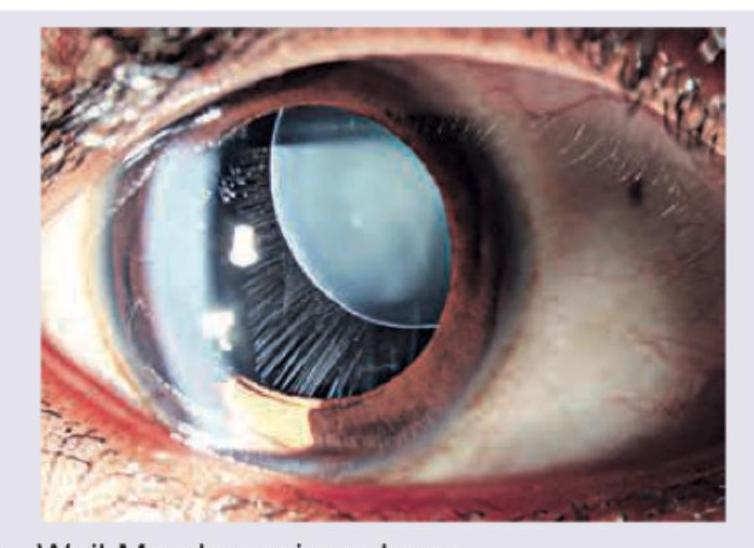
Which of the following types of cataract is most commonly associated with aging?
Rider's cataract is seen in which of the following types of cataracts?
Vossius ring is seen in the:
Which of the following is not a complication of posterior capsule rupture during cataract surgery?
Corticosteroids cause which type of cataract?
Elschnig's pearls are seen in which of the following conditions?
Which of the following is true about lens epithelium?
Uncontrolled hypertension may cause which of the following complications in cataract surgery?
What is the recommended treatment modality for a congenital cataract involving the visual axis?
What is true about complicated cataract?
Explanation: **Explanation:** **Nuclear Cataract** is the most common type of age-related (senile) cataract. It occurs due to the progressive intensification of the normal aging process of the lens. As we age, the lens fibers become increasingly compressed and dehydrated at the center (nucleus), leading to **nuclear sclerosis**. This is characterized by the deposition of yellow-brown pigment (urochrome), which increases the refractive index of the lens, often causing a "myopic shift" or "second sight" in elderly patients. **Analysis of Incorrect Options:** * **B. Intumescent cataract:** This is a stage of cataract progression (usually cortical) where the lens becomes swollen due to the osmotic imbibition of water. It is not a primary type associated with aging but rather a complication of the immature stage. * **C. Morgagnian cataract:** This represents a hypermature stage where the cortex liquefies, allowing the heavy, brownish nucleus to settle at the bottom of the capsular bag. This is an advanced stage, not the most common presentation. * **D. Posterior subcapsular cataract (PSC):** While it can occur with age, it is more classically associated with **steroid use**, diabetes mellitus, or ionizing radiation. It causes significant glare and vision loss in bright light. **High-Yield Clinical Pearls for NEET-PG:** * **Second Sight:** A hallmark of nuclear cataract where the myopic shift allows elderly patients to read without glasses again. * **Cupuliform Cataract:** Another name for Posterior Subcapsular Cataract. * **Grading:** Nuclear cataracts are graded based on color (e.g., *Cataracta Brunescens* for brown, *Cataracta Nigra* for black). * **Most common cause of blindness in India:** Cataract (specifically senile).
Explanation: **Explanation:** **Zonular (Lamellar) cataract** is the most common type of congenital cataract. It is characterized by opacity involving a specific "zone" or layer of the lens fibers (usually the fetal nucleus), while the embryonic nucleus and the cortex remain clear. The hallmark feature of this condition is **"Riders."** These are linear, U-shaped opacities that extend from the main zone of opacity into the clear cortex, straddling the equator like a rider on a horse. This occurs because the lens fibers formed during the period of metabolic insult become opaque, while those formed before and after remain transparent. **Analysis of Incorrect Options:** * **Blue dot cataract (Punctate cataract):** These are the most common congenital cataracts but are usually stationary and asymptomatic. They appear as small, bluish, rounded opacities scattered throughout the lens. * **Anterior capsular cataract:** These are small, central, white opacities on the anterior lens capsule, often associated with persistent pupillary membranes or intrauterine inflammation. * **Coronary cataract:** This is a form of senile or developmental cataract where club-shaped opacities are arranged in a ring (like a crown) in the peripheral deep cortex, often hidden by the iris. **Clinical Pearls for NEET-PG:** * **Etiology:** Zonular cataracts are frequently associated with **Vitamin D deficiency (Hypocalcemia)** during infancy or maternal infections. * **Visual Impact:** They are usually bilateral and often cause significant visual impairment, frequently requiring surgical intervention. * **Morphology:** Always look for the keyword "linear opacities straddling the equator" to identify Riders.
Explanation: **Explanation:** **Vossius ring** is a classic clinical sign of **blunt ocular trauma**. It is a circular ring of faint, brownish pigment (melanin) deposited on the **anterior capsule of the lens**. **Why it occurs:** When a blunt object strikes the eye, the force causes a sudden compression of the globe. This results in the pupillary margin of the iris being forcibly pressed against the anterior surface of the lens. The pigment from the posterior iris epithelium is "stamped" onto the lens capsule in a circular pattern that corresponds to the diameter of the pupil at the time of impact. **Analysis of Options:** * **Option B (Correct):** The pigment is deposited specifically on the **anterior capsule**. Over time, this ring may remain stationary even if the pupil dilates or constricts, serving as a permanent marker of past trauma. * **Option A (Cornea):** While trauma can cause corneal abrasions or blood staining, Vossius ring is not a corneal finding. Pigment on the posterior cornea is typically seen in Pigment Dispersion Syndrome (Krukenberg spindle). * **Option C (Posterior capsule):** Blunt trauma usually causes a "Stellate" or "Rosette-shaped" cataract in the posterior subcapsular region, but the pigment ring itself is always anterior. * **Option D (Iris):** The iris is the *source* of the pigment, not the site where the ring is visualized. **High-Yield Clinical Pearls for NEET-PG:** 1. **Rosette Cataract:** The most common type of traumatic cataract following blunt injury (usually found at the posterior cortex). 2. **Concussion Injury:** Vossius ring is a "concussion" sign; it does not require a penetrating injury. 3. **Size:** The diameter of the ring provides a clue to the pupillary size at the exact moment of the trauma. 4. **Associated findings:** Always look for other signs of blunt trauma, such as hyphaema, iridodialysis, or angle recession.
Explanation: **Explanation:** **Posterior Capsule Rupture (PCR)** is a significant intraoperative complication of cataract surgery. Understanding its sequelae is vital for NEET-PG. **Why Angle Recession is the Correct Answer:** Angle recession refers to the tearing of the ciliary body face, leading to a widening of the anterior chamber angle. This is a classic hallmark of **blunt ocular trauma**, not surgical trauma during cataract extraction. It occurs due to a sudden hydraulic force pushing the iris-lens diaphragm backward during an injury. It is unrelated to the integrity of the posterior capsule. **Analysis of Incorrect Options (Complications of PCR):** * **Retinal Detachment (RD):** PCR often leads to vitreous loss. Vitreous traction on the peripheral retina (vitreoretinal traction) significantly increases the risk of rhegmatogenous retinal detachment postoperatively. * **Macular Edema (Cystoid Macular Edema/Irvine-Gass Syndrome):** Vitreous incarceration in the surgical wound or inflammatory mediators released due to PCR can lead to fluid accumulation in the macula, causing decreased vision. * **Dislocation of Intraocular Lens (IOL):** The posterior capsule provides the primary support for a standard IOL. A rupture compromises this support, leading to early or late decentration or complete dislocation of the lens into the vitreous cavity (Nucleus/IOL drop). **High-Yield Clinical Pearls:** * **Signs of PCR:** Sudden deepening of the anterior chamber, momentary pupillary dilation, and the "tilt" of the lens nucleus. * **Management:** If PCR occurs, the priority is **Anterior Vitrectomy** to clear the wound and prevent vitreous incarceration. * **IOL Choice:** In PCR with adequate capsular support, a 3-piece IOL in the sulcus is preferred. If support is absent, an ACIOL or Scleral Fixated IOL (SFIOL) is used.
Explanation: **Explanation:** **1. Why Posterior Subcapsular Cataract (PSC) is Correct:** Corticosteroids (both systemic and topical) are strongly associated with the development of **Posterior Subcapsular Cataracts (PSC)**. The underlying mechanism involves the binding of steroids to lens epithelial cells, which alters the transcription of genes responsible for lens fiber differentiation. This leads to the migration of abnormal lens epithelial cells toward the posterior pole, where they accumulate under the posterior capsule (forming Wedl or bladder cells). These opacities are particularly bothersome as they lie close to the nodal point of the eye, causing significant glare and vision loss, especially in bright light or during near work (miosis). **2. Why Other Options are Incorrect:** * **A. Cortical:** These are typically age-related (senile) opacities characterized by "cuneiform" or wedge-shaped opacities. They are not the primary manifestation of steroid-induced lens changes. * **B. Nuclear:** Nuclear sclerosis is the most common form of age-related cataract. While some studies suggest a weak link with long-term steroid use, PSC remains the classic and most definitive association. * **C. Anterior Subcapsular:** These are commonly associated with **Amiodarone**, Chlorpromazine, or trauma. They are not a characteristic feature of steroid use. **3. High-Yield Clinical Pearls for NEET-PG:** * **Dose-Dependency:** Steroid-induced PSC is dependent on both the **duration** of treatment and the **dosage**. * **Reversibility:** Unlike some drug side effects, steroid-induced cataracts are generally **irreversible** even after stopping the medication. * **Other Causes of PSC:** Chronic intraocular inflammation (Uveitis), Ionizing radiation, Diabetes Mellitus, and Retinitis Pigmentosa. * **Steroid-Induced Glaucoma:** Always remember that steroids also cause an increase in Intraocular Pressure (IOP) by decreasing aqueous outflow through the trabecular meshwork.
Explanation: **Explanation:** **Elschnig’s pearls** are a common manifestation of **Posterior Capsular Opacification (PCO)**, the most frequent late complication following extracapsular cataract surgery (ECCE/Phacoemulsification). 1. **Why "After cataract surgery" is correct:** During surgery, some lens epithelial cells (LECs) may remain in the equatorial region of the capsular bag. These residual cells undergo proliferation and migration across the posterior capsule. When these cells undergo aberrant differentiation into large, vacuolated, globular structures, they are termed **Elschnig’s pearls**. They appear like a "cluster of grapes" or "fish eggs" on slit-lamp examination and can significantly reduce visual acuity. 2. **Why other options are incorrect:** * **Wilson’s Disease:** Characterized by the **Sunflower cataract** (copper deposition in the anterior capsule) and the Kayser-Fleischer (KF) ring in the cornea. * **Diabetes Mellitus:** Classically associated with **Snowflake cataracts** (subcapsular opacities) and an earlier onset of senile nuclear sclerosis. * **Myotonic Dystrophy:** Classically presents with **Christmas tree cataracts** (polychromatic luster) which later progress to stellate subcapsular opacities. **High-Yield Clinical Pearls for NEET-PG:** * **Treatment of PCO:** The gold standard treatment is **Nd:YAG Laser Capsulotomy**. * **Soemmering’s Ring:** Another form of PCO where lens fibers are trapped between the two layers of the capsule, forming a ring-like structure. * **Prevention:** PCO incidence is reduced by using **square-edge** Intraocular Lenses (IOLs) and biocompatible materials like hydrophobic acrylic.
Explanation: The lens epithelium is a single layer of cuboidal cells located just beneath the anterior lens capsule. Understanding its dynamics is crucial for NEET-PG. ### **Explanation of the Correct Option** **B. Is deposited as lens fibers:** The lens epithelium is metabolically active only in the anterior and equatorial regions. At the **equator (germinal zone)**, these epithelial cells undergo continuous mitosis, elongate, and differentiate into **secondary lens fibers**. These new fibers are deposited layer-upon-layer over the pre-existing ones throughout life. This unique process makes the lens the only organ that never sheds its cells, leading to the increasing density of the lens nucleus with age. ### **Analysis of Incorrect Options** * **A. Contains polygonal cells:** The anterior lens epithelium consists of a single layer of **cuboidal cells**, not polygonal cells. These cells are responsible for the metabolic transport and synthesis of crystallins. * **C. Remains dehydrated:** While the lens maintains a relatively low water content (approx. 66%) to ensure transparency, it is not "dehydrated." It maintains a **state of relative deturgescence** through the active Na+/K+ ATPase pump located primarily in the lens epithelium. ### **High-Yield Clinical Pearls for NEET-PG** * **Posterior Capsule:** There is **no posterior epithelium** in the adult lens (it is used up during embryonic development to form primary lens fibers). This is why the posterior capsule is the thinnest part of the lens. * **Vossius Ring:** A circular ring of pigment on the anterior lens capsule following blunt trauma, corresponding to the pupillary margin. * **Epicapsular Stars:** Remnants of the tunica vasculosa lentis found on the anterior lens surface (congenital anomaly). * **Cataract Pathogenesis:** Abnormal proliferation and migration of epithelial cells toward the posterior pole lead to **Posterior Subcapsular Cataract (PSC)**.
Explanation: **Explanation:** **Suprachoroidal Hemorrhage (SCH)** is one of the most dreaded complications of intraocular surgery. It occurs due to the rupture of the **long or short posterior ciliary arteries**, leading to the accumulation of blood in the suprachoroidal space (between the choroid and the sclera). **Why Hypertension is the Key Factor:** Uncontrolled systemic hypertension is a major risk factor because it increases intravenous and intraocular pressure. During cataract surgery, when the eye is opened (incised), there is a sudden drop in intraocular pressure (**sudden hypotony**). In hypertensive patients, this pressure gradient causes the fragile ciliary vessels to rupture. This leads to an "expulsive hemorrhage," which can push intraocular contents (iris, lens, vitreous) out of the wound. **Analysis of Incorrect Options:** * **A. Glaucoma:** While postoperative pressure spikes can occur, hypertension is not a direct primary risk factor for acute surgical glaucoma compared to factors like retained viscoelastic or pupillary block. * **B. Retinal Detachment:** Risk factors include high myopia, vitreous loss, or lattice degeneration, rather than systemic hypertension. * **C. Endophthalmitis:** This is an infectious complication caused by a breach in aseptic technique or contaminated instruments; it is unrelated to the patient’s blood pressure. **High-Yield Clinical Pearls for NEET-PG:** * **Risk Factors for SCH:** Systemic hypertension, advanced age, high myopia, glaucoma, and atherosclerotic cardiovascular disease. * **Intraoperative Signs:** Sudden shallowing of the anterior chamber, increased firmness of the globe (stony hard eye), and a dark/reddish mass visible through the pupil. * **Management:** Immediate closure of the surgical incision to tamponade the bleed. * **Prevention:** Ensure blood pressure is well-controlled (ideally <140/90 mmHg) before elective cataract surgery.
Explanation: **Explanation:** The primary goal in managing congenital cataracts is the prevention of **amblyopia** (lazy eye). When a cataract involves the visual axis, it causes **stimulus-deprivation amblyopia**, which can lead to permanent, irreversible vision loss if the visual pathway is not stimulated during the critical period of visual development. **Why the correct answer is right:** * **Immediate surgical intervention** is mandatory for cataracts that are central, larger than 3 mm, or dense enough to obscure the red reflex. * The **"Critical Period"** for visual development is most sensitive in the first few weeks of life. For unilateral cataracts, surgery is ideally performed within **4–6 weeks** of birth; for bilateral cases, within **8–10 weeks**. **Why the other options are wrong:** * **Observation (A):** Only indicated for small, peripheral, or partial cataracts that do not interfere with the visual axis or visual development. * **Surgical intervention at a "suitable age" (B):** Delaying surgery beyond the critical period results in dense amblyopia and nystagmus, making later surgery ineffective for functional vision. * **Mydriatics (C):** While pupillary dilation can sometimes be used as a temporary measure for small central cataracts to allow light to pass around the opacity, it is not a definitive treatment for cataracts involving the visual axis. **High-Yield Clinical Pearls for NEET-PG:** * **Most common cause** of congenital cataract: Idiopathic (Overall); **Rubella** (Infectious). * **Surgery of choice:** Lens aspiration (Lensectomy) + Anterior Vitrectomy + Primary Posterior Capsulotomy (PPC). * **IOL Implantation:** Generally avoided in infants <6 months due to changing eye size and high inflammatory response; usually performed after 1–2 years of age. * **Morphology:** **Zonular (Lamellar) cataract** is the most common type of congenital cataract. **Oil droplet** appearance is seen in Galactosemia.
Explanation: **Explanation:** **Complicated cataract** refers to opacification of the lens resulting from intraocular inflammatory or degenerative diseases. **Why the correct answer is right:** The lens is avascular and derives its nutrition from the aqueous humor. In conditions like chronic uveitis or retinitis pigmentosa, inflammatory toxins or metabolic waste products accumulate in the aqueous. These toxins first affect the thinnest part of the lens capsule, which is the **posterior pole**. Consequently, a complicated cataract typically begins as a **polychromatic luster** (iridescence) followed by a **bread-crumb appearance** in the **posterior subcapsular** region. **Analysis of incorrect options:** * **Option A:** Systemic hypertension is not a primary cause of complicated cataract. While diabetes mellitus is strongly associated with cataracts, hypertension primarily affects the retinal vasculature. * **Option B:** There is no gender predilection; it occurs equally in males and females depending on the underlying ocular pathology. * **Option C:** Endophthalmitis is a severe infective complication of intraocular surgery or trauma, not a natural progression of a complicated cataract. **High-Yield NEET-PG Pearls:** * **Most common cause:** Chronic Anterior Uveitis. * **Early Sign:** Polychromatic luster (rainbow-like play of colors) seen at the posterior pole. * **Classic Appearance:** "Bread-crumb" appearance. * **Associated Ocular Conditions:** High myopia, Retinitis Pigmentosa, Retinal detachment, and Ciliary body tumors. * **Visual Prognosis:** Often guarded, as the visual outcome depends more on the health of the underlying retina and uvea than the lens opacity itself.
Lens Anatomy and Physiology
Practice Questions
Age-Related Cataract
Practice Questions
Congenital and Developmental Cataracts
Practice Questions
Traumatic Cataract
Practice Questions
Metabolic Cataracts
Practice Questions
Drug-Induced Cataracts
Practice Questions
Cataract Surgery Techniques
Practice Questions
Intraocular Lens Implants
Practice Questions
Complications of Cataract Surgery
Practice Questions
Posterior Capsular Opacification
Practice Questions
Lens Subluxation and Dislocation
Practice Questions
Specialty IOLs
Practice Questions
Get full access to all questions, explanations, and performance tracking.
Start For Free