Satellite lesions on the cornea are typically seen in which type of ulcer?
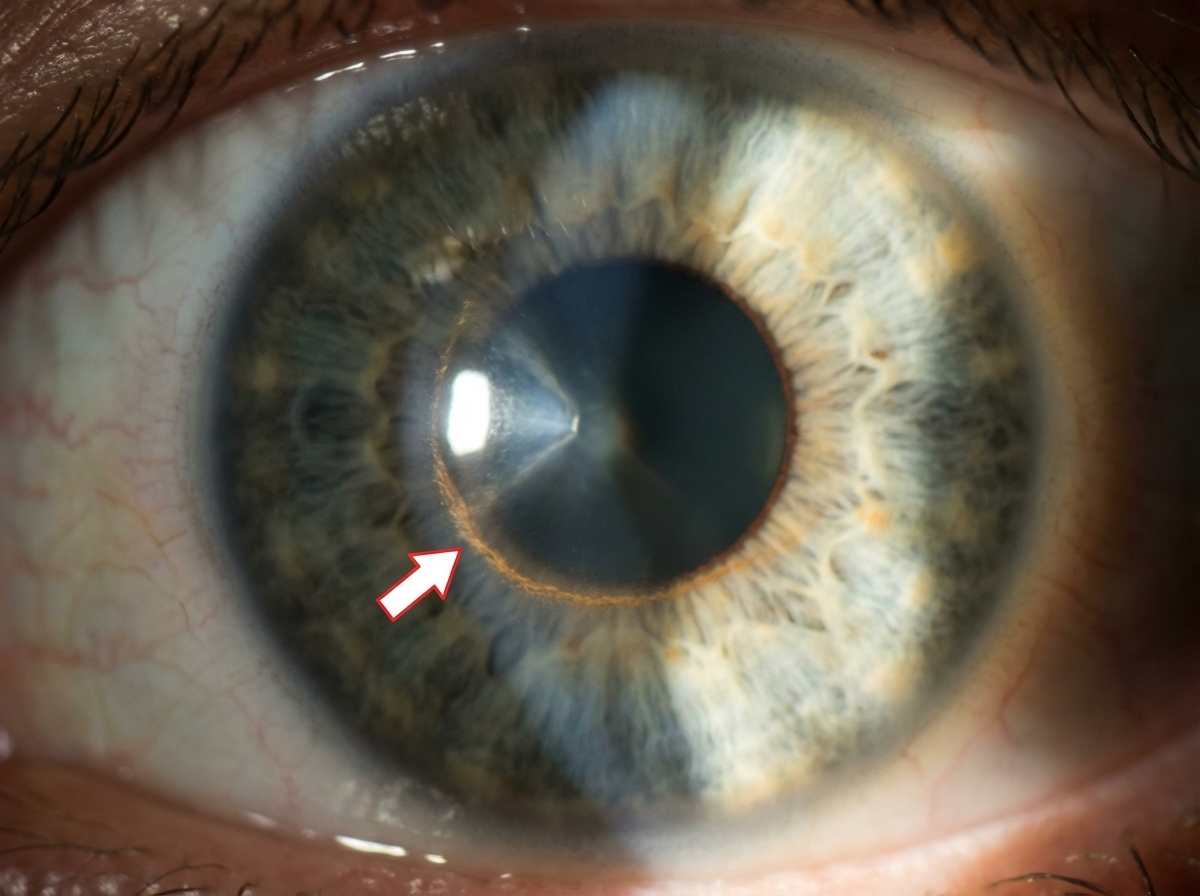
Kayser-Fleisher ring is seen in which condition?
A 30-year-old man presents with a 10-day history of decreased vision in his left eye. He reports trauma to his left eye with vegetative matter 10-15 days prior. Examination reveals an ulcerative corneal lesion with a raised, creamy infiltrate at the base. The ulcer margins are described as feathery and hyphate, with a few satellite lesions present. What is the most probable causative agent?
Which of the following is NOT a characteristic of femtolasik?
In which of the following layers of the cornea does iron deposition occur, resulting in the formation of a 'Hudson-Stahli line'?
A dendritic ulcer is classically caused by which of the following pathogens?
Exposure keratitis is not associated with which of the following conditions?
Dendritic Keratitis is characteristic of which of the following?
Khodadaust Line indicates:
The thickness of the cornea is best detected by?
Explanation: **Explanation:** **1. Why Fungal Ulcer is correct:** Satellite lesions are a hallmark clinical feature of **filamentous fungal keratitis** (most commonly caused by *Aspergillus* or *Fusarium*). These are small, discrete infiltrates located away from the main ulcer margin. They occur because fungal hyphae can penetrate deep into the corneal stroma and spread laterally, creating secondary foci of infection separate from the primary site. Other characteristic features include a dry, leathery appearance, feathery margins, and a fixed hypopyon. **2. Why other options are incorrect:** * **Viral/Herpetic Ulcer:** These typically present with **dendritic ulcers** (linear branching with terminal bulbs) or geographic ulcers. They are characterized by diminished corneal sensations rather than satellite lesions. * **Bacterial Ulcer:** These usually present as a well-defined, yellowish-white suppurative ulcer with an associated mobile hypopyon. The margins are typically distinct or shaggy (in *Pseudomonas*), but they do not form isolated satellite spots. **3. NEET-PG High-Yield Pearls:** * **Most common cause of Fungal Keratitis:** Trauma with vegetative matter (e.g., a branch or leaf). * **Immune Ring (Wessely Ring):** An annular infiltrate often seen in fungal or chronic herpetic keratitis due to antigen-antibody reaction. * **Diagnostic Gold Standard:** Potassium Hydroxide (**KOH**) mount showing hyphae; Culture on **Sabouraud’s Dextrose Agar (SDA)**. * **Treatment of choice:** Topical Natamycin (5%) or Voriconazole. * **Note:** Steroids are strictly contraindicated in fungal ulcers as they promote rapid fungal growth and corneal perforation.
Explanation: **Explanation:** The **Kayser-Fleischer (KF) ring** is a hallmark clinical sign of **Wilson’s disease** (Hepatolenticular degeneration). It is caused by the deposition of **copper** in the **Descemet’s membrane** of the cornea. 1. **Wilson’s Disease (Correct):** This is an autosomal recessive disorder involving a mutation in the *ATP7B* gene, leading to impaired biliary copper excretion. Copper accumulates in the liver, brain, and eyes. The KF ring typically appears as a bilateral, golden-brown or greenish-brown pigment ring at the periphery of the cornea, starting superiorly. It is best visualized using a **Slit-lamp examination**. 2. **Incorrect Options:** * **Still’s Disease (Systemic JIA):** Characteristically associated with **Band-shaped keratopathy** and chronic non-granulomatous uveitis, not copper deposition. * **Systemic Lupus Erythematosus (SLE):** Ocular manifestations include dry eyes (Sjögren’s), episcleritis, or retinal vasculitis (cotton wool spots), but not corneal rings. * **Chalcosis:** This refers to intraocular copper (usually from a retained foreign body). It causes a **Sunflower cataract** (copper in the anterior lens capsule) rather than a classic KF ring. **High-Yield Clinical Pearls for NEET-PG:** * **Location:** KF rings are found in the **Descemet’s membrane** (not the epithelium or stroma). * **Reversibility:** The ring disappears with effective chelation therapy (e.g., D-Penicillamine). * **Diagnostic Value:** A KF ring is present in 95% of patients with neurological Wilson's but only about 50-60% of those with purely hepatic presentation. * **Differential:** A similar-looking ring can rarely be seen in primary biliary cholangitis or chronic cholestasis.
Explanation: **Explanation:** The clinical presentation is a classic case of **Fungal Keratitis (Keratomycosis)**. The most significant risk factor mentioned is trauma with **vegetative matter** (e.g., agricultural injury), which is the hallmark history for fungal infections of the cornea. **Why Fusarium is correct:** * **Feathery/Hyphate margins:** These represent fungal hyphae invading the corneal stroma. * **Satellite lesions:** These are small, discrete infiltrates surrounding the main ulcer, characteristic of fungal etiology. * **Raised, creamy/dry-looking infiltrate:** Fungal ulcers often appear "dry" or "pasty" compared to the wet, necrotic appearance of bacterial ulcers. * **Fusarium** and **Aspergillus** are the most common filamentous fungi causing keratitis worldwide, especially in tropical climates following trauma. **Why other options are incorrect:** * **Acanthamoeba:** Typically associated with contact lens wear or exposure to contaminated water. It presents with disproportionate pain and a characteristic **ring-shaped infiltrate**. * **Corynebacterium diphtheriae:** A rare cause of bacterial keratitis that is unique because it can penetrate an **intact corneal epithelium**. It usually presents with a membranous conjunctivitis. * **Streptococcus pneumoniae:** A common cause of bacterial "creeping" ulcers (**Ulcus Serpens**). These are typically acute, painful, and associated with a hypopyon, but lack feathery margins and satellite lesions. **High-Yield Clinical Pearls for NEET-PG:** * **Gold Standard Investigation:** Corneal scraping for **KOH mount** (shows hyphae) and culture on **Sabouraud’s Dextrose Agar (SDA)**. * **Drug of Choice:** Topical **Natamycin (5%)** is the first-line treatment for filamentous fungi like *Fusarium*. * **Fixed Dilated Pupil:** Often seen in fungal keratitis due to the penetration of toxins into the anterior chamber. * **Avoid Steroids:** Topical steroids are strictly contraindicated as they worsen fungal replication and can lead to corneal perforation.
Explanation: **Explanation:** **Femto-LASIK** (Femtosecond Laser-Assisted In Situ Keratomileusis) is an advanced refractive surgery where a femtosecond laser is used to create a corneal flap instead of a mechanical microkeratome (blade). 1. **Why Option A is correct:** Femto-LASIK is **not** flapless. It still involves the creation and displacement of a corneal flap to allow the excimer laser to reshape the underlying stroma. The term "Flapless" refers to procedures like **SMILE** (Small Incision Lenticule Extraction) or surface ablations like **PRK**. 2. **Why Option B is incorrect:** It is indeed "Bladeless" because the femtosecond laser replaces the traditional oscillating steel blade (microkeratome). 3. **Why Option C is incorrect:** Femto-LASIK is associated with a lower incidence of dry eyes compared to traditional LASIK. This is because the laser allows for a thinner, more predictable flap, which results in less damage to the sub-basal corneal nerve plexus. 4. **Why Option D is incorrect:** Like traditional LASIK, Femto-LASIK requires a minimum residual stromal bed (usually >250-300 microns) to prevent ectasia. Therefore, it cannot be safely performed in patients with very thin corneas. **High-Yield Clinical Pearls for NEET-PG:** * **SMILE:** The true "flapless" and "bladeless" procedure where a lenticule is extracted through a small incision. * **Flap Thickness:** Femtosecond lasers create flaps of approximately 100–110 microns, whereas microkeratomes are less predictable (130–160 microns). * **Complication:** A specific complication of Femto-LASIK is **Transient Light Sensitivity Syndrome (TLSS)**.
Explanation: **Explanation:** The **Hudson-Stahli line** is a horizontal line of iron deposition (hemosiderin) found at the junction of the upper two-thirds and lower one-third of the cornea. **1. Why Bowman’s Membrane is Correct:** The iron deposition in a Hudson-Stahli line occurs specifically in the **basal layers of the corneal epithelium** and the underlying **Bowman’s membrane**. It is typically seen in elderly patients and is considered a physiological sign of corneal aging. It forms due to the pooling of tears at the line of lid closure during blinking, where the iron from the tear film (lactoferrin) precipitates over time. **2. Why Other Options are Incorrect:** * **Epithelium:** While iron is deposited in the basal epithelial cells, standard NEET-PG curriculum and clinical texts (like Kanski) emphasize **Bowman’s membrane** as the primary structural site for these pigmented lines. * **Descemet’s Membrane:** This layer is associated with copper deposition (Kayser-Fleischer ring) or silver (Argyrosis), but not typically iron lines. * **Endothelium:** This is the site for **Krukenberg spindles** (pigment from the iris), not iron lines. **3. High-Yield Clinical Pearls for NEET-PG:** Iron lines in the cornea are high-yield "spotters." Remember these specific associations: * **Hudson-Stahli Line:** Age-related; lower 1/3rd of cornea. * **Fleischer Ring:** Found at the base of the cone in **Keratoconus**. * **Ferry’s Line:** Found in front of a **Filtering Bleb** (post-glaucoma surgery). * **Stocker’s Line:** Found at the leading edge of a **Pterygium**. * **Kayser-Fleischer (KF) Ring:** Copper deposition in Descemet’s membrane (Wilson’s Disease).
Explanation: **Explanation:** The correct answer is **Herpes simplex virus (HSV)**. A dendritic ulcer is the hallmark clinical presentation of **Herpes Simplex Keratitis** (epithelial type). **Why HSV is correct:** The virus infects the corneal epithelium, causing cell lysis. The ulcer spreads in a branching, linear pattern resembling the veins of a leaf (dendritic). Key features include **terminal bulbs** (knob-like ends containing live virus) and **diminished corneal sensations** due to the neurotropic nature of the virus. Staining with Fluorescein highlights the ulcer bed (green), while Rose Bengal stains the devitalized cells at the margins (red). **Why other options are incorrect:** * **Mycetoma (Fungal):** Fungal keratitis typically presents with "feathery" margins, satellite lesions, and a dry, raised appearance. It does not form linear dendrites. * **Staphylococcus aureus & Streptococcus pneumoniae:** These are common causes of **Bacterial Keratitis**. They typically present as a circumscribed, yellowish-white purulent ulcer with an associated hypopyon (pus in the anterior chamber), rather than a branching pattern. **High-Yield Clinical Pearls for NEET-PG:** * **Treatment:** Topical **Acyclovir (3%)** or Ganciclovir. **Steroids are strictly contraindicated** in epithelial (dendritic) keratitis as they can lead to a "Geographic ulcer." * **Recurrence:** HSV remains latent in the **Trigeminal ganglion**. * **Differential Diagnosis:** *Acanthamoeba* keratitis can cause a "pseudo-dendrite," but it lacks terminal bulbs and is associated with intense pain and contact lens use. * **Disciform Keratitis:** This is an immune-mediated (Type IV hypersensitivity) reaction to HSV, presenting as central stromal edema without an active epithelial ulcer.
Explanation: **Explanation:** **Exposure Keratitis** occurs due to the **mechanical inability of the eyelids to close properly (lagophthalmos)**, leading to excessive evaporation of the tear film and drying of the corneal epithelium. **Why 5th Nerve Paralysis is the Correct Answer:** The 5th cranial nerve (Trigeminal nerve) provides **sensory** innervation to the cornea. Paralysis of the 5th nerve leads to **Neurotrophic Keratitis**, not exposure keratitis. In neurotrophic keratitis, the cornea becomes anesthetic, leading to a loss of the blink reflex and poor epithelial healing, but the eyelids can still physically close. **Analysis of Incorrect Options:** * **7th Nerve Paralysis (Bell’s Palsy):** The 7th nerve (Facial nerve) innervates the **orbicularis oculi** muscle, which is responsible for eyelid closure. Paralysis leads to lagophthalmos, causing direct corneal exposure. * **Symblepharon:** This is the adhesion of the palpebral conjunctiva to the bulbar conjunctiva. These structural adhesions can physically tether the eyelids, preventing complete closure and leading to exposure. * **Ectropion:** This is the outward turning of the eyelid margin. It prevents the eyelid from apposing the globe correctly, leading to an unstable tear film and exposure of the lower corneal/conjunctival surface. **High-Yield Clinical Pearls for NEET-PG:** 1. **Key Distinction:** Exposure Keratitis = **Motor** failure (7th Nerve); Neurotrophic Keratitis = **Sensory** failure (5th Nerve). 2. **Bell’s Phenomenon:** An upward and outward rolling of the eyeball during closure. If Bell's phenomenon is healthy, it protects the cornea even in mild lagophthalmos. 3. **Management:** Initial treatment involves intensive lubrication; surgical intervention includes **Tarsorrhaphy** (sewing the eyelids together) to protect the ocular surface.
Explanation: **Explanation:** **Dendritic Keratitis** is the hallmark clinical presentation of **Herpes Simplex Virus (HSV)** epithelial keratitis. The virus infects the corneal epithelial cells, leading to cell lysis and the formation of linear, branching (dendritic) ulcers. These ulcers are characterized by **terminal bulbs** (knob-like ends containing live virus) and stained brilliantly with **Fluorescein** (the floor) and **Rose Bengal** (the devitalized margins). A key diagnostic feature is **diminished corneal sensations** due to trigeminal nerve involvement. **Why other options are incorrect:** * **Pseudomonas:** Typically causes a rapidly progressing **bacterial keratitis** characterized by a "soupy" yellowish-green discharge and a large hypopyon. It is common in contact lens wearers. * **Streptococci:** *S. pneumoniae* often causes a circumscribed, serpiginous ulcer with a tendency for perforation, but it does not form dendritic patterns. * **Staphylococci:** Usually presents as a well-defined, grayish-white stromal infiltrate (often associated with chronic blepharitis), not a branching epithelial ulcer. **High-Yield Clinical Pearls for NEET-PG:** * **Treatment:** Topical **Acyclovir (3%)** or Ganciclovir. **Steroids are strictly contraindicated** in the dendritic stage as they can lead to "Geographic Ulcers." * **Geographic Ulcer:** An enlarged, amoeboid-shaped ulcer formed when dendritic ulcers coalesce, often due to inappropriate steroid use. * **Recurrence:** HSV remains latent in the **Trigeminal Ganglion** and can reactivate due to stress, fever, or UV exposure. * **Differential Diagnosis:** "Pseudo-dendrites" (lacking terminal bulbs) can be seen in *Acanthamoeba* keratitis, Herpes Zoster Ophthalmicus, or healing corneal abrasions.
Explanation: ### Explanation **Khodadoust Line** is a hallmark clinical sign of **endothelial rejection** following a penetrating keratoplasty (corneal graft). #### Why Option B is Correct: The Khodadoust line represents a linear precipitate of inflammatory cells (lymphocytes) on the corneal endothelium. These cells typically start at a vascularized part of the limbus and migrate across the graft's endothelial surface. As the line advances, it destroys the donor endothelial cells, leading to localized corneal edema behind the line. It is a definitive sign of **Type IV (cell-mediated) hypersensitivity** rejection. #### Why Other Options are Incorrect: * **Option A:** Sympathetic ophthalmia is characterized by bilateral granulomatous panuveitis (Mutton-fat KPs and Dalen-Fuchs nodules), not a Khodadoust line. * **Option C:** Acute congestive glaucoma presents with corneal edema due to high intraocular pressure and "Halos," but the Khodadoust line is specific to immunological rejection, not pressure-induced damage. * **Option D:** Lesions at the optic chiasma typically present with visual field defects (e.g., Bitemporal Hemianopia) and have no correlation with corneal findings. #### High-Yield Clinical Pearls for NEET-PG: * **Krachmer’s Spots:** Subepithelial infiltrates seen in **epithelial rejection** of a corneal graft. * **Wessely Ring:** An immune ring in the cornea seen in HSK (Herpes Simplex Keratitis) or Acanthamoeba keratitis. * **Treatment:** The mainstay of treatment for graft rejection is **intensive topical corticosteroids** (e.g., 1% Prednisolone acetate hourly). * **Timeframe:** Graft rejection usually occurs at least 2 weeks to months after surgery (unlike primary graft failure, which occurs within 24–48 hours).
Explanation: **Explanation:** The correct answer is **Pachymetry**. **1. Why Pachymetry is correct:** Pachymetry is the clinical procedure used to measure the **thickness of the cornea**. It is essential in ophthalmology for two primary reasons: * **Glaucoma Management:** Intraocular pressure (IOP) readings are influenced by corneal thickness. A thin cornea leads to an underestimation of IOP, while a thick cornea leads to an overestimation. * **Refractive Surgery:** It is a mandatory screening tool before LASIK to ensure the residual stromal bed is thick enough to maintain structural integrity. The average central corneal thickness (CCT) is approximately **540 μm**. **2. Why the other options are incorrect:** * **Keratometry:** This measures the **curvature** of the anterior corneal surface (specifically the central 3mm). It is used to calculate IOL power and diagnose astigmatism, not thickness. * **Placido Disc:** This is a diagnostic tool used to assess the **regularity** of the corneal surface. It projects concentric rings onto the cornea to detect irregularities like keratoconus. * **Tonometry:** This is the method used to measure **Intraocular Pressure (IOP)** (e.g., Goldmann Applanation Tonometry). **Clinical Pearls for NEET-PG:** * **Gold Standard:** Optical Coherence Tomography (OCT) and Ultrasound Pachymetry are the most common methods used today. * **Corneal Edema:** An increase in corneal thickness is an early sign of endothelial dysfunction (e.g., Fuchs' Dystrophy). * **Critical Limit:** For LASIK, a minimum residual stromal bed of **250–300 μm** is generally required to prevent corneal ectasia.
Corneal Anatomy and Physiology
Practice Questions
Bacterial Keratitis
Practice Questions
Viral Keratitis
Practice Questions
Fungal Keratitis
Practice Questions
Protozoan Keratitis
Practice Questions
Corneal Degenerations
Practice Questions
Corneal Dystrophies
Practice Questions
Keratoconus and Ectatic Disorders
Practice Questions
Corneal Transplantation
Practice Questions
Corneal Topography and Imaging
Practice Questions
Dry Eye Disease
Practice Questions
Corneal Trauma
Practice Questions
Get full access to all questions, explanations, and performance tracking.
Start For Free