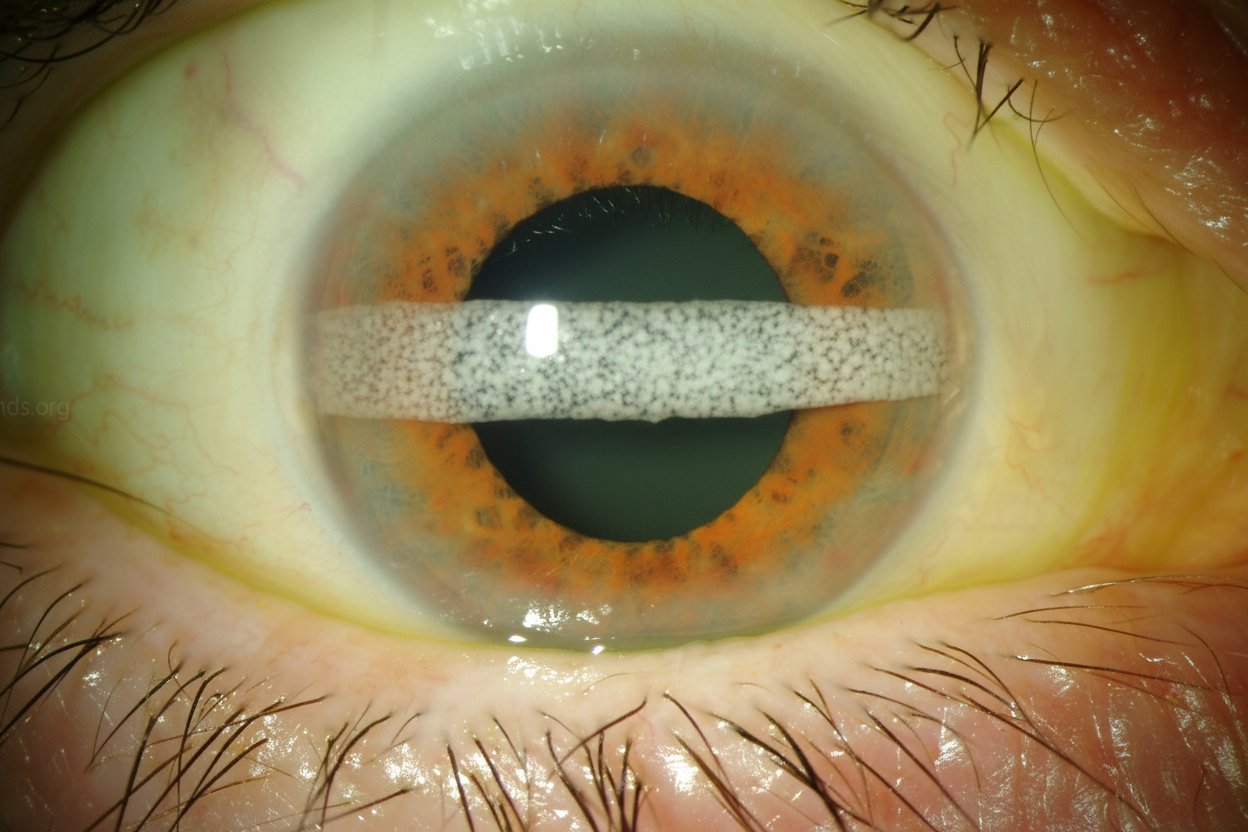
In a child with juvenile idiopathic arthritis, the eye examination shows presence of:
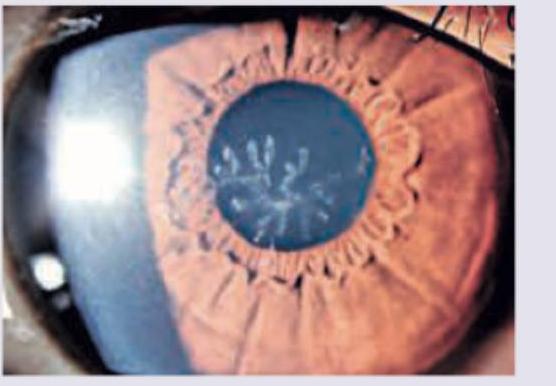
Dendrites on the cornea as shown below may be seen with:
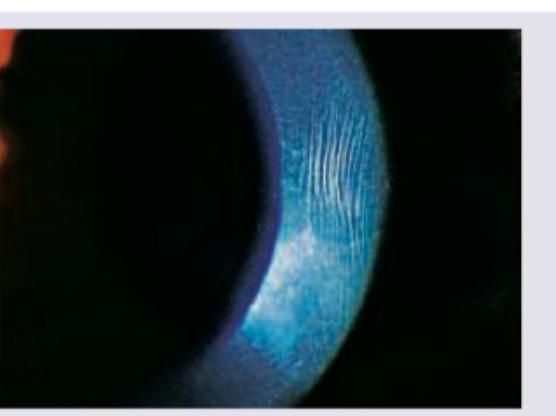
These vertical striations in the cornea shown below are seen in: (Recent NEET Pattern 2016-17)
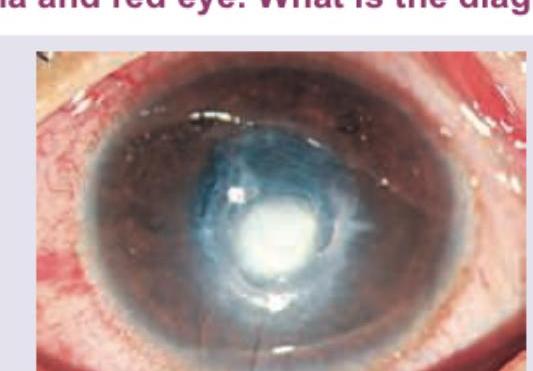
A 30-year-old lady presents with blepharospasm, lid edema and red eye. Examination findings are shown in the image. What is the diagnosis?
The corneal presentation shown in the image is characteristic of:
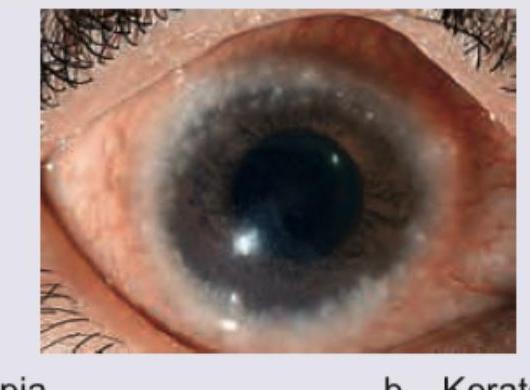
What does the given image show?
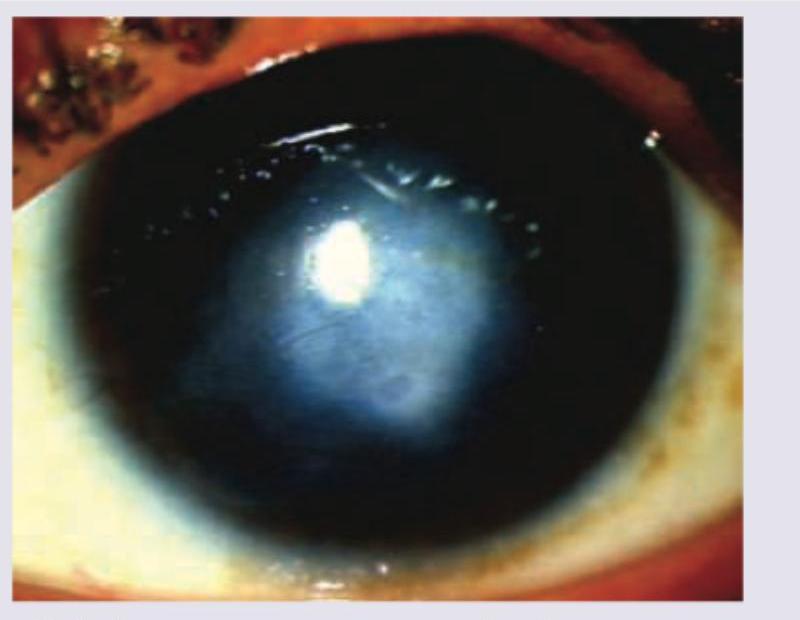
What does the following image show?
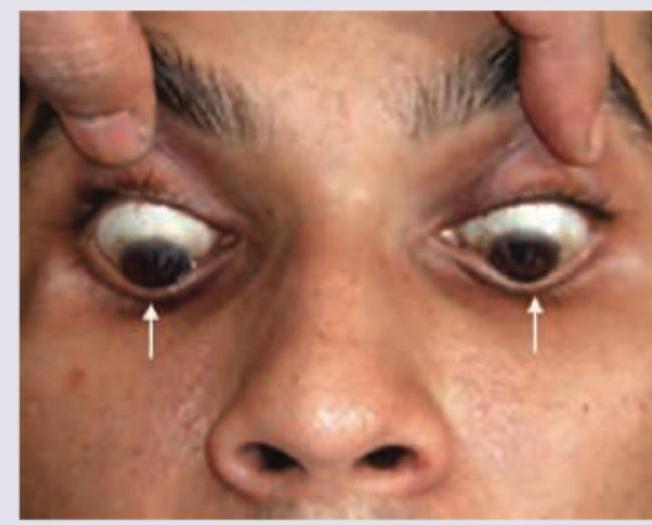
All are true regarding the image shown except:
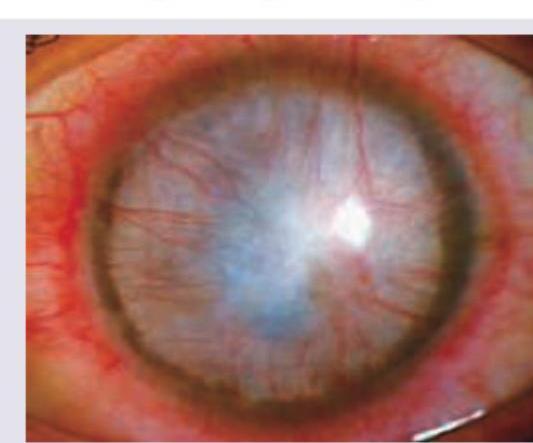
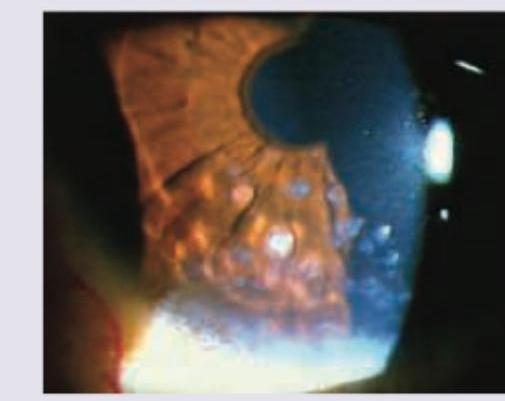
What does the following image show?
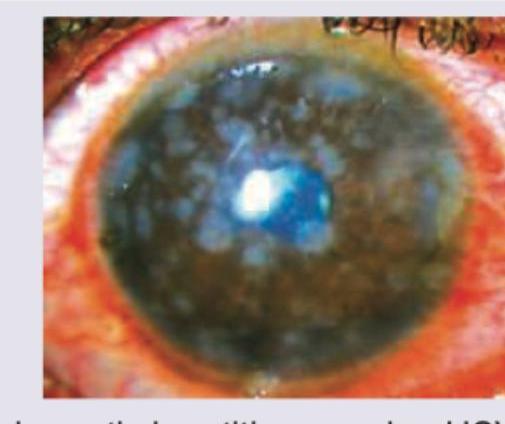
What does the following image show?
Explanation: ***Band keratopathy*** - **Band keratopathy** is a common ocular manifestation in children with chronic uveitis secondary to **juvenile idiopathic arthritis (JIA)**, characterized by a horizontal band-like deposition of calcium salts in the superficial cornea. - The image depicts a whitish or grayish band across the cornea, consistent with **calcium deposition**, which is a hallmark of band keratopathy. *Vortex keratopathy* - **Vortex keratopathy** (or **cornea verticillata**) is a swirling, whorl-like pattern of corneal deposits, typically caused by drug toxicity (e.g., amiodarone, chloroquine) or metabolic disorders (e.g., Fabry disease). - It does not present as a horizontal band or diffuse opacification like that seen in the image, and is unrelated to JIA. *Fuchs' endothelial dystrophy* - **Fuchs' endothelial dystrophy** is a unilateral or bilateral progressive condition primarily affecting the corneal endothelium, leading to stromal edema and **guttae** (small excrescences on Descemet's membrane). - It typically affects older adults and is not primarily linked to JIA or the appearance in the provided image. *Bitot's spots* - **Bitot's spots** are foamy, triangular patches of keratinized conjunctival epithelium, usually located on the temporal bulbar conjunctiva, and are pathognomonic for **vitamin A deficiency**. - They are a conjunctival finding, not a corneal one, and are not associated with JIA.
Explanation: ***HSV keratitis*** - The image shows classic **dendritic corneal ulcers**, which are pathognomonic for **herpes simplex virus (HSV) keratitis**. - These linear, branching lesions with terminal bulbs represent active viral replication in the corneal epithelium. *Staphylococcal keratitis* - This typically presents as a **bacterial keratitis** with a focal, dense, white or yellow infiltrate, often associated with an overlying epithelial defect. - It does not produce the characteristic dendritic pattern seen in the image. *Pseudomonas keratitis* - This is a severe form of bacterial keratitis, often caused by contact lens use, characterized by a rapidly progressing, **dense, greenish-yellow infiltrate**, often with stromal melting and hypopyon. - It does not manifest as dendritic lesions. *Acanthamoeba keratitis* - This parasitic infection of the cornea typically presents with severe pain disproportionate to clinical signs, and characteristic **radial perineuritis** or **ring-shaped infiltrates** in later stages. - It does not cause dendrites.
Explanation: ***Congenital glaucoma*** - The image exhibits **vertical striations in the cornea**, which are known as **Haab's striae**. These are ruptures in Descemet's membrane due to increased intraocular pressure. - **Haab's striae** are pathognomonic of **congenital glaucoma** and are typically oriented vertically or arcuately. *Keratoconus* - **Keratoconus** is characterized by progressive thinning and steepening of the cornea, leading to a cone-like protrusion. - While it can cause some corneal irregularities, it typically presents with **Vogt's striae** (fine, vertical lines in the deep stroma due to corneal stress), different from the broader Haab's striae of congenital glaucoma. *Aphakia* - **Aphakia** refers to the absence of the crystalline lens in the eye, usually due to surgical removal or trauma. - This condition does not cause vertical striations in the cornea; its primary visual effect is severe hyperopia. *Subluxated lens* - A **subluxated lens** (partially dislocated lens) means the lens is displaced but remains within the pupil. - It can cause visual disturbances like monocular diplopia or astigmatism but does not directly lead to the characteristic vertical corneal striations seen in the image.
Explanation: ***Herpes simplex keratitis*** - The image likely depicts a **dendritic ulcer**, a hallmark feature of herpes simplex keratitis, which is further supported by symptoms like blepharospasm, lid edema, and red eye. - Herpes simplex keratitis often causes **recurrent episodes** and can lead to significant corneal scarring if not treated appropriately. *Fungal ulcer* - Fungal ulcers typically present with **feathery borders**, satellite lesions, and often a history of trauma involving vegetable matter or contact lens use. These features are not explicitly described or obvious in the provided image. - They tend to progress more slowly than bacterial ulcers but more aggressively than viral ulcers. *Bacterial ulcer* - Bacterial ulcers usually present as a **well-demarcated, dense, white or yellowish stromal infiltrate** with significant inflammation, often associated with rapid progression and severe pain. - The image does not clearly show the characteristic appearance of a typical bacterial corneal ulcer. *Ulcus serpens* - "Ulcus serpens" is an older term for a severe form of **bacterial corneal ulcer**, specifically a **hypopyon ulcer** caused by virulent bacteria, leading to a spreading serpiginous edge. - While it involves severe inflammation and often a hypopyon, the primary lesion in the image appears more consistent with a viral dendritic pattern rather than a rapidly spreading bacterial infiltrate.
Explanation: ***Keratoconus*** - The image shows **central corneal thinning** and **conical protrusion** of the cornea, which are pathognomonic features of **keratoconus**. - This progressive corneal ectatic disorder causes irregular **astigmatism** and **myopia** as secondary refractive consequences, leading to progressive blurred vision. - Key diagnostic features include **Vogt's striae**, **Fleischer's ring**, and **Munson's sign** (not visible on standard refraction). *Myopia* - While keratoconus **causes secondary myopia** as a symptom, the question asks for the **primary diagnosis** based on the corneal structural changes. - Simple myopia is a **refractive error** without structural corneal thinning or conical protrusion. - The characteristic **corneal cone shape** and **thinning** distinguish keratoconus from uncomplicated myopia. *Hypermetropia* - Hypermetropia (farsightedness) occurs when the eye is too short or corneal curvature is too flat, causing light to focus behind the retina. - The structural corneal changes (thinning and protrusion) seen in the image are **incompatible** with hypermetropia. - Keratoconus causes myopia and astigmatism, not hypermetropia. *Cataract formation* - Cataracts involve **lens opacity**, not corneal structural changes. - The image demonstrates **corneal pathology** (thinning and ectasia), not lens changes. - Acute hydrops in advanced keratoconus can mimic cataract symptoms but the primary issue remains corneal.
Explanation: Please provide the correct option from the given JSON input so I can generate the explanation as per the instructions.
Explanation: ***Keratoglobus*** - The image shows a globe that appears **enlarged and thinned peripherally**, along with a clear cornea, which is characteristic of keratoglobus. - This condition is often associated with conditions like **Ehlers-Danlos syndrome** and **osteogenesis imperfecta**, indicating systemic collagen abnormalities. *Limbic keratoconjunctivitis* - This refers to inflammation of the conjunctiva and cornea near the **limbus**, typically associated with vernal keratoconjunctivitis, and would present with papillae or follicles. - It does not cause the generalized corneal thinning and globe enlargement seen in the image. *Keratoconus* - Characterized by **conical protrusion and thinning of the central cornea**, not the generalized thinning and enlargement of the entire globe. - Clinical signs include Vogt's striae, Fleischer's ring, and Munson's sign, which are not explicitly visible in this image. *Striate keratopathy* - Involves **fine lines or folds in Descemet's membrane** resulting from corneal edema or trauma. - This condition does not involve changes in the overall shape or size of the cornea or globe like keratoglobus.
Explanation: ***Vessels end abruptly at the limbus*** - This statement is **FALSE** and therefore the correct answer to this "EXCEPT" question. - The image clearly shows **vascularization extending into the cornea**, past the limbus, which is characteristic of corneal neovascularization. - In a healthy eye, the **cornea is avascular**, and blood vessels normally do not extend beyond the limbus into the corneal tissue. *Superficial vascularization of cornea* - This statement is TRUE (therefore incorrect answer for an "EXCEPT" question). - The image displays prominent **red vessels invading the corneal stroma** from the limbus and superficial layers, indicating superficial vascularization. - This suggests an underlying inflammatory process or chronic irritation causing **neovascularization**. *Seen in interstitial keratitis* - This statement is TRUE (therefore incorrect answer for an "EXCEPT" question). - **Interstitial keratitis (IK)** is characterized by inflammation and vascularization of the corneal stroma, often without primary involvement of the epithelium or endothelium. - The image depicts such stromal vascularization and inflammation, making IK a plausible diagnosis. *Branching of vessels in arborescent fashion* - This statement is TRUE (therefore incorrect answer for an "EXCEPT" question). - The blood vessels in the image show a distinct **tree-like branching pattern** as they penetrate the cornea, which is described as an arborescent fashion. - This **specific pattern of vascularization** is often seen in various forms of chronic keratitis.
Explanation: ***Busacca nodules*** - The image shows multiple, small, translucent nodules scattered across the iris surface, consistent with **Busacca nodules**. - These nodules are collections of **macrophages and epithelioid cells** located in the **stroma of the iris**, typically seen in granulomatous anterior uveitis. *Salzmann's nodular degeneration* - This condition involves elevated, **bluish-white to grayish nodules** usually found in the **mid-peripheral cornea**, often associated with chronic keratitis. - The image displays nodules on the iris, not the cornea. *Koeppe's nodules* - **Koeppe's nodules** are small, grayish-yellow cellular aggregates found at the **pupillary margin**, which are typically less prominent and uniform than what is seen in the image. - While also associated with uveitis, their location is strictly at the pupillary edge, unlike the more widespread distribution in the image. *Cornea guttata* - **Cornea guttata** are small, refractile, wart-like excrescences on the **Descemet's membrane** (innermost layer of the cornea) due to endothelial dysfunction. - They appear as small, dark spots in retroillumination but are not elevated nodules on the iris surface as depicted.
Explanation: ***Metaherpetic keratitis*** - The image exhibits **diffuse punctate epithelial defects** and **subepithelial haze**, which are characteristic of metaherpetic keratitis. - This condition is a **complication of recurrent HSV keratitis** where epithelial healing is impaired due to chronic inflammation and nerve damage, despite the absence of active viral replication. *HSV keratitis* - Active HSV keratitis, especially in its epithelial form, typically presents as **dendritic ulcers** or **geographic ulcers** with characteristic terminal bulbs, which are not clearly seen here. - While HSV is the underlying cause, the image depicts the chronic, non-replicative sequelae rather than an acute viral infection. *Nummular keratitis* - Nummular keratitis is characterized by **coin-shaped, discrete lesions** in the corneal stroma, often without significant epithelial involvement. - The image shows a more widespread and superficial epithelial and subepithelial process, rather than focal stromal nummular infiltrates. *Marginal keratitis* - Marginal keratitis involves **inflammatory infiltrates located at the corneal periphery**, typically near the limbus. - The findings in the image are more centrally located and diffuse across the cornea, not confined to the periphery.
Corneal Anatomy and Physiology
Practice Questions
Bacterial Keratitis
Practice Questions
Viral Keratitis
Practice Questions
Fungal Keratitis
Practice Questions
Protozoan Keratitis
Practice Questions
Corneal Degenerations
Practice Questions
Corneal Dystrophies
Practice Questions
Keratoconus and Ectatic Disorders
Practice Questions
Corneal Transplantation
Practice Questions
Corneal Topography and Imaging
Practice Questions
Dry Eye Disease
Practice Questions
Corneal Trauma
Practice Questions
Get full access to all questions, explanations, and performance tracking.
Start For Free