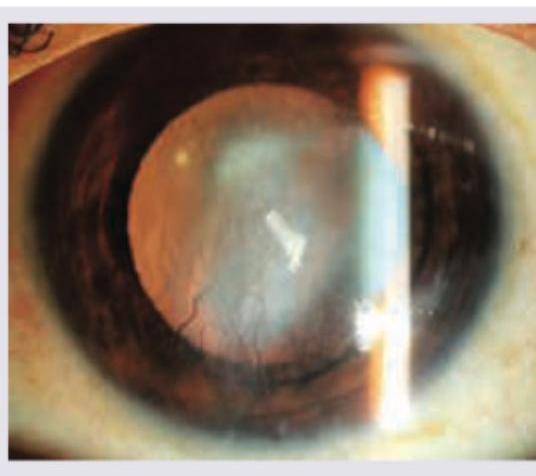
Which of the following is a treatment option for keratoconus?
Which of the following statements regarding corneal transplantation is true?
All of the following are true about blood staining of the cornea except?
A patient using contact lenses develops corneal infection. Laboratory diagnosis of Acanthamoeba keratitis was established. What is the best drug for its treatment?
Which form of calcium is deposited in band-shaped keratopathy?
Placido disc is used for measuring which parameter of the cornea?
Transparency of the cornea is mainly due to which layer?
Where are limbal stem cells located?
Dendritic ulcer is seen in:
Which gene is primarily responsible for anterior segment morphogenesis?
Explanation: **Explanation:** Keratoconus is a progressive, non-inflammatory thinning and cone-like ectasia of the cornea, leading to irregular myopic astigmatism. The management strategy is tiered based on the severity of the disease and the degree of visual impairment. 1. **Spectacles (Option A):** In the **early stages**, mild astigmatism can be corrected with spectacles. While they do not stop progression, they provide adequate visual acuity initially. 2. **Contact Lenses (Option B):** As the disease progresses and the cornea becomes more irregular, spectacles fail. **Rigid Gas Permeable (RGP)** or Scleral lenses become the mainstay of treatment. They create a regular refracting surface by trapping a tear film between the lens and the irregular cornea. 3. **Keratoplasty (Option C):** In **advanced stages** (e.g., presence of corneal scarring or hydrops) where contact lenses are no longer tolerated or effective, surgical intervention is required. Options include Deep Anterior Lamellar Keratoplasty (DALK) or Penetrating Keratoplasty (PKP). Since all three modalities are valid treatments depending on the clinical stage, **Option D** is correct. **High-Yield Clinical Pearls for NEET-PG:** * **CXL (Corneal Collagen Cross-linking):** The only treatment that **arrests the progression** of keratoconus (uses Riboflavin and UV-A light). * **Munson’s Sign:** V-shaped bulging of the lower lid on down-gaze (late sign). * **Vogt’s Striae:** Vertical stress lines in the posterior stroma. * **Fleischer’s Ring:** Iron deposition in the basal epithelium at the base of the cone (best seen with a cobalt blue filter). * **Rizutti’s Sign:** Conical reflection on the nasal cornea when light is shone from the temporal side.
Explanation: **Explanation:** **Correct Answer: C. Specular microscopy analysis is used to assess endothelial cell count** The success of a corneal transplant (keratoplasty) depends primarily on the health of the donor endothelium, as these cells do not regenerate and are responsible for maintaining corneal dehydration and clarity. **Specular microscopy** is the gold standard non-invasive technique used to evaluate the donor cornea. It provides a photographic record of the endothelial layer, allowing for the assessment of **Endothelial Cell Density (ECD)**, pleomorphism (variation in shape), and polymegethism (variation in size). For a successful transplant, a donor cell count of **>2000–2500 cells/mm²** is generally required. **Why other options are incorrect:** * **Option A:** The whole eye is typically preserved in a moist chamber at 4°C for short periods (up to 24 hours). However, for longer preservation, only the **corneo-scleral rim** is excised and stored in media like **McCarey-Kaufman (M-K) medium** (4 days) or **Optisol-GS** (up to 14 days). Tissue culture is used for long-term storage (up to 35 days). * **Option B:** There is no strict upper age limit for corneal donation. While younger tissue is preferred, donors **above 60 or 70 years** are frequently accepted provided the endothelial cell count is adequate and the tissue is healthy. * **Option D:** Unlike kidney or bone marrow transplants, **HLA matching is NOT mandatory** for routine corneal transplants because the cornea is an "immunologically privileged" site (avascular). It is only considered in "high-risk" cases (e.g., vascularized corneas or previous graft failures). **High-Yield Clinical Pearls for NEET-PG:** * **Ideal time for eye donation:** Within 6 hours of death. * **Contraindications for donation:** Death of unknown cause, slow virus infections (Rabies, SSPE, Creutzfeldt-Jakob), HIV, Hepatitis B/C, and systemic malignancies like Leukemia/Lymphoma. * **Storage Media:** M-K Medium (4°C, 4 days); Optisol-GS (4°C, 14 days - most common); Organ Culture (37°C, 35 days).
Explanation: **Explanation:** Corneal blood staining is a serious complication typically occurring after a traumatic **hyphema** (blood in the anterior chamber). It results from the breakdown of hemoglobin into **hemosiderin**, which penetrates the corneal stroma through a damaged endothelium. **1. Why Option B is the Correct Answer (The Exception):** Corneal blood staining clears **from the periphery towards the center**. The peripheral cornea clears first because of its proximity to the limbal blood vessels, which facilitate the removal of pigment. The central cornea is the last to clear. Therefore, the statement that it clears from the center to the periphery is incorrect. **2. Analysis of Other Options:** * **Option A:** Raised intraocular pressure (IOP) is the primary risk factor. High pressure forces red blood cell breakdown products through the endothelium into the stroma. * **Option C:** The clearing process is extremely slow. Depending on the density of the staining, it can take anywhere from **several months to 2 years or more** to resolve completely. * **Option D:** The visual prognosis is often poor because the staining can lead to **amblyopia** (especially in children) and is usually associated with severe ocular trauma and secondary glaucoma. **Clinical Pearls for NEET-PG:** * **Appearance:** Initially, the cornea looks rusty or greenish-brown; in late stages, it may resemble a "dislocated lens" in the anterior chamber. * **Management:** To prevent staining, a surgical wash-out of the hyphema is indicated if IOP remains >35 mmHg for 7 days or >25 mmHg for 1 day in patients with Sickle Cell Trait. * **Histology:** Staining is primarily due to **hemosiderin** granules in the stroma.
Explanation: **Explanation:** **Acanthamoeba keratitis** is a sight-threatening infection typically associated with contact lens wearers (due to poor hygiene or use of tap water). The organism exists in two forms: the active **trophozoite** and the highly resistant **double-walled cyst**. **Why Polyhexamethylene biguanide (PHMB) is the correct answer:** PHMB (0.02%) is a biguanide disinfectant that acts as a potent **cysticidal** agent. It disrupts the cytoplasmic membrane of the amoeba, leading to cell death. Because the cysts are notoriously resistant to most antibiotics and antifungals, biguanides (PHMB or Chlorhexidine) are considered the **first-line treatment** and the "gold standard" for medical management. **Analysis of Incorrect Options:** * **Propamidine (Brolene):** While used in the past (often in combination with biguanides), it is a diamidine. It is primarily effective against trophozoites but has poor cysticidal activity when used alone, leading to high recurrence rates. * **Neosporin:** This is a combination of Neomycin, Polymyxin B, and Bacitracin. While Neomycin has some anti-acanthamoebic activity, it is insufficient as monotherapy and is generally used as an adjunct to prevent secondary bacterial infection. * **Ketoconazole:** This is an antifungal agent. While some systemic antifungals (like Voriconazole) are used in refractory cases, Ketoconazole is not the primary treatment for Acanthamoeba. **High-Yield Clinical Pearls for NEET-PG:** * **Classic Sign:** **Ring-shaped stromal infiltrate** (late stage) and **Radial Keratoneuritis** (early stage, pathognomonic). * **Pain-Feature Mismatch:** The patient often experiences severe pain that is out of proportion to the clinical signs. * **Culture Media:** Non-nutrient agar (NNA) enriched with *E. coli*. * **Stains:** Calcofluor white (fluorescent) or Periodic acid-Schiff (PAS).
Explanation: **Explanation:** **Band-shaped Keratopathy (BSK)** is a degenerative condition characterized by the deposition of calcium salts in the sub-epithelial layers of the cornea, specifically within the **Bowman’s membrane**, the anterior stroma, and the epithelial basement membrane. 1. **Why Calcium Hydroxyapatite is Correct:** The specific chemical form of these deposits is **Calcium Hydroxyapatite** $[Ca_{10}(PO_4)_6(OH)_2]$. This occurs due to the precipitation of calcium salts in the interpalpebral fissure. The process is driven by the evaporation of tears, which increases the local concentration of salts, and the relative alkalinity of the exposed ocular surface (due to the loss of $CO_2$), which decreases the solubility of calcium phosphate. 2. **Why Incorrect Options are Wrong:** * **Calcium chloride:** This is a highly soluble salt and does not precipitate in ocular tissues under physiological conditions. * **Calcium cyanide:** This is a potent systemic toxin and is not a biological mineral found in human tissue. * **Sodium hydroxyapatite:** This is a chemically incorrect term; hydroxyapatite is inherently a calcium-phosphate mineral. **High-Yield Clinical Pearls for NEET-PG:** * **Appearance:** Characterized by a "Swiss-cheese" appearance (holes represent areas where corneal nerves pierce the Bowman’s membrane). * **Location:** Deposits begin at the limbus (3 and 9 o'clock positions) but are separated from the limbus by a **clear zone**. * **Etiology:** * *Chronic Uveitis* (most common cause in children, often associated with Juvenile Idiopathic Arthritis). * *Metabolic:* Hypercalcemia, Hyperphosphatemia, Chronic Renal Failure. * *Ocular:* Silicone oil in the vitreous cavity, Phthisis bulbi. * **Treatment:** The treatment of choice is **Chelation** using **EDTA** (Ethylenediamine tetra-acetic acid) after removing the corneal epithelium.
Explanation: **Explanation:** The **Placido disc** (keratoscope) is a diagnostic tool consisting of a series of concentric black and white rings. It works on the principle of **specular reflection**, where the anterior surface of the cornea acts as a convex mirror. 1. **Why "Corneal Surface" is correct:** The Placido disc is primarily used to assess the **regularity and integrity of the corneal surface**. When a patient looks at the disc, the reflection of the rings (Mire images) is observed. If the corneal surface is smooth and regular, the rings appear perfectly circular and concentric. If the surface is irregular (e.g., in keratoconus or corneal scarring), the rings appear distorted, broken, or crowded. 2. **Why other options are incorrect:** * **Corneal thickness (A):** Measured via **Pachymetry** (ultrasound or optical). * **Corneal staining (C):** Assessed using dyes like **Fluorescein** or Rose Bengal under a slit lamp to detect epithelial defects. * **Corneal curvature (D):** While Placido-based topography can derive curvature data, the primary parameter measured by the disc itself is the surface regularity. Quantitative curvature (dioptric power) is specifically measured by a **Keratometer**. **Clinical Pearls for NEET-PG:** * **Photokeratoscopy:** A Placido disc system that captures a photograph of the rings for analysis. * **Computerized Corneal Topography:** The modern evolution of the Placido disc, used for early diagnosis of **Keratoconus** (shows "steepening" or "bow-tie" patterns). * **Limitation:** It cannot provide information about the posterior corneal surface; for that, **Scheimpflug imaging** (e.g., Pentacam) is required.
Explanation: **Explanation:** The **corneal endothelium** is the single most important layer for maintaining corneal transparency. It acts as a metabolic pump (Na+/K+ ATPase pump) that actively removes water from the corneal stroma into the aqueous humor. This maintains the cornea in a state of **relative dehydration (deturgescence)**. If the endothelium fails, water enters the stroma, disrupting the uniform arrangement of collagen fibrils (Maurice’s lattice theory), leading to corneal edema and opacity. **Analysis of Options:** * **Endothelium (Correct):** It regulates the hydration status. A healthy cell count (approx. 2500–3000 cells/mm²) is vital; once lost, these cells do not regenerate, leading to irreversible bullous keratopathy. * **Descemet’s Membrane:** This is the basement membrane of the endothelium. While it provides structural support and is resistant to proteolysis (seen in *Descemetocele*), it does not actively regulate transparency. * **Bowman’s Membrane:** This is an acellular, condensed layer of the anterior stroma. It provides resistance to injury but does not regenerate if damaged (resulting in a scar) and plays no role in the active dehydration of the cornea. **High-Yield Clinical Pearls for NEET-PG:** * **Maurice’s Lattice Theory:** Transparency is due to the uniform diameter and quasi-regular lattice arrangement of collagen fibrils (spaced less than half the wavelength of light apart). * **Critical Cell Count:** Corneal decompensation and edema usually occur when the endothelial cell count falls below **500 cells/mm²**. * **Specular Microscopy:** The gold standard investigation to assess endothelial cell density and morphology (pleomorphism/polymegethism). * **Fuchs’ Endothelial Dystrophy:** A common clinical condition where endothelial "guttae" lead to stromal edema and loss of transparency.
Explanation: **Explanation:** The **limbus** is the transitional zone between the clear cornea and the opaque sclera. The corneal epithelium is unique because it undergoes constant renewal, which is dependent on a reservoir of multipotent cells known as **Limbal Stem Cells (LSCs)**. **Why the correct answer is right:** Limbal stem cells are specifically sequestered within the **Palisades of Vogt**. These are radial fibrovascular ridges located in the limbal basal epithelium. This specialized "niche" provides a protective environment with a rich vascular supply, shielding the stem cells from UV damage and mechanical stress while regulating their proliferation and differentiation into mature corneal epithelial cells. **Analysis of incorrect options:** * **Corneal stroma:** This is the thick, collagenous middle layer of the cornea. It contains keratocytes but does not house epithelial stem cells. * **Ciliary body:** This is part of the uveal tract responsible for aqueous humor production and accommodation; it has no role in corneal epithelial regeneration. * **Fornices:** The conjunctival fornices contain the **Glands of Krause** and stem cells for the *conjunctival* epithelium, not the corneal epithelium. **High-Yield Clinical Pearls for NEET-PG:** * **Limbal Stem Cell Deficiency (LSCD):** Caused by chemical burns (alkali is worse), Stevens-Johnson Syndrome, or ocular cicatricial pemphigoid. * **Clinical Sign:** Loss of Palisades of Vogt and **"Conjunctivalization"** of the cornea (conjunctival epithelium grows over the cornea, leading to vascularization and opacification). * **Treatment:** Limbal Stem Cell Transplantation (LSCT) or Simple Limbal Epithelial Transplantation (SLET).
Explanation: **Explanation:** **Herpes Simplex Keratitis (HSK)** is the most common cause of corneal blindness in developed nations. The hallmark of primary or recurrent epithelial HSK is the **Dendritic Ulcer**. This occurs due to active viral replication in the corneal epithelium, leading to cell lysis in a linear, branching pattern. **Key Features of the Dendritic Ulcer in HSK:** * **Morphology:** True branches with characteristic **terminal bulbs** (knobs) containing live virus. * **Staining:** The floor of the ulcer stains with **Fluorescein** (denuded epithelium), while the margins stain with **Rose Bengal** or Lissamine Green (devitalized cells). * **Sensation:** Significantly **reduced corneal sensations** (hypesthesia) due to trigeminal nerve involvement. **Why other options are incorrect:** * **Fungal Keratitis:** Typically presents with a "dry" looking ulcer, **feathery margins**, satellite lesions, and often a fixed hypopyon. * **Chlamydial Keratitis:** Usually presents as follicular conjunctivitis with superior epithelial keratitis or pannus, but not dendritic ulceration. * **Herpes Zoster Keratitis:** Characterized by **Pseudodendrites**. Unlike HSK, these are elevated (plaque-like), lack terminal bulbs, and do not stain deeply with fluorescein. **High-Yield Clinical Pearls for NEET-PG:** * **Treatment:** Topical **Acyclovir (3%)** or Ganciclovir. **Steroids are strictly contraindicated** in epithelial (dendritic) keratitis as they can lead to a "Geographic Ulcer." * **Recurrence:** Triggered by stress, fever, or UV exposure. * **Disciform Keratitis:** An endotheliitis (Type IV hypersensitivity) causing central stromal edema without an active epithelial ulcer.
Explanation: **Explanation:** The **PAX6 gene** (located on chromosome 11p13) is considered the **"master control gene"** for eye development. It is a homeobox gene that encodes a transcription factor essential for the morphogenesis of the entire eye, particularly the **anterior segment** (cornea, iris, ciliary body, and lens). Mutations in PAX6 lead to a spectrum of ocular anomalies, most notably **Aniridia**, as well as Peters anomaly and corneal opacification. **Analysis of Options:** * **PAX6 (Correct):** It initiates the formation of the optic vesicle and regulates the differentiation of the surface ectoderm into the lens and corneal epithelium. * **PITX2:** While also involved in anterior segment development, it is specifically associated with **Axenfeld-Rieger Syndrome**. It acts downstream or in coordination with PAX6 but is not the primary "master" regulator. * **TSG (Tumor Suppressor Genes):** This is a broad category of genes (like RB1) that regulate the cell cycle. While vital for preventing ocular tumors (like Retinoblastoma), they are not the primary morphogenetic drivers for the anterior segment. * **GLC1:** This locus (specifically GLC1A or MYOC) is associated with **Primary Open Angle Glaucoma (POAG)** and juvenile-onset glaucoma, rather than the initial structural morphogenesis of the eye. **High-Yield Clinical Pearls for NEET-PG:** * **WAGR Syndrome:** A deletion involving PAX6 results in **W**ilms tumor, **A**niridia, **G**enitourinary anomalies, and mental **R**etardation. * **Aniridia:** Characterized by a rudimentary iris, foveal hypoplasia, and nystagmus; it is the classic clinical manifestation of a PAX6 mutation. * **Keratocytes:** PAX6 expression continues in the adult cornea to maintain the transparency and regenerative capacity of the corneal epithelium.
Corneal Anatomy and Physiology
Practice Questions
Bacterial Keratitis
Practice Questions
Viral Keratitis
Practice Questions
Fungal Keratitis
Practice Questions
Protozoan Keratitis
Practice Questions
Corneal Degenerations
Practice Questions
Corneal Dystrophies
Practice Questions
Keratoconus and Ectatic Disorders
Practice Questions
Corneal Transplantation
Practice Questions
Corneal Topography and Imaging
Practice Questions
Dry Eye Disease
Practice Questions
Corneal Trauma
Practice Questions
Get full access to all questions, explanations, and performance tracking.
Start For Free