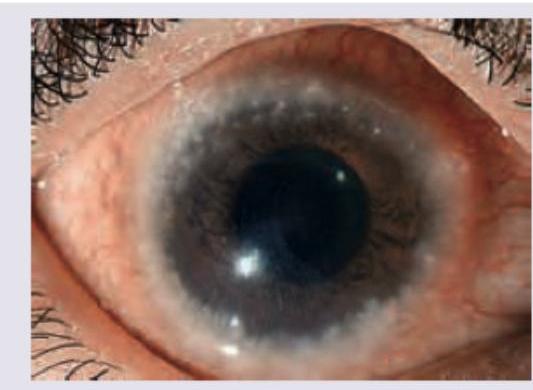
What is correct about the image shown below?
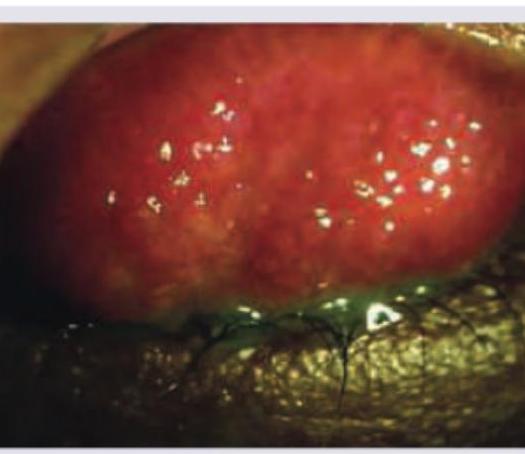
A patient from slum presents with grittiness in eyes. Everted eyelid shows: (Recent NEET Pattern 2016-17)
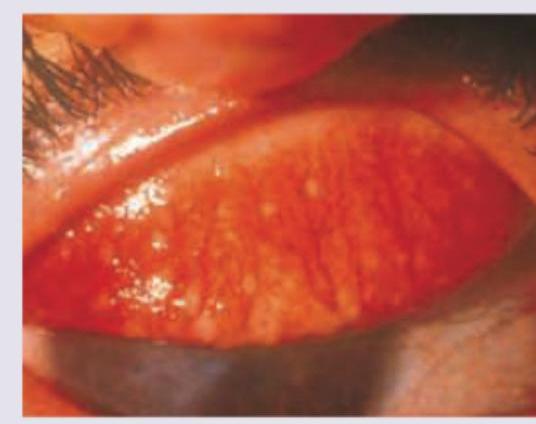
A 5-year-old child presents with severe itching and ropy discharge. Image shows:
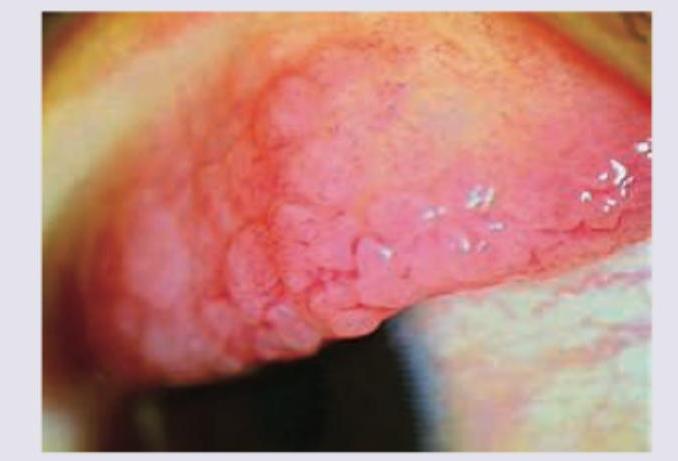
The image shown below depicts:
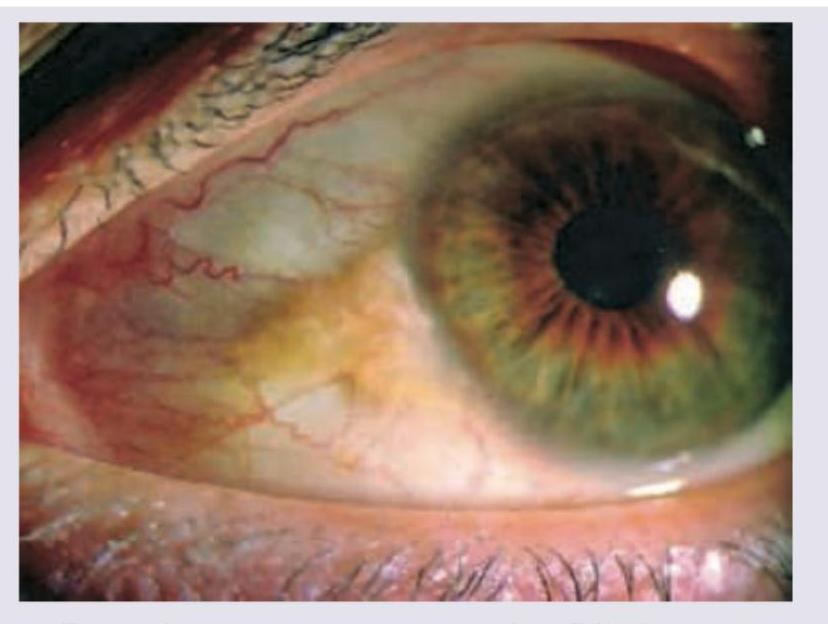
A five-year-old child presents with recurrent episodes of thick, woody pseudomembranous growths on the conjunctiva that have been difficult to remove. Which condition is shown in the image below?
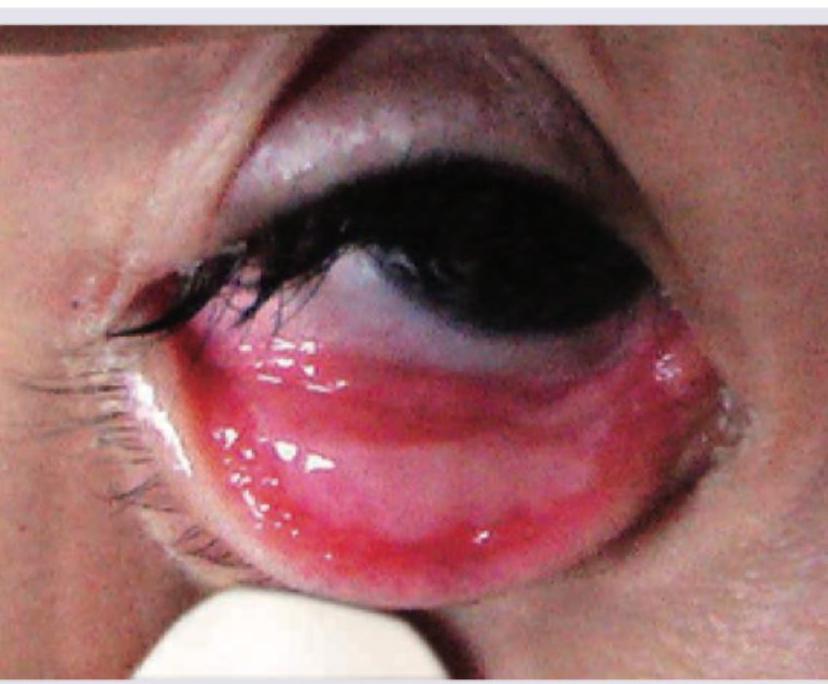
The given image shows presence of:
A 25-year-old lady presents with itching and excoriation of the skin near inner canthus bilaterally. Sometimes a slight mucopurulent discharge is present in the morning. What is the best treatment for this patient? (Recent NEET Pattern 2016-17)
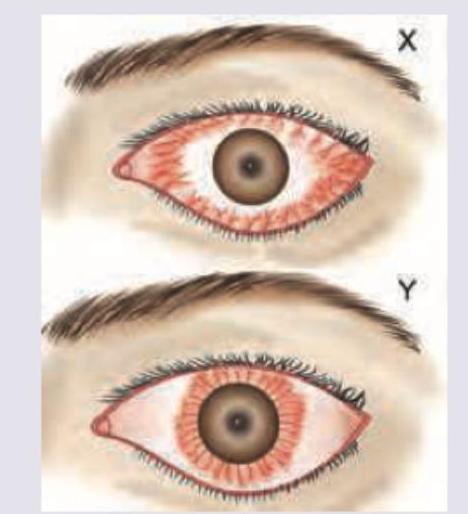
A patient presents with red eye. What is correct about the image shown below?
Spring catarrh is a type of conjunctivitis caused by
All are true about Vernal conjunctivitis EXCEPT:
Explanation: ***Vernal conjunctivitis*** - The image exhibits **cobblestone papillae** on the upper tarsal conjunctiva, which are characteristic of vernal keratoconjunctivitis (VKC). - The small white dots on top of the papillae are often **Trantas dots**, another hallmark of active VKC, consisting of degenerated eosinophils and epithelial cells. *Trachoma* - Trachoma is characterized initially by **follicular conjunctivitis** and later by scarring, which can lead to **entropion** and trichiasis, not the large papillae seen here. - While it can cause superior tarsal scarring (Arlt's line) and Herbert’s pits, these features are distinct from the hypertrophied papillae in the image. *Eales disease* - Eales disease is primarily a **retinal vasculitis** affecting the peripheral retina, leading to recurrent vitreous hemorrhage and retinal detachment. - It does not present with conjunctival findings like those shown in the image. *Phlyctenular keratoconjunctivitis* - This condition involves the formation of **phlyctenules** (small, nodular lesions) on the cornea or conjunctiva, often associated with hypersensitivity reactions to bacterial antigens. - It does not present with diffuse cobblestone papillae on the tarsal conjunctiva.
Explanation: ***Trachoma*** - The image shows **conjunctival follicles** and **gritty sensation** in a patient from a slum, which are classic signs of Trachoma caused by *Chlamydia trachomatis*. The everted eyelid typically reveals these characteristic follicles. - Trachoma is prevalent in areas with **poor sanitation** and **limited access to water**, consistent with a "slum" setting. *Vernal conjunctivitis* - Characterized by **giant papillae (cobblestone papillae)** on the upper tarsal conjunctiva, often associated with a history of allergies and intense itching. - While it can cause grittiness, the picture does not show the typical giant papillae, but rather smaller, more numerous follicles. *Eales disease* - This is an **idiopathic inflammatory vaso-occlusive disease** affecting the retinal vessels, primarily in young adult males. - It presents with **recurrent vitreous hemorrhages and retinal detachment**, not primarily with conjunctival findings or grittiness. *Phlyctenular keratoconjunctivitis* - Involves the formation of **phlyctenules** (small, nodular lesions) on the conjunctiva or cornea, often associated with delayed hypersensitivity to microbial antigens, such as *Staphylococcus* or *Mycobacterium tuberculosis*. - While it can cause grittiness and photophobia, the follicular pattern in the image is not typical of phlyctenules.
Explanation: ***Vernal conjunctivitis*** - The image exhibits **giant papillae** on the upper tarsal conjunctiva, a hallmark feature of vernal conjunctivitis. - The history of **severe itching** and **ropy discharge** in a child are classic symptoms of this allergic condition. *Ligneous conjunctivitis* - Characterized by the formation of **wood-like, firm, white, or yellowish pseudomembranes** on the conjunctiva, which are not seen here. - This is a rare form of chronic conjunctivitis often associated with **plasminogen deficiency**. *Angular conjunctivitis* - Primarily caused by **_Moraxella lacunata_** and is characterized by chronic conjunctival inflammation predominantly affecting the **outer canthi** (angles of the eye). - It typically presents with localized redness, soreness, and maceration of the skin at the **lateral canthi**, and not the diffuse papillary hypertrophy seen in the image. *Parinaud's conjunctivitis* - A rare unilateral conjunctivitis associated with **lymphadenopathy** caused by various infections, most commonly **cat-scratch disease** (_Bartonella henselae_). - It presents with **granulomas** and **follicles** on the conjunctiva, along with a prominent preauricular or submandibular lymph node, features not consistent with the image or symptoms.
Explanation: ***Pterygium*** - The image shows a **triangular growth of conjunctival tissue** extending onto the cornea, which is characteristic of a pterygium. - This growth typically involves **vascularization** and can eventually affect vision by encroaching on the pupillary area. *Bitot's spots* - These are **foamy, white, or silvery patches** on the conjunctiva, often associated with **vitamin A deficiency**. - They are distinct from the fleshy, vascularized growth seen in the image. *Nodular scleritis* - Nodular scleritis presents as a **painful, localized nodule** on the sclera, often red or bluish, due to inflammation of the sclera. - The lesion in the image is a **conjunctival and corneal growth**, not an inflamed scleral nodule. *Pinguecula* - A pinguecula is a **yellowish, benign growth** on the conjunctiva, usually on the nasal side, but it **does not extend onto the cornea**. - The image clearly shows the growth extending past the limbus onto the cornea, differentiating it from a pinguecula.
Explanation: ***Ligneous conjunctivitis*** - The image shows a **thick, woody, and pseudomembranous growth** on the conjunctiva, which is characteristic of ligneous conjunctivitis. - This condition is a rare form of chronic pseudomembranous conjunctivitis linked to a deficiency in **plasminogen**, leading to impaired fibrinolysis. *Adenovirus pseudomembrane* - While adenoviral conjunctivitis can cause pseudomembranes, they are typically **thinner** and more easily peelable than the thick, fibrin-rich lesions seen in the image. - Adenoviral infections are usually acute and self-limiting, whereas ligneous conjunctivitis tends to be **chronic and recurrent**. *Vernal conjunctivitis* - Vernal conjunctivitis is an **allergic condition** characterized by **cobblestone papillae** on the upper tarsal conjunctiva and **Trantas dots** at the limbus, which are not depicted in the image. - It often presents with intense itching and a ropy mucous discharge, distinct from the solid mass shown. *Foreign body granuloma* - A foreign body granuloma typically presents as a **localized, firm nodule** and is usually a reaction to a retained foreign material. - The diffuse, extensive, and often bilateral involvement of the conjunctiva as seen here is inconsistent with a typical foreign body granuloma.
Explanation: ***Arcus senilis*** - The image clearly displays a **gray-white opaque ring** around the corneal limbus, which is characteristic of arcus senilis. - This ring is formed by **lipid deposits** (cholesterol and phospholipids) in the peripheral cornea. *Horner Tranta's spots with bulbar congestion* - **Horner-Trantas spots** are gelatinous papulae seen at the limbus, typically in allergic conjunctivitis, and are not visible in this image. - While there is some **bulbar congestion** (redness of the conjunctiva), it is a non-specific finding and not the primary feature shown. *Normal eye* - A **normal eye** would not exhibit the prominent gray-white corneal ring seen in the image. - The presence of this distinct deposit indicates an abnormality, specifically lipid deposition. *Herbert's pits* - **Herbert's pits** are characteristic of resolved trachoma, appearing as small, shallow depressions at the limbus after the resorption of limbal follicles. - The image shows a **continuous white ring**, not discrete pits.
Explanation: ***Oxytetracycline with zinc oxide*** - The patient's symptoms of itching, excoriation near the inner canthus bilaterally, and mucopurulent discharge suggest an **angular blepharoconjunctivitis**, often caused by *Staphylococcus* or *Moraxella*. - **Oxytetracycline is an effective broad-spectrum antibiotic** against these organisms, and **zinc oxide has astringent and mild antiseptic properties** that help in drying out the moist excoriated skin and soothing irritation, making this combination ideal. *Gentamicin with boric acid* - **Gentamicin is an aminoglycoside antibiotic** that can be effective against certain bacterial infections, but it's not the **first-line choice for angular blepharoconjunctivitis** and can have higher rates of allergic reactions. - **Boric acid has weak antiseptic properties** but is generally less effective for the significant excoriation and discharge seen in angular blepharitis compared to zinc oxide. *Gentamicin with zinc oxide* - While **zinc oxide** is beneficial for the skin irritation, **gentamicin** may not be the most appropriate primary antibiotic for the causative organisms of angular blepharitis. - The efficacy against common pathogens of this condition might be superior with alternative antibiotics like tetracyclines. *Oxytetracycline with boric acid* - **Oxytetracycline is a good antibiotic choice** for angular blepharoconjunctivitis. - However, **boric acid is typically less effective than zinc oxide** for the specific excoriation and skin healing required in this condition, as zinc oxide provides better astringent and protective properties for inflamed skin.
Explanation: ***Correct: X = Conjunctival congestion, Y = Ciliary congestion*** - Image X demonstrates **conjunctival congestion**, characterized by dilated superficial blood vessels that are more prominent away from the limbus and **reddening in the fornices**, indicating a superficial inflammation like conjunctivitis. - Image Y shows **ciliary congestion (perilimbal injection)**, where prominent deep vessels form a reddish-purple ring around the limbus, suggesting deeper inflammation such as **uveitis, keratitis, or acute angle-closure glaucoma**. *Incorrect: X = Ciliary congestion, Y = Conjunctival congestion* - This option reverses the patterns of vascular dilation shown in images X and Y. - Ciliary congestion (Y) is characterized by a **violaceous flush around the cornea (limbus)**, while conjunctival congestion (X) shows **more diffuse redness that is worse in the fornices**. *Incorrect: X = Phlyctenular keratoconjunctivitis, Y = Angular conjunctivitis* - This option incorrectly identifies specific inflammatory conditions rather than the types of congestion shown. - **Phlyctenular keratoconjunctivitis** involves nodular lesions (phlyctenules) near the limbus, which are not depicted in image X. - **Angular conjunctivitis** causes redness and excoriation primarily at the outer and inner canthi, not the perilimbal pattern seen in image Y. *Incorrect: X = Angular conjunctivitis, Y = Phlyctenular keratoconjunctivitis* - This option reverses the incorrect attributions from the previous option. - Angular conjunctivitis affects the **canthi** (not the diffuse pattern in X), and phlyctenular keratoconjunctivitis involves **nodules on the conjunctiva or cornea** (not the circumcorneal congestion in Y).
Explanation: ***Exogenous allergen*** - **Spring catarrh**, also known as **vernal keratoconjunctivitis (VKC)**, is exclusively a type of allergic conjunctivitis. - It is triggered by exposure to **environmental allergens**, commonly identified as dust, pollen, or other airborne irritants, especially during warmer seasons. *Virus infection* - Viral conjunctivitis, such as that caused by **adenovirus**, often presents with watery discharge, redness, and may be associated with an upper respiratory tract infection. - Unlike spring catarrh, it is highly **contagious** and does not typically recur seasonally due to allergen exposure. *Endogenous toxins* - Ocular conditions caused by endogenous toxins are rare and usually associated with systemic diseases or metabolic disorders affecting body system, not typically a primary cause of conjunctivitis. - This category does not align with the clear allergic and seasonal presentation characteristic of spring catarrh. *Bacterial infection* - Bacterial conjunctivitis is characterized by purulent (pus-like) discharge, severe redness, and often involves one eye initially (though can spread to both). - It is treated with antibiotics and does not typically exhibit the seasonal recurrence or papillary hypertrophy on the tarsal conjunctiva seen in spring catarrh.
Explanation: ***Most signs are in lower lid*** ✗ - This is **INCORRECT** and is the answer to this EXCEPT question. - **Vernal conjunctivitis (VKC)** primarily affects the **upper tarsal conjunctiva**, not the lower lid. - The characteristic **cobblestone papillae** develop on the **upper eyelid** due to friction from blinking, causing **papillary hypertrophy**. - While bulbar conjunctiva and limbus can be affected, the most severe signs are in the **upper lid**. *Type of allergic conjunctivitis* ✓ - **VKC** is correctly classified as a chronic, bilateral, severe form of **allergic conjunctivitis**. - It is typically a **Type I hypersensitivity reaction**, often associated with atopy. *Cobblestone appearance* ✓ - This refers to the characteristic **large, flattened giant papillae** that develop on the **upper tarsal conjunctiva** in VKC. - The appearance results from marked hypertrophy of these papillae, resembling cobblestones. *Itchy eyes with other allergic problems* ✓ - **Intense itching** is the cardinal symptom of VKC, often accompanied by **photophobia**, **tearing**, and stringy mucous discharge. - Patients frequently have a personal or family history of other **atopic conditions** like asthma, eczema, or allergic rhinitis.
Conjunctivitis: Bacterial
Practice Questions
Conjunctivitis: Viral
Practice Questions
Conjunctivitis: Allergic
Practice Questions
Conjunctivitis: Chronic
Practice Questions
Degenerations of Conjunctiva
Practice Questions
Benign Tumors of Conjunctiva
Practice Questions
Malignant Tumors of Conjunctiva
Practice Questions
Conjunctival Manifestations of Systemic Diseases
Practice Questions
Cicatricial Conjunctival Disorders
Practice Questions
Pterygium and Pinguecula
Practice Questions
Conjunctival Trauma
Practice Questions
Subconjunctival Hemorrhage
Practice Questions
Get full access to all questions, explanations, and performance tracking.
Start For Free