What is the most common cause of blepharoconjunctivitis?
What is the most common cause of conjunctivitis in a newborn?
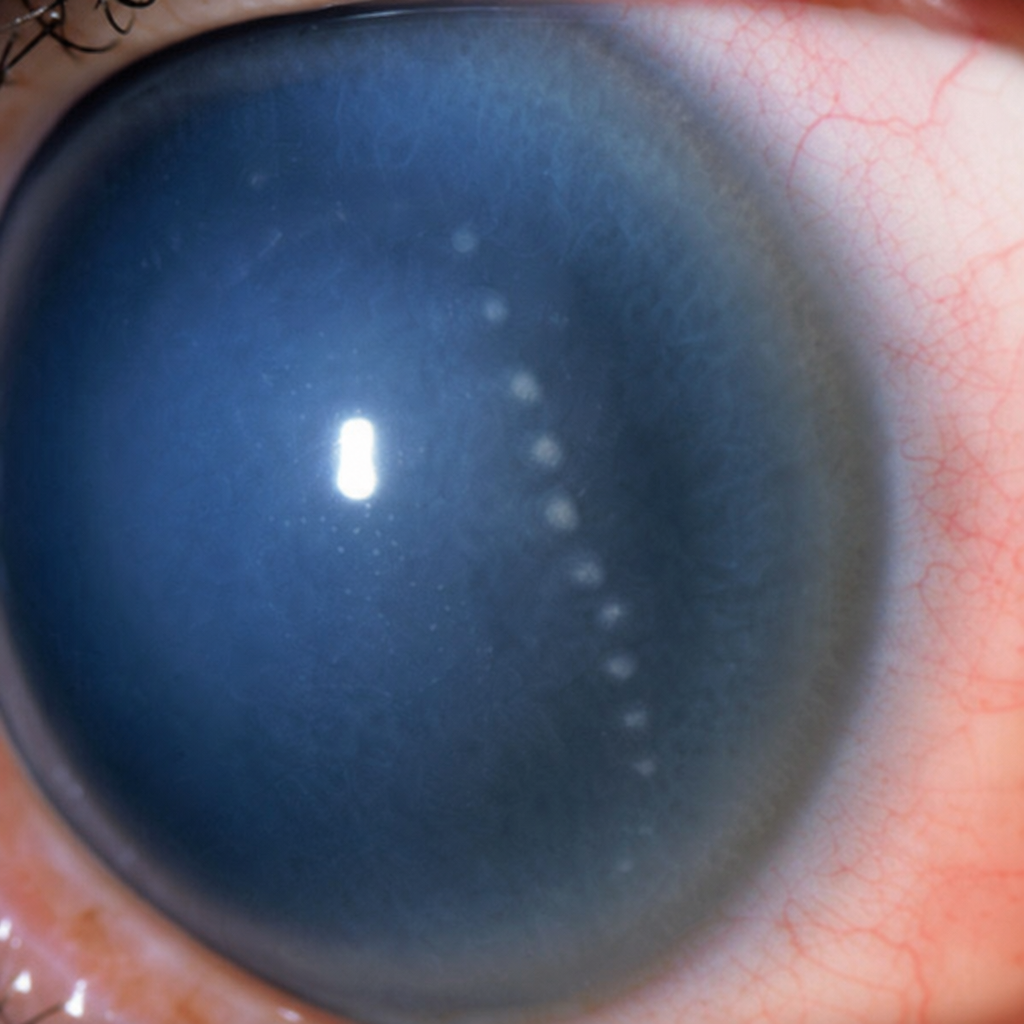
Herpes pits are diagnostic of which condition?
Which of the following may present as a bluish red nodule resembling conjunctival hemorrhage?
Which of the following is NOT a feature of conjunctivitis?
Chalazion of the lid is characterized by which of the following pathological findings?
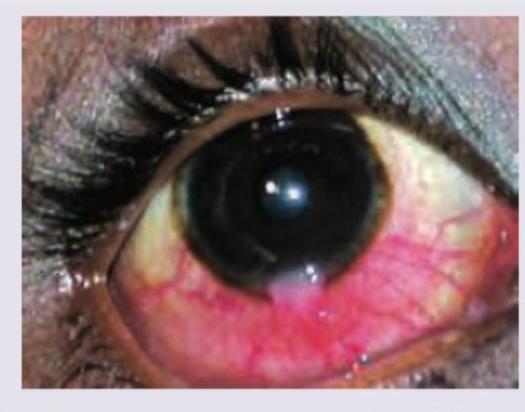
Type IV hypersensitivity to Mycobacterium tuberculosis antigen may manifest as?
A 10-year-old boy presents with severe itching of the eye and a ropy discharge. His symptoms aggravate in the summer season. What is the most likely diagnosis?
Trachoma in a newborn cannot produce follicular reaction because:
Recurrent chalazion has the risk of which of the following?
Explanation: **Explanation:** **Blepharoconjunctivitis** is a clinical condition characterized by the simultaneous inflammation of the eyelid margins (blepharitis) and the conjunctiva. **Why Staphylococcus aureus is correct:** *Staphylococcus aureus* is the most common cause of both chronic ulcerative blepharitis and acute blepharoconjunctivitis. It produces exotoxins and enzymes that irritate the ocular surface and cause a hypersensitivity reaction. This leads to the characteristic "collarettes" (crusts) around the base of the eyelashes, marginal keratitis, and papillary conjunctival reaction. **Analysis of Incorrect Options:** * **Corynebacterium:** While *Corynebacterium xerosis* is a commensal of the conjunctival sac, it is rarely a primary pathogen. It is more commonly associated with Bitot’s spots in Vitamin A deficiency. * **Moraxella lacunata:** This organism is the classic cause of **Angular Blepharoconjunctivitis**, characterized by excoriation of the skin at the outer or inner canthus. While high-yield, it is not the *most common* cause overall. * **Staphylococcus epidermidis:** Although it is the most common commensal of the eyelid and a frequent cause of chronic blepharitis, *S. aureus* remains the more virulent and frequent primary pathogen for clinically significant blepharoconjunctivitis. **High-Yield Clinical Pearls for NEET-PG:** 1. **Angular Blepharoconjunctivitis:** Always associate this with *Moraxella lacunata* and treatment with Zinc oxide/Boric acid. 2. **Collarettes:** Pathognomonic for Staphylococcal blepharitis (crusts encircling the lash). 3. **Sleeves:** Pathognomonic for *Demodex* infestation (cylindrical dandruff). 4. **Treatment:** Management involves lid hygiene (warm compresses and lid scrubs) and topical antibiotic ointments (Erythromycin or Bacitracin).
Explanation: **Explanation:** The question addresses **Ophthalmia Neonatorum**, defined as any discharge or inflammation of the conjunctiva occurring within the first 30 days of life. **Why Gonococcal is the correct answer:** While *Chlamydia trachomatis* is globally the most frequent cause of neonatal conjunctivitis in general populations, **Gonococcal conjunctivitis (*Neisseria gonorrhoeae*)** is historically and clinically emphasized in medical examinations as the most significant and "classical" bacterial cause. In the context of this specific four-option MCQ (where Chlamydia is absent), *N. gonorrhoeae* is the most common and dangerous pathogen. It is characterized by a hyperacute, profuse purulent discharge and carries a high risk of corneal perforation if not treated aggressively with systemic Ceftriaxone. **Why the other options are incorrect:** * **Staphylococcal (B):** *Staphylococcus aureus* is a common cause of bacterial conjunctivitis in older children and adults, but it is less frequent than Gonococcus or Chlamydia in the immediate neonatal period. * **Streptococcal (C) & Pneumococcal (D):** While these can cause conjunctivitis, they are sporadic causes in newborns and do not match the prevalence or clinical significance of Gonococcus in the birth canal transmission route. **High-Yield Clinical Pearls for NEET-PG:** * **Incubation Periods (Crucial for Diagnosis):** * **Chemical (Silver Nitrate):** First 24 hours. * **Gonococcal:** 2–5 days (Most severe). * **Chlamydial (TRIC):** 5–14 days (Most common overall). * **Herpes Simplex:** 1–2 weeks. * **Prophylaxis:** 1% Silver nitrate (Credé’s method) or Erythromycin ointment. * **Treatment:** Gonococcal requires **systemic** antibiotics (Ceftriaxone) because of the risk of systemic dissemination (e.g., arthritis, meningitis).
Explanation: **Explanation:** **Herbert’s pits** (often misspelled or misheard as "Herpes pits") are a pathognomonic clinical feature of **Trachoma**, which is caused by *Chlamydia trachomatis* (Serotypes A, B, Ba, and C). ### Why Chlamydial Infection is Correct: In the active stage of Trachoma, lymphoid follicles form at the upper limbus. As these follicles heal and regress, they leave behind characteristic shallow, circular, pigmented depressions in the limbal area. These cicatricial depressions are known as **Herbert’s pits**. Their presence is diagnostic of past or chronic chlamydial infection. ### Why Other Options are Incorrect: * **Buphthalmos:** This refers to an enlarged eyeball due to congenital glaucoma. It is characterized by Haab’s striae (breaks in Descemet’s membrane), not limbal pits. * **HSV Infection:** Herpes Simplex Virus typically causes dendritic or geographic ulcers on the cornea. While it can cause follicular conjunctivitis, it does not result in Herbert’s pits. * **Vernal Catarrh (VKC):** This allergic condition presents with "cobblestone" papillae on the palpebral conjunctiva and **Trantas dots** (white limbal spots consisting of eosinophils), but not permanent cicatricial pits. ### NEET-PG High-Yield Pearls for Trachoma: * **Arlt’s Line:** A horizontal scar on the upper palpebral conjunctiva (junction of anterior 1/3rd and posterior 2/3rd). * **WHO Classification (FISTO):** **F**ollicles, **I**ntense inflammation, **S**carring, **T**richiasis, **O**pacity. * **SAFE Strategy:** **S**urgery, **A**ntibiotics (Azithromycin is the drug of choice), **F**acial cleanliness, **E**nvironmental improvement. * **Vector:** The common housefly (*Musca sorbens*).
Explanation: **Explanation:** **Kaposi Sarcoma (KS)** is a vascular neoplasm caused by Human Herpesvirus 8 (HHV-8), most commonly seen in patients with HIV/AIDS. In the eye, it typically involves the conjunctiva (usually the inferior fornix). It presents as a **bright red or bluish-red, highly vascularized subconjunctival mass**. Because of its intense vascularity and color, it is frequently mistaken for a chronic subconjunctival hemorrhage. However, unlike a hemorrhage, it does not resolve over time and may appear as a fleshy, elevated nodule. **Why the other options are incorrect:** * **Ciliary Staphyloma:** This is a thinning of the sclera with incarceration of uveal tissue. While it appears dark blue/black, it is located over the ciliary body (behind the limbus) and represents a structural defect of the globe rather than a vascular nodular mass. * **Lymphoma:** Conjunctival lymphoma typically presents as a smooth, painless, **"salmon-pink" or "flesh-colored"** subconjunctival patch or mass. It lacks the intense bluish-red vascular appearance of KS. * **Limbal Dermoid:** This is a congenital choristoma (normal tissue in an abnormal location). It appears as a **whitish-yellow, firm, solid mass** at the limbus, often containing hair follicles or sebaceous glands. **High-Yield Clinical Pearls for NEET-PG:** 1. **HIV Association:** Any patient presenting with a lesion suspicious for Kaposi Sarcoma should be screened for HIV/AIDS. 2. **Differential Diagnosis:** Always differentiate a non-resolving "hemorrhage" from KS or a malignant melanoma. 3. **Treatment:** Management includes Highly Active Antiretroviral Therapy (HAART), local excision, cryotherapy, or radiotherapy. 4. **Salmon-patch appearance:** This is the classic buzzword for Conjunctival Lymphoma.
Explanation: **Explanation:** In ophthalmology, distinguishing between **conjunctivitis** (a superficial inflammation) and **sight-threatening intraocular conditions** (like acute glaucoma or iridocyclitis) is a high-yield clinical skill. **Why "Impaired pupillary reactions" is the correct answer:** Conjunctivitis is an inflammation of the conjunctiva, which is an extraocular structure. It does not involve the internal structures of the eye such as the iris or the ciliary body. Therefore, the **pupillary size and reaction to light remain normal**. Impaired pupillary reactions are "red flags" indicating deeper involvement: * **Fixed, mid-dilated pupil:** Suggests Acute Congestive Glaucoma. * **Constricted/Miosis (sluggish reaction):** Suggests Acute Iridocyclitis (Uveitis). **Analysis of incorrect options:** * **Mucoid discharge (A):** This is a hallmark of conjunctivitis. Discharge can be watery (viral), purulent (bacterial), or mucoid/ropy (allergic). * **Chemosis (C):** This refers to edema of the conjunctiva. It is a common sign of acute inflammation, especially in allergic or severe bacterial conjunctivitis. * **Halos (D):** While classically associated with glaucoma (due to corneal edema), halos can occur in conjunctivitis when thick **mucopurulent discharge** lies over the cornea, acting as a prism. These "false halos" disappear after washing the eye or blinking. **NEET-PG High-Yield Pearls:** * **Vision:** Always remains **normal** in simple conjunctivitis; it is blurred/decreased in glaucoma and uveitis. * **Ciliary Congestion:** Absent in conjunctivitis (which shows superficial conjunctival congestion) but present in keratitis and iridocyclitis. * **Pain:** Conjunctivitis presents with "grittiness" or "foreign body sensation," not the deep, throbbing ache seen in intraocular inflammation.
Explanation: ### Explanation **Correct Answer: C. Chronic lipogranulomatous inflammation** **Why it is correct:** A chalazion is a chronic inflammatory lesion caused by the obstruction of a **Meibomian gland** (modified sebaceous gland). When the gland duct is blocked, lipid secretions (sebum) leak into the surrounding tarsal stroma. These lipids act as foreign bodies, triggering a **granulomatous inflammatory response**. Histologically, this is characterized by a "lipogranuloma"—a collection of epithelioid cells, multinucleated giant cells (Langhans and foreign-body type), lymphocytes, and plasma cells surrounding clear spaces that originally contained the lipid material. **Why the other options are incorrect:** * **A. Caseous necrosis:** This is the hallmark of Tuberculosis. While chalazion is granulomatous, it is non-caseating. * **B. Chronic nonspecific inflammation:** This refers to general infiltration by lymphocytes and plasma cells without the formation of organized granulomas or giant cells. Chalazion has a specific granulomatous architecture. * **D. Liposarcoma:** This is a malignant tumor of adipose tissue. While both involve lipids, a chalazion is purely inflammatory/benign and does not involve neoplastic proliferation of adipocytes. **NEET-PG High-Yield Pearls:** * **Location:** Most common in the **upper lid** (due to a higher number of Meibomian glands). * **Clinical Feature:** It is a **painless**, firm, non-tender nodule away from the lid margin (unlike a stye/hordeolum which is painful). * **Complication:** A large chalazion can cause **against-the-rule astigmatism** by pressing on the cornea. * **Red Flag:** Recurrent chalazion in the same location in elderly patients must be biopsied to rule out **Sebaceous Gland Carcinoma**. * **Treatment:** Conservative (warm compresses) or surgical (**Incision and Curettage** via a vertical incision on the conjunctival side to avoid damaging adjacent glands).
Explanation: **Explanation:** **Phlyctenular conjunctivitis** is a localized **Type IV (delayed-type) hypersensitivity reaction** of the conjunctiva and cornea to endogenous microbial proteins. Historically and most commonly in developing countries, the inciting antigen is **Mycobacterium tuberculosis**. Other triggers include *Staphylococcus aureus* (common in the West), *Moraxella*, and certain fungi. The condition is characterized by the formation of a **phlycten**—a small, greyish-yellow nodule surrounded by a zone of hyperemia. Pathologically, this represents a lymphocytic infiltration in the subepithelial tissue. **Analysis of Incorrect Options:** * **A. Iridocyclitis:** While TB can cause granulomatous uveitis, it is typically due to direct infection or a different immunological mechanism, not specifically a Type IV reaction manifesting as a phlycten. * **B. Polyarteritis nodosa (PAN):** This is a systemic necrotizing vasculitis associated with **Type III hypersensitivity** (immune complex deposition), frequently linked to Hepatitis B, not TB antigens. * **C. Giant cell arteritis:** This is a large-vessel vasculitis of the elderly. While it involves granulomatous inflammation, it is not a recognized manifestation of hypersensitivity to TB antigens. **High-Yield Clinical Pearls for NEET-PG:** * **Triad of Symptoms:** Photophobia, lacrimation, and blepharospasm (more severe when the cornea is involved). * **Fascicular Ulcer:** A characteristic wandering corneal ulcer that carries a leash of blood vessels behind it. * **Treatment:** Topical steroids (to control the hypersensitivity) and investigation/treatment of the underlying cause (e.g., Chest X-ray/Mantoux test for TB).
Explanation: **Explanation:** The clinical presentation of a young boy with **seasonal exacerbation** (summer), **severe itching**, and **ropy (stringy) discharge** is a classic description of **Vernal Keratoconjunctivitis (VKC)**, also known as "Spring Catarrh." **Why Vernal Keratoconjunctivitis is correct:** VKC is a bilateral, recurrent, external ocular inflammation primarily affecting young males (usually 5–20 years old). It is a **Type I IgE-mediated hypersensitivity** reaction to environmental allergens. The hallmark symptoms include intense itching (the most constant feature) and a characteristic thick, tenacious, ropy discharge due to increased mucus production from goblet cells. **Why other options are incorrect:** * **Blepharitis:** This is a chronic inflammation of the eyelid margins. While it causes irritation, it does not typically present with seasonal peaks or the classic ropy discharge seen in VKC. * **Trachoma:** Caused by *Chlamydia trachomatis*, this is a chronic infectious keratoconjunctivitis. It presents with follicles and scarring (Arlt’s line, Herbert’s pits) rather than seasonal itching and ropy discharge. * **Acute Conjunctivitis:** Usually viral or bacterial. Viral presents with watery discharge and follicles; bacterial presents with mucopurulent discharge and crusting. Neither is strictly seasonal or characterized by the intense itching of VKC. **High-Yield Clinical Pearls for NEET-PG:** * **Cobblestone Papillae:** Large, flat-topped papillae found on the superior palpebral conjunctiva (Palpebral form). * **Trantas Dots:** White, chalky dots at the limbus consisting of eosinophils and epithelial debris (Limbal form). * **Shield Ulcer:** A sterile, transverse oval ulcer in the upper cornea (a serious complication). * **Maxwell-Lyons Sign:** A thin film of fibrin/mucus covering the giant papillae. * **Treatment:** Mast cell stabilizers (Sodium Cromoglycate), antihistamines, and topical steroids for acute flares.
Explanation: **Explanation:** The correct answer is **B. The adenoid layer is devoid of lymphoid tissue.** **1. Understanding the Mechanism:** A follicle is a localized collection of lymphocytes and other inflammatory cells within the conjunctival stroma. In the conjunctiva, the stroma is divided into two layers: the superficial **adenoid layer** and the deeper **fibrous layer**. In a newborn, the adenoid layer is structurally present but is **physiologically immature and devoid of lymphoid tissue**. Lymphoid tissue only begins to develop in the conjunctiva between **3 to 6 months of age**. Since follicles are essentially lymphoid aggregations, they cannot form in a newborn regardless of the severity of the infection (such as Trachoma or Inclusion Conjunctivitis). Instead, the newborn conjunctiva responds to inflammation with a **papillary reaction**. **2. Analysis of Incorrect Options:** * **Option A:** While maternal IgG antibodies are transferred via the placenta, they do not prevent the local cellular structural response (follicle formation) in the conjunctiva. * **Option C:** The absence of follicles is due to a **structural/anatomical lack** of lymphoid tissue, not a generalized failure of the systemic immune system. * **Option D:** The incubation period for Chlamydia trachomatis is typically 5–14 days, not one year. **Clinical Pearls for NEET-PG:** * **Follicles vs. Papillae:** Follicles are "rice-like" pale elevations (vascularity on the surface), while papillae have a central vascular core (redder appearance). * **Trachoma Stages:** Remember the WHO classification (**FIST**: **F**ollicular, **I**ntense, **S**carring, **T**richiasis). * **Arlt’s Line:** Horizontal scarring in the upper palpebral conjunctiva (pathognomonic for Trachoma). * **Herbert’s Pits:** Healed follicles at the limbus.
Explanation: **Explanation:** **Why Sebaceous Cell Carcinoma is correct:** A chalazion is a chronic granulomatous inflammation of the **Meibomian glands** (modified sebaceous glands). While most chalazia are benign, a **recurrent chalazion** at the same site or one that appears unusually firm and fixed in an elderly patient is a classic "masquerade syndrome." It may actually be **Sebaceous Cell Carcinoma (SGC)**. SGC is a highly malignant tumor that mimics the clinical appearance of a chalazion or chronic blepharoconjunctivitis. Therefore, any recurrent chalazion must be biopsied to rule out malignancy. **Why the other options are incorrect:** * **A. Squamous Cell Carcinoma (SCC):** While SCC is the most common eyelid malignancy after Basal Cell Carcinoma, it typically arises from the surface epithelium (skin or conjunctiva) and presents as a nodular or ulcerative lesion, not as a deep-seated meibomian cyst. * **B. Malignant Melanoma:** This arises from melanocytes. It presents as a pigmented lesion with irregular borders and is not associated with the granulomatous inflammation seen in chalazia. * **D. All the above:** Incorrect, as the specific anatomical origin of a chalazion (sebaceous glands) links it specifically to Sebaceous Cell Carcinoma. **High-Yield Clinical Pearls for NEET-PG:** * **Masquerade Syndrome:** Sebaceous cell carcinoma is the most notorious "masquerade" in ophthalmology; it can mimic chalazion or unilateral chronic blepharitis. * **Biopsy Protocol:** For recurrent chalazia, a **full-thickness wedge biopsy** is required. * **Pagetoid Spread:** SGC is known for "pagetoid spread," where malignant cells infiltrate the conjunctival epithelium, necessitating map biopsies. * **Staining:** If SGC is suspected, **Oil Red O** stain on fresh/frozen tissue is used to identify lipid droplets within the cells.
Conjunctivitis: Bacterial
Practice Questions
Conjunctivitis: Viral
Practice Questions
Conjunctivitis: Allergic
Practice Questions
Conjunctivitis: Chronic
Practice Questions
Degenerations of Conjunctiva
Practice Questions
Benign Tumors of Conjunctiva
Practice Questions
Malignant Tumors of Conjunctiva
Practice Questions
Conjunctival Manifestations of Systemic Diseases
Practice Questions
Cicatricial Conjunctival Disorders
Practice Questions
Pterygium and Pinguecula
Practice Questions
Conjunctival Trauma
Practice Questions
Subconjunctival Hemorrhage
Practice Questions
Get full access to all questions, explanations, and performance tracking.
Start For Free