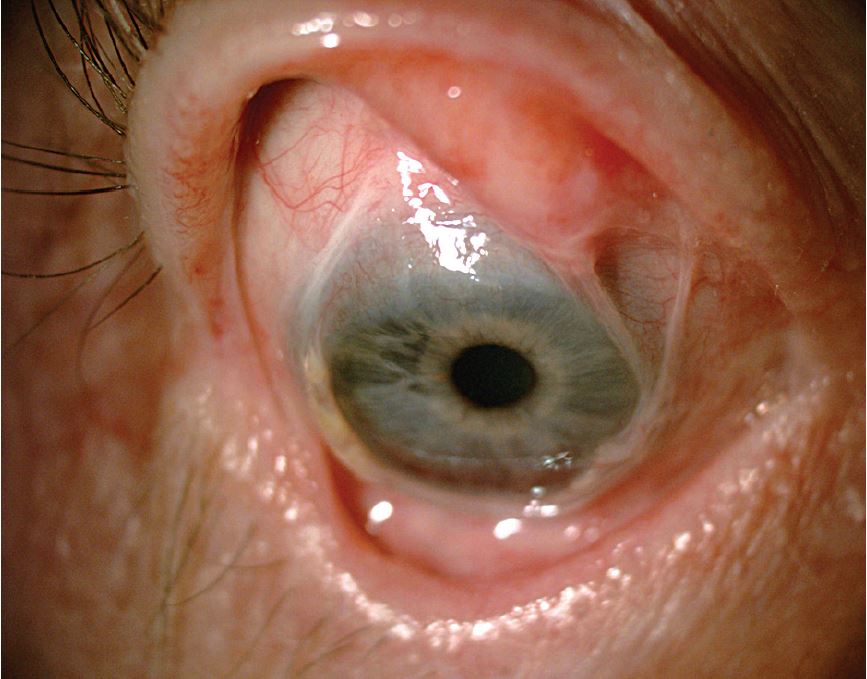
What is the cause of Apollo conjunctivitis?
White, ropy secretion is a characteristic feature of which of the following conditions?
Spring catarrh is classified as which type of hypersensitivity reaction?
Keratoconjunctivitis sicca is most commonly associated with which of the following conditions?
Trachoma causes which of the following complications?
A female presented with irritation of both eyes. She also complained about the collection of a grey-white foamy discharge at the angles of the eyes along with redness in the angles. Examination reveals angular conjunctivitis. What is the causative organism of this condition?
Why does a subconjunctival hemorrhage typically remain bright red in color for an extended period?
Which of the following stains is used to assess tear film integrity?
Trachoma can cause all of the following except?
In the grading of Trachoma, Trachomatous Inflammation-follicular is defined as the presence of?
Explanation: **Explanation:** **Apollo Conjunctivitis**, clinically known as **Acute Hemorrhagic Conjunctivitis (AHC)**, is a highly contagious viral infection. The correct answer is **Enterovirus** (specifically **Enterovirus 70** and **Coxsackievirus A24**). It earned the name "Apollo conjunctivitis" because it was first recognized as a major pandemic in 1969, coinciding with the Apollo 11 moon mission. * **Why Enterovirus is correct:** These viruses cause a rapid-onset infection characterized by painful conjunctival congestion and pathognomonic **subconjunctival hemorrhages** (initially petechial, then spreading). It is typically self-limiting but spreads rapidly in crowded conditions via the fey-oral or hand-to-eye route. **Analysis of Incorrect Options:** * **Chlamydia:** Causes Trachoma or Inclusion Conjunctivitis. These are chronic or subacute infections characterized by follicles and, in the case of Trachoma, Arlt’s lines and Herbert’s pits, rather than acute hemorrhage. * **Allergy:** Allergic conjunctivitis presents with intense itching, ropy discharge, and papillae (e.g., Vernal Keratoconjunctivitis). It is not associated with the explosive outbreaks or hemorrhages seen in AHC. * **Contact Lens:** Prolonged use is associated with Giant Papillary Conjunctivitis (GPC) or microbial keratitis (often *Acanthamoeba* or *Pseudomonas*), not viral hemorrhagic epidemics. **High-Yield Clinical Pearls for NEET-PG:** * **Incubation Period:** Very short (12–48 hours). * **Key Sign:** Subconjunctival hemorrhage (starts superiorly). * **Neurological Complication:** Rarely, Enterovirus 70 is associated with a polio-like **radiculomyelitis** (cranial nerve palsies or flaccid paralysis). * **Management:** Primarily supportive; strict hand hygiene is essential to prevent outbreaks.
Explanation: **Explanation:** **Vernal Keratoconjunctivitis (VKC)**, also known as "Spring Catarrh," is a bilateral, recurrent, external ocular inflammation primarily affecting young boys in warm climates. It is a **Type I hypersensitivity** reaction to exogenous allergens (like pollen). The hallmark clinical feature of VKC is the presence of **white, ropy (stringy) discharge**. This occurs due to the excessive production of mucus by hypertrophied goblet cells, which mixes with inflammatory cells (especially eosinophils) and tears, creating a characteristic tenacious secretion. **Analysis of Incorrect Options:** * **Phlyctenular Conjunctivitis:** This is a **Type IV hypersensitivity** reaction to endogenous bacterial proteins (most commonly Tubercular protein). It is characterized by small, greyish-yellow nodules (phlyctens) near the limbus, but it does not produce ropy discharge. * **Trachoma:** Caused by *Chlamydia trachomatis* (Serotypes A, B, Ba, C). It is characterized by follicles, Arlt’s line, and Herbert’s pits. The discharge is typically **mucopurulent**, not ropy. * **Tubercular Conjunctivitis:** A rare form of primary tuberculosis of the conjunctiva, usually presenting as a chronic granulomatous ulcer or nodule, often associated with regional lymphadenopathy (Parinaud’s Oculoglandular Syndrome). **High-Yield Clinical Pearls for VKC:** * **Cobblestone/Pavement stone papillae:** Large, flat-topped papillae seen on the superior palpebral conjunctiva. * **Horner-Trantas Dots:** White, chalky dots at the limbus consisting of eosinophils and epithelial debris. * **Shield Ulcer:** A sterile, indolent, oval corneal ulcer seen in the upper part of the cornea. * **Maxwell-Lyons Sign:** A thin, filmy membrane (pseudomembrane) covering the papillae, often seen in the morning.
Explanation: **Explanation:** **Spring Catarrh**, also known as **Vernal Keratoconjunctivitis (VKC)**, is a chronic, bilateral, seasonal inflammation of the conjunctiva. It is primarily classified as a **Type I hypersensitivity reaction** (IgE-mediated). When a predisposed individual (usually a young male with an atopic background) is exposed to exogenous allergens like pollen or dust, it triggers mast cell degranulation, releasing histamine and other inflammatory mediators. *Note: While modern research suggests a "th2-cell mediated" component (Type IV), for the purpose of NEET-PG and standard textbooks, Type I remains the primary classification.* **Why the other options are incorrect:** * **Type II (Cytotoxic):** Involves antibodies (IgG/IgM) directed against antigens on specific cell surfaces (e.g., Cicatricial Pemphigoid). VKC does not involve direct cell lysis by antibodies. * **Type III (Immune-complex):** Caused by the deposition of antigen-antibody complexes in tissues (e.g., Stevens-Johnson Syndrome). This mechanism is not seen in VKC. * **Type IV (Delayed-type):** Mediated by T-cells rather than antibodies (e.g., Phlyctenular keratoconjunctivitis). While VKC has a minor Type IV component, it is not the classic textbook classification. **High-Yield Clinical Pearls for NEET-PG:** * **Demographics:** Most common in young boys (4–20 years); "Spring" is a misnomer as it peaks in summer. * **Hallmark Sign:** **Cobblestone papillae** (large, flat-topped) on the superior palpebral conjunctiva. * **Trantas Dots:** White limbal dots consisting of eosinophils and epithelial debris. * **Shield Ulcer:** A sterile, transverse corneal ulcer seen in severe cases. * **Cytology:** Conjunctival scraping typically shows an abundance of **eosinophils**.
Explanation: **Explanation:** **Keratoconjunctivitis Sicca (KCS)**, commonly known as dry eye syndrome, is primarily caused by a deficiency in the aqueous layer of the tear film. **Why Sjogren’s Syndrome is the Correct Answer:** Sjogren’s syndrome is an autoimmune disorder characterized by lymphocytic infiltration and destruction of the exocrine glands, specifically the **lacrimal and salivary glands**. This leads to the classic triad of xerophthalmia (KCS), xerostomia (dry mouth), and often a connective tissue disorder. While KCS can occur in various systemic diseases, it is the **pathognomonic hallmark** of Sjogren’s syndrome, making it the most common and direct association. **Analysis of Incorrect Options:** * **Rheumatoid Arthritis (RA):** While RA is the most common systemic *connective tissue disease* associated with Secondary Sjogren’s, KCS itself is more fundamentally linked to the diagnosis of Sjogren’s syndrome. * **Systemic Lupus Erythematosus (SLE) & Dermatomyositis:** These are systemic autoimmune diseases that can occasionally cause secondary dry eye, but the prevalence and direct causal link are significantly lower than in Sjogren’s syndrome. **High-Yield Clinical Pearls for NEET-PG:** * **Schirmer’s Test:** Used to quantify tear production. <5 mm in 5 minutes is diagnostic for KCS. * **Rose Bengal/Lissamine Green Staining:** Highlights devitalized conjunctival and corneal epithelial cells. * **Tear Film Break-up Time (BUT):** An indicator of mucin deficiency; a value <10 seconds is abnormal. * **Filamentary Keratitis:** A common complication of severe KCS where epithelial debris and mucin form strands on the cornea.
Explanation: **Explanation:** Trachoma, caused by *Chlamydia trachomatis* (serotypes A, B, Ba, and C), is a chronic keratoconjunctivitis characterized by a cycle of inflammation and scarring. The complications listed are classic sequelae of the cicatricial (scarring) stage of the disease. 1. **Mechanical Ptosis:** In the chronic stage, inflammatory infiltration and hypertrophy of the conjunctiva and tarsal plate increase the weight of the upper eyelid. This "heaviness" leads to drooping of the lid, known as mechanical ptosis. 2. **Trichiasis:** Chronic inflammation leads to misdirection of eyelashes so that they rub against the eyeball. This is often exacerbated by the scarring of the lid margin. 3. **Entropion:** This is a hallmark complication of Trachoma. Cicatricial contraction of the palpebral conjunctiva and the underlying tarsal plate causes the eyelid margin to roll inward (Cicatricial Entropion). **Why "All of the above" is correct:** The pathogenesis of Trachoma follows a progression from follicles and papillae to **Arlt’s line** (horizontal scarring in the sulcus subtarsalis). This scarring pulls the lid margin inward (Entropion), misdirects the lashes (Trichiasis), and the associated tarsal thickening causes the lid to droop (Ptosis). **High-Yield Clinical Pearls for NEET-PG:** * **WHO Grading (FISTO):** **F**ollicles, **I**ntense inflammation, **S**carring, **T**richiasis, **O**pacity. * **Herbert’s Pits:** Pathognomonic clinical sign representing healed follicles at the limbus. * **Arlt’s Line:** Horizontal scar on the upper tarsal conjunctiva. * **SAFE Strategy:** **S**urgery (for trichiasis), **A**ntibiotics (Azithromycin), **F**acial cleanliness, **E**nvironmental improvement. * **Drug of Choice:** Single dose of oral Azithromycin (20 mg/kg).
Explanation: ### Explanation **Correct Answer: A. Moraxella Axenfeld bacillus** The clinical presentation of **Angular Conjunctivitis** is classically characterized by redness (hyperemia) localized to the inner and outer canthi (angles) of the eye, accompanied by a characteristic **grey-white foamy/frothy discharge**. The underlying pathophysiology involves the production of a **proteolytic enzyme** by *Moraxella lacunata* (Axenfeld bacillus). This enzyme acts by macerating the epithelium of the conjunctiva and the surrounding skin at the angles. The foamy nature of the discharge is due to the breakdown of proteins in the tears into amino acids. **Analysis of Incorrect Options:** * **B. Pneumococci:** Typically causes acute mucopurulent conjunctivitis, often associated with petechial subconjunctival hemorrhages and a membranous presentation in severe cases, rather than angular involvement. * **C. Gonococci:** Causes hyperacute purulent conjunctivitis (Ophthalmia Neonatorum in newborns) characterized by profuse, thick, creamy pus and a high risk of corneal perforation. * **D. Adenovirus:** The most common cause of viral conjunctivitis (Pink eye). It typically presents with watery discharge, follicular reaction, and preauricular lymphadenopathy (e.g., Pharyngoconjunctival fever or Epidemic Keratoconjunctivitis). **High-Yield Clinical Pearls for NEET-PG:** * **Drug of Choice:** Topical **Oxytetracycline** or Zinc oxide. Zinc acts by inhibiting the proteolytic enzyme produced by the bacteria. * **Reservoir:** The primary reservoir for *Moraxella* is often the **nasal mucosa**; hence, concurrent nasal infection may be present. * **Differential Diagnosis:** Angular conjunctivitis can also be caused by **Staphylococcus aureus**, but the foamy discharge is pathognomonic for Moraxella. * **Deficiency Link:** Chronic angular blepharoconjunctivitis can sometimes be associated with **Pyridoxine (Vitamin B6)** or Riboflavin deficiency.
Explanation: **Explanation:** **1. Why the correct answer is right:** Subconjunctival hemorrhage (SCH) occurs when a small blood vessel under the conjunctiva ruptures, causing blood to pool in the potential space between the conjunctiva and the sclera. Unlike a bruise on the skin, which turns blue, green, or yellow as hemoglobin breaks down into biliverdin and bilirubin, a subconjunctival hemorrhage remains **bright red** for several days. This is because the **conjunctiva is a thin, semi-permeable membrane** that allows atmospheric oxygen to diffuse through it. This oxygen continuously re-oxygenates the trapped hemoglobin, maintaining its bright red (oxyhemoglobin) state until the blood is eventually reabsorbed. **2. Why the incorrect options are wrong:** * **Option B:** The "natural color" of deoxygenated blood in a closed space is dark red or purple. Without the constant supply of oxygen through the membrane, the blood would darken and change color as it degrades. * **Option C:** While it is true that the blood is trapped (pooled), the lack of drainage explains why the hemorrhage takes time to disappear (1–2 weeks), but it does not explain the specific maintenance of the bright red color. **3. Clinical Pearls for NEET-PG:** * **Etiology:** Most cases are idiopathic or caused by a sudden rise in venous pressure (e.g., coughing, sneezing, straining/Valsalva maneuver). * **Management:** It is a self-limiting condition. Reassurance is the treatment of choice. * **Red Flag:** If SCH is bilateral or recurrent, investigate for systemic hypertension or bleeding diathesis (coagulopathy). * **Trauma:** In cases of head injury, if the posterior limit of the hemorrhage is not visible, it may indicate a **base of skull fracture** (the blood tracks forward from the orbit).
Explanation: **Explanation:** **Rose Bengal** is a vital stain that has a high affinity for **dead and degenerated epithelial cells** and areas where the protective mucin layer of the tear film is deficient. In clinical practice, it is used to assess tear film integrity and ocular surface health, particularly in diagnosing **Keratoconjunctivitis Sicca (Dry Eye Syndrome)**. It stains the conjunctival and corneal lesions a characteristic vivid pink/red, helping to identify "dry spots" or epithelial erosions. **Analysis of Incorrect Options:** * **Congo Red:** This is a histological stain used specifically to identify **Amyloid deposits**. Under polarized microscopy, it shows a characteristic "apple-green birefringence." It has no role in assessing the tear film. * **Alcian Blue:** This stain is used to highlight **acid mucopolysaccharides** (mucins). While mucin is a component of the tear film, Alcian Blue is typically used in histopathology to identify goblet cells or connective tissue disorders, rather than as a clinical tool for bedside tear film assessment. **High-Yield Clinical Pearls for NEET-PG:** 1. **Fluorescein Stain:** The gold standard for detecting **corneal epithelial defects** (ulcers). It stains the exposed stroma brilliant green. It is also used for the **Tear Film Break-up Time (TBUT)** test (Normal >10 seconds). 2. **Lissamine Green:** Similar to Rose Bengal but preferred by patients because it causes **less stinging/irritation**. It also stains dead/degenerated cells. 3. **Schirmer’s Test:** Used to quantify aqueous tear production. **Schirmer I** (without anesthesia) measures total secretion; **Schirmer II** measures reflex secretion. 4. **Bengal Rose vs. Lissamine:** Remember that Rose Bengal is slightly toxic to healthy cells, whereas Lissamine Green is better tolerated.
Explanation: **Explanation:** Trachoma, caused by *Chlamydia trachomatis* (serotypes A, B, Ba, and C), is a chronic keratoconjunctivitis characterized by a cycle of infection and scarring. **Why Enophthalmos is the correct answer:** Enophthalmos refers to the backward displacement of the eyeball into the orbit. Trachoma primarily affects the **conjunctiva and cornea** (surface tissues). It does not involve the orbital fat, extraocular muscles, or the bony orbit, which are the structures typically implicated in enophthalmos. Therefore, enophthalmos is not a complication of Trachoma. **Analysis of incorrect options:** * **Loss of vision:** Trachoma is the leading infectious cause of preventable blindness worldwide. Vision loss occurs due to secondary corneal complications. * **Clouding of the cornea:** Chronic inflammation and mechanical trauma from inturned lashes lead to **corneal opacification** (clouding) and vascularization (pannus). * **Trichiasis:** This is a hallmark of the cicatricial (scarring) stage. Conjunctival scarring causes the eyelid margin to roll inward (Entropion), leading to misdirected eyelashes (Trichiasis) that rub against the cornea. **NEET-PG High-Yield Pearls:** * **WHO Grading (FISTO):** **F**ollicular, **I**ntense inflammation, **S**carring, **T**richiasis, **O**pacity. * **Arlt’s Line:** Horizontal scar in the upper palpebral conjunctiva (junction of anterior 1/3 and posterior 2/3). * **Herbert’s Pits:** Healed follicles at the limbus (pathognomonic). * **SAFE Strategy:** **S**urgery (for trichiasis), **A**ntibiotics (Azithromycin), **F**acial cleanliness, **E**nvironmental improvement.
Explanation: ### Explanation The correct answer is **A. Five or more follicles in the upper tarsal conjunctiva.** This definition is based on the **WHO simplified grading system (FISTO)** for Trachoma, introduced to facilitate easy diagnosis by field workers. **1. Why Option A is Correct:** According to the WHO criteria, **Trachomatous Inflammation—Follicular (TF)** is defined as the presence of **five or more follicles** in the **central part of the upper tarsal conjunctiva**, each being at least **0.5 mm** in diameter. The upper tarsal conjunctiva is the primary site for clinical assessment in Trachoma because the mechanical rubbing of the eyelid and the concentration of lymphoid tissue there make it the most sensitive area for detecting active infection by *Chlamydia trachomatis* (Serotypes A, B, Ba, and C). **2. Why Other Options are Incorrect:** * **Options B & C:** The lower tarsal conjunctiva is not used for grading Trachoma. Follicles in the lower lid are non-specific and can occur in various other types of viral or allergic conjunctivitis. * **Option D:** Three follicles are insufficient for a diagnosis of TF. The threshold of "five" was specifically chosen to increase the specificity of the diagnosis and avoid over-reporting minor irritations. **3. NEET-PG High-Yield Clinical Pearls:** * **WHO FISTO Grading:** * **TF:** 5+ follicles on the upper tarsus. * **TI (Intense):** Pronounced inflammatory thickening obscuring >50% of deep tarsal vessels. * **TS (Scarring):** Presence of white fibrous bands (Arlt's line). * **TT (Trichiasis):** At least one lash rubbing on the eyeball. * **CO (Corneal Opacity):** Visible opacity over the pupil. * **SAFE Strategy:** **S**urgery (for TT), **A**ntibiotics (Azithromycin), **F**acial cleanliness, **E**nvironmental improvement. * **Herbert’s Pits:** Pathognomonic scarred remnants of follicles at the limbus.
Conjunctivitis: Bacterial
Practice Questions
Conjunctivitis: Viral
Practice Questions
Conjunctivitis: Allergic
Practice Questions
Conjunctivitis: Chronic
Practice Questions
Degenerations of Conjunctiva
Practice Questions
Benign Tumors of Conjunctiva
Practice Questions
Malignant Tumors of Conjunctiva
Practice Questions
Conjunctival Manifestations of Systemic Diseases
Practice Questions
Cicatricial Conjunctival Disorders
Practice Questions
Pterygium and Pinguecula
Practice Questions
Conjunctival Trauma
Practice Questions
Subconjunctival Hemorrhage
Practice Questions
Get full access to all questions, explanations, and performance tracking.
Start For Free