Which of the following is not a feature of keratoconus?
Keratometry is useful in measuring:
Acute corneal hydrops is seen in:
Which is an emergency therapeutic indication of keratoplasty?
Assertion: Myopia is a risk factor for retinal detachment. Reason: In myopia, the axial length of the eye increases, causing the retina to thin and become more prone to detachment.
Which of the following is a true statement regarding the human eye?
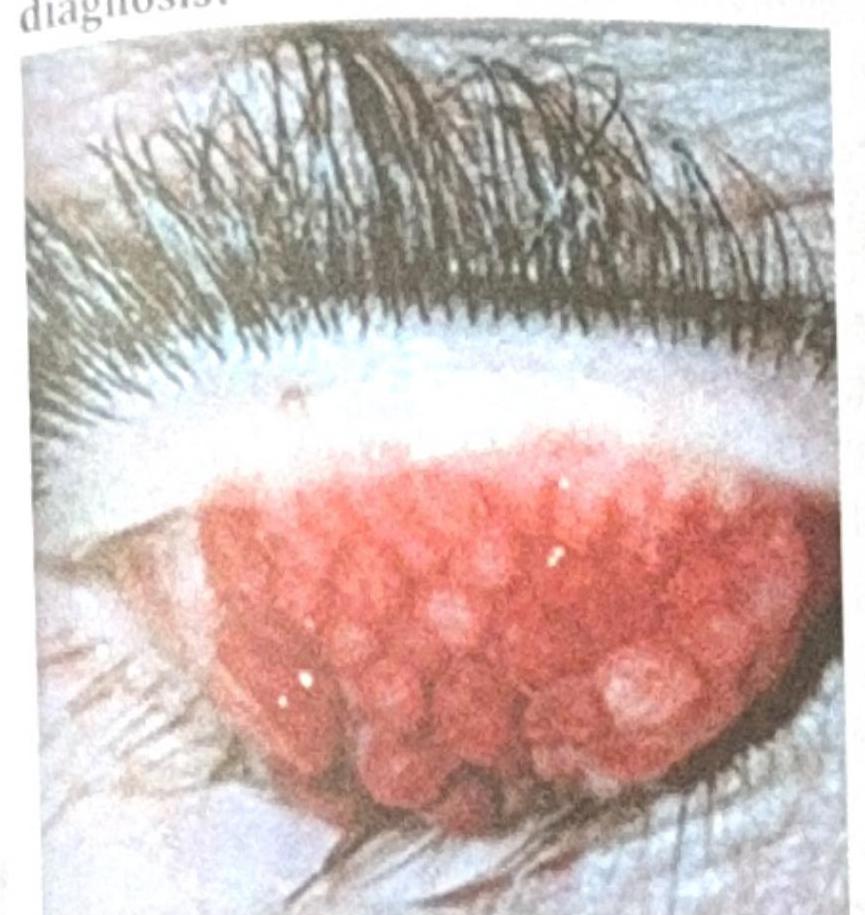
A patient with contact lens use for the past 2 years presents with the ocular findings shown in the image below. What is the most probable diagnosis?
What is the minimum contact period required for effective chlorination of drinking water?
A 23-year-old woman is diagnosed with chlamydia. Her partner refuses testing. What contact tracing approach is most appropriate?
Shortening of 2 mm of axial length of the eyeball causes?
Explanation: ***Haab's striae*** - **Haab's striae** are characteristic of congenital glaucoma, presenting as horizontal breaks in Descemet's membrane due to increased intraocular pressure and corneal stretching. - In contrast, keratoconus involves **vertical breaks in Descemet's membrane** (due to corneal thinning and protrusion), known as Vautin's striae or Vogt's striae, not Haab's striae. *Irregular astigmatism* - **Irregular astigmatism** is a hallmark of keratoconus, resulting from the asymmetric and non-uniform thinning and protrusion of the cornea. - This irregular corneal shape leads to a significant reduction in visual acuity that cannot be fully corrected with spherical or regular cylindrical lenses. *Scissoring reflex* - The **scissoring reflex** (or scissoring phenomena) is an objective finding observed during retinoscopy in patients with keratoconus, indicating significant irregular astigmatism. - It refers to the opposing movements of the retinoscopic reflex, resembling the opening and closing of scissors, as the light across the pupil is neutralized. *Munson's sign* - **Munson's sign** is a classic clinical finding in advanced keratoconus, where the lower eyelid protrudes in a V-shape when the patient looks downwards. - This protrusion is caused by the conical shape of the cornea pushing against the eyelid.
Explanation: ***Corneal curvature*** - **Keratometry** directly measures the curvature of the central anterior corneal surface, which is crucial for assessing **astigmatism** and fitting **contact lenses**. - The device projects an illuminated object onto the cornea and measures the size of the reflected image to calculate the radius of curvature. *Corneal thickness* - **Corneal thickness** is measured by **pachymetry**, not keratometry. - This measurement is important for diagnosing conditions like **corneal edema** and for glaucoma management (e.g., central corneal thickness influencing intraocular pressure readings). *Corneal diameter* - **Corneal diameter** is typically measured with a ruler or **calipers**, or imaging techniques like **optical coherence tomography (OCT)**, not a keratometer. - This measurement, often referred to as **horizontal visible iris diameter (HVID)**, is mainly relevant for contact lens fitting and refractive surgery planning. *Depth of anterior chamber* - The **depth of the anterior chamber** is measured by various methods such as **slit-lamp biomicroscopy** with an optical pachymeter, **ultrasound biomicroscopy (UBM)**, or **anterior segment OCT**. - This measurement is critical for assessing risk of **angle-closure glaucoma** and for intraocular lens calculations.
Explanation: ***Keratoconus*** - **Acute corneal hydrops** is a classic complication of advanced **keratoconus**, occurring when a break in **Descemet's membrane** allows aqueous humor to enter the corneal stroma. - This leads to sudden onset of **corneal edema**, pain, and significant vision loss, often presenting with a milky white cornea due to stromal clouding. *Corneal dystrophy* - **Corneal dystrophies** are a group of genetic disorders that affect the clarity and structure of the cornea, typically causing progressive vision loss or recurrent epithelial erosions. - While some dystrophies can lead to corneal edema, **acute hydrops** specifically due to a Descemet's membrane rupture is not a characteristic feature. *Anterior staphyloma* - An **anterior staphyloma** is a bulging scar of the cornea and sclera, usually resulting from severe thinning or perforation, often associated with elevated intraocular pressure. - It is a structural deformation involving the entire globe's anterior segment, distinct from the sudden stromal edema of **corneal hydrops** caused by Descemet's rupture. *Interstitial keratitis* - **Interstitial keratitis** is characterized by non-ulcerative inflammation of the corneal stroma without primary involvement of the epithelium or endothelium, often associated with systemic infections like syphilis or Lyme disease. - It typically results in stromal opacification and vascularization ("salmon patch") but does not involve the acute rupture of Descemet's membrane seen in **hydrops**.
Explanation: ***Perforated corneal ulcer*** - A **perforated corneal ulcer** is an ocular emergency requiring urgent intervention to restore the integrity of the globe and prevent severe vision loss or endophthalmitis. Keratoplasty, in this context, acts as a tectonic graft to seal the perforation. - The emergent nature stems from the high risk of **intraocular infection** and **collapse of the anterior chamber**, which can lead to permanent damage and vision impairment. *Keratoconus* - While severe **keratoconus** can eventually lead to keratoplasty, it is typically an elective procedure performed to improve vision after other treatments like contact lenses are no longer effective. - It is a **slowly progressive condition** that does not usually pose an immediate threat to ocular integrity unless acute hydrops occurs, which itself may require different acute management. *Myopia* - **Myopia**, or nearsightedness, is a refractive error typically corrected with glasses, contact lenses, or elective refractive surgery (e.g., LASIK). - It is not a condition that warrants a **therapeutic or emergency keratoplasty**, as it does not involve structural compromise or disease of the cornea that would necessitate transplantation. *Hypermetropia* - **Hypermetropia**, or farsightedness, is also a refractive error, managed with corrective lenses or elective refractive surgery. - Similar to myopia, it does not involve a corneal disease process that would necessitate a **keratoplasty**, especially not on an emergency basis.
Explanation: **Assertion Analysis:** The assertion is **true** – **myopia is a well-established risk factor for retinal detachment**. This association is particularly strong in **high myopia** (>6 diopters), where the risk increases significantly compared to emmetropic eyes. **Reason Analysis:** The reason is **true and provides the correct explanation** for the assertion. In myopia, especially high myopia, the **axial length of the eye increases** due to excessive elongation of the globe. This stretching leads to: - **Thinning of the retina and choroid** – The ocular tissues are stretched over a larger surface area - **Peripheral retinal degeneration** – Including lattice degeneration and retinal holes - **Increased vitreous liquefaction** – Leading to posterior vitreous detachment - **Greater mechanical stress** on the retina These structural changes make the retina more **fragile and susceptible to breaks**, which can progress to **rhegmatogenous retinal detachment**. **Conclusion:** ***Both Assertion and Reason are true, and Reason is the correct explanation for Assertion.*** The increased axial length and subsequent retinal thinning directly explain why myopia increases retinal detachment risk.
Explanation: ***Normal eye medium will permit wavelength of 400- 700 nm*** - The **normal human eye** can perceive light in the **visible spectrum**, which ranges approximately from **400 nm (violet)** to **700 nm (red)**. - This range of wavelengths is efficiently transmitted through the ocular media (cornea, aqueous humor, lens, vitreous humor) to reach the retina. *Lens will not reflect light* - The human **lens** does **reflect some light**, contributing to phenomena like **glare** and internal reflections, especially if there are opacities like cataracts. - While its primary function is to transmit and refract light, it is not perfectly non-reflective. *Even after cataract surgery UV rays are not penetrated* - Modern **intraocular lenses (IOLs)** implanted during **cataract surgery** are designed to **block UV light (UVA and UVB)** to protect the retina. - However, the natural lens also blocks UV light, and before the development of UV-blocking IOLs, patients sometimes experienced increased retinal exposure to UV post-surgery. *Cornea cut off wavelength upto 400 nm* - The **cornea** primarily absorbs and blocks **UVB (280-315 nm)** and **UVC (100-280 nm)** radiation, protecting the anterior segment structures and retina from harmful short-wavelength light. - It does **not cut off wavelengths up to 400 nm**; it primarily transmits wavelengths longer than approximately 300-310 nm into the eye.
Explanation: ***Giant Papillary conjunctivitis*** - The image shows **large, elevated papillae** on the **tarsal conjunctiva**, which are characteristic findings of giant papillary conjunctivitis. - This condition is common among **contact lens wearers**, caused by chronic mechanical irritation and an allergic response to lens material or deposits. *Trachoma* - Trachoma is a **chronic infectious disease** caused by *Chlamydia trachomatis*, leading to scarring of the conjunctiva. - It typically presents with **follicles** in the early stages, followed by **scarring** and **pannus formation**, not the large papillae seen here. *Ocular Surface Squamous Neoplasia (OSSN)* - OSSN refers to a spectrum of conditions from **dysplasia to squamous cell carcinoma** affecting the conjunctiva or cornea. - It usually presents as a **gelatinous, fleshy, or leukoplakic lesion**, often at the limbus, which is distinct from the diffuse papillae shown. *Vernal Keratoconjunctivitis* - Vernal keratoconjunctivitis (VKC) is a **severe form of allergic conjunctivitis** but primarily affects children and young adults with a history of atopy. - While it can cause large papillae (cobblestone papillae), it is not specifically associated with contact lens wear and usually has other systemic allergic manifestations.
Explanation: ***30 minutes*** - A minimum **contact period of 30 minutes** is generally recommended for effective chlorination to sufficiently inactivate most pathogenic microorganisms in drinking water. - This duration allows for adequate time for the **chlorine residual** to penetrate and destroy bacterial and viral structures. *1 hour* - While a longer contact time like 1 hour would be effective, it is not the **minimum required** for practical purposes and might lead to increased operational costs or complexity without significant additional benefit in typical scenarios. - Exceeding the minimum contact time can sometimes lead to the formation of **disinfection byproducts**, although this is more dependent on chlorine concentration and water composition. *2 hrs* - A contact time of 2 hours significantly exceeds the **minimum effective period** for most disinfection needs. - Such extended contact times are usually only considered in specific situations with highly resistant pathogens or particular water quality challenges, or when using **lower chlorine doses**. *4 hrs* - A 4-hour contact period is far beyond the **standard minimum** for effective chlorination of drinking water. - Such long contact times are typically impractical for municipal water treatment and could potentially increase the risk of forming **undesirable disinfection byproducts** if not carefully managed.
Explanation: ***Expedited partner therapy (EPT)*** - This approach allows clinicians to provide medication or a prescription for a partner without a prior medical examination, facilitating treatment when a partner is unwilling or unable to seek care. - It is particularly useful for **chlamydia** and **gonorrhea** to reduce reinfection rates and further transmission. - **Recommended by CDC and WHO** for STI partner management when partners are unlikely to present for care. - *Note: EPT implementation varies by country; in India, partner notification with clinical evaluation is standard practice, but EPT represents the most direct approach when partners refuse testing.* *Patient referral only* - Relying solely on the patient to inform and encourage their partner to seek testing and treatment can be effective but carries a risk of the partner not following through, leading to continued transmission. - This method might be less successful if the partner is uncooperative or unwilling to get tested, as is implied in this scenario. - **Most commonly used approach** in resource-limited settings but has lower success rates. *Contract referral* - Involves the patient agreeing to notify their partner, with the understanding that if the partner does not present for treatment within a specified timeframe, health officials will then intervene. - While it offers a backup, it still relies on initial patient action and may not be immediate enough when a partner is actively refusing testing. - Provides a **safety net** but involves delays in partner treatment. *Provider referral only* - This method involves a healthcare provider directly contacting the partner to inform them of exposure and recommend testing and treatment, respecting patient confidentiality. - This option is generally preferred when there are concerns about the patient's safety or if the patient is unable or unwilling to notify their partner. - More resource-intensive and requires **trained health workers** for partner notification, but ensures partners are reached even if the index patient cannot or will not inform them.
Explanation: ***6D hypermetropia*** - A 1 mm shortening of the **axial length** of the eyeball typically results in approximately **3 diopters** of hypermetropia. - Therefore, a 2 mm shortening would cause **6 diopters** (2 mm x 3 D/mm) of hypermetropia. *3D myopia* - Myopia (nearsightedness) is caused by an **eyeball that is too long** or a cornea that is too steeply curved, not by a shortened axial length. - A 2 mm shortening would cause **hypermetropia** (farsightedness), not myopia. *2D myopia* - This option incorrectly identifies both the **type of refractive error** (myopia instead of hypermetropia) and the magnitude of the change. - Shortening of the axial length makes the eye effectively **farsighted**, not nearsighted. *1D hypermetropia* - While reflecting the correct type of refractive error (hypermetropia), the **magnitude is incorrect**. - A 1 mm change in axial length results in about 3 diopters, so 2 mm would be **6 diopters**, not 1 diopter.
Get full access to all questions, explanations, and performance tracking.
Start For Free